Shared posts

10 Aug 18:23

Gardens, not buildings

by Seth Godin

Great projects start out feeling like buildings. There are architects, materials, staff, rigid timelines, permits, engineers, a structure.

It works or it doesn't.

Build something that doesn't fall down. On time.

But in fact, great projects, like great careers and relationships that last, are gardens. They are tended, they shift, they grow. They endure over time, gaining a personality and reflecting their environment. When something dies or fades away, we prune, replant and grow again.

Perfection and polish aren't nearly as important as good light, good drainage and a passionate gardener.

By all means, build. But don't finish. Don't walk away.

Here we grow.

       
31 Jul 17:26

Revealing Portraits of Abandoned Albinos in Tanzania

by Pinar


Tribe of Ghosts is an insightful and revealing project by photojournalist Jacquelyn Martin that presents portraits of mistreated and often abandoned albinos in Africa while simultaneously sharing their personal stories and revealing their unappreciated beauty. Spending three-and-a-half weeks in Tanzania, a nation known for having one of the highest counts of the genetic mutation, Martin focused her lens on people with albinism living at the Kabanga Protectorate Center—a protective retreat that some see as a boarding school of sorts.

Filled with many children, the center paints a picture of an unfortunate tale that many of them share. Due to the social discrimination and cultural legends about people with albinism, many of these people are forsaken and even attacked. Browsing through the series and reading Martin's discoveries from each personal account reveals the horrors that these people, young and old, have endured in a society that rejects their genetic makeup and even hunts them down because of it. (Witch doctors seem to believe that their body parts can be used for magic potions.)

Some of the residents of Kabanga center were left there by their parents while others were sent by the government for their own protection. In some heart-wrenching stories, these people have even been attacked by groups led by their own relatives. While the situation remains dire, there is some hope with the younger generations who have shown interest in becoming teachers, lawyers, and politicians in an effort to aid and protect other people with albinism.

After revealing that he's been called "zero zero" which translates as a hurtful insult meaning that he is nothing, 18-year-old Bethod Alfred says, "Maybe one day I can be a member of Parliament so that I can defend people living with albinism." Through her series, Martin shares the light that shines from within each of her subjects, despite their societal alienation. She says, "In society, they are reviled, so they really responded to being treated with dignity and being photographed in a respectful, humanitarian manner." She adds, "Because they are not treated like humans, because they are not treated with respect, I hope they have a little something that helps them reflect on the beauty in themselves — to help them going forward."


Jacquelyn Martin website
via [Razorshapes, NPR]

31 Jul 17:09

Fuck the police

31 Jul 16:22

Controversial study finds that big and famous hospitals aren’t always the best for surgery

by Reuters

By Sharon Begley

NEW YORK (Reuters) – Patients going to a hospital for surgery care about many things, from how kind the nurses are to how good the food is, but Consumers Union (CU) figures what they care about most is whether they stay in the hospital longer than they should and whether they come out alive.

In the first effort of its kind, the nonprofit publisher of Consumer Reports magazine released ratings of 2,463 U.S. hospitals in all 50 states on Wednesday, based on the quality of surgical care. The group used two measures: the percentage of Medicare patients who died in the hospital during or after their surgery, and the percentage who stayed in the hospital longer than expected based on standards of care for their condition. Both are indicators of complications and overall quality of care, said Dr John Santa, medical director of Consumer Reports Health.

The ratings will surely ignite debate, especially since many nationally renowned hospitals earned only mediocre ratings. The Cleveland Clinic, some Mayo Clinic hospitals in Minnesota, and Johns Hopkins Hospital in Baltimore, for instance, rated no better than midway between “better” and “worse” on the CU scale, worse than many small hospitals. Because CU had only limited access to data, the ratings also underline the difficulty patients have finding objective information on the quality of care at a given facility.

Nevertheless, “this is a step in the right direction,” said Paul Levy, former president of Beth Israel Deaconess Medical Center in Boston, who was not involved in the project. “To whatever extent you can empower patients to get better care and become partners in pushing the healthcare system to make improvements is to the good.”

CU’s ratings are based on Medicare claims and clinical records data from 2009 to 2011 for 86 kinds of surgery, including back operations, knee and hip replacements, and angioplasty. The rates are adjusted to account for the fact that some hospitals treat older or sicker patients, and exclude data on patients who were transferred from other hospitals. These are often difficult cases that, CU felt, should not be counted against the receiving hospital.

Although the ratings do not explicitly incorporate complications such as infections, heart attacks, strokes, or other problems after surgery, the length-of-stay data captures those problems, said Santa.

Some of the findings are counterintuitive. Many teaching hospitals, widely regarded as pinnacles of excellence and usually found at the top of rankings like those of U.S. News & World Report, fell in the middle of the pack.

“This isn’t the first time we’ve seen this sort of surprise,” said Dr Marty Makary, a surgeon at Johns Hopkins Hospital and author of the 2012 book, “Unaccountable: What Hospitals Won’t Tell You and How Transparency Can Revolutionize Health Care.” “For a complex procedure you’re probably better off at a well-known academic hospital, but for many common operations less-known, smaller hospitals have mastered the procedures and may do even better” with post-surgical care.

NOT ‘A TRUE PICTURE’

The Cleveland Clinic’s chief quality officer, Dr Michael Henderson, said CU’s methodology, which gave his hospital a middle-of-the-scale rating below that of such Ohio hospitals as the Fulton County Health Center in Wauseon and the Institute for Orthopaedic Surgery in Lima, “doesn’t give you a true picture” of the quality of surgical care. Much better, he said, is actual outcome data – how well patients undergoing any given procedure fare – which Cleveland is a pioneer in making public via its website.

Experts at other big-name hospitals whose CU ratings fell short of their reputations also questioned the methodology. “The accuracy of claims data,” like that CU used, “is very low or unknown,” said Dr Peter Provonost of Hopkins.

CU also found that several urban hospitals did well despite serving many poorer, sicker patients, including Mount Sinai Hospital in New York and University Hospitals Case Medical Center in Cleveland. Rural hospitals did better, on average, than other hospitals, and many hospitals practically unknown beyond their zip code outranked famous ones, including Kenmore Mercy near Buffalo, New York; Arrowhead in Glendale, Arizona; Sacramento Medical Center in California; and Arkansas Heart in Little Rock.

Hospital choice matters more for some procedures than others. Length of stay for hip and knee replacements and back surgery varied widely, for instance, while hospitals’ scores for colon surgery and hysterectomy were more similar to one another.

Like other experts pushing for greater “medical transparency” – that is, reporting data on how patients fare after treatments – CU’s Santa said available data, including that used by CU, is far from perfect.

The American College of Surgeons collects data on surgical outcomes, such as the rate of infections at the surgical site and urinary tract infections, through its National Surgical Quality Improvement Program. The group will not release the data to the public because it promised confidentiality to hospitals providing the data, said Dr Clifford Ko, a cancer surgeon at UCLA Jonsson Comprehensive Cancer Center who is involved in the project. However, 102 of about 500 participating hospitals voluntarily report some of their data to the federal Center for Medicare and Medicaid Services.

“I think the public would be surprised at all the data they’re not allowed to see,” said Santa. “One of the reasons we did this was to stimulate debate and irritate people” enough to force hospitals and others to be open about the quality of care they provide. Many critics of CU’s methods agree with that goal. Hopkins’ Provonost, for instance, has called for a medical version of the Securities and Exchange Commission to require hospitals to report patient outcomes, just as the SEC requires public companies to report financial data.

Until and unless that happens, the lack of transparency can be expensive, not only in lives but also in dollars. Last week the Leapfrog Group, whose employer-members provide health insurance to workers, released a calculator of “hidden hospital surcharges,” the amount that errors, accidents, infections and injuries cost payers.

On average, said Leapfrog president and chief executive Leah Binder calculates, a patient treated at a hospital with a grade of “C” or lower on an A-to-E scale of safety incurs $7,780 in costs due to medical errors.

The CU report is available at www.ConsumerReports.org/cro/hospitalratings0913.

(Reporting by Sharon Begley; Editing by Prudence Crowther)

31 Jul 15:58

Avocado Paratha

by noreply@blogger.com (Meera)

I had come across this unique flatbread at Indira's Mahanandi during my pre-blogging days. She had come across this recipe at GM's "The Spice is right".  I was really impressed with this fusion cooking. Since then, I have been making my version of Avocado Parathas.

Avocado Paratha - (Count 7 - 9)
Avocado Flatbread
Ingredients

Mash
1 ripe avocado, peeled & pitted
salt to taste
1/2 tsp cumin powder
1/2 tsp turmeric powder
1/2 tsp chile powder
1 clove garlic, peeled & grated
3 tbsp minced cilantro
1 tsp lemon juice

3/4 - 1 cup wheat flour
3 tbsp - 1/4 cup water

Oil  - as needed for roasting
Rice flour or wheat flour - as needed, for dredging

Method
1. Mash avocado so there are no lumps. Mix in salt, cumin powder, turmeric powder, chile powder, grated garlic, cilantro and lemon juice.
2. Add wheat flour and mix together. Do not add water initially. Add water as needed to knead into a smooth dough ball.
3. Make 7 - 9 uniform balls.
4. Roll into thick parathas/flabtbreads dredging into rice or wheat flour as needed.
5. Heat a pan or griddle. Roast each flatbread, adding very little oil for roasting.
6. Cover in a clean, kitchen towel - till ready to serve.

Note -
1. Above proportion gives me about 7 - 9 parathas. This count will vary depending on the diameter of the parathas.

Credits
The Spice is Right
&
Mahanandi


Print Page
31 Jul 15:54

Conservatives Move To Trying To Trick Lower Income People Out Of Health Care

by Amanda Marcotte

Empty….just how the right likes it.

Kevin Drum links a story about a last ditch effort to try to hurt Obamacare: Radio ads trying scare uninsured people from using the exchanges to purchase insurance.

To that end, Brase launched the “Refuse to Enroll” campaign earlier this month on her daily radio show, “Health Freedom Minute,” which is broadcast on more than 350 stations nationwide, including the American Family Radio Network with stations throughout Ohio. [...]

“Contrary to popular belief, non-enrollment in the exchanges does not result in any penalties; fines are only for failure to be insured,” said Brase, whose organization claims the law will limit consumers’ choices, threaten their privacy and increase the cost of health insurance. “We look at the law as being unconstitutional because it’s a government takeover of health care, so we want to make it difficult for the law to function as its proponents want it to.”

There’s two possibilities for the person who is snookered by the “Obamacare will destroy you!” hysteria and doesn’t look for insurance on the exchange:

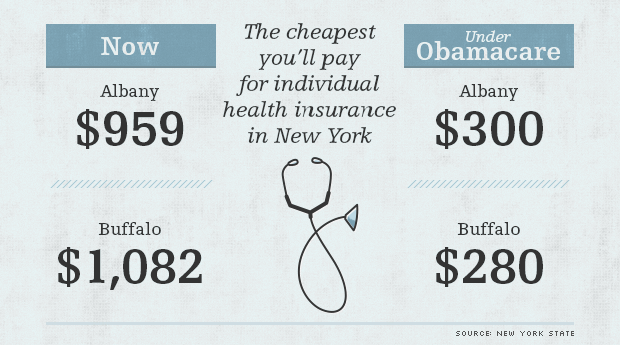
1) They buy insurance directly, instead of taking advantage of the competitive prices created in the exchange. This will be a massive financial penalty for falling for this trick, according to CNN Money.

2) They take one look at the extremely high non-exchange prices and go without, figuring the fine will cost them less. This is clearly what this “Refuse to Enroll” campaign is hoping people will do—keep people as far away from exchanges and the discounts that make insurance affordable, so that people just don’t get insured.

Drum is understandably offended on a moral level, because shit is evil.

Conservatives are just hellbent on trying to keep poor people from getting decent health coverage. The right-wing intelligentsia can claim otherwise, but the plain truth is that no one in the actual governing wing of the Republican Party wants to replace Obamacare with anything else. They just want to repeal it, full stop. For some reason, the mere idea of poor and working-class people getting medical care with taxpayer help drives them into conniptions.

Let’s be clear: This campaign is only about the exchanges. So when Drum says “taxpayer help”, he means simply the cost of setting up and running the exchanges. This is critical, because lower enrollment numbers will not really affect the amount of taxpayer money being spent on the exchanges—the exchanges are basically a virtual market funded by the government, and the number of customers strolling through doesn’t really change the cost of maintaining a market space. So this isn’t, no matter what our inevitable half-educated screeching trolls will claim, about saving taxpayer money. This has nothing to do with the “taxpayer” part, and just with the “help” part—and really, it’s mostly about access.

I said it repeatedly during the battles over health care reform and I’ll say it again: Most of the paranoia and hysteria coming from the right over Obamacare (they’ll regret naming it after him when the exchanges plus subsidies become one of the most popular government programs running 10 years hence) boils down to one of the most base emotions on the right: The fear and disgust that boils up when they fear they will have to share something with lower class people. I’ve dubbed it the “waiting room problem”: conservatives are deeply, unshakably afraid that once the uninsured start getting insurance, they’ll have to sit next to them in doctors’ waiting rooms, and that’s what they don’t want to happen.

You may laugh, but if you think about it, this fear of having to share spaces with “others” who have less money than they do—and who may be, gasp, different than they are—drives a whole shitload of conservative policy preferences and hang-ups. The hostility towards any attempt to improve public transportation is expressing a direct preference for unmanageable traffic over having to sit on a train or a bus with poor people (even though no one actually makes you use public transportation, but I guess the mere temptation of using the train is so serious that the rest of us have to give access). Hatred of immigrants and the ugly hostility towards cities? Same thing. There’s a tendency on the right to see lower income people as inherently contaminating, as if their very presence degrades everything around them by the force of magic or something. Witness George Will blaming “culture”—which is a conservative code word for the presence of lower income people and definitely for lower income people of color—for the problems Detroit is facing. Pay special attention to his freak-out over reading and literacy rates.

Being literate is a learned behavior; outside of those with learning disorders, it is not about anything inherent to the person. The reason that one school lags behind another in reading is because of social investment in that school and not anything to do with the inherent qualities of the students. Usually there are not enough teachers or the schools are falling apart or there aren’t enough resources. Often, schools in poverty-stricken districts have outside problems coming in, too, such as students who don’t have enough rest or food, or have stressful situations outside the school doors that make it hard to study. All these problems have solutions, usually involving investment in communities and investment in decent paying jobs, but Will seems rock solid certain that it’s the poor people themselves that are the problem, that their mere presence is a contaminant that spreads—people themselves are viewed as the problem to be avoided or contained, instead of as people who have problems, such as lack of health care, that need to be fixed.

On the contrary, to the conservative mind, the last thing you want to do is help fix people’s problems, because the fixes usually involve creating situations where various classes of people have more contact. That’s how conservative thinking goes: If working class people have insurance, they’ll go to the doctor. It might be my doctor and then their very presence will ruin everything!

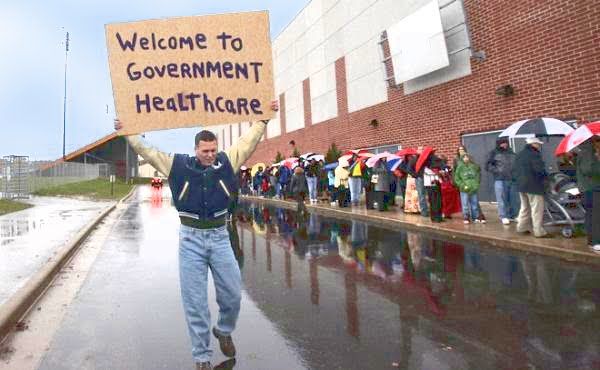
While this kind of paranoid thinking seems too idiotic to be possible, it’s evident all over conservative media and not just in Will’s prissy rants. It’s really common, for instance, for conservatives to suggest that health care is going to physically resemble a soup kitchen line. It’s not subtle, either—my Google search for “health care lines” turned this up as the first image.

This one guy decided to protest a line of people waiting for a flu shot, if you want a general idea of what emotionally compels the right.

While this asshole would like you to believe the “problem” is letting everyone access health care, the real problem was that the H1N1 vaccine had just come out, so of course there was a mad rush to get it. In real life, most health care situations do not have everyone at once trying to get care. But this is the narrative that conservatives are humping: If lower income people are allowed in the system, then they’re going to DESTROY EVERYTHING!!!11!!11!!1!1!!! So they’re using every underhanded trick they can in hopes of keeping people out.

Yeah, it’s ugly. I don’t know what else to say. It should make you angry. It’s infuriating.

30 Jul 23:13

Brilliantly designed penguin conservation advocacy posters.

by David Ng

Wow. Nice…

savethepenguins

savethepenguin2

By Bittersuite, South Africa (full team details here). Via Fresh Photons.


30 Jul 23:02

Look! Gorgeous Food Typography Made of Curry, Flour, and Other Pantry Ingredients

by Cambria Bold

This has got to be one of the prettiest uses of raw ingredients I've ever seen. Designer and illustrator Danielle Evans letters with ingredients like curry powder, flour, coffee grounds, chili powder, and green tea. The resulting "food typography" is beautiful, temporal, and just plain delightful. See a video below:

More


30 Jul 22:53

LG Curved OLED TV

For years we haven't seen much innovation in TVs beyond growing screen sizes and shrinking costs — but that all changes with the LG Curved OLED TV ($15,000). The first...

Visit Uncrate for the full post.


30 Jul 21:45

Titles

by Brian Russell

Have you ever met someone that insisted on being called by his or her title? Probably the most notable is people with doctorates wanting to be called Dr. This and Dr. That. For the most of them, they’re not doctors, so the idea of calling them so seems so foreign. Perhaps we should all pick titles […]

The post Titles appeared first on The Underfold.

30 Jul 20:02

A simple fact of life that I forget once a week.

30 Jul 18:41

The Rothko Chapel (1964-71) "The Rothko Chapel is...


The Rothko Chapel (1964-71)

"The Rothko Chapel is a non-denominational chapel in Houston, Texas. The interior serves not only as a chapel, but also as a major work of modern art.

On its walls are fourteen black but color-hued paintings by Mark Rothko. 

‘The Rothko Chapel…became the world’s first broadly ecumenical center, a holy place open to all religions and belonging to none. It became a center for international cultural, religious, and philosophical exchanges, for colloquia and performances. And it became a place of private prayer for individuals of all faiths.’

In 1964 Rothko was commissioned to create a meditative space filled with his paintings. The works are site-specific, one of the requirements of the program.

As Rothko was given creative license on the design of the structure, he clashed with the project’s original architect over the plans for the chapel. The plans went through several revisions and architects.

Ultimately he did not live to see the chapel’s completion in 1971.

After a long struggle with depression, Rothko committed suicide in his New York studio on February 25, 1970."

30 Jul 04:10

Watch and laugh!

30 Jul 00:23

Photo

Cary

({i})


29 Jul 23:36

Friend posted this, "Anyone else want me to babysit their kid? When they act up I give them old men haircuts."

Cary

She didn't even leave some long strands for a decent comb-over...

29 Jul 23:09

Huge Storm Waves Amost Swallow People in Portugal

by alice


This past January, a massive storm hit across Portugal that produced strong winds of up to 80 miles per hour and heavy rain. The disaster, described as the biggest natural catastrophe in Portugal in recent years, was caused by a freak cyclone weather phenomenon called an explosive cyclogenesis.

One of the areas where you could see nature in all its fury was in Porto, on the jetty that houses the Felgueiras Lighthouse. Photographer Veselin Malinov was on hand, where he was able to capture these incredible shots of enormous waves that seemed as if they wanted to swallow anyone that got in their way.

Huge walls of water surrounded those crazy enough to walk along the jetty. Malinov included those figures to, not only show a sense of scale, but also, perhaps, to show the fearlessness (or madness) of those willing to go near.


Veselin Malinov on 500px

29 Jul 23:01

Real Goods

by mark
Cary

I'll have to take a look.. I'm finally building a pond for our bloody water turtles -- I would like to go with a solar powered pump.

A good source for reliable off-the-grid appliances is Real Goods. Located in the hippy heartland of northern California where many folks live year-round off-the-grid, this store has been selling highly selected solar and eco-friendly gear since 1978. It’s good place to get 12-volt freezers, refrigerators and solar well pumps.

-- KK

Real Goods

Sample Excerpts:

solar

Solar Well Pump Kit – 100′ Depth
Price: $2,199

Our basic solar well pump system can be submerged up to 100 feet underwater with a total of 230 feet of lift, giving an additional 130 feet of lift out of the well, ideal for pumping to elevated watertanks without the use of booster pumps. This system contains everything you need to ditch the noise and costs of the generator.

The Shurflo pump is 100% field servicable, and we offer a full line or replacement parts from gaskets to motors.

The following items are included with this kit:

1 Linear Current Booster 12/24 Volt DC, 7A, PPT 12/24-7
240 Submersible Pump Cable 10/2 Per Foot
1 SJE PumpMaster SPDT Float Switch
1 SHURflo 9300 24VDC Submersible Pump
1 MC4 PV Output Cable 15′
1 DP Custom Top Pole Mount
2 ET Solar 95w Polycrystalline Solar Panel ET-P63695
1 MidNite Solar 10A 150VDC Din Rail Mount Breaker MNEPV10
1 MidNite Solar Combiner Box MNPV3
2 PV Grounding Lug 980010

29 Jul 20:17

Desperate times call for desperate measures

UPD: We have received a number of proposals that we are discussing right now. Chances are high that public The Old Reader will live after all

image

Since we launched first public version almost a year ago up until March 2013 we have been working on The Old Reader in “normal” mode. In March things became “nightmare”, but we kept working hard and got things done. First, we were out of evenings, then out of weekends and holidays, and then The Old Reader was the only thing left besides our jobs. Last week difficulty level was changed to “hell” in every possible aspect we could imagine, we have been sleep deprived for 10 days and this impacts us way too much. We have to look back.

The truth is, during last 5 months we have had no work life balance at all. The “life” variable was out of equation: you can limit hours, make up rules on time management, but this isn’t going to work if you’re running a project for hundreds of thousands of people. Let me tell you why: it tears us to bits if something is not working right, and we are doing everything we can to fix that. We can’t ignore an error message, a broken RAID array, or unanswered email. I personally spent my own first wedding anniversary fixing the migration last Sunday. Talk about “laid back” attitude now. And I won’t even start describing enormous sentimental attachment to The Old Reader that we have.

We would really like to switch the difficulty level back to “normal”. Not to be dreaded of a vacation. Do something else besides The Old Reader. Stop neglecting ourselves. Think of other projects. Get less distant from families and loved ones. The last part it’s the worst: when you are with your family, you can’t fall out of dialogues, nodding, smiling and responding something irrelevant while thinking of refactoring the backend, checking Graphite dashboard, glancing onto a Skype chat and replying on Twitter. You really need to be there, you need to be completely involved. We want to have this experience again.

That’s why The Old Reader has to change. We have closed user registration, and we plan to shut the public site down in two weeks. We started working on this project for ourselves and our friends, and we use The Old Reader on a daily basis, so we will launch a separate private site that will keep running. It will have faster refresh rate, more posts per feed, and properly working full-text search — we are sure that we can provide all this at a smaller scale without that much drama, just like we were doing before March.

The private site?

Accounts will be migrated to the private site automatically. We will whitelist everybody we know personally, along with all active accounts that were registered before March 13, 2013. And of course, we will migrate all our awesome supporters and people who donated to keep the project running (if you sent us bitcoins, please get in touch to get identified). Later this week your account will get a distinct indication whether it will be migrated to the private site or not. If you see that message and believe that it’s wrong, or if all your friends are getting migrated and you are left behind — please, drop us a line.

Give me my data!

You will have two weeks to export your OPML file regardless of our decision. OPML export link is located at the bottom of the Settings page — use the top-right menu to get there. All posts that you saved for later by using Pocket integration will obviously remain in your Pocket account.

But you could…

For those who would like to start the usual “VC, funding, mentor” or “charge for the damn thing” mantras — please, spare it. We’re not in the Valley where it might be super-easy, and, after all, not everyone wants to be an entrepreneur. We just love making a good RSS reader.

We really want The Old Reader to be a big and successful project, with usable free accounts. But this is not possible to achieve with what we have, so unless someone resourceful takes over the project and brings it to the next level, it is not gonna happen. We had over 2 000 new registrations after the blackout last week. This is amazing and sad at the same time.

If anyone is interested in acquiring The Old Reader and making it better, we are very open and accepting proposals at hello@theoldreader.com. We would be waiting for them for two weeks, supporting and maintaining The Old Reader as usual. Please don’t write us if you don’t have resources to maintain a site used by tens of thousands of people every day, or if you don’t know how you would improve The Old Reader. And please spare our time if you just want to buy the domain name and park a bunch of silly ads there — it’s not going to happen.

We value our community very much, and we will either pass the project to somebody who we know is going to take a good care of it, or we will switch it to private mode.

What next?

From one point of view, it’s not a big deal: “RSS is obsolete”, nobody died, we don’t owe anybody anything, you name it. Also, there are a lot of good readers around to choose from, a large part of them is smaller than The Old Reader and had not experienced growing pains of 80 000 daily active users in no time. But for us, it’s heartbreaking.

I will finally get back to work on my small studio — Bespoke Pixel — which has been run by my awesome partner all this time. Dmitry will keep being bright young software developer, making scalable and beautiful projects. Our team will stay together, and will keep working on making the private version of The Old Reader awesome.

We feel great responsibility for the project. We’d rather provide a smooth and awesome experience for 10 000 users than a crappy one for 420 000.

Sorry, each and everyone if we failed you. You are an incredible, supportive and helpful community. The best we could possibly hope for.

All the love,
Elena Bulygina and Dmitry Krasnoukhov

29 Jul 19:43

Cats are like, "She doesn't even go here!!"

29 Jul 19:43

FETCH MAH BEER

29 Jul 19:39

A solid 15-story hotel in China built in 6 days

by everydayminimalist


Quite impressive. It’s like a pre-fab building. Can’t say they aren’t efficient.

“Case in point: this 15-story Ark Hotel in Changsha, China was literally built in six days.

It’s level nine earthquake resistant, sound-proofed and thermal-insulated.

Thanks to pre-made construction modules and modern construction techniques, Chinese construction happens at a seriously dizzying speed.” Via Absolutely Fobulous

Related posts:

  1. 10 Days in a Carry-On
  2. The Story of the Japanese farmhouse: Minka
  3. Living in a Hotel FAQ: General Re-Purging – What passed and what failed?
  4. Living in a Hotel FAQ: How does living at a hotel work and what does it cost?
  5. The Story of Two Rosebushes


If you are reading this on any other blog than The Everyday Minimalist or via my RSS Feed, it is stolen content without credit.

You can contact me here or find me on Twitter via @brokeinthecity.

Come and visit my other blog: Fabulously Broke in the City, a lifestyle blog with just a hint of money talk!

© everydayminimalist for The Everyday Minimalist, 2013. |
| Permalink | No comments |

29 Jul 18:51

www.YetiStuff.com

by awkwardyeti

www.YetiStuff.com

T-shirts, prints, greeting cards, phone cases and more with a variety of original Awkward Yeti cartoons and designs. Go to http://www.yetistuff.com and buy stuff to make your walls and torso less boring!


29 Jul 18:48

"Slingatron" To Hurl Payloads Into Orbit

by samzenpus
cylonlover writes "People have been shooting things into space since the 1940s, but in every case this has involved using rockets. This works, but it's incredibly expensive with the cheapest launch costs hovering around $2,000 per pound. This is in part because almost every bit of the rocket is either destroyed or rendered unusable once it has put the payload into orbit. Reusable launch vehicles like the SpaceX Grasshopper offer one way to bring costs down, but another approach is to dump the rockets altogether and hurl payloads into orbit. That's what HyperV Technologies Corp. of Chantilly, Virginia is hoping to achieve with a 'mechanical hypervelocity mass accelerator' called the slingatron."

Share on Google+

Read more of this story at Slashdot.


28 Jul 23:23

This looks like a cover of a murder mystery book

28 Jul 22:34

I want to leave


artofmarkbryan.com


artofmarkbryan.com


artofmarkbryan.com

I want to leave

28 Jul 21:33

Horror in the Subway

by boulet


28 Jul 21:13

David Harris-Gershon: Obama’s Promise to “Protect Whistleblowers” Has Disappeared From Change.gov

by David Harris-Gershon
Since 2008, the Obama administration had made available the President's original campaign promises at Change.gov. However, the Obama administration removed access to these promises on June 8, two days after Edward Snowden's first revelation. The likely reason? One of those promises was to protect whistleblowers.
28 Jul 20:53

Hidden Underwater River Flows Along Mexico's Ocean Floor

by alice

If you've been waiting for inspiration to strike before you take those scuba diving lessons, here's something for you. In Mexico's Yucatan Peninsula, visit Cenote Angelita (or Little Angel) and then get ready to experience a dive unlike any other. A 10 to 15 minute drive south of Tulum, Cenote Angelita is an advanced scuba diving cenote (or water-filled cave) that houses a surreal surprise.

An underwater river flows through the ocean! How is this possible? It's due to a thin layer of hydrogen sulfate, which separates the freshwater at the top from the saltwater below. Divers can actually swim right through the false floor or mystical cloud that resembles a flowing river. With fallen leaves and branches lining the "river," you can't help but think you're in a mystical forest!

Here's how Maya Diving describes it, "From the surface, you look down and all you can see is deep blue water. You all give the ok and begin your descent, at first you see nothing but blueness all round then slowly at about 18m/60ft you begin to see what looks like a strange wispy bottom appearing below with a few ghostly, bare limbed tree trunks and branches sticking out. As it becomes clearer you begin to feel the first effects of narcosis at the same time as you see an expanse of wispy fog below. At the top of the cloud you stop and look around, everything appears surreal and a spooky feeling takes over amplified by the effects of the nitrogen in your brain. Now you descend through the cloud, for a minute you can't see anything except for the brownish glow of your lights and maybe you bump into a branch or two in the murk then you are through and realize that there is a black abyss below you still, the water is very clear, but your light doesn't illuminate anything below, the beam is swallowed up in blackness. You are already at 33m/100ft and you go a little farther down and move away from the slope of the cone of debris in the middle and look up at the dim glow of light coming through the foggy layer above...

"Now that was a diving adventure that you will never forget."

Underwater photographer Anatoly Beloshchin has taken some spectacular shots of this naturally occurring phenomenon. Unreal, isn't it?


There's also a video.

Antaoly Beloshcin's website
via [Reddit], [WebEcoist]

28 Jul 20:46

Why Google Reader died.

Buzzfeed has the story, and it's remarkably short, and has the ring of truth to it.

It's worth noting because this is how decisions are really made in tech, and probably every other industry.

Larry Page says Meh! to RSS and readers. He doesn't use Google Reader.

When it comes up at meetings, if it ever does, the person who brought it up is the subject of jokes.

It keeps running for months if not years on its own, with no one working on development.

Every time there's a cleanup, Google Reader is at the top of the list. Someone says "Oh but there are a lot of users and a bunch of them are reporters." So they keep it running for a little while longer.

Then, to make a point that he wants people to focus, a first-level report of Page's puts it on the shutdown list, despite the objections. Everyone shrugs.

They write a blog post with some BS about how everyone gets news now on their Android phone, something that's sure to make LP happy if he ever sees it.

A few months later it shuts down. Google survives.

28 Jul 01:59

Tutorial : Install TWRP recovery and root your 2013 Nexus 7 using SuperSU

by abhijoysarkar

TeamWin has already released a new version of its TWRP custom recovery for the new Nexus 7. The procedure to get the TWRP custom recovery running on the device is pretty simple, which will then allow you to flash root.