"I love physics with all my heart ... It is a kind of personal love, as one has for a person to whom one is grateful for many things."
- Lise Meitner, 1915
On February 11th 1939 Austrian physicists Lise Meitner and Otto Robert Frisch published a
one page note in Nature describing the impossible: the splitting of a uranium atom into two lighter elements, barium and krypton. They coined this process "
fission" as an analogue to biological fission process of cell division and ignited immediate interest in nuclear physics labs around the world.
But the discovery came at exactly the wrong time for Meitner, and her primary role in both the experimental and theoretical discovery of nuclear fission would never be properly awarded.
Meitner (born 1878) grew up in an intellectual family in Austria and displayed an aptitude for science and math at an early age. But her entrance to university was delayed because Austria did not allow access for women until 1897.
"Although I had a very marked bent for mathematics and physics from my early years, I did not begin a life of study immediately," Meitner wrote later. Thinking back, "one realizes with some astonishment how many problems then existed in the lives of ordinary young girls ... among the most difficult of these problems was the possibility of normal intellectual training."
In 1901, after years of intensive preparation, Meitner passed the university entrance exam at the age of 23 and entered the University of Vienna. The highlight of her undergraduate education, she recalled even decades later, was the set of lectures delivered by the famous physicist,
Ludwig Boltzmann. She took everything from electromagnetism to thermodynamics with Boltzmann and thought his lectures were "the most beautiful and stimulating that I have ever heard".
Meitner's physics study began just a few years after two dramatic discoveries changed forever the view of atoms as indivisible — radioactivity was discovered in 1896 and the electron in 1897 — setting the stage for Meitner's future work.
In 1906, at the age of 27, Meitner received her PhD based on her experimental work on heat conduction. She was only the second woman from the University of Vienna to receive a doctorate in physics.
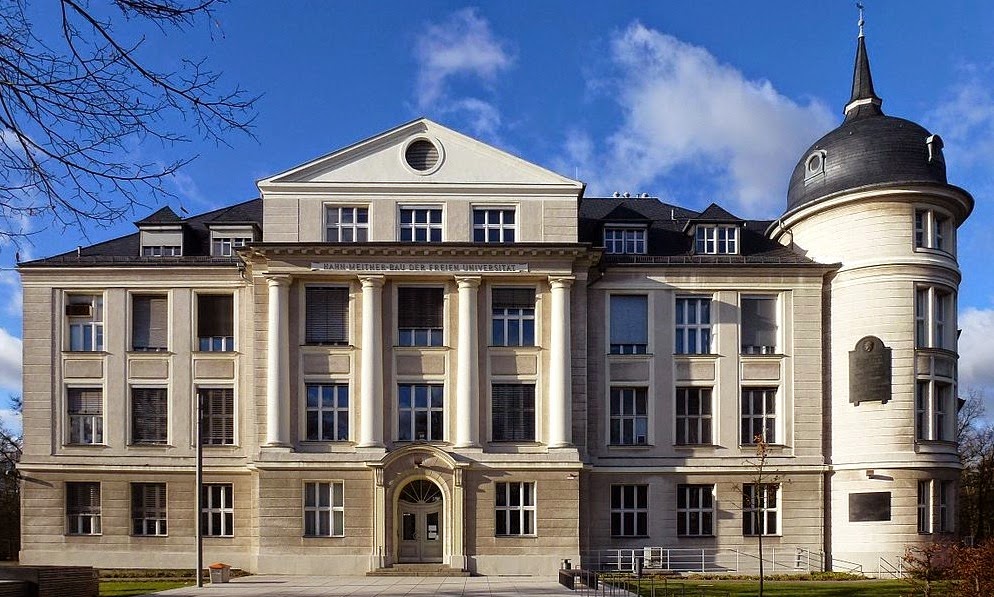 |
Former Kaiser-Wilhelm-Institut for Chemistry in Berlin, where nuclear fission was discovered.
Credit: Fridolin freudenfett (Peter Kuley) via Wikimedia commons
|
Many universities still barred women from holding faculty positions and Meitner had trouble securing a place in a research lab, much less any funding for her work. After completing short-term research projects in both optics and radioactivity, Meitner realized Vienna could offer her nothing further and moved to Berlin in 1907 in search of esteemed physicist
Max Planck.
Planck was initially surprised by Meitner's drive to pursue physics. On an early visit to Planck's home, she recalled that he said, "But you are a Doctor already! What more do you want?" Nevertheless, Planck allowed her to attend his lectures and eventually she found experimental work with Otto Hahn, an established chemist in the field of radioactivity.
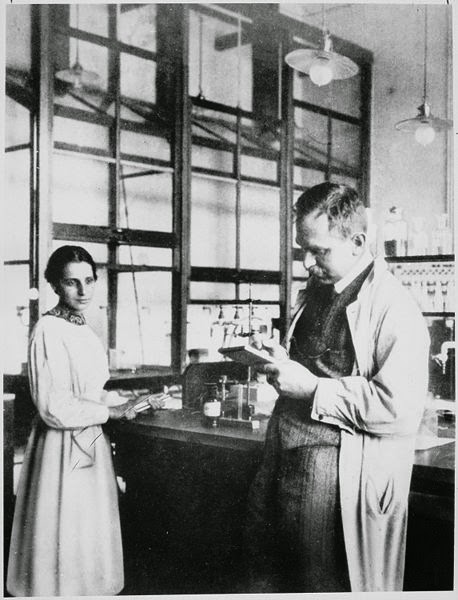 |
Lise Meitner and Otto Hahn in the KWI
laboratory. Credit: public domain
|
Meitner's physics background complimented Hahn's chemical expertise and their collaboration lasted for the next 31 years. During those years they had a very fruitful collaboration studying various radioactive decay processes and discovering the element
protactinium. They eventually moved labs to the newly-constructed
Kaiser-Wilhelm-Institut (KWI) for Chemistry southwest of Berlin and Meitner was appointed to her first paid position as an assistant for Max Planck, grading his students' papers. The recognition was vital to her self-esteem and sense of independence.
"I know very well that especially in one's developing years, one urgently needs the encouragement of external recognition, to know that one's chosen path is not a wrong one," reflected Meitner in her seventies. By 1919, she had worked up to the rank of Professor at KWI, very likely the first woman in Germany to achieve this title.
But anti-semitism was growing in Germany and Meitner had Jewish heritage. Many of her colleagues across Germany quickly fled, but Meitner stayed in Berlin until it was almost too late. Her lab and her colleagues were everything to her and the field of nuclear physics continued to dazzle.
Ernest Rutherford reported the discovery of the proton in 1919, and by 1932 the neutron was also found (along with the positron in 1932 and deuterium in 1931), completing the basic picture of atomic cores. With such breaking discoveries, Meitner may have found it difficult to consider leaving.
The KWI was initially a safe haven for scientists of "non-Aryan" descent and for those who refused on moral grounds to join the Nazi party. One such person was
Fritz Strassmann, a chemist who joined Meitner and Hahn's lab in 1929. In 1934, Meitner, Hahn, and Strassmann began investigating uranium and potentially heavier elements, bombarding uranium with neutrons to spark unknown reactions. Five years later their joint efforts would culminate in the discovery of nuclear fission.
But in the first few years, their bombardment experiments confused Meitner. Her role as physicist was to explain the observed chemistry with a plausible series of reactions and she found herself writing down with increasingly unlikely radioactive decay processes in order to explain their results.
Initially Hahn and Meitner thought they had created so-called transurane elements (elements just heavier than uranium), based on the the firm belief held in physics that neutron bombardment would only change the atomic number of the target by a few numbers up or down. The products did not look like elements just below uranium so Hahn and Meitner concluded they must be new heavier elements. This was the view they published from 1935 to 1938, but it became more and more difficult to justify with known reaction processes.
In March 1938 Germany annexed Austria, suddenly making Meitner's Austrian citizenship and passport obsolete. She could not travel without a valid passport and yet her Jewish heritage prevented her from obtaining a German passport. It became urgent that she leave Germany before she was trapped indefinitely and at the last minute she managed to secure a place in Stockholm. When Meitner left Berlin in July 1938, her experiments were in progress, her books on the shelf, and her students largely unaware of her departure.
 |
The experimental apparatus used to discover nuclear fission, on display in the Deutsches Museum in Munich.
Credit: J Brew via Wikimedia commons
|
While struggling to adjust to her new life in Stockholm, Meitner exchanged frequent letters with Hahn and Strassmann in late 1938, discussing their experiments and helping interpret their results.
On December 19th 1938, Hahn wrote to Meitner about a final set of experiments before the Christmas break. "Actually there is something about the 'radium isotopes' that is so remarkable that for now we are telling only you. ... Our Ra isotopes act like
Ba. ... Perhaps you can come up with some sort of fantastic explanation. We know ourselves that it can't actually burst apart into Ba."
After bombarding a uranium sample with neutrons, instead of the expected radium product (Ra), Hahn and Strassmann found only barium (Ba), a much smaller element. After years of looking for an element only slightly larger or slightly smaller than uranium, they finally realized the truth was quite different. Meitner, Hahn, and Strassmann had been inadvertently splitting the uranium atom, and confirming the presence of barium was the experimental proof.
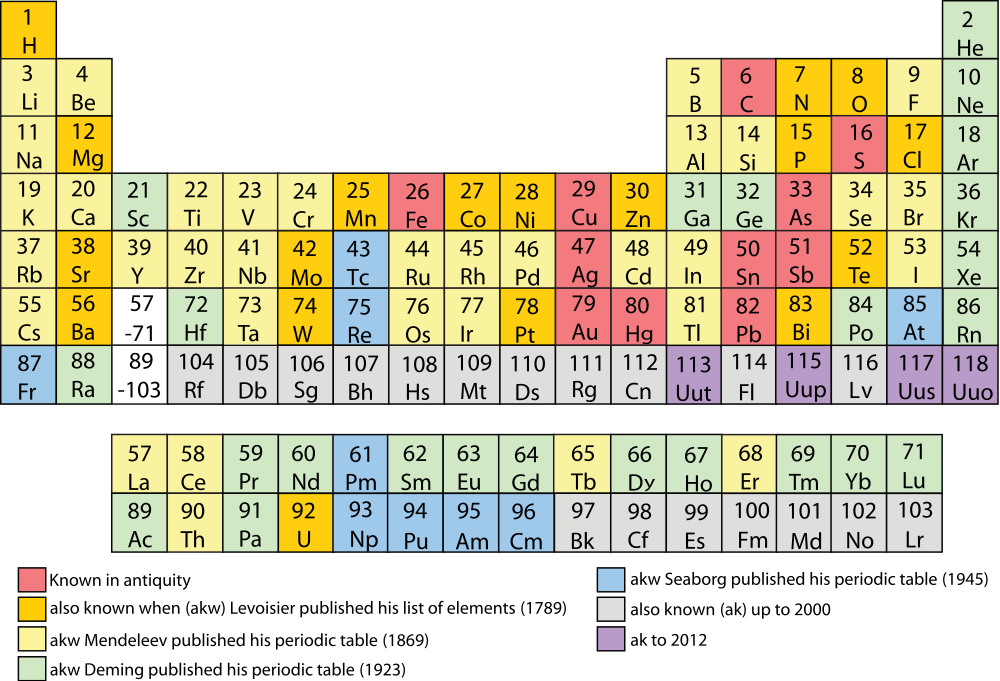 |
| Periodic table of elements, colored by discovery date. Credit: Sandbh via Wikimedia commons
|
It had only been five months since Meitner left the lab, and Hahn's confidential letter made it clear that she was still a part of the team. In fact, it was Meitner who urged Hahn to do further tests on the supposed radium, and instead he found barium.
Without a full physical understanding of the process, Hahn and Strassmann
submitted their barium results for publication on December 22nd 1938.
Just after receiving Hahn's letter, Meitner traveled to the west coast of Sweden for the Christmas holiday, joined by her nephew and physicist
Otto Frisch. Meitner and Frisch immediately began discussing Hahn's barium finding, trying to find a physical explanation. They recalled that
Niels Bohr had suggested in 1935 that the nucleus of an atom might behave like a liquid drop and with this visualization the idea of splitting the droplet quickly took shape.
In his memoirs Frisch recalled the snowy walk he and Meitner took while working out the basic theory. "At this point we both sat down on a tree trunk, and started to calculate on scraps of paper. The charge of a uranium nucleus, we found, was indeed large enough to destroy the effect of surface tension almost completely; so the uranium nucleus might indeed be a very wobbly, unstable drop, ready to divide itself at the slightest provocation (such as the impact of a neutron)."
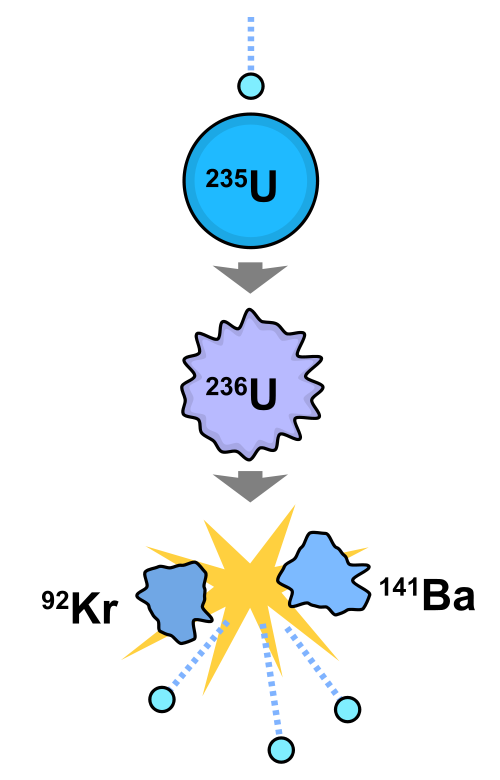 |
Nuclear fission of uranium
into barium and krypton.
Credit: public domain
|
Meitner also worked out the kinetic energy of the two split parts, speeding away from each other due to charge repulsion, and found that this energy could be exactly supplied by a small but expected change of mass, which disappeared into energy by Einstein's E = mc
2. This neat and elegant theory suddenly made sense and explained years of strange results and convoluted theories in one go.
Anxious to be a part of the discovery, and knowing it was politically impossible to publish with her old colleagues, Meitner and Frisch rushed to prepare a short note for
Nature. In addition to describing the theoretical process of fission, Frisch quickly performed a few simple experiments which found the energetic recoil products they predicted.
On January 16th 1939, Meitner and Frisch submitted their theoretical fission paper, along with a separate experimental paper by Frisch. In their joint paper, Meitner also predicted the second half of the fission process; if uranium (with 92 protons) split in two, with barium as one half (56 protons), then the other half had to be krypton (Kr) with 36 protons in order for the proton number to add up.
This paper would not be published in
Nature until the February 11th 1939, but in the meantime, labs around the world read Hahn and Strassmann's paper and excitedly started to perform their own experiments. And Bohr inadvertently let slip Meitner's theory while traveling to the United States in mid-January; Meitner had privately discussed the nuclear drop theory with Bohr and he had worked over the fission process with another physicist, forgetting to say the work was still confidential.
As a result, word spread quickly and as Frisch recalled "[A] fantastic race was already going on in a number of American laboratories ... to perform the same easy experiments I had already made to detect the fission fragments."
Just in time, Meitner and Frisch's publications appeared on February 11th, maintaining their priority on both the theory and first physical detection of fission.
Hahn and Strassmann soon confirmed the presence of krypton and its decay products, but did not fully credit Meitner's role in predicting it, and barely mentioned her theoretical paper. She was hurt by this snub and wrote to Hahn "it would have been so nice for me if you had just written that we — independently of your wonderful findings — had come upon the necessity for the existence of the Kr-Rb-Sr series".
Hahn continued to minimize Meitner's role in the discovery of fission, likely out of fear of working under the Nazi regime, and he alone received
the 1944 chemistry Nobel Prize for the discovery of fission. Many scientists felt Meitner had been unfairly left out, and there were indications that the selection process was flawed; the Nobel committee actually postponed the 1944 chemistry award in order to reconsider the contribution from Meitner and Frisch, but in 1945 voted against changing their decision by a slim margin. Strassmann was also left out, in spite of his constant role in the experiments.
Despite later nominations, Meitner never received the physics Nobel prize. She did however receive many other awards later in life including the Max Planck Medal, the Otto Hahn Prize (ironically), and just before she died, the Enrico Fermi Award in 1966 along with Frisch. Meitner also had the rare privilege of having an element named after her,
meitnerium, although this occurred much later in 1997.
Lise Meitner died in 1968, aged 89, leaving behind a legacy of extraordinary experimental and theoretical discoveries which changed the view of the atomic nucleus forever. And she remained scrupulous about her work. When the Manhattan Project was first established, Meitner refused to help develop the atomic bomb, later saying she was "sorry the bomb had been invented". Upon her death, Frisch inscribed on her headstone "Lise Meitner: a physicist who never lost her humanity".
76 years after Lise Meitner published her nuclear fission paper, the American Physical Society is
recognizing Meitner at the March Meeting 2015, this year in San Antonio, as part of a broader social media outreach effort. Meitner was chosen by popular vote on the
@APSphysics twitter account and joins physicists
Nikola Tesla and
Richard Feynman selected in previous years. APS hopes to raise awareness of a remarkable and brilliant physicist, that she might continue to inspire.
For further reading, check out the
'This Month in History' column about Meitner in the 2007 APS newsletter. The biography by Ruth Lewin Simes,
"Lise Meitner: A Life in Physics" is also a thoroughly enjoyable read and provided many of the quotes and biographical facts used in this article.
--
Top image: Meitner in Vienna, circa 1906. Credit:
public domain



 26 bucks
 2.6 cents
 Not digging this method.
 10 bucks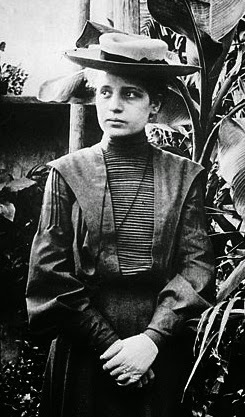
%2C_lecturing_at_Catholic_University%2C_Washington%2C_D.C.%2C_1946.jpg)


 Enter a caption (optional)
 Enter a caption (optional)
 Enter a caption (optional)
 Enter a caption (optional)






,_lecturing_at_Catholic_University,_Washington,_D.C.,_1946.jpg)
