I haven’t listened to the radio bit, but that is an AMAZING cover for Little Women.
If you'd like to hear my dulcet tones blathering on about book design and recommending obscure books on the Australian national broadcaster, have at it!
Or listen here:
(NB: To my knowledge I don't usually sound as though I'm 4 feet tall and trapped in a metal bucket)
For anyone looking for the awful, awful book covers (like that above) referenced in the interview, start here.
For 70 more obscure book recommendations, try here.
Merry Christmas! Check out this great drone capture above a Christmas tree farm in Whitehouse, Ohio. Of the more than 160 million Christmas trees growing in the United States in 2015, roughly 2 million were in Ohio. The biggest grower in the U.S. is Oregon, which had upwards of 50 million trees growing in 2015.
Here at Time, we made several major changes in 2020. Now that 2021 is here, we’re rolling out a brand new set of regulations.
A Minute
A minute used to be sixty seconds long. Then in 2020, we made a minute take either one hour or 3.5 seconds. Well, we’re pleased to announce that in 2021, a minute simply no longer exists. Like pennies, minutes are now totally useless. Enjoy!
A Day
You may remember last year we adjusted a day so that instead of taking 24 hours, it would be over the moment you first ask yourself, “What time is it?”
We thought this could use improvement. This year, a day is over the moment you think about a recent activity you did, and you ask yourself, “Wait, that was yesterday?” That’s the moment a day ends.
Speaking of which…
Yesterday
From here on out, yesterday will always feel like it was about one to two weeks ago.
A Week
Last year, we changed a work-week so that it lasted an entire year. Everyone really hated this, so we did a little recalibration.
This year, a work-week lasts ten and a half days. This might sound random and hard to keep track of, but it’s the number that tested the best. And it will make total sense once you read about…
A Weekend
In 2020, we announced that we got rid of weekends. To make up for that, in 2021, you will always think it’s the weekend, even if it’s the middle of the week.
It will be Wednesday afternoon and your boss will email asking if you’re sick and that’s why you didn’t work today. And you’ll realize that it’s not Sunday like you thought it was, because it’s tough to keep track of ten and a half day work-weeks.
And you don’t want to tell your boss you thought today was Sunday, so instead you lie and say that you are sick, but you make it clear that it’s not COVID.
But then your boss will think you do have COVID, because that’s just what someone who doesn’t want their boss to know they have COVID would say.
And that will all happen every single week.
A Month
Months used to be pretty inconsistent: some were 30 days, some were 31, and one was 28 or 29. We made this easier last year and said that months would all last exactly four days.
This ended up feeling way too short. So now every month is two months long. This might seem like a paradox, and that’s because it is. Good luck!
Tomorrow
Tomorrow will never come.
A Year
Last year, we didn’t have an exact estimate for how long a year was, because the year hadn’t ended yet. Now that 2020 is over, we have clear evidence that one year lasts approximately forty-two months.
Now: we are expecting 2021 to feel a little shorter—perhaps thirty-five or thirty-six months. But who knows? We’ve been wrong before, and you can bet we’ll be wrong again.
That’s all for our updates. See you in thirty-five to forty-two months!
As we continue our 2020 Year in Review, it would be impossible to overstate the impact that COVID-19 has had on this year. The pandemic has affected almost every aspect of our lives and will continue to do so for years to come. Worldwide, more than 80 million cases of COVID-19 have been confirmed and at least 1.75 million people have died from the disease. These Overviews provide a few examples of how the pandemic and its effects were seen from space.
1. Huoshenshan Hospital in Wuhan, China was built over a 10-day period between January 23rd and February 2nd to help slow the spread of COVID-19.
2. Singapore Airlines jets are stored at Alice Springs Airport, Northern Territory, Australia in July. At this point, the airline had grounded 138 of its 147 aircraft worldwide because of the pandemic.
3. St. Peter’s Basilica in the Vatican City sits empty on Easter Sunday 2020, an occasion that would normally be bustling for the Pope’s Easter Homily.
I’ve been experimenting with generating Christmas carols using machine learning algorithms of various sizes. The smallest AIs, trained from scratch on a set of carols, tended to get confused about what exactly the carols are celebrating. GPT-2, larger and with some internet pretraining… still got confused. Its carol about Rudolph “the All-Gracious King of All the Earth” was unsettling enough before Joe Zieja’s dramatic reading and The Forever Now’s eerily calm arrangement.
Now in 2020 we have GPT-3, trained on so much of the internet that my challenge is now to stop it from simply repeating carols that it has memorized. Give it just three example carols and it will respond with another from the internet, which is technically exactly what it was rewarded for during training. To get it to generate new carols, I discovered I could give it three existing carols (I chose Hark! The Herald Angels Sing (“bruise in us the serpent’s head”), All My Heart This Night Rejoices (“sin away and for aye full atonement maketh”), and Run Run Rudolph (“and away went Rudolph a whizzing like a merry-go-round”)), plus just the title of a nonexistent carol. It would generate, for example:
Mild is Rudolph
Mild is Rudolph’s image in the snow He has a shiny nose and knows how to cozy-up-nose He has a little red nose and tiny little hooves He persuaded a mischievous infant to go straight to sleep
Goodness, how downy is Rudolph’s hide He has, oh his forehead, so plump and smooth and divine He has a little black snout and tiny little hooves Benevolence makes foolish young children go straight to sleep
Shy is Rudolph’s figure when he’s near He has a twinkle, oh in his eye, and he’s kind of lean He has a bright shiny nose, and tiny little hooves He can make any child go straight to sleep
The AI has seen the existing Rudolph lore many times, however, so it would tend to drift back into singing Rudolph the Red-Nosed Reindeer. Sometimes it would only drift back partway.
The Carol of the Rudolphs
Rudolf the red-nosed reindeer had a very shiny nose. He kept it polished nice and clean with a white piece of soap. All of the other reindeer used to laugh and joke, and call him names like ugly, Zonker, Dunderhead. But their laughter stopped when they saw him get him speed on down the runway.
For he could change the course of the wind with his nose, and people called him Very Bright.
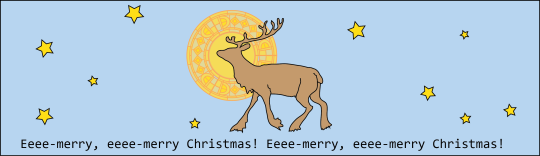
Rudolf, the darting reindeer knew the trail through the woods, even in the fog he could spot his mark. Eeee-merry, eeee-merry Christmas, Yes, that is his song.
He could steer a craftsman’s plane, Could lead a camel home out of a trance. His tender little bat-like ears could hear a whisper, from ten miles away.
He could roar like a lion. He could fly, gliding with ease. His little rusty wheel, he would use to help create the most wonderful wheel of cheese.
Yes, Rudolf, the cherry nosed reindeer, could do all of these things and more, But the only thing his nose could not do was smell. Delectable Waffles Who knows what’s in Rudolph’s nose? Only Rudolph knows – And Rudolph won’t tell!
The “sing the praises of Rudolph” directive seems to come through very well, especially if I give it an appropriate title.
All Hail to Rudolph
All hail to Rudolph The legend of Christmas The most famous reindeer of all
All hail to Rudolph Happy all the year From everyone we see
Heroes come and heroes go But Rudolph stays forevermore Oh boys and girls of every age Can’t you hear the sleigh bells ringing?
Oh look! There’s Santa and Parson Brown Defying the laws of time and space Now prepare yourself and your family my boy Prepare to get your Christmas fix
Now Rudolph goes smashing through the roof Just like a power lift with a candy-cane moustache And the deer’s nose is dead-on, deadly accurate Pow! Now it’s Rudolph versus Mars
All hail this joyful night All hail the night folks sing All hail to Rudolph The legend of Christmas The most famous reindeer of all
O Come Rudolph, Come
O Come Rudolph, Come Ye Faithful Oh come, come holly, clad in white, Oh come ye faithful. Oh come aloud! Oh come and join our choir, Oh make a joyful noise till earth and heaven ring.
Even if I give it a title like “Rudolph is the Worst” it knows that the story of Rudolph ends with redemption. (That is, unless it goes into truly awful territory, there being a lot of ways of being the Worst in its internet training data.)
Rudolph is The Worst Reindeer
Rudolph the red-nosed reindeer Was a stubborn old reindeer. Never would you find him Participating in Christmas. Never entered his head, Of decorating a sleigh.
Then along came Bumbleboo One foggy Christmas Eve, And he said, “Rudolph with your nose so bright, Won’t you guide my sleigh tonight?”
Then all the other reindeer, Gathered round to admiere him, And they nodded their heads, As they shouted out in cheer, “Rudolph the red-nosed reindeer You’ll go down in history.”
Other times it seemed to be going for counting songs and, like GPT-2, is weird when it counts things. Here my title prompt was “Rudolph of”.
Rudolph of Orange (Medley)
There are 15 different colors, That you see within the shirt. There is a booklet, Which identifies each one.
You’re looking at a number one, While the kids are knocking on your door. Then we started laughing, When we realized that Rudolph was near!
Courtesy of the index theory, There are only twenty eight! July is the eighth, And that’s when Christmas is!
REFRAIN:
And 1 wrapped a nose (Time now for teasing and for fun) 2 pictures, horns a cap, 3 hooves and legs and feet, 4 antlers sweeming! 5 eyes, 6 nostrils, 7 buttons, zipper, 8 bolts and bumpers, 9 flashing lights on his cap, 10 red nose, 11 furry chin, 12 rubsy ears, 13 plastic eyes, 14 laughing so joyously. 15 steps and a twisted reindeer train! 16 frosted incislotes, 17 dreamily red bow, 18 nose light, 19 velco on reins, 20 candy apple red.
Two reindeer he’ll need to pull him through! It’ll be commercial Christmas, For years to come, When Rudolph gets his new reindeer team.
For a few more carols (including “O Little Rudolph” which involves ghosts and ghouls somehow), enter your email!
The iceberg is comparable in size to many well-known islands. A68a is very similar in size and shape to Jamaica, almost as long as the U.S. territory Puerto Rico, and dwarfs China’s Hong Kong Island as well as the Southeast Asian city state of Singapore.
Observers from the British Antarctic Survey told media that a flight last year over the A68a took about one and a half hours. The berg is so big, Royal Air Force pilots this week were unable to capture it all in one, single photograph.
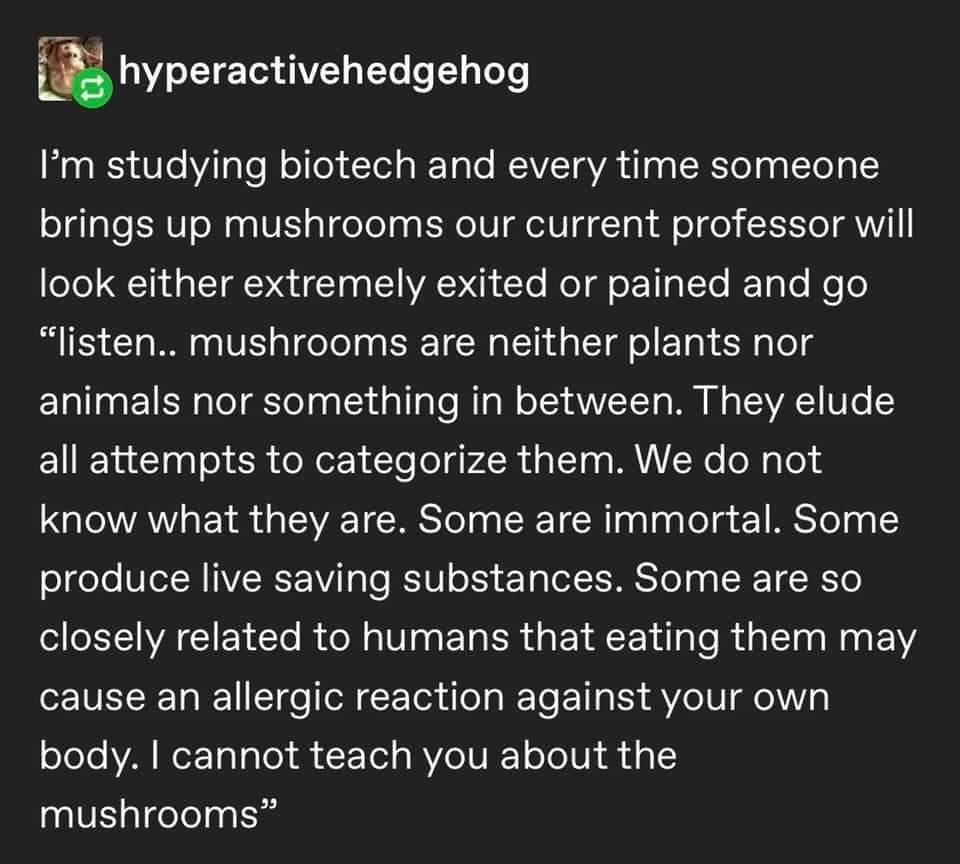
if you grow mushrooms over a toxic waste site, chemical spill, or other polluted growing medium, they will suck up the toxins into their fruiting bodies with such effectiveness that they are being studied for their ability to clean up tainted industrial sites. it’s called mycoremediation.
if you do this with edible mushrooms, they are no longer technically edible, but on the other hand they make a great way to poison your enemies. this is called murder and it’s usually frowned upon, but they won’t see it coming and you get bragging rights afterwards about your ability to kill people with a pizza topping.
Sorry this was not precisely most people’s idea of “nice.” Let me add that you are a glow of comforting absurdity in an ever-more-fucked-up world.
The technological white supremacy extends to human hair, where the term “hair” has become shorthand for the visual features that dominate white people’s hair. The standard model for rendering hair, the “Marschner” model, was custom-designed to capture the subtle glints that appear when light interacts with the micro-structures in flat, straight hair. No equivalent micro-structural model has ever been developed for kinky, Afro-textured hair. In practice, the straight-hair model just gets applied as a good-enough hand-me-down.
Similarly, algorithms for simulating the motion of hair assume that it is composed of straight or wavy fibers locally sliding over each other. This assumption does not hold for kinky hair, where each follicle is in persistent collision with a global range of follicles all over the scalp. Over the last two decades, I have never seen an algorithm developed to handle this case.
This racist state of technology was not inevitable. The 2001 space-opera flop Final Fantasy: The Spirits Within was released before the dipole approximation was available. The main character, Dr. Aki Ross, is a young, fair-skinned scientist of ambiguous ethnicity, and much of the movie’s failure was placed on her distressingly hard and plasticine-looking skin. Less often mentioned was the fact that two other characters in the movie, the Black space marine Ryan Whittaker and the elderly Dr. Sid, looked much more realistic than Aki Ross. Blacker and older skin does not require as much translucency to appear lifelike. If the filmmakers had aligned their art with the limitations of the technology, Aki Ross should have been modeled after a latter-day Eartha Kitt.
For a brief moment in the 2000s, the shortest scientific path to achieving realistic digital humans was to refine the depiction of computer-generated Blackness in film, not to double down on algorithmic whiteness. Imagine the timeline that could have been. Instead of two more decades of computer-animated whiteness, a generation of moviegoers could have seen their own humanity radiating from Black heroes. That alternate timeline is gone; we live in this one instead.
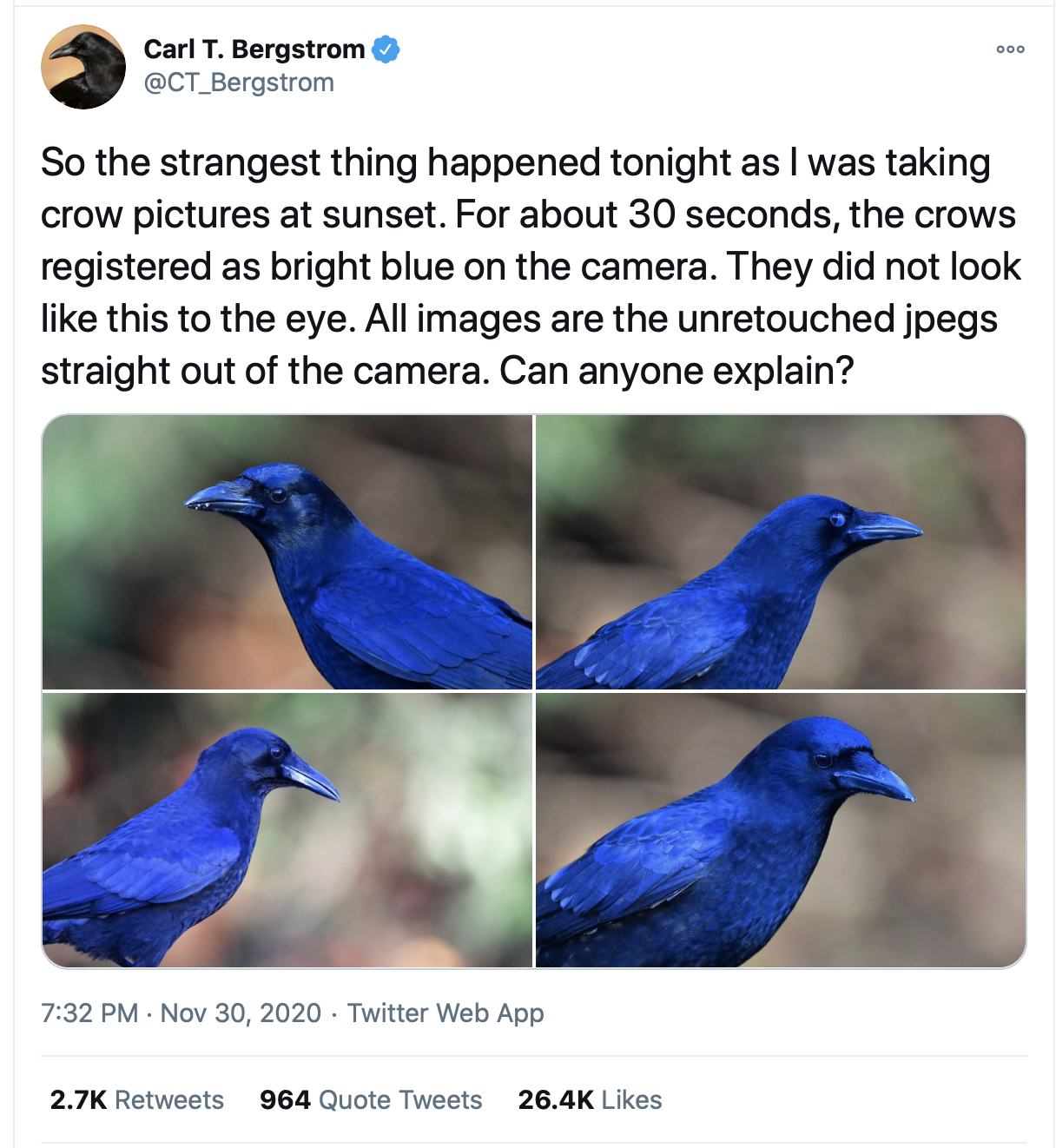
Recently, a marvelous set of blue crow photos from Carl Bergstrom had the internet’s corvid fans doing a collective double take. In addressing what could be responsible for such spectacularly odd images, many people’s first instinct was to wonder if these photos might be revealing the hidden ultra-violet lives of crows. After all, as a group, passerines (aka songbirds, of which crows are part of) are well known for their abilities to express themselves and see beyond the visual spectrum available to people. But while, “can crows see in UV? Is their perception of the feathers adorning their flock mates different from our own?,” feel like simple enough questions, a google search after their answers results in an almost unprecedented silence from the otherwise vast body of crow knowledge that exists beyond your search bar. Sure, you can find the occasional popular science article that talks about the visual systems of birds and maybe includes a photo of a crow, but these articles never provide citations and most speak simply in generalizations about passerines, not about crows specifically. The reason for this knowledge gap is that while the visual systems of birds is generally well studied, there are over 10,000 species of birds and not all of them can be the darling of every field of research. So while crows take a disproportionate share of our scientific attention, relative to many other species, not much has actually been done on their visual systems; what does exist is spread out and sometimes hard to find. But this is a question that comes up time and time again so let’s take a moment to harness what has been done, and offer the best possible answers to these questions that science currently has to offer.
Before we get to the heart of our questions though, let’s take a beat to review the more technical aspects of vision, and why our visual experience of the world is different from our dogs’ or possibly crows’. Vertebrate eyes work fundamentally via the same 5 step process: Step 1) light enters eye through pupil, Step 2) the cornea bends the light that passes through the pupil, Step 3) the light then passes through the lens which focuses it on the retina, Step 4) rods and cones of retina detect light and color and, Step 5) cells in retina convert this into impulses which go to brain. But while the general process is conserved across most species, the details of each of these steps can vary in life altering ways. Crucial to this discussion is that fourth step that involves the rods (which are motion sensitive light detectors) and the cones (which are contrast sensitive color detectors). Depending on the classes of cones a species possess, an animal can be either dichromatic (most mammals), trichromatic (primates and marsupials), or tetrachromatic (birds and reptiles), which translates to different levels of color vision. 1 While we are able to detect red, green and blue light, most birds have a fourth cone that allows them to more acutely detect short wavelength colors near the ultraviolet range. The ability to simply detect UV isn’t enough though (in fact humans are sensitive to UV light), you must also have the ability to transmit that part of the spectrum. While our eyes filter it out, rendering it invisible to us, birds have special oil droplets in their cones that allow for the passage of UV light, while limiting its damage.2 Among birds, that 4th cone (called the short-wave sensitive 1 or SWS1) can be further divided into two variants: the violent-sensitive variant (VS birds) or the ultra-violet sensitive (UVS birds) variant. Without getting any more technical, suffice it to say that UVS birds have a much keener visual experience of the UV spectrum, relative to VS birds, though both can detect UV light.3
The function of this “enhanced” vision is many fold.4 For one, it allows for greater contrast of the environment, rendering what may look to our eyes as a flat wall of green vegetation, as a much more dynamic plane, enhancing a bird’s ability to fly through dense foliage. Like insects, UV sensitivity is also important among many types of nectarivorous (nectar drinking) and frugivorous (fruit-eating) birds. Many fruits, for example, are coated in a UV-reflecting waxy substance that helps advertise their availability to would be seed dispersing birds. And finally, descriptive UV patterns in feathers opens an entire world of visual signaling that is otherwise completely hidden from us. Given the ways we might image crows would benefit from exploiting any one of these possibilities, it makes sense that they would possess the kind of rich UV experience that many other birds are known for.
Which brings us, finally, to the rub. While it’s true that most passerines are what we call UVS birds, corvids, like flycatchers and most raptors, are VS birds, meaning their visual system is biased toward the violet-spectrum and they are not considered especially sensitive to UV light.3,5 The low UV-detection abilities of corvids and many raptors, appears to offer a lifeline to smaller passerines, which exploit these visual differences in their plumage, allowing them to remain conspicuous to potential mates, while staying inconspicuous to their potential predators.6 Given this finding, we would expect crows not to, for example, show a great deal of UV detail in their feathers, and the research seems to bear this out. A study of large-billed crows found them to be so weakly iridescent, that the authors proposed their violet-blues hues may simply be an artifact of chance, and play no functional role.7 Likewise, unlike many other passerines, crows don’t seem to communicate aspects of their identify via secret codes in their feathers. A 2007 study, for example, confirmed that American crows, fish crows, and Chihuahuan ravens are sexually monochromatic from an avian visual perspective, meaning there’s no UV signaling of “male” or “female” hidden from us in their feathers.8 These birds were among only 14, of the 166 North American passerines sampled, for which this was true.
Despite these findings though, the role of UV in the lives of crows and other corvids hasn’t been rendered completely immaterial. When presented against high contrast backdrops (green foliage), fish crows are more adept at picking out UV reflecting berries than matte black Vaccinum berries. On the other hand, when both are presented in front of a backdrop that offers no contrasting advantage to the UV reflecting fruit (sandy backdrops) they pick out both berries equally.9 And while the UV spectrum may not be super useful to crows for coding information, that doesn’t mean the feathers of corvids don’t carry any weight. Common magpies, for example, convey all sorts of information from sex to age to territory status in their iridescent tail feathers.10 Taken together, these findings seems to suggest that there is a lot more to unpack with respect to the role of UV in the lives of corvids than, well, meets the eye, and species-specific studies may be necessary to fully parse the potential nuance.
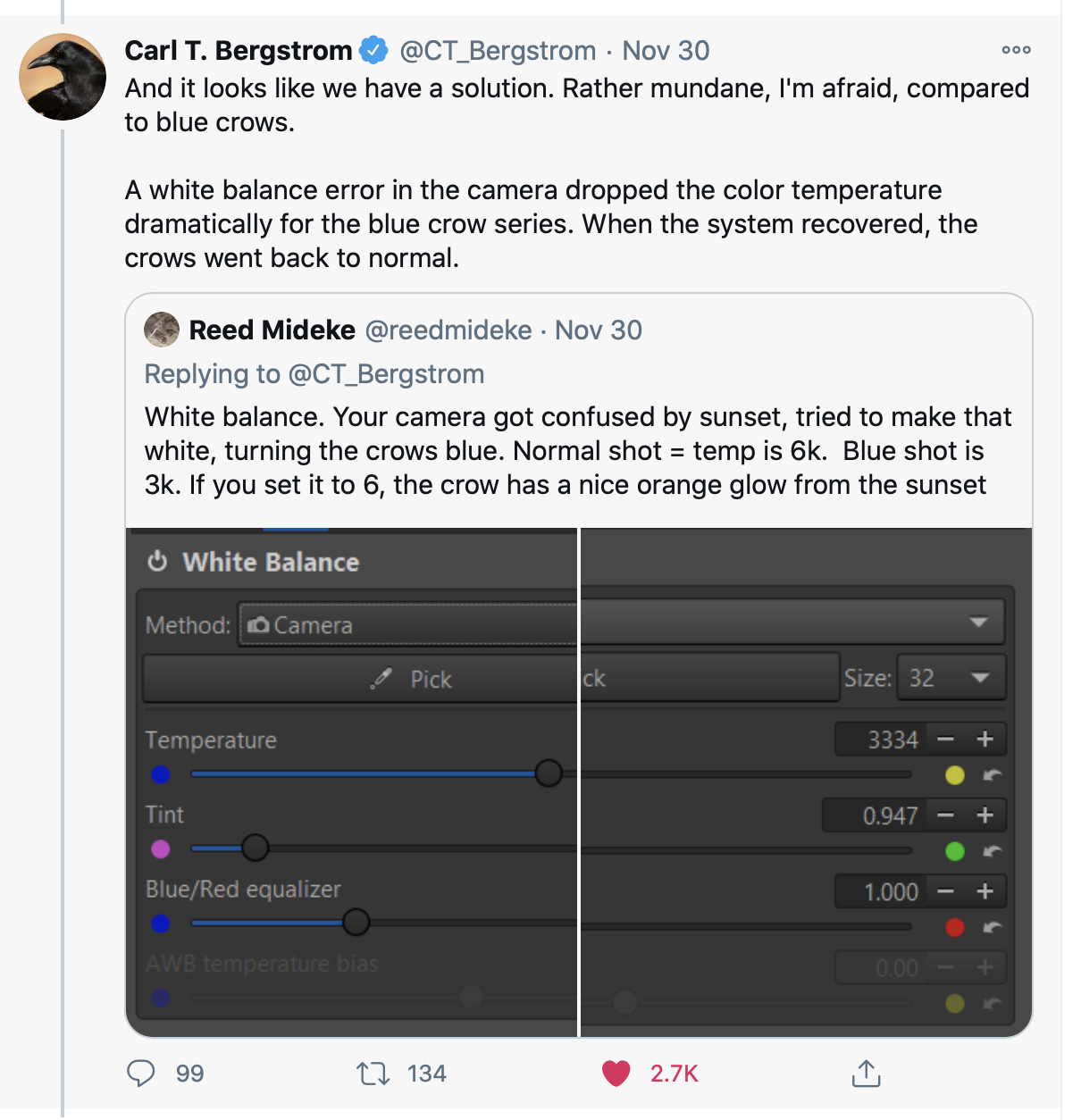
In the mean time, while the errant photo of a blue crow may be eye catching, it’s probably not revealing an otherwise visually hidden secret, like that time a ghost showed up in the background of your vacation photo. Instead, blue crows are probably just an artifact of the photographer’s white balance gone awry in the golden hues of a fine day.
Literature cited
Bowmaker JK. 1998. Evolution of colour vision in vertebrates. Eye12, 541–547
Lind O, Mitkus M, Olsson P, Kelber A. 2014 Ultraviolet vision in birds: the importance of transparent eye media. Proc. R. Soc. B 281: 20132209.
Ödeen A, Håstad O & Alström P. 2011. Evolution of ultraviolet vision in the largest avian radiation – the passerines. BMC Evol Biol11: 313.
Withgott J. 2000. Taking a Bird’s-Eye View…in the UV: Recent studies reveal a surprising new picture of how birds see the world. BioScience 50: 854–859.
Brecht KF, Nieder A. 2020. Parting self from others: Individual and self-recognition in birds. Neuroscience & BiobehavioralReviews 116: 99-108.
Håstad O, Victorsson J, Ödeen A. 2005. Differences in color vision make passerines less conspicuous in the eyes of their predators. Proceedings of the National Academy of Sciences 102: 6391-6394.
Lee E, Miyazaki J, Yoshioka S, Lee H, Sugita S. 2012. The weak iridescent feather color in the Jungle Crow Corvus macrorhynchos. Ornithol Sci 11: 59–64.
Muir DE. 2007. Avian Visual Perspective on Plumage Coloration Confirms Rarity of Sexually Monochromatic North American Passerines. The Auk 124: 155–161.
Schaefer HM, Levey DJ, Schaefer V, and Avery ML. 2006. The role of chromatic and achromatic signals for fruit detection in birds. Behavioral Ecology 17: 784-789
Nam HY, Lee S, Lee J, Choi C, and Choe JC. 2016. Multiple Structural Colors of the Plumage Reflect Age, Sex, and Territory Ownership in the Eurasian Magpie Pica pica. Acta Ornithologica 5: 83-92.
A good reminder to backup! (And never forget google reader.)
Google is not your friend, it’s a tool.
It’s been 2,702 days since they shut down Google Reader and people still remember.
Or consider that Google can shut you out of all their services with no recourse or appeal possible. All your data, photos, calendars, emails… gone.
But yes, you can back up your data. Do it today…
Visit this page to start the process. It’s free. Hopefully, you’ll never need it. Press a few buttons and back up your data to a cloud service so that it’s in two places–This should happen automatically, but since it doesn’t, it’s worth doing.
The internet was originally designed as a resilience machine, designed to heal itself and work around interruptions. And the essence of it was a distributed, peer-to-peer network that worked precisely because it was open. As data is hoarded, manipulated and monetized, that original intent has been turned upside down.
Resilient systems don’t have to trend toward monopoly. In fact, it’s better when they don’t. And don’t forget to backup your data.
[PS the post from earlier today was skewed by homonyms. Thanks to alert readers for pointing it out… sorry about missing it, but the metaphor is still worth thinking about.]
Two years ago, I lived through a coup in Sri Lanka. It was stupid. The minority party threw chili powder at everyone in Parliament and took over by farce. Math, however, requires a majority and the courts kicked them out. They gave in. We’d been on the streets for weeks but yay, we won.
No.
I didn’t know it at the time, but we had already lost. No one knew — but oh my God, what we lost. The legitimate government came back but it was divided and weak. We were divided and weak. We were vulnerable.
Four months later, on Easter Sunday, some assholes attacked multiple churches and hotels, killing 269 of us. My wife and kids were at church, I had to frantically call them back. Our nation was shattered. Mobs began attacking innocent Muslims. It was out of control. The coup broke our government, and four months later, that broke us.
The coup was a farce at the time but how soon it turned to tragedy. They called it a constitutional crisis, but how soon it became a real one. Right now, the same thing is happening to you. I’m trying to warn you America. It seems stupid now, but the consequences are not.
The past four years have seen striking magazine covers, biting political cartoons and design as activism. Will that be part of the outgoing president’s lasting impact?
Today’s Doodle celebrates the 96th birthday of Polish-born, French and American mathematician Benoit Mandelbrot, widely known as the “father of fractal geometry.” Mandelbrot’s pioneering research was instrumental in introducing the world to the powerful concept of fractals–irregular yet infinitely repeating mathematical shapes found throughout nature and our everyday lives.
Mandelbrot was born on this day in 1924 in Warsaw, Poland to parents of Lithuanian-Jewish heritage. From being a local chess champion to a student of his father’s map collection, at a young age Mandelbrot was exposed to mathematics and geometry in everyday life. In 1936 the family emigrated to France, and Mandelbrot went on to pursue his education in both Paris and the United States, culminating in a doctorate in 1952.
In 1958 Mandelbrot began working at the Watson Research Center at IBM in New York, where his study of peculiar repetitions in signal noise formed an early inspiration for his groundbreaking work. An early pioneer of the use of computers for research, he later used a basic computerized typewriter to develop an algorithm that modeled landforms found in nature. In 1975, he coined the now-famous term “fractal geometry” to describe these mathematical phenomena; with the release of his book “The Fractal Geometry of Nature” in 1982, Mandelbrot’s work reached the world, forever altering the field of applied mathematics.
Mandelbrot went on to receive countless awards for his work, including the Wolf Foundation Prize for Physics in 1993.
Happy birthday to Benoit Mandelbrot, a man whose curiosity helped to expand the way we see the world around us.
Special thanks to the family of Benoit Mandelbrot for their partnership on this project. Below, Benoit’s son, Dr. Didier Mandelbrot, shares his thoughts on his father’s legacy.
Benoit Mandelbrot was the chief architect of our understanding of roughness in nature. With careful calculations, immense knowledge, and the ability to see geometry in almost everything, he developed a new geometry, fractal geometry. Benoit always was generous with young scientists, with students, and with teachers. To put at ease a group of high school teachers, he began the discussion with "Sometimes people ask what is the most difficult theorem I've proved. I've proved only very simple theorems." The room was dead silent, and he continued, "But I reserve the right to ask very hard questions." The teachers laughed, relaxed, and had a wonderful conversation with Benoit."
Throughout his life, Benoit was driven by curiosity. His memory was prodigious; he played with ideas, always looking for connections. Consequently, he could have interesting conversations with almost anyone, from brilliant scientists and artists to humble machinists and school children. So much of science is about specializing, looking ever more closely at ever narrower parts of the world. Benoit was a rare person who looked more broadly and by this, saw more deeply.
Pictured: Benoit Mandelbrot
Photo credits: Courtesy of the Mandelbrot Family
Interested in learning more about fractals — and experiencing their intricate beauty? Now you can explore the endless patterns of the Mandelbrot set, zooming in and out of its recursive loops, with our interactive fractal viewer.
It’s grown easier and easier to generate fake faces with AI. For The New York Times, Kashmir Hill and Jeremy White demonstrate the tech with a slick interactive. Quickly adjust age, eye, mood, and gender. All fake.
It was only a few years ago when the idea seemed novel. One year later, there were guides (and warnings) for spotting fake faces. By 2019, there was a marketplace for fake faces (of course). Sometimes it’s scary to think about what the internet will be in five years.
In any case, check out the NYT piece. The smooth transitions between faces, one facial aspect at a time, is mesmerizing.
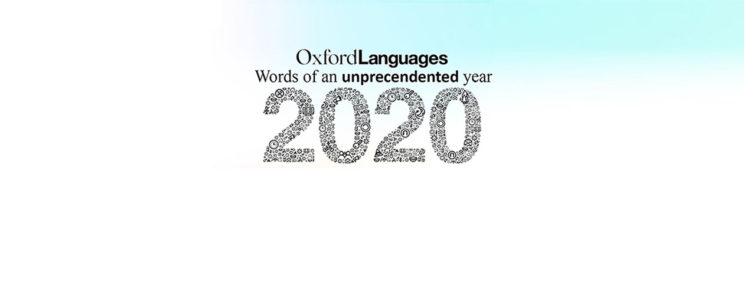
Bushfires. A global pandemic. Lockdown. Economic recession. Racial injustice. International protests. A pivotal election. For over a decade, we have selected a word or expression that captures the ethos, mood or preoccupations of the last 12 months, driven by data showing the ways in which words have been used. But this year, how could we pick a word, or even a shortlist, to summarize the ways in which we’ve been continually knocked off our axis?
Instead, today we released a comprehensive report entitled “Words of an Unprecedented Year” which tracks some of the new words and most significant language trends to have emerged across a truly unique year. The report shows how “Covid-19” spread across the world, not just epidemiologically but through our language, becoming one of the most used nouns of the year, despite only being coined in February. It maps how we went into ”lockdown” in some countries and were asked to “shelter-in-place” in others, while “circuit breakers” made their way from Singapore to Western Europe. It marks the moment in which the term “Black Lives Matter” surged back into our collective consciousness and “Karens” made a name for themselves, while the use of “systemic racism” increased by 1,623%, compared to last year. And, as the year ground on, our conversations shifted to the political, with words such a “mail-in” increasing by 3000% during the run-up to and uncertainty of the US election.
The report makes for fascinating reading, but how do we go about selecting these words? Like all of our lexical efforts, the process is driven by data. We observe how people wield their words, how they flex them and merge them, how they pick them up and drop them again, and we record all of this objectively. We analyse huge corpus databases to understand how words are being used, when new words are being born, and when others are slipping out of popular use. This data captures real word uses of English around the world, whether in North America or the Caribbean, East or West Africa, Southeast Asia, or Australia, and helps our expert lexicographers to identify trends. We then examine these trends to identify which words truly encapsulate the events of the year.
To be considered for Word of the Year, we’re looking for words where the evidence shows it has emerged, changed, or grown in a significant way in this year in particular, and which captures a certain collective feeling about the time we’ve just experienced. For example, in 2016, when “post-truth” was named Word of the Year, we’d lived through a year in which fake news was hitting the headlines, quite literally, and public trust in institutions was plummeting. It’s always difficult to whittle down a shortlist of words that capture the breadth of events that take place within any given year. This year, our data showed us that the way we use certain words and the new words that emerged were so radically different and prolific that we have a much more detailed story to share.
And that story paints a picture: Imagine a historian in 50 years’ time—to understand what 2020 was about they would need to look no further than our language. They would see “coronavirus” replace “time” as the most commonly used noun in the English language, they would see “social distancing” become the norm, and the hope of “re-opening.” They’d see the growth of “cancel culture,” the political tension surrounding elections the world over, and thoughts turn to environmental sustainability and the future as we turn our attention to rebuilding. By releasing this longer form piece of language research, I’m hopeful that we can bring a greater understanding of both the language and our global experience to this unprecedented year.
If you’d like to know more, I invite you to join me and my colleagues, Fiona McPherson and Kate Wild, for a webinar on 10 December where we’ll give an overview of our corpus analysis-based approach to monitoring language, and this year’s particular challenges of keeping track of rapid language developments.
Hello everyone. Originally, this post was supposed to be devoted to the year 1978, however something came up, and by something, I mean this 2.2 million-dollar, 5,420 sq ft 4 bed/4.5 bath house in Colt’s Neck, NJ.
You see, usually, when a listing goes viral, I’m content to simply retweet it with a pithy comment, but this house genuinely shook something in me, genuinely made me say “what the (expletive)” out loud. It is only fair to inflict this same suffering onto all of you, hence, without further ado:
Looks normal, right? Looks like the same low-brow New Jersey McMansion we’re all expecting, right? Oh, oh dear, you couldn’t be more wrong.
Guess who’s making a list and checking it twice?
Guess who’s gonna find out who’s naughty or nice?
Guess who’s coming to town?
Guess who’s coming to town to drag your ass into hell?
A gentle reminder that it is not yet Thanksgiving.
But oh. Oh. It continues:
If you’re wondering what’s happening here, you’re not alone, and sadly there is no convenient way to find out via a kind of haunted house hotline or something.
I can’t even label these rooms because frankly I’m not even sure what they are. All I am sure of is that I want out of them as soon as humanly possible.
How is it that a room can simultaneously threaten, frighten, and haunt me? Me, of all people!
My eyes do not know where to go here. They go to the window, they go to the fireplace, they go to the massive mound of fake plant and statuary currently gorging on the leftmost corner of the room, they go to my hands, which are shaking.
“Hello, I would like to get in touch with the Ministry of Vibes? Yes, I’ll hold.”
I haven’t been this afraid of a shower since I went to Girl Scout camp in the fifth grade and there was a brown recluse spider in the camp shower and I screamed until the counselor came in and told me it was only a wolf spider but it turns out those still bite you and it hurts.
I love watching Still Images on my Television Set :)
Nobody make a sound. He’s watching you.
i spy with my evil eye:
:)
Their souls are trapped in these photographs forever :)
Okay, phew, we made it out alive. Here’s the back of the house I guess.
Well, I hope you’re as thoroughly disturbed as I am. Seriously, I’m going to have trouble sleeping. I mean, I already have trouble sleeping, but this is just making that existing problem so much worse.
There is a whole new slate of Patreon rewards, including: good house of the month, an exclusive Discord server, weekly drawings, monthly livestreams, a reading group, free merch at certain tiers and more!
Not into recurring donations but still want to show support? Consider the tip jar! (Tips are much appreciated since I am making a cross country move in two weeks!!!)
Or, Check out the McMansion Hell Store! Proceeds from the store help protect great buildings from the wrecking ball.
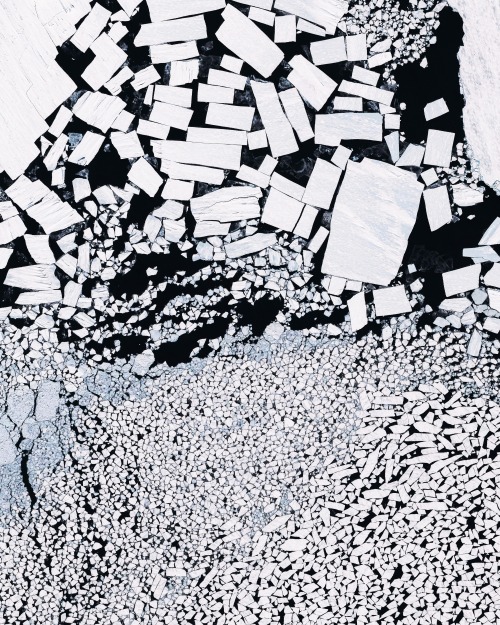
Sea ice breaks apart in various block sizes roughly 40 miles (64 kilometers) off the coast of Antarctica. Antarctic sea ice extends far north in the winter and retreats almost to the coastline every summer. In the 1980s, Antarctica lost 40 billion tons (36.3 billion metric tons) of ice every year. In the last decade, that figure was estimated at a staggering 252 billion tons (229 billion metric tons) per year.
This image and story is taken from our new book “Overview Timelapse”. Click below to learn more or order a copy!