07 Oct 08:04
by Fabio Lima, Mikhail A. Kabeshov, Duc N. Tran, Claudio Battilocchio, Joerg Sedelmeier, Gottfried Sedelmeier, Berthold Schenkel, Steven V. Ley
Abstract
We report herein a new method for the photoredox activation of boronic esters. Using these reagents, an efficient and high-throughput continuous flow process was developed to perform a dual iridium- and nickel-catalyzed C(sp2)–C(sp3) coupling by circumventing solubility issues associated with potassium trifluoroborate salts. Formation of an adduct with a pyridine-derived Lewis base was found to be essential for the photoredox activation of the boronic esters. Based on these results we were able to develop a further simplified visible light mediated C(sp2)–C(sp3) coupling method using boronic esters and cyano heteroarenes under flow conditions.

Solubility rules! A high-throughput flow process was developed to perform a dual Ir/Ni-catalyzed photoredox C(sp2)–C(sp3) coupling of boronic esters by circumventing solubility issues associated with potassium trifluoroborate salts. Formation of a Lewis acid–base adduct with a pyridine-derived Lewis base was found to be essential for the photoredox activation of the boronic esters (see scheme).
29 Sep 08:46
by Andreas Hafner, Paolo Filipponi, Lorenzo Piccioni, Mark Meisenbach, Berthold Schenkel, Francesco Venturoni and Joerg Sedelmeier

Organic Process Research & Development
DOI: 10.1021/acs.oprd.6b00281

28 Sep 19:53
by Luke D. Elliott, Malcolm Berry, Bashir Harji, David Klauber, John Leonard and Kevin I. Booker-Milburn

Organic Process Research & Development
DOI: 10.1021/acs.oprd.6b00277

27 Sep 08:39
by Magnus Rueping
Abstract
A new and efficient nickel-catalyzed decarbonylative borylation reaction of carboxylic acid esters with bis(pinacolato)-diboron has been developed. This transformation allows access to structurally diverse aryl as well as alkenyl and alkyl boronate esters with high reactivity, broad substrate scope, and excellent functional-group tolerance. Further experiments show that this protocol can be carried out on a gram scale and applied to orthogonal synthetic strategies.

A new and efficient nickel-catalyzed decarbonylative borylation reaction of carboxylic acid esters with bis(pinacolato)diboron was developed. This transformation allows access to structurally diverse aryl as well as alkenyl and alkyl boronate esters with high reactivity, broad substrate scope, and excellent functional-group tolerance. The protocol can be carried out on a gram scale and applied to an orthogonal synthetic strategy.
27 Sep 08:37
by Anaïs Bouisseau, Ming Gao, Michael C. Willis
Abstract
A one-pot three-step sequence involving Rh-catalyzed alkene hydroacylation, sulfide elimination and Rh-catalyzed aryl boronic acid conjugate addition gave products of traceless chelation-controlled hydroacylation employing alkyl aldehydes. The stereodefined β-aryl ketones were obtained in good yields with excellent control of enantioselectivity. Good variation of all three reaction components is possible.

From S to Ar: Alkyl aldehydes with chelating sulfide substituents are the substrates for an alkene hydroacylation/sulfide elimination/boronic acid conjugate addition sequence that provides β-aryl ketones in high yields with excellent enantioselectivities. Variation of all three reaction components is possible, and derivatization to a variety of useful heterocycles is demonstrated (see scheme).
27 Sep 08:37
by Magnus Rueping
Abstract
A mild approach for the decarboxylative aminomethylation of aryl sulfonates by the combination of photoredox and nickel catalysis through C−O bond cleavage is described for the first time. A wide range of aryl triflates as well as aryl mesylates, tosylates and alkenyl triflates afford the corresponding products in good to excellent yields.

A mild approach for the decarboxylative aminomethylation of aryl sulfonates by the combination of photoredox and nickel catalysis through C−O bond cleavage is described. A variety of aryl triflates, mesylates, tosylates, and alkenyl triflates react with α-amino acids to afford the corresponding aminomethylated products in good to excellent yields.
26 Sep 21:33
by Renata Marcia de Figueiredo, Jean-Simon Suppo and Jean-Marc Campagne

Chemical Reviews
DOI: 10.1021/acs.chemrev.6b00237

15 Sep 17:24
by Ze-Kun Yang, Dong-Yu Wang, Hiroki Minami, Hiroyuki Ogawa, Takashi Ozaki, Tatsuo Saito, Kazunori Miyamoto, Chao Wang, Masanobu Uchiyama
Abstract
Various aryl-, alkenyl-, and/or alkyllithium species reacted smoothly with aryl and/or benzyl ethers with cleavage of the inert C−O bond to afford cross-coupled products, catalyzed by commercially available [Ni(cod)2] (cod=1,5-cyclooctadiene) catalysts with N-heterocyclic carbene (NHC) ligands. Furthermore, the coupling reaction between the aryllithium compounds and aryl ammonium salts proceeded under mild conditions with C−N bond cleavage in the presence of a [Pd(PPh3)2Cl2] catalyst. These methods enable selective sequential functionalizations of arenes having both C−N and C−O bonds in one pot.

Cut and paste! Various aryl-, alkenyl-, and/or alkyllithium species smoothly reacted with aryl and/or alkyl ethers with cleavage of the inert C−O bond, catalyzed by an Ni catalyst. The coupling reaction between the aryllithium reagents and aryl ammonium salts also proceeded under mild conditions by a C−N bond cleavage in the presence of a Pd catalyst. These methods enable selective and sequential functionalizations of arenes having both C−N and C−O bonds, in one pot.
02 Sep 20:49
by Benjamin D. W. Allen, Matthew J. Connolly, Joseph P. A. Harrity

Pd Catalysis A readily available cyclic carbamate functions as a general precursor to a range of functionalized piperidine products using a new Pd-catalyzed annulation strategy. An asymmetric catalytic variant provides a rapid and efficient means to access these heterocycles with high to excellent levels of enantiocontrol. In addition, these richly functionalized compounds are amenable to further chemoselective elaboration. For more information, see the Communication by J. P. A. Harrity et al. on page 13000 ff.
23 Aug 10:17
by Kay Yeung, Rebecca E. Ruscoe, James Rae, Alexander P. Pulis, David J. Procter
Abstract
A highly enantio- and diastereoselective copper-catalyzed three-component coupling affords the first general synthesis of homoallylic amines bearing adjacent stereocenters from achiral starting materials. The method utilizes a commercially available NHC ligand and copper source, operates at ambient temperature, couples readily available simple imines, allenes, and diboranes, and yields high-value homoallylic amines that exhibit versatile amino, alkenyl, and boryl units.

A copper-catalyzed three-component coupling affords homoallylic amines with adjacent stereocenters from achiral starting materials with high enantio- and diastereoselectivity. The method utilizes a commercially available NHC ligand and copper source, operates at ambient temperature, couples simple imines, allenes, and diboranes, and yields valuable homoallylic amines with versatile amino, alkenyl, and boryl units.
18 Aug 08:05
by Ksenia S. Egorova, Valentine P. Ananikov
Abstract
Environmental profiles for the selected metals were compiled on the basis of available data on their biological activities. Analysis of the profiles suggests that the concept of toxic heavy metals and safe nontoxic alternatives based on lighter metals should be re-evaluated. Comparison of the toxicological data indicates that palladium, platinum, and gold compounds, often considered heavy and toxic, may in fact be not so dangerous, whereas complexes of nickel and copper, typically assumed to be green and sustainable alternatives, may possess significant toxicities, which is also greatly affected by the solubility in water and biological fluids. It appears that the development of new catalysts and novel applications should not rely on the existing assumptions concerning toxicity/nontoxicity. Overall, the available experimental data seem insufficient for accurate evaluation of biological activity of these metals and its modulation by the ligands. Without dedicated experimental measurements for particular metal/ligand frameworks, toxicity should not be used as a “selling point” when describing new catalysts.

Heavy weights versus the light weights: A comparison of available data on biological activity of metals commonly used in catalysis suggests that the assumption of toxic heavy metals and benign lighter metals should be re-evaluated. The available experimental data are insufficient for accurate evaluation of biological activity of these metals. Therefore, without dedicated experimental measurements, toxicity should not be used as a “selling point” when describing new catalysts.
14 Jul 07:21
by Melissa Moss, Xinping Han, Joseph M. Ready
Abstract
Organozirconocenes are versatile synthetic intermediates that can undergo carbonylation to yield acyl anion equivalents. Zirconocene hydrochloride ([Cp2ZrHCl]) is often the reagent of choice for accessing these intermediates but generates organozirconocenes only from alkenes and alkynes. This requirement eliminates a broad range of substrates. For example, organozirconocenes in which the zirconium center is bonded to an aromatic ring, a benzylic group, or an alkyl group that possesses a tertiary or quaternary carbon atom α to the carbon–zirconium bond can not be formed in this way. To provide more generalized access to acyl zirconium reagents, we explored the transmetalation of Grignard reagents with zirconocene dichloride under a CO atmosphere. This protocol generates acyl zirconium(IV) complexes that are inaccessible with the Schwartz reagent, including those derived from secondary and tertiary alkyl and aryl Grignard reagents.

An inclusive approach: Acyl zirconocenes [Cp2ZrCl(COR)] are valuable acyl anion equivalents in synthetic chemistry. Traditionally, they have been prepared by the hydrozirconation of alkenes or alkynes, thus precluding the generation of aryl, benzyl, tertiary alkyl, or branched acyl zirconocenes. Now a zirconium-mediated carbonylative coupling of Grignard reagents is described that involves previously inaccessible zirconocene intermediates (see scheme).
07 Jul 08:25
by Aymeric P. Colleville, Richard A. J. Horan, Sandrine Olazabal and Nicholas C. O. Tomkinson

Organic Process Research & Development
DOI: 10.1021/acs.oprd.6b00117

31 May 16:10
by Joshua P. Barham, Graeme Coulthard, Katie J. Emery, Eswararao Doni, Florimond Cumine, Giuseppe Nocera, Matthew P. John, Leonard E. A. Berlouis, Thomas McGuire, Tell Tuttle and John A. Murphy

Journal of the American Chemical Society
DOI: 10.1021/jacs.6b03282

15 Apr 13:57
Green Chem., 2016, 18,3804-3807
DOI: 10.1039/C6GC00200E, Paper
Sabine Fenner, Lutz Ackermann
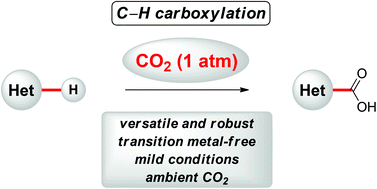
The C-H carboxylation of heteroarenes was achieved under transition metal-free reaction conditions with naturally abundant CO2 as the C1 source at relatively low temperature.
The content of this RSS Feed (c) The Royal Society of Chemistry

27 Feb 16:18
Green Chem., 2016, 18,2604-2608
DOI: 10.1039/C6GC00402D, Communication
Lijun Gu, Wei Wang, Jiyan Liu, Ganpeng Li, Minglong Yuan
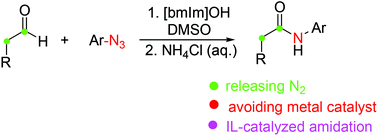
A [bmIm]OH-catalyzed amidation of azides and aldehydes is reported. The overall transformation involves azide-enolate cycloaddition, which subsequently undergoes rearrangement to give amides.
The content of this RSS Feed (c) The Royal Society of Chemistry

29 Jan 08:20
by Zhixiong Ruan, Sebastian Lackner, Lutz Ackermann
Abstract
The C−H alkylation of aniline derivatives with both primary and secondary alkyl halides was achieved with a versatile nickel catalyst of a vicinal diamine ligand. Step-economic access to functionalized 2-pyrimidyl anilines, key structural motifs in anticancer drugs, is thus provided. The C−H functionalization proceeded through facile C−H activation and SET-type C−X bond cleavage with the assistance of a monodentate directing group, which could be removed in a traceless fashion.

One for all: An inexpensive nickel catalyst enables the C−H alkylation of pyrimidyl anilines with both primary and secondary alkyl halides. The directing group (DG) could be easily removed in a traceless fashion, and the products contain key structural motifs of important anticancer drugs.
28 Jan 10:56
by Liana Hie, Noah F. Fine Nathel, Xin Hong, Yun-Fang Yang, Kendall N. Houk, Neil K. Garg
Abstract
We report the first catalytic method for activating the acyl C−O bonds of methyl esters through an oxidative-addition process. The oxidative-addition adducts, formed using nickel catalysis, undergo in situ trapping to provide anilide products. DFT calculations are used to support the proposed reaction mechanism, to understand why decarbonylation does not occur competitively, and to elucidate the beneficial role of the substrate structure and the Al(OtBu)3 additive on the kinetics and thermodynamics of the reaction.

The acyl C−O bonds of methyl esters are activated through a nickel-catalyzed oxidative-addition process. The putative oxidative-addition adducts are trapped in situ to provide anilides. DFT calculations support the proposed mechanism, explain why decarbonylation does not occur competitively, and elucidate the beneficial role of Al(OtBu)3 on the kinetics and thermodynamics of the reaction.
22 Jan 14:26
by Philipp M. Holstein, David Dailler, Julien Vantourout, Janah Shaya, Anthony Millet, Olivier Baudoin
Abstract
A variety of strained α-alkylidene-γ-lactams were synthesized by palladium(0)-catalyzed intramolecular C(sp3)−H alkenylation from easily accessible acyclic and monocyclic bromoalkene precursors. These lactams are valuable intermediates for accessing various classes of mono- and bicylic alkaloids containing a pyrrolidine ring, as illustrated with the synthesis of an advanced model of the marine natural product plakoridine A and of the indolizidine alkaloid δ-coniceine.

Strain away: A variety of strained α-alkylidene-γ-lactams were synthesized from easily accessible acyclic and monocyclic bromoalkene precursors. These lactams are valuable intermediates for accessing various classes of mono- and bicylic alkaloids containing a pyrrolidine ring, as illustrated with the synthesis of an advanced model of the marine natural product plakoridine A and of the indolizidine alkaloid δ-coniceine.
caohua and -1 others like this
21 Jan 08:04
by Bijay Shrestha, Surendra Thapa, Santosh K. Gurung, Ryan A. S. Pike and Ramesh Giri

The Journal of Organic Chemistry
DOI: 10.1021/acs.joc.5b02077

16 Jan 15:07
by Alba Millán, James R. Smith, Varinder K. Aggarwal
Abstract
Tetrahydropyrans are common motifs in natural products and have now been constructed with high stereocontrol through a three-component allylboration-Prins reaction sequence. This methodology has been applied to a concise (13 steps) and efficient (14 % overall yield) synthesis of the macrolide (−)-clavosolide A. The synthesis also features an early stage glycosidation reaction to introduce the xylose moiety and a lithiation-borylation reaction to attach the cyclopropyl-containing side chain.

Growing complexity: A highly efficient and diasteroselective three-component allylboration–Prins reaction serves to construct the highly functionalised THP-ring of (−)-clavosolide A from simple starting materials. An early stage diasteroselective glycosidation and a late stage lithiation–borylation are used to complete the synthesis of this complex natural product in just 13 steps from ethanol in 14 % overall yield.
16 Jan 13:44
by José A. Fernández-Salas, Andrew J. Eberhart and David J. Procter

Journal of the American Chemical Society
DOI: 10.1021/jacs.5b12579

04 Jan 17:38
Chem. Sci., 2016, 7,2302-2307
DOI: 10.1039/C5SC04062K, Edge Article

Open Access
Emma E. Blackham, Jonathan P. Knowles, Jonathan Burgess, Kevin I. Booker-Milburn
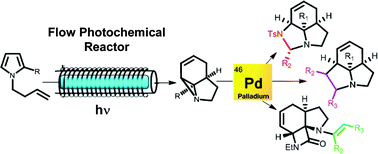
The powerful combination of photochemistry and catalysis transforms simple pyrroles into complex polycyclic structures in just two steps. Initial formation of highly reactive aziridines enables new Pd-catalysed cascade sequences, forming a range of polyheterocycles including tricyclic [small beta]-lactams.
The content of this RSS Feed (c) The Royal Society of Chemistry

02 Jan 16:12
by James D. Firth, Peter O’Brien and Leigh Ferris

Journal of the American Chemical Society
DOI: 10.1021/jacs.5b11288

29 Dec 23:41
by Ranjana Bisht and Buddhadeb Chattopadhyay

Journal of the American Chemical Society
DOI: 10.1021/jacs.5b11683

29 Dec 23:35
by Sureshbabu Guduguntla, Valentín Hornillos, Romain Tessier, Martín Fañanás-Mastral and Ben L. Feringa

Organic Letters
DOI: 10.1021/acs.orglett.5b03396

29 Dec 23:26
by Weilong Xie, Sukbok Chang
Abstract
New reactivity of a [Cu(NHC)] (NHC=N-heterocyclic carbene) catalyst is disclosed for the efficient C![[BOND]](http://onlinelibrarystatic.wiley.com/undisplayable_characters/00f8ff.gif) H allylation of polyfluoroarenes using allyl halides in benzene at room temperature. The same catalyst system also promotes an isomerization-induced alkenylation of initially the generated allyl arenes when the reaction is run in tetrahydrofuran. Significantly, not only electron-deficient but also electron-rich (hetero)arenes undergo this double-bond migration process, thus leading to alkenylated products. The present system features mild reaction conditions, broad scope with respect to the arene substrates and allyl halide reactants, good functional-group tolerance, and high stereoselectivity.
H allylation of polyfluoroarenes using allyl halides in benzene at room temperature. The same catalyst system also promotes an isomerization-induced alkenylation of initially the generated allyl arenes when the reaction is run in tetrahydrofuran. Significantly, not only electron-deficient but also electron-rich (hetero)arenes undergo this double-bond migration process, thus leading to alkenylated products. The present system features mild reaction conditions, broad scope with respect to the arene substrates and allyl halide reactants, good functional-group tolerance, and high stereoselectivity.

Something new for Cu: New reactivity of a [Cu(NHC)] (NHC=N-heterocyclic carbene) catalyst is disclosed for the direct CH allylation and alkenylation of both electron-deficient polyfluoroarenes and electron-rich heteroarenes. This catalyst system leads to mild reaction conditions, broad scope with respect to the arenes and allyl halides, good functional-group tolerance, and high stereoselectivity.
ease, 王飞 and one other like this
04 Dec 12:37
by Calum W. Muir, Julien C. Vantourout, Albert Isidro-Llobet, Simon J. F. Macdonald and Allan J. B. Watson

Organic Letters
DOI: 10.1021/acs.orglett.5b03030

03 Dec 17:48
Chem. Commun., 2015, Accepted Manuscript
DOI: 10.1039/C5CC08881J, Communication
Keith Gordon Andrews, Declan Summers, Liam Donnelly, Ross Matthew Denton
We report a catalytic reductive alkylation reaction of primary or secondary amines with carboxylic acids. The two-phase process involves silane mediated direct amidation followed by catalytic reduction.
The content of this RSS Feed (c) The Royal Society of Chemistry

01 Dec 10:13
Green Chem., 2016, 18,14-19
DOI: 10.1039/C5GC02371H, Perspective
Fabrice Gallou, Nicholas A. Isley, Adnan Ganic, Ulrich Onken, Michael Parmentier
Process Mass Intensity (PMI) for (a) process in organic solvents, (b) process in water with surfactants.
The content of this RSS Feed (c) The Royal Society of Chemistry