Shared posts

11 Sep 23:17

A Loud Sound Just Shut Down a Bank's Data Center for 10 Hours | Motherboard

by brandizzi

ING Bank’s main data center in Bucharest, Romania, was severely damaged over the weekend during a fire extinguishing test. In what is a very rare but known phenomenon, it was the loud sound of inert gas being released that destroyed dozens of hard drives. The site is currently offline and the bank relies solely on its backup data center, located within a couple of miles’ proximity.

“The drill went as designed, but we had collateral damage”, ING’s spokeswoman in Romania told me, confirming the inert gas issue. Local clients were unable to use debit cards and to perform online banking operations on Saturday between 1PM and 11PM because of the test. “Our team is investigating the incident,” she said.

The purpose of the drill was to see how the data center's fire suppression system worked. Data centers typically rely on inert gas to protect the equipment in the event of a fire, as the substance does not chemically damage electronics, and the gas only slightly decreases the temperature within the data center.

The gas is stored in cylinders, and is released at high velocity out of nozzles uniformly spread across the data center. According to people familiar with the system, the pressure at ING Bank's data center was higher than expected, and produced a loud sound when rapidly expelled through tiny holes (think about the noise a steam engine releases).

The bank monitored the sound and it was very loud, a source familiar with the system told us. “It was as high as their equipment could monitor, over 130dB”.

Sound means vibration, and this is what damaged the hard drives. The HDD cases started to vibrate, and the vibration was transmitted to the read/write heads, causing them to go off the data tracks.

“The inert gas deployment procedure has severely and surprisingly affected several servers and our storage equipment,” ING said in a press release.

There is still very little known about how sound can cause hard drive failure. One of the first such experiments was made by engineer Brendan Gregg, in 2008, while he was working for Sun's Fishworks team. He recorded a video in which he explains how shouting in a data center can result in hard drives malfunction.

In ING Bank’s case, it was “like putting a storage system next to a [running] jet engine,” a source told me.

Researchers at IBM are also investigating data center sound-related inert gas issues. “[T]he HDD can tolerate less than 1/1,000,000 of an inch offset from the center of the data track—any more than that will halt reads and writes”, experts Brian P. Rawson and Kent C. Green wrote in a paper. “Early disk storage had much greater spacing between data tracks because they held less data, which is a likely reason why this issue was not apparent until recently.”

Siemens also published a white paper a year ago saying that its tests show that “excessive noise can have a negative impact on HDD performance”. Researchers said this negative impact may even begin at levels below 110dB.

“It can now be established with a high degree of certainty that the faults in storage systems as a result of an inert gas extinguishing systems discharge were caused by the impact of high noise levels on the hard disk drives,” according to Siemens.

The Bank said it required 10 hours to restart its operation due to the magnitude and the complexity of the damage. A cold start of the systems in the disaster recovery site was needed. “Moreover, to ensure full integrity of the data, we’ve made an additional copy of our database before restoring the system,” ING’s press release reads.

Over the next few weeks, every single piece of equipment will need to be assessed. ING Bank’s main data center is compromised “for the most part”, a source told us.

Let's block ads! (Why?)

11 Sep 23:17

Watch Bacteria Evade Antibiotics And Transform Into Superbugs : Shots - Health News : NPR

by brandizzi
Adam Victor Brandizzi

Basicamente, filmaram a evolução :)

Credit: Michael Baym, Roy Kishony, Rick Groleau, Tami Lieberman, Rick Groleau, Remy Chait/Harvard Medical School

If you've ever wanted to watch a superbug evolve before your very eyes, you're in luck. Researchers filmed an experiment that created bacteria a thousand times more drug-resistant than their ancestors. In the time-lapse video, a white bacterial colony creeps across an enormous black petri dish plated with vertical bands of successively higher doses of antibiotic.

The colony pauses when it hits the first band of antibiotic, creating a stark border between the white colony and the black petri dish. Then the bacteria start to edge their way into the toxic soup. More dots appear and they start growing, racing to the next, stronger band of antibiotic. The bacteria are evolving. After almost two weeks of real time have passed, they've become resistant to the strongest antibiotic and completely taken over the kitchen-table-sized petri dish.

We know dangerous bacteria are getting stronger all the time and that it's our fault because of our excessive and indiscriminate use of antibiotics. Each year, 23,000 people in the U.S. die as a result of superbug infections. But we typically don't get to see superbugs created.

For most people, evolution is just conceptual, says Tami Lieberman, an evolutionary microbiologist at MIT. She and her Ph.D. adviser, Roy Kishony at Harvard Medical School, wanted something that would make the evolution of superbugs seem more concrete. "The goal was to see evolution, not to abstract it," she says.

Their video and report were published Thursday in the journal Science.

By having the E. coli bacteria grow across bands of increasingly stronger doses of antibiotic, the scientists could make it look like evolution was marching across the dish. But the setup had another effect that the researchers didn't expect. The faster growing colonies of resistant bacteria were cutting off the growth of slower but more drug-resistant colonies and becoming more successful.

When bacteria evolve drug resistance, it usually comes at some kind of cost to the bug. In the presence of an antibiotic, faster growing colonies don't grow as robustly as the slower ones — but that often doesn't matter. If the strain wants to live on, it just needs to be the first to get to the next human or food source. "[This] phenomenon has been very, very tough to study classically," says Michael Baym, the postdoc who built the 4- by 2-foot petri dish in Kishony's lab. In his contraption, it's impossible to miss.

And if scientists can see it, maybe they can start to study it. Using something as simple as a giant petri dish like this could help scientists open up that spatial dimension that has been missing from the lab, says Pamela Yeh, a microbiologist at UCLA who was not involved in the experiment. "Hopefully this will put back in people's minds how important the spatial element can be."

It's possible that there's a lot of research that can be done by getting away from small, classic petri dishes, Yeh says. But for now, Kisony's 2-by-4 is mostly just a demonstration. Hopefully, a useful one, Lieberman says. "Getting more people to understand how quickly bacteria evolve antibiotic resistance might help people understand why they shouldn't be prescribed antibiotics. The drug resistance is not some abstract threat. It's real."

Let's block ads! (Why?)

11 Sep 23:14

In summary

https://www.oglaf.com/insummary/

11 Sep 13:35

Bicicleta, transporte alternativo ou alternativa de transporte

by Tiago de Thuin
A idéia da bicicleta como meio de transporte é algo que ganha cada vez mais corpo mundo afora. Em São Paulo, tornou-se controversa com a construção, pelo então prefeito Fernando Haddad, de centenas de quilômetros de ciclofaixas e algumas dezenas de quilômetros de ciclovias; a discussão se orientou por linhas político-partidárias, mas também entre aqueles que acharam absurda a redução do espaço dedicado ao automóvel e os defensores da bicicleta como transporte alternativo. Estes elencam benefícios incontestáveis: além do impacto sobre o meio ambiente ser infinitamente menor do que o de um carro, quem anda de bicicleta vê melhoras na sua saúde física e mental; numa mesma área de rua cabem muito mais bicicletas do que carros; bicicletas podem ser guardadas dentro de casa mesmo.

Se esses benefícios são tão incontestáveis, por que não vemos a bicicleta se massificar? Para além do poder de publicidade das grandes montadoras, acho que boa parte da resposta está na própria ideia de transporte alternativo. "Alternativo" remete a algo que se faz porque é melhor, porque é virtuoso, é certo. Mas bem, sinceramente, ninguém faz o que é certo. Não passamos fio dental todo dia, não fazemos o exercício nem comemos a comida que deveríamos. Alguns fazem, e parabéns - mas isso não altera o transporte em massa. Enquanto a bicicleta for vista como um transporte alternativo, ela não está sendo vista como alternativa de transporte. 

É claro que a bicicleta, sozinha, não é um meio de transporte suficiente para uma metrópole de 20 milhões de pessoas, em que muitos deslocamentos ordinários estão na casa das dezenas de quilômetros, muito menos para uma metrópole construída sobre morros, em que boa parte dos percursos é um sobe-e-desce sem fim, cansativo até para quem está a pé. Mas ela pode, sim, transportar literalmente milhões de pessoas, tirando das ruas milhões de carros, economizando bilhões de reais e milhares de vidas. Oito milhões de carros entopem as artérias da capital paulista; dois terços das viagens que esses carros percorrem estão dentro de um raio de 4km - ou seja, de um raio em que a bicicleta é superior ao carro em tempo de percurso. 

Para quem percorre grandes distâncias, por outro lado, uma das chaves para considerar a bicicleta uma alternativa de transporte de massa, e não apenas um transporte alternativo está na última perna, ou última milha, combinada com os grandes troncos de transporte ferroviário (e, em menor escala busãoviário). A bicicleta não vai conduzir muita gente de Itaquera à Paulista, mas ela pode fazer com que muito mais gente esteja "ao lado" das estações de metrô respectivas, ampliando a área coberta por esses troncos e aliviando a lotação dos ônibus alimentadores. 

O efeito não é pouca coisa. Vamos supor que o raio em que se está a uma distância conveniente de andar até uma estação é de uns 600m, o equivalente a fazer com que pessoas andem até um quilômetro para pegar o metrô. E vamos imaginar que o raio equivalente, de bicicleta, seja de uns 3km. Parecem suposições razoáveis; uma pessoa normal pedala umas quatro ou cinco vezes mais rápido do que anda, com o mesmo esforço.Em ambos os casos, você está falando de menos de vinte minutos. 

 No primeiro raio, em volta da estação Itaquera, moram 12.025 pessoas. No segundo, 313.801. Pensar nas pessoas chegando ao trem de bicicleta, ao invés de a pé, aumentou em 25x a quantidade de gente que pode chegar na estação, convenientemente e sem depender de uma rede de ônibus. Para todo o metrô (sem contar a CPTM) , passamos de 1,3 milhões de pessoas a menos de 600m de uma estação para 5 milhões de pessoas que podem alcançá-lo de bicicleta - e na CPTM, em que a distância entre as estações é maior e não há sobreposição, essa conta é ainda maior. Ao todo, a menos de 3km de uma estação ferroviária moram 12,4 milhões de pessoas, mais da metade de todos os habitantes da região metropolitana de São Paulo. 

E não é só o trajeto casa-estação que seria afetado pela massificação da bicicleta como extensão dos trilhos. Olhemos os dois maiores parques da cidade, o Ibirapuera e o Parque do Carmo. O segundo está a pouco menos de quatro quilômetros do metrô, o primeiro a pouco mais de três. Meia hora, quarenta minutos, talvez até uma hora para um pedestre um pouco mais lento ir até o Carmo. Mas dez, quinze, talvez vinte minutos de bicicleta. Dentro do centro expandido, não há lugar nenhum em que não se possa chegar ao metrô pedalando. E a bicicleta é o jeito mais barato de conseguir essa penetração, tanto diretamente quanto em termos de impactos; os impactos da bicicleta na vida das pessoas são positivos ao invés de negativos, e o custo de cosntrução da infraestrutura é bem menor do que aquele para implantar corredores de ônibus (e muito menor ainda do que o de construir metrô, especialmente subterrâneo). 

Se nos parágrafos acima nós vemos que a bicicleta teria potencial para substituir milhões de carros e de ônibus locais, por que isso não acontece, hoje? Porque não é barato, como exige a categoria de "transporte alternativo." Não na escala metropolitana. Essa é, afinal, das diferenças entre algo ser encarado como transporte alternativo, da paz, legal, e alternativa de transporte real: a escala dos gastos e ações envolvidas. É muito mais barato fazer ciclovia do que metrô, mas para fazer a infraestrutura cicloviária ser alternativa de transporte, ainda temos que falar em gastos vultosos, sim. Os gastos atuais, apesar de toda a controvérsia, ainda são periféricos, ainda são uma coisinha que a prefeitura toca de lado. Um hobby, e não trabalho. (Não é de se espantar que muita ciclovia viva cheia de gente correndo para ficar com o cooper feito.) Para não falar, claro, do automóvel particular: a mera manutenção do asfalto paulistano recebeu um investimento da casa dos 6 bilhões.

O principal: você teria de ter ciclovias e ciclofaixas seguras para o uso de uma grande quantidade de pessoas, inclusive pessoas que não estão particularmente dispostas a correr riscos. Isso não é verdade quanto ao sistema atual, em que a maioria das ciclovias se assemelha a um jogo de super mario brothers, com pulos e obstáculos, enquanto as ciclofaixas têm metade de sua largura ocupada por sarjetas fundas; pistas para ultrapassagem são algo de que não se ouve falar, e mesmo a mera passagem segura em direções opostas frequentemente não existe, fora os casos extremos - mas ocupando pontos críticos - como o da ciclovia da Rebouças, mais estreita que um guidão. 

Teriam que ser reformulados, também, os sistemas de bicicleta pública. Os dois sistemas (incompatíveis entre si) usados em São Paulo, juntos, não chegam a ter 250 estações, com menos de duas mil bicicletas no total. Imaginando uma rotatividade perfeita, com as bicicletas sendo usadas o dia inteiro por quinze minutos de cada vez, isso dá pra transportar 150.000 pessoas. Menos de um terço da quantidade de gente que mora entre 0,6 e 3 quilômetros da estação Consolação. A título de comparação, em Bruxelas, que tem três milhões de habitantes, são 5000 bicicletas em 346 estações. Em Paris, com metade da população de São Paulo, são 18.000 bicicletas em 1230 estações. Em Hangzhou, com mais ou menos a mesma população que a terra da Garoa, são 78000 bicicletas em 2950 estações.  E nenhuma dessas cidades está saturada. Em todas elas há planos de expansão. 

O sistema de bicicletas públicas não tem que ser apenas expandido. Tem que ser reformulado; além das estações espalhadas pelos bairros mais ricos de maneira quase aleatória (respondendo ao interesse do patrocinador em ter sua marca anunciada), deveria haver grandes estações, com centenas de pontos, junto às estações do metrô e CPTM nos bairros centrais, de modo que você já pudesse sair do metrô e pegar sua bicicleta. E estações médias, com pelo menos 20-70 bicicletas, em locais de grande atração - shoppings, grandes prédios de escritório, faculdades, etc. Sim, ao contrário do modelo atual, financiado e pautado por anúncios, isso exigiria investimento da prefeitura e do estado - mas continuaria sendo uma opção barata de transporte. 

Além das bicicletas públicas, seria necessária a construção de grandes bicicletários, em todas as estações possíveis, especialmente na outra ponta, na periferia, em que as bicicletas públicas veriam menos uso e mais gente está saindo de casa para a estação. De novo, não estamos falando de meia dúzia de postes, e sim de centenas de milhares de pontos de estacionamento. De novo, isso é dinheiro de verdade para ser investido pelo poder público, mesmo sendo mais barato do que outros modos. Nem é trivial falar em adicionar ainda mais gente para os troncos, muitos dos quais já estão bastante cheios. 

A topografia da cidade, tão citada pelos opositores, é um problema, verdade (lembrando: não estamos falando de gente que "anda de bicicleta," que dirá que rápido você se acostuma), e puxa soluções que vão das óbvias e caras (bicicletas elétricas, como as que já estão sendo testadas em sistemas de bicicleta pública aqui e acolá, inclusive em Lima, no Peru, para ficar em uma cidade quase vizinha e mais pobre que SP). 

Toda essa infraestrutura é, talvez, mais importante do que as próprias ciclovias, na medida em que ajuda a gerar massa crítica. Quando o número de bicicletas é grande o bastante, o trânsito se acostuma a elas de tal modo que elas podem ocupar as ruas sem problemas (aliás, ajudando a reduzir velocidades máximas e acidentes no trânsito em geral), e a própria ciclovia se torna quase desnecessária. 

De novo: a bicicleta pode ser uma das alternativas de transporte mais baratas de se implantar numa cidade, tanto no momento da implantação quanto, eventualmente, pelas economias relacionadas à poluição e à manutenção das vias. Mas para tal, é preciso que ela abandone as vestes de transporte alternativo. Não é a bicicleta do ciclista que tem potencial pra retomar (sim, retomar; bicicletas são mais antigas que o automóvel, afinal, e já foram o principal meio de transporte urbano) as ruas, mas sim a bicicletinha de vó, a caloi ceci, a mama-chan. E para que ela seja alternativa de transporte, tem que ser tratada como tal pelos governos, não como hobby, não como algo virtuoso a se fazer com o que sobra, enquanto o grosso das verbas vai para os transportes motorizados. 

10 Sep 21:30

Can trivia help us to be less ignorant of our own ignorance?

by Tim Harford
Undercover Economist

In the early hours of April 20 1995, police knocked on the door of McArthur Wheeler and arrested him for holding-up two Pittsburgh banks the previous day. Wheeler could hardly have been surprised that the police were on to him: wearing no mask or disguise, he had ambled into the banks during business hours and brandished a gun in full view of security cameras. Nevertheless, he was astonished, protesting “but I wore the juice!” Wheeler had formed the erroneous belief that lemon juice rendered people invisible on video.

Wheeler is now a legend in psychology, since it was his regrettable escapade that inspired two psychologists, David Dunning and Justin Kruger, to figure out whether we have a good sense of our own strengths and weaknesses. Dunning and Kruger set tests of grammar, logic and even having a sense of humour to a group of undergraduates. Then they asked them how they stacked up to others in the group. Was their grasp of logic and grammar better or worse than average? Were they better able than other students to distinguish funny from unfunny jokes?

Most students thought that they were above-average logicians, grammarians and wits but the Dunning-Kruger effect is not mere overconfidence. The competent people in the study had a reasonable grasp of where they stood in the pecking order. The incompetent ones were blissfully unaware of their incompetence. The good students knew that they were good; the bad students had no clue that they were bad.

Perhaps because Dunning and Kruger opened their 1999 research paper with the story of McArthur Wheeler, the Dunning-Kruger effect has now become a popular insult in some corners of the internet. We chuckle at people who are far too stupid to know that they are stupid. Unfortunately, such mockery misses the subtlety and universality of the effect. All of us are incompetent in some areas. When we stray into them, the Dunning-Kruger effect may be lurking.

The fundamental problem is a person trying to diagnose his own incompetence is — almost by necessity — likely to be missing the skills needed to make that diagnosis. Not knowing much grammar means you’re poorly placed to diagnose your ignorance of grammar.

There is, of course, a cure for the curse of Dunning-Kruger: asking for advice or criticism. On the question of whether lemon juice is an invisibility potion as well as an invisible ink, McArthur Wheeler could have benefited from a second opinion. Doing so, alas, would have required him to doubt his own reasoning on the matter; it would also have required him to identify a bright-enough advisor. And all of us — especially high-status people — face the problem that when we are sorely mistaken, our friends and colleagues are often too polite to tell us. Still: two heads are better than one.

In a new book, Head in the Cloud (US) (UK), William Poundstone argues for a fresh defence against Dunning-Kruger catastrophes: trivia. Poundstone believes that a broad base of knowledge helps to clue us in to the times when we are stumbling towards a humbling; if we know a little about a lot, we have more opportunities to catch ourselves in the middle of a Dunning-Kruger moment.

Poundstone’s own research suggests that there’s a correlation between income and general knowledge, over and above what might be expected from education levels. One of many plausible explanations: people with a good grasp of general trivia are people who are paying attention to the world.

This is highly speculative stuff, but thought-provoking. Poundstone is pushing against the tide: educational fashion, as well as common sense, suggests that in the age of the smartphone it is better to focus on critical thinking than on rote memorisation. But he may have a point; any particular fact can be looked up, but without a knowledge base who knows where to start?

Recently, psychologist Sarah Tauber and four fellow researchers posed a long series of trivia questions to hundreds of young people (their average age was 20). An example: “What is the name of the large hairy spider that lives near bananas?” Despite a generous marking system (for example, “teranchula” was considered correct), performance was unimpressive. Fewer than half the subjects knew which country’s capital was Baghdad, or what the spear-like object was that was thrown around in athletics contests. Only 43 per cent knew that the hairy spider was a tarantula, however spelt.

As for more challenging pieces of trivia, the performance was astonishingly bad. Name Flash Gordon’s girlfriend, or the author of The Brothers Karamazov, or the first man to run a four-minute mile, or the mountain range separating Europe from Asia? Out of hundreds of participants, nobody knew. Nobody. There were 50 such questions, questions to which not a single person could venture a suitable guess. And these 20-year-olds were undergraduates, so presumably reasonably smart and ostensibly well educated.

It’s not that young people today are stupid. They’re the most educated generation in history, and their intelligence is higher, at least as measured by IQ tests. It’s just that there’s a lot they don’t know, and (as per Dunning-Kruger) a lot they don’t know they don’t know. I’m not sure that is a problem but it might be. As Poundstone points out, one thing you cannot Google is what you should be googling.

Written for and first published in the Financial Times.

It helps any new book to pick up some advance orders, so if you like my writing please consider pre-ordering my new book, “Messy” .(US) (UK) More to follow soon…

Free email updates

(You can unsubscribe at any time)

Email Address


10 Sep 17:55

Sign Play

by Greg Ross

Like any language, sign language partakes in jokes, puns, and wordplay. Dorothy Miles’ poem “Unsound Views” observes that hearing people seem to be slaves to their telephones. In English, there’s no obvious pun in the next-to-last line, “They live to serve their telephone God.” But in British Sign Language it runs

THEY LIVE RESPECT THAT TELEPHONE
HOLD-HANDSET
THIN-AERIAL-ON-HANDSET AERIAL-MOVES-UP GOD
TELEPHONE-AERIAL

“Here, the aerial on the telephone handset is signed with the ‘G’ handshape that refers to long, thin objects,” explains Rachel Sutton-Spence in Analysing Sign Language Poetry. “The BSL sign GOD is also made using a ‘G’ handshape, albeit in a different location, but when the aerial is moved up to the location where GOD is normally articulated, the pun elevates the telephone to the status of a god.”

One more: In Miles’ poem “Exaltation,” a stand of trees seems to part the sky “And let the peace of heaven shine softly through.” In the American Sign Language version, this can be glossed as ALLOW PEACE OF HEAVEN LIGHT-SHINES LIGHT/HAND-TOUCHES-HEAD. The form of the sign LIGHT is made with a fully open ‘5’ handshape, but in this context the handshape can be seen simply as a hand. “If LIGHT-TOUCHES-HEAD is interpreted as HAND-TOUCHES-HEAD, the obvious question is ‘Whose hand?’ and the obvious answer is ‘God’s.’ In many cultures, placing hands gently upon a person’s head is taken as a blessing.”

10 Sep 17:51

War and Peace

by Greg Ross

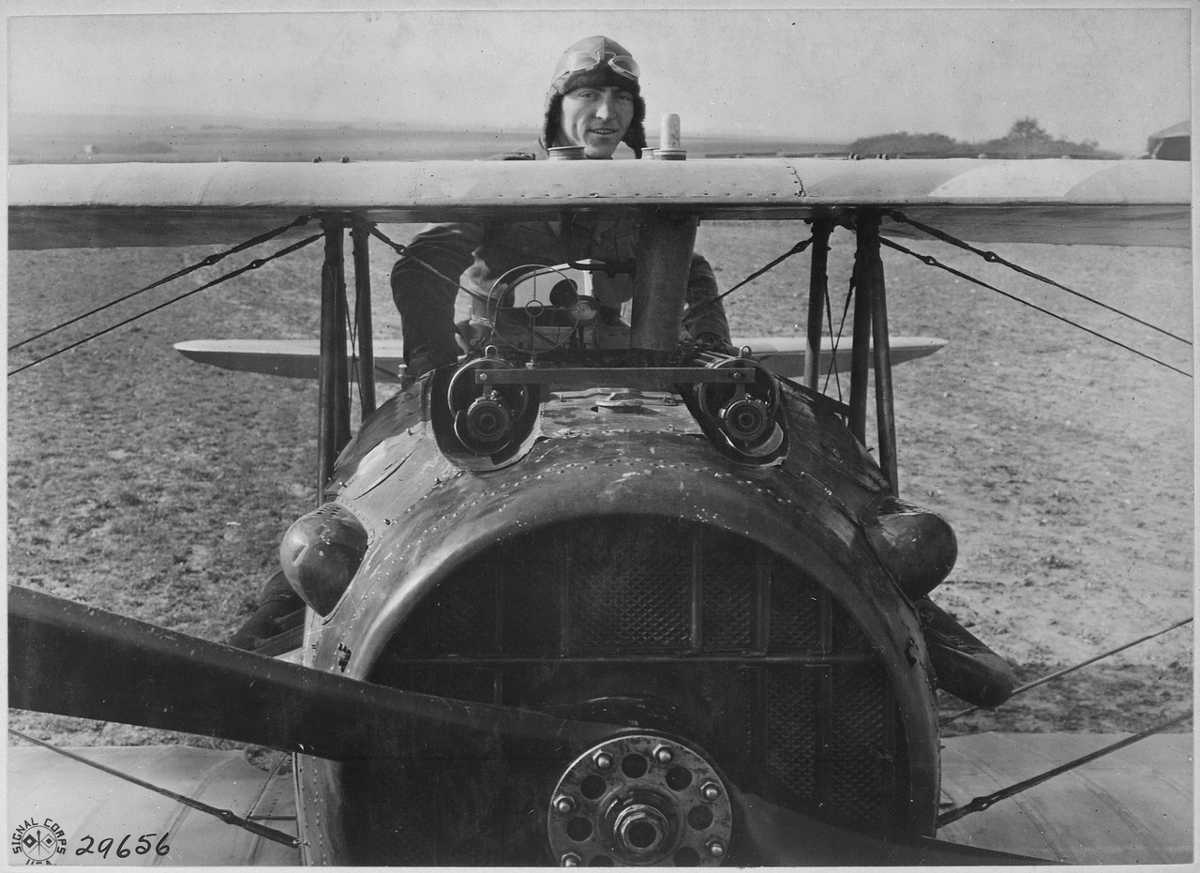
https://commons.wikimedia.org/wiki/File:First_Lieutenant_E._V._(Eddie)_Rickenbacker,_94th_Aero_Squadron,_American_ace,_standing_up_in_his_Spad_plane._Near..._-_NARA_-_530773.tif

On the morning of the World War I armistice, Nov. 11, 1918, American fighter ace Eddie Rickenbacker took off against orders and made his way to the front. He arrived at Verdun at 10:45 and flew out over the no-man’s-land between the armies. Less than 500 feet off the ground, “I could see both Germans and Americans crouching in their trenches, peering over with every intention of killing any man who revealed himself on the other side.”

I glanced at my watch. One minute to 11:00, thirty seconds, fifteen. And then it was 11:00 a.m. the eleventh hour of the eleventh day of the eleventh month. I was the only audience for the greatest show ever presented. On both sides of no-man’s land, the trenches erupted. Brown-uniformed men poured out of the American trenches, gray-green uniforms out of the German. From my observer’s seat overhead, I watched them throw their helmets in the air, discard their guns, wave their hands. Then all up and down the front, the two groups of men began edging toward each other across no-man’s-land. Seconds before they had been willing to shoot each other; now they came forward. Hesitantly at first, then more quickly, each group approached the other.

Suddenly gray uniforms mixed with brown. I could see them hugging each other, dancing, jumping. Americans were passing out cigarettes and chocolate. I flew up to the French sector. There it was even more incredible. After four years of slaughter and hatred, they were not only hugging each other but kissing each other on both cheeks as well.

Star shells, rockets and flares began to go up, and I turned my ship toward the field. The war was over.

(From his autobiography.)

10 Sep 17:50

A Cognitive Illusion

by Greg Ross
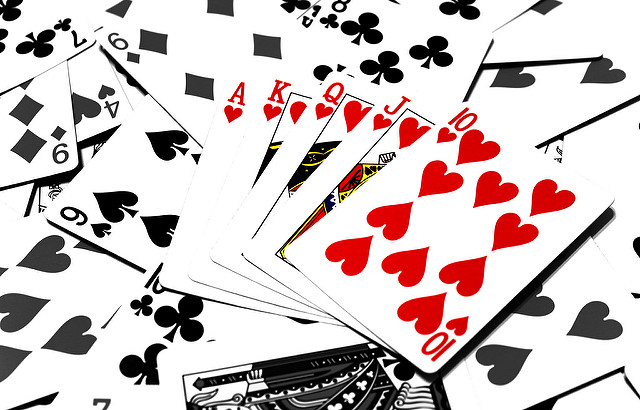
https://www.flickr.com/photos/minhimalism/5708719581
Image: Flickr

Given these premises, what can you infer?

  1. If there is a king in the hand then there is an ace, or if there isn’t a king in the hand then there is an ace, but not both.
  2. There is a king in the hand.

Practically everyone draws the conclusion “There is an ace in the hand.” But this is wrong: We’ve been told that one of the conditional assertions in the first premise is false, so it may be false that “If there is a king in the hand, then there is an ace.”

But almost no one sees this. Princeton psychologist Philip Johnson-Laird writes, “[Fabien] Savary and I, together with various colleagues, have observed it experimentally; we have observed it anecdotally — only one person among the many distinguished cognitive scientists to whom we have given the problem got the right answer; and we have observed it in public lectures — several hundred individuals from Stockholm to Seattle have drawn it, and no one has ever offered any other conclusion.” Johnson-Laird himself thought he’d made a programming error when he first discovered the illusion in 1995.

Why it happens is unclear; in puzzling out problems like this, we seem to focus on what’s true and neglect what might be false. Computers are much better at this than we are, which ironically might lead a competent computer to fail the Turing test. In order to pass as human, writes researcher Selmer Bringsjord, “the machine must be smart enough to appear dull.”

(Philip N. Johnson-Laird, “An End to the Controversy? A Reply to Rips,” Minds and Machines 7 [1997], 425-432.)

10 Sep 17:38

Why Do Tourists Visit Ancient Ruins Everywhere Except the United States?

Why Do Tourists Visit Ancient Ruins Everywhere Except the United States?


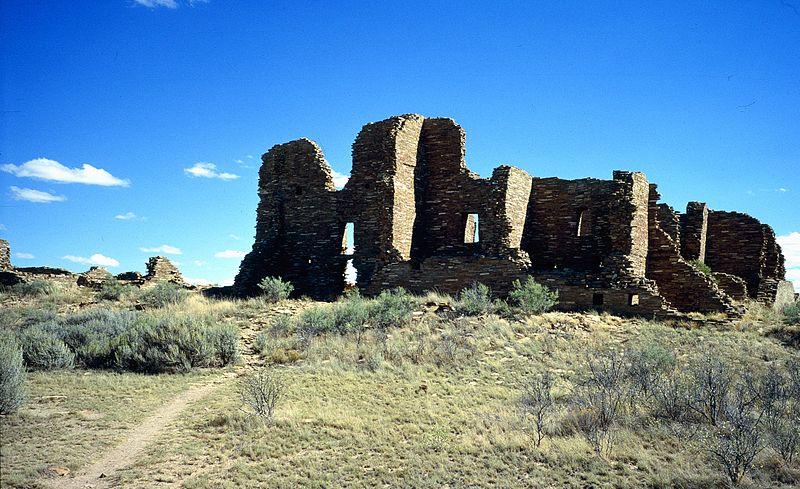
An image of the Cliff Palace in Mesa Verde by Andreas F. Borchert

In 1811, a young lawyer and journalist named Henry Brackenridge found the ruins of an ancient city near St. Louis. 

At the time, St. Louis was a small, young city that served as the gateway to the land acquired in the Louisiana Purchase. Americans knew little about the new territory, and Brackenridge was struck by the size of the ruins. “If the city of Philadelphia and its environs were deserted,” he wrote, “there would not be more numerous traces of human existence.” 

As archaeologist Timothy Pauketat has written, Brackenridge was standing on the site of what was once the Grand Plaza of Cahokia, a city inhabited in 1250 by some ten to twenty thousand Native Americans. Brackenridge believed he’d made a great discovery. He did not see ancient stone walls or worn foundations. Instead he marveled at the pattern of raised earth that resembled an urban grid, human bones, and mounds of soil formed into dozens of grassy pyramids up to 100 feet tall. 

“I was struck with a degree of astonishment,” Brackenridge recalled, “not unlike that which is experienced in contemplating the Egyptian pyramids.”

But the world ignored Brackenridge’s discovery, and Americans have not treated what Dr. Pauketat calls “Ancient America’s great city on the Mississippi” with reverence. Four-lane roads and highways surround and bisect Cahokia, the sprawl of East St. Louis covers more of the ancient site, and many of the earthen pyramids have been scraped away to use as infill. 

Cahokia has since been dignified with a state park and visitors center, but it’s not well known outside of Illinois and Missouri. It hardly attracts the number of visitors you’d expect for America’s version of the pyramids and the ruins of the country’s greatest, ancient city. 

The same is true of impressive and important American Indian sites like the pueblos of Chaco Canyon, New Mexico, and the pre-historic earthworks of Poverty Point in Louisiana. 

Americans travel to Machu Picchu, Petra, Troy, and Angkor Wat. So why do so few visit America’s own ruins?

The New World: A Crowded Place

The concept of tourists flockingto American Indian archeological sites may seem strange if you learned in school—like this author did—that America was sparsely inhabited wilderness before Europeans arrived. 

Through the 1950s, this was the consensus in academia. As journalist Charles C. Mann eloquently explains in 1491, a sweeping history of the Americas up to the arrival of Christopher Columbus, the most commonly cited estimate of North America’s population in 1491 was 1.15 million. That’s about the population of modern-day Rhode Island.

Yet early European colonists discovered that the areas they intended to settle were densely populated. When colonists like John Smith (of Pocahontas fame) established Jamestown, they became the neighbors of 14,000 Native Americans. As Mann writes, “The English were like the last people moving into a subdivision—they ended up with the least desirable property. Their chosen site was marshy, mosquito-ridden, and without fresh water.”

The steps down from Cahokia's largest earthwork, Monks Mound, show how roadways bisect the site of Cahokia. Photo credit: Daniel X. O'Neil

Similarly, Mann notes that a French soldier exploring Cape Cod in 1605 decided that the area was too well settled to build a French base. And when Hernando de Soto pillaged his way through the American Southeast in 1539, his Spanish force regularly encountered thousands of Indian warriors and saw areas “very well peopled with large towns."

The reason that Europeans could, decades later, settle unoccupied lands was that their predecessors had unleashed smallpox, bubonic plague, and the measles in the Americas. By living in close contact with domesticated animals like pigs and cows, residents of the Old World had incubated all sorts of diseases, which they then developed resistances to. The New World had few domesticated animals and no resistance to the dozens of diseases that appeared at once. When colonization began in earnest, European settlers found skeletons and abandoned villages. 

This is part of the common understanding of American history. (Although in the 1600s and 1700s, many Europeans looked at the deaths as divine providence rather than tragedy.) But in the 1960s and 1970s, revisionist historians argued that the death toll—and therefore America’s pre-Columbian population—had been severely underestimated. Some believed that up to 18 million people lived in North America in 1491; a more conservative figure was seven million.

According to archaeologist Timothy Pauketat, seven million remains a common estimate. “The numbers many conservative archaeologists would give would be much lower, all the way down to one million,” he explains over email. “[But that’s] way too low.”

Once you add in revised estimates of the population of South America, the idea that Christopher Columbus “discovered” a “New World” appears even more absurd. 

“Perhaps one human being in five was a native of the Americas,” James Wilson writes in The Earth Shall Weep, which uses the seven million estimate for the population of North America. “In 1492, the western hemisphere was larger, richer and more populous than Europe." 

America’s First Great City

The racist and ideologically convenient views held by European colonists of Native Americans as small, simple groups of people influenced interpretations of North American history.

When Americans did notice Cahokia’s ruins, most of them assumed that Indians could not have made them. They theorized that Vikings, Greeks, or Egyptians built the mounds; Thomas Jefferson advised Lewis and Clark to look for white, Welsh-speaking Indians who raised the pyramids. Even later archeologists struggled to imagine an Indian city. 

That’s no longer the case. Dr. George Milner, who has excavated in Cahokia, believes that around 3,000 to 8,000 people lived in the city—a figure he calls “very respectable for a pre-industrial city… On a worldwide basis, that’s impressive.” 

Dr. Timothy Pauketat, an archeologist who wrote a book about Cahokia, believes the city was home to over 10,000 people in 1250, with more Cahokians living on the surrounding farmland. If that’s the case, Cahokia was larger than London. 

Cahokia is mysterious to historians because North America did not have writing systems, and Cahokia’s population disappeared suddenly and mysteriously in the late 1300s. By the time Europeans found the site, even Native Americans knew little about it. 

What we do know is that a village was razed in 1050 to rebuild Cahokia on a grid, with a grand plaza and ceremonial structures built on two hundred huge, earthen pyramids. The population increased so rapidly—Dr. Pauketat writes that walking from the edge of Cahokia’s territory to the city center would have taken two days at its peak—that Cahokia must have drawn thousands of immigrants inspired by its religion, culture, or politics. 

That culture included human sacrifices, which took place when Cahokia’s leaders were buried on its pyramids. The idea that cruel leadership may have driven away Cahokia’s immigrants is one of many theories for its demise. 

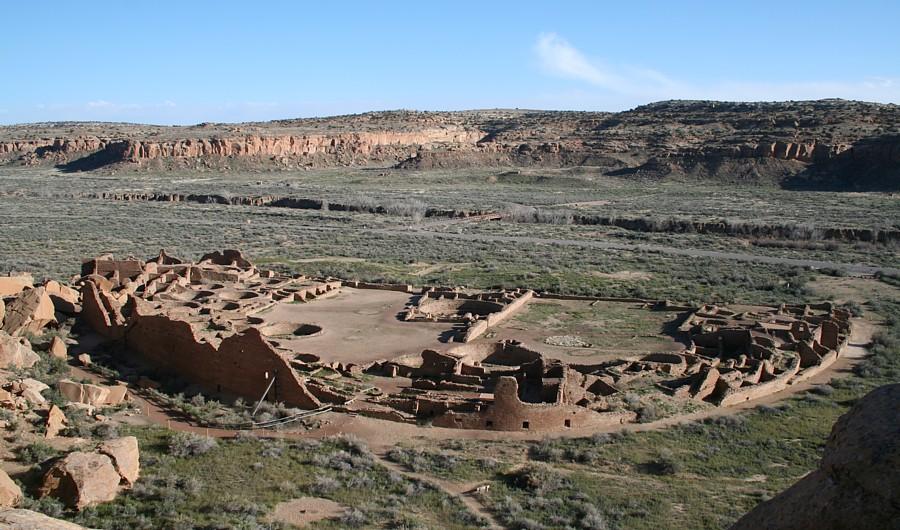
Pueblos in Chaco Canyon. Photo credit: HJPD

We know what we know about Cahokia because Americans built a highway through it. The law that created the interstate highway system in the 1960s included funding to investigate archaeological sites that would be damaged, which meant scholars had funding and a mandate to study Cahokia. 

Discovering that the mounds were actually the remains of the greatest city in North American history didn’t stop the construction of the highway or the expansion of the suburbs, which destroyed many of the pyramids and left roads crossing and surrounding Cahokia. 

But what remained of Cahokia was already a state park, which UNESCO named a World Heritage Site in 1982, and the state built a visitors center dedicated to Cahokia’s history. Many St. Louis schoolchildren visit on field trips. 

Cahokia receives around 250,000 visitors per year, and tourists from Germany, France, and the U.K. sign the guest book. That makes Cahokia a modest attraction—over one million tourists visit the Incan ruins of Machu Picchu (despite quotas that limit the number of daily visitors), and 1.5 million tourists visit the Mosque-Cathedral of Cordoba, Spain, which was one of the world’s largest cities in Cahokia’s time. 

Cahokia and other mound sites “have just never really gripped the imagination of the public,” explains archeologist George Milner. “People are more fascinated by photogenic places like Chaco Canyon.” 

The ruins of pueblos built by ancestors of the Hopi and Pueblo people in Chaco Canyon, New Mexico, are stunning. But they draw only 40,000 tourists annually. (Chaco Canyon is not easily accessible.) Like at Cahokia, the number of visitors has decreased in recent years.

The exception to this trend of disappointing turnout is Mesa Verde State Park, which is home to the Cliff Palace and draws 550,000 annual visitors

Who Wants Tourists?

The tourism industry is not a bastion of free-market principles. 

Instead governments are active participants who compete for tourists’ attention and wallets. Governments do market research and marketing. Governments build highways to remote destinations. Governments provide security and regulate tour operators. 

You might suspect that few people visit Cahokia because earthen mounds are not that inspiring (although the Egyptian pyramids are really just piles of rocks). Or because the large pueblos and cliff dwellings of Mesa Verde and Chaco Canyon are remote (although tourists flock to isolated sites like Machu Picchu and the Valley of Kings).

But imagine if the Southeastern United States were today a country inhabited and led by Mississippians whose ancestors had built the earthworks that still dot the region. The Lonely Planet guide to the country of Mississippi would list dozens of operators that led tours of the ancient earthworks, and Cahokia’s ruins would be the can’t-miss attraction. 

“The main pyramid offers views of both the St. Louis skyline and the plaza where around 10,000 Cahokians once lived,” the guidebook would read, “and is the most popular selfie spot in Mississippi.” 

But in reality, this is how a National Geographic writer described the same view when he visited Cahokia in 2010:

I just can't get past the four-lane gash that cuts through this historic site. Instead of imagining the thousands of people who once teemed on the grand plaza here, I keep returning to the fact that Cahokia Mounds in Illinois is one of only eight cultural World Heritage sites in the United States, and it's got a billboard for Joe's Carpet King smack in the middle of it.

The Greek government loves to invest in the Parthenon, and Greeks love to visit it. But Indian sites are more likely to remind Americans of the Trail of Tears and treaty violations than appeal to their nationalism. 

“Cahokia doesn’t mesh with the narrative of what the U.S. was like,” explains Dr. Adrienne Keene, a Native scholar and activist. “We are taught that nothing was here, so Native people deserved to have their land taken away. There would be less excitement about making Cahokia a national monument: that’s how white supremacy and colonialism work.” 

The lack of enthusiasm for promoting Cahokia is evident on its website, which advertises a crowdfunding campaign for its marketing efforts: 

Due to the economic conditions of the State of Illinois and the Illinois Historic Preservation Agency, no funding is available for public outreach, community events, and marketing. All of these activities are funded solely by the support group the Cahokia Mounds Museum Society.  

But even if Americans did invest in Native archeological sites and wanted to visit them, many American Indians might still feel wary about welcoming them. 

Camille Ferguson is the Executive Director of The American Indian Alaska Native Tourism Association (AIANTA). When we talk over the phone, she explains that many sites, unlike Cahokia or Chaco Canyon, are owned by tribes. And those tribes often lack the funding to build the infrastructure and provide the security a tourism attraction would need. 

“A lot of the native archeological sites that have been found have been taken advantage of,” Ferguson says. “Tribes are trying to do repatriation—to get [stolen artifacts] back.” 

This state tourism video shows some of the earthworks built between 1650 and 700 BC in Poverty Point, Louisiana. 

Theft is not the only concern; so is respect. 

Dr. Keene, for example, has several friends who portrayed American Indians at Sturbridge Village, a “living museum” in Massachusetts that re-creates rural life in 1830s New England. "Visitors thought they weren't native because they didn't look like a Hollywood Indian," says Keene. "Or people asked them about the Washington football team. The public still leaves with the impression that natives were savage or uncivilized. These experiences are hard on native people."

There are no residents of Stonehenge or the pyramids. But the relatively young ruins of North America are still homelands to many native peoples. 

“We call them sacred sites—not necessarily archeological sites,” Camille Ferguson explains. “The sacred sites are where the grave sites are. It’s something that hasn’t really been looked at as an attraction as much as something to be protected. I like to see ruins, but some of those cultures are very much alive.”

This sentiment pervades The Inconvenient Indian, a book by Thomas King. In the same way that Ta-Nehisi Coates explains in Between the World and Me what it feels like to be a black man in America, King explains what it feels like to be an Indian in North America. And to be an Indian, King writes, is to feel like an inconvenience. Because Indians were “supposed to” die out.

“The demise of Indians was seen as a tenet of natural law,” King writes. “‘The sun of their days is fast sinking in the western sky’... Problem was, Live Indians didn’t die out… [so] as the nineteenth rolled into the twentieth century, Live Indians were forgotten, safely stored away on reservations.” Americans are comfortable with seeing “Dead Indians” in traditional garb on packages of butter or in Western films, but a Live Indian in a suit seems “inauthentic.” 

This is why Camille Ferguson, speaking on behalf of many American tribes, is happier talking about new cultural centers than ancient ruins, which cement the idea that Indians have died out. 

“Tribes want tourism to be a way of perpetuating their culture,” she says, “not just putting it in a museum.”

***

Sites like Cahokia and Chaco Canyon are underappreciated, but North America does have fewer ancient ruins than many parts of the world.

This is because the largest cities in the Americas were in Mexico and South America—the home of the Incas, Mayans, and the Aztec city of Tenochtitlan, which, in 1519, Charles Mann writes, caused Spanish conquistadors to “gawp like hayseeds at the wide streets, ornately carved buildings, and markets bright with goods from hundreds of miles away. They had never before seen a city with botanical gardens, for the excellent reason that none existed in Europe.”

But in North America, Cahokia was the lone great city. Why? 

According to Dr. George Milner, “you can find as many opinions [on that question] as archeologists.” The theory presented by Jared Diamond in Guns, Germs, and Steel, however, is that North America never developed the intensive agriculture to support permanent farms and dense cities.

But judging the natives of North America by the number of large cities, ancient, stone towers, and permanent farms is making the same mistake as the early Europeans. 

Photo credit: James Q. Jacobs

In 1491, Charles Mann writes that “Europeans tended to manage land by breaking it into fragments for farmers and herders. Indians often worked on such a grand scale that the scope of their ambition can be hard to grasp.”

Indians primary tool for reshaping their environment was fire. During the Civil War, American troops in Virginia’s woods could barely see each other through the dense underbrush. But when Europeans first arrived, they marveled that they could ride a horse straight through a forest. The difference was that Indians had once cleared out the underbrush with fires so large that the earliest colonists watched the burns like they were fireworks

Not every part of North America was transformed in this way, but in many areas, Mann writes, “Indians retooled whole ecosystems to grow bumper crops of elk, deer, and bison…. Millennia of exuberant burning shaped the plains into vast buffalo farms.” 

Much of what European explorers saw as rich, untamed wilderness was actually what Mann calls “the world’s largest garden.” 

“It was an altered landscape,” Dr. George Milner explains. “But Europeans didn’t recognize it as such.”

This is the irony of Americans' indifference to the country’s archeological sites. By 1492, American Indians had created a giant park whose beauty and riches inspired thousands and thousands of Europeans to cross a continent. 

They just failed to realize what they were seeing. And now it’s gone. 

Our next article investigates the business of storing nuclear waste that will be lethal for the next 10,000 years. To get notified when we post it  →  join our email list.

Announcement: The Priceonomics Content Marketing Conference is on November 1 in San Francisco. Get your early bird ticket now.


Let's block ads! (Why?)

10 Sep 17:20

bunnyfood: laughingsquid: Cody the Shih Tzu Lets Out a Blood...

10 Sep 17:20

CONHECENDO O DF - METROPOLITANA

by Borboleta Roxa
Fim de semana passado achei que ia passar "curtindo" a sinusite na solidão do lar. Daí uma amiga me convida pro ensaio aberto da banda de rock do cunhado dela, a Galões de Diesel em um estúdio em Águas Claras. Clima bem simples, mas sonzeira de primeira. Quando o ensaio estava acabando, ela me convida pra ir comer (já que no local só tinha espetinho) no trailer do primo dela de hambúrgeres artesanais, o Zoião Hamburber Artesanal. Ela, chefe de cozinha, foi responsável pelas receitas do blend de carnes para o hamburger e do molho. Não é porque é minha amiga não, mas até eu que não gosto tanto de hamburger comi um quase inteiro de tão gostoso que estava. Super recomendo. 
E lá fomos nós pra uma pracinha super fofa na Metropolitana, "bairro" do Núcleo Bandeirante. A Metropolitana localiza-se "atrás" do Núcleo Bandeirante (já tinha visto placas dentro do Bandeirante e também no pedaço do Park Way lá próximo. É como uma cidadezinha de interior, com uma praça principal com a igreja e uma escola de madeira. Lugar pacato e frio, pois tem córregos pela região. Um pedacinho da história de Brasília escondido ali. Pra quem gosta de ver construções antigas e gosta de pracinhas fofas, é bom conhecer, embora não haja muito o que conhecer por lá. Então aproveite quando estiver por perto pra dar uma passadinha lá.
10 Sep 11:06

The modern nomad

by Cale

1

2

3

4

5

6

7-1

The post The modern nomad appeared first on Things in Squares.

10 Sep 09:57

Photo


07 Sep 09:39

More Cluster Fudge HERE


More Cluster Fudge HERE

06 Sep 09:09

Rede gostaria, mas não há terceira via em impeachment

A Rede Sustentabilidade, partido de Marina Silva, teve meses difíceis durante a guerra de 2015-2016. Impeachment só tem dois lados, o do presidente e o do vice-presidente. A Rede gostaria de ser uma terceira via, e não há terceira via em impeachment.

O partido parecia bem posicionado para ganhar eleições quando PT e PSDB enfraquecessem um ao outro. Mas, para azar dos sustentabilistas, a briga não durou até as eleições. Se nas urnas Marina tinha boas chances, no conchavo parlamentar o PMDB era imbatível.

A polarização extrema dos últimos anos foi péssima para os planos da Rede. O partido deveria ser um ponto de reunião dos desiludidos com o PT com o que sobrou de centro-esquerda no PSDB. O impeachment trancou todos onde estavam: mesmo esquerdistas que haviam se afastado do PT voltaram para defendê-lo contra a aliança conservadora. E os tucanos marcharam, sem dissidências, com os conservadores contra o PT.

A Rede apoiou o impeachment, mas liberou o voto dos parlamentares. Marina Silva aderiu ao "Fora Dilma", talvez pelos ataques do PT na campanha de 2014, talvez em respeito a seus eleitores conservadores. Mas a maioria dos parlamentares da Rede veio da esquerda. Abandonaram o PT, em boa parte, por não aguentar mais o custo ético de se aliar à mesma turma que acaba de conquistar a presidência. Alessandro Molon saiu do PT por discordar da promiscuidade entre PT e PMDB no Rio; deveria ter votado em Temer? Mas tudo isso é complexo demais para 2016, e os sustentabilistas acabaram ficando mal com os dois lados.

O triste é que o partido começou a crise acertando mais que todo mundo (mais do que eu, por exemplo): pedindo novas eleições. Era o que defendiam 60% dos brasileiros. Mas os 11% que aprovavam Dilma não compraram a tese enquanto era tempo; e os 14% de Temer têm Gilmar Mendes no TSE. A disputa em 2016 se deu entre esses dois candidatos que, somados, não teriam votos para ir ao segundo turno em 2014.

Agora o desafio da Rede é tentar convencer os 60% dos eleitores que queriam novas eleições de que estava com eles quando foram abandonados.

O PMDB sabe que isso pode dar certo, e seus puxa-sacos começaram a bombardear Marina logo depois do afastamento de Dilma. O Movimento Brasil Livre foi às redes sociais dizer "nós não fizemos tudo isso para vocês votarem na Marina". Os novos chapas-branca passaram a defender que novas eleições é que seriam golpe. Como já dito aqui, golpe é sempre o dos outros.

Enfim, resta saber se a Rede saberá reconquistar os apoios sequestrados pela polarização. Pode fazer uma abertura para a ala do PT que defendeu novas eleições. Pode também ser um refúgio para tucanos que venham a descobrir que o governo que acabam de instalar quer fazer um "acordão". Ao que parece, essa intenção era completamente impossível de deduzir dos áudios de Romero Jucá ou das declarações de Gilmar Mendes, e só foi revelada na votação da inelegibilidade de Dilma.

Acordão, vejam só, também é sempre o dos outros.

De qualquer modo, se a polarização do impeachment tiver acabado com as chances da Rede e de outras iniciativas similares, a turma conservadora que articulou a derrubada de Dilma Rousseff pode ter destruído a única coisa que realmente seria, para o PT, o fim: um substituto.

Let's block ads! (Why?)

06 Sep 09:06

Be Coachable — Quarrelsome

by brandizzi

This is the first in a series of posts that have been rattling around in my head about lessons I’ve learned from taking up a sport in my 40s. The summary of the back story here is that I started out with Derby Lite in 2012, got kicked out, went back a year later, and,… well, I fell in love with roller derby. Apparently this is a thing that happens. I sat in the bleachers, watching the game with an intensity and focus that made me realise I wanted to play.

It is the curse of smart people everywhere that their lived experience is one of more or less consistent reward. We quickly get good at nearly everything we try. Some things are so easy that they they become boring long before you master them.

Roller derby has not been one of those things for me.

David Foster Wallace, in his “This is Water” speech, says, “A huge percentage of the stuff that I tend to be automatically certain of is, it turns out, totally wrong and deluded.” This is a perfect description of my experience of learning to Be Coachable. I went into this with a mindset that the skills required for derby would, like everything else I’d ever tried, come at the pace everything else had.

They didn’t.

In fact, I was asked to leave Derby Lite because I was not following instructions. To be fair, it had been said that if we were uncomfortable participating in a drill, we could sit it out; this turned out to not be entirely true. Rejection, right there at the beginning, caused me to undertake some serious introspection. I really wanted to learn to skate, but I have a long history of getting into trouble for not doing what I’m told. Because, you know, I’m smarter than everybody else. I’d become quite spoiled to doing things at my own pace on my own terms… because I had avoided doing things that required me to participate in a group.

Does not play well with others. I’m independent. I don’t fit the mold. That’s good, right?

Turns out that when you want to learn to do something that is Really Hard from someone who already knows how to do it, independent thinking becomes an impediment. So the first year of my skating career sucked a lot more than it needed to because I was just too gosh darn independent. In hindsight, that cost me a great deal, and it is still really fucking painful for me. I have no one to blame but me.

The idea of shutting the fuck up and just listening popped into my head on a drive home from a speed skating session. At the time, it wasn’t a particularly well-formed thought. No, that epiphany didn’t come until later. In fact, I think it’s still sort of sneaking up on me from time to time and smacking me in the back of the head.

A year ago, thereabouts, I started going to a new program run by The Windy City Rollers called Learn To Skate. At the time, this program was being run by Poppy Spock. Man, I really admire Poppy. I’m pretty sure a tornado could go directly over her, pass on and she’d be the only thing left standing. She is also the only woman I’ve ever known who can jump from a kneeling to a squatting position. She did it on her first try. I was at that moment (and will always be) in complete awe of Poppy Spock.

The first thing that Poppy said to us was, “Be coachable.” This meant not talking back, not saying can’t (and sure as fuck not saying won’t). It meant that we would do what she told us to do, how she told us to do it. This is how “shut the fuck up and listen” got a name. Be coachable. This is where the idea started to congeal. Poppy has skills I want to have. She’s in the room, telling me how she got them (unpaid). But if I’m not coachable, I won’t learn shit.

Let me back up for a second and describe roller derby from an insider’s perspective. I won’t insult you — you can search for videos on YouTube about roller derby to learn how the sport works. You get up before dawn on a Saturday and drive to a rink for speed skating session where a 9-yr-old on inlines will shred your ego as she whizzes past you. You go to your league practice at the end of a long, draining day at work, put on our smelly gear (that is sometimes still damp from your last practice), and maybe Surprise! We’re doing TIME TRIALS today!

And all the time you sweat. Just unbelievable amounts of sweat. Like there’s no chance you’ll be able to wear these clothes again without washing them amounts of sweat. Salt crystals form on you amounts of sweat. Hair completely soaked through amounts of sweat.

And all of the time, you fall. At first, you’re terrified of falling, so you skate around stiff as a 2x4 and wonder for days afterwards why you’re so fucking sore. That doesn’t keep you from falling. Because, you know, you’re doing things like jumping over shit. On skates.

After you fall a few dozen times, you start to get the idea that nothing bad really happens when you fall. Then you start to love falling because it gives you an adrenaline rush. Also because your teammates cheer when you eat shit. In roller derby, it is said, “If you don’t fall, you’re not trying hard enough.”

And then, one day, you get cleared for contact. Yes, that’s right. Not only are you on skates, but someone bigger, stronger, faster and more experienced than you is going to skate directly into you and knock you onto the floor. On purpose. Because that is how the game of roller derby is played. Eventually you learn to love that, too. Adrenaline is addictive.

If you’ve never played contact sports before, the first few times you intentionally slam your body into someone else’s body will be an uncomfortable feeling for you. Then you look back over the past several months of training and think, “This whole fucking ride has been uncomfortable.”

I have a post about discomfort, too. That is not this post. This post is about what it means to be coachable. Be coachable means that, if you REALLY WANT IT, shut the fuck up. Take everything you are “automatically certain” of, in your mind, put it in a box and stash it in a corner. It is only when your mind is empty of all notions, all fears and insecurities, that you are ready to learn.

From Poppy Spock, Cuban Miss Elle and dozens of other coaches, I have learned to be a great deal less arrogant. I have learned to put a leash on my certitude and righteousness and rein them in. It feels if somehow I’ve been liberated. I feel like a kid again; the world is vibrant and real — there is still so much to learn. It is thrilling.

I recommend it with all my heart.

Let's block ads! (Why?)

06 Sep 08:54

Photo


06 Sep 08:54

Saturday Morning Breakfast Cereal - Social Longevity

by tech@thehiveworks.com


Hovertext:
Sorry, you're not allowed to be a plumber until you've completed 14,000,000 hours of apprenticeship.

New comic!
Today's News:
06 Sep 08:53

Time Flies

by Doug
03 Sep 13:22

Temple Grandin: Inside ASD | Autism Research Institute

by brandizzi
Adam Victor Brandizzi

It is always interesting to read Temple Grandin.

Temple Grandin: An Inside View of Autism

Introduction

I am a 44-year old autistic woman who has a successful international career designing livestock equipment. I completed my Ph.D. in Animal Science at the University of Illinois in Urbana and I am now an Assistant Professor of Animal Science at Colorado State University. Early intervention at age 2 1/2 helped me overcome my handicap.

Two of the subjects covered in this chapter are the frustration of not being able to speak and sensory problems. My senses were oversensitive to loud noise and touch. Loud noise hurt my ears and I withdrew from touch to avoid over-whelming sensation.

I built a squeezing machine which helped me to calm my nerves and to tolerate touching. At puberty, horrible anxiety "nerve" attacks started and they became worse with age. Antidepressant medication relieved the anxiety. In the last section of the chapter directing my fixations into constructive activities and a career will be discussed along with the importance of a mentor. My skill and deficit areas are covered in detail. All my thinking is visual, like videos played in my imagination. Even abstract concepts such as getting along with other people are visualized through the use of door imagery.

Lack of Speech

Not being able to speak was utter frustration. If adults spoke directly to me I could understand everything they said, but I could not get my words out. It was like a big stutter. If I was placed in a slight stress situation, words would sometimes overcome the barrier and come out. My speech therapist knew how to intrude into my world. She would hold me by my chin and made me look in her eyes and say "ball." At age 3, "ball" came out "bah," said with great stress. If the therapist pushed too hard I threw a tantrum, and if she did not intrude far enough no progress was made. My mother and teachers wondered why I screamed. Screaming was the only way I could communicate. Often I would logically think to myself, "I am going to scream now because I want to tell somebody I don't want to do something."

It is interesting that my speech resembled the stressed speech in young children who have had tumors removed from the cerebellum. Rekate, Grubb, Aram, Hahn, and Ratcheson (1985) found that cancer surgeries that lesioned the vermus, deep nuclei, and both hemispheres of the cerebellum caused temporary speech loss in normal children. Vowel sounds were the first to(1) return, and receptive speech was normal. Courchesne, Yeung-Courchesne, Press, Hesselink, and Jernigan (1988) reported that 14 out of 18 high- to moderate- functioning autistics had undersized cerebellar vermal lobules VI and VII. Bauman and Kemper (1985) and Ritvo et al. (1986) also discovered that brains from autistics had lower than normal Purkinje cell counts in the cerebellum. In my own case an MRI scan revealed cerebellar abnormalities. I am unable to tandem walk (the standard "walk the line" test done by the police for drunken drivers). I end up toppling sideways, but my reactions are normal for other simple motor tests of cerebellar dysfunction.

Vestibular stimulation can sometimes stimulate speech in autistic children. Slowly swinging a child on a swing can sometimes help initiate speech (Ray, King, & Grandin, 1988). Certain types of smooth, coordinated movements are difficult for me, even though I appear normal to the casual observer. For example, when I operate hydraulic equipment that has a series of levers, I can operate one lever at a time perfectly. Coordinating the movement of two or three levers at once is impossible. This may explain why I do not readily learn a musical instrument, even though I have innate musical talent for pitch and melody. The only musical instrument I mastered is whistling with my mouth.

Rhythm and Music

Throughout elementary school my speech was still not completely normal. Often it took me longer than other children to start getting my words out. Singing, however was easy. I have perfect pitch and I can effortlessly hum back the tune of a song I have heard only once or twice.

I still have many problems with rhythm. I can clap out a rhythm by myself, but I am unable to synchronize my rhythm with somebody else's rhythm. At a concert I am unable to clap in time with the music with the rest of the people. A lack of rhythm during autistic piano playing is noted by Park and Youderian (1974). Rhythm problems may be related to some autistic speech problems. Normal babies move in synchronization with adult speech (Condon & Sander, 1974). Autistics fail to do this. Condon (1985) also found that autistics and, to a lesser extent, dyslexics and stutterers have a defective orienting response. One ear hears a sound sooner that the other. The asynchrony between ears is some- times over one second. This may help explain certain speech problems. People still accuse me of interrupting. Due to a faulty rhythm sense, it is difficult to determine when I should break into a conversation. Following the rhythmic ebb and rise of a conversation is difficult.

Auditory Problems

My hearing is like having a hearing aid with the volume control stuck on "super loud." It is like an open microphone that picks up everything. I have two choices: turn the mike on and get deluged with sound, or shut it off. Mother reported that sometimes I acted like I was deaf. Hearing tests indicated that my hearing was normal. I can't modulate incoming auditory stimulation. Many autistics have problems with modulating sensory input (Ornitz, 1985). They either overreact or under-react. Ornitz (1985) suggests that some cognitive deficits could be caused by distorted sensory input. Autistics also have profound abnormalities in the neurological mechanisms that control the capacity to shift attention between different stimuli (Courchesne, 1989).

I am unable to talk on the phone in a noisy office or airport. Everybody else can use the phones in a noisy environment, but I can't. If I try to screen out the background noise, I also screen out the phone. A friend of mine, a high-functioning autistic, was unable to hear a conversation in a relatively quiet hotel lobby. She has the same problem I have, except worse.

Autistics must be protected from noises that bother them. Sudden loud noises hurt my ears like a dentist's drill hitting a nerve. A gifted, autistic man from Portugal wrote, "I jumped out of my skin when animals made noises" (White & White, 1987). An autistic child will cover his ears because certain sounds hurt. It is like an excessive startle reaction. A sudden noise (even a relatively faint one) will often make my heart race. Cerebellar abnormalities may play a role in increased sound sensitivity. Research on rats indicates that the vermus of the cerebellum modulates sensory input (Crispino & Bullock, 1984). Stimulation of the cerebellum with an electrode will make a cat hypersensitive to sound and touch (Chambers, 1947).

I still dislike places with confusing noise, such as shopping malls. High-pitched continuous noises such as bathroom vent fans or hair dryers are annoying. I can shut down my hearing and withdraw from most noise, but certain frequencies cannot be shut out. It is impossible for an autistic child to concentrate in a classroom if he is bombarded with noises that blast through his brain like a jet engine. High, shrill noises were the worst. A low rumble has no effect, but an exploding firecracker hurts my ears. As a child, my governess used to punish me by popping a paper bag. The sudden, loud noise was torture.

Even now, I still have problems with tuning out. I will be listening to a favorite song on the radio, and then realize I missed half of it. My hearing just shuts off. In college, I had to constantly keep taking notes to prevent tuning out. The young man from Portugal also wrote that carrying on a conversation was very difficult. The other person's voice faded in and out like a distant radio station (White & White, 1987).

Tactile Problems

I often misbehaved in church, because the petticoats itched and scratched. Sunday clothes felt different than everyday clothes. Most people adapt to the feeling of different types of clothing in a few minutes. Even now, I avoid wearing new types of underwear. It takes me three to four days to fully adapt to new ones.

As a child in church, skirts and stockings drove me crazy. My legs hurt during the cold winter when I wore a skirt. The problem was the change from pants all week to a skirt on Sunday. If I had worn skirts all the time, I would not have been able to tolerate pants. Today I buy clothes that feel similar. My parents had no idea why I behaved so badly. A few simple changes in clothes would have improved my behavior.

Some tactile sensitivities can be desensitized. Encouraging a child to rub the skin with different cloth textures often helps. The nerve endings on my skin were supersensitive. Stimuli that were insignificant to most people were like Chinese water torture. Ayres (1979) lists many good suggestions on methods to desensitize the tactile system.

Approach-Avoid

In my book Emergence: Labeled Autistic (Grandin & Scariano, 1986), I describe craving pressure stimulation. It was an approach-avoid situation. I wanted to feel the good feeling of being hugged, but when people hugged me the stimuli washed over me like a tidal wave. When I was 5 years old, I used to daydream about a mechanical device I could get into that would apply comforting pressure. Being able to control the device was very important. I had to be able to stop the stimulation when it became too intense. When people hugged me, I stiffened and pulled away to avoid the all- engulfing tidal wave of stimulation. The stiffening up and flinching was like a wild animal pulling away. As a child, I used to like to get under the sofa cushions and have my sister sit on them. At various autism conferences, I have had 30 or 40 parents tell me that their autistic child seeks deep pressure stimuli. Research by Schopler (1965) indicated that autistic children prefer (proximal) sensory stimulation such as touching, tasting, and smelling to distal sensory stimulation such as hearing or seeing.

Squeeze Machine

At age 18 I built a squeezing machine. This device is completely lined with foam rubber, and the user has complete control over the duration and amount of pressure applied. A complete description of the machine is in Grandin (1983, 1984), and Grandin and Scariano (1986). The machine pro- vides comforting pressure to large areas of the body.

It took me a long time to learn to accept the feeling of being held and not try to pull away from it. Reports in the literature indicate that autistics lack empathy (Bemporad, 1979; Volkmar & Cohen, 1985). I feel that the lack of empathy may be partially due to a lack of comforting tactual input.

One day about 12 years ago, a Siamese cat's reaction to me changed after I had used the squeeze machine. This cat used to run from me, but after using the machine, I learned to pet the cat more gently and he decided to stay with me. I had to be comforted myself before I could give comfort to the cat (Grandin, 1984).

I have found from my own experiences with the squeeze machine that I almost never feel aggressive after using it. In order to learn to relate to people better, I first had to learn how to receive comfort from the soothing pressure of the squeeze machine. Twelve years ago I wrote, "I realize that unless I can accept the squeeze machine I will never be able to bestow love on another human being" (Grandin, 1984). During my work with livestock, I find that touching the animals increases my empathy for them. Touching and stroking the cattle makes me feel gentle towards them. The squeeze machine also had a calming effect on my nervous system.

Squeeze machines have been in use in clinics working with autistic and hyperactive children (Figures 6-1 and 6-2). Lorna King, an occupational therapist in Phoenix, Arizona, reports that it has a calming effect on hyperactive behavior. Therapists have found that deep pressure stimulation has a calming effect (Ayres,, 1979). Both animal and human studies have shown that pressure stimulation reduces nervous system arousal (Kumazawa, 1963; Melzack, Konrad, & Dubrobsky, 1969; Takagi & Kobagasi, 1956). Pressure on the sides of the body will induce relaxation in pigs (Grandin, Dodman, & Shuster, 1989).

Anxiety at Puberty

As a child I was hyperactive, but I did not feel "nervous" until I reached puberty. At puberty, my behavior took a bad turn for the worse. Gillberg and Schaumann (1981) describe behavior deterioration at puberty in many autistics. Shortly after my first menstrual period, the anxiety attacks started. The feeling was like a constant feeling of stage fright all the time. When people ask me what it is like I say, "Just imagine how you felt when you did something really anxiety provoking, such as your first public speaking engagement.

Now just imagine if you felt that way most of the time for no reason." I had a pounding heart, sweaty palms, and restless movements.

The "nerves" were almost like hypersensitivity rather than anxiety. It was like my brain was running at 200 miles an hour, instead of 60 miles an hour. Librium and Valium provided no relief. The "nerves" followed a daily cycle and were worse in the late afternoon and early evening. They subsided late at night and early in the morning. The constant nervousness would go in cycles, with a tendency to be worse in the spring and fall. The "nerves" also subsided during menstruation.

Sometimes the "nerves" would manifest themselves in other forms. For weeks I had horrible bouts of colitis. When the colitis attacks were active, the feeling of "stage-fright" nerves went away.

I was desperate for relief. At a carnival I discovered that riding on the Rotor ride provided temporary relief. Intense pressure and vestibular stimulation calmed my nerves. Bhatara, Clark, Arnold, Gunsett, and Smeltzer (1981) have found that spinning in a chair twice each week reduces hyperactivity in young children.

While visiting my aunt's ranch, I observed that cattle being handled in a squeeze chute sometimes relaxed after the pressure was applied. A few days later I tried the cattle squeeze chute, and it provided relief for several hours. The squeeze machine was modeled after a squeeze chute used on cattle. It had two functions: (1) to help relax my "nerves" and (2) to provide the comforting feeling of being held. Prior to building the squeeze machine, the only other way I could get relief was strenuous exercise or manual labor. Research with autistics and mentally retarded clients has shown that vigorous exercise can decrease stereotypies and disruptive behavior (McGimsey & Favell, 1988; Walters & Walters, 1980). There are two other ways to fight the nerves: fixate on an intense activity, or withdraw and try to minimize outside stimulation. Fixating on one thing had a calming effect. When I was livestock editor for the Arizona Farmer Ranchman, I used to write three articles in one night. While I was typing furiously I felt calmer. I was the most nervous when I had nothing to do.

With age, the nerves got worse. Eight years ago, I had a stressful eye operation that triggered the worst bout of "nerves" in my life. I started waking up in the middle of the night with my heart pounding and obsessive thoughts about going blind.

Medication

In the next section, I am going to describe my experiences with medication. There are many autism subtypes, and a medication that works for me may be useless for another case. Parents of autistic children should obtain medical advice from professionals who are knowledgeable of the latest medical research.

I read in the medical library that antidepressant drugs such as Tofranil (Imipramine) were effective for treating patients with endogenous anxiety and panic (Sheehan, Beh, Ballenger, & Jacobsen, 1980). The symptoms described in this paper sounded like my symptoms, so I decided to try Tofranil. Fifty mg of Tofranil at bedtime worked like magic. Within a week, the feelings of nervousness started to go away. After being on Tofranil for four years I switched to 50 mg Norpramin (desipramine), which has fewer side effects. These pills have changed my life. Colitis and other stress-related health problems were cured.

Dr. Paul Hardy in Boston has found that Tofranil and Prozac (fluoxetine) are both effective for treating certain high-functioning autistic adolescents and adults. Both Dr. Hardy and Dr. John Ratey (personal communication, 1989) have learned that very small doses of these drugs must be used. These doses are usually much lower than the dose prescribed for depression. Too high a dose can cause agitation, aggression, or excitement, and too low a dose will have no effect. My "nerve" attacks would go in cycles, and I have had relapses while on the drug. It took will power to stick with the 50 mg dose and let the relapse subside on its own. Taking the medicine is like adjusting the idle screw on a car's carburetor. Before taking the drug, the engine was racing all the time. Now it runs at normal speed. I no longer fixate, and I am no longer "driven." Prozac and Anafranil (clomipramine) have been very effective in autistics who have obsessive-compulsive symptoms or obsessive thoughts which race through their heads. The effective doses for Prozac have ranged from two 20 mg capsules per week to 40 mg per day. Too high a dose will cause agitation and excitement. If an autistic person becomes agitated the dose should be lowered. Other promising drugs for aggressive autistic adolescents and adults are beta blockers. Beta blockers greatly reduce aggressive behavior (Ratey et al., 1987).

Slow Improvement

During the eight years I have been taking antidepressants, there has been a steady improvement in my speech, sociability, and posture. The change was so gradual that I did not notice it. Even though I felt relief from the "nerves" immediately, it takes time to unlearn old behavior patterns.

Within the last year, I had an opportunity to visit an old friend who had known me before I started taking antidepressants. My friend, Billie Hart, told me I was a completely different person. She said I used to walk and sit in a hunched-over position and now my posture is straight. Eye contact had improved and I no longer shifted around in my chair. I was also surprised to learn that I no longer seemed to be out of breath all the time, and I had stopped constantly swallowing.

Various people I have met at autism meetings have seen steady improvement in my speech and mannerisms throughout the eight-year period I have taken the medicines. My old friend, Lorna King, also noticed many changes. "Your speech used to seem pressured, coming in almost explosive bursts. Your old tendency to perseverate is gone" (Grandin & Scariano, 1986).

I had a odd lack of awareness of my oddities of speech and mannerisms until I looked at videotapes. I think videotapes could be used to help many high-functioning autistics with speech and social skills.

Family History

There is much that can be learned from family history. During my travels to autism conferences, I have found many families with affective disorder in the family history. The relationship between autism and affective disorder has also been reported in the literature (Gillberg & Schaumann, 1981). Family histories of high-functioning autistics often contain giftedness, anxiety or panic disorder, depression, food allergies, and learning disorders. In many of the families I have interviewed the disorders were never formally diagnosed, but careful questioning revealed them.

My own family history contains nervousness and anxiety on both sides. My grandmother has mild depression, and Tofranil has also worked wonders for her. She is also very sensitive to loud noise. She told me that when she was a little girl, the sound of coal going down the chute was torture. My sister is bothered by confusing noise from several sources. On my father's side there is explosive temper, perseveration on one topic, extreme nervousness, and food allergies. Both sides of my family contain artists. There are also signs of immune system abnormalities in myself and my siblings. I had shingles in my thirties, and my brother had them at age 4. My sister had serious ear infections similar to the ear infections in many young autistics. My dad, brother , and myself all have eczema.

Sensory Deprivation Symptoms

Animals placed in an environment that severely restricts sensory input develop many autistic symptoms such as stereotyped behavior, hyperactivity, and self-mutilation (Grandin, 1984). Why would an autistic and a lion in a barren concrete zoo cage have some of the same symptoms? From my own experience I would like to suggest a possible answer. Since incoming auditory and tactile stimulation often overwhelmed me, I may have created a self-imposed sensory restriction by withdrawing from input that was too intense. Mother told me that when I was a baby I stiffened and pulled away. By pulling away, I did not receive the comforting tactile input that is required for normal development. Animal studies show that sensory restriction in puppies and baby rats has a very detrimental effect on brain development. Puppies raised in a barren kennel become hyper-excitable, and their EEGs (brain waves) still contain signs of overarousal six months after removal from the kennel (Melzack & Burns, 1965). Autistic children also have a desynchronized EEG, which indicates high arousal (Hutt, Hutt, Lee, & Ounstead, 1965). Trimming the whiskers on baby rats causes the parts of the brain that receive input from the whiskers to become oversensitive (Simons & Land, 1987). The abnormality is relatively permanent; the brain areas are still abnormal after the whiskers grow back. Some autistics also have overactive brain metabolism (Rumsey et al., 1985).

I often wonder, if I had received more tactile stimulation as a child would I have been less "hyper" as an adult? Handling baby rats produces less emotional adults who are more willing to explore a maze (Denenbert, Morton, Kline, & Grota, 1962; Ehrlich, 1959). Tactile stimulation is extremely important for babies and aids their development (Casler, 1965). Therapists have found that children who withdraw from comforting tactile stimulation can learn to enjoy it if their skin is carefully desensitized. Rubbing the skin with different cloth textures often helps. Deep pressure stimulation also reduces the urge to pull away.

I was born with sensory problems (due to cerebellar abnormalities), but perhaps secondary neurological damage is caused by withdrawal from touching. Autopsies of five autistic brains indicated that cerebellar abnormalities occur during fetal development, and many areas of the limbic systems were immature and abnormal (Bauman, 1989). The limbic system does not fully mature until two years after birth. Maybe withdrawal from touching made some behavior problems worse. In my book, I describe stupid " bathroom" fixations that got me into a lot of trouble. An interesting paper by McCray (1978) shows a link between a lack of tactual stimulation and excessive masturbation. Masturbation stopped when the children received more affection and hugging. Perhaps the "bathroom" fixation would never have occurred if I could have enjoyed affection and hugging.

Lately there has been a lot of publicity about holding therapy, where an autistic child is forcibly held and hugged until he stops resisting. If this had been done to me I would have found it highly aversive and stressful. Several parents of autistic children have told me that a gentler form of holding therapy is effective and it improved eye contact, language, and sociability. Powers and Thorworth (1985) report a similar result. Perhaps it would be beneficial if autistic babies were gently stroked when they pulled away. My reaction was like a wild animal. At first touching was aversive, and then it became pleasant. In my opinion, tactual defensiveness should be broken down slowly, like taming an animal. If a baby could be desensitized and learn to enjoy comforting tactile input, possible future behavior problems could be reduced.

Direct Fixations

Today I have a successful career designing livestock equipment because my high school science teacher, Mr. Carlock, used my fixation on cattle chutes to motivate me to study psychology and science. He also taught me how to use the scientific indexes.

This knowledge enabled me to find out about Tofranil. While the school psychologist wanted to take my squeeze machine away, Mr. Carlock encouraged me to read scientific journals so I could learn why the machine had a relaxing effect. When I moved out to Arizona to go to graduate school, I went out to the feedlots to study the reactions of the cattle in squeeze chutes. This was the beginning of my career.

Today I travel all over the world designing stockyards and chutes for major meat-packing firms. I am a recognized leader in my field and have written over 100 technical and scientific papers on livestock handling (Grandin, 1987). If the psychologists had been successful in taking away my squeeze machine, maybe I would be sitting somewhere rotting in front of a TV instead of writing this chapter.

Some of the most successful high-functioning autistics have directed childhood fixations into careers (Bemporad, 1979; Grandin & Scariano, 1968; Kanner, 1971). When Kanner (1971) followed up his original 11 cases, there were two major successes. The most successful person turned a childhood fixation on numbers into a bank teller's job. The farmer who reared him found goals for his number fixation; he told him he could count the corn rows if he plowed the field.

Many of my fixations initially had a sensory basis. In the fourth grade, I was attracted to election posters because I liked the feeling of wearing the posters like a sandwich man. Occupational therapists have found that a weighted vest will often reduce hyperactivity.

Even though the poster fixation started out with a sensory basis, I became interested in the election. My teachers should have taken advantage of my poster fixation to stimulate and interest in social studies. Calculating electoral college points would have motivated me to study math. Reading could have been motivated by having me read newspaper articles about the people on the posters. If a child is interested in vacuum cleaners, then use a vacuum-cleaner instruction book as a text.

Another one of my fixations was automatic glass sliding doors. Initially I was attracted to the doors because I liked the sensation of watching them move back and forth. Then gradually the doors took on other meanings, which I will talk about in the next section. In a high-functioning adolescent, and interest in sliding doors could be used to stimulate science interests. if my teacher had challenged me to learn how the electronic box that opened the door worked, I would have dived head first into electronics. Fixations can be tremendous motivators. Teachers need to use fixations to motivate instead of trying to stamp them out. A narrow, fixated interest needs to be broadened into constructive activities. The principle can also be used with lower- functioning children; Simons and Sabine (1987) list many good examples.

Fixations need to be differentiated from stereotypies, such as hand flapping or rocking. A fixation is an interest in something external, such as airplanes, radio, or sliding doors. Engaging in stereotypic behavior for long periods of time may be damaging to the nervous system. In one experiment, pigs in a barren pen that engaged in large amounts of stereotyped rooting on each other had abnormal dendritic growth in the somatosensory cortex (Grandin, 1989).

Visualization

All my thinking is visual. When I think about abstract concepts such as getting along with people I use visual images such as the sliding glass door. Relationships must be approached carefully otherwise the sliding door could be shattered. Visualization to describe abstract concepts is also described by Park and Youderian (1974). As a young child I had visualizations to help me understand the Lord's Prayer. The "power and the glory" were high-tension electric towers and a blazing rainbow sun. The word "trespass" was visualized as a "No Trespassing" sign on the neighbor's tree. Some parts of the prayer were simply incomprehensible. The only non-visual thoughts I have are of music. Today I no longer use sliding doors to understand personal relationships, but I still have to relate a particular relationship with something I have read - for example, the fight between Jane and Joe was like the U.S. and Canada squabbling over the trade agreement. Almost all my memories relate to visual images of specific events. If somebody says the word "cat," my images are of individual cats I have known or read about. I do not think about a generalized cat.

My career as a designer of livestock facilities maximizes my talent areas and minimizes my deficits. I still have problems handling long strings of verbal information. If directions from a gas station contain more than three steps, I have to write them down. Statistics are extremely difficult because I am unable to hold one piece of information in my mind while I do the next step. Algebra is almost impossible, because I can't make a visual image and I mix up steps in the sequence. To learn statistics I had to sit down with a tutor and write down the directions for doing each test. Every time I do a t-test or a chi-square, I have to use the notes. I have no problem understanding the principles of statistics, because I can see the normal or skewed distributions in my head. The problem is I cannot remember the sequence for doing the calculations. I can put a regression line on a graph full of dots visually. The first time I tried it, I was off only a few degrees. I also have many dyslexic traits, such as reversing numbers and mixing up similar-sounding words such as "over" and "other." Right and left are also mixed up.

Visual thinking is an asset for an equipment designer. I am able to "see" how all parts of a project will fit together and see potential problems. It never ceases to amaze me how architects and engineers can make so many stupid mistakes in buildings. The disastrous accident where the catwalks at the Hyatt Regency fell and killed 100 people was caused by visualization errors. All the calculations were correct, but the architect's original design was impossible to build. Further visualization errors made during construction resulted in doubling the load on poorly designed fasteners. Academic requirements probably keep many visual thinkers out of these professions. Designing a piece of equipment with a sequential mind may be just as difficult for an engineer as statistics equations are for me. The sequential thinker can't see the whole. I have observed many incidents in industry where a brilliant maintenance man with a high school education designs a piece of equipment after all the Ph.D. engineers have failed. He may be an unrecognized visual thinker. There may be two basic kinds of thinking, visual and sequential. Farah (1989) concluded that "thinking in images is distinct from thinking in language." I have also had the opportunity to interview brilliant people who have very little visual thought. One professor told me that facts just come out of his mind instantly. To retrieve facts, I have to read them off a visualized page of a book or "play a video" of some previous event.

There is however, one area of visualization I am poor in. I often fail to recognize faces until I have known a person for a long time. This sometimes causes social problems, because I sometimes don't respond to an acquaintance because I fail to recognize them. Einstein was a visual thinker who failed his high school language requirement and relied on visual methods of study ((Holton, 1971-1972). The theory of relativity was based on visual imagery of moving boxcars and riding on light beams. At an autism meeting I had the opportunity to visit some of Einstein's relatives. His family history has a high incidence of autism, dyslexia, food allergies, giftedness, and musical talent. Einstein himself had many autistic traits. An astute reader can find them in Einstein and Einstein (1987) and Lepscky (1982).

In my own family history, my grandfather on my mother's side was co-inventor of the automatic pilot for airplanes, and on my father's side my great-grandfather was a maverick who started the largest corporate wheat farm in the world. My two sisters and one brother are all visual thinkers. One sister is dyslexic and is brilliant in the art of decorating houses. My brother can build anything but had problems with calculus when he tried to major in engineering. He is now a very successful banker and did well in all other subjects in college. My youngest sister is a sculptress and did well in school. My mother and grandparents on the mother's side were all good at higher math, and many people on my mother's side were well-known for intellect.

Drawing elaborate drawings of steel and concrete livestock stockyards is easy (Figure 6-3). I am able to visualize a motion picture of the finished facility in my imagination. However, drawing realistic human faces is very difficult. Figure 6-4 illustrates a buffalo-handling facility I designed. Since it was a government low-bid contract, every piece of steel had to be visualized and drawn on 26 sheets of detailed drawings. I am very proud of this job because I was able to accurately visualize everything prior to construction except for one little ladder. When I was a child, my parents and teachers encouraged my artistic talent. It is important to nurture talents.

Discussions with other high-functioning autistics have revealed visual methods of thinking on tasks that are often considered non-visual. A brilliant autistic computer programmer told me that he visualized the program tree in his mind and then just filled in the code on each branch. A gifted autistic composer told me that he made "sound pictures."

I was good at building things, but when I first started working with drawings it took time to learn how the lines on a drawing related to the picture in my imagination. When I built a house for my aunt and uncle, I had difficulty learning the relationship between symbolic markings on the drawings and the actual construction. The house was built before I learned drafting. Now I can instantly translate a drawing into a mental image of a finished structure. While agonizing over the house plans, I was able to pull up pictures out of my memory of a house addition that was built when I was eight. Mental images from my childhood memory helped me install windows, light switches, and plumbing. I replayed the "videos" in my imagination.

Savant Skills

Studies have shown that when autistic savants become less fixated and more social they lose their savant skills such as card counting, calendar calculation, or art skills (Rimland & Fein, 1988). Since I started taking the medication I have lost my fixation, but I have not lost my visualization skill. Some of my best work has been done while on the medication.

My opinion is that savants lose their skill because they lose the fixated attention. Card counting (shown in the Rain Man movie) is no mystery to me. I think savants visualize the cards being dealt onto a table in a pattern, like a series of clocks or a Persian rug pattern. To tell which cards are still in the deck, they simply look at their patterns. The only thing that prevents me from card counting or calendar calculation is that I no longer have the concentration to hold a visual image completely steady for a long period of time. I speculate that socialized savants still retain their visualization skills. I still have the perfect pitch skill, even though I don't use it. If I had greater concentration, I could sing back much longer songs after hearing them once.

In my own case the strongest visual images are of things that evoked strong emotions, such as important big jobs. These memories never fade and they remain accurate. However, I was unable to recall visual images of the houses on a frequently traveled road until I made an effort to attend to them. A strong visual image contains all details, and it can be rotated and made to move like a movie. Weaker images are like slightly out-of-focus pictures or may have details missing. For example, in a meat-packing plant I can accurately visualize the piece of equipment I designed but I am unable to remember things I do not attend to, such as the ceiling over the equipment, bathrooms, stairways, offices, and other areas of little or not interest. Memories of items of moderate interest grow hazy with time.

I tried a little memory experiment at one of my jobs. After being away from the plant for 30 days, I tried recalling a part of the plant that I had attended to poorly, and another part I had attended to intently. I had not designed either of these places. The first place was the plant conference room, and the other was the entrance to the room that housed my equipment. I was able to draw a fairly accurate map of the office, but I made major mistakes on conference-room furniture and ceiling covering. The room I visualized was plain and lacked detail. On the other hand, I visualized the entrance door to the equipment room very accurately, but made a slight mistake on the door-handle style. The visualized door had much greater detail than the visualized conference room. The conference room was not attended to even though I negotiated with the plant managers in that room.

Talents need to be nurtured and broadened out into something useful. Nadia, a well-known autistic case, drew wonderful perspective pictures as a child (Seifel, 1977). When she gained rudimentary social skills, she stopped drawing. Possibly the talent could have been revived with encouragement from teachers. Seifel (1977) describes how Nadia drew pictures on napkins and waste papers. She needed proper drawing equipment. Treffert (1989) reported on several savants who did not lose their savant skills when they became more social. Use of savant skills was encouraged.

At the age of 28, my drafting drastically improved after I observed a talented draftsman named David. Building the house taught me how to understand blueprints, but now I had to learn to draw them. When I started drawing livestock facilities I used David's drawings as models. I had to "pretend" I was David. After buying a drafting pencil just like David's, I laid some of his drawings out and then proceeded to draw a loading ramp for cattle. I just copied his style, like a savant playing music, except my ramp was a different design. When it was finished I couldn't believe I had done it.

Deficits and Abilities

Five years ago I took a series of tests to determine my abilities and handicaps. On the Hiskey Nebraska Spatial Reasoning test, my performance was at the top of the norms. On the Woodcock-Johnson Spatial Relations test, I only got an average score because it was a timed speed test. I am not a fast thinker; it takes time for the visual image to form. When I survey a site for equipment at a meat-packing plant, it takes 20 to 30 minutes of staring at the building to fully imprint the site in my memory. Once this is done, I have a "video" I can play back when I am working on the drawing. When I draw, the image of the new piece of equipment gradually emerges. As my experience increased, I needed fewer measurements to properly survey a job. On many remodeling jobs, the plant engineer often measures a whole bunch of stuff that is going to be torn out. He can't visualize what the building will look like when parts of it are torn out and a new part is added.

As a child I got scores of 120 and 137 on the Wechsler. I had superior scores in Memory for Sentences, Picture Vocabulary, and Antonyms-Synonyms on the Woodcock-Johnson. On Memory for Numbers I beat the test by repeating the numbers out loud. I have an extremely poor long-term memory for things such as phone numbers unless I can convert them to visual images. For example, the number 65 is retirement age, and I imagine somebody in Sun City, Arizona. If I am unable to take notes I cannot remember what people tell me unless I translate the verbal information to visual pictures. Recently I was listening to a taped medical lecture while driving. To remember information such as the drug doses discussed on the tape I had to create a picture to stand for the dose. For example, 300mg is a football field with shoes on it. The shoes remind me that the number is 300 feet, not yards.

I got a second-grade score on the Woodcock-Johnson Blending subtest where I had to identify slowly sounded-out words. The Visual Auditory Learning subtest was another disaster. I had to memorize the meaning of arbitrary symbols, such as a triangle means "horse," and read a sentence composed of symbols. I could only learn the ones where I was able to make a picture for each symbol. For example, I imagined the triangle as a flag carried by a horse and rider.

Foreign languages were almost impossible. Concept Formation was another test with fourth-grade results. The name of this test really irks me, because I am good at forming concepts in the real world. My ability to visualize broad unifying concepts from hundreds of journal articles has enabled me to outguess the "experts" on many livestock subjects. The test involved picking out a concept such as "large, yellow" and then finding it in another set of cards. The problem was, I could not hold the concept in my mind while I looked at the other cards. If I had been allowed to write the concept down, I would have done much better.

Learning to Read

Mother was my salvation for reading. I would have never learned to read by the method that requires memorization of hundreds of words. Words are too abstract to be remembered. She taught me with old-fashioned phonics. After I laboriously learned all the sounds, I was able to sound out words. To motivate me, she read a page and then stopped in an exciting part. I had to read the next sentence. Gradually she read less and less. Mrs. David W. Eastham in Canada taught her autistic son to read in a similar manner, using some Montessori methods. Many teachers thought the boy was retarded. He learned to communicate by typing, and he wrote beautiful poetry. Douglas Biklen at Syracuse University has taught some nonverbal autistic people to write fluently on the typewriter. To prevent perseveration on a single key and key targeting mistakes the person's wrist is supported by another person.

A visualized-reading method developed by Miller and Miller (1971) would also have been helpful. To learn verbs, each word has letters drawn to look like the action. For example, "fall" would have letters falling over, and "run" would have letters that looked like runners. This method needs to be further developed for learning speech sounds. Learning the sounds would have been much easier if I had a picture of a choo-choo train for "ch" and a cat for hard "c" sound. For long and short vowels, long "a" could be represented by a picture of somebody praying. This card could be used for both "pr" and long "a" by having a circle around "pr" on one card and the "a" on another.

At first, reading out loud was the only way I could read. Today, when I read silently, I use a combination of instant visualization and sounding words. For example, this phrase from a magazine - "stop several pedestrians on a city street" - was instantly seen as moving pictures. Sentences that contain more abstract words like "apparent" or "incumbent" are sounded out phonetically.

As a child, I often talked out loud because it made my thoughts more "concrete" and "real." Today, when I am alone designing, I will talk out loud about the design. Talking activates more brain regions than just thinking.

Mentor

"A skilled and imaginative teacher prepared to enjoy and be challenged by the child seems repeatedly to have been a deciding factor in the success and educational placement of high-functioning, autistic children" (Newson, Dawson, & Everard, 1982). Bemporod (1979) also brings forth the mentor concept. My mentor in high school was Mr. Carlock, my high school science teacher. Structured behavior modification methods that work with small children are often useless with a high-functioning older child with normal intelligence.

I was lucky to get headed on the right path after college. Three other high-functioning autistics were not so fortunate. One man has a Ph.D. in math and he sits at home. He needed somebody to steer him into an appropriate job. Teaching math did not work out; he should have obtained a research position that required less interaction with people. The other lady has a degree in history and now works doing a boring telephone-sales job. She needs a job where she can fully utilize her talents. she al so needs a mentor to help her find an appropriate job and help open doors for her. Both these people needed support after college, and they did not receive it. The third man did well in high school and he also sits at home. He has a real knack for library research. If some interested person worked with him, he could work for a newspaper researching background information for stories. All three of these people need jobs where they can make maximum use of their talents and minimize their deficits.

Another autistic lady I know was lucky. She landed a graphic-arts job where she was able to put her visualization talents to good use. Her morale was also boosted when her paintings received recognition and were purchased by a local bank. Her success with the paintings also opened up many social doors. In my own case, many social doors opened after I made scenery for the college talent show. I was still considered a nerd, but now I was a "neat" nerd. People respect talent even if they think you are "weird." People became interested in me after they saw my drawings and pictures of my jobs. I made myself an expert in a specialized area.

High-functioning autistics will probably never really fit in with the social whirl. My life is my work. If a high- functioning autistic gets an interesting job, he or she will have a fulfilling life. I spend most Friday and Saturday nights writing papers and drawing. Almost all my social contacts are with livestock people or people interested in autism. Like the Newson et al. (1982) subjects, I prefer factual, non-fictional reading materials. I have little interest in novels with complicated interpersonal relationships. When I do read novels, I prefer straightforward stories that occur in interesting places with lots of description.

The mentor needs to be somebody who can provide support on several different fronts. Employment is only one area. Many high-functioning autistics need to learn about budgeting money, how to make claims on health insurance, and nutritional counseling. As the person becomes more and more independent the mentor can be phased out, but the mentor may still be needed if the autistic loses his job or has some other crisis.

Who Helped Me Recover

Many people ask me, "How did you manage to recover?" I was extremely lucky to have the right people working with me at the right time. At age 2, I had all the typical autistic symptoms. In 1949, most doctors did not know what autism was, but fortunately a wise neurologist recommended "normal therapy" instead of an institution. I was referred to a speech therapist who ran a special nursery school in her home. The speech therapist was the most important professional in my life. At age 3, my mother hired a governess who kept me and my sister constantly occupied. My day consisted of structured activities such as skating, swinging, and painting. The activities were structured, but I was given limited opportunities for choice. For example, on one day I could choose between building a snowman or sledding. She actually participated in all the activities. She also conducted musical activities, and we marched around the piano with toy drums. My sensory problems were not handled well. I would have really benefited if I had had an occupational therapist trained in sensory integration.

I went to a normal elementary school with older, experienced teachers and small classes. Mother was another important person who helped my recovery. She worked very closely with the school. She used techniques that are used today in the most successful mainstreaming programs to integrate me into the classroom. The day before I went to school, she and the teacher explained to the other children that they needed to help me.

As discussed earlier, puberty was a real problem time. I got kicked out of high school for fighting. I then moved on to a small country boarding school for gifted children with emotional problems. The director was an innovative man and considered a "lone wolf" by his psychologist colleagues. This is where I met Mr. Carlock. Another extremely helpful person was Ann, my aunt. I visited her ranch during the summer.

In high school and college, the people that helped me the most were the creative, unconventional thinkers. The more traditional professionals such as the school psychologist were actually harmful. They were too busy trying to psychoanalyze me and take away my squeeze machine. Later when I became interested in meat-packing plants, Tom Rohrer, the manager of the local meat-packing plant, took an interest in me. For three years I visited his plant once a week and learned the industry. My very first design job was in his plant. I want to emphasize the importance of a gradual transition from the world of school to the world of work. The packing plant visits were made while I was still in college. People with autism need to be gradually introduced to a job before they graduate. The autistics I discussed earlier could have excellent careers if they had a local businessperson take an interest in them.

Autism Programs

During my travels I have observed many different programs. It is my opinion that effective programs for young children have certain common denominators that are similar regardless of theoretical basis. Early, intense intervention improves the prognosis. Passive approaches don't work. My governess was sometimes mean, but her intense, structured intervention prevented me from withdrawing. She and my mother just used their good instincts. Good programs do a variety of activities and use more than one approach. A good little children's program should include flexible behavior modification, speech therapy, exercise, sensory treatment (activities that stimulate the vestibular system and tactile desensitization), musical activities, contact with nor mal children, and lots of love. The effectiveness of different types of programs is going to vary from case to case. A program that is effective for one case may be less effective for another.

References

Ayres, J. A. (1979). Sensory integration and the child. Los Angeles: Western Psychological Services.

Bauman, M. (1989). The anatomy of autism. In Conference Proceedings: Autism Society of America (pp. 10-12). Washington, DC: Autism Society of America.

Bauman, M., & Kemper, T.L. (1985). Histoanatomic observations of the brain, in early infantile autism. Neurology, 35, 866-874.

Bemporad, J.R. (1979). Adult recollections of a formerly autistic child. Journal of Autism and Developmental Disorders,9,179-197.

Bhatara, V., Clark, D.L., Arnold, L.E., Gunsett, R., & Smeltzer, D.J. (1981). Hyperkinesis treated with vestibular stimulation: An exploratory study. Biological Psychiatry, 61, 269-279.

Biklen, D. Communication unbound: Autism and praxis. Harvard Educational Review, 60, 291-314.

Casler, L. (1965). Effects of extra tactile stimulation on a group of institutionalized infants. Genetic Psychology Monographs, 71, 137-175.

Chambers, W.W. (1947). Electrical stimulation of the interior cerebellum of the cat. American Journal of Anatomy, 80, 55-93.

Condon, W.S. (1985). Sound-film microanalysis: A means of correlating brain and behavior. In F.Duffy & N.Geschwind (Eds.), Dyslexia: A neuro-scientific approach to clinical evaluation. Boston: Little, Brown.

Condon, W., & Sander, L. (1974). Neonate movement is synchronized with adult speech. Science, 183, 99-101.

Courchesne, E. (1989). Implications of recent neurobiologic findings in autism, In Conference Proceedings; Autism Society of America, (pp. 8-9). Washington, DC: Autism Society of America.

Courchesne, E., Courchesnes-Yeung, R., Press, G.A., Hesselink, J.R., & Jernigan, T.L. (1988). Hypoplasia of cerebellar vermal lobules VI and VII in autism. New England Journal of Medicine, 318, 1349-1354.

Crispino, L., & Bullock, T.H. (1984). Cerebellum mediates modality-specific modulation of sensory responses of midbrain and forebrain in rats. Proceedings: National Academy of Science - Neurobiology, 81, 2917-2920.

Denenberg, V.H., Morton, J.R., Kline, N.J., & Grota, L.J. (1962). Effects of duration of infantile stimulation upon emotionality. Canadian Journal of Psychology, 16(1), 72-76.

Ehrlich, A. (1959). Effects of past experience on exploratory behavior in rats. Canadian Journal of Psychology, 13(4), 248-254.

Einstein, A., & Einstein, M.W. (1987). The collected papers of Albert Einstein (A. Beck & P. Havens, Trans.) Princeton, NJ: Princeton University Press.

Farah, M.J. (1989). The neural basis of mental imagery. Trends in Neuroscience, 12, 395-399.

Gillberg, B., & Schaumann, H. (1981). Infantile autism and puberty. Journal of Autism and Developmental Disorders, 11, 365-371.

Grandin, T. (1980). Observations of cattle behavior applied to the design of cattle handling facilities. Applied Animal Ethnology, 6, 19-31.

Grandin, T. (1983). Letters to the editor: "Coping strategies." Journal of Autism and Developmental Disorders, 13, 217-221.

Grandin, T. (1984). My experiences as an autistic child. Journal of Orthomolecular Psychiatry, 13, 144-174.

Grandin, T. (1987). Animal handling. In E. O. Price (ED.), Farm animal behavior, veterinary clinics of North America(Vol. 3, pp. 323-338). Philadelphia: W.B. Saunders.

Grandin, T. (1989). Effect of rearing environment and environmental enrichment on the behavior and neural development of young pigs. Doctoral dissertation, University of Illinois.

Grandin, T., & Scariano, M. (1986). Emergence: Labelled autistic. Novato, CA: Arena.

Grandin, T., Dodman, N., & Shuster, L. (1989). Effect of naltrexone on relaxation induced by lateral flank pressure in pigs. Pharmacology, Biochemistry and Behavior, 33.

Holton, G. (1971-1972). On trying to understand scientific genius. American Scholar, 41, 102.

Hutt, S.J., Hutt, C., Lee, D., & Ounsted, C. (1965). A behavioral and electroencephalographic study of autistic children. Journal of Psychiatric Research, 3, 181-197.

Kanner, L. (1971). Follow-up study of eleven autistic children originally reported in 1943. Journal of Autism and Childhood Schizophrenia, 1, 112-145.

Kumazawa, T. (1963). Deactivation of the rabbit's brain by pressure application to the skin. Electroencephalography and Clinical Neurology, 15, 660-671.

Lepscky, I. (1982). Albert Einstein. New York: Barrons.

McCray, G.M. (1978). Excessive masturbation in childhood: A symptom of tactile deprivation. Pediatrics, 62, 277-279.

McGimsey, J.F., & Favell, J.E. (1988). The effects of increased physical exercise on disruptive behavior in retarded persons. Journal of Autism and Developmental Disorders, 18, 167-179.

Melzack, R., & Burns, S. K. (1965). Neurophysiological effects of early sensory restriction. Experimental Neurology, 13, 163-175.

Melzack, R., Konrad, K.W., & Dubrobsky, B. (1969). Prolonged changes in the central nervous system produced by somatic and reticular stimulation. Experimental Neurology, 25, 416-428.

Miller, A., & Miller, E.E. (1971). Symbol accentuation, single-track functioning and early reading. American Journal of Mental Deficiency, 76, 110-117.

Newson, E., Dawson, M., & Everard, P. (1982). The natural history of able autistic people: Their management and functioning in a social context. Nottingham, England: University of Nottingham Child Development Unit.

Ornitz, E. (1985). Neurophysiology of infantile autism. Journal of the American Academy of Child Psychiatry, 24, 251-162.

Park, D., & Youderian, P. (1974). Light and number: Ordering principles in the world of an autistic child. Journal of Autism and Childhood Schizophrenia, 4, 313-323.

Powers, M.D., & Thorworth, C.A. (1985). The effect of negative reinforcement on tolerances of physical contact in a preschool autistic child. Journal of Clinical Psychology, 14, 299-303.

Ratey, J.J., Mikkelsen, E., Sorgi, P., Zuckerman, S., Polakoff, S., Bemporad, J., Bick, P., & Kadish, W. (1987). Autism: The treatment of aggressive behaviors. Journal of Clinical Pharmacology, 7, 35-41.

Ray, T.C., King, L.J., & Grandin, T. (1988).The effectiveness of self-initiated vestibular stimulation in producing speech sounds in an autistic child. Journal of Occupational Therapy Research, 8, 186-190.

Rekate, H.L., Grubb, R.L., Aram, D.M., Hahn, J.F., & Ratcheson, R. A. (1985). Muteness of cerebellar origin. Archives of Neurology, 42, 697-698.

Rimland, G., & Fein, D. (1988) Special talents of autistic savants. In L.K. Obler & D. Fein (Eds.), The exceptional brain. New York: Guilford.

Ritvo, E., Freeman, B.J., Scheibel, A.B., Duong, T., Robinson, H., Guthrie, D., & Ritvo, A. (1986). Lower Purkinje cell counts in the cerebella of four autistic subjects. American Journal of Psychiatry, 143, 862-866.

Rumsey, J.M., Duara, R., Grady, C., Rapoport, J.L., Margolin, R.A., Rapoport, S.I., & Cutler, N.R. (1985). Brain metabolism in autism. Archives of General Psychiatry, 42, 448-455.

Schopler, H.R. (1965). Early infantile autism and the receptor process. Archives of General Psychiatry, 13, 327-337.

Seifel, L. (1977). Nadia: A case of extraordinary drawing ability in an autistic child. New York: Academic Press.

Sheehan, D.V., Beh, M.B., Ballenger, J., & Jacobsen, G. (1980). Treatment of endogenous anxiety with phobic, hysterical and hyperchondriacal symptoms. Archives of General Psychiatry, 37, 51-59.

Simons, D., & Sand, P. (1987). Early tactile stimulation influences organization of somatic sensory cortex. Nature, 326, 694-697.

Simons, J., & Sabine, O. (1987). The hidden child. Kensington, MD: Woodbine House.

Takagi, K., & Kobagasi, S. (1956). Skin Pressure reflex. Acta Medica et Biologica, 4, 31-37.

Treffert, D.A. (1989). Extraordinary people: Understanding the savant syndrome. Ballantine Books, New York.

Volkmar, F.R., & Cohen, D.J. (1985). The experience of infantile autism: A first person account by Tony W. Journal of Autism and Developmental Disorders, 15, 47-54.

Walters, R.G., & Walters, W.E. (1980). Decreasing self-stimulatory behavior with physical exercise in a group of autistic boys. Journal of Autism and Developmental Disorders, 10, 379-387.

White, G.B., & White, M.S. (1987). Autism from the inside. Medical Hypothesis, 24, 223-229.

Let's block ads! (Why?)

03 Sep 10:32

Comic for September 03, 2016

by Scott Adams
03 Sep 10:30

As cores

by Will Tirando

ÓCULOS-PARA-DALTÔNICOS

03 Sep 10:30

Saturday Morning Breakfast Cereal - The Talk

by tech@thehiveworks.com


Hovertext:
Now, let's have the Mark Twain talk and the Albert Einstein talk.

New comic!
Today's News:
02 Sep 16:38

Hopes for the Future

by Reza

hopes-for-the-future

02 Sep 16:38

Photo


02 Sep 16:38

Cron Mail

Take THAT, piece of 1980s-era infrastructure I've inexplicably maintained on my systems for 15 years despite never really learning how it works.
02 Sep 16:36

Finding Your Voice

by Grant

Posters of this comic are available at my shop.
You can now support Incidental Comics on Patreon.
02 Sep 16:35

Comic for 2016.09.02

by Dave McElfatrick
Adam Victor Brandizzi

Romance is alive still.

02 Sep 16:34

How to Be Diplomatic

by Scott Meyer

In my experience, the person who controls the availability and the quality of the coffee supply in an office wields great power. Maybe the fact that the office I worked in was in Seattle in the early 2000s had something to do with that, but what can I say? My experiences are what they are.

Of course, messing with the coffee supply was a dicey proposition, because lack of caffeine in the morning makes coffee addicts irritable, and causing that irritability by failing to supply the coffee in the first place gives them all an obvious target upon which to focus their irritability.

I think that’s why the British Navy used to placate the sailors with rum. Deny someone their rum and they get more rational, not less. 


You can comment on this comic on Facebook.

As always, thanks for using my Amazon Affiliate links (USUKCanada).

02 Sep 16:33

TBT


TBT