Shared posts

01 Nov 16:15

The case for medical LSD, mushrooms, and ecstasy

As the world increasingly embraces medical marijuana, some researchers are beginning to look at how other, more taboo drugs might be used to treat health issues. Hallucinogens aren't often at the center of conversations about US drug policy. But these drugs — LSD, mushrooms, and ecstasy, to name a few — are categorized by the federal government as schedule 1 substances, with high risk of abuse and no medical value.

Researchers are now investigating whether that classification is warranted. Inspired by the work of researchers from the 1950s and 1960s, experts like UCLA psychiatrist Charles Grob are tapping into the hallucinogens for their potential to treat all sorts of psychological conditions: alcoholism, anxiety, obsessive compulsive disorder, and even nicotine addiction.

Grob bases his belief off early results from his own research and other ongoing studies, as well as research from the 1950s through 1970s that found massive medical potential in the hallucinogens. It might be hard to understand now, but there was a moment in those early years when many doctors strongly believed hallucinogens would revolutionize psychiatric care.

The concept of medical hallucinogens first surfaced in the 1950s

From the 1950s through the early 1970s, the psychiatric world took the idea of medical hallucinogens very seriously. "At that time, they were considered to be really the cutting-edge of psychiatric research," Grob says. "They only collapsed because of all of the cultural and political turmoil of that era."

Two leading reviews of the research from that time, with a focus on the highly popular LSD, found the drugs could produce solid medical results in controlled settings. A 1960 study by UCLA psychiatrist Sidney Cohen found hallucinogens could pose some risks to patients, but those risks were mitigated in better regulated environments. Under conditions in which a patient was carefully guided through the hallucinogen experience and treated through psychotherapy before and after, the results were promising.  A 1984 follow-up study by University New Mexico psychiatrist Rick Strassman had similar findings.

The promise of hallucinogens, Grob explains, is that they could produce a psychological effect in one or two doses that would take months or even years to reproduce with other drugs.

Albert Hofman, pictured above, discovered LSD and helped launch a new field of research. (Hulton Archive via Getty Images)

"When you're talking about psychiatry, the medications we use that I prescribe all the time usually have to be utilized on a daily basis — for weeks, for months, sometimes for years," Grob says. "When you're talking about a hallucinogen treatment model, the drug itself might only need to be applied on one occasion or perhaps a couple of occasions spread out by many weeks or many months — all within the context of ongoing psychotherapy."

The idea is these drugs create a hallucinogenic experience of such magnitude that they can essentially reorient a person's worldview away from anxiety, depression, or even addiction. If that reorientation is guided properly, the experience can have a long-lasting positive effect on certain patients.

Grob and other researchers aren't only relying on studies from half a century ago. With the help of organizations like the Heffter Research Institute and MAPS, research in this field is getting a new shot. Currently, there are ongoing studies for alcoholism, anxiety among cancer patients, and autism.

Grob in 2011 conducted his own study on the effects of psilocybin, the psychoactive compound in mushrooms, with late-stage cancer patients struggling with anxiety. Although the dose and sample size were admittedly quite low, Grob says the results were promising and the lessons learned from the study will help spur future research.

"The reports I got back from the subjects, from their partners, from their families, were very positive — that the experience was a great value and it helped them regain a sense of purpose, a sense of meaning to their life," Grob explains. "The quality of their lives notably improved."

A recent study of LSD as a treatment for anxiety in patients with life-threatening diseases produced similarly promising results. The study also looked at a small sample size of 12 patients, but the reductions in anxiety seemed to last even a year after the treatment.

So far, the research has drawn little opposition — perhaps because it's been conducted quietly with little fanfare. It's likely anti-drug groups, such as those who currently oppose the legalization of medical marijuana, will try to put up more hurdles to the studies if the research becomes more mainstream.

These studies also aren't definitive, given the small sample sizes and low doses. But, for Grob and other interested parties, they show that researchers should at least pick up where their colleagues left off decades ago.

The drugs aren't for everyone

Grob emphasizes that hallucinogens should only be tried with willing patients after conventional treatments fail. When they are used, he says the drugs should only be deployed in a controlled environment further guided by psychotherapy both before and after the treatment.

"You're not going to write a prescription, give it to someone, and say, 'Take one of these, tell me what happens,'" Grob explains. "Nothing like that."

"You're not going to write a prescription, give it to someone, and say, 'Take one of these, tell me what happens.' Nothing like that."

For the doctor facilitating the treatment, Grob argues there should be a long list of expectations: the facilitators should be trained to prepare the patient for what could happen in the treatment, actively guide the patient through the experience, and, after the treatment, help patients integrate what they went through into their lives.

Based on previous research, Grob argues the drugs work better when a patient is predisposed to what could be interpreted as a spiritual experience. Since the idea is to help someone tear themselves away from self-imprisoning thoughts, the treatment might be more effective if someone is ready to accept a hallucinogen experience as evidence of something greater than one's self.

As researchers dig deeper into these drugs, they'll find out whether the decades-old findings stick. It's certainly possible that the drugs could be useful for a wider audience — or they might turn out to have much less medical value than people like Grob hope. At least for now, though, it seems like the field is being taken more seriously.

Charles Grob is a professor of psychiatry and biobehavioral sciences at UCLA who is highly active in a burgeoning field of psychiatric research: medical hallucinogens. Grob has conducted research into the drugs as a potential treatment for anxiety in late-stage cancer patients, and he co-wrote an article in the Scientific American on the topic in 2010. I spoke with Grob earlier this week about the potential of medical hallucinogens. This interview has been edited for length and clarity.

German Lopez: What's the case for using medical hallucinogens?

Charles Grob: Keep in mind that some of these drugs were explored during the 1950s and 1960s as possible treatment models. At that time, they were considered to be really the cutting-edge of psychiatric research. They only collapsed because of all of the cultural and political turmoil of that era.

Here we are, many decades later, and it seems more feasible again. We're able now to conduct these studies in the way they ought to be conducted — without a lot of fanfare, quietly, often under the radar, using very strong research methodologies, and going through all the approval processes of the government regulating agencies.

"This model has particular merit with patient populations that do not respond well to conventional treatments"

This model has particular merit with patient populations that do not respond well to conventional treatments. That's the case with alcohol abusers, that's the case with chronic post-traumatic stress disorder patients, that's the case with people with advanced cancer who have overwhelming anxiety, depression, and demoralization. It's kind of a reactive, catastrophic existential experience they're going through, and conventional treatment doesn't get them very far with these kinds of situations.

But the hallucinogen model when conducted under optimal conditions has been shown to have a remarkable potential.

One thing that's different about this treatment compared to conventional drug treatment models is the frequency of use. When you're talking about psychiatry, the medications we use that I prescribe all the time usually have to be utilized on a daily basis — for weeks, for months, sometimes for years. When you're talking about a hallucinogen treatment model, the drug itself might only need to be applied on one occasion or perhaps a couple of occasions spread out by many weeks or many months — all within the context of ongoing psychotherapy.

It's not a treatment model where you write a prescription and say, "Here, have this filled, take it when you have the chance, and tell me next week what it does." It's nothing at all like that. We have people come in — they're seen in one of the research facilities at our hospital — and we sit with them for the full six to eight hours, however long the experience is. We interact, and it's very much a controlled environment.

German Lopez: Is the idea with these drugs that they have such a massive effect on a person's mind that they can produce an experience strong enough to reorient their brain and self-perception?

Charles Grob: I would say it's a reequilibration of one's sense of self: how they perceive their history and their past, how they perceive themselves in the present, and how they perceive themselves moving forward into the future. It can allow for a dramatic kind of reequilibration and, under some conditions, a rather dramatic transformation.

German Lopez: You've worked with cancer patients. What was the response you saw from those patients?

Charles Grob: It was a pilot study, a preliminary investigation. Based on our primary article, you can see that, despite the relatively small sample size, we got very positive results.

We established good safety parameters. Nobody had an adverse medical reaction, nobody had an adverse psychological reaction, nobody had a bad trip, nobody had any flooding anxiety, paranoia, or anything in those regards.

Grob used psilocybin, the psychoactive compound in magic mushrooms, for his research.

We also established feasibility — that we could get all the regulatory approvals. That took a couple of years. So we established feasibility and safety. Those were actually our two biggest goals.

On top of that, the bonus was in terms of how patients did. People responded very positively. Their anxiety lessened, their moods improved — often to a significant degree. It was surprising given that we only had 12 subjects, and each subject acted as their own control.

That's just from our quantitative data. But I also spent plenty of time with these people and their close family and spoke with them in great detail as to the impact of the treatment experience and how it played out over the following weeks, months, and sometimes the next year or two. The reports I got back from the subjects, from their partners, from their families, were very positive — that the experience was a great value and it helped them regain a sense of purpose, a sense of meaning to their life. The quality of their lives notably improved.

Here's an example: this one woman, who was quite ill and was shutting herself off from friends and family, was becoming increasingly isolated, and conventional treatments hadn't helped her. She had a very profound experience during the treatment. Afterward, she and her husband started to become more social. They reached out again to some of their old friends, they started going to concerts, they even went up to San Francisco to see the opera, which they really loved. To the degree that her medical illness allowed, she normalized her life again.

German Lopez: That's a dramatic change, especially given that it was a low dose of psilocybin.

Charles Grob: Yes, it was a modest dose. The Johns Hopkins University study and New York University study were initiated after our study. Since we had already established good safety parameters, they were able to get approval for a higher dose, which I believe may be better.

German Lopez: How do you see those studies going?

Charles Grob: They're just finishing studying their final subjects, and now they have to wait for six months to elapse after the last treatment of the last subject. Then they're going to do the quantitative analysis. So we don't know for sure until we get their analysis back, which will be in some months.

But just talking to the investigators, they were very moved by many of their subjects and the reports they provided. By all appearances, their subjects seemed to do as well or perhaps even better than ours — given that they were using a slightly higher dose.

German Lopez: With hallucinogens, there's been a multi-decade gap of no research since the early 1970s. Back then, our research protocols weren't as rigorous. Is that something that makes looking back at the old research harder?

Charles Grob: Not necessarily. You start off understanding that they just had different models of investigation. They would provide far more detail on the single case of an individual, but they collected far less quantitative data. They didn't have the rigorous control models that we use. Nevertheless, their reports are very, very encouraging and really should point us to take another look at the kind of work they did.

Today, we can utilize state-of-the-art research methodologies conducted under optimal conditions, go through all the regulatory agencies, and then we can see whether its value is as promising as the early investigators strongly believed it was.

"Remember, these are not treatments for everyone. Someone needs to almost be called to it, or the individual may decide that what they hear about it resonates with them."

German Lopez: So how do you see these drugs being deployed?

Charles Grob: Remember, these are not treatments for everyone. Someone needs to almost be called to it, or the individual may decide that what they hear about it resonates with them.

Again, it's not for everyone. But in cases involving advanced cancer, if they are experiencing very high levels of anxiety focused on their impending passing, and if they feel a loss of sense of purpose or loss of meaning, those might be indications that this treatment is worth considering.

But at the end of the day, the subject on their own needs to come to their own decision of whether this is a treatment they want to pursue. I would not want patients to be pressured into undergoing this kind of treatment.

German Lopez: I'm sure some people might not be open to what others consider a spiritual experience. Is that part of the issue too?

Charles Grob: Right. One thing that's quite unique about these compounds, when you structure the conditions just right, is that they appear to have a rather unique potential of facilitating very powerful psychospiritual experiences.

Early investigators from the 1960s and 1950s observed some interesting results in this regard by looking at patient populations with chronic alcoholism or terminal cancer and anxiety. They found some subjects who went through what was often only one session of treatment within the context of psychotherapy had a powerful mystical experience. That experience appeared to be predictive of a better therapeutic outcome down the line. Meaning, the ones in the alcoholic group who had that powerful, mystical experience were more likely to establish and sustain sobriety over longer periods. In the case of the patient with advanced cancer and anxiety, that's the patient who was more likely during evaluations in the weeks and months following to have reported more marked improvement in their anxiety and mood regulation.

Micro-tablets of LSD. (Gamma-Keystone via Getty Images)

German Lopez: You mentioned this isn't for everyone. How would doctors actually get this to patients? Would they recommend it?

Charles Grob: Oh, no. I'm sure a lot of people might disagree with me on this, but I think there needs to be a special certification process for health providers who are facilitators of this experience.

I don't think just any doctor or health provider could be a facilitator. I think there needs to be an individual with special qualifications. There needs to be some kind of process providing training, oversight, supervision, and proper vetting of future facilitators.

It's similar to what you observe in the field of surgery, in which you have some procedures that not just any surgeon can conduct. You need to go through a special course of training, you need to observe more experienced surgeons conduct that procedure, you need to conduct the procedure under direct supervision, and much later on you may perhaps end up supervising someone as he or she learns the procedure.

German Lopez: With these kind of drugs, there's always going to be concerns about the possible health effects. How do you respond to those concerns?

Charles Grob: First and foremost, you optimize safety. You need very knowledgeable, well-trained, and ethical facilitators. It takes tremendous trust to be able to conduct this work.

You also need optimal conditions for psychedelic psychotherapy. Set and setting — that's what the early investigators realized would determine outcomes. The set is the psychological disposition and underlying vulnerabilities of the person receiving the drug, as well as their intentions, their expectations, and what they hope to get out of it. Then the setting is where you have the experience, how safe and secure it is, who is overseeing the session, who is making sure the safety parameters are very well set in place, how good is the therapeutic structure in which someone is working. So set and setting are very important for predicting therapeutic outcomes and ensuring safety.

"First and foremost, you optimize safety. You need very knowledgeable, well-trained, and ethical facilitators."

If you go back at the prior era of psychiatric research with hallucinogens in the 1950s and 1960s, you had about a thousand published papers discussing upwards to 50,000 subjects who had been treated. On two occasions, very comprehensive assessments were conducted evaluating all of these published studies, looking at safety and outcomes.

One study was done in 1960 by a UCLA psychiatrist named Sidney Cohen, who looked at all the work published on the psychedelics in the 1950s. He found that very strong safety parameters were maintained in well-structured studies.

A follow-up was done in 1984 by another psychiatrist at the University New Mexico named Rick Strassman. He looked at all the work after the Cohen assessment, so he looked at the 1960s to the early 1970s. Again, he found very strong safety parameters in studies where optimal attention to set and setting features were provided.

German Lopez: Almost as much as the drug itself, it seems like one of your big focuses is getting the patient in the right environment. It's not like, say, obtaining a medical marijuana card, picking up pot at a dispensary, and getting high at home.

"You're not going to write a prescription, give it to someone, and say, 'Take one of these, tell me what happens.' Nothing like that."

Charles Grob: Exactly. You're not going to write a prescription, give it to someone, and say, "Take one of these, tell me what happens." Nothing like that. It has to be under direct supervision in an optimally structured setting with facilitators who know what they're doing, have good ethical integrity, and who are adept in monitoring these situations.

Then, very importantly, facilitators should be able to help patients integrate their experiences after they happen. That's why it's important to have preparatory psychotherapy prior to treatment and also integrative psychotherapy in the days, weeks, and months after the session — to help subjects put into context what they experienced.

German Lopez: How is it seeing this research start moving forward a little more quickly after years of work?

Charles Grob: The pace of progress is picking up. Years and years ago, we were a couple of lone voices in the wilderness. At this point, there are more studies, more proposals for more studies, more investigators expressing strong interest, and more understanding that this is an important field that could potentially help a lot of people.

There's also a couple of organizations that have really helped facilitate progress. One is the Heffter Research Institute. I'm on the board of Heffter, and they helped with funding for my psilocybin cancer-anxiety study, as well as the two studies at NYU and Johns Hopkins. Another organization is called MAPS. They've been involved in MDMA treatment studies, including providing start-up funding for my current study on autism and social anxiety.

German Lopez: Given that progress, do you feel optimistic about your work?

Charles Grob: I think it's been a neglected topic, but it's great to see that momentum is moving forward. I think we are going to be able to accomplish the goals that the earlier generations were not able to, by and large because the world we live in today is far more ready to handle the implication of research with psychedelic drugs.

We can now do this in a safe, responsible manner — as opposed to what happened in the 1960s, when we had a relatively immature culture that was not ready to understand the full range of effects of these compounds nor did they adequately understand the importance of structures designed to maintain safety for human research conducted with psychedelic drugs.

Bookmarked at brandizzi Delicious' sharing tag and expanded by Delicious sharing tag expander.
01 Nov 16:15

'Adultos devem aprender como ensinar seus filhos', diz educadora

15 Setembro 2014 | 02h 02

Ensinar crianças a ler e escrever é um aprendizado constante também para adultos. Essa é a reflexão proposta pela argentina Ana Teberosky, pesquisadora da Universidade de Barcelona e referência mundial em educação infantil. Segundo ela, o processo de alfabetização exige pais e professores interativos e cada vez mais preparados. Um dos desafios é compreender o leitor iniciante de hoje - uma geração acostumada aos códigos das telas e teclados bem antes de chegar à sala de aula.

Alex Silva/Estadão "É preciso ter estratégias unificadas, mas, ao mesmo tempo, diversidade. Deve-se levar em conta aspectos pessoais, regionais e culturais", diz Ana Teberosky
Quais são as dificuldades de orientar a educação infantil em um país tão grande e diverso como o Brasil?

Os desafios são muitos. É preciso ter estratégias unificadas, mas, ao mesmo tempo, diversidade. Deve-se levar em conta aspectos pessoais, regionais e culturais. A vantagem é que as crianças se parecem mais entre si quando pequenas. Por outro lado, os estudos mostram que elas já se diferenciam no primeiro ano de vida, em função da família, região ou contexto socioeconômico. Na linguagem oral, já existem diferenças, que explicam problemas mais tarde, no ensino fundamental.

Quais são essas diferenças?

Há variações no vocabulário - a quantidade de palavras que as crianças compreendem e produzem. E não significa que as palavras vão simplesmente nomear as coisas, mas dão sentidos mais amplos. 'Água' pode significar sede. Isso influencia toda a aprendizagem posterior do oral e do escrito. Com um vocabulário pobre, a criança entende menos o texto e aprende menos. A função da escola é compensatória. Isso também tem a ver com o ambiente enriquecedor. Por isso, nós estimulamos os adultos a interagirem com as crianças. A linguagem se aprende pelo uso. Se o menino não escuta, também não fala.

Como deve ser a formação dessas crianças?

Na educação infantil, até 5 anos, a leitura deve ser feita pelo adulto e a escrita, em parte, também. A criança entra e participa do processo sempre que há leitores e escritores à disposição. Uma das coisas mais importantes nessa idade é a leitura em voz alta. Além disso, é preciso acabar com a oposição entre brincadeira e aprendizado. O jogo de faz-de-conta, de caráter simbólico, contribui para a construção do conhecimento. Se apenas colocamos as crianças sentadas em carteiras por horas para copiar cartilhas será entediante.

Como deve ser a participação dos pais nesse processo?

É possível qualificar o contexto de aprendizagem com a participação do adulto. Em linguagem, assim como nos cuidados com saúde e alimentação, os adultos devem aprender como ensinar seus filhos. Qualquer pai tem condições de ajudar: cantando ou explicando imagens, por exemplo.

Como são as crianças que chegam à escola hoje?

São bem diferentes de anos atrás. Um fator muito importante é a tecnologia. Quase todas as crianças sabem o que são computadores ou smartphones, independentemente do nível econômico. Os objetos mudaram e a interação com os objetos também. A criança já enxerga todas as letras do alfabeto pelo que vê no teclado do celular. A urbanização e a escolarização são outros aspectos. Antes o menino chegava à escola apenas aos 6 anos. Hoje em dia as mulheres trabalham e as crianças são escolarizadas cedo, por causa da necessidade. Essa é a tendência. Outra mudança, influenciada pelo contexto urbano, é o consumo. Quase tudo vem etiquetado e superespecializado. Não se compra apenas leite - mas leite do tipo desnatado, sem lactose ou sem cálcio. As crianças aprendem isso. É informação escrita que elas reconhecem imediatamente.

Como mudou a interação entre os sujeitos na aprendizagem?

A socialização é de outra maneira. No espaço escolar, as crianças aprendem com outras crianças e com outros adultos, que não são o pai e a mãe. Ao mesmo tempo, existe a possibilidade de aprendizagem compartilhada, com diversas crianças ao mesmo tempo. É bem diferente de aprender sozinho.

Essa sobrecarga de informações confunde a criança?

Não, ela se acostuma. Vivemos em um contexto hiperinformado, cheio de signos. A confusão acontece se ela não alcança as ferramentas para entendê-lo. Outro ponto é que, mais do que leitores, crianças e adultos são voyeurs. Cada vez mais temos informação visual, mas não estamos preparados para isso. As professoras devem ensinar como interpretar ilustrações. Tabelas, infografias e quadrinhos, com textos e imagens, também são recursos excelentes para a aprendizagem.

Bookmarked at brandizzi Delicious' sharing tag and expanded by Delicious sharing tag expander.
17 Sep 20:25

Grupos ateos florecen en el centro del cinturón bíblico de Estados Unidos

El ateísmo ha cobrado una fuerza inesperada en Texas, donde la religión es una parte importante de la vida en comunidad. Varios grupos de no creyentes se han volcado en actividades comunitarias y de promoción en el Estado que considerado uno de los pilares del cinturón bíblico de Estados Unidos, ubicado en el centro sur del país, y donde la religión tiene un fuerte componente social.

Una encuesta realizada por la firma Gallup en 2011 a 353,491 adultos a nivel nacional mostró que en Texas un 47% se definió como “muy religioso”. Pero en este mismo estado los grupos ateos han encontrado un terreno fértil en el cual florecer formando comunidades donde las personas encuentran elementos muy similares a los de una iglesia, excepto por uno: Dios.

Houston Oasis es uno de ellos. El grupo se reúne los domingos por cerca de hora y media. ¿Su objetivo? Ser un lugar abierto para los libre pensadores que quieran celebrar la “experiencia humana” y discutir los principios del mundo basados en el razonamiento y no la tradición, apoyados en la evidencia. Se fundó en 2012 y cuenta con actuaciones musicales, café, educación, un salón para cuidado de los niños y programas juveniles.

“Sin importar la orientación teológica, hay una necesidad profundamente arraigada en el ser humano por ser parte de una comunidad. Los Homos Sapiens son una especie tribal y necesitan el apoyo de otros, eso no se puede negar”, reflexiona el director ejecutivo de Houston Oasis, Mike Aus.

Otro grupo, como la Comunidad Atea de Austin, se define como una corporación educacional para apoyar a la comunidad ateísta y proveer oportunidades para socializar y defender la separación entre el Estado e Iglesia en Estados Unidos. La Comunidad está detrás de un programa de televisión semanal titulado La Experiencia Atea, donde reciben llamadas en vivo. 

“Similar a lo que ocurre con las iglesias, interesadas en sumar nuevos miembros, los grupos ateos están usando estrategias de marketing para ganar personas en sus filas y ser reconocidos por las opinión pública”, aseguró Santiago Piñon, profesor del departamento de religión en la Texas Christian University de Fort Worth, Texas.

“No sé si su objetivo es coexistir con grupos religiosos. Puede ser que algunos sí, pero hay otros que definitivamente están en una posición de ataque hacia la religión. Fanáticos que se van al extremo”, agregó.

Texas fue la cuna de la convención nacional de 2013 organizada por American Atheists, donde asistieron cerca de 900 personas. Entre los oradores contaron con la presencia de excongresistas, músicos, escritores, expastores, entre otros. 

El grupo Metroplex Atheists es uno de los más activos en el norte de Texas, donde este tipo de comunidades ha logrado concentrarse. “Tenemos 770 miembros en nuestro sitio web, el número se ha duplicado en los últimos dos años”, comentó Ray Work, vocero de Metroplex.

“Al proveer instancias donde la gente pueda socializar, estamos haciendo lo mismo que las iglesias, sólo que sin religión. Los eventos sociales proveen un sentido de comunidad de redes y apoyo, cuando es necesario”, agregó.

Lo que ocurre en Texas es parte de un fenómenos nacional. Un análisis publicado por Pew Research Center en 2013 mostró que 2,4% de los estadounidenses se declaran ateos, un 0,8% más que en 2007. El 67% de ellos son hombres, un 38% tiene entre 18 y 29 años, y el 43% posee un título universitario. Un 14% de las personas que se declararon ateos en el estudio dijeron creer en Dios o en un espíritu universal.

La mayoría de los grupos que se definen como ateos a nivel local coinciden en el sentido de comunidad, en crear un espacio para quienes no se sienten cómodos en otros lugares. En Texas la fórmula parece estar funcionando, sobre todo los domingos.

Bookmarked at brandizzi Delicious' sharing tag and expanded by Delicious sharing tag expander.
17 Sep 12:48

In a Word

by Greg Ross

tongue-shot
n. speaking or talking distance, voice-range

Inhabitants of La Gomera, a small mountainous island in the Canary group, use a whistled language called the Silbo to communicate over great distances. “This is a form of telephony inferior to ours as regards range, but superior to it in so far as the only apparatus required is a sound set of teeth and a good pair of lungs,” noted Glasgow University phoneticist André Classe in New Scientist in 1958. “The normal carrying power is up to about four kilometres when conditions are good, over twice as much in the case of an exceptional whistler operating under the most favourable circumstances.”

17 Sep 12:46

Day Job

by Greg Ross

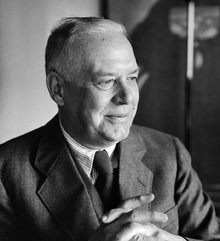
https://en.wikipedia.org/wiki/File:Wallace_Stevens.jpg

Despite being a Pulitzer Prize-winning poet, Wallace Stevens held down a full-time career as an insurance lawyer. He took a job at the Hartford Accident and Indemnity Company in 1916, at age 36, and worked there until his death in 1955.

He composed his poems on hour-long walks that he took during his lunch break, stopping periodically to scribble lines on the half-dozen or so envelopes that were always in his pockets. He would also pause occasionally at work to record fragments of poems, which he kept filed in the lower right-hand drawer of his desk. Then he would hand the collected fragments to his secretary for typing.

He was promoted to vice president in 1934 but declined all further opportunities for advancement. His colleagues knew of his poetry, but he avoided talking about it, and he earned a reputation as “the grindingest guy … in executive row”: Working diligently and largely alone, he came to be considered “the dean of surety-claims men in the whole country” and “absolutely the diamond in the tiara” of his company.

“I find that having a job is one of the best things in the world that could happen to me,” he once wrote. “It introduces discipline and regularity into one’s life. I am just as free as I want to be and of course I have nothing to worry about about money.”

16 Sep 23:58

The Secret Playbook of Internet Trolls

by George Washington

Pleased to meet you
Hope you guess my name
What’s confusing you
Is the nature of my game

- The Rolling Stones

The reason that Internet trolls are effective is that people still don’t understand their game.

There are 15 commonly-used trolling tactics to disrupt, misdirect and control internet discussions.

As one interesting example, trolls start flame wars because – according to two professors – swearing and name-calling shut down our ability to think and focus.

And trolls will often spew divisive attacks so that people argue against each other, instead of bad actions and policies of the powers-that-be.   For example, trolls will:

Start a religious war whenever possible using stereotypes like “all Jews are selfish”, “all Christians are crazy” or “all Muslims are terrorists”.

Yesterday, the alternative news site Common Dreams caught a troll using scores of different user names to spew anti-Semitic bile. (Common Dreams discovered that the same troll was behind the multiple user names by tracking their IP addresses. And the troll confessed to Common Dreams.)

The troll is a “a Jewish Harvard graduate in his thirties who was irritated by the website’s discussion of issues involving Israel”.

He posted anti-Semitic diatribes – such as Hitler should have finished the job and killed all Jews – using one alias.  Then – a couple of minutes later – he’d post an attack on the first poster using a different alias, claiming that criticism of Israel is the same thing as anti-Semitism.  (Note: Holocaust survivors and Israeli ministers say it’s not.)

Why would a Jew post vile anti-Semitic comments?  Because normal people are offended by – and don’t want to be associated with – pure, naked anti-Semitism, and so they will avoid such discussions.  If the discussion was originally criticizing a specific aspect of Israeli policy, the discussion will break down, and the actual point regarding policy will be lost.

Similarly, anti-Semitic posts weaken websites by making them seem less reputable. Indeed, Common Dreams says that the troll’s anti-Semitic comments drove away many of that site’s largest donors … dealing a severe blow to its continued viability. That’s exactly what trolls spewing anti-Semitic bile are trying to do: shut down logical discussion and discredit and weaken sites which allow rational criticism of policy.

It is well-known that foreign  governments and large companies troll online. See this, this this, and this. For example, the Israeli government is paying students to post pro-Israeli comments online.

And American students are also attempting to influence internet discussion.

While the Common Dreams troll claims that he’s not sponsored by the state of Israel, government  agencies have manipulated  Internet discussion for years. This includes the use of multiple “socket puppet” aliases.  The potential for mischief is stunning.

Unless we learn their game …

16 Sep 20:09

Being Counted: Reporting My Rape at a School Under Title IX Investigation

by Katie Rose Guest Pryal

July 2014

The first thing I have to do is find out X.’s full name. I know his first and last name, but I want to have his middle name. Being able to say all three names has power. Like when I get mad at my kids and say all three names, they know they’re in deep shit.

I don’t even know how to spell X.’s first name properly—it’s a name with a couple of possible spellings. Since I figure he’ll be a practicing doctor now, I just Google him. I don’t think twice. I type his name into the search bar and Google takes me right to his home page. To the page of his plastic surgery practice in one of the wealthiest towns in the United States.

Cheesy synth-jazz plays in the background while I stare into the eyes of my rapist.

I am not prepared for this.

I am not prepared to look into his eyes after so many years. After one doctorate, one marriage, and two children. This is not something I could ever have been prepared for. I hit mute on my computer.

I hate this man. I hate that he has a plastic surgery practice. The menu for the work he does divides women into body parts like “thighs,” “face,” “breasts,” and “torso.” Women’s eyes stare at me through my screen. His homepage looks like a fucking porno site. I get his full name and shut the browser.

I type his name into the rape reporting notes that I’m preparing to bring with me to campus. The notes feel inauthentic when compared to the report of, say, an undergraduate in a moment of crisis. But I know I will fight similar battles to the young women reporting rapes after finding themselves naked in frat house broom closets or basements.

The rape reporting people on campus will want details (details I won’t have.) They will want to tell me what to do with my report (and I will have to resist them.) They will quickly form ideas about what kind of person I am the minute I walk through the door (and those ideas will likely be wrong.)

Because they will want details, I’m preparing notes. My first problem is that I don’t remember the date. Fortunately, I’m detail-obsessed. I’ve kept journals since age thirteen to record everything. So that’s the first place I look to find the date. But, for some reason, I didn’t write down much about X. raping me. I didn’t write down the date. This is very unlike me. (Note to Past Me: What were you thinking?)

No problem, though, because I also keep a detailed calendar. Like, if Adrian Monk decided to keep a calendar, he would be jealous of my calendar. He’d ask me for calendar lessons. I start flipping through my past calendars, year by year, to the calendar for 20-- … and it is gone. Fucking gone. They’re all lined up on the shelf, and that one is missing.

Now, I wouldn’t have written in the calendar “Raped by X.” on whatever day in 20--. But I would have written down when I was flying to visit a guy that I’d just started dating. The reason I was in Chapel Hill at all, instead of in Greensboro where I was attending graduate school, was to stay overnight with my sister so I could fly out of the Raleigh airport the next morning on Southwest Airlines.

In the early morning hours before that flight, X. raped me.

Read more Being Counted: Reporting My Rape at a School Under Title IX Investigation at The Toast.

16 Sep 20:01

¡Os jodéis, ateos! BWAHAHAHAHAHAHAHA...


16 Sep 15:10

Gender-Bending Kids In Afghanistan

by Andrew Sullivan

El fenómeno “Bacha Posh”, niñas afganas obligadas por sus padres a vivir como niños> http://t.co/Vv3KiMGtTB pic.twitter.com/wSaW6QTy3n

— Telecinco.es (@telecincoes) May 21, 2014

In an essay adapted from her forthcoming book, Jenny Nordberg explains why some Afghan families raise their daughters as boys:

Officially, girls like Mehran do not exist in Afghanistan, where the system of gender segregation is among the strictest in the world. But many other Afghans, too, can recall a former neighbor, a relative, a colleague, or someone in their extended family raising a daughter as a son. These children even have their own colloquialism, bacha posh, which literally translates from Dari to “dressed like a boy.”

Midwives, doctors, and nurses I’ve met from all over the provinces are more familiar with the practice than most; they have all known bacha posh to appear at clinics, escorting a mother or a sister, or as a patient who has proven to be of another birth sex than first presumed.

The health workers say that families who disguise their daughters in this way can be rich, poor, educated, or uneducated, or belong to any of Afghanistan’s many ethnic groups. The only thing that binds the bacha posh girls together is their families’ need for a son in a society that undervalues daughters and demands sons at almost any cost. They disguised their girls as boys because the family needed another income through a child who worked and girls aren’t allowed to, because the road to school was dangerous and a boy’s disguise provided some safety, or because the family lacked sons and needed to present as a complete family to the village. Often, as in Kabul, it is a combination of factors. A poor family may need a son for different reasons than a rich family, but no ethnic or geographical reasons set them apart.

16 Sep 11:56

Comic for September 16, 2014

15 Sep 12:21

A campanha que virou piada

Marcelo Rubens Paiva

sexta-feira 12/09/14

  Campanha do Sindicato dos Médicos do Estado do Ceará (SIMEC) pergunta sobre ser operado por médico ou voar com piloto depois de tais profissionais terem fumado maconha.     Virou piada na Internet. E mostra um desconhecimento de causa, o que causa estranheza por se tratar de uma instituição que deveria se pautar pela [...]

Campanha do Sindicato dos Médicos do Estado do Ceará (SIMEC) pergunta sobre ser operado por médico ou voar com piloto depois de tais profissionais terem fumado maconha.

Virou piada na Internet.

E mostra um desconhecimento de causa, o que causa estranheza por se tratar de uma instituição que deveria se pautar pela ausência de preconceitos.

A coxinha é liberada, nem por isso um comandante de avião se entope de coxinha antes de um voo.

Nem de cachaça, Rivotril, Melhoral, energéticos…

E se tais profissionais são responsáveis pelas vidas de outros, como tratam daqueles que precisam de ajuda por estarem em estados alterados?

Aqueles que defendem a liberação da maconha no campo da saúde visam a melhoria da qualidade de vida do paciente, extraem e pesquisam os benefícios da erva, pensam no controle dos riscos da substância ao tirar a penumbra em que vivem usuários e viciados, e livrar cidadãos das consequências da violência e da polícia e prisões.

Bookmarked at brandizzi Delicious' sharing tag and expanded by Delicious sharing tag expander.
15 Sep 12:21

Fotografia quântica revolucionária é desenvolvida por brasileira

Eletrônica

Redação do Site Inovação Tecnológica - 29/08/2014

Brasileira faz demonstração histórica da física quântica
Gabriela idealizou o experimento usando o desenho de um gato entalhado em uma fina pastilha de silício - uma referência ao também famoso Gato de Schrodinger. [Imagem: Gabriela Barreto Lemos et al. - 10.1038/nature13586]

Entrelaçamento quântico

Uma física brasileira realizou uma demonstração impressionante de um dos aspectos mais bizarros e difíceis de compreender da física quântica.

Ela tirou uma foto do desenho de um gato que nunca foi iluminado pelos fótons capturados para gerar a imagem.

Além de demonstrar os princípios da mecânica quântica, o experimento revela uma nova forma de imageamento revolucionária: uma câmera que tira fotos sem que a luz precise iluminar o objeto a ser fotografado.

Gabriela Barreto Lemos é pesquisadora da UFRJ (Universidade Federal do Rio de Janeiro) e está atualmente fazendo pós-doutorado na Academia Austríaca de Ciências, em Viena.

Seu experimento é uma demonstração cabal do fenômeno do entrelaçamento quântico - ou emaranhamento -, segundo o qual duas partículas podem ficar de tal forma interconectadas que qualquer coisa que aconteça a uma influenciará imediatamente a outra, ainda que elas estejam a anos-luz de distância.

O entrelaçamento quântico é desafiador mesmo para as mentes mais brilhantes - Einstein desdenhou dele chamando-o de "ação fantasmagórica à distância" -, mesmo porque ele desafia o limite de velocidade universal, a velocidade da luz, uma vez que as partículas entrelaçadas parecem trocar informações instantaneamente.

Brasileira desenvolve fotografia quântica revolucionária

Imagem do experimento, mostrando os diferentes caminhos dos dois fluxos de fótons. [Imagem: Universidade de Viena]

Fotografia fantasma

Gabriela idealizou o experimento usando o desenho de um gato entalhado em uma fina pastilha de silício - uma referência ao também famoso Gato de Schrodinger.

Ela produziu pares de fótons entrelaçados e os enviou em duas direções diferentes: enquanto o primeiro fóton podia atravessar o recorte do gato e então se perder, o outro membro de cada par ia direto para um detector, sem nunca passar pelo gato, e sem ter como se comunicar com seu irmão.

A imagem foi gerada pelos fótons coletados pelo detector - aqueles que nunca poderiam ter passado pelo recorte do gato.

Confirmando as predições da teoria quântica, o gato apareceu perfeitamente na fotografia - uma imagem gerada por fótons que nunca passaram pelo objeto que foi fotografado.

Aplicações biológicas

Embora o fenômeno do entrelaçamento quântico não precisasse mais de demonstrações para se comprovar real, o experimento pode ter aplicações práticas em áreas muito diferentes, principalmente porque cada par de partículas entrelaçadas pode ser formado por fótons de energias diferentes.

Assim, um disparador de fótons pode enviar fótons de baixa energia sobre amostras biológicas muito delicadas, enquanto a imagem da amostra é gerada por fótons comuns, na faixa do visível, por uma câmera digital convencional.

Este processo é muito mais simples e direto do que as imagens fantasmas capturadas por câmeras de pixel único.

Gabriela está trabalhando na equipe do professor Anton Zeilinger, que no ano passado surpreendeu os próprios físicos demonstrando que os eventos quânticos independem do espaço e do tempo, o que foi visto com uma espécie de "fim da causalidade".

Bibliografia:

Quantum imaging with undetected photons
Gabriela Barreto Lemos, Victoria Borish, Garrett D. Cole, Sven Ramelow, Radek Lapkiewicz, Anton Zeilinger
Nature
Vol.: 512, 409-412
DOI: 10.1038/nature13586

Outras notícias sobre:

Mais Temas


Copyright 1999-2014 www.inovacaotecnologica.com.br.
Todos os direitos reservados.
É proibida a reprodução total ou parcial, por qualquer meio, sem prévia autorização por escrito.

Bookmarked at brandizzi Delicious' sharing tag and expanded by Delicious sharing tag expander.
15 Sep 12:06

Pendulum Waves with Philip Glass


Pendulum Waves with Philip Glass

15 Sep 11:48

Neste post explico a melhor fórmula para derrotar o ISIS na Síria

by Gustavo Chacra

O melhor dos cenários para a Síria, neste momento, seria a manutenção do regime, mas com a saída de Bashar al Assad, e a inclusão de algumas figuras da oposição doméstica tradicional de Damasco. Um novo líder laico, mesmo sendo integrante do Baath ou das Forças Armadas envolvido nas ações militares, não teria sobre si o peso do nome Assad e poderia reatar as relações com a Turquia, se aproximar dos EUA, sem a necessidade de romper com Rússia, Irã e Hezbollah. Este novo líder, com o regime intacto, poderia ser armado pelos EUA e outros países para enfrentar o ISIS.

Armar grupos opositores supostamente moderados, como pretende Obama, será uma tarefa árdua e que levará muito tempo. Eles são fracos, irrelevantes, aliados da Frente Nusrah (Al Qaeda) e sem apoio popular. A chance de fracasso é enorme. Obviamente, Assad não irá sair por livre e espontânea vontade. Mas em vez de armar rebeldes, os serviços de inteligência dos EUA deveriam há tempos ter organizado um golpe de Estado para derrubá-lo em coordenação com membros das forças de segurança sírios.

Muitos comandantes militares e de milícias pró-governo sírios, sejam eles alauítas, cristãos ou sunitas, estão insatisfeitos com a performance de Assad. Sem dúvida odeiam os rebeldes do ISIS, da Frente Nusrah (Al Qaeda) e mesmo os tais moderados carpinteiros, engenheiros e padeiros, nas palavras de Obama. O regime ainda é a única forma de garantir a segurança de cristãos, alauítas e drusos. Os rebeledes, mesmo os tais moderados, cometerão genocídio se puderem. Nos tempos da Guerra Fria, um golpe provavelmente já teria ocorrido para manter o regime sem Assad. Era comum na América Latina e mesmo no Oriente Médio.

Ou, talvez, tenha havido uma tentativa em meados de 2012, quando o ministro da Defesa, o cunhado de Assad e seu irmão Maher foram alvo de um suposto atentado terrorista. Há quem diga que eles, em coordenação com países do Ocidente, planejavam dar um golpe de Estado e derrubar Bashar. Mas líder sírio, como tradicional Michael Corleone, não iria deixar seu irmãozinho “Fredo” (Maher) dar um golpe.

 Não sei como faz para publicar comentários. Portanto pediria que comentem no meu Facebook (Guga Chacra)  e no Twitter (@gugachacra), aberto para seguidores

Guga Chacra, comentarista de política internacional do Estadão e do programa Globo News Em Pauta em Nova York, é mestre em Relações Internacionais pela Universidade Columbia. Já foi correspondente do jornal O Estado de S. Paulo no Oriente Médio e em NY. No passado, trabalhou como correspondente da Folha em Buenos Aires

Comentários islamofóbicos, antissemitas, anticristãos e antiárabes ou que coloquem um povo ou uma religião como superiores não serão publicados. Tampouco são permitidos ataques entre leitores ou contra o blogueiro. Pessoas que insistirem em ataques pessoais não terão mais seus comentários publicados. Não é permitido postar vídeo. Todos os posts devem ter relação com algum dos temas acima. O blog está aberto a discussões educadas e com pontos de vista diferentes. Os comentários dos leitores não refletem a opinião do jornalista

Acompanhe também meus comentários no Globo News Em Pauta, na Rádio Estadão, na TV Estadão, no Estadão Noite no tablet, no Twitter @gugachacra , no Facebook Guga Chacra (me adicionem como seguidor), no Instagram e no Google Plus. Escrevam para mim no gugacha


15 Sep 09:48

Future Self

Maybe I haven't been to Iceland because I'm busy dealing with YOUR crummy code.
12 Sep 23:17

Afinal, quem são “os evangélicos”?

Homofóbicos, cortejados pela presidente, fundamentalistas. Massa de manobra de Silas Malafaia, conservadores, determinantes no segundo turno das eleições. De tanto que se falou sobre os evangélicos nas últimas semanas, nos jornais e nas redes sociais, talvez caiba uma pergunta: afinal, quem são “os evangélicos”?

A resposta mais honesta não poderia ser mais frustrante: os evangélicos são qualquer pessoa, todo mundo, ou, mais especificamente, ninguém. São uma abstração, uma caricatura pintada a partir do que vemos zapeando pelos canais abertos misturado ao que lemos de bizarro nos tabloides da internet com o que nosso preconceito manda reforçar. Dizer que “o voto dos evangélicos decidirá a eleição” é tão estúpido quanto dizer a obviedade de que 22,2% dos brasileiros decidirão a eleição. Dizer que “os evangélicos são preconceituosos”, significa dizer que o ser humano é preconceituoso. É não dizer nada, na verdade.

Acreditar que há uma hegemonia de pensamento, de comportamento ou de doutrina evangélica é, em parte, exatamente acreditar no que Silas Malafaia gosta de repetir, mas é, em parte, desconhecer a história. A diversidade de pensamento é a razão de existir da reforma protestante. E continuou sendo pelos séculos seguintes, quando as igrejas reformadas do século 16 deram origem ao movimento evangélico, aos pentecostais, e estes aos neopentecostais, todos microdivididos até o limite do possível, graças, novamente, à diversidade de pensamento – sobre forma de governo, vocação e pequenos e grandes pontos doutrinários. E boa parte dessas denominações não tem sequer organização central nem “presidência”, muito menos representantes possíveis, com as decisões sendo tomadas nas comunidades locais, por votação democrática.

Assim como não existe “os evangélicos” também não existe “os pentecostais”, nem “os assembleianos”: dizer que Malafaia é o “papa da Marina Silva” como disse Leonardo Boff, apenas porque ambos são membros da Assembléia de Deus, é ignorar que, por trás dos 12,3 milhões de membros detectados pelo IBGE, a denominação é rachada entre ministérios Belém, Madureira, Santos, Bom Retiro, Ipiranga, Perus e diversos outros, cada um com seu líder, sua politicagem e sua aplicação doutrinária. A Assembléia de Deus Vitória em Cristo de Malafaia, aliás, sequer pertence à Convenção Geral das Assembleias de Deus no Brasil.

Ignorância parecida se manifesta em relação ao uso do termo “fundamentalista”, como sinônimo de “literalista”, aquele incapaz de metaforizar as verdades morais dos livros da Bíblia. A teologia cristã debate há dois mil anos sobre a observação, interpretação e aplicação dos escritos sagrados, quais são alegóricos e quais são históricos, quais são “poesias” e quais devem ser tomados ao pé da letra. O deputado Jean Wyllys, colunista da Carta Capital, do alto de alguma autoridade teológica presumida, já chegou à sua conclusão: o que não for leitura liberal, é fundamentalista e, portanto, uma ameaça às minorias oprimidas. (Liberalismo teológico é uma corrente do final do século 19 que propôs uma leitura crítica das escrituras, completamente alegorizada, negando sua autoridade sobrenatural, a existência dos milagres, e separando história e teologia).

Só que isso simplesmente não é verdade. Dentro da multifacetação das igrejas de tradição evangélicas, há as chamadas “inclusivas”, mas há diversas igrejas históricas, tradicionais, teologicamente ortodoxas, que acreditam nos absolutos da “sola scriptura” da Reforma Protestante, mas que têm política acolhedora e amorosa com as minorias. Algumas criaram pastorais para tratar da questão homossexual, outras trabalham para integrá-los em seus quadros leigos; ou, ainda, como disse o pastor batista Ed René Kivitz, estão mais dispostos a aprender como tratar “uma pessoa que está diante de mim dizendo ter sido rejeitado pela família, pela igreja” do que discutir a literalidade dos textos do Velho Testamento.

O panorama da questão pode ser melhor entendido em Entre a cruz e o arco-íris: A complexa relação dos cristãos com a Homoafetividade (de Marília de Camargo César, da Editora Autêntica), livro que tive a honra de editar. Nele, o pastor batista e sociólogo americano Tony Campolo, ex-conselheiro do presidente Bill Clinton, diz: “Se você vai dizer à comunidade homossexual que em nome de Jesus você a ama (...) não teria que lutar por políticas públicas que demonstrem que você as ama? Pode haver amor sem justiça? Eu luto pela justiça em favor de gays e lésbicas, porque em nome de Jesus Cristo eu os amo.” Campolo, entretanto, faz distinção entre direitos e casamento: “O governo não deve se envolver nem declarar, de forma alguma, o que é casamento, quem pode ou não se casar”, ele disse. “Governo existe para garantir os direitos das pessoas. Casamento é um sacramento da igreja – governos não devem decidir quem deve ou não receber esse sacramento.” Campolo acredita que esta será a visão dominante entre cristãos americanos “em cinco ou seis anos”.

Entre os evangélicos brasileiros, há quem pense desde já como Campolo – distinguindo união civil de casamento. Há quem pense de forma ainda mais radical: que a união civil, com implicações patrimoniais e status de família, deveria valer não apenas para casais homossexuais, mas para irmãos, primos ou quem quer que se entenda como família. Há quem defenda o acolhimento dos gays nas igrejas, mas que se reserve o celibato para eles. Quem, embora sabendo que mais da metade das famílias brasileiras já não são no formato pai-mãe-filhos, ainda luta para restabelecer esse padrão idealizado. Há, sim, quem acredite que o seu conjunto de doutrinas e o seu modo de vida são fundamentais. Há aqueles ainda que, enquanto discutimos aqui, estão mais preocupados se a melhor tradução do grego é a João Ferreira de Almeida ou a Nova Versão Internacional. E há quem acorde diariamente acreditando ser o porta-voz do “povo de Deus”, pague espaço em redes de televisão para multiplicar esse delírio (mas, a julgar pelo 1% de intenção de voto do Pastor Everaldo, somente ativistas gays e jornalistas desmotivados acreditam nesse discurso). Esses são “os evangélicos”.

Na fatídica sexta-feira em que o PSB divulgou seu programa de governo, enquanto Malafaia gritava no Twitter em CAPSLOCK furibundo, o pastor presbiteriano Marcos Botelho, postou: “Marina, que bom que vc recebeu os líderes do movimento LGBTs, receba as reivindicações com a tua coerência e discernimento de sempre e um compromisso com o estado laico que é sua bandeira. Vamos colocar uma pedra em cima dessa polarização ridícula entre gays e evangélicos que só da IBOPE para líderes políticos e pastores oportunistas.”

Botelho não representa “os evangélicos” porque não existe “os evangélicos”. Mas Marcos Botelho existe e é evangélico. Assim como existe William Lane Craig, o filósofo que convida periodicamente Richard Dawkins para um debate público, do qual este sempre se esquiva; existe o geneticista Francis Collins vencendo o William Award da Sociedade Americana de Genética Humana; existe o presidente Jimmy Carter, dando aula na escola bíblica no domingo e sendo entrevistado para a capa da Rolling Stone por Hunter Thompson na segunda-feira; existe o pastor congregacional inglês John Harvard tirando dinheiro do próprio bolso para fundar uma universidade “para a glória de Deus” nos Estados Unidos que leva seu sobrenome até hoje; existe o pastor batista Martin Luther King como o maior ativista de todos os tempos; existe o jovem paulista Marco Gomes, o “melhor profissional de marketing do mundo”, pedindo licença para “falar uma coisa sobre os evangélicos”. E existe o Feliciano, o Edir Macedo, a Aline Barros, o Thalles Roberto, o Silas Malafaia e o mercado gospel. Como existe bancada evangélica, mas existem os que lutaram pela “separação entre igreja e estado” na constituição, e existem os que acreditam que levar Jesus Cristo para a política é trabalhar não para si, mas para os menos favorecidos.

Existe o amor e existe a justiça, como existe o preconceito, o dogmatismo, o engano, o medo, a vaidade e a corrupção. Não porque somos evangélicos, mas porque somos humanos.

* Ricardo Alexandre é jornalista e escritor, radialista e blogueiro, Prêmio Jabuti 2010, ex-diretor de redação das revistas Bizz, Época São Paulo e Trip. E é membro da Igreja Batista Água Viva em Vinhedo, interior de São Paulo.
Bookmarked at brandizzi Delicious' sharing tag and expanded by Delicious sharing tag expander.
12 Sep 19:35

Subsídios do BNDES custam um Bolsa Família, mas efeito é quase nulo

by Míriam Leitão

Enviado por Míriam Leitão - |

na cbn

Subsídios do BNDES custam um Bolsa Família, mas efeito é quase nulo

O custo dos subsídios do BNDES mais do que dobrou em 2014. Chega a R$ 23 bilhões. Durante todo o ano passado o gasto havia sido de R$ 10,6 bilhões. O montante se aproxima do valor repassado pelo Bolsa Família (R$ 24,5 bi), em 2013. Mas o resultado na economia mostra que o efeito é quase nulo para o crescimento do país.

O custo, pago por todos nós, é formado pela diferença de juros. O Tesouro levanta recursos vendendo títulos e os remunera a 11%. O BNDES empresta parte desse montante cobrando a TJLP, atualmente em torno de 5%.

Os maiores beneficiados são os grandes empresários, em especial da indústria, setor em fase de definhamento a meses. Os empreendedores menores, contudo, acessam esse recurso por meio de bancos intermediários, que cobram taxas e comissões.

Os maiores beneficiados dessa política acabam sendo as grandes companhias, as mesmas que têm acesso à captação a juros muito baixos no exterior. É bom lembrar disso quando se questiona se a economia estaria ainda pior sem o gigantismo do BNDES. Quem melhor se serve dele é o grande capital (bancos ou empresas), e não consta que ele seja dependente do banco de fomento para financiar seus projetos.

Subsidiar grandes grupos através de empréstimos é uma política já tentada nos anos 1970, de tristes lembranças econômicas. É exatamente por conhecê-la que eu não acredito nela.

Ouça aqui o comentário feito na CBN.

12 Sep 19:29

Mental Health Break

by Andrew Sullivan

A hypnotic lesson in physics:

12 Sep 19:12

Crime and Punishment

by Greg Ross

In the eyes of the law, a corporation is a person. But it’s a strangely bodiless person, which makes it tricky to punish with laws designed for human offenders.

Tired of this, federal judge Robert Doumar in 1988 sentenced Allegheny Bottling Company to three years in prison and a fine of $1 million. The company had been caught in a price-fixing scheme that cheated consumers out of at least $10 million. “Congress has not said a corporation could not be imprisoned,” Doumar said. “This court will deal with any individual who similarly disregards the law.”

How? The court decided that the essence of imprisonment is restraint, or a deprivation of liberty, and that it could restrain or immobilize a corporation — by closing the physical plant and guarding it, for example. Doumar suspended the sentence but said that if the company violated its probation he would send a U.S. Marshal to “padlock every facility Allegheny owns.”

“Some 200 years ago, the Lord Chancellor of England said, ‘You cannot expect a corporation to have a conscience when it has no soul to be damned and no body to be kicked,'” he said. “Obviously, Allegheny Bottling Company did not have a conscience.”

More recently, California resident Jonathan Frieman put a charity’s incorporation papers in his passenger seat and drove in the carpool lane, arguing that his car now had multiple occupants.

“After I explained the reason I was citing him, he explained to me that he was exempt because he was in essence a corporation,” CHP Officer Troy Dorn testified. “I explained to him I was not sure about his standing as a corporation but he could explain it later in a Marin County court.”

Jurist Frank Drago admired the novelty of Frieman’s argument but said, “I look at it a little differently. … Common sense says carrying a sheath of papers in the front seat does not relieve traffic congestion. And so I’m finding you guilty.”

12 Sep 19:07

Sagging Pants And The Long History Of 'Dangerous' Street Fashion

Plenty of fashions adopted by young people get under the skin of adults, but the opposition to sagging often has the feel of a moral panic. i i

Plenty of fashions adopted by young people get under the skin of adults, but the opposition to sagging often has the feel of a moral panic.

Robert Mecea/AP

Mary Sue Rich finally had enough.

The council member from Ocala, Fla., was tired of seeing the young people in her town wearing their pants low and sagging, and successfully pushed to prohibit the style on city-owned property. It became law in July. Violators face a $500 fine or up to six months in jail.

"I'm just tired of looking at young men's underwear, it's just disrespectful," Rich said. "I think it would make [people who wear sagging pants] respect themselves, and I would wager 9 out of 10 of them don't have jobs."

The rationale behind the ban enacted last year in Wildwood, N.J., was similar. "I'm not trying to be the fashion police, but personally I find it offensive when a guy's butt is hanging out," said Ernest Troiana, the town's mayor, after he announced that his city would very much be policing fashion.

Pikeville, Tenn., switched it up a little: Officials there said they were doing so in part because of health concerns related to the "improper gait" of the saggers. The mayor even pointed to a study from a Dr. Mark Oliver Mansbach of the National American Medical Association that supposedly found that around 8 in 10 saggers suffered from sexual problems like premature ejaculation. One problem: Neither Mark Oliver Mansbach nor NAMA actually exist; the much-referenced study was an April Fools' joke.

“ There's certainly nothing novel about adults thinking that young people's fashions are distasteful — indeed, that's often kind of the point.

This isn't merely the hobbyhorse of small-town politicos — no less a figure than President Obama has weighed in on sagging. "Brothers should pull up their pants," he told MTV a few years ago. "That doesn't mean you have to pass a law ... but that doesn't mean folks can't have some sense and some respect for other people. And, you know, some people might not want to see your underwear — I'm one of them."

For sagging's many detractors, kids wearing their pants below the waist — or below the butt cheeks, in the case of the look's most fervent adherents — has doubled as a reliable shorthand for a constellation of social ills ostensibly befalling or propagated by young black men. A dangerous lack of self-respect. An embrace of gang and prison culture. Another harbinger of cultural decline. Those are all things that people say about hip-hop, which helped popularize the sagging aesthetic. And if those are the presumed stakes, it's hardly any wonder why opposition to sagging sometimes has the feel of a full-on moral panic.

Such is the apoplexy around the styles that many of the most vocal proponents of sagging bans are people who might otherwise be wary of putting young black men into unnecessary contact with the criminal justice system. When Jefferson Parish, La., banned sagging last year, the move got a big cosign from the head of the nearby chapter of the NAACP. "There is nothing positive about people wearing saggy pants," he told a local TV station. (The national NAACP, it should be noted, has fought back against bans like these.) And a group called the Black Mental Health Alliance of Massachusetts began airing public service announcements in Boston last year that pointedly used the threat of arrest as deterrent. "Our community and our people are tired of these kids walking around like this," Omar Reid, one of the initiative's leaders, told the Boston Globe.

There's certainly nothing novel about adults thinking that young people's fashions are distasteful — indeed, that's often kind of the point. Full disclosure time: Like an awful lot of people in my generational cohort, I used to sag. Here's what I'll say about that: Everyone who thought he was cool as a teenager and reaches his 30s will look back at photos of himself from high school and cringe mightily. But that isn't specific to sagging, of course. Like goth dress, it freaks out old people, and then most of its practitioners move on to other things. The difference is that the anxieties around something like goth dress don't get codified into laws that threaten jail time.

There's another argument against sagging, which you can see in this video that's part of the "Pull Up Your Pants Challenge," that tries to appeal to respectability and pragmatism: Black kids should jettison the look if only to avoid agitating unnecessary suspicion from police and strangers.

But if history is any indication, that suspicion has proven to be pretty sticky, and it's attached itself to a bunch of different styles — hoodies, construction boots, do-rags.

Sagging, though, has been a uniquely long-lived source of agita.

The Murky Genesis Of Saggy Pants

Los Angeles police officer Victor Vinson was talking to an audience of local parents, warning them about the lure of street gangs. He told them how they might recognize if their own kids had come under the thrall of gangs. The biggest tell, he said, was their sagging pants.

"Kids today are dressing for death," Vinson said.

That sentiment sounds a lot like the feelings of Mary Sue Rich, the Ocala, Fla., council member. But Vinson is quoted in a Los Angeles Times article from way back in 1988, one of the earliest mentions of the trend in the press. It's a reminder that people have been fretting about sagging for nearly three decades.

The world has changed a lot since then. Los Angeles in 1988 really was a violent place, especially compared with today, and much of that violence was gang-related. Hip-hop hadn't become a staple of mainstream music yet. Fashion has changed, too, as people have moved to more contoured, fitted clothing. Sagging has tracked with that: the huge, baggy jeans of the 1990s have been replaced with skinny jeans and pants today. (Unless, you know, you're Michael Jordan.)

But let's back up a bit. The most familiar origin myth for sagging goes something like this: Convicts prohibited from wearing belts often wore sagging prison-issued uniforms, and they carried that look with them once they were back on the outside. Another story goes that some prisoners would wear their pants low to let other inmates know they were sexually available. Both have been tentpoles of "scared straight" arguments against sagging for a long time. Um, literally so in the case of the latter.

"You want to walk around looking like a criminal? Pull up your damn pants!"

"You know that in jail that look meant you wanted to have sex with other prisoners? Pull up your damn pants!"

But it's murky as to how true this be.

"I don't think we can definitively say that sagging began in prisons," said Tanisha C. Ford, an Indiana University historian who researches fashion.

An entry about sagging's genesis on Snopes, the online dictionary of urban legends, says the trend did in fact originate in prison, but the article doesn't link to its sources.

Consider the many other fashions that once carried the stigma of imprisonment that have migrated to the outside world. It's probably not an accident that the mainstreaming of tattoos and body art have coincided with the explosion of the American incarceral state.

Whatever the origins, people have actively courted that connection by positioning themselves against mainstream American ideas of propriety through their dress. But when that fashion itself goes mainstream, what counts as oppositional requires some occasional recalibrating.

It's highly possible, then, that sagging might still be a thing all these decades later because it hasn't lost its unique ability to rankle.

When 'Hoodlums' Wore Suit Jackets

But all this drama around young brown kids, baggy clothes and crime goes back much further than hip-hop and street gangs. In the 1930s, black and Mexican-American men in California began rocking big, oversize suit jackets, and pants that tapered down at their ankles: zoot suits.

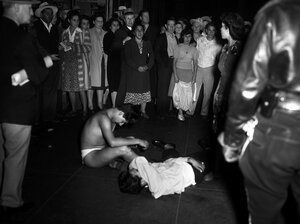
Young men were stripped of their clothes and badly beaten as policemen scoured the streets in Los Angeles for zoot-suited young men they blamed for petty crime. i i

Young men were stripped of their clothes and badly beaten as policemen scoured the streets in Los Angeles for zoot-suited young men they blamed for petty crime.

Harold P. Matosian/AP

Ford, the fashion historian, said the look was born out of improvisation, since many of those kids couldn't afford tailors. "A lot of kids would just go to the thrift store to buy those suits, and then get their mom or their aunts to taper the pants," she said.

But Luis Alvarez, a historian at University of California, San Diego who wrote a book on that period called The Power of the Zoot, said that just like the origins of sagging, the genesis of the zoot suit is pretty murky. "Some might argue that [people started wearing it because] it looked better when they were spinning girls around the dance floor," he said. "I argued with a guy who said they got it from [Clark Gable] in Gone with the Wind because he was sort of wearing a baggy suit in that movie."

What isn't in doubt, he said, is that the look was spread by black jazz musicians as they traveled around the country.

Today, those zoot suits are synonymous with Jazz Age and World War II-era cool. But back then, they were seen as the wardrobe of black and Mexican-American delinquents and gang members. Zoot suiters' opponents — and there were lots — saw them as harbingers of a moral decline. In his book, Alvarez cites a 1943 Washington Post article that was typical of the way the trend was covered in big-city newspapers. The language in it sounds an awful lot like the speech Officer Vinson would give those Los Angeles parents decades later on the dangers posed by saggers.

"Chief features are the broad felt hat, the long key chain, the pocket knife of a certain size and shape, worn in the vest pocket by boys, in the stocking by girls, the whisky flask of peculiar shape to fit into the girl's bosoms, the men's haircut of increasing density and length at the neck — all of which paraphernalia has symbolic and secret meanings for the initiates. In some places, the wearing of the uniform by the whole gang is a danger signal, indicating a predetermine plan for concerted action and attack."

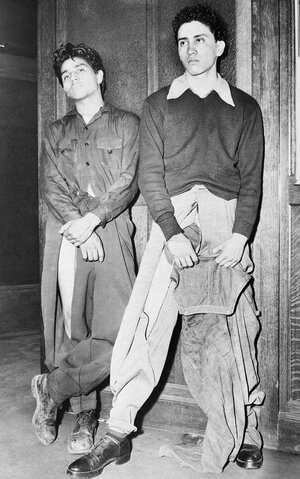
In 1943, Noe Vasquez and Joe Vasquez — both 18 years old but not relatives — told Los Angeles police that they were roughed up by sailors who tore their zoot suit-style clothes. And even after all that? Swag. i i

In 1943, Noe Vasquez and Joe Vasquez — both 18 years old but not relatives — told Los Angeles police that they were roughed up by sailors who tore their zoot suit-style clothes. And even after all that? Swag.

AP

"The style is linked to jazz music, it's linked to urban spaces, it's linked to a criminal underworld — gambling and numbers-running," Ford said. And those crimes were associated with blacks and Latinos.

Alvarez wrote that "[z]oot syle came to represent what was morally and politically deficient with the home front during World War II — violence, drinking, premarital sex, and the threat of street attacks." That distaste for the clothes and the culture associated with it persisted even though a good number of the people in the military and war industry were themselves zoot suiters.

As the war ramped up, Americans were, uh, tightening their belts. (My bad, y'all.) There were strict rations put on textiles and fabrics, which angered zoot suit opponents even more — those baggy, bulky threads weren't just criminal, but an affront to the nation's war goals.

"In '42 and '43 it becomes a flashpoint for ideas that were larger than just youth style," Alvarez told me. "This is when it becomes the platform for arguments about who is or who isn't American."

That anger exploded into violence in Los Angeles when bands of white servicemen — joined by hundreds of police officers — left their posts to search for young black and Mexican-American men dressed in that style to beat up. People were pulled from streetcars and pummeled by crowds. They were bludgeoned in the streets. The violence went on for more than four days.

"These kids wearing those outfits were stripped by sailors and LAPD and their suits were burned in the street," Ford said. But the anti-zoot marauders were hardly picky; people who weren't wearing zoot suits were jumped, too.

Similar but smaller paroxysms of violence would unfold in other big cities across the country as zoot suiters clashed with the police and angry whites. When things calmed down, the Zoot Suit Riots became a kind of national scandal, with both left-leaning folks and conservatives arguing that they might have been part of a plot to sow disunity on the domestic front.

Dangerous Fashion Goes Mainstream

The war ended. Fashion moved on. Ford said that as time went on, looks like dashikis and Afros would come to take on their own aura of black menace, although the threat in those style choices was more about fears of militancy and political unrest than street crime.

"We look at the Afro and the dashikis ... as part of iconography of the 1970s, but we don't remember how controversial and political those were," she said. Some historically black colleges like Hampton University once placed bans on Afros, and the hairstyle was verboten in Cuba and Tanzania.

Untethered from their contemporary messiness, though, those looks have folded into mainstream life. Afros used to scandalize white folks and older black people alike. Today college-educated women post their "big chop" pics to Facebook, Instagram or the countless blogs dedicated to natural hair, and they're greeted with affirmation and cosigns.

And zoot suits? Ford joked that the "Steve Harvey suits" that were the preferred dressed-up look for millionaire athletes looked a whole lot like the zoot suits of the World War II era. "You'd see these huge, 6-8 basketball players walking with the big, long suit jackets," she said. (I've been looking for any excuse to link to this draft night photo of Jalen Rose. Thank you, Dr. Ford.)

You might still see teenagers rocking them, too. "Nowadays I can't go a week or two in May or June without driving past some kids wearing zoot suits to their prom," Alvarez said.

I wondered if sagging was likely to ever make that same transition into ordinariness. "Once historians go and tell the story of the late 20th century — which we haven't done yet — there's a way that sagging and hoodies and t-shirts will be revered as markers of a particular era," Ford told me. She said that the hoodie and sagging pants look might even become the way we remember the youth resistance of our time. But, she said, "it's definitely still going to be tied to [ideas of] criminality."

Alvarez said zoot suits and sagging share much of the same DNA: They were ways that people made statements about their relationships to other people and their circumstances.

"[For the wearers,] it's a mechanism to reclaim dignity that's been taken away from them," he said.

A lot of people would roll their eyes and shake their fists if you told them that there was anything dignifying about sagging pants, I said.

"Youth culture, in general, is not always decipherable to those outside of the inner circle," Alvarez responded. "In many ways, our dress and our vocabulary and our vernacular becomes powerful because [outsiders] can't understand it."

Bookmarked at brandizzi Delicious' sharing tag and expanded by Delicious sharing tag expander.
12 Sep 18:03

Burger King do Japão lança hambúrguer totalmente preto

Adam Victor Brandizzi

É uma tendência pelo visto.

Divulgação

Um hambúrguer visualmente intragável (para os ocidentais) será servido pela rede Burger King no Japão. O pão, o queijo e o molho são pretos. O pão do Kuro Burger é feito de carvão de bambu, o molho leva alho, cebola e um toque de tinta de polvo. A coloração preta do queijo também é obtida a partir do carvão de bambu.

O Kuro Burger (kuro significa preto) é servido pela rede no Japão desde 2012; no ano passado, foi lançado o Kuro Ninja, com uma fatia de bacon adicional. Essa é a terceira geração dos hambúrgueres pretos, e será lançada nas versões Diamond e Pearl -- a diferença é a salada colorida.

Imagens: divulgação

De acordo com o Burger King, o Kuro Burger teve uma boa aceitação no Japão. O McDonalds já havia lançado sanduíches com fatias de pães pretos na China, em referência à filosofia "Yin-yang". Mas o queijo preto é novidade. O Kuro Burger Pearl custa o equivalente a R$ 10,40, enquanto o Diamond é vendido por R$ 14,80.

Com informações do The Independent

Curta o Administradores.com no Facebook
Acompanhe o Administradores no Twitter
Receba Grátis a Newsletter do Administradores

Carregando...

Vagas de trabalho
Bookmarked at brandizzi Delicious' sharing tag and expanded by Delicious sharing tag expander.
12 Sep 18:03

Goths and metalheads, is your heart black enough for the Indonesian Ayam Cemani Chicken?

Goths and metalheads, is your heart black enough for the Indonesian Ayam Cemani Chicken?

title


The Ayam Cemani Chicken is notable for a couple of things. First of all, partially due to its rarity, especially outside of its native Indonesia, one Ayam Cemani will run you about $2,500. Second, it is clearly the chicken of Our Dark Lord and Savior Satan! The birds exhibit the genetic condition “fibromelanosis,” which renders them totally black—we’re talking feathers, skin, organs, bones, the works. Only their blood is red, albeit a very dark shade.

Frankly, I think such a cool-looking evil luxury animal could be a perfect mascot for some underwordly music subculture. Sure, chickens are not usually associated with the darkness, but stranger pairings have been made—Leather Nun doing ABBA’s “Gimme Gimme Gimme,” for example, is pretty delicious! And if you’re vegetarian, it could make a very suitable avian familiar. Check out the video below for some decidedly unholy clucking—I assume if you play the video backwards you can hear the voice of Beezlebub.
 

Yum?
 

Hail Satan.
 

Gaze into the blackness of its soul


Via Geekologie

Posted by Amber Frost
Bookmarked at brandizzi Delicious' sharing tag and expanded by Delicious sharing tag expander.
12 Sep 18:01

"I’m embarrassed to say this, but I’ll say it....


"I’m embarrassed to say this, but I’ll say it. I’ve had a really hard time finding work, so I’ve been living with my grandmother. And she’s told me recently that she doesn’t have the money to feed me. So I’ve been eating at my friend’s house. I go over there, and I’m too embarrassed to ask for anything, but his dad always insists. He says: ‘Why aren’t you eating? Please, eat!’ This has really caused my idea of ‘family’ to widen. I’ve learned that your family can be anyone."

(Kinshasa, Democratic Republic of Congo)

12 Sep 14:18

Woman in her twenties discovers that she was born without a cerebellum

A woman living in China’s Shandong Province got a bit of a surprise recently when doctors at the Chinese PLA General Hospital told her that her brain was missing one of the most important centers for motor control: the cerebellum. She had initially checked herself into the hospital because of a bad case of dizziness and nausea, New Scientist reports.

Only nine other such cases in the world, and most died early on

The cerebellum is a small portion of the brain located at the back of the skull. But don’t be fooled by its size; it actually contains half of the brain’s neurons. And, unsurprisingly, having a missing cerebellum — cerebrospinal fluid was found in its place — caused quite a few problems for this woman over the course of her life. For one thing, her speech was slurred until age six, and she only began to walk at age seven. Moreover, she has had trouble maintaining her balance her entire life.

There have only been nine other such cases in the world and most died early on, so the fact that this woman has made it to adulthood – and is doing reasonably well — is pretty astounding. Doctors will undoubtedly want to study her further to find out how her brain adapted to the exclusion so quickly (it’s likely that the cortex took over for the missing mass). The results of her initial examination, however, are already available in the journal Brain.


ICYMI:Detours, Episode 2 - Boston Children's Hospital and 3-D Printed Brains
Bookmarked at brandizzi Delicious' sharing tag and expanded by Delicious sharing tag expander.
12 Sep 11:53

Watches

Adam Victor Brandizzi

Nah, acredito que o meu vai ficar livre ainda por um tempo.

Old people used to write obnoxious thinkpieces about how people these days always wear watches and are slaves to the clock, but now they've switched to writing thinkpieces about how kids these days don't appreciate the benefits of an old-fashioned watch. My position is: The word 'thinkpiece' sounds like a word made up by someone who didn't know about the word 'brain'.
12 Sep 11:48

How To Cheat Death

by Doug
11 Sep 21:08

Can You Have a Career In Solving Big World Problems?

by Scott

I regularly take the the top voted question from readers and answer it in a post. With 41 votes, today’s winner was:

How would you start a career tackling big world problems? (Submitted by Steve Chung)

It’s certainly a wonderful ambition. What’s concerning is much like the saying “I want to change the world” it’s more about ego than the world itself. Why does the world need changing exactly? Why are you wise enough or worthy of the power required to change the world? Once you scratch the surface of the sentiment and think, just for a minute, about the history of people who wanted to solve big problems, much less the ones who succeeded, you’ll discover how narrow your focus needs to be.

The obvious answer is: Go solve some small world problems and work your way up. No one wants to hear this of course, but if you’re serious about the above question this has to be one of the strongest answers. To cure a disease takes a lifetime of study. To invent a new technology that saves energy, or write a novel that inspires people to be less mean to each other, or a thousand other world changing ideas can only happen if you’re committed to one path, at least for a time. Do you really think someone solved a big world problem in an afternoon? By accident? Do some homework and see what you find.

The real question then is how much work are you willing to invest in your dream? The dream is free, the work is not. Before you can solve big problems you need to learn how to solve many small ones and that will require patience and time. The bigger the problem you want to solve, the more of a commitment you’ll need to make. For fun look at the list of unsolved problems: there are plenty to pick from, and a small contribution to a big problem can have tremendous impact. Maybe start by picking a small problem that’s part of a big problem you care about?

1. It Doesn’t Matter Where You Start

When doing something big where you start does not matter. In our minds ideas are perfect and we imagine the world can turn in such a way that manifesting that idea in the world becomes easy. This prevents many people from starting. Like waiting for an ideal moment to cross a very busy street, a moment that never comes, many smart people stand on the sidewalk forever. They wait and wait, expecting a perfectly shaped path between the present and the dream, and in the waiting nothing ever happens.

We all know from life experience you can’t see much of anything from the outside. It’s only once you step inside the forest that you can begin to find your way through the trees. If you get lost you might need to step out and start again elsewhere, but it’s in the getting lost you learn insight into what you’re truly looking for. Even Elon Musk was involved in several companies before he created SpaceX and Tesla, two companies ambitious about the big problems of space exploration and transportation. But had he tried to start SpaceX first, he might have failed for the lack of experience and resources he gained from those first ventures.

Few people earn the grand reputation in their field of being the go to person for big problems and the ones who do earned it over time. Winston the Wolf from the film Pulp Fiction didn’t start his career as The Wolf.  Queen Elizabeth wasn’t simply granted control over her country because she was born. It can take a career of dedication to earn needed trust from other important people. It may require specializing in a field, and narrowing your focus.

Firemen, SWAT teams and special operations military like Navy Seals are professional emergency problem solvers, but notice they don’t get to pick the problems they solve. They’re called in as the rescue squad, in service to people who perhaps weren’t careful enough to avoid creating the problem in the first place. Being a “big problem solver” might just mean you spend most of your time solving the same problems again and again. Every field has its set of consultants who get paid very well to repeat the same loop with client after client.

This is why it doesn’t matter where you start: no matter what you choose to do first you’ll have a long road of choices ahead. To get the most out of every choice you make, ask the people you find yourself working with three questions:

  • What is the biggest problem you’ve tried to solve?
  • What did you learn from the experience?
  • What will you do differently the next time you take on a big problem?

2. Study People Who Solved Big World Problems

The second best way to learn how to live a certain kind of life is to read biographies of people who have already done it (the first best way is to know people who are already living that life, but that requires more effort than reading a book). Who do you think has changed the world? How did they achieve it? What sacrifices did they make? Where does the reality of their life not fit the fantasy you’ve seen in the movies? In any field there are legendary heroes, but the legends are always filled with myths. You need to do some hard work to uncover what their lives were really like and put into your own memory the benefits of their experience.

I’ve read about heroes like Buckminster Fuller, Gandhi, Michelangelo, Marie CurieVan Gogh, Alexander The Great, and Bertrand Russell, and try to read about a new hero at least every year. Films like Malcolm X, Walk The Line  (Johnny Cash) or Frida do provide some of what you need to understand, but films are dramas. They skip over the boring, daily work demanded to achieve anything interesting. It’s only by understanding the details of real lives that you can compare and contrast what your ambitions are, what you’re willing to do to achieve your goals and what you’re not willing to sacrifice.

Biographies are stereotyped as superficial, but that’s only the bad ones. A good biography explores the interior life of high achievers, and the internal, personal struggles they faced. If you want to follow in their footsteps you have to read about how they chose to take those strides and what it cost them. To your surprise you might discover that every big world problem was born from the previous big world solution.

3. Build Something You Control

Any big world problem demands the ability to make things, whether it’s robots, manifestos or political policies. The sooner you experience the psychological challenges of making an entire thing, end to end, where you are accountable for every part, the better. You will have no one to blame for the feedback you receive, forcing you to learn how to maturely seek feedback that can help you. Rarely in life do we get to put our name on something we make, but when we do it changes our relationship to the work and to ourselves. It is one of the few ways to discover our weakest skills, a discovery that’s good to make early (and more than once, as our weaknesses and strengths change over time). To the surprise of many dreamers, a common weakness is a lack of dedication to their own dreams.

Many people see books, films and the arts as the most leveraged place for a person with world changing ideas to work. It’s in these mediums they can make things unencumbered by anyone else and have a chance for thousands or millions of people to see their work. The writer or filmmaker chooses every word and every shot that makes it into their work, something most people in most organizations can never say. Getting people to care about what you make is another matter, but craft should come before marketing, and craft comes only from making things. In building things yourself, even as a novice, you may discover insights that experts in the field have long overlooked.

You may discover, in the actual doing of the work, that you enjoy solving small problems more than big ones. Or that it’s not the size of the problem that matters, but how much you care about the people who have the problem. For a young child in trouble, the lack of a friendly adult in their lives might be the biggest problem they have, and solving it for a specific person might be more meaningful than any number of inventions or awards. Our biggest liability as a species might just be we underestimate the big impact that solving small problems can have.

4. Build Something You Don’t Control

I’ve been spoiled by the freedom of software startups, so taking on the bureaucracy of government, cities and law turned me off.

The oldest and most important systems are the hardest to change, yet that’s where most of the big problems in the world are. World peace? World hunger? Space exploration? Crime? Health care? These are all grand problems that mostly involve forces you can never entirely control.  Any big world problem hinges on collaboration, and working with people who have resources you need and can’t get on your own. Read about Susan B. Anthony, FDR, Margaret Mead or Marie Curie. How did they use power that wasn’t their own to achieve big things? The sooner you try to build something that depends on other people, the sooner you’ll learn that social and political changes are often far harder than technological and creative ones. The big discovery for would-be world changers is that persuasion is central to success: and how big a factor your reputation is in persuading people.

5. Think in Systems 

Americans often forget that the President of the United States is not a dictator: his powers are muted, in the design of the U.S. Constitution, by the other two branches of government. This means to be successful a president must not only have ideas, but understand how to navigate those ideas through the complex politics of Congress. Systems thinking is a field of study that identifies the system, meaning the rules and the patterns, as having primary importance. Learning to think in systems gives an alternative view of why a problem exists, and helps separate causes from symptoms. To ask questions like  “Why does this problem even exist?” or “What patterns does this problem follow compared to big problems in other fields?” is to look at the broader system view, where solutions to the hardest problems are often found.

  • Who benefits from the Status Quo?
  • When was the last time this problem changed dramatically for the better or worse?
  • Who has proposed good solutions in the past and was rejected? Why?
  • What are the assets and liabilities of the group that has power over this problem?
  • Who is the most powerful person interested in change?
  • What coalition can be built and what will unite them?

The Systems Bible by Gall is a comical introduction to systems thinking, particularly how a failure to think in system terms is a common cause of failure in trying to solve problems. The Logic of Failure by Dorner, explores how systems of decision making in organizations leads to avoidable failures. Learning to ask good questions is central to problem solving and systems thinking, and the best book on asking questions for problem solving is Are Your Lights On? By Weinberg. But sadly I don’t know of a single good book that explains how to use systems thinking to solve big problems. Perhaps that’s the first big problem one of you readers can solve.

—————-

What advice would you give to someone who wanted a career in solving big problems? Leave a comment.

11 Sep 17:53

Why Arabs Lose Wars :: Middle East Quarterly

Adam Victor Brandizzi

I can't recall who recommended this piece. For you, unknown sharer, my many thanks!

Norvell De Atkine, a U.S. Army retired colonel with eight years residence in Lebanon, Jordan, and Egypt, and a graduate degree in Arab studies from the American University of Beirut, is currently instructing U.S. Army personnel assigned to Middle Eastern areas. The opinions expressed here are strictly his own.

Arabic-speaking armies have been generally ineffective in the modern era. Egyptian regular forces did poorly against Yemeni irregulars in the 1960s.1 Syrians could only impose their will in Lebanon during the mid-1970s by the use of overwhelming weaponry and numbers.2 Iraqis showed ineptness against an Iranian military ripped apart by revolutionary turmoil in the 1980s and could not win a three-decades-long war against the Kurds.3 The Arab military performance on both sides of the 1990 Kuwait war was mediocre.4 And the Arabs have done poorly in nearly all the military confrontations with Israel. Why this unimpressive record? There are many factors—economic, ideological, technical—but perhaps the most important has to do with culture and certain societal attributes which inhibit Arabs from producing an effective military force.

It is a truism of military life that an army fights as it trains, and so I draw on my many years of firsthand observation of Arabs in training to draw conclusions about the ways in which they go into combat. The following impressions derive from personal experience with Arab military establishments in the capacity of U.S. military attaché and security assistance officer, observer officer with the British-officer Trucial Oman Scouts (the security force in the emirates prior to the establishment of the United Arab Emirates), as well as some thirty year's study of the Middle East.

False Starts

Including culture in strategic assessments has a poor legacy, for it has often been spun from an ugly brew of ignorance, wishful thinking, and mythology. Thus, the U.S. army in the 1930s evaluated the Japanese national character as lacking originality and drew the unwarranted conclusion that the country would be permanently disadvantaged in technology.5 Hitler dismissed the United States as a mongrel society6 and consequently underestimated the impact of America's entry into the war. As these examples suggest, when culture is considered in calculating the relative strengths and weaknesses of opposing forces, it tends to lead to wild distortions, especially when it is a matter of understanding why states unprepared for war enter into combat flushed with confidence. The temptation is to impute cultural attributes to the enemy state that negate its superior numbers or weaponry. Or the opposite: to view the potential enemy through the prism of one's own cultural norms. American strategists assumed that the pain threshold of the North Vietnamese approximated their own and that the air bombardment of the North would bring it to its knees.7 Three days of aerial attacks were thought to be all the Serbs could withstand; in fact, seventy-eight days were needed.

It is particularly dangerous to make facile assumptions about abilities in warfare based on past performance, for societies evolve and so does the military subculture with it. The dismal French performance in the 1870 Franco-Prussian war led the German high command to an overly optimistic assessment prior to World War I.8 The tenacity and courage of French soldiers in World War I led everyone from Winston Churchill to the German high command vastly to overestimate the French army's fighting abilities.9 Israeli generals underestimated the Egyptian army of 1973 based on Egypt's hapless performance in the 1967 war.10

Culture is difficult to pin down. It is not synonymous with an individual's race nor ethnic identity. The history of warfare makes a mockery of attempts to assign rigid cultural attributes to individuals—as the military histories of the Ottoman and Roman empires illustrate. In both cases it was training, discipline, esprit, and élan which made the difference, not the individual soldiers' origin.11 The highly disciplined, effective Roman legions, for example, were recruited from throughout the Roman empire, and the elite Ottoman Janissaries (slave soldiers) were Christians forcibly recruited as boys from the Balkans.

The Role of Culture

These problems notwithstanding, culture does need to be taken into account. Indeed, awareness of prior mistakes should make it possible to assess the role of cultural factors in warfare. John Keegan, the eminent historian of warfare, argues that culture is a prime determinant of the nature of warfare. In contrast to the usual manner of European warfare which he terms "face to face," Keegan depicts the early Arab armies in the Islamic era as masters of evasion, delay, and indirection.12 Examining Arab warfare in this century leads to the conclusion that Arabs remain more successful in insurgent, or political warfare13—what T. E. Lawrence termed "winning wars without battles."14 Even the much-lauded Egyptian crossing of the Suez in 1973 at its core entailed a masterful deception plan. It may well be that these seemingly permanent attributes result from a culture that engenders subtlety, indirection, and dissimulation in personal relationships.15

Along these lines, Kenneth Pollack concludes his exhaustive study of Arab military effectiveness by noting that "certain patterns of behavior fostered by the dominant Arab culture were the most important factors contributing to the limited military effectiveness of Arab armies and air forces from 1945 to 1991."16 These attributes included over-centralization, discouraging initiative, lack of flexibility, manipulation of information, and the discouragement of leadership at the junior officer level.

The barrage of criticism leveled at Samuel Huntington's notion of a "clash of civilizations"17 in no way lessens the vital point he made—that however much the grouping of peoples by religion and culture rather than political or economic divisions offends academics who propound a world defined by class, race, and gender, it is a reality, one not diminished by modern communications.

But how does one integrate the study of culture into military training? At present, it has hardly any role. Paul M. Belbutowski, a scholar and former member of the U.S. Delta Force, succinctly stated a deficiency in our own military education system: "Culture, comprised of all that is vague and intangible, is not generally integrated into strategic planning except at the most superficial level."18 And yet it is precisely "all that is vague and intangible" which defines low-intensity conflicts. The Vietnamese communists did not fight the war the United States had trained for, nor did the Chechens and Afghans fight the war the Russians prepared for. This entails far more than simply retooling weaponry and retraining soldiers. It requires an understanding of the enemy's cultural mythology, history, attitude toward time, etc.—demanding a more substantial investment in time and money than a bureaucratic organization is likely to authorize.

Mindful of walking through a minefield of past errors and present cultural sensibilities, I offer some assessments of the role of culture in the military training of Arabic-speaking officers. I confine myself principally to training for two reasons. First, I observed much training but only one combat campaign (the Jordanian Army against the Palestine Liberation Organization in 1970). Secondly, armies fight as they train. Troops are conditioned by peacetime habits, policies, and procedures; they do not undergo a sudden metamorphosis that transforms civilians in uniform into warriors. General George Patton was fond of relating the story about Julius Caesar, who "In the winter time ... so trained his legions in all that became soldiers and so habituated them to the proper performance of their duties, that when in the spring he committed them to battle against the Gauls, it was not necessary to give them orders, for they knew what to do and how to do it."19

Information as Power

In every society information is a means of making a living or wielding power, but Arabs husband information and hold it especially tightly. U.S. trainers have often been surprised over the years by the fact that information provided to key personnel does not get much further than them. Having learned to perform some complicated procedure, an Arab technician knows that he is invaluable so long as he is the only one in a unit to have that knowledge; once he dispenses it to others he no longer is the only font of knowledge and his power dissipates. This explains the commonplace hoarding of manuals, books, training pamphlets, and other training or logistics literature. On one occasion, an American mobile training team working with armor in Egypt at long last received the operators' manuals that had laboriously been translated into Arabic. The American trainers took the newly-minted manuals straight to the tank park and distributed them to the tank crews. Right behind them, the company commander, a graduate of the armor school at Fort Knox and specialized courses at the Aberdeen Proving Grounds ordnance school, collected the manuals from the crews. Questioned why he did this, the commander said that there was no point in giving them to the drivers because enlisted men could not read. In point of fact, he did not want enlisted men to have an independent source of knowledge. Being the only person who can explain the fire control instrumentation or boresight artillery weapons brings prestige and attention. In military terms this means that very little cross-training is accomplished and that, for instance in a tank crew, the gunners, loaders, and drivers might be proficient in their jobs but are not prepared to fill in for a casualty. Not understanding one another's jobs also inhibits a smoothly functioning crew. At a higher level it means there is no depth in technical proficiency.

Education Problems

Training tends to be unimaginative, cut and dried, and not challenging. Because the Arab educational system is predicated on rote memorization, officers have a phenomenal ability to commit vast amounts of knowledge to memory. The learning system tends to consist of on-high lectures, with students taking voluminous notes and being examined on what they were told. (It also has interesting implications for foreign instructors; for example, his credibility is diminished if he must resort to a book.) The emphasis on memorization has a price, and that is in diminished ability to reason or engage in analysis based upon general principles. Thinking outside the box is not encouraged; doing so in public can damage a career. Instructors are not challenged and neither, in the end, are students.

Head-to-head competition among individuals is generally avoided, at least openly, for it means that someone wins and someone else loses, with the loser humiliated. This taboo has particular import when a class contains mixed ranks. Education is in good part sought as a matter of personal prestige, so Arabs in U.S. military schools take pains to ensure that the ranking member, according to military position or social class, scores the highest marks in the class. Often this leads to "sharing answers" in class—often in a rather overt manner or junior officers concealing scores higher than their superior's.

American military instructors dealing with Middle Eastern students learn to ensure that, before directing any question to a student in a classroom situation, particularly if he is an officer, the student does possess the correct answer. If this is not assured, the officer will feel he has been set up for public humiliation. Furthermore, in the often-paranoid environment of Arab political culture, he will believe this setup to have been purposeful. This student will then become an enemy of the instructor and his classmates will become apprehensive about their also being singled out for humiliation—and learning becomes impossible.

Officers vs. Soldiers

Arab junior officers are well trained on the technical aspects of their weapons and tactical know-how, but not in leadership, a subject given little attention. For example, as General Sa‘d ash-Shazli, the Egyptian chief of staff, noted in his assessment of the army he inherited prior to the 1973 war, they were not trained to seize the initiative or volunteer original concepts or new ideas.20 Indeed, leadership may be the greatest weakness of Arab training systems. This problem results from two main factors: a highly accentuated class system bordering on a caste system, and lack of a non-commissioned-officer development program.

Most Arab officers treat enlisted soldiers like sub-humans. When the winds in Egypt one day carried biting sand particles from the desert during a demonstration for visiting U.S. dignitaries, I watched as a contingent of soldiers marched in and formed a single rank to shield the Americans; Egyptian soldiers, in other words, are used on occasion as nothing more than a windbreak. The idea of taking care of one's men is found only among the most elite units in the Egyptian military. On a typical weekend, officers in units stationed outside Cairo will get in their cars and drive off to their homes, leaving the enlisted men to fend for themselves by trekking across the desert to a highway and flagging down busses or trucks to get to the Cairo rail system. Garrison cantonments have no amenities for soldiers. The same situation, in various degrees, exists elsewhere in the Arabic-speaking countries—less so in Jordan, even more so in Iraq and Syria.

The young draftees who make up the bulk of the Egyptian army hate military service for good reason and will do almost anything, including self-mutilation, to avoid it. In Syria the wealthy buy exemptions or, failing that, are assigned to noncombatant organizations. As a young Syrian told me, his musical skills came from his assignment to a Syrian army band where he learned to play an instrument. In general, the militaries of the Fertile Crescent enforce discipline by fear; in countries where a tribal system still is in force, such as Saudi Arabia, the innate egalitarianism of the society mitigates against fear as the prime motivator, so a general lack of discipline pervades.21

The social and professional gap between officers and enlisted men is present in all armies, but in the United States and other Western forces, the noncommissioned officer (NCO) corps bridges it. Indeed, a professional NCO corps has been critical for the American military to work at its best; as the primary trainers in a professional army, NCOs are critical to training programs and to the enlisted men's sense of unit esprit. Most of the Arab world either has no NCO corps or it is non-functional, severely handicapping the military's effectiveness. With some exceptions, NCOs are considered in the same low category as enlisted men and so do not serve as a bridge between enlisted men and officers. Officers instruct but the wide social gap between enlisted man and officer tends to make the learning process perfunctory, formalized, and ineffective. The show-and-tell aspects of training are frequently missing because officers refuse to get their hands dirty and prefer to ignore the more practical aspects of their subject matter, believing this below their social station. A dramatic example of this occurred during the Gulf war when a severe windstorm blew down the tents of Iraqi officer prisoners of war. For three days they stayed in the wind and rain rather than be observed by enlisted prisoners in a nearby camp working with their hands.

The military price for this is very high. Without the cohesion supplied by NCOs, units tend to disintegrate in the stress of combat. This is primarily a function of the fact that the enlisted soldiers simply do not trust their officers. Once officers depart the training areas, training begins to fall apart as soldiers begin drifting off. An Egyptian officer once explained to me that the Egyptian army's catastrophic defeat in 1967 resulted from a lack of cohesion within units. The situation, he said, had only marginally improved in 1973. Iraqi prisoners in 1991 showed a remarkable fear and enmity toward their officers.

Decision-making and Responsibility

Decisions are made and delivered from on high, with very little lateral communication. This leads to a highly centralized system, with authority hardly ever delegated. Rarely does an officer make a critical decision on his own; instead, he prefers the safe course of being identified as industrious, intelligent, loyal—and compliant. Bringing attention to oneself as an innovator or someone prone to make unilateral decisions is a recipe for trouble. As in civilian life, conformism is the overwhelming societal norm; the nail that stands up gets hammered down. Orders and information flow from top to bottom; they are not to be reinterpreted, amended, or modified in any way.

U.S. trainers often experience frustration obtaining a decision from a counterpart, not realizing that the Arab officer lacks the authority to make the decision—a frustration amplified by the Arab's understandable reluctance to admit that he lacks that authority. This author has several times seen decisions that could have been made at the battalion level concerning such matters as class meeting times and locations requiring approval from the ministry of defense. All of which has led American trainers to develop a rule of thumb: a sergeant first class in the U.S. Army has as much authority as a colonel in an Arab army. Methods of instruction and subject matter are dictated from higher authorities. Unit commanders have very little to say about these affairs. The politicized nature of the Arab militaries means that political factors weigh heavily and frequently override military considerations. Officers with initiative and a predilection for unilateral action pose a threat to the regime. This can be seen not just at the level of national strategy but in every aspect of military operations and training. If Arab militaries became less politicized and more professional in preparation for the 1973 war with Israel,22 once the fighting ended, old habits returned. Now, an increasingly bureaucratized military establishment weighs in as well. A veteran of the Pentagon turf wars will feel like a kindergartner when he encounters the rivalries that exist in the Arab military headquarters.

Taking responsibility for a policy, operation, status, or training program rarely occurs. U.S. trainers can find it very frustrating when they repeatedly encounter Arab officers placing blame for unsuccessful operations or programs on the U.S. equipment or some other outside source. A high rate of non-operational U.S. equipment is blamed on a "lack of spare parts"—pointing a finger at an unresponsive U.S. supply system despite the fact that American trainers can document ample supplies arriving in country and disappearing in a malfunctioning supply system. (Such criticism was never caustic or personal and often so indirect and politely delivered that it wasn't until after a meeting that oblique references were understood.) This imperative works even at the most exalted levels. During the Kuwait war, Iraqi forces took over the town of Khafji in northeast Saudi Arabia after the Saudis had evacuated the place. General Khalid bin Sultan, the Saudi ground forces commander, requested a letter from General Norman Schwarzkopf, stating it was the U.S. general who ordered an evacuation from the Saudi town.23 And in his account of the Khafji battle, General Bin Sultan predictably blames the Americans for the Iraqi occupation of the town.24 In reality the problem was that the light Saudi forces in the area left the battlefield.25 The Saudis were in fact outgunned and outnumbered by the Iraqi unit approaching Khafji but Saudi pride required that foreigners be blamed.

As for equipment, a vast cultural gap exists between the U.S. and Arab maintenance and logistics systems. The Arab difficulties with U.S. equipment are not, as sometimes simplistically believed, a matter of "Arabs don't do maintenance," but something much deeper. The American concept of a weapons system does not convey easily. A weapons system brings with it specific maintenance and logistics procedures, policies, and even a philosophy, all of them based on U.S. culture, with its expectations of a certain educational level, sense of small unit responsibility, tool allocation, and doctrine. Tools that would be allocated to a U.S. battalion (a unit of some 600-800 personnel) would most likely be found at a much higher level—probably two or three echelons higher—in an Arab army. The expertise, initiative and, most importantly, the trust indicated by delegation of responsibility to a lower level are rare. The U.S. equipment and its maintenance are predicated on a concept of repair at the lowest level and therefore require delegation of authority. Without the needed tools, spare parts, or expertise available to keep equipment running, and loathe to report bad news to his superiors, the unit commander looks for scapegoats. All this explains why I many times heard in Egypt that U.S. weaponry is "too delicate."

I have observed many in-country U.S. survey teams: invariably, hosts make the case for acquiring the most modern of military hardware and do everything to avoid issues of maintenance, logistics, and training. They obfuscate and mislead to such an extent that U.S. teams, no matter how earnest their sense of mission, find it nearly impossible to help. More generally, Arab reluctance to be candid about training deficiencies makes it extremely difficult for foreign advisors properly to support instruction or assess training needs.

Combined Arms Operations

A lack of cooperation is most apparent in the failure of all Arab armies to succeed at combined arms operations. A regular Jordanian army infantry company, for example, is man-for-man as good as a comparable Israeli company; at battalion level, however, the coordination required for combined arms operations, with artillery, air, and logistics support, is simply absent. Indeed, the higher the echelon, the greater the disparity. This results from infrequent combined arms training; when it does take place, it is intended to impress visitors (which it does—the dog-and-pony show is usually done with uncommon gusto and theatrical talent) rather than provide real training.

This problem results from three main factors. First, the well-known lack of trust among Arabs for anyone outside their own family adversely affects offensive operations.26 Exceptions to this pattern are limited to elite units (which throughout the Arab world have the same duty—to protect the regime, rather than the country). In a culture in which almost every sphere of human endeavor, including business and social relationships, is based on a family structure, this orientation is also present in the military, particularly in the stress of battle. Offensive action, basically, consists of fire and maneuver. The maneuver element must be confident that supporting units or arms are providing covering fire. If there is a lack of trust in that support, getting troops moving forward against dug-in defenders is possible only by officers getting out front and leading, something that has not been a characteristic of Arab leadership.

Second, the complex mosaic system of peoples creates additional problems for training, as rulers in the Middle East make use of the sectarian and tribal loyalties to maintain power. The ‘Alawi minority controls Syria, East Bankers control Jordan, Sunnis control Iraq, and Nejdis control Saudi Arabia. This has direct implications for the military, where sectarian considerations affect assignments and promotions. Some minorities (such the Circassians in Jordan or the Druze in Syria) tie their well-being to the ruling elite and perform critical protection roles; others (such as the Shi‘a of Iraq) are excluded from the officer corps. In any case, the assignment of officers based on sectarian considerations works against assignments based on merit.

The same lack of trust operates at the interstate level, where Arab armies exhibit very little trust of each other, and with good reason. The blatant lie Gamal Abdel Nasser told King Husayn in June 1967 to get him into the war against Israel—that the Egyptian air force was over Tel Aviv (when most of its planes had been destroyed)—was a classic example of deceit.27 Sadat's disingenuous approach to the Syrians to entice them to enter the war in October 1973 was another (he told them that the Egyptians were planning total war, a deception which included using a second set of operational plans intended only for Syrian eyes).28 With this sort of history, it is no wonder that there is very little cross or joint training among Arab armies and very few command exercises. During the 1967 war, for example, not a single Jordanian liaison officer was stationed in Egypt, nor were the Jordanians forthcoming with the Egyptian command.29

Third, Middle Eastern rulers routinely rely on balance-of-power techniques to maintain their authority.30 They use competing organizations, duplicate agencies, and coercive structures dependent upon the ruler's whim. This makes building any form of personal power base difficult, if not impossible, and keeps the leadership apprehensive and off-balance, never secure in its careers or social position. The same applies within the military; a powerful chairman of the joint chiefs is inconceivable.

Joint commands are paper constructs that have little actual function. Leaders look at joint commands, joint exercises, combined arms, and integrated staffs very cautiously for all Arab armies are a double-edged sword. One edge points toward the external enemy and the other toward the capital. The land forces are at once a regime-maintenance force and threat at the same time. No Arab ruler will allow combined operations or training to become routine; the usual excuse is financial expense, but that is unconvincing given their frequent purchase of hardware whose maintenance costs they cannot afford. In fact, combined arms exercises and joint staffs create familiarity, soften rivalries, erase suspicions, and eliminate the fragmented, competing organizations that enable rulers to play off rivals against one another. This situation is most clearly seen in Saudi Arabia, where the land forces and aviation are under the minister of defense, Prince Sultan, while the National Guard is under Prince Abdullah, the deputy prime minister and crown prince. In Egypt, the Central Security Forces balance the army. In Iraq and Syria, the Republican Guard does the balancing.

Politicians actually create obstacles to maintain fragmentation. For example, obtaining aircraft from the air force for army airborne training, whether it is a joint exercise or a simple administrative request for support of training, must generally be coordinated by the heads of services at the ministry of defense; if a large number of aircraft are involved, this probably requires presidential approval. Military coups may be out of style, but the fear of them remains strong. Any large-scale exercise of land forces is a matter of concern to the government and is closely observed, particularly if live ammunition is being used. In Saudi Arabia a complex system of clearances required from area military commanders and provincial governors, all of whom have differing command channels to secure road convoy permission, obtaining ammunition, and conducting exercises, means that in order for a coup to work, it would require a massive amount of loyal conspirators. Arab regimes have learned how to be coup-proof.

Security and Paranoia

Arab regimes classify virtually everything vaguely military. Information the U.S. military routinely publishes (about promotions, transfers, names of unit commanders, and unit designations) is top secret in Arabic-speaking countries. To be sure, this does make it more difficult for the enemy to construct an accurate order of battle, but it also feeds the divisive and compartmentalized nature of the military forces. The obsession with security
can reach ludicrous lengths. Prior to the 1973 war, Sadat was surprised to find that within two weeks of the date he had ordered the armed forces be ready for war, his minister of war, General Muhammad Sadiq, had failed to inform his immediate staff of the order. Should a war, Sadat wondered, be kept secret from the very people expected to fight it?31 One can expect to have an Arab counterpart or key contact to be changed without warning and with no explanation as to his sudden absence. This might well be simply a transfer a few doors down the way, but the vagueness of it all leaves foreigners with dire scenarios—scenarios that might be true. And it is best not to inquire too much; advisors or trainers who seem overly inquisitive may find their access to host military information or facilities limited.

The presumed close U.S.-Israel relationship, thought to be operative at all levels, aggravates and complicates this penchant for secrecy. Arabs believe that the most mundane details about them are somehow transmitted to the Mossad via a secret hotline.This explains why a U.S. advisor with Arab forces is likely to be asked early and often about his opinion of the "Palestine problem," then subjected to monologues on the presumed Jewish domination of the United States.

Indifference to Safety

In terms of safety measures, there is a general laxness, a seeming carelessness and indifference to training accidents, many of which could have been prevented by minimal efforts. To the (perhaps overly) safety-conscious Americans, Arab societies appear indifferent to casualties and show a seemingly lackadaisical approach to training safety. There are a number of explanations for this. Some would point to the inherent fatalism within Islam,32 and certainly anyone who has spent considerable time in Arab taxis would lend credence to that theory, but perhaps the reason is less religiously based and more a result of political culture. As any military veteran knows, the ethos of a unit is set at the top; or, as the old saying has it, units do those things well that the boss cares about. When the top political leadership displays a complete lack of concern for the welfare of its soldiers, such attitudes percolate down through the ranks. Exhibit A was the betrayal of Syrian troops fighting Israel in the Golan in 1967: having withdrawn its elite units, the Syrian government knowingly broadcast the falsehood that Israeli troops had captured the town of Kuneitra, which would have put them behind the largely conscript Syrian army still in position. The leadership took this step to pressure the great powers to impose a truce, though it led to a panic by the Syrian troops and the loss of the Golan Heights.33

Conclusion

It would be difficult to exaggerate the cultural gulf separating American and Arab military cultures. In every significant area, American military advisors find students who enthusiastically take in their lessons and then resolutely fail to apply them. The culture they return to—the culture of their own armies in their own countries—defeats the intentions with which they took leave of their American instructors.

When they had an influence on certain Arab military establishments, the Soviets reinforced their clients' cultural traits far more than, in more recent years, Americans were able to. Like the Arabs', the Soviets' military culture was driven by political fears bordering on paranoia. The steps taken to control the sources (real or imagined) of these fears, such as a rigidly centralized command structure, were readily understood by Arab political and military elites. The Arabs, too, felt an affinity for the Soviet officer class's contempt for ordinary soldiers and the Soviet military hierarchy's distrust of a well-developed, well-appreciated, well-rewarded NCO corps.

Arab political culture is based on a high degree of social stratification, very much like that of the defunct Soviet Union and very much unlike the upwardly mobile, meritocratic, democratic United States. Arab officers do not see any value in sharing information among themselves, let alone with their men. In this they follow the example of their political leaders, who not only withhold information from their own allies, but routinely deceive them. Training in Arab armies reflects this: rather than prepare as much as possible for the multitude of improvised responsibilities that are thrown up in the chaos of battle, Arab soldiers, and their officers, are bound in the narrow functions assigned them by their hierarchy. That this renders them less effective on the battlefield, let alone places their lives at greater risk, is scarcely of concern, whereas, of course, these two issues are dominant in the American military culture, and are reflected in American military training.

Change is unlikely to come until it occurs in the larger Arab political culture, although the experience of other societies (including our own) suggests that the military can have a democratizing influence on the larger political culture, as officers bring the lessons of their training first into their professional environment, then into the larger society. It obviously makes a big difference, however, when the surrounding political culture is not only avowedly democratic (as are many Middle Eastern states), but functionally so. Until Arab politics begin to change at fundamental levels, Arab armies, whatever the courage or proficiency of individual officers and men, are unlikely to acquire the range of qualities which modern fighting forces require for success on the battlefield. For these qualities depend on inculcating respect, trust, and openness among the members of the armed forces at all levels, and this is the marching music of modern warfare that Arab armies, no matter how much they emulate the corresponding steps, do not want to hear.


1 Saeed M. Badeeb, The Saudi-Egyptian Conflict over North Yemen 1962-1970, (Boulder, Westview Press: 1986), pp. 33-42.
2 R. D. McLaurin, The Battle of Zahle (Aberdeen Proving Grounds, Md.: Human Engineering Laboratory, Sept. 1986), pp. 26-27.
3 Anthony Cordesman and Abraham Wagner, The Lessons of Modern War, Volume II: The Iran-Iraq War, (Boulder, Colo.: Westview Press, 1990), pp. 89-98; Phebe Marr, The Modern History of Iraq (Boulder Colo.: Westview Press, 1985), pp. 22-223, 233- 234.
4 Kenneth M. Pollack, "The Influence of Arab Culture on Arab Military Effectiveness" (Ph.d. diss., Massachusetts Institute of Technology, 1996), pp. 259-261 (Egypt); pp. 533-536 (Saudi Arabia); pp. 350-355 (Iraq). Syrians did not see significant combat in the 1991 Gulf war but my conversations with U.S. personnel in liaison with them indicated a high degree of paranoia and distrust toward Americans and other Arabs.
5 David Kahn, "United States Views of Germany and Japan," Knowing One's Enemies: Intelligence Before the Two World Wars, ed., Ernest R. May (Princeton: Princeton University Press, 1984), pp. 476-503.
6 Gerhard L. Weinberg, The Foreign Policy of Hitler's Germany: Diplomatic Revolution in Europe, 1933-1936 (Chicago: University of Chicago, 1970), p. 21.
7 Stanley Karnow, Vietnam: A History (New York: Penguin Books, 1984), p. 18.
8 Paul Kennedy, The Rise and Fall of Great Powers (New York: Random House, 1987), pp. 186-187. The German assessment from T. Dodson Stamps and Vincent J. Esposito, eds., A Short History of World War I (West Point, N.Y.: United States Military Academy, 1955), p. 8.
9 William Manchester, Winston Spencer Churchilll: The Last Lion Alone, 1932-1940 (New York: Dell Publishing, 1988), p. 613; Ernest R. May "Conclusions," Knowing One's Enemies, pp. 513-514. Hitler thought otherwise, however.
10 Avraham (Bren) Adan, On the Banks of the Suez (San Francisco: Presideo Press, 1980), pp. 73-86. "Thus the prevailing feeling of security, based on the assumption that the Arabs were incapable of mounting an overall war against us, distorted our view of the situation," Moshe Dayan stated."As for the fighting standard of the Arab soldiers, I can sum it up in one sentence: they did not run away." Moshe Dayan: Story of My Life (New York: William Morrow and Company, 1976), p. 510.
11 John Keegan, A History of Warfare (New York: Alfred A. Knopf, 1993), p. 18.
12 Ibid., p. 387
13 John Walter Jandora, Militarism in Arab Society: A Historiographical and Bibliographical Sourcebook (Westport, Ct.: Greenwood Press, 1997), p. 128.
14 T. E. Lawrence, The Evolution of a Revolt (Ft. Leavenworth Kans.: CSI, 1990), p. 21.( A reprint of article originally published in the British Army Quarterly and Defense Journal, Oct. 1920.)
15 Author's observations buttressed by such scholarly works as Eli Shouby, "The Influence of the Arabic Language on the Psychology of the Arabs," Readings in Arab Middle Eastern Societies and Culture, ed. Abdullah M. Lutfiyya and Charles Churchill (The Hague: Mouton Co., 1970), pp. 688-703; Hisham Shirabi and Muktar Ani, "Impact of Class and Culture on Social Behavior: The Feudal-Bourgeois Family in Arab Society," Psychological Dimensions of Near Eastern Studies, ed. L. Carl Brown and Norman Itzkowitz (Princeton: The Darwin Press, 1977), pp. 240-256; Sania Hamady, Temperament and Character of the Arabs (New York: Twayne Publishers, 1960), pp. 28-85; Raphael Patai, The Arab Mind (New York: Charles Scribner's Sons, 1973), pp. 20-85.
16 Pollack, "The Influence of Arab Culture," p. 759.
17 Samuel P. Huntington, "The Clash of Civilizations," Foreign Affairs, Summer 1993, pp. 21-49.
18 Paul M. Belbutowski, "Strategic Implications of Cultures in Conflict," Parameters, Spring 1996, pp. 32-42.
19 Carlo D'Este, Patton: A Genius for War (New York: Harper-Collins, 1996), p. 383.
20 Saad el-Shazly, The Crossing of the Suez (San Francisco: American Mideast Research, 1980), p. 47.
21 Jordan may be an exception here; however, most observers agree that its effectiveness has declined in the past twenty years.
22 Pollack, "The Influence of Arab Culture," pp. 256-257.
23 H. Norman Schwarzkopf, It Doesn't Take A Hero (New York: Bantam Books, 1992), p. 494.
24 Khaled bin Sultan, Desert Warrior: A Personal View of the War by the Joint Forces Commander (New York: Harper-Collins, 1995), pp. 368-69.
25 Based on discussions with U.S. personnel in the area and familiar with the battle.
26 Yesoshat Harkabi, "Basic Factors in the Arab Collapse During the Six Day War," Orbis, Fall 1967, pp. 678-679.
27 James Lunt, Hussein of Jordan, Searching for a Just and Lasting Peace: A Political Biography (New York: William Morrow, 1989), p. 99.
28 Patrick Seale, Asad of Syria: The Struggle for the Middle East (Berkeley: University of California Press, 1988), pp. 197-99; Shazly, Crossing of the Suez, pp. 21, 37.
29 Samir A. Mutawi, Jordan in the 1967 War (Cambridge: Cambridge University Press, 1987), p. 161.
30 James A. Bill and Robert Springborg, Politics in the Middle East, 3rd Ed. (New York: Harper-Collins, 1990), p. 262.
31 Anwar el-Sadat, In Search of Identity (New York: Harper and Row, 1978), p. 235.
32 Hamady, Temperament and Character of the Arabs, pp. 184-193; Patai, The Arab Mind, pp.147-150.
33 Joseph Malone, "Syria and the Six-Day War," Current Affairs Bulletin, Jan. 26, 1968, p. 80.

Related Topics:  Norvell B. De Atkine  |  December 1999 MEQ receive the latest by email: subscribe to the free mef mailing list This text may be reposted or forwarded so long as it is presented as an integral whole with complete and accurate information provided about its author, date, place of publication, and original URL.

Bookmarked at brandizzi Delicious' sharing tag and expanded by Delicious sharing tag expander.
11 Sep 12:13

Infographic: Results after legalizing pot in Colorado

11 Sep 11:30

Ferguson é aqui: auto de resistência e licença para matar

by Valdenor Júnior

Por Valdenor Júnior

Em Ferguson, no estado americano do Missouri, o adolescente desarmado Michael Brown levou seis tiros da polícia local. Uma onda de protestos tomou a cidade, reivindicando justiça e exigindo o fim da militarização e dos abusos policiais.

Mas e a Ferguson brasileira?

No Brasil, a polícia é rotineiramente abusiva, especialmente contra jovens pobres das periferias de grandes cidades. Extorsões policiais de comerciantes e transeuntes são comuns e a tortura é disseminada. Mortes por atuação desproporcional ou execução por parte da polícia não são investigadas nem punidas.

Há alguns meses, Cláudia Silva Ferreira, cujo único “crime” foi o de estar com um copo de café na mão, foi baleada, carregada até a viatura policial para ser levada para o hospital e colocada no porta-malas. Quando o porta-malas abriu, seu corpo ficou preso no para-choque e foi arrastado por cerca de 350 metros pelo asfalto até ser empurrada de volta para dentro do carro.

Não é um caso isolado: no Estado de São Paulo, por exemplo, em 2012, 95% dos feridos em confrontos policiais transportados pela polícia morreram no trajeto até o hospital. Após a proibição desse transporte e a obrigação de contatar socorro especializado, o número de mortes nesses casos diminuiu em 39%.

Todo brasileiro deve estar mais ou menos familiarizado com fatos do tipo. Mas poucos conhecem o instrumento legal que dá aos policiais licença para matar: o auto de resistência.

Segundo Juliana Farias, pesquisadora da ONG de direitos humanos Justiça Global:

“É importante lembrar que esta denominação [auto de resistência] foi criada durante a ditadura [militar], e é um termo que, assim como naquela época, vem sendo utilizado para encobrir ações da policia que deveriam ser registradas como homicídio.”

O auto de resistência funciona como uma licença para matar porque o registro da “resistência seguida de morte” cria uma presunção em favor do policial. Não se trata de uma mera presunção de inocência, mas de um privilégio da polícia de que sua versão é verdadeira. No caso de Cláudia Silva Ferreira, os PMs responsáveis por sua morte já haviam sido envolvidos em 62 autos de resistência e 69 mortes.

A presunção de inocência não significa que possíveis crimes cometidos por um indivíduo não devam ser investigados, mas os autos de resistência são usados exatamente para evitar investigações. O arquivamento de inquéritos policiais envolvendo autos de resistência é recorrente.

O deputado Paulo Teixeira acrescenta:

“Isso é um entulho da ditadura e continua existindo. No Rio de Janeiro foram analisados 12 mil autos de resistência e 60% deles foram execução pura e simples, muitas com tiro na nuca. Queremos que essas pessoas respondam por homicídio.”

Negros e pobres são ainda mais afetados por esse privilégio policial. Em evento pela abolição do auto de resistência, Vinícius Romão, ator que ficou preso por 16 dias supostamente confundido pela vítima de um assalto, relatou:

“O policial apontou a arma para minha cabeça por causa da minha cor de pele. E só não fui mais um ‘auto de resistência’ porque em nenhum momento pensei em correr. Fiquei tranquilo porque sou formado em psicologia e acreditei que em poucos minutos o erro fosse solucionado. Mas fui levado como flagrante e 157 (assalto a mão armada). Eu não fui parado na mesma rua da ocorrência nem estava com arma nenhuma. Fui parado porque tinha o cabelo black power. Só o que chamou a atenção da mídia foi quando anunciaram que um ator de novela havia sido confundido. ‘Ator de novela’ vende mais jornal do que ‘negro’.”

Grupos de direitos humanos defendem a substituição do registro do “auto de resistência” ou “resistência seguida de morte” pelo registro da “lesão corporal decorrente de intervenção policial” ou “homicídio decorrente de intervenção policial”, com investigação dos fatos garantida.

O auto de resistência é emblemático do caráter do estado brasileiro.  A força policial não apenas monopoliza a prevenção e a investigação de crimes, mas também possui um instrumento facilmente conversível em licença para matar. Não à toa os extermínios, execuções extrajudiciais e “desaparecimentos” são epidêmicos nas cidades brasileiras. É difícil imaginar sistemas alternativos que pudessem ser mais facilmente explorados.

Como afirmou Robert Nozick, todo indivíduo tem direito a um sistema confiável e imparcial e tem o direito de resistir a procedimentos percebidos como pouco confiáveis ou injustos. No Brasil, porém, a resistência é fútil e já não causa qualquer comoção.

Em um cenário onde os direitos do indivíduo são reconhecidos e onde a liberdade humana para escolher seu provedor do direito fosse reconhecida, os autos de resistência sancionados pelo estado brasileiro seriam ilegais.

Nos Estados Unidos, a morte de Michael Brown causou revolta e a população de Ferguson exigiu justiça. Se Michael Brown fosse brasileiro, seria estatística de auto de resistência.

Com esse instrumento, o Brasil legalizou a violência policial. Por isso, ao ver os protestos nos EUA, lembre-se: Ferguson é aqui.

___________________________________________________________________________

Publicado originalmente no Centro por uma Sociedade sem Estado – C4SS

junior

Valdenor Júnior é advogado. Editor no site Mercado Popular. Escreve também para o site internacional Centro por uma Sociedade sem Estado (C4SS), escreveu para o site brasileiro Liberzone, e mantém o blog pessoal Tabula (não) Rasa & Libertarianismo Bleeding Heart. Seus principais interesses são filosofia política liberal, economia mainstream e institucional, ciência evolucionária, naturalismo filosófico, teoria naturalizada do Direito, direito internacional dos direitos humanos e psicologia cognitiva.