President Trump said he would announce on Tuesday who would help him decided when to ease up on social distancing guidelines meant to mitigate the public health impact of coronavirus.
(Image credit: Jim Watson/AFP via Getty Images)

President Trump said he would announce on Tuesday who would help him decided when to ease up on social distancing guidelines meant to mitigate the public health impact of coronavirus.
(Image credit: Jim Watson/AFP via Getty Images)
MICHAEL: Some asshole just crashed my Zoom meeting in full Carole Baskin cosplay. I see why people are so upset with the platform, but in this era where anti-aging serums are no longer considered essential, those filters are a greater gift to humanity than Mo Willems.
ALEXANDRA: This probably isn’t the best time to be sacrilegious. But since we’re living with your family rather than my deeply Catholic mother, I’ll risk saying this out loud — I’d rather see Lunch Doodles resurrected than our Lord and Savior.
MICHAEL: YOUR Lord and Savior. I can’t believe your folks seriously considered attending Easter Mass. The regular inhabitants of this house and I finished up our holiday celebrations well before the weekend via teleconferencing. Though, full disclosure, given a choice between sharing a glass of wine with the prophet Elijah or Mo, I’d struggle, too. I miss Mo and his beard so much.
ALEXANDRA: Well, I still see him every day. He’s a regular in my sex dreams these days.
MICHAEL: Really? Mine have mostly been about Cuomo.
ALEXANDRA: Andrew or Chris?
MICHAEL: Yes.
ALEXANDRA: When we loaded Kittery and those canisters of Clorox wipes into the car nearly a month ago, I would never have thought my mental health would be so reliant on the playful banter of those two. Thanks to Andrew, nipple rings and bespoke face masks are going to be the hottest new trends this fall. How can we quickly leverage that into a business model that will allow us to keep paying our mortgage and monthly donations to Stacey Abrams’ Fair Fight?
MICHAEL: After Wisconsin’s primary, I think we make the latter our priority. All those dystopian novels, movies, and comic books we’ve consumed over the years, and I can’t think of a single one where the author imagined the internet would still be functioning during the apocalypse. At least we have that?
ALEXANDRA: Can you think of a story set in this century where a grown man crashing in his grandmother’s basement DOES NOT spend all his time on the internet? We’re twenty minutes away from Kate Hudson walking in here to give you a makeover. Assuming she could find the appropriate PPE, of course.
MICHAEL: Awww yeah. We’re in a rom-com. Let’s cut to the part where the guy gets the girl. Then we can burn off some energy AND scratch your itch for doodling.
ALEXANDRA: The thought of having sex under your grandmother is just too unsettling.
MICHAEL: That was a uniquely disturbing visual. I feel duped. Like all the state governors who bought their own PPE only to have it confiscated and redistributed to republican allies.
ALEXANDRA: Are we ever going to be able to get back to the city? Every trip to the grocery store feels like heading down the steps to the subway after 9-11. If it’s unsafe everywhere, can’t we be unsafe at home where out of work Broadway actors croon from their fire escapes and people take this thing seriously?
MICHAEL: You’re going to waste the summer months atop concrete when we could be growing food for the inevitable food shortage this winter?
ALEXANDRA: You couldn’t keep your sourdough starter alive for longer than a week, and suddenly you’re going to grow enough zucchini to feed us the two of us?
MICHAEL: The seven of us. Bubbe loves zucchini. And now that school is closed for the year, my sister and her kids are here indefinitely, too. I’ve never seen her this tired and I really want to support her in any way I can. Especially while she’s putting in so many hours at the hospital.
ALEXANDRA: That reminds me. I saw a tutorial where they removed the elastic from old fitted sheets to make masks. I was going to give it a try after distance learning was done for the day.
MICHAEL: You’re a regular Rosie the Seam Ripper-ter, my love. Her sewing machine is another reason we need to stay with Bubbe. Besides, she’s the only one of us who knows how to can.
ALEXANDRA: I AM NOT BUILT FOR HOMESTEADING, MICHAEL.
MICHAEL: It’s not forever, Alex. Just for the next year to 18 months. With probably some seasonal flares for a few more years. Funny how when 45 says we’ll be open by Easter, I scream he’s delusional, but when my nocturnal Knuddelbärchen forms a Regional Reopening Council with his other governor buddies around the northeast, it almost feels plausible.
ALEXANDRA: And now that the state leaders are resolved to making all these decisions on their own due to the lack of credible federal involvement, 45 goes and appoints his regular slew of assholes to his joke of a Council to Reopen America? I FUCKING CAN’T. I can’t handle quarantine fatigue on top of my outrage fatigue, and now the tigers at the Bronx Zoo have tested positive for COVID-19, and even though Kittery has indisputably NOT been within six feet of a tiger in the last two weeks, I don’t know what kind of mutations this asshole virus has been up to! I know that I need to stop watching every briefing from every governor, and I need to stop reading every article posted in my social media feed if I have any hope of not spiraling out here. But I also feel a compulsion to bear witness to these crimes and horrors. Like every moment I spend cataloging these wrongdoings is my testimony and duty so these people might someday be held accountable. Otherwise, I am nothing but the culmination of a steady diet of white guilt, baked goods, and John Hughes’ films.
MICHAEL: Would it help if I told you that not watching that stuff would negatively impact his ratings?
ALEXANDRA: It would. And I suppose another plus of being away from home is not having to face that daunting pile of unread New Yorkers. Though these days, not touching them for at least a week after delivery is the responsible choice. I haven’t been this afraid of my mail since the anthrax thing. I’m over here texting “USPS" to Resistbot while simultaneously boiling my renewed credit cards.
MICHAEL: Remember when 2001 seemed like it would be the hardest year of our lives?
ALEXANDRA: Honestly, I barely even remember what life was like before November 2016. This entire century is pretty disappointing thus far.
MICHAEL: Speaking of disappointments, how about all these glimpses into celebrity homes we’re getting these days? They all fall into one of two styles: Midwest Country Cottage 1998 or first apartment out of college with bare walls and one halogen floor lamp.
ALEXANDRA: Not John Krasinsksi and Emily Blunt’s house.
MICHAEL: True. His Some Good News bit is mercifully in good taste. Even if I sob through every single minute of every single episode.
ALEXANDRA: There have been two, Michael.
MICHAEL: Time and space have no meaning anymore, Alex. Maybe John could be your new Mo?
ALEXANDRA: I could never do that to Emily.
MICHAEL: That attitude isn’t going to win us any elections. Should we go ahead and order our shirts from Biden headquarters, or do you want to wait until he unveils his choice for VP? I know he’s problematic and VP feels like a conciliation prize, but at least there will be a woman in the White House?
ALEXANDRA: Fuck everything about 2020. The only way we can move forward is through some benevolent old white guy bestowing us with an opportunity? And what if he dies before the election?
MICHAEL: November feels like seven lifetimes away right now, Alex. Maybe we should just try and get through today.
ALEXANDRA: I don’t think my sleeper sofa-traumatized back can take another GoNoodle, Michael. Plus I need to make a meme rebuttal to all these internet assholes telling me Shakespeare wrote King Lear in quarantine. YOU are leading the kids in Phys Ed today.
MICHAEL: I suppose that’s warranted considering my carb intake. Too bad there isn’t a Zoom filter for that.

Joe Exotic in a still from Tiger King, 2020
Tiger King hit a sought-after zeitgeist for a streaming series — we are all social distancing, and a batshit docuseries about extremely twisted people who run private tiger zoos appeared in our queue. Of course everyone watched. Tiger King immediately hooks you with its time-shifting chronicle of Joe Exotic, a mulleted, gay, meth-addicted impresario who runs a tiger zoo in the backwoods of Oklahoma with a cast of ne’er-do-wells and ex-cons, plus Carol Baskin, Joe’s nemesis, who campaigns against such private big cat zoos while she runs a “sanctuary” in Florida that is suspiciously similar to Joe’s set up. There’s also a lot of Bhagavan ”Doc” Antle, a perverted new-age guru of sorts with a tiger zoo and a harem of women who work serf-like hours for him and who he has renamed.
Things begin buoyantly, aside from the obvious and rampant animal abuse. The tigers aren’t beaten, but to see such majestic creatures cramped in cages and corralled around for human entertainment is unsettling. There are around 4,000 wild tigers in the world (e.g. those living free), and between 5,000 and 10,000 tigers in captivity by private owners in the United States. The strange, blackly comic, and particularly American horror of this is articulated in Tiger King. The bounty of the world is not only in the hands of the aristocrats, but also in the unique, utopic fiefdoms of all our petty little tyrants. Only in America.
Throughout the seven episodes, the show slowly transitions from a somewhat guilty and hilarious pleasure to something much darker. Joe’s two husbands—previously “straight” much younger handsome country dudes, are seduced and then destroyed by Joe’s meth. One loses almost all his teeth; another shoots himself in a drug-fueled mania — a horrific scene caught on a security camera. Jeff Lowe, a dead-eyed, Oakley-wearing creep who uses baby tigers as literal bait to set up threesomes in Las Vegas with his various girlfriends (polyamory comes across very poorly in Tiger King), ruthlessly takes over Joe’s operation. Joe eventually descends into meth-fueled madness and paranoia and tries to have Baskin murdered. He is arrested, and is currently in prison (where he’s contracted Coronavirus). The end.
Finishing Tiger King came with a pang of regret and sadness, like polishing off a giant plate of fries or a pint of ice cream alone. I wondered if such works as Tiger King or American Movie or Paradise Lost, which cast their sordid tales of American Grotesque from an intellectual distance, are much different from the earlier gleeful exploitation of Jerry Springer, or the myriad reality trash from Vanderpump Rules to Love After Lockdown. I think the answer is that one type of entertainment wears a turtleneck and tortoiseshell frames, and the other cargo shorts and a flat-brim hat. Both reveal (and revel in) the misfortune of desperate, thirsty strangers. All such shows and films are tinged with this cruelty, and thus, on some elemental level, are even more unsettling than the bleakest Bela Tarr film.
I do believe that Tiger King and all the rest, despite their exploitative cores, perform a sort of memento mori — the slave who whispers that “all this will someday be gone” in Caesar’s ear as he rides a chariot through a triumph. There is a certain type of narrative movie that bombs spectacularly — Vice, The Counselor, Killing Them Softly — where the film was simply too unsparing, unsentimental, and caustic to be taken straight. Reality TV, with its candied gauze of absurdity and hierarchies (after all, you’re not as trashy as those people) sneaks in similar acidic truths. Survivor is about the limitless rapacity and ruthlessness of humans in the pursuit of fortune; all the dating shows are about the relentless humiliation intrinsic in romantic love; Vanderpump Rules is about how the resilient delusion of exceptionality can keep a dream that is really a nightmare going for years, or even decades.
And Tiger King is about how, while we think we are the hero of our own movie, we’re actually merely one villain of many in a rogue’s gallery that just drifts on and on, like a steadicam tracking shot. In a way, it’s actually pretty funny. And all this will someday be gone.
The post Tiger King and The Candied Abyss appeared first on Glasstire.

Installation view of Elizabeth Schwaiger’s ‘Darkening Warmth’ at Co-Lab Projects, Austin.
Two large paintings hang against a stark white wall directly opposite the gallery entrance. They are large enough not only to draw the viewer into the room, but to envelope them, and to absorb them into the bizarre painterly perspectives they play with. Both are painted with bright red, pink and translucent purple hues, and the gestural strokes move and dance along the canvas quickly. The movement of the artist’s brush across the canvas combined with the translucency of the paint allows for long drip marks to fall down the canvas, as though the paintings are slowly bleeding out.

Elizabeth Schwaiger, Darkening Collection.
It is a bizarre predicament to write about an exhibition no one can visit, especially since the exhibition is appropriate to the exact moment we are collectively facing and taking precaution from. While the COVID-19 pandemic was certainly not a part of the conceptual planning for Elizabeth Schwaiger’s solo exhibition Darkening Warmth at Co-Lab Projects in Austin, it has become a major protagonist in the unsettling timeliness of the exhibition itself.

Elizabeth Schwaiger, Darkening Muse.
This show is Schwaiger’s return to Austin, and she has composed thirteen paintings of varying sizes, and three sculptures that sit in the center of the space. While Co-Lab’s Springdale location is a modest-size space, and most of the work hangs on the walls, Darkening Warmth fills the gallery in interesting ways. Color palettes range from bright pinks and purples to darker blues and grays, adding a range of contrast and contradiction. It is the gestural lightness of Schwaiger’s hand, however, that creates a sense of movement in the room and between the works themselves; then the variety of sizes adds more subtle moments of movement. Things are contained even as they stretch the limitations of the white cube, both intentionally and surprisingly. Canvases are pulled across the stretchers so the images bleed into the edges, and paintings are hung butted up directly against corners, challenging the container of the space and containment in general.

Elizabeth Schwaiger, Turning Tide.
Schwaiger’s painterly gestures and varied foreshortening make the perspective of each painting wildly different, as though you’re looking at each from a different point in the room even though you’re standing in one spot. The work itself offers an eerie look into the possibilities of catastrophe or disaster — a blurry reminder of our own shifting fallibility and contrary search for permanence. The artist’s choice to shift perspectives and fluctuate between interior and exterior scenes in the works lends a sense of constant movement in the gallery space, and potentially emotional vertigo. The interior scenes are devoid of people, as though they were painted just after a major event took place, and the view is of the suffocating silence left behind.

Elizabeth Schwaiger, Reflecting Pool.
The interior of the Hague Conferences of 1899 and 1907 — often referenced in Schwaiger’s work — shows the violent history paintings hanging in the conference space, with the stark irony of pervasive images of brutality and conquest decorating the very space where talks of peace were carried out during the conferences themselves. Schwaiger’s domestic interiors are treated with a looming sense of doom; a dark palette and sweeping brush strokes carry a sense of abandonment. A backyard pool sits empty and forgotten. Paintings of exterior images reference nuclear aftermaths and tear gas through toxic, bulbous cumulus clouds.

Elizabeth Schwaiger, Plume.
Indeed, Darkening Warmth is apropos to the bizarre time we find ourselves in currently, and while her show was painted to reference natural disasters such as rising sea levels and floods, Schwaiger’s references have shifted to a new relevance — of the spread of a viral sickness causing an international lockdown. Darkening Warmth is the balance of both beauty and tragedy taking place simultaneously.
Currently up at Co-Lab Projects @ Springdale General in Austin. You can view the video Five-Minute Tour of the show here, or below.
The post Elizabeth Schwaiger’s ‘Darkening Warmth’ at Co-Lab Projects, Austin appeared first on Glasstire.

Hovertext:
I've been reading 538 since it was a weird little blog by a lone baseball dork, so this is pretty damn cool.
Go back to the dawn of 2020 and the notion of everyone downloading an app to track our encounters with other people would have been worrying if not absurd. Today, with cases of COVID-19 ballooning in the US, it’s becoming increasingly probable that this kind of surveillance will be a key component in restoring society to normalcy.
The proposal is to use our smartphones for digital contact tracing. In the journal Science, a key paper by University of Oxford researchers recommends the technique. Even the European Data Protection Supervisor has advocated for an EU-wide app. Meanwhile, after Singapore and South Korea used tracing apps as part of their strong response to the spread of COVID-19, governments in France and the UK (through its National Health Service) are developing their own tracing apps. And the head of the US Centers for Disease Control and Prevention (CDC) says the method is under “aggressive evaluation” as projects in the US sprout up from coast to coast.
The unprecedented collaboration on an interoperable infrastructure between Apple and Google -- which came together in two weeks and was announced last Friday -- has now set the stage for a robust, potentially global contact tracing system.
The idea of contact tracing is straightforward. When someone is infected with a disease, public health workers need to know who that person has had recent contact with to be able to locate, test and possibly isolate those contacts to stop the disease spreading even further.
For decades, this technique has required painstaking drudgery -- interviewing patients about their every move, calling airlines and managers of restaurants, examining hotel records -- to determine everyone that’s been exposed. This was the case in tracking the paths of HIV, Ebola and measles.
The challenge is that tracing each case typically takes many days. In Wuhan, China, more than 9,000 epidemiologists performed this task, working in teams of five, according to the WHO. According to the latest figures, there are about 83,000 cases of COVID-19 in China. In the US, there are currently tens of thousands of new known cases every day, meaning a similar effort might require tens if not hundreds of thousands of epidemiologists.
Right now, most of the US is under stay-at-home orders because we don’t know who’s infected and who isn’t; to be safe, we’re presuming that anybody could be.
This is where digital stalking comes in. All that detective work could happen in an instant, using a tracking app. Anyone who has had contact with a patient -- shared an elevator or office, bus or train -- gets a message to instruct them on how to get tested. In one UK survey, about three in four respondents said they’d definitely or probably install this sort of app.
Right now, most of the US is under stay-at-home orders because we don’t know who’s infected and who isn’t; to be safe, we’re presuming that anybody could be. In San Francisco and Massachusetts, local authorities are beefing up their contact-tracing capabilities, but for the most part, experts say, we’ve missed the boat on tracking the exact path of virus transmission for now.
However, effective tracing paired with widespread testing will be pivotal in containing COVID-19 after social distancing ends. For people to work and congregate again, we need to continuously identify and test infected people so they can be individually quarantined. Knowing who does and doesn’t have it could allow us to separate the safe from the vulnerable, allowing society and the economy to gradually sputter back to life.
Here’s the first catch: For contact tracing to be effective, a lot of people need to opt in to tracking. David Bonsall, an Oxford researcher and co-author of the Science paper, has placed ‘a lot’ at about 60 percent of a country’s population. And while smartphone ownership in the US is just over 80 percent, the question is How do you get three quarters of the nation’s smartphones to all persistently share locations?
Enter Apple and Google. Unlike startups, NGOs and university initiatives, these companies already have a critical mass of users. With nothing but a software update, about 3 billion phones globally could have contact-tracing functionality.
Around now, alarm bells might start ringing. Consenting to this kind of global surveillance appears to fly in the face of everything we’ve learned about sound data hygiene. Trust in the technology industry was already in decline before COVID-19. In a worse case scenario, privacy experts fear contact tracing could create the architecture for a more invasive surveillance state -- and new norms that can’t be rolled back.
Consider that Google has hardly covered itself in glory when it comes to being honest about its use of our location. Separately, the US Department of Homeland Security has reportedly bought cellphone location information from private companies for Immigration and Customs Enforcement (aka ICE) to detect undocumented immigrants.
In response to the coronavirus pandemic, Israel has tapped cell phone data from its domestic intelligence agency to identify people potentially exposed to the virus. In Korea, mobile alerts broadcast information about nearby infected people, which might include their family name, age and recent locations. In some areas of China, an opaque algorithm built into wallet app Alipay determines someone’s health risk, which in turn determines their ability to take public transport.
“There’s no question that civil liberties have to give way when it comes to a public health crisis like this but any incursions on civil liberties have to be necessary, they have to be effective and they have to be proportional.”
The location-based data initiatives we’ve seen in the US so far have relied on aggregated, anonymized location data -- the kind one might rely on in everyday apps like Google Maps -- released by companies like Facebook, Google and Foursquare. The CDC and regional governments have also reportedly been using this data to see trends of where people congregate. But this data doesn't give away individual locations.
“There’s no question that civil liberties have to give way when it comes to a public health crisis like this,” said Jay Stanley, a Senior Policy Analyst at the ACLU's Speech, Privacy and Technology Project. “But any incursions on civil liberties have to be necessary, they have to be effective and they have to be proportional.”
With GPS location data considered too revealing, the safe solution that projects like COVID Watch and the Pan-European Privacy Preserving Proximity Tracing (PEPP-PT) have been pushing for uses Bluetooth. The system would have every opted-in phone regularly emit anonymous beacons via Bluetooth. Other phones in the vicinity receive and store those unique beacons -- which frequently change -- and emit their own. This creates a record of two phones in proximity to each other, but only known by the two phones.
Should one person later test positive for COVID-19, a health official could ask the patient to send their records to a server that broadcasts to other phones and alert any phone whose records match that they’ve recently encountered a person with the virus, perhaps encouraging them to get tested.
Based on the details so far -- more are still forthcoming -- this is, for the most part, the system Apple and Google have thrown their weight behind.
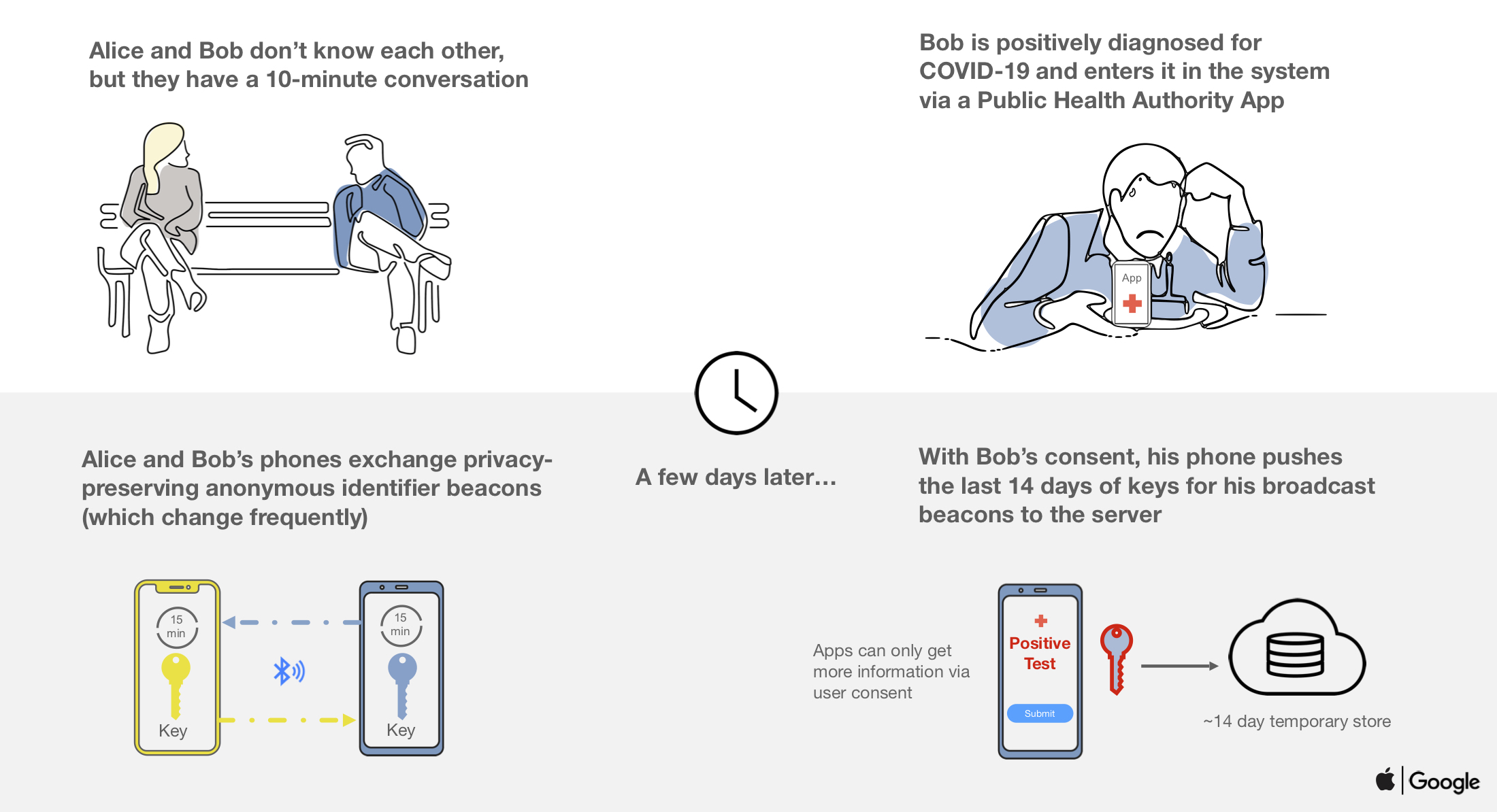
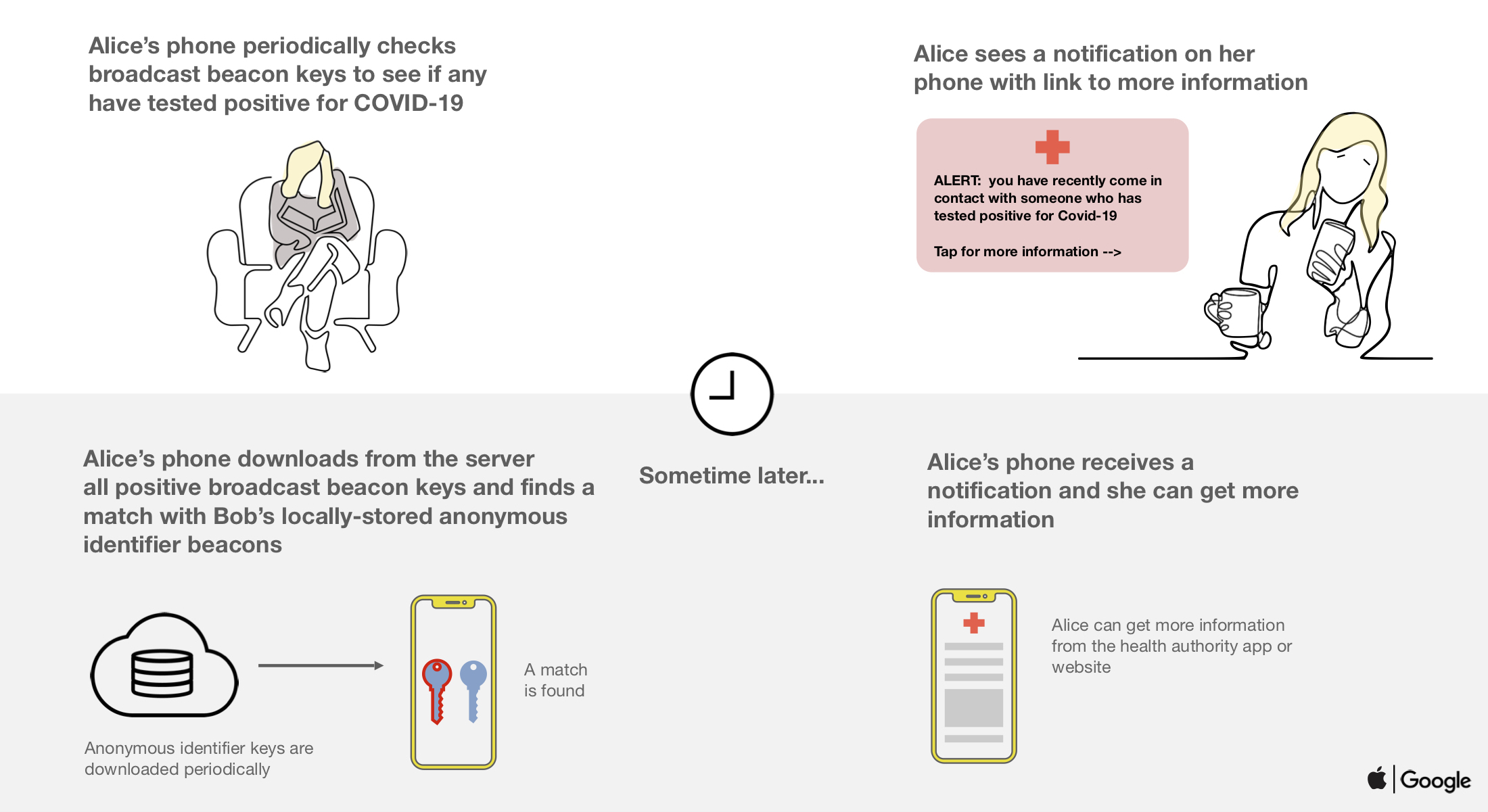
First, they will introduce an interoperable API on both Android and iOS for Bluetooth-based contact tracing on public health apps. This should be ready by mid-May. Then, they’ll add their own contact-tracing functionality into their respective operating systems. But this is months away and would still require a public health app for a full range of functions.
There are some potential downsides with Bluetooth -- it doesn’t track transmission of the virus via surfaces (the reason we’re all sterilizing our deliveries) and could create false positives depending on the range of a phone’s Bluetooth signal and the amount of time apps determine you need to be close to someone to register an encounter.
But from a privacy perspective, the key idea is that there will be no recording of where you were or when. The only thing you know is whether you’ve encountered someone who tested positive in the last 14 days, and there would be no revelation of who that person was. It would be opt-in only and minimize the data that goes to a central server. Apple and Google say that they cannot see users’ encounters and have published early technical specifications for scrutiny online. The fact that the two major smartphone giants have built this architecture means that every NGO, academic and government health department is now incentivized to work within it.
One issue not addressed in Google's announcement of the partnership is Android-version support. The company has long had a problem with Android version fragmentation; because manufacturers each have their own quirks when it comes to customization and support, billions of Android devices, globally, run thousands of slightly different software configurations. While a source of annoyance to both developers and users, though, this hasn't generally been a catastrophic problem. But when it comes to developing a system that needs to be opted into by 75 percent of all smartphone users, this presents a major challenge.
The latest version of its mobile OS, Android 10, is used by a proportionally low number of people. Google no longer publicly shows the breakdown of Android version use, but third-party statistics from StatCounter suggest that only around 31 percent of devices run Android 10, while 65 percent of devices in the US run Android 9.0 or later. Google told us that its contract-tracing system will be released through the Play Store and will support all devices running Android 6.0 or later. This will cover, according to StatCounter, 94 percent of devices in the US or 91 percent of devices worldwide.
Apple does not have such a big problem. It has near-complete control over its devices, and just supporting back to iOS 13 would reach 80 percent worldwide, or 85 percent in the US.
As with Android, we have little more than anecdotal information about who is using what device, but a better sense of how many devices are at least capable of running which OS version. All iPhones newer than the 6S support the latest version of iOS, while the 6 and 5S are on 12.4 but are still receiving critical updates. We've asked Apple to clarify which of its devices will support contact tracing.
The issue with just looking at usage statistics is that they don't reveal the demographics that feed into them. As the gulf between US and worldwide figures suggest, the more affluent a person is, the more likely they are to have a recent smartphone or to have purchased a sufficiently high-end device that continues to be supported with updates. Anecdotally, it's probable that many elderly people, who are among the most vulnerable to COVID-19, are using low-end or outdated smartphones.
Apple and Google’s announcement looks to address two important challenges: making contact tracing available to as many people as possible and institutionalizing strong privacy practices. But it’s still unclear if people will opt in -- both to the system and to the eventual public health apps.
The main challenge here is not necessarily the tech -- Apple and Google probably have more granular location data about us in their stores than a new system of Bluetooth signals would reveal. The challenge is to make the technology respectful of privacy, then prove it to enough people that 60 percent sign up. Everyone from hacker collectives to privacy advocates to new coalitions of technologists during the pandemic have listed their best practices for what that should look like.
We all have a natural incentive to comply with an ambitious public-health measure -- to stay healthy and get the right people treated -- said the ACLU’s Stanley. But to buy into a new level of surveillance takes the kind of public trust in the tech industry that has been eroding in recent times.
“This kind of approach cannot succeed unless it achieves wide adoption. And in a country like the United States, which is very suspicious of authority and government, being able to assure people that this is not any kind of broader tracking device will make it more successful as a public-health measure,” he said. “This is a situation where privacy and public health are very aligned.”
Aaron Souppouris contributed to this report.

Last week I got hundreds of emails about COVID-19 from every vendor telling me they have a plan and they care deeply about me. Almost every website I read regularly has some kind of COVID-19 plan. So here is mine:
Mary’s ALB COVID-19 Plan
COVID-19 has thrown everything out of order for me. (I promise to be better in the next pandemic.) I have a handful of posts left and a few library specific posts for National Library Week. So until further notice, we are reducing the number of posts per week until I can get back into the catalog or think of something clever to post in its place. If any of you have some candidates hiding out in your personal weeds, bring out your dead and share them with us. Click on the Submissions tab on the main menu to find out more.
For the record, Holly and I are doing just fine, health-wise. We hope you and yours are staying healthy and safe.
Mary and Holly
The post The COVID-19 Post appeared first on Awful Library Books.
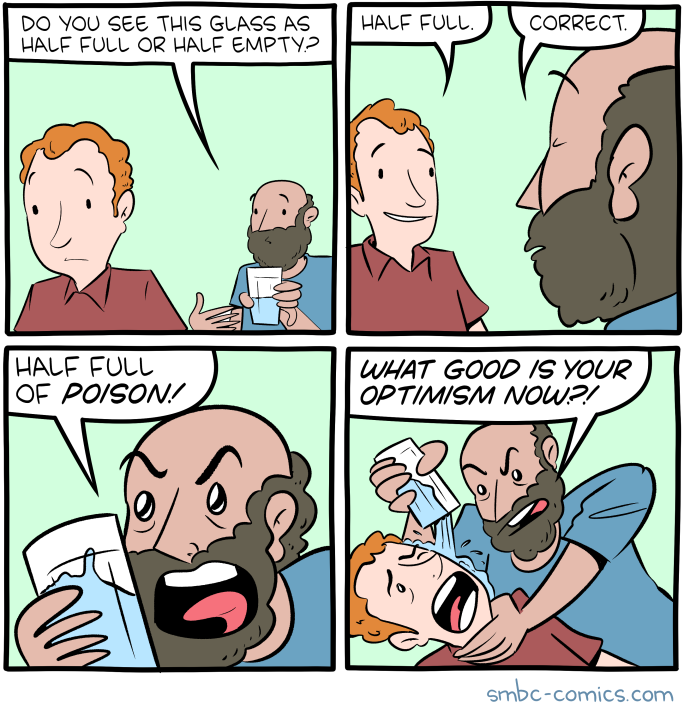
Hovertext:
I have this sudden fear that Cyanide and Happiness already did this joke and I'm cryptomnesiacally stealing it.
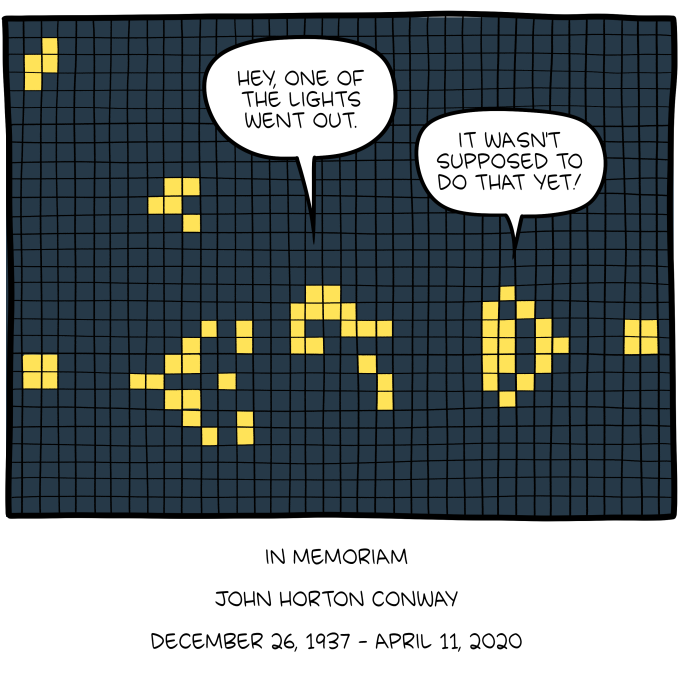
Hovertext:
300 years from now, a young mathematician looks up from a recent biography of Conway. 'What the hell is covid?'
Scott, who knows far far more here than I do, wrote a nice memoriam.

Dangerous storms are set to hit the southeastern United States on Easter Sunday. Faced with a choice between social distancing and taking cover in a shelter, experts recommend sheltering with others.
(Image credit: NOAA)


The coronavirus has killed at least 55 people in Kansas and infected 1,275. Three of the state's 12 clusters of cases have stemmed from church gatherings, according to health officials.
(Image credit: John Hanna/AP)

Graphics by Donald Pearsall
A vaccine for COVID-19 has entered Phase 1 of clinical trials in Seattle. How was it made? And how likely is it that this vaccine, or any others, will work against the new coronavirus? Science journalist and video producer Anna Rothschild spoke with Dr. John Mascola, the director of the Vaccine Research Center at the National Institutes of Health, which co-created the vaccine being tested, along with Moderna Inc.
The EEOC has issued new guidance about coronavirus in the workplace — and has clarified that some practices that wouldn’t normally be allowed are permissible during the outbreak. Here’s what you need to know.
• Your employer can ask if you’ve had symptoms associated with coronavirus (fever, chills, cough, shortness of breath, sore throat), if you’ve been tested and what the results were, and if you’ve had contact with anyone with symptoms or who has tested positive. However, if they’re asking this, they need to ask it of everyone or only of people who seem to have symptoms; they can’t single someone out without a legitimate reason.
Also, note that they should not ask for other medical information (which could violate the Americans with Disabilities Act) or for medical information about your family members (which could violate the Genetic Information Nondiscrimination Act).
• Employers can take your temperature as you arrive at work. Normally medical exams are restricted under the ADA — but the law does allow exams that are “job-related and consistent with business necessity.” The EEOC says public safety during a pandemic qualifies, and this is allowed. (Bu they also say that failing to take other sensible measures to limit virus exposure — like limitations on non-essential travel, encouragement to work from home, and social distancing — may undermine an employer’s good-faith basis for using a temperature screen.)
• Your employer can require you to provide a doctor’s note certifying your fitness to return to work if they’ve asked you to stay home based upon reasonable, objective evidence that you may have been infectious or if you have been quarantined by a health care provider or public health official. That said, the CDC is encouraging employers to accept less formal confirmation because of the current burden on health care providers.
• If your employer learns you have coronavirus or its symptoms, they can inform fellow employees of their possible exposure to the virus, but should not identify you without your permission.
• If you become infected and have only mild symptoms, coronavirus will not be considered a disability under the Americans with Disabilities Act (ADA). However, if your reaction is severe or complicates another health condition, you’re likely protected under the ADA and entitled to its job accommodations. (Individual states may also have more expansive disability laws.)
• If you’re using the new paid sick leave related to the outbreak, your employer can require documentation of your reason. In fact, in order to receive the tax credits that fund this new sick leave, your employer is required to have the following documented:
* the qualifying reason for requesting leave
* a statement that you are unable to work, including telework, for that reason
* the source of any quarantine or isolation order
* the name of the health care provider who has advised you to self-quarantine or written documentation from a health care provider advising you to self-quarantine, if applicable
your employer can take your temperature, and other changes was originally published by Alison Green on Ask a Manager.
I keep hearing from people asking about the best way to explain a layoff right now, or a work gap on their resume caused by the current outbreak.
You will not need to explain it.
Everyone will get it.
Many of your interviewers will have been in the same situation themselves. If they weren’t, they’ll know plenty of people who were — spouses, kids, parents, friends, and other loved ones.
People tend to worry too much about explaining layoffs and work gaps under normal circumstances. You really don’t need to worry about them right now.
What happened in 2020 is going to be remembered and understood for a long time.
This is one thing you don’t need to feel anxious about right now.
you won’t need to explain your current work gap was originally published by Alison Green on Ask a Manager.
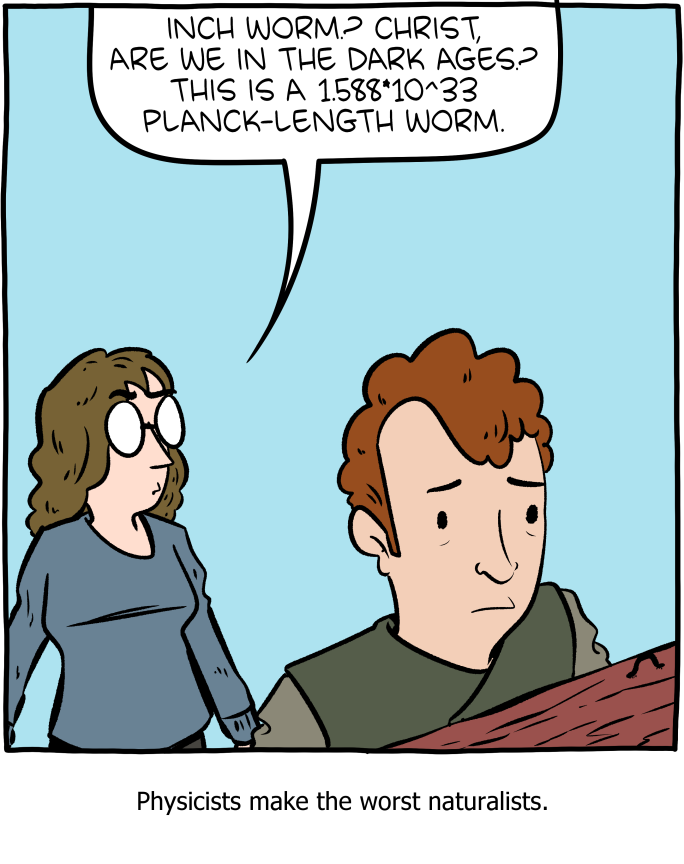
Hovertext:
Just kidding, the real physicist would say 'It's 10 of something long.'
A few years ago, when we celebrated Easter together for the first time and I had to explain our Orthodox tradition. This year, we have to celebrate both Easters in quarantine, which will definitely feel strange, but it's important that we do so. Wishing you all a healthy and happy Easter!

That guy you worked with at a Bennigan’s during college who photographs every “immune-boosting” meal he cooks, somehow making each dish look like regurgitated five-day-old stew. (Unfollow)
Your sixth-grade science teacher who is now an anti-vaxxer and thinks COVID-19 is a “Democrat conspiracy” to take down the president. (Unfriend)
The drummer from Asparagus Piss, that band you followed in college, who thinks social distancing to stop the spread of coronavirus is a poor idea because we need to “cull the herd.” (Block)
Biochem study partner from college who now shares posts from “doctors on the front lines” claiming you can tell if you have coronavirus by holding your breath for ten seconds. (Comment with links to the WHO and CDC explaining that the only way to tell is by a difficult-to-get medical test, then unfriend when he says he “doesn’t trust acronyms”)
That girl who dealt speed in your high school and now belongs to the Facebook groups “Build the Wall with Libtards’ Bones,” “Just Say NO to Social Distencing,” (sic) and “Friday Night Knitting Circle.” (Block)
Your neighbor Sage, who posts multiple links touting “aromatic hydrocarbon aromatherapy” as a cure for COVID-19. (Post links to the WHO and CDC as well as information on the toxicity and carcinogenicity of benzene, then unfriend when she spams you on Messenger with links to a “sniffing circle”)
That woman you worked with at a feminist bookshop in the ‘90s who now can’t wait to tell you the various ways in which every old movie you find comforting in these stressful times is “quite problematic, actually.” (Unfollow, add to restricted list)
Second cousin once removed who subjected you to eight racist memes in the six minutes you were Facebook friends, including two that blamed President Obama for the coronavirus outbreak. (Block with such force that you sprain your index finger)
Friend from elementary school who reposts a televangelist’s missives touting “a whiff of benzene a day — sweet remedy for the saved.” (Post links to the toxicity and carcinogenicity of benzene, then block when he suggests you might be aligned with “dark forces”)
Your neoliberal aunt who thinks that article you posted criticizing the Trump administration’s focus on the markets during a pandemic was a “little unfair” and that it’s important to call out “media bias” wherever she sees it. (Unfollow, add to restricted list)
Karen, who thinks that even though her community is on lockdown, she shouldn’t have to pay her cleaning lady because “basically, she’s on vacation.” (Post angry rebuttal, then unfriend)
Your best friend’s sister, whose feed consists entirely of memes professing her love of Chardonnay. (Refollow after years of unfollowing; a bottle of wine or five sounds really good right now)
Your sister’s ex-husband, who just purchased “the benzene cure” and thinks a “sweet drop a day” in his coffee will confer immunity to the coronavirus. (Post links to the toxicity and carcinogenicity of benzene, then unfriend when he replies, “You do you.”)
Jill Stein, because if she hadn’t run as a third-party candidate in 2016, we might have a president in charge of this Kafkaesque nightmare who believes in science. (Block in a rage-and-tequila blackout)
That girl you smoked pot with once before Driver’s Ed who immediately starts trying to sell you the “Neti Pot COVID Cure” after you accept her friend request. (Post links to the WHO and CDC, unfollow, then block when she keeps spamming you on Messenger)
Deadhead ex-boyfriend who thinks you’re being “a little aggressive” with all the CDC and WHO links and that you should “just relax.” (Block)
Blaine, who posts yacht rock videos every day from the home his family “decamped to” in the Hamptons. (Block)
David Geffen, who posts photos from his actual yacht. (Try to block, discover that he’s made his account private, sob inarticulately when your partner with whom you share a one-bedroom apartment asks what’s wrong)
Kevin, who called himself “Barleycorn” when you both lived in a vegan anarchist collective in the ’80s and who still thinks most things should be unregulated — including people’s ability to congregate during a pandemic. (Post links on the value of social distancing, then block when he says he thinks veganism confers immunity from the virus)
Every celebrity and sportsball player who says they tested positive and are “feeling fine,” I mean, what the actual fuck, I thought there were hardly any tests available, is there a goddamn stockpile of them for the fucking rich and famous? (Fling phone across room, ignore shattered screen, then block liberally)
Mark Zuckerberg. (Block)
The coronavirus. (Unfollow, then block)
JARED: Welcome to our Passover Seder. The history of the Jewish people reaches back nearly 4000 years—
IVANKA: Wait, we’re holding the Seder with just the two of us?
JARED: In times of great adversity, Jews find comfort in their traditions. (He lights the candles.) As we say the blessing over the candles, this Passover we give thanks to Mitch McConnell for keeping your father in office, and to the coronavirus—
IVANKA: Wait, what?
JARED: To stop the pandemic, your father tapped me to mobilize the private sector, so I tapped my brother Josh and his insurance company Oscar Health. I told Josh to copy and paste the CDC’s evaluation questions onto his website. Here’s the beautiful part: once people start taking his online survey, Oscar Health will soon be able to bill the federal government for “virus evaluation.”
IVANKA: Wow, and I thought Josh was the smart one because he got into Harvard on his own, but that’s genius, Jared.
JARED: Thank you. I came up with the idea between brokering Middle East Peace, solving the opioid crisis, and googling about ventilators.
IVANKA: How do we benefit, though?
JARED: I don’t want to discuss the intricacies of corporate holding companies on Passover. It’s time for the blessing over the wine. (Holds up a cup of wine.) This wine, provided by Eric Trump Winery, symbolizes the sweetness of unfettered power and influence.
IVANKA: Amen.
JARED: (Holds up a sprig of parsley.) The parsley on our Seder plate represents spring and the earth’s natural bounty. Speaking of which, would you like to take a walk later and check out the cherry blossoms on the National Mall? It’s closed to the public but no one will stop us.
IVANKA: …
JARED: I mean, we’re quarantined in the same house, yet I never see you.
IVANKA: I’m social distancing.
JARED: We dip the parsley into salt water representing the tears of a man who only wishes to spend some quality time with his wife.
IVANKA: (Rolls eyes) I’ve had my hands full staging Instagram photos with three kids and no nanny.
IVANKA: (Breaks a piece of matzah and holds it up.) This matzah is the bread of affliction. Though afflicted by relentless insults on Twitter, we thank God for the millions we’ve earned since becoming senior White House advisors. It is enough — Dayenu.
JARED: Have I read enough articles on WebMD about coronavirus to call myself an expert?
IVANKA: How much longer before I can flood the Chinese market with Ivanka Trump fashions?
JARED: Will I ever become Ambassador to Israel?
IVANKA: Where does it actually say a President’s job is to solve a national health crisis?
JARED: The Torah instructs us to teach our children the story of Passover. Where are the children anyway?
IVANKA: I’m making the nanny help them find the afikoman over Zoom. No reason she can’t pitch in just because we fired her.
JARED: It’s not too late to have another baby, you know.
IVANKA: …
JARED: You know, having four children is very biblical.
IVANKA: …
JARED: A cup of water is placed on the table to honor the prophet Miriam. We embrace this modern Passover tradition as passionate supporters of women. And I am the most passionate supporter of the most beautiful woman in the world. (He reveals a previously hidden cup.) Behold the “The Ivanka Cup.” Nothing says, “Let’s have another baby” like a diamond-encrusted 14K-gold kiddush cup.
IVANKA: I’m having my third cup of wine now.
JARED: Now it’s time to retell the story of Passover. A Pharaoh came to power in Egypt who feared the Jews—
IVANKA: Can’t we skip this part? Jews in slavery, plagues, blah, blah, they hang out in the desert, eat flatbread, and go swimming in the Red Sea. Sounds like Coachella.
JARED: I’ve never attended. I know this quarantine has been hard on you, living without housekeepers and daily massages, but you’ve got to stay strong, Ivanka. You’re like a modern-day Anne Frank.
IVANKA: Maybe I should start a blog?
JARED: Maybe we should go to our doomsday bunker in New Zealand? The architect just emailed that the indoor pool is complete.
IVANKA: I can’t leave the country in the middle of a pandemic. America’s working moms depend on me to boost their spirits. #TogetherApart #ImJustLikeYou
IVANKA: (Holds the shank bone limply.) The shank bone represents the sacrificial lamb Jews slaughtered the night they left Egypt. This Passover we engrave the shank bone with BIDEN.
JARED: Sometimes I think you don’t take your Judaism seriously.
IVANKA: What about your Judaism? Tell me, which plagues are the residents of your housing projects suffering under this Passover? Flies? Lice? Roaches?
JARED: All of a sudden you’re a champion of the downtrodden?
IVANKA: Oh, look: it’s wine time again. (She downs a full glass.)
IVANKA: (Waves the bitter herbs in his face.) These bitter herbs represent the bitterness of a man whose wife has higher favorability ratings.
JARED: This is charoset, a delicious Passover favorite that balances the bitterness of the maror. It’s made with apples, honey, and a dose of hydroxychloroquine. I got extra to balance your father’s bitterness over everyone liking Cuomo more than him.
(JARED stares into space, as if he were deep in thought. IVANKA scrolls through Instagram.)
JARED: Can we not argue on Passover. We’re both fighting for the same things: wealth and privilege. (He holds up the egg.) Let this roasted egg symbolize the rebirth of our nation… and perhaps our relationship?
(IVANKA likes an old Instagram photo of her brothers smiling next to a dead elephant they hunted.)
IVANKA: OK, whatever, you’re right. Let us welcome the prophet Elijah who will lead the way for peace in the world and between us.
JARED: Where’s Elijah’s cup?
IVANKA: Christ, are you really going to insist on dirtying an extra glass? It’s expensive enough as it is to FedEx our dirty dishes to the housekeeper without adding more.
JARED: As we conclude our Seder, we remember life is a mixture of bitter and sweet. People will likely die due to my incompetence, but the bitterness of death is countered by the sweetness of controlling the nation’s stockpile of medical supplies. This year we are here; next year in Jerusalem. Or New Zealand.
See also:
2017 edition
2018 edition
2019 edition