Welcome to another episode of Confidence Interval, where we make a persuasive case for a hot take … and then reveal how confident we really feel about the idea. This time, politics podcast host and producer Galen Druke asks if this could be the year Democrats win Texas for the first time since 1976.
President Trump came into office with high praise for current and former generals, but now he's attacking them in ways that are unprecedented, according to military analysts.
(Image credit: Brendan Smialowski/AFP via Getty Images)
"I don't want to jump up and down and start screaming, 'Death! Death!' " the president said when asked about why he publicly downplayed the pandemic while privately acknowledging its severity.
Team Indicator buys Cardiff a surprise present. A terrible, extremely risky, but wildly interesting investment. Then it gets interesting. The company that issued the junk bond declared bankruptcy. But that wasn't the end of the story. | Subscribe to our daily podcast, The Indicator here.
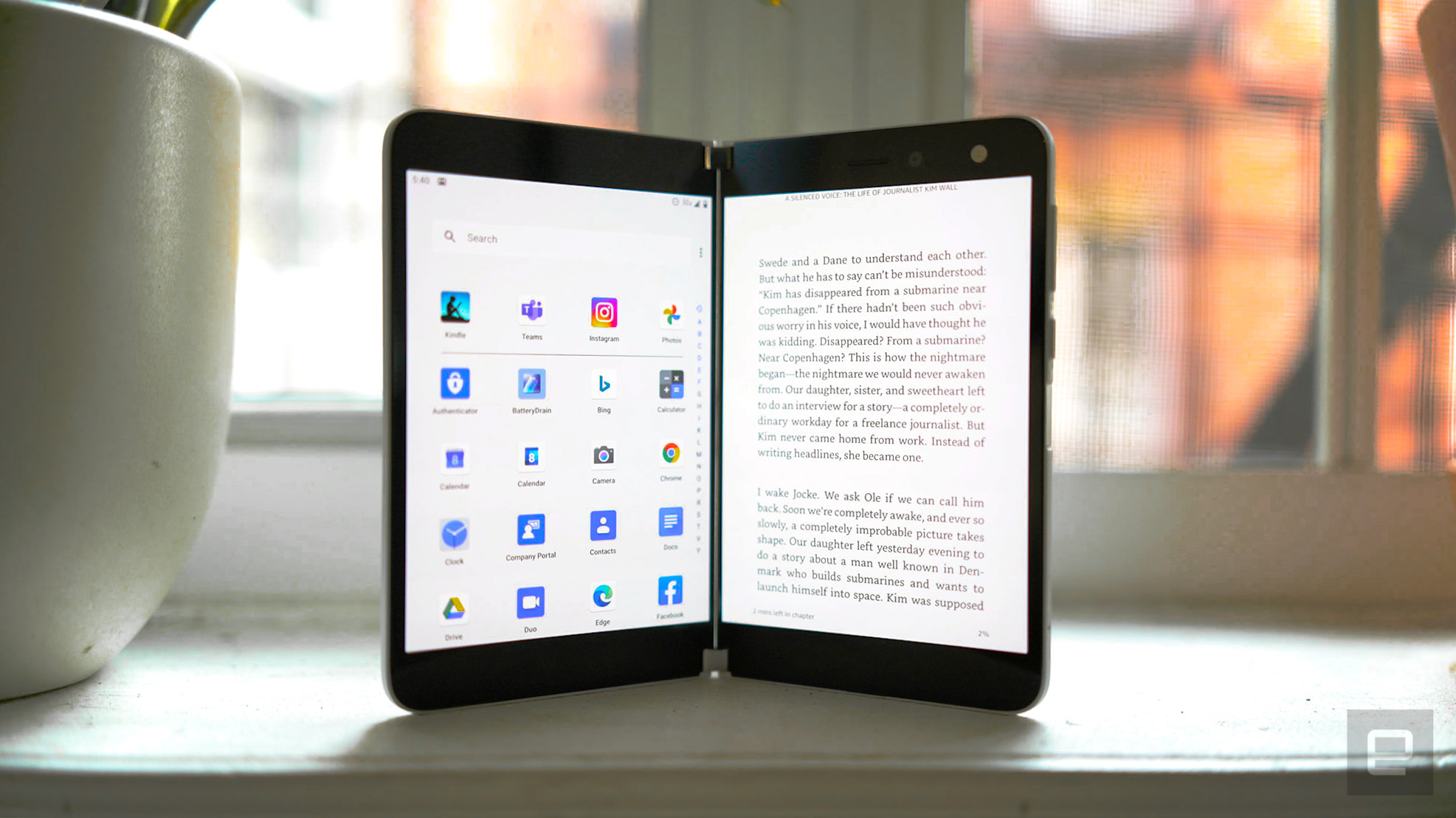
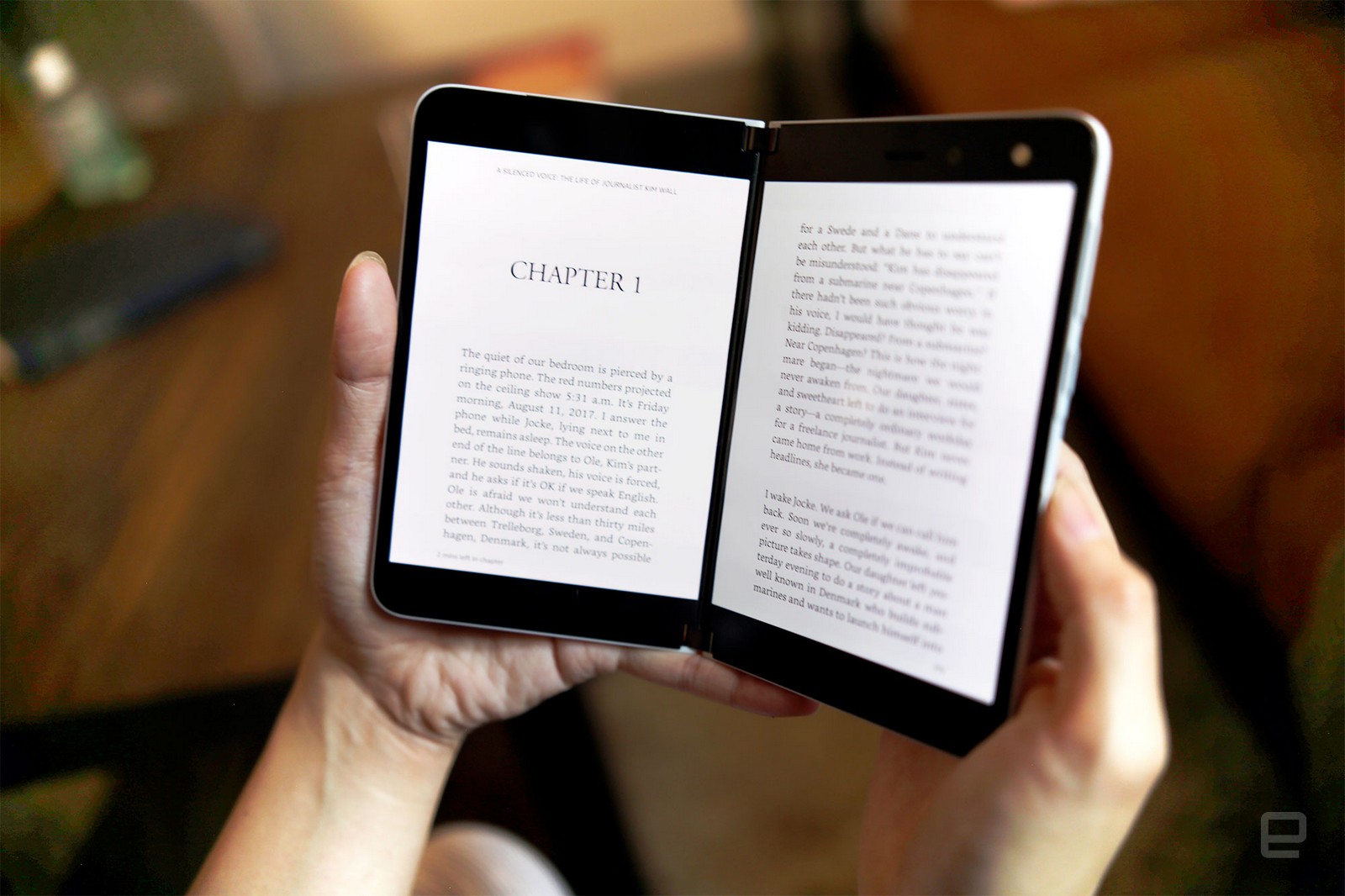
A new class of devices is rising -- a type of device that wants to be both a phone and a tablet. The Surface Duo is one of the more exciting attempts to straddle that divide. Instead of going for a foldable screen like Samsung, Motorola or Huawei, Microsoft simply connected two screens together. That makes sense, given the company's experience with Surface tablets and their hinges. Plus, since the Duo can rotate 360 degrees, it offers a few more orientations, or what Microsoft likes to call “postures,” than the Galaxy Z Fold 2.
But software has always been Microsoft's Achilles heel on the mobile front. So, for the Surface Duo it teamed up with Google to offer a version of Android 10. These two giants collaborating could succeed where other dual-screen phones have failed before, and the early results seem promising.
Hardware
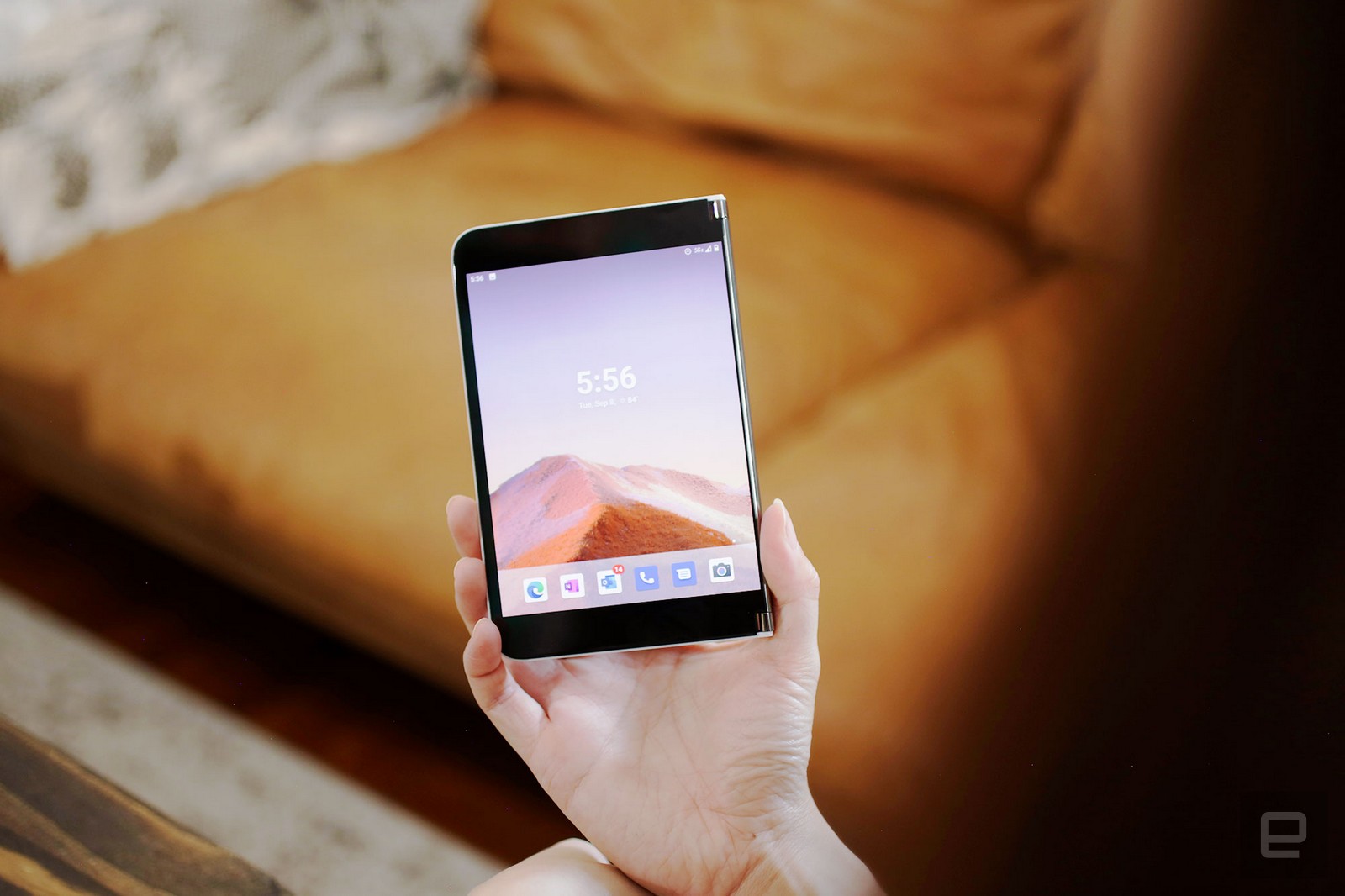
Whether it’s open or shut, the Surface Duo is impressively thin, unlike the Galaxy Z Fold 2 or older dual-screen phones like the ZTE Axon M. It’s 9.9 mm or about 0.38 inches thick when closed and 4.8mm when open, while the Z Fold 2 is almost twice that. At 250 grams (or 8.8 ounces), the Duo is also light enough to hold for long gaming or reading sessions and a hair lighter than the 282-gram Z Fold 2.
On the Duo’s right edge sits power and volume buttons as well as a fingerprint sensor. And slightly off center on the bottom is the USB-C charging port.
When closed, you’ll see the silver Microsoft logo on one side of the Duo’s glossy white cover, which pairs nicely with the silver hinge. I love the clean, minimal aesthetic, though the device does get smudged up pretty easily. Thankfully, its Gorilla Glass coating is more resistant to scratches than fingerprints and survived a couple of falls from my couch without a mark.
The Duo’s hinge is sturdy but moves effortlessly -- like a knife through softened butter. It also rotates a complete 360 degrees, while Samsung’s foldable, for obvious reasons, can only open up to 180 degrees flat.
That freedom to open all the way allows the Surface Duo to be set up in a variety of modes like tent and laptop. But you can also flip it so that both screens are facing outside, so you’ve essentially got a pretty wide phone.
As a phone
The Surface Duo experience differs greatly across all its ”postures.” As a smartphone, it is... decent. Each of its 5.6-inch AMOLED screens has a 4:3 aspect ratio and requires two hands to maneuver. The Full HD-ish resolution delivered crisp text and images, and I was impressed by how sharp and vibrant the music video for Blackpink’s How You Like That looked.
I wasn’t sure the solo 11-megapixel camera above the right display would take great pictures. Images looked slightly cloudy as I framed them up. But when I viewed the shots after, they were surprisingly clear and rich. The Duo lagged most flagship phones in low light, but delivered respectable color and clarity. I sometimes could barely differentiate the Surface Duo’s photos from the Pixel 4a’s, but when I could, it was because Microsoft’s photos were slightly green and Google’s portrait mode is superior.
While image quality may be similar to most smartphones, the Duo’s single-camera setup takes some getting used to. Because this one sensor will serve as both your regular and selfie shooter, Microsoft had to build software that detects which direction you’re pointing the phone. Then it’ll enable the corresponding screen. When I first started using the Duo, this was insanely finicky -- my selfie-taking attempts were thwarted because I could never get the screen with the camera facing me to stay on. After a software update on September 5th this became more reliable, but it’s still quite slow and requires very deliberate flipping.
Chris Velazco / Engadget
Honestly, if you’re trying to capture fleeting moments, you might miss most of them with the Duo. First, you’ll have to take out the Duo and turn on the camera, which can take awhile if you don’t already have the screens facing outwards. Then you’ll have to wait for the software to figure out which display to activate, and hope it’s right. I always had to futz around for at least five seconds before I could snap a picture, by which point your smiling baby or prancing pup may have already stopped being cute.
This is one of the things about the Duo that requires some learning and a lot of patience. For those with smaller hands like me, you’ll want to enable the one-handed keyboard, which shifts towards the screen’s edge so letters are easier to reach. I generally prefer Google’s GBoard for its better swipe typing and predictions, but only Microsoft’s Swiftkey adapts to the different postures right now.
I see why Microsoft hesitates to call the Duo a phone, because it doesn’t feel like it’s really designed to be that. Although, if you want to, you can still make and take calls. It looks a little odd, but the Duo isn’t so wide that I can’t hold it up to my ear with one hand and it’s only slightly broader than the Galaxy Mega from 2013.
As two screens joined together (book or laptop)
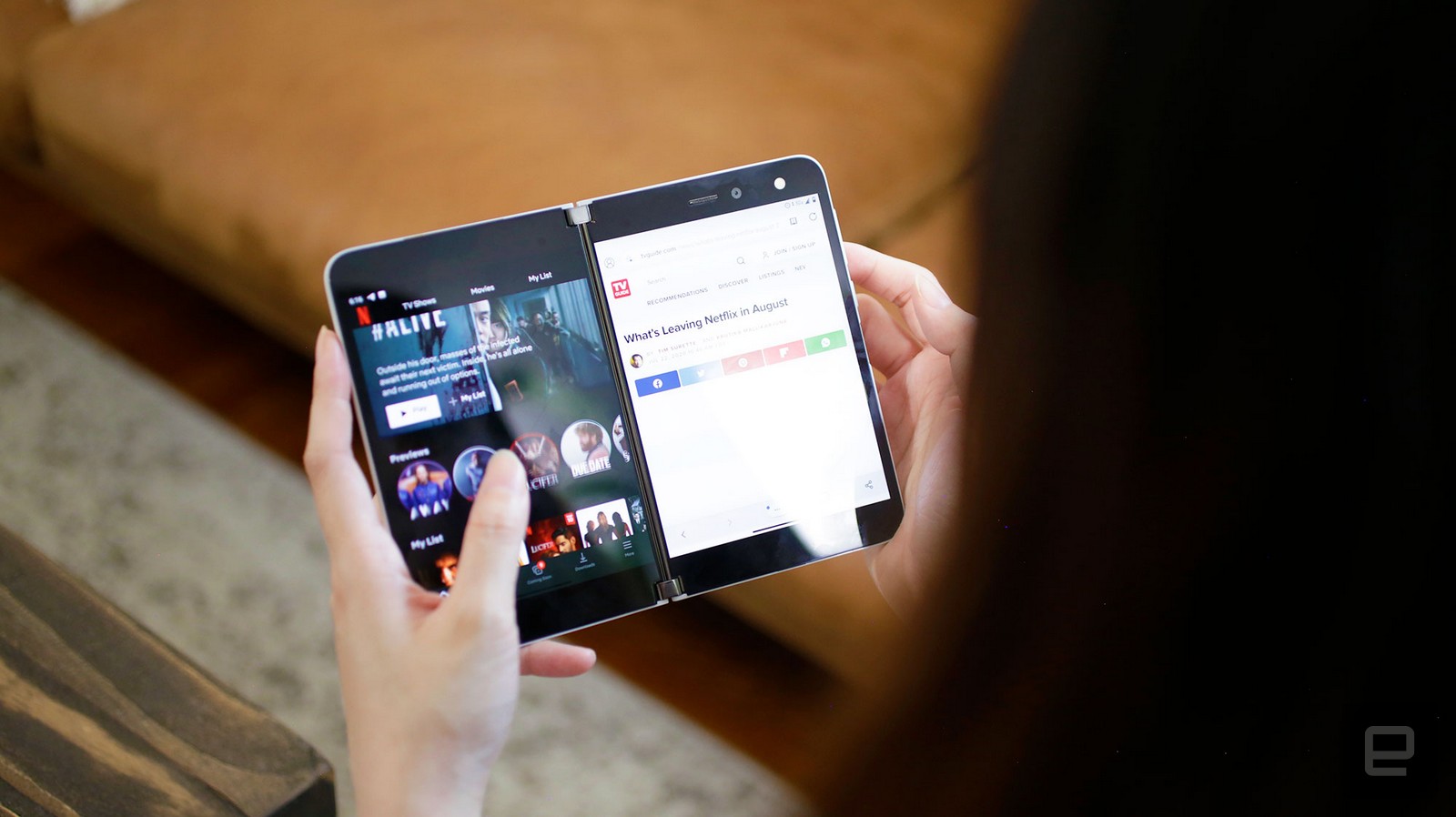
Someone on Twitter said they made their own version of the Duo by sticking two smartphones together with tape. Frankly, that’s the best way to think of the Duo -- a pair of connected phones. The hinge between the two screens is minimal, but it still creates separation. This is bad for doing things in tablet mode, but is perfectly fine when running apps side by side.
This book-like configuration is the perfect “posture” for multitasking -- I went on a Solitaire binge on the right screen, which I used most of the time and relegated the left side to things I didn’t need to actively engage in like Twitter. Sometimes I had a YouTube video going on the left and Google Keep on the right to note timestamps of important moments. I also went through a list of shows leaving Netflix on one screen, while adding them to my watchlist on the other. Artists could have a reference photo on the left while drawing with the Surface Pen on the right.
There’s a lot you could do with the dual-screen setup, and it gets even more useful with a drag-and-drop feature. Pull up a recipe and copy its ingredients to a shopping list on the other screen, for example. Drag and drop currently only works with Microsoft tools like Word, To Do, Edge and PowerPoint, though. Developers need to set their apps as targets before you can pull from or paste into them.
Chris Velazco / Engadget
One of the features Microsoft promised was that links you clicked in apps or browsers would open on the other screen if it was empty. While that sort of worked in Edge and Chrome (only if you select the “Open in other window” option after long pressing the link), it didn’t in Instagram’s in-app browser. That’s not a huge deal but it does seem like developers also need to tweak their code to support this.
My biggest trouble with running apps simultaneously was when trying to move them between screens. You can launch an app from the display where you want it. But if you want to switch it to the other side, you’ll have to flick up from bottom to find the handle, then hold down on that bar till the device vibrates before carefully dragging it over. The gesture itself is easy enough to learn, but the problem was the finicky software. A software update improved the overall reliability, but before that apps would disappear when I tried to move or expand them.
In fact, a lot of the Duo’s software is buggy, and I don’t have enough time or room to list them all out in this review. But Microsoft said it plans to roll out updates for the Duo every month, so hopefully the most glaring issues will get fixed soon enough.
But there are some things that might not change. For example, the notification shade here is the same size as on a regular smartphone, so on a screen as wide as the Duo’s, it feels very narrow. A Microsoft spokesperson told me that they were aware of this but kept the width so as not to “fork Android,” and it doesn’t sound like that will be changing anytime soon. The concern is that if Microsoft tweaks interface settings like this, it will be making a different version of Google’s OS that will require developers go out of their way to support.
Chris Velazco / Engadget
Another issue with the notifications panel: when you have it down, you won’t be able to use either screen. So if you slide it down to see your alerts on the left display, you won’t be able to type a reply on a messaging app on the right until you dismiss the panel. This is another one of those things that Microsoft didn’t change because it didn’t want to “fork Android.”
Two things to note when using the Duo in this half-folded setup: You’ll want to mostly stick to portrait orientation. In landscape, where the device is more like a mini laptop, the software doesn’t quite know how to make use of the screen space.
When I tried to log into Google Drive on the bottom screen with a video playing on top, the keyboard took over the entire bottom display so I couldn’t see what I was typing… which turned out to be nothing, despite having definitely pressed the letters.
Chris Velazco / Engadget
If you’re using the Duo’s screens in landscape, you’ll want to save the bottom half for the keyboard instead of running two apps at once. Though, I also had an issue with Telegram jumping to the lower display after I was done replying a message and dismissed the keyboard. Again, this is something that could be fixed by a software update.
What can’t be fixed though is the Duo’s speaker. It sits behind the left display, so if you’re watching a video on the right, it can be slightly jarring. It’s a relatively minor issue, though, just make sure if you want to open a video in this setup to keep it on the left panel.
My favorite way to use the Duo was actually to fold it halfway with both panels facing out for a traditional Tent mode. But instead of propping the device up on its edges, I laid one of the displays face down with the other looking at me. This turned the Duo into a sort of mini second screen so I could keep an eye on a YouTube chat during a livestream or play hours of Solitaire. This is something the Z Fold 2 can’t do since it can’t bend outwards.
As a tablet
But Samsung’s advantage over Microsoft is as a tablet. The Z Fold 2 may have a slight crease running down its face, sure, but the Surface Duo’s hinge straight up eats content. When you run an app across the Duo’s combined 8.1-inch screen in what Microsoft calls Span, words and pictures get broken up and lost. I missed parts of friends’ tweets and messages, as well as articles I was reading full-screen, though the Kindle app was optimized to avoid this issue.
Android apps also continue to be lousy at making use of a bigger screen, with Instagram being the classic example of simply morphing into a stretched out phone app.
Performance and battery life
Though there are lots of kinks that Microsoft has to iron out, I’m happy to report that when things worked, the Duo ran smoothly. Though it uses last year’s Snapdragon 855 processor and 6GB of RAM, that was enough for multitasking in all the different modes. There is some lag when switching between apps, sending something to a different screen or taking photos in rapid succession, but that feels more like a software struggle than a slow processor. I was concerned that the Duo has a tendency to run warm even when it wasn’t doing much more than opening an app or two, but it never got searingly hot.
For a device that’s basically two phones, the Duo’s battery life is impressive. It generally hung around for a full day after being unplugged the night before, which is longer than the original Galaxy Fold and LG G8X ThinQ (with its second screen attached). Our regular battery test assumes a single display, so I had to modify it slightly. I ran a looping video on one screen, while displaying the Android homescreen on the other, and clocked 10 hours and 32 minutes. Obviously your results may vary if you use both screens more intensively.
Chris Velazco / Engadget
Wrap up
It’s best if you don't think of the Surface Duo as a phone or a tablet -- it’s adequate as the former and pretty bad as the latter. It is, however, fantastic as two screens stuck together, like a laptop connected to an external monitor.
While there are plenty of bugs and software troubles, that’s not surprising when Microsoft is basically trying to invent a new hardware category. And so far at least, the company has been pretty good about delivery fixes and updates. But that’s not guaranteed to last, and not everyone will feel confident in splurging $1,399 on a promise and some potential.
"I still like playing it down, because I don't want to create a panic," Bob Woodward quotes Trump as saying of COVID-19 in his book "Rage." The author concludes: "Trump is the wrong man for the job."
(Image credit: Logan Cyrus/Bloomberg via Getty Images)
8. Wearing a mask is an effective way to slow the spread of the coronavirus.
9. Grammatically, the phrase “Joe Biden and the Democrat’s Defense of the Indefensible” refers to Joe Biden and one other Democrat, not the whole Democratic Party.
10. The death rate for the coronavirus is about 1%, which is 400 times higher than the 0.0025% rate of suspected cases of voter fraud.
11. Out of all of the people who insist that the Second Amendment is meant to prevent a tyrannical government, very few came out in support of protesters in Portland, Oregon, when unidentified federal agents began arresting people without probable cause.
12. President Trump has voted by mail in 2017, 2018, and 2020.
13. The Justice Department is supposed to be an unbiased law enforcement agency.
14. Children who get infected with the coronavirus can transmit it to their parents and other people.
15. A moratorium on rent does not mean that rent is not due; it only means that the deadline to pay rent is moved back, allowing multiple payments to build up and forcing the renter into debt.
25. The vast majority of Americans get their health care coverage through their employer, and lose their coverage if they get laid off or become unemployed.
27. When police officers do not identify themselves, the people they detain might think that they’re being kidnapped, resist arrest, and unknowingly commit a felony or get killed.
32. The four presidents on Mount Rushmore are George Washington, Thomas Jefferson, Theodore Roosevelt, and Abraham Lincoln, and there is no set process for adding another one.
33. It is very unusual for one country to pay people of another country to kill soldiers of a third country.
37. The U.S. invaded Iraq and Afghanistan under the guise of “spreading democracy,” but did not react when China effectively ended democracy in Hong Kong.
40. President Trump is the “law and order” candidate for the 2020 election, but all three of the people who managed his 2016 campaign have faced criminal charges.
41. The Strategic National Stockpile of medical equipment is maintained by the federal government for the benefit of the states.
42. Under the Constitution, Congress, not the president, has the power to direct federal spending by, for example, directing it towards the Postal Service, or away from a wall along the southern border.
43. Reopening schools will lead to a sharp rise in the number of coronavirus cases.
45. Police brutally attacked unarmed protesters who spoke out against police brutality, but did not interfere when armed protestors took over Michigan’s capitol building and demanded that the state’s coronavirus lockdown be lifted so they could get a haircut.
About a month ago, we laid out five ways that Republicans are making it harder to vote and more generally undermining the electoral process in 2020. We focused on Republicans for two reasons. First, making it harder to vote is a more controversial and anti-democratic goal than making it easier to vote, as Democrats are aiming to do. And second, President Trump is playing a central role in these voting wars. Trump has publicly said that he is opposed to efforts in many states to make absentee voting and voting by mail (the two are functionally the same thing) available to virtually anyone who wants to vote that way. He has also suggested that higher overall voter turnout would make it harder for Republicans to win elections.
Over the last month, with the election approaching, Republican officials — from county-level election administrators to the president himself — have in some ways escalated their use of these tactics. So here’s an update on those efforts to complicate the voting process and oppose moves that would make it easier. These five categories, which we used in the last article, are generally ordered from least alarming to most alarming. (There is no formal system tracking every lawsuit concerning voting and the electoral process in all 50 states, so this article is based on our informal tracking, which means we might have missed a key development in a state or two.) Here’s what’s happening:
1. Opposing changes to make it easier to vote amid COVID-19
Opposing or limiting the use of ballot drop boxes. Recent U.S. Postal Service changes enacted by Postmaster General Louis DeJoy, a GOP megadonor, have slowed down mail delivery and likely increased the potential that some mail-in ballots will get to elections offices too late to be counted. (In most states, mail-in ballots must be received by Election Day.)
In response, to make sure that people don’t have to vote in person and to ensure that their ballots are received in time, Democrats have been pushing states and localities to expand the number of secure boxes where people can drop off their ballots so they can be picked up later by election officials. Republicans, though, are also opposing these drop boxes. In Ohio, the Republican secretary of state is blocking any county from having more than one ballot drop-off location — even though it would obviously make sense for counties with larger populations to have more than one. In Iowa, the Republican secretary of state is allowing such boxes only at government-owned buildings (as opposed to, say, outside grocery stores). Missouri, another GOP-dominated state, is barring the use of any drop boxes.
Opposing moves to make it easier to vote by mail. The GOP-controlled board of commissioners in Gwinnett County, Georgia (that’s suburban Atlanta), rejected a proposal to have applications for absentee ballots sent to all registered voters in the county. In Arizona, the Trump campaign is opposing a push to count any ballot that is postmarked by Election Day (as opposed to received by Election Day).
Limiting the use of NBA arenas as voting centers. After their brief strike in the days after the shooting of Jacob Blake in Kenosha, Wisconsin, NBA players successfully pushed the league to authorize using its arenas as voting centers. But despite owners offering the space to local governments, election officials in Miami (Florida) and Memphis (Tennessee) have opted against using those arenas. (Miami has a Republican mayor; the elections procedures in Shelby County, which includes Memphis, are set by a board whose members are appointed by the state’s GOP-controlled legislature.)
Opposing early processing of absentee ballots. In Michigan, Republican lawmakers so far aren’t pushing forward proposed legislation to allow elections officials to start processing mail-in ballots (basically removing the outer envelope that they are contained in and verifying voters’ signatures) before Election Day. Even under this proposed legislation, election officials would not start reading the ballots and counting votes until Nov 3. But starting the process of opening up the ballots before Election Day would help officials speed up the count.
2. Seeking to invalidate laws that make it easier to vote amid COVID-19
This is different from the prior category (and more concerning) because in these instances Republicans are seeking to overturn decisions already made to ease the voting process.
Stopping local officials from making absentee voting easier. Republicans in Texasfiled and won a lawsuit to bar officials in Democratic-leaning Harris County (the Houston area) from sending absentee ballot applications to all registered voters in the county. In Iowa, the Trump campaign filed and won a lawsuit stopping officials in one of the state’s more urban and Democratic-leaning areas from sending voters absentee ballot applications that already had some information (like the voter’s name and birthday) already filled in. In Montana, the Trump campaign and GOP officials have filed a lawsuit to block a policy implemented by the state’s governor, who is a Democrat, that would allow all counties to set up comprehensive vote-by-mail programs.
3. Advancing new practices and provisions that make it harder to vote
Complicating the voting process for felons in Florida. Not much has changed in the last month in this category. But Republican officials in Florida are continuing litigation to keep in place a law they adopted in 2019 that requires convicted felons to pay all fees associated with their sentence before their voting rights are restored. The law, in effect, limits a 2018 ballot initiative adopted by Florida voters intended to restore felon voting rights. In continuing this litigation, Florida Republicans are likely to be successful in basically running out of the legal clock and keeping the 2018 provision from truly going into effect in the 2020 election cycle.
4. Anti-democratic rhetoric
Misleading statements about voter fraud.Trump and Attorney General William Barr continue to argue that widespread mail-in voting will lead to a lot of voter fraud, often making outlandish and inaccurate claims to support their position. There is no evidence that voting by mail leads to increased fraud, and in states like Washington and Oregon, where most people have voted by mail for years, there has been no evidence of widespread malfeasance.
5. Fundamental changes to the electoral process
Encouraging people to vote twice. Trump has recently been encouraging people who vote by mail to also go to vote at the polls on Election Day. If the election systems are working properly, he argues, they won’t be allowed to vote in person. It is very unlikely that anyone’s vote will be counted twice, but encouraging people who have already voted by mail to also show up in person will complicate election officials’ jobs. If some people actually do vote twice, that would, of course, undermine the entire voting process — and break the law.
Downplaying potential Russian interference. Published reports suggest that Russian operatives are using measures similar to those they employed in 2016 to both boost Trump and increase political division in America. But the Trump administration has opted against clearly saying that Russia is engaged in such conduct or forthrightly condemning it. Instead, senior Trump officials have suggested that both Russiaand China are trying to interfere, with China favoring Democratic nominee Joe Biden and Russia favoring Trump. But in reality, while the Chinese do favor Biden, according to published reports, there is no evidence that they are pursuing active measures to help him win, unlike Russia.
In addition, the Trump administration — apparently in retaliation for congressional Democrats publicly indicating that Russia is trying to tilt the election toward Trump — has opted to limit briefings to Congress on election security. In particular, top intelligence officials will now only submit written comments to Congress, instead of meeting in-person with leaders from both parties on the key intelligence committees.
There are plenty of Republican officials, even in some of the states listed above, taking steps to make it easier to vote. Texas, for example, increased the number of days in which early voting is available. So it’s not that all Republicans are trying to complicate the voting process. Rather, most of the officials trying to complicate the voting process are Republicans. Also, Republicans aren’t the only people filing a lot of lawsuits and pushing a lot of changes to the voting system — it’s just that Democrats’ extensive legal efforts are generally pushing to make it easier to vote.
So the most surprising aspect of the voting process is what we have laid out here: One party seems to be systemically making it harder to vote and taking other steps that undermine the integrity of the electoral process. The big question is whether these tactics will work, either by keeping anti-Trump ballots from being cast or counted, or by throwing the election results (whatever they end up being) into doubt.
The pandemic has been unkind to many businesses across the country, especially in the restaurant industry, where as many as 30 percent of businesses may be at risk of closing permanently. The threat is even greater for those that were struggling long before capacities were slashed and Americans learned that sitting in a dining room with unmasked strangers could be hazardous to their health. Luby’s, the beloved Texas cafeteria that had spent years trying to rebuild its niche in a crowded marketplace for fast-casual dining, announced in June that the company was up for sale. Then, today, the 73-year-old company announced that—as no buyer has yet been found—Luby’s will be liquidating its assets and dissolving. What this means for the future of your LuAnn Platter…View Original Post
Maria Kolesnikova was taken away by masked men in a van Monday while walking in the capital Minsk, according to reports citing eyewitnesses. She disputed official presidential election results.
In his book Disloyal: A Memoir, President Trump's former personal attorney catalogs a laundry list of accusations, ranging from racism and sexual misconduct to financial misdeeds.


























 The pandemic has been unkind to many businesses across the country, especially in the restaurant industry, where as many as 30 percent of businesses may be at risk of closing permanently. The threat is even greater for those that were struggling long before capacities were slashed and Americans learned that sitting in a dining room with unmasked strangers could be hazardous to their health. Luby’s, the beloved Texas cafeteria that had spent years trying to rebuild its niche in a crowded marketplace for fast-casual dining, announced in June that the company was up for sale. Then, today, the 73-year-old company announced that—as no buyer has yet been found—Luby’s will be liquidating its assets and dissolving. What this means for the future of your LuAnn Platter…View Original Post


