Remember the manager last week whose employee given her an “it’s her or me” ultimatum? I wrote that it seemed like that employee had it in for her coworker and wasn’t trustworthy and that the manager was pretty badly mishandling the situation. She got a lot of criticism from both me and the commenters, but was gracious enough to send in an update later that day anyway:
So today was a rough day after I read your response. I don’t have a lot of managerial experience but in other parts of my previous career, people always praised my leadership skills, so I thought I had this in the bag. I didn’t go into the office today. I went to talk to my brother-in-law and filled him in on everything over lunch. He’s a department VP for a big state-wide company and oversees and manages a huge team across the state. (Nothing had changed much since I wrote in, except Miranda has pulled away drastically and Laura has mentioned she’s upset with me for not having acted yet on her ultimatum.)
After I told my brother-in-law everything, he was quiet for a second and then asked for Miranda’s information so he could offer her a job; they have remote positions open, and local positions in her area. When I said I was relieved because it let me off the hook for having to fire her, he said he wasn’t letting me off the hook, he was poaching a hardworking professional who deserves better. I think that’s when it hit me that I’ve been wrong about this whole situation.
He also told me I needed to take managerial classes and was very ticked off about Laura loaning me her car. Everybody seemed ticked off about that, I read the comment section. Never read the comments.
That was five hours ago and Miranda just texted me her resignation, no two weeks notice, no transitional help, nothing. I get why she’s doing it, but I feel like it’s pretty unprofessional of her after 4 years of working together.
When I texted the rest of the staff in our group chat to let them know Miranda left, Laura didn’t say anything, she just texted me privately asking to clarify that Miranda was definitely fired and that she didn’t quit.
I have a feeling Laura might leave on her own and I’m preparing to bring the shipping contractor back on board if that’s the case. I learned a lot of lessons today.
And then an update to the update a few days later:
Laura did quit when I told her I wasn’t discussing Miranda and she took one of the other staff with her. They both trashed me to the sky on social media, which lead to a demand for refunds and cancellation of orders I can’t recover from. The one staff member who stayed is trying to help me keep everything going. I had a competitor offer to buy out my business, and I think I’m going to take her up on it because she’s offering a great price despite knowing I’m in the red.
When I hired Laura, she was recommended to me by a close friend of hers who happens to be a close friend of mine. We shared a lot of friends in common and as much as I don’t want to admit it, I realize I oversold how much I needed Laura’s help when I interviewed her, and I might have undercut Miranda from the beginning. Laura came in with the sense that she was being hired as a fixer. My brother-in-law and my sister (who also owns her own very successful small business) along with your wake-up call helped me realize all the huge mistakes I’m making. I used to work in medicine in a highly competitive field that was unfriendly and cliquey, and I think that’s what drove me to push for friendships instead of an employer/employee relationship. I offered Miranda her job back but she doesn’t want it. It’s hard to admit, but that’s fair. I really screwed up.
Because she was recommended by my friend, I didn’t check any of Laura’s references. She said she had managerial experience from her previous job. She didn’t. Through some town chatter, I found out her department at her last job threw a party the day after Laura quit, and an acquaintance who worked at the company expressed a lot of shock that I hired her. I called her references and two of the numbers were disconnected, and the other person is the close friend who recommended her to me.
I can’t believe the Koolaid I was drinking a week ago. I found some business classes at our local college and I’m going to take some time off and go back to school and freelance. Such a crappy week. Thank you for your honesty. I really needed it. I might print it and put it in a frame.
Good morning. Ida has finally weakened into a tropical storm this morning, and is now slowly, at a rate of about 8 mph, moving away from Southern Louisiana. Much of the region is submerged under storm surge and very heavy rainfall. More than 1 million customers in the state, affecting about half of the state’s population, are without power today. Some will be without power for many weeks. Ida, in short, has left a sobering trail of destruction and misery in its wake. We must help our neighbors, and here are some ways to do that right now.
Monday
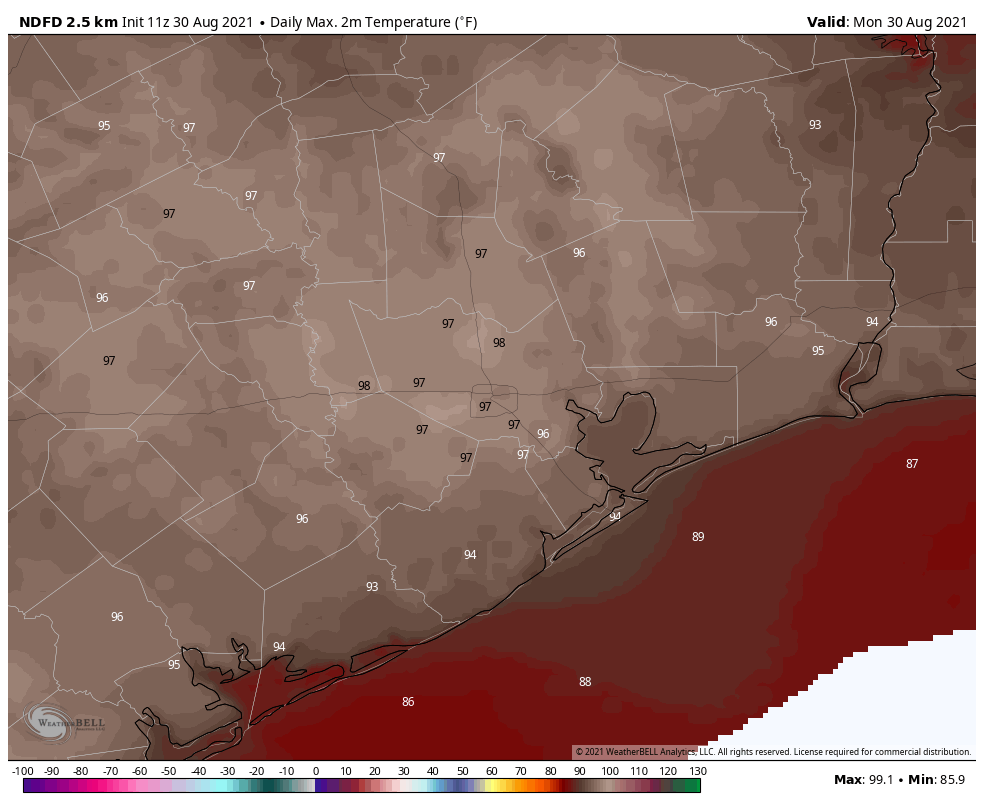
Today will be hot and sunny, with only a slight chance of showers and thunderstorms. Highs will likely reach the upper 90s. As Ida pulls away from Louisiana, winds will be out of the north and northwest locally, at about 5 to 10 mph, and the overall flow will draw warm air into the region. Rain chances will be down to around 10 percent. Overnight lows will be around 80 degrees.
A hot summer day is on tap for Houston. (Weather Bell)
Tuesday
This will be a similar day to Monday, albeit with slightly higher chances of rain showers, perhaps on the order of 20 percent.
Wednesday and Thursday
Low pressure aloft will bring a modest increase to rain chances by the middle of the week, perhaps about 40 percent for areas south of Interstate 10, and less to the north, and this should also cool temperatures down into the mid-90s. Skies should otherwise be mostly sunny with warm and partly cloudy nights.
Friday, Saturday, and Sunday
While the weekend forecast is not yet locked in, the greatest likelihood is that we see hot and sunny weather, with highs in the mid-90s. As some slightly drier air mixes in, overnight lows may drop into the mid-70s. While not “nice” this definitely would be more pleasant than sultry nights around 80 degrees. Overall rain chances look low this weekend, probably below 20 percent each day.
Tropics
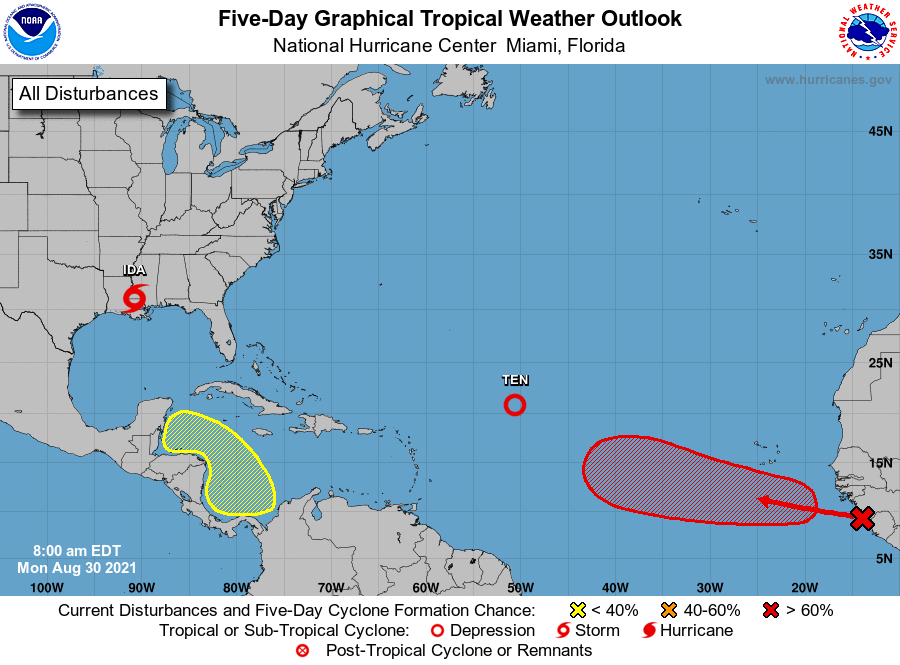
With Ida inland, and an inconsequential tropical depression in the open Atlantic Ocean, what else is there for us to worry ourselves about? The primary area to watch is the southern Caribbean Sea where conditions are somewhat favorable for a tropical depression to develop later this week. The National Hurricane Center gives this area a 20 percent chance of development.
Tropical Outlook on Monday morning. (National Hurricane Center)
This system is likely to approach Central America or the Yucatan Peninsula later this week, and if it survives interactions with land—which is far from certain—something may eventually move into the Gulf of Mexico. However there is no strong signal in the global models that this will happen, and if it does, there’s little indication it will eventually track toward the upper Texas coast. So while this is something we’re watching, it’s not something we’re particularly concerned about. As for the disturbance moving off of Africa (red X in the map above), it has a high chance of developing but is likely a fish storm that will not bother and landmasses.
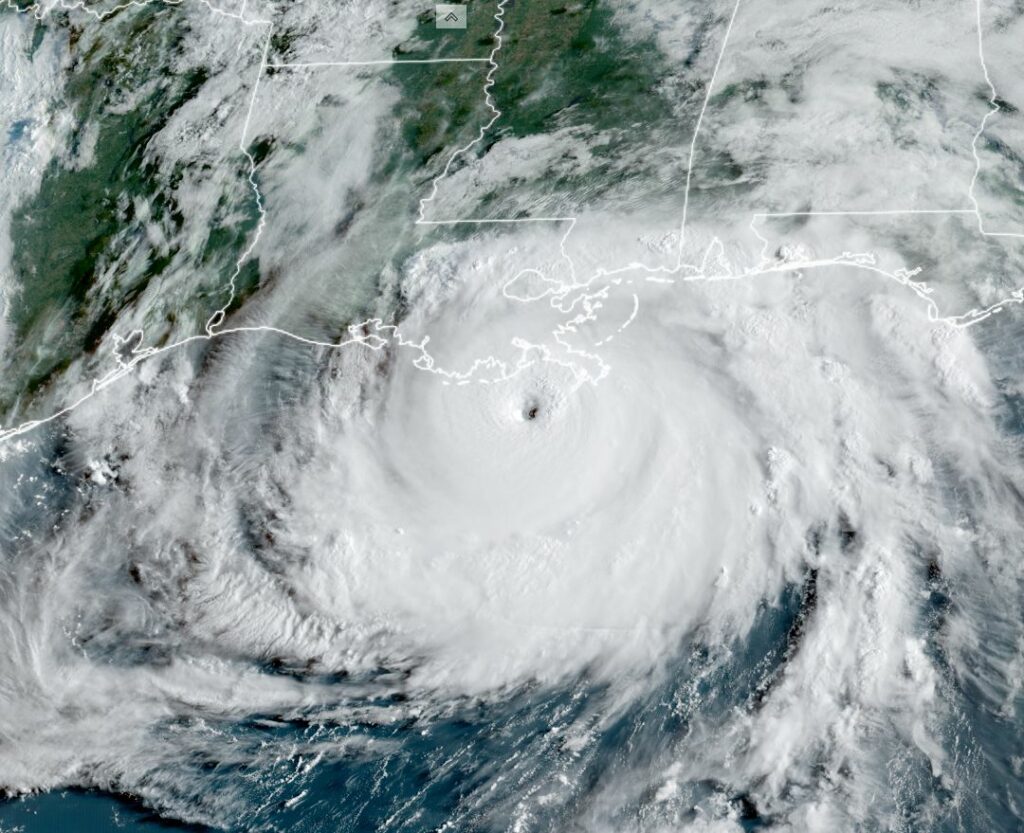
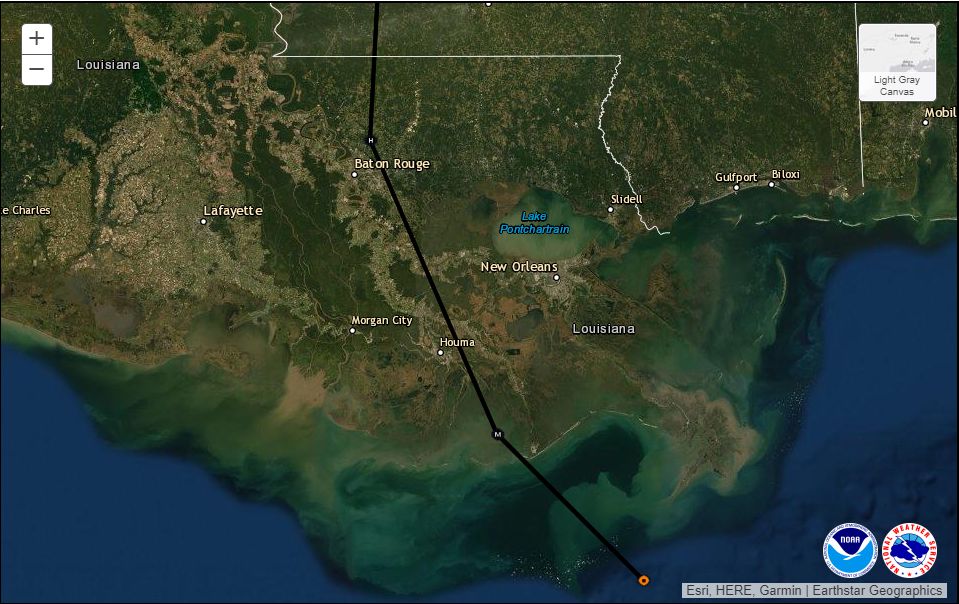
Hurricane Ida has rapidly intensified overnight, seeing a steep pressure fall and maximum winds increasing to 150 mph. Very nearly a Category 5 hurricane, Ida should reach the southern coast of Louisiana, about 50 miles due south of New Orleans, around Noon today.
This will be the most devastating hurricane to hit the region since Katrina, 16 years ago today. For some areas, in some ways, it will be worse. The eyewall of the storm will pass very near to the New Orleans metro area. Hurricane-force winds extend across a 70-mile diameter.
Satellite image of Hurricane Ida at 8:20am CT on Sunday. (NOAA)
Over the next 24 hours parts of Southeastern Louisiana will experience sustained winds well above 120 mph with higher gusts, 15 to 20 inches of rainfall, and a storm surge of 12 to 15 feet. For the New Orleans area, the winds and rainfall should be significantly greater than experienced during Katrina, although the surge should be less. This storm will offer a stiff test of the levee system built after Katrina struck the below sea-level region in 2005.
Hurricane track forecast for Ida. (National Hurricane Center)
Ida will be barreling into a low-lying, swampy part of the U.S. Gulf Coast. The storm surge will move easily over this region for miles. While parts of the coast of sparsely populated, there is also major infrastructure in harm’s way. Jeff Masters and Bob Henson have an excellent rundown of damages this region experienced during Katrina, including a complete shutdown to the Port of New Orleans and weeks of delayed barge traffic. Impacts will be similarly severe this time around. Food and fuel prices should rise across the country.
Forecast for swath of highest wind gusts from Hurricane Ida. (Weather Bell)
There is no way to sugarcoat this situation. For those who survive, months of misery await the inhabitants of Southeastern Louisiana. Normally recovery efforts are led in Louisiana out of Baton Rouge, the state capital, which is about 100 miles inland. However, Ida is forecast to pass just east of Baton Rouge, with sustained winds of 100 mph. It seems very probable that Ida will knock out power along the entirety of the region’s most populated core, from New Orleans to Baton Rouge. The state—which has one of the worst COVID-19 outbreaks in the country, and nearly 500 patients in ventilators—will lose much of its ability to function. This is just an exceptionally grim situation.
As a forecaster there is not much else to say. The storm is here, and it is a gut punch. Ida is a nightmare scenario for the state of Louisiana. We must stand ready to help them survive, recover, and rebuild.
When I first moved to Dallas from Berkeley in 1996, my journalist friends were quick to tell me about Jim Schutze’s The Accommodation. They said the two-hundred-page nonfiction book was the real, uncensored story of how Dallas managed to avoid the far-reaching changes wrought on other major cities by the civil rights movement. When I asked if I might borrow a copy, they looked at me askance. The book had been out of print for nearly a decade; those lucky enough to own a rare copy tended to guard it closely. After I finally pried one away from a colleague at The Dallas Morning News, I was almost afraid to open it, for fear I might drop it, or tear a page.No need to worry…View Original Post
The Accommodation begins with the bombings. The 1950s terror spree that racist Dallasites unleashed on Black residents who’d dared buy homes in a then-white neighborhood. The dozen or so packages of dynamite hurled at South Dallas houses that rocked the city, yet led to no criminal conviction. The shameful episode that local elites have fought to see forgotten but that, the book’s author writes, sprung “right up out of the spiritual heart of the white community, the heart darkened by nineteenth-century specters.”
A 34-year-old work set for republication this September, The Accommodation is an unusual book with an unusual backstory. Jim Schutze, a long-time acerbic city columnist and white man, wrote the text in the mid-1980s after many evenings buried in Dallas Public Library archives. The end-product may fairly be called a journalistic account, blending straight reportage and opinionated analysis, of race and civil rights in mid-20th century Dallas. But the 260-page book is also amateur history and historiographical critique, newsy play-by-play and grand political theory. It is a fierce indictment, occasionally indiscriminate and overwrought, that still hits its target. It is, perhaps above all, a pleasure to read.
The Accommodation almost never saw the light of day. In 1986, the book’s Dallas-based publisher unexpectedly scrapped it due to either poor pre-sales or political pressure, depending on who you ask. A year later, a New Jersey press gave the book a small release but decided against a second run. Schutze then handed over the rights to Dallas County Commissioner John Wiley Price, who pledged to find a publisher, but after the two men had a falling out, Schutze says, Price simply sat on the book for decades. Thus, an obscure book’s legend grew.
Like literary contraband, young Dallasites over the last decade passed around a Dropbox link leading to a photocopied version of the book. No one seems sure who made the copy. On Amazon, The Accommodation listed for hundreds of dollars and D Magazineprofiled the phenomenon in a piece titled “The Most Dangerous Book in Dallas.” As the now-75-year-old Schutze interprets it, millennial-age residents were encountering a Dallas still viciously riven by a north-south divide and allergic to talking about why. His book spoke to a burning question: “Why is the city like this?” Now, with Price’s blessing, the local publisher Deep Vellum will let everyone digest Schutze’s answers.
The book’s thesis is this: Dallas, despite its boosters’ claims, is a place crafted stem to stern by white supremacist violence and expropriation. Yet, through an anti-democratic alliance between the city’s business class and conservative Black clergy members, Dallas managed to avoid the riotous convulsions of the civil rights era seen elsewhere in America. The city maintained a relative peace with precious little justice, the titular “accommodation,” which Schutze believes hampered the development of independent Black leadership and the advancement of white attitudes.
“Dallas commands a part of Texas that is much more Southern, with stronger roots in slave culture, than many outsiders realize,” Schutze writes. To make the case, he recounts the 19th-century influx of enslavers to North Texas, where he argues slavery then was likely even crueller than in the Deep South. He reviews post-Civil War federal reports recounting floggings and murders that permeated Dallas, and describes the city in the 1920s as a hotbed of KKK activity. As the Black middle class fitfully grew, he describes how the city used “legal hocus pocus” to vaporize property rights, clear neighborhoods, and push as many Black residents as possible into segregated housing projects. These very pressures, he details, led Black housebuyers to venture into South Dallas, where working-class whites responded with dynamite.
Black Dallasites fought back, defending their homes with guns as necessary, but—in Shutze’s telling—the public square stayed rather quiet. Bull Connor sicced his dogs in Birmingham and Watts burned in Los Angeles, but Dallas saw just a few picket lines outside downtown stores. The key player, he says, was the Citizens Council, a coterie of business elites that controlled the city council, elected entirely at-large, and ran Dallas like a “pre-democratic city-state.” With a fine-tuned sense of when to co-opt a leader or cut ties with one who veers too far-right, the council was adept at propaganda and substituting tokenistic reforms for justice. The group ultimately sowed the enduring myth of Dallas as a rational Southwestern city of convenient commerce. Members of the Citizens Council also composed the grand jury that, after finding the 1950s bombings plot involved respected white community leaders, asked to be disbanded. Still, the city did not burn, and blatant segregation persisted from the State Fair to graduation ceremonies.
For Schutze, a turning point came finally in the late ‘70s, when a movement of Black homeowners spearheaded a lawsuit that overturned the at-large city council system, leading to district elections that the Citizens Council couldn’t control. The book ends hopefully. But, in a new foreword, County Commissioner Price argues that little has actually changed in Dallas—even in today’s era of Black Lives Matter uprisings—and many locals still see the city as a uniquely white-washed place.
Jerry Hawkins, now the director of Dallas Truth, Racial Healing and Transformation—an anti-racist nonprofit—was one of those Dallas residents who discovered The Accommodation through a Dropbox link years ago. He tore through the PDFs. “These were things I had never heard of,” he says. “Nobody talked about this stuff.”
Hawkins says he’s shared the photocopied version with numerous acquaintances, and he references it at talks where he finds that even lifelong Dallasites don’t know the history of the bombings and similar events. He says The Accommodation spreads well thanks to its reputation as a banned book and because it’s written “like a telenovela.” With a friend, Hawkins formed a reading group to discuss each chapter. “This book has created a whole bunch of other things,” he says, noting that the actor William Jackson Harper, a Dallas native, wrote a 2018 play based on the story.
At the same time, Hawkins doesn’t actually buy a core piece of the book’s thesis. He thinks Schutze undersells the history of Black activism in Dallas, not because of ill will but because of ignorance. “The notion that Dallas didn’t really have a civil rights movement is kind of a myth that’s perpetrated in the way the author tells the tale,” he says. “I’m not saying he’s intentionally leaving things out. I’m saying he probably doesn’t even have the key to the door to get that information; I mean the Black Panther Party was in Dallas, and he’s not going to be in those meetings.”
Hawkins plans to help flesh out the story of Black Dallas himself. He’s editing a collection of essays called A People’s History of Dallas, set for release next year, and he’s researching another project, with a working title of “How to Build a Racist City.”
Schutze himself has called for further attempts to unravel Dallas’ past. In a recent article, he described his own book, with some exaggeration, as “the only attempt anybody has made so far to solve a glaring unavoidable riddle: Why is the city like this?” He then urged new and younger authors to soon produce “a better answer to the question.”
Good Saturday morning. Ida is strengthening steadily this morning as it moves into the heart of the exceptionally warm Gulf waters between Cuba and Louisiana. Not much has changed since yesterday in terms of the forecast track or, unfortunately, forecast intensity.
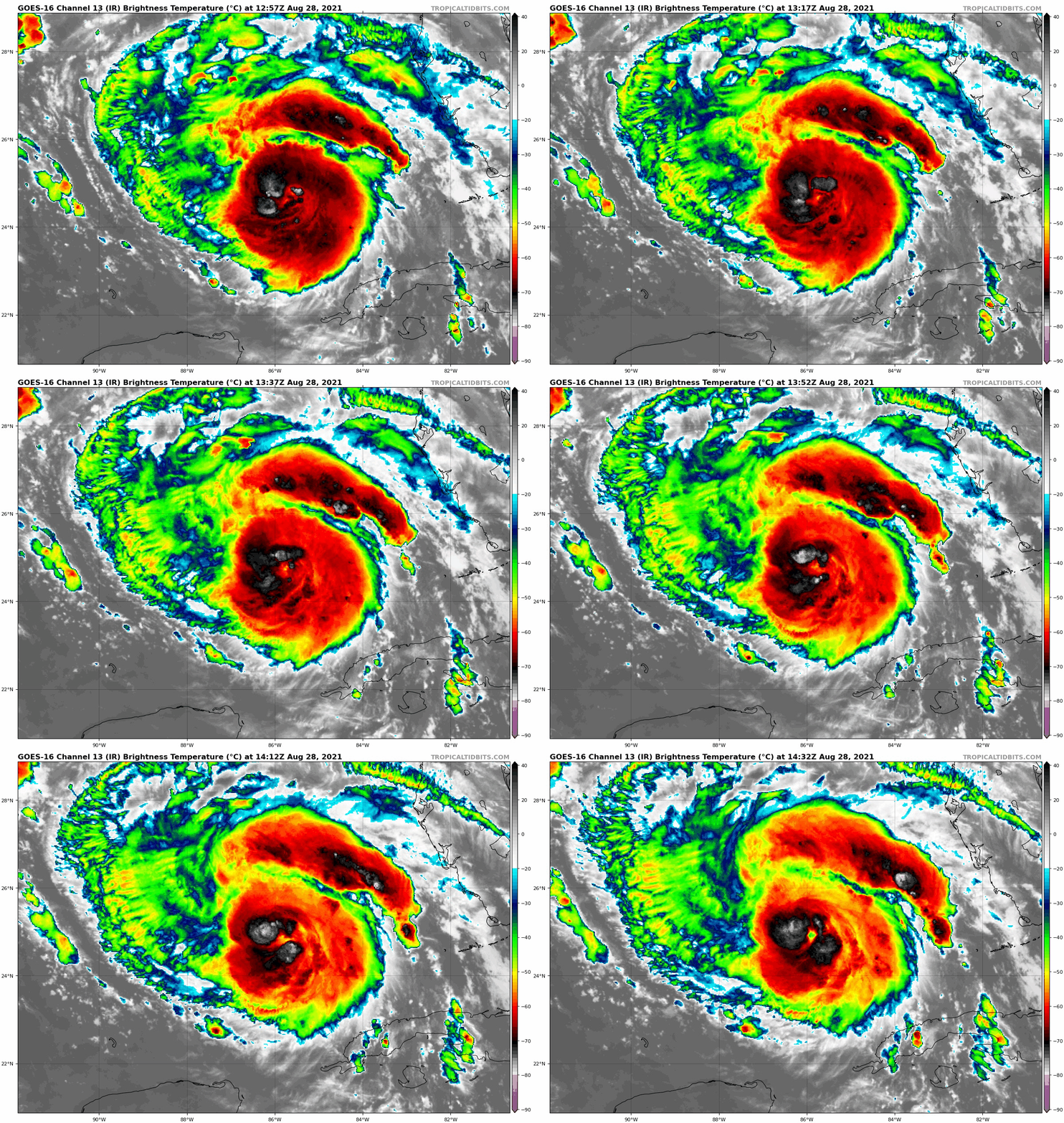
Hurricane Ida’s eye has emerged this morning, indicating that intensification continues. (Tropical Tidbits)
If you look at the satellite loop above, Hurricane Ida’s eye is emerging, indicated by the little green “dot” in the middle of the storm, an indication that the system is strengthening.
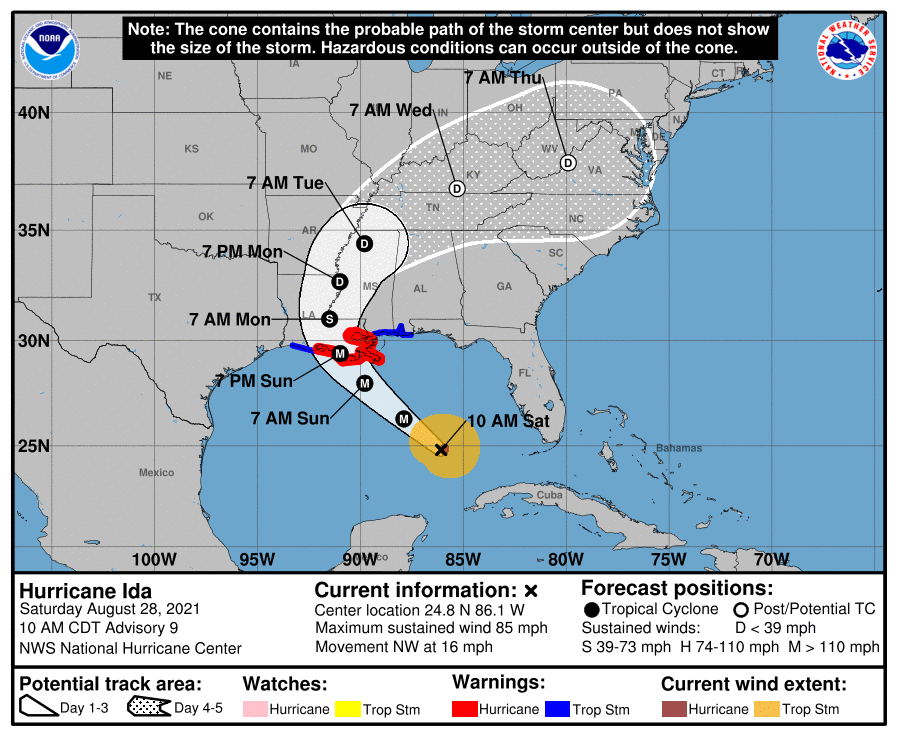
Unfortunately, very little has changed since yesterday. The track is essentially unchanged, with the National Hurricane Center predicting a track toward Morgan City, LA, with a little wiggle room on either side.
The NHC forecast has been dialed in for some time now, and a landfall near Morgan City, LA seems most likely on Sunday afternoon or evening as a powerful category 4 hurricane. (NOAA)
The intensity forecast is mostly unchanged as well, with modeling implying that a major (category 3 or 4) hurricane is almost certainly going to be what makes landfall. At this point, folks along the eastern Louisiana coast should be preparing for significant hurricane impacts.
Storm surge values are mostly unchanged today too,
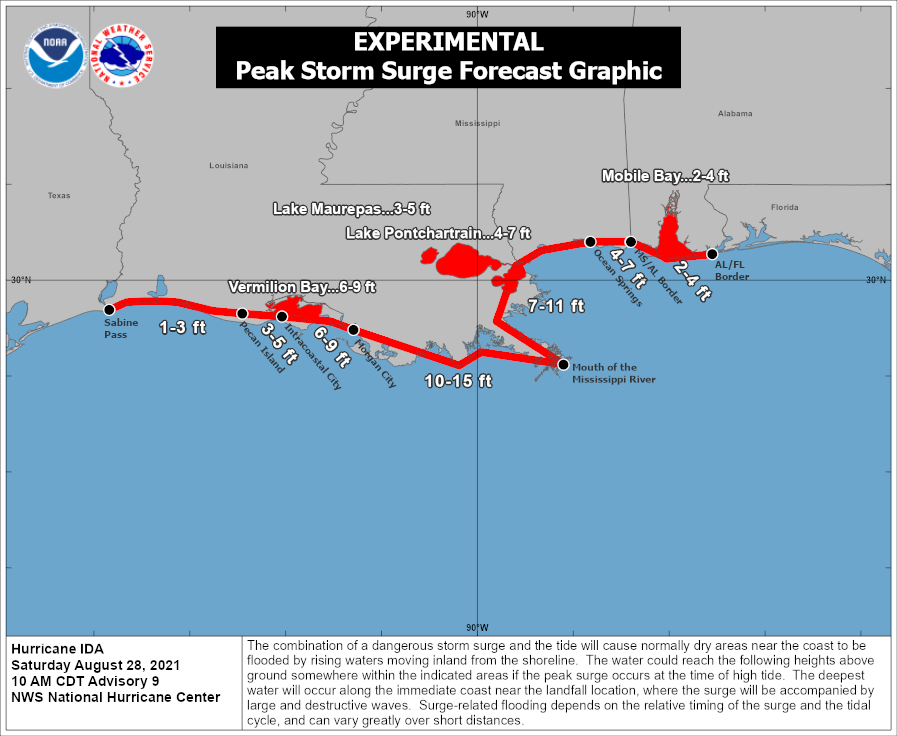
Significant storm surge of 10 to 15 feet above ground will be possible if Ida makes landfall around high tide tomorrow in eastern Louisiana. That much water can be expected outside of levee protected areas. (NOAA)
A significant 10 to 15 foot surge is possible between Morgan City, Grand Isle, and the mouth of the Mississippi River. Slightly lower values can be expected just southeast of New Orleans. It is tempting to compare Ida with Katrina, but there are a number of differences from track to intensity to size. For New Orleans, in Katrina, winds were out of the east and then out of the north. With Ida, winds will be out of the southeast most of the time, which means different impacts this time around. Hopefully far less severe, particularly given the distance of landfall from the city. But it’s obviously much too close for comfort.
In addition to the wind and surge, as we’ve noted Ida will have a ton of moisture as it comes ashore. This will lead to significant rainfall and probably freshwater flooding issues all across eastern Louisiana and Mississippi.
Significant flooding rainfall will be likely across most of eastern Louisiana and much of Mississippi as Ida comes inland. As much as 10 to 15 inches of rain is possible between Baton Rouge and New Orleans. (Pivotal Weather)
Maximum totals of 10 to 15 inches will be possible along and east of where Ida comes ashore, leading to significant flash flooding and river and bayou flooding in eastern Louisiana. Significant flash flooding issues will likely continue as Ida lifts north into Mississippi as well.
All in all, Ida will be a very, very serious storm for our neighbors to the east, and our thoughts are with them.
Local update
Just a quick local update for the weekend. Scattered showers or thunderstorms will be possible today. We expect coverage to diminish tomorrow, so less chance of rain. And even less chance of rain is with us on Monday. Look for temperatures in the low-90s today and mid-90s tomorrow. Mid, if not upper-90s will be possible on Monday. Winds here should be out of the north or west after tomorrow and be no worse than 10 to 15 mph or so. Some minor runup is possible along the coast with rough surf and strong rip currents, so exercise caution if you’ll be swimming tomorrow or Monday.
Barring any significant changes with Ida, Eric will have our next update on Sunday morning.
We have seen and covered a great many ridiculous copyright issues here at Techdirt. It is, after all, sort of our thing. Still, some attempts at enforcing copyrights are so ludicrous that they take your breath away. Now, granted, often times the most egregious of these stories arise out of the use of automated bot systems that troll all the places for copyright infringement and often times get it completely wrong. But that isn't so much an excuse for those situations as it is a spotlight on how brutally terrible the current iteration of copyright enforcement has become and how despicable it is that the wider copyright industries just shrug their shoulders at all the collateral damage they cause.
And then there's the moon. I know, I know, you're thinking, "The moon? Is Timothy having another stroke while writing a post?" First off, my personal health is none of your concern. And secondly, nope, because a video recording of the moon as seen from Greece, which included no audio, was blocked all over the place due to a copyright claim made by Universal Music Group.
British filmmaker Philip Bloom recently filmed the Moon during sunset Skiathos in Greece. After sharing it on social media, he was surprised when the video was blocked due to a claim by Universal Music Group, which claimed copyright to the generic shots of the Moon. Here’s the audio-less video that Bloom shared to his personal Facebook account while on his holiday:
Yup, that's it. So, how did this get flagged for copyright by UMG? Well, according to the block notification, UMG says the video contains "30 seconds of video owned by UMG". How? Well, who the hell knows. If I had to guess, I would speculate that there is some music video out there or something that also contains footage of the moon and that somehow has resulted in an automated system flagging this video of the moon as copyrighted content.
But, just so everyone is clear, UMG does not actually own footage of our nearest celestial neighbor. The person who filmed the footage, filmmaker Philip Bloom, is understandably not pleased.
“I uploaded some shots of the moon to Facebook late last year shot with the Canon R5 but it was a 2/3rds moon,” Bloom tells PetaPixel. “It looks like their AI is looking for full moon shots.”
Bloom then filed a dispute against the copyright infringement block, explaining to Facebook: “It’s a shot of the moon I personally filmed tonight!!! UMG doesn’t own the moon!”
But because, again, the way copyrights are enforced currently is a goddamned nightmare, the footage is still offline for those social media channels in all those countries while Bloom is going through the appeals process. And it's very much worth considering that this isn't an isolated case, either.
Bloom says that after he shared about what happened on social media, one of his followers shared that the exact same thing happened to them.
And so here we are. During the appeals process for Facebook at least, it appears that the assumed state of things is such that UMG owns the copyright on footage of the moon. If the fact that the setup of the DMCA and our enforcement of it allows this result makes any sense at all to you, then perhaps you'd be better off living on UMG's moon.
Join Bayou Billy (someone who has no relevance to anything) as he ventures to some rich guy's estate to save his girlfriend, or sister, or maybe she's his accountant? Anyway, you're gonna want to see this.
This article contains mild spoilers for season two, episode three of 'Star Trek: Lower Decks.'
This week’s episode of Lower Decks, “We’ll Always Have Tom Paris,” manages to squeeze two references into its title: a season one The Next Generation installment called “We’ll Always Have Paris,” and the name of a main cast member of Star Trek: Voyager, Lieutenant Tom Eugene Paris. But aside from that clever bit of wordplay, the title also carries a deeper meaning: That as much as we’d like to forget about the more embarrassing moments of the Star Trek franchise, they still happened and they weren’t all bad. Even, and especially, Voyager.
CBS
Viewer reactions to Voyager have been rather polarized over the course of the 26 years since it premiered. Back in the ‘90s, many fans were excited to have a “real” Star Trek show again, one that took place on a ship that was constantly exploring, unlike the comparatively stationary political drama of Deep Space Nine. But clunky writing soured many people’s opinion on Voyager, and toward the end of its run the show was known more for Seven of Nine’s skintight outfits and its slate of guest stars of the week, including Jason Alexander and Dwayne “The Rock” Johnson.
After the show went off the air, the franchise stopped moving forward in its timeline, choosing to explore Starfleet’s founding in Enterprise and rebooting the entire universe completely with the 2009 Star Trek movie. While fans were thrown a bone with a brief cameo by Admiral Kathryn Janeway in the last TNG-era film, Nemesis, Voyager would essentially disappear from the Star Trek canon until the appearance of Seven of Nine in episode four of Picard.
Trae Patton
For fans of The Next Generation, Picard had its upsides: We got to see Troi and Riker as a family, and Data got a better sendoff into the afterlife. But for fans of Voyager, it was anything but positive, with the death of a supporting character and a rather grim existence for fan-favorite Seven of Nine.
Star Trek: Lower Decks rolls back the clock a little bit, as it takes place a year after the events of Nemesis, making it our first real view of the Star Trek universe’s immediate future after TNG, DS9 and Voyager. The Dominion War is over, Romulus is under a new regime and the crew of the USS Voyager are basically celebrities after seven years spent in the Delta Quadrant; Picard takes place nearly twenty years later, when the luster would have been gone.
Matt Kennedy
Here everything is just shiny and new and worthy of commemorative plates — a bit of a weird thing to exist in a post-scarcity culture, but this is a comedy series, after all. And in this week’s B-plot, Brad Boimler is looking to get one of his plates signed by a special guest to the USS Cerritos: Tom Paris. Or, as Brad refers to the former Voyager crew member, “Creator of Fairhaven, Captain Proton himself” as well as the first human to break the transwarp barrier. Straight off, that’s a reference to three of the goofiest, oddball and some say worst episodes of Star Trek: Voyager. And just in case you forgot what was so bad about the last one, Mariner asks “is he still a salamander?,” because that is a thing that happened in the episode “Threshold.”
Undeterred (and perhaps even encouraged) by the weirdness, Boimler is all hyped to meet his hero. Even after the ship’s system doesn’t recognize him and won’t let him through any doors, he takes to the Jefferies tubes to make his way to the bridge to meet Lt. Paris.
In a way, it feels like a metaphor for how the fandom feels about Star Trek: Voyager now. While everyone admits it had a lot of dumb moments, those actually made it moreendearing. The famous line “there’s coffee in that nebula” would inspire astronaut Samantha Cristoforetti to bring a replica uniform with her and wear it on a mission back in 2015:
— Samantha Cristoforetti (@AstroSamantha) April 17, 2015
And who can forget the infamous “Tuvix” episode, where crew members Tuvok and Neelix were merged into one being thanks to a transporter accident? Though the resulting individual was healthy and happy, the decision was made to force him to split back into his component persons, inspiring the recent internet rallying cry “Janeway murdered Tuvix.” Even Janeway actor Kate Mulgrew entered the debate, responding to a tweet from Congresswoman Alexandria Ocasio-Cortez. When you’ve got politicians involved it’s not really a fandom in-joke anymore.
Willing to hear the crew’s thoughts, as always. However, shouldn’t Tuvok and Neelix should have the biggest say...oh wait, they couldn’t! I stand by my decision to restore them to their lives. Rewatch and report back, AOC - and congrats on your win! 👏🏻
Maybe it’s time to give Voyager a bit more credit. It’s not as good as TNG or DS9, but it still has its fair share of fans. I remember a time when it seemed like it was constantly running on Spike TV (now the Paramount Network), as opposed to Deep Space Nine, which is seldom rerun due to its serialized nature. Last year I sat down and rewatched the entire Star Trek franchise, including Voyager, and saw quite a few episodes I had missed the first time. I found myself enjoying some of it, cringing just as often, and eventually remembering why I had stopped watching the show for a while back when it aired. In general, I feel like the show’s biggest problem was missed potential, like the way the conflict between the Starfleet and Maquis crew members was quickly smoothed over, how it underutilized many of its cast, and why on earth did Harry Kim never get promoted.
CBS
However, it’s not the job of Lower Decks to explain or redeem Voyager. Boimler and Tom Paris are only the B-plot here, with the main drive of the episode being Tendi and Mariner’s mission to pick up a package for Doctor T’Ana as well as Rutherford’s quest to find out how a certain dead officer is alive again. The episode just asks us to consider what it would be like to be a Starfleet officer and hear about all of Voyager’s adventures in the Delta Quadrant. Weird and goofy? Yes. But honestly, they’re also pretty cool.
DOS Haven is a site dedicated to 21st century DOS games, released long after the operating system's early-1990s heydey. Homebrewers are still making them even now! Quoted is Lt. Commander Geordi La Forge: "Just because something's old doesn't mean you throw it away." — Read the rest
I was wondering about your opinion on a strange situation I was in a few years ago that I don’t know how I should’ve handled.
I had a coworker, Jane, who had just turned 50. I was in my mid 20’s and in my first professional setting in my chosen field. Jane and I didn’t click, but we shared a small office with no problems. I worked in front of the computer all day, and she was often away on meetings. I think I had worked at the office for about a year at the time, and she had started after me.
My job was completing orders that came through a digital system. The person who put in the orders (Jane was one out of 10) had to fill in as much information as possible. If I didn’t have the right information, I couldn’t do my job properly. Jane was impossible at this — she never filled in enough info and getting it from her directly was like pulling teeth. At one point I reminded everyone at one of our monthly meetings to fill out everything (she wasn’t the only offender). As we were looking at the board, someone else pointed at and asked about an order that Jane had created, and I replied with something like, “Yeah, that one would need some work, Jane.”
One day, at another of our monthly meetings, one of the managers mentioned that if you had a problem with someone you should let them know, instead of going around sulking about it (not in those words, but that was the gist). Right after the meeting, I’m at my desk and Jane comes in. She asks if I have a second to talk, and closes the door. What the manager had said had resonated with her and she had something to say.
Her biggest issue was that I had called her out in front of everyone and that I had been “militant” towards her. She said she had worked in different teams for 30 years and never met someone with this much attitude, and that everyone she mentioned this to had agreed with her (I think she meant her friends and not our colleagues). She also mentioned that I never said “hi” first in the morning, she was always the one who said it first. By this point, she was very teary and said that she didn’t know what to do. I, being a level 10 out of 10 on the Scared of Confrontations Scale, made an instant semi-genuine apology to smooth things over. Apparently, that was enough for her and said she was glad to have this resolved. If it hadn’t been, she was going to the boss to say that she couldn’t work with me anymore. This all came like a torrent and I was so high on adrenaline that I almost couldn’t breathe.
Alison, I am not militant, nor do I have an attitude. I am an anxious mess and a chronic goody-two-shoes, of course I say hello in the morning! I recognize that being called out on a mistake in front of others is never a good feeling, so I will be careful with that in the future. For me, though, this wasn’t resolved. I remember being nervous around her, feeling like she’d keep score on whether or not I said hi every day. I never did anything about this, as I was a few months from leaving but hadn’t told anyone. Jane never mentioned it again.
I’m still fairly new in my career, so I’d like to learn from this experience. Looking back, I should’ve probably told my boss right away and not apologized. I think. Help?
Jane sounds over-the-top. But sometimes the easiest way to deal with someone like that is exactly what you did: apologize and let that be the end of it.
That’s not to say you wouldn’t have been entitled to handle it differently — to decline to apologize and to loop your boss in. You could have done that! But it would have made it a much bigger deal, and even though you weren’t the one causing the drama, now you’d be enveloped in it anyway. Just giving her the apology she wanted let you put it to rest without it becoming something bigger. (To be clear, I am not advocating for any sort of across-the-board policy of apologizing when you didn’t do anything wrong. This is specific to this situation, where you had a very worked-up coworker and an easy, 10-second way to defuse things.*)
Except that you then got stuck with being anxious around her for the next few months as a result, which isn’t a good outcome either.
Ideally, if we could go back in time, I’d say to do what you did in that conversation, but internally roll your eyes at Jane, file this away as “okay, Jane is super sensitive about morning hellos and any public acknowledgement of her mistakes, noted,” and move on. But “move on” can be a tough sell when anxiety is in the mix.
* It’s also easy to call it a success now because it worked. If instead Jane had escalated things, started picking at you all the time, or otherwise responded badly, you would have needed to go to your boss at that point — and in hindsight, maybe now we’d be concluding you should have handled it differently from the get-go. But at least as an initial response, what you did was reasonable from a drama-minimizing perspective.
I’m actually kind of a fan of this book. Aside from the dated advice, it is actually a pretty good book. It’s written without any cutesy condescending language. I am also a big fan of the vocabulary/definition appendix in this book. Jargon is often an extra layer of complication when someone is learning a new skill. My nerd librarian self loves good footnotes, indexes, etc. The author/publishers recognize that the use and organization of the information is also critical. Regardless of gender, this is a pretty decent book.
My mom was actually quite the fixer around our house. She was never afraid to pick up a tool and figure something out. My mom would have liked this and even back in 1972 would have definitely disliked a “feminine” version of a repair manual.
by kpodd@uxbridgeshimoda.com (Dan Kennedy and Benjamin Harrison)
01-08-98: Machine Bolt finally, really apologizes to Everclear, and the Raddest Morning Team begins a scintillating Thursday broadcast. El Farto’s foot is broken due to a cheezy sauce incident, and the station’s live room is out of commission because Machine Bolt was trying to make Steph laugh. It’s January 8, 1998, and the news is bad, but the radio is so damn good. Awesome!
I’m the one who asked you about a new hire who blew up on me because he is friends with my ex.
The day after you posted my question, I went on a week-long business trip out of town.
Guess what happened when I came back to the office? No sight of Joe! Apparently he no longer works for our company. I never even needed to talk to our senior manager (admittedly, I was putting off having that conversation out of my fear of being looked at as someone who causes drama). His character spoke for itself (I’m guessing he did something just as outrageous while I was gone).
I wanted to thank you and the AAM community for your kind words. I wrote to you in a place where I really did feel so down, and to get so much support from strangers who don’t need to be in my corner really made all the difference to me. I actually kickstarted my job search the same week the letter was published, and am happy to share I’m in a new role I love that is a 30% increase in pay for a fraction of the stress!
Now … a couple of (crazy) updates:
One, Amy and Brooke fired almost everyone else on the team there shortly after I wrote in. My first thought was that they were in financial troubles, but I heard through the grapevine they replaced all the roles and then some of those new people ended up getting let go as well. So, they’ve essentially fired every single person they ever hired to do the role I did.
I guess the slew of let go employees turned to Glassdoor to share their experiences, all nearly identical to mine – I guess I was just the first of many. I still haven’t written one, but I guess I didn’t need to!
THEN, Amy and Brooke go on to write an absolutely unhinged blog post talking about how they “love the negative glassdoor reviews” and going LINE by LINE through the reviews talking about how everyone that got let go was simply “mediocre,” ignoring all the valid criticisms and devastating experiences each reviewer had. It was truly a sight to see, it got sent to me almost a dozen times on LinkedIn from mutual connections.
So, overall, the whole experience was a great lesson. I’ll never let another person allow me to go against my own better judgment, or blindly believe colleagues/bosses have my best interest at heart. Hindsight is always 20/20, and WOW I’m so happy I’m done with that place.
Thank you again Alison, I can’t even begin to tell you how much your advice helped me come back from a really low place.
Writing in with an update to my question from February about taking a second job and working it during the downtime hours of my current full-time job.
In the interim, I’ve had a big career/life change and will be starting a (long, full-time) grad school program this fall. Since my full-time job proved itself during the pandemic that it can be fully remote, I just heard from my employer and they are making the remote-work call on a case-by-case basis, and I get to stay remote! Because I’ll be remote, I will be keeping my job while I’m in school. There will be overlap during official working hours and class time. I anticipate some early mornings, evenings, and weekend times to (unofficially) flex my work load and get stuff done. I’ve done a bit of a trial run over the past couple months and I think it is doable. Doable and I know it will be a lot, but doable. It is a huge relief to know that my living expenses will be paid for with my work paycheck, and I will be able to take out fewer student loans!
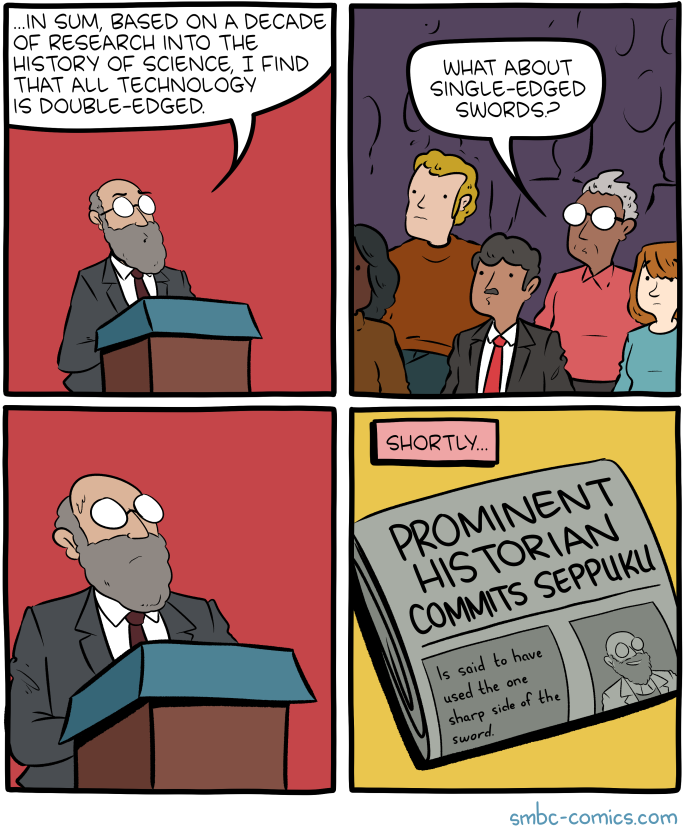
Hovertext: I've been told by programmers that physicists make the worst code because they want all the variables to be single letters instead of descriptions of what the variable means.
James Akers appeared before the Dripping Springs Independent School District in Texas and took all his clothes off except for his underwear. His point was, if people don't have to wear masks, then why should he wear clothes?
"I do not like government or any other entity — just ask my wife — telling me what to do," said Akers, the parent of a high schooler. — Read the rest






 When I first moved to Dallas from Berkeley in 1996, my journalist friends were quick to tell me about Jim Schutze’s The Accommodation. They said the two-hundred-page nonfiction book was the real, uncensored story of how Dallas managed to avoid the far-reaching changes wrought on other major cities by the civil rights movement. When I asked if I might borrow a copy, they looked at me askance. The book had been out of print for nearly a decade; those lucky enough to own a rare copy tended to guard it closely. After I finally pried one away from a colleague at The Dallas Morning News, I was almost afraid to open it, for fear I might drop it, or tear a page.No need to worry…