Shared posts

16 Nov 18:04

Savage Love

by Dan Savage
Backlot Access by Dan Savage

I'm a 44-year-old gay male and I've never been in a serious relationship. I would like to find my way into an LTR, but I have a series of overlapping dating issues that I don't know how to navigate.

First, due to my career, I move around a lot, and often don't see the point in dating when I know I am going to be moving again; I have another potential move on the horizon in six months. Second, I find online dating apps to be awful. I have encountered more ghosts on apps than I did in the Haunted Mansion at Disneyland. Last year one date I arranged through an app turned out to be the setup for either a mugging or a hate crime. I managed to escape physically unharmed, but I did delete all the dating apps after that. Third, I'm a beefier guy, but I have never really fit into the bear community. I hate wearing leather, I can't stand growing facial hair, and don't have any kinks—and leather, beards, and kinks seem to be prerequisites for joining the bear club. Also, most bears are older guys and older guys don't really do it for me. And younger guys always seem to be looking for a sugar daddy. I'm a Goldilocks who can't find her "just right."

Fourth and finally, I've lived a big life. Due to a parent in the entertainment industry, I grew up with backlot access. I have literally traveled all over the world. I can tell stories for days. But it makes dating hard when the other guy has only his work or cats to talk about. I've gone on more than one date where the guy told me he didn't have anything interesting to say about himself and that he just wanted to hear about my life. Am I destined to be either a spinster or a sugar daddy?

Lost And Can't Keep Investigating New Guys

1. If you don't see any point in dating because you're always on the move, LACKING, it's not a long-term relationship you should be seeking, but a nice string of fulfilling short-term relationships. STRs can be serious, they can be loving, and with more people working remotely than ever before, a successful-if-geographically-challenging STR has a much better shot at becoming a successful LTR these days.

2. Dating and hookup apps are awful. People on the apps sometimes lie about who they are, they ghost on you, and they block you without explanation. But bars are awful too. People in bars sometimes lie about who they are, they excuse themselves "for a second" and never return, they go home with you one night and eat your ass for hours and then pretend they don't know you the next time you see them at the same bar. And just as people have been mugged, assaulted, and murdered by people they met on apps, people have been mugged, assaulted, and murdered by people they met in bars—and at work, at church, through friends, etc. So, wherever we're meeting people, online or off, we need to be careful; we need to have those first meetings in a public place, we need to tell a friend where we're going and who we're with, and we need to trust our guts. When someone makes you feel uncomfortable or unsafe, get out of there and/or ghost on them. (And if we find that people are constantly ghosting on us… well… then we need ask ourselves if we're doing something that makes other people feel uncomfortable or unsafe.)

3. Not all bears have beards or kinks or wear leather. At any big event for bears, LACKING, you're likelier to see guys in jeans, t-shirts, and trucker hats than you are to see guys in leather—unless it's a fetish party, LACKING, where you'll see a lot of guys in leather. But even at a fetish party, LACKING, you'll see guys in neoprene, wrestling singlets, diving suits, hand-crocheted harnesses, and on and on. Leather isn't required.

4. I'd rather listen to a charming guy tell me a funny story about his cat than a conceited guy drone on and on about some famous actor he saw on a backlot pocketing granola bars from the craft services table. I'm not saying you're conceited or boring, LACKING, but if I were a betting man and only had the last paragraph of your letter to go on, I'd put my chips on conceited and boring. Look, if a guy tells you halfway through a date there's nothing he wants to share with you about himself and invites you to carry on talking about yourself, that doesn't mean he's so enthralled by your stories he just wants to listen. That means he's bored and/or annoyed and has already made up his mind that you're not gaining access to his backlot.

Zooming out, LACKING, can you see the pattern in your letter? You say you want a relationship, but you don't see the point of dating because you're always moving. You say you want a relationship, but the apps are a waste of time because some people are sketchy. You say you want a relationship, but you don't wanna go to places where people might be buying what you're selling (bear nights, bear parties) because you don't wanna wear the kind of clothes you're required to wear at those events (leather, which you're not actually required to wear) or grow the kind of facial hair you're required grow to attend them (beards, which you're not actually required to grow). You say you want a relationship, but guys who didn't grow up with wealthy and connected parents bore you—which is going to make finding someone next to impossible. Gay men are a tiny percentage of the population and finding someone in your preferred age range is going to be hard enough without ruling out guys who can't match your story about peeing next to Matt LeBlanc in a men's room on the Warner Bros. lot with a story of their own about some celebrity they peed next to. Or on.

Viewed together, LACKING, the above looks less like "this dude is just unlucky in love" and more like "this dude is engaged in some serious self-sabotage." So, the problem isn't the apps or the job-related moves or leather pants or scratchy beards or guys who insist on boring you with stories about their cats when you've got a much better story about Mariska Hargitay's dog walker. The problem is you. I'm not saying you're an asshole or that you're unworthy of love. You're not an asshole; you're just a little up your own ass. If love and commitment are what you want, LACKING, then I want you to find them. But you're going to need to get out of your own ass and out of your own way.

P.S. If you have the kind of career that requires you to move every couple of years, LACKING, you should think twice before rejecting guys who aren't as career-oriented or privileged as you are. Those are the guys who can easily relocate with you. So, while dismissing every guy with a boring and/or low-paying job means you won't wind up briefly dating a boy who just wants a sugar daddy, LACKING, never giving a regular guy with a regular job a chance could wind up costing you a lot more in the long run.


I'm a 35-year-old gay guy who's about to get married. My fiancé and I decided to open our relationship recently and had a wonderful, slutty summer. Not long ago, one of my fiancé's hookups made me feel jealous. The next time we had sex, just the two of us, I asked my fiancé to worship my body like he worshipped our buddy's body. My fiancé got impatient, I got frustrated, and then I asked him to stop, which killed the mood. We talked and I asked him to be brutally honest. I asked him if he was attracted to me, and it turns out that he is not. He only has sex with me to make me happy. I died inside. He insists that he loves me deeply and wants to be with me. But I don't want to spend the rest of my life with someone who isn't physically attracted to me. (Yes, I can get enthusiastic sex outside the relationship, but I want that from the man I love.) We both freaked out and cried. Now, here I am, due to be married in three months. What on Earth should I do?

Gutting Revelation Overturns Our Marital Schedule

Postpone the wedding, GROOMS.

You made a reasonable assumption about your fiancé—that he was attracted to you sexually—and your fiancé allowed you to make that assumption. Now that he's opted, with your encouragement, to be brutally honest (loves you, but not attracted to you) you're going to need some time to process that. Basically, you have to decide if what's on offer here—a sexless (or soon to be sexless) companionate marriage where your husband is free to seek sex with men he finds attractive and you're free to seek sex with men who find you attractive—is something you're willing to accept. As prices of admission go, this one is pretty fucking steep. If paying it sounds no less awful and/or impossible a few months from now than it does right now, GROOMS, call the wedding off.


mail@savagelove.net

Follow Dan on Twitter @FakeDanSavage.

Check out my new website at Savage.Love!

10 Nov 12:40

SATAN WHISPERS TO KIDZ!

by noreply@blogger.com (JerryMaguire)
10 Nov 12:36

Saturday Morning Breakfast Cereal - Assimilate

by tech@thehiveworks.com


Click here to go see the bonus panel!

Hovertext:
Borging is my contribution to English verbs.


Today's News:
09 Nov 20:04

HR called employee’s wife about his bad behavior, should my employer pay for my flat tire, and more

by Ask a Manager

This post, HR called employee’s wife about his bad behavior, should my employer pay for my flat tire, and more , was originally published by Alison Green on Ask a Manager.

It’s five answers to five questions. Here we go…

1. Should HR ever call a spouse about an employee’s bad behavior?

This is a secondhand question, but I’m interested in your take.

Nora’s partner Nick works at ACME Corp; Nora does not work there. Nora notices that Nick seems to be in trouble at work, but Nick tells her that it’s because of petty procedural issues (failing to put the new cover sheet on TPS reports or whatever). Then one day, Nora gets a call from ACME’s HR informing her that Nick is being fired because he’s been sending explicit photos of himself to coworkers.

Should HR have contacted Nora? On the one hand, it doesn’t seem right for Nora to be in the dark about this. On the other, HR informing someone’s partner about a firing seems inappropriate in general — though perhaps the specific reason here is clearly Nora’s business in a way that “we’re firing Nick because he can’t comply with our new TPS documentation requirements” wouldn’t be?

Nora is a friend of a friend, so I don’t have a lot of details about exactly how HR framed it, but my understanding was that it was along the lines of “you deserve to know what’s going on with Nick.”

Nah, they overstepped. Nick’s employer has no business meddling in his marriage or reporting his activities to his wife, reprehensible as they may be. The appropriate response to Nick’s behavior was ending their employment relationship with him, which they did, not trying to ensure he faces consequences at home.

2. Should my employer pay for my flat tire?

I was on the clock on my way to a work event when I got a flat tire. I was close enough to the event location that I was able to park my car nearby and walk there. After the event, I called roadside assistance, a tow truck driver changed my tire, and I drove home and clocked out.

The tire cannot be repaired. I will find out tomorrow how much it’s going to cost to replace it. I told my boss about it, and she said I could leave early the next day to cut my hours, but she did not offer to pay for my tire. I work for a small organization with few written policies. Should they be responsible for at least part of the cost of replacing my tires?

Typically an employer wouldn’t cover something like this unless it was directly caused by the work you were doing — like if something you were transporting to the event damaged your car. A flat tire isn’t really linked to the event itself; you just happened to be on your way to a work function when it happened.

3. My managers are so upset I’m leaving that they’re taking time off to “deal with their feelings”

I work in a caring profession with a lot of vulnerable clients. I’ve been in this field for over a decade, dealing with funding cuts, and I’m now making the jump to another kind of role. Earlier this year I made a couple of attempts to get some support from management but they weren’t receptive. I was burnt out and it was definitely time to go. I’m team lead, not a partner or director, and I gave my full notice.

My colleagues are being lovely but my two managers have lost it — “disappointed,” “betrayed,” and taking time off to deal with their feelings. They haven’t made me a counteroffer or tried to talk about how to ease the transition or anything practical at all. So I’m not sure what their purpose is, except … I don’t know, to make me feel bad?

A few times I’ve tried to discuss something relating to handover and the discussion gets derailed into them saying, “Fine, we’ll just close the whole department because how will it function without you?” … with me just trying to redirect our talk back to practicalities. Can you suggest a script that would be a professional way of saying, “Knock off the guilt trips and treat your next employee better?”

Taking time off to deal with their feelings about your resignation? Dear lord.

The next time they say they should close down because they won’t be able to function without you, please respond with, “That would reflect terribly on the organization if it were true.” If you want to soften it you can add “which it’s not” … or you can just look at them for an awkward beat and then go back to whatever you were discussing.

With other forms of guilt-throwing, just say, “I have limited time remaining and we should really spend it focusing on the handover. So about XYZ…” If they won’t let up after that: “You know, I tried to talk with you about my concerns before deciding to leave, but I didn’t get anywhere. If you’d like feedback on what will help the next person stay, I’m happy to give it — let me know if so.”

Take this all as confirmation that you made the right decision.

4. Employee’s father is stalking her at work

I am still new as a manager and I have a lot to learn. I have an employee who has been at our company for several years. She is young and comes from a dysfunctional household. Her alcoholic, abusive father has been stalking her at our business and she seems understandably stressed. What can I do to help her?

Talk with her and ask! When you do, you should do three things: First, let her know you know the situation isn’t her fault and it doesn’t affect the way she’s perceived in any way (because people dealing with this sort of thing often worry they’ll be seen as a source of drama, even though they’re not the ones causing it). Second, lay out some options that she might not know she can ask for — things like ensuring no one at work gives out any info about her whereabouts to any caller, ensuring the front desk and security have a photo of her father and know he’s not allowed on the premises, having someone escort her to her car after work, removing any indications she works there from your website, letting her work from a less visible/accessible location if that’s an option, and giving her time off to deal with it legally if she needs to. (She might not want all or any of these things; the idea is to just let her know they’re available if she does, and without judgment.) Third, let her know this isn’t a one-time offer; if things change in the future and she needs additional help, she should come back to you and you’ll help however you can.

5. Pre-planned trips when you switch jobs

I wondered how you would approach negotiating vacation time with a new employer. I’ve just had a very positive second interview with a company I’m excited about, and was told they will be offering their final candidate the position within the next two weeks. The position is set to begin in December, but I already have out-of-town travel plans (with plane tickets booked) over Christmas and MLK weekend. I imagine that in this new job, similarly to my current position, during the first 3 to 6 months I won’t automatically be allowed any time off. If I’m offered the position, how should I negotiate these days off since they’re already booked? Do you have a script I can use? I don’t want to seem entitled, but after not traveling for two years, I really want to see my family!

Yes! The time to raise it is once you have an offer but before you’ve officially accepted. At that point, you’d just say, “I have two trips scheduled that I want to make sure will be okay — one on (dates) and one on (dates). I can of course take the time unpaid if I won’t have vacation time accrued yet, but I want to mention the dates up-front since the plane tickets were already purchased.”

People do this all the time, and companies are used it. And here is a whole guide to time off when you’re starting a new job.

09 Nov 19:57

my employee took money under false pretenses from a nonprofit

by Ask a Manager

This post, my employee took money under false pretenses from a nonprofit , was originally published by Alison Green on Ask a Manager.

A reader writes:

I recently had an employee, “Jane,” leave the organization due to personal reasons. I knew the day would come eventually, as she was unhappy in her role and there was not a lot of room for advancement or specialization within the company. I had tried to support her career as much as I could, including listing her as “high potential” during corporate talent reviews, getting her aligned with special projects across the company, and more. My thoughts were that even if she didn’t stay with our company, I wanted to help her grow her career. I even supported her using our tuition program for her to obtain an advanced degree, which requires approvals and time off from work to complete different things.

Since I was her immediate manager, I got access to all her computer files when she left. I have been going through every document, as I have discovered a lot of things that were missed during her time with us and I want to make sure nothing falls through the cracks. I found months worth of bank statements. Within those bank statements I noticed credit from our company and from a nonprofit focused on helping individuals obtain their education.

For the record: I wasn’t digging through her statements. Credits were at the top of the statements and debits were after, so as soon as the document opens the credits are right there. And the documents were titled “invoice XYZ” so it wasn’t easy to tell what they were offhand, and there were company invoices titled similarly.

Here’s the rub: our tuition pays 100% minus any scholarships, assistance, etc. Jane didn’t need any additional assistance for her degree, nor did she indicate in any of her company requests that she was receiving assistance in any form besides ours. There is a specific question in or request document for this.

So what do I do? I feel a moral obligation to inform the nonprofit, as it is designed to help those without resources. At the same time I feel like it is a breach of confidentiality.

Ugh. If it’s what it looks like, Jane fraudulently claimed money from a charity, and someone else didn’t get assistance as a result.

Is there any chance it’s not what it looks like? Could the nonprofit’s funding have been for a separate course of study Jane was pursuing, different from the one your company paid for? That might be a stretch, but it’s worth asking the question before you take any action.

As for what to do … I can tell you what I think should happen, but in real life you shouldn’t decide it on your own; your company needs to be involved. If company policy is that they reimburse the full costs of tuition minus other assistance and you’ve got documents showing there was other assistance, Jane claimed company funds fraudulently and your company should be involved in figuring out what to do. So start by talking to whoever at your company coordinates the tuition reimbursement program (or someone above them if they’re pretty junior).

But for the sake of exploring it, let’s say you were in a job where how to proceed was your call. I’d start by contacting Jane and asking her directly about what you found. Then, assuming she didn’t say something that cleared her, I’d have a lawyer look at the exact wording in your written agreements about the program to (a) make sure that what she did was indeed fraudulent, (b) see what options, if any, you had for recovering the money, and (c) get a legal opinion on whether to alert the charity to her fraud against them.

I think a lot of people would argue that contacting the nonprofit would be an overstep, but ripping off a charity and thus preventing someone else from getting assistance from them is a remarkably awful thing to do. Personally, I’d be inclined to tip them off and let them decide for themselves how to handle it (and they need to know if there are holes in whatever system they use to vet applicants). You don’t owe Jane any particular confidentiality if you confirm that she did indeed double-dip.

09 Nov 19:47

Saturday Morning Breakfast Cereal - VR

by tech@thehiveworks.com


Click here to go see the bonus panel!

Hovertext:
I'm prepared to give this TED Talk.


Today's News:
09 Nov 19:47

Flinch

Premed: "Does this count for a physics credit? Can we shorten the string so I can get it done faster? And can we do one where it hits me in the face? I gotta do a thing for first aid training right after."
09 Nov 19:45

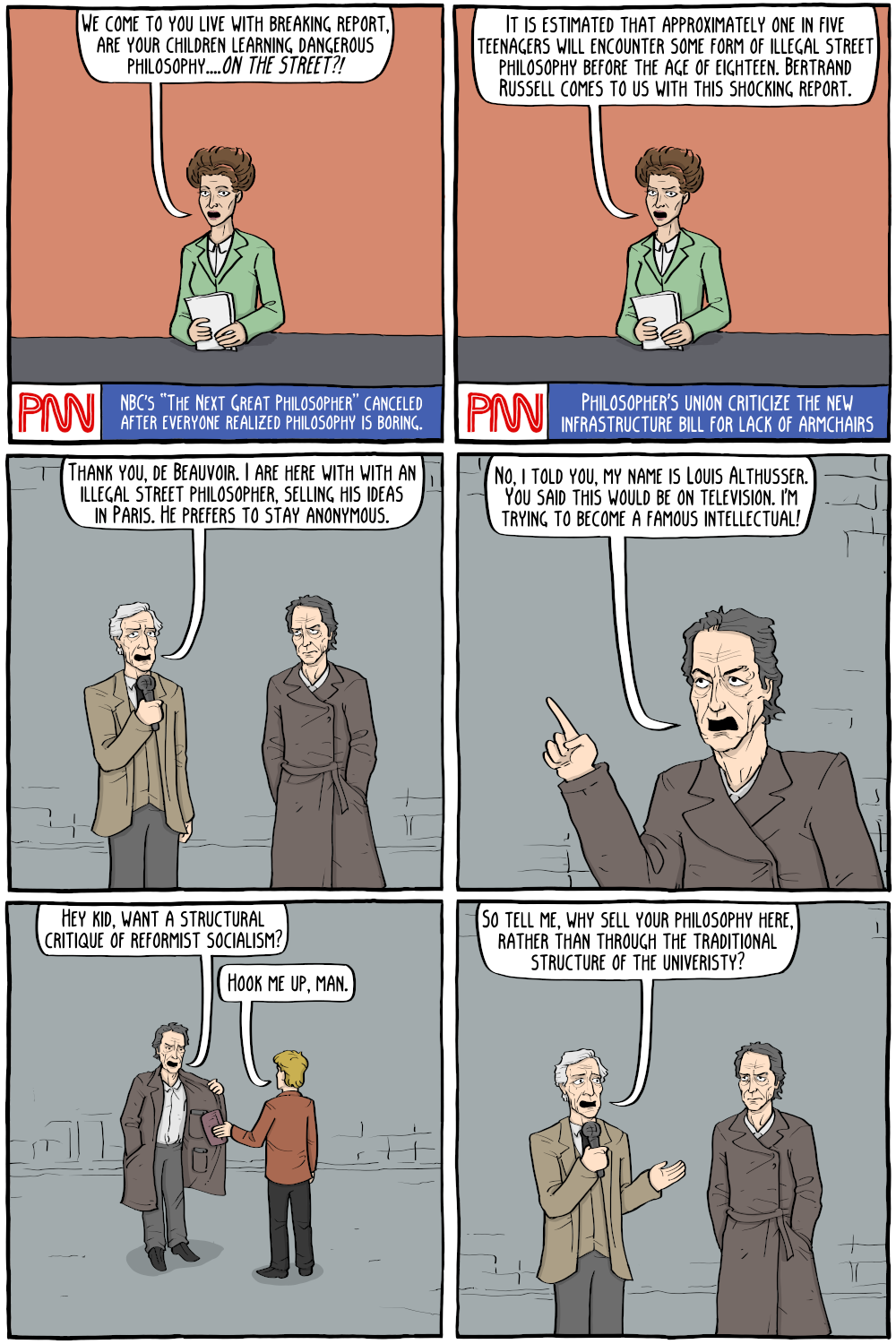
Philosophy News Network: Street Philosophy

by Corey Mohler
Simone de Beauvoir: "We come to you live with breaking report, are your children learning dangerous philosophy....ON THE STREET?!"

News Ticker:" NBC's “The Next Great Philosopher” canceled after everyone realized philosophy is boring."

de Beauvoir: "It is estimated that approximately one in five teenagers will encounter some form of illegal street philosophy before the age of eighteen. Bertrand Russell comes to us with this shocking report."

News Ticker: "Philosopher's union criticize the new infrastructure bill for lack of armchairs"

Bertrand Russell: "Thank you, de Beauvoir. I are here with with an illegal street philosopher, selling his ideas in Paris. He prefers to stay anonymous."

Althusser: "No, i told you, my name is Louis Althusser. You said this would be on television. I'm trying to become a famous intellectual!"

Althusser: "Hey kid, want a structural critique of reformist socialism?"
Kid: "Hook me up, man."

Russell: "So tell me, why sell your philosophy here, rather than through the traditional structure of the university?"


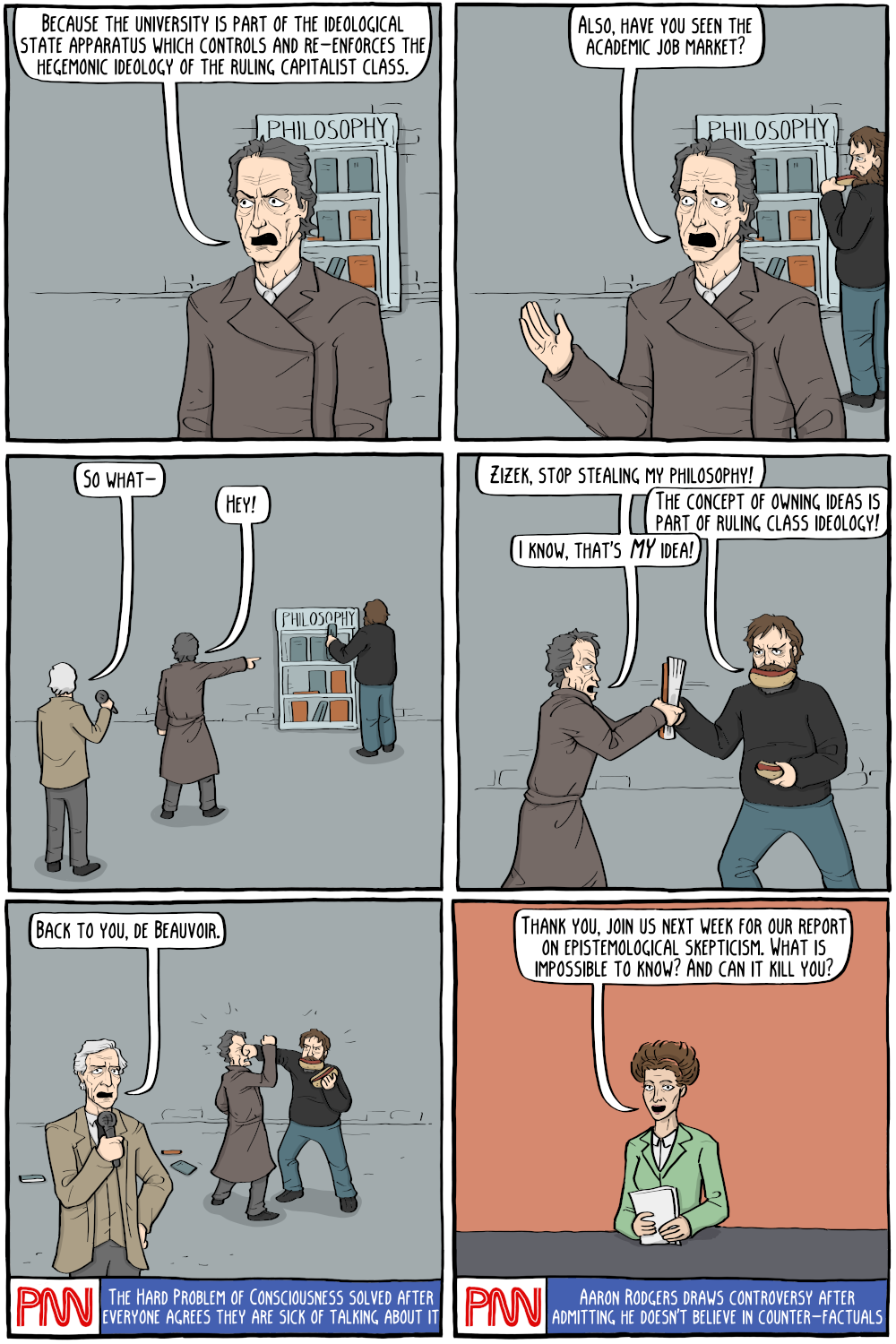
Althusser: "Because the university is part of the ideological state apparatus which controls and re-enforces the hegemonic ideology of the ruling capitalist class. "

Althusser: "Also, have you seen the academic job market?"

Russell: "So what-"

Althusser: "Hey!"

Althusser: "Zizek, stop stealing my philosophy!"
Zizek: "The concept of owning ideas is part of ruling class ideology!"
Althusser: "I know, that's MY idea!"

Russell: "Back to you, de Beauvoir."

News Ticker: "The Hard Problem of Consciousness solved after everyone agrees they are sick of talking about it."

de Beauvoir: "Thank you, join us next week for our report on epistemological skepticism. What is impossible to know? And can it kill you?"

News Ticker: "Aaron Rodgers draws controversy after admitting he doesn't believe in counter-factuals"
08 Nov 20:49

Killing Website Comment Sections Wasn't The Brilliant Move Many Newsroom Leaders Assumed

by Karl Bode

So for years we pointed out how the trend of news websites killing off their comment section (usually because they were too cheap or lazy to creatively manage them) was counterproductive. One, it killed off a lot of local, community value and engagement created within your own properties. Two, it outsourced anything vaguely resembling functional conversation with your community -- and a lot of additional impressions and engagement -- to Facebook. Despite the downsides everybody ran with the idea that comment sections were utterly irredeemable and unnecessary.

Turns out, much of the conventional wisdom driving those decisions wasn't so grounded in fact. This Poynter piece does a really good job revisiting whether killing the comment section was a good idea ten years on. It's true that negative comments in the comment section can tarnish a visitor's perception of the quality of an outlet's brand. But it's also true that the discussions outsourced to Facebook continue to also do that, they're just doing that over at Facebook. So many researchers argue that if you're going to have a discussion, you're probably better off having at locally at your site:

"Conversations on Twitter, Facebook and Instagram won’t stop. And the same research premise holds true — negative comments on those platforms will have a negative impact on the outlet’s credibility. So is it better to at least keep one forum where the outlet has control and the potential to monetize commenters into subscribers? And how do we make that forum as good as it can possibly be?"

If you recall, when most news empires over the last decade announced they were killing their comment sections, it was usually accompanied with some form of gibberish about how the decision was made because they just really "valued conversation" or wanted to "build better relationships." Sometimes newsroom managers would be slightly more candid in acknowledging they just didn't give enough of a shit to try very hard, in part because they felt news comments were just wild, untamable beasts, outside of the laws of physics and man, and irredeemable at best.

But again, as it turns out, none of that was true.

One recent experiment worked collaboratively with 24 Gannett newsrooms giving them four options: to turn off comments, to keep existing commenting systems in place, to use Vox Media’s "Coral" commenting system, but to use Coral’s commenting system and only allow subscribers to comment. You'll never guess what the study found:

"Turning off comments actually lowered the average time readers spent on the site, according to Stroud’s research.

And journalists, who have the most to lose from a harsh comment, didn’t have increased job satisfaction or feel differently about how the newsroom served the community when comments were eliminated."

While yes, many readers are often incoherent trolls, many other readers actually (gasp!) know what they're talking about, and their input and conversations can actually improve journalism. As is often evident here at Techdirt, sometimes the resulting conversation can correct something the author has gotten wrong, or give reporters insights into trends and ideas they'd never previously even considered. If modern news is actually a conversation, quality comments are a helpful extension of that conversation:

The Detroit Free Press’ Delgado sees involving reporters more routinely in the process as a potential solution. Having the journalist in the space with commenters can create a conversation between the newsroom and the community. It’s beneficial not just to readers, but to the reporters themselves.

“I know when I moderate comments, I’m a smarter, better journalist,” Delgado said. “I know what people are talking about, and you can start to see a lot of the ideas and theories that are resonating."

The problem wasn't so much the comment section, it was poor managers running news organizations in a country that doesn't properly fund journalism. And the study above does show that if you're not going to run a comment section well, you're better off not trying. But at the same time, a lot of these organizations did have the resources to do a better job at managing on-site community, it was just easier and cheaper to pretend comment sections were some irredeemable, malicious force we were all better off without to justify their corner cutting. That was always a narrow oversimplification.

The untapped irony is that many of these same major outlets that outsourced all discourse to Facebook over the last five to ten years, now complain incessantly about how Facebook has too much power over discourse, ad markets, and everything else. It's pretty rare you'll see anybody acknowledge that the decision to muzzle local communities and outsource all discourse to Facebook helped create at least some of the problems they're now complaining about.

08 Nov 12:32

Saturday Morning Breakfast Cereal - Quest

by tech@thehiveworks.com


Click here to go see the bonus panel!

Hovertext:
I'm gonna go palely loiter, though the sedge here is just trash.


Today's News:
08 Nov 12:31

Token Fungibles

this is a diesel sweeties comic strip

What happens when you drink coffee in the METAVERSE???

07 Nov 16:54

BLOOD IS GOOD, MON!

by noreply@blogger.com (JerryMaguire)
07 Nov 16:53

LOST KIDZ TRAILER!

by noreply@blogger.com (JerryMaguire)
07 Nov 16:52

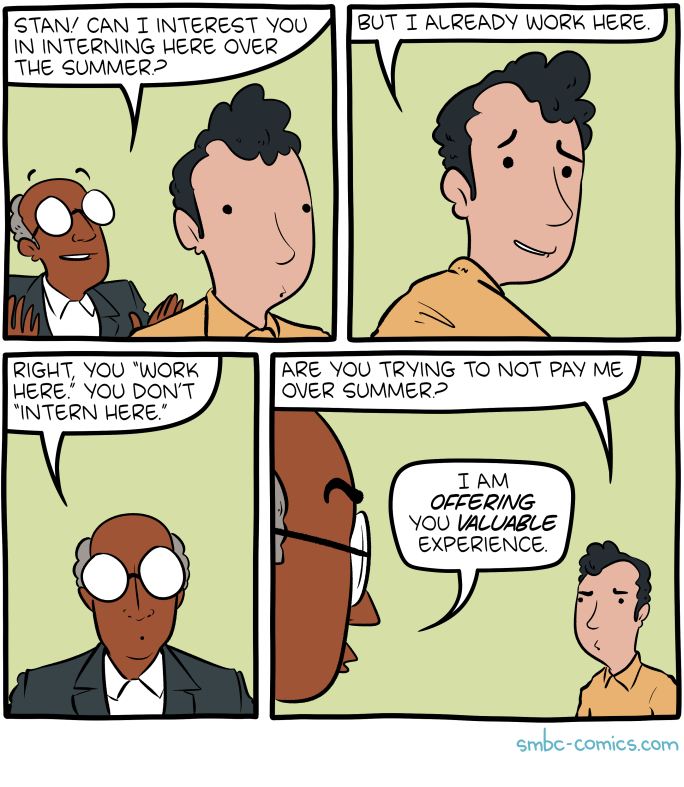
Saturday Morning Breakfast Cereal - Intern

by tech@thehiveworks.com


Click here to go see the bonus panel!

Hovertext:
Also Winter internships are getting locked up, so apply soon!


Today's News:
07 Nov 16:52

Art Class

by Sarah Andersen

null

07 Nov 16:51

The Supreme Court must decide if it loves religious liberty more than the death penalty

by Ian Millhiser
A gurney with multiple straps alone in a small room.
The lethal injection chamber at the Ellis Unit, a maximum security prison in Huntsville, Texas, in 1991. | Paul Harris/Getty Images

A new religion case forces the Supreme Court to confront the legacy of one of its cruelest decisions.

Dunn v. Ray (2019) is the kind of Supreme Court decision that a comic book supervillain might write. Widely denounced, even by prominent conservatives, when it was handed down, Ray held that a Muslim inmate in Alabama could be executed without his imam present — even though the state permitted Christian inmates to have a spiritual adviser present during their execution.

As Justice Elena Kagan wrote in dissent, one of the Constitution’s “clearest command[s]” is that “one religious denomination cannot be officially preferred over another.” But that’s exactly what the Court permitted in Ray.

After witnessing the bipartisan backlash to this decision — the conservative National Review’s David French labeled it a “grave violation of the First Amendment” — the Court eventually started to slink away from it. In Murphy v. Collier (2019), decided only a few months after Ray, the Court temporarily blocked the execution of a Buddhist inmate in Texas — unless that state “permits Murphy’s Buddhist spiritual adviser or another Buddhist reverend of the State’s choosing to accompany Murphy in the execution chamber during the execution.”

Most recently, in Dunn v. Smith (2021) the Court seemed to suggest that all people who are being executed, regardless of their faith, must be allowed to have a spiritual adviser present. Although there was no majority opinion in Smith, even some of the dissenting justices conceded that they’d been beaten. “It seems apparent that States that want to avoid months or years of litigation delays,” Justice Brett Kavanaugh wrote in a brief dissenting opinion, “should figure out a way to allow spiritual advisers into the execution room.”

And yet, while the Court’s treatment of Domineque Ray, the inmate in Ray, appears to be discredited, the Court has yet to tie up several loose ends left over from that decision, including questions about which procedural barriers can be erected between death row inmates and their spiritual advisers, and questions about what such advisers may do to comfort a dying prisoner.

These issues are front and center in Ramirez v. Collier, which will be argued before the justices on Tuesday. Texas permits John Ramirez, the death row inmate at the center of this case, to have his pastor present during his execution. But the state neither permits the pastor to lay hands on Ramirez nor to audibly pray over him.

The fundamental question in Ramirez, in other words, is whether a death row inmate is allowed to actually receive spiritual comfort during his execution — or whether Ramirez’s pastor must simply stand there, doing little to ease a dying man’s final moments.

Ramirez wants this to be a case about religious liberty. Texas wants it to be a case about process.

Federal judges have a ghoulish duty. Whenever an execution draws nigh, judges are inundated with motions from capital defense lawyers trying to save their client’s life — or at least to ensure that the execution is performed as humanely as possible.

Because the Supreme Court is the nation’s court of last resort, many of these disputes eventually reach the justices. And so the justices must contend with a steady stream of emergency death penalty cases, often with only a few hours to review them.

The burden of spending years deciding who lives and who dies weighs differently on different justices. Some proclaim, as Justice Harry Blackmun did a few months before his retirement in 1994, that they “no longer shall tinker with the machinery of death.” Blackmun — and more recently, Justices Ruth Bader Ginsburg and Stephen Breyer — concluded, after decades of hearing last-minute capital appeals, that the death penalty is unconstitutional.

“Factual, legal, and moral error gives us a system that we know must wrongly kill some defendants,” Blackmun wrote.

In Ray, five conservative justices took the polar opposite approach. They attempted to quell the tidal wave of emergency death penalty motions by cutting off many inmates’ ability to file them in the first place. Domineque Ray’s error, these justices claimed, was that he waited too long to bring a lawsuit insisting that his imam be present at his execution.

It was a singularly unpersuasive claim — so unpersuasive that many observers accused the Court of offering a pretextual excuse to deny relief to a Muslim. Ray had filed his lawsuit just five days after a prison warden formally denied Ray’s request to have his imam comfort him during his execution. The Court’s explanation for its decision was quite literally unbelievable.

No doubt with the Court’s decision in Ray in mind, Texas spends the lion’s share of its brief in Ramirez accusing Ramirez of making minor procedural errors that supposedly doom his case. The brief spends an entire subsection, for example, arguing that Ramirez should lose because, when he filed a grievance asking to have his pastor present at his execution, he didn’t specifically state that the pastor should be allowed to speak.

Indeed, Texas spends only about a dozen pages of a 62-page brief arguing that its policy of forbidding a death row inmate’s spiritual adviser from speaking or touching the inmate can be justified under federal civil rights law.

The specific law at issue in this case is the Religious Land Use and Institutionalized Persons Act. It forbids prisons from imposing a “substantial burden” on an inmate’s faith, unless that burden is “in furtherance of a compelling governmental interest” and the prison uses “the least restrictive means of furthering that compelling governmental interest.”

That should be a difficult burden for Texas to carry in this case. Among other things, as Ramirez’s lawyers argue in his brief, until fairly recently, Texas permitted pastors to touch and speak to death row inmates while they were being executed. It even quotes from a book, authored by a former Texas criminal justice official, that recount past executions where chaplains placed their hands on the dying man’s knee. So it’s tough for Texas to argue that its current policy uses the “least restrictive” method of executing inmates, when it used to have a less restrictive policy.

To the extent that Texas even tries to defend its current policy, much of its defense rests on unlikely scenarios that could only occur if Texas’s own death chamber is run by rank incompetents. Texas argues, for example, that Ramirez’s pastor must not be allowed to touch him “in the event the inmate escaped his restraints, smuggled in a weapon, or otherwise became a threat in the chamber.” The fear is that “a spiritual adviser standing close enough to touch the inmate would be in harm’s way or in a position to assist the inmate.”

Texas, in other words, offers only a weak defense of its actual policy. It rests most of its argument on a hope that a majority of the justices will repeat their performance in Ray and rely on a procedural reason to deny Ramirez the relief he seeks.

So how is this case likely to come out?

The case for pessimism, if you are Ramirez’s lawyers, is fairly straightforward. In Smith, only the three liberals, plus conservative Justice Amy Coney Barrett, took a clear position in favor of religious freedom on death row. Roberts, Thomas, and Kavanaugh all dissented. That means that either Justice Samuel Alito or Justice Neil Gorsuch (or maybe both) silently voted in favor of the inmate in Smith.

But Alito and Gorsuch are both die-hard supporters of the death penalty. If you are a capital defense attorney and you are counting on their vote, you’re normally in trouble.

That said, there are also a few reasons for Ramirez’s lawyers to be optimistic that they can secure five votes.

One notable difference between Ramirez and Ray is that Ray arose on the Court’s shadow docket, a mix of emergency motions and other expedited requests that are typically decided in short order without full briefing or oral argument. Ramirez, by contrast, will be heard on the Court’s regular docket and will receive an oral argument.

That distinction matters because the Supreme Court ordinarily reserves full briefing and argument for cases that have either divided lower court judges or that involve unusually important questions of federal law. It’s unlikely that the Court would have agreed to hear Ramirez’s case if it thought that the correct answer turned on a minor procedural error that is unique to just this one case.

Although Smith did not produce a majority opinion, four justices — including Barrett — joined an opinion by Kagan that lays out a possible path forward in Ramirez. Kagan argued that states with restrictive policies governing spiritual advisers can simply adopt the practices used in other states. “In the last year, the Federal Government has conducted more than 10 executions attended by the prisoner’s clergy of choice,” Kagan noted — the implication being that states could copy the federal government’s procedures and do the same.

A state that fears a particular member of the clergy may present a security risk “can do a background check on the minister; it can interview him and his associates [and] it can seek a penalty-backed pledge that he will obey all rules,” Kagan wrote. But it can’t root its policy in speculative fears that a pastor may help an inmate stage a daring escape in the middle of their execution.

So while the outcome of this lawsuit is not entirely certain, Ramirez has good reason to hope that, in his final moments, he will receive spiritual comfort.

07 Nov 02:09

Atlantic Tropical Weather Outlook

by nhcwebmaster@noaa.gov (NHC Webmaster)

000
ABNT20 KNHC 062312
TWOAT

Tropical Weather Outlook
NWS National Hurricane Center Miami FL
800 PM EDT Sat Nov 6 2021

For the North Atlantic...Caribbean Sea and the Gulf of Mexico:

The National Hurricane Center is issuing advisories on Tropical
Storm Wanda, located several hundred miles west of the Azores.

Tropical cyclone formation is not expected during the next 5 days.

$$
Forecaster Reinhart
07 Nov 02:00

Astroworld Festival joins a list of historical concert tragedies

by Rachel Treisman
Flowers rest outside of the canceled Astroworld festival at NRG Park in Houston on Saturday. The crowd surge that killed eight people calls to mind other concerts and music festivals that turned deadly in recent decades.

Astroworld Festival calls to mind other rare but traumatic incidents at concerts and festivals throughout the last half-century. Here's a timeline of those tragedies.

(Image credit: Alex Bierens de Haan/Getty Images)

06 Nov 01:54

Making Film Reveal its Image: the B&W Development Process (Photography Part 2)

by Technology Connections

Developers! Developers! Developers! Developers! Developers!

Links n' stuff:
The previous video:
https://youtu.be/wbbH77rYaa8
That video on why old movies are HD and analog video isn't:
https://youtu.be/rVpABCxiDaU
The video on phosphor dots (oh and you'll notice that the thumbnail I showed on-screen here was actually for the original video that this video was made in response to - so pedants, I know! It was on purpose because it says "These Are Not Pixels." OK now here's the dang link):
https://youtu.be/Ea6tw-gulnQ
Technology Connections on Twitter:
https://twitter.com/TechConnectify
The TC Subreddit
https://www.reddit.com/r/technologyconnections

This channel is supported through viewer contributions on Patreon. Thanks to the generous support of people like you, Technology Connections has remained independent and possible. If you'd like to join the amazing people who've pledged their support, check out the link below. Thank you for your consideration!
https://www.patreon.com/technologyconnections

Oh, and look at these wonderful patrons!
John Feldman, Ted Ledbetter, Tobias Putz, Caytlin Vilbrandt, Alex Rich, Geo (Overand), Nikhill Rao, Robert Fletcher, William PS, Douglas Geusz, Alexane Desbiens, TwoFiftyFare, Bob Frankston, Nick Kourpias, Stateless, Benhart, Douglas JM, Sammy Newton, SeaburyNorton , Zach Berger, Lew Zealand, Shaitageth, Daniel Castonguay, FirenzeFire , Mason DeBord, Jarocks, Nathaniel Robichaud, Benjamin Richards, Chris Brosz, Stewart , Kyle Burton, Jonas Lührig, Woofy, Russell Grant, Dan Simon, cparks1000000 , Kyle, Puffin, false, Patrick B., Ellis , David Glover-Aoki, iPaq , Peter Murray, probnot, Mike West, Philipp Saß, Kenneth Perronne, The Great Geno, mini mac, Kara Durocher, Andrea Seward, Mark Lewin, Victor , Jared Fry, Nathan Bergey, Steve Davis, Keiran Hillcoat, David Lefton, Chris O'Dea, Tyler, Jason and Katie Corradino, Eric Lemar, kyhm , Alex Gartrell, Spencer R, William O'Driscoll, Sam Ellis, Christian Bikle, Christian Czekay, Andrew Backer, Jonathan Tunnell, MiNX6, Forrest P, FrenchSword , Mike, David Green, Marie and Peter, Trevor Rudolph, Kevin Rogers, Ian Greig, Jaye Martindell, UbiquitousChris, Luke Hogan, Brian Alvarez, Alex Berliner, Kevin Marty, Bram , Paul Adamski, David Joubert, Kyle Ward, Anders Madsen, Josh Jones, Chrono , Pietro Gagliardi, Kornel , Becca Roughton, Romans Bajevs, Fernando Martinez, David Carpenter, Steve Martin De Souza, Density, Joseph Shivak, Ben Douglass, Brentton Paulus, Nicholas Bellamy, Noah Kantrowitz, Lauren Nodonly, Jeremy , Paul Schermerhorn, Colleen Dunseath, Tashlin Familiy, Lellius Rose, andritolion, Adi , Christopher Berger, Nathaniel Kren, Simon J, Vamsikrishna Gopikrishna, Chris Dion, RICHARD CROWLEY, EmpiricalFox, Alexander Curtiss, Iain Cuthbertson, Thomas Schenck, Chiroplut, Windows98 , Clark Marx, Sierrajulietalpha, Rambling Nerd, James Cooper, ​, Joe Athman, Stewart Smith, Timothy Conard, Ron A Goldberg, HookerHeels, Jon S., Mike Dean, Matthew Hwong, Kyle Van Essen, Trevin Beattie, Hobie Thompson, Pizzafourlife, Joris Lankhorst, shitpostbotmin, Dennis Hulsman, Justin Kuemerle, Ryan Gordon, Buddy DarDar, Anton M., Steve Washington, Stainless, John F. Woods, Lianne Schroeder, Stuart Young, Logan Hetzel, Sugarschild, Justin Smith, Emerick Touilloux, Preston Chaderton, Kate Bates, William Carpenter, Seren Ward, Tyler Dare, Steve Stuart, Axel Kingsley, Nuck, RangerMankin, Ryan Young, Yuriy Taraday, Michael Kelly, Ruairi P Donaldson

00:00 Intro
01:42 What the emulsion is and how it works
04:53 Preparing the film for development
07:18 A note on developing tank styles and why I prefer plastic tanks
09:16 Loading the 120 film onto the reel
10:42 Developers! Developers! Developers!
12:24 Stand development
15:22 The development process
18:20 Fixer
20:39 Rinsing and Photo-flo
21:53 A Mishap
22:50 Image reveal
23:33 A viewing trick
24:12 Outro, credits, & bloopers
06 Nov 01:54

Call For Yellowstone Beta Testers

by Steve

Here we go! Beta testing kicks off today for the Yellowstone universal disk controller for Apple II. Yellowstone is a replacement for the Liron disk controller, the Apple 3.5 disk controller, and the standard Disk II controller, all rolled into one. It even handles Macintosh disk drives. After a soldering marathon this week, I now have five working Yellowstone boards and three working Yellowstone testers. All the testers work with all the boards. The ducks are finally in a row. Let’s do this.

Before jumping into beta testing specifics, some readers may be curious to know how the Yellowstone tester turned out. The goal of the tester is to program and verify a newly-assembled Yellowstone board, as quickly and easily as possible, without requiring any other equipment. The tester development proved to be a major project in its own right, and occupied most of my available time for the past couple of months, but I’m happy to say it’s finally working. Here’s a video demonstrating the tester operation:

 
Calling Beta Testers

I need your help! I’ve tested the hell out of Yellowstone, but I won’t be truly confident it’s ready until it’s passed through other people’s hands, with other types of computers and disk drives, and other software environments. That’s where you come in.

The ideal Yellowstone beta tester will have:

  • at least 5-10 hours available for testing in the next two weeks
  • a personality that enjoys making lists, spreadsheets, and similar record-keeping
  • a variety of Apple II computers and disk drives, especially an Apple II+, Duo Disk, Unidisk 5.25, Apple SuperDrive (FDHD Drive G7287), third-party 3.5 inch drives from Applied Engineering / Chinon / Laser / American Micro Research, and CPU accelerator cards.

I need to be slightly picky about who gets these beta cards, since I only have a few of them. The cards should go to people who are in the best position to help with testing, either by virtue of the hardware they have or the energy they’re willing to put into methodical testing. If this appeals to you, please get in touch with me using the Contact link at upper-right of the page, and let’s talk! If you’re more interested in Yellowstone for personal use and you aren’t sure you’ll have time or energy for beta testing, you’ll have an opportunity to get one soon when they become generally available.

 
What You’ll Get

The draft instruction manual for Yellowstone offers a good overview of its capabilities. In brief, any type of Apple II or Macintosh floppy drive from the 1970s – 1990s should work with Yellowstone, as well as intelligent Smartport-based hard disks such as Floppy Emu’s Smartport HD emulation mode. It supports two drives of different types connected at the same time, or up to five drives for intelligent Smartport devices. Drives with 19-pin D-SUB DB-19 connectors and 20-pin rectangular connectors are both supported.

For the beta testers, I will also be including a pair of DB-19 female adapters. These will probably be a separate accessory when Yellowstone goes on sale, since not everyone will need them, and the DB-19 female connectors are rare and somewhat expensive. You’ll need these DB-19F adapters when connecting drives like the Duo Disk, Apple 3.5, or Macintosh M0131. The adapters aren’t needed when connecting a Floppy Emu, a Disk II, or internal / bare drive mechanisms using a ribbon cable with a 20-pin rectangular connector. The wiring of the DB-19F adapters is designed only for use with Yellowstone, so don’t try to connect them anywhere else.

I think that’s everything, and I’m very excited to be launching the Yellowstone beta today. Thanks in advance for your help, and don’t hesitate to contact me if you’re interested in being a beta tester.

06 Nov 00:52

Snack

Although grad students, suddenly reminded that food exists, tend to just grab and devour both without further discussion.
05 Nov 21:02

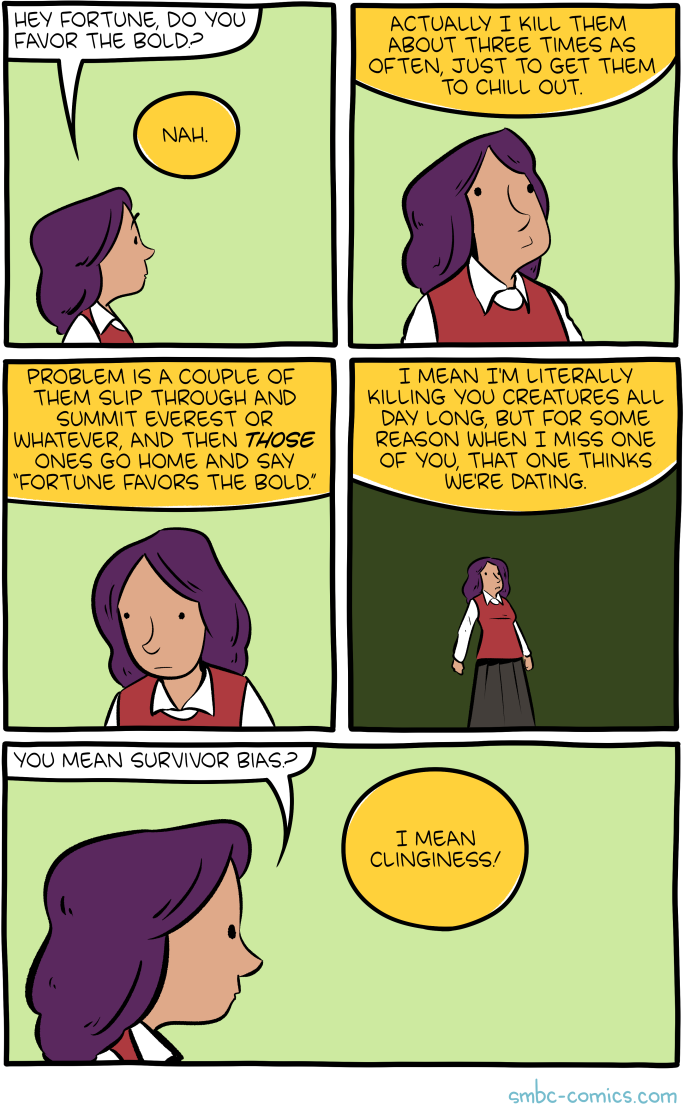
Saturday Morning Breakfast Cereal - Fortune

by tech@thehiveworks.com


Click here to go see the bonus panel!

Hovertext:
To be featured in my forthcoming book, SMBC Yells At Disembodied Concepts.


Today's News:
05 Nov 20:09

The mighty food processor

by Mary Kelly

food processor cookbook

Better Homes and Gardens
Food Processor Cookbook
1979

I plucked this from a local library and it was in such good condition. Given the 1979 publication date, I immediately became suspicious. The book is over 40 years old and it looks this good? That might mean no one was interested in it from the get-go. The pictures were pretty crisp and the recipes were just meh. Be sure to check out the recipes for Chilled Chicken Loaf and Glazed Ham Balls. Other than coleslaw type recipes or maybe making things like breadcrumbs, having a food processor wasn’t necessary to some of the recipes.

Food processors were the “it” appliance in the 1970s and were shockingly expensive compared to other kitchen electronics. I didn’t see them as a regular part of kitchens until the 1980s. The go-to brand was Cuisinart. (Click for an article from Bon Appetit about Cuisinart’s origin.) I finally broke down and bought a food processor in the 1990s thinking it would be fabulous to have thin sliced potatoes for certain family recipes. Since I am no real cook, this appliance gets used maybe once or twice a year.

I think like Instant Pot, this was probably a great choice as food processors became more mainstream. I am not sure that in 2021 this has the same level of interest as it did in the 70s and 80s. We shall see if Instant Pot has the staying power.

Mary

salads

vegetables

main dishes

recipes


The post The mighty food processor appeared first on Awful Library Books.

05 Nov 20:07

Say Bye

by Reza
05 Nov 20:03

Pics of the Day

by noreply@blogger.com (Jason Adams)

The past year or so has seen Lee Pace finally come into his own, comfortable enough in his own (golden) (glistening) (taut) skin to start thirst-trapping our asses like nobody's business. I wonder if part of it was having to run starkers across a stage for hundreds of people a night in Angels in America? (Was there, can confirm it ruled.) Or maybe finally coming out flipped a switch, or possibly being in a relationship he can actually have publicly, or maybe it was just the fact that he had to get into such insane shape for this Foundation role of his  (you can trace it right back to that shirtless boat- snap heard round the gay world in October of 2018) -- whatever it was, we're happy for him, and happy for ourselves in the process. Which brings us to these photos from the set of Foundation that Lee shared with Variety today -- he's giving the people what they want! Hit the jump for several more (and prepare to hit your zoom buttons on a few of these)...


05 Nov 17:41

Install your own phone!

by Mary Kelly

Chilton guide to telephone installation

Chilton’s Guide to Telephone Installation and Repair
Martin
1985

In the old days, the phone were the “property” of Ma Bell (aka the phone giant AT&T).  After lengthy anti trust case, AT&T was split into the “baby bells” and phone service changed for most consumers. People had to buy or rent phones and arrange for installation. Cellular phones were still not common until the late 1980s, and they were expensive. This would have been a good purchase for a public library back in the day, but I doubt would get much action these days. It’s an obvious weed, so I will add a link to Lily Tomlin’s Ernestine that originated on Rowan and Martin’s Laugh-In. (An awesome show.) This clip is when Ernestine calls General Motors.

Enjoy!

Mary

back cover

local network

telephone services

telephone services

diagram

The post Install your own phone! appeared first on Awful Library Books.

05 Nov 17:30

Open Source Doesn't Mean More Software Is Better Software

by Noam Cohen
The battle between Mastodon and Trump’s Truth Social is a reminder that while the internet has changed, the ideals of free software haven't. That's a problem.
05 Nov 17:16

Internet Archive Would Like To Know What The Association Of American Publishers Is Hiding

by Mike Masnick

Last year when a bunch of the biggest publishing houses sued the Internet Archive, in the midst of a pandemic, over their digital library program, I was a bit surprised that the announcement about the lawsuit came not from any of the publishers themselves directly, but rather from the Association of American Publishers (AAP), which is officially not a party in the lawsuit. That alone felt a bit... sketchy.

And, now it may be an issue in the lawsuit itself. Last week, the Internet Archive asked the judge for a hearing because the AAP is attempting to withhold various responsive documents on the discovery requests that were made to the publishers themselves regarding their communications with the AAP, and a separate subpoena served on the AAP. And it appears the AAP really doesn't want that stuff to get into the hands of the Internet Archive's legal team.

This dispute concerns documents (i) responsive to the Internet Archive’s requests for production served on Plaintiffs and (ii) responsive to the Internet Archive’s subpoena served on the AAP. These withheld documents are critical to the Internet Archive’s fair use defense—specifically the fourth factor, market harm. The varying views of publishers regarding whether they objected to the Internet Archive’s activities, whether they regarded themselves as having been harmed by those activities, and whether that harm was of a large or of a small magnitude are key pieces of evidence as to whether Internet Archive’s nonprofit library lending causes any substantial market harm.

There's also a hint in the letter suggesting that the Internet Archive is suggesting that the only real "harm" caused by its Open Library was that it made it more difficult for the big publishers to collude (as they did with Apple regarding ebook prices) to jack up the prices on ebooks sold (but not really sold) to libraries.

And publishers’ communications regarding the source of that harm—for example, if the Internet Archive’s activities simply make it more difficult for publishers to agree among themselves on ebook prices, as they did in United States v. Apple, Inc., 791 F.3d 290 (2d Cir. 2015)—will shed light on whether that harm is cognizable under the fourth factor. Further, the Internet Archive is entitled to explore whether Plaintiffs and other publishers conspired here as they did in the Apple case; if so, such anticompetitive conduct here may support an additional defense which could preclude infringement liability. See Saks Inc. v. Attachmate Corp., No. 14-civ-4902-CM, 2015 WL 1841136, at *12 (S.D.N.Y. Apr. 17, 2015) (“[H]istorically, the defense of copyright misuse has been successfully asserted most often in cases where anticompetitive effects were alleged.”). Finally, withheld documents are likely to be relevant to the Internet Archive’s laches defense. The requested documents will shed light onto why the AAP (and Plaintiffs), despite being aware for years of the Internet Archive’s digital lending library, waited until the summer of 2020 to sue.

The AAP is trying to argue that its communications with the publishers is protected by attorney-client privilege, which is made difficult by the fact that the AAP is not acting as the publishers' lawyers here, but rather as lobbyists.

Plaintiffs have not demonstrated beyond conclusory statements in their privilege logs that communications with the AAP were exchanged to solicit, receive, or give legal advice rather than to discuss business concerns and interests....

.... One of Plaintiffs’ justifications for withholding their communications with the AAP is that some AAP staff members are attorneys. But AAP employees who happen to be attorneys wear many hats. For example, the President and CEO of the AAP is also a lawyer, as is AAP’s Senior Vice President of Global Policy. While it is conceivable that these executives do legal work for the organization, the burden is on AAP to justify why particular documents are privileged, given these executives’ predominant business roles.

Also, generally speaking, if documents are attorney-client privileged, it means you don't share it with anyone who is not on the legal team. But, that's not what happened here:

Plaintiffs’ privilege logs also suggest that AAP employees who were not attorneys were copied on withheld documents, including communications staff—which suggests that the predominant purpose of the document may not have been to secure legal advice. United States v. IBM Corp., 66 F.R.D. 206, 213 (S.D.N.Y. 1974) (“no protection attaches to a document prepared for simultaneous review by legal and nonlegal personnel.”). Finally, several entries on Plaintiffs’ privilege logs reference communications either (i) solely between non-party third parties or (ii) between Plaintiffs and third parties (like authors and literary agents). Plaintiffs have not met their burden to show that privilege extends to any of these third parties.

There's some more in the letter, but it does seem pretty clear that the AAP desperately doesn't want the Internet Archive to know what it was talking about with the publishers regarding the plans around dealing with the Open Library.

04 Nov 11:33

Comic for 2021.11.03

New Cyanide and Happiness Comic
04 Nov 11:29

GLOOMY KID BLUES!

by noreply@blogger.com (JerryMaguire)