Shared posts

19 May 15:04

Old, New, and Back Again: What’s in a Map?

by Allison Marino

Note: This is the winning essay of the 2022 Central Texas Glasstire Art Writing Prize.

It took me a long time to start thinking about maps as art objects. While I was learning about maps in art history classes and looking at pictures of them in articles published by art historians, I was more focused on ideas around cartographic history, so my understanding of them was clouded. What were maps about, if not precision, scientific and mathematical accuracy, and objectivity? Art is the opposite — subjective, rife with interpretative possibilities. The last “subjective” interpretation I had of a map was from the passenger seat of my mom’s car during our road trip from Florida to Texas in the summer of 2020. My “creative interpretation” of Apple Maps is what had led us to where we were: an hour’s drive off of our intended highway route.

Slowly but surely — two seminar papers and an undergraduate thesis later, to be exact — I warmed to the idea that, for most of history, the functionality of maps was not foremost about getting people where they needed to go. The contemporary blinders that I wore limited my understanding of maps as complex works of art that served varied purposes to different people and cultures throughout history. They also shackled me to a Eurocentric mindset that saw topographic objectivity and mapping as inherently linked.

A 16th century, hand-drawn map of the town of Epazoyuca. The map is an aerial view, featuring a church-shaped building at the center, and other rectangular buildings surrounding it

Map of Epazoyuca, from the “Relación de Epazoyuca,” 1580

When it came time for me to choose a topic for my master’s thesis, I became fascinated by the body of maps included in the Relaciónes geográphicas, a group of texts produced in the late-sixteenth century in response to a survey distributed by the Spanish crown. In line with King Philip II’s campaign to map (and consequently solidify Spain’s influence over) its newly, violently acquired territories, his royal cosmographer, Juan López de Velasco, sent a 50-question survey across the Atlantic to Spanish officials in the so-called “New World.” Respondents were asked for information about the foundational history, natural history, and resources of the respective cities they inhabited. Their responses conveyed the sheer awe with which they viewed these Native cities, their peoples, and governments.

From an art lover’s perspective, the most striking part of most of these texts was the intricately detailed, hand-painted maps included therein. These maps, a vast majority of which were produced by Native artists, vary greatly in terms of style and information conveyed. Some, like the map from the Relación de Epazoyuca (c. 1580), show the city in relation to its bountiful local flora. Others, like an image of Cholula from the Relación of 1581, emphasize the dual presence of Native and Spanish spiritual customs in the city — churches stand alongside a massive temple complex near the top right, named on the map in Nahuatl: “Tlachihualtepetl.” 

A 16th century, hand-drawn map of the town of Cholula. The map is an aerial view, featuring detailed drawings of multiple churches, and crudely drawn versions of other buildings.

Map of Cholula, from the “Relación de Cholula,” 1581

Despite the distinct beauty individual to each and every last one of these maps, no image intrigued me quite like the approximately seven-inch circular map included in the Relación de Teozacoalco y Amoltepec (1580). Contained inside the delicately drawn boundaries of this circle are a plethora of symbols that stem from the Native pictorial tradition and represent the history and geography of the towns depicted. Teozacoalco, the cabecera (or the “head town”; the administrative center) of this specific Spanish region is represented to the left of the circle by the two larger buildings with crosses at their peaks — one, a church; the other, a cabildo, or meeting house for officials. Surrounding these buildings, the thirteen smaller churches represent Teozacoalco’s estancias (dependencies or estates). In maps produced in and of cities of New Spain, churches were the established symbols of townships. The “agreement” between the maps’ elite Native painters, patrons, and officials who approved their distribution was that, so long as churches were somehow incorporated, the painter could depict his city however he wished. 

Like many others, the painter of this map chose to show not only the natural landscape of his city — its mountains, rivers, trees and plants (like the flowers and cacti decorating its circular borders), but also its history and social relationships. Pairs of humans, drawn facing one another in vertical columns both inside the circle and proceeding towards the left of the page, represent the royal couples central to the mythology and genealogy of Teozacoalco’s foundation.

Inhabitants of different roles and social status walk Teozacoalco’s borders on the map. Animals, like snakes and birds, trod alongside them. This aspect of the map is my favorite. The painter conveys his appreciation of his environment by emphasizing the coexistence and mutually dependent relationships of humans, flora, and fauna. The map’s artist strives not only to depict his city, but also to celebrate the cyclical relationship that allows it to exist. What the earth provides for humans, humans respect, appreciate, and care for, and thus give back to the earth.

A 16th century map depicting the town of Teozacoalco. The map is circular and intricately drawn fearuring many small figures and lines.

Map of Teozacoalco from the “Relación de Teozacoalco y Amoltepec,” 1580

The prompt for this Art Writing Prize asked me to consider a work of art that I love, and why. It may come across a bit tongue-in-cheek that I decided to write about a work I discovered through my own academic research. There’s a bit more to it, however. When people ask me why I love art history, I tell them that, more than anything, I’m thankful for it. Studying the objects of so many different people, cultures, and periods has changed my entire worldview. I can’t read the news without thinking about how what I’m reading is so eerily similar to something that’s happened before. I must consider the central role that cultural politics and cultural heritage play in shaping rhetoric around current events. And now, I can’t look at a map without thinking about the ones that came before it. The functionality and appearance of these daily tools has changed so much over time — getting someone from point A to point B is only one of the many purposes maps have served throughout history.

And so, I write about the map of Teozacoalco not for brownie points, but because it’s representative of how, through art history, something as commonplace as Apple Maps has taken on new meaning for me. And of course, this essay merely scratches the surface of what the Teozacoalco map, and the sixty-eight other maps included in the Relaciónes geográphicas, offer. I implore you to keep exploring them, as they have so much to give.

The thick blue and red lines running across the map of Teozacoalco represent the rivers and trails that people traveled to form and sustain the city. If you take a closer look, you can see a trail of footprints* lining them. The alternating steps of man and horse, markers of the reciprocity between humans and the earth, are forever imprinted in the landscape by the map’s painter. Looking at the image, you might consider the footprints that you leave behind as you traverse the landscape of your daily life.

And, as you do, you might consider how they honor the ones that came before.


*The term “trail of footprints” comes from the title of Alex Hidalgo’s book, Trail of Footprints: A History of Indigenous Maps from Viceregal Mexico (Austin: The University of Texas Press, 2019).

The post Old, New, and Back Again: What’s in a Map? appeared first on Glasstire.

19 May 14:58

How the burrito became a sandwich (Classic)

A sandwich is generally defined as something delicious slapped between two slices of bread. New York tax code would beg to differ. | Subscribe to our weekly newsletter here.
19 May 14:58

Canonical is Recruiting Devs for ‘Ubuntu Gaming’ Team

by Joey Sneddon

unsplash gaming laptop pictureAnyone remember Ubuntu Gamer? It was a spin-off blog we launched way before Steam for Linux was a thing. Oops! But hey, here's something related…

This post, Canonical is Recruiting Devs for ‘Ubuntu Gaming’ Team is from OMG! Ubuntu!. Do not reproduce elsewhere without permission.

19 May 12:54

religious decor in a shared work space, yoga pants at a team-building event, and more

by Ask a Manager

This post, religious decor in a shared work space, yoga pants at a team-building event, and more , was originally published by Alison Green on Ask a Manager.

It’s five answers to five questions. Here we go…

1. Religious decor in a shared work space

I share an office with the rest of my small team — one coworker and our supervisor. Due to the nature of our work, even when all three of us are working at the same time, we are rarely in this shared office together (if at all), so one desk/computer is enough for us to function just fine.

However, someone has put up some religious decor here and there, and it makes me kind of uncomfortable. It’s nothing outrageous — think a bible verse taped to the monitor, for one example — but I have a pretty negative personal history with religion, Christianity in particular. I don’t begrudge anyone else their beliefs! But the constant reminders of those negative experiences staring me in the face while I’m trying to work are frustrating at the best of times.

To complicate things, I’m almost positive it was my supervisor who put up these things. I have a good relationship with both her and my teammate, but in conversation, my teammate has explicitly mentioned that she isn’t religious, so that just leaves our boss.

I’m worried that I’m overreacting to the situation. Should I let this go? Or can I say something? How do you bring up something like this with regards to a shared space without damaging an otherwise great team relationship?

You’re not overreacting. Someone put religious decor on your computer! It’s their computer too, yes, but when you share space and equipment like that, you need to be considerate of the people you’re sharing it with; generally that means not taping up bible verses directly on the computer they will be using (which is much more in your face than, say, something on a shared wall would be).

Legally speaking, employers can prohibit or allow religious decor in employees’ personal work areas (they just can’t allow it for some religions but not for others), but I haven’t been able to find anything addressing religious decor in a shared work space like yours. My hunch is that if you were to go to HR about this, your right not to have religious items unavoidably in your face while you work would trump your boss’s interest in having them there.

But it doesn’t sound like you’re looking for an HR or legal solution (at least not at this stage). So one option is to just try moving the items to a less central location so they’re not so in your face. That might be all it takes. Otherwise, though, would you be comfortable saying to your boss, “Would you mind if I move these religious items to a different spot?” Or even just, “By the way, I moved the bible verse and cross to the other side of the room so they weren’t at the shared computer.” A reasonable person will not bristle at this. But if your boss is an unreasonable person, you might want to try getting your coworker to join you in speaking up (so your boss can’t single out just one of you) or skip her entirely and ask HR to handle it.

2. My new boss is sending me tons of work emails before I’ve started

I have a question as I transition from one job to another. I’m in K-12 education, so though I’ve accepted a new job for the next school year, officially beginning on July 1, I am still finishing out my very high-stress current position until mid-June (so way longer than your typical two weeks, but not uncommon for education).

Though I don’t start the new job for seven more weeks, I have started to receive emails from my new boss inviting me to meetings and looping me in on projects that will be a part of my job description once I start. Though this information is important, and i will need to know what happens in these meetings, I don’t work there yet. And I don’t have the capacity to attend these meetings and consider these projects while still working my current job.

I don’t want to get off on the wrong foot with my new workplace, so do you have any suggestions for a script that will express to my new manager that though I am excited to get started on this work soon, I can’t do it until A) I wrap up with my old job and B) I actually start getting paid by my new job? Everything I can come up with sounds snarky since what they’re asking of me is so unreasonable, and I don’t want to release the snark this early on.

Say this: “I’m not sure if you were hoping I’d attend any of these meetings or respond about projects before I start. Realistically I won’t be able to give them any attention until I start — my current job is going to be really busy for the remainder of my time here. Is there a way to send them to my new email address there so that they’re all available to me when I begin work?”

If they can’t do that (which could be the case if your new email isn’t set up yet), you can put the messages in a folder yourself and not deal with them until you start.

It’s possible that your new boss isn’t sending you this stuff because she hopes you’ll deal with it now but just thinks she’s keeping you in the loop about things that will affect you once you do begin. Or who knows, maybe she does think you’ll deal with it now (which would be wildly unreasonable). But saying the above should clear it up.

3. Are yoga pants too revealing for an athletic work event?

I have a corporate team-building day coming up next week, and it was just announced that the event will involve physical activity and we should come in athletic attire. Putting aside my feelings on athletic team-building events (I have your scripts for how to suggest a more inclusive activity for next time), I’m panicked about what to wear. All of my athletic bottoms are yoga pants, and while I generally feel comfortable wearing yoga pants in my day to day life, I tend to dress pretty conservatively at the office, so it feels different to be dressed that way around coworkers.

Is it appropriate for me to wear yoga pants to this event or should I wear something less form-fitting like hiking pants or sweats, which may be less comfortable if the planned activities are intense? If it makes a difference, I’m one of the youngest members of my group and a woman.

I don’t think yoga pants are inappropriate when you’ve specifically been told to come in athletic attire and if you want to wear them … but it depends on whether you’ll be comfortable or not. If you think there’s even a chance you might feel self-conscious, go for sweats instead.

4. Interviewer scheduled a phone call with me but never called

A job I applied for reached out to me asking when I was available for a 30-minute call to discuss the role. They selected a time at the very end of the block of availability I gave, and then never called me. I double checked that we were on the same page regarding time zones and I know there’s not a problem with my phone because I had a phone call with a different company later the same day, and I confirmed my number when we confirmed a time.

I waited until the end of our scheduled time, then sent an email saying, “Did you run into any issues calling me today? I was expecting your call at [TIME] EST but did not hear from you, and I don’t see any missed calls on my phone.”

I don’t have this person’s phone number, so I couldn’t call them myself. I don’t know if they were running late but knew I wouldn’t be available later, or if something happened. Was this the appropriate response? I still haven’t heard from them, and I’m just left wondering.

Your response was fine. You could have added, “I’m still interested in the role and would like to reschedule if that makes sense on your side” … but if they do want to reschedule, they’re likely to let you know that whether you explicitly invite it or not.

Unfortunately employers flake on phone interviews all the time — sometimes reappearing later and sometimes not. It’s rude, but there’s not much you can do about it.

5. Paying back PTO if you leave with your balance in the red

Something came up when I was talking about work with friends and they insist that paying back an employer for PTO/parental leave when you quit is a common standard. I had never come across this, but was wondering if I was lucky, if this is common in certain industries, or if they are wrong.

Both of my friends work in different mid-size companies in a state with very few worker protections. At their companies, you accrue PTO quarterly but it appears in their system as all available to you at the start of the year. If you take more than what you’ve accrued and then quit, you have to write a check to the company to pay them back for that PTO. If you take parental leave and then quit within six months of returning from leave, you also have to pay back the company for your parental leave. At least one employee had to write a check for over $1,000 for using PTO that hadn’t accrued and then quitting before it would have accrued.

I was shocked. I said I would assume the company would just write it off as a loss. Whenever I have worked someplace where PTO accrued by pay period/quarter, it was very clear if you were trying to use PTO that hadn’t been accrued yet (extra manager approval, limit on the amount you could borrow, etc). And I’ve never heard of paying parental leave back (plus, at places I’ve worked that offered paid parental leave it was mostly funded by the short term disability benefit offered by the employer, so sending my employer a check for the pay that was covered through insurance confuses me). Is this common? Or do my friends just work for two separate, really off-base companies?

It’s pretty common.

It’s not unusual to see policies that require you to pay some or all parental leave pay if you don’t return to work once your leave is over (and health insurance premiums for that period too). It’s less common to see that extended for six months after you return, but not unheard of (although they can’t include insurance premiums in that if you return for 30 days or more). With the exception of a few state laws, companies aren’t obligated to offer any paid parental leave in the U.S., so they can put whatever stipulations on it that they want.

It’s also not unusual to require employees to pay back PTO if they use more than they’ve accrued and leave before their balance gets out of the red. Advancing PTO to an employee before it’s accrued is basically treated like a loan that can be required to be paid back when the person leaves, and generally that’s done by deducting the amount from the person’s final paycheck (although the logistics of that can depend on state law).

19 May 12:51

Recent Report from IFLA: How well did copyright laws serve libraries during COVID-19?

by Lila Bailey

The short answer to this question from a report recently published by IFLA appears to be: not very well at all. The report documents a worldwide survey of 114 libraries, 83% of which said they had copyright-related challenges providing materials during pandemic-related facility closures. The report also provides direct quotes from a series of interviews of library professionals, discussing the challenges they faced and often how difficult digital access to necessary materials such as textbooks has been throughout the last two years. As one librarian from the United States explains:

Times were tough. We were scrambling and worried about so many things – including the health and safety of our students, faculty and colleagues – and trying to spin up as much as possible in the way of service. There are certainly some vendors that we personally like the interactions with, but it felt to me like the publishers saw this as an opportunity just to make more money and not really an opportunity to build stronger connections with us and our library. They offered free things for a very limited period of time.

The report is well worth reading in its 22-page entirety. You can find it here.

The post Recent Report from IFLA: How well did copyright laws serve libraries during COVID-19? appeared first on Internet Archive Blogs.

19 May 12:49

I Regret to Inform You That I Can Get Pregnant with My Legs Closed

by Sarah Hutto

In light of multiple strangers repeatedly telling me, “keep your legs closed,” I’d like to avoid further embarrassment by explaining that I can, in fact, get pregnant with my legs closed.

Shockingly, a woman’s legs are not metal appendages that open and close like steel gates to a cattle pen. Thanks to your parents storming PTA meetings to ensure your lack of sexual education, you remain clueless when it comes to sex and continue to spread the rampant myth that if women keep their legs closed, they cannot get pregnant.

By simply bending over—you know, just like you do when reaching down to pick up your TV-ordered tactical military sunglasses that fell off during your last Call of Duty tantrum—a slut like me can indeed have sex with their legs closed. That’s right, a sex partner with a good attitude and a fundamental understanding of physics can still get their dick in there. A person who has had sex in more than just the missionary position would know that, but, strangely, you seem as committed to poor anatomical understanding as someone trying to work their way through a tattered deli punchcard to get to the free terrible sandwich at the end. How ironic that “close your legs”—a retort born of sexual myth—only highlights your epic ignorance of anatomy and sex.

Astonishingly, this closed-legs sexual witchcraft can be practiced not only while standing, but also while laying down, a position those of us who’ve actually gotten laid like to call “spooning.” It’s hard to imagine a fully grown adult admitting ignorance of this basic sexual position, itself a confession of never having spooned, nor been spooned. No wonder you’re so upset.

Other things us tramps can do with our legs closed are: drive cars, vote, and write comedy pieces about your sad, under-spooned, misinformed ass.

You know that cliche joke about not being able to find the clitoris? You can completely ignore that one—it’s not for you. If you don’t know about women getting pregnant with their legs closed, then you are a million lightyears from ever finding the clit. You still require lessons on how to get inside a vagina, even after its owner has willingly bent over in front of you, guiding the way with signal flares and those inflatable car dealership thingies.

So maybe leave the hypothetical pregnancy discourse to those of us who can actually, you know, fathom how it occurs in the first place, not to mention know which hole we pee out of.

Instead of “close your legs,” a more accurate phrase might be, “you’ve revealed the invalidity of my very flimsy argument about preserving life, and that I actually need more women to get trapped by unplanned pregnancies because I cannot compete with them for jobs, due to my mediocrity.” So much simpler.

19 May 12:48

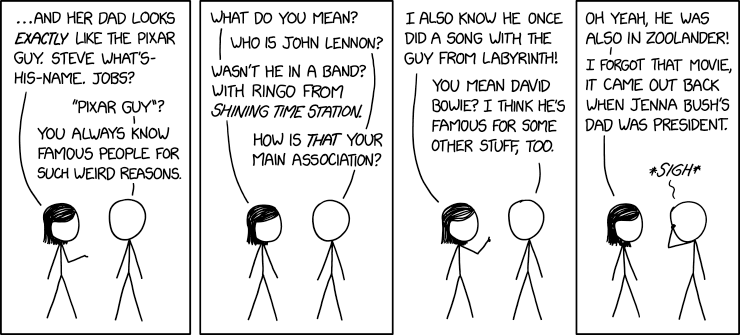
Mainly Known For

Oh sure, I know Keira Knightly, from the first movie in that series by The Land Before Time producer. You know, the franchise with the guy from Jurassic Park and Ghostwriter, and script work by Billie Lourd's mom?
18 May 19:09

can I ask a company to speed up their hiring process?

by Ask a Manager

This post, can I ask a company to speed up their hiring process? , was originally published by Alison Green on Ask a Manager.

A reader writes:

I am interviewing with several companies, two of which I really like. Company A, I interviewed twice already, and they’ve been very responsive to my emails and thank-you notes. They also reached out to me without me emailing them first and told me there’s been a delay in hiring but they will update me soon. They have reposted the job again but continue to keep in contact with me, so I am unsure what is going on.

Company B, I interviewed for recently and it went well, and both the internal recruiter and the hiring manager replied to my thank-you notes. However, Company B’s timeline is four to six weeks, with a second interview in two weeks. I cannot wait this long and I will continue to apply for other jobs because I will be unemployed soon due to my contract at my current job ending. Both companies know my contract is ending very soon.

Is there a way to ask both companies to somehow speed up the process and make a decision without me ruining my chances?

Not really.

If you had an offer from Company A or B, at that point you could reach out to the other company and say something like, “I want to let you know that I have another offer that I need to respond to by Friday. I’m really interested in working with you though, so I wanted to check and see if you might be able to have a decision by then.” If they’re really interested in you, they might be willing to expedite things. That’s not guaranteed; even if they’re interested in hiring you, they might not be interested enough to short-circuit their process with other candidates, or they might have internal hiring processes they’re bound by. But it’s a reasonable thing to ask, and it’s definitely a thing that happens.

But without another offer that’s about to take you off the market, you can’t really ask them to speed up their process. That’s basically just saying, “I need a job soon, can you hurry up?” and that’s not really a thing that’s ever done or that would be compelling to them.

When a company is willing to expedite its process, it’s because the candidate is about to become unavailable to them if they don’t (because they’re on the verge of accepting another offer). They’re acting in their own interests to hire their top choice; they’re making the calculation that it’s worth it to them to forego other interviews, or bother the decision-maker on vacation, or juggle whatever they need to juggle to make a faster decision. You’d be asking them to speed things up because it would be in your interests, and it just doesn’t work that way.

You might read this and think, “Well, if I can use another offer to get them to move faster, couldn’t I just say I have another offer even if I don’t?” But it’s a bad idea. Aside from the issue with lying itself, you risk hearing, “We can’t meet that deadline so you should take the other job and best of luck with it” and then being removed from the running. (In theory you could come back later and say you decided not to take the other job so would like to remain a candidate, but then you look like you were probably bluffing and that’s a big strike against you.)

Unfortunately, employers move at the speed they move at. It might be because they’re slow and indecisive, but there can also be good reason for it, like questions about the role that need to be ironed out before they hire, or a pending potential reorg of the team, or a last-minute internal candidate, or all sorts of things. The best thing you can do is exactly what you’d do if these jobs rejected you or didn’t exist at all: keep applying to other places. If they come back to you with an offer, great. If they don’t, you won’t have slowed down on their account.

18 May 19:05

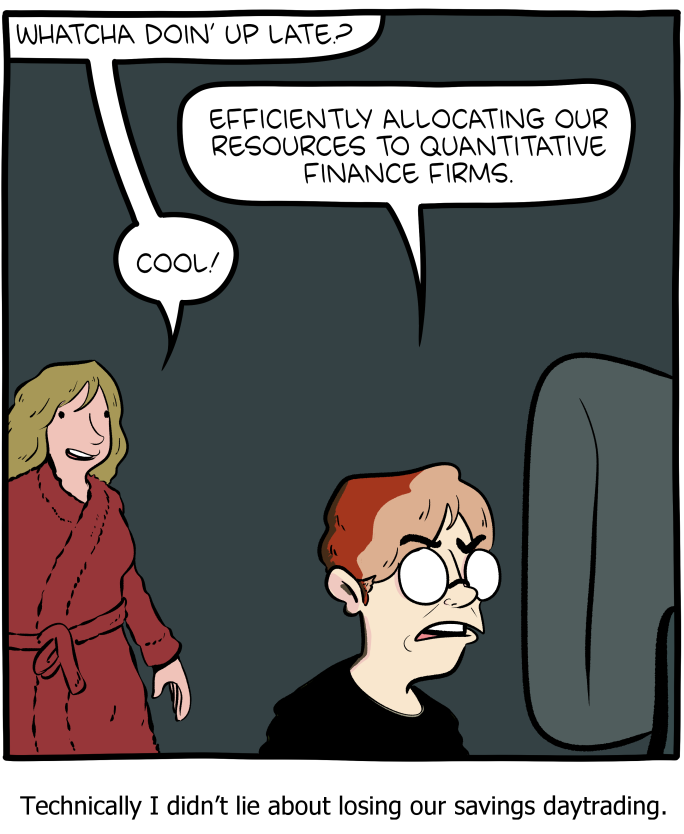
Saturday Morning Breakfast Cereal - Efficient

by tech@thehiveworks.com


Click here to go see the bonus panel!

Hovertext:
If you play long enough, it's not a bet, since the outcome is certain.


Today's News:
18 May 17:38

our boss is demanding a gift with an accounting of names and how much each person contributed

by Ask a Manager

This post, our boss is demanding a gift with an accounting of names and how much each person contributed , was originally published by Alison Green on Ask a Manager.

A reader writes:

Our boss informed us that she’s leaving for a new position at another company. Hooray for the boss, and hooray for us because the boss was truly awful.

Here’s where things get icky: the company is throwing her a farewell party. Everyone has been invited to make a financial contribution to a farewell gift for her. She forces her assistant to organize the gift and share with her the names of those who gave money and the amounts they gave. (Her assistant can’t afford to lose her job.) This has happened before (think major happy life events) and each time everyone has given increasing/outrageous sums of money towards gifts for her, realizing that she received an accounting of who has given what amount.

For many, our generosity is driven by fear because she is an unpredictable, chaotic, and vindictive human being who has inflicted unnecessary suffering upon all below her. She also happens to be in an extremely high ranking position at our teapot company. Her yearly salary is 10 or 15 times higher than most of ours.

The farewell party is six weeks before her planned last day on the job. What happens during those six weeks? She does our performance reviews! This seems like the last in a long string of unfair setups and indignities we’ve been subjected to under her reign. We’ve already given money toward gifts for all the other life events she’s celebrated in the past. Asking us to pay more money for a going away gift seems gauche, especially since a) she is a terrible boss who did nothing but make everyone miserable, and b) compared to her obvious wealth, our monetary “donations” to her come at a substantial cost to our pocketbooks that far outpaces the difference in our pay. The idea of her parting shot being unfair performance reviews deflated or inflated depending on how much we pony up for her gift makes me ill.

We do have HR but it functions purely to protect the company, not the workers. Because this is a high ranking person, we expect HR will shield her and exact retribution on anyone who asks for their assistance with this matter. What should we do?

Well, this is profoundly messed up. There should never be pressure on employees to donate money to anything and especially not upward to a manager. When someone controls your paycheck and whether you continue to have a job, it ranges from tacky to outright abusive for them to expect gifts from you.

But your boss takes this to a new level. Requiring her assistant to collect money from people, and to share with her the names and amounts people contributed?! Your boss is a cartoon villain.

Normally in a situation like this I’d recommend tipping off HR, but it sounds like HR is off the table. I do want to nudge you to make sure that’s really the case, though; HR’s function generally is to protect the company, but that doesn’t mean siding with managers every time. In fact, in a case like this at a decent organization, “protecting the company” would mean putting a stop to what your manager is doing — not because it’s illegal (it’s not) but because it’s a terrible practice that will demoralize people and is a flag that there’s likely a ton of other questionable stuff going on.

But if your experience with HR at your company is that they’re not going to be of help (and nor will your boss’s boss, I’m guessing?), then your basic options are:

1. Everyone bands together and agrees not to donate money to a gift for the boss. Maybe you all sign a card instead, if that. If none of you contribute, it’ll be harder for her to penalize you. Not impossible — she could certainly decide to give you all awful performance reviews because she didn’t get to leave the job with a pricey new handbag or whatever she’s hoping for, but it could work.

2. Everyone bands together and agrees to donate money to a charity in the boss’s name, and then it’s presented to her as “we knew this would be so meaningful to you” because sometimes that approach can work with problem people — when you say, essentially, “I know you care so much about being a good person,” sometimes they feel obligated to try to live up to it in this one narrow situation.

3. Everyone bands together and agrees to donate some low amount, like $5 each. Yes, it’s money you shouldn’t have to spend. But it might be the most expedient solution; you’d basically be paying $5 to make this problem go away. You’d need everyone or nearly everyone on board with this though.

I considered including an option #4 where a group of you pushes back more directly, telling your boss openly that your team doesn’t want to do gifts this way, that people feel pressured to contribute money they can’t afford, and the accounting of names and amounts makes people worry that what they give will be factored into how they’re managed. And that’s an option if enough of you feel comfortable with it. But if she’s truly the cartoon villain that she seems, options #1-3 are likely going to be a lot less drama.

18 May 17:24

Preserving Pro-Democracy Books From Shuttered Hong Kong Bookstore

by Caralee Adams

Albert Wan ran Bleak House Books, an independent bookstore in Hong Kong, for nearly five years, before closing it in late 2021. The changing political climate and crackdown on dissent within Hong Kong made life too uncertain for Wan, his wife and two children. 

As they were preparing to move, Wan packed a box of books at risk of being purged by the government. He brought them on a plane back to the United States in January and donated them to the Internet Archive for preservation. 

The collection includes books about the pro-democracy protests of 2019—some photography books; another was a limited edition book of essays by young journalists who covered the event. There was a book about the Tiananmen Square massacre and volumes about Hong Kong politics, culture and history—most written in Chinese. 

“In Hong Kong, because the government is restricting and policing speech in a way that is even causing libraries to remove books from shelves, I thought that it would be good to digitize books about Hong Kong that might be in danger of disappearing entirely,” Wan said.

“I thought that it would be good to digitize books about Hong Kong that might be in danger of disappearing entirely.”

Albert Wan, owner of the now-closed Bleak House Books

Hearing that Bleak House Books would be shutting its doors, the Internet Archive reached out and offered to digitize its remaining books. As it happens, Wan said his inventory was dwindling quickly. So, he gathered contributions from others, and along with some from his own collection, donated about thirty books and some periodicals to the Internet Archive for preservation and digitization. Wan said he was amazed at how flexible and open the Archive was in the process, assisting with shipping and scanning the materials at no cost to him. (See Hong Kong Community Collection.)

Now, Wan wants others to do the same.

“There are still titles out there that have never been digitized and might be on the radar for being purged or sort of hidden from public view,” Wan said. “The hope is that more people would contribute and donate those kinds of books to the Archive and have them digitized so that people still have access to them.”

Do you have books you’d like to donate to the Internet Archive? Learn more.

Wan said he likes how the Internet Archive operates using controlled digital lending (CDL) where the items can be borrowed one at time, not infringing on the rights of the authors, while providing broad public access.

Before his family moved to Hong Kong for his wife’s university teaching job, Wan was a civil rights and criminal defense attorney in private practice. Now, they are all getting settled in Rochester, New York, where Wan plans to open another bookshop.

The post Preserving Pro-Democracy Books From Shuttered Hong Kong Bookstore appeared first on Internet Archive Blogs.

18 May 17:23

Excerpts from Successful Admissions Essays for Woodmont College

by Jason Roeder and Mike Sacks

It’s a ritual as time-honored among teenagers as prom or drinking too much and crashing your parents’ Corolla into the window of a Mexican restaurant—glossy catalogs from colleges arriving by the dozen each spring. Aside from the faint odor of kiwi bubblegum vape smoke, Woodmont College’s catalog, Welcome to Woodmont College, is superficially not unlike the others. But there’s no school quite like Woodmont College (no longer “university” due to a court order). And every page of its catalog is proof of this uniqueness, whether it’s touting the college’s low rate of scorpion infestation or celebrating its faculty’s various facial tattoos. The best part? You can order your own copy of Welcome to Woodmont College and learn for yourself why U.S. News and World Report has hailed the school as “a singular educational experience for young people searching for neglect of the arts and aggression by townies.”

Comedy writers Mike Sacks and Jason Roeder are your guides to Woodmont College—its missteps, its glories, its unsupervised quicksand pits—and we’ll be sharing bonus content from this e-book all week long to help herald its publication.

- - -

It takes more than passing grades and an impressive financial lifeline to an offshore tax shelter to find yourself accepted at Woodmont College. Why not help your chances by writing an essay that “stands out”? We have a long authorial tradition here, which is why we are proud to have many famous writers on our distinguished alumni list, including the best-selling, recently murdered author of A Friendly Guide to Cockfighting. Beyond that, there’s the award-winning copywriter behind DuPont’s ad campaign for shoulder-length cow insemination gloves.

Picture our esteemed admissions committee as they sit around their favorite booth inside a Bojangles and languidly decide students’ fates based on attractiveness, “lucky” grade-point-average combinations, and Coach Jim Esmond’s very peculiar fetish for brawny athletes who might be able to handle themselves as “bruisers” on the country’s only NCAA Quidditch team.

Here are some selected excerpts1 from a few of our more successful submissions. Some were ghostwritten by unemployed Woodmont English major graduates to earn enough cash to eat and reimburse the college for one of our “rental scholarships.” It’s a circle of life that we can live with.

“While recently watching my favorite show Unlikely Animal Friends, it occurred to me that perhaps this could be a great metaphor for humans coming together regardless of all their differences. This brings me to the current horrific situation in Ukraine…”

“What has two thumbs, one big toe, and totally loves learning? This guy!…”

“So I apologize for the messiness of this essay, but you try writing an essay on a used promotional car wash coupon with a golf pencil inside of a soundproofed 1996 Ford Aerostar being used as a temporary prison by a local meth gang bent on destroying everything academic in this dirty town…”

“Here is my poem about once squirting goat milk into the mouths of a waiting row of feral barn cats…”

“Congressman Jim Jordan, my unofficial ‘uncle,’ told me something interesting while we were playing tetherball. He said, ‘With your grades, have you thought about Woodmont?’…”

“Being seventeen doesn’t mean I don’t know from sadness. Just yesterday, I learned that a beloved relative of mine had suddenly died. No one was expecting it! I had just talked to her last month. She and I were extremely close. For example, we both preferred our hamburgers the same way: medium rare. I’m going to miss her terribly. In August, she would have turned a spritely 104 …”

“Let’s talk about knives…”

“This is not a brag, but I’m famous at my high school for rocking the jorts-and-Tevas look…”

“You see me as you want to see me, in the simplest terms, the most convenient definitions. You see me as a Brain, an Athlete, a Basketcase, a Princess, a Criminal… mostly as a criminal, right?”

“It. Is. Nice. To. Meet. You. Human. Masters. I. Am. Going. To. Speak. Like. A. Robot. For. The. Entire. Four. Years. Of. My. Time. At. Woodmont. That. Is. If. You. Let. Me. In…”

“What a dream to attend the nation’s only school offering a PhD program in slip-and-fall insurance fraud!”

“… And so that’s why I adore blueberry Go-Gurt.”

1 For less family-friendly examples, please visit the official Woodmont website and click the “Naughty X-tras” tab or the eggplant icon located in the upper-right corner of every page.

- - -


Order today!

18 May 17:20

A Passenger’s One-Star Review of the Trolley Ride from the Trolley Problem

by Tyler Gooch

Where to even begin? I mean, first of all, we killed a guy. My general rule of thumb is this: if I have to witness someone’s death, you’re not getting above three stars (exception: my four-star review of Lee’s Ten Pin Lanes).

You can’t expect luxury on public transit, but the seats were very uncomfortable, and we were packed in so tight that I had a guy basically sitting in my lap. Also, the brakes failed, and we began barreling uncontrollably down the tracks toward several innocent people that had been inexplicably tied to the tracks. Maybe the uncontrolled barreling made the seat seem more uncomfortable than it really was, I can’t say for sure.

It’s not just that we ran over the guy (it happens, I get it). But on the return trip, and every subsequent trip I’ve taken on that trolley, there is always a slightly different combination of people tied to the tracks. Sometimes it’s a relative of the person trackside who is manning the lever. Sometimes it’s a scientist, or an older person, or a kid.

That brings me to my next issue. I’ve taken plenty of bus rides where people constantly pull the string, causing the ride to take forever. But I’ve never, in my life, been on a form of public transportation that can suddenly be diverted to a different set of tracks by some random passerby. I don’t want to act like I know all there is to know about the trolley business, but it seems like the trolley route should fall only under the purview of transit authority employees. Call me old-fashioned, but I don’t think they should have a lever that allows any old idiot to divert the whole group of us to Westport on a whim.

When people hear about the trolley problem, they only consider the folks tied to the tracks. They don’t think for a moment about us, the passengers aboard a runaway trolley who are about to have the unsettling experience of listening to, and passively participating in, the bone-crunching death of another human, and on top of that, also ending up hours from our intended destination. It’s not like we can just get off at the next stop and transfer to the M line. If we can’t stop before we hit a human being, then we’re surely going to blow right through the Reynolds Street stop and career on until we reach the end of the line at Northampton.

Again, not to sound like I think I’m the king of trolley mountain, but if someone has enough time to tie six different people to two sets of tracks before the next trolley comes through, then I don’t think we are making efficient use of the taxpayer-funded trolley rails in this town. Old Western villains could barely get one woman tied down in hopes of getting the deed to her father’s ranch before a train came along. To tie one person down, travel to a different set of tracks, and tie FIVE more people down must have taken hours. How is it possible we were the first train to come along in that time? It’s just not an efficient use of resources.

This is probably for a separate review, but where is the law in this town? A madman is tying several people to trolley tracks, and not a single cop is around?

All in all, the ride was bumpy (especially during the part where we ran over a man’s body), it was crowded, and we ended up miles from our intended destination. I give this trolley one star. I do not recommend it. If you are looking for a more reliable method of transportation where every outdated piece of equipment has been replaced with a new part, please see my five-star review of the Ship of Theseus.

18 May 17:19

Stronger

by Reza

18 May 17:17

A research project for the ages and ages

by Marc Abrahams

Andrew Stafford took a look at the current state of the Ig Nobel Prize-winning pitch drop experiment. His report, in The Guardian, bears the headline ” ‘It’s literally slower than watching Australia drift north’: the laboratory experiment that will outlive us all“.

The 2005 Ig Nobel Prize for physics was awarded to John Mainstone and the late Thomas Parnell of the University of Queensland, Australia, for patiently conducting an experiment that began in the year 1927 — in which a glob of congealed black tar has been slowly, slowly dripping through a funnel, at a rate of approximately one drop every nine years.

18 May 12:58

can I ethically hire when the company is a mess, employers that want a reference from your current boss, and more

by Ask a Manager

This post, can I ethically hire when the company is a mess, employers that want a reference from your current boss, and more , was originally published by Alison Green on Ask a Manager.

It’s five answers to five questions. Here we go…

1. Can I ethically hire when the company is a mess?

I love(d) my job! Great executive leader, great team, great work. However, our beloved leader has departed and the replacement that has been hired is a tyrant. All kinds of red flags – executive assistants have all fled, half the leadership team has voluntarily left with no next steps planned (“to explore future opportunities”) and there’s a general feeling of panic. It’s not great. I’m skipping a lot of the details here for brevity!

I had a medically-related departure on my team. While most positions have been frozen, the job is critical enough and I’m allowed to hire. I have a candidate in the final stages — they are great. However, more things are crumbling every day and I’m now making a plan to be out of here in about six months; however, I can’t not hire someone for the current work. I’m feeling bad about this; I’m going to hire someone, bring them on, train them, and then I’ll probably be leaving a few months after that and leaving this new person in a lion’s den. They are leaving a comfortable to them position they’ve had for 10 years in order to advance their career and I’m concerned that with all the chaos over here, it’s going to end up being the wrong choice for them.

Is it ethical to hire this person? Is there a way I can convey this to them?

Yeah, it’s unethical to hire the person if you’ve led them to believe the culture there is different than what it is. Be up-front! You might think that if you do that, you’ll never be able to hire anyone but there are people who aren’t that bothered by cultural stuff (often because they have thick skins and just want to come to work and do their jobs, and things that bother other people roll off them). You shouldn’t say, “This place is a disaster zone, run!” (and if you feel you’d have to, you’d be better off avoiding hiring right now) but you can say, “I want to be up-front with you that we’re going through some challenges. We have new leadership that’s changing the culture, a lot of people are leaving, and there are concerns about XYZ. I can put you in touch with people who would be your peers in this role if you want to talk one-on-one with some of them to hear their perspectives.”

2. Candidates don’t know what the job they’re interviewing for is

Over the past two years, I have been working in a role closely associated with a public university that involves hiring young / student employees (part-time, minimum wage) to provide support to students with disabilities.

More often than not (like 60-70% of the time) in interviews, it is quite apparent to me that the applicants have literally no idea what our nonprofit does or what the services the role they’re interviewing for provides. I stopped explaining my role when I introduced myself because I found that interviewees would just parrot back what I said my job was. (I do not do what the role they applied for does!)

If it only happened with a few people, I would feel comfortable not moving forward with the applicant, or even ending the interview and ask them to come back after researching. But I am so short staffed right now that I am starting to feel worried that the bar of even knowing what job someone is interviewing for is too high for where I am at right now.

Is there anything I could be doing to reduce this happening? Or anything I may be doing wrong with candidates or in the interview process? I unfortunately can’t control the pay rate (the university does), the job posting has a full position description, and we have an easy to find website.

Assuming these are scheduled interviews that your candidates had time to prepare for, my guess is that it’s partly the job market (they may have a ton of other options right now and not be prioritizing this one) and partly that you’re dealing with an inexperienced applicant pool.

One thing you can try: when you’re confirming the interview time, include something like, “As part of this interview, I’ll be asking questions about XYZ, and we ask that you familiarize yourself with our organization (LINK) and the job description (LINK) ahead of time.” Should you have to spell that out? Nope! But given what’s going on with your applicant pool, you might as well try it and see what happens. In fact, you could look at it as an equity practice, in that not every college student has been taught the basics on to how to interview well.

3. Interviewers that want a reference from your current manager

A friend of mine recently applied for a job in a department she used to work at. They asked her to give her current supervisor as a reference. My friend was very hesitant to do so because she wasn’t ready to reveal to her current employer that she was considering leaving. Ultimately she did give the requested reference (and got the job), but she was very uneasy about it.

This past week, I was approached to interview for a job within my large government agency. I’m not currently looking, but I’m always open to new opportunities. I (respectfully) reiterated this multiple times to the hiring manager during the interview.

The interview otherwise went well, so I was not surprised they asked for my references. However, they too asked for my current supervisor! There’s no way I’m going to jeopardize my current job for a new job I’m not sure about, so I’m withdrawing my candidacy.

Has it always been this way? Is this new? I’ll admit I’ve been out of the job market for a few years, but I cannot recall encountering this in the past. I have no idea what I’ll do when I’m actually ready to leave my job.

It’s always been pretty common to do if you’re applying internally; in that case you’ll often be required to notify your manager before you even interview.

But requiring a reference from your current manager when you’re applying outside of your organization is much, much rarer and rightly so, since it can put your current job in jeopardy (with no guarantee that they’ll offer you the new job, or that you’ll want to accept it). Most employers understand that and don’t do it as a result. But a small number of employers always have.

If that happens to you with an external job, you can try pushing back before you withdraw. Sometimes they’ll back off the requirement if you spell out what should be obvious to them but apparently isn’t, and offer an alternative instead: “My employer doesn’t know I’m looking and I’m not comfortable alerting them to that at this stage because it could jeopardize my job. However, I’d be happy to put you in touch with previous managers and colleagues.” If they won’t budge after that, they’re showing a real disregard for your job security (as well as professional norms) and withdrawing is the right move.

4. What does this change in reporting lines mean?

Two colleagues of mine, “John” and “Steven,” have been working together as peers in the same team for years, under the supervision of “Sharon.” John and Steven have several reports each, with some fluctuations during the years. They work in product development, on different aspects of the same product. If we were baking cakes, John would be in charge of making the dough and Steven of the preparation of the glazing of the same cake. Something like that.

At a recent company-wide meeting, it was announced that from now on Steven and his team will report to John, who will continue reporting to Sharon. Steven will keep his direct reports. The content of their roles hasn’t been restructured at all; each of them will still be responsible for his part of the cake. The change was announced as a “change in strategy,” even though we won’t really be changing anything. We won’t be making other types of cakes or changing anything else in what we do. The change wasn’t presented as a promotion for John, either.

Personally, if I was in Steven’s shoes I wouldn’t feel that was right. It is not really a demotion but it goes a bit in that direction, right? From now on he will have an additional layer of management above him and he will report to a former peer.

My husband thinks this is just a change like any other that a company might do. Am I being too delicate? Or better, would I be too delicate if it would happen to me? Is it a sign that management trusts Steven a little bit less? Or am I totally off-base and this is just normal?

It’s likely that there are reasons for it behind the scenes, which you might not know but John and Steven very well might. For example, it could be a matter of Sharon needing fewer direct reports to manage and John being better suited to manage Steven than vice versa — which Steven might not be thrilled about but would still be a reasonable business decision. It could be that Steven needs a lot of support and coaching (either in his management of his team or in something else) and John is well positioned to do that. Or plenty of other explanations that people outside those directly impacted wouldn’t have a need to know. It’s hard to say whether Steven should feel slighted without knowing more of the details.

5. What rights do we have when our company is sold?

I work for a small company – 12 employees total. All of our manufacturing/warehousing is off-site. Our CEO (I am his administrative assistant) has decided to sell the company and we are currently in the due diligence phase with an interested buyer.

What rights do we as employees have? So far we have not been given any information as to whether or not we will still have jobs, given severance packages, nothing, no information whatsoever.

At what point is it reasonable to expect that we would be assured we will still have jobs or that we will be let go and our jobs will be taken over by the buyer’s company?

You almost certainly won’t know until after the deal is complete, and even then you might not know right away. You can ask your CEO if he can negotiate some kind of job protection (or barring that, severance) for your company’s employees into the deal, which he may or may not do — but it’s a thing that can happen. You can also simply ask for information. He might have some insight into what the acquiring company’s plans are.

18 May 12:51

Memorial Day BBQ, Live Music and Lost Landscapes at the Internet Archive – Monday May 30, 2022

by BZ Petroff

Calling all SF Cineastes and Archivists!

LOST LANDSCAPES is BACK!! With BBQ and live music too!

Come join the fun this Memorial Day and hang out with us at the Internet Archive.

$1 hotdogs, live music by the Traveling Wilburys Revue then onto a screening of Prelinger Archives’ “Lost Landscapes: Earth, Fire, Air, Water: California Infrastructures“.

Date: Monday, May 30, 2022
When:
5:30 PM BBQ – 6:30 PM Live Music – 8:15 PM Film Screening
Where:
300 Funston Ave., San Francisco, CA
Cost:
$15.00

GET YOUR TICKETS HERE

The post Memorial Day BBQ, Live Music and Lost Landscapes at the Internet Archive – Monday May 30, 2022 appeared first on Internet Archive Blogs.

18 May 12:45

Google backtracks on legacy GSuite account shutdown, won’t take user emails

by Ron Amadeo
A battered and bruised version of the Google logo.

Enlarge / An artist's rendering of Google's current reputation. (credit: Aurich Lawson)

Google finally launched a solution for people with "legacy" GSuite Google accounts. After initially threatening to shut down free GSuite accounts if users didn't start paying for the service, Google has completely backed off. Once users jump through some sign-up hoops, Google will allow their ~16-year-old accounts to continue functioning. You'll even get to keep your email address.

The saga so far, if you haven't been following, is that Google has a custom-domain user account service, currently called "Google Workspace" and previously called "G Suite" and "Google Apps." The service is mostly a normal Google account that lets you use an email that ends in your custom domain name rather than "@gmail.com." Today this service is aimed at businesses and costs money each month, but that was not always the case. From 2006 to 2012, custom domain Google accounts were free and were even pitched at families as a geeky way to have an online Google identity.

In January, some bean counter at Google apparently noticed this tiny group of longtime users was technically getting a paid service for free and decided this was unacceptable. Google posted an announcement in January declaring these people "Legacy GSuite users" and basically told them, 'Pay up or lose your account.' These users signed up for a free Google service and stored data on it for as long as 16 years, and there were no indications it would ever be charged. Google held this decade-plus of user data hostage, telling users to start paying business rates for Workspace or face an account shutdown.

Read 6 remaining paragraphs | Comments

17 May 20:40

Texas’ grid operator told a power plant to delay repairs ahead of a May heat wave. It was among six that crashed.

by Mitchell Ferman, Texas Tribune
Climate change and other factors are shortening the window when aging Texas power plants can make repairs to run at full strength in hot summer months.
17 May 20:30

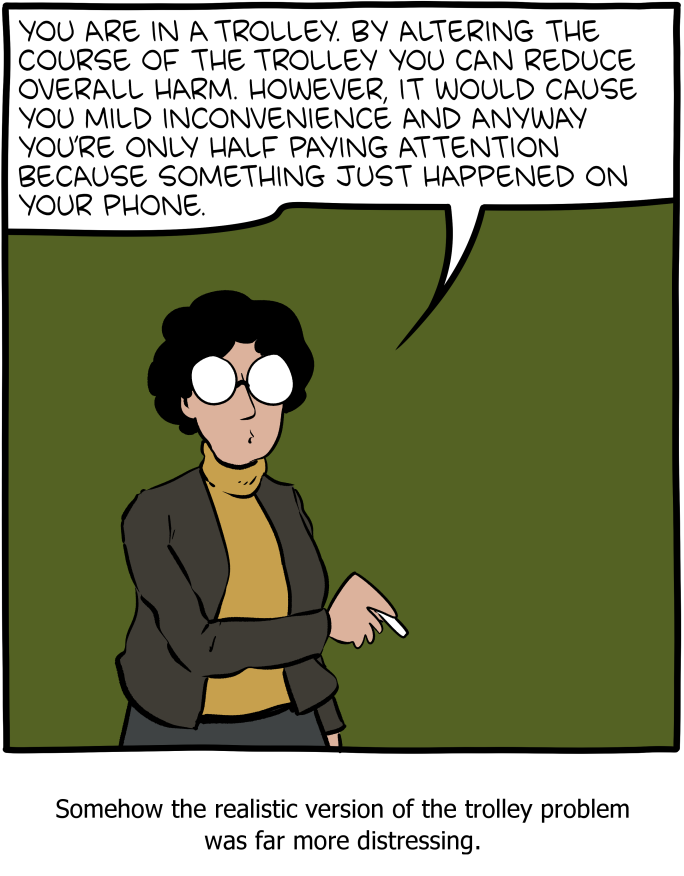
Saturday Morning Breakfast Cereal - Trolley Realism

by tech@thehiveworks.com


Click here to go see the bonus panel!

Hovertext:
There's nothing on the chalkboard, because you wouldn't pay attention anyway.


Today's News:
17 May 18:48

how do I spot red flags in a job interview if I have no work experience?

by Ask a Manager

This post, how do I spot red flags in a job interview if I have no work experience? , was originally published by Alison Green on Ask a Manager.

A reader writes:

I am a law student who just finished my first year, and I am applying to jobs for the summer. My one and only job was one that I started when I was 17 (I am 23 now) and was self-employed. Before this, I’ve only ever had one interview, and it was through my university so I knew the interviewers beforehand.

I just got out of a second interview with a potential job. I am so torn. I feel very uncomfortable with some of what I am and would be expected to do, but I don’t know if it is a red flag or just what entry-level positions have to do. This position is for a law clerk/legal assistant.

Here are some examples:

• This position is unpaid for approximately two months or so before turning into a paid position (because I will have to be taught everything, so I won’t bring any value to the boss yet). He did not specify what the pay is once I get to that level, but said we could negotiate at that time.

• The hiring manager gave me some small work to do for an ongoing case and asked me to complete it. (I know you say skills tests are good, and this is literally work that he needs to do for a case that he will be litigating later this summer. It is also not paid.)

• He said he is open to remote work, but I won’t be paid for it because I’m not in-office and therefore not of much use to him.

• He constantly talks in circles. Our first interview lasted an hour and a half, he asked me one question, and spent the rest of the time talking about his work, himself, and his children (and all of his past “secretaries”).

• He says that all women under the age of 50 are “girls” so he refers to his past employees as “the girls who have worked for him in the past.”

• He really doesn’t seem to answer questions. I’ve asked him four or five and the only clear answer I got was the one about the position being unpaid at first.

• The firm is only himself and one current legal assistant.

All that being said, I’m not sure how much of this is my own inexperience and anxiety. I can tell that he is very smart, his current legal assistant loves him, and I do think I would get exposed to a lot of different situations at his firm. On the other hand, each time I stepped out of his office after the interview, I felt uncomfortable and anxious. How do you know if something is a red flag in a job interview when you have almost no work experience?

First, do not under any circumstances accept this job. We’ll get to how to spot red flags in a minute, but first let’s tackle this specific job and the reasons you should run far away:

• The manager doesn’t plan to pay you for two months of work. This is illegal; the law requires him to pay you at least minimum wage unless this is structured as an unpaid internship where you are the primary beneficiary, not him. This isn’t that, so it’s illegal.

• He’s not willing to tell you what you’d be paid after those two months. It’s moot because of point one, but it’s an additional red flag. Decent employers do not bring people on without clearly agreeing on pay, and you should never accept a job without a firm understanding of what you will be paid for your work. His statement that you could negotiate it later on — no. You’ll have far less negotiating power once you’re already working there and if you can’t agree on terms, then what? You’ll leave, having worked for free for two months and with nothing to show for it?

• Skills tests are good — when they’re used exclusively to assess your skills. When they’re real work that the employer will use, they’re unethical and unacceptable, unless you’re paid for them.

• He’s “open” to remote work … as long as you do it for free? How generous. Remote work is real work, and you need to be paid for it. Again, illegal. Again, unethical.

• He won’t answer direct questions. This one pales in comparison to the things above but is still highly alarming.

The other stuff — talking in circles, sexism, and tiny firm size — are things that you might consider if none of the above was happening. If everything else was good, you might decide that you could live with those things, depending on what other options you had. (Tiny firm size isn’t inherently a bad thing, but it does mean that if he’s not great, that will have an outsized impact on your day to day quality of life at work and there will be no checks and balances in the mix. It also means you’ll have a very different experience than you would at a larger firm; that’s not necessarily prohibitive, but it’s something to be aware of.) But it’s all moot because the other issues are immediate deal-breakers.

So first and foremost: in this case, run.

As for how to know if something is a red flag when you don’t have much experience: One of the most important things you can do is to cultivate relationships with people with more experience and whose judgment you trust, so that you can turn to them for a reality check on this sort of thing. Ideally you’d have several people you can bounce things off of; everyone has blind spots, even normally spot-on people, so it’s good to have a variety of people you can check with. Once you start working, you’ll find more of them, but for now it might be a family member whose professional accomplishments you respect, a particularly savvy friend, a professor you clicked with, and/or someone you meet in an industry group. (Just make sure their knowledge seems recent. Someone no more than 8-10 years ahead of you professionally can be ideal because they’ll be more likely to be in touch with how things work at your level now, rather than how it worked several decades ago.)

Your gut is another resource too; there’s a reason you were feeling uncomfortable and anxious every time you talked to this guy. Guts can be wrong, of course — and in particular, if you struggle with anxiety they can mislead you in ways that aren’t helpful. But if you don’t normally feel anxious after interviews and one particular person/job is making you feel that way, listen to that; there’s likely something there. In fact, it’s good to start paying attention to your gut so that you can see patterns in how it operates; if your gut sends off a lot of false positives or false negatives, that’s good information to have and then you can see if you can find patterns in what’s making it trigger inaccurately. But if you find it has a reliable track record, that’s more reason to trust it in the future.

17 May 15:27

Woodmont College Commencement FAQ

by Jason Roeder and Mike Sacks

It’s a ritual as time-honored among teenagers as prom or drinking too much and crashing your parents’ Corolla into the window of a Mexican restaurant—glossy catalogs from colleges arriving by the dozen each spring. Aside from the faint odor of kiwi bubblegum vape smoke, Woodmont College’s catalog, Welcome to Woodmont, is superficially not unlike the others. But there’s no school quite like Woodmont College (no longer “university” due to a court order). And every page of its catalog is proof of this uniqueness, whether it’s touting the college’s low rate of scorpion infestation or celebrating its faculty’s various facial tattoos. The best part? You can order your own copy of Welcome to Woodmont and learn for yourself why U.S. News and World Report has hailed the school as “a singular educational experience for young people searching for neglect of the arts and aggression by townies.”

Comedy writers Mike Sacks and Jason Roeder are your guides to Woodmont College—its missteps, its glories, its unsupervised quicksand pits—and we’ll be sharing bonus content from this e-book all week long to help herald its publication.

- - -

Commencement is a special time of year at Woodmont College. It’s when we proudly confer diplomas upon graduating students and underclassmen we’ve just grown weary of having on campus. It’s a day of pageantry—students in caps and gowns, faculty holding at least a paper plate in front of their genitals—and goodbyes. Goodbyes to friends, mentors, and an institution that has been a home for the past four to twenty-four years.1

If you’re attending commencement 2022 this year, you’ll find the most commonly asked questions addressed below.

Where and when is the ceremony?
Commencement will be held at Woodmont Field, just steps from where our demoralized lacrosse team buried themselves alive last season at halftime. Family and friends are welcome to sit in the bleachers on a first-come, first-served basis, though due to safety concerns with the aging structures, seating will be restricted to persons under thirty pounds.

The specific date remains undetermined. Visitors are advised to secure lodging adjacent to campus for six full weeks in early May and to await a phone call or hand signal.

Who will the speakers be?
Esteemed Donor Edward Gurd, CEO of Spore Capital: As is tradition, Woodmont honors its most generous benefactor with a keynote address. Gurd, a self-described take-no-prisoners libertarian who singlehandedly funded the reupholstering of several seats in our business school’s auditorium, will be allowed to say anything he wants for as long as he wants.

Woodmont Chancellor TBD: We are currently conducting a search for a new chancellor to succeed Dr. Victor Moya, who resigned after admitting to plagiarizing much of his prior academic research from Bristol Palin’s memoir. In the event the Board of Trustees has not appointed a new chancellor by Commencement Day, Executive Vice President Olivia Wofford will fill in and explore what she wished she knew when she picked out a divorce attorney.

Student Speaker, Brooke Glickson ’22: Valedictorian Glickson will look back on her time at Woodmont and discuss how it shaped her decision to drop out of society the moment commencement ends.

Honorary Degree Recipient, Manscaped Brand Ambassador Troy Riggs: Will hype the newly released “Ball Mower.”

What is the plan for inclement weather?
Springtime weather at Woodmont can be unpredictable, owing to the unique microclimate created by exhaust from the smokestacks at the Department of Journalism and Experimental Plastic Fabrication. The rain or snow at Woodmont is sufficiently corrosive to make indoor contingency plans beside the point. Join us in collectively praying for sunshine.

How do I know whether I’m eligible to graduate?
Visit the Registrar’s Office to check the status of your credits. If you lack sufficient credits, you may still graduate by guessing the exact weight of the giant pumpkin located on the former site of the Campus Security kiosk. (Pumpkins are swapped out on the hour to help safeguard the contest’s integrity.)

What is the $2,500 tassel fee?
Often cherished as keepsakes, our tassels are a genuine rayon-polyester blend and come with a commemorative plastic charm featuring all four digits of the year “2022.” The tassels are optional, however. Students who elect not to purchase one will still be provided with a quarter-inch of yarn, which must be returned along with a $50 cleaning fee once commencement festivities conclude.

Why am I signing this waiver?
Because you’re going to be a star in our upcoming reality AMC series Naked Graduation Island! Put your mind to rest—this show will be produced by the very same alumnus (Woodmont ’86) responsible for the 2019 mega-hit HBO series Naked Assisted Living!

1 After twenty-four years, students are automatically graduated with a special “QUARTER-LIFE LEARNER” diploma, recognizing sheer collegiate perseverance.

- - -


Order today!

17 May 14:25

rejected on a video call, meetings on Juneteenth, and more

by Ask a Manager

This post, rejected on a video call, meetings on Juneteenth, and more , was originally published by Alison Green on Ask a Manager.

It’s five answers to five questions. Here we go…

1. Hiring manager set up a video call to reject me

I applied to an internal job at my current company that would be fully remote. I went through the first and second round interviews and felt I did pretty well, but continued to apply to other places. In the meantime, I tried not to get too emotionally attached to this position, but the truth is I really, really wanted this job.

At my organization, the hiring process is extremely slow. About a month after the second interview, I followed up with the recruiter. I was told they would be interviewing one more person within the next week and to hold tight.

Fast forward to that next week and I received a video meeting invite from the hiring manager. The meeting was titled “quick touch-base” with no agenda attached and was scheduled for 15 minutes at the very end of a long day. Since I had no idea what to expect, I dressed in a full suit, made sure my hair and makeup were on point, and reviewed the job description, my resume, and cover letter again.

When we got on camera, the hiring manager said they had some disappointing news. They moved forward with another candidate. They were very impressed with my skill set and a generic email from HR seemed too impersonal, so they wanted to tell me personally and directly.

I sat there semi-dumbfounded in a full suit feeling like an idiot with little to say. It felt extremely awkward. I had no room to emote in that moment and no time to process. I kept a smile plastered on my face and just said, “Thanks for the opportunity, if you ever have a position that matches, please reach out to me.”

It was bizarre and made the rejection that much more painful. I was sort of shocked that someone would schedule a video call to tell me this. I’m not sure if this is a new standard, but instead of feeling kind, it felt very cruel. I went through the trouble of getting myself together for a video chat that ended up being maybe five minutes long. I understand not wanting to come across as impersonal, but it made me feel put on the spot.

Hiring managers, if you plan to reject someone, sometimes an email really is the best way to go about it. I would have even accepted a call over being forced to be on video to receive the not-so-great news. At least I wouldn’t have had to feel the need to prep and get myself ready for something that wasn’t going to happen.

Yes, this is a terrible idea. Calling people with a job rejection is usually the wrong move too, for many of the same reasons: the person gets their hopes up, then has to process and react to disappointing news on the spot. Doing it on video has all the same faults, plus more — now you have to control your face, not just your words, and you’ve dressed up for it too.

If a hiring manager wants to make a rejection feel less impersonal, they can do it by sharing the news in an email initially and then offering a call if the person wants it — not by blindsiding someone with the news in real time, and definitely not on camera.

2. A meeting scheduled on Juneteenth

My company recognizes and observes Juneteenth. I think this is super cool. This year, because Juneteenth falls on a Sunday, the office is closed on Monday, June 20th. We have a paid day off.

I’ve been invited to a meeting on the 20th. The meeting is with an organization that really values DEI in their work (as do I). I sit on their advisory board and this meeting is related to my service on the advisory board. I consider being part of the advisory board to be part of my “work.” The organizer has reached out to collect RSVPs. I drafted an email saying I wouldn’t be able to attend because my office is closed that day, but I have yet to hit “send” because I feel a little weird about it.

Here’s why:
• I have the day off, so I should take the day off, right? I am being paid because I am a salaried, exempt employee and it’s a recognized holiday at my organization. I struggle enough with work-life balance without actively choosing to work on days off. I DO have the option of flexing the time and cutting out early later in the week.
• But attending this meeting where we will no doubt talk about DEI seems like a valuable way to spend my Juneteenth!
• But, if I decline and tell them why, perhaps that will prompt this organization to follow suit and observe Juneteenth in the future and that would be cool, right? I don’t actually know of any other organizations that recognize and observe Juneteenth, so perhaps my org is ahead of the curve on this and this would help with the spread? It’s even early enough that perhaps that can reconsider the date of the meeting and reschedule it for this year.

My organization makes a lot of decisions that don’t support their DEI goals (for example, not posting salaries in job descriptions), but they are actively working on a DEI initiative so I expect to see changes. The culture at my organization is really positive and supportive. I live in a largely white state that has a lot of work to do (starting with first recognizing they have work to do). I will likely attend an event on Juneteenth to recognize the day.

I am white and I’d really like to do the most thoughtful and helpful thing in this situation.

Why not point out that it’s the federal holiday for Juneteenth and ask them to reschedule the meeting? (They may not be thinking about Juneteenth at all, and/or they may not realize it became a federal holiday last year and is being observed on the 20th this year since the day falls on a weekend.)

You don’t have to say you won’t attend if they don’t, but just as you might point out that a meeting was scheduled for Yom Kippur even if you weren’t Jewish, it’s a useful thing to flag and suggest they change.

If they don’t change it, then it’s up to you to decide whether or not you want to attend a meeting that day — but flagging it as early as you can and suggesting they pick another date sounds like the most useful thing you could do.

3. Setting boundaries with student workers as a new manager

I am writing as a recent graduate from a master’s program who just landed a job in the field I got the degree for. It is at a university library, the same library I worked at as a grad student in one of the student assistant positions. Part of my new position is to manage the grad student assistants (five total), all of whom are students in the program I just graduated from.

I am asking for tips to make myself more authoritative and to assert the supervisor/student boundary. I believe part of the issue is that I am very close in age to the students (only a year or so older). I also used to work with a couple of them as a student, although this will change after they graduate this year. They see me as more of a peer than a supervisor.

I was recently pulled into a conversation with one of the student workers that I believe was inappropriate, considering our relationship. What started as me asking about how their degree was going turned into them being highly critical of the university, the master’s program, as well as specific professors that we had shared. Not the type of conversation you should ever be having with your boss. When I saw the conversation taking an unprofessional turn, I tried to head it off, but the student did not take the hint and kept going until I eventually excused myself from the conversation.

Since then, I have tried thinking of possible responses or strategies to more quickly shut down a conversation if it ever heads that way again, as well as ways to bring up the issue with the student directly if it ends up persisting. Advice regarding both would be really appreciated.

Depending on the specifics of the complaints, you could try this: “As your boss, this isn’t a conversation we should have, but if you do want to talk to someone about these issues, you could speak with ____.” Or, “I’m sorry you’re having frustrations — as your manager, I’m not the right audience for this but you could try ___.” Or, “That sounds really frustrating (or alarming/concerning/whatever is appropriate). Can I put you in touch with ____ to see if they can help?”

That said, it’s not inherently inappropriate for a student worker to share criticisms about the school with you, although it depends on the specifics of the complaints and whether they’re just venting or not. Either way, though, the responses above should help since (a) if the complaints are legit, you’ll be steering them toward an appropriate resource, and (b) if it’s really just venting, by taking it seriously and directing them elsewhere you’ll still be communicating the boundaries on your role and the relationship.

Other stuff that might help with establishing authority:

how I can be more authoritative now that I’m a manager?

how to appear more authoritative at work

4. Putting psychometric test results on a resume

What are your thoughts on the Clifton Strengths Finder? Should it be referenced in a resume or cover letter, or mentioned in an interview? Or just used to incorporate better language when discussing skills and accomplishments?

Don’t reference it in your resume or cover letter; that would be putting an unwarranted amount of emphasis on something that a lot of the people reading your resume will be unfamiliar with or just don’t find particularly valuable. It’s also more subjective than is helpful in this context, similar to putting “self-starter” or “good writer” on your resume — hiring managers want to see what you’ve done with your traits (actual accomplishments), not the traits themselves.

Those types of assessments can be useful in helping you understand your own strengths and way of working, but they shouldn’t go on a resume or in a cover letter.

5. Leaving my job while I’m covering for my boss

I am a deputy director of a small team within a larger institution. I have risen steadily through the ranks over the last few years and now find myself second in command. My boss is going to be on extended leave for several months, and every expectation is I will take the reins of the team and lead it through my boss’s absence. It is notable that the absence will include a critical time for the organization, including the potential for major upheaval and job loss if things don’t go our team’s way. I have gotten a little preview of what things will be like as my boss has been out for two weeks and it has been incredibly stressful doing two jobs.

Against this background I have had a potential job opportunity come up in another very prestigious institution. I did not apply for this job, but was contacted for it. There are still a lot of things to work through before I have an offer or accept it, including whether my salary requirements will be met. But I think I will likely be put in the position of making a choice. My job and boss have been good to me, but I have also worked very hard to get where I am. I know in the past I have let feelings of loyalty keep me from taking other opportunities, but I feel very lost about how I should evaluate and decide whether to stay or not. My spouse says my organization needs to be bigger than me, and no doubt they will get on without me somehow. I just worry about disappointing people and knowing what is right for me. I am also a WOC in a white, male-dominated field and I deal with impostor syndrome all the time. Where do I start?

If you end up wanting the other job, you should take the other job. If you’re good at your work, people will always be disappointed when you leave, but that can’t affect your decision or you’d never be able to leave at all. And yes, this will be a particularly inconvenient time for you to leave, but it’s not reasonable for your employer to expect you to put your career on hold for their convenience … and if they do want that, they have the option of negotiating that with you and paying you accordingly, like with a written, contractual retention bonus.

You can frame it as “this fell in my lap and it’s not something I can pass up.”

All that said, if it’s just a matter of pushing back the start date at the new job by a month or so, you could ask if the new employer would be open to that so you can finish out the leave coverage. The more senior you get, the easier it often is to do that, and the more common a request it is.

17 May 13:51

Chimpanzee Capitalism

by Corey Mohler
PERSON: "Alright guys i have this great idea. You know how we have experienced almost no economic growth? "

PERSON: "You see, our labor isn't being allocated efficiently. We need captialism."

PERSON: "What is that? "

PERSON: "Great question, i love your enthusiasm."

PERSON: "Uh..."

PERSON: "Okay, I guess we'll give it a try... "

PERSON: "later..."

PERSON: "Stealing? Noooooo.....what gave you that idea?"


PERSON: " "

PERSON: "So, we've decided to just all work together instead. "

PERSON: "You are forming a union? Are you kidding, it isn't worth it, think about all the union dues! "

PERSON: "Wait, you guys haven't even seen these charts on supply and demand... "
17 May 13:47

The many, many costs of breastfeeding

by Aubrey Hirsch

Breastfeeding isn’t free — and it isn’t a solution to the national baby formula shortage.

17 May 02:57

Guess Whooooooooo?

by GameGrumps

Click to SUBSCRIBE ► http://bit.ly/GrumpSubscribe
MERCH!! ► http://gamegrumps.com/merch
Support us on Patreon! ► https://www.patreon.com/gamegrumps
Our email list! ► http://eepurl.com/cN7syX

*********************************************

We have NEW MERCH every other TUESDAY!
►►► http://gamegrumps.com/merch

*********************************************

FACEBOOK ► https://www.facebook.com/GameGrumps
TWITTER ► https://www.twitter.com/gamegrumps
INSTAGRAM ► https://www.instagram.com/gamegrumps/
WEBSITE ► http://gamegrumps.com

*********************************************

Game Grumps are:
Arin ► http://www.youtube.com/Egoraptor
Danny ► http://www.youtube.com/NinjaSexParty

#gaming
17 May 02:55

Petscii Robots Mega Update - Arcade, Genesis, MS-DOS and more!

by The 8-Bit Guy

Support The 8-Bit Guy on Patreon:
https://www.patreon.com/8BitGuy1

Visit my website:
http://www.the8bitguy.com/

I will post the GeekPub video of the cabinet build here once that video is finished. Or you can just subscribe so you'll see it when it goes live: https://www.youtube.com/c/TheGeekPub

Montezuma's Revenge Kickstarter:
http://kck.st/3LiIC5b

Gameplay Tutorial Video:
https://youtu.be/1YZ6bpS2gJc

00:00-Arcade Build
06:54-Sony Playstation Portable
07:39-PET updates
08:01-Apple II updates
08:31-C64 updates
09:47-Sinclair ZX Spectrum
10:15-Sega Genesis release
11:33-Nintendo NES update
15:48-Atari 7800 update
16:25-Super Nintendo Update
16:40-MS-DOS update
17:46-Soundtrack cassettes and vinyl
16 May 19:57

Saturday Morning Breakfast Cereal - Right In

by tech@thehiveworks.com


Click here to go see the bonus panel!

Hovertext:
May the Lord chill out by the time you die, amen.


Today's News:
16 May 19:25

update: I’m a member of The Satanic Temple and got outed at work

by Ask a Manager

This post, update: I’m a member of The Satanic Temple and got outed at work , was originally published by Alison Green on Ask a Manager.

Remember the letter-writer who’s a member of The Satanic Temple and got outed at work and her boss had become hostile to her? Here’s the update.

So my update is better but a bit of a bummer.

My manager got suspended pending an investigation. Not because of me directly, but this was I guess a cherry on the cake of issues she’d been having for a while under the radar.

At the beginning of April, our corporate office sent out a few holiday well wish bulletins for Ramadan, Eid, Passover, and Easter. Boss had been complaining about only certain bulletins (guess which ones) quite loudly to certain people. Other coworkers had been to HR because of Boss’s comments and weird requirements about time off for non-Christian staff. Our staff is really diverse and we have a lot of coverage so it’s not like there was a shortage of people that would impact the schedule.

I went to HR before your response because things with my boss kept getting worse. My yearly reviews are in June, she pulled me in three months early and basically trashed my chances for a promotion I really wanted saying I was a distraction in the office and becoming entitled and my work quality was low.

The rest of the comments with my coworkers I’ve been able to handle with humor and being blunt but I took my performance eval to HR and explained everything.

HR was great. I didn’t expect that level of support and while I don’t think I’m the catalyst for her suspension, I’m relieved the company is upholding the values they say they have.

16 May 18:51

Trial begins for roommate accused of killing, dismembering "Thundercats" writer around Tampa. Should've used "The Sword Of Omens" instead of a Walmart circular saw [Florida]