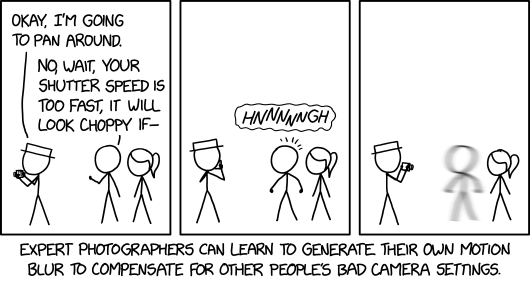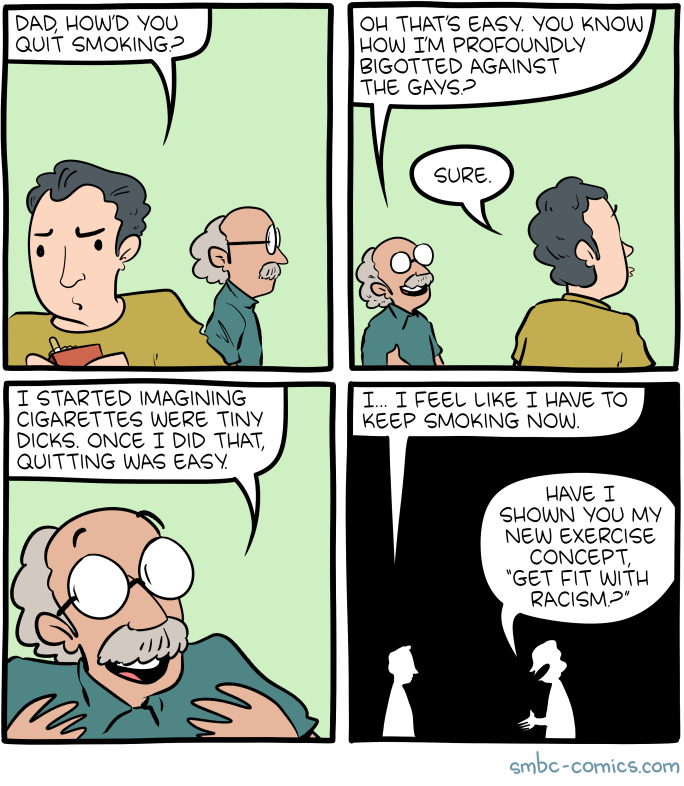
New comic!
Today's News:
In their defense, from their perspective, this is only the first time they've thought of this.
In their defense, from their perspective, this is only the first time they've thought of this.
Hovertext:
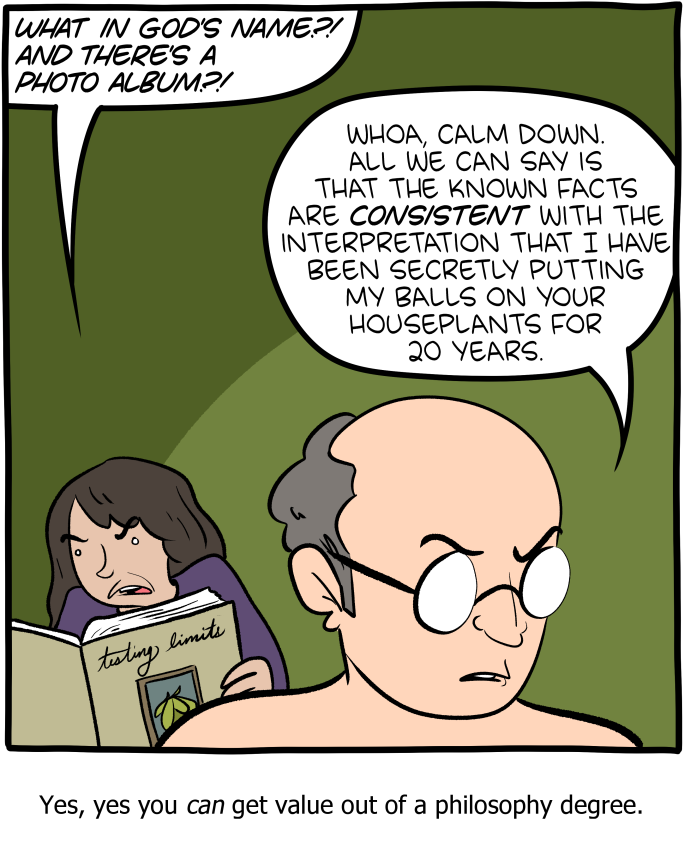
Correlation doesn't imply causation! Induction is impossible! Hand me my briefs!
We now take a break from comics about aliens finding humans being weird to one about humans being weird.
Last time I wrote a post here I was surprised how many weirdos wrote in to tell me they still read the blog. Well, I'll just let you weirdos know that the amazing kids' book I've been working on for a year is finally (almost) heading toward the presses. I'm hopeful we'll be able to reveal more soon.
<3
Zach


Read more of this story at Slashdot.
On Tuesday, as the world knows already, an 18-year-old man carried an AR-15-style rifle into a 574-student elementary school just off Highway 83 in the town of Uvalde, 90 minutes west of San Antonio. Unobstructed by police, he barricaded himself in a 4th grade classroom and unleashed hell on earth, slaying 19 children and two teachers—the worst school shooting in Texas history. After an hour, as frantic parents panicked outside, law enforcement finally killed the man.
In moments like these, maddeningly frequent, what is it we expect from our political leaders? The answer varies according to partisanship. But, generally, we want a leader who feels what we feel, who tells the truth, and who plausibly promises policies to address the problem—the first being a salve for public wounds, the second a necessity for democracy, and the third the literal job description of those in power. With Texas’ governor, you’ll get none of this, and you may as well like it, because he’s not changing.
Shortly after the massacre, Governor Greg Abbott first addressed the shooting at a news conference. In a state that had seen five other mass shootings in his tenure, four of which involved similar assault-style rifles, Abbott said—with passionless delivery—that the killer acted “incomprehensibly.” Without any specifics whatsoever, he pledged the state would “do everything that is necessary” to prevent a seventh bloodbath. Then, he stopped by a fundraiser five hours away.
The state’s leading daily papers pilloried the governor’s performance. “If he couldn’t get choked up over little kids, is he likely to budge from the state GOP’s hard-line resistance to any changes in gun laws? In a word, no,” wrote Bob Garrett in the Dallas Morning News. Over at the Houston Chronicle, the editorial board added: “No one, especially not the governor of a state with some of the most inept, irresponsible and dangerous gun laws in the nation, should be confused, somehow unable to comprehend, the reasons for this never-ending tragedy.”
The next day in Uvalde, it was almost like Abbott had taken notes. In his second press conference, he deployed a teary voice repeatedly, pausing long enough that it couldn’t be missed. He began by saying that “evil swept across Uvalde yesterday”—a cherished Republican misdirection that casts a policy matter in intractable and Biblical terms. Then, he pivoted to a more modern canard, one that speciously implies a policy agenda: mental illness.
“I asked the sheriff and others an open-ended question … ‘What is the problem here?’ And they were straightforward and emphatic, they said, ‘We have a problem with mental health illness,’” Abbott said—despite previously noting the shooter had “no known mental health history.”
Of course, no one can dispute that mental health matters, or that more “resources” would be good. But, here, Abbott is simply changing the topic.
The Uvalde shooter did not kill those children with his purported mental health struggles. He did not shoot them with estrangement; he did not murder them with malaise; he did not ravage their little bodies with the inchoate rage of his misguided youth. He killed them with a goddamn assault rifle, and high-capacity magazines, designed for the precise purpose of human annihilation.
In perhaps his most deranged comment, Abbott said the massacre “could have been worse”—had law enforcement not so bravely and effectively intervened.
To the contrary, as more details emerge, we are finding that law enforcement may have botched the whole response. Why did it take an hour to take the shooter down? Why did state police report that an armed school resource officer confronted the shooter before he entered, only to later say this never occurred? Why are videos circulating of enraged parents outside, shouting at police to “go in there?” Why was one mother reportedly handcuffed, before escaping, hopping a fence, and running into the school to save her children herself? These questions are being investigated by the Texas Rangers and Congressman Joaquin Castro has requested an FBI inquiry.
Abbott also attempted to promote his policy record on the matter: “We consider what we did in 2019 to be one of the most profound legislative sessions not just in Texas but in any state in addressing school shootings,” he said.
Back in 2019, Texas’ biennial Legislature was under heat to do something after the Sutherland Springs church shooting of 2017, 26 dead, and the Santa Fe high school shooting of 2018, 10 dead. Even Abbott had changed his tune, pivoting away from full-blown God-tinged fatalism: “We need to do more than just pray for the victims and their families,” he said after Santa Fe. He convened a roundtable and task force, but when it came time in 2019 to pass any meaningful gun restrictions—such as universal background checks or a “red flag” law allowing courts to seize guns from dangerous individuals—Abbott caved easily to the gun lobby and his right flank.
In reality, Abbott in 2019 signed laws making it easier to carry guns in public places. As for shootings like Santa Fe, he signed school “hardening” legislation funding active-shooter response training and physical security infrastructure along with a program allowing more teachers to possess guns at school. Hardly any teachers have taken advantage of the opportunity, perhaps not wanting to be police officers. The money has been spent, the schools “hardened,” including in the Uvalde Consolidated Independent School District. Yet here we are, reeling from our worst school shooting ever.
On Wednesday, Abbott’s opponent in the November election, Democrat Beto O’Rourke, interrupted the press conference. “The time to stop the next shooting is right now and you are doing nothing. … This is on you,” he said while being escorted out of the building.
Outside, O’Rourke continued. “It is insane that we allow an 18-year-old to go in and buy an AR-15; what the hell did we think he was going to do with that?” he said. “I’ve got three kids … and I face their judgment and my conscience and ultimately my maker for what I do when I have the chance to change this.”
This was O’Rourke at his best, impassioned and spontaneous, drawing on the deep well of hurt in his own hometown of El Paso. A few months after the 2019 legislative session closed, a racist North Texan, motivated by hatred of immigrants, killed 23 at a Walmart in that city. Abbott fleetingly acknowledged that his own anti-immigrant rhetoric should change in light of the massacre, a tentative pledge he would later renege on relentlessly. As for firearm policy, by the time the 2021 legislation session came around, it was as if nothing had happened: The only high-profile gun bill to pass was so-called constitutional carry, the pinnacle of legislative recklessness, a law that allows residents to carry handguns without the basic safeguard of a permit.
In the race for governor, Abbott has gleefully and relentlessly bashed O’Rourke for saying in 2019 that he supported the confiscation of assault rifles. Studies show that mass shootings carried out with these guns are far deadlier than when other weapons are used. A federal assault weapons ban, in place from 1994 to 2004, appeared to tamp down mass shootings in America. It’s unclear whether Congress will take any meaningful action in response to Uvalde.
On Friday, Abbott was scheduled to speak at the National Rifle Association’s convention in Houston. Under intense pressure, he changed gears, deciding to stay in Uvalde rather than attend. But he didn’t condemn the convention or call for its cancellation. No, instead he announced he’d send pre-recorded video remarks for the gathering, a congregation of those politically committed to the prospect of more Uvaldes, to enjoy.
It’s classic Abbott. With nothing meaningful left to say, and no policy agenda to address the crises Texans face, he puts his finger to the wind and shifts slightly when it blows too hard, backtracking when it dies down. After all, it wasn’t moral courage or bettering ordinary Texans’ lives that got him this far, so why change now?
The post Greg Abbott Is Full of Shit appeared first on The Texas Observer.
Read more of this story at Slashdot.
I love it when I find a new band and can't stop playing one of their songs or albums. Something just hits right for you in that moment, and yes, timing is everything. You know what I mean?
Something about The Veils just hits right in this moment. The drum beat across their Total Depravity album is outstanding. It was released in 2016, but I just discovered it (thanks, 10up Music League!). Something about it works just as well as background music for work or adulting tasks as much as it is does as a great road trip album. Or, you can just as easily throw the full album up at a backyard party. I'd love to see them live.
Singer Finn Andrews and bass player Sophia Burn first met when they were 12 years old at high school in New Zealand. Along with Henning Dietz (drums), Dan Raishbrook (guitar), and Uberto Rapisardi (keys), The Veils have released three records on Rough Trade Records.
– Banished Music
You really should listen to the full album, but if you have to pick one song to try them out, "Swimming with the Crocodiles" is the one that hooked me.
They also released a short film in 2013, "The Veils At Abbey Road."
I love sharing music finds with y'all. Hope you enjoy this one!
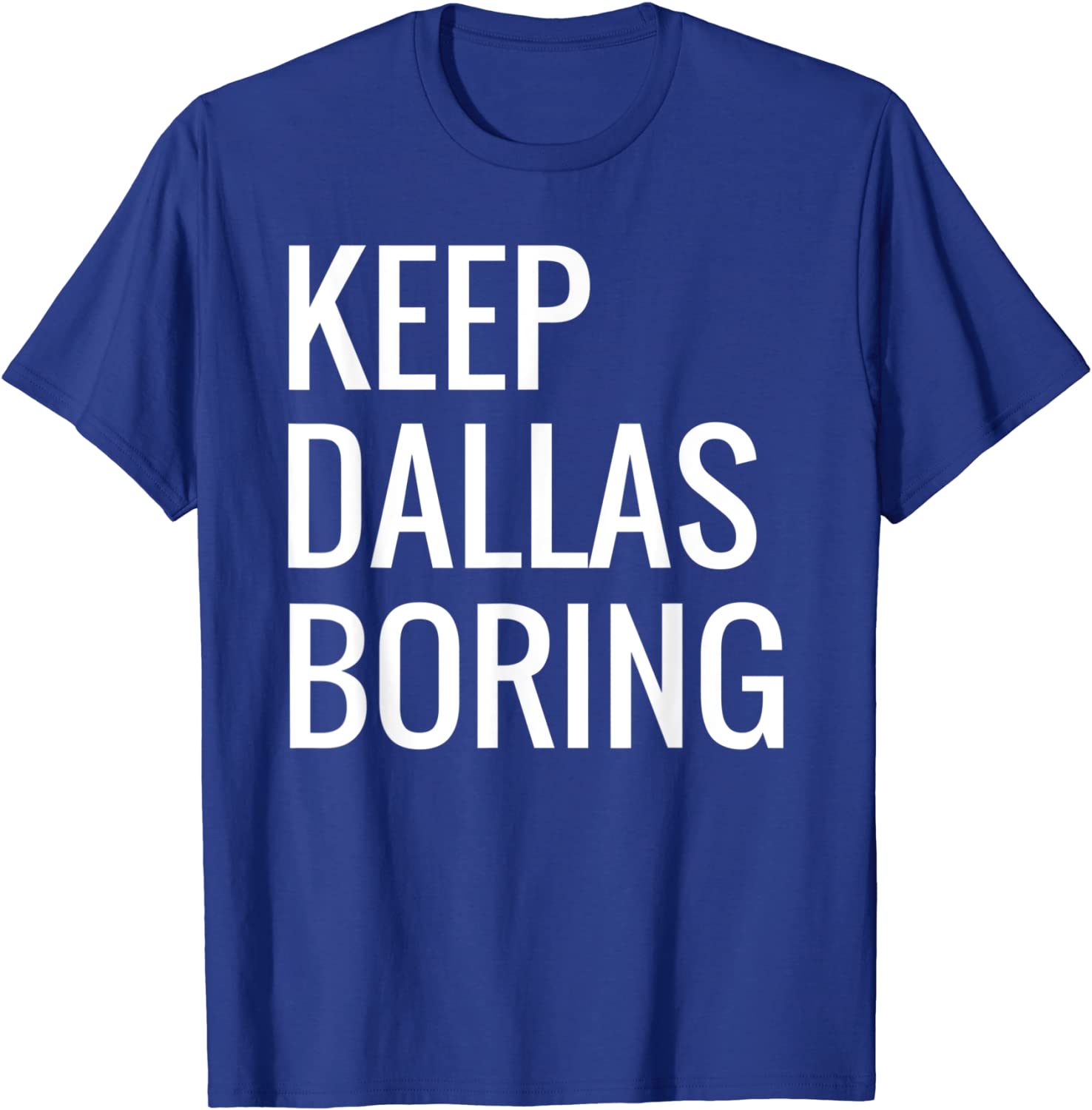
Keep Dallas Boring shirt, via Amazon
In April, I went with friends to see Beach Bunny, a young, energetic pop-punk band, perform at The Studio. The Studio is a bespoke sidecar venue to the Bomb Factory in Dallas’ Deep Ellum neighborhood. The all-ages nature of the show meant that young people from far and wide were lined up outside, forming a small crowd on the sidewalk. This is the essence of Deep Ellum: loud music, young crowds, and traffic everywhere you turn. However, the neighborhood has its own cycles of fast and slow. When I arrived in town, in 2013, the area felt all but abandoned, and foot traffic was not guaranteed.Humble, experimental art shows have encircled the neighborhood with some regularity, but these days you’ll see live-and-work residential concepts, a competitive restaurant scene, and music venues of every size.
It’s easy to understand why young crowds, well dressed cosmopolites, and tourists in general spend their disposable cash in Deep Ellum. Dallas is a place of rapid transition, and Deep Ellum is usually an indicator of the general status of the region. Ten years ago, real estate developers were letting artists use their unoccupied spaces. In 2022, however, there’s less vacant space and much more to do in Dallas’ urban center; the neighborhood is now a locus of creativity, but the turnover can be high. The Bomb Factory, a massive live music venue that originally opened in the 90s, closed for nearly 20 years, and then reopened to great success in 2015. I know a Texas painter who moved to Deep Ellum a couple years ago, and then promptly moved out because the night life was too disruptive. Restaurants come and go all the time. In Texas, memories (and certainly memories of good art) are made in places that are not always permanent.
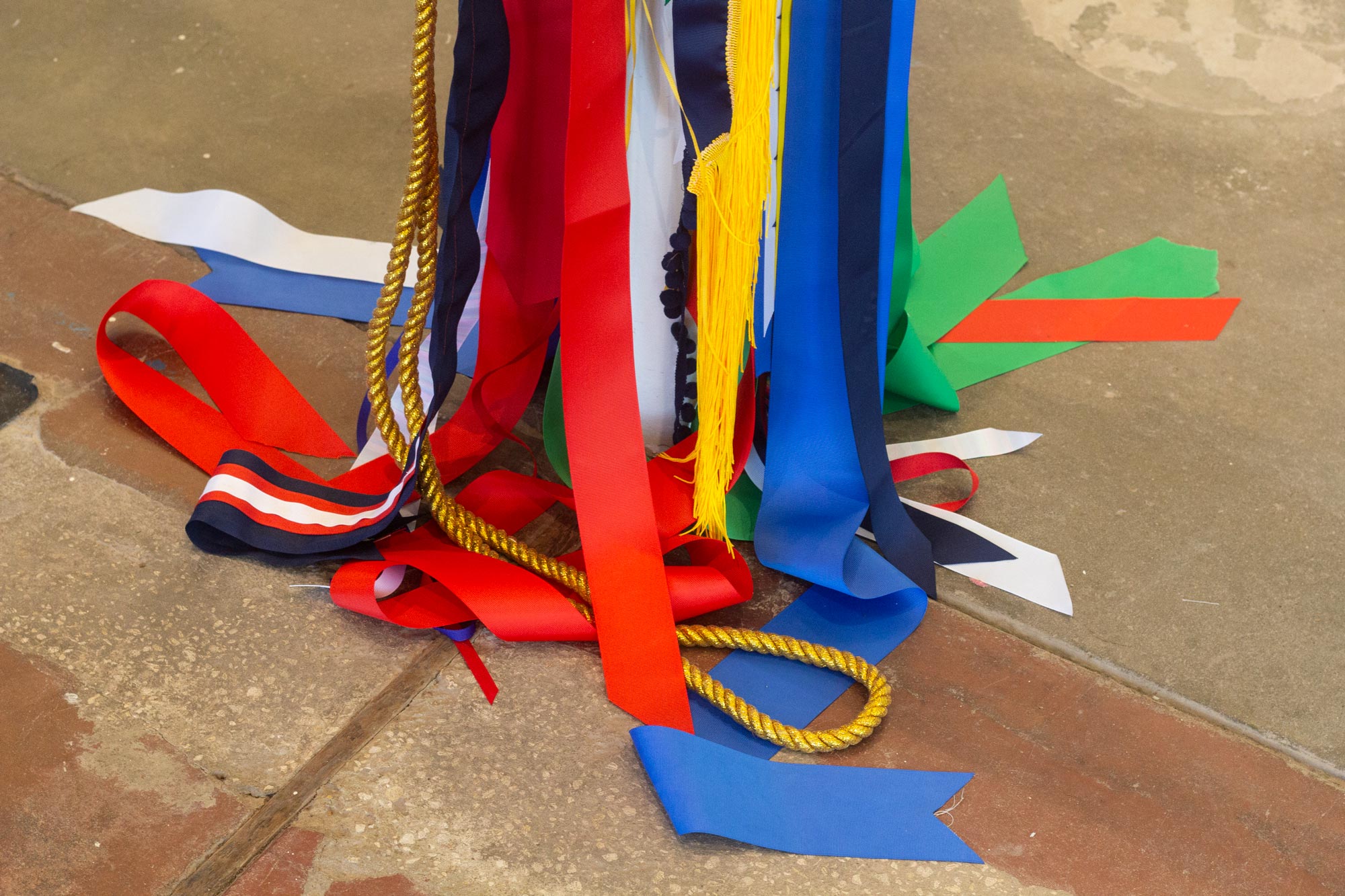
Alexandra Robinson, “Exceptionally Meritorious Contribution of Great Responsibility” (detail), 2020-22, gros grain ribbons, gold cording, stars, approx. 84 x120 inches
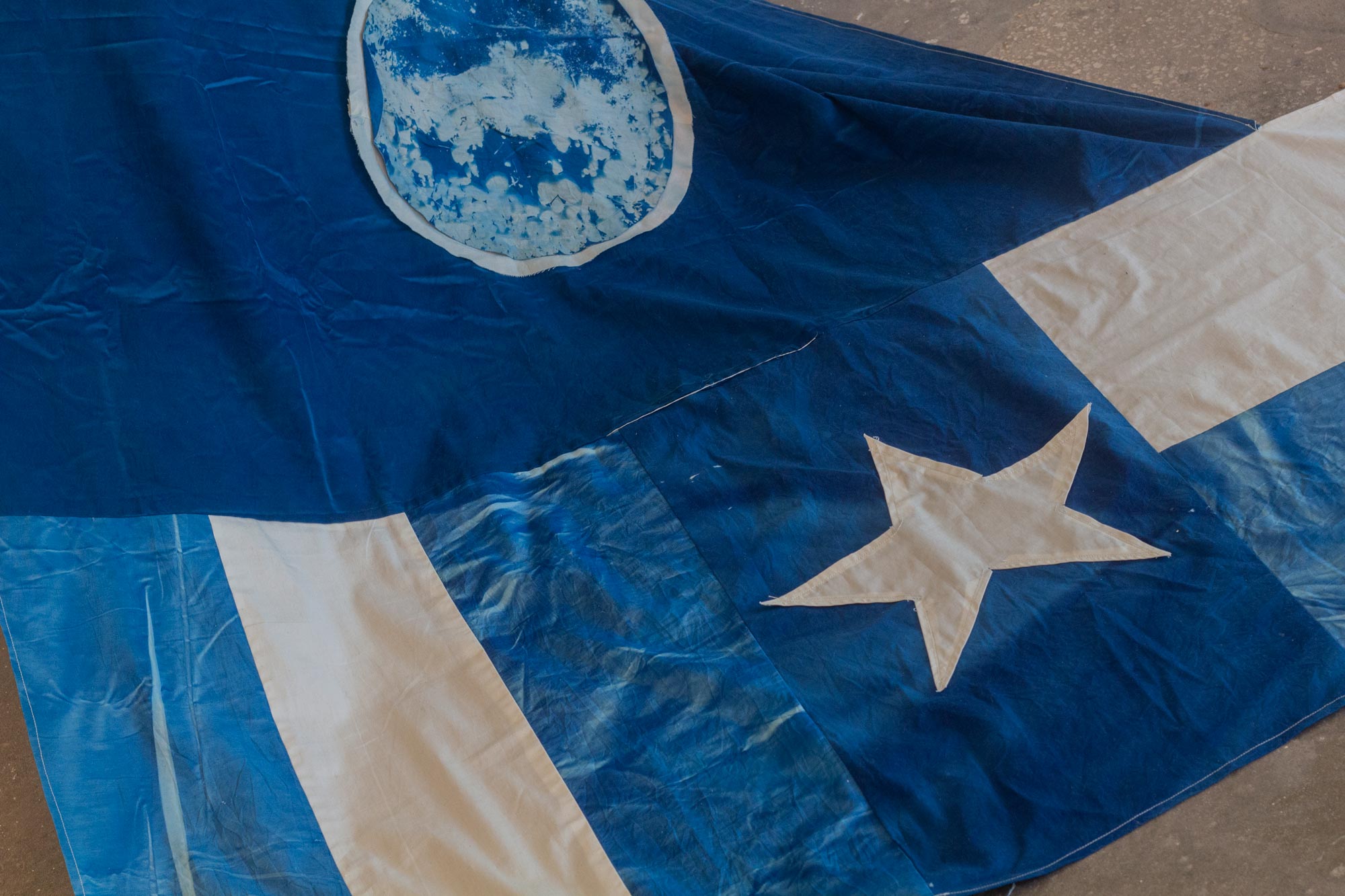
Alexandra Robinson, “De Donde Soy (where I’m from)” (detail), 2019 cyanotype on cotton muslin, cotton muslin, and flag holder
When I arrived at The Studio with my friends, something caught my eye: on the street, I saw a man wearing a purple shirt emblazoned with the phrase, “Keep Dallas Boring.” This is probably a play on the popular slogan “Keep Austin Weird,” coined by Austin librarian Red Wassenich in 2000. The phrase insinuates that Austin’s “weirdness” is under a general threat, and must be maintained. Its syntax successfully captures the imagination of creatives in other Texas cities, rendering its power for their purposes. However, Wassenich’s phrase was initially meant as a verbal expression of financial and operational support that he lent to local businesses and organizations, a slogan for a life of action. “Keep Austin Weird” is meant to reflect acts of support within the community. Does Dallas aspire to… bore?
Texas’ cultural map is compartmentalized by its size, which I think, in part, makes slogans inevitable. There’s no one catch-all phrase or attitude that can encapsulate Texas, and who doesn’t love a graphic tee? Concert-going music fans in Deep Ellum seem to be willing to get behind the “boring” label. However, art in and about our state and its cities has the ability to dig a deeper sentiment than a few short words can express.
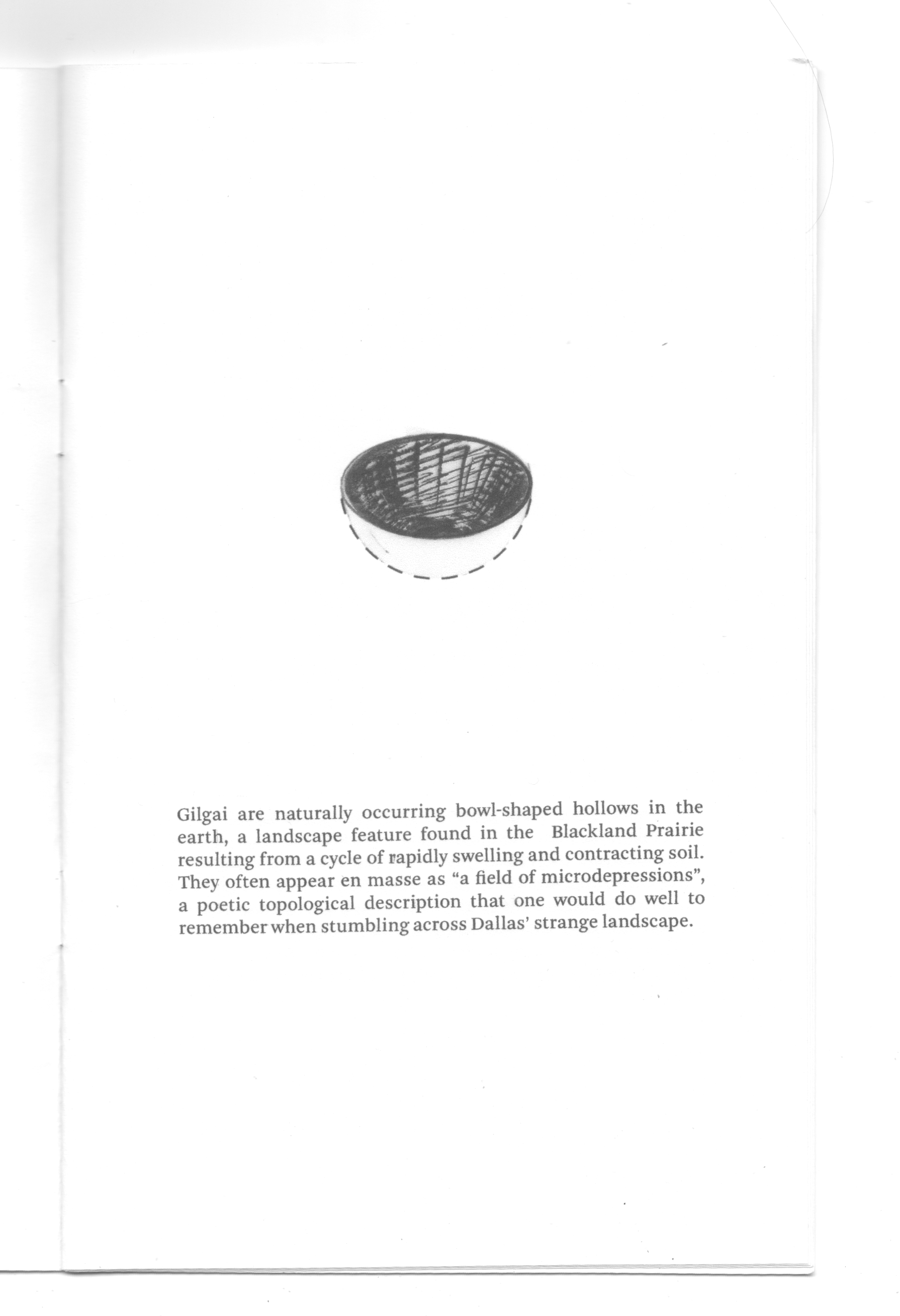
The first page from Isaac Dunne’s “This Week In Texas” zine, 2022

Tina Medina, “Lágrimos Eternos,” 2019, fabric, thread and handkerchief, 6 x8 1/2 inches
Thinking about what it means for a place to have an identity is a common theme in recent Texas exhibitions. Bottomland at Sweet Pass Sculpture Park in Dallas is a site full of sites; six artists that spent a year thinking about what has become of Dallas’ native Blackland Prairie. Isaac Dunne’s sculptural works, Porta Potties, include printed essays that examine the relationships between public space and implicit rhetoric. In Austin, Women and Their Work exhibited Alexandra Robinson’s show of morse code and flag semaphore, which are communication protocols used by the U.S. Army. In the show, rectangles and stripes are pleated into each other, or strung from the ceiling. The colors tangle and become difficult to decipher.
Similarly, Tina Medina’s exhibition Xicanisma, A Retrospective at the Latino Cultural Center in Dallas makes use of handkerchiefs and flags throughout the 20-year span of her career. While these works all have some relationship to symbols, fabric, and identity, it isn’t spelled out. These concepts are communicated visually, but they wouldn’t fit neatly on a shirt, nor should they have to. Shirts are merchandise, and exhibitions are spaces dedicated to exploring ideas — they have different goals.
Also in April, as I was driving into downtown Houston, I passed the train bridge above I-45 that has been known to be graffitied with the words “Be Someone,” which has become a beloved city landmark. Viewable only by car and without an author, its optimism and gritty typographic style has made it a perfect slogan for Houston. However, during my visit, it was nowhere to be seen, and instead had been painted over with the statement, “NO WAR KNOW PEACE”.
I felt a little shocked; I had expected “Be Someone” to be respected forever, which is unlikely for any street art (even pieces that are in hard-to-reach places). Of the overpass mural, Glasstire’s Publisher Brandon Zech (and Houston resident), said, “The fact that our most iconic tag dis- and then reappears is indicative of Houston’s general disregard for preservation/its ever-changing landscape.” The erasure of Houston’s iconic commute affirmation disappointed me, even though I don’t live in the city and wouldn’t see it daily. People form attachments to place, regardless of whether those places are natural or built. Slogans are how we caption our communities, but art is how we sift through what we are still learning about them.

Photo via 365 Things to do in Houston
I realize that this reflection was sparked by a shirt that a stranger wore, weeks ago at that. My fixation is less on deciphering exactly what the shirt intends to communicate, and more on the feeling it exudes — that places are inevitably not ours. The battle for who gets to claim the cultural capital of our cities is eternal, and it wages on in every zone of the city where something cool is starting to catch on. In Austin, Houston, and Dallas, things are definitely changing, so I can empathize with claiming ownership of a statement that makes you feel like you get to be a part of where you live. If that means wearing a neighborhood shirt to your next concert experience, go right ahead. Whether you’re keeping Austin weird, or keeping Dallas boring, don’t forget to be someone.
The post KEEP DALLAS BORING: On Art, Shirts, and Slogans appeared first on Glasstire.
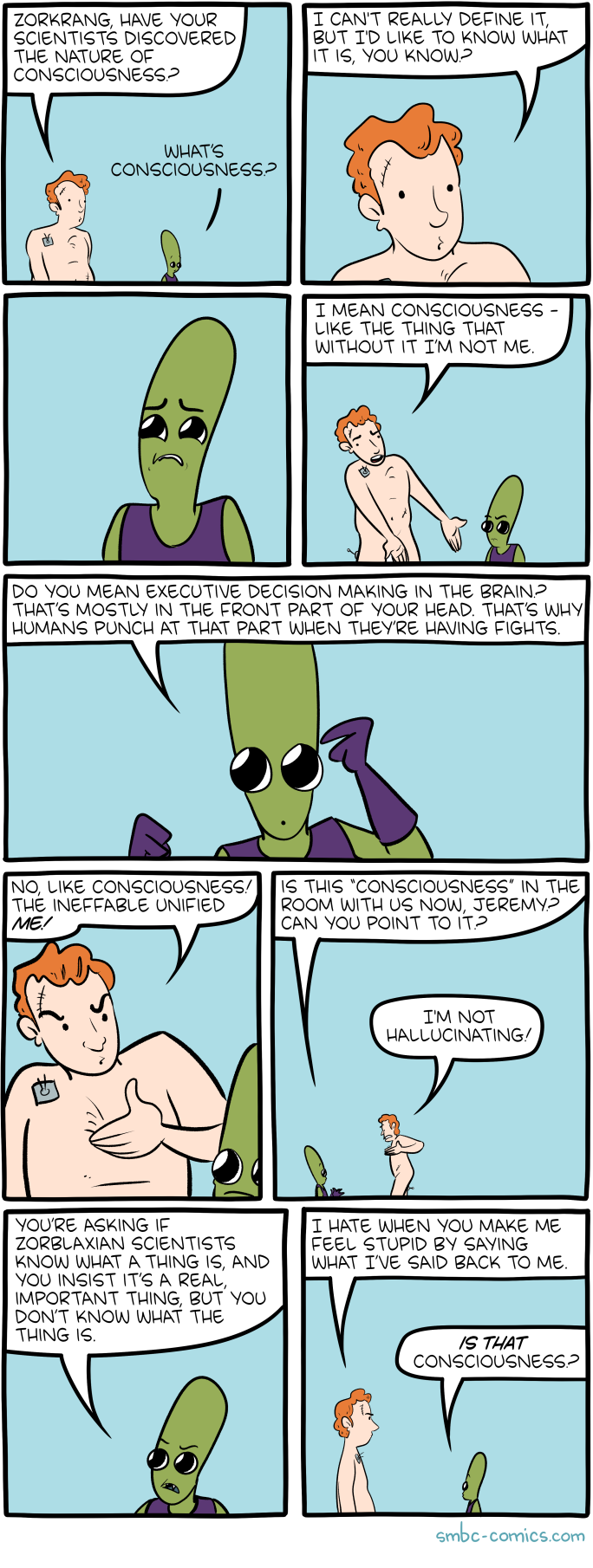
Hovertext:
Looking forward to the SMBC consciousness book, which you'll think you're experiencing as moderately funny, but that is only the illusion of unity.
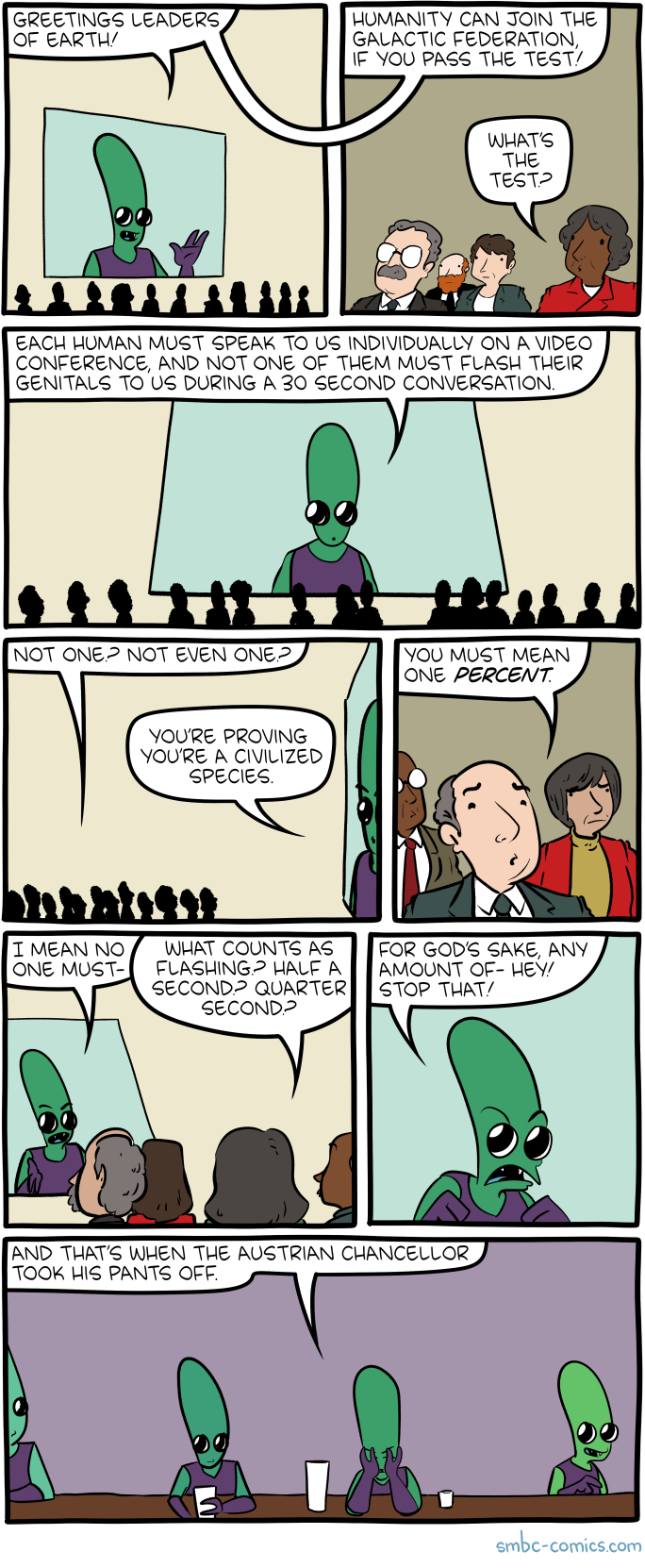
Hovertext:
What do chancellors do anyway? Do they chancell? And who is being chancelled?
Taser and surveillance vendor Axon has proposed what it claims to be the solution to the epidemic of school shootings in the United States: a remote-controlled flying drone armed with a taser. For many many reasons, this is a dangerous idea. Armed drones would mission-creep their way into more every-day policing. We must oppose a process of normalizing the arming of drones and robots.
EFF has stated strongly before that drones and robots, whether they be autonomous or remote-controlled, should not be armed–either with lethal or “less-lethal” weapons. And we’re far from the only group to do so.
Police currently deploy many different kinds of moving and task-performing technologies. These include flying drones, remote control bomb-defusing robots, and autonomous patrol robots. While these different devices serve different functions and operate differently, none of them—absolutely none—should be armed with any kind of weapon.
Mission creep is very real. Time and time again, technologies given to police to use only in the most extreme circumstances make their way onto streets during protests or to respond to petty crime. For example, cell site simulators (often called “Stingrays”) were developed for use in foreign battlefields, brought home in the name of fighting “terrorism,” then used by law enforcement to catch immigrants and a man who stole $57 worth of food. Likewise, police have targeted BLM protesters with face surveillance and Amazon Ring doorbell cameras.
We cannot state this strongly enough: if police get their hands on taser drones, they will not sit in a warehouse until the next emergency mass shooting situation. History has proven this. We will see them flying over protests and shopping districts. We will hear news stories about police using a drone to taser someone for vandalism, petty theft, or fleeing the drone. It will not be a matter of if, but when.
Police will be more likely to use this kind of force if the entire process feels like a video game—if they can send tens of thousands of volts through a person’s body with the push of a button far removed from that person. And the person at risk of being tased might not hear the drone’s commands or may be confused by the presence of a floating robot.
Police use of tasers have killed over 500 people since 2010, according to a study on the lethality of the technology done by USA Today in 2021.
The Axon Ethics Board has voted firmly against Axon moving forward with this project.
Armed drones are just one part of a multi-part strategy from Axon for selling products that they claim might curb mass incidents of gun violence. Axon has also announced a partnership with Fusus, a company that specializes in consolidating private security camera feeds and giving police live access. EFF raised concerns in 2020 when police in Jackson, Mississippi, announced a pilot program with Fusus to get live access to video streams from private cameras, ranging from commercial security cameras to resident’s private Ring doorbell cameras.
This would create, with the permission of the camera owners but not the people who walk by them every day, a massive surveillance network. Like drones, it will ultimately be used by police much more often than in rare critical emergency situations.
We’ve seen this before. Time and time again, police conjure the extreme worst-case-scenario threat in order to deploy extraordinary powers, which end up being used in everyday acts of policing which disproportionately affect the lives of people of color, immigrants, and other vulnerable members of society. Before these tools are deployed, we demand that armed police drones never see the light of day.
Axon has announced a Reddit AMA here on Friday, June 3, 2022, to ask questions about these new products. Ask questions about your concerns. You can ask questions like: How do you feel about making a dangerous technology that will likely be used in other less dire scenarios than their preferred use case? Why has your ethics advisory board condemned the project? Will that stop you?
Disclosure: EFF's Surveillance Litigation Director Jennifer Lynch serves on the Axon AI Ethics Board in her personal capacity.

A 14-year-old student spells 21 words correctly during a 90-second spell-off to claim the annual competition.
(Image credit: Jose Luis Magana/AP)

Top Gun: Maverick is finally here after years of waiting, so how does it stack up against the other Top Gun 2? You know, Top Gun: The Second Mission for the NES! Which is better? The game? Or the movie? That’s the battle we’re going to settle today!
Top Gun: Maverick is directed by Joseph Kosinski and stars Tom Cruise returning as Captain Pete “Maverick” Mitchell. Set 36 years after the original 1986 film, Maverick returns to the Navy’s Top Gun program to train a new class of young pilots, including the son of his deceased best friend Goose, “Rooster” (Miles Teller). Maverick must not only confront his past, but also prepare the new pilots for mission that seems impossible. Also starring Jennifer Connelly and Val Kilmer returning as “Iceman”.
Last night, twenty-one year-old Brian Hernandez broke into the Dallas Museum of Art (DMA) and purposefully destroyed display cases, furniture, a computer, phones, and multiple artworks, including three ancient Greek vessels and a Cado bottle. Mr. Hernandez reportedly told the museum’s guards that “he got mad at his girl so he broke in and started destroying property.” Dallas police say that he did approximately $5.153 million in damage.
Around 9:40 pm Mr. Hernandez broke the museum’s glass entrance doors with a metal chair. A DMA security guard was alerted to Mr. Hernandez’s presence in the museum by a motion sensor. Mr. Hernandez was not armed, and the guard apprehended him prior to calling the police.
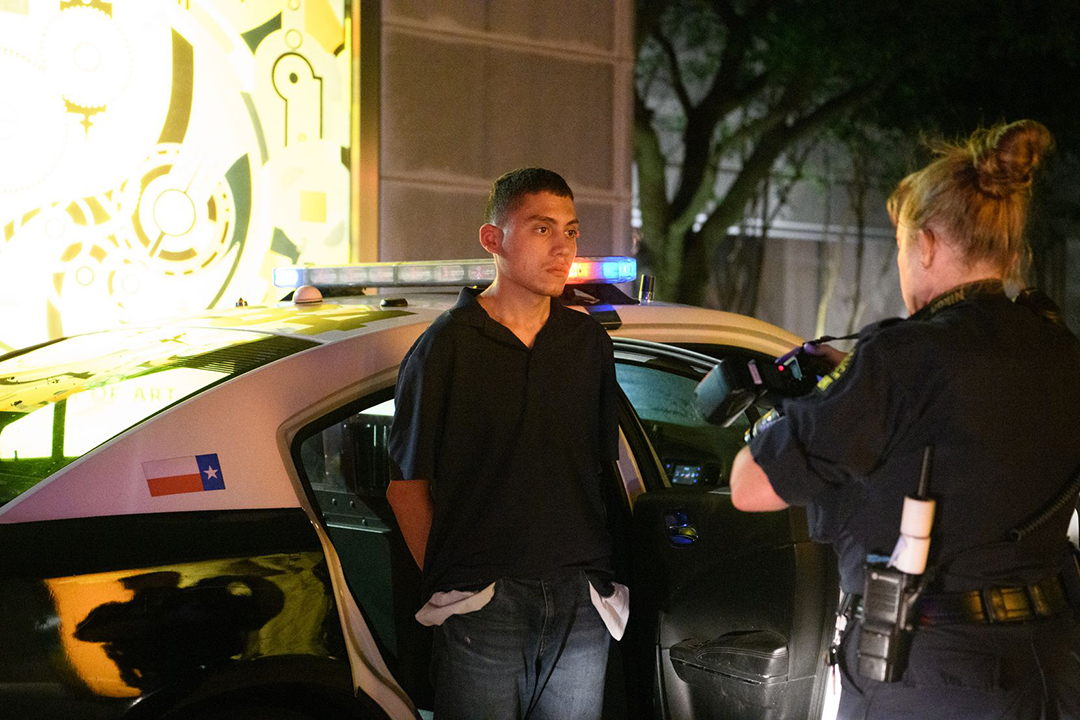
A Dallas Police Department crime scene analyst photographs Brian Hernandez outside the Dallas Museum of Art after he was apprehended Wednesday. Photo credit: Avi Adelman/The Dallas Morning News
In a public statement posted on the museum’s website, the DMA remarked, “This was an isolated incident perpetrated by one individual acting alone, whose intent was not theft of art or any objects on view at the Museum. However, some works of art were damaged, and we are still in the process of assessing the extent of the damages. While we are devastated by this incident, we are grateful that no one was harmed. The safety of our staff and visitors, along with the care and protection of the art in our stewardship, are our utmost priorities.”
The museum is open to the public today and has resumed normal operations.
The post Over $5 Million of Art Destroyed During Dallas Museum of Art Break-In appeared first on Glasstire.
Claudio Feliciani, co-winner of the 2021 Ig Nobel Prize for kinetics, is the subject of an NHK-World TV special, which you can watch online. NHK explains:
Claudio Feliciani is a Swiss-Italian scientist whose main interest is the movement of crowds. He worked alongside 3 Japanese scientists on a study that examined why people bump into each other when some of them are looking at a smartphone. It won an Ig Nobel Prize, which honors research that first makes you laugh, then makes you think. In a Japanophiles interview, Feliciani tells Peter Barakan how he ended up in Japan, and why he finds crowds so fascinating.
 The Knox Gelatine Cookbook
Rutledge Books, Inc, Knox Gelatine, Inc
1977
Submitter: Just in time for those summer gelatine/Jello salads – who wouldn’t want calico corn relish, creamy cranberry relish, or a zesty seafood appetizer in gelatine? The pictures just make my…mouth water would not be the right phrase. This one is off to the sale cart.
Holly: That corn thing looks disgusting, and I’ll eat just about anything! What was the obsession with gelatine in the 70s?? Especially paired with weird things like fish.
Mary: Jell-o-type products should only be used with fruit cocktail and maybe some whipping cream, if you want to be fancy. Even reading a recipe of one of these “savories” makes me gag.


The post Just No Gelatine! appeared first on Awful Library Books.
This post, updates: teaching with cancer, moving in with a coworker, and more , was originally published by Alison Green on Ask a Manager.
Here are three updates from past letter-writers.
1. Teaching with a cancer diagnosis (#5 at the link)
I wrote to you at the end of last year, wondering if I should share my breast cancer diagnosis with my college students. I was concerned about burdening them. You and the commenters were beyond helpful. I read the comments early one morning, while lying in bed, and just cried. I was so overwhelmed by all the support.
I took your (and the commenters’) advice, and matter-of-factly addressed things during our first class session. I said something along the lines of: “we’re meeting over Zoom this term because I am being treated for breast cancer. I’m telling you this because there will be times when I will wear different wigs or head coverings, and I don’t want you to feel awkward about noticing or concerned. Because of my treatment schedule, I will be a bit slower on returning graded assignments, and I will be completely unavailable over the weekends. But that is the only impact on you, and I appreciate your understanding.” You and the commenters were right – the students were very adult about everything, and many sent me notes of support. I am so glad I shared my diagnosis with them. The vast majority of them respected my weekend absences (which was a healthy boundary to draw regardless of the cancer!).
When I wrote to you I was still so raw from the diagnosis, and feeling what I now recognize was internalized shame. The type of cancer I have is rare, and most frequently occurs in obese women. So I was feeling a lot of shame and thoughts that I had somehow brought this on myself by being overweight. Obviously, that is not true, but I recognize now how deep that shame was and how it was affecting my difficulties deciding to disclose the diagnosis.
For others facing similar health issues, I do encourage you to share what you are willing with your communities. Both my department chair and dean have been quite supportive, and I have been impressed with my students’ maturity. Thanks to everyone who offered advice about pausing the tenure clock. I get an extra year because of COVID to begin with, and can apply for additional time (and probably will) any time until I submit my file for promotion.
I finished chemo earlier in the spring, and am now recovering from surgery. It is still a long road ahead, and I will have to have similar conversations with my classes next fall and spring. But I will head into those discussions prepared with the advice from you and your commenters, and more confident in myself. Thank you again for your compassion and your advice.
2. How can I tell a good employee she’s not likely to advance here? (#3 at the link)
I wrote to you a little over a year ago about an employee looking to advance on a team where there wasn’t much room for advancement. Everything ended up working out in a very roundabout way!
A few months after I wrote to you, a position did open up that would have been a step up for my employee. She took on a lot of extra responsibilities at a time when our team was very short staffed. I did have some talks with her about moving into the vacant position and hoped she would apply.
The day that the posting was closing, she ended up putting in her notice. She had found a position with a shorter commute, higher salary, and more WFH time than we could offer! I was (and still am) really happy for her! This was all a couple months ago. We just took her out to dinner to celebrate her new job since our office was closed for covid on her last day. She seems like she is excelling in her new role as well!
I was finally able to get all the positions filled on my team and we are no longer short-staffed. I have been very open with my new staff about professional development and my support for their next career steps, wherever those may be. One of my new employees has only been here a few months and already applied for a year-long leadership development program and another is interested in going next year. It just makes me really happy to see them all working toward their goals and I’m happy to be here to support them!
3. My partner and I both work from home … and we’re moving in together
It’s been great! Who knew living together could be so easy.
I’ve found that I love going back to the office more, so have been heading in 3-4 days per week and my partner goes in at least once per week. We typically only work at home together on Fridays, when he sits at the dining table (on a proper computer chair) and lets me have have them study with the proper desk. I really appreciated all the advice re. Fitting a second desk in the main bedroom, but to us it was more important to have a separation of where we sleep and work.
Neither of us often works past 6pm (and never on a Friday!) and everything work related other than the computer chair gets cleared every evening.
This post, how do you tell a company that this is truly your dream company/job? , was originally published by Alison Green on Ask a Manager.
A reader writes:
I have a second interview with a company I have been working towards my entire career. They only hire experienced candidates, and I’m finally at that level. I’ve also freelanced for this company, which was a wonderful experience.
How should I — or should I do this at all? — tell them how serious I am, not only about the specific job, but about working for the institution itself? I don’t want to come off as some deranged fan, but I would like to underscore how much I want the job (and honestly, I would do just about any job I am qualified for at this institution). How much emphasis should I place on this when explaining why I want to work there — I assume saying I’ve spent my entire career wanting to work there is overkill?
By the way, of course I know that “dream jobs” don’t truly exist. But this is close, and the institution has a great track record of how it treats its employees.
The thing about expressing intense enthusiasm — dream job level enthusiasm — is that very few jobs hire people because they’re wildly enthusiastic. They want to see a baseline level of interest, of course. But once that box is checked, having extra high levels of it doesn’t add that much. After all, they’re not going to hire you because you really want to work there; they’re going to hire you because you seem like you would excel at the work (at least at healthy companies, which are the ones you want to work for).
There’s also a point where it can become a negative. If you seem like you have rose-colored glasses on, interviewers will worry about whether you’re being realistic about what working there will really be like and how well you’re able to assess whether it’s really the right fit for you.
So you want to aim for a middle ground — interested and engaged, but grounded about it too. It’s this difference between this:
“This has always been my dream job! I’m so excited to be talking to you. I’ve always wanted to work here.”
and:
“Since the start of my career, I’ve been really interested in X Org’s work because of your focus on ___ and the unusual approach you’ve taken to ___. I’ve always hoped there might be an opportunity to work together and be part of your ___.”
The second one still expresses genuine interest, but it grounds it and adds more nuance (plus you sound informed!). Since you’ve freelanced for them in the past, you could potentially reference something specific from that experience too.
Also! Passion for the work is a different thing — someone who fully nerds out talking about their love of, say, data or customer service or llama grooming (or whatever the job is focused on) is much more exciting than someone who’s really focused on loving the company itself.

Ever wanted to build a dashboard for your secret time machine? You know, where you can see your current date, and your destination date before embarking?

This post, did my mom ruin my chances for a job, my ex’s now-wife applied for a job on my small team, and more , was originally published by Alison Green on Ask a Manager.
It’s five answers to five questions. Here we go…
1. Did my mom ruin my chances for a job?
I applied for an IT position at a hospital that my mother has worked at for nearly 30 years as a nurse. When I told her I was applying in casual conversation, my mom was adamant that I needed to name drop her in a cover letter and point out the family connection, and that I had visited the hospital many times in my teens/early 20s for random chitchat or to drop something off.
When I refused to do so, citing fear of looking like I wanted special favoritism based on my mom’s career, she decided to message the IT team asking what credentials I would need and what I could do to get an edge. (She says she didn’t name me and asked as a general question, but she also apparently talks about me a lot at work.) She didn’t really get a response beyond “read the posting and apply.” She told me this is “the done thing” and is completely acceptable and even expected in the professional world and you need to “use every asset you have.”
As I expected after that, I was rejected without an interview at all. I’m under the impression that it would be career suicide to do something like that, as I was applying for an IT job and she’s a nurse, so it’s not like the careers overlap. Plus having your parents try and influence your hiring would make me look immature.
Is she right that name dropping a family member can help benefit my application, even if not in the same field, or am I right that it’s best to not mention family connections/experience in a resume/cover letter? I’m also in my 30’s so I have an established career of my own and am not straight out of school.
It’s not career suicide in the sense of being an automatic deal-breaker. It wasn’t a great move on your mom’s part — asking what credentials you need likely came across strangely since presumably that info is in the job post, and asking how you could get an edge probably seemed pushy and a bit naive — but it wasn’t so over-the-top that it would reflect terribly on you. That stuff reflects more on her. Still, though, it might have raised worries for the hiring manager that your mom would continue to be pushy if they interviewed and/or hired you. That’s not necessarily why they rejected you, but it’s possible that it played a role.
Your mom is right that people use their connections all the time, but this isn’t exactly how to use them. It would have been better if you’d applied on your own (not mentioning your mom since that’s not about your qualifications) and then she had mentioned to the hiring manager that you did, but without asking for any special treatment. That kind of low-key flagging from a current employee will often get an application a closer look. At this point, though, I’d be a little wary of having her do that with jobs in the future since it sounds like her instincts for how to go about it are … not great.
2. How do we advertise salary range when it could vary hugely depending on the candidate?
I know from reading your column that it’s not appropriate for an employer to ask a candidate to name their desired salary before indicating the salary range of the position, preferably in the job posting. With that in mind, what should be put into the job posting when the salary will be very dependent upon the experience and skills of a candidate, with a more than 1.5X salary range, and how should it be presented during any interviews?
I’ve long been involved with a nonprofit that’s been quite successful. In the early days, money was extremely tight and it was impossible to find a qualified, experienced manager for the salary we could pay. After a series of short-lived and incompetent managers, another board member and I selected an employee we thought had potential and undertook her training ourselves. The result was someone who excelled in certain areas, but has had continued issues in other areas. We had to continually step in to be more active in some areas than ideal but, because of her strong skills in other areas, we’ve accepted the weaker ones.
Now she’s looking at moving on and we’re starting the hiring process from scratch. She’s currently paid an average salary for our area and the field. The organization is in a much stronger financial position now and we’d be able and willing to pay significantly more if we find that magical person who won’t require the level of oversight and assistance we’ve been providing, together with exceptional skills in the other areas.
We live in a very rural area with an extremely limited candidate pool.
We don’t want to discourage someone who might excel in all areas from applying if we state a starting salary in the range she’s currently receiving, but also don’t want to be tied to a higher range if we once again have to accept someone who requires our continued oversight and guidance or who can’t provide the exceptional skills she’s had in the other areas. Is there some way to maintain very wide variations on the potential salary until we determine the qualifications of a candidate without discouraging one group or raising unrealistic expectations from the other?
The easiest way is to be transparent about it in the job posting! For example: “We’re open to two different versions of this role — one mid-level and one more senior. For the mid-level role, we’re seeking (qualifications) with a salary range of $X-Y. For the more senior version of the role, we’re seeking (qualifications) with a salary range of $Y-Z. We encourage you to apply if you meet either profile.”
3. My ex’s now-wife applied for a job on my small team
I was in a long-term relationship that ended several years ago. Generally, we were not good for each other in the romantic sense, and things ended on a not-so-great note. Fast forward to today: I am now happily married with a baby on the way. He is also married, though I have not spoken to him, nor do I know his partner in any way. He met her toward the end of our relationship, and there is a possibility that he emotionally cheated on me with her. Again, I have moved on and do not care.
I started a new job in the last six months in a small department. I recently found out from my coworker that my ex’s wife has applied for an open position in our department. The position is not located in the same building as mine, so interaction would be limited to team meetings that happen maybe once a month.
Being so new, I want to be as professional as I can be (especially now that I will be leaving for maternity leave before my first year anniversary with the company). I can easily put the past behind me and be polite and professional with this person. I am unsure of how she would react though, and this situation has potential to be very awkward. Should I flag this to my boss?
Unless you have reason to think your ex’s wife wouldn’t handle the situation professionally, I wouldn’t be terribly worried, especially since you wouldn’t be working together closely.
That said, I tend to believe more information is better than less, so you could mention it to your boss and let her make the call on whether it’s something she wants to consider. If you do, be clear that you don’t have any reason to think poorly of the candidate or to think she’d conduct herself unprofessionally but are just flagging it in case she wants to be aware of the connection. You could frame it as, “I don’t know her at all and I’d have no problem interacting with her just like I would with any other colleague, but I figured I’d mention it in case it’s the kind of connection you’d rather know about.”
4. Asking an interviewer, “What is your company’s greatest weakness?”
What do you think about asking the interviewer this question: “What is your company’s greatest weakness?”
It’s common for job applicants to be asked what their greatest weakness is, and it seems that turnabout would be fair play. However, I’m concerned that such a question may be unwelcome. As applicants, we have great concerns about taking a job at a company and then regretting it later. Job boards that have company reviews are often lacking, especially for smaller or newer companies. Asking about company culture usually won’t indicate if the boss is a jerk, or if many of the employees are unhappy. I think this question might be useful unless there’s a better question to ask.
You won’t get honest answers. Interviewers aren’t going to tell you the boss is a jerk or all the employees are unhappy (or at least this question won’t get it out of them if asking about company culture didn’t). In general, you should always assume that you can’t rely on what employers tell you about themselves since even interviewers who don’t intend to mislead you can have significant blind spots or feel that loyalty to their employer prevents them from being completely candid. Instead, assume you’ll always need to do your own due diligence outside of your formal interviews.
5. Exploding field: privacy specialist
I feel like this might be of interest to your readers who are looking to change direction.
I recently shifted gears into a data privacy specialist role, which literally quadrupled my salary and I got hired at a FAANG company with basically three months of relevant experience under my belt. Data privacy is an almost brand-new field since the EU passed the GDPR, and California passed the CCPA, and now a whole ton of companies that handle any customer or employee data a) anywhere in Europe or b) anywhere in California require regulatory specialists in the field. It is a hiring FRENZY at all levels, and the primary certification costs around $1200 and takes about 10 weeks. But I got hired with “certification expected April 2022” on my LinkedIn, as I was studying for the certification and got snapped up before I got around to taking it! I do have a law degree (some of my colleagues do; some don’t), but I was hired at a FAANG company for around $140k a year, plus signing bonus and stock. My total comp with stock included is close to $250k/year.
I am 44 with a wildly spotty work history, as I have a disabled child whose needs put me out of the workforce repeatedly. I had done exactly one three-month, very small privacy project for my former employer. Now I’m going to be able to create a special needs trust for my kid, and eventually retire!
Anyway, it’s an entirely new regulatory regime that’s come into existence in basically the past two years and EVERY company has to comply with it if they do ANY business in the EU or in California — and more states are passing laws every day (Colorado, Utah, Virginia, Connecticut …). AAM job seekers who are willing to do a privacy certification will instantly be very attractive to companies — everybody needs privacy regulatory specialists, but the profession basically didn’t exist before two years ago, so NOBODY has any experience, and it’s a wild west of “we will hire you whatever your relatively minimal qualifications are.” Not everybody is hiring at FAANG salaries, but EVERYBODY is hiring unless they are flatly bailing out of California.
Consider it passed along!