In the first test of its kind since the Dobbs ruling, Kansas voters have decided not to amend the state constitution, keeping abortion legal in the state — for now.
(Image credit: Danielle Kurtzleben/NPR)

In the first test of its kind since the Dobbs ruling, Kansas voters have decided not to amend the state constitution, keeping abortion legal in the state — for now.
(Image credit: Danielle Kurtzleben/NPR)

Taxpayers spent $15 million on research to build a breakthrough battery. Then the U.S. government gave it to China.
(Image credit: Jovelle Tamayo for NPR)

Sk8er Boi’s band’s sophomore album did not chart, and they broke up in 2004. In 2016, Sk8er Boi attempted a comeback as an alt-right rapper but failed to generate buzz for his single, “Don’t Sk8 on Me.” He is now trying to push his own cryptocurrency, Sk8erCoin.
With the help of a qualified therapist, A Girl realized that her boyfriend was a gaslighter and that she was allowed to feel sad sometimes. For example, crying when her grandpa passed away was not “drowning the whole world.” The last straw was when A Girl gave him a framed photo of the two of them, and he told her he would absolutely prefer the photo if she were smiling, then called her “babe.”
In 2005, she dumped him and moved to Central Oregon, where she works as a whitewater rafting guide. She does not hide her pretty face, isn’t lonely, and enjoys cheekily telling her passengers that the river is not made of her tears.
Delilah and her beau finally connected in New York City. Their time in NYC was magical but short-lived, as it turned out he was unable to pay their bills with that guitar. The two decided to get married, have a child, and generally have the life they knew they would, despite a recent explosive argument where Delilah’s husband said she was not as bright as Times Square and never had been.
For twenty years, the now not-so-little girl has remained on the ride, decreasingly confident that everything will be all right, and increasingly concerned about what people have been telling themselves this whole time she’s been away.
To better understand why her tears were falling at night, Lucky went on an ayahuasca retreat in Peru in 2003. While under the influence, she realized she no longer wanted to be an actor and instead wanted to pursue cooking. She attended the Culinary Institute of America, and in 2008 opened her first restaurant, Lonely Heart of Palm.
Roger Johnson, a restaurant critic formerly with Pop News, covered the opening ceremony of Lucky’s second restaurant for the New York Times in 2018, writing, “The real star is the crispy Yukon potatoes!”
Immediately after this guy claimed that despite extensive video and material evidence, it wasn’t him who was creeping with the girl next door, his girlfriend laughed in his face and left him.
This experience did not deter him from telling outlandish lies. The fifty-four-year-old was recently fired from Chick-fil-A after dropping a joint in the fryer and saying it wasn’t him, even though the incident was captured on a cell phone by a coworker. “Old Guy Deep Fries Weed, Says It Wasn’t Him” has been viewed over seventy million times on TikTok.
After looking into the costs associated with moving to Vegas, the couple decided that it would probably be in their best interest to finish high school. They parted ways shortly before graduation after a heated altercation stemming from a conversation about whether or not the Madden twins were posers.
Years later, at the last Warped Tour in 2019, they crossed paths again. They were married to other people, but saw each other immediately and ran past the Vans merch table to embrace. She said, “What?” He told her that he didn’t know. A single tear rolled down his cheek.
They then divorced their spouses without a fucking explanation. Currently, they reside just outside Reno.
Nona Jones-Blalock, formerly known as The Girl All the Bad Guys Want, became a born-again Christian in 2010, trading in her nose ring, reefer, and a forty for a tenty-four-karat gold cross necklace and a sweater set from J. Jill. Nona is currently running on an anti-abortion and anti-immigration platform for state legislature in Arkansas. She hired the most expensive PR firm in the Little Rock area to cover up her past.
The Guy Who Wanted the Girl All the Bad Guys Want still can’t grow a mustache, had his moped repossessed, and is the moderator of an incel group on 4chan.
Shawty completed the software engineering degree that she had been working on while dancing part-time at the club. She traded her Apple Bottom jeans for a job at Apple in 2015. While she has fond memories of her club years, she is much happier with her current role. Shawty has generous stock options and not one client has compared her to a sexy kitchen appliance. She also works remotely, allowing her to wear baggy sweatpants as much as she likes.
Sadly, Shawty seriously injured her ankle at her cousin’s wedding this June while attempting to prove she could still get low. She is currently undergoing physical therapy and hopes to be able to comfortably wear shoes other than wide-width boots (with the fur) in a few months.
Mr. Brightside returned to his cage, where he has remained for the past fifteen years after getting caught opening up his eager eyes too far and becoming a convicted sex offender. When asked, he tells people he’s doing just fine.

"Star Trek" has endured for decades as a beacon of hope as we try to strive toward a future where humanity has allowed bigotry and prejudice to become relics of an antiquated past. Gene Roddenbery's sci-fi adventure series presented a world that has embraced the thrilling concept of new discoveries just waiting to be found in the cosmos. With just three seasons, the original run of "Star Trek" became one of the defining shows of the '60s, one of those reasons being the diverse casting aboard one of Starfleet's most famous vessels.
On July 30, 2022, the U.S.S. Enterprise lost its Chief Communications Officer in Nichelle Nichols, who passed away at the age of 89. Her tenure as Uhura left a considerable impression in the hearts and minds of Trekkies, but most importantly, she set a trailblazing example as one of the first major recurring roles given to a Black woman on television. Nichols was also front and center with the small screen's first interracial kiss with co-star William Shatner.
If you really want an idea of how vital her legacy aboard the Enterprise was, it was none other than Dr. Martin Luther King Jr. who convinced Nichols to stay on after she expressed doubts about remaining on the show. It was the endorsement of a lifetime, and she knew it.
It can't be understated how revolutionary it was to see a Black woman in a meaningful role on television. And while "Star Trek" will continue to define her legacy, Nichols' work off-set effectively changed the space program as we know it.
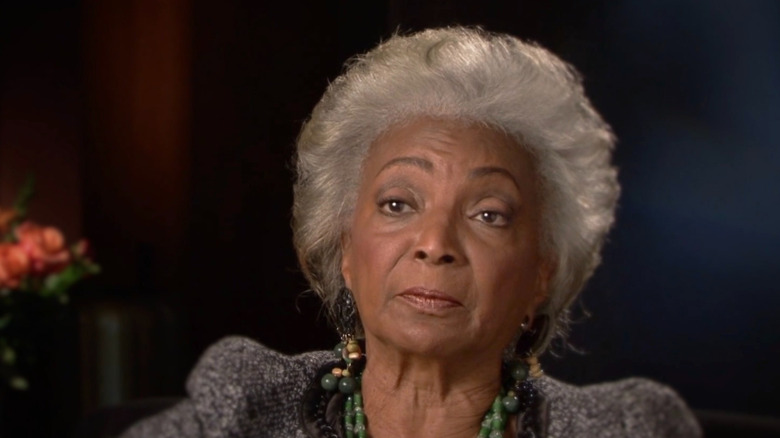
It wasn't enough that Nichols pretended to live among the stars -- she had the spirit and determination to reach for them too, or at least make them accessible to people who never would have been given the opportunity.
"Woman of Motion" is a wonderful documentary that chronicles Nichols' from her days aboard the Enterprise to the future that she envisioned all those decades ago. Within the film, Nichols speaks about the complications of watching a national event like Apollo 11 landing on the moon. She was in absolute awe of the achievement, but was dispirited by the sea of white men that made it happen. People had looked up to her because she provided the kind of representation that didn't exist on television, and now she was in a place where she wanted to see women and people of color celebrating these victories .
Of course, the notoriety of her time on "Star Trek" allowed Nichols the chance to make her thoughts known on the inequalities happening at NASA through a series of articles highlighting the systemic oversight of the predominately white male participants. In 1977, Nichols was appointed to the Board of Directors for the National Space Institute, which ultimately set the stage for a speech that would set the wheels of change in motion.
As she explains in "Woman in Motion," Nichols addressed over 3,000 members at their annual board council meeting, asking the entire room of white men, "Space, what's in it for me?" She saw impossibilities become possible, and wondered why women and applicants of color were being shut out of the chance to experience these miracles. NASA heard Nichols, and wondered where to go from there.

In affiliation with her inclusive production company, Women in Motion, Nichols became a recruiter for NASA. There were a slew of discrepancies in their system, and she was going to correct them. According to Nichols in "Woman in Motion," applicants of color didn't apply because they didn't believe NASA was serious in giving them a fair shot." She made it explicitly clear that if her role conjured no new results from within the program, she was going to rip them apart by any means necessary:
"I will bring you so many qualified people, you will have no choice. And if I have done my work and it's still an all-white male Astronaut Corps, I will be your worst nightmare because I will file a class action lawsuit against you. I will go and speak before Congress, and I will expose what I have done."
After going through the astronaut training program herself, Nichols set out to recruit as many applicants as she could throughout every corner of the United States. She was also involved in a bunch of recruitment videos. Even when the Pentagon tried to play the intimidation card, saying she couldn't interfere with any of their recruitment, Nichols hilariously fooled them into confirming a loophole, which allowed her to seek out potential recruits that weren't already on their list. It just made it easier for her to find the kind of people she was looking for, as she could advise them to apply directly to NASA.
Applications went from 1,500 to 8,000, with over 2,649 of them being from the applicants she'd been fighting for.
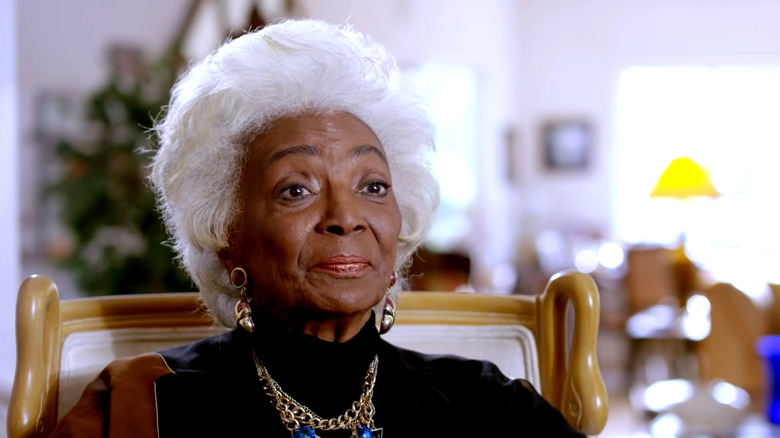
It's spectacular how Nichols not only set the path for fellow "Star Trek" alum such as Whoopi Goldberg, LeVar Burton, and Sonequa Martin-Green, but also true space pioneers. Without her, Guion Bluford wouldn't have become the first Black man in space. Frederick Gregory wouldn't have been the first Black man to pilot a space shuttle. Sally Ride and Judy Resnik, who became a close friend of Nichols, wouldn't have set the stage as some of the first women in space.
Nichols' presence at NASA came full circle in 1992 when Dr. Mae Jemison became the first Black woman astronaut ... and also appeared in a brief cameo in an episode of "Star Trek: The Next Generation." Of course, Nichols was there on set to see it all unfold.
Nichols' recruitment tour may have only lasted about four months, but if you look at the legacy she left behind for the future of NASA, it's hard to see anything but a trailblazing effort on her part. Nichols got to play pretend within a much more inclusive vision of the future, and in turn, make her own.
In the event we can pull ourselves of this dark hole we, as a species, are currently trapped in, the potential Starfleet of our world will have an origin that can be directly traced back to a kind-hearted and determined woman who wanted to be the first Black ballerina, and instead, embraced the prospect of a better future. She will be dearly missed. Live long and prosper.
"Woman in Motion" is currently available to stream on Paramount+, Peacock, VUDU and Kanopy.
Read this next: Every Star Trek Show And Movie In Chronological Order
The post After Star Trek Ended, Nichelle Nichols Went To Work For NASA appeared first on /Film.


Two Washington Post journalists say pharmaceutical companies collaborated with each other — and with lawyers and lobbyists — to create laws to protect the industry. Their new book is American Cartel.
(Image credit: Patrick T. Falon/AFP via Getty Images)

Four of us went down to Las Cruces for Joey Fauerso’s opening on June 10. A few days later I sent Joey some questions.
Hills Snyder (HS): Is your work cinematic?
Joey Fauerso (JF): This is a good question. What do you think? I would hope that some of the pieces function that way. When I think of something being cinematic, I think of a transportive experience, something that is immersive and uses scale to trigger an emotional, physical experience in the viewer. I recently saw Ryûsuke Hamaguchi’s film Drive My Car in the theater with my brother, Neil. It was such a beautiful movie; the sound design blew me away, you physically felt like you were inside of the scenes, sometimes inside of the body of the characters, almost like some of Janet Cardiff’s sound installations. With my video works, I love the editing process — the rhythm and orchestration of editing across multiple screens. I guess in all of my work, the physicality is really important. A lot of my work resides at the intersection of painting and performance. One of my favorite all-time works is Jasper Johns’ painting Bitten by a Man from 1961; it is so direct and immediate, it feels like it just happened, and that maybe you were the one who took the bite. Getting back to the cinematic, I would like to continue to push the scale of my work, both with the videos and paintings.
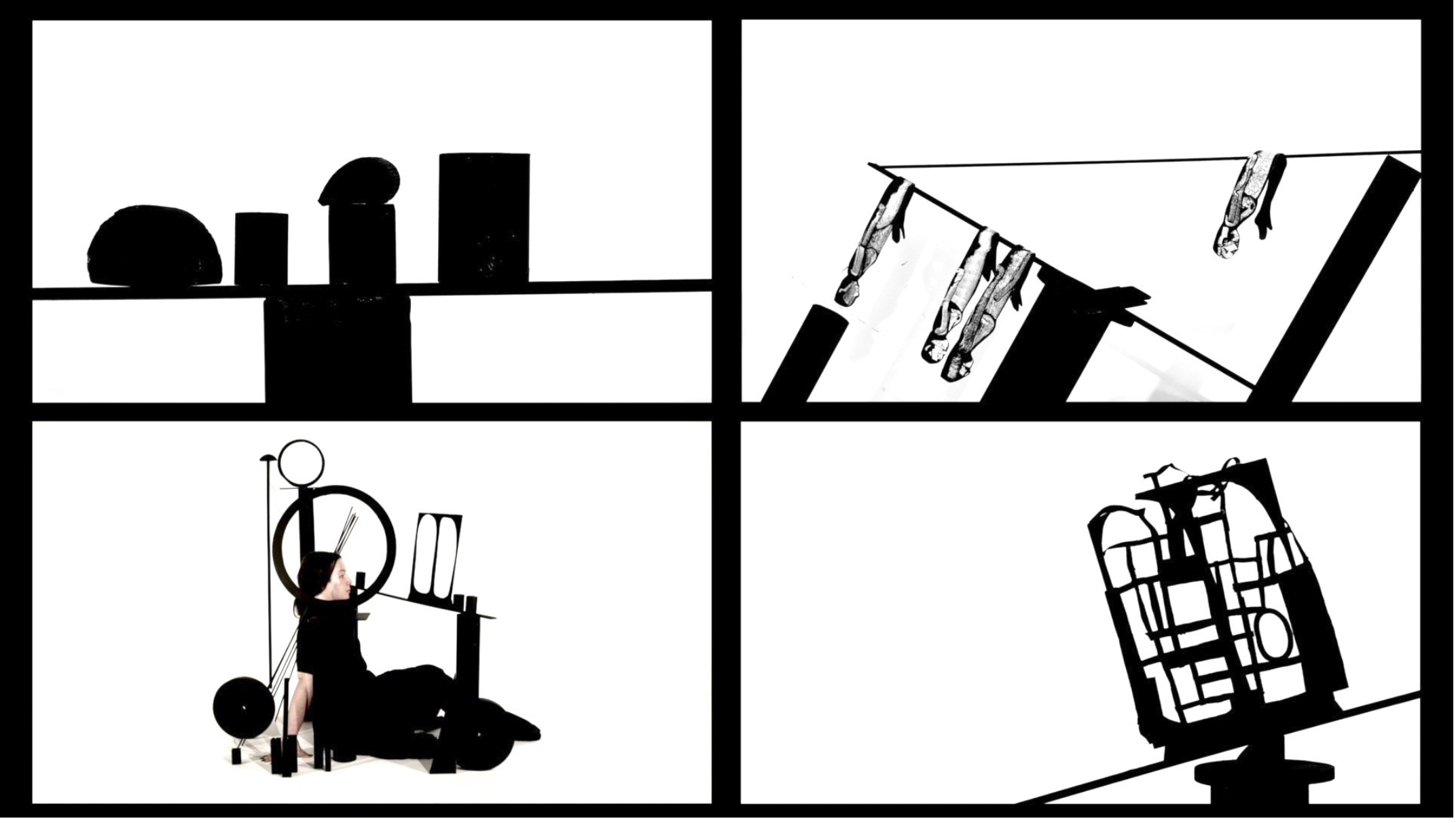
Joey Fauerso, “You Destroy Every Special Thing I Make,” 2017-2019, 4-channel video, 10:00. View the piece here.
HS: My question was spurred by those wall-mounted pieces that project the frame of the piece outward toward the viewer via an oblique three-dimensional drawing made of quarter-inch painted steel rod. They read as tiny theaters, drawing focus from the viewer. The one I’m picturing features the profile of a leg, cut off by the frame or seemingly slid-in to a thin space as in a magic trick. For me, cinema is about a camera enclosing my vision in its point-of-view. I’m thinking right now of the way Altman likes to linger on a peripheral object in a scene just as the action is leaving that scene for whatever is next. This is the camera sharing insight with the viewer, as if we in the audience are being shown the elephant in the room, even as it remains invisible to the characters. Additionally, these frames of yours are almost like a two-point perspective invitation to look into a stereopticon. So yes, I think your work is cinematic.
I have to wonder if the sensuous qualities of molten encaustic might have been what invited Jasper Johns to bite that painting, possibly as you say, spontaneously. In this bite, I see a kiss given to Francis Bacon’s Head VI, 1949, which incidentally also features that oblique linear cube enclosing the image of the figure, a framing device quite similar in construction to your three-dimensional version made of quarter-inch rod.
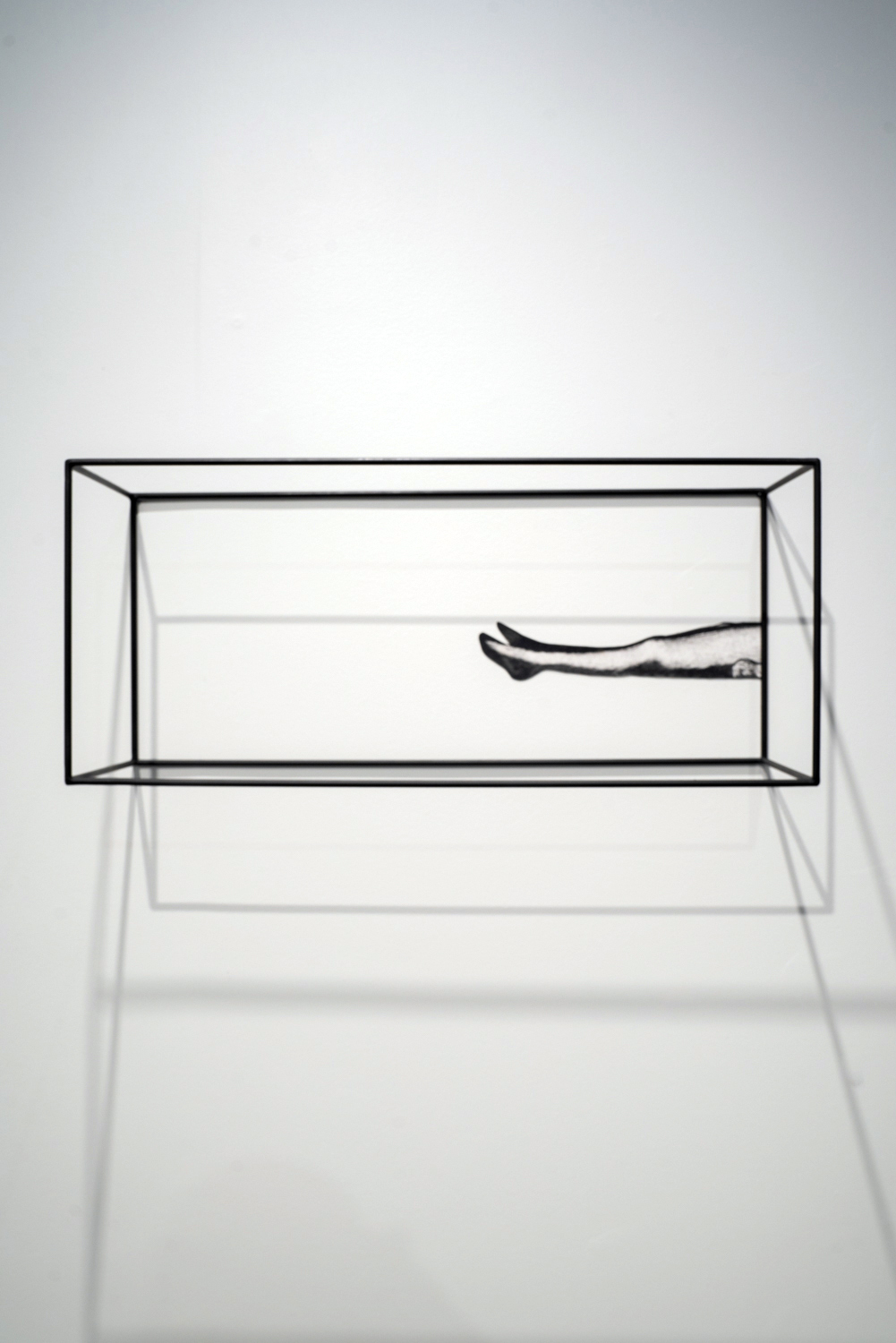
Joey Fauerso, “Relax Your Face,” 2022, painted canvas and steel, 13 x 30 inches.
JF: Oh man I was just looking at Bacon’s Head VI — what a beautiful and terrifying painting. It reminds me how influential he is to so many artists now and throughout the second half of the 20th century. Also, I love what you wrote about the painting being a kiss and a bite, that is a wonderful, complicated image. I think your point about the cinematic framing of a subject, the lingering and drifting which creates a point of view shared by director and audience, is so interesting. Framing has been something I have been thinking a lot about in both the paintings and the videos — how a frame creates both a physical and psychological space to absorb the work, and also how the frame can in some cases become the central subject of the work. An inversion of subject and ground. One of my favorite poems is Mark Strand’s “Keeping Things Whole.”
In a field
I am the absence
of field.
This is
always the case.
Wherever I am
I am what is missing.
When I walk
I part the air
and always
the air moves in
to fill the spaces
where my body’s been.
We all have reasons
for moving.
I move
to keep things whole.
I’m also glad you brought up magic tricks. Do you know that one of the early versions of the magic trick where a woman is sawed in half was titled “Modern Art?” I keep thinking about that…
HS: I didn’t know about Modern Art so I looked it up and found this:
“Modern Art is described and detailed in Steinmeyer’s booklet Modern Art and other Mysteries. Owners of this book are authorized to build and perform this illusion.”
This was very revealing to me, as I’ve been wondering what kind of stuff the Texas Governor reads — the women that participated in Modern Art are sawed in half while standing.
That Mark Strand poem could be like the riddle of the Sphinx — what kind of container shrinks as its contents enlarge?

Installation view of the artist’s show, “Wait for It,” at NMSU Art Museum, 2022
In your videos in which assemblies of components are falling apart, what is falling apart?
JF: The individual elements are not falling apart; and the performers and participants in the videos are not falling apart; what is falling apart are the compositions — the set ups of individual elements creating a structure or image that at first seems stable and fixed, but actually exists in a state of continual precarity, on the verge of collapse. The arrangements of blocks and paintings are graphically so strong because of the high contrast black and white, but they are actually really delicate and fragile. Those pieces hopefully function on several levels, but personally for me that work springs from my own experience being diagnosed with breast cancer in my thirties, when my kids were young. Life swung into such chaos and instability so quickly, and then had to be reassembled under new conditions. Uncertainty, precarity and chaos, I think, are right at the center of the human condition. We have all certainly been experiencing this the last couple of years.
HS: Disease is among the roughest of lessons. There are many to be had in our accumulations of loss. There is so much more to living a life than living through it, and there is more to it than making do with what is left. It’s almost as if the appurtenances are just props, concealing a hidden purpose. Then, when the failures and the falls happen, something is revealed. Meanwhile, you are undeterred by the wobble in the screen, the blink in the sunrise. Which takes the most resolve — art, survival, motherhood? It is a rhetorical question because the comparison is absurd, but maybe there are different kinds of resolve.
JF: Those are really big universal themes, but I will answer in a very personal way that speaks to my experiences. For me, once you become a mother, it doesn’t really have anything to do with resolve. It is a change in conditions, like being thrown into a pool of water, there is no resolve to be in the water, you are just in it. You might be better or worse at swimming, but the experience of having children, and having them instantly be the central fulcrum of your life, is pretty dramatic and irreversible. The resolve to survive exists within the shadow of motherhood, because from the moment you become a mother or parent, you understand how much your child needs you. Your kids are older, does that feeling change once they are grown?
I think making art requires huge resolve. It’s kind of like ice-fishing. You know there are fish swimming below the ice, but to gather all of your gear, bundle up for the cold, drill a hole, cast your line, and sit in the cold waiting to feel a pull requires a lot of resolve and a great love of ice-fishing. And you don’t always catch a fish, and often no one cares if you do! Full disclaimer, I have never been ice-fishing. This answer is dedicated to my good friend, cellist and ice fisherman Charles Lee.
HS: The connection is lovely, but I would not call it need. Your thrown-into-water comparison is right on target though, as is survival existing in the shadow of parenthood, though there is some irony in that one — knowing your life is being viewed by your kids is like being in a room with the lights on all the time. When you hear words of gratitude from a child for having an unconventional childhood, that is even more light to bask in, so I guess the shadow comes and goes.
I like the idea of ice-fishing, though I’ve also never been. Sitting around a hole in the ice, cultivating silence, observation, and patience, sounds a lot like sitting around a fire, a true pastime — though I would walk all day if I had nothing to write, make or sing. Those are not pastimes and they do require resolve — especially if you’re tempted to walk all day.
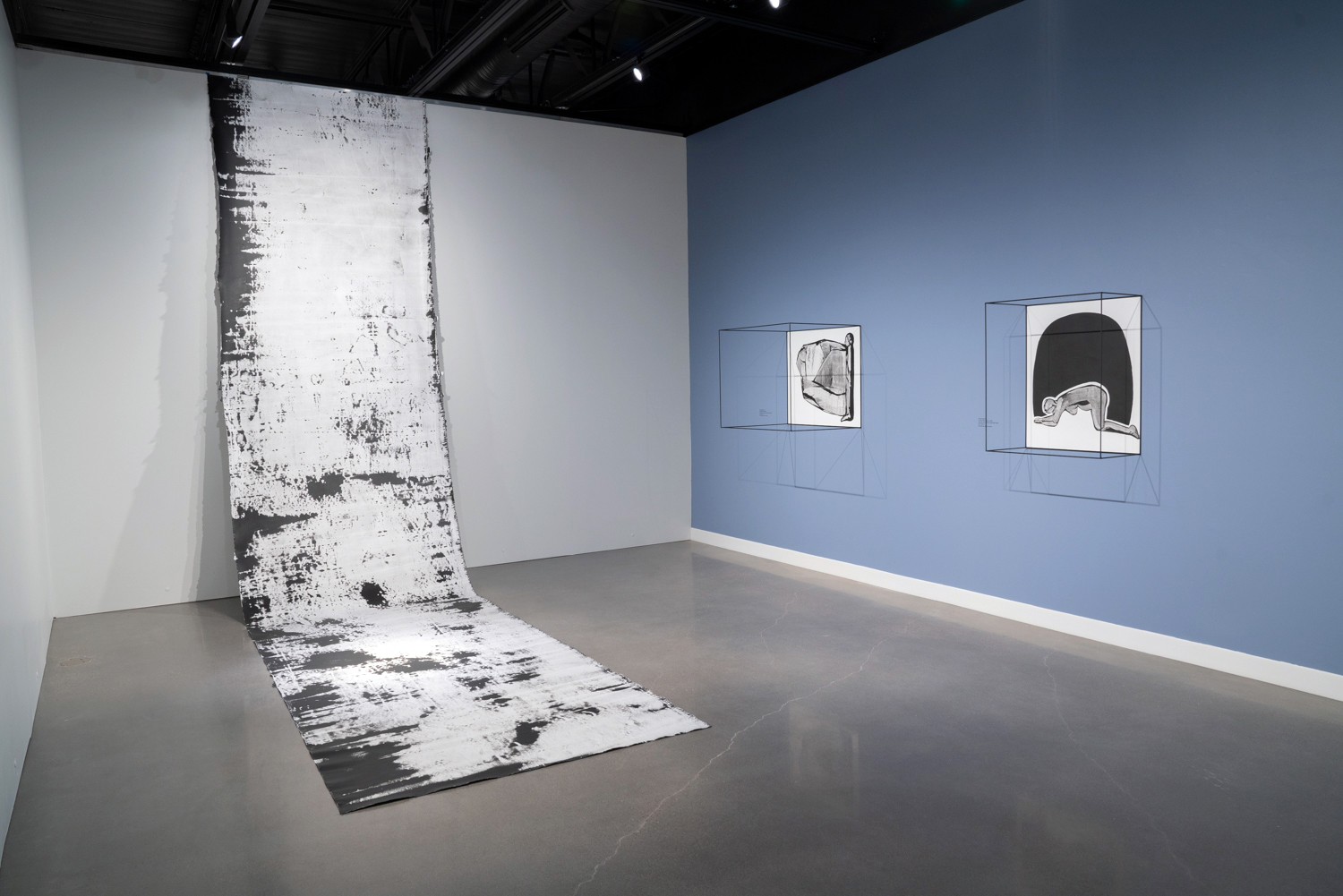
Installation view of the artist’s show, “Wait for It,” at NMSU Art Museum, 2022
You mentioned Drive My Car. I love how that movie does to you what the actor in the play in the movie says that Chekhov does to him. That performing his lines is terrifying. Chekhov’s texts are mentioned as drivers of illumination simply by reading them if you’re a psychic digger, or saying them if you’re an actor delivering his plots. Drive My Car does this too, piling simultaneity on revelation. It’s a slow burn, but by the time you’re the fourth person in the car with Yūsuke and Kōji in the backseat and Misaki driving Yūsuke’s Saab, the twisting into truth will include your own reflections. This only intensifies when later in the film, Yūsuke and Misaki do a day-long drive to the location of her childhood home which was destroyed by a landslide when she was young. I identify with this crawling from the wreckage in which reference and association come smack up against self-recognition and honest looks within.
At this point in our conversation, I returned to Joey’s show for a second visit and had a chance encounter with the museum’s Director, Marisa Sage. She came into the gallery and was overflowing with her support for the exhibition and what it was giving:
“I’ve just been coming into the museum and to this gallery every day to kind of cope with what’s been going on in our country since they overturned Roe vs. Wade, and looking at the strength of these women. Every single woman that she depicts — these mothers, these other artists, these thinkers, these doers, these women who build collectives — I’m struck and I’m reinvigorated in my belief in women every time I come into this space.
Knowing Joey, not only a mother, an artist, a thinker, a reader, but she is so inspired by many other women artists, women thinkers and women doers; and she is inspiring a whole other generation of women artists, thinkers, and doers. As a teacher at Texas State and as a mentor, there is not a woman artist in San Antonio that doesn’t talk about Joey. She is just what I believe our future of women to be. I’m just inspired by her art — it’s so beautiful and so strong and just shows the strength and that we will fucking overcome.”

Joey Fauerso, “Utopia 4,” 2020, acrylic on canvas, 66 x 66 inches.
HS: Your figurative paintings have a look — simultaneously like xerox copies and solarized photography, as if mitigation is the handle, as opposed to straight-up documentation. Would you mind speaking to how you evolved this form of representation?
JF: I have always painted in a subtractive way-using rags, brushes, and solvents to wipe away and reveal the underlying surface. In 2014 I stopped using oil paint due to concerns over toxicity and started using acrylic. The paint had such a different feel, and I knew I had to come up with a new way to build an image, not just try to paint the way I did with oils, because it wouldn’t really work. I started to develop a subtractive method of primarily monochromatic painting in which I would cover the entire surface of the canvas or paper with paint, and then scrape away the paint to build or carve out the image. I use a variety of different tools — rubber spatulas, silk-screen squeegees, and other non-traditional implements that I have experimented with over the last eight years. Oftentimes, I paint on the floor, so the texture of the floor of my studio becomes a kind of indexical print embedded in the imagery. The resulting paintings have a quality that positions them in a place between traditional mediums. They feel sort of like wood-block prints, two-dimensional carvings, daguerreotypes, sometimes drawings. They are also very sculptural to me; they sort of look like they are carved out of stone.
HS: Wait for It, the title of your exhibition, appears to be borrowed from Jenny Browne, clearly honoring your friendship and acknowledging her creative energies. I suspect there are other alignments there. Care to comment?
JF: Actually, it was the reverse. I titled the exhibition that opened at the Visual Arts Center at the University of Texas in Austin Wait for It, and then we asked Jenny to write a poem and short essay in response to the show. The show is built around the many experiences and interpretations of waiting, both as a place of anxiety and a place of speculation, and a place for dreaming. Jenny’s beautiful poem was in response to a painting titled The Waiting Room that isn’t included in the NMSU show, but we loved the poem so much, we wanted to include it in this version of the show as well. But to your larger question, Jenny is an ongoing collaborator, and a real creative inspiration in my life. We have been friends for a long time, and share many experiences-as artists, mothers, and teachers. I am always looking for a reason to work together.
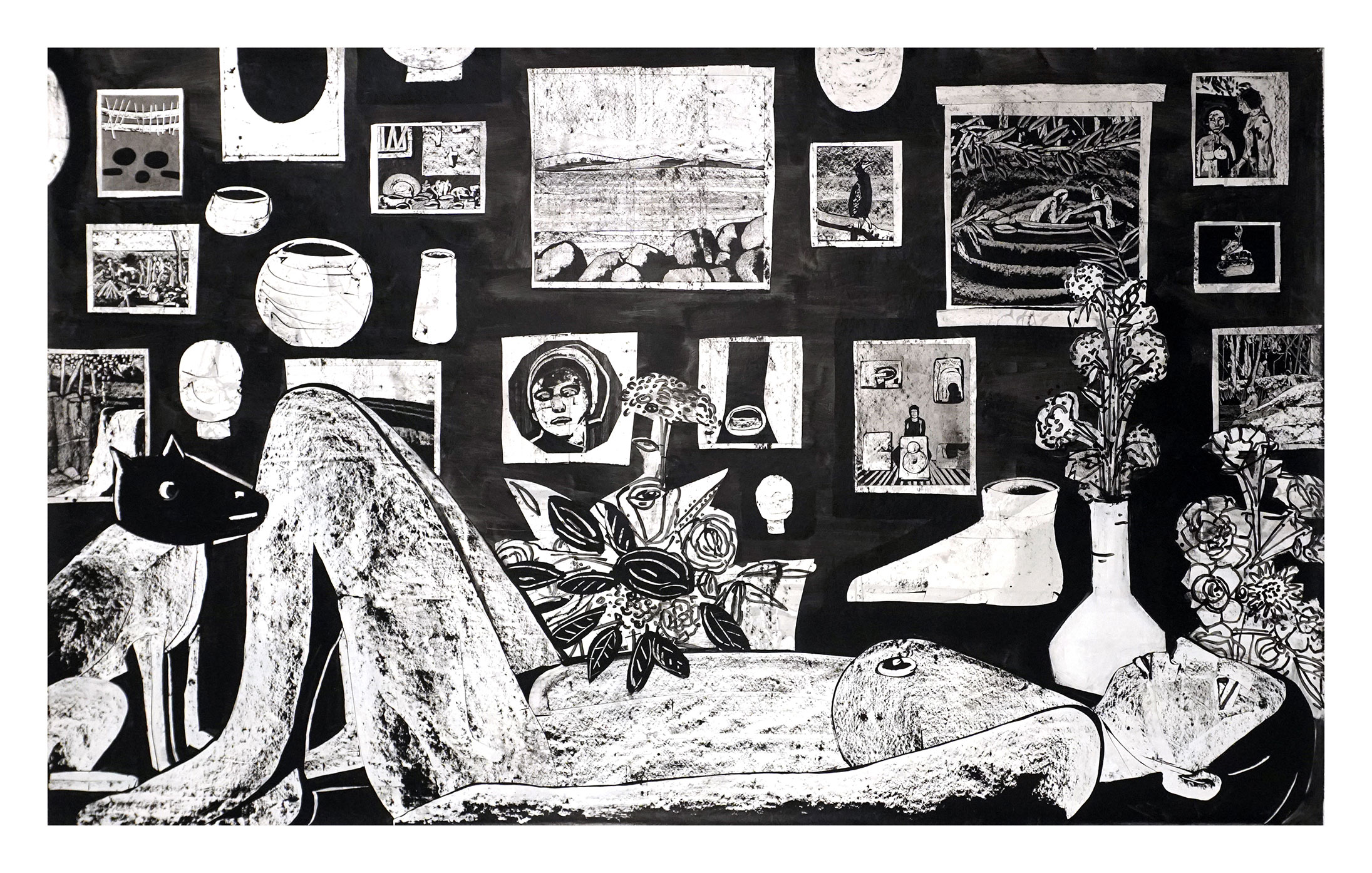
Joey Fauerso,”The Waiting Room,” 2020, acrylic on canvas, 84×136 inches.
HS: The titles of your pieces are frequently oblique, as if the words are caught in ricochet off the images. Is this where your meanings lie, in some form of crossfire?
JF: Yes, I love that imagery so much. The titles are often in conversation with the pieces, but hopefully do not pin them down too much. Sometimes I start with a title, like with You Destroy Every Special Thing I Make or Under the Table, and sometimes the title comes later. If a good title doesn’t come to me, I like to go a very direct route like Laeree With Flowers, or in the case of that big head, it’s just titled A Head. But I love language and poetry, so the process of thinking through titles is really enjoyable.

Joey Fauerso, “Holding Patterns 1 and 2”, 2021, acrylic on canvas, 66×66 inches each
HS: Holding Patterns 1 and 2 suggests a repeating iconography of helping, lifting, holding, crawling, bundling, maybe even severing…but all the images float in a white space that leaves connections ambiguous. This is generous to the viewer, lots of room in that open space, inviting personal interpretation. What is your version?

Joey Fauerso, “Under The Table,” 2021, acrylic on canvas, 82 x 110 inches
JF: You touch on something important here, which is that one of my key working methods is to create a collection of disparate imagery that is held together by a loose theme, in this case contrasting imagery of togetherness and isolation, and of dreams of escape. I think these were dominant experiences for many of us during the pandemic — loneliness for some and crushing claustrophobia for others. But for almost everyone there was a desire to escape circumstances outside of our control. I like to mix the personal and historical, so in these paintings you see images of my brother and his friends lifting each other, sculptures made by my sons of rocks pressed together like bodies wrestling, and paintings of myself and my kids. But there are also paintings of Mary Queen of Scots; a twelve-thousand-five-hundred-year-old carved wooden head discovered in a peat bog in the Ural Mountains; and the Paper Mache heads made by Frank Morris and the Anglin brothers to place in their beds when they escaped from Alcatraz. I’m kind of obsessed with those heads, they made them using toilet paper and hair-clippings from the prison barber. In another part of the show there is a small monoprint of Frank Morris — he was the mastermind of the Alcatraz escape. He was such an interesting and complicated person from what I have read.
HS: Under the Table. That’s where you go when someone drinks you there, but on the table, there is a parade of items — coffee cup, fruit in a bowl, potted plant, fish on a platter, watermelon, candlesticks, flower arrangements… Then, a heart out of body, rather nonchalantly joining the tableau of what are otherwise rather mundane items. Then, under the table, that’s where the color is, where the work of holding a family together happens, where the cats play, where I lie, drunk on your images, again caught in the crossfire.
JF: Yes, this was one of those paintings where the title came to me first. I was thinking about the idea that a lot of the most interesting stories and the most dramatic events are hidden from view, this has certainly been the case with most women’s lives up until very recently. Almost everything took place “under the table.” Have you ever seen pictures of Catherine the Great’s erotic furniture? I love it so much, there is a table that looks pretty traditional from above, but underneath there are huge penises and breasts. Catherine the Great was a master of concealment. Another recurring strategy in my work is to try to shift the conventions in traditional genres of painting, while still using those genres. So, in this case the still life — which is very still — is just the outer crust. As you point out, there is a much weirder, wilder, freer and more colorful world taking place below.
HS: I have to wonder if Catherine the Great first conceived of her erotic furniture while being erotic on furniture. Or maybe she was underneath, projecting. Everyone leaves an erotic imprint on the planetary memory — maybe she needed to manifest hers concretely. At any rate, that teeming energy as the hidden support of a conventional surface seems to point at how the baroque is the over-culture unconsciously attempting to take its clothes off — but that conventional surface keeps trying to polish its way into dominance, even though it is eros that is the actual engine of anything moving or evolving. So eros meets resistance — there was a beloved ceramics artist at Texas Tech and later at UTSA, Steve Reynolds, who came to Lubbock from Odessa where he’d been teaching and there was a story about how his multi-breasted ceramic nun-vessels had drawn the ire of some Odessian who had shot at his house with a shotgun.
I guess I’m relating your various subtraction strategies to the cultural process of stripping back the crust to a greater reveal, and how this is alarming to aspects of the culture; giving us the current dynamics of containment mixed with sudden explosions of violence.
JF: Yes, I definitely think that’s one of art’s most important jobs — to reveal the hidden currents, to “strip things back” as you say, to push against the conventional surface of things. Your thoughts on this topic reminded me of a painting/poem I made in 2016 titled Cottonmouth.
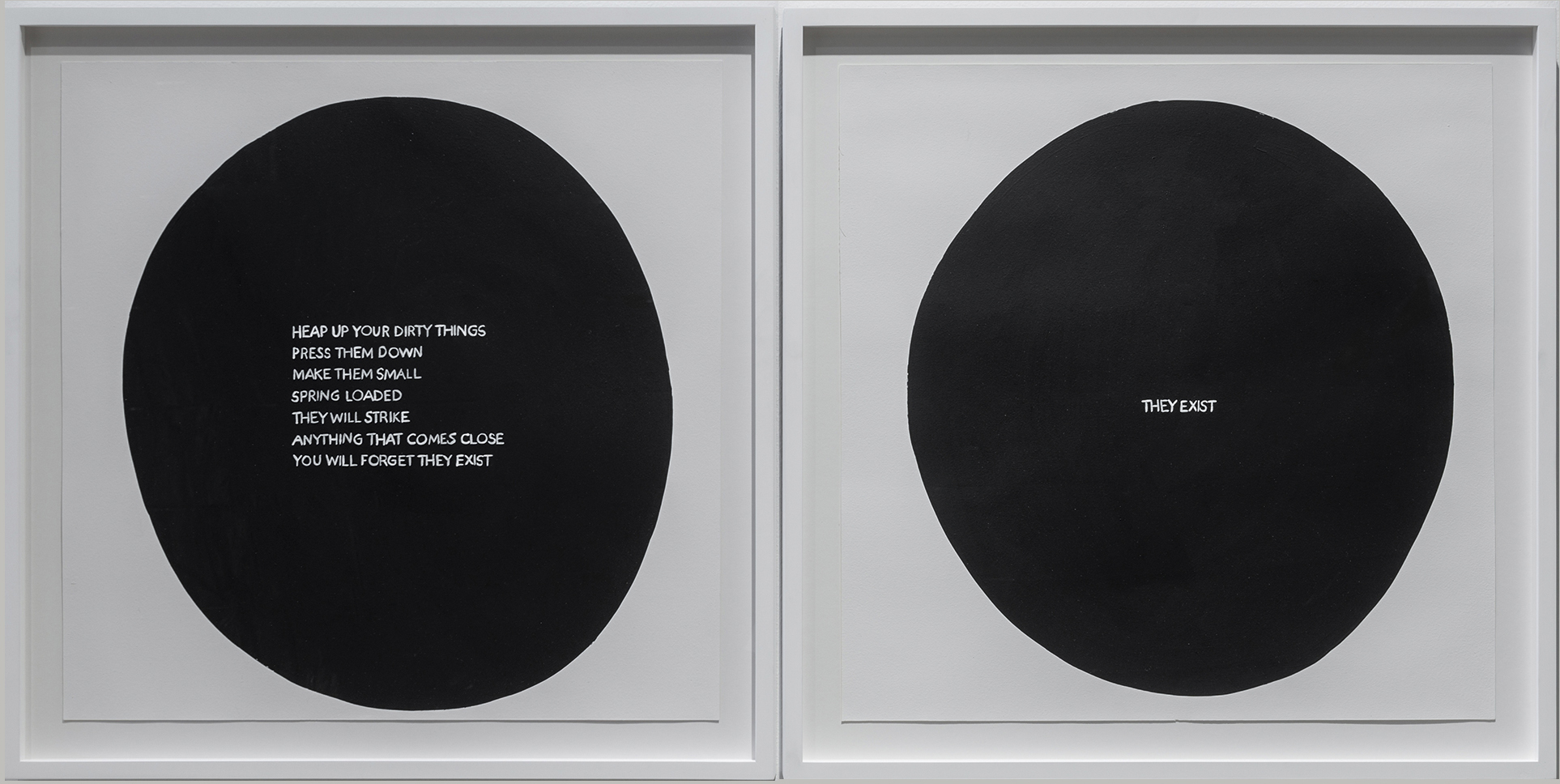
Joey Fauerso, “Cottonmouth,” 2016, acrylic on paper, 22 x 44 inches.
Wait for It
The wall tried hard
to frame paradise.
The black dog waits
for his door to open.
The boulders win
their staring contest
with the blossoms.
Some will wonder
how long it lasted.
Some will wake
to sirens then silence.
Some wanted to be
followed by the sound
of their own howling.
Watch how she imagines
herself a boarding pass
to anywhere waves
crash without asking
or having to ask.
-Jenny Browne, August 2021
Wait for It, at the New Mexico State University Art Museum, Las Cruces, New Mexico, continues through September 2, 2022.
The post A Conversation with Joey Fauerso on the Occasion of her Exhibition, “Wait for It,” at New Mexico State University Art Museum appeared first on Glasstire.
This post, my company wants us to sign a loyalty oath , was originally published by Alison Green on Ask a Manager.
A reader writes:
My workplace is incredibly weird and, oftentimes, problematic. In the past there have been issues with religious harassment, sexual harassment, and general abuse all coming from management and administration. You can’t complain to HR because they are part of the harassment as well. They all answer to our CEO, who is also a religious leader in the community. A lot of management, HR, and administration are hired from the CEO’s church.
The newest issue is the Statement of Oath. It is a 40-page document all employees are required to sign and contains some vague and troubling bits. The greatest one is a new rule: “To maintain complete loyalty to [the business] and to pursue its mission and initiatives.” What does that mean? They expect me to sign an oath to maintain Complete Loyalty?
I’m worried. There have been several extremely negative Glassdoor reviews recently and even some former employees lambasting the company in Google reviews. The vague phrasing makes me wonder if they will use this document to sue or threaten to sue people who leave negative reviews upon leaving. Note that I’m not a lawyer.
What do I do? I don’t want to sign this. No one wants to be sued or threatened for a negative review. I just don’t understand.
A 40-page oath?!
What do all the other pages contain?!
Regardless of what else might be in this lengthy document, you’re right to take issue with being asked to promise “complete loyalty.” What does that mean? Can you not change jobs? May you complain to your spouse at night? Must you cover up a crime? Refuse to unionize?
Obviously it’s reasonable for companies to expect some types of loyalty — like that you’ll act in good faith, report conflicts of interest, and not divert business to a competitor. Those things don’t require you to sign an oath; they’re covered under a legal concept called “duty of loyalty.” If your company is asking for more — and “complete loyalty” certainly implies that they are — they need to spell out exactly what that means. In fact, if they don’t, this document is of awfully questionable legality.
I’m curious, too, whether the oath addresses what your company pledges to you: In return for your obeisance, are they agreeing to pay you fairly, provide competitive benefits, set clear expectations, provide development opportunities, operate with transparency, address problems forthrightly, and so forth? Or is this loyalty all one-way? (Spoiler: it’s one-way.)
As for what to do … don’t sign this without running it by a lawyer. I know that’s a pain and costs money, so you can try just not signing it and seeing what happens. If nudged you can say, “My lawyer says I can’t sign it without their review.” But assuming they continue to press you, do get a lawyer to look at it — and don’t pledge “complete loyalty” without them spelling out precisely what that means.
“The Florida Legislature passed a bill granting approval for former and present members of the military to teach in classrooms… Candidates must have a minimum of 60 college credits, a 2.5 grade-point average, and a passing score on a Florida subject area examination for bachelor’s level subjects.” – Newsweek
Dear Colleagues,
This communication is to inform you of recent changes to state teaching qualifications. We hope you understand the immense pressure we are under to place warm, preferably conscious and lucid bodies in classrooms of 72 students (with 32 desks) in the next two weeks.
Due to recent societal upheavals, as well as a general lack of respect and belief in education, compassion, or humanity, we will be offering thirty-five-year renewable teaching certifications to the following:
The above changes are not meant to create community discussion surrounding pay increases for those current teachers with myriad Masters’ degrees whose lives have been spent working toward the safety and security of all students.
Other duties as assigned will still include:
Due to politics and pandemic fatigue, there will never be overtime for weekends spent grading or planning for the sole sake of supporting student progress (in this vein, and with regard to equity, retirees’ monthly checks will be cut by twelve percent).
There won’t be any pay increases to cover both housing and food price inflation, nor monetary help to pay for graduate courses that are mandatory in order to continue being paid the same wage as a 17th-century scullery maid.
We cannot justify bonuses to cover the cost of living increases for teachers, as we must also cover medieval salaries for bus drivers, crossing guards, custodians, and school nurses (see new qualifications for nurses—including watching three or more seasons of Grey’s Anatomy).
We have added ten extra summer work days for vague professional development on new COVID-19-variant protocols, what to do without sanitary wipes or windows that open in your classroom, an Introduction to Social Network Supplies Pleading, and a required session on Bridging the Thousand Vacancies in Ten Easy Steps Without Whining about Work-Life Balance. Of course, these courses will be available in late February on the new and incomprehensible online platform.
We appreciate your unwavering commitment to the people in charge who have never set foot in a public classroom, and we wish you the very best for the 2022-2023 school year.
Patronizingly yours,
The Board of Education, spouses, step-children, exes, and dogs of larger breeds
Toxic work environment. Employees never know when their shifts will be over. Owner makes a big deal of nailing the communal tip jar to the front counter but takes all the tips for himself at the end of the day. ADA-compliant.
The barista is always a hot tattooed guy with an asymmetrical haircut. In lieu of tips, you leave an offering at the altar of Yojo. If you and the boss touch foreheads, he will give you half his salary. Drink sizes are “Smallee,” “Biggee,” and “Coffin.”
The guy at the counter will not shut up, so be prepared to wait while you learn about the geographic origins of the beans, every step of the milling and roasting process, and the childhood of the guy who invented the milk foamer. (And half of what he says is reportedly bullshit.) Never gives you the right drink, but it tastes so good that you won’t complain. If you wear a hat inside, it will be knocked off. Drink sizes are “Duodecimo,” “Octavo,” and “Folio.”
Has the best in-store playlists. Partnership with Fleece’s soul food. Serves coffee so strong that you’ll stop sleeping and think you can see God.
Uses earthenware mugs so big that you could fall into them.
Serves fair-trade coffee. Chill atmosphere, but if you make that “I like my coffee the way I like my men…” joke, you’ll be thrown out on your ass. Drink sizes are “Tall,” “Very Tall,” and “NBA All-Star.”
Runs like a Cold Stone. Everyone is referred to as a “crew member” and sings shanties at you for tips. Avoid like the plague if you’re not a morning person, but the people who like it really like it.
Serves espresso in itty bitty cups to make the owner’s hands look bigger. If you call your cup “cute,” he will physically fight you.
Only one New Bedford location but gets a worldwide draw. Kitschy gimmick where the façade of the store looks like a ship. Owner gets salty if you complain about the Bible verses on the cups.
Practically a speakeasy. Zero signage or advertising. Probably hidden under an abandoned Chili’s and accessible only by secret knock. Barista intuits your order by looking deep into your eyes.
In business since the dawn of time. Only serves flat whites. Never updates its facilities. Seemingly never open. Somehow still more profitable and famous than all of its competition.

A blockbuster new study reveals a key factor explaining rates of upward mobility.
(Image credit: Flashpop/Getty Images)

This post, candidate showed up in-person for a Zoom interview “to demonstrate their interest” , was originally published by Alison Green on Ask a Manager.
A reader writes:
As part of my job, I’m responsible for hiring processes for director level positions. We first conduct a phone screening, then a Zoom interview, and then pay for finalist candidates to visit our city for the the final round of interviews.
Recently, following the phone screenings, I scheduled Zoom interviews with our candidates. We use a self-scheduling system, and notified candidates on Tuesday that they could start scheduling interviews. The first available interview was on that Thursday. On Wednesday (so 24 hours after the self scheduling opened, and 24 hours before the interview), one of the candidates called me to say that they had driven to our city from their state about 12 hours away, with their entire family, at their own expense, to “demonstrate their interest in the position.” They asked if we would instead hold the interview in person, since they were in town. Our search committee was not prepared to hold this interview in person, as some members of the committee live far away, so I told this candidate that we would still need to hold the interview via Zoom. They expressed disappointment that we weren’t able to make it work.
I think this crosses professional boundaries and is a huge red flag. One of my colleagues was impressed by this candidate’s “go-getter” attitude and thought we should have accommodated the request to have the interview in person. What do you think?
What on earth, no! This is indeed a huge red flag.
This isn’t about being a go-getter. It’s about lacking an understanding of professional norms and being willing to push what they want ahead of what works for you, without regard for the process you already laid out. (They also apparently haven’t noticed at any time during the last two years that a lot of people work remotely or from separate locations now?)
This is someone who’s going to ignore clear instructions when work is assigned to them in favor of doing whatever they think best, without thinking about what problems their “better” approach might cause. This is also someone who has muddled thinking about how much energy and how many resources are worth expending for what pay-off. (A 12-hour drive? With their whole family?!)
It’s particularly troubling that they didn’t think to check with you first. It would have been fine for them to offer to come in-person, as long as they waited to hear whether that worked for you. But simply showing up without bothering to check, and then being surprised when it didn’t work for you, bodes badly.
If they wanted to demonstrate their interest in the job, they could do that by, you know, interviewing for it and explaining their interest. No stunts required.
Your colleague who liked it isn’t thinking it through.

Focus on Marijuana
Zeller
1990
I think a lot of folks would like to focus on marijuana. Since legalization (or decriminalizing) seems to be a trend, maybe an updated book is needed. There is also a statement about marijuana as a gateway drug. From what I can tell, this is still a debate from the scientific community. There is also no recognition of the on going research into the benefits of marijuana such as chronic pain, anxiety, and epilepsy.
I really don’t have an opinion on the benefits since my experience is limited to a shared joint in 1981. I was more worried about getting the munchies and killing any ambition to keep my ass from expanding any further.
These types of books kind of bother me. They have more of an agenda than about real information. I have had many a teen and preteen that must do a “drug report”. More than once I have had a teen question me on why marijuana is “worse” aka illegal than alcohol. Gotta say my favorite questions are ones where the teens call b.s. and ask me to help them get better resources so they make a case.
Mary


The post Focus on Mary Jane appeared first on Awful Library Books.
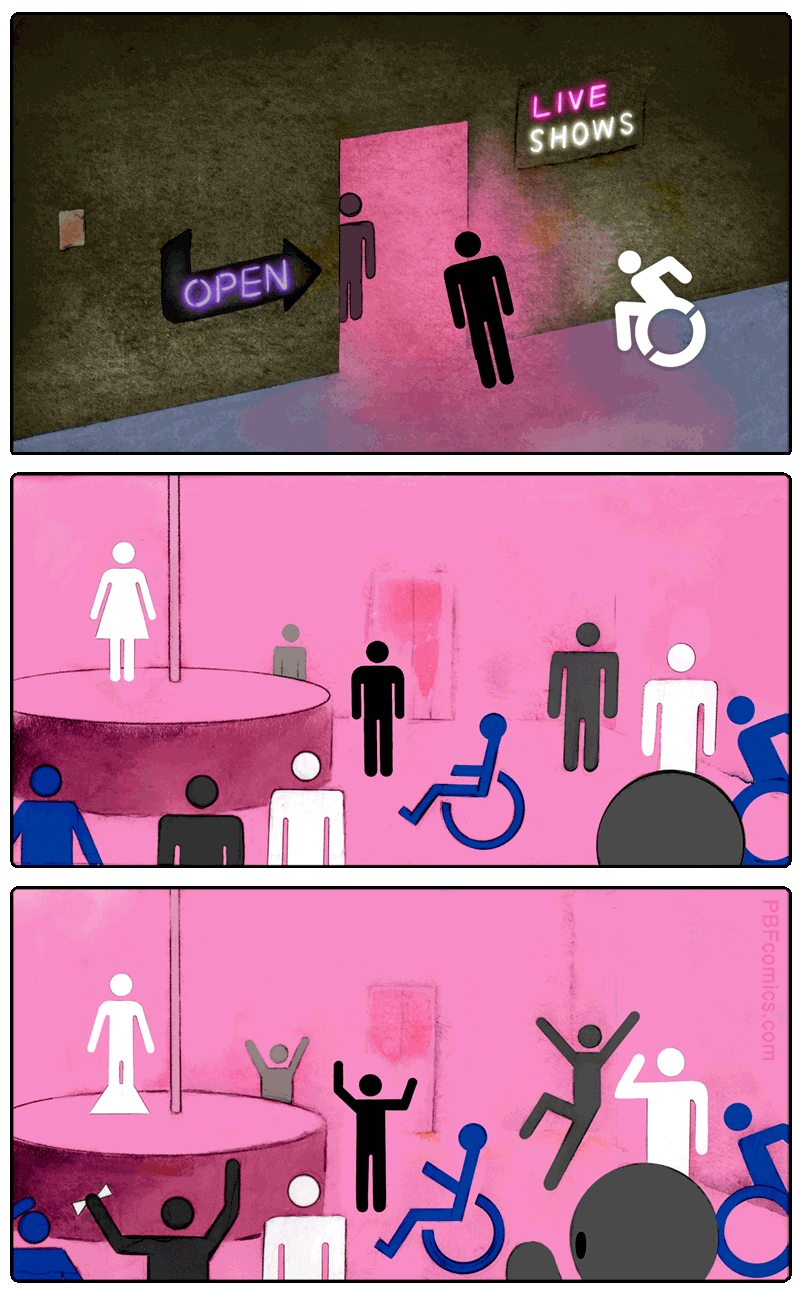
The post Sex Show appeared first on The Perry Bible Fellowship.


Read more of this story at Slashdot.

Candy Funhouse's chief candy officer will taste test over 3,500 products a month. Applicants can be as young as 5 years old.
(Image credit: Leonard Towers/Flickr)


Nichols broke ground and paved the way for Black actors in Hollywood as Uhura. Her castmate George Takei wrote, "We lived long and prospered together."
(Image credit: CBS via Getty Images)


It's extremely important to include representation and diversity in mainstream media. I could say this every day of my life and it still won't be enough for some people to understand, but sometimes a good story can better illustrate the point. One of the most famous examples of how integral it is for everyone to see people that look like them in the movies, shows, and literature that they consume involves legendary comedian and actor Whoopi Goldberg and "Star Trek."
The story (as told by Nichelle Nichols) goes that a nine-year-old Goldberg came across an episode of "Star Trek: The Original Series" on TV one day. When Nichols appeared onscreen as Lt. Nyota Uhura, the future star of "Sister Act," "The Color Purple," and "Ghost" ran to her mother and said, "I just saw a Black woman on television, and she ain't no maid!" From that point forward, she was inspired to become a performer that could be a positive force for representation as Nichols was for her.
Eventually, Goldberg received the opportunity to do just that while also being a part of the franchise that started it all for her. However, when it came to landing a role in "Star Trek: The Next Generation," it wasn't very easy for the bonafide movie star. But that's only because Gene Roddenberry thought that people were joking about one of the highest-paid actresses of the 1990s wanting to be on his show.
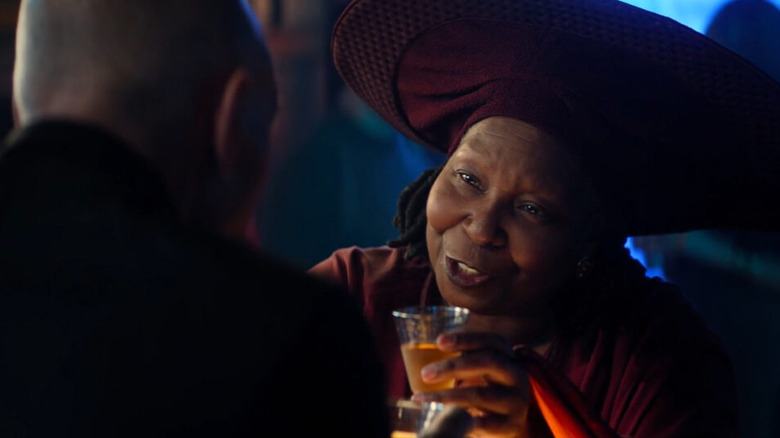
During an appearance on "David Tennant Does A Podcast With ..." from 2019, Goldberg recounted to the once and future "Doctor Who" star her story about being inspired by Nichols' "Star Trek" character. She had indeed been inspired by the existence of Uhura, and expanded on the significance of this milestone event by explaining that Black people weren't represented in science fiction up until that point. It was the first time she'd seen science fiction even acknowledging that they were going to be a part of the future. So when she got word that "Star Trek: The Next Generation" was coming together, she was determined to be a part of it.
"When LeVar Burton told me that he was doing the new 'Star Trek,' I said, 'Will you tell them that I want to be a part of it because ...' and I explained the whole thing about Lt. Uhura. I didn't see him for a couple of months, then I see him and say, 'Did you tell them?' And he said, 'Yeah ... and they didn't believe me.' So we call Gene [Roddenberry] and I said, 'My name is Whoopi Goldberg. I would like to come in and explain to you why I want to be part of this.' He said, 'Why do you want to do this?' I said, 'Because do you not know that before Lt. Uhura there were no Black people in the future? I'm telling you, before this character, there was no representation of a person of color in the future.' ... I just want to be part of that thing that says, 'Yes, we will be in the future.'"
As another layer of how important Guinan was for her, Goldberg went on to share that her sagely bartender might have been the last character that Gene Roddenberry wrote before he passed away. With the groundwork laid by the "Star Trek" OG himself, Goldberg has since become an inspirational figure for others, just like Nichols was for her. And thanks to trailblazers like both of these iconic women, fans can feel seen and reassured that they are and will continue to be a part of this universe for generations to come.
Read this next: Every Star Trek Show And Movie In Chronological Order
The post Whoopi Goldberg Was Determined To Get A Role In Star Trek: TNG Because Of Lt. Uhura appeared first on /Film.
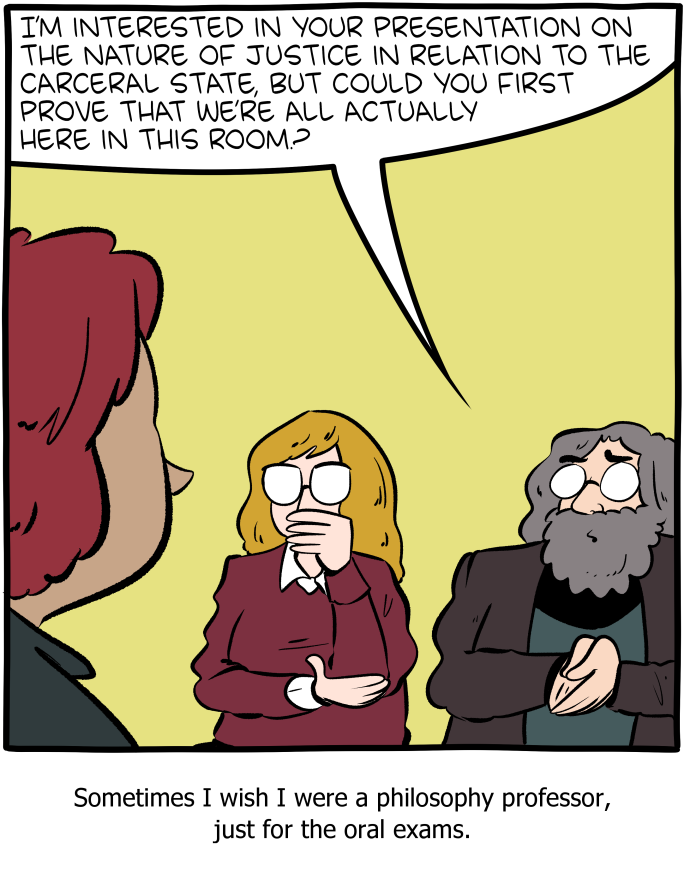
Hovertext:
Actually, prove the room exists, that we exist, and that we're in the room at the same time.

An editing battle over its "recession" entry prompted Wikipedia to put a temporarily lock on revisions. The entry was changed to a definition of recession that aligned with President Biden's stance.
(Image credit: Pavlo Gonchar/SOPA Images/LightRocket via Getty Images)



/https://static.texastribune.org/media/files/67e0ee35b8524946a02ceea87242f859/Hale%20Wind%20Farm%20TrT%20TT%2007.jpg)