Cowboy Who?
Shared posts
Somebody's watching me (parody) - Very spooky Halloween Special
Real Leaders Never Quit, Liz—Take It from Us Republicans
“After a turbulent 45 days in office in which she crashed the markets, lost two key ministers, and shed the confidence of almost all her own MPs, Liz Truss said a new Conservative leadership election would be called to decide her replacement. Truss will be the shortest-serving prime minister in UK history.”
— The Guardian, 10/20/22
What were you thinking, Liz? You quit being prime minister of the UK just because you were a colossal failure? Where’s the logic in that?
In a REAL democracy, like the one we have here in the United States, right-wing leaders NEVER resign under any circumstances, even if they’ve been caught failing, cheating, or treasoning. In fact, especially when they’re caught treasoning.
Seriously, though, we here at the GOP have had politicians who have paid sex traffickers, enabled and covered up sexual abuse, abused girlfriends and wives, lied about election results, incited insurrection, confirmed an accused rapist to the Supreme Court, elected and defended a self-proclaimed sexual abuser and accused rapist to the presidency, defrauded Medicare, trafficked human beings to Martha’s Vineyard, fled to Cancun during a time of crisis, and blamed wildfires on Jewish space Lasers.
And honestly, that’s just a very partial list.
The point is, you name it, we’ve done it. But so what? That’s no reason for us to resign.
In America, egregious wrongdoings are just a golden opportunity to flood our constituents’ inboxes with pleas for money. Allow us to explain how that works: We do something terrible, and then when someone points it out, we defend ourselves against “slander” and fight back against liberal “lies.”
You see, Liz? When you’re a Republican, they not only let you do it, they reward you for it. Spreading lies and COVID misinformation is just a means to rake in some sweet dollars. Promoting an insurrection means you’re about to come into major money. And stealing top secret, classified files is simply a time-honored Republican way to cash in. We’re not joking here—please sign up for our mailing list and see for yourself. Also, remember to give us money every time we do something appalling.
A real leader doesn’t back down when they mess up. We can’t believe we even have to say this, but the job of a leader is to make sure voters believe that they—the leader—are always the true victim. The role of a conservative politician is to screw up repeatedly and then accuse the lamestream media of being biased, mendacious, or making a mountain over a nothing burger. Getting vanquished by a head of lettuce is one thing, Liz, but being held accountable is unforgivable.
Yes, sure, Dick Nixon resigned back in the day. But that was a different era. The 1970s happened ages ago, long before Fox News and conservative dark money and the Culture Wars convinced 40 percent of gullible Americans that Democrats were socialist satanic child traffickers that must be stopped by any means necessary. Picture a hippie, and you’ll understand just how messed up everything was back then. In fact, picture Charles Manson and he’d probably be a senator nowadays—but only in a red state, LOL.
And with that reliable base ensuring that Republicans retain power in any district populated by a majority of white people, there’s absolutely no reason for any GOP politician ever to be held accountable again, unless they spill the beans about our secret orgies, that is.
It’s a win-win situation for Republicans, Liz, whereas you clearly lost. It’s a perfect system for us conservative politicians who can fail, cheat, and steal and never have to worry about our jobs. And I think we can all agree that it’s a far better system than the one you have in the UK, where a PM has to give in to the woke mob and resign when they’re a total and abject failure.
Anyway, it’s over now, Liz. You’re not going to be prime minister anymore, and it’s all because you were a terrible prime minister, which is such a silly reason. You have to suffer consequences for your actions, which is the worst possible thing we at the GOP can ever imagine. And come November 8, we hope our voters agree.
James Corden Breaks Silence On Restaurant Controversy: ‘I Like To Find Stray Dogs And Suffocate Them To Death’

NEW YORK—Addressing an accusation that he was “the most abusive customer” at New York restaurant Balthazar, Late Late Show host James Corden finally broke his silence Friday to confirm that he enjoys finding stray dogs and choking them until they die. “The rush I feel when watching the light leave a poor struggling…
U.K. Prime Minister Liz Truss Steps Down After 6 Weeks

U.K. Prime Minister Liz Truss resigned after 44 days in office after a failed tax-cutting budget that rocked financial markets and led to a revolt within her own Conservative Party, giving her the shortest PM tenure in U.K. history. What do you think?
Some People Really Are Mosquito Magnets, Study Finds


Read more of this story at Slashdot.

Lost something? Search through 91.7 million files from the ’80s, ’90s, and 2000s

Enlarge / Search through millions of vintage files with Discmaster. (credit: Aurich Lawson | Getty Images)
Today, tech archivist Jason Scott announced a new website called Discmaster that lets anyone search through 91.7 million vintage computer files pulled from CD-ROM releases and floppy disks. The files include images, text documents, music, games, shareware, videos, and much more.
Discmaster opens a window into digital media culture around the turn of the millennium, turning anyone into a would-be digital archeologist. It's a rare look into a slice of cultural history that is often obscured by the challenges of obsolete media and file format incompatibilities.
The files on Discmaster come from the Internet Archive, uploaded by thousands of people over the years. The new site pulls them together behind a search engine with the ability to perform detailed searches by file type, format, source, file size, file date, and many other options.
America’s Trumpiest court just declared an entire federal agency unconstitutional

The Fifth Circuit’s opinion in Community Financial v. CFPB is completely incoherent.
Three judges appointed by former President Donald Trump handed down an astonishing decision on Wednesday, effectively holding that the Consumer Financial Protection Bureau, the federal agency charged with protecting consumers from a wide range of predatory activity by lenders and other financial services, is unconstitutional and must be stripped of its authority.
The decision by the conservative United States Court of Appeals for the Fifth Circuit relies on a novel reading of an obscure provision of the Constitution, and is entirely at odds with a Supreme Court decision that rejects the Fifth Circuit’s reading of that provision. This is not unusual behavior from the Fifth Circuit, which often reads the Constitution in novel and unexpected ways that benefit political conservatives and the Republican Party.
Indeed, Judge Cory Wilson admits in the court’s new opinion in Community Financial Services v. CFPB that “every court to consider” the arguments presented in this case has deemed the CFPB to be “constitutionally sound.”
Should the three Trump judges’ decision stand, it would effectively neutralize much of the federal government’s ability to fight financial fraud — although that outcome probably is not likely given that the Fifth Circuit’s decision is such an outlier. As Wilson explains, the CFPB assumed enforcement authority “over 18 federal statutes” when it was formed nearly a dozen years ago, and these statutes “cover everything from credit cards and car payments to mortgages and student loans.”
Meanwhile, the agency also enforces a “sweeping new proscription on ‘any unfair, deceptive, or abusive act or practice’ by certain participants in the consumer-finance industry.” All of these consumer protections could evaporate if the Fifth Circuit’s decision earns the favor of the Supreme Court.
The CFPB is constitutional
The judges’ decision in Community Financial Services v. CFPB, turns on the somewhat unusual way the CFPB is financed.
Most federal agencies receive an annual appropriation from Congress that may be altered each year during legislative negotiations over federal spending. Many agencies, however, have separate funding sources, such as the ability to collect fees or assessments from the entities they regulate, and do not rely on the annual appropriations process to fund their operations.
This arrangement, where an agency has a continuous funding source regardless of what Congress decides to do in annual debates over federal spending, is particularly common among financial regulatory agencies. The Federal Reserve, the Federal Deposit Insurance Corporation, the Federal Housing Finance Agency, the National Credit Union Administration, and the Office of the Comptroller of the Currency are all financed outside of the annual appropriations process. So is the CFPB.
Nothing in the Constitution prevents Congress from funding agencies in a variety of ways. Congress could fund an agency through an annual appropriation, or a five-year appropriation, or a 500-year appropriation. It may also authorize the agency to collect fines or fees to fund its operations.
The Constitution does provide that “no money shall be drawn from the Treasury, but in Consequence of Appropriations made by Law.” But, as the Supreme Court held in Cincinnati Soap Co. v. United States (1937), this provision “means simply that no money can be paid out of the Treasury unless it has been appropriated by an act of Congress.” Thus, if the federal government wants to spend its money, Congress must pass a law permitting it to do so.
But Congress did pass a law creating the CFPB and its financing structure, the Dodd-Frank Wall Street Reform and Consumer Protection Act of 2010, which provides that the Federal Reserve shall transfer up to 12 percent of its “total operating expenses” to the CFPB each year, upon the CFPB’s request.
Because this funding mechanism was enacted by Congress, it is constitutional.
The Fifth Circuit imposed a novel limit on how Congress may fund federal agencies
The Fifth Circuit’s reasoning in Community Financial is difficult to parse, but the three judges essentially argue that the CFPB is unconstitutional because its funding passes through the Federal Reserve — another agency that is not funded through the annual congressional appropriations process — before arriving at the CFPB.
Wilson’s opinion describes this funding structure as “double-insulated funding” because the CFPB’s money passes through two agencies that are not subject to annual appropriations, and he claims that this kind of funding structure is “unique.” He also deems this somewhat unusual funding structure to be problematic because none of the other agencies that are insulated from the annual appropriations process wield “enforcement or regulatory authority remotely comparable to the authority the [CFPB] may exercise throughout the economy.”
That last statement is doubtful, given that one of the other agencies that are insulated from annual appropriations is the Federal Reserve itself, the agency that controls the US money supply and that has such extraordinary power over the global economy that markets rise and fall based on merely on investors’ conjectures about what the Federal Reserve might do in the future.
In any event, the Constitution does not say that “double-insulated” agencies are unconstitutional. It also does not say that Congress must fund powerful agencies differently than it funds less powerful agencies. It only says that Congress must pass a law funding an agency before that agency may spend money to carry out its functions.
And, in this case, Congress enacted such a law.
Saturday Morning Breakfast Cereal - Uncanny

Click here to go see the bonus panel!
Hovertext:
Also could you duplicate some of your protrusions? Doesn't matter where.
Today's News:
In This Housing Market, I’ll Never Be Able to Afford to Haunt My Own Home
Growing up, when it came to property ownership, I always bought into the classic American dream: I’d get married, start a family, die unexpectedly in a freak gas fire, and then own my own three-bed, two-bath clapboard home to have and haunt as a ghost for eternity. Alas, as any young millennial in this phase of her afterlife knows, affording a home in this market is about as likely as colliding with a living human and NOT effortlessly passing through their solid, corporeal flesh sending a chill down the spine. It simply is not done.
It was easy enough for ghosts of my parents’ generations to find their own homes to torment. Sprawling estates in the moody English countryside. Severe New England manors atop sinister hills. Abandoned temples overgrown with moss. Real estate was booming!
But now, with inflation skyrocketing and wages stagnating, it’s next to impossible for a young ghost to scrape together the 100K-plus bones for a down payment. And I do quite literally mean bones, which is what we use for currency in the spiritual realm. Last I checked, the average spooky skeleton has only 206 bones in its whole body! How’s a first-time home haunter supposed to come up with that kind of moolah?
Then, of course, there’s the issue of supply and demand, as fewer and fewer homes go on the market each year. Demons, ghosts, and ghouls just aren’t peacefully passing over into the afterlife the way they used to. Instead, they’re haunting the same home for three, four, even five hundred years, before begging to finally be released into oblivion.
At this rate, I’ll be haunting with roommates until I’m forty decades old. Sure, at first having a few roommates wasn’t so bad. There was always someone around to make sure that doors unexpectedly swing open, or to check that you turned the lights off and on and off and on. But after a while, not having your own space becomes frustrating, like when you want to unwind from a long day of being dead, kick back, and possess a portrait, and your roommate’s already occupied it. Or when you’re trying to get a peaceful night’s rest, and your roommate’s invited over his girlfriend, the Loudly Shrieking Lady of Saint Clair Lake.
Maybe eventually, I’ll be able to save up to afford a small little place, like a studio apartment or an oil lamp, but don’t get me started on how little square footage you get in an oil lamp. That hardly leaves much room to host, let alone haunt.
I suppose I could always try to move somewhere with a less competitive market, where prices are lower, but my unfinished business in the mortal realm firmly ties me to a VHCOL city that’s ideally on the coast and has temperate year-round weather.
Ultimately, perhaps I just have to accept that some dreams, like owning that three-bed, two-bath clapboard home, are meant to die, becoming ghosts of our own to haunt us and—oh! I’m fading! Guess that tidy realization has finally released me into oblivion—now that is some serious square footage.
Larry the Cat outlasts fourth U.K. prime minister

The 15-year-old tabby is the Chief Mouser of No. 10 Downing Street, where Britain's prime ministers both work and reside. Larry has been in the post since David Cameron ran the government.
(Image credit: Ki Price/WPA-Pool/Getty Images)

The Equation That Explains (Nearly) Everything!
PBS Member Stations rely on viewers like you. To support your local station, go to:http://to.pbs.org/DonateSPACE
Sign Up on Patreon to get access to the Space Time Discord!
https://www.patreon.com/pbsspacetime
The Standard Model of particle physics is arguably the most successful theory in the history of physics. It predicts the results of experiments with a numerical precision unmatched by any other branch of science, and it does so almost unfailingly. The theory is encapsulated in a single equation known as the Standard Model Lagrangian. Today we’re going to explain to you how it works!
Want to Dive Deeper into the Standard Model Lagrangian? Check out:
https://www.youtube.com/watch?v=kixAljyfdqU&list=PLsPUh22kYmNBgF_VMMLHFK0lbQGlVGk3v&ab_channel=PBSSpaceTime
Check out the Space Time Merch Store
https://www.pbsspacetime.com/shop
Sign up for the mailing list to get episode notifications and hear special announcements!
https://mailchi.mp/1a6eb8f2717d/spacetime
Search the Entire Space Time Library Here: https://search.pbsspacetime.com/
Hosted by Matt O'Dowd
Written by Fernando Franco Felix & Matt O'Dowd
Post Production by Leonardo Scholzer, Yago Ballarini, Pedro Osinski, Caique Oliveira, Adriano Leal & Stephanie Faria
Directed by Andrew Kornhaber
Associate Producer: Bahar Gholipour
Executive Producers: Eric Brown & Andrew Kornhaber
Executive in Charge for PBS: Maribel Lopez
Director of Programming for PBS: Gabrielle Ewing
Assistant Director of Programming for PBS: John Campbell
Spacetime is produced by Kornhaber Brown for PBS Digital Studios.
This program is produced by Kornhaber Brown, which is solely responsible for its content.
© 2022 PBS. All rights reserved.
End Credits Music by J.R.S. Schattenberg: https://www.youtube.com/user/MultiDroideka
Special Thanks to Our Patreon Supporters
Big Bang Sponsors
Ankur Anand
Ryan Salsamendi
Steffen Bendel
Gautam Shine
NullBlox.ZachryWilsn
Adam Hillier
Bryce Fort
Peter Barrett
David Neumann
Charlie
Leo Koguan
Alexander Tamas
Morgan Hough
Amy Hickman
Juan Benet
Vinnie Falco
Fabrice Eap
Mark Rosenthal
David Nicklas
Quasar Sponsors
Vivaan Vaka
Glenn Sugden
Sujasha Gupta Vaka
Vikram Vaka
Alex Kern
Ethan Cohen
Stephen Wilcox
Christina Oegren
Mike Conroy
Mark Heising
Hank S
Hypernova Sponsors
Ryan Moser
David Giltinan
Ivari Tölp
Vyce Ailour
Brandon Paddock
Oneamazinguy
Ken S
Gregory Forfa
Kirk Honour
Mark Evans
drollere
Joe Moreira
Marc Armstrong
Scott Gorlick
Paul Stehr-Green
Russell Pope
Ben Delo
Scott Gray
Антон Кочков
John R. Slavik
Mathew
Donal Botkin
John Pollock
Edmund Fokschaner
Joseph Salomone
chuck zegar
Jordan Young
John Hofmann
Daniel Muzquiz
Gamma Ray Burst Supporters
Walter Montalvo
Andrea Galvagni
Larka
Jerry Thomas
Nikhil Sharma
Alexander Gruber
Jonathan Cordovano
John Anderson
Scott Hannum
Paul Widden
Bradley Ulis
Craig Falls
Kane Holbrook
John Yaraee
Ross Story
teng guo
Mason Dillon
Harsh Khandhadia
Thomas Tarler
bsgbryan
Sean McCaul
Susan Albee
Frank Walker
Matt Q
MHL SHS
Terje Vold
James Trimmier
Anatoliy Nagornyy
comboy
Andre Stechert
Paul Wood
Kent Durham
jim bartosh
Nubble
Ramon Nogueira
The Mad Mechanic
Ellis Hall
John H. Austin, Jr.
Diana S
Faraz Khan
Almog Cohen
Alex Edwards
Ádám Kettinger
MD3
Endre Pech
Daniel Jennings
Cameron Sampson
Geoffrey Clarion
Russ Creech
Jeremy Reed
Eric Webster
David Johnston
Web Browser
Michael Barton
Mr T
Andrew Mann
Isaac Suttell
Devon Rosenthal
Oliver Flanagan
Bleys Goodson
Robert Walter
Bruce B
Mirik Gogri
Mark Delagasse
Mark Daniel Cohen
Nickolas Andrew Freeman
Shane Calimlim
Tybie Fitzhugh
Robert Ilardi
Eric Kiebler
Craig Stonaha
Graydon Goss
Frederic Simon
Tonyface
John Robinson
Jim Hudson
A G
David Neal
justahat
John Funai
Tristan
Bradley Jenkins
Daniel Stříbrný
Luaan
Cody
Thomas Dougherty
King Zeckendorff
Dan Warren
Patrick Sutton
John Griffith
Daniel Lyons
DFaulk
Kevin Warne
British Prime Minister Liz Truss resigns after weeks of criticism and turmoil
Open Letter to the Friend I Was Probably in Love with in High School Before I Realized I Was Gay
Dear girl I was probably in love with before I realized I was gay:
Okay, you got me. I probably was in love with you. In my defense, I had convinced myself that thinking about you all the time and wanting to spend every day with you and trying to find excuses to talk to you and memorizing the contours of your face, your voice, your smile when you looked at me were all just things that good buddies did. I felt that my greatest purpose was making you laugh until your eyes welled up with tears, and I also thought that most besties thought that about their gal pals.
When the prickling feeling that it may have been romantic love tugged at my heart, I would simply pick a random female classmate and imagine myself kissing her, and the lack of desire I would feel at that fantasy convinced me that I cared not for you to any sapphic degree. That was my bad, sorry if I ever made it awkward.
The fact that I wanted to lie with you on top of a mountain with nobody around while we traced the stars with our eyes and made plans for our shared future genuinely did not strike me as anything but platonic at the time. The fact that I envisioned us as two confirmed bachelorettes living in the city together in a tiny apartment—so small we could only fit one bed—did not clue me in to my own sexuality. I imagined I could not be a lesbian; I had never owned a flannel shirt, and I never wished to procure an undershave.
I further reasoned that, if ever you were to come out as gay or bi or pansexual, I would happily fit the mold of the endlessly supportive straight best friend. Naturally, people would occasionally—or frequently—mistake us for a couple, but that would just be a testament to how well gays and straights can get along. Our inter-sexuality friendship, therefore, would serve to break down barriers and perhaps someday contribute to the collapse of homophobia. We would be real casual about it, though.
My future heterosexual male partner and love of my life would understand completely that, despite our uniquely close friendship, he had nothing to worry about because I was 100 percent completely straight. All about the peen. You would sigh and shrug and say, Perhaps in a different life, and I would agree and say, How easy it would be for us to spend our lives together in a small cottage on a private island with only each other for company, but it’s okay because that’s how in love we are, and we only ever need each other. Ah, but alas, curse my overt heterosexuality!
I would write theses about how our profound connection was confirmation, finally, that soulmates are not necessarily found in our romantic partners. After all, look at us: we’re soulmates—everyone’s saying it—and we’ve never so much as scissored. I mean, we got close that one night when the heat went out and we had to huddle together in our bed, buried under so many blankets that we felt completely removed from the real world, from obligations, from consequences… but in the end, we had just laughed jovially at our silliness and spooned the whole night through. Like two best friends for life sometimes do.
I must also apologize for privately wondering whether you were testing me when you gushed about your crush on that boy in fifth period. It was wrong of me to create a convoluted hypothetical scenario in my head in which you were analyzing my microexpressions and body language to gauge whether I felt jealousy or regret at the thought of you having a boyfriend. Honestly, I probably should’ve been more focused on academics and less on whether you were secretly in love with me but too scared to confess because you were afraid it might ruin a beautiful friendship.
In conclusion, I am way less likely to fall for my best friend nowadays, even though she is objectively hot. I think you would be proud of how I’ve matured. I credit this evolution to college, where I realized that straight people are a dying breed and growing into my sexuality in New York City was way less scary than doing it in Orange County, California. Also, I did S-E-X with a superb young woman, and this experience sort of hammered home my lesbianic proclivities. So, yeah, I’m doing just fine.
If you want to speak further, I welcome your correspondence, and I hope you trust that my undying love for you has faded into a memory that only serves to elicit from me a reaction of how the fuck didn’t I realize sooner? Finally, if, dear friend from high school, you’re wondering whether this letter is about you—it probably is.
All my (platonic!) love,
Phoebe
Texas Students To Get DNA Kits To Help Identify Children’s Bodies In ‘Emergencies’
The state of Texas is sending public school students home with DNA kits designed to help their parents identify their children “in case of an emergency,” which authorities would use to help find missing children or identify those killed in a school shooting. What do you think?
Star Trek: Lower Decks Brings Back One Of The Franchise's Most Unsettling Enemies

This post contains spoilers for the latest episode of "Star Trek: Lower Decks."
For an animated comedy series, "Star Trek: Lower Decks" takes its world very seriously. The workplace comedy set in Starfleet, now nearing the end of its third season, has deep reverence for the "Star Trek" universe even when it's being its irreverent itself. And that means occasionally getting a little dark.
In the third season's penultimate episode, "Trusted Sources," a U.S.S. Cerritos away team ends up face-to-helmet with one of the franchise's most terrifying villains, the Breen. Like the Gorn, the lizard-like species that Captain Kirk (William Shatner) once fought on the original series, the Breen were considered a bit of a joke when they were originally introduced on "Star Trek: The Next Generation." We wouldn't actually see the Breen until "Star Trek: Deep Space Nine," and it turns out they're absolutely deserving of our fear. Just like "Star Trek: Strange New Worlds" made the Gorn into true nightmare creatures, "Deep Space Nine" revealed that the Breen were bloodthirsty and cold, potentially even scarier than the series' other killing machines, the Jem'Hadar.
There are quite a few villainous alien races fighting in the Dominion War in "Deep Space Nine," but the Breen were the final villains introduced and they might have dealt a death blow to the entire Alpha Quadrant. Having them show up in "Star Trek: Lower Decks" and having them be just as scary as they were at the end of "Deep Space Nine" is the exact kind of "Star Trek" swing that makes "Lower Decks" so great.
A Breen Invasion On Brekka

In the "Lower Decks" episode, the leadership team of the Cerritos are trying a new initiative created by Captain Freeman (Dawnn Lewis) that she calls the Planetary Follow-Up Initiative. The idea is to go back to planets that engaged with Starfleet in some way and make sure that things are still going well. After all, the Federation has a habit of giving problems quick fixes and then zooming off to explore other parts of the galaxy, so it wouldn't hurt to follow-up. With a journalist tagging along to observe, the crew head down to the planet Ornara, which had been freed from a horrible addiction during a visit from Captain Jean-Luc Picard (Patrick Stewart) in the events of the "Star Trek: The Next Generation" episode "Symbiosis." It turns out that the Ornarans are doing great, and Captain Freeman is going to look foolish in front of the press. She decides to take the crew over to the neighboring planet, Brekka, which was also impacted by Picard's decision because they had been supplying the drugs to the Ornarans.
When the away team arrives on Brekka, they find it nearly deserted. Then Commander Ransom (Jerry O'Connell) runs into a Brekkan woman who tells him to run, but she's soon phasered out of existence. It turns out that Brekka has been taken over by the Breen, the masked aliens who joined the Dominion near the end of the Dominion War, and they're more than willing to shoot at Starfleet. Ransom and the rest of the away team barely beam out in time, and then they endure a space battle with multiple Breen ships. They survive, but what does this mean for the future of the series? The Breen don't just forgive and forget, and if they're taking over entire planets in the Alpha Quadrant, the Federation has bigger problems than some bad press.
A Force To Be Reckoned With

The Breen were kind of a strange "Star Trek" species because they were mentioned a few times on "Star Trek: The Next Generation" and "Star Trek: Voyager" before they were ever seen on "Deep Space Nine," and became kind of a red herring for danger. When they finally did show up on "Deep Space Nine," however, they were ruthless killers who had very little patience and even fewer scruples. They had the cold, murderous intent of the Jem'Hadar but weren't controlled by anyone or anything. The Breen didn't need Ketracel White or the Changelings commanding them -- and they were fearless. By the time they team up with the Changelings and the rest of the Dominion, they've managed to make both Cardassians and Klingons nervous, which is no easy feat. The Breen are never seen without their unique suits or helmets (which coincidentally look a lot like the helmet Princess Leia wears while rescuing Han Solo in "Return of the Jedi"), and their motives, culture, and biology are almost a complete mystery.
Part of what makes the Breen so scary is that they're extremely intelligent. They have similarly advanced technology to many of the other species in Federation space but are not bound by Federation ethics. The Breen keep slaves, use extreme torture to get information out of captives, and are basically just the ultimate "Star Trek" baddies. At least with the Borg you'll get to exist on in assimilated form. With the Breen, you're probably just in a body bag.
If you want to get in on all of this deep-cut "Star Trek" goodness, you can check out season 3 of "Star Trek: Lower Decks," streaming on Paramount+.
Read this next: 13 Reasons Why Deep Space Nine Is The Best Star Trek Show
The post Star Trek: Lower Decks Brings Back One of the Franchise's Most Unsettling Enemies appeared first on /Film.
Copyright Absurdity Rules Over Amazon’s ‘The Rings Of Power’
J.R.R. Tolkien’s “Lord of the Rings” is one of the best-known and best-loved modern works of literature, not least thanks to Peter Jackson’s films based on the cycle. Given that popularity, it’s no surprise that there was interest in creating adaptations of other Tolkien works. The result is “The Lord of the Rings: The Rings of Power”. According to Wikipedia:
Amazon bought the television rights for The Lord of the Rings for US$250 million in November 2017, making a five-season production commitment worth at least US$1 billion. This would make it the most expensive television series ever made.
A post on ScreenRant explains:
Tolkien chronicled tens of thousands of years of stories occurring prior to The Lord of the Rings. Some of these stories were referenced in The Hobbit or The Lord of the Rings trilogy, including the Appendices at the end of The Return of the King, but most of what’s known about that additional canon comes from other works by Tolkien published after his death, such as The Silmarillion, which The Rings of Power isn’t allowed to use for its own story.
The reason, of course, is copyright, because Amazon only has the rights to use “The Lord of the Rings” books, which include the appendices mentioned above. As the ScreenRant article notes, this has forced the team behind “The Rings of Power” to come up with clever but rather convoluted solutions in order to explain key elements of the earlier Tolkien world, without drawing on forbidden materials like “The Silmarillion“.
Some Tolkien fans are not happy about those divergences, but few are aware that copyright is to blame. The saga about new adaptations of the Tolkien epics is a perfect illustration of how copyright is not something that helps people to create, but can act as a serious obstacle to it that must be circumvented.
Follow me @glynmoody on Twitter, or Mastodon. Originally posted to Walled Culture.
I’m about to inherit a bad employee who’s a jerk to our good employee
This post, I’m about to inherit a bad employee who’s a jerk to our good employee , was originally published by Alison Green on Ask a Manager.
A reader writes:
I’m an assistant manager at a medium retail store. Corporate gives us so many full-time/part-time slots we can fill and we have a number of part-time employees. Let’s call two of them Dwight and Lucy.
Dwight has been in the store for a very long time, but unfortunately he is very limited in the scope of work that he’s able and willing to do. He wants to work in one part of the store, doing a handful of behind-the-scenes things that don’t necessarily need to get done. He will do anything to avoid interacting with customers, will stand next to a ringing phone and not pick it up, and generally doesn’t accomplish much during a shift. Dwight went on medical leave last year, was out for about eight months, and has recently returned.
We hired Lucy while Dwight was gone and she’s been a dream. She’s willing to really go above and beyond and take extra duties off of my and my manager’s plate, and she’s wonderful with customers. She also has had some really wonderful input to improve the store.
Since Dwight returned, he has been icy to Lucy, to say the least. He’s made remarks like he doesn’t understand why we had to hire anyone new (we had a slot open from another employee leaving and needed help!) and he’s taken the printed schedules from the wall in the break area and copied them and has been tallying up hours that all the part-time employees get, with a focus on Lucy because he doesn’t think the schedules are fair. Not only is there no guarantee that every part-time employee gets the same number of hours, but he gets more than every other employee and his and Lucy’s hours are very comparable. She may get a shift more than Dwight does in a pay period, but she also gets more accomplished and is willing to work in areas of the store that he has refused.
My manager is set to retire in a few months and I’m in line to become the store manager. It isn’t set in stone but it’s more than reasonable to assume that, barring something truly bonkers occurring, I’ll be moving up. This leaves an assistant manager position open and I think Lucy is ideal. She has expressed interest.
My main problem is this: I feel that my store manager is leaving me with a problem employee and is also refusing to deal with the fact that, when Lucy found out that Dwight is copying the schedule and keeping track of her hours, she expressed that she was very uncomfortable and asked the store manager if the schedules can be kept private. We do use a web-based schedule program so everyone has access to their personal schedule online. Posting a paper schedule is just for the convenience of the store manager to tell at a glance who’s working.
I guess in summation, I disagree with the way my store manager is handling the situation about the schedules and I’m afraid of what Dwight’s reaction will be when things shift in a few months and I promote Lucy. What can I do now, and what can I do then? I’d really love your input.
Yeah, your manager should be shutting down all this behavior from Dwight. Why isn’t she?
At a minimum, Dwight needs to be told to stop tracking other people’s schedules, that other people’s hours aren’t up for discussion and he needs to stop raising it, and that part of his job includes being civil to all of his coworkers, including Lucy. Your manager should also stop posting the paper schedule publicly, at least for now, so that there’s a bigger barrier to Dwight’s behavior.
Someone should also talk with Lucy to find out more about what’s been going on with Dwight. Is her discomfort with him tracking her hours simply because it’s obnoxious for him to be doing that (which it is) or is there something more going on? Does she have safety concerns about Dwight knowing when she’s working? If so, you need to take that very, very seriously. (I’m going to assume for the sake of this response that’s not the case, but if it is, you’d have a completely different situation on your hands. Hopefully it’s not, but ask her — don’t assume.)
Beyond that, I’m curious about why Dwight is still employed there at all. In addition to being a jerk to Lucy and a pain in the ass for you and your manager, he’s not willing to do the entire job, ignores customers, and “generally doesn’t accomplish much during a shift.” Each of those last three on their own would be a reason to fire him. I’m guessing he’s been allowed to stay for so long because your manager is passive to the point of negligence (based on the totality of your letter), but he shouldn’t have been — or at least it should have been made clear to him that he’d need to make and sustain significant changes in order to stay.
That’s what you should do yourself if become the store manager. Lay out clear and specific changes you need to see from Dwight and then hold him to those. If he doesn’t start working at the level you need (meaning doing the whole job, not just parts of it) or if he continues alienating other employees, at that point you really should let him go. (As for promoting Lucy, you have clear and compelling reasons for that choice. Explain them calmly and matter-of-factly. If Dwight explodes over that … well, see above. If he can’t behave professionally and non-disruptively, it doesn’t make sense to keep him on your team.)
However. The fact that Dwight has been allowed to behave this way for so long and just came back from medical leave complicates things — because it potentially would allow him to argue that what’s really going on is that you’re discriminating against him for medical reasons (which is illegal if the situation falls under the Americans with Disabilities Act). After all, none of his behavior was a problem for years and now, right after he returns from a medical leave, he’s being fired? You’ll likely be able to show that’s not your reason, but your manager’s negligence has created enough risk that it would be smart to consult with an employment attorney (or HR, if you have it) to make sure you navigate it correctly.
(This, by the way, is one of the many reasons managers need to deal with problems quickly and not drag their feet before doing it. It’s not the main reason, but if you wait there’s always a chance that something could happen that make the problem harder to address. For example, if the employee happens to ask for religious accommodations or announces she’s pregnant, then suddenly addressing the work problems that you hadn’t tackled previously risks looking a lot like discrimination or retaliation — to the employee, to their colleagues, and possibly to a jury — even when it’s not. Resolve to address issues as they come up and you’ll avoid that complication altogether.)
Saturday Morning Breakfast Cereal - Cold War

Click here to go see the bonus panel!
Hovertext:
Can we please not? Can the world just be boring for a while?
Today's News:

Fantasy Football League Ruined By Guy Who Won’t Update Roster Weeks After Wife’s Death

RAHWAY, NJ—Voicing frustrations about the competitive balance being thrown off, several players in a local fantasy football league told reporters Thursday their season was being ruined by a guy who wouldn’t update his roster weeks after his wife’s death. “It’s just so annoying—here you are trying to win the league and…
Coworker Has Sad Little Vacation Souvenir On Desk To Help Mentally Whisk Him Back To Boston

POTTSTOWN, PA—Commemorating his weekend-long trip with a depressing snow globe displayed prominently in his workspace, office payroll coordinator Andy Shinn keeps a sad little vacation souvenir on his desk to help mentally whisk him away to Boston, coworkers reported Thursday. “In the middle of a long day, this small…

Extraterritorial Compliance and Small Business
I’m a tiny business selling physical products through a web store to a global audience. I face a pile of business-related regulatory compliance requirements from my local city, county, state, and national government. A recent trend has seen the unwelcome addition of new compliance requirements from states and countries where I don’t live and don’t have any physical business assets – extraterritorial laws and regulations designed to reach beyond the borders of the governments that created them. While most of these regulations are well-meaning, there’s a very large combined burden from regulations from dozens of states and countries around the world where customers exist. For a small business, it means ever more time spent pushing paper, and less time focused on the core business and product development. Ultimately it could force the difficult choice to stop serving customers outside the home area.
Extraterritorial Regulations Background
For many US-based businesses, the European GDPR regulations were their first experience with an extraterritorial law. This EU regulation is mostly responsible for the proliferation of “cookie warnings” we see on virtually every web site today, regardless of whether the site’s owner is located in the EU. In this case, the EU asserts jurisdiction over companies anywhere that may interact with EU citizens on the web. Unless the web site uses geolocation to block visitors from Europe, this means GDPR is effectively a global regulation.
How are these extraterritorial laws enforced? The EU doesn’t have any legal jurisdiction over people outside its borders, and no standard way to enforce its extraterritorial regulations. Enforcement relies on the high amount of international business interconnections in today’s world. Non-EU companies that violate GDPR may have their EU-based shipments and assets seized, or they may be ostracized by forbidding EU companies from doing business with them. Only the most insular companies can afford to ignore such threats.
Just in case it’s not clear, I’m not a huge fan of extraterritorial regulations. They not only make BMOW’s operations more difficult, but they subject people to regulations where they had no representation in the decision making. But I do acknowledge something is needed to craft sensible laws in a cloud-based world where location can be a fuzzy concept.
EU Requirements
From BMOW’s viewpoint, many of these externally-imposed regulations are coming from the EU.
LUCID is an obligatory packaging requirement. As best as I can understand, it exists in many EU countries but the enforcement effort is from Germany. All companies, wherever they’re located, are required to register themselves with the LUCID authorities and declare their annual weight of shipped packages. Then they must purchase a packaging license from a third party. The cost of this license is intended to offset the cost of disposing of or recycling the packaging from shipments, and it depends on the type of packaging used (for example paper versus plastic) as well as the total amount. The goal is to encourage companies to use more environmentally-friendly packaging options, which is laudable. But for businesses outside the EU, the implementation is onerous and it creates an extra hoop that must be jumped through for every international sale.
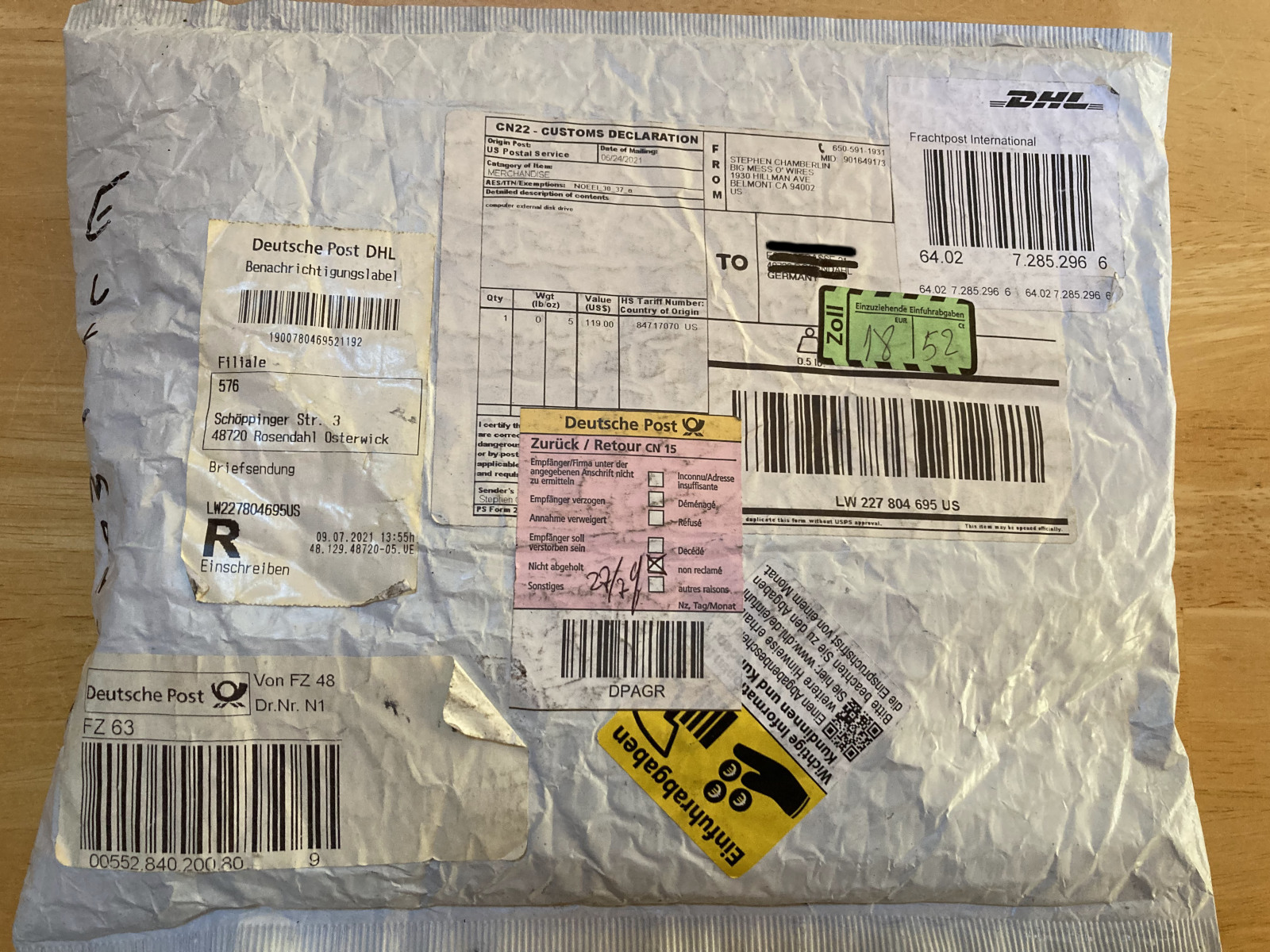
Language and product support requirements for other countries have also been a challenge and a source of confusion. I once had a shipment rejected by the German customs authority for reasons that weren’t immediately clear. After speaking with the customer, who spoke with the customs inspector, I was informed that I needed to provide German language product documentation and an in-country representative to handle product concerns. The customer didn’t get their package, and I had to apologize and give a refund. I’d never heard of that requirement before, nor has it come up again since then.
Another potential source of externally-imposed regulation is the GDPR. Beyond the actual privacy requirements that were already mentioned, businesses that do not have a physical presence in any EU country may need to have a physical representative located inside the region to comply with the GDPR.
Sales Tax Collection
Tax collection is the most visible area where other states and countries impose requirements on businesses outside their borders. For internet-based sellers in the USA, it used to be common practice to collect sales tax from customers located in the same state as the business, and everyone else got tax-free purchases. If a customer in New York bought something from an internet merchant in California, the customer was supposed to file and pay a New York use tax return, but in reality zero people did this and New York would just lose the tax revenue. In recent years the states have been much more aggressive about pursuing sales tax from out-of-state business, based on confusing requirements about economic nexus. For sales within the USA, businesses may have to collect sales (at varying location-based rates) and submit separate sales tax returns to up to 45 different states, individually.
Most states now apply a sales threshold beyond which out-of-state sellers are required to collect and report sales tax, even if they don’t have a physical presence in the state. Some e-commerce platforms like Shopify will track these thresholds for you. Here’s some of mine:
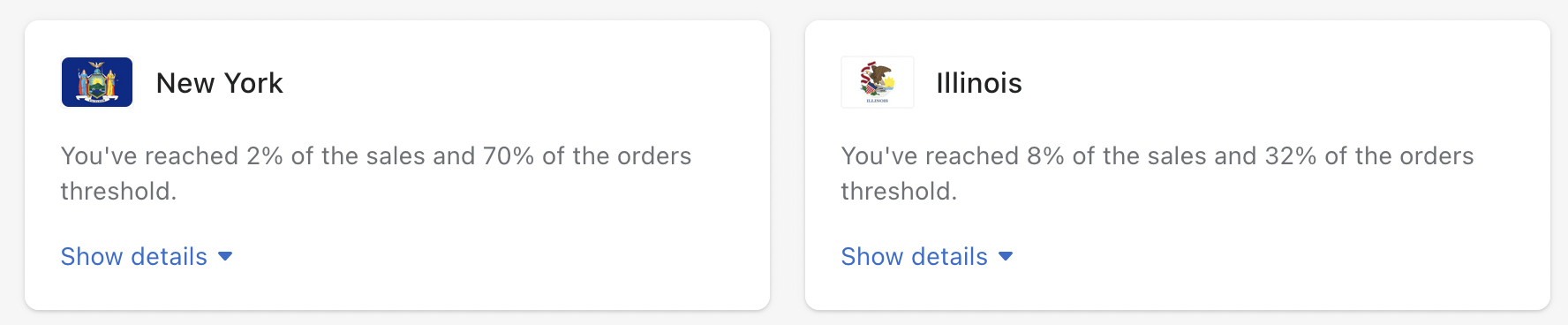
Unfortunately the automated tracking of a sales threshold is a completely different animal from actually registering with a state’s tax authority and filing a quarterly sales tax return. California’s sales tax return already requires several hours of my time four times per year, and I don’t relish the thought of adding returns in New York and Illinois and 42 other states. I’m undecided about what I’ll do when that New York threshold reaches 100 percent. Cutting off sales to customers in New York isn’t a fun prospect, but neither is adding more compliance paperwork to an already full pile.
VAT Collection
Just as New York and Illinois are eager to get sales tax when their residents buy something from my California business, France and Germany are eager to get VAT when their residents buy something from my USA business. Now it’s called VAT instead of sales tax, but it’s the same concept and it extends the potential tax collection and reporting burden from 45 US states to every nation in the world.
Currently it’s the EU and Canada at the forefront of international VAT collection efforts. And unlike for out-of-state US sales tax, there’s generally no sales threshold and no minimum purchase amount below which small businesses can take shelter. EU countries require that non-EU businesses collect and submit VAT beginning with their very first sale, for any amount of dollars or euros. It’s totally understandable that these countries want to recoup the lost VAT revenue, but it puts a huge amount of extra compliance burden on small businesses. The idea of registering with tax authorities in Belgium, collecting per-customer VAT payments, and submitting periodic European tax returns and reports… for me, as a company with no EU business presence, that’s simply a bridge too far.
Fortunately there’s an alternative that works for now. BMOW can send shipments to the EU and Canada without any VAT, and the authorities in those countries will collect the VAT directly from the customer before delivering the shipment. It sounds great, except it creates some extra delays and costs for customers in those locations. Even when everything goes as expected, it’s a cumbersome process where the package gets stored in a warehouse while the shipper sends a notice to the customer, asking for the payment of VAT plus an additional brokerage fee. The customer may be able to pay online, or may need to physically visit a post office or shipping office. Once the VAT is paid, the package gets released for final delivery to the customer’s door. But if there’s a hiccup in the process, the customer never gets notified that their package is awaiting VAT payment. It languishes in a warehouse for weeks until it’s finally returned to sender by the slowest possible method, arriving back at my address six months or a year later.
So What?
There’s a lot of regulation that impacts small businesses, and much of it from external authorities, but so what? I expect this essay may attract some negative comments and a story on Hacker News titled Small Business Snowflake Thinks Laws Shouldn’t Apply to Him. They’ll say “If you don’t like the laws in (wherever), then don’t serve customers there!” Quite right. And that’s exactly the decision I’m facing now.

I’m realistic. The tax man needs to get paid, and can’t allow buyers to escape paying tax by purchasing everything out-of-state or out-of-country. Governments need to be able to craft product environmental and safety laws that won’t be trivially circumvented by products coming from outside their borders. These are real problems.
But where does this leave a small business with a global reach, a 1.5-person show selling retrocomputer gadgets that were designed for fun? Every day I’m looking at the mounting pile of compliance requirements and paperwork coming from every corner of the globe, and wondering how I’ll ever find time for business and product development amid everything else. My local and state compliance requirements already include the city business license, state reseller permit and sales tax returns, income tax returns, liability insurance, worker’s comp, employment regulations, and more. It’s already a mountain of red tape, even before external jurisdictions begin to impose their own requirements on me.
Ultimately my hope is to pay somebody to handle most of this stuff, if it’s not prohibitively expensive. I don’t spend time stressing about payroll filings, because I use a payroll service. Maybe an accountant to handle the 50 different sales tax and VAT reports? For several of these requirements like LUCID and EU VAT, there already exist cottage industries of in-country agents that will assist foreign businesses. Shopify has some support for these things too, although they tend to be focused on collecting information and stop short of actually fulfilling the compliance obligations. When I researched them in the past, my eyes quickly glazed over with legalese and I failed to grasp the big picture of what exactly I’ll need to do. But with a bit of luck, I hope to reach the summit of this regulatory compliance mountain.
In my dream world, the US would have a single national sales tax system instead of countless separate state, county, and city tax fiefdoms. Then governments wouldn’t worry about losing revenue on out-of-state sales, while businesses would only have to cope with a single collection and reporting system, and everyone would benefit. In this dream world, countries would also work together at the UN or WTO to draft product requirements that applied consistently across the globe, instead of a hodge-podge of different requirements in every different country. Compliance and reporting requirements would also come with intelligent thresholds based on sales volume or business size, to ensure that the compliance burden was appropriate for the business size, and nobody was driven out of business due to overwhelming red tape. I can dream.
we had to share our “shadow sides” and “be more vulnerable” at a meeting
This post, we had to share our “shadow sides” and “be more vulnerable” at a meeting , was originally published by Alison Green on Ask a Manager.
A reader writes:
The small team of seven people I’m on (within a Fortune 500 company) recently had an offsite for team-building and strategic planning. A junior employee was assigned to plan the team-building part of our offsite. She’s repeatedly said she wants more trust within the team and for us to feel like a “family.” So she planned an activity for us to “be more vulnerable with each other.” We were given blank paper masks and asked to draw/paint our strengths and things we showed to the world on the front of the mask, and then on the back to draw/paint our “shadow sides” or weaknesses or things we don’t usually share in the workplace. Then we were all asked to share.
I managed this by not talking about anything I didn’t want to share. But one employee cried while sharing and another was visibly uncomfortable. I’ve done this type of activity before, but in the context of group therapy under the supervision of a professional therapist!
I have the credibility and capital to share some feedback with my management team about this activity. But I’m having a hard time figuring out how to articulate it beyond “inappropriate for the workplace.” I don’t want them to tell the junior employee that other people didn’t like her activity, but I do want the managers to vet activities going forward! Do you have any suggested language to talk about this?
Eeessh…
It’s so common for managers to let employees plan this kind of activity without any oversight! Often the first time other people hear details about the activity are when it’s being announced at the meeting and everyone is expected to participate on the spot. It’s pretty bizarre since if team-building and ice-breakers are valuable enough to spend meeting time on (and they can be! I’m not saying they never are), you’d think they’d be important enough for someone to review before setting a junior staffer loose with complete free rein to come up with anything they want.
Especially one who has repeatedly said the team should feel more like a family.
Anyway, here’s your list of reasons:
* Highly personal activities about people’s most intimate selves are best done with the guidance of a therapist or at a spiritual retreat, not at work. For many people, good-faith participation in this activity would have meant delving into and revealing trauma, which no one should have to do at work … and which could be counter to some employees’ mental health needs.
* It’s intrusive. Many people feel violated by demands that they lower their boundaries, and feel being expected to share deeply intimate things with colleagues or managers as highly invasive and overstepping.
* Asking employees to “be more vulnerable” may not actually be safe for everyone there to do. It puts some people — particularly those with marginalized identities — in a position of actual vulnerability and risks opening them up to discrimination.
* It’s true that high-functioning teams are ones where people feel psychologically safe and where they can be their authentic selves. However, that environment is something that’s created by good management over a sustained period of time. Simply demanding emotional intimacy from employees doesn’t achieve that; to that contrary, that will make many people feel less safe.
* Activities like these always need to be opt-in; people should never feel obligated or pressured to participate. (And even opt-in activities can be inappropriate for work, and I’d argue this one is.)
So yes, please do share feedback with your management team about what happened at this meeting, and ask that future activities be vetted ahead of time and guidelines provided to anyone charged with planning them. Your coworkers will thank you.
Introducing Democracy’s Library
Democracies need an educated citizenry to thrive. In the 21st century, that means easy access to reliable information online for all.
To meet that need, the Internet Archive is building Democracy’s Library—a free, open, online compendium of government research and publications from around the world.

“Governments have created an abundance of information and put it in the public domain, but it turns out the public can’t easily access it,” said Internet Archive founder Brewster Kahle, who is spearheading the effort to collect materials for the digital library.
By having a wealth of public documents curated and searchable through a single interface, citizens will be able to leverage useful research, learn about the workings of their government, hold officials accountable, and be more informed voters.
Too often, the best information on the internet is locked behind paywalls, said Kahle, who has helped create the world’s largest digital library.
“It’s time to turn that scarcity model upside down and build an internet based on abundance,” Kahle said. There is a need for equitable access to objective, historical information to balance the onslaught of misinformation online.
Libraries have long played a vital role in collecting and preserving materials that can educate the public. This mission continues, but the collections need to include digital items to meet the needs of patrons of the internet generation today.
Over the next decade, the Internet Archive is committing to work with libraries, universities, and agencies everywhere to bring the government’s historical information online. It is inviting citizens, libraries, colleges, companies, and the Wikipedians of the world to unlock good information and weave it back into the Internet.
Democracy’s Library will be celebrated at the October 19 event, Building Democracy’s Library, in San Francisco and online.
Watch the livestream of Building Democracy’s Library:
The project is part of Kahle’s vision to build a better Internet—one that keeps the public interest above private profit. It is based on an abundance model, in which data can be uncovered, unlocked and reused in new and different ways.
“We know there’s an information flood, but it’s not necessarily all that good,” Kahle said. “It turns out the information on the Internet is not very deep. If you know a subject well, you find that the best information is buried or not even online.”
Democracy’s Library is a move to make governments’ massive investment in research and publications open to all.
Kahle added: “Democracy’s Library is a stepping stone toward citizens who are more empowered and more engaged.“
The first steps of Democracy’s Library are available online at https://archive.org/details/democracys-library.
The post Introducing Democracy’s Library appeared first on Internet Archive Blogs.
The Proper Way to Make a Cup of Tea
Experts, especially British experts, both agree and disagree on the question: What is the proper way to make a cup of tea? Investigator Gary Dryfoos reminds us that there are audiovisual materials documenting some of those views. Here are a few of those materials. One might keep in mind that there is an official British standard, and that that standard — six pages in length —was honored with the 1999 Ig Nobel Literature Prize.
The final item on the list, below, conveys an innovative opinion, from the Thames Valley Police, as to the importance of knowing the proper way.
Lost Something? Search Through 91.7 Million Files From the 80s, 90s, and 2000s
Read more of this story at Slashdot.
Comic for 2022.10.19 - Couples Costume
What Infowars Viewers Are Saying About The Alex Jones Trial

Far-right conspiracy theorist Alex Jones has been ordered by a jury to pay $965 million to the families of victims of the Sandy Hook school shooting. The Onion asked Infowars viewers what they thought about the verdict, and this is what they said.