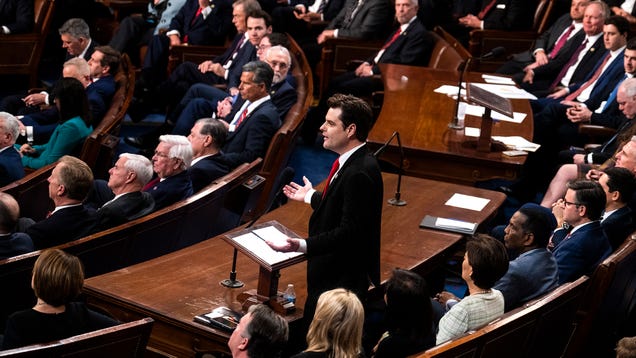
Dear Republican Members-Elect of the House of Representatives,
Thanks so much for this extension on all the reports I was supposed to prepare for members of the House to start reviewing this week as part of their new committee assignments. I really appreciate it.
I was getting super stressed juggling everything—trying to figure out when or if I’ll ever have to pay back my student loans, waiting on hold with Southwest Airlines, traveling over state lines to get safe prenatal care, and helping my neighbors escape from cars stranded in the snow. Modern life is a lot, you know? Adulting. It’s a lot. And then, on top of everything, I got the triple whammy—COVID, RSV, and the flu. By the way, if you saw me in the building today, you might want to wear a mask for a while, unless your constituents would think that makes you one of the sheeple. No judgment.
I was starting to think, Dang, someone really needs to do something about all this stuff. I mean, I’m not the only one who got COVID, right? And I think other people have student loans. And snow. And unusable airplane tickets. And doctor’s appointments. It’s like we need some kind of… I don’t know, collective action? Working group? Leadership initiative? I’m just spitballing here. Some sort of way for people to work together centrally to fix problems affecting many of us at a societal level. Has anyone invented that yet? Maybe I should talk to some of the venture capital guys I see at the bar about spinning something up? Or we could do a GoFundMe?
But then, when you deadlocked over electing a speaker of the House, causing all other legislative business to grind to a halt, I was like, PHEW, now I don’t have to get those reports done for the House committees, and I can focus on getting better and taking care of my own problems for a while. I know, I know, this is just being a grownup. Gotta do it yourself, right? Bootstrapping and all that.
If I were to give you just a bit of feedback, it would be that the uncertainty factor is still kind of stressful. I mean, when does this extension end? Could be tomorrow, could be in two months, right? I could use a hint. If it’s going to last longer than your most recent argument over the debt ceiling, please have George Santos blink twice slowly. He’s trying so hard to be useful anyway.
Anyway, when it looks like you’re getting closer to picking someone (anyone!), give me a nudge, and I’ll switch from reading about the tragedy and horror in Ukraine (by the way, are we really planning on not helping out with that?) back to writing the reports you’ll want to see next week. What is it you asked for again? How many elementary schools have libraries or something? I was surprised to be asked to highlight the ones that do in red, not the ones that don’t—was that a typo?
A customer wanted to create a user with a specific SID prefix:
We know that you can’t create a user with a specific SID, but can we at least create it with a specific SID prefix?
We naïvely tried this:
net user /add Fred
net localgroup "Cryptographic Operators" Fred /add
Since the Cryptographic Operators group SID is S-1-5-32-569, we expected that the newly-created user “Fred” would have a SID of the form S-1-5-32-569-(random)-1000, but it doesn’t.
How do we create a user with a specific SID prefix? We want Fred to be a member of the “Cryptographic Operators” group, so we need the user SID to be under the “Cryptographic Operators” SID.
Okay, that’s not how SID prefixes work.
Group membership is not controlled by SID prefixes. It is not the case that all members of the “Cryptographic Operators” group have a SID prefix of S-1-5-32-569, nor is it the case that you must have that prefix in order to be a member of the “Cryptographic Operators” group.
In fact, S-1-5-32-569 is not a legal SID prefix at all, since it is not a so-called domain identifier, which is the fancy name for “a thing that can produce new SIDs via suffixing.”
If you think about it, it makes sense that group membership is not controlled by SID prefixes. After all, a user can belong to multiple groups: You are probably a member of the local Administrators group (S-1-5-32-544), the Remote Desktop Users group (S-1-5-32-555), the Users group (S-1-5-32-545), the Authenticated Users group (S-1-5-11), and a whole bunch of others. But you have only one SID, so it can’t have all of those groups as a prefix.
Group membership is determined by entries in the user’s token, and those entries are placed there at token creation based on the group memberships. When the system later wants to check if a user is in a group, it does so by looking in the token to see if there is an entry for that group in the token. It doesn’t do it by doing a prefix check on the user SID.
You have your gym membership card in your wallet, but that doesn’t mean that you were born at the gym. Your national identity number was issued by Stockholm, but that doesn’t prevent you from being a registered resident of Göteborg.
The way to create a user in a group is to do exactly what the customer did: Create the user (which will assign them a SID), and then add the user to the groups you want them to be members of (which will add them in the group membership database).
The numeric properties of the SID are not important. As long as each entity gets a unique SID, that’s the important thing. The prefixing technique is just a way to make sure that separate SID-creating entities can create unique SIDs without colliding with each other: If you give each SID-creating entity a unique prefix to stamp onto its created SIDs, then you can be sure that their SIDs won’t collide.
Bonus chatter: Although the numeric properties are not important from a security standpoint, you can use knowledge of the SID-assignment algorithm to infer information about the circumstances of the SID’s creation, in the same way that looking at a person’s national identity number tells you where they were born.¹ For example, by looking at the SID, you can determine which SID-creating entity issued it, and from the RID you can infer which domain controller was used.
¹ In 1990, Sweden stopped encoding geographic information in the national identity number, so that trick works only for older people.
I was reading NPR and caught this amusing article on banned words, as in the annoying slang/jargon/buzzwords (ugh, “buzzwords”) that people are painfully sick of hearing. It made me think of a coworker who has a deep addiction to the word “touch-base,” substituting it for “meeting” at every conceivable opportunity. I have always disliked this word (or phrase? whatever) and through working with this person (who also combines an unusually nasal voice with severe overuse of the condescending “Does that make sense?”), I’ve slowly come to hate it. If I can avoid hearing or using “touch-base” this year, I will.
My question is how to do this. I recognize that many of these terms pass into oblivion sooner or later (one of the banned words in the year of my birth was the mysterious “harya doone,” which I can only surmise might have been a bad joke on the phrase “how are you doing?”). But I want “touch-base” out of my life now. Is there a polite way to say “Ugh, shut your piehole with that jargon crap” or should I just use “meeting” assiduously and let this fool do what they do?
You can try, but even if you succeed someone else will start constantly saying “out of pocket” to mean “unavailable” and another person will start using “ping” instead of “message” and new pet peeves will continually move in to replace the old ones, as that NPR piece demonstrates.
That said, if you have decent rapport with your coworker, there’s no reason you can’t say, “Agh, I really hate how we’ve started saying things like ’a touch-base’ when we mean a meeting or (insert another example of jargon from your office here). I’m on a mission to get us back to plain language!” (Obviously, judge the relationship first. There are people who would bristle at this and people who would take it good-naturedly. If the person is a bristler, it’s not worth it.) Even if it goes over well, though, are they going to change what’s clearly become an ingrained habit? Maybe! Sometimes this stuff becomes unconscious and a nudge can dislodge the habit. Other times … not.
Really, though, you’re generally better off just trying to find it funny. Because language, even soulless corporate jargon, is funny.
(Also, years ago, I worked with someone who would say “I’m going to be out of pocket” constantly when he meant “I’ll be unavailable” and my coworker and I turned our annoyance with it into inspiration to see if we could make up a weird phrase and get it into common use in our office. We started saying “I’m going to be out of orbit” when we were going to be unavailable and, sure enough, the “out of pocket” guy picked that one up too. Feel free to try something like this.)
WASHINGTON—Defying speculation that the 118th Congress would get little accomplished during its term, the incredibly productive House of Representatives assembled Thursday for its eighth vote in just three days. “Less than 72 hours into the new session, and they’ve already held seven votes—these committed…
The HPD officer was responding to a non-emergency call without his sirens. A major aspect of the investigation is determining how fast the officer was going.
Wednesday was an A+ weather day in Houston, and Mother Nature is going to get high marks again today as high pressure holds sway over our region. The forecast turns rainy by this weekend, with a healthy dose of clouds and rain chances through Monday before sunnier weather returns next week. Temperatures will remain fairly mild for the foreseeable future.
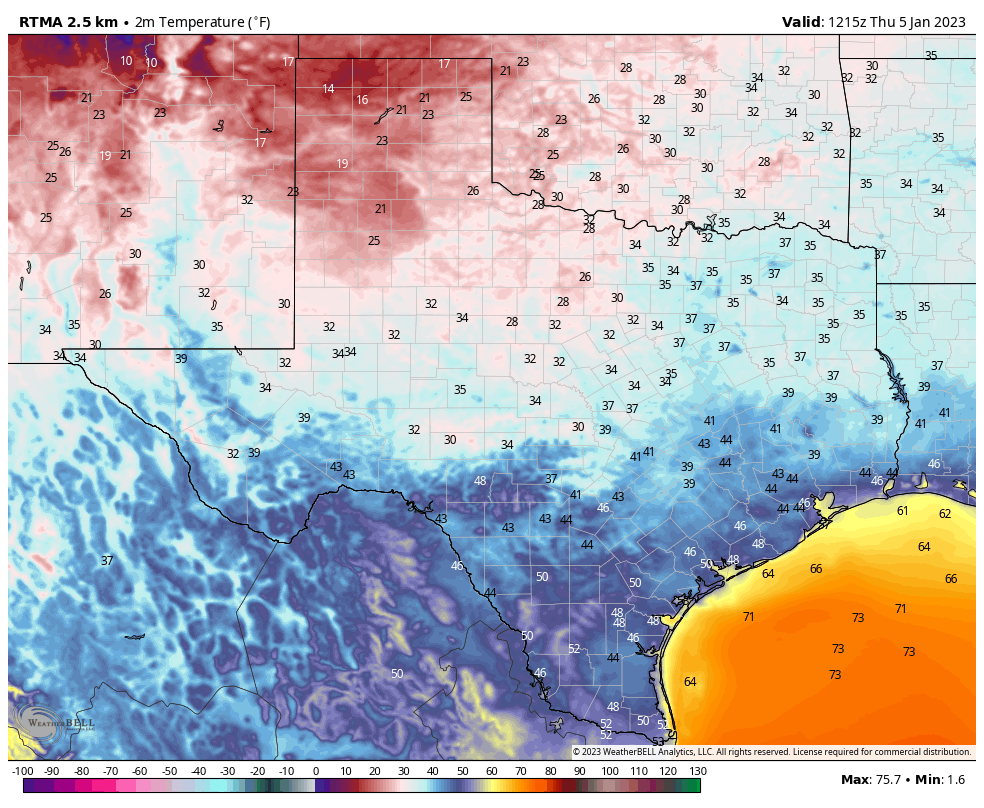
Thursday morning temperatures across much of Texas are rather brisk. (Weather Bell)
Thursday
With high pressure still in place, we’ll see sunny skies today with highs of around 70 degrees across the metro area. However this pattern starts to change later this afternoon or evening, as winds shift from the northwest to southeast. Due to this more southerly flow look for lows on Thursday night to be a few degrees warmer, bottoming out in the low 50s in Houston.
Friday
This will be another sunny day, but highs will climb into the mid-70s as a more pronounced southerly flow resumes. Look for fairly robust southeasterly winds, gusting to perhaps 20 mph. This will start to pump up atmospheric moisture levels. Low temperatures on Friday night will only drop to around 60 degrees in Houston.
Saturday
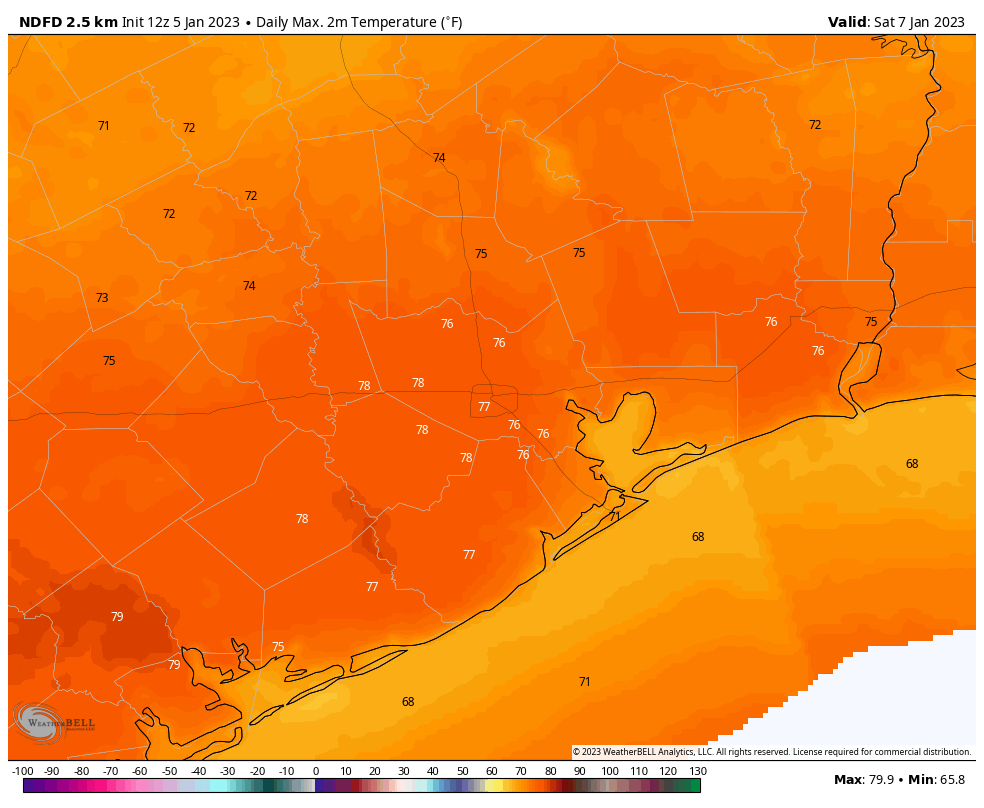
The first half of the weekend will be quite warm, with highs in the upper 70s. Local temperatures will depend on how much sunshine you see, as at least partly sunny skies are possible during the daytime. Some scattered showers will be possible during the day, but the better chances will hold off until Saturday night into Sunday, as a cold front slogs toward the area. Look for accumulations of 0.5 to 1.5 inches of rain for most into Sunday morning.
High temperature forecast for Saturday. (Weather Bell)
Sunday
For inland areas, rain chances will be fairly low after Sunday morning, with mostly cloudy skies and highs in the 60s. Some showers may linger closer to the coast however, as the front may stall just offshore. Hopefully Matt will be able to fine tune the weekend forecast a little bit in tomorrow’s post. Lows on Sunday night should drop into the mid-50s in Houston.
Next week
A second round of showers is possible on Monday as an atmospheric disturbance moves through, but I’m not expecting too much in terms of precipitation from this system. After that, much of the rest of next week looks partly to mostly sunny, with highs in the low 70s, and lows in the 50s. It looks like a stronger front may arrive by Thursday or Friday to knock overnight lows into the 40s for a bit. Rain chances look low for the weekend of the Houston Marathon to go along with cooler temperatures, but that remains subject to change this far out.
Paperback copy of Liftoff
This week the publisher of my book about the origins of SpaceX, titled Liftoff, released a paperback copy for the first time. I am happy to sign and personalize copies of this new paperback edition of Liftoff if you order a copy today from Houston-based Blue Willow Bookshop. You can find instructions for doing so here, if you are interested. Thanks!
With a group of Republicans holding out against the candidacy of Rep. Kevin McCarthy, the election of a new House speaker has hit a stalemate, and the House cannot begin business until a speaker is chosen. The Onion takes a step-by-step look at how the speaker of the House is elected.
Sala Diaz, a nonprofit exhibition space in San Antonio’s Cultural Arts District, has announced its acquisition of a new building, as well as details of its 2023 programs and exhibiting artists.
Sala Diaz’s newly acquired property, Compound House.
During the summer of 2022, an anonymous donor purchased and donated a property neighboring Sala Diaz. The home, located at 521 Stieren Street, is identical to the 1910 residential duplex which houses Sala Diaz and the organization’s residency program, Casa Chuck. It was also one of five houses owned by San Antonio art patron Mike Casey and rented to artists. In October 2021, the San Antonio Heron reported that developer Chris Coker and a partner purchased the 521 property, along with two other houses that were once owned by Mr. Casey. At the time, Sala Diaz board members were in discussions about purchasing one of the homes as part of the organization’s expansion plans.
Prior to its donation, the duplex at 521 Stieren, called Compound House by Sala Diaz, was equipped with a new roof and foundation, and its interior was stripped down to the studs. The space will host short-term rentals throughout the year, generating revenue to support the organization’s exhibitions and residency program. Additionally, Sala Diaz plans to update the landscaping of both properties, and to create an office and storage space.
Last fall, Sala Diaz was among five Texas arts spaces to receive grant funding from the Milwaukee-based Ruth Foundation for the Arts, a new organization supported by a bequest from the late Ruth DeYoung Kohler II, who was a museum director and educator. While Ballroom Marfa received a multi-year Thought Leaders grant totaling $300,000, Sala Diaz, along with Houston-based organizations DiverseWorks, the Orange Show Center for Visionary Art, and Project Row Houses, each received a Core Grant of $50,000.
Kat Cadena, “And yet, we bloom,” 2020, acrylic mural, 10 x 20 feet. Location: Intersection of E Houston St. & Navarro St. San Antonio, Texas.
This summer, Sala Diaz will pilot a new program in which a selected artist will take over its existing gallery and use it as a studio space. Kat Cadena, a San Antonio-based multimedia artist, was selected as the inaugural Summer Studio artist by Sala Diaz Board President Ethel Shipton.
Kim Bishop, “I Carry You,” 2022, graphite on paper, 5 x 3 feet.
In a press release, the organization also announced that its 2023 exhibitions will feature women artists, in response to the diminishing of women’s rights. This is likely a reference to the Supreme Court’s decision to overturn Roe v. Wade in June 2022. Exhibiting artists include Kim Bishop, Barbara Felix, Cristina Cardenas, Mari Hernandez, and Kat Cadena.
1. My boss hated my “question authority” bumper sticker
You recently posted an old letter from a guy who had a “fat girls can’t jump” bumper sticker on his truck and he was facing HR complaints about it. This made me think about something that happened to me early in my career. I had a bumper sticker on my private vehicle that said “question authority.” That’s it, that’s all it said; black text on a white background, no images. My manager hounded me for weeks about how I needed to remove that sticker because he found it offensive, how it demonstrated I had a terrible attitude, and how important it was that I never question his authority. To my knowledge, no one else ever complained about it, and HR was never involved. The car was my private car, and the job was a desk job, no driving, no customer interface. Was the manager right that I should remove that sticker? I think this is a thornier issue than “fat girls can’t jump” and am interested in where you draw the line.
Did your manager not realize how much he was revealing about himself there? He needs his own bumper sticker that says “insecure authoritarian.”
Anyone who deserves to hold authority should want to be questioned and should be suspicious of people who don’t examine things too deeply.
In any case, that’s an absurd thing to ask you to remove. Your sticker was inoffensive and far outside the bounds of anything an employer should care about, let alone raise to you. I suspect if you’d taken it to HR, they would have shut him down.
2. Is my babysitting client stealing from his employer to pay me?
I’m a recent college grad with a full-time office job. Since I was a teen, I babysit for extra cash on the side.
For the past 10 months, I’ve been caring for a very sweet infant boy. His father is a single dad who works at a nonprofit. I don’t like him for several reasons, but my question is about payment. In the beginning, he would pay me by Venmo or cash, which has been pretty standard in every babysitting job I’ve worked. About four months ago, he switched to writing checks. The checks were labeled with the nonprofit, and the memo line made no reference to childcare, but generic “logistic support.” Being naive, I cashed the checks and went about my business. Honestly, I thought he was just embarrassed to write nanny or babysitter. He has now sent me a W9 form through the nonprofit, and I’m expected to pay taxes on all payments received by check. I have never done any sort of work for the nonprofit. My work is exclusively changing diapers and making bottles for the baby.
I’ve never been asked to pay taxes on babysitting income, but it’s probably legal to ask me to pay taxes in general. But was it legal to pay me with company checks and send the W9 through the nonprofit? He’s neither a donor nor the owner. My mom (a childcare professional with over 30 years experience) says it’s embezzlement and fraud. I don’t plan on returning to that family for a number of reasons, but this would be a huge one.
Whoa, no, this guy is almost certainly stealing from the charity that employs him. And especially now that they’ve sent you a tax form, you really need to call the organization and report it. Call and ask why they’re sending you a tax form since the only work you’ve done is personal babysitting for one of their employees. (It’s very likely that he didn’t generate the W9 himself — the org is just automatically sending them to all their contractors and thinks you’re one of them because he fraudulently claimed they needed to pay you for logistics work. Holy crap.) They’re going to be able to unravel it from there.
I know that might not feel great — he’s a single dad, etc. — but ethically you really have to now that he’s made you part of it.
3. When I tell people my job, they always share heavy emotional stories with me
I have an extremely niche job, one that almost no one has heard of. I love talking about it, because it’s my passion and because people are very interested in it once they understand what I do. I’m a veterinary social worker — I guide pet families through hard decision-making and through the euthansia process and provide grief counseling and resources, and I also work with veterinary staff on burnout, compassion fatigue, processing of difficult cases, and suicide prevention and intervention.
The trouble I run into is that because my fields are so universally experienced, everyone I talk to (and I do mean EVERYONE, I’m not sure I’ve ever met an exception) has an “Oh wow, I wish you’d been there when…” story. These are often very heavy, emotional stories, relayed by strangers as I’m grocery shopping, getting my hair cut, waiting for my kids at the dance studio, getting coffee … and whether it’s a cause or effect of my job, I have the kind of face people want to tell these stories to. Often they’ve never had the opportunity to tell the story to someone who would understand and validate its significance in their lives. Is there a compassionate, kind way of establishing and holding a boundary for my own sake in those relatively brief interactions without invalidating their experience or just never talking about my amazing job?
I do think you probably need to be more circumspect about what you do in situations where you’re not up for getting into the details — and really, strangers in the grocery store don’t need to know exactly what you do! You could say social worker (true) or consulting (also kind of true) or anything else vague that isn’t likely to prompt the sort of outpouring you don’t want in that moment. (I often just mention the consulting part of my work in similar situations, because when I say I write a work advice column, I get everyone’s horrible boss stories — which aren’t as emotionally draining as the ones you get, but still aren’t what I want to hear when I’m trying to disconnect from work.)
But in cases where you do want to share more, you could try being transparent about what you want to avoid. For example, after explaining what you do, you could add, “I always hear everyone’s heart-breaking pet stories when I share this so I should be up-front that I need a break from that right now!” Some people will give you their stories anyway because some people are like that, but you’ll have laid the groundwork to interject and say, kindly, “I’m sorry — I know this topic can be such a tough one, but I need space from my work right now. Thank you for understanding.” There may also be times when there doesn’t feel like there’s any kind way to say that, so adapt as needed based on what you’re up for doing.
4. A former employee keeps sending critical emails to another former employee … and BCC’ing me
I work at a company that does design stuff. 40 years ago, a then-employee, Carlyle, led a major design charge that resulted in Big Project which drastically changed our downtown for the better. It was one of our firm’s biggest and to this day most recognizable projects. He also apparently was hard-headed and difficult to get along with.
I started at my company three years ago. Another employee, Hiram, had started there right out of college. Hiram is a big design thinker and had a lot of big ideas, a lot of graphic skills, and a lot of youthful naivete and hubris. In his free time, worked with a grassroots collective that was looking to inspire large-scale design changes to continue to shape the city. He had reached out to Carlyle during his schooling to learn about his experience on Big Project. However, as Hiram and the collective’s vision started to depart from what Carlyle thought it should be, Carlyle started to lash out through emails.
Hiram has moved on to another job in a different city but is still somewhat active in the collective. I have only met Carlyle a handful of times. The last time he came to the office, I gave him my business card and email address. He frequently copies me on mass emails he sends, which include other designers in the community, fervently pushing his ideas and pushing for other people to push them. Lately he has taken to BCC’ing me on emails he sends to Hiram with accusatory critiques of his ideas. I would like to get Carlyle to stop including me on these emails, and stand up for Hiram a bit. My petty response would be to reply to a BCC asking Carlyle to stop copying me, but I’d like to handle it tactfully. What’s the best way to respond? Should I respond?
It’s not petty to respond to the next email and ask him to stop. (It would be petty if you replied-all, but not if you just address it to him.) There’s nothing wrong with replying to the next one with, “I’d prefer not to be included on these messages and would appreciate you removing me in the future. Thank you.”
5. My temp’s eyes glaze over whenever I talk
I have a temp who I meet with once a week virtually. I am a full-time worker and we are both the same age. She reports to me. I have been working in our field longer so I often explain things to her when providing her direction so she has context. She’s expressed this isn’t her dream job or anywhere close, but a learning experience and a way to pay the bills. It’s been three months.
More often than not, when I explain our tools, how it compares to other tools, and general functions, she gives me a blank stare. I’ll ask, did that make sense or was any part confusing? She just nods. I sometimes say, I don’t want to scare you and I talk a lot, so you can interrupt me or say that you have enough info if you want me to stop. She hasn’t done that. But I feel that her eyes glaze over when she asks me a question and I respond (perhaps, it seems, too long-windedly). Her body language expresses boredom or subtle annoyance.
She is responsive to small talk and whenever we talk about shared hobbies. I was hoping to teach her more stuff since she is newer, since I had a boss who did the same for me and I really appreciated it, but maybe I am overstepping my bounds. Your thoughts?
I don’t think you’re overstepping your bounds — you’re her boss, you’re sharing work information — but it does sound like you could be ignoring cues that she’s just not that interested in information that doesn’t directly relate to her job. While you appreciated it when your boss taught you things, this is someone who’s already told you she’d not that invested in this job and so she might feel very differently than you did.
My big question is: How’s her work? When you give her info that’s relevant to how she should do her job, is it later reflected in her work? If so, then you might just need to back off from sharing the extras with her, or accept that she’s not going to be terribly engaged in these conversations. But if her work has problems, then that’s something you’d need to address, and as part of that you might raise the question of whether she’s not paying enough attention when work is discussed.
It sounds like you have good rapport with each other, so you could also just ask point-blank: “I might be misinterpreting, but when I talk to you about X or Y, you seem like you’re bored or wanting me to wrap up. Am I reading that correctly?” That said, I’d be less inclined to do this with a temp, whose professional development you’re not responsible for in the same way you would be with a longer-term employee.
AKRON, OH—During a press conference in which they described the game as the best option available for passing the long hours their parents spent drinking at bars, children of the nation’s alcoholics announced Thursday that they might as well get really good at pool. “Our moms and dads just ordered their fourth round,…
Q: Can we get ice cream? (Age 2) A: Sure, honey! But the word “cream” incorrectly suggests that this is a dairy product. In reality, it’s a congealed mass of artificial gums and pastes that are almost certainly not permitted for human consumption in any other major democracy. Enjoy!
Q: What happened to Mufasa? (Age 3) A: He’s sleeping.
Q: Can we get a puppy? (Age 4) A: Maybe in a few years, when Daddy’s ability to say no—along with his overall sense of self—has been sufficiently worn down.
Q: Where does rain come from? (Age 5) A: Good question. First, water on the ground evaporates up into the sky. There, it collects in clouds until it falls to the ground as rain, and the whole pattern starts over again. It’s called the water cycle, the only thing I learned as a child that I still remember. Seriously. I don’t know the different types of triangles or how to write in cursive or what hopscotch even is, but the water cycle? I could write a dissertation on it, baby.
Q: What’s money? (Age 6) A: Money is green paper that we use to buy food, clothes, and Daddy’s stress-relief soap that is going to start working any day now.
Q: Why is green paper valuable? (Age 6) A: It’s not; that would be silly. The paper is a stand-in for shiny yellow metal.
Q: Why is shiny yellow metal valuable? (Age 6) A: Because the human brain is not done evolving.
Q: What happened to Bambi’s mom? (Age 7) A: She’s clearly dead, honey.
Q: Want to play catch? (Age 8) A: Ask Mom. You just joined Little League, and I don’t want you learning the wrong way to do everything.
Q: Can we get a puppy? (Age 9) A: Whatever.
Q: Is it true that the stars we see at night are actually suns? (Age 10) A: Sort of. It’d be more accurate to say that they were suns. See, the stars in the night sky are very far away, and light takes a long time to travel that distance. That means that the stars we see have probably already died—either in enormous, violent explosions or sad little displays of fizzling out into nothingness. Either way, what matters is that stars, like all else in existence, inevitably succumb to the natural law of decay and are doomed to be forgotten. G’night!
Q: Can I have my own phone? (Age 11) A: I’m not sure that’s a good idea, honey. Phones expose us to cyberbullying, political misinformation, conspiracy theories, and a pervading sense of isolation that makes us feel alone even when surrounded by those we love.
Q: Can I have my own phone? (Age 13) A: Yes.
Q: Will you help me with my algebra homework? (Age 14) A: Sure. Let me just finish up this quantum mechanics paper so I can send it to the astrophysics department at MIT. It’s going to revolutionize their understanding of black holes! Ha ha ha! Algebra homework! Sorry, but that’s a good one. Wow.
Q: Why don’t you and Mom sleep in the same bed anymore? (Age 15) A: Don’t worry—it’s not that our marriage is in trouble.
Q: Then what is it? (Age 15) A: I’d rather not say, sweetheart.
Q: Dad. (Age 15) A: Two words: back hair.
Q: Nikki’s having a party when her parents are out of town. Can I go? (Age 17) A: Nikki? The girl who rides a motorcycle and got kicked off the volleyball team for coming to practice drunk? I guess, but next time, just lie to me and say you’re going somewhere to study. Where the hell is my stress-relief soap?
Q: Should I major in English or philosophy? (Age 20) A: Whichever one makes you happy. Although, since you’re my daughter, you’ll probably never be fully happy. Obsessive-compulsive disorder, generalized anxiety, depression, acute fear of cat-sized dogs—it’s only a matter of time before you get diagnosed with something. I’d blame genetics. Hey, maybe they teach that in biology! Is it too late to major in that? Might clear some things up.
Q: Can you and Mom babysit tonight? (Age 35) A: Of course! We can’t get enough of the grandkids. I’ll tell them stories of what life was like when I was young, coming back from the ol’ swimmin’ hole to fire up my dial-up internet. You know, it would make the craziest noises. Ka-chrrgh-ehhh-eeeeeihhhnnnng, and so forth, until finally you could join a chatroom. Chatrooms were rooms where you’d go to chat, naturally, but don’t let the name fool you. These weren’t physical rooms! They were more like virtual bingo halls, only instead of playing bingo, you’d be trying to think of something sexy to type—
Q: The children have asked that you not tell them stories. (Age 35) A: Understood.
Q: Can we get ice cream? (Age 41) A: Honey, I’m seventy-two. It’s all I’m physically able to eat.
Cattle guards are common in the Prairies. In Alberta, they are known as Texas gates. That’s how they appear on road signs, in some municipal legislation and provincial Hansard references. But elsewhere, it's a different story.
Both Kevin McCarthy and the nominee for speaker a century ago represented a party establishment regarded with hostility by a potent faction of the party. They became the embodiment of its grievances.
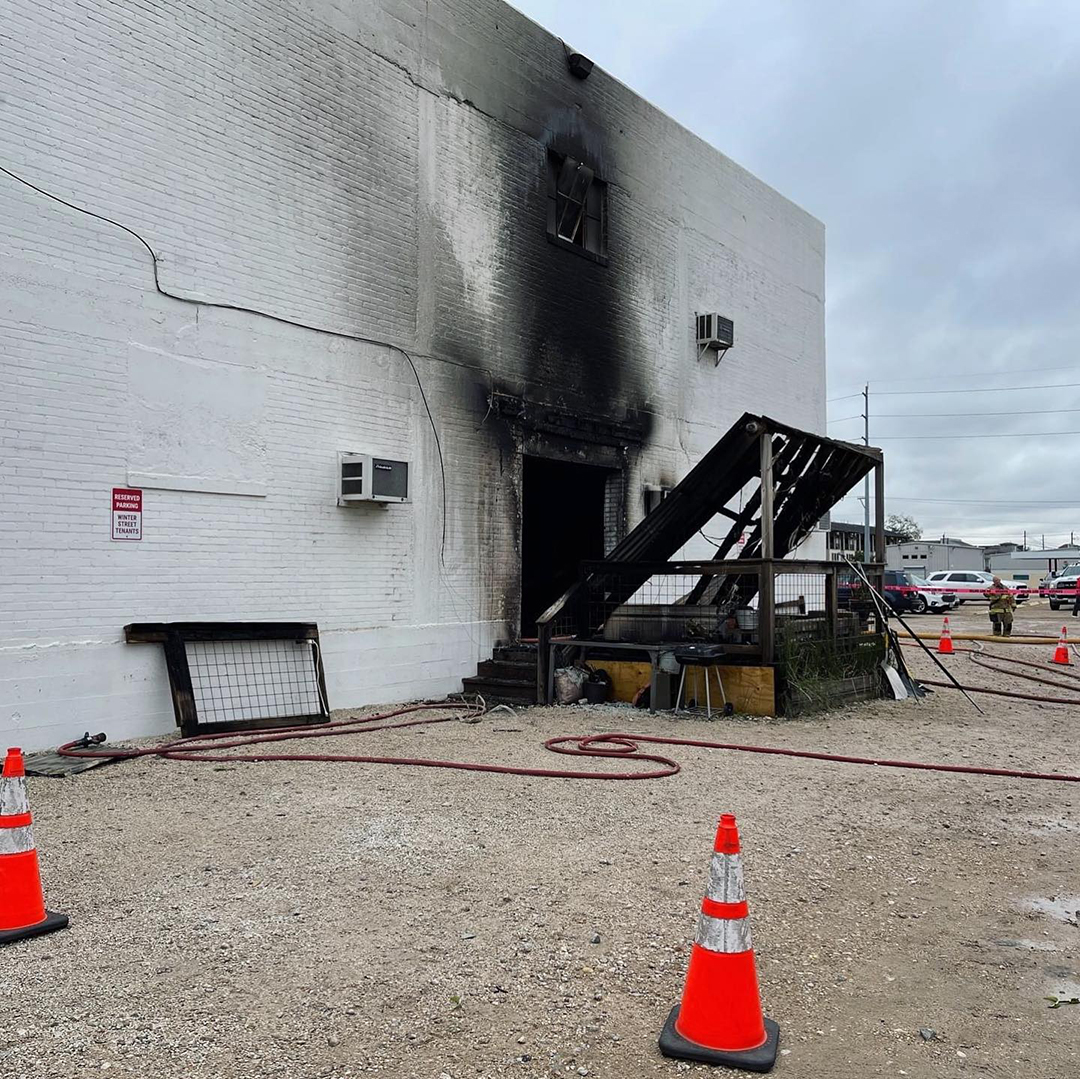
On December 22, 2022, Eoles “Deuce” Whitaker II, the man believed to have intentionally started the Winter Street Studio fire, died of suicide by jumping out of his high-rise downtown Houston apartment as police attempted to arrest him.
The exterior of Winter Street Studios. Photo by Taylor Clendennen.
The fire was started in artist Jack Potts’ Bohemian Photography studio, which suffered the most damage of the nearly 100 spaces that were affected. Early on, Mr. Potts suspected Mr. Whitaker, his friend who he previously worked with, of stealing his photography equipment and setting the fire. The two recently had a disagreement over $1,000, and Mr. Whitaker lost his job two months ago and may have been facing financial difficulties.
The Houston Fire Department confirmed that Mr. Whitaker was identified via surveillance video from Winter Street, and was also seen on video at his residence, The Rice Apartments, carrying some of Mr. Potts’ equipment. Investigators obtained an arrest warrant, but before they entered his apartment, Mr. Whitaker jumped from his 17th-floor window.
Eoles B. Whitaker II
Mr. Whitaker was an artist, a civil servant, and community advocate. According to his LinkedIn page, over the past decade he has held several positions, including Director of Intergovernmental Relations through the Texas House of Representatives, adjunct professor at both Texas Southern University and Houston Community College, and General Manager for the 5 Corners Improvement District, an organization that works to enhance the well-being of the Five Corners District located in southern Houston. Additionally, Mr. Whitaker was the founding president and CEO for Whitaker Alliance Group, a management consulting and investment management firm.
Jack Potts stands outside his damaged Bohemian Photography studio.
Mr. Potts told KHOU, Houston’s CBS affiliate, “I still would consider [Mr. Whitaker] a friend. To reach a point… where that’s justifiable, he had to be hurting pretty bad.”
Separately, Mr. Potts told Houston’s Eyewitness News, “As soon as I realized it was him, I can say this honestly, I was never even mad at him. It immediately went to the pain he had to be in… I’m sure he had no idea what was going to happen… the impact, the hundreds of artists that were affected one way or another.” After the events around the fire and Mr. Whitaker’s suicide, Mr. Potts is urging anyone who is depressed or struggling to reach out and ask for help.
Estimates of the damage and loss Mr. Potts has faced range from $250,000 to $500,000. Friends have launched a GoFundMe campaign to support Mr. Potts’ recovery, and the Houston Arts Alliance (HAA), through its Emergency Relief Fund, is still providing stipends to Winter Street Studio artists affected by the fire. Artists seeking relief can apply for emergency funds, and people wishing to donate can do so at HAA’s website.
Currently, the whole Winter Street Studio building is closed, though developer John Deal anticipates two-thirds of the building will be ready for artists to return in February. The other part of the building, which suffered the most damage, will require some structural repairs, and nearly half of the studios in this space will be completely rebuilt. The hope is to have all work completed in about six months.
In June, I was really lucky to do a work experience with my state electorate’s representative (I’m not American but I live in a western country).
While I certainly got some invaluable experience and built up my skills, I felt like I was treated slightly harshly by my boss, the aforementioned politician. For example, she made comments that my work or behavior was only acceptable “for a student,” despite my feeling I wasn’t acting much differently from her five other employees.
One comment that sticks with me, though, was at the end of the work experience, when my boss handed me a report I was supposed to return to my career counselor. I was mostly happy with it, but she took me aside to mention something she didn’t want to put on my report and “embarrass me” — that I sit in chairs and couches around the office too casually and I need to fix how I act at work versus home.
I have physical posture issues and a psychological disinhibition, which leads me to often find sitting uncomfortable and so I recline or lie down, especially on spaces like couches, but I didn’t consider myself to be excessively slouching or having an “unprofessional” posture in chairs. I was only approached about this at the very end of the work experience, but apparently she found it such an issue she wanted to include it on my report but instead opted to discuss it with me privately. She called it a “watching TV position,” which made me feel belittled, but I decided I wouldn’t confront her at the very end and ignored it. This experience and my future aspirations weren’t a public-facing people job — I wouldn’t be dealing with clients who’d have issues with it.
I’m trying to figure out if this is something I’d be seriously judged for in future jobs. Do managers often consider posture or how much I recline in seats, or would this be another sign of my boss’s critical nature? Am I even allowed to have these complaints about her or should I stay in my lane?
It’s definitely possible for a posture to be too unprofessional for an office — like if you were routinely slouched so far down in your chair that your head was barely visible over your desk or propping your feet up on your desk or stretched out on a couch while customers were talking to you or, oh I don’t know, working from a nest of blankets on the office floor.
To be clear, a lot of people slouch! Offices don’t generally expect people to have perfect posture all day long. But there’s a big difference between a little slouching and the stuff in the paragraph above.
I don’t know whether your posture was actually that extreme or whether it was more like a little slouching … but if you were indeed often lying on couches (and it sounds like maybe you were?) then yeah, that’s going to come across as overly casual in most offices. (As always, there can be exceptions for people who need medical accommodations, but I’m assuming that isn’t the case here.)
You also mentioned that you have “psychological disinhibition,” which might make it more likely that you were indeed being too disinhibited for an office environment … and perhaps especially for a legislator’s office, which are often on the more formal end of things. In general, the expectation at work is that you’ll maintain a certain level of inhibition on your behavior. That’s true even if you’re not public-facing — and while partly that’s just because of the conventions we have around professionalism, it’s also to avoid disrupting your coworkers.
The totality of the details in your letter — especially your mention of disinhibition — makes me suspect your boss was giving you legitimate feedback that you’d want to pay attention to for future jobs. But since I haven’t observed you firsthand, it might be worth asking for feedback from people who have, like past coworkers. Since people aren’t always comfortable giving honest feedback about potentially awkward topics, you can increase your chances of candid input if you frame your request as, “I’m realizing I need to up my professionalism for future jobs and I wonder if you could offer any specific advice on what I could do differently, based on what you observed when we worked together.” If they have a hard time coming up with anything, that’s useful data. But if they quickly rattle off a bunch of changes you should make, it’s likely your boss wasn’t being overly nitpicky.
All that said, it’s interesting to ask: why shouldn’t you be able to put your feet up on your desk and spend the day lying on a couch if you can easily work from there? If something doesn’t impede your work (or other people’s work, which is also key), why shouldn’t you be able to work from whatever position you want? If we could design our professional norms from scratch, maybe we’d leave this one out. But the reality is that as a society we do have existing ideas of what “professional” looks like, and it’s important to understand what those are because they can have a big impact on how you’re perceived and what opportunities you’re given. You might end up deciding to break some of those conventions (and I’d support that in some cases, especially when a convention is rooted in racial, gendered, or ableist bias, as some of them are). But when you’re flouting conventions around professionalism, you want that to be a deliberate calculation on your part — one where you’ve assessed the risks and benefits and how much political capital you have to spend, and decided the risks are worth it to you — rather than something you stumble into without having thought it through.
Diet Away Your Stress, Tension, and Anxiety
The Fructose Diet Book
Palm
1976
Well folks, this is the miracle diet you have been waiting for!
Dr Palm’s theory is that a fructose regimen can improve the function of the nervous system. Benefits include decrease of demand for alcohol in alcoholics and eliminate cravings for food among those who overeat. In addition, he continues with claims to improve symptoms in psychiatric disorders such as schizophrenia, lessons the “premenstrual tension” and improves the management of diabetes.
Nearly a half-decade ago, the DHS began rolling out biometric scanning at international airports. The early efforts targeted foreign travelers, but it was always clear the DHS (and its underling, the TSA) ultimately desired facial recognition tech to be the status quo in US airports.
The slow rollout that began with scanning foreigners’ faces was the DHS’s intellectually dishonest Overton window. It wasn’t an attempt to see what people would tolerate if routinely subjected to unproven tech. Instead, it was meant to show people would put up with almost anything if their only other option was abandoning their travel plans and expensive airline tickets.
Having proven nothing more than people are willing to be subjected to ever-expanding surveillance programs in exchange for freedom of movement, the TSA has moved forward with its biometric scanning. It has quietly expanded its facial recognition program to US citizens and residents on domestic flights at 16 airports.
At this point, the program is still opt-in. The TSA clearly wants it to be the default option for travelers, but at the moment, it is not forcing fliers to verify their identity via its facial recognition kiosks. That being said, it’s not exactly making it clear to travelers that they’re not required to participate in the program in order to board flights. The less obvious the options, the less likely it is that travelers will choose options the TSA doesn’t prefer.
A TSA rep (Jason Lim) spoken to by the Washington Post claimed travelers who opted to go the usual route — presenting their ID to TSA agents rather than utilizing the kiosks — would not be subjected to worse service simply because they opted out.
“None of this facial recognition technology is mandated,” said Lim. “Those who do not feel comfortable will still have to present their ID — but they can tell the officer that they do not want their photo taken, and the officer will turn off the live camera.” There are also supposed to be signs around informing you of your rights.
[…]
You should have no derogatory experience based on you exercising your right,” said Lim. If you suspect that has happened, the TSA says you should ask to speak to a manager.“
Without a doubt, TSA agents have been apprised of these developments, as well as their obligation to provide the same level of (presumably subpar) service to travelers deciding to bypass the facial recognition kiosks. Memos, emails, posters, etc. have presumably been passed on to TSA employees, advising them of their options when travelers decide to utilize something other than the TSA’s preferred ID verification option.
But what the TSA says and what it does are two very different things, as traveler YK Hong notes on Mastodon. The TSA spokesperson says travelers will be treated equitably, no matter their personal decision. The boots on the ground say otherwise. This is from YK Hong’s Mastodon thread:
Coming out of the flight there was a row of kiosks for facial biometric capture. There were no people. Just kiosks. So I kept walking.
The next point of contact was the passport agents at their desks. Agent A asked me, “Did you take your photo at the kiosk?” I said, “No, I am opting out of biometric facial recognition.” And the agent asked, “Why?”
First off, the “why” doesn’t matter. The program is still opt-in, which means TSA agents should expect far more people to bypass the kiosks than utilize them. As the TSA spokesperson stated, face scanning is not mandatory. So, if someone does not do something that is not mandated, they should not face additional hassling from government employees.
But that’s what YK Hong experienced. They were clear on their rights and obligations. It was the TSA that seemed ill-informed about the facial recognition rollout. The agent who had no right to ask why YK Hong had decided not to utilize the kiosks received an answer:
“Because I don’t like it”
No reason was needed. And this reason was good enough, especially since YK Hong was under no obligation to explain their decision. The question was repeated by the agent, since he clearly wasn’t satisfied with the answer he had no right to demand. YK Hong reiterated their stance on the issue, stating they were opting out. The agent directed YK Hong to read a sign that basically said they could do exactly what they had already done.
The sign read: “U.S. citizens and select foreign nationals who are not required to provide biometrics and who wish to opt out of the new facial biometric process may simply notify a CBP officer, request a manual document check, and proceed with processing consistent with existing requirements for entry into the United States.”
That should have been the end of it. The TSA agent should have asked for YK Hong’s ID, compared it with the person standing in front of him, and allowed them to continue on through the airport. Instead, it became a whole thing involving three TSA agents, only one of which appeared to possess any amount of common sense.
The TSA has, since its inception, verified ID with physical documents. That it now has another option doesn’t mean the original option no longer exists. Hong’s experience suggests the soft rollout of facial recognition tech has somehow wiped the minds of TSA employees, forcing them to forget how things used to be done before the implementation of this unproven tech.
Then agent C arrived at the adjoining desk to begin work. And agent B said, pointing at me, “She doesn’t want to do the face scan. Which manager do I call?”
Agent C then said, “You don’t have to call anyone. Just look at her face and then compare it to her passport photo.”
And I said, “Yes, how it used to be done just a year ago.”
And agent B said, “You’re my first opt out.”
Then agent C said, you just have to enter on the screen why she doesn’t want it.” So again, I said, “I don’t like the repetitive image capture.”
Agent B said, “You’re losing the advantages of going through quickly.” I said, “That’s fine.” He shook his head.
Finally, after a lot of fumbling on their end, I was able to proceed through.
All very stupid. All very depressing. And all very par for the course when it comes to federal agencies in the national security business.
You can see why the DHS and TSA would love to nudge people towards (human) contactless verification. It allows everyone to blame the machines, rather than the employees, when something goes wrong. The TSA obviously doesn’t trust its agents to make judgment calls during ID verification. And agents clearly feel they should never be asked to use their better judgment while providing their particularly useless form of travel security. Making regular people interface with machines allows everyone (but travelers) to pretend any blown calls are out of their hands — an unfortunate turn of events that will always be greeted by official (and officious) shrugs of “what are you gonna do” by public servants.
Was this interaction worse than feeding your face to a machine? Indubitably. And, despite TSA statements otherwise, this is how the DHS and TSA want it to be. Any amount of friction that encourages people to do what the government prefers rather than what’s in their own best interest is a win for the DHS. The option of bypassing grumpy people in ill-fitting uniforms who are incapable of utilizing common sense is just too tempting for most travelers. The surveillance state wins. And the wheels are greased for mission creep. And all because the government performs routine tasks so poorly most people will do whatever it takes to avoid interacting with the people agencies have placed on the front lines.
When Alan Pean drove himself to Houston’s St. Joseph Medical Center in August 2015, he got into a minor car accident. He wasn’t thinking straight—he was trying to check himself in for mental health treatment. He had a history of bipolar disorder and, according to court documents, was seeking help for acute emotional distress—he’d hallucinated that men were trying to invade his apartment. But in the hospital, things would only get worse. The day after he was admitted, Pean was shot in the chest in his room.
Pean was unarmed and naked at the time of the shooting. He survived after emergency surgery, only to be hit with criminal charges for alleged assault of the armed guards who charged into his hospital room. His lawyers later described that ultimately unsuccessful prosecution effort as a calculated conspiracy to absolve the man who had shot and nearly killed Pean: an off-duty Houston Police officer. In October, the City of Houston agreed to pay out $902,500—one of the highest settlement amounts in the city’s recent history—to Pean, whose father and two brothers are working as or training to be physicians, and who identifies as Black.
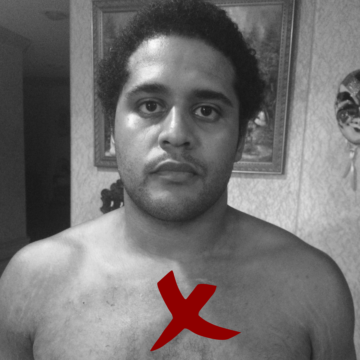
A red X marks the spot where an off-duty Houston police officer shot Alan Pean in the chest, nearly killing him. Courtest of Alan Pean
For Pean’s brother Christian, the seven-year battle for compensation shows how “deliberately slow the wheels of justice turn.” He said the family still struggles to understand the lack of accountability for the officers involved in the case. “We do view the settlement as a modicum of accountability from the City of Houston for the atrocity that took place under their watch,” Christian said. “We continue to grapple through legal proceedings with the hospital system and the security company that put protocols in place that led to a response to a mental health crisis with bullets instead of healthcare. The country still needs a public health approach to mental health and justice reform to improve everyday outcomes for communities and police officers alike.”
Pean and his lawyers filed suit in 2016 naming the City of Houston, the officers involved in the shooting who worked extra jobs as hospital security guards, two others involved in the investigation, the hospital and its parent company, and the security company. The civil case against the hospital is ongoing.
The City of Houston’s payouts for officer-involved shootings tend to be relatively low compared to other major cities. Pean’s is the second-highest in the past seven years, records show. In 2020, the city paid out $1.2 million to the estate of Jordan Baker, who was killed by an off-duty Houston police officer in 2014. Like Pean, Baker was a young, unarmed Black man.
Settlements are far from a perfect metric for determining how often excessive force is used by a police department. A slew of variables—from the public perception of police to the budget to a victim’s willingness to pursue legal action—affect the amount of settlements for police misconduct in any city. An investigation by NPR found that settlements in 2015 were more likely in Democratic counties. Conservative communities that once seemed likely to settle have dialed back in the Black Lives Matter era, which some lawyers see as backlash from recent social upheaval, the investigation found.
Pean has mostly recovered from his injuries—and his brothers have participated in BLM marches as a result of his experience. His family members have also spoken out for more awareness of the fact that no one in America seems immune from police brutality—not even in a hospital.
Houston Police Department records show there have been 371 officer-involved shootings in Houston since 2010. In 120 of those, the suspect was killed. None resulted in an indictment, according to city staff.
But Houston PD’s system policy of investigating officer-involved shootings was previously found lacking after a civil rights suit against the department was filed by Audry Releford, a Black Houstonian whose unarmed son was killed by a police officer in front of his house in 2012.
“These cases are extremely difficult, because in large part, law enforcement gets the benefit of a doubt.”
A 2020 study in the Michigan Law Review compared Philadelphia and Houston, two large cities with similarly sized police departments, over a period of time and found that Philadelphia had more civil rights suits filed against police officers, and that those suits resulted in 100 times more in settlements and judgments than in Houston. This wasn’t indicative of a pristine policing environment in Houston; in fact, another investigation found Houston officers were more likely to kill people than their Philadelphia counterparts. (They were also more likely to lose their peace officer licenses).
Larry Taylor Jr., managing partner with the Cochran Firm in Dallas, has worked on police misconduct cases for about a decade. He said it’s difficult in many places for police misconduct suits to result in actual relief for the victim or for a dead victim’s family. “These cases are extremely difficult, because in large part, law enforcement gets the benefit of a doubt,” he said. “The script that is typically used in these cases is the officer was in fear of his life, the assailant was dangerous or is believed to be armed. And those statements alone make these cases extremely, extremely difficult for someone to prosecute, without some survivor or without video.”
City of Houston Attorney Arturo Michel said the city agreed to the relatively high settlement amount for several reasons, including the desire for the “finality and certainty in ending a lawsuit where the incidents preceded the current administration.” There were other hurdles to the city’s defense, including a “loss of key witnesses” and “difficulty in developing evidence to establish an accurate crime scene,” Michel said.
Pean’s attorney Joe Melugin said that, while the settlement wasn’t as large compared to other high-profile personal injury cases, this is a notable amount for Houston.
“The reason it’s larger than so many other settlements the city has entered into is because unlike those other settlements, [Pean] survived being shot by Houston police,” Melugin said. “The story that Houston was going to tell was not going to hold water. They had significant liability beyond just the officers’ liability … because their de facto policy is essentially a license for Houston police officers to kill.”
The case drew national headlines in 2015 after Houston authorities criminally charged Pean and attempted to justify the off-duty officers’ decision to shoot an unarmed man in his hospital room.
After Pean checked into the hospital that night, he continued behaving erratically. Video available in the Paen case shows that he had been dancing naked in the doorway of his hospital around the time a nurse called security for assistance.
“They had significant liability beyond just the officers’ liability … because their de facto policy is essentially a license for Houston police officers to kill.”
Off-duty Houston Police Department Officers Roggie Law and Oscar Ortega responded. They were working as paid security for the hospital at the time. The officers entered Pean’s hospital room and closed the door. There were no hospital staff members or cameras in the room with them.
According to the lawsuit, the officers then “initiated a physical confrontation with Alan,” who was naked and unarmed and in the midst of a mental health crisis. The officers, unable to subdue Pean, escalated the situation. First, Officer Law used his Taser on Pean. When that failed to defuse the confrontation, Ortega shot Pean in the chest with his service pistol. As Pean lay on the floor bleeding, the officers handcuffed him, the lawsuit says. When they radioed others about the incident, they allegedly failed to mention Pean had been shot. A hospital employee examined Pean and rushed him to the intensive care unit. As he recovered, he remained handcuffed in his hospital room.
During this time, the lawsuit alleges the hospital and police concocted a plan to “cover up and falsely justify their actions” by slapping Pean with charges of aggravated assault against a public servant and reckless driving. “HPD’s notorious blue wall of silence also operates as a blue wall of sound to protect HPD officers against outside scrutiny,” the lawsuit alleges.
None of these charges would stick—a Harris County grand jury dismissed the assault charges, and the Harris County Criminal Court nixed the reckless driving charge. But Pean was still forced to post bond. He later had to travel from New York back to Texas to surrender himself when he found out about the reckless driving charge.
The Houston Police Department’s internal affairs division cleared the officers without interviewing the victim or consulting medical records.
An investigation by the Houston Chronicle after the fact showed the Houston Police Department’s internal affairs division reviewed the officers and quietly cleared them—without interviewing the victim or consulting medical records.
Houston Police Department’s current use of force policy requires officers to take someone’s “mental capacity” into account before using force. Officers are also required to request emergency medical services when they come across someone who is injured (whether or not they’re the cause of the injury). The policy also requires officers to “provide first aid to their level of training without any unreasonable delay” while they await medical personnel.
Pean’s legal saga is far from over, as he, his family, and his attorneys continue to seek damages from the medical facility for its handling of his crisis. His father and brother, as physicians, have spoken out to medical groups too.
“Alan and our family have continued to share his story in medical education venues to raise awareness about mental health practices and justice reform in the hope that fewer American families find themselves in the horrific circumstances we faced that day,” Christian Pean said in an email to the Texas Observer.
I have been a manager for more than 20 years. I started at a new company about three months ago. About a week and a half ago, I was having a meeting with my team of two in my office. The door was closed. I have frosted glass but I could see my boss pacing back and forth outside the door a few times. Eventually, I saw him stop and I could see that he was cupping his ear to listen at the door.
My department has had a lot of turnover. Though I have not been there long, I can already tell you that my boss is the reason for the turnover. I have literally been losing sleep while working for this man. How do I confront him? I’m generally a very blunt, straight shooter type personality. I’m having a hard time right now for fear of losing the job but his behavior shows a clear lack of trust and I may lose my job whether I speak up or not. I guess I just have to chalk that up. I can’t stand the distrust and disrespect.
Listening at your door was ridiculous, but it sounds like there are much bigger problems with your boss and I don’t think there’s a ton to be gained by “confronting” him over this. You could certainly say, “It looked like you needed something while I was meeting with Jane and Maximilian — feel free to knock if you need me urgently while I’m in a meeting” … although since it’s been a week and a half since it happened, the window for saying that is probably gone. Ideally, you would have addressed it while it was happening, like by opening the door and saying, “I’ll be done in about 15 minutes if you need me” (which is a way of responding assertively without making it adversarial).
But if you’re losing sleep working for this guy, there are bigger issues than his eavesdropping, and I’d focus on deciding whether there’s any bearable way to stay (and actively working on leaving if there’s not).
2. Not accepting a job that drug tests, and being honest about why
My partner is an engineer who has been casually job searching. She was recently offered a role at a very large company and is inclined to accept, but recently discovered she will have to be randomly drug tested. She is fully remote and does not do any work in the field.
We live in California and regularly use cannabis (both recreationally as well as for medical reasons for me, so it’s always going to be around). Not only does my partner not want to stop smoking, we both are morally against the war on drugs and the way that cannabis has been criminalized and demonized.
She wants to mention this when refusing the offer and make clear that she believes it’s a DEI issue to drug test remote workers who don’t operate any machinery, pushing out people who are disproportionately non-white or disabled.
Is it worth it to mention this to the recruiter? She doesn’t expect or desire any change to their decision, it just seems right to flag that candidates care about this. Would that be appropriate?
Hell yes. One person pushing back on something like this usually won’t in itself create change, but multiple people doing it absolutely can. Be one of those voices. That kind of pushback is often what tells employers when the tide is turning on a whole range of issues; it’s often how companies realize that something that they thought was uncontroversial no longer is. (Note: It’s possible this policy is outside the control of the company, like if they have certain types of government contracts. But it’s worth speaking up regardless.)
3. Using a fake name for job hunting
With my unusual last name (think similar to Butts or Dicks), I have found that I get zero, zip, zilch response to any online application. I’m accustomed to websites stating that I can’t use my last name since it violates their profanity policy (Disney and Citibank are recent examples). Even if I have a contact at the firm I’m targeting and I’ve spoken to them on the phone, they always say I still need to submit my information online to their applicant tracking system. And there’s where it dies.
Adding to my conspiracy theory, both of my children graduated from college in the past few years. Both have the identical experience (hundreds to thousands of applications, zero responses) with the internet job search process.
Prior to internet job boards, I was always able to get a new position in under week. From all of this, I’m pretty convinced that my submissions are being filtered out early in the process.
What are your thoughts on using an assumed name in my resume, email address, LinkedIn name, etc.? Once we’re at the offer or background check stage, I would let them know my real name.
Using a different last name could be a problem if you’re filling out an application that requires you to attest all the info you’re submitting is accurate … but otherwise, I think you might as well experiment since you’re not getting bites any other way. At this point, it doesn’t sound like you’ve got anything to lose by trying.
Rather than making up a whole new last name though (which could throw people when you have to explain), could you use your middle name as your last name? Or a parent’s maiden name? Or even add a suffix to your real last name (so Dicks becomes Dickson or so forth)? That way when you do explain it, it doesn’t seem like you just threw a random false name in there. Also, when you explain, be very matter-of-fact — “I’ve starting using Dickson because a surprising number of online systems think my legal name is profanity.”
It’s ridiculous that this is happening, by the way.
4. Conflicting cover letter advice
I’m stuck between two different common sources of bad advice: my parents and my college career center. While writing cover letters for internship applications, I’ve bounced back and forth between the two and gotten wildly different feedback. For instance, my school suggests starting with something like “I’m delighted to apply for X position at your company.” My parents, however, suggest I leap straight into the cover letter and start discussing myself. For comparison here’s the first few sentences of a cover letter after being reviewed by each:
Career center:
Dear X company hiring committee,
I’m delighted to apply for Y internship and honored to have the opportunity to learn from a business that values the explosive imaginations of both players and employees and whose colorful, distinctive franchises have reached around the world.
Parents:
Hello, X company hiring committee!
Professional whimsy, artistic science, playful programming: these are terms many might consider oxymorons, but in Y industry, it’s never either-or. The best entertainment (to me) always embraces these paradoxes.
Whose advice is better? On the one hand, I understand my parents’ point that the career center version feels a bit lifeless/personalityless. On the other, I feel weird not acknowledging the company or posting until the end of the first paragraph. Because internship cover letters are a different beast than job applications, a lot of the cover letter advice online is irrelevant to me, so I’m left ping-ponging between these two. Help! Whose advice is better—or is there a happy medium? And do you have any advice for writing internship cover letters in specific?
These … are both bad.
You want to write like a normal person, with plain but conversational language and the way you would write if you were writing an email to a slightly senior colleague who you knew a little but not well. I will bet a large sum of money that there is no circumstance in your life where you would truly write emails with phrases like “explosive imaginations of both players and employees” or “professional whimsy, artistic science, playful programming.” Those read like … well, really bad marketing language. Do not take cover-letter-writing advice from either of these sources.
If the question is how to open a cover letter, you really only need to say “I am writing to apply for your X position.” That’s it — then go into why you’d do a good job at it.
I strongly urge you to read some of the sample cover letters in the archives here (like this, this, or this). It’s not true that internship cover letters should be dramatically different; all the same rules apply. When I hire, I’m looking for the same thing in cover letters from intern applicants as I am from employee applicants; the only real differences are that you’ll have less experience to pull from, so they can be harder to write in that respect. But the general goals, structure, and content should be the same.
5. National park passes as gift idea
At the end of every year I’m always looking for ideas for holiday gifts for people in the office, either ones who report to me or not. So I wanted to write to offer a suggestion: annual national park passes. We are fortunate to be located right near one of our amazing national parks in the country, and in December they offer annual passes for the next year for half price, making it affordable for me to buy several for my reports. I realized that these are great gifts for people, a full year’s worth of natural beauty, able to be experienced at any time. In theory it’s a good healthy resource for personal de-stressing, also offers a nice option for something to do either alone or with one’s family whenever they want, on the weekends, whatever. Depending on the park, an annual pass is ~$50, which with the cost of everything going up, is enough of an expense that I predict a lot of working people don’t feel comfortable justifying spending on themselves. Getting it for them as a gift solves that. Finally, it avoids getting people gift cards for restaurants they might not like, etc., or booze or anything potentially fraught, that sort of thing. I just wanted to mention the annual national park pass for your local national park as a good option. Plus that money supports the national parks, another good thing.
We're now in the first week of 2023, and that means different things for different people, such as taking another stab at a New Year's resolution that's been on the list forever or getting started on a plan to reach a goal before the year ends. For Louisiana residents, it also means having to verify their ages if they want to access porn online.
A new state law (PDF, courtesy of Motherboard) went into effect on January 1st, requiring websites containing "a substantial portion" of "material harmful to minors" to ask users to prove that they're 18 or older. "Substantial portion," according to the new law, is more than 33.3 percent of a website's content. As Gizmodo notes, Pornhub, Youporn and Redtube have already started asking visitors to verify their age.
Websites that host content that can be considered porn have to implement "reasonable age verification methods," including asking users to present a government-issued ID or a digitized form of it. Pornhub, Youporn and Redtube had chosen to ask visitors to prove their age by using their LA Wallet app, which is the state's digital wallet app for drivers licenses. A video posted on Twitter shows how Pornhub uses the app to check for a user's age.
Hello from the surveillance state of Louisiana. People in Louisiana have to use their drivers license to go to pornhub. This is truly wild. Under his eye. https://t.co/uji6Jo3Tdepic.twitter.com/pVKEeVcCGw
In the document detailing the law, its authors said: "Due to advances in technology, the universal availability of the internet, and limited age verification requirements, minors are exposed to pornography earlier in age. Pornography contributes to the hyper sexualization of teens and prepubescent children and may lead to low self-esteem, body image disorders, an increase in problematic sexual activity at younger ages, and increased desire among adolescents to engage in risky sexual behavior. Pornography may also impact brain development and functioning, contribute to emotional and medical illnesses, shape deviant sexual arousal, and lead to difficulty in forming or maintaining positive, intimate relationships, as well as promoting problematic or harmful sexual behaviors and addiction."
Speaking to TechCrunch, Olivia Snow, sex worker and research fellow at UCLA's Center for Critical Internet Inquiry, described the need for verification to access porn as "surveillance." She also said that it can harm LGBTQ populations in extreme cases: "As homophobia and transphobia — especially homophobia in the context of porn — is rising, I could totally see the state zeroing in on people consuming gay porn, or lesbian porn, and either surveilling them further or criminalizing that." Critics are also raising security and privacy concerns about having to present IDs to access porn online even if Pornhub promises that one's "proof of age does not allow anyone to trace [their] online activity."
Bestselling author James Patterson is set to complete an unfinished manuscript by the late Michael Crichton, a story in which the imminent eruption of Hawaii’s Mauna Loa volcano threatens a secret cache of deadly chemical weapons. What do you think?
New York has become the latest state to ban the sale of cats, dogs, and rabbits in pet stores, passing a law that will take effect in 2024 and target commercial breeding operations decried by critics as “puppy mills.” What do you think?