Cowboy Who?
Shared posts
Kevin McCarthy's difficult day - in 90 seconds
The 118th Congress is off to a historic start. Here's a look at the first day


This was supposed to be Kevin McCarthy's moment. Instead, GOP chaos reigns

This was supposed to be Kevin McCarthy's moment, one he had contorted himself into political knots to get to.
(Image credit: Chip Somodevilla/Getty Images)

Gigi Sohn’s FCC Future Looking Brighter As Biden Plans Renomination
Several sources familiar with the nomination process tell me that the Biden Administration is not only planning to re-nominate Gigi Sohn to the FCC in 2023, but that Sohn still has the full support of the Administration and of Biden personally.
At points in 2022 it wasn’t entirely clear that team Biden had the political backbone to continue one of the sleazier fights in modern policy history (this recent Verge breakdown is a great read if you need catching up). But this renomination puts that debate to rest, and the reconstituted Senate in the wake of Warnock’s win in Georgia suggests that Sohn should have a far more promising 2023.
The telecom and media industry used every dirty trick in the lobbying playbook in 2022 to prevent Sohn from getting the 50 Senate confirmation votes needed. The result: the longest delay in seating an FCC Commissioner in U.S. history, despite Sohn’s bipartisan popularity and experience.
That’s in stark contrast to the late 2020 nomination and seating of Trump FCC pick Nathan Simington, which took less than 30 days from start to finish despite Simington having virtually no telecom experience.
Unlike the bullrush approach used to nominate and promote reformer Lina Khan to the FTC, Sohn wasn’t even nominated by the Biden administration until October of 2021, nine months into his first term. I’m told by several sources there was some (baseless) concern by key advisors that the “controversy” surrounding Sohn’s nomination would interfere with efforts to get the infrastructure bill across the finish line.
The delayed nomination gave the telecom industry ample runway to develop a coordinated smear campaign (pushed through a variety of industry-linked nonprofits) falsely accusing Sohn of being a radical enemy of cops, rural America, Hispanics, and free speech. The sleazy attacks were bipartisan, and included some help from former Democratic Senator Heidi Heitkamp.
The accusations were gibberish to anybody that actually knows Sohn, who in reality is popular across both sides of the aisle. But they functioned as intended: they provided the entire GOP with the flimsy rhetorical cover needed to do the telecom industry’s direct bidding. Which, contrary to a lot of pretense in the press and DC, is generally the position the GOP always takes on any issue of telecom and media policy (see: net neutrality, media consolidation, consumer rights, consumer privacy, etc.).
But the attacks provided the same flimsy cover for several key Senate Democrats, including Arizona Senator Mark Kelly, Nevada Senator Catherine Cortez Mastro, and West Virginia Senator Joe Manchin. Several sources tell me Kelly and Mastro will likely support Sohn with their contentious election battles in the rear-view mirror, though it’s equally likely Manchin will remain in stubborn, noncommittal opposition.
Enter Senator Rafael Warnock, whose election victory in Georgia should provide the 50 votes necessary to get over the hump… provided there’s no surprises. If Sohn backers can’t get Mastro and Kelly lined up, Sohn’s fate would require flipping a key Republican vote like Alaska Senator Lisa Murkowski.
The catch: with the renomination, the entire process needs to start over, meaning additional contentious hearings where GOP Senators get to pretend Sohn is an unhinged radical. If everything goes well, Sohn could still be seated by February or March. If everything doesn’t go well, and industry has its way, Sohn will face a gantlet of entirely new hearings where captured lawmakers push entirely new attacks.
That would give the Biden FCC a very short runway to push numerous policies (policies that can take up to 9 months to fully cook) ahead of the 2024 Presidential election. That means stuff like restoring net neutrality or media consolidation rules will likely be sidelined in favor of other more recent, politically safer priorities like improved broadband mapping, which looks to be an ugly mess in the making.
Again all of this dysfunction was by design: the telecom industry enjoyed a fully captured regulator for four years under Trump. Now, thanks to a few thousand dollars and some ethically-dodgy nonprofits, they successfully gridlocked the FCC for another two years.
That’s six straight years in which the nation’s top telecom and media regulator was either directly representing the interests of industry or mired in partisan gridlock because of industry lobbying. That’s six years of the FCC being unable to explore any policy considerations deemed even remotely controversial by industry giants and their GOP allies.
It may come as a surprise, but that’s not how healthy Democracies function. Holding telecom monopolies accountable has massive, bipartisan public appeal, yet corruption ensures it happens very rarely. So rarely, we can’t even field a fully staffed FCC because it might piss off Comcast.
Again, you’d be pretty hard pressed to find a more qualified and popular candidate to the FCC than Sohn. The problem is that unlike so many political DC animals, she’s an actual reformer genuinely interested in fixing problems. That’s a cardinal sin for telecom monopolies, who’d prefer to keep the FCC as feckless as humanly possible, for as long as humanly possible. Forever would be their preference.
The worst-selling Microsoft software product of all time: OS/2 for the Mach 20
In the mid-1980’s, Microsoft produced an expansion card for the IBM PC and PC XT, known as the Mach 10. In addition to occupying an expansion slot, it also replaced your CPU: You unplugged your old and busted 4.77 MHz 8088 CPU and plugged into the now-empty socket a special adapter that led via a ribbon cable back to the Mach 10 card. On the Mach 10 card was the new hotness: A 9.54 MHz 8086 CPU. This gave you a 2× performance upgrade for a lot less money than an IBM PC AT. The Mach 10 also came with a mouse port, so you could add a mouse without having to burn an additional expansion slot.
Sidebar: The product name was stylized as MACH in some product literature.
The Mach 10 was a flop.
Undaunted, Microsoft partnered with a company called Portable Computer Support Group to produce the Mach 20, released in 1987. You probably remember the Portable Computer Support Group for their disk cache software called Lightning.
The Mach 20 took the same basic idea as the Mach 10, but to the next level: As before, you unplugged your old 4.77 MHz 8088 CPU and replaced it with an adapter that led via ribbon cable to the Mach 20 card, which you plugged into an expansion slot. This time, the Mach 20 had an 8 MHz 80286 CPU, so you were really cooking with gas now. And, like the Mach 10, it had a mouse port built in. According to a review in Info World, it retailed for $495.
The Mach 20 itself had room for expansion: it had an empty socket for an 80287 floating point coprocessor. One daughterboard was the Mach 20 Memory Plus Expanded Memory Option, which gave you an astonishing 3.5 megabytes of RAM, and it was high-speed RAM since it wasn’t bottlenecked by the ISA bus on the main motherboard. The other daughterboard was the Mach 20 Disk Plus, which lets you connect 5¼ or 3½ floppy drives.
A key detail is that all these expansions connected directly to the main Mach 20 board, so that they didn’t consume a precious expansion slot. The IBM PC came with five expansion slots, and they were in high demand. You needed one for the hard drive controller, one for the floppy drive controller, one for the video card, one for the printer parallel port, one for the mouse. Oh no, you ran out of slots, and you haven’t even gotten to installing a network card or expansion RAM yet! You could try to do some consolidation by buying so-called multifunction cards, but still, the expansion card crunch was real.
But why go to all this trouble to upgrade your IBM PC to something roughly equivalent to an IBM PC AT? Why not just buy an IBM PC AT in the first place? Who would be interested in this niche upgrade product?
Well, for one thing, at $495, the Mach 20 card cost a lot less than a new IBM PC AT, which would set you back $4000. You don’t get to plug new AT-style peripherals into your modded XT, and the video card is still a piece of junk, but if you’re just using it for number-crunching, the CPU performance is really what you’re after.
This bias toward upgrading an old computer to a pale imitation of a more advanced computer was exacerbated by tax laws and generally-accepted accounting principles.
During this era, technology was advancing far faster than the accounting industry could keep up. Computers were classified as office equipment, which at the time had a seven-year depreciation schedule. But computers were improving so rapidly that a seven-year-old computer was beyond obsolete. Companies needed to upgrade their computers, but their accountants wouldn’t let them just throw out the old ones since they still had several years of depreciation left and consequently had no budget for buying new computers. “The government says that these have to last seven years, so by golly, you’re going to make them last seven years!”
These upgrade cards were much less expensive than a new computer and could be more easily hidden inside your office equipment budget, thereby avoiding a lot of arguments with accountants.
The Mach 20 sold better than the Mach 10, but then again, that’s not saying much.
Okay, that was a very long set-up for the actual story. Because I’m not here to ridicule the lackluster sales of the Mach 20 hardware. I’m here to ridicule the lackluster sales of the Mach 20 software.
The Mach 20 allowed you to run Windows 2.0 in standard mode, which took advantage of the 80286 processor and expanded memory.
Microsoft also produced a customized version of OS/2 for the Mach 20. Despite being tailor-made for the Mach 20, it still had terrible performance problems.
One of my former colleagues spoke with the person who took over from him as the support specialist for OS/2 for Mach 20. According to that person’s memory (which given the amount time that has elapsed, means that we should basically be saying “according to legend” at this point), a total of eleven copies of “OS/2 for Mach 20” were ever sold, and eight of them were returned.
That leaves three customers who purchased a copy and didn’t return it. And the support specialist had personally spoken with two of them.
If these numbers are accurate, I believe this makes OS/2 for Mach 20 a strong candidate for being the worst-selling actually-shipped Microsoft software product of all time.¹
Bonus chatter: The leader in the “expansion card to give your IBM PC new life” product category was the Orchid Tiny Turbo 286, which you could find for around $300 if you shopped around. Some time later, Intel joined the fray with the Inboard/386, which let you upgrade your IBM PC, PC XT, or PC AT to an 80386 processor. The Inboard/386 took even more advantage of the tax accounting mismatch between depreciation schedule and practical lifetime.
Bonus reading: We got around three.
¹ If you’re one of those retro-computing archivists, I guess this poses an extraordinary challenge even greater than possessing a Tandy Video Information System: Can you track down one of the three remaining copies of OS/2 for Mach 20?
The post The worst-selling Microsoft software product of all time: OS/2 for the Mach 20 appeared first on The Old New Thing.
Why can’t I print when I boot Windows into audit mode?
A customer found that when they deployed Windows and booted into audit mode, they were unable to print anything.
If they were not in audit mode, then everything printed fine. It was just audit mode that was broken. They wanted to know how to print in audit mode.
Don’t print in audit mode.
Audit mode is for you to configure your system in preparation for resealing it, so that the next boot will run through the Out of Box Experience, commonly abbreviated OOBE and pronounced /oo-bee/. You aren’t expected to be using the system as a normal user. Install the apps, make your final tweaks, and reseal that puppy.
Specifically, a number of services are disabled in audit mode. It’s not surprising that printing wouldn’t work.
The post Why can’t I print when I boot Windows into audit mode? appeared first on The Old New Thing.
How can I detect programmatically whether Windows is an N or KN version?
A customer was dealing with a problem that occurred only when running on an N or KN version of Windows. These versions of Windows are special versions that omit the multimedia features.¹ Microsoft is legally required to offer these versions of Windows in certain jurisdictions, although in practice, the number of people who buy them is vanishingly small. (It sometimes feels like the sole reason those customers exist is to file bugs that reproduce only on N and KN versions.)
The customer wanted to know how to detect that the user is running an N or KN version of Windows, so they could disable the features of the product that depend upon multimedia support.
The answer is that you don’t check whether you are on an N or KN version of Windows. Rather, you check whether multimedia support is present.
Because the user, after buying an N or KN version of Windows (perhaps inadvertently), can later download and install the Media Feature Pack and restore multimedia support. In that case, they expect your program to enable its multimedia features.
So really, what you want to do is detect whether multimedia support is present. One way to do that is to see if you can call the MFStartup function, and whether it succeeds. If not, then Media Foundation is not available, and multimedia features are not available.
This particular customer had a Web-based app, in which case they can use HTMLMediaElement. to detect whether the system can play their media, and skip the video if so.
Bonus chatter: The bug was that if you asked to see the training video, the video didn’t play (expected), but the app also hung (not expected). The reason is that the app tried to play the video roughly like this:
var video = document.queryselector("#training-video");
video.src = "/videos/training.mp4";
video.addEventListener("error", onVideoFinished);
video.addEventListener("ended", onVideoFinished);
If multimedia support is not present, the error event is raised immediate upon setting the src property. But the code hasn’t registered a handler for that event, so the error event is raised, but nobody is there to handle it. The app later adds a handler, but it’s too late. That’s why the app appeared to hang.
To deal with errors that occur immediately, the app should register the event handlers before setting the source.
(Note that canPlayType is still useful, even after they fix this race condition. That lets them detect that the system cannot play the training video at all, and they can remove the “Play training video” option from their interface, or replace it with an explanation of why the training video is not available.)
¹ The KN version also omits Windows Messenger, but since Windows Messenger itself has been discontinued, the distinction is meaningless in practice.
The post How can I detect programmatically whether Windows is an N or KN version? appeared first on The Old New Thing.
It rather involved being on the other side of this airtight hatchway: Gaining code execution from a Trojan horse
A security vulnerability report arrived that went roughly like this:
The Xyz object can be used to execute arbitrary command lines.
LoadLibrary(L"xyz.dll");GetProcAddressforDllGetClassObject.- Call
DllGetClassObjectwithCLSID_XyzandIID_IXyz.- From the resulting object, call
IXyz::Initialize, and thenIXyz::Execute.
So far, we don’t have any statement of vulnerability. Sure, the Xyz object can be used to execute arbitrary command lines, but how is that a security vulnerability?
We asked the finder some questions to clarify the nature of the alleged vulnerability.
Q: What is the attack vector?
A: The attack vector is a Trojan horse executable. The victim needs to double-click the executable, which triggers the exploit.
Q: Is there elevation of privilege?
A: Not at this time.
Q: Is this remote code execution.
A: Essentially, it is not. The exploit must be downloaded to the victim machine in order to proceed with the attack.
Q: As a result of this exploit, what can the attacker do that they couldn’t do without this issue?
A: I don’t know. I am not a professional attacker. The main attack technique is as described in the original report. I think I explained it like this.
What we have is another case of if I can trick you into running my program, then I have gained code execution, also known jokingly as MS07-052: Code execution leads to code execution.
If you have gained sufficient trust with the victim that they will run any program you give them, then you don’t need the Xyz object in order to launch arbitrary command lines. You already have arbitrary code execution: That’s even better than command line execution! You don’t need to find an existing program that does whatever bad thing you want to do; you can just make your custom program do that bad thing directly.
Tying up some loose ends: The command line passed to IXyz::Execute runs with the same privilege as the caller, so there is no elevation of privilege.
Bonus chatter: Not long afterward, we received the following security vulnerability report:
Download and run the following script. It deletes all your files. If run as an administrator, it can delete operating system files.
That’s nice, but there is no security vulnerability yet. The script can delete only files that the user has permission to delete. In a way, you can say that the script “unlocks the user’s full file deletion potential”.
If the point of the attack is that the user can be tricked into deleting all their files by running this suspicious script, well, that’s not particularly surprising. If you can trick a user into running a suspicious script, then you have effectively tricked them into granting you full access to their account, and it’s not surprising that you can delete all their files.
The post It rather involved being on the other side of this airtight hatchway: Gaining code execution from a Trojan horse appeared first on The Old New Thing.
Works by M.C. Escher, Virginia Woolf & Others Enter the Public Domain
January 1, 2023 marked the annual Public Domain Day, in which certain copyrights expire, bringing new works of literature, cinema, and visual art into the public domain. This year, copyrighted literature, film, and art from 1927 has entered the United States public domain, making the works free for anyone to copy, share, or expand upon.

“The Case Book of Sherlock Holmes” by Sir Arthur Conan Doyle, originally published 1927.
Some major written works now in the public domain include Virginia Woolf’s To the Lighthouse, Arthur Conan Doyle’s The Case-Book of Sherlock Holmes, Countee Cullen’s second book of collected poems Copper Sun, Thornton Wilder’s The Bridge of San Luis Rey, Agatha Christie’s The Big Four, and Herbert Asbury’s The Gangs of New York. The original German versions of Hermann Hesse’s Der Steppenwolf and Franz Kafka’s Amerika have also entered into the public domain.

Heinz Schulz-Neudamm, “Poster for Metropolis,” 1926, lithograph, 81 x 36 1/2 inches.
Movies that have entered the public domain include Metropolis, directed by Fritz Lang; the first feature-length film with synchronized sound, The Jazz Singer, directed by Alan Crosland; and The Lodger: A Story of the London Fog, directed by Alfred Hitchcock.
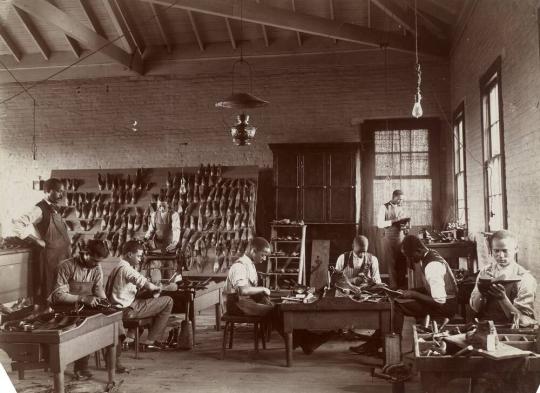
Frances Benjamin Johnston, “Shoemaking, Tuskegee Institute,” 1902, gelatin silver print, 6 7/8 x 9 3/8 inches. Museum of Fine Arts, Houston. Museum purchase funded by the S. I. and Susie Morris Photography Endowment.
Unlike many countries whose public domain laws relate to an amount of time passed after the creator’s death, the U.S.’ laws concern the work’s dates of publication. Throughout most of Europe, works are transferred to the public domain 70 years after the creator’s death. Notable artists who died in 1952, and whose work is now in the public domain in Europe, include American photographer and photojournalist Frances Benjamin Johnston, American painter and illustrator Howard Chandler Christy, Italian writer and painter Alberto Savinio, Welsh sculptor Goscombe John, and American Modernist painter Arthur Beecher Carles.
For Canada, New Zealand, and many countries in Africa and Asia that transfer works to the public domain 50 years after the creator’s death, pieces by M. C. Escher have entered the public domain.
The post Works by M.C. Escher, Virginia Woolf & Others Enter the Public Domain appeared first on Glasstire.
this is incredible
This post, this is incredible , was written by Alison Green and published on Ask a Manager.
My favorite thing of last week:
The fic is absolutely pitch-perfect and completely nails Alison's voice. I have so many friends who are @askamanager fans and ALL OF YOU SHOULD READ THIS, IT'S HILARIOUS.https://t.co/591SiRWw6o
— Naomi Kritzer @naomikritzer@mspsocial.net (@NaomiKritzer) December 26, 2022
Also, if you haven’t yet read Hench, by Natalie Zina Walschots, you should! It’s about a woman who works very boring temp jobs … for super villains. It turns out that even when you work for super villains, you still need to deal with bosses who are way too interested in how you are feeling, office politics, and worries about health insurance. If you like Ask a Manager, there’s a high chance you’ll like Hench. I loved it.
my coworker and I attend the same sex club
This post, my coworker and I attend the same sex club , was written by Alison Green and published on Ask a Manager.
A reader writes:
In the context of talking about sex positivity in some of the advising we do, it came out that my coworker and I go to the same sex club. She has not been since pre-Covid but is planning to return soon with her partner. I meanwhile go almost every weekend. We are definitely going to run into each other at some point.
Our work is very close. We share an office and are a two-person department.
We agreed that we will probably see very different sides of each other than our work selves and we will practice selective amnesia when it happens. (Obviously we won’t interact with each other there outside of a nodding acknowledgement.)
I don’t really have a question I guess. I just thought, I wonder if this is one Alison has dealt with before.
Yes, thanks to an invitation from Dan Savage to weigh in on a similar question (warning: not safe for work), although in that case the question-asker managed the employee he had encountered at a local sex club — and that distinction really matters. As a manager, you really, really can’t put yourself into a sexual situation with an employee … which in that person’s case meant he needed to stop attending.
In your case, you don’t have those power dynamics so you don’t have the same strict imperative to stop attending if you’re both comfortable continuing.
However, things I’d think about:
• Do you completely trust your coworker not to share anything she learns about you at these events with others at work, even accidentally? If she slips up and does reveal something, how will you feel about that? Will there be any professional repercussions for you? (I know you might feel there’s a sort of mutually-assured destruction dynamic in effect — in that she can’t gossip about you without revealing things about herself — but it doesn’t always play out that way.)
• If you answered “yes, I completely trust her,” you still need to think about what could change down the road. What if you have a falling-out at work and the relationship changes? How about after you’re no longer working together?
• While you are peers currently, is there any chance one of you could end up in a position of power over the other in the future? If that happens, would you wish you had made a different choice now? (Obligatory reminder that at that point, one of you would indeed need to stop attending.)
• Is it possible you’ll see something at these events that will make it harder for you to interact with her professionally at work? (I’m avoiding listing out specific possibilities here, and it’ll depend on how out-there these events get, but there are certainly things one can’t unsee that one might later wish to unsee.) How about vice versa?
To be clear, these are all genuine questions, not ones I think you need to answer a certain way. You might consider all of this and decide you’re fine with the risk, in which case go forth and enjoy your mutual selective amnesia. Just make sure you’ve thoroughly thought through all the potential downsides first.
Kevin McCarthy Assures Skeptical Republicans He Shares Their Vision Of Innocents Drowning In Oceans Of Blood

WASHINGTON—In an effort to garner their support and become Speaker of the House, Rep. Kevin McCarthy (R-CA) assured his skeptical GOP colleagues Tuesday that he shared their vision of innocents drowning in oceans of blood. “While I hear your concerns and am prepared to make a long list of concessions in exchange for…
THIS MAN LOVES FALLING INTO LAKES!
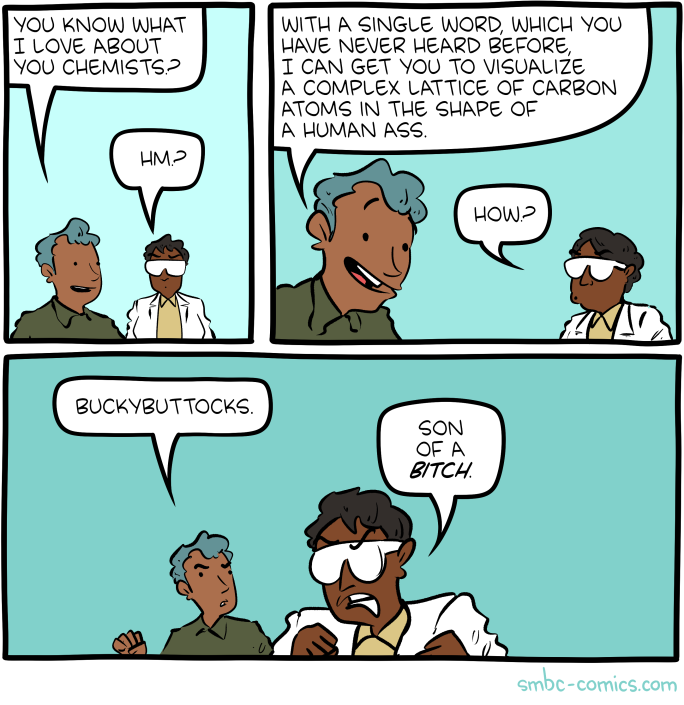
Saturday Morning Breakfast Cereal - Chem
Click here to go see the bonus panel!
Hovertext:
Thanks to patreon subscribers for correcting a scientific error in the original version of this ass joke.
Today's News:
The Hidden Cost of Cheap TVs


Read more of this story at Slashdot.
Pornhub requires ID from Louisiana users to comply with state’s new porn law

Pornhub and other major porn sites owned by MindGeek now require Louisiana residents to verify their ages because of the state's new porn law that took effect on January 1, 2023.
"Louisiana law now requires us to put in place a process for verifying the age of users who connect to our site from Louisiana. The privacy and security of the Pornhub community is our priority, and we thank you for your cooperation," the Pornhub website tells Louisiana-based users when they try to access the website.
Pornhub owner MindGeek also operates Brazzers, YouPorn, and Redtube. All of those MindGeek sites now prompt Louisiana-based users to verify their age. Websites that violate the new state law could be found liable in civil lawsuits.
Houston’s early 2023 humidity will break today with the passage of a front
Good morning. A cold front is moving into Houston this morning, which will knock down the very sticky humidity the region has experienced for the last several days. Some storms will persist south of Interstate 10 this morning, but by mid- to late-morning drier air will be replacing this moisture, and bringing an end to rain chances. We’ll then be rain-free until the weekend, when the forecast turns more complex as another front slogs into the area.
Tuesday
Skies will clear out later this morning, and we’ll see a pleasant, sunny day with temperatures around 70 degrees. Winds will be out of the north or northwest at 10 mph, with slightly higher gusts, so this won’t be a howling front in that sense. Lows tonight will drop down to around 50 degrees in Houston, with colder conditions in outlying areas.

Wednesday and Thursday
These will be fine January days, with highs in the upper 60s to 70 degrees, and lows in the upper 40s. Days will be sunny, and nights clear. Winds, generally, will be light.
Friday
As high pressure moves away from the area, the onshore flow will resume. Nevertheless, for most of Friday we should see sunny skies, with highs in the low 70s. Clouds will start to build Friday night, with lows dropping only to around 60 degrees, or slightly below that, in Houston.
Saturday and Sunday
The forecast for the weekend is starting to come into better focus. What we’re likely to see is a slow-moving front push into the Houston and generate widespread rain showers. At this point I think skies will be mostly cloudy on Saturday, with perhaps a 30 percent chance of rain. The better chances will come into the forecast on Saturday night and Sunday. High temperatures on both days will likely be in the 60s, with lows in the 50s. I don’t think these will be flooding rains, but more likely showers and a few thunderstorms of the light- to moderate variety. Most areas should see on the order of 0.75 to 1.5 inch of rain, give or take, spread out over one to two days.

Next week
As the aforementioned front continues to linger over or near Houston, rain chances will likely persist into Monday morning before we finally clear out some behind the front. Most of next week looks pleasant for January, with highs in the 60s or low 70s, with lows in the 40s and 50s.


denying a new mom’s request for remote work, punny edits to work docs, and more
This post, denying a new mom’s request for remote work, punny edits to work docs, and more , was written by Alison Green and published on Ask a Manager.
It’s five answers to five questions. Here we go…
1. Denying a new mom’s request for remote work while approving a different one
An issue has cropped up at my partner’s job, and I’m curious about your take on it. Pre-pandemic, the job was 100% in-person. During the pandemic, the company went remote. Post-pandemic, they returned to 100% in-person per the CEO, despite everyone proving they could work remotely, no drop in productivity, etc.
In the last year, two women (same position, same duties) got pregnant. They gave birth a few months apart. Woman A had one child. As she was getting ready to come back to the office, she asked to work from home two or three days a week because of a problem with childcare. This accommodation would last for one month to resolve the childcare situation then she could return to work full-time and in-person. She was denied.
Woman B had triplets. Just before her return to the office, she announced that she was relocating to a different state where she has family to help out. She also said that she would keep working for the company full-time, but in an office located in that state. The thing is, she’s going to remain a full-time employee of my partner’s office. So, basically, she’s working in a corporate office, but because she’s in another state, she’s working remotely.
No one is happy about this for so, so, so many reasons. While I know manager’s discretion is a thing, is this legal? It seems like they accommodated one person and not another despite the fact that their situations are the same (both just gave birth, both had childcare issues, etc. I know giving birth to one is different than three, but I don’t know if that makes a difference here).
It’s legal. It’s legal to treat different employees differently, even within the same job, as long as it’s not based on a protected characteristic like race, religion, sex, etc. (and intentions aside, as long as it doesn’t have a disparate impact on people in a particular protected class). That doesn’t mean it’s always smart or good management — although sometimes it is — but it’s legal.
In this case, it’s possible that Woman B is considered more valuable, so the company is more willing to accommodate her to avoid losing her. Or maybe since Woman A was only asking for a month-long accommodation, they’d rather have her extend her leave by a month until the situation is resolved. Or, who knows, it could just be the personal whim of the manager, or a manager who doesn’t accommodate anyone until it’s obvious that they’re quitting otherwise, or all sorts of other things.
But it’s worth noting that Woman A was asking to work from home and Woman B was asking to work from a different office and those are very different things. A company can dislike people working from home while being fine with them working from a different office. Woman A was also asking to work while simultaneously caring for a baby, and it’s not unreasonable for an employer to decide that’s not practical.
Regardless of the cause, though, it sounds like they’ve mishandled the communication around the decision. They might have avoided the reaction they’re getting now if they’d done a better job of explaining their reasons for each decision.
2. Job applicant didn’t tell me she’d been fired after applying
I was pulling together an offer for the top candidate for an open position. Let’s call her Mary. I work in higher education and Mary works in a different part of the same university.
Well, not exactly.
My HR officer reported back that Mary had been let go from her current job during her six-month probationary period. Mary applied on 10/15. Her termination letter was dated 10/28. My first interview with Mary was on 11/6.
During the interview, Mary did not share that she had been let go. However, I did not directly ask if she had been. Instead, I asked about her interest in our position and why she wanted to make the switch so soon.
Should Mary have volunteered this information? Most of the advice I see online tells people not to talk about being fired. I can’t help feeling like Mary lied to me and I am hesitant to hire her if I don’t trust her.
If she just didn’t volunteer the information, she didn’t lie. When she applied with a resume listing the job as current, it was true. As long as she didn’t then talk in the interview about the job as if she were still there (“I’m currently working on a project doing X, which we’ll launch in February…”), she didn’t lie to you.
It’s very, very common for people to be unsure about how to handle the situation was Mary was in and — as you saw — a lot of the advice out there tells people not to proactively raise it with an interviewer (but still be honest if asked), including mine.
If you have questions about what led to the firing, you can certainly ask Mary about that, but I wouldn’t penalize her for not proactively alerting you that it happened.
3. Punny edits to work documents
I’ve just started a new job at quite a prestigious marketing firm. One of my new colleagues, let’s call him John, was on leave during my first few weeks. Everybody was hyping him up as the life of the office, a real character, can’t wait for you to meet him, etc. etc. Alas, turns out his brand of humor is pretending to mishear instructions, e.g. he’ll respond to “could you fetch the printouts” with “why would you want me to fetch primordial ooze?” and then he’ll try to maintain the joke for another minute or three. (Note: he’s definitely not hard of hearing or buying time to process.) It’s an unfunny annoyance, but whatever.
However, his other party trick is editing puns into work documents. I work on the text side, while John designs. So, if I send him 10 banners to design, one is bound to contain a naughty pun when it comes back to me for feedback. He’ll also sneak “puns” into file names — so a PDF named Marketing_batch_3 might come back as snarky_batman_3 (that’s not even funny!). At my previous gig, this was a DEADLY SIN. You would get raked over the coals! The risk of a punny document being circulated? And reaching our clients, who take their subject matter very seriously? I’m astounded that nobody seems openly bothered. As a newcomer, and with him being obviously popular, I’m not sure what to say.
Since you’re new and everyone else seems to find John hilarious, you probably don’t have much standing to say or do anything, other than privately roll your eyes. The exception to this would be if you’re in a position of authority that gives you standing to address it — like if you’re John’s boss or the person with the most ownership of the documents he’s working on. Otherwise, though, chalk this up to different offices tolerating different things, even when they shouldn’t (and make a point of checking the name of every single file John sends you).
4. Are visibly mended clothes still professional?
I’m a huge proponent of sustainable fashion, which includes mending my own clothes as needed. Recently I had to mend one of my work shirts that had a rip in a place where my best option was to apply a patch. It’s about as visible as most stylized elbow patches, and in a complementary color to the pattern of the original fabric, but given the placement it’s pretty obvious this wasn’t an original design feature. Can I still wear the shirt in a business casual office? Would the answer change if the mend was as noticible but more decorative, like embroidering a flower to cover a hole?
For context, the dress code at my office is more like “creative business casual.” Jeans and t-shirts aren’t allowed, but one of my boss’s favorite button-downs has an unsubtle pattern of skulls, another person tends to wear tops and pants in very loud contrasting prints, etc., and in most ways I’m one of the more conservative dressers in the office. I’ve had a few positive conversations with my boss about sustainable fashion, as its tangentially related to our field, and I’m sure I could just ask, but I’m curious as to whether you think “no visible mends” is a universal/reasonable rule in the same way that “no visible holes” would be.
A visible mend via a patch should be fine in all but the most conservative dress codes (and even in a lot of those it would still be fine). In an office where the boss is wearing a skull shirt, have zero worries.
5. Including a background check with your application
I’ve been listening to a podcast that has a lot of ads for a background check service that says including a background check with your resume will give you a leg up. This is ridiculous, right? If a company wants a background check, they won’t trust one you do on yourself!
Yeah, this is weird and not helpful. I assume the intent isn’t to imply this would replace the background check the company would run on you, but rather is supposed to demonstrate that you’ll be able to pass it … but “can pass a background check!” is not a terribly exciting qualification on its own (especially since more people pass checks than not) and it’s likely to make you seem naive and/or out-of-touch with professional norms. This company is just trying to make money off you and you should ignore them.
France To Offer Free Condoms To Adults Up To Age 25

French president Emmanuel Macron has announced that starting in 2023, condoms would be made available for free in pharmacies for 18- to 25-year-olds in a bid to reduce the spread of STIs, which increased by 30% over the last two years. What do you think?
Saturday Morning Breakfast Cereal - Real Life

Click here to go see the bonus panel!
Hovertext:
With no disrespect intended to you freaks.
Today's News:
should I organize an all-men beach weekend for my coworkers, asking for time to process things before responding, and more
This post, should I organize an all-men beach weekend for my coworkers, asking for time to process things before responding, and more , was written by Alison Green and published on Ask a Manager.
I’m on vacation. Here are some past letters that I’m making new again, rather than leaving them to wilt in the archives.
1. Should I organize an all-men beach weekend for my coworkers?
I work at a bank branch of about 17 people, nine of whom are male. I’m considering inviting all the guys in the office for a weekend at the beach. We all get along and enjoy golfing, and think it could be a fun weekend. I wouldn’t be advertising it around the office because this would be a “guys weekend,” but since all the guys in the office are being invited, I’m anticipating the women in the office hearing about it and causing some drama.
Am I overthinking this because of the office culture we live in today, or is there a specific way that I should approach this? No work is going on during the trip, so no “deals” are being made. We are simply hanging out. The simple fact is that us guys are all pretty friendly towards one another and enjoy each other’s company. We’re all on the same career path and no one officially answers to or manages the other. Thoughts?
Yeah, it’s likely to be a problem. There’s a long history of women being excluded professionally through informal all-male social networks, where men are included in networking and business conversations in off-hours social settings without women. You have to understand that history to understand why, even if you 100% don’t intend this that way, it’s likely to have echoes of that to people. (Especially with the golf, by the way, as that was a traditional way women were excluded. Golf and strip clubs.)
Don’t be part of that, and definitely don’t be the person who organizes it. At a minimum it’s going to look really bad, and you may end up causing real issues in your office, as well as making people above you question your judgment.
And if you’re really friends with all the men in the office and none of the women, it’s worth thinking about why that is, since in a group of 17 people, that’s not likely to be a random quirk of statistics.
– 2018
2. Can I ask for a chance to process things at work before responding?
I’m an introvert who works for and with a group of extroverts. When in critical work conversations where my boss is giving direct feedback or asking my input on changes she’d like to make to the team that I manage, I often find myself unable to think on my feet and clearly articulate what I think would work best. I know myself well enough to know that I almost always come up with better answers when I’ve had time to process things. I should add that my boss is sometimes known to spring large changes on people in our organization without much warning.
I’ve thought about asking for some of those types of “change” announcements/suggestions in email, or asking for a day or two to think about things, but I’m afraid of it not being received well or being perceived as weaker because some of the other managers aren’t like this and she likes to make quick decisions. Is it ever appropriate to ask for a chance to process? If so, when and how? If that’s not appropriate, what else can I do?
Yes, at least sometimes. Ways to say it in the moment:
* “I want to take a little time to reflect on this. Can I come back to you with input by Thursday?”
* “Do you need our thoughts right now, or could we take a couple of days to think on this and then revisit it?”
* “My initial thought is ___, but I haven’t fully digested it yet. Could I take some time to think this through and come back to you later this week?”
You could also address it more big-picture with your boss: “I find I’m more able to give you input on things like X and Y if I have some time to think rather than doing it on the spot. I know that’s not possible with everything, but where there is room to circulate things a bit before we’ll be asked to comment on them, it would help me give you better input.”
– 2018
3. Taking a two-month vacation my first year on a job
I’m fresh out of college (though I started late and am now 30) and an important thing I wasn’t able to do before now was really in-depth travel (due to either school or low-paying temp jobs between semesters). I now can happily say I have a two-month vacation planned in Asia with my best friend starting in eight months! We’ve been saving and planning for over a year.
The only problem is: now that I’m done with school, I’m excited to start looking for career opportunities and have found my ideal job is hiring. I’m qualified, it’s a company I really want to work for, and a job I feel passionate about. I don’t want to go back to a unrelated job when I know I’m ready for more and need the resume experience. Is it irresponsible to apply for a career job knowing I’ll be gone in eight months for a two-month span?
Should I bring my vacation up if I get the offer? Should I see what the job is like and then work on selling the trip as benefiting the company and myself in the role (it likely would help as the job is about cultural outreach within my city). I’d love to do the job remotely if they’ll let me, but I doubt I’ll know if remote is possible until I start. Is it professional to politely quit and tell them I truly hope they’ll have an opening for me when I return?
All of this is under the umbrella that I’m an excellent worker. I’ve never been fired, get promoted quickly, and my reviews are frequently in the “exceeds expectations” category. I love working and my dedication to the company and the job always shows.
Assuming you’re in the U.S., it’s very unlikely that a junior-level job is going to let you take two months off at once … ever, but especially in your first year of working there. You typically have to have a lot of capital built up to get an employer to agree to that, and if you’re just getting started in your field, you’re very unlikely to have that capital.
That’s not to say it’s impossible. It’s possible that you could find some company that would agree to it, if you negotiate it as part of your offer. But the vast majority of employers will say no to it.
It’s also not a good idea to go in planning to quit after such a short time (and by the time you’re hired and start, it’s likely to be only six months or less before the vacation), especially since you called it your ideal job. That’s likely to burn a bridge and not be great for your resume.
If you’re committed to doing the two-month vacation, you’d be better off waiting to job search until you’re back from it. But that has its own drawbacks, and sometimes it’s easier to get hired when your degree is brand new. (2023 addition: You could also try to negotiate a start date for after you return.)
But the timing here may just not work out; it might not be realistic to take a two-month vacation in the same year you’re launching yourself into a new field.
– 2018
4. I’m embarrassed that my boss found out I’m living with my parents
I’m 26 years old and moved back in with my parents three months ago as a combination of getting renovicted (where a landlord evicts a tenant under the, sometimes false, reason of conducting renovation) and wanting to save up a down payment to purchase my own place.
I work in an office and have been with the company since graduating five years ago. On a recent day off, my manager called the home phone and my mother picked up and handed the phone to me. I think they were provided an outdated phone number by HR.
Obviously I am embarrassed by this, as I especially don’t want people at work to know I moved back home as an adult. People will tend to judge you and look at you a certain way and I am aware of that. Basically I’m afraid that word will get around and affect my work relationships and/or future prospects with this employer. Why would a manager want to advance someone or recommend someone who doesn’t seem to have their personal life together?
I know it shouldn’t matter on paper but people don’t behave like that. Am I being paranoid? My plan now is just to basically just ignore it ever happened and be truthful if asked (and to get HR to update my cell #). What else should I do?
You are indeed being paranoid, or at least just overthinking this. This is not a big deal! It’s not even clear that your boss knows for sure that you moved back home (for all he knows, maybe your mom just answered your phone because you couldn’t get to it in time). But even if he does know or asks about it in the future, it’s no big deal to say “I’m saving up a down payment to purchase my own place” or “I’m temporarily at my parents’ house because my landlord decided to renovate.”
Living at home doesn’t mean you don’t have your personal life together. It’s true that it can come across that way if there are other signs of that too — inability to hold down a job, refusal to engage with the rest of the world, etc. But assuming that you otherwise seem reasonably together, it’s very unlikely that this would enter into your manager’s thinking about Professional You.
– 2018
E.U. To Allow Cell Phone Calls On Flights

The European Commission will permit airlines to provide 5G connectivity on board, allowing passengers to make phone calls and use high-speed data on their cell phones during their flight. What do you think?
Things To Never Say To Someone Who Loves Elon Musk

If you know someone who stans the almighty Meme Lord and CEO of the Boring Company Elon Musk, here are things you should never say.
World’s Oldest Jeans Found In 1857 Shipwreck Sell For $114,000
A pair of white, heavy-duty miner’s pants pulled from a 1857 shipwreck, which auction officials described as the oldest known pair of jeans in the world, have sold at auction for $114,000. What do you think?
DistroWatch Weekly, Issue 1000
Welcoming 1927 to the Public Domain
This year we are welcoming works from 1927 into the public domain in the United States, including books, periodicals, sheet music, and movies.
Big events of 1927 include the first transatlantic phone call from New York to London, the formation of The Academy of Motion Picture Arts and Sciences, the first successful long distance demonstration of television, the release of the first popular “talkie,” The Jazz Singer, and the first nonstop transatlantic solo airplane flight, from New York to Paris, by Charles Lindbergh.
Movies
Despite the popularity of The Jazz Singer, movies were still mostly silent in 1927, including the gorgeous Metropolis by Fritz Lang. Laurel and Hardy’s first film, Putting Pants on Phillip, was released that year, along with an early Gary Cooper Western, Nevada, Joan Crawford in Spring Fever, Mary Pickford in My Best Girl, Clara Bow in Get Your Man, and Cecil B. DeMille’s King of Kings.
I was particularly taken with No Man’s Land, which gives top billing to a horse (Rex the Wonder Horse, in case you were wondering – if you’d like to follow his career he also starred in The King of Wild Horses and Black Cyclone).
Or we can time travel with Koko the Clown in Koko in 1999 where they apparently thought that at the turn of the last century everything would happen via automation and you’d get a wife from a vending machine for 25 cents.
Music
No new recorded music enters the public domain in the US this year — the next group of recorded music becomes available in 4 years, due to how the music modernization act is written — but we do have some fun new sheet music to explore. The biggies that are most remembered today are probably The Best Things in Life Are Free and I Scream, You Scream, We All Scream For Ice Cream. But you should also take some time to play Dream Kisses, The Desert Song, My Ohio Home, and Girl of My Dreams.
Periodicals
Thousands of issues of periodicals from 1927 are entering the public domain, some from titles that are still well known today like:
- Life
- Vogue
- The Billboard
- Cosmopolitan
- The Saturday Evening Post
- The Progressive Farmer
- The New Yorker
You may also want to check out copies of The American Girl (published by the Girl Scouts), check up on the financial markets leading up to the Great Depression in the The Financial Times, or research bling in The Jewelers Circular.
Books
The Sherlock Holmes books came to an end in 1927, and with it the release of The Complete Sherlock Holmes by Arthur Conan-Doyle (vol I and vol II). Other biggies include Death Comes for the Archbishop by Willa Cather and Mosquitoes by William Faulkner.
But as always, the most fun is to be had perusing the books from 1927 for hidden gems. Enjoy the gorgeous art deco designs in Ideas & studies in stencilling & decorating, for instance.
Some other fun titles include
- Insect-musicians and cricket champions of China
- Aunt Sammy’s radio recipes
- Distinctive houses of Indiana limestone
- Complete history of southern Illinois’ gang war
- The home movie scenario book
Celebrate Public Domain Day
You can join us to celebrate public domain day two ways this year, virtually or in person.
We are having a virtual party on January 19, 2023 at 1pm Pacific/4pm Eastern. REGISTER FOR THE VIRTUAL EVENT HERE!
And the next day we will have an in-person Film Remix Contest Screening Party on January 20, 2023 at 6pm at 300 Funston Ave in San Francisco, to watch this year’s Public Domain Day Remix Contest winning entries. REGISTER FOR THE IN-PERSON PARTY IN SAN FRANCISCO HERE!
The post Welcoming 1927 to the Public Domain appeared first on Internet Archive Blogs.
Art-Inspired New Year’s Resolutions
Going into the new year, it is common to consider things we’d like to change or improve. The tradition can be dated back about 4,000 years to the ancient Babylonians, who held the first recorded celebrations honoring the new year and making promises to their gods to pay their debts and return borrowed items. Though the kinds of resolutions we make have changed with the times, setting goals for the new year is still a common tradition.
On this, the first day of 2023, I take inspiration from the countless works of art I’ve seen across the state of Texas and beyond to guide my resolutions. I’m sharing them here, as some may resonate with our readers.

A detail from Guadalupe Rosales’ “Drifting on a Memory,” at the Dallas Museum of Art.
1. Take time for self-reflection, personally and professionally.

Installation image of work by Sheryl Anaya.
2. Celebrate your culture and learn about others’.

Carol Ivey, “Stepping Back,” 2018, oil on canvas. Image courtesy of the artist.
3. Make your environments beautiful, and appreciate their beauty.

An interactive exhibition featuring silhouettes of artworks that were in storage or on loan at the Musée d’art moderne et d’art contemporain de Nice.
4. Approach challenges with creativity.

Nancy K Fisher, “Seeking Solace,” hand dyeing, hand appliqué, free motion quilting on cotton and linen. On view at LHUCA, Lubbock, July 2022.
5. Find peaceful moments of solitude.

A painting by Aliyah Cydonia. On view at Daisha Board Gallery, Dallas, April 2022.
6. Increase your flexibility, physically and otherwise.

Jack Hoyer, “Solstice Woods,” 2017, oil on linen, 46 x 51 3/4 x 2 inches. On view at the Dallas Art Fair, April 2022.
7. Spend more time in nature.

A performance during the opening reception of “Tina Medina: A Retrospective” at the Latino Cultural Center, Dallas.
8. Step outside your comfort zone. (This is made easier when you have the support of those closest to you.)

Eugène Delacroix, “Portrait of a Woman in a Blue Turban,” 1827. Dallas Museum of Art, The Eugene and Margaret McDermott Art Fund, Inc., in honor of Patricia McBride. On view in “Afro-Atlantic Histories” at the National Gallery of Art, Washington D.C.
9. See familiar people or things in new contexts.
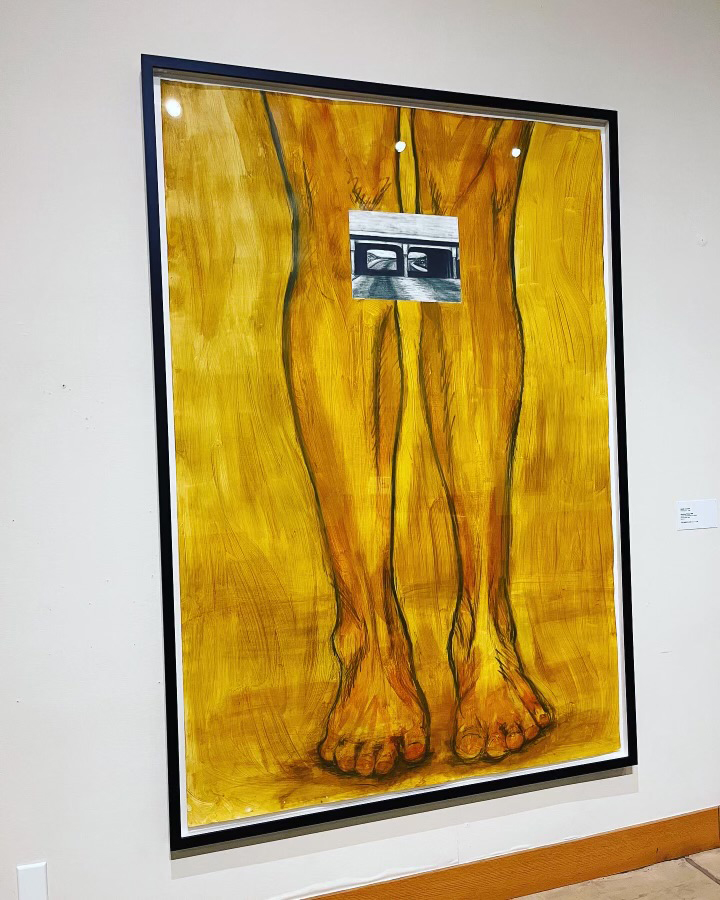
David A. Cook, “Standing Plans,” 1988, acrylic and graphite on paper. On view at the Old Jail Art Center, Albany, August 2022. Gift of Reilly Nail.
10. Step out and go see some (more) art.
The post Art-Inspired New Year’s Resolutions appeared first on Glasstire.
Saturday Morning Breakfast Cereal - Peace

Our Most-Read Articles of 2022
Thanks to all our readers, writers, and supporters for sticking with us this year. Bring on 2023!
1. A NOTE OF REASSURANCE FROM YOUR SCHOOL DISTRICT REGARDING OUR UPDATED OMICRON POLICIES
by Kara Baskin
2. WHAT YOUR FAVORITE SAD DAD BAND SAYS ABOUT YOU
by John Moe
3. A PARENT’S TYPICAL DAY, AS ENVISIONED BY MY CHILD’S PRESCHOOL
by Ruti Wen
4. SELECTED NEGATIVE TEACHING EVALUATIONS OF JESUS CHRIST
by Amanda Lehr
5. IF I EMAILED MY PARENTS LIKE DEMOCRATS EMAIL ME
by Sarah Gruen and Chandler Dean
6. THANK YOU FOR CALLING THE PERIMENOPAUSE HOTLINE, WHERE OUR HOLD TIMES ARE COMPLETELY UNPREDICTABLE
By Kathryn Baecht
7. MATH CONCEPTS THE STATE OF FLORIDA FINDS OBJECTIONABLE
by Carlos Greaves
8. I’M TIMOTHÉE CHALAMET, AND THIS WAS SUPPOSED TO BE MY CONTROVERSIAL OSCARS NIGHT
by Emily Flake
9. THE NINE MONTHS OF PREGNANCY, RANKED FROM WORST TO BEST
By Kristen Mulrooney
10. HERE’S WHY YOU’RE WRONG FOR SUPPORTING EITHER IN-PERSON OR VIRTUAL SCHOOL
by Chandler Dean
11. I’M WEARING TUNICS NOW
by Wendi Aarons
12. WE ARE A PICTURESQUE SMALL TOWN, AND WE REFUSE TO BE THE SETTING FOR YOUR ROMANTIC COMEDY
by Rachel Mans McKenny
13. HOW WE WILL SEPARATE YOU FROM ANY LINGERING HOPE AND OTHER IMPORTANT TOPICS OF TODAY’S FACULTY MEETING
by Julie Cadman-Kim
14. EVERY EPISODE OF A TELEVISION SHOW WRITTEN BY JULIAN FELLOWES
by Shannon Reed
15. HOW NON-LIBRARIANS IMAGINE A LIBRARIAN’S TYPICAL WORKDAY
by John Howard Hughes
16. WELCOME TO THE MIDDLE-AGED RESTAURANT. PLEASE STOP COMPLAINING
by Wendi Aarons and Denise Schipani
17. FISHER-PRICE RECALLS THE DELUXE KICK ’N PLAY PIANO GYM FOR HAVING TOO MANY BOPS
by Laura Foody
18. WE ARE AN ANTI-ABORTION COUPLE, AND DON’T WORRY, WE WILL ADOPT YOUR BABY
by Lucy Huber
19. MY FAVORITE CONTROLLED SUBSTANCE IS DAYCARE
by Sarah Suksiri
20. TEVYE FROM FIDDLER ON THE ROOF, NOW A RICH MAN, RECEIVES A LETTER FROM HIS HOA
by Stephen Ruddy
A bill to fight expensive prison phone call costs heads to Biden's desk

Congress recently passed legislation that will give federal regulators greater authority to limit the costs of prison phone calls.
(Image credit: John Moore/Getty Images)
