A RAND Corporation survey found that Americans who served in the military support extremist views at rates lower than nonveterans.
(Image credit: Adam Kaz/Getty Images)

A RAND Corporation survey found that Americans who served in the military support extremist views at rates lower than nonveterans.
(Image credit: Adam Kaz/Getty Images)
Last fall, Big Art. Bigger Change., a mural project curated by Street Art for Mankind (SAM), unveiled nine murals in downtown Houston. This week, Central Houston, Inc. (CHI), an organization of business leaders in the downtown area, announced the expansion of the project to include more than two dozen murals.

“Big Art. Bigger Change.” mural by Emily Ding, 2022.
In a press release, President & CEO of CHI and Houston Downtown Management District Kristopher Larson said, “We are thrilled to announce the expansion of Big Art. Bigger Change. to include even more talented artists from at home and all over the world. Downtown Houston is a place where culture thrives, and we hope that these additional murals continue to bring our community together, spark meaningful conversation and ultimately reflect the diversity that makes Houston such an incredible and unique place to live.”
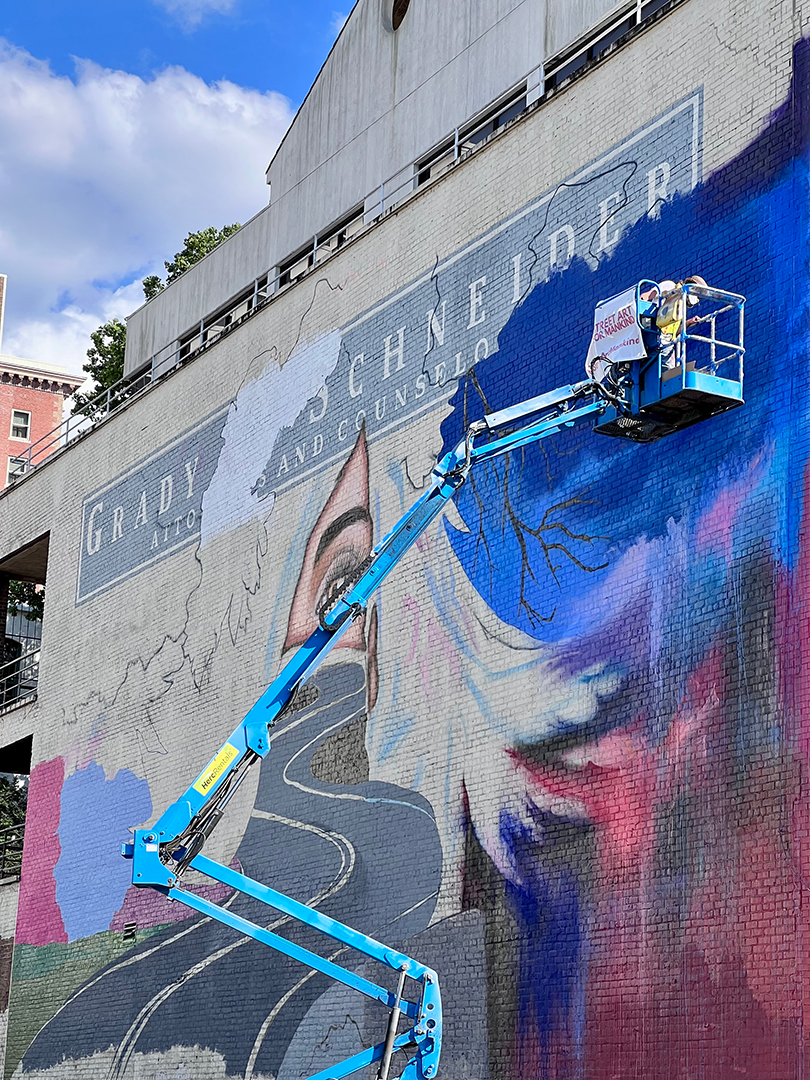
Artist Mr. D working on a mural in downtown Houston.
The 2023 muralists include Houston-based artists Alex Arzu, Mr. D, and Gelson D. Lemus aka w3r3on3, as well as creatives from around the world. See the full list of artists below. A committee of Houston community and arts leaders reviewed the pieces for Big Art. Bigger Change. The goal was to reflect the 17 Sustainable Development Goals adopted by the United Nations General Assembly, which include gender equality, quality education, climate action, and clean water and sanitation.
Harris County Commissioner Rodney Ellis, who conceived of the mural series, remarked, “In our homes, we hang photos and paintings to honor our past and express our values. In our city, we install public art to remind us of our history and unite around the values and causes that define us. In Houston, you don’t need an admission ticket to take in breathtaking displays and one-of-a-kind pieces. The expansion of this project brings art to the people, and I’m grateful to Street Art for Mankind’s efforts to democratize an essential part of community life.”
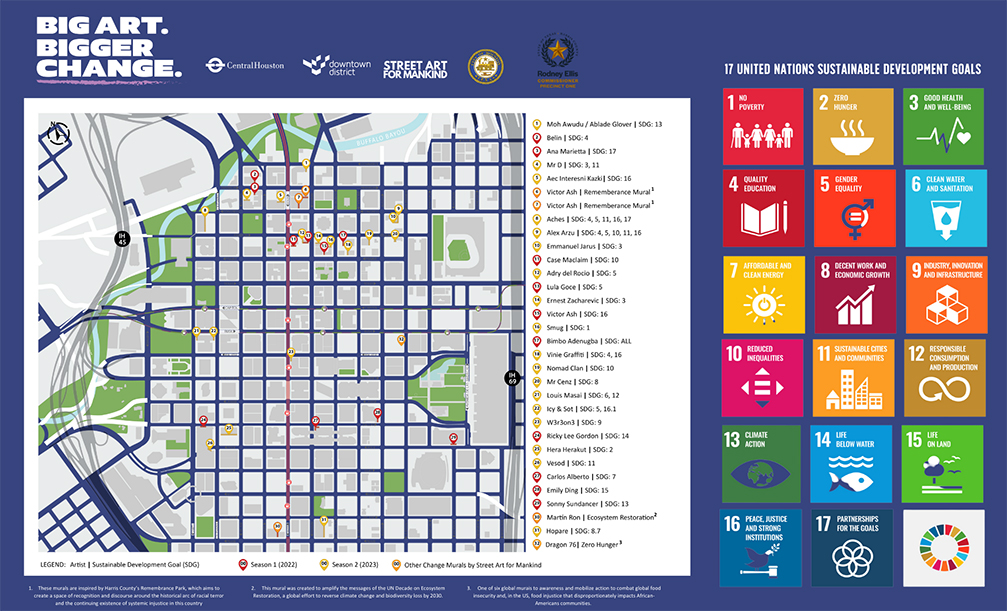
“Big Art. Bigger Change.” Mural Map
The large-scale works completed by the internationally recognized street artists will be unveiled this Saturday. Learn more about the project at SAM’s website.
Big Art. Bigger Change. 2023 Artists
Aec Interesni Kazki
Alex Arzu
Ernest Zacharevic
Hera Herakut
Aches
Mr. D
Icy & Sot
Smug
Adry del Rocio
Moh Awudu & Ablade Glover
Louis Masai
Vesod
W3r3on3
Hopare
Nomad Clan
Emmanual Jarus
Vinie Graffiti
The post “Big Art. Bigger Change.” To Unveil Massive Murals in Downtown Houston this Weekend appeared first on Glasstire.
This article is part four of a multipart series. Click here to read Part One, Part Two, and Part Three.
So far we’ve visited post office murals in West Texas and North Texas. Now, let’s travel around the Central Texas region.
We’ll begin our journey just east of Waco in a small town called Mart. (Fun fact: Remember Landry Clarke from the popular television show Friday Night Lights? The actor who played the role, Jesse Plemons, was raised in Mart.) Mart is located in McLennan county on the Edwards Plateau. Why does that matter? The county is named for Neil McLennan, who is the subject of the Mart post office mural by José Aceves, which is titled McLennan Looking for a Home. The main character of our 1939 mural is shown in buckskin, the quintessential outfit of a colonial settler (think Daniel Boone). McLennan and his family, who accompany him in a covered wagon pulled by a couple of oxen, are in search of a place to settle. See that trading post in the lower right background? That was added by request of a local politician who claimed, inaccurately, that McLennan had passed the landmark on his journey through nearby Bosque County. It was not the first time, nor the last, that an artist has had to acquiesce to outside influences in their public artwork. In fact, the mural’s subject matter is not characteristic of Aceves’ work, but rather was selected for the residents of Mart.

Mart, TX. José Aceves, “McLennan Looking for a Home,” 1939. Photo: Leslie Thompson.
Aceves is one of the few, if not only, artists of color who painted a post office mural in Texas. A naturalized citizen, Aceves was born in Chihuahua, Mexico. As a young boy, he moved with his family to El Paso during the Mexican Revolution. Aceves received no formal artistic training, but he did find mentors in local artists like Tom Lea and Audley Dean Nicols, who was known as one of the Purple Mountain Painters. Inspired by the nuances of the desert light, Aceves developed a reputation for his colorful landscapes of the American Southwest. Similar to the Mart mural, Aceves’ style can be characterized as clean and detailed with sharp lines and strong contrasts. The Mart mural exemplifies his use of idealized colors with its vivid blue sky and the rich brown of the oxen. Even the sheen of McLennan’s buckskin is anything but dull.
Next we’ll travel an hour west on Highway 6 to Clifton, where we’ll find Ila McAfee’s 1941 post office mural, Texas Longhorns – A Vanishing Breed. The mural depicts a herd of Texas Longhorns grazing among the rolling plains of bluebonnets, cacti, and cypress. In addition to the cattle, other furry friends are hidden in the foreground corners, like cottontail rabbits on the left and a skunk on the right. There are many different names for cattle, so let’s clear things up: Bulls are male cattle, and if you want to get more specific, a steer is a castrated male. Female cattle are called heifers before having their very first calf, after which she forever becomes known as a cow. The more you know, right?

Clifton, TX. Ila McAfee, “Texas Longhorns – A Vanishing Breed,” 1941. Photo: Leslie Thompson.
For most Texans, the longhorn is old hat — hardly special subject matter for a public mural. But for a Colorado artist who was fascinated by the longhorn, McAfee was adamant about her subject selection, to the dismay of the local residents who wanted her to paint an old mill. There were enough images of the beloved mill around town, she argued. To strengthen her argument of the significance of the longhorn to the region, McAfee referenced J. Frank Dobie, who wrote the book on longhorns (literally). Personally, with the proliferation of images of cattle and longhorns around the state these days, I wouldn’t mind a painting of a historic mill, but to each their own. The residents finally came around, as the postmaster could attest by the remarks he would hear from people in the post office lobby. In the end, the local newspaper, The Clifton Record, solidified McAfee’s success: “Volumes could be written about the Texas Longhorn, but in this limited space it can only be said that the Texas Longhorn, rough, rangy, unlovely and wild, able to exist without care, was the reason for, the sole cause of America’s Romance of Cattle…this country, and Texas in particular should hold in honored memory – the Texas Longhorn.”
After I learned that McAfee specialized in animal portraits, it’s no wonder she pushed for her choice in subject matter. Having grown up in a ranching community, McAfee drew horses as a young girl. She developed her artistic skills through her studies at Western State Colorado College, the Art Institute of Chicago (where she apprenticed with muralist James E. McBurney), and the Art Students League and the National Academy of Design, both in New York. After marrying her husband, painter Elmer Page Turner, the artist couple moved to Taos, New Mexico where they lived for nearly the remainder of their careers.
Let’s continue our journey west to Hamilton, one of my favorite small Texas towns through which to travel. In their sweet little post office just south of the square is a 1942 mural by Ward Lockwood, called Texas Rangers in Camp. Supported by a cluster of trees, a group of Texas Rangers is hanging around a campfire at night; one playing his guitar, one playing a fiddle, one singing up to the night sky, and the other singing while cleaning his weapon. Despite the presence of a rifle, overall the scene evokes a cheery, light-hearted spirit.
The residents of Hamilton were enthusiastic about the mural. The Hamilton Herald Record seemed to speak for the town when it reported: “Every Hamiltonian and every Texan who’s ever read a book, seen a movie, or listened to the tales their grandfathers told can appreciate ‘Texas Rangers in Camp’…even a Texas Ranger himself could appreciate Lockwood’s art!” As mentioned during our travels through North Texas’ post office murals, today the reputation of the Texas Rangers is complicated, as folklore and legendary tales often masked the agency’s history of racism and violence. Like every element of history, the Texas Rangers were multifaceted, and the mural in Hamilton preferred to focus on the group’s more positive facets.
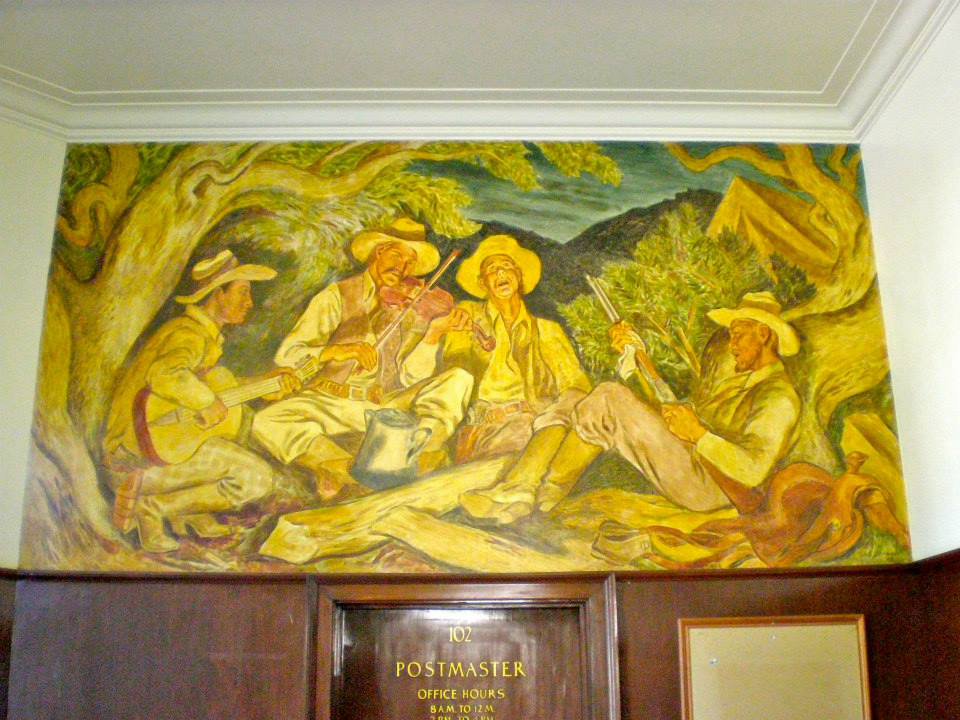
Hamilton, TX. Ward Lockwood, “Texas Rangers in Camp,” 1942. Photo: Leslie Thompson.
The branch of the trees circling the rangers creates a swirling integration of the figures with the environment that is reminiscent of Thomas Hart Benton and the American Scene, a style Lockwood would have recognized and become familiar with during his time in Kansas. The artist was born in Atchison, Kansas, and studied at the University of Kansas and then the Pennsylvania Academy of Fine Arts, where he was introduced to modernism. When he spent time in Paris after serving in the military during WWI, Lockwood noticed the work of artists like Vincent Van Gogh and Paul Cezanne, who would influence his art. After returning to the U.S., he moved to New Mexico, where he was a member of the Taos Society of Artists. Texas stakes its claim on Lockwood due to his founding and organizing of the art department at UT Austin when he was hired as its chair in 1938. Lockwood left Texas after ten years to teach at UC Berkeley.
Like many artists of the New Deal era, Lockwood painted his Hamilton mural in the American Scene style. But the mural is quite different in style from his later work, as he’s best known for his watercolors of abstract southwest landscapes. His style changed throughout the years, and depending on the era, one can find influences from Expressionism, Cubism, Surrealism, and Constructivism in his artworks.
Just half an hour southeast from Hamilton is Gatesville, known as the “Spur Capital of Texas” because it’s home to a collection of 10,000 pairs of spurs (just in case you’re a spurs fan). Keeping with the western theme, Gatesville is also home of the 1939 post office mural Off to Northern Markets, by Joe De Yong. While the subject matter of this mural is the well-known cattle drives of Texas, the way the artist arranged his composition is unusual. Our immediate view is of a chuck wagon pulled by a team of mules. The middle ground shows a cowboy driving a herd of horses. At the very top of the background is the herd of cattle being driven to market. Why the artist chose to make the chuckwagon the central figure rather than the cattle is unclear (though the cook was essential to any cattle drive).
But what caught my eye is the brand marking the cover of the chuck wagon: bar diamond. Who does that brand belong to? Why did Joe De Yong feature it in this mural? Knowing how these mural artists made connections to the local residents, it would seem plausible that a Bar Diamond ranch was in the area. Unfortunately, my research has yet to uncover the answer. If anyone knows anything about this brand or its history, let me know.
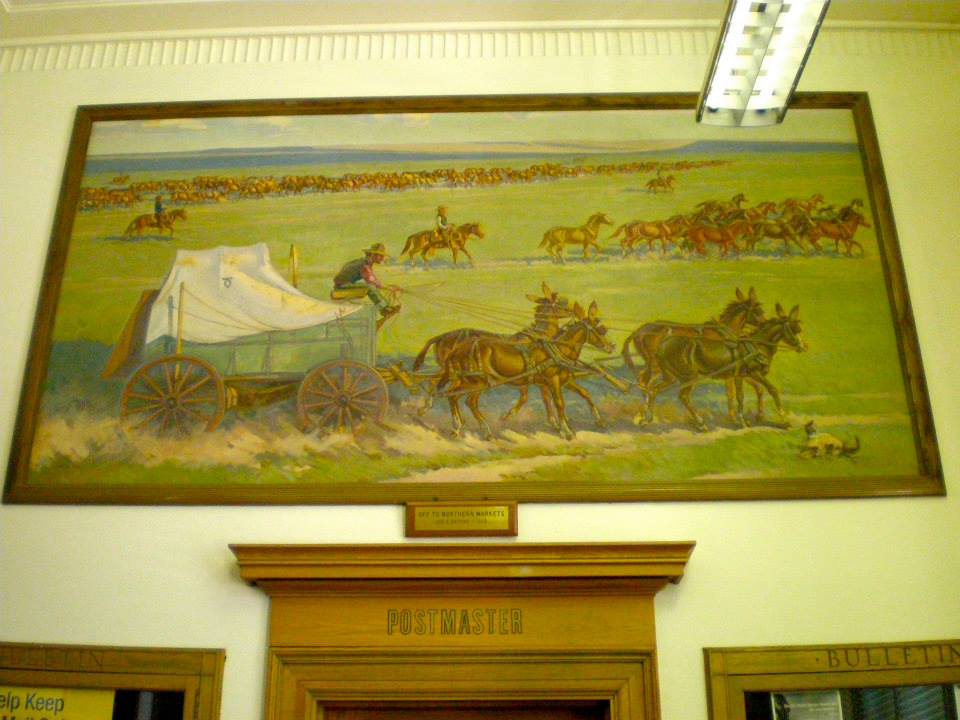
Gatesville, TX. Joe De Yong, “Off to Northern Markets,” 1939. Photo: Leslie Thompson.
Joe De Yong was familiar with ranching life, having done a bit of work on roundups while in Oklahoma, where he grew up. Around the age of 18, while riding as an extra in a Tom Mix movie, De Yong contracted spinal meningitis, which left him deaf. Unable to work on ranches, De Yong began to focus on his art, and eventually developed a relationship with the famous cowboy artist, Charles Russell. De Yong was Russell’s only protégé, and I like to believe that the bison skull in the lower right of the Gatesville mural is an homage to his mentor, whose signature always included said skull.
In addition to his career as an artist, De Yong also worked in Hollywood designing sets and costumes and performing as a technical consultant for many Western films like The Virginian (1946), Red River (1948), and Shane (1953). In fact, De Yong developed the Gatesville mural while working as an adviser and costume designer for the Cecil B. De Mille movie Union Pacific. Just a few years earlier, he had worked on the set of De Mille’s film The Plainsman.
Want to know where the geographical center of Texas is? Visit the small town of Brady, known as the “Heart of Texas.” While out in the middle of nowhere, so to speak, Brady is home to one of the most vibrantly colored post office murals, Texas Immigrants, by Gordon K. Grant. The bright mural depicts a family of Anglo colonial settlers traveling across the rolling prairies of Texas with a small herd of longhorn and a covered wagon. The intense blue of the main rider’s shirt complements and contrasts against the saturated orange hills glowing atop the plains of neon yellow grass. One of the men in the group points off into the distance, where the family has caught sight of a couple of American Indians hunting bison. With his back to us, a prominently centered male figure holds a rifle in his hand either signifying danger, or at least casting a layer of tension to the scene.
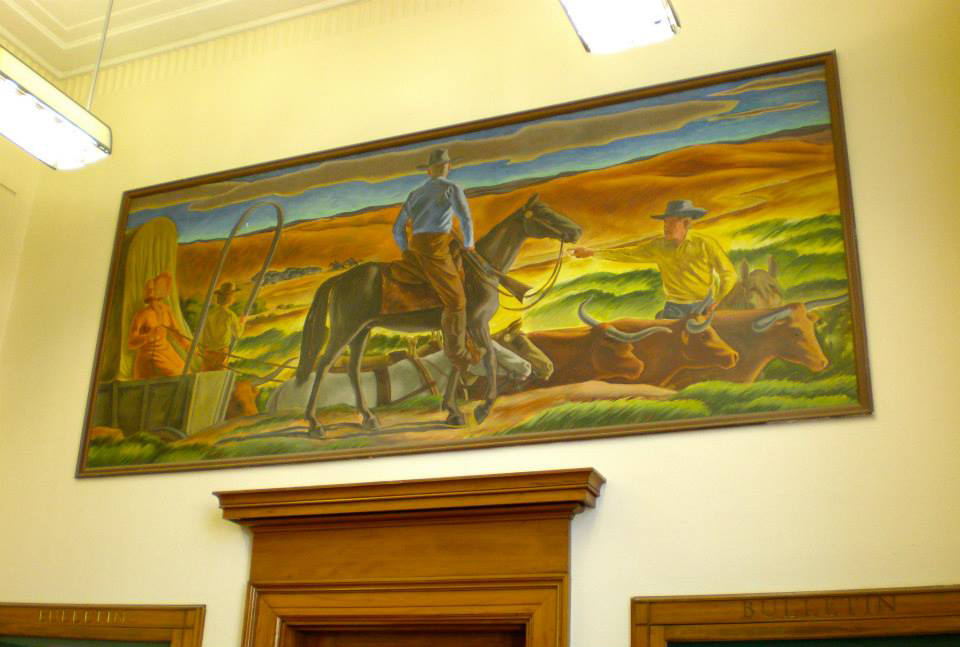
Brady, TX. Gordon K. Grant, “Texas Immigrants,” 1939. Photo: Leslie Thompson.
You probably wouldn’t know it by looking at this mural, but Grant was a renowned painter from San Francisco who was known for his maritime watercolors. Yet, I’m reminded of historical allegories tying western lands to the ocean with Spanish conquistadors and missionaries remarking how the vast plains swallow you up like the sea. The swaths of glowing green grass blowing in the wind remind me of waves, like an ocean of prairie. Despite the fact that Grant did not travel to Texas and did most of his research at his local library in Santa Barbara, California, the residents of Brady were impressed with the result, as indicated by the headline of a local newspaper: “Artist Who Painted ‘Longhorns” on Post Office Mural Has Never Seen A Longhorn.”
We end our adventure through Central Texas down in Smithville, just an hour outside of Austin. You probably know this small town through the 1998 film Hope Floats, starring Sandra Bullock and Harry Connick Jr. (you can still drive by the house featured in the movie), or by watching the 2008 film Tree of Life, starring Brad Pitt, Jessica Chastain, and Sean Penn. This quaint town along the Colorado River is also home to a 1939 post office mural, The Law – Texas Rangers, by Minette Teichmueller. Yep, another post office mural featuring the Texas Rangers.
Here, a mounted Texas Ranger points his gun at two men across the landscape who have their hands up in surrender. One of the bandits is Anglo, while the more prominent man is likely Mexican, with his sombrero and dark skin. There is an open box with cash scattered on the ground, money that the bandits have just stolen. The artist had no clear reason for the subject matter other than she thought it would be a crowd pleaser. She reported that “There is practically no historical element to be considered, so I’ve made my design allegorical, and simple as the building calls for.” She continued: “Texas Rangers are still known throughout the world for their cool courage and deadly aim.”
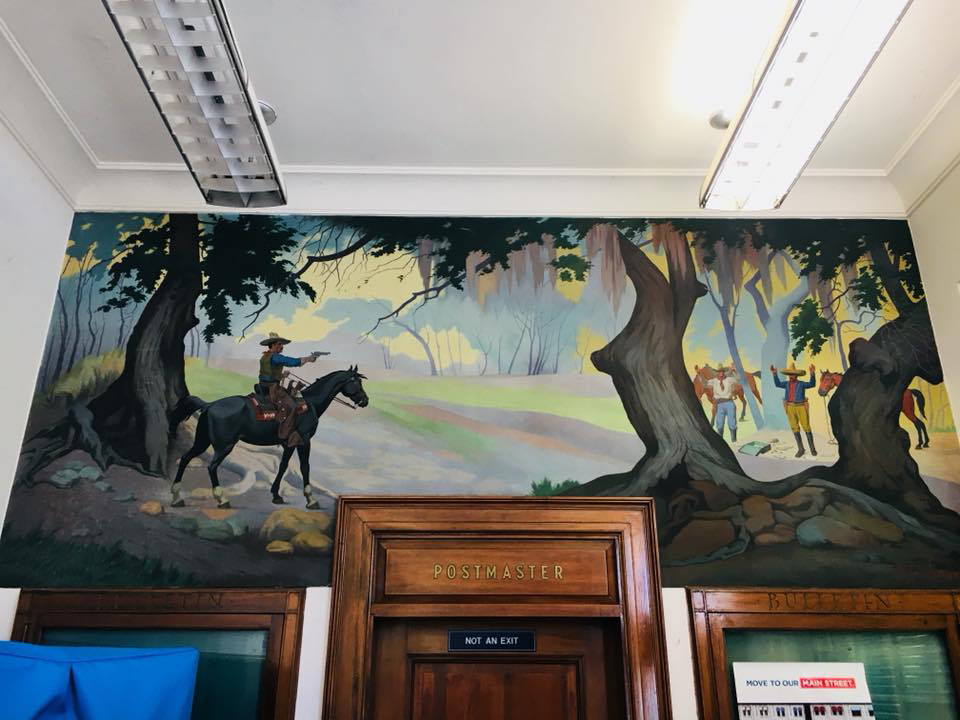
Smithville, TX. Minette Teichmueller, “The Law – Texas Rangers,” 1939. Photo: Leslie Thompson.
Born in La Grange, Teichmueller spent most of her career around San Antonio. She studied at the Chicago Academy of Fine Art, where she met her husband, artist Hugo D. Pohl. She also studied at the San Antonio Academy of Art, where she eventually taught. Later, Teichmueller and Pohl established an artist colony nearby in Leon Springs. Teichmueller was one of the ten women (by my count) who received a post office mural commission in Texas.
The Smithville mural is very colorful. When I first laid eyes on it in person, my mind immediately conjured images of scenes from Sleeping Beauty or Cinderella — it feels reminiscent of that early Disney illustration style. I did not find any connection between Minette and Disney, but her color and styling is very similar.
Put aside the drama and focus on the background. It has a romantic, whimsical sensibility using soft, dreamy colors and gentle, sweeping shapes. When researching one of the main artists of the 1950 Disney film Cinderella, Mary Blair, I discovered that she was inspired by a trip through South America, where she was influenced by the color and vibrancy of the cultures she encountered and their tropical palette of vibrant colors. I think the same could be said of the ambiance of Teichmueller’s mural.
We’ll be nearing the end of our journey when we meet up next time, as we move eastward for the last installment of this post office mural series.
The post Texas Post Office Murals, Part IV: Central Texas appeared first on Glasstire.
This post was written by Alison Green and published on Ask a Manager.
It’s five answers to five questions. Here we go…
1. I got in trouble for overstepping at work
It’s been 18 years since my last job. I was a stay-at-home mother of five, but I was also stuck in a seriously abusive relationship; he prevented me from doing anything. After finally escaping him in 2019, I became extremely agoraphobic, with severe anxiety and all that stuff that makes it hard to be around people.
I wanted to try to put myself back out there. Believe it or not, I handpicked my job as a laundry attendant to slowly get myself back out there. It had been a little over a month and I was feeling great. I felt like I had a lot to prove to them and myself, but I have never been the type of person to just stand around, doing nothing, waiting to be told what to do. I found things to do — sweep, vacuum, clean shelves, dust the top of machines. All of a sudden, the housekeeping supervisor has this huge problem with me, stating, “I only need you to do what I hired you to do!” I wanted to cry all day. I’m so confused why hard work, good work ethic, and taking initiative has become such a bad thing. I have never worked at a place that punishes their employees by cutting hours because they work too hard.
I have made a few comments about how they keep the rooms. As a guest, I would not stay there. They only change the top covers if they are stained, and no one cleans properly. And this isn’t some hole-in-the-wall, this is an award-winning hotel. So my supervisor took my ideas to her boss and blamed me for the crap happening in the laundry room. I’m totally beside myself and confused.
It’s not unreasonable that they’d want you to stick to the job they hired you to do! If the job is laundry attendant and you were going beyond that to do other work — even if it was work you could see needed to be done — they might legitimately feel you were overstepping and/or causing them more work. That’s not always easy to see when you’re the person trying to take initiative, but sometimes doing X without being trained or authorized to do X can cause problems you don’t have the context to anticipate. For example, you could be stepping on someone else’s toes, or messing up an established system that you don’t know about because they didn’t have any reason to teach it to you, or adding to the list of things your boss would be responsible for overseeing.
Sometimes volunteering for extras will be helpful and appreciated … but you have to be willing to be told no and not take it personally.
I can’t tell how much of the problem came from your comments about how they keep the rooms — but it wouldn’t be surprising if they bristled at that, especially if they were already concerned that you were overstepping the bounds of the job they hired you for. It sounds like your manager is telling you pretty clearly that the contributions you hoped would help just aren’t things they want to see, for whatever reason. If you don’t like the idea of sticking just to your assigned duties, this job isn’t the right fit (which is okay! no job is a good fit for everyone who does it). If that’s the case, why not look for a job with broader responsibilities?
2. Is it a faux pas to bring luggage to an interview?
I once interviewed someone who brought their luggage with them. To be fair, we were close to the airport and this was a city where five miles is an hour of driving. It was a little odd though, and they had come about 30 minutes early and joined me and my coworkers while we ate lunch (open concept floor). After the interview, we concluded that they should have waited at the coffee shop across our building instead of coming into the office so early.
We ended up not going with them for a few reasons, but I was curious if this was actually a faux pas, or if I was being a little unfair. I was early in my career and that workplace had a cliquey mentality, so looking back I wonder if the luggage wasn’t such a big deal. I still think the lunch/earlyness was weird, but I’m happy to be corrected.
I can’t count the number of people I’ve interviewed who brought their luggage with them to the interview! If someone has flown in for an interview and has come straight from the airport or will be going there right afterwards, they might have no choice. It happens all the time, and it’s normal and not a faux pas in any way.
Arriving 30 minutes early is a misstep though. Depending on the reception area set-up, it can force the employer to deal with the candidate before they’re ready for them. And unless the candidate was explicitly invited to join you for lunch, that was definitely an overstep — you could have intended to use that time to discuss the hiring process or confidential work or all sorts of other things.
3. I’m the only one still wearing a mask
I work for a smallish company (about 75 employees) and as of about a year ago, my department has gone almost 100% digital. From January 2022 until January 2023, I worked from home almost exclusively. Unfortunately, at the start of this year, the VPs decided to require everyone to come back to the office at least three days per week. Upon returning to the office, I discovered that I am the only person in the entire building who wears a mask. My partner is high-risk, and I have told anyone and everyone who will listen that I have to protect him and that we cannot take the risk of just vaccinating and hoping for the best (though we are five times vaccinated now).
At the end of last month, I came down with bronchitis after babysitting my nephew and niece and had to go back to working from home until I recovered. I had just shaken the fever this last weekend and came back to the office two days ago, when I learned last night that a coworker (who was in the office yesterday, unmasked) tested positive for asymptomatic Covid.
I’m pretty angry with my workplace. One year ago, I was happy with my job; I felt productive, had a healthy work-life balance, and could see myself working there for many years to come. Today? I’m pissed. I feel betrayed and that they’ve undermined all the hard work my partner and I have done these last 3+ years to keep him safe. Further, the idea of potentially having my lungs hit by Covid scarring while I’m still dealing with lingering bronchitis effects terrifies me. If I end up testing positive, I want to let all the higher-ups know how I feel about this, but should I? And how do I say it without all the fuck-words that are in my head and heart?
What you describe in your office is pretty typical of most offices, not just yours: most people, unless they are high-risk or have high-risk loved ones, have largely stopped masking.
I get why you’re upset — I still mask in most indoor situations too because my mom is immunocompromised from chemo and I don’t want to endanger her. But the vast majority of people in the U.S. have decided Covid infections and the risk of long Covid are things they’re willing to live with. I know that sucks if you’re high-risk or close to people who are high-risk. If it feels like the world has left you to fend for yourselves … it has. But it’s extremely likely that you’ll encounter the same conditions in any other job (unless it’s fully remote and you’re confident it’ll stay that way) and extremely unlikely that your company will require everyone to start masking again, or even that they’ll think you’re reasonable for being upset that your asymptomatic coworker wasn’t masking before the positive test.
What you’re upset about isn’t something specific to your company; it’s the response of the world in general. I’m sorry.
4. Is this job description a red flag?
I just came across a job listing that had these last two bullets:
• Maintain a calm demeanor and manage issues professionally and respectfully in accordance with our company standards.
• Act with integrity and trust, modeling behavior that respects our employees, peers, and customers in accordance with the core values of our company.Stuff like this always gives me pause and (to me) is a red flag that they have to specifically ask people to be a cordial, working professional in a job listing. Or is it a green flag that misbehavior isn’t tolerated and they have a code of conduct that folks really buy into?
I wouldn’t read anything into it. It reads pretty boilerplate.
Even if it were a little weirder, I wouldn’t necessarily read much into it. Sometimes hiring managers overreact to their last bad hire — like if the previous person was hostile and argumentative all the time, sometimes that’ll show up in the form of a job description that seems disproportionately focused on handling conflict well, and it’s not because it’s a high-conflict workplace but because they’re trying to avoid the mistakes they made with the last person. That doesn’t mean you should ignore anything that seems weird in a job description; it’s always okay to ask about it (“I noticed you emphasized the need for X; can you tell me more about that?”). But I wouldn’t consider it a red flag on its own.
5. Should I tell employers I was laid off a few months ago?
I was laid off from my tech job in mid-February and I’m currently still job hunting (not having much luck!).
Should I mention “laid off” on my resume and/or cover letter? I’ve heard mixed reviews from everyone I’ve talked to (friends, recruiters, former colleagues), so I’ve kept everything on my resume as “present” and don’t mention being laid off until during a live interview. Thoughts?
You don’t need to specify that you were laid off on your resume or in your cover letter — although you might choose to if you think it helps to explain for why you left — but you definitely definitely definitely should not be sending out a resume in May that says you’re still at a job that you left in February! That’s deliberately misleading, and I’d be concerned if I realized a candidate had done that.
JACKSONVILLE, FL—Expressing concern that he might have played up his facility with witchcraft and dark magic at the expense of other qualifications, local man Timothy Sellers told reporters Tuesday that he might have mentioned sorcery a few too many times during a recent job interview. “It seemed to go pretty well,…
Sunday’s temperatures were remarkably mild for late May in Houston, with highs generally in the upper 70s to 80 degrees during the afternoon hours thanks to a weak front this weekend, and persistent cloud cover. That pattern will change this week, mostly sunny to sunny skies for most of the week. But we’re not going to get too hot.
One thing to note, however. We’re also not going full bore into summer-like humidity this week. That is certainly coming, but with dewpoints generally in the low- to mid-60s this week our air won’t be oppressively humid. So if you’re thinking this week feels a bit like summer, well, just you wait.
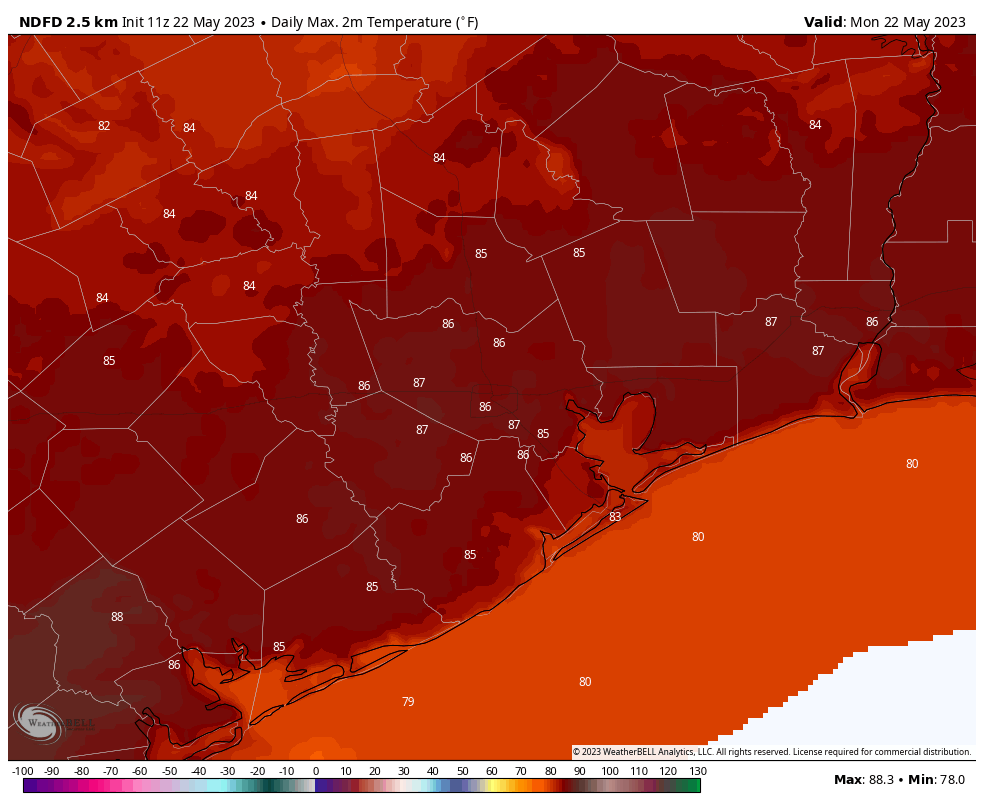
Slightly cooler air will linger today, keeping high temperatures in the mid- to upper 80s despite mostly sunny skies. Winds will be light, out of the northeast, at about 5 mph, shifting to come from the east overnight. Lows will drop to around 70 degrees in Houston, and perhaps a few degrees cooler for inland areas.
Warming up a little more, with sunny skies and high temperatures of about 90 degrees. Winds will be light, out of the north, at perhaps 5 mph. Lows on Friday night will again drop to about 70 degrees in the city of Houston.
This will be another mostly sunny day with highs of around 90 degrees. The difference is that an atmospheric disturbance drops into the region during the daytime, and this may produce a slight or even decent chance of showers and thunderstorms in the afternoon. For now let’s ballpark rain chances at 20 percent, but this may go higher.
Both of these days should see sunny skies, with highs in the upper 80s to 90 degrees.
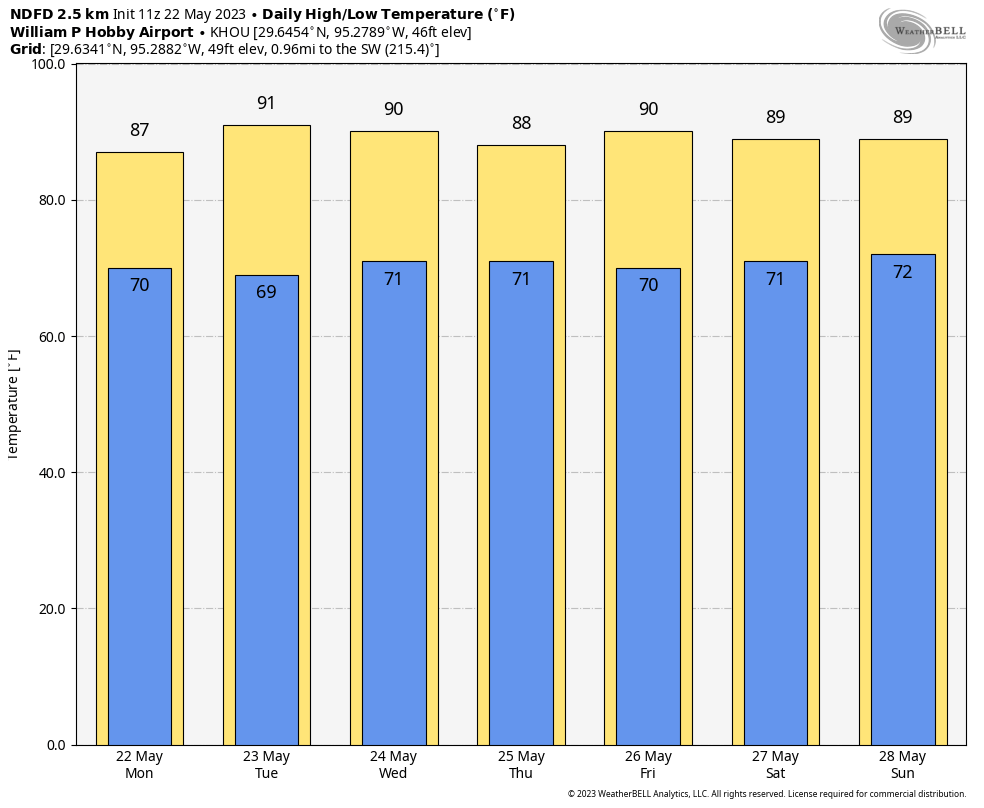
Warm and moderately humid conditions continue into Memorial Day weekend, with highs of around 90 degrees, and lows around 70 degrees. Skies should be mostly sunny on Saturday and Sunday, with the possibility of some clouds by Monday. We’ll see. Some slight rain chances probably return by Tuesday or so of next week, as we get close to June.


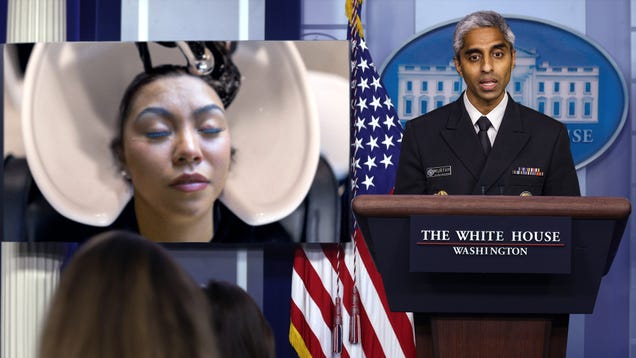
WASHINGTON—In response to the ongoing loneliness epidemic in the United States, Surgeon General Vivek Murthy warned Americans Monday that they should avoid becoming so lonely that they cry a little when someone washes their hair at the salon. “Whenever possible, we highly recommend preventing an escalation of any…
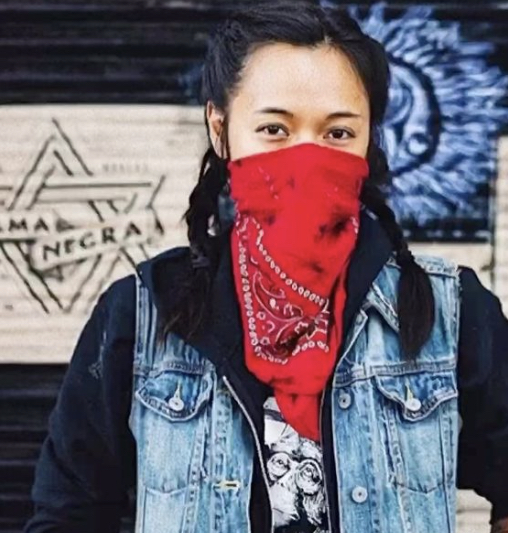
Late last year, the Houston Mayor’s Office of Cultural Affairs (MOCA) launched a call for artists to create a public art work for the City’s new Montrose Library. Earlier this week, MOCA announced that Kill Joy, a Filipino-American artist, has been selected for the opportunity.
Kill Joy
Born in West Texas, Kill Joy explores mythology from around the world and studies ancient symbols. Her research is infused in her art practice, which includes printmaking, mural painting, book making, and puppetry. Currently based in Houston, Kill Joy has created other murals in the city, including one at Trebly Park and one at METRO’s Kashmere Bus Operating Facility, as part of the Arts in Transit program..
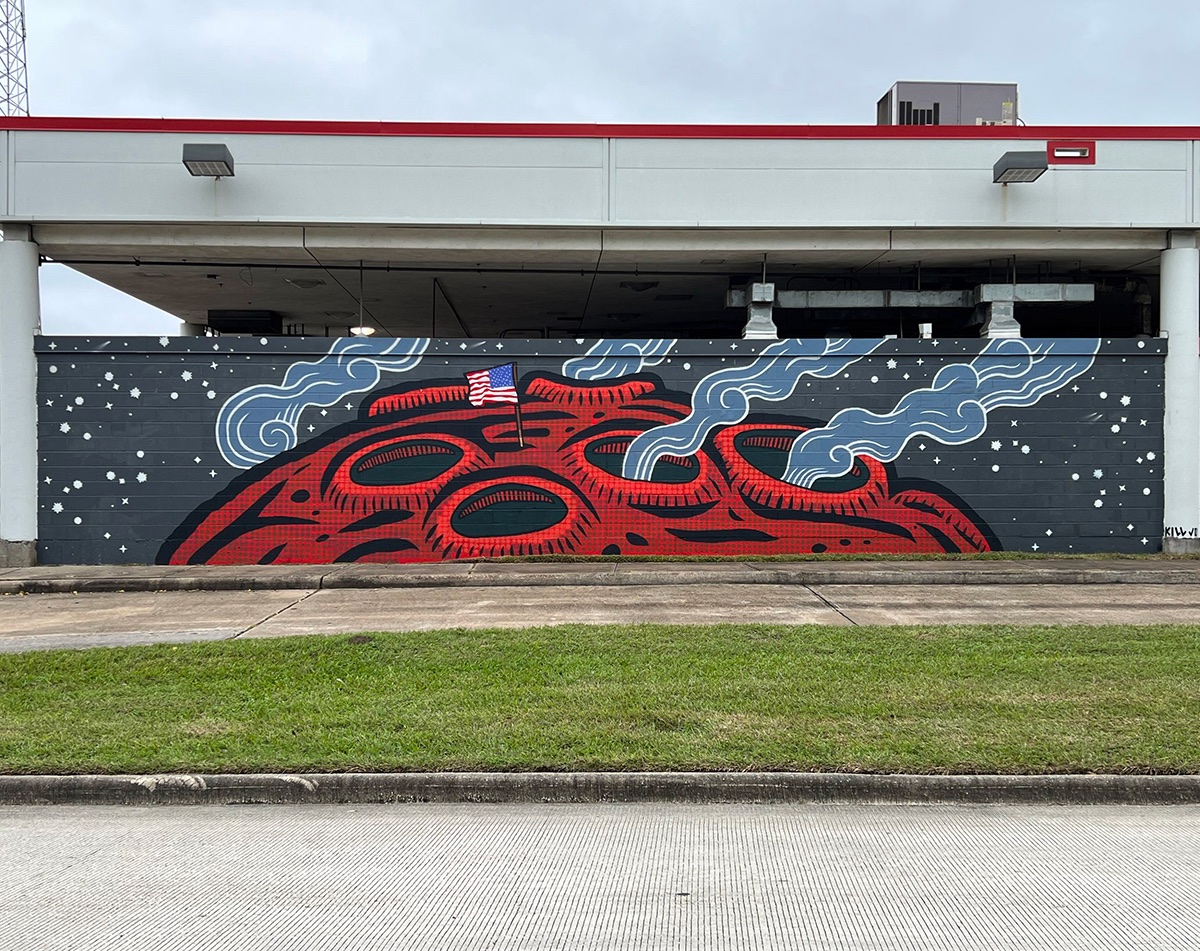
Kill Joy’s mural at Houston METRO’s Kashmere Bus Operating Facility.

Kill Joy’s mural at Trebly Park.
The site-specific public art commission that Kill Joy will create includes a mural, sculpture, and light piece, and will draw inspiration from the history of the Montrose neighborhood. The City has budgeted $85,000 to cover costs, including artist fees, design, engineering, permitting, insurance costs, lighting, travel, fabrication, materials, and more. Though the original open call stated that the new library would be built at 1001 California Street, new information indicates that it will be built a half mile south of that location at 4001 Montrose Boulevard, the current site of the existing library.

Rendering of the exterior of the Montrose Library. Courtesy of the Houston Mayor’s Office of Cultural Affairs.
In a press release, Houston’s Mayor Sylvester Turner remarked, “The artwork being the centerpiece of the new Montrose library location highlights the Houston Public Library’s commitment to storytelling in all forms and mediums, as well as the City’s commitment to sharing uplifting experiences through art and it’s great to see another dynamic mural be added to the City’s Civic Art Collection.”
Artist Kill Joy added, “Libraries are sacred. They are a gathering space that imprints local stories and connects people to global, and even intergalactic worlds. Libraries are a celebration of community building, and I am very honored to contribute to these time-honored sanctuaries of learning, community, democracy and imagination.”
The post Houston-based Artist Kill Joy Selected for Montrose Library Public Art Commission appeared first on Glasstire.
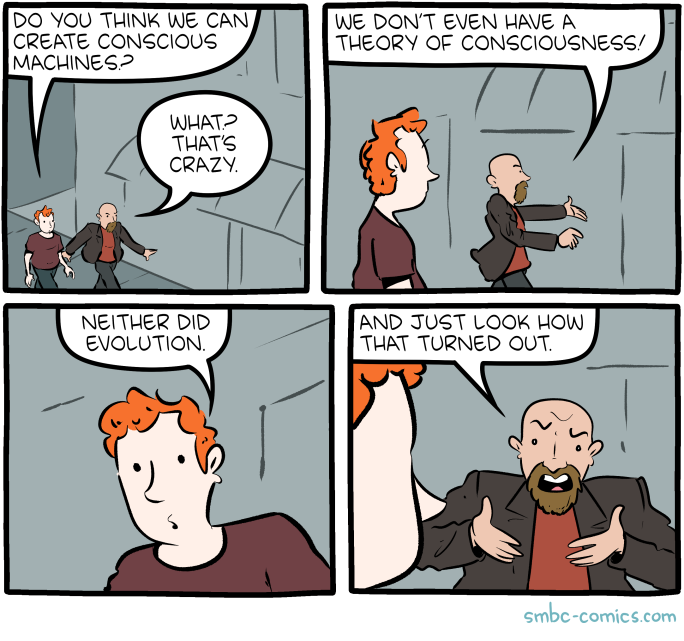
Hovertext:
Some time in the next 10 years, someone's gonna whoopsie an AGI into existence trying to create a highly multimodal porn-bot.
Reminder:
Steal a rugby ball and write your name on it, you’re a common thief.
Steal a rugby ball and put your team name on it, and you’re part of the Texas Rugby Union Ball Exchange Program.
Also: Don’t bring anything you care about to a 7’s tournament.
Bon Voyage Bristol Bears Rugby Ball!
TORONTO – Local television writer Sean Tudyk recently assured a concerned public that the Writers Guild of America strike wasn’t negatively impacting him because, as a Canadian screenwriter, it has no bearing on his current state of joblessness. Tudyk explained that while the current work interruption, between the WGA and the Alliance of Motion Picture […]
The post Canadian TV writer not on strike, just unemployed appeared first on The Beaverton.
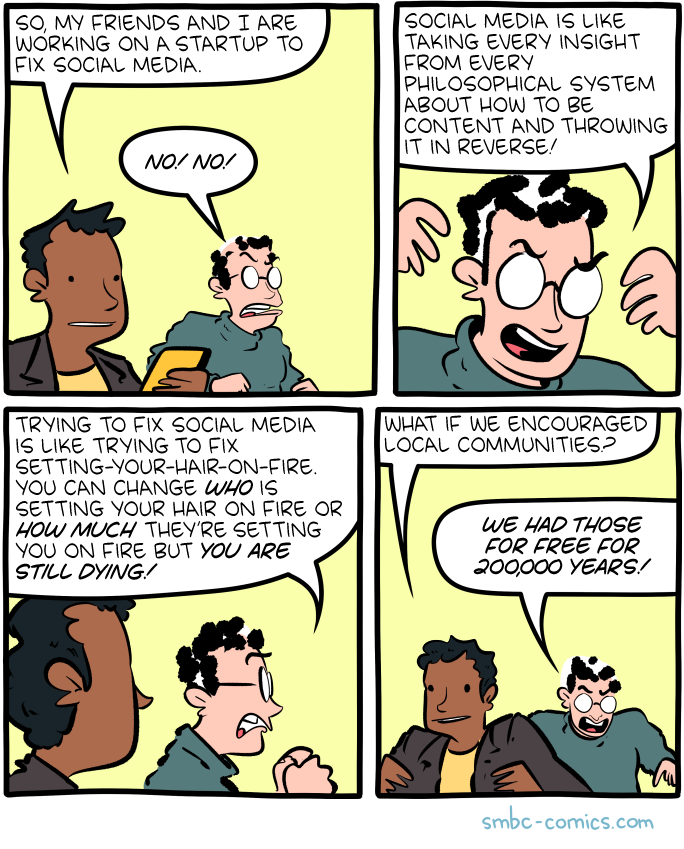
Hovertext:
Ever since twitter got weird people have tried to fix twitter by making twitter.
The Walt Disney Co. canceled plans for a billion-dollar office complex in Florida that was set to bring thousands of jobs to the region as the company and Florida Gov. Ron DeSantis continue their ongoing feud. What do you think?
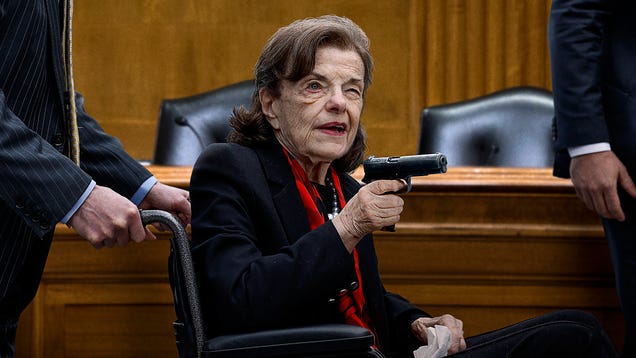
WASHINGTON—Thrown into a panic when the confused 89-year-old appeared on the Senate floor randomly pointing a firearm at various colleagues, lawmakers reportedly freaked out Friday after Sen. Dianne Feinstein (D-CA) got her hands on a gun. “Good God, someone get that thing away from her!” said Sen. Joe Manchin (D-WV),…
Shane Lamond allegedly used his position in the Metropolitan Police Department's Intelligence Branch to share information with Enrique Tarrio, a leader with the far-right extremist group


MANASSAS, VA—Claiming that the gift was simply a gesture of kindness rather than an ethics violation, Supreme Court Justice Clarence Thomas stated Friday that there was nothing wrong with a wealthy donor renting out an entire D.C.-area water park just for him. “One friend is allowed to treat another friend to a nice,…
Hovertext:
I'm like 4 comics away from the Clown Book.
Our long national wait for how the Supreme Court would rule regarding Section 230 is over, and the answer is… we need to keep waiting. The headlines note, correctly, that the court punted the matter. But there are other elements of the actual rulings that are kind of interesting and could bode well for the future of the internet and Section 230.
As you’ll likely recall, back in October, the Supreme Court surprised a lot of people by taking two sorta related cases regarding the liability of social media sites, Gonzalez v. Google, and Twitter v. Taamneh. Even though both cases were ruled on by the 9th Circuit in the same opinion, and had nearly identical fact patterns (terrorists did an attack overseas, family of a victim sued social media to try to hold them liable for the attacks because social media allowed terrorist organizations to have accounts on social media), only one (Gonzalez) technically dealt with Section 230. For unclear reasons, even though there was some discussion of 230 in the Taamneh case, the ruling was more specifically about whether or not Twitter was liable for violating JASTA (the Justice Against Sponsors of Terrorism Act).
Both cases sought cert from the Supreme Court, but again in an odd way. The family in Gonzalez challenged the 9th Circuit’s ruling that their case was precluded by Section 230, but kept changing the actual question they were asking the Supreme Court to weigh in on, bouncing around from whether recommendations took you out of 230, to whether algorithms took you out of 230, to (finally) whether the creation of thumbnail images (?!?!?!?) took you out of 230. For Taamneh, Twitter sought conditional cert, basically saying that if the court was going to take Gonzalez, it should also take Taamneh. And that’s what the court did. Though I’m still a bit confused that they held separate oral arguments for both cases (on consecutive days) rather than combining the two cases entirely.
And the end result suggests that the Supreme Court is equally confused why it didn’t combine the cases. And also, why it took these cases in the first place.
Indeed, the fact that these rulings came out in May is almost noteworthy on its own. Most people expected that, like most “big” or “challenging” cases, these would wait until the very end of the term in June.
Either way, the final result is a detailed ruling in Taamneh by Justice Clarence Thomas, which came out 9 to 0, and a per curiam (whole court, no one named) three pager in Gonzalez that basically says “based on our ruling in Taamneh, there’s no underlying cause of action in Gonazalez, and therefore, we don’t have to even touch the Section 230 issue.”
The general tenor of the response from lots of people is…. “phew, Section 230 is saved, at least for now.” And that’s not wrong. But I do think there’s more to this than just that. While the ruling(s) don’t directly address Section 230, I’m somewhat amazed at how much of Thomas’s ruling in Taamneh, talking about common law aiding and abetting, basically lays out all of the reasons why Section 230 exists: to avoid applying secondary liability to third parties who aren’t actively engaged in knowingly trying to help someone violate the law.
Much of the ruling goes through the nature of common law aiding and abetting, and what factors are conditions are necessary to find a third party liable, and basically says the standards are high. It can’t be mere negligence or recklessness. And Justice Thomas recognizes that if you make secondary liability too broad it will sweep in all sorts of innocent bystanders.
Importantly, the concept of “helping” in the commission of a crime—or a tort—has never been boundless. That is because, if it were, aiding-and-abetting liability could sweep in innocent bystanders as well as those who gave only tangential assistance. For example, assume that any assistance of any kind were sufficient to create liability. If that were the case, then anyone who passively watched a robbery could be said to commit aiding and abetting by failing to call the police. Yet, our legal system generally does not impose liability for mere omissions, inactions, or nonfeasance; although inaction can be culpable in the face of some independent duty to act, the law does not impose a generalized duty to rescue.
The crux then:
For these reasons, courts have long recognized the need to cabin aiding-and-abetting liability to cases of truly culpable conduct. They have cautioned, for example, that not “all those present at the commission of a trespass are liable as principals” merely because they “make no opposition or manifest no disapprobation of the wrongful” acts of another.
Those statements are actually the core of why 230 exists in the first place: so that we put the liability on the party who actively and knowingly participated in the violative activity. Thomas spends multiple pages explaining why this general principle makes a lot of sense, which is nice to hear. Again, Thomas concludes this section by reinforcing this important point:
The phrase “aids and abets” in §2333(d)(2), as elsewhere, refers to a conscious, voluntary, and culpable participation in another’s wrongdoing.
If that language sounds vaguely familiar, that’s because it’s kind of like the language the 9th Circuit used in saying that Reddit didn’t violate FOSTA last fall, because it wasn’t making deliberate actions to aid trafficking.
Having established that basic, sensible, framework, Thomas moves on to apply it to the specifics of Taamneh, and finds it clear that there’s no way the plaintiffs have shown that social media did anything that gets anywhere within the same zip code as what’s required for aiding and abetting. Because all they did was create a platform that anyone could use.
None of those allegations suggest that defendants culpably “associate[d themselves] with” the Reina attack, “participate[d] in it as something that [they] wishe[d] to bring about,” or sought “by [their] action to make it succeed.” Nye & Nissen, 336 U. S., at 619 (internal quotation marks ommitted). In part, that is because the only affirmative “conduct” defendants allegedly undertook was creating their platforms and setting up their algorithms to display content relevant to user inputs and user history. Plaintiffs never allege that, after defendants established their platforms, they gave ISIS any special treatment or words of encouragement. Nor is there reason to think that defendants selected or took any action at all with respect to ISIS’ content (except, perhaps, blocking some of it).13 Indeed, there is not even reason to think that defendants carefully screened any content before allowing users to upload it onto their platforms. If anything, the opposite is true: By plaintiffs’ own allegations, these platforms appear to transmit most content without inspecting it.
From there, he notes that just because a platform can be used for bad things, it doesn’t make sense to hold the tool liable, again effectively making the argument for why 230 exists:
The mere creation of those platforms, however, is not culpable. To be sure, it might be that bad actors like ISIS are able to use platforms like defendants’ for illegal—and sometimes terrible—ends. But the same could be said of cell phones, email, or the internet generally. Yet, we generally do not think that internet or cell service providers incur culpability merely for providing their services to the public writ large. Nor do we think that such providers would normally be described as aiding and abetting, for example, illegal drug deals brokered over cell phones—even if the provider’s conference-call or video-call features made the sale easier.
I’ve seen some people raise concerns that the language in the above paragraph opens up an avenue for SCOTUS to pull a “social media is a common carrier, and therefore we can force them to host all speech” but I’m not sure I actually see that in the language at all. Generally speaking, email and “the internet generally” are not seen as common carriers, so I don’t see this statement as being a “social media is a common carrier” argument. Rather it’s a recognition that this principle is clear, obvious, and uncontroversial: you don’t hold a platform liable for the speech of its users.
From there, Thomas also completely shuts down the argument that “algorithmic recommendations” magically change the nature of liability:
To be sure, plaintiffs assert that defendants’ “recommendation” algorithms go beyond passive aid and constitute active, substantial assistance. We disagree. By plaintiffs’ own telling, their claim is based on defendants’ “provision of the infrastructure which provides material support to ISIS.” App. 53. Viewed properly, defendants’ “recommendation” algorithms are merely part of that infrastructure. All the content on their platforms is filtered through these algorithms, which allegedly sort the content by information and inputs provided by users and found in the content itself. As presented here, the algorithms appear agnostic as to the nature of the content, matching any content (including ISIS’ content) with any user who is more likely to view that content. The fact that these algorithms matched some ISIS content with some users thus does not convert defendants’ passive assistance into active abetting. Once the platform and sorting-tool algorithms were up and running, defendants at most allegedly stood back and watched; they are not alleged to have taken any further action with respect to ISIS.
Again, I’ve seen some concerns that this language opens up some potential messiness about AI and “neutrality,” but I’m actually pretty pleased with the language used here, which avoids saying “neutral” (a completely meaningless word in the context of algorithms whose entire purpose is to recommend stuff) and talks about providing general tools that just try to provide any user with results that match their interests.
Basically, my read on this is that the court is effectively saying that if you create algorithms that are just designed to take inputs and provide outputs based on those inputs, you’re in the clear. The only hypothetical where you might face some liability is if you designed an algorithm to deliberately produce violative content, like an AI tool whose sole job is to defame people (defAIMe?) or to take any input and purposefully try to convince you to engage in criminal acts. Those seem unlikely to actually exist in the first place, so the language above actually seems, again, to be pretty useful.
The ruling again doubles down on the fact that there was nothing specific to the social media sites that was deliberately designed to aid terrorists, and that makes the plaintiff’s argument nonsense:
First, the relationship between defendants and the Reina attack is highly attenuated. As noted above, defendants’ platforms are global in scale and allow hundreds of millions (or billions) of people to upload vast quantities of information on a daily basis. Yet, there are no allegations that defendants treated ISIS any differently from anyone else. Rather, defendants’ relationship with ISIS and its supporters appears to have been the same as their relationship with their billion-plus other users: arm’s length, passive, and largely indifferent. Cf. Halberstam, 705 F. 2d, at 488. And their relationship with the Reina attack is even further removed, given the lack of allegations connecting the Reina attack with ISIS’ use of these platforms.
Second, because of the distance between defendants’ acts (or failures to act) and the Reina attack, plaintiffs would need some other very good reason to think that defendants were consciously trying to help or otherwise “participate in” the Reina attack. Nye & Nissen, 336 U. S., at 619 (internal quotation marks omitted). But they have offered no such reason, let alone a good one. Again, plaintiffs point to no act of encouraging, soliciting, or advising the commission of the Reina attack that would normally support an aidingand-abetting claim. See 2 LaFave §13.2(a), at 457. Rather, they essentially portray defendants as bystanders, watching passively as ISIS carried out its nefarious schemes. Such allegations do not state a claim for culpable assistance or participation in the Reina attack.
Also important, the court makes it clear that a “failure to act” can’t actually trigger liability here:
Because plaintiffs’ complaint rests so heavily on defendants’ failure to act, their claims might have more purchase if they could identify some independent duty in tort that would have required defendants to remove ISIS’ content. See Woodward, 522 F. 2d, at 97, 100. But plaintiffs identify no duty that would require defendants or other communication-providing services to terminate customers after discovering that the customers were using the service for illicit ends. See Doe, 347 F. 3d, at 659; People v. Brophy, 49 Cal. App. 2d 15, 33–34 (1942).14 To be sure, there may be situations where some such duty exists, and we need not resolve the issue today. Even if there were such a duty here, it would not transform defendants’ distant inaction into knowing and substantial assistance that could establish aiding and abetting the Reina attack.
Is there the possibility of some nonsense sneaking into the second half of that paragraph? Eh… I could see some plaintiffs’ lawyers trying to make cases out of it, but I think the courts would still reject most of them.
Similarly, there is some language around hypothetical ways in which secondary liability could apply, but the Court is pretty clear that there has to be something beyond just providing ordinary services to reach the necessary bar:
To be sure, we cannot rule out the possibility that some set of allegations involving aid to a known terrorist group would justify holding a secondary defendant liable for all of the group’s actions or perhaps some definable subset of terrorist acts. There may be, for example, situations where the provider of routine services does so in an unusual way or provides such dangerous wares that selling those goods to a terrorist group could constitute aiding and abetting a foreseeable terror attack. Cf. Direct Sales Co. v. United States, 319 U. S. 703, 707, 711–712, 714–715 (1943) (registered morphine distributor could be liable as a coconspirator of an illicit operation to which it mailed morphine far in excess of normal amounts). Or, if a platform consciously and selectively chose to promote content provided by a particular terrorist group, perhaps it could be said to have culpably assisted the terrorist group….
In those cases, the defendants would arguably have offered aid that is more direct, active, and substantial than what we review here; in such cases, plaintiffs might be able to establish liability with a lesser showing of scienter. But we need not consider every iteration on this theme. In this case, it is enough that there is no allegation that the platforms here do more than transmit information by billions of people, most of whom use the platforms for interactions that once took place via mail, on the phone, or in public areas.
And from there, the Court makes a key point: just because some bad people use a platform for bad purposes, it doesn’t make the platform liable, and (even better) Justice Thomas highlights that any other holding would be a disaster (basically making the argument for Section 230 without talking about 230).
The fact that some bad actors took advantage of these platforms is insufficient to state a claim that defendants knowingly gave substantial assistance and thereby aided and abetted those wrongdoers’ acts. And that is particularly true because a contrary holding would effectively hold any sort of communication provider liable for any sort of wrongdoing merely for knowing that the wrongdoers were using its services and failing to stop them. That conclusion would run roughshod over the typical limits on tort liability and take aiding and abetting far beyond its essential culpability moorings.
Thus, based on all this, the court says the 9th Circuit ruling that allowed the Taamneh case to move forward was clearly mistaken, and sends it back to the Court. Specifically, it dings the 9th for having “misapplied the ‘knowing’ half of ‘knowing and substantial assistance.’”
At the very very end, the ruling does mention questions regarding Google and payments to users, and whether or not that might reach aiding and abetting. But, importantly, that issue isn’t really before the court, because the plaintiffs effectively dropped it. It’s possible that the issue could live on, but again, I don’t see how it becomes problematic.
Overall, this was kind of a weird case and a weird ruling. SCOTUS seems to have recognized they never should have taken the case in the first place, and this ruling effectively allowed them to back out of making a ruling on 230 that they would regret. However, instead, Justice Thomas, of all people, more or less laid out all of the reasons why 230 exists and why we want that in place, to make sure that liability applies to the party actually making something violative, rather than the incidental tools used in the process.
Separately, it does seem at least marginally noteworthy that, while not directly addressing Section 230 (and explicitly saying they wouldn’t rule on the issue today), Thomas didn’t also file a concurrence with the Gonzalez ruling begging for more 230 cases. As you may know, Thomas seemed to skip no opportunity to file random concurrences on issues unrelated to 230 to muse broadly on 230 and how he had views on the law. And here, he didn’t. Rather he wrote a ruling that sounds kinda like it could be a defense of Section 230. Maybe he’s learning?
In the end, this result is probably about as good as we could have hoped for. It leaves 230 in place, doesn’t add any really dangerous dicta that can lead to abuse (as far as I can tell).
It also serves to reinforce a key point: contrary to the belief of many, 230 is not the singular law that protects internet websites from liability. Lots of other things do as well. 230 really only serves as an express lane to get to the same exact result. That’s important, because it saves money, time, and resources from being wasted on cases that are going to fail in the end anyway. But it doesn’t mean that changing or removing 230 won’t magically make companies liable for things their users do. It won’t.
Finally, speaking about money, time, and resources, a shit ton of all three were spent on briefs from amici for the Gonzalez case, in which dozens were filed (including one from us). And… the end result was a three page per curiam basically saying “we’re not going to deal with this one.” The end result is good, and maybe it wouldn’t have been without all those briefs. However, that was an incredible amount of effort that had to be spent for the Supreme Court to basically say “eh, we’ll deal with this some other time.”
The Supreme Court might not care about all that effort expended for effectively nothing, but it does seem like a wasteful experience for nearly everyone involved.