Shared posts

14 Nov 17:53

November 13, 2023 Outlook: Late season tropical system possible in the Caribbean, and we check in on — Alaska?

by Matt Lanza

One-sentence summary

Today’s post talks about the potential for a late season tropical system in the Caribbean this week, as well as a detailed look at polar opposite weather that’s causing trouble in Alaska lately.

Tropical update: Caribbean mischief may present itself this week

We’ve got ourselves a late season system to possibly monitor in the southwest Caribbean later this week.

The Southwest Caribbean is highlighted with 60 percent odds of development this week by the National Hurricane Center. (Tomer Burg)

Model guidance is pretty persistent in developing low pressure off the coast of Nicaragua or Costa Rica around Wednesday or Thursday. It would quickly move northeast or north-northeast toward Jamaica, eastern Cuba, or Hispaniola from there, before accelerating out into the open Atlantic, perhaps impacting Bermuda on the way out this weekend. This will all occur quickly.

The GFS (left) and Euro (right) offer two differing outcomes but the same broad idea for the potential track of low pressure out of the Caribbean. (Tropical Tidbits)

As is often the case this time of year, the GFS model is much more aggressive with this system than the European model. The GFS has the equivalent of a strong tropical storm or low-end hurricane racing northeast of Jamaica on Saturday, whereas the Euro is a bit slower and notably weaker. The Euro has had a slightly better track record in the Caribbean, but it’s still a good idea for eastern Cuba, Jamaica, Haiti, and the Dominican Republic to monitor this potential system in the coming 2 to 3 days. From there, the Bahamas, Turks & Caicos, and Bermuda should also keep tabs on things. Whatever happens will happen fast, as this thing is going to be hauling north-northeast, tracking from the deep southwest Caribbean on Wednesday or Thursday to past Bermuda by Sunday or Monday.

U.S. Weather this week: Stormy Gulf, wet West Coast

A storm system on the Gulf Coast over the next couple days will bring some moderate to heavy precipitation between Texas and Florida, with anywhere from 2 to 5 inches likely. The highest totals are likely near Mobile, AL and Pensacola, FL. Flooding isn’t expected to be a huge concern, as the entire region is in pretty serious drought, and if anything, this will be a mostly beneficial rainfall.

This week’s rainfall will be mostly minor, except on the Gulf Coast and in coastal California and the Cascades. (Pivotal Weather)

The West will see a few surges of moisture this week thanks to a storm sitting offshore of California. This is expected to bring moderate to locally heavy rain to coastal California and some snow in the Sierra.

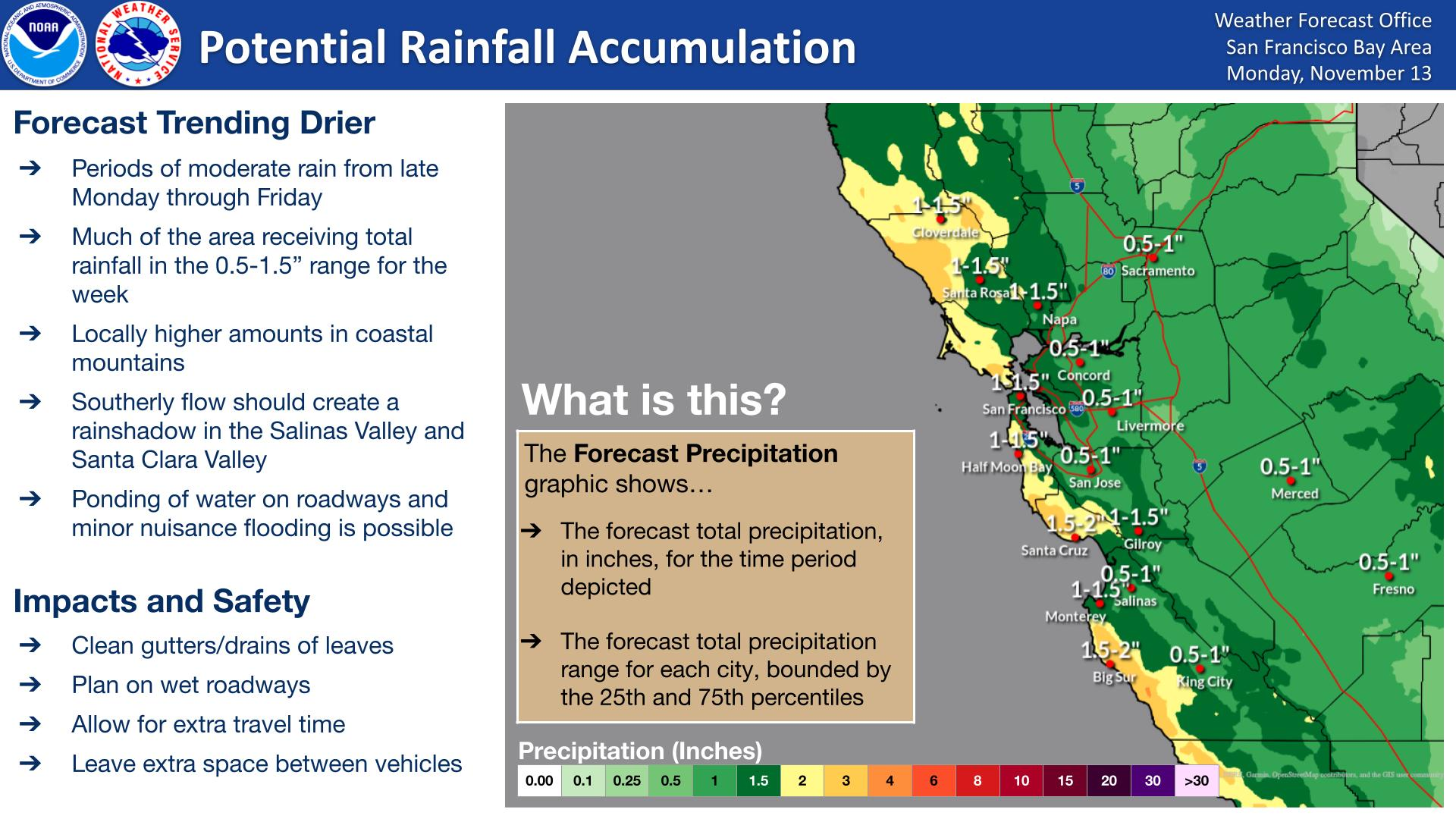
Rain totals have come off some versus a few days ago in California, but a wet period is expected this week. (NWS Monterey/SF Bay Area)

Overall, this should be more of a periodic ramp up/ramp down type precipitation event for California, but the rain (and snow) will add up over time. About 1 to 3 inches of rain is possible on the coast, including both San Francisco and LA, with locally higher amounts in the mountains and perhaps a little less in San Diego. Flooding isn’t a major concern at this point, particularly as the forecast has trended a little less excited about things.

Flaked Alaska: Heavy snow causes familiar problems in Anchorage

We don’t often talk about Alaska for weather unless it’s due to the pattern up there impacting the pattern for the weather across the U.S. But it’s worth talking about what’s happened in parts of Alaska to start November.

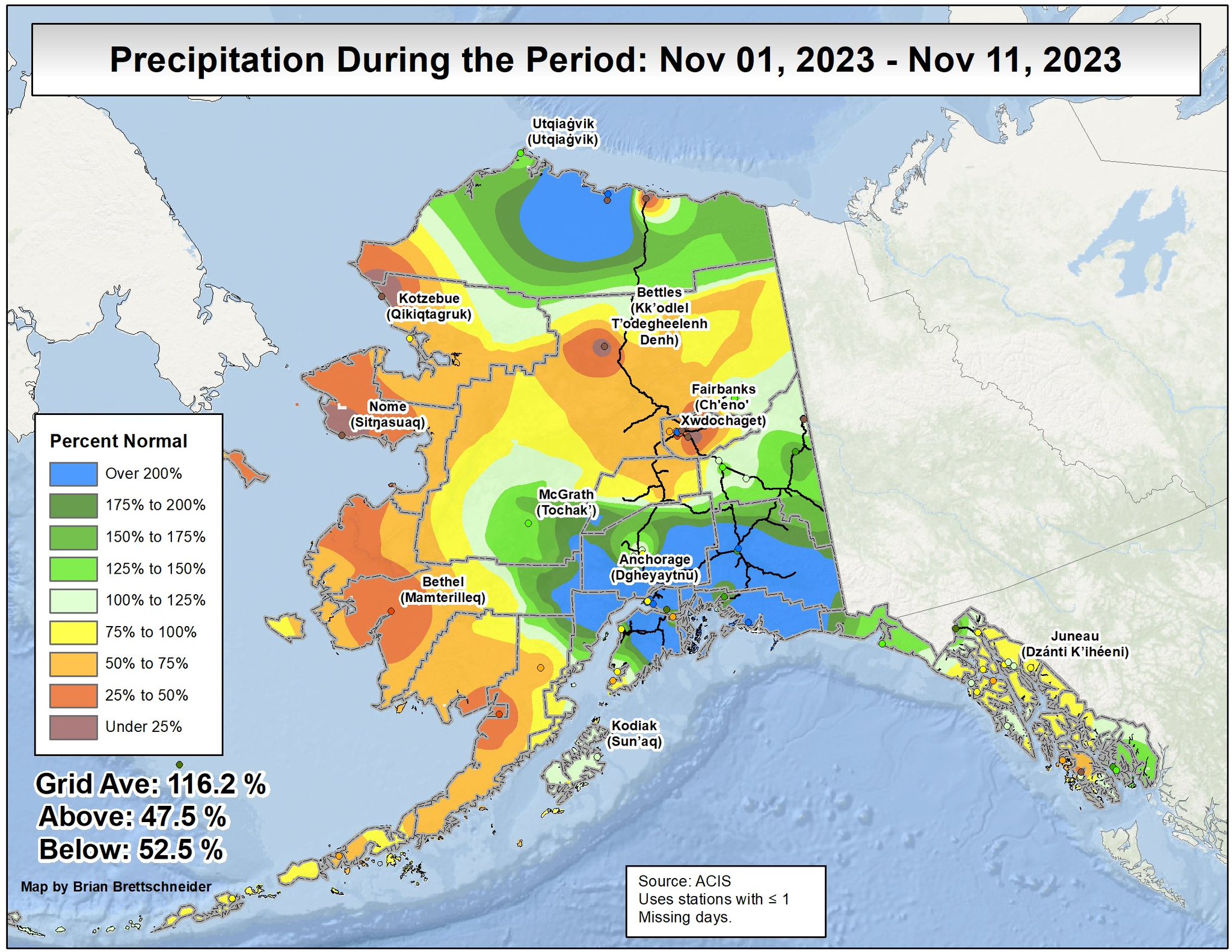
Precipitation to start the month in Alaska has been extremely heavy, with over 200% of normal for the period in southern Alaska, including the Anchorage area. (Brian Brettschneider)

Anchorage, the largest city in Alaska, with a population near 300,000 has received nearly 30 inches of snow this month so far, most of it courtesy of an atmospheric river event last week. This is the snowiest start to November on record in Anchorage. I reached out to the authority on all things Alaska weather, Brian Brettschneider, and I asked him to put into context how this sort of big time snow fits the typical climatology for Anchorage.

First, he tells me that the median snow depth for Anchorage around this time of year is about an inch or two. The snow depth there is around 2 feet, which only happens in maybe half of all winters at all there. “This snow will not fully melt out until April,” he says.

On top of that, this was a wet snow for Anchorage. What do we mean when we say “wet snow?” A number of factors play into what we call the “snow ratio,” or how much snow you would melt to get 1 inch of water. In general, colder and drier air masses produce higher snow ratios. It takes more snow to get that 1 inch of liquid. You see this a lot with lake effect snow. One inch of liquid may produce anywhere from 20 to 30 inches of dry, fluffy snow.

Warmer, more humid air masses tend to produce lower snow ratios, or situations where it does not take as much snow to produce an inch of liquid. A general rule of thumb, particularly on the East Coast, is that 10 inches of snow usually melts down to 1 inch of liquid. So the ratio is 10:1 (ten to one). In Anchorage, a colder and typically drier place, Brettschneider says that the average ratio is 17:1 typically. With this recent event, the snow ratio was 11:1. I wouldn’t call that “cement,” but that’s a very wet snow for Anchorage. Wet snow tends to be harder to move and clear, it can bring down trees and power lines, and it also causes significant issues on roadways as it will produce slush that can freeze into solid ice. This is one problem in Anchorage right now.

And it’s not a new problem either. Brettschneider said that it’s important to understand the current context of the situation in Anchorage. “Three rapid succession storms last December caused a month-long road-pocalypse around town. The state/city made it a priority to not let that happen again – yet here we are.”

Last December, Alaska Public Media asked “Should snow in Anchorage be this disruptive?” In a follow up article last month, APM reported that Anchorage said it was prepared should a storm like last December’s happen again. Anchorage mayor Dave Bronson said at his October news conference, “We are ready.”

The residents of Anchorage can decide if that’s the case. The second major multi-day snowstorm in Anchorage in less than a year is surely impressive. It’s also worth noting that despite the snow, it has not been cold in Anchorage, at least not compared to normal. “So far this month, the first 11 days are all warmer than normal in Anchorage – much warmer than normal,” per Brettschneider. It typically takes someone milder weather to produce this kind of snow in Alaska, as warmer air can hold more moisture.

On a serious note, the AP reports that four unhoused people died during the winter storm in Anchorage last week.

More snow is coming to Alaska today, including Anchorage.

The forecast through Tuesday afternoon in the Anchorage area calls for about another 6 inches of snow. (NWS)

As much as another half-foot or even a bit more of snow is possible in the Anchorage area today, with higher amounts in the Chugach Mountains east of the city. More snow is possible later this week.

14 Nov 17:48

Layer After Layer: Cey Adams’ “Combinations” at West Chelsea Contemporary

by Barbara Purcell
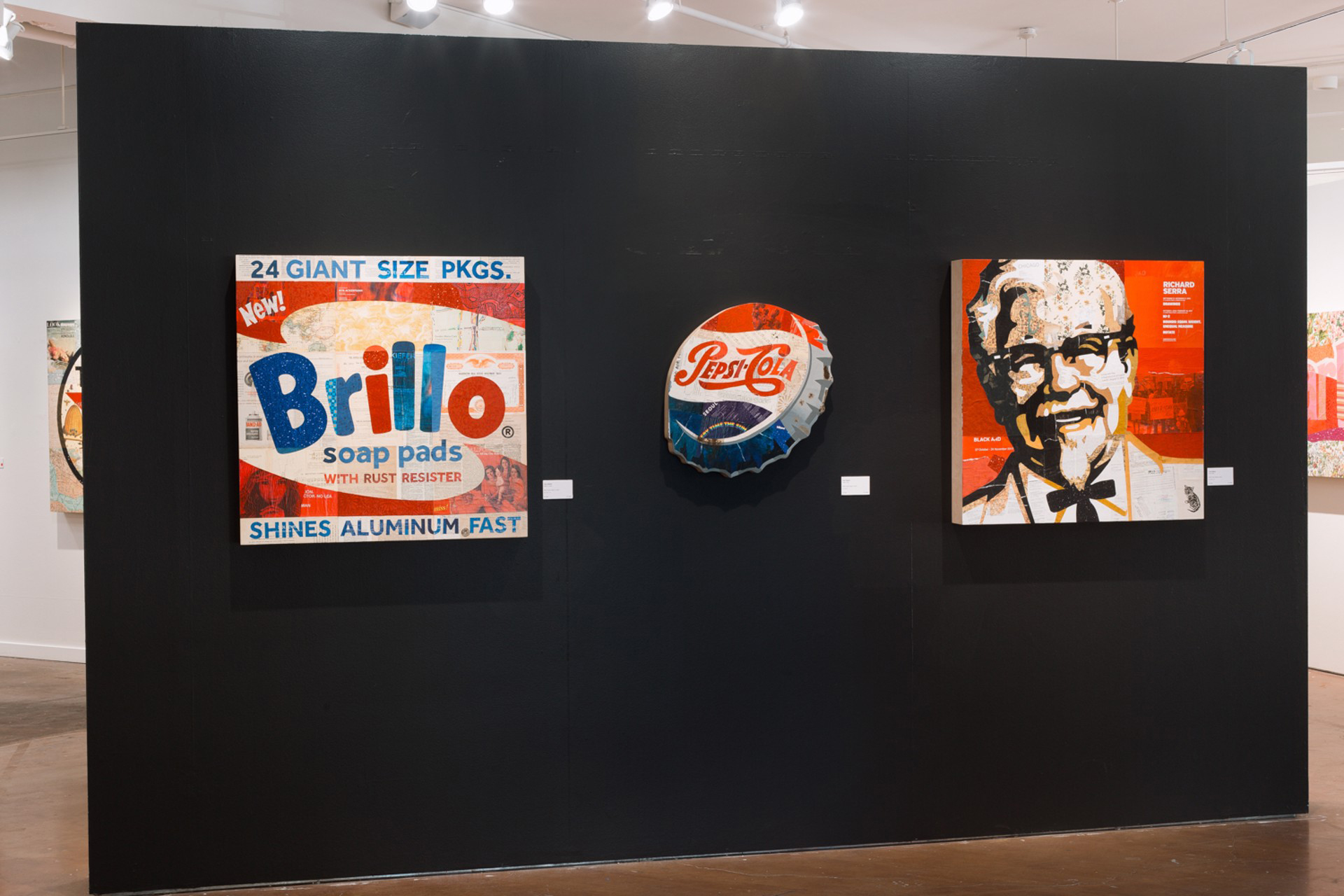
Photo of works of art on a wall

Cey Adams, “Combinations” (installation view), 2023, West Chelsea Contemporary, Austin, Texas.

Cey Adams was a teenager in New York in the 1970s when block parties in the Bronx began to birth a new beat. A young graffiti artist with a knack for graphic design, he quickly found himself in the early momentum of hip hop, making album art and logos for artists like the Beastie Boys, Run-DMC, and Public Enemy. As the founding Creative Director at Def Jam Recordings, Adams helped turn words once scrawled on city walls into their own cultural lexicon. 

A traveling retrospective, Cey Adams, Departure: 40 Years of Art and Design, is currently on view at the University of North Texas in Denton, but it’s a show in Austin that’s celebrating Adams’ 40-year career with all new work. Combinations at West Chelsea Contemporary features nearly 100 mixed media collages, ranging from iconic American logos to street art and Pop-inspired designs. 

Pepsi-Cola, KFC, and Brillo collages jump out as fresh throwbacks, mixing and remixing nostalgia with ephemera: wallpaper scraps, maps, and layers of magazine clippings reveal the cultural clamor of America. In KFC (2023), an image from the civil rights era, pasted to the right of Colonel Sanders’ ear — just below a gallery flyer for Richard Serra — creates connections that are more subliminal than accidental. 

Photo of a visitor looking at a work of art on a wall

Cey Adams, “Combinations” (installation view), 2023, West Chelsea Contemporary, Austin, Texas.

But Adams says there’s no relationship between the Colonel and the civil rights movement in this composition: “It’s about the craftsmanship of the design — the letterform, the spacing, the idea that you can take a portrait and break it down in three shades and it looks exactly like a person.”

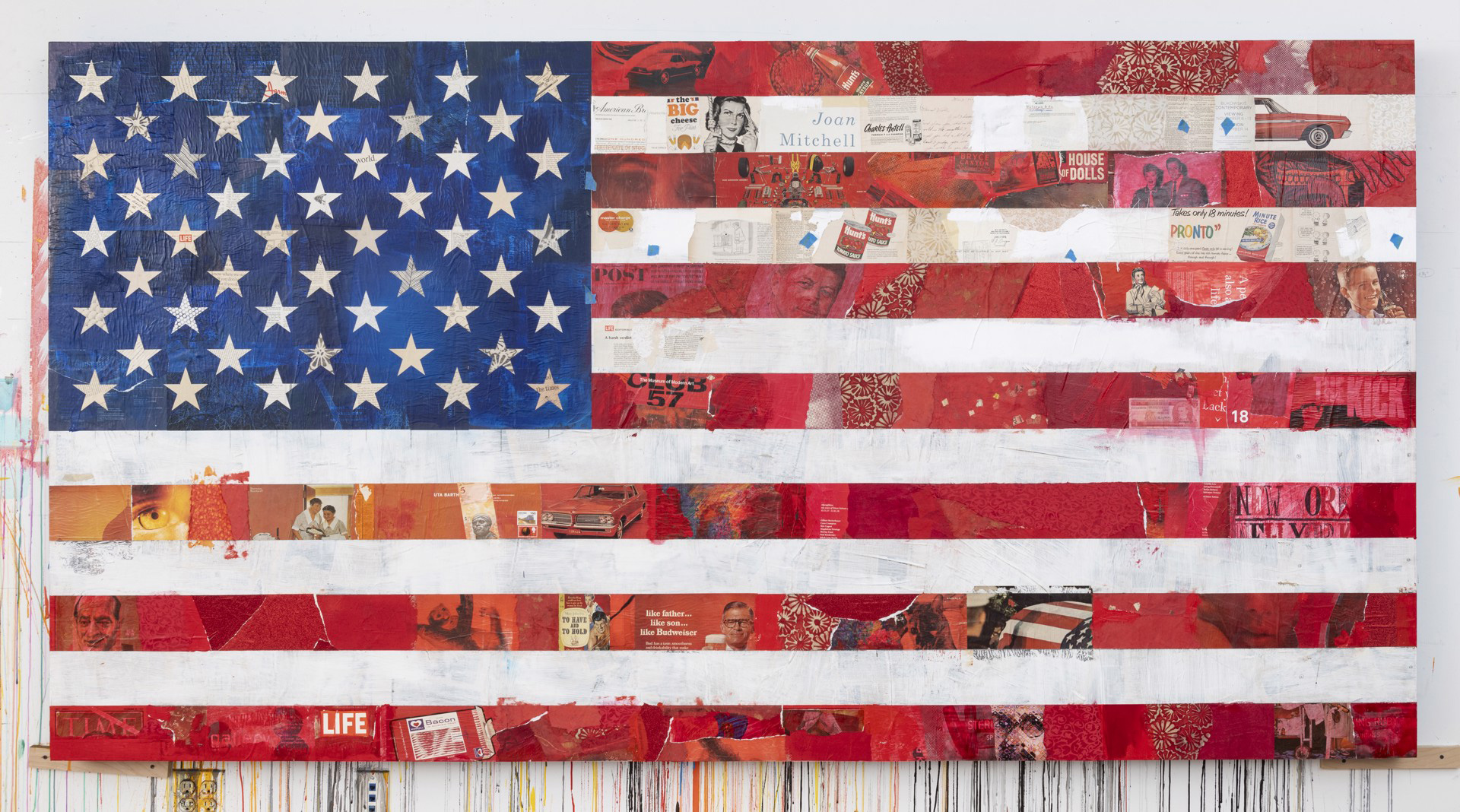
The show’s largest collage-based work, American Flag (2023), is an homage to Jasper Johns, its blue boxful of stars and red and white stripes replete with advertisements and documents, celebrity sightings, and glitter paper. But take Bob Hope out of it — take out the red paint, red glitter, red monkey, red book cover — and it’s just a red stripe, Adams insists. The lines, the colors, the way they combine: “It only becomes a flag when you have 13 of them.”

Adams points to an elegant handwritten letter in the top white stripe, which begins with the words My Dearest Violet. The letter is dated from March of 1925; he was born in March of 1962, and the near 40-year difference is something of a marvel to him. “I am fascinated by time periods — especially things that are original, with a date confirming that the signature was made at that time.”

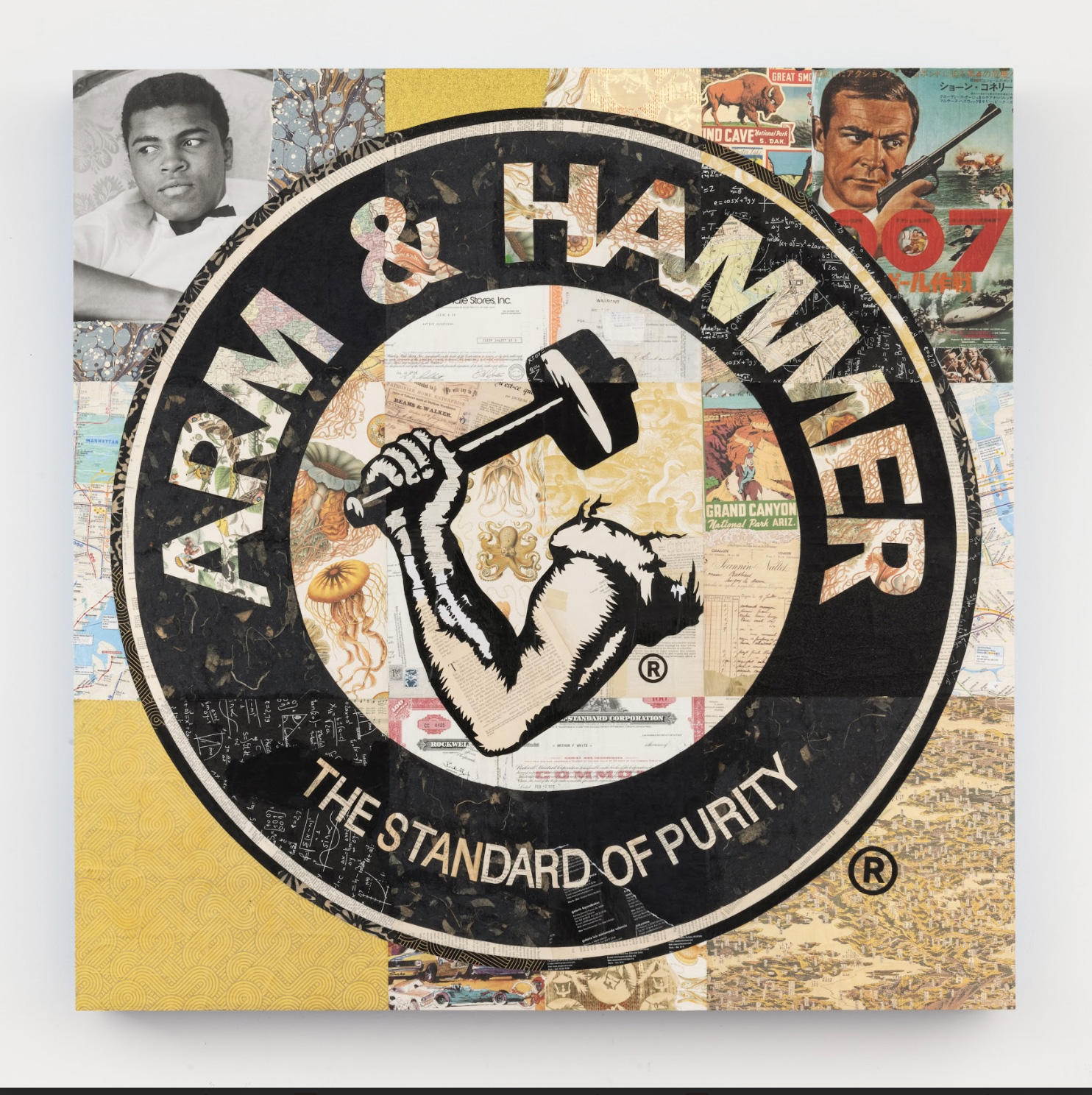
Image of a collage arm and hammer logo

Cey Adams, “Arm & Hammer,” 2023, mixed media collage on panel, 48 x 48 x 4 inches. Courtesy West Chelsea Contemporary.

Adams’ own timeline is evident at every turn in these works, from 1960s aesthetics, to 1980s stylistics, to flashes of adolescence: Hot Wheels and Barbie logos conjure one’s own Mattel memories from childhood. Adams started producing collage works around 2010, to better connect with young students who might otherwise shy away from making art. Anyone can play with glue sticks and paper, he shrugs. As for his own collages, so perfectly put together and chock-full of visuals, it’s just “layer after layer after layer.” 

Most of the works in Combinations are presented in groupings — a sort of strength in numbers — as seen in a grid of 20 12 x 12-inch word-centric pieces, their colorful seriality a clear nod to Warhol. Across the way, a suite of four LOVE collages, à la Robert Indiana gives way to a hard-edge painting of the same word in bright white, pressing out from a swirl of color set against a pitch black background. (A much larger version, painted on panels of blue denim, resides in the Levi’s headquarters in San Francisco.) 

IMage of a collaged work with the word Barbie

Cey Adams, “Barbie,” 2023, mixed media collage on panel, 36 x 72 x 4 inches. Courtesy West Chelsea Contemporary.

“Things look better in groupings,” he tells me as we take in the LOVE series. “One supports another supports another.”

Combinations gets its name not from the various components of each collage-based work, but from the people Adams has worked with throughout the last 40 years. An early press shot of Run-DMC from the late 1980s, taken by music photographer Janette Beckman, appears in the show, with auras of color, added after the fact by Adams, radiating outward from the trio. The mashup perfectly captures the energy and artistry of the era. 

A street mural photographed by Martha Cooper — who documented much of New York’s graffiti scene in the ‘70s and ‘80s — is also featured in the show. Carwash (1982), which Adams asked Cooper to shoot at the time, hid in a box of slides for 40 years, and has been brought to life as a silkscreen print courtesy of Gary Lichtenstein (no relation to Roy Lichtenstein), whose own work instantly caught Adams’ attention when he visited the master printer’s former Jersey City studio in 2016. 

Photo of a collage work of an american flag

Cey Adams, “American Flag,” 2023, mixed media collage on panel, 60 x 114 x 4 inches. Courtesy West Chelsea Contemporary.

Throughout his career, Adams has helped shape the art and design of hip hop culture, and American culture, and after seeing Combinations, mixed media collage seems like the natural choice in bringing it all together. “That’s what’s so great about doing collage, this is an art form that no one respects,” he laughs. 

But these works are certainly designed to make people pay attention. From a few feet away, Adams’ logos and letterforms are instantly recognizable — up close, their layers of information take time to unpack. 

Like he said while we stood before them: “The story only unfolds when you step back.”


Cey Adams: Combinations is on view at West Chelsea Contemporary in Austin through November 19, 2023. 

The post Layer After Layer: Cey Adams’ “Combinations” at West Chelsea Contemporary appeared first on Glasstire.

14 Nov 17:48

“Between Yesterday & Tomorrow” at San Antonio’s Culture Commons Gallery

by Xan Murphy
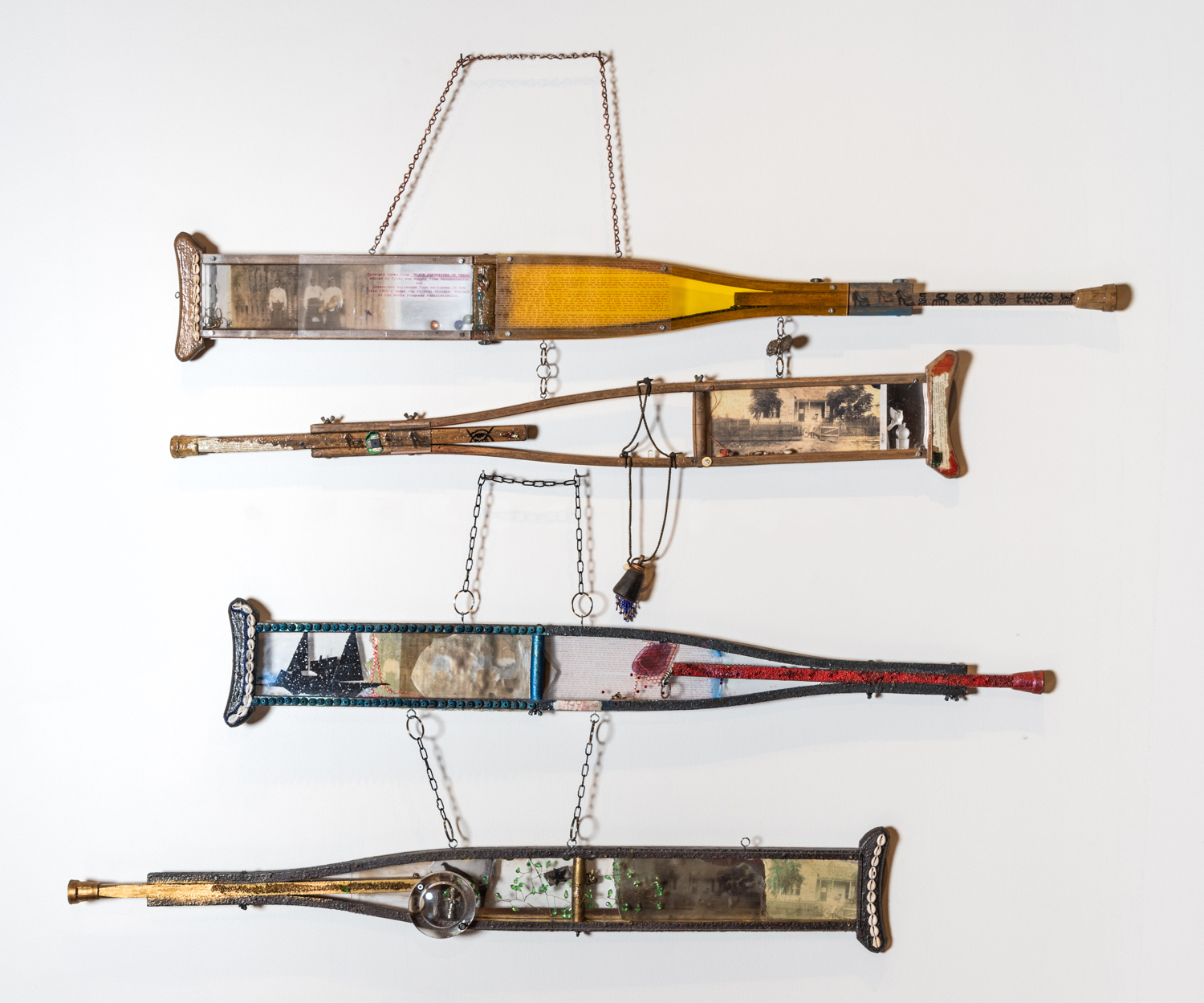
Wall sculpture of four crutches hanging on a wall

Bernice Appelin-Williams, “The Crutch Series” and “Slave Narratives: Transbluency #5,” assemblage, 60 in. x 27 in. On view at Culture Commons Gallery, January 19 – November 17, 2023. Photo: Beth Devillier for the City of San Antonio.

Between Yesterday & Tomorrow: Perspectives from Black Contemporary Artists emerged from DreamWeek San Antonio. The first official DreamWeek San Antonio event took place in 2011, the same year it was founded by Shokare Nakpodia, and it has since become a 17-day summit with more than 200 events across the globe. This exhibition is as its title and location describe: a show of all Black artists who are currently living in San Antonio, Texas. The curator, Barbara Felix, is an artist herself. To organize the show she searched for every Black artist in the city, chose 36 works from 17 of them, and then identified emerging themes her selections.

The exhibition brings together diverse perspectives from the artists, who range in age from 24 to 84 and who are of diverse cultures and backgrounds: some are queer, some are veterans, and some are immigrants to America. They also work in diverse media, including assemblage, photography, drawing, painting, mixed media, digital media, sculpture, and quilting.

Installation view of two dimensional work hanging on a wall

“Between Yesterday & Tomorrow,” installation view at Culture Commons Gallery. Photo: Beth Devillier for the City of San Antonio.

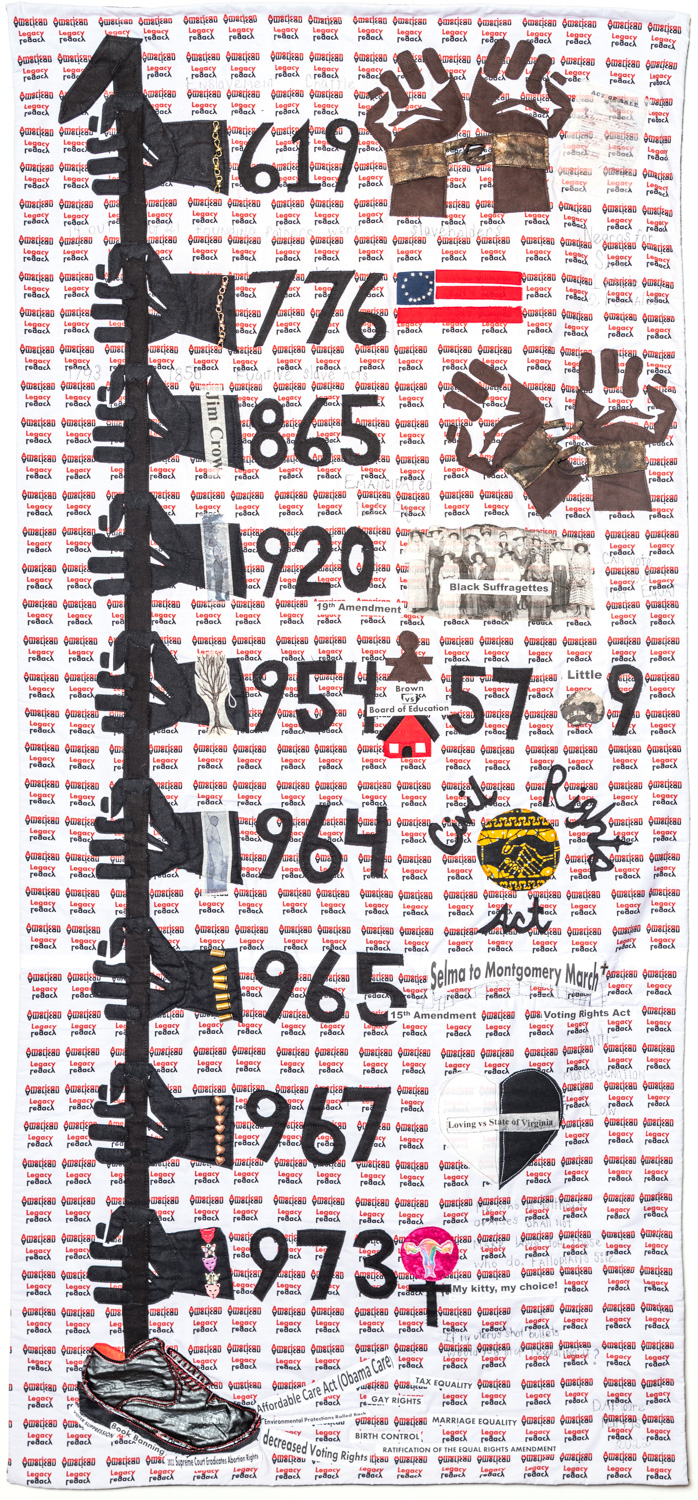
Deborah Moore Harris’s American Legacy Too nods to African quilting traditions as narrative tools, while depicting a timeline of civil rights policies from 1619 to the present. Hands in the shape of the Black power fist are cuffed with various objects at every event on the timeline. Along the piece, viewers can read historical facts, such as: “14 out of 21 founding fathers were slaveholders.” The phrase “American Legacy” repeats all over the textile in red ink, and is reflected in a mirror image in black ink, connoting hidden perspectives and bloody violence. Harris shows the American legacy to include violence against Black Americans, as well as the liberation work civil rights leaders have done and continue to do. 

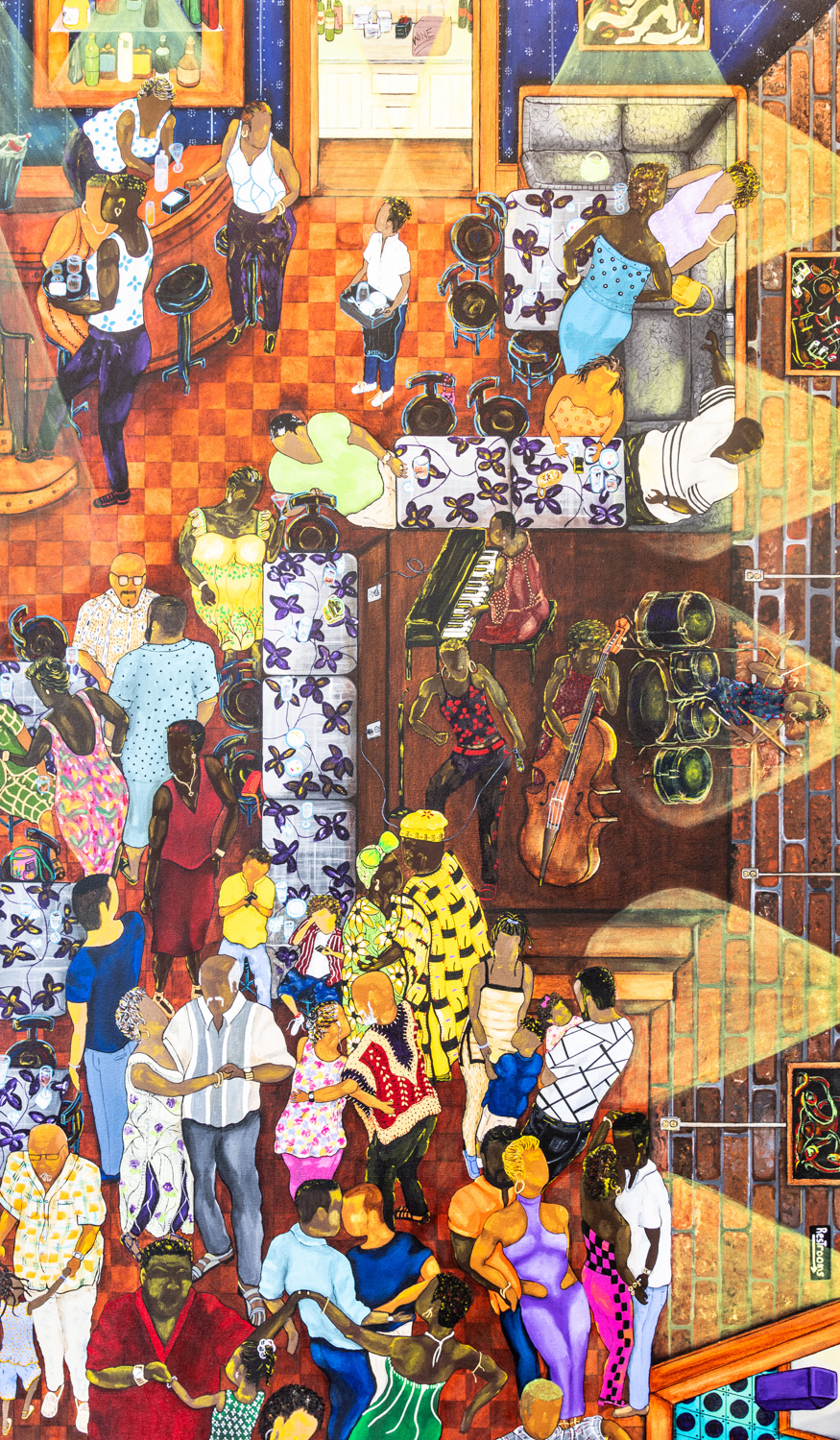
Painting of a night club scene

Carmen Cartiness Johnson, “Invitation Only,” acrylic on canvas, 42 in. x 72 in. On view at Culture Commons Gallery, January 19 – November 17, 2023. Photo: Beth Devillier for the City of San Antonio.

Bernice Appelin-Williams’s Slave Narratives: Transbluency #5 and The Crutch Series are constructed from found objects. Both assemblages use pieces from demolished homes and businesses that once stood where San Antonio’s Alamodome Stadium stands today. Wooden walking crutches are coupled in their respective pairs with chains and are adorned with collaged objects such as beads, shells, transcriptions of interviews with former slaves, and photographs found at flea markets. Appelin-Williams used clear materials to enclose parts of the crutches into compartments to hold these objects and narratives, as if they’re capsules of time. The artist is showing these two works — made 11 years apart — together for the first time in this exhibition. She is uncovering the histories of Black San Antonians via the houses they lived in, the objects that surrounded them, and the stories they told. 

Hanging textile piece of a timeline

Deborah Moore Harris, “American Legacy Too,” fiber and faux leather, 38 in. x 90 in. On view at Culture Commons Gallery, January 19 – November 17, 2023. Photo: Beth Devillier for the City of San Antonio.

Documentation of a performance dance piece

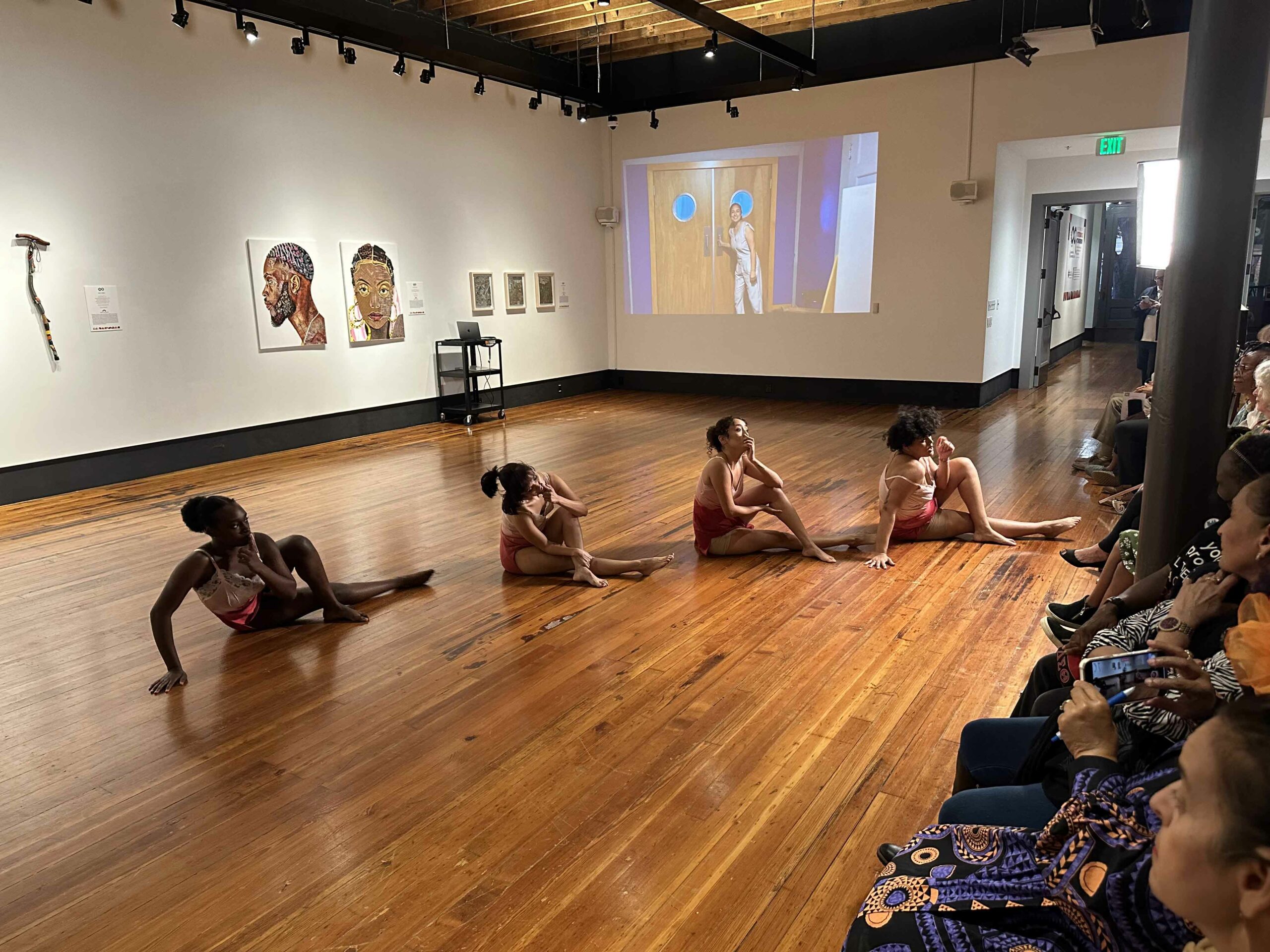
A dance performance by Tanesha Payne at Culture Commons Gallery, October 11, 2023. Photo: The City of San Antonio.

Carmen Cartiness Johnson’s Invitation Only is a painting depicting a private party, replete with a bar, a band, and people dancing. The work’s aerial perspective heightens the excitement in this scene of people of all skin tones and genders who are enjoying each other’s company. Replete with energetic postures, the work celebrates the act of coming together, which is exactly what this exhibition aims to do. Barbara Felix and the Department of Arts & Culture collaborated to activate the exhibition space with various events: a poetry night, an artist panel discussion, a Pride Month event, a film night, and a dance event. This 11-month-long exhibition is meant to bring the Black community of San Antonio together through diverse media and perspectives.

Documentation of a performance dance piece

A dance performance by Tanesha Payne at Culture Commons Gallery, October 11, 2023. Photo: The City of San Antonio.


Between Yesterday & Tomorrow: Perspectives from Black Contemporary Artists is on view at The Culture Commons Gallery through November 17, 2023. 

The post “Between Yesterday & Tomorrow” at San Antonio’s Culture Commons Gallery appeared first on Glasstire.

14 Nov 17:46

I’m in trouble for badging in and then going back home, coworker made a pass at me, and more

by Ask a Manager

This post was written by Alison Green and published on Ask a Manager.

It’s five answers to five questions. Here we go…

1. I’m in trouble for badging in, then going back home

My large corporate employer is coming down hard on people who aren’t returning to the office in person. I’ve been badging in the required three times a week, but now I’m being investigated because I’ve been badging in, then immediately out to go home and do my work. I was working from home for three years during the pandemic. I also just started a coaching business, which was approved by the company, but they are questioning if it interferes with my work and work hours (it doesn’t). Someone reported me; I have no idea who.

I was required to meet with employee relations this week (two of them) via MS Teams. They told me they were recording the call but said I was not allowed to record it. Is it legal for them to record the call and tell me I can’t record it? I am badging in three times per week as per their directive. There is no minimum time required. Can they take action against me?

Yes, they can fire you over this, and it’s very likely that they will if you dig your heels in. You’ve got to be aware that they didn’t just intend for you to badge in and then go home; they wanted you working in the office three days a week, period. Not only are you breaking that policy, but you’re also trying to deceive them about it (or you’re being intentionally obtuse about what the badging in requirement meant, as malicious compliance) — and adding intentional deception to the mix will always make things worse.

If you want to keep the job and they’re telling you the three days a week in the office is a requirement, then you’ve got to decide if you want the job under those terms or not. That’s true even if you think it’s a ridiculous requirement and even if you did fine working from home for three years previously; they have the authority to require on-site work. They also have the authority to decide your coaching business is a conflict, even if you feel it’s not.

Also, yes, your employer can put restrictions on what’s recorded, although that’s the least of the issues here.

2. My coworker made a creepy pass at me

I started a new job this summer around the same time as another coworker, “Mac.” Our office is one where we’re often up and moving between different areas to complete tasks, so there’s a fair amount of brief socialization that goes on as paths intersect. Mac and I have started to gravitate to each other often in that context. I had assumed it was because we’re some of the only employees in the same particular stage of life: married with kids the same age, similar lifestyles. We even discovered we live in the same neighborhood, just a few streets apart. But Mac said something to me this morning that has me scrutinizing all of our past interactions and unsure how to move forward.

He said, “You have this whole ‘sexy librarian’ thing going on today, and I think it’s a problem for me.” His statement was made with a bit of a smirk and a raised eyebrow, and it came across like he was making a pass at me.

Now I’m looking back at all of our past interactions and wondering if I’ve been giving the wrong signals. I make no secret of the fact that I’m happily married and I love my husband, but I talk to Mac more than any other coworker. I’m also open, friendly, and quick to smile … but I’m like that with everyone. Even our clientele regularly comment on my upbeat and smiley demeanor, and I am definitely not flirting with any of them. (Not on purpose at least. Now I don’t know!)

I don’t know what I’m supposed to do from here. In the moment, I laughed it off and kept moving to where I was going without comment. I did do my hair and makeup a little differently today and wore my oft-neglected glasses, so maybe I won’t do that combination of things again. I don’t want Mac to think I’m interested in a clandestine office romance, but I don’t know how I should act around him going forward. I’m not very good at turning off the “happy” that apparently reads as “flirty.”

Ugh, I’m sorry. You don’t need to change your hair and makeup choices over this! I promise those choices are not responsible for Mac’s creepy remark; Mac himself is.

If you’re comfortable with it, you could go back to him and say, “Your remark the other day was really inappropriate. Don’t say things like that to me again.” Or, “Your remark the other day was really inappropriate and frankly it pissed me off that you’d say something like that when we’ve had a good working relationship up until now. I’ll forget it happened as long as it never happens again.” If he says something stupid in response or tries to play it off as a joke, say, “I don’t want to debate it, I’m just telling you not to do it again.” If he’s weird with you for a while after that, that’s on him, not you. Let him manage his feelings about being called out as a creep on his own.

If he continues similar remarks after that, or if he makes your work life difficult in any way (because he feels awkward or embarrassed or angry), that’s something you should report because that’s harassment territory and your company would legally need to put a stop to it.

But please don’t let this make you question whether clients and others think you’re flirting with them. This was a Mac problem, not a you problem. He took what sounds like a normal and friendly work relationship and sexualized it because he wanted to and didn’t care if he made you uncomfortable. You didn’t cause that, he did.

3. My staff is pushing back on schedule changes

I’ve just recently stepped into managing a team at a fitness studio, and I am not keeping the same hours the previous manager kept. Scheduling has been really difficult as the staff all have extremely specific availability, and they’re being very inflexible with the changing schedule. I need to balance the needs of the business with the availability of the staff, and no one is happy. I am getting so stressed trying to make things work, but I am getting constant pushback.

How do I set a boundary of “this is the schedule, you’ve got to come in or find someone to switch” without losing my brand new staff? I don’t want to be a pushover and give in to every little request, but I can’t risk a bunch of people quitting either. What’s a good way to juggle this and transition smoothly?

If they each have specific availability … that is probably their specific availability, especially with fitness center jobs, which a lot of people do on top of full-time work elsewhere (and if they have to choose between the two, most people will choose their full-time jobs). If they were hired on the premise that they could work a specific set of hours, it’s not unreasonable for them to push back when you try to change that.

You do need to prioritize the needs of the business, but you can’t make people magically change their availability. You might need to hire new people who can work the schedules you need … but while you’re doing that (because it won’t happen overnight) you’ll have to decide if it’s more important to stick to the hours you want or to keep the staff you have. It sounds like they’re telling you that doing both isn’t an option.

One note: You put this in terms of setting boundaries. The thing to realize about setting boundaries is that boundaries are about what you do. They’re not about what someone else does. You can say “these are the hours I’m scheduling you for and I’m holding firm on that” and that’s your boundary. They can say “that won’t work for me so I’m quitting” and that’s their boundary. You’ve got to decide if you’re okay with the risk of that outcome.

4. How do I get my staff to take PTO earlier in the year?

I have over a dozen direct reports and every year we run into the same problem: they wait until early November to try to use up PTO and between holidays (we’re generous with time off) and already planned vacations, we can’t fit in all of their PTO. In years passed, I have tried reminding them as a group or individually (or both) to try to spread out their PTO, take it in the summer (we’re slow), and even have gone so far as to look up the spring break schedules of their kids’ schools to try to entice them to take time off. It never works. Every year they seem shocked that they have so much time left and they’re DEVASTATED if they have to lose any time. I feel for them — I plan my vacation very diligently so that I won’t lose any PTO.

Am I obligated to approve every request simply so they don’t lose time even if it will make the remaining folks miserable? Is there a way to convince them next year to take this more seriously in spring and not wait until late fall? I want to be a good manager to my entire staff, but this time of year that starts to feel like a fool’s errand.

No, you’re not obligated to approve every request even if it will make the remaining folks miserable, at least not as long as you’ve been proactive about pushing people to take their time earlier in the year and — this is key — ensuring they can actually do it without coming back to a pile of work so large that it wipes out any benefits of them having gotten away.

Since you know this is a thing your team struggles with, why not address it as a group? As in, “This keeps happening, I remind everyone throughout the year, but people still aren’t taking enough time off and then are devastated if they realize at the end of the year that they’re going to lose time. How do we want to handle it?” Sometimes getting people’s involvement in the solution makes them take the problem more seriously. Some things to put on the table to consider during that discussion: a formal quarterly report from you about how much time each person has remaining and a nudge for a plan from them to use it, or even a scheduled time (June?) when you sit down with each person and say, “Here’s how much time you have, let’s plan when you’ll take it.” But also as part of that conversation, make sure you ask why it’s happening, since if it’s being caused by workload/workflow issues, that’s not something people can solve without your intervention.

5. Professional obligation to employer after a layoff

If someone with mid-level fiduciary duties at an institution is laid off by new leadership, and that new leadership has no real idea of the scope of that person’s role and responsibilities (and frankly does not care), does the person being laid off have a professional or moral obligation to document one’s role and responsibilities before departing, even though no one in leadership has asked/seems to care/has a transition plan in place? Asking because I am staying at the same organization in a new role and because I care about the place.

The fact that you’re staying on in another role means you shouldn’t just throw up your hands and leave them with nothing, even if they don’t seem to care. But that just means you should do  what you reasonably can to document your work in the amount of time you have left; don’t exhaust yourself doing it. That means don’t work extra hours to get it done or take on additional stress; it should be part of your normal work, to the extent that you can comfortably fit it in. If you find that you don’t have the time to fit it without extra stress or extra hours, you should flag that to your boss — “in order to get XYZ documented before I leave, I’d need to move ABC off my plate.” If they make it clear they’re not willing to prioritize it, then you don’t need to care more than they do.

One thing to consider: I’ve seen people spend hours on lengthy, detailed transition memos that no one ever reads. Hell, I’ve written those lengthy, detailed memos and am pretty sure no one read them. Short and concise, with only very top-level stuff, is more likely to get used. Think about what’s truly a fiduciary responsibility and focus there.

14 Nov 17:37

Post-Credits ‘Marvels’ Scene Teases Better Film That Actors Could’ve Been In If MCU Didn’t Exist

LOS ANGELES—Following the conclusion of The Marvels, the latest film in the Marvel Cinematic Universe, a post-credits scene teases a much better film that all the actors could’ve been in if the MCU didn’t exist. “After the credits rolled, the screen opened on a mature, compelling drama that featured Brie Larson and…

Read more...

14 Nov 17:37

Congressional Staffers Instructed To Smash Any Phone That Receives Calls About Palestine

WASHINGTON—With a clear majority of their constituents demanding a ceasefire, members of Congress instructed staffers on Monday to smash any phone that received a call about Palestine. “Should voters attempt to reach you to express their opposition to hostilities in Gaza, please make sure the device on which they…

Read more...

14 Nov 17:35

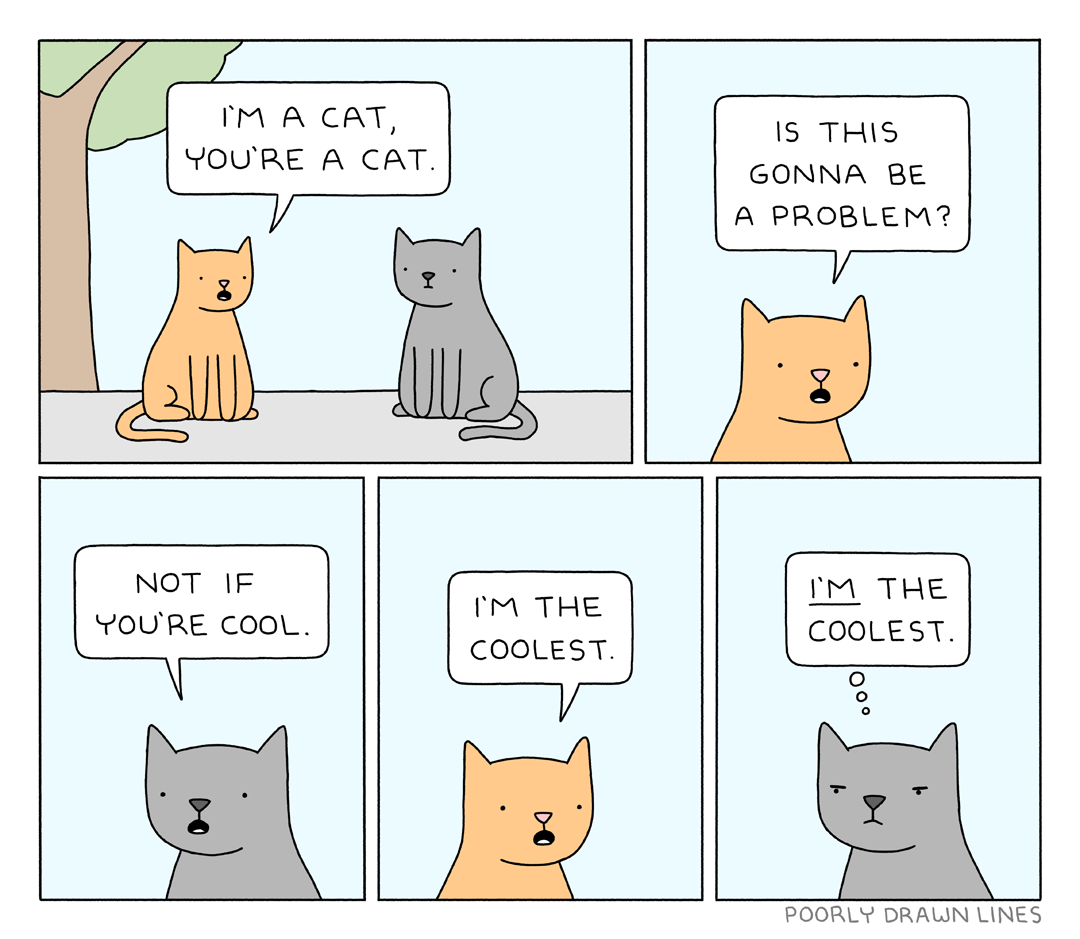
A Cat

by Reza
14 Nov 17:34

Never miss an opportunity to remind buyers of their lonely childhood.

Never miss an opportunity to remind buyers of their lonely childhood.

14 Nov 04:52

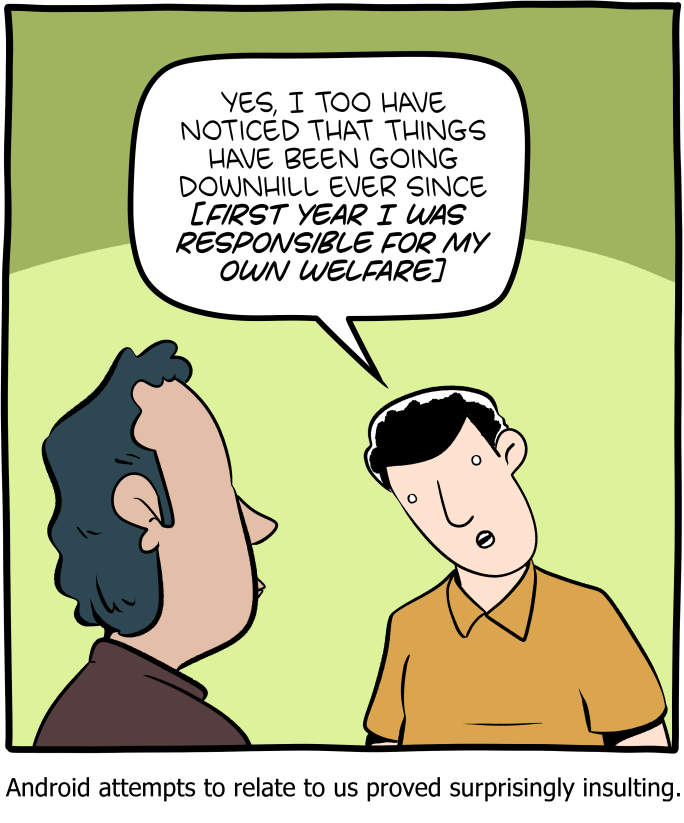
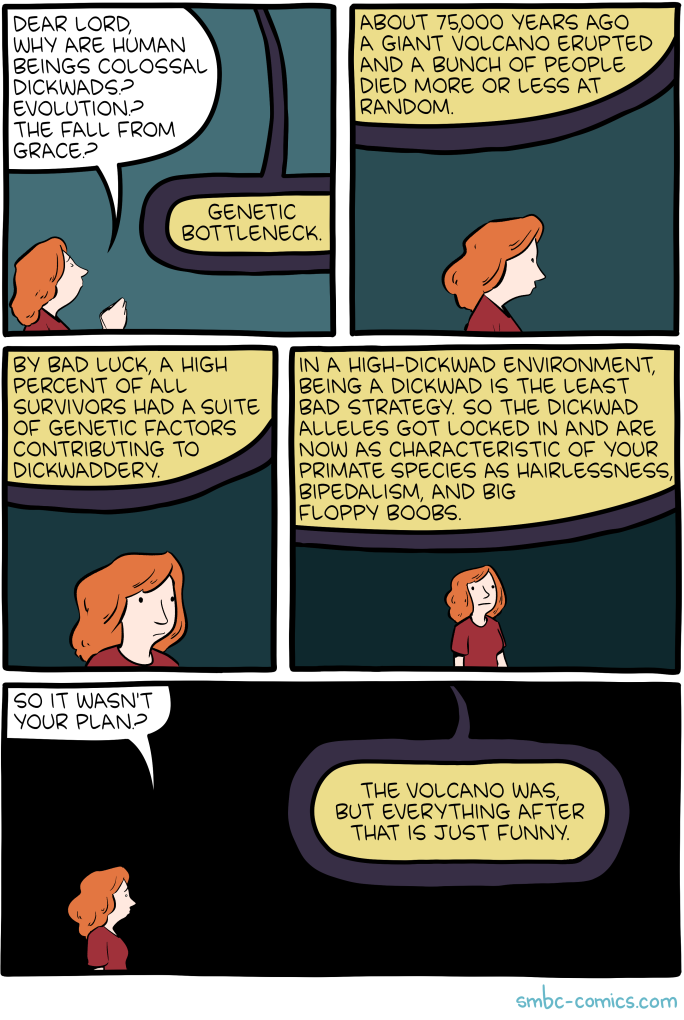
Saturday Morning Breakfast Cereal - Downhill

by Zach Weinersmith


Click here to go see the bonus panel!

Hovertext:
I too commit the fundamental attribution error!


Today's News:

Hey geeks, last day to buy A City on Mars during launch week. Purchases now really help us, so if you were going to buy, we appreciate it happening soon. I am looking forward to a day when it is not incumbent on me to be annoying about this stuff!

14 Nov 04:51

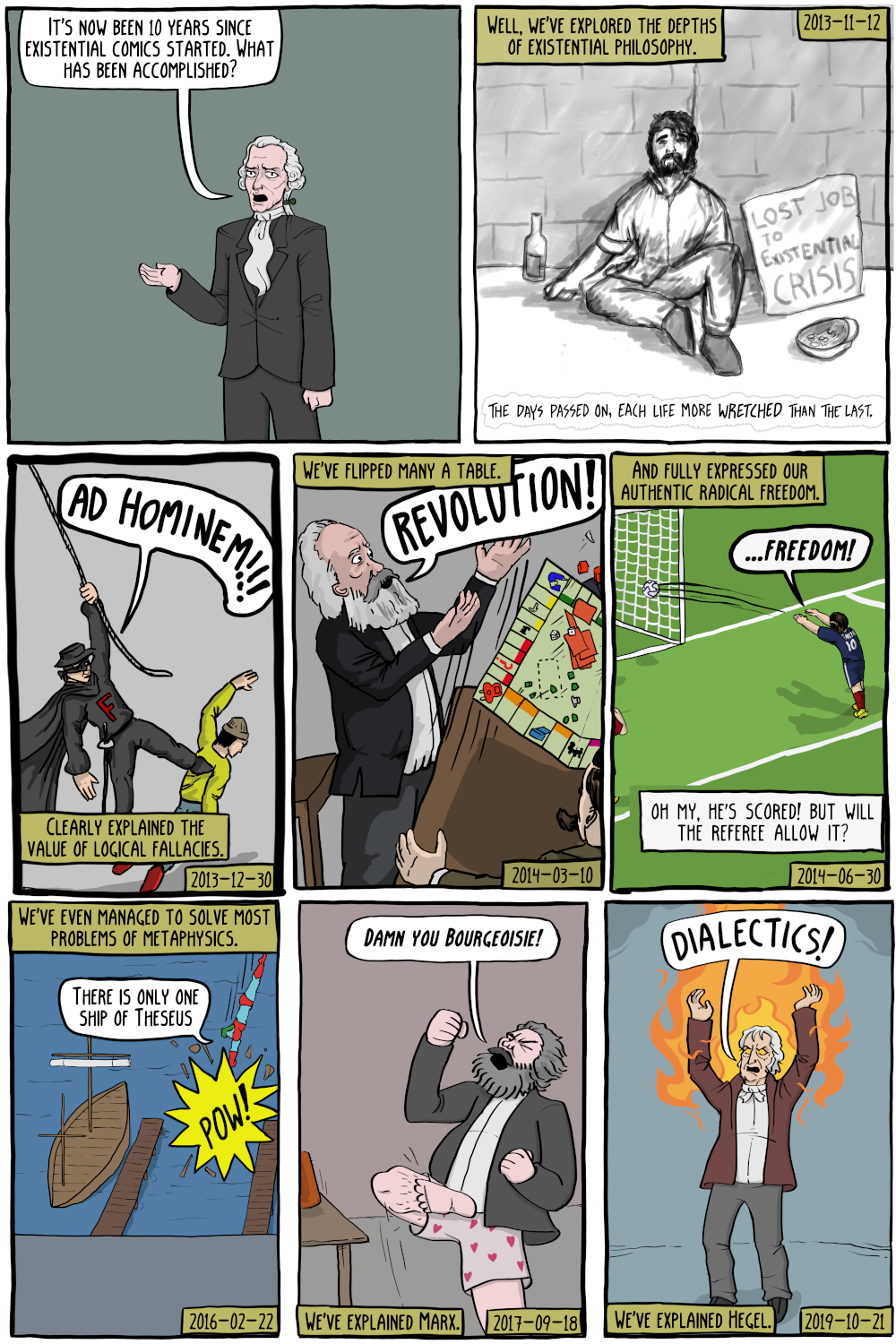
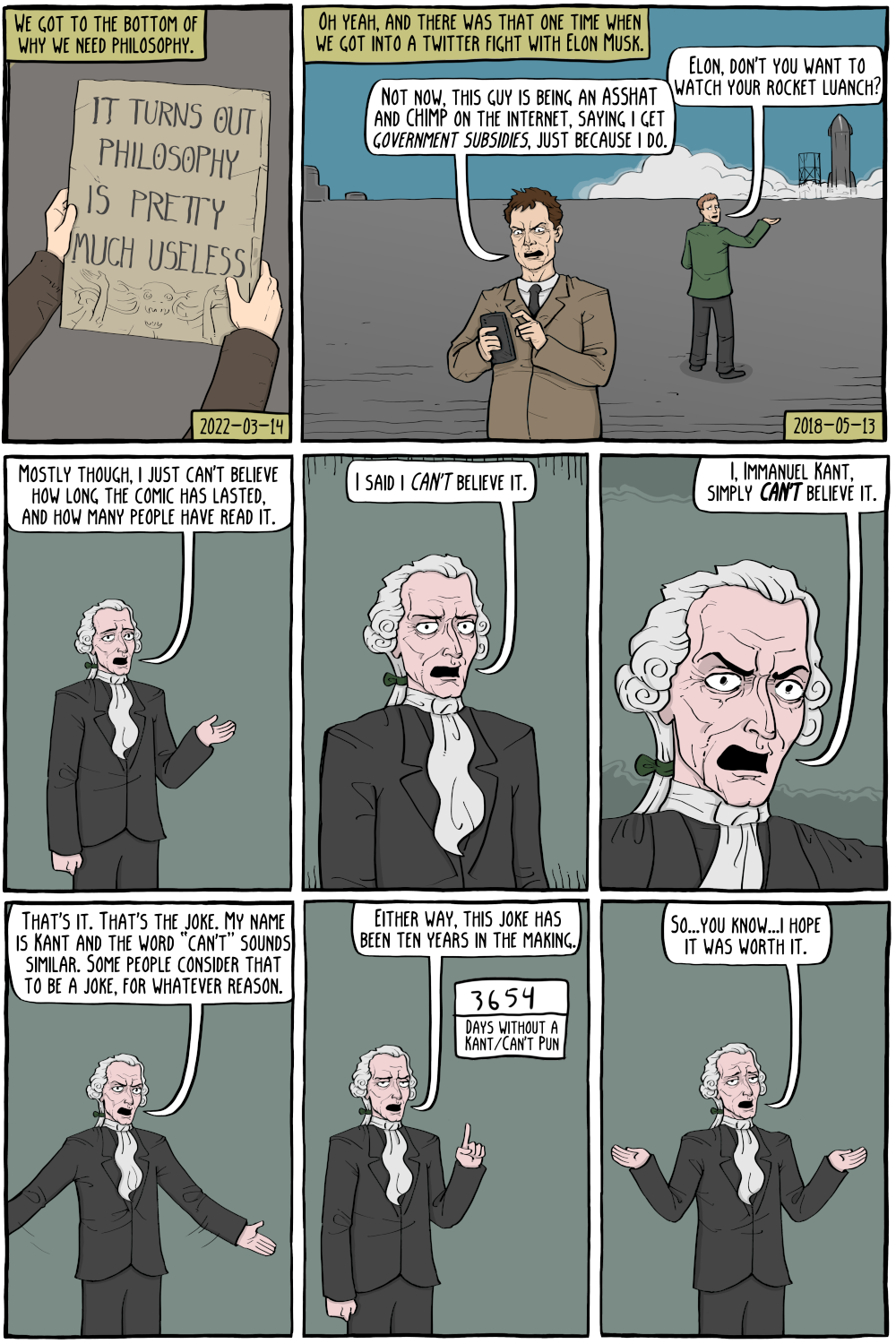
Ten Years of Existential Comics

by Corey Mohler
PERSON: " "

PERSON: "2013-11-12"

PERSON: "Well, we've explored the depths of existential philosophy."

PERSON: "2013-12-30"

PERSON: "And fully expressed our authentic radical freedom."

PERSON: "We've flipped many a table. ::::(-32 3629)Clearly explained the value of logical fallacies."

PERSON: "2014-03-10"

PERSON: "2014-06-30"

PERSON: "There is only one ship of Theseus"

PERSON: "2016-02-22"

PERSON: "We've even managed to solve most problems of metaphysics."

PERSON: "We've explained Hegel."

PERSON: "We've explained Marx."

PERSON: "2017-09-18"

PERSON: "2019-10-21"


PERSON: "We got to the bottom of why we need philosophy."

PERSON: "2022-03-14"

PERSON: "Oh yeah, and there was that one time when we got into a twitter fight with Elon Musk."

PERSON: "Elon, don't you want to watch your rocket luanch?"

PERSON: "2018-05-13"

PERSON: "Mostly though, i just can't believe how long the comic has lasted, and how many people have read it."

PERSON: "That's it. That's the joke. My name is Kant and the word “can't” sounds similar. Some people consider that to be a joke, for whatever reason."

PERSON: "So...you know...i hope it was worth it."

PERSON: " "
14 Nov 04:41

Pluralistic: The (open) web is good, actually (13 Nov 2023)

by Cory Doctorow


Today's links


A picture of a stately columnated museum. Obscuring most of its facade is the view from inside a VR headset. The headset's eye-screens have been blurred out and a single Web 1.0-era 'image not found' Netscape icon sits in the center of each. A 'code waterfall' from the credits sequences of the  Wachowskis' 'Matrix' movie is bleeding through the sky overhead.

The (open) web is good, actually (permalink)

The great irony of the platformization of the internet is that platforms are intermediaries, and the original promise of the internet that got so many of us excited about it was disintermediation – getting rid of the middlemen that act as gatekeepers between community members, creators and audiences, buyers and sellers, etc.

The platformized internet is ripe for rent seeking: where the platform captures an ever-larger share of the value generated by its users, making the service worse for both, while lock-in stops people from looking elsewhere. Every sector of the modern economy is less competitive, thanks to monopolistic tactics like mergers and acquisitions and predatory pricing. But with tech, the options for making things worse are infinitely divisible, thanks to the flexibility of digital systems, which means that product managers can keep subdividing the Jenga blocks they are pulling out of the services we rely on. Combine platforms with monopolies with digital flexibility and you get enshittification:

https://pluralistic.net/2023/01/21/potemkin-ai/#hey-guys

An enshittified, platformized internet is bad for lots of reasons – it concentrates decisions about who may speak and what may be said into just a few hands; it creates a rich-get-richer dynamic that creates a new oligarchy, with all the corruption and instability that comes with elite capture; it makes life materially worse for workers, users, and communities.

But there are many other ways in which the enshitternet is worse than the old good internet. Today, I want to talk about how the enshitternet affects openness and all that entails. An open internet is one whose workings are transparent (think of "open source"), but it's also an internet founded on access – the ability to know what has gone before, to recall what has been said, and to revisit the context in which it was said.

At last week's Museum Computer Network conference, Aaron Straup Cope gave a talk on museums and technology called "Wishful Thinking – A critical discussion of 'extended reality' technologies in the cultural heritage sector" that beautifully addressed these questions of recall and revisiting:

https://www.aaronland.info/weblog/2023/11/11/therapy/#wishful

Cope is a museums technologist who's worked on lots of critical digital projects over the years, and in this talk, he addresses himself to the difference between the excitement of the galleries, libraries, archives and museums (GLAM) sector over the possibilities of the web, and why he doesn't feel the same excitement over the metaverse, and its various guises – XR, VR, MR and AR.

The biggest reason to be excited about the web was – and is – the openness of disintermediation. The internet was inspired by the end-to-end principle, the idea that the network's first duty was to transmit data from willing senders to willing receivers, as efficiently and reliably as possible. That principle made it possible for whole swaths of people to connect with one another. As Cope writes, openness "was not, and has never been, a guarantee of a receptive audience or even any audience at all." But because it was "easy and cheap enough to put something on the web," you could "leave it there long enough for others to find it."

That dynamic nurtured an environment where people could have "time to warm up to ideas." This is in sharp contrast to the social media world, where "[anything] not immediately successful or viral … was a waste of time and effort… not worth doing." The social media bias towards a river of content that can't be easily reversed is one in which the only ideas that get to spread are those the algorithm boosts.

This is an important way to understand the role of algorithms in the context of the spread of ideas – that without recall or revisiting, we just don't see stuff, including stuff that might challenge our thinking and change our minds. This is a much more materialistic and grounded way to talk about algorithms and ideas than the idea that Big Data and AI make algorithms so persuasive that they can control our minds:

https://pluralistic.net/2023/11/06/attention-rents/#consumer-welfare-queens

As bad as this is in the social media context, it's even worse in the context of apps, which can't be linked into, bookmarked, or archived. All of this made apps an ominous sign right from the beginning:

https://memex.craphound.com/2010/04/01/why-i-wont-buy-an-ipad-and-think-you-shouldnt-either/

Apps interact with law in precisely the way that web-pages don't. "An app is just a web-page wrapped in enough IP to make it a crime to defend yourself against corporate predation":

https://pluralistic.net/2023/08/27/an-audacious-plan-to-halt-the-internets-enshittification-and-throw-it-into-reverse/

Apps are "closed" in every sense. You can't see what's on an app without installing the app and "agreeing" to its terms of service. You can't reverse-engineer an app (to add a privacy blocker, or to change how it presents information) without risking criminal and civil liability. You can't bookmark anything the app won't let you bookmark, and you can't preserve anything the app won't let you preserve.

Despite being built on the same underlying open frameworks – HTTP, HTML, etc – as the web, apps have the opposite technological viewpoint to the web. Apps' technopolitics are at war with the web's technopolitics. The web is built around recall – the ability to see things, go back to things, save things. The web has the technopolitics of a museum:

https://www.aaronland.info/weblog/2014/09/11/brand/#dconstruct

By comparison, apps have the politics of a product, and most often, that product is a rent-seeking, lock-in-hunting product that wants to take you hostage by holding something you love hostage – your data, perhaps, or your friends:

https://www.eff.org/deeplinks/2021/08/facebooks-secret-war-switching-costs

When Anil Dash described "The Web We Lost" in 2012, he was describing a web with the technopolitics of a museum:

  • where tagging was combined with permissive licenses to make it easy for people to find and reuse each others' stuff;
  • where it was easy to find out who linked to you in real-time even though most of us were posting to our own sites, which they controlled;

  • where a link from one site to another meant one person found another person's contribution worthy;

  • where privacy-invasive bids to capture the web were greeted with outright hostility;

  • where every service that helped you post things that mattered to you was expected to make it easy for you take that data back if you changed services;

  • where inlining or referencing material from someone else's site meant following a technical standard, not inking a business-development deal;

https://www.anildash.com/2012/12/13/the_web_we_lost/

Ten years later, Dash's "broken tech/content culture cycle" described the web we live on now:

https://www.anildash.com/2022/02/09/the-stupid-tech-content-culture-cycle/

  • found your platform by promising to facilitate your users' growth;
  • order your technologists and designers to prioritize growth above all other factors and fire anyone who doesn't deliver;

  • grow without regard to the norms of your platform's users;

  • plaster over the growth-driven influx of abusive and vile material by assigning it to your "most marginalized, least resourced team";

  • deliver a half-assed moderation scheme that drives good users off the service and leaves no one behind but griefers, edgelords and trolls;

  • steadfastly refuse to contemplate why the marginalized users who made your platform attractive before being chased away have all left;

  • flail about in a panic over illegal content, do deals with large media brands, seize control over your most popular users' output;

  • "surface great content" by algorithmically promoting things that look like whatever's successful, guaranteeing that nothing new will take hold;

  • overpay your top performers for exclusivity deals, utterly neglect any pipeline for nurturing new performers;

  • abuse your creators the same ways that big media companies have for decades, but insist that it's different because you're a tech company;

  • ignore workers who warn that your product is a danger to society, dismiss them as "millennials" (defined as "anyone born after 1970 or who has a student loan")

  • when your platform is (inevitably) implicated in a murder, have a "town hall" overseen by a crisis communications firm;

  • pay the creator who inspired the murder to go exclusive on your platform;

  • dismiss the murder and fascist rhetoric as "growing pains";

  • when truly ghastly stuff happens on your platform, give your Trust and Safety team a 5% budget increase;

  • chase growth based on "emotionally engaging content" without specifying whether the emotions should be positive;

  • respond to ex-employees' call-outs with transient feelings of guilt followed by dismissals of "cancel culture":

  • fund your platforms' most toxic users and call it "free speech";

  • whenever anyone disagrees with any of your decisions, dismiss them as being "anti-free speech";

  • start increasing how much your platform takes out of your creators' paychecks;

  • force out internal dissenters, dismiss external critics as being in conspiracy with your corporate rivals;

  • once regulation becomes inevitable, form a cartel with the other large firms in your sector and insist that the problem is a "bad algorithm";

  • "claim full victim status," and quit your job, complaining about the toll that running a big platform took on your mental wellbeing.

https://pluralistic.net/2022/02/18/broken-records/#dashes

The web wasn't inevitable – indeed, it was wildly improbable. Tim Berners Lee's decision to make a new platform that was patent-free, open and transparent was a completely opposite approach to the strategy of the media companies of the day. They were building walled gardens and silos – the dialup equivalent to apps – organized as "branded communities." The way I experienced it, the web succeeded because it was so antithetical to the dominant vision for the future of the internet that the big companies couldn't even be bothered to try to kill it until it was too late.

Companies have been trying to correct that mistake ever since. After three or four attempts to replace the web with various garbage systems all called "MSN," Microsoft moved on to trying to lock the internet inside a proprietary browser. Years later, Facebook had far more success in an attempt to kill HTML with React. And of course, apps have gobbled up so much of the old, good internet.

Which brings us to Cope's views on museums and the metaverse. There's nothing intrinsically proprietary about virtual worlds and all their permutations. VRML is a quarter of a century old – just five years younger than Snow Crash:

https://en.wikipedia.org/wiki/VRML

But the current enthusiasm for virtual worlds isn't merely a function of the interesting, cool and fun experiences you can have in them. Rather, it's a bid to kill off whatever is left of the old, good web and put everything inside a walled garden. Facebook's metaverse "is more of the same but with a technical footprint so expensive and so demanding that it all but ensures it will only be within the means of a very few companies to operate."

Facebook's VR headsets have forward-facing cameras, turning every users into a walking surveillance camera. Facebook put those cameras there for "pass through" – so they can paint the screens inside the headset with the scene around you – but "who here believes that Facebook doesn't have other motives for enabling an always-on camera capturing the world around you?"

Apple's VisionPro VR headset is "a near-perfect surveillance device," and "the only thing to save this device is the trust that Apple has marketed its brand on over the last few years." Cope notes that "a brand promise is about as fleeting a guarantee as you can get." I'll go further: Apple is already a surveillance company:

https://pluralistic.net/2022/11/14/luxury-surveillance/#liar-liar

The technopolitics of the metaverse are the opposite of the technopolitics of the museum – even moreso than apps. Museums that shift their scarce technology budgets to virtual worlds stand a good chance of making something no one wants to use, and that's the best case scenario. The worst case is that museums make a successful project inside a walled garden, one where recall is subject to corporate whim, and help lure their patrons away from the recall-friendly internet to the captured, intermediated metaverse.

It's true that the early web benefited from a lot of hype, just as the metaverse is enjoying today. But the similarity ends there: the metaverse is designed for enclosure, the web for openness. Recall is a historical force for "the right to assembly… access to basic literacy… a public library." The web was "an unexpected gift with the ability to change the order of things; a gift that merits being protected, preserved and promoted both internally and externally." Museums were right to jump on the web bandwagon, because of its technopolitics. The metaverse, with its very different technopolitics, is hostile to the very idea of museums.

In joining forces with metaverse companies, museums strike a Faustian bargain, "because we believe that these places are where our audiences have gone."

The GLAM sector is devoted to access, to recall, and to revisiting. Unlike the self-style free speech warriors whom Dash calls out for self-serving neglect of their communities, the GLAM sector is about preservation and access, the true heart of free expression. When a handful of giant companies organize all our discourse, the ability to be heard is contingent on pleasing the ever-shifting tastes of the algorithm. This is the problem with the idea that "freedom of speech isn't freedom of reach" – if a platform won't let people who want to hear from you see what you have to say, they are indeed compromising freedom of speech:

https://pluralistic.net/2022/12/10/e2e/#the-censors-pen

Likewise, "censorship" is not limited to "things that governments do." As Ada Palmer so wonderfully describes it in her brilliant "Why We Censor: from the Inquisition to the Internet" speech, censorship is like arsenic, with trace elements of it all around us:

https://www.youtube.com/watch?v=uMMJb3AxA0s

A community's decision to ban certain offensive conduct or words on pain of expulsion or sanction is censorship – but not to the same degree that, say, a government ban on expressing certain points of view is. However, there are many kinds of private censorship that rise to the same level as state censorship in their impact on public discourse (think of Moms For Liberty and their book-bannings).

It's not a coincidence that Palmer – a historian – would have views on censorship and free speech that intersect with Cope, a museum worker. One of the most brilliant moments in Palmer's speech is where she describes how censorship under the Inquistion was not state censorship – the Inquisition was a multinational, nongovernmental body that was often in conflict with state power.

Not all intermediaries are bad for speech or access. The "disintermediation" that excited early web boosters was about escaping from otherwise inescapable middlemen – the people who figured out how to control and charge for the things we did with one another.

When I was a kid, I loved the writing of Crad Kilodney, a short story writer who sold his own self-published books on Toronto street-corners while wearing a sign that said "VERY FAMOUS CANADIAN AUTHOR, BUY MY BOOKS" (he also had a sign that read, simply, "MARGARET ATWOOD"). Kilodney was a force of nature, who wrote, edited, typeset, printed, bound, and sold his own books:

https://www.theglobeandmail.com/arts/books/article-late-street-poet-and-publishing-scourge-crad-kilodney-left-behind-a/

But there are plenty of writers out there that I want to hear from who lack the skill or the will to do all of that. Editors, publishers, distributors, booksellers – all the intermediaries who sit between a writer and their readers – are not bad. They're good, actually. The problem isn't intermediation – it's capture.

For generations, hucksters have conned would-be writers by telling them that publishing won't buy their books because "the gatekeepers" lack the discernment to publish "quality" work. Friends of mine in publishing laughed at the idea that they would deliberately sideline a book they could figure out how to sell – that's just not how it worked.

But today, monopolized film studios are literally annihilating beloved, high-priced, commercially viable works because they are worth slightly more as tax writeoffs than they are as movies:

https://deadline.com/2023/11/coyote-vs-acme-shelved-warner-bros-discovery-writeoff-david-zaslav-1235598676/

There's four giant studios and five giant publishers. Maybe "five" is the magic number and publishing isn't concentrated enough to drop whole novels down the memory hole for a tax deduction, but even so, publishing is trying like hell to shrink to four:

https://pluralistic.net/2022/11/07/random-penguins/#if-you-wanted-to-get-there-i-wouldnt-start-from-here

Even as the entertainment sector is working to both literally and figuratively destroy our libraries, the cultural heritage sector is grappling with preserving these libraries, with shrinking budgets and increased legal threats:

https://blog.archive.org/2023/03/25/the-fight-continues/

I keep meeting artists of all description who have been conditioned to be suspicious of anything with the word "open" in its name. One colleague has repeatedly told me that fighting for the "open internet" is a self-defeating rhetorical move that will scare off artists who hear "open" and think "Big Tech ripoff."

But "openness" is a necessary precondition for preservation and access, which are the necessary preconditions for recall and revisiting. Here on the last, melting fragment of the open internet, as tech- and entertainment-barons are seizing control over our attention and charging rent on our ability to talk and think together, openness is our best hope of a new, good internet.

The cultural heritage sector wants to save our creative works. The entertainment and tech industry want to delete them and take a tax writeoff.

As a working artist, I know which side I'm on.

(Image Diego Delso, CC BY-SA 4.0, modified)


Hey look at this (permalink)


A Wayback Machine banner.

This day in history (permalink)

#20yrsago Pearson Airport threatens to sue websites that take its name in vain https://www.techdirt.com/2003/11/13/is-it-against-the-law-to-put-the-name-of-the-toronto-airport-on-the-web/

#15yrsago Zoe’s Tale: Scalzi’s smart-ass young-adult sf thriller https://memex.craphound.com/2008/11/12/zoes-tale-scalzis-smart-ass-young-adult-sf-thriller/

#10yrsago UK home secretary wants to overturn human rights treaties and make terror suspects stateless https://www.theguardian.com/uk-news/2013/nov/12/theresa-may-british-terror-suspects-stateless-passport

#10yrsago David Nutt wants to make non-addictive, safer synth-booze that comes with a sober-up pill https://www.independent.co.uk/news/uk/home-news/getting-drunk-without-the-hangover-or-health-risks-scientist-seeks-investment-for-alcohol-substitute-drug-8931946.html

#10yrsago Irish Freedom of Information amendment will send FOI fees to infinity https://www.mcgarrsolicitors.ie/2013/11/10/freedom-information-fees-multiplied-new-amendment/

#10yrsago GCHQ used fake Slashdot, LinkedIn to target employees at Internet exchanges https://arstechnica.com/tech-policy/2013/11/uk-spies-continue-quantum-insert-attack-via-linkedin-slashdot-pages/

#10yrsago Edward Snowden is almost broke https://world.time.com/2013/11/12/edward-snowden-is-almost-broke/

#10yrsago Vi Hart: cramming G+ into YouTube has made comments even worse, I’m leaving https://web.archive.org/web/20131114001432/http://vihart.com/google-youtube-integration-kind-of-like-twilight-except-in-this-version-when-cullen-drinks-bellatubes-blood-they-both-become-mortal-but-cullen-is-still-an-abusive-creep-also-it-is-still-bad/

#10yrsago Tune: Still Life, new installment in romcom/alien abduction graphic novel https://memex.craphound.com/2013/11/13/tune-still-life-new-installment-in-romcom-alien-abduction-graphic-novel/

#5yrsago Trump is bailing out a Chinese owned pork producer to compensate it for retaliatory Chinese tariffs https://www.latimes.com/business/la-fi-smithfield-china-tariffs-20181109-story.html

#5yrsago Yanis Varoufakis on capitalism’s incompatibility with democracy https://www.youtube.com/watch?v=gGeevtdp1WQ

#5yrsago Congressional Democrats’ first bill aims to end gerrymandering, increase voter registration and rein in campaign finance https://www.npr.org/2018/11/12/665635832/democrats-say-their-first-bill-will-focus-on-strengthening-democracy-at-home

#5yrsago Big Tech got big because we stopped enforcing antitrust law (not because tech is intrinsically monopolistic) https://www.wired.com/story/book-excerpt-curse-of-bigness/

#5yrsago A catalog of ingenious cheats developed by machine-learning systems https://docs.google.com/spreadsheets/u/1/d/e/2PACX-1vRPiprOaC3HsCf5Tuum8bRfzYUiKLRqJmbOoC-32JorNdfyTiRRsR7Ea5eWtvsWzuxo8bjOxCG84dAg/pubhtml

#5yrsago Youtube CEO: it will be impossible to comply with the EU’s new Copyright Directive (adios, Despacito!) https://blog.youtube/inside-youtube/i-support-goals-of-article-13-i-also/

#5yrsago Italian prosecutors have given up on catching the person who hacked and destroyed Hacking Team https://www.vice.com/en/article/3k9zzk/hacking-team-hacker-phineas-fisher-has-gotten-away-with-it

#5yrsago Wells Fargo: We can’t be sued for lying to shareholders because it was obvious we were lying https://www.latimes.com/business/hiltzik/la-fi-hiltzik-wells-puffery-20181109-story.html

#5yrsago Global antiquarian bookseller strike brings Amazon to its knees https://www.nytimes.com/2018/11/07/technology/amazon-bookseller-protest-strike.html

#5yrsago New, “unbreakable” Denuvo DRM cracked two days before its first commercial deployment https://torrentfreak.com/hitman-2s-denuvo-protection-cracked-three-days-before-launch-181112/

#5yrsago How many computers are in your computer? https://gwern.net/turing-complete#how-many-computers-are-in-your-computer

#5yrsago The market failed rural kids: poor rural broadband has created a “homework gap” https://www.wired.com/story/rural-kids-internet-homework-gap-fcc-could-help/

#1yrago The Framework is the most exciting laptop I've ever broken https://pluralistic.net/2022/11/13/graceful-failure/#frame

#1yrago They Want to Kill Libraries https://pluralistic.net/2022/11/13/they-want-to-kill-libraries/


Colophon (permalink)

Today's top sources: Nancy Proctor (https://mastodon.world/@NancyProctor).

Currently writing:

  • A Little Brother short story about DIY insulin PLANNING
  • Picks and Shovels, a Martin Hench noir thriller about the heroic era of the PC. FORTHCOMING TOR BOOKS JAN 2025

  • The Bezzle, a Martin Hench noir thriller novel about the prison-tech industry. FORTHCOMING TOR BOOKS FEB 2024

  • Vigilant, Little Brother short story about remote invigilation. FORTHCOMING ON TOR.COM

  • Spill, a Little Brother short story about pipeline protests. FORTHCOMING ON TOR.COM

Latest podcast: Moral Hazard (from Communications Breakdown) https://craphound.com/stories/2023/11/12/moral-hazard-from-communications-breakdown/
Upcoming appearances:

Recent appearances:

Latest books:

Upcoming books:

  • The Bezzle: a sequel to "Red Team Blues," about prison-tech and other grifts, Tor Books, February 2024
  • Picks and Shovels: a sequel to "Red Team Blues," about the heroic era of the PC, Tor Books, February 2025

  • Unauthorized Bread: a graphic novel adapted from my novella about refugees, toasters and DRM, FirstSecond, 2025


This work – excluding any serialized fiction – is licensed under a Creative Commons Attribution 4.0 license. That means you can use it any way you like, including commercially, provided that you attribute it to me, Cory Doctorow, and include a link to pluralistic.net.

https://creativecommons.org/licenses/by/4.0/

Quotations and images are not included in this license; they are included either under a limitation or exception to copyright, or on the basis of a separate license. Please exercise caution.


How to get Pluralistic:

Blog (no ads, tracking, or data-collection):

Pluralistic.net

Newsletter (no ads, tracking, or data-collection):

https://pluralistic.net/plura-list

Mastodon (no ads, tracking, or data-collection):

https://mamot.fr/@pluralistic

Medium (no ads, paywalled):

https://doctorow.medium.com/

Twitter (mass-scale, unrestricted, third-party surveillance and advertising):

https://twitter.com/doctorow

Tumblr (mass-scale, unrestricted, third-party surveillance and advertising):

https://mostlysignssomeportents.tumblr.com/tagged/pluralistic

"When life gives you SARS, you make sarsaparilla" -Joey "Accordion Guy" DeVilla

13 Nov 19:49

how can I support my Black employee who doesn’t want me to report anything, and other questions about race

by Ask a Manager

This post was written by Alison Green and published on Ask a Manager.

I’m thrilled to welcome back Michelle Silverthorn to answer readers’ questions on race. Michelle is the founder and CEO of Inclusion Nation. A recognized keynote speaker on inclusion and belonging, she speaks on hundreds of virtual and in-person stages every year and her interactive e-learning suite, Inclusion LAUNCH, is in use by organizations across the world. A graduate of Princeton and the University of Michigan Law School, Michelle is a TEDx speaker and the author of the best-selling book, Authentic Diversity: How to Change the Workplace for Good. Sign up for Monday Mornings with Michelle, her weekly newsletter with practical steps for allyship at work.

Michelle answered so many questions this time that we’re making it a two-parter. Part one is below, and part two is coming on Wednesday. Take it away, Michelle!

1. How can I support my Black employee who doesn’t want me to report anything?

I am white and manage the only Black person at our organization of 30. She and I have discussed race multiple times before, and she told me after one team meeting that she needed to decompress. She did not specify why, but I suspect it’s because of the problematic race-related discussion during the meeting. I told her to take time to decompress anytime she needs to. I try to speak up, but it often falls flat.

Recently, in her self-assessment, she wrote a vague line about how it’s challenging to manage nuance at our organization. When I asked her about it, she said that it’s because she feels her Blackness is more obvious at our organization than any other organization she has ever worked for. When I probed a little more, she shared that she sometimes feels her work has been treated differently than others’ because of her race. She has told me before that she does not want to report and does not want me to report anything. She would prefer to speak up when race comes up, but I’m not sure if I’ve gotten to the point where I need to go against her wishes and report the situation to the powers that be.

If she believes that she is being treated differently because of her race, then this goes beyond an inclusion issue and into a workplace discrimination issue. Yes, she has told you, “She does not want to report and does not want me to report anything.” But you are her manager. You represent the organization to her. And someone telling their manager that they are experiencing “differential treatment” triggers all my lawyer spidey-senses.

I would like to know what policies your organization has in place when someone alleges that they are being treated differently because of race. It’s a small organization so I know you may or may not have an in-house HR lead. But whoever you have in charge of People, I hope they have given you concrete steps on what to do when you hear or witness something like this. If not, now would be a great time to connect with them and find out what you need to do.

She has also said she would prefer not to report it. This is common for people who experience harassment or discrimination at work. But HR has a very important job to protect the company from reputational damage and lawsuits, while at the same time building a workplace centered on fairness and inclusion. Her comments on feeling treated differently because of her race may not have made it into her self-assessment, but they did make it to you. As her manager, I would talk to HR to determine what they suggest as the next step. Because, and I want to be extra sensitive to this part, if she is feeling treated differently and you are her manager, you are likely to be somehow involved in that treatment, even if it was by you not preventing it. You may not have the entire story so this would be a good time to step aside and let someone else get involved.

I do want to address the other part of your question for you or for anyone else who might be experiencing this: “I try to speak up, but it often falls flat.” You used the word “often.” How often do you see things like this “problematic race-related discussion”? This might be a part of why your direct report is feeling that her Blackness is obvious at this organization. Are you having many “problematic race-related discussions”? That’s another issue right there. When I do my anti-harassment trainings, I talk about all the forms that harassment at work can take. And part of it can be in discussions where someone repeatedly denies another person’s lived experiences, or “plays devil’s advocate,” or says “but what about,” or the many other ways these discussions can play out.

You say you try to speak up, and that is certainly one option. If that’s the choice you make, then figure out what is stopping you from saying anything. Social anxiety? Lack of knowledge? Worry about repercussions? Fear that you might make it worse? Identify what is making you uncomfortable and learn the skills, actions, behaviors, and knowledge you need to navigate that discomfort. Then, talk with her about what you can do to help her feel safe and not under attack when these discussions are taking place. Maybe it is you speaking up in the moment. Maybe it’s finding others who will share as well. Maybe it’s redirecting a conversation. Maybe it’s calling in someone else’s manager to speak to the person saying hurtful things. Maybe it’s giving her time and space to heal, which is what you did. Start with self-reflection and see what it reveals for you.

2. Our team has little diversity

My question concerns team diversity, and what responsibility manager/team leadership have towards cultivating it, and how that should happen.

In the technical branch of a large tech company that strives for equality, my team of just under 20 people has three full-time employees who aren’t white and male (passing, at least). In the past year, every new hire except one has been both white and male (again, passing). Another wrinkle is that two of three of the non-white-and-male employees are Asian, which isn’t even considered a racial minority in tech! To what extent can this be attributed to the leadership of the team, and what are things they could have done (or can do in the future) to prevent this? (Is this even an appropriate grievance to have?)

What type of diversity would you like to cultivate and why? There are many reasons to increase diversity across all identity groups — improved problem-solving, greater variety of perspectives, richer discussions, better decision-making, reconceiving tasks, and on and on and on. But I’ll be frank. If the business case for diversity were enough, every organization would have “solved” diversity years ago. If your team is thriving, no one is complaining, and you are delivering the impactful results your community needs, then it’s no wonder your leadership might shrug their shoulders and say, “We’re fine.”

But, and I say this as someone who has done this work for a very long time, there will be a time where it will not be “fine.” It might happen when you hire a transgender employee who feels both misunderstood and isolated in the workplace. It might happen when you have an autistic colleague who feels their peers don’t understand how to communicate with them. It might happen when a Gen Z employee rejects your workplace because it doesn’t meet their inclusion expectations. It might happen when a woman files a discrimination suit because they have been passed over for a promotion multiple times. It might happen when you release a product that doesn’t at all represent the community who you want to adopt it. It might happen when an entire nation has a racial reckoning and companies start scrambling to understand what racial justice means in a workplace that lacks any Black leaders. Instead of waiting until that happens, your team leadership needs to think about what kind of team they want to be.

I may have mentioned this before, but every single diversity initiative needs to start with two questions: “Why are you doing this?” and “What does success look like to you?” If you can’t answer these two questions, then at times like right now when there is massive pushback on diversity initiatives — both legal and otherwise — your leadership can go, “Well we don’t really know why we’re doing this” and, “It hasn’t been successful anyway.” You can either wait until the crisis arises — and it might take one or multiple crises to get to that tipping point — or you can sow the seeds now.

So here is the 5-Step Guidebook for Diversity According to Michelle Silverthorn:

Step 1. “Why?” Why are we doing this? What is it that I am not aware of? It could start with a conversation. It could start with training. It could be in management meetings where you share data from salary reports and evaluation forms and engagement surveys and exit interviews. The reality is some people, and I truly mean this, genuinely do not see an issue with a homogenous team of White men who have similar backgrounds to them, similar interests as them, and similar cultural touchstones as them. That’s why I always start with awareness. Because that leads to the second Why — why should this matter to you?

Step 2. “What?” What diversity are we hoping to achieve? Step 3. “How?” How do we achieve that? And how do we measure it? Step 4. “When?” When do we want this to be accomplished by? And finally Step 5, “Who?” Who will be in charge of the work?

If you can lay that out, it will do wonders to get people on board and get them to hold themselves and their peers accountable for success.

3. Participating in racial justice work as the only white person in the room

I am relatively new to a job where I am almost always the only white person on teams and in conversations. Our workplace is really openly progressive, and there is a strong focus on equity in all of our work. To give just one example, I sit next to many physical signs on the topic of all the offensive things white people do and say in the workplace. Some of the phrases on these signs include: “Demanding proximity to whiteness,” “Diminishing my melanin,” “Unsolicited feedback,” “Tone policing,” “Minimizing the experiences of people of color,” “Defensiveness,” “The white experience is not the norm/superior,” “White-splaining,” “Who is allowed to take up space,” among others. In my first week, I was sent into a Zoom breakout room to discuss race, again as the only white person, to discuss and defend my projects in the context of their work toward racial justice. I barely understood the projects I was working on yet, let alone their impact on racial justice, and I felt paralyzed and embarrassed.

No training has ever been provided on how to contribute to these conversations, and I worry that asking for help might make it seem like I expect to be made more comfortable as a white person in the workplace. I understand there is a long history of people of color being made to feel “othered” in the workplace, and that many people of color have experienced workplaces in which they are the only person of color in rooms full of white people. It’s not the job of my coworkers to make me feel comfortable in this environment.

At the same time, I often feel there is no right thing to say in any conversation, and I am in constant terror of offending my coworkers, including by just existing in their space as a manager for some of them. I often default to limiting my input in these mandatory conversations to yield space for my coworkers and to avoid upsetting anyone. However, I understand that not participating and contributing to these conversations can also be seen as offensive, and I recently received feedback from my own manager that I need to be more active in them.

I respect the challenges of people of color in my workplace, and I genuinely want to participate effectively in these conversations, understand the experiences of my coworkers, and contribute to valuable work on racial justice issues. I am open to feedback but worry that any input that is not exactly right will deeply impact my credibility on any team. The lack of training and guidance has even made me feel resentful at times of being forced into conversations where I feel I cannot possibly contribute in a positive and meaningful way.

How can I feel more confident in participating in racial justice work as the only white coworker in most rooms? Is it possible for me to meaningfully contribute while also not offending anyone? How do I find where my input fits in? Is this even possible?

I am sorry you are participating in conversations that feel forced, that you are experiencing terror, and that you are worried about saying something offensive. No one should ever feel like that around racial equity work. Sadly, it does occur for many people in some form. And for you, that concern is even more heightened because of the position you hold as almost always the only White person in your spaces.

But instead of focusing on those conversations, I want to highlight something else you wrote: “At the same time, I often feel there is no right thing to say in any conversation, and I am in constant terror of offending my coworkers, including by just existing in their space as a manager for some of them.”

This seems to be far bigger than saying the wrong thing about race in a conversation. It seems that you feel like you are under attack because you are a White manager for people of color who often talk about issues of race in ways that not only exclude you but make you feel like you’re the problem. I can give you advice on how to have better conversations — start with empathy, center the experiences of those who are marginalized, listen without judgment, learn what makes you uncomfortable, educate yourself instead of expecting to be educated — but part of me wonders if your issue is broader than the conversation itself and is instead your identity as the only White person in a room where phrases like “White-splainin” and “Unsolicited feedback” make you feel more than uncomfortable; they make you feel diminished.

My advice would be to root out the underlying reasons you are feeling resentful. How do your coworkers speak to you in conversations not around racial justice? Are you included in their social interactions? When you make suggestions around equity initiatives, how do they consider them? After you sort through your feelings, I would like you to go to your manager and respond to their feedback about how you can be more active in conversations. As a manager yourself, I would like your response to not focus only on how you feel as a peer and an individual colleague, but also on how you can successfully work with direct reports who you don’t seem comfortable managing.

Which means, most of all, I want you to be honest with yourself. Many people of color learn, work, and live in White-majority spaces where they feel marginalized, excluded, and minimized — exactly like those signs said. I also wonder if you feel like those signs are personally referencing you. If so, make your manager aware of that because as supportive as someone can and should be about a racially just workplace, your feelings are valid as well. I think getting tips on how to have better conversations about race will be less helpful than diving into how that perceived exclusion, or the feeling that you are being resented because of your race, would be.

4. What can we actually do as members of culture committees?

I’ve always been an individual contributor, and at my last three places of employment I’ve ended up on some variation of a culture committee. In one workplace it was in the context of DEI. At another it was because my particular manager got bad scores on the internal company survey. Now I find myself on another, the result of a new VP who has overseen my team for about a year.

Every time, the committee consists of “worker bees” and maybe a “small manager” or two—someone who has one or two reports. And we always end up circling back to the same place …that as people without authority or power, we aren’t really able to address or solve the workplace issues. We have conversations where we struggle about what to do or suggest.
In the end we end up suggesting a literal or metaphorical pizza party, since we can’t come up with anything else that’s within our control.

Is there anything I’m missing? What are leaders hoping to get out of these groups? I would love any suggestions you have.

Michelle here. I was about to answer this when I realized that my superstar strategy consultant, Kim Holmes, has been working on these exact issues for the three and a half years we’ve been together. Since she’s leaving Inclusion Nation at the end of the month to set out on her own, I’ll let her share how she would answer this question. Take it away, Kim!

Kim: It is not uncommon for culture committees to be asked to create change without a clear understanding of the desired future state and/or without the necessary resources to affect sustainable change. Like Michelle said, we like to start initiatives with the question, “What does success look like?” This is a question that the leaders who convene the committee should be able to answer. Another way to ask the question is, “How will our organization be different because this committee exists?”

Doing this groundwork should then open up the conversation about the resources — time, people, including decision makers, and money — available to fuel the work. Once you understand what “good” looks like and know the resources you have to work with, you can then dive into the work of developing and delivering the programs that move the organization to the future state. This work should be treated like any other business initiative with goals, metrics and timelines that align to the definition of success you’ve created. There should be transparency in reporting progress toward the goals set so that there is visible accountability.
Does your organization have employee resource groups (“ERGs”)? If so, is there an opportunity to collaborate with the ERGs to create the desired change? If the organization hasn’t yet launched ERGs, this might be an opportunity to create the culture and talent optimizer that ERGs can be. While the same needs for clarity of mission, vision and criteria of success exist, there will be a collection of diverse voices who have been empowered (and funded, hopefully) to drive innovative approaches to the work of building the culture you want.

Thanks, Michelle and Kim!

13 Nov 19:10

centralbunnyunit:

13 Nov 16:45

Comic for 2023.11.13 - It’s Not Easy

New Cyanide and Happiness Comic
13 Nov 16:45

Law and Order: Toronto to follow exciting story of police ignoring gay community about serial killer

by Geoff Cork

Toronto, ON – Producers of the exciting Law and Order series centering around crimes related to Toronto finally revealed what crime the pilot episode will look at. “We’re very excited to have a first episode where the police actually do nothing,” explained Dick Wolf, that producer everyone knows the name of. “Instead of having a […]

The post Law and Order: Toronto to follow exciting story of police ignoring gay community about serial killer appeared first on The Beaverton.

13 Nov 16:45

Oilers struggles blamed on carbon tax

by H. Clair

EDMONTON – With the pre-season Stanley Cup favourite Edmonton Oilers struggling to develop momentum, Premier Danielle Smith blamed the team’s performance on the Liberal government’s carbon tax. “Alberta’s capital has been suffering greatly under the Federal government’s hostile attitude to the oil industry, and one need look no further than our beloved hockey team,” the […]

The post Oilers struggles blamed on carbon tax appeared first on The Beaverton.

13 Nov 16:45

Twelve Things Your College Freshman Son Will Never Say During His Weekly Call Home

by Lili Wright

1. “How are you?”

2. “I vacuumed my room.”

3. “You were right—Clash Royale is a waste of time.”

4. “I set up my own Amazon account, so you don’t have to pay $28.49 for my Bavarian Lederhosen Halloween costume.”

5. “I dropped Spikeball Club to join Model UN.”

6. “In Intro to Philosophy, we just discussed Heidegger’s Correspondence Theory of Truth, and I’d like to hear your take on it.”

7. “I have a girlfriend, and I want you to meet her.”

8. “I have a boyfriend, and I want you to meet him.”

9. “During Thanksgiving break, let’s stash our phones and spend quality time together raking leaves.”

10. “I already bought my airline ticket home, because I know prices go up if you wait until the last minute.”

11. “When I say ‘love you,’ it doesn’t mean I want to get off the phone.”

12. “We should talk more often.”

13 Nov 16:44

Awkward Zombie - Rocky Road

by tech@thehiveworks.com

New comic!

Today's News:

Anything can be a car if you wish hard enough.

13 Nov 16:43

Nation’s Therapists Recommend Depressed Individuals Cheer Selves Up With Root Beer Float

WASHINGTON—In an effort to address the nation’s mental health crisis, the American Psychological Association issued a blanket recommendation Monday for depressed individuals to cheer themselves up with a cool, tasty root beer float. “In recent decades, clinical depression has risen to epidemic levels in the United…

Read more...

13 Nov 16:43

Ashamed Meta Employee Just Tells Everyone He Works As Guard In Private Prison For Disabled Children

CHICAGO—Unable to tell the group of acquaintances how he really earns his living, Meta employee Alex Kondell reportedly stated Monday that he works as a guard in a private prison for disabled children. “I actually left Meta forever ago—yeah, I’m much happier now, ” said Kondell, who, too ashamed to admit he stills…

Read more...

13 Nov 16:43

Sellout Poet Made Over $150 In 2023 Alone

CHICAGO—Blasting the writer for clearly abandoning his artistic ideals in pursuit of commercial success, sources confirmed Monday that sellout poet Cullen Quinn Roberts had earned over $150 in 2023 alone. “God, this hack is practically rolling in it after having his chapbook Anagram Arpeggio published by a small…

Read more...

13 Nov 04:08

Round two of heavy rainfall for Houston is coming Monday for coastal areas

by Eric Berger

Good morning. After the healthy amounts of rainfall the region received on Thursday and Friday—most areas picked up 1 to 3 inches—I wanted to reset expectations for the remainder of the “wet” period that will last through Monday. We’re probably not looking at any significant flooding, but it should be another wet and dreary day. Matt and I also wanted to take the opportunity this morning to thank veterans who have served our country. Veterans Day may be the one day we say it, but we appreciate our freedom every day of the year.

Finally, I wanted to remind readers that we have just kicked off our annual fundraiser, which will last for a limited time only. You can visit our merch store to purchase items or simply make a donation. Thank you for the tremendous response so far!

Rain showers are well offshore on Saturday morning. (RadarScope)

Saturday and Sunday daytime

The radar is quiet this morning, and based on the latest trends, I more or less expect that to continue for the remainder of today. Coastal areas, such as Galveston and Brazoria counties, are likely to see some intermittent, light to moderate showers. So rain chances for areas inland of Interstate 10 are probably 20 percent or less, with 40 percent or so for areas closer to the water. High temperatures on Saturday will reach about 60 degrees. Expect overnight lows to drop into the mid-50s. Sunday will probably be similar in terms of precipitation coverage, but highs should reach the mid-60s.

Sunday night and Monday

Rain chances will be on the increase beginning Sunday evening through Monday, as a low pressure system pushes into the area. There is not great consistency in the models here, but there are hints that some areas—again, most likely along or south of Interstate 10—could see some significant accumulations. Widespread rain totals may be around 1 to 2 inches, but some locations may pick up 3 to 5 inches by Tuesday morning. The bottom line is that you should plan for a wet Monday, especially closer to the coast. How disruptive might this be? It’s impossible to say for sure. We’re just starting to get into the realm of high-resolution models, so we should be able to soon tighten up this forecast. We will have an update on Sunday, if needed.

NOAA rainfall accumulation forecast for now through Tuesday. (Weather Bell)

Next week

Rain chances start to fall off by Tuesday, and we’ll begin to see some sunshine on Wednesday. Highs are likely to remain in the 60s or 70s next week, with nights generally in the 50s.

13 Nov 04:08

Saturday Morning Breakfast Cereal - Bottleneck

by Zach Weinersmith


Click here to go see the bonus panel!

Hovertext:
He did a similar thing with dinosaurs but it got way out of hand.


Today's News:

BAHFest! London! Saturday! With the Ig Nobels! Nerdiest night of the year, I promise. Tickets already 2/3 gone, so buy soon!

12 Nov 14:17

Sam Bankman-Fried is guilty, and the industry he helped build wants to move on

by David Gura
After a monthlong trial, New York City jury found former FTX CEO Sam Bankman-Fried guilty of seven criminal counts, including securities fraud.

As Sam Bankman-Fried prepares to go to prison for one of the largest financial frauds in history, the cryptocurrency industry is looking ahead to a future without its former "golden boy."

(Image credit: Michael M. Santiago/Getty Images)

12 Nov 14:15

Vatican removes conservative Texas bishop who was critical of Pope Francis

by Juliana Kim
A view of St. Peter

Joseph Strickland of Tyler, Texas, who has been openly opposed to Pope Francis' reforms, was asked to resign, which he refused to do. Francis later made the decision to remove the bishop.

(Image credit: Andrew Medichini/AP)

12 Nov 14:15

This school board made news for banning books. Voters flipped it to majority Democrat

by Emily Rizzo
Five Democratic Central Bucks School District candidates pose with current school board member Mariam Mahmud at the Bucks County Democratic headquarters on election night. Pictured left to right: Heather Reynolds, Rick Haring, Mahmud, Susan Gibson, Dana Foley and Karen Smith.

The Central Bucks school board has made national headlines for its heated meetings and book banning policy. On Tuesday, voters flipped the board from majority Republican to majority Democrat.

(Image credit: Courtesy of Diana Leygerman)

12 Nov 14:14

Former NFL player D.J. Hayden was among 6 killed in a Houston car crash

by Emma Bowman
D.J. Hayden, the Raiders

The two-car collision occurred early Saturday after a driver sped through a red light at a downtown intersection, police said.

(Image credit: Tony Avelar/AP)

12 Nov 14:11

clubwear

https://www.oglaf.com/clubwear/

12 Nov 14:09

Saturday Morning Breakfast Cereal - Sicky

by Zach Weinersmith


Click here to go see the bonus panel!

Hovertext:
Toot toot! Go the trumpets!


Today's News:

Hey! If you want a signed Bea Wolf or A City on Mars, or Soonish, *or* Phil Plait's new book Under Alien Skies, buy here.

12 Nov 14:08

Pluralistic: "Brand safety" killed Jezebel (11 Nov 2023)

by Cory Doctorow


Today's links


A hellscape from Bosch's 'Garden of Earthly Delights,' with every face replaced by a smiley emoji.

"Brand safety" killed Jezebel (permalink)

Progressives: if you want to lose to conservatives, all you need to do is reflexively praise and support everything conservatives turn into a culture-war issue, without considering whether they might be right. Because sometimes…they're right.

Remember early in the Trump presidency, when conservatives all woke up and discovered that America's spy agencies – excuse me, "the intelligence community" – were dirty-tricking psychos who run amok, lawlessly sabotaging democracy? Progressives have been shouting this ever since Hoover's FBI tried to blackmail MLK into killing himself:

https://en.wikipedia.org/wiki/FBI%E2%80%93King_suicide_letter

But millions of progressives forgot about COINTELPRO, CIA dirty tricks and CIA mass spying when this "intelligence community" temporarily set out to wrong-foot Trump. Remember James Comey votive candles?

https://www.usatoday.com/story/opinion/2019/08/30/james-comey-fbi-memo-leaks-trump-inspector-general-report-column/2157705001/

Anthropologists have a name for this phenomenon, in which one side reverses its positions because their sworn enemies have done so. It's called schismogenesis, and it goes like this: "If they hate it, we love it":

https://pluralistic.net/2021/12/18/schizmogenesis/

Schismogenesis is an equal-opportunity delusion. Within living memory, white evangelicals supported abortion, because their sworn enemies – Catholics – opposed it. Some of those white Boomer women who voted Trump because abortion was literally the only issue they cared about held the opposite position on abortion not so long ago – and completely forgot about it:

https://text.npr.org/734303135

The main purpose of the culture war isn't immiserating marginalized people – that's its effect, but its purpose is to distract low-information turkeys (working people) so they'll vote for Christmas (the ongoing seizure of power by American oligarchs). For the funders of conservative movement politics, the cruelty isn't the point, it's merely the tactic. The point is power:

https://pluralistic.net/2022/03/09/turkeys-voting-for-christmas/#culture-wars

Which brings me to "woke capitalism." Conservative string-pullers have whipped up their base about the threat of companies embracing social causes. They (erroneously) claim that corporations have progressive values, and that big business is thumbing the scales for causes they despise. The purpose here isn't to sow distrust of capitalism per se. Rather, it's to stampede talk-radio-addled supporters into backing the oligarchy's agenda. Remember when culture war leaders told their base to support being gouged on credit-card junk fees "to own the libs?"

https://pluralistic.net/2023/08/04/owning-the-libs/#swiper-no-swiping

That's schismogenesis working against the conservative rank-and-file, tricking them into taking the side of a cartel of wildly profitable payment processors who are making billions by picking their pockets (credit card fees are up 40% since the covid lockdowns), because (checks notes), Target pays these profiteers a lot to process its payments, and Target sells Pride merch (no, really):

https://pluralistic.net/2023/08/04/owning-the-libs/#swiper-no-swiping

It's easy to point and laugh at conservative dopes when they're tricked into shooting themselves in the balls to own the libs. This is not a hypothetical example:

https://pluralistic.net/2020/05/28/holographic-nano-layer-catalyser/#musketfuckers

But progressives do it, too, particularly when they embrace monopolies as a force for positive social change. Remember 2019, when people got excited about playing loud pop music at Nazi rallies in the hopes that the monopoly video platforms' copyright filters would make any video from that rally impossible to post?

https://memex.craphound.com/2019/07/23/clever-hack-that-will-end-badly-playing-copyrighted-music-during-nazis-rallies-so-they-cant-be-posted-to-youtube/

I warned then that if this tactic worked, it would be used by cops to prevent you from recording them when they're macing you or splitting your skull with a billy club, and yup, within a couple years, cops were blaring Taylor Swift music in hopes of preventing the public from posting videos of their illegal conduct:

https://pluralistic.net/2022/04/07/moral-hazard-of-filternets/#dmas

Conservatives are (partially) right about woke capitalism. It is a threat to democracy. Concentrating the power to decide who gets to speak and what they get to say into the hands of five or six corporations, mostly run by mediocre billionaires, is bad for society. The moderation decisions of giant platforms are a form of (commercial) censorship, even these don't violate the First Amendment:

https://locusmag.com/2020/01/cory-doctorow-inaction-is-a-form-of-action/

(The progressive delusion that censorship only occurs when the First Amendment is violated is a wild own-goal, one that excuses, for example, the decision by school book-fair monopolist Scholastic to remove books about queers and Black and brown people from its offerings as a purely private matter without consequences for free speech):

https://www.themarysue.com/scholastic-response-to-authors-and-illustrators-on-diverse-books/

Conservatives are only partially right about woke capitalism, though. Here's what they're wrong about: corporations don't have values. Target isn't selling Pride tees because they support progressive causes, they're selling them because it seems like a good way to increase returns to their shareholders. Individuals – even top executives – at Target might endorse the cause, but the company will only durably support the cause if that endorsement is profitable, which means that when it stops being profitable, the company will stop supporting the cause:

https://www.cnn.com/2023/05/23/business/target-lgbtq-merchandise/index.html

The idea that corporations have values isn't merely stupid, it's very dangerous. The Hobby Lobby decision – which allows corporations to deny basic health-care expenses for women on the basis that a Bronze Age mystic wouldn't approve of an IUD – rests on the ideological foundation that corporate personhood includes corporate values:

https://en.wikipedia.org/wiki/Burwell_v._Hobby_Lobby_Stores,_Inc.

Citizens United – the idea that corporations should be allowed to funnel unlimited funds to politicians who'll sell out the public good in favor of investor profits – also depends on a form of corporate personhood that includes values:

https://en.wikipedia.org/wiki/Citizens_United_v._FEC

There are undeniably instances in which corporate monopoly power benefits progressive causes, but these are side-effects of corporate power's main purpose, namely: taking money and power away from working people and giving it to rich people. That is what monopoly power is for.

Which brings me to ad-tech, "brand safety," and the demise of Jezebel, the 16 year old feminist website whose shuttering was just announced by its latest owner, G/O Media:

https://www.metafilter.com/201349/This-is-the-end-of-Jezebel-and-that-feels-really-really-bad

Jezebel's demise is the direct result of monopoly power. Jezebel writes about current affairs – sex, politics, abortion, and other important issues of great moment and significance. When we talk about journalism as a public good, necessary for a healthy civic life, this is what we mean. But unfortunately for Jezebel – and any other news outlet covering current events – there are vast, invisible forces that exist solely to starve this kind of coverage of advertising revenue.

Writing for the independent news site 404 Media, reporter Emanuel Maiberg and former Motherboard editor-in-chief Jason Koebler go deep on the "brand safety" industry, whose mission is to assist corporations in blocking their ads from showing up alongside real news:

https://www.404media.co/advertisers-dont-want-sites-like-jezebel-to-exist/

Maiberg and Koebler explain how industry associations like the World Federation of Marketers' Global Alliance for Responsible Media (GARM) promulgate "frameworks" to help advertisers automatically detect and exclude real news from consideration when their ads are placed:

https://www.peer39.com/blog/garm-standards

This boycott makes use of scammy "AI" technology like "sentiment and emotional analysis" to determine whether an article is suitable for monetization. These parameters are then fed to the ad-tech duopoly's ad auction system, so Google and Meta (who control the vast majority of online advertising) can ensure that real news is starved of cash.

But reality is not brand-safe, and high quality, reputable journalistic outlets are concerned with reality, which means that the "brand safe" outlets that attract the most revenue are garbage websites that haven't yet been blacklisted by the ad-safety cartel, leading to major brands' ads showing up alongside notorious internet gross-out images like "goatse":

https://www.404media.co/sqword-game-dev-sneaks-goatse-onto-a-dozen-sites-that-stole-his-game/

More than a fifth of "brand safe" ad placements end up on "made for advertising" sites, which 404 Media describe as "trash websites that plagiarize content, are literally spam, pay for fake traffic, or are autogenerated websites that serve no other purpose than capturing ad dollars":

https://www.ana.net/miccontent/show/id/rr-2023-06-ana-programmatic-transparency-first-look

Despite all this, many progressives have become cheerleaders for "brand safety," as a countervailing force to the drawdown of trust and safety at online platforms, which led to the re-platforming of Nazis, QAnon conspiratorialists, TERFs, and other overt elements of the reactionary movement's vanguard on Twitter and Facebook. Articles about ads for major brands showing up alongside Nazi content on Twitter are now a staple of progressive reporting, presented as evidence of Elon Musk's lack of business acumen. The message of these stories is "Musk is bad at business because he's allowing Nazis on his platform, which will send advertisers bolting for the exits to avoid brand-safety crises."

This isn't wrong. Musk is a bad businessman (he's a good scam artist, though). Twitter is hemorrhaging advertisers, notwithstanding the desperate (and easily debunked) stats-juking its "CEO," Linda Yaccarino, floats onstage at tech conferences:

https://www.techdirt.com/2023/10/11/math-problem-for-linda-yaccarino-if-90-of-the-top-advertisers-have-come-back-but-are-only-spending-10-of-what-they-used-to-how-screwed-are-you/

But progressives are out of their minds if they think the primary effect of the brand safety industry is punishing Elon Musk for secretly loving Nazis. The primary effect of brand safety is killing reality-based coverage of the news of the day, and since reality has a well-known anti-conservative bias, anything that works against the reality-based community is ultimately good for oligarchy:

https://en.wikipedia.org/wiki/Reality-based_community

We can't afford to let schismogenesis stampede us into loving things just because conservative culture warriors have been momentarily tricked into hating them as part of oligarchs' turkeys-voting-for-Christmas project. "Swivel-eyed loons hate it, so it must be good," is a worse-than-useless heuristic for navigating complex issues:

https://locusmag.com/2023/05/commentary-cory-doctorow-the-swivel-eyed-loons-have-a-point/

A much better rule of thumb is "If oligarchs love something, it's probably bad." Almost without exception, things that are good for oligarchs are bad for the rest of us. I mean, this whole shuttering of Jezebel starts with an oligarch imposing his will on millions of other people. Jezebel began life as a Gawker Media site, beloved of millions of readers, destroyed when FBI informant Peter Thiel secretly funded Hulk Hogan's lawsuit against the publisher in a successful bid to put them out of business to retaliate for their unfavorable coverage of Thiel:

https://www.theatlantic.com/business/archive/2018/02/hogan-thiel-gawker-trial/554132/

This, in turn, put Jezebel under the ownership of G/O Media, who are unwilling to pay for a human salesforce that would – for example – sell advertising space on Jezebel to sex-toy companies or pro-abortion groups. G/O has been on a killing spree, shuttering beloved news outlets like Deadspin:

https://deadspin.com/this-is-how-things-work-now-at-g-o-media-1836908201

G/O's top exec, an oligarch named Jim Spanfeller who answers to the private equity looters at Great Hill Partners, is bent on ending reality-based coverage in favor of "letting robots shit out brand safe AI-assisted articles about generic topics":

https://www.msnbc.com/opinion/msnbc-opinion/ai-articles-disinformation-future-g-o-media-rcna95944

Three quarters of a century ago, Orwell coined a term to describe this kind of news: duckspeak,

It was not the man’s brain that was speaking it was his larynx. The stuff that was coming out of him consisted of words but it was not speech in true sense: it was a noise uttered in unconsciousness like the quacking of a duck.

When investors and analysts speak of "content" (rather than, say, "journalism"), this is what they mean – a warm slurry of platitudes, purged of any jagged-edged fragments to render it a perfectly suitable carrier for commercial messages targeted based on surveillance data about the "consumer" whose eyeballs are upon it.

This aversion to reality has been present among corporate decisionmakers since the earliest days, but the consolidation of power among large firms – ad-tech firms, online platforms, and "brands" themselves – makes corporate realityphobia much easier to turn into, well, reality, giving advertisers the fine-grained power to put Jezebel and every site like it out of business.

As Koebler and Maiberg's headliine so aptly puts it, "Advertisers Don’t Want Sites Like Jezebel to Exist."

The reason to deplore Nazis on Twitter is because they are Nazis, not because their content isn't brand-safe. The short-term wins progressives gain by legitimizing a corporate veto over what we see online are vastly overshadowed by the most important consequence of brand safety: the mass extinction of reality-based reporting. Reality isn't brand safe. If you're in the reality based community, brand safety should be your sworn enemy, even if they help you temporarily get a couple of Nazis kicked off Twitter.


Hey look at this (permalink)


A Wayback Machine banner.

This day in history (permalink)

#20yrsago CVS as a means of keeping track of your life https://dl.acm.org/doi/fullHtml/10.5555/566949.566953

#15yrsago Al Jaffee’s Tall Tales: skinny comics with snappy humor https://memex.craphound.com/2008/11/11/al-jaffees-tall-tales-skinny-comics-with-snappy-humor/

#10yrsago G4S forged documents used to return asylum seeker who claims he was tortured after UK deportation https://www.theguardian.com/business/2013/nov/10/g4s-officials-accused-forgery

#5yrsago Security chips have not reduced US credit-card fraud https://geminiadvisory.io/card-fraud-on-the-rise/

#5yrsago Oracle’s bad faith with security researchers led to publication of a Virtualbox 0-day https://www.zdnet.com/article/virtualbox-zero-day-published-by-disgruntled-researcher/

#1yrago Apple's business model made Chinese oppression inevitable https://pluralistic.net/2022/11/11/foreseeable-consequences/#airdropped


Colophon (permalink)

Today's top sources:

Currently writing:

  • A Little Brother short story about DIY insulin PLANNING
  • Picks and Shovels, a Martin Hench noir thriller about the heroic era of the PC. FORTHCOMING TOR BOOKS JAN 2025

  • The Bezzle, a Martin Hench noir thriller novel about the prison-tech industry. FORTHCOMING TOR BOOKS FEB 2024

  • Vigilant, Little Brother short story about remote invigilation. FORTHCOMING ON TOR.COM

  • Moral Hazard, a short story for MIT Tech Review's 12 Tomorrows. FIRST DRAFT COMPLETE, ACCEPTED FOR PUBLICATION

  • Spill, a Little Brother short story about pipeline protests. FORTHCOMING ON TOR.COM

Latest podcast: The Canadian Miracle, Part 2 (https://craphound.com/news/2023/11/05/the-canadian-miracle-part-2/
Upcoming appearances:

Recent appearances:

Latest books:

Upcoming books:

  • The Lost Cause: a post-Green New Deal eco-topian novel about truth and reconciliation with white nationalist militias, Tor Books, November 2023
  • The Bezzle: a sequel to "Red Team Blues," about prison-tech and other grifts, Tor Books, February 2024

  • Picks and Shovels: a sequel to "Red Team Blues," about the heroic era of the PC, Tor Books, February 2025

  • Unauthorized Bread: a graphic novel adapted from my novella about refugees, toasters and DRM, FirstSecond, 2025


This work – excluding any serialized fiction – is licensed under a Creative Commons Attribution 4.0 license. That means you can use it any way you like, including commercially, provided that you attribute it to me, Cory Doctorow, and include a link to pluralistic.net.

https://creativecommons.org/licenses/by/4.0/

Quotations and images are not included in this license; they are included either under a limitation or exception to copyright, or on the basis of a separate license. Please exercise caution.


How to get Pluralistic:

Blog (no ads, tracking, or data-collection):

Pluralistic.net

Newsletter (no ads, tracking, or data-collection):

https://pluralistic.net/plura-list

Mastodon (no ads, tracking, or data-collection):

https://mamot.fr/@pluralistic

Medium (no ads, paywalled):

https://doctorow.medium.com/

Twitter (mass-scale, unrestricted, third-party surveillance and advertising):

https://twitter.com/doctorow

Tumblr (mass-scale, unrestricted, third-party surveillance and advertising):

https://mostlysignssomeportents.tumblr.com/tagged/pluralistic

"When life gives you SARS, you make sarsaparilla" -Joey "Accordion Guy" DeVilla