Shared posts

08 Jan 13:30

Chick-Fil-A Announces They Will Only Serve Chickens Conceived In Wedlock

ATLANTA—In an effort to align the brand’s supply chain with its Christian values, the fast food restaurant Chick-fil-A announced Monday that it would only serve chickens conceived in wedlock. “Starting today, our more than 3,000 Chick-fil-A locations will no longer ask customers to eat bastard chicks born to unwed…

Read more...

08 Jan 12:38

my boss flipped out when I said I “have options,” interviewing a candidate who was recently hired elsewhere, and more

by Ask a Manager

This post was written by Alison Green and published on Ask a Manager.

It’s five answers to five questions. Here we go…

1. My boss flipped out when I said I “have options”

Recently, I had a terse exchange with my boss during a meeting where a group of my colleagues and I were being updated on a serious HR situation.

After hearing about the problem and the path forward, I tried to clarify the timeline for rectifying the situation. After I asked a question similar to “So are we talking about a month, six months, a year?” my boss deflected by asking, “Why do you need to know that and what does it matter to you?” This certainly raised the temperature in the room and I stammered something about this situation impacting my team and my own career negatively. I calmly said that I hoped the the situation would be resolved quickly and that we all had “options” if not.

Several days later I got called into a private meeting with my boss. They went absolutely ballistic. They said that they had never had an employee tell them that they “had options” during decades of management. They said that was such a horrible misstep that I was lucky I wasn’t getting fired. I was stunned, but apologized!

I am still really shaken, but mostly I’m struggling to believe that I really did something horrible. I’m curious if you also think that telling your boss you “have options” is the worst thing you can do.

What on earth. Your boss is wildly out of line. No, calmly noting that you “have options” is not a cardinal sin, let alone something that should get you fired (!). It’s true that you said the quiet part out loud; it’s not super common for people to spell out that they might leave if a serious problem remains unresolved, but it’s certainly implicit in many, many conversations (hell, it’s often the subtext when you do something as basic as ask for a raise) and the concept itself is not an adversarial one. Of course you have options! Of course you might choose to leave if you’re dissatisfied with your job/company/boss. That’s how this works. It’s good that you have options — it’s good for you for all the obvious reasons and it’s good for your boss because it means they’re employing people who have desirable skills. (As a manager, I would be much more concerned if my employees didn’t have options. What would that say about my hiring?)

A less volatile boss might still have found it a little blunt or aggressive for you to say it so baldly in that particular context, but your boss’s bizarrely excessive reaction says a ton about them and how they see employees: they don’t want to be reminded that you’re an independent agent with the power to act in your own interests, and they want you to perform deference in a really outmoded and exploitative way.

2. We’re interviewing a candidate who was recently hired elsewhere

I follow my former employer on social media, and saw that they recently hired Uniquely Named Guy (UNG) to a junior position. I am part of a hiring committee interviewing UNG for a senior position at my current company next week. Because I’m connected to the prior incumbent of the junior position on LinkedIn, I know when that job came open: about the same time as our senior position. Our hiring process is admittedly slow for the senior position (it’s pretty high level and a lot of teams are invested in the hire) but he would have known he was in the running when he took the other job.

I know that I shouldn’t tell my former colleagues that their new hire is still looking. What I am wondering is whether or not this is a black mark against his candidacy here? Should I tell the other members of the hiring committee what I know?

Nah, leave it alone. You don’t know the full context — it’s possible that his new job has turned out to be horrible and that’s why he’s staying in the running with you. Or he accepted his current job because he needed the income, but if he’s offered a much better fit (like your more senior and presumably better paid position), he’s reasonably going to take it.

I know the concern is “will he do this to us too?” — but really, that’s always possible when you hire someone and you can’t perfectly control for it. If he seems to have a relatively stable job history, I wouldn’t worry too much about it.

3. Job application asked for my consent for AI screening

I’m currently applying for jobs and came across this note while doing an Indeed application: “We use machine learning for an initial comparison of resumes against the education, experience, and skills requirements of the job description. This analysis does not exclude any applicants from consideration. For more information, the Profile Relevancy score for applicants who opt out will be listed as ’Not Available.’” Then there was a box to check for “I wish to opt out from having my resume reviewed by artificial intelligence as part of the application process.”

I know that software has been used for years, but this is the first time I’ve been given the option to forgo the software review. I thought I’d share it with you because I found it interesting but I’m also curious if an applicant should or shouldn’t opt out?

They’re using that language because New York City, Maryland, and Illinois now require companies using AI to assist in making decisions about applications to notify applicants and allow them to opt out, and several other states are considering similar legislation.

Typically when employers use software that automatically scores applicants, having no score isn’t treated the same as having a low score and it’s not likely to result in an automatic rejection. And most employers experimenting with AI in early-stage screening are likely using it to generate a score to flag particularly competitive applications, but that doesn’t mean they aren’t looking at the others. In fact, I’ve never known a competent hiring manager who doesn’t give at least a quick look at all applicants, regardless of how their hiring software works.

Still, there are a lot of ways this could play out over time. For now, if you want to play it safe, you’re probably better off opting in (and frankly, I’m not convinced it’s appreciably different than the electronic application systems that have been helping to process applicants for quite a while, without any consent required).

4. Should I stay or go?

A year ago, after nearly 15 years working in nonprofits, I took a job at a small consulting firm. My friend and close colleague was also transitioning from his longtime research position and coming on as the new CEO; we had big hopes of expanding the firm’s niche work— in, let’s say, china teapots — to include copper teapots, plus training on how to make copper teapots, brew the best tea in them … all of the things in my wheelhouse. The owners of the parent company had made some promises about helping us expand into the copper teapot market, but none of that support is present here.

Everybody else is focused on either working on their teapot work and following the same business models that have existed for years. Then there’s me: I am a specialist in copper, with an understanding of copper teapots, but really my expertise is copper overall — so the expectation that I understand marketing, communication, business planning and development. It’s like I’m frozen solid every day with anxiety and utterly overwhelmed, absolutely over my head with work that I’m not good at, doing work I didn’t want. Yes, I wanted to be a consultant and have freedom, but I joined a firm with the expectation that I wasn’t going to have to do it all solo and establish this copper expansion and generate business, the way that one would if they hung up their own shingle. I have creativity and freedom, but it goes nowhere because I don’t know what I’m doing … and since everybody else is focused on their specialty work in china teapots, nobody can help me. I’m expected to do this; this is my job. (Let’s not touch on how I feel like I can’t even ask for help with how my ADHD is impacting my work, lest I come off like I’m trying to shirk administrative work everybody else seems to do effortlessly.)

The thing is, there’s another consulting company that does specialize in all things copper, and I could apply for an open position there. They are very well established, I’d just take on the work that they assign me. I’m getting conflicting advice from folks around me — many say stick with the current company and give it another year, others worry that my mental health is taking such a blow that it’s better to try to get a position elsewhere. I’m worried that I’ll look flaky by leaving after a year, especially when the CEO believes in me. I can’t tell if I just need to dig in and let this ride for a while more and see if it stabilizes or makes more sense (and maybe we expand to hire folks to help with marketing, who knows) versus if it’s time to move to something more certain.

In a lot of similar situations, my advice would be to try talking to the CEO and/or your boss first if you haven’t already, to name the problem and see if anything changes. But in this case, the problems sound fundamental enough and broad enough that I’m skeptical that will produce enough change. It sounds like you were lured into the job under false pretenses — maybe not intentionally, but it’s certainly been the outcome that the things you were told would happen are not happening, and no one is even talking about making them happen. They’d need to make really significant shifts, including multiple new hires, to give you the set-up you were led to believe you’d have. That’s just not likely to happen.

Even if you get some movement from them, it doesn’t sound likely to be enough.

And you’ve been there a year! It’s not flaky to leave after a year as long as long as you don’t have a pattern of lots of short-term stays. You also have a very easy explanation of “I was brought in because the company planned to shift its focus to X but that ended up not happening.”

You’re not happy, the job isn’t what you were promised, there’s another job that sounds much more promising … you should go for it! You don’t need to stay just because the CEO believes in you.

5. Is it unprofessional to say I’m on a road trip?

I was furloughed for the month of January, and I’m using the time to take the big cross-country road trip I’ve always dreamed of. I also already told my boss that I won’t be returning to our company afterwards.

In the meantime, I’m reaching out to contacts in my area to ask about freelance and full-time positions for when I get back. But is it unprofessional to say that I’m not available until February because I’m on a road trip?

It’s not unprofessional, but it’s also not necessary. You can simply say “I’m away until February” or “I’m on the road until February so not available until then.”

Whenever you give details in a situation like this, you run the risk of people having Opinions (like that a road trip sounds frivolous when they would be prioritizing their search or so forth). When you’re job hunting, it can be smarter not to invite that (unless you’re deliberately choosing to, as a screening mechanism or because you want to share and DGAF, which is also legitimate).

08 Jan 12:32

Off Topic: Getting my brain back into technology.

by Reece Martin

This year, I’ll be writing Off-Topic posts on some Sundays. They’ll always have Off Topic in the title, so if you’re not interested in musings about learning, life, and technology, feel free to skip them. Obviously these posts are not mostly about public transport, but I am sure it’ll come up from time to time.


Background

Growing up, I always had a passion for transport, which developed into a passion for public transit as I grew older. But, I had also always had a huge interest in technology (I did a lot of the usual things young technology nerds do as a kid — including building Lego-based robots, and eventually building computers and a 3D printer when they were first).

That passion was a big part of why I decided to study Computer Science in university (I had previously been very interested in Architecture), which was a pretty awesome experience. In choosing a city to study in, Toronto was obvious: not only did it have the biggest transit expansion in Canada (and I’d argue in the Americas), but it also has one of the best universities to study computer science at (I was really interested in machine learning back in the early 2010s and Toronto was and is quite a hub for it).

The view I enjoyed every day going to school.

While I actually really enjoyed doing my degree, learned a lot, and felt very challenged, I feel bad to say I let my interest in technology and software kind of sit by the wayside for the last 5 years or so as I focused on transit. This was probably not a good sacrifice in retrospect and I think people often let good things fall away when they are focused on life.

As I discussed in my New Year’s Goals post, I got back into reading (I read maybe 2 books in 2022 and 23 in 2023). This was because in retrospect my voracious reading of nonfiction and publications such as Popular Science (rest in peace) — which I would take out en mass from my school library — was a big aid to me later in life understanding science and technology. It brings me back to the idea that certain intellectual investments pay dividends over the long term.

In a similar way, my knowledge of computer science, computer hardware, and to some extent electrical engineering has helped me think about lots of other topics, and I don’t want to let that go. Surprising as it might sound, I think I know about as much about tech as I do about transit as that was probably a big part of why my YouTube channel originally had the tag line “Transit, Technology, and more”.

The Plan

So how do I plan to “exercise the muscle”? (For what its worth, I think this is actually a bit of a good “never studied Computer Science”, but want the knowledge playbook)

Hardware

Computer hardware is something I enjoy so much that I do sometimes regret not going into electrical engineering or computer engineering. I was surprised how much of the Computer Science crowd in university was uninterested and often unaware of hardware (the pinnacle of this was a CS professor I really respect couldn’t get a projector to work properly!).

One of the last computers I built.

One thing I will do this year is build myself a new computer. The last computer I built I sold off (and made money) during the great GPU winter of 2020/21. While I’ve loved using my Apple Silicon-powered MacBook Pro, I quite honestly enjoy building computers and not only understanding how they work, but also the potential for self-repair and longevity when you can invest in good components and take care of them.

A video I quite enjoyed about Linux workstations and one of the reasons why I’m making the switch!

A well-built computer can last a shockingly long amount of time, and warranties for high-quality components often run 5 years or longer, which is way better than even the extended warranties you can get for most consumer technology these days. To be clear, while I do like ARM and Apple Silicon (though I’d love to see Risc-V take off long term), I do not like Apples attitude towards their customers (I often feel like Apple wants me to be grateful that I can buy their products), and I do not like the locked-down and put-everything-in-one-package design direction (which is kind of Apple’s culture to be fair), even if it can allow for incredible optimization and production scalability. There have actually been some really interesting developments slowly progressing in the desktop computer world such as ATX 12V. I am excited to get back to the fun (and the stress) of building a machine and I will likely write an article about the components I chose when I actually end up building it.

If I somehow find the time this year, and manage to get the FPGA I gave to a friend back from them, I might even dabble in some software-defined electronics or other electronics projects this year. Creating small electronics projects has never been my strongest skill, but it’s one that I should be far, far better at especially considering its relevance to things like train and tram electronics.

Software

The bulk of my time devoted to “getting my brain back into tech” will likely be spent on software — it is after all what I spent so much of those years studying doing.

The sort of starting point for a lot of software work is getting back used to working in the command line. I used to be fairly good, but I can count the number of times I have opened the terminal on my Apple Silicon Mac on one hand. Ideally, this time I will record more of my learnings into notes that I can refer back to — something I was not that consistent with in university. I do feel like there should be a command line course in school, because I feel that by the time most people get comfortable with it they are finished their degree. Just thinking about writing code and getting it up on my Github I’m realizing I’ve forgotten almost entirely all of the various git tools and commands…

For data structures and algorithms, I’m hoping some of my old notes come in handy, but the worst case scenario is I crack open CLRS and start studying. While I really enjoyed the data structures and algorithms courses in university, they were not long enough or comprehensive enough to be satisfying, and courses of this type always feel rushed. Actually stretching my logic and algorithm skills will probably just be solving lots of Leetcode problems, which has the extra benefit of letting you practice different languages from problem to problem. Just doing a ton of Leetcode problems seems like a great way of getting back up to speed.

There are also certain subdomains I want to really immerse myself in — things I took a class on in school and enjoyed, but never really followed up because doing stuff your interested in is hard when you’re taking a ton of classes at once and trying to do well in each of them.

One of those topics that was super interesting was functional programming, and not just basic lambda expressions and functions taking other functions as arguments obviously. I enjoyed my functional programming class a lot, and learning Haskell and Lisp was a lot of fun, but frankly there just was not enough time in the class for me to absorb the material and so some concepts didn’t full land with me until it was done. Even more annoying was the fact that we dabbled a bit in parsing and interpreters at the end of the course, which was brief, but very interesting. Diving back in seems like a super interesting idea and an opportunity to really truly deepen my understanding — which excites me.

Operating systems was another class that was super interesting and exciting, but where I just didn’t have enough time to get into enough depth. I really feel like classes like that were called things like “Operating Systems”, but were really just very brief intros to the subject. My hope is to try a few different Linux distros on that computer I mentioned building above.

I also would love to learn a “trendy” new language, since much of my degree was spent in the trenches in Javascript, Python, and Java. Golang has long interested me, but I think Rust might be the language I decide to spend my time trying to learn (I remember being introduced to it when it had just been released many years ago during a visit to Mozilla Toronto).

Proofs

As I highlighted in my New Year’s goals post, I do plan on getting back into writing proofs (that is of the mathematical variety), which I explored a fair bit in university, and which I found incredibly interesting. The issue I think with proofs is they sometimes require a lot more time to understand than you can or are willing to devote to them, and so sinking lots of time into understanding and expanding my knowledge of the topic excites me. I saved (wisely I’m realizing) a lot of the content from my university courses and that will give me some stuff to look at. I’m also thinking about getting “How to Prove It” and going through that. I also want to learn how to prove the basics of Calculus, which my (less advanced) first year Calculus course in university (it really was basically just a repeat of high school Calculus) didn’t cover.

Why like this?

You are probably wondering — why the decision to “get back into” a topic with this torturous barrage of different topics? For me, doing a lot at once makes it fun, but I also find that when I start looking at one part of a topic like this my brain starts thawing the related elements and so just trying to touch all of them in quick succession will (I imagine) help speed things along. It’s a lot like getting back on a bike.

As I mentioned before, it also takes some time for some of these topics to sink in and for my mind to fully grasp them, so having multiple topics I can “round-robin” through helps give me that time.

Truth be told, diving in headfirst is also a mechanism to try and overcome one of my big personal failing, which is that when I feel intellectually intimidated or don’t understand something sometimes I become avoidant and turn away from it. This year I want to do better.

I am often intimidated when I don’t understand something and become avoidant, that’s hard to admit — but this year I am diving in head first to tackle it!

07 Jan 21:52

Saturday Morning Breakfast Cereal - Self

by Zach Weinersmith


Click here to go see the bonus panel!

Hovertext:
The next smbc kickstarter will be for ass-lightning.


Today's News:
07 Jan 14:01

Comic for 2024.01.05 - Expensive

New Cyanide and Happiness Comic
07 Jan 14:00

Comic for 2024.01.06 - Sitter

New Cyanide and Happiness Comic
07 Jan 14:00

Comic for 2024.01.07 - Cheating

New Cyanide and Happiness Comic
07 Jan 14:00

moss

https://www.oglaf.com/moss/

07 Jan 13:58

New Chappelle special searing hourlong takedown of trans cashier who forgot to smile at him

by Ian MacIntyre

HOLLYWOOD – Fresh off the release of his controversial Netflix stand-up special The Dreamer, legendary comedian Dave Chappelle has dropped another hourlong special entirely devoted to a lone time that a trans employee at a Jamba Juice forgot to smile at him. Chappelle’s quickly-released followup special, titled So Brave, chronicles in meticulous detail a time […]

The post New Chappelle special searing hourlong takedown of trans cashier who forgot to smile at him appeared first on The Beaverton.

07 Jan 13:58

Mac Sync-inator Update

by Steve

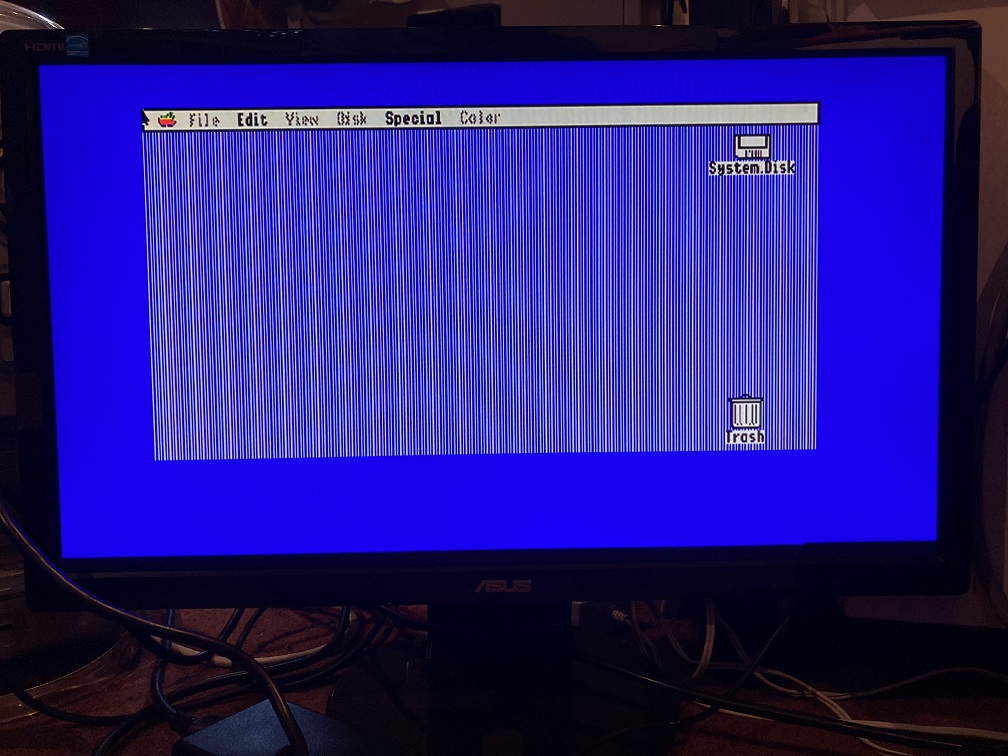
I’m beginning to see the light at the end of the tunnel for my Mac Sync-inator Mac to VGA adapter. The hardware is essentially final now, and all that remains are software tweaks, which are mostly related to the new composite sync splitter behavior. Along the way I’ve amassed a large test fleet of different monitors and an even larger number of Macintosh and Apple-compatible video sources, and testing all those combinations has been very slow.

 
Elevator Pitch

The Sync-inator is a small in-line dongle that aims to be a “pro version” of the Mac to VGA adapters you likely already have, and that takes some of the frustration out of the Mac-to-monitor setup dance, and enables some new combinations of video sources and monitors to work together that were previously incompatible.

The Sync-inator works by rerouting, modifying, or splitting the sync signals from the video source before they’re sent to the monitor. It’ll do everything that common Mac to VGA adapters (e.g. Belkin) will do, plus more. Sync-inator is not a video scaler, and the timing and resolution of the RGB video signals are not modified in any way, only the sync.

The Sync-inator’s “normal” features are:

  • DIP switches to set the desired video resolution. Settings for common resolutions are printed on the back of the device.
  • Configurable passive methods of sync pass-through, like a sync switch matrix.

The “pro” features of the Sync-inator over standard VGA adapters are:

  • Micrcontroller-driven active splitting of a composite sync signal into separate hsync and vsync signals. This is essential for older video sources that only provide composite sync. Although some monitors can handle composite sync or sync on green directly, many can’t, and for those monitors a composite sync splitter is required. This is what motivated this project initially, trying to get my Mac IIci built-in video working on one such monitor.
  • Auto-detecting and auto-configuration of the sync behavior, reducing the typical setup hassles experienced with other adapters. If it senses that hsync and vsync signals are already present, it’ll simply pass them through. If those signals aren’t present, then it’ll kick over to composite sync splitter mode.
  • Sync-inator has two LEDs that will visually show whether the video source is outputting composite sync, separate h and vsync, both, or neither. This should further reduce setup hassles, by making it easy to distinguish between cases where there’s no picture due to sync/resolution compatibility problems versus cases where the video source isn’t outputting anything at all.
  • Sync-inator has a serial port that will dump a bunch of diagnostic info about the video source and its characteristics and timing. That’s fun for video nerds, and maybe useful for something.

“Sync splitting” is a slightly misleading term, because it sounds like there are already two signals that simply need to be separated. In reality it’s more like “sync generation”, synthesizing two wholly new hsync and vsync signals using the csync signal as a reference. This is straightforward in theory, but in practice it’s proven challenging to get every timing detail 100 percent right. Along the way I’ve discovered that some monitors care about certain aspects of hsync and vsync that others don’t seem to: like whether they trigger from the hsync falling edge, rising edge, or both edges, their sensitivity to changes in hsync pulse width, and their tolerance for small amounts of jitter in sync signal edges.

 
Apple IIgs Testing

The Apple IIgs uses the same DB-15 port as early Macintosh computers for connecting RGB monitors, so I wondered whether the Sync-inator could also be made to work on the IIgs. The answer is mostly yes, although there are a few things to watch for. Although the IIgs uses the same pins as the Mac for RGB signals, grounds, and composite sync, some of the other pins are different. On the Mac, three pins are used as a Sense ID to set the desired video resolution, but the IIgs uses one of these same pins for a -5V power supply. It doesn’t need a Sense ID since it always outputs the same video resolution. Unfortunately this means one of the Sense ID DIP switch combinations will connect the IIgs -5V supply to GND. This isn’t fatal, but it prevents the IIgs from turning on, and it’s definitely not good. For IIgs use, the Sense ID switches can all be turned off.

Another challenge for the IIgs is the horizontal sync rate of 15.7 kHz, which is much lower than typical monitors will support. Even if the sync signals are all good, most monitors will refuse to display the RGB video from a IIgs. For testing purposes I bought a Samsung SyncMaster 512N specifically because it was reported to work at 15 kHz with the IIgs. Unfortunately it was a bust. The 512N’s activity LED would turn green and the backlight would turn on, but no picture would appear. The monitor’s front panel buttons were also unresponsive, as if the monitor firmware were frozen. I tried the IIgs’ RGB video in composite sync splitting mode, as well as sync-on-green and csync-to-hsync modes, with the same results every time. The failure in csync splitting mode could be a flaw with the Sync-inator, but the other modes should definitely have worked since this monitor supports 15 kHz as well as SOG and csync-to-hsync (I confirmed its sync support with some other video sources).

So I started doing some digging. In the manual for the 512N, it lists 30 kHz as the lowest supported refresh rate, not 15 kHz. Then I found a handy web page with a big list of older monitors and brief reports of their 15 kHz support. This page lists the 510N’s 15 kHz capabilities as “partial”. It doesn’t have an entry for the 512N, but I think they’re the same thing with and without audio speakers. The other SyncMasters in the same product series were also listed as “partial” or “no”.

After doing more reading, this leads me to believe that 15 kHz may be an undocumented feature that may only work on some 512N samples. Either Samsung changed the internal design during the product’s lifetime without changing the model number, or it’s a question of engineering tolerances and manufacturing variability whether 15 kHz works or not. In my case, the answer seems to be “not”.

Update: I later discovered that the IIgs was in PAL mode (50 Hz refresh). After switching the IIgs to 60 Hz vertical refresh, the 512N behaved identically to the VE228H described next.

 
A Second 15 kHz Monitor

But hang on, that handy web page also lists the Asus VE228H as having full 15 kHz support, and that just happens to be one of the eleven monitors in my growing fleet of test equipment. So I hooked up the VE228H in sync-on-green mode, and it worked! The title photo shows an Apple IIgs GS/OS desktop output via the Sync-inator on the VE228H. I also tried the mode where csync is sent to the monitor’s hsync input, and that worked too, even when I physically cut the green video line to be certain the monitor wasn’t sneakily using SOG.

Sadly the Sync-inator’s csync splitting mode didn’t work on the VE228H – mostly it just showed a blank screen or “out of range” error. That’s OK because csync splitting isn’t needed in this particular case, since one of the other sync modes can be used instead, but it meant that something wasn’t quite right with my 15 kHz csync-split signal. That might eventually be a problem in other settings with other monitors. I spent a long time fiddling with parameters and attempting to hand-tune the resulting sync signals to be as good as possible, and while I did succeed in getting the IIgs video to appear for brief moments, I never found a combination that worked reliably.

Is this a failure? Looking at that 15 kHz web page list again, most of the comments for monitors that worked say that they were tested with a simple passive adapter, without any fancy sync processing. The Sync-inator can do that too, as my tests showed. A 15 kHz csync splitting mode would only be relevant in cases where somebody has a IIgs and a 15 kHz monitor, but the monitor only supports 15 kHz on its separate hsync/vsync inputs and can’t support that same signal as sync-on-green or csync-to-hsync. The comments on the web page would suggest that’s a rare situation, maybe non-existent. Manufacturers that include 15 kHz support probably know that they’re targeting older computers and game consoles where composite sync and SOG are common.

Given all this, I’m planning to remove explicit IIgs support from the csync-splitting code, since it doesn’t work in its current incarnation, and since most of the time it should be possible to use another sync mode with the IIgs (assuming a 15 kHz monitor). Removing the IIgs-specific code would have other benefits too, slightly simplifying the main loop code for csync splitting and enabling it to run a bit faster, which might also help in other areas.

 
Status and Next Steps

With that, I think I’ve nearly reached the end of compatibility testing. One significant change made recently is the addition of a feature that dynamically changes the microcontroller’s system clock speed depending on the supply voltage it detects. The Sync-inator is normally self-powered, drawing its supply current from the sync signals themselves, and the supply voltage varies depending on the particular Mac or video card being used. Higher clock speeds require higher supply voltages. This clock speed adjustment allows for slightly more precise csync splitting behavior when sufficient voltage is available, but has no effect on the other passive sync translation modes.

“Normal” Mac-to-VGA adapter behaviors are now 100 percent working, including setting the desired video resolution through DIP switches, and choosing a passive sync translation mode. This matches the capabilities of other Mac-to-VGA adapters.

For troubleshooting help, the csync and hsync/vsync activity LEDs are working, and the serial port output is working. The default DIP switch setting for the sync mode is also “automatic”, which aims to reduce guesswork.

For the Mac IIci and IIsi, composite sync splitting is 100 percent working on every monitor that I’ve tested. That was my main goal, and it’s met. This enables the IIci and IIsi to work on a wider selection of monitors than before.

I’m fairly certain there aren’t any other Macintosh models whose built-in video doesn’t output separate hsync/vsync signals and that would benefit from csync splitting. Among plug-in video cards, I’ve only found a few early cards from the 1980s that don’t output separate hsync/vsync. For the Macintosh Monochrome Card, composite sync splitting with the Sync-inator is working out-of-the-box with 90 percent of monitors tested, and the one exception also works if an external 5V power supply is used. That’s great.

The Toby Nubus video card has a strangely different csync signal than others. It works with all of the monitors tested, but has a few quirks. For a small number of monitors, an external 5V supply for the Sync-inator is needed when using csync splitting mode. One “Planar” brand monitor balks at the csync splitting signals from the Toby, but automatically switches over to sync-on-green which works. I’d rate the csync splitting support for Toby as 4.5 out of 5 stars.

The SuperMac ColorCard SE/30 is another oddball. It fares similar to the Toby, working with all of the monitors tested but requiring a 5V Sync-inator supply when used with some fussier monitors. The benefit of a 5V supply appears to increase for higher resolution video modes. The Planar monitor behaves the same as with the Toby card, switching over to sync-on-green. I’d rate the csync splitting support for this SuperMac card as 4.5 out of 5 stars.

Although I’ve focused heavily on csync splitting in this discussion, most of the time csync splitting mode won’t be needed, because you’re not using a crusty old video source with composite sync or else because your monitor supports SOG or csync-to-hsync. Those common cases are completely working, 5 out of 5 stars.

I still need to clean up a few loose ends here, but I’m hoping I can finally finish this project soon.

06 Jan 16:17

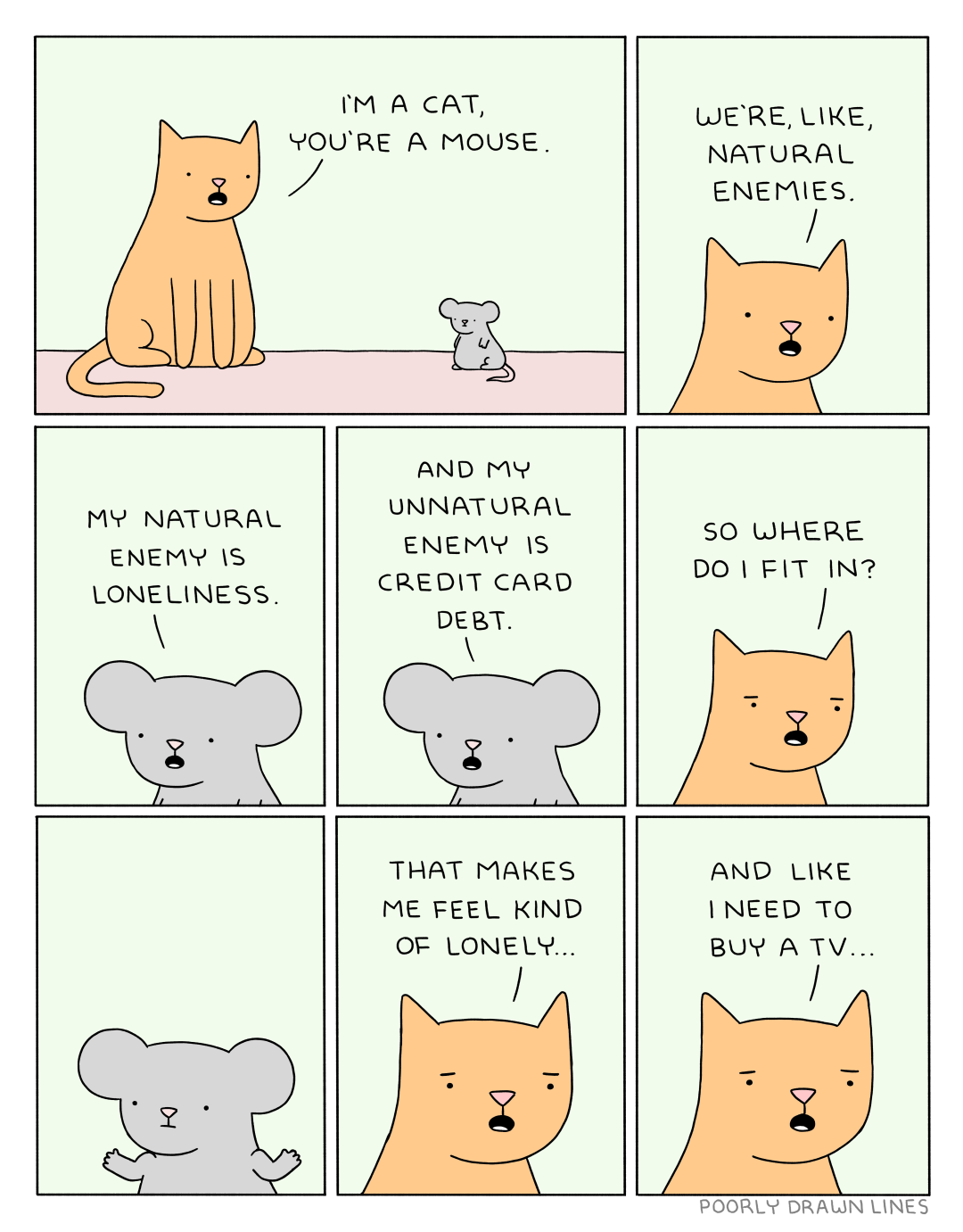
Natural Enemies

by Reza
06 Jan 16:15

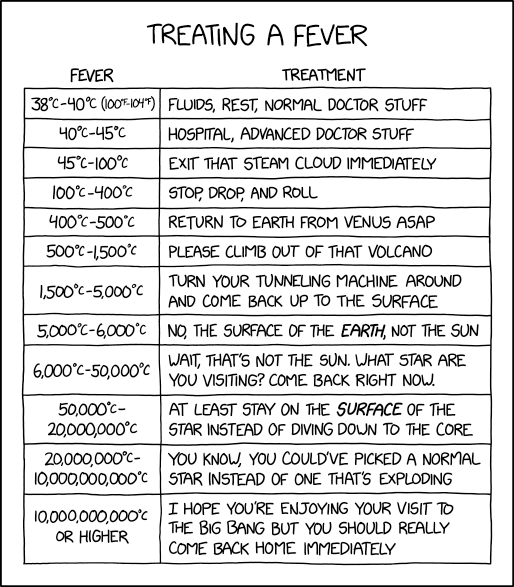
Fever

Hypothermia of below 98.6 K should be treated by leaving the giant molecular cloud and moving to the vicinity of a star.
05 Jan 20:50

Four Houston-area residents win $1 million-plus prizes from Texas Lottery scratch-off tickets

by Adam Zuvanich
The biggest recent scratch-off winner was a Conroe resident who took a $3 million prize, according to the Texas Lottery Commission, which also announced this week that a $1 million Powerball ticket sold in Houston in July had yet to be claimed.
05 Jan 15:45

Don't look so blue, Neptune: Now astronomers know this planet's true color

by Nell Greenfieldboyce

Neptune has long been depicted as a deeper, darker blue than its fellow ice giant Uranus, but a new study shows that both are a similar shade of light greenish blue.

(Image credit: P. Irwin)

05 Jan 15:43

What’s going on with the polar vortex, and is an Arctic outbreak on the way for Texas?

by Eric Berger

Earlier this morning, over on our companion site The Eyewall, Matt wrote about a series of winter storms that are going to affect the United States. Part of the post dealt with a topic that a lot of readers have been asking about, the stability of the polar vortex, and whether that means an outbreak of arctic air is likely to reach Texas later this month. The short answer is that yes, the second half of January does look colder. But how cold? That’s a forecast that’s impossible to make as of yet. Here’s Matt with the details.

There has been a lot of speculation on social media about the polar vortex coming later this month. The reasoning is attributed to a sudden stratospheric warming event (SSW) that displaces the polar vortex from the Pole and dumps cold air into the mid-latitudes where most people live. It sounds pretty terrible, unless of course you love cold. So what’s the deal, really?

Every winter, the polar vortex strengthens over the North Pole. It basically houses the coldest air in the Northern Hemisphere. It’s never perfectly still, but it’s usually confined to the North Pole. Every so often, the polar vortex can be disrupted, allowing cold to leak out of the polar region and toward the mid-latitudes, where most people live.

An example of a stable polar vortex that is typically seen in winter (left) and a disrupted polar vortex (right), which happens from time to time during winter. (NOAA/UCAR)

The image above lays out, broadly how this happens. For example, this winter has been a mild one for most of the U.S. so far, and it’s not a shock that the polar vortex has been fairly strong.

One of the pathways to displace or split the polar vortex is by what we call a sudden stratospheric warming. What is that, and why does it matter? When we talk about the “polar vortex,” most meteorologists are actually referring to the stratospheric polar vortex. We’re looking about 10 miles and higher up in the atmosphere. That’s the actual polar vortex. When you think of the polar vortex, you’re likely thinking of blobs of intense cold that periodically drop into the U.S. during winter. So, they’re two fundamentally different things. Related, but different.

During some winters, there will be a disruption of the stability in the stratosphere that happens via a sudden warming event, where the strong westerly winds locking the polar vortex over the Pole can weaken or even reverse. When that happens it can release some of that cold from the polar region into the mid-latitudes, impacting the U.S. or Europe or Asia.

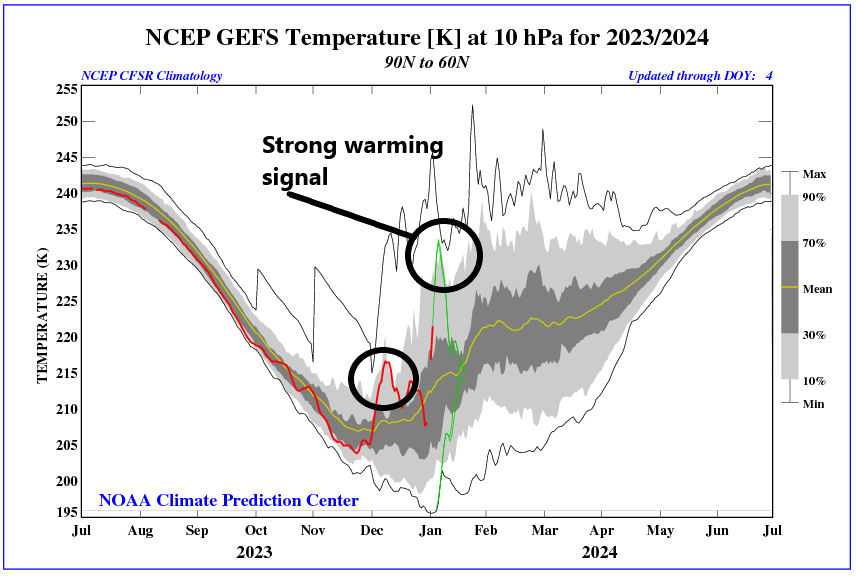
Stratospheric warming is ongoing, which may be enough to qualify as a lower-end sudden stratospheric warming event. (NOAA)

But that’s not a guarantee. No two SSWs are identical, and not every SSW will lead to a “release the hounds” cold air outbreak over the U.S. (or Europe or Asia). There’s a lot that we don’t completely understand about these events and what causes one to produce big cold or another to do little to nothing. But the bottom line here is that this year we are seeing a minor SSW event ongoing. This will do some work on the polar vortex, and it should allow for a relatively wavier jet stream heading into later January. That does not mean a repeat of the February 2021 or December 2022 cold events in Texas, but it could mean some pushes of stronger cold than we’ve seen so far this winter.

One hurdle right now is that snowfall across North America is running a good bit below normal.

Snowfall across North America is struggling mightily this year. (Rutgers University)

Snow cover is below average in the West, Canada, the Midwest, and Plains. Cold air modifies and moderates as it comes south, and when it travels over less snowy ground, it can moderate faster. This can change in the coming weeks, but will it happen in the Plains? That’s TBD.

The takeaway from all this is that a SSW event does *not* guarantee strong cold air. There are complicating factors involved that can prevent strong cold from materializing. However, an SSW event does tend to weaken the polar vortex and increase the odds that colder air could emerge from the polar regions at times in a few weeks. That does not necessarily mean a repeat of February 2021 (Uri). These types of situations occur several times a decade and most do not produce historic cold air like we saw in that event. But they can produce some of the coldest air of a given winter. So our advice: Sell the hype. But don’t be surprised if the forecast later this month turns a bit colder than we’ve seen so far this winter.

05 Jan 15:40

coworker offered to be my “work mom,” asking an employee to blur her Zoom background, and more

by Ask a Manager

This post was written by Alison Green and published on Ask a Manager.

It’s four answers to four questions. Here we go…

1. Coworker offered to be my “work mom”

I know your take on calling someone a work mom, but I’m wondering about your take on Work Parents in general. Through television, I’ve heard jokes about a work wife or work husband and, since it’s drama shows, never put much stock in it.

I’m relatively new to my team, and at a company lunch a woman who’s been with the company for a long time came over to offer the table of less-senior women a “work mom.” It was fairly easy to brush off, but she followed up with an email. Now, I’m all for a mentor. I’m very happy at my company and it’s incredibly rare in my field to have so many women. But this is also my second career, making me nearly 10 years older than the majority of my peers. My only thought at her offer was, “I have a biological mother and a mother-in-law and that’s plenty.” This woman doesn’t directly oversee any of the people she was talking to, but it’d be really easy to fall into that scenario here. Is this a normal relationship to happen in the office, and people have just gotten cute about the names? Does she actually mean a professional mentor role, not a motherly figure? Am I properly weirded out by this?

Maybe it also needs to be said — I’m a queer agender person with a feminine name and body, but I present very masculine/andro. It’s a reasonable assumption I’m also a little weirded out by gender roles.

No, that’s not a normal thing! It’s weird. I assume she was offering herself as a mentor, but calling it a “work mom” is really bizarre and problematic. (I promise you no men are going around offering themselves up as a “work dad” and if they are it’s coming across as creepy.) She could have simply said “mentor” and conveyed what she meant. “Work mom” brings in all sorts of other connotations that don’t apply in a business context, including that you are young and in need of parenting. It sounds like the phrase of someone who has no frame of reference for women in senior positions or with authority, and therefore “mom” — with all of its gendered subtext — is her go-to rather than “mentor,” “advisor,” or “senior colleague.” That in itself makes her suspect as a good choice for the role she’s offering.

(As a side note, it’s also a title that’s particularly odd to bestow on oneself! When it does get used, it’s normally in the context of a third party saying something like “Jane always makes sure everyone has enough food at meetings, she’s like our work mom” — which is also sexist and problematic — rather than someone saying, “hi, I’m available to be your work mom.”)

2. My team lead says it’s a problem that I don’t trust my incompetent coworker

I work in a close-knit team in a company with about 170 employees. I like my job and have grown a lot since I started a few years ago, but a situation with a coworker has me baffled and has made me question if I want to stay here.

“Brenda” has worked for the company for about 15 years, the longest of anyone on my team. She started at entry level and worked her way up to the role she has today, which I thought was really impressive. Until it wasn’t.

We deal with a lot of subjects that require tactfulness, and Brenda is as tactful as a sledgehammer. Her work is sloppy and her suggestions for technical solutions are so out of touch that I have found myself stunned into silence in meetings with her. Some of her mistakes could have been prevented if she brainstormed with anyone on the team first, but she likes to do her own thing. She doesn’t take feedback; either she coldly replies and does nothing, or she says thank you and corrects one mistake out of 10. There have been two instances since I started where she felt slighted and didn’t show up to group meetings to prove a point.

Her behavior is something I, and other coworkers, have addressed with my team leader several times, both separately and in a group. During one recent conversation with the team lead, they told me that I “have no trust in Brenda at all, which is a massive problem.” This shocked me, and I made it clear that I am not the problem here, Brenda is, and they agreed and mentioned that even our manager has seen examples of her sloppy work.

I have mulled on this conversation a lot: is it a bigger problem that I don’t trust my underperforming colleague than that someone underperforms? It can’t be okay that someone produces bad work as long as the team gets along, right? Ever since I started, and realized there was an annoyance with her work from others, I have tried to find something positive about her work and even told other coworkers to stop assuming the worst. But I am at my wit’s end with how to go about this. I feel like my team lead is dealing with Brenda with kid gloves and I fear that my only two options are accepting the situation or leave.

It sounds like those are indeed your only options, since you and others have raised your concerns repeatedly and nothing is changing. It’s possible something is happening behind the scenes that you don’t know about (in most cases you wouldn’t), but if it’s been months and months since you started raising the issues (as opposed to a few weeks), it’s safe to conclude you’re dealing with a passive manager who’s not handling a serious situation with the urgency it needs. (Updated to add: I just realized you didn’t say you’ve raised the problems with your actual manager. If you haven’t, that’s absolutely the next step.)

But no, it’s not a bigger problem that you don’t trust a coworker who has shown you can’t trust her than it is that she’s underperforming in the first place. If Brenda had fixed the problems and was operating differently and you still didn’t show her any trust a year later, that could be a reasonable thing for your team lead to flag — but when Brenda is still actively Brenda-ing, of course you don’t trust her. Why would you? Your team lead sounds like they’re focusing on something they feel they might be able to influence (you) rather than on Brenda because Brenda is a harder problem (and one they might have no power to affect, if their manager refuses to act).

3. Can I ask an employee to blur her Zoom background on external meetings?

Is it appropriate for me to ask my direct report to blur her Zoom background in external meetings? She works from her bedroom, which is totally fine — I couldn’t care less most of the time. However, her room is often untidy and the background is generally an unmade bed with a lazy dog lounging on it. I think that this is fine for internal meetings, I know she’s proud of her animals and likes to show them off. However, I invited her to an external meeting with a prospect for corporate sponsorship and it felt unprofessional. Is it appropriate for me to suggest that in external meetings we should blur our backgrounds? How could I go about this?

It’s 100% appropriate to say she needs a professional background for external meetings, and that one way to do that would be to blur her background. That’s a pretty basic professional expectation; you’re not overstepping by requesting it.

Say this: “I don’t care about anyone’s background during internal meetings, but for external meetings, we need a professional look, which includes no beds or pets visible on the call. I know it can be tough to find a neutral-looking space when you’re working from home, but blurring your background should solve it — can you plan to do that for external meetings?”

4. Can I take off a full week when no one can cover for me?

I work for a completely virtual, family-owned company, about 45 employees. I’ve been here eight years. I am head of a three-person department and answer directly to the owner/CEO. We haven’t had raises in two years, not even cost of living. We keep hearing how we’re losing customers — and we are. (Bad management, but that’s another letter!) I did negotiate a lot of vacation — 20 days a year, which I like because we only get seven paid holidays a year. I generally take vacation a few days here and there, because our sales/customer service staff gets hysterical if I can’t instantly respond to a customer request.

But now I want to take a week off at a time more often and completely disconnect. This is going to make our sales/customer service go nuts. The two people under me are very good and trustworthy, but don’t have the experience I do. I’m not saying I’m a genius and the only one who can possibly do this, but it’s more than technical training: it’s years of experience in areas I have that they don’t. Working to get them here just through video chats, when we don’t work near each other, would be next to impossible. Do I basically just find a polite way to say, “Folks, I’m taking off a week in two months from now. I’m well ahead on my scheduled work, but many of these customer ‘crises’ are just going to have to wait”? Or should I just realize life isn’t perfect and try to connect even when I’m on vacation?

Nope, take your vacation. Give people a heads-up in advance, but that’s your time off that you negotiated as part of your benefits package and you’re entitled to take it. Taking a few days here and there can be great, but it’s also important to be able to disconnect for a large chunk of time like a week or more or you won’t reap any of the real benefits of time away. (I say this as someone who just took five weeks off and didn’t even begin to feel fully decompressed until the end of it!) That kind of real break is necessary to avoid burn-out.

Unless you’re very highly compensated and it was part of the deal going in, do not agree to stay connected during your time off; if you do that, you’ll negate the benefits of trying to disconnect in the first place. (And frankly, even people in highly compensated jobs where it was part of the deal going in still can take full weeks off here and there if they set their minds to it.)

However, if your boss does push back and you think you’re likely to give in, this would be a very good time to say you need to revisit your salary if those are the expectations.

05 Jan 15:31

Grandma, Grandpa Have Same Haircut

05 Jan 15:30

23andMe Blames Customers For Massive Data Breach

The genetic testing company 23andMe, which was subject to a data breach in December that compromised the genetic and ancestry data of 6.9 million users and now faces more than 30 lawsuits, blamed the victims of the hacking in a recent letter to users, stating that they “negligently recycled and failed to update their…

Read more...

05 Jan 15:29

The Good and Bad of Berlin Transit: Part 3

by Reece Martin

This is actually the third and final post in my series of “The Good and Bad Of” posts on Berlin, and I recommend reading the first and second post before diving into this one!

Good Roads and Buses 👍

Depending on how you look at this ,it’s either very good or very bad. I’ll start with the bad so nobody thinks I am ignoring it — Berlin feels quite car-oriented. What was remarkable about the city having spent so much of the last decade in Toronto is that people talk about Toronto being car-oriented, and while this is also said of Berlin, the truth on the ground is that I felt similarly unsafe walking around Berlin.

Subscribe for free to help support the blog!

Trying to cross the street and having aggressive drivers not yield was not great, and worse still was when I saw a driver slam on the gas and weave around a cyclist at high speed on a narrow street near Friedrichstraße.

That being said, Berlin is more refined in its car-oriented nature, and a lot of that ends up paying off for transit riders — particularly those on buses (once you get off the vehicle it can be rough). At one point when I was “investigating” a very nice Mercedes bus at the Hauptbahnhof, the bus took off and headed into the (surprisingly long) tunnel under the Tiergarten and the Spree, which gets you most of the way to Potsdamer Platz. While this infrastructure probably overwhelmingly benefits cars, it was amazing how quickly I made that trip on bus, and it felt almost like it would be competitive with rapid transit that might make a stop between the two big stations.

A bus speeding along on a Berlin road.

The other thing I really notice when compared to Canada — and not just Toronto and Montreal, but even Metro Vancouver — was the buttery smooth quality of the roads, which meant riding a bus (a good bus to be sure) was quite the blissful experience.

Retail in Transit 👍

Something that was very nice in Berlin that you basically do not see in Canada is an enormous amount of shops and services in train stations. While perhaps not so unique for big train stations like Berlin Hauptbahnhof, what was cool to see was how many fairly small S-Bahn and U-Bahn stations have shops right on the platform. This is interesting because obviously Berlin generally has more minimal stations, which tend to not be very deep and do not have faregates or turnstiles and thus eliminate an entire portion of what you see in stations in London, Paris, or New York. Despite this, the many wide island platforms in the city are put to good use with kiosks that offer all kinds of things.

The S-Bahn platform at Ostkreuz, with lines of shops down the centre.

Probably my favorite example of this is at Ostkreuz (which is just generally an awesome station) where the S-Bahn platform for the Ringbahn is ultra wide, and thus has enough space for passengers to wait for trains going in both directions, but also for a central “walkway” down the middle of the island platform that is flanked by two rows of shops.

The approaches seen in Berlin are interesting, because instead of slightly expanding intermediate spaces, the preference is for large open volumes that are frequently filled with lots of utilities for passengers (there’s probably something to be drawn from this regarding how at Berlin Hauptbahnhof you’re kind of meant to hang out on the platforms). I think this works especially well due to the lack of fare paid and unpaid zones, which allows people to easily flow through parts of the station.

Digitally-Enabled 📱

Berlin’s system often does not look all that modern — I love the elevated section of U1 and U3 precisely because it looks and feels so “old-timey”. But what’s amazing about the system overall is how modern it feels.

An U-Bahn train on dated infrastructure near Schlesisches Tor.

This may be unremarkable to you if you are from Berlin, but the pervasiveness of free public wifi on the transit system was awesome, especially coming from London where free wifi basically doesn’t exist (unless you already are signed up with a British phone carrier, at which point why are you using Wifi?).

The “digitally-enabled” ticketing was also awesome, and yet another reminder of why proof-of-payment can be so great. As I was waiting to get off my flight in Berlin, I was able to download the BVG app (which is really good!) and get a zonal transit pass, as well as activate it and put it in my Apple Wallet. From then on out, I never really thought about ticketing again, and that’s a pretty cool experience. Even though that flow is all digital, since there isn’t fixed station infrastructure I had to interact with, it should be pretty easy to implement and inexpensive to operate, and frankly I really enjoy not having to ever pull out a card or ticket while riding around town.

And I think this all goes to highlight why Berlin’s public transport is such a good experience. — the embodiment of less is more!

05 Jan 15:20

daily-spooky:

04 Jan 21:28

‘The Onion’ Has Obtained A Copy Of Everyone Named In The Jeffrey Epstein Trial

A federal judge has unsealed hundreds of documents naming victims and con-conspirators in the trial of deceased sex offender Jeffrey Epstein. The Onion obtained a copy of these documents. Here, in pursuit of transparency and journalistic forthrightness, we present the names for the public’s enlightenment.

Read more...

04 Jan 21:26

Report: List Of So-Called Elite Perverts Lacks Star Power

NEW YORK—Dismissing the long-awaited unsealing of court documents related to Jeffrey Epstein as “underwhelming,” sources reported Thursday that the list of so-called elite perverts lacked star power. “Bill Clinton, Prince Andrew, David Copperfield—what kind of cabal are they running here?” said sources who…

Read more...

04 Jan 21:25

my interview was canceled because I was “rude and pushy”

by Ask a Manager

This post was written by Alison Green and published on Ask a Manager.

A reader writes:

After an eight-month job search in a second language, I finally lined up a great interview with a great company. It took them four weeks from my application (and a follow-up email) to get the interview but, at 9:30 pm on a Monday night, they asked me to confirm one of two time slots on Thursday.

Time slot confirmed, I sat back to wait for details of where I had to be, or how the interview would take place. By Wednesday, I was a little twitchy and sent another email asking for some details. Thursday morning, two hours before the interview was to take place, I still knew nothing. So I sent a Google Meets link and asked if that worked for the interviewer.

Ten minutes later, I received an email telling me the interview, and my candidacy, were cancelled on account of me being “rude and pushy.” I thought I was showing initiative and enthusiasm. I called to clarify and make things right and was told it was “no big deal, as you were our weakest candidate.”

I’m not sure how else I was supposed to handle that situation, so … was I rude and pushy? And how should I have done it differently?

You weren’t rude but you were a little pushy.

But not horrifically so, and not in any way that justified rejecting you over it.

Generally it’s up to the interviewer to determine what meeting software will be used for the interview and to set it up and generate an invitation. This is more about convention than logic, but it is very much the convention. (Partly it’s because as the candidate you don’t necessarily know exactly who will be attending and thus needs the link, whether they have internal procedures they have to adhere to, etc. — but all those things are also true of, say, vendor meetings and yet the convention that party X will always issue the invitation isn’t nearly as strong there.) But convention carries a lot of power and, rightly or wrongly, flouting it can make you look pushy or out of touch with professional norms or other things that don’t help you when you’re interviewing.

Now, should they have sent details to you earlier than Thursday morning? Yes! It’s rude to leave a candidate waiting like that, making them wonder if the meeting is even going to happen. But at the same time, it’s not terribly uncommon for people to only send meeting links right before a meeting time. And if that’s their regular practice, having you send your own link came across as Too Much.

With interviews, you’ll generally do better if you accept that you don’t have total control. Maybe your interviewer will call when they say they’ll call, maybe they won’t. Maybe they’ll send you the meeting link the night before, maybe they’ll send it 30 minutes before. All of this is nerve-wracking for candidates (and none of it is right or anything I’d advise employers to do, just very common) but you can’t control it. Setting up your own meeting link and sending it to them doesn’t make it any more or less likely that they’ll be at that meeting. Either they’re on top of their appointments or they’re not; if they’re not, your meeting link won’t change that. Because of that, I think your action was partly about self-soothing — “now there’s a meeting link so I can relax and won’t need to wait for theirs” — but it’s not aligned with that reality, and it came at the expense of annoying them.

But to the extent that your meeting link was Too Much, it was a small thing, not something to reject you over. They could have simply replied, “Apologies for the delay — we’ll be using Zoom and here’s the link.”

And then telling you it was “no big deal” because you were their weakest candidate? That’s a rude and snotty response, which amplifies the snottiness of their handling of the situation as a whole.

I’m hesitant to say “bullet dodged” based just on this one thing — maybe they’ve got one crappy HR person but the rest of the company is great — but it’s not an awesome sign about them.

04 Jan 17:53

They did it again

modmad:

beatrice-otter:

thegaymertrainer:

They did it again

Oh, cool! I love the behind-the-scenes stuff. If you’ve never seen the original (this version is narrower so you miss a lot that was going on) it’s here:

THANK YOU

04 Jan 14:11

Potholes In Nice Part Of Town Filled With Italian Marble

04 Jan 14:10

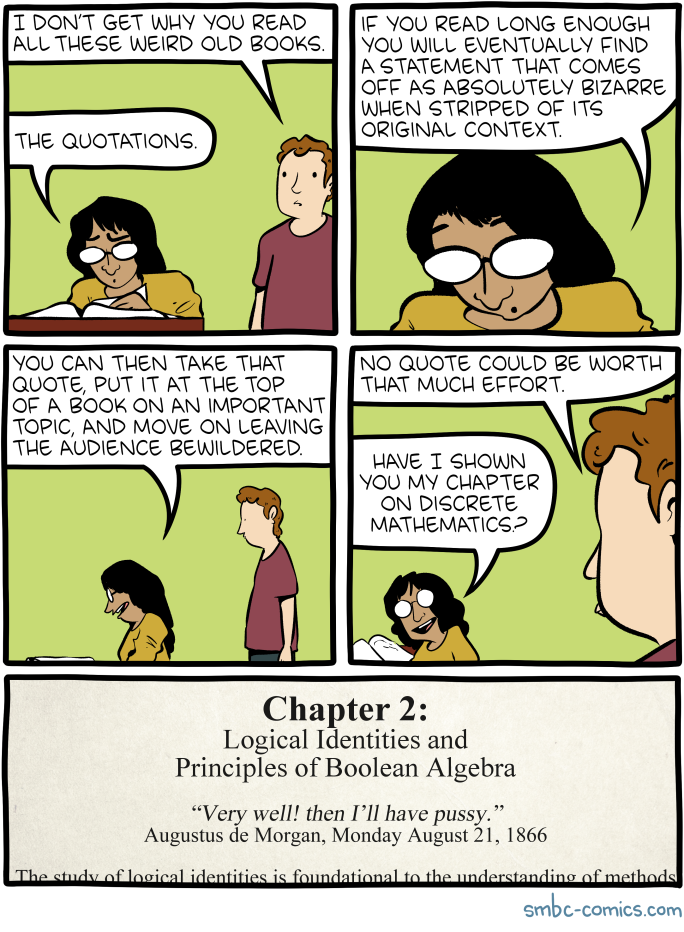
Saturday Morning Breakfast Cereal - Quote

by Zach Weinersmith


Click here to go see the bonus panel!

Hovertext:
This isn't quite on the level of the time Hemingway said 'Fuck literature' but it *is* more out-of-context.


Today's News:

Right here.

04 Jan 12:21

Texan Bitcoin miners profit by using less electricity; advocates say all Texans should get the same chance

by Kevin Vu and Emily Foxhall
Bitcoin miner Riot Platforms made headlines over the summer for making millions by selling pre-purchased power back to the grid. The news highlighted how the grid can benefit businesses more than consumers.
04 Jan 12:20

This town wants to be named the quinceañera capital of Texas

by Jess Huff
Diboll’s growing Hispanic population has inspired a new economy of party planners and DJs to produce quinceañeras. City leaders are taking notice.
04 Jan 12:09

Everyone Laughing At Thing Man Can’t Change About Himself

04 Jan 12:09

Live Together, It's Time!

This two-bedroom condo is perfect for you and Jessica. It’s been two years, and really, what are you so afraid of? You’d each get your own bathroom, there’s oak flooring throughout, and there’s something about the granite countertops that just screams “mature decision.” Low taxes!

Read more...