Shared posts

06 Aug 01:10

Why Are There No Short Arch Dams?

by Wesley Crump

[Note that this article is a transcript of the video embedded above.]

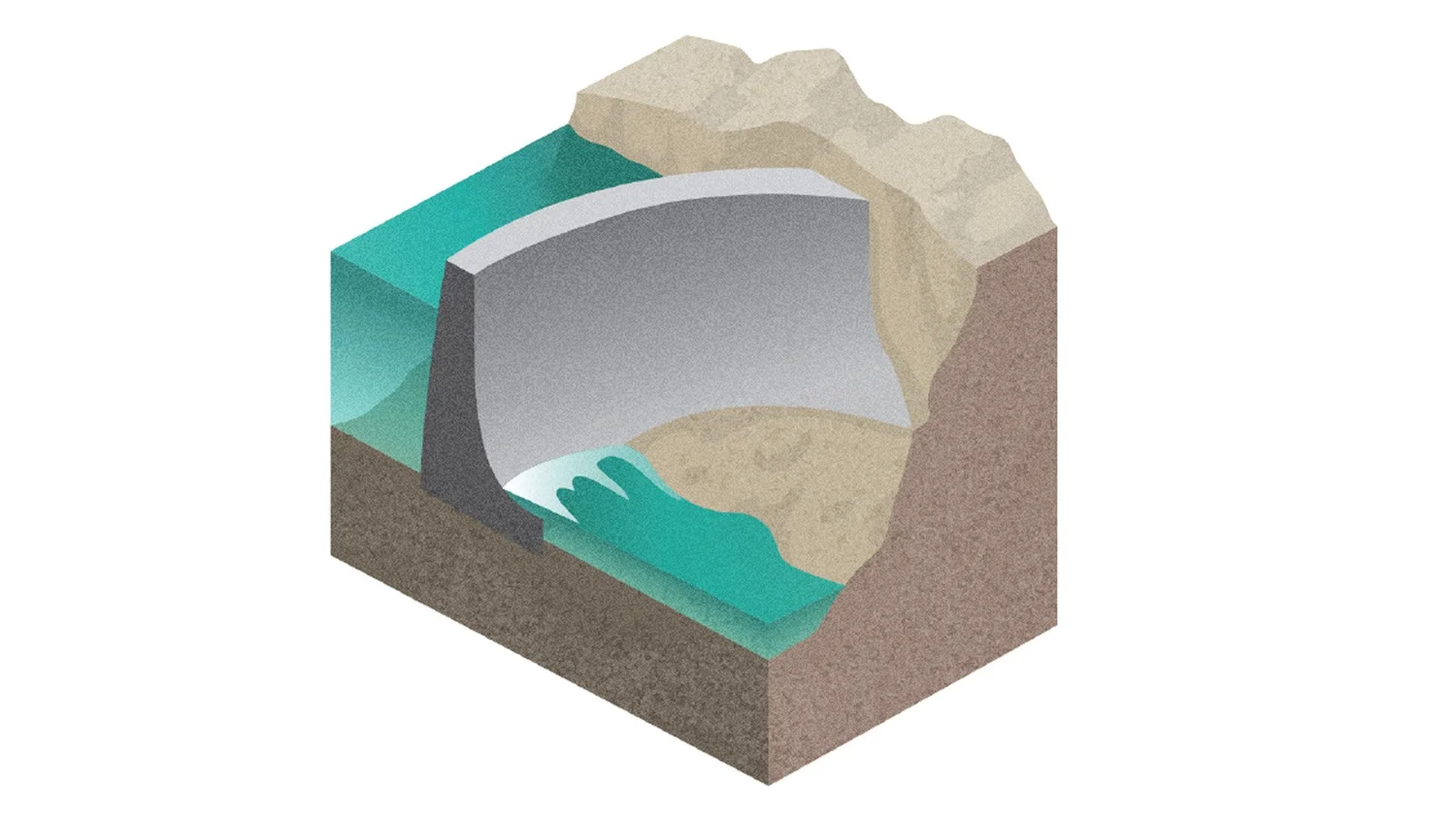
Flaming Gorge Dam rises from the Green River in northern Utah like a concrete wedge driven into the canyon, anchored against the sheer rock walls that flank it. It’s quintessential, in a way. It’s what we picture when we think about dams: a hulking, but also somehow graceful, wall of concrete stretching across a narrow rocky valley. But to dam engineers, there’s nothing quintessential about it. So-called arch dams are actually pretty rare. For reference, the US has about 92,000 dams listed in the national inventory. I couldn’t find an exact number, but based on a little bit of research, I estimate that we have maybe around 50 arch dams - it’s less than a tenth of a percent.

The only reason we think of arch dams as archetypal is because they’re so huge. I counted 11 in the US that have their own visitor center. There just aren’t that many works of infrastructure that double as tourist destinations, and the reason for it is, I think, kind of interesting. Because an arch dam isn’t just an engineering solution to holding back water, and it’s not just a solution to holding back a lot of water. It’s all about height, and I built a little demo to show you what I mean. I’m Grady, and this is Practical Engineering.

Engineers love categories, and dams are no exception. You can group them in a lot of ways, but mostly, we care about how they handle the incredible force of water they hold back. Embankment dams do it with earth or rock, relying on friction between the individual particles that make up the structure. Gravity dams do it with weight. Let me show you an example.

I have my tried and trusted acrylic flume with a small plastic dam. Once this is all set up, I can start filling up the reservoir. This little dam is a little narrower than the flume. It doesn’t touch the sides, so it leaks a bit. The reason for that will be clear in a moment. And hopefully you can see what’s about to happen. This gravity dam doesn’t have much gravity in it, so it doesn’t take much water at all before you get a failure. I’m counting failure as the first sign of movement, by the way. That’s when the stabilizing forces are overcome by the destabilizing ones. And the little dam by itself could hold until my reservoir was about a quarter of the way to the top.

Gravity dams get their stability against sliding from… you guessed it… friction. Bet you thought I was going to say gravity. And actually, it kind of is gravity, since frictional resistance is a function of just two variables: the normal force (in other words, the weight of the structure) and a coefficient that depends on the two materials touching. Engineers analyze the stability of gravity dams in cross-section, essentially taking a small slice of the structure. You want every slice to be able to support itself. That’s why I didn’t want the demo touching the sides of the flume; it would add resistance that doesn’t actually exist in a cross-section. The destabilizing force is hydrostatic pressure from the reservoir, which increases with depth. And the stabilizing force is friction. There are some complexities to this that we’ll get into, but very generally, as long as you have more friction than pressure, you’re good; you have a stable structure.

So let’s add some normal force to the demo and see what happens. [Beat] You can see my little reservoir gets a little higher before the dam fails, about halfway to the top. And we can try it again with more weight. But the result gets a little more interesting… the dam didn’t actually slide this time, but it still failed.

Turns out gravity dams have two major failure modes: sliding and overturning. Resistance to sliding comes from friction, which really doesn’t depend on how the weight of the dam is distributed. That’s not true for overturning failures. Let’s look back at our cross-section. For a unit width of dam, the hydrostatic pressure from the reservoir looks like this. Pressure increases with depth. And the area under this line is the total force pushing the dam downstream. We can simplify that distribution and treat it like it’s a single force, and it turns out when you do that, the force acts a third of the way up the total depth of water. Most dams want to rotate about the downstream toe, so you have a destabilizing force offset from the point of rotation. In other words, you have a torque, also called a moment. The dam has to create an opposite moment around that point to remain stable. Moment or torque is calculated as the force multiplied by its perpendicular distance from the point of rotation. So, the further the center of mass is from the downstream toe, the more stable the structure is, and the demo shows it too.

Here’s where we left the weights the last time, and let’s see it happen again. The reservoir makes it about two-thirds of the way up the walls before the dam overturns. Let’s make a simple shift. Just move the weights further upstream and try again. It’s not a big difference. The reservoir reaches about three-quarters the way up before we see a sliding failure, but shifting the weights did increase the stability. And this is why a lot of gravity dams have a fairly consistent shape, with most of the weight concentrated on the upstream side, and usually a sloped or stepped downstream face.

Interestingly, you can use the force of water against itself in a way. Watch what happens when I turn my little model around. Now the hydrostatic pressure applies both a destabilizing and stabilizing force, so you get more resistance for a given depth. A lot of deployable temporary storm barriers and cofferdam systems take advantage of this kind of configuration. You can imagine if I extended the base even further, I could create a structure that was self-stable just from its geometry alone. The weight of the water on the footing would overcome the lateral pressure. But there’s a catch to this. This is fully stable now, but watch what happens when I give the dam just a bit of a tilt. All of a sudden, it’s no longer stable.

This might seem kind of intuitive, but I think it’s important to explain what’s actually going on. Hydrostatic pressure from the reservoir doesn’t only act on the face of a dam. With smooth plastic on smooth plastic, you get a pretty nice seal, but as soon as even a tiny gap opens, water gets underneath. Now there’s upward pressure on the bottom of the dam as well. If you’re depending on the downward force of a dam from its weight for stability, it’s easy to see why an upward force is a bad thing. And it’s so dramatic in the example with the upstream footing specifically. In that case, the downward pressure of the reservoir is acting as a stabilizing force, but if water can get underneath that footing, it basically cancels out. The pressure on the bottom is the same as the pressure on the top. But this isn’t only an issue in that case.

The ground isn’t waterproof. In fact, I’ve done a video all about the topic. Soil and rock works more like a sponge than a solid material, and water can flow through them. That’s how we get aquifers and wells and springs and such. But it’s a problem for gravity dams, because water can seep below the structure and apply pressure to the bottom, essentially counteracting its weight. We call it uplift.

Looking back at the cross-section, we can estimate this. Of course, you have the triangular pressure distribution along the upstream face. But at this point you have the full hydrostatic pressure also pushing upward. And at the downstream toe, you have no pressure (it’s exposed to the atmosphere). So, now you have a pressure distribution below the dam that looks like this. Of course, this part can get a lot more complicated since most dams don’t sit flush with the ground, and many are equipped with drains and cutoff walls, so definitely go check that other video out if you want to learn more.

But let me show you the issue this causes with some recreational math on our cross-sectional slice of the dam. The taller the dam, the greater the uplift force. That happens linearly. In other words, the force is proportional to the depth of the reservoir. But look at the lateral force. Again, remember it’s the area under this triangle. Maybe you remember that formula: one-half times base times height. Well, the height is the depth of the water. And the base is also a function of the depth. More specifically, it’s the unit weight of water times depth. Multiply it together, and you see the challenge: the force increases as a function of the depth squared. So for every unit of additional height you want out of a gravity dam, you need significantly more weight to resist the forces, which means more material and thus a lot more cost.

Hopefully all this exposition is starting to reveal a solution to this rapid divergence of stability and loads as a reservoir increases in height. Dams don’t actually float in space like my demonstration and graphics show. You know, by necessity, they extend across the entire valley and usually key into the abutments on either side. Naturally, that connection at the sides is going to offer some resistance to the forces dams need to withstand. And if you can count on that resistance, you can significantly lower the mass, and thus the cost, of the structure. But, again, this gets complicated. Let’s go back to the demo.

Now I’m going to replace my gravity dam with something much simpler. Just a sheet of aluminum flashing, and, to simulate that resistance provided by socketing the structure into the earth, I’ve taped it to the bottom and sides… with some difficulty, actually. When I fill up the reservoir with water, it holds just fine. There’s a little leaking past my subpar tape job, but this is a fully stable structure. And I think the comparison here is pretty stark. When you can develop resistance from the sides you can get away with a lot less dam. But it’s harder than you might think to do that.

For one, the natural soil or rock at a dam site might not be all that strong. The banks of rivers aren’t generally known for their stability, so the prospect of transferring enormous amounts of force into them rarely makes a lot of engineering sense. But the other challenge is in the dam itself. Take a look back at this demo. See how my dam is bending behind the force of the water. It’s holding there, but, you know, we don’t actually build dams out of aluminum flashing. Resisting loads in this way basically treats the dam like a beam, like a sideways bridge girder. Except, unlike girder bridges that usually only span up to a few hundred feet, dams are often much longer. Even the stiffest modern materials, like prestressed concrete boxes, would just deflect too much under load to transfer all the hydrostatic pressure across a valley into the abutments. Plus we usually don’t like to rely on steel too much in dams because of issues with corrosion and longevity. So where a typical beam experiences both tensile and compressive stress on opposite sides, we really need to transfer all that load, creating only compressive stress in the material. I’m sure you see where I’m going with this.

How have we been building bridges for ages from materials like masonry where tensile stress isn’t an option? It’s arches! The arch is a special shape in engineering because you can transfer loads by putting the material in compression only, allowing for simpler, cheaper, and longer-lasting materials like masonry and concrete. You basically co-opt the geology for support, reducing the need for a massive structure. For completeness’s sake, let me show you how it works in the demo. I’ve formed a little arch from my thin sheet of aluminum. Now when I fill up the reservoir, there’s no deflection like the previous example. And again, side by side, it’s easy to see the benefits here. You get a lot more efficiency out of your materials than you do with an earthen embankment dam or a gravity structure.

Of course, there are some drawbacks here. For one, arches create horizontal forces at the supports called thrusts that have to be resisted. Sites that use this design really require strong, competent rock in the abutments to withstand the enormous loads. And just like with bridges, the span matters. The wider the valley, the bigger the arch needs to be, so these dams generally only make sense in deep gorges and steep, narrow canyons. The engineering is a lot more complicated, too. You can’t use a simple 2D cross-section to demonstrate stability. The structural behavior is inherently three-dimensional, which is tougher to characterize, especially when you consider unusual conditions like earthquakes and temperature effects. And since they’re lighter, arch dams don’t resist uplift forces very well, making foundation drainage systems more critical. All this means that it’s really only a solution that makes economic sense in a narrow range of circumstances, one of the most important being height.

For smaller dams, the additional complexity and expense of designing and building an arch aren’t justified by the structural efficiency. Gravity and embankment dams are much more adaptable to a wider range of site conditions. And there are other types of dams, too, that blend these ideas. Multiple-arch dams use a series of smaller arches supported by buttresses, dividing the span into more manageable components. Even what is perhaps the most famous arch dam in the world - Hoover Dam - isn’t a pure arch structure. Technically, it’s a gravity-arch dam, meaning it resists part of the water load through mass while also distributing the forces into the canyon through arch action. The proportions are carefully balanced to take advantage of the unique site conditions and relatively wider canyon than most arch dams are built in.

And so, when you look at the tallest dams on Earth, one structural form dominates. By my estimation, around 40 percent of the tallest 200 dams in the world incorporate an arch into their design. There aren’t that many places where it makes sense, but when you compare what it takes to hold a reservoir back in a narrow canyon valley, I think the case for arches is pretty clear.
06 Aug 01:09

Texas AG can't depose Catholic Charities leader in migrant aid case, appeals court rules

by By Uriel J. García
The three-judge panel agreed with a lower court that Ken Paxton’s office can’t question officials from Catholic Charities under oath without first filing a lawsuit.
06 Aug 01:09

Gov. Greg Abbott asks Texas Supreme Court to expel House Democratic leader who left state

by By Eleanor Klibanoff
Legal experts say it’s “inconsistent with the Texas Constitution” to argue that leaving the state to halt legislative action qualifies as abandoning an office.
06 Aug 01:08

Titan implosion that killed all five on board was 'preventable', says report

A damning report from the US Coast Guard says Oceangate, that owned and operated the Titan, failed to follow safety protocols.
06 Aug 01:08

'Vote him out!' - Republican lawmaker Mike Flood heckled by constituents

The Nebraska representative faced backlash over President Trump’s tax and spending bill, which was signed into law in July.
06 Aug 01:06

Tropical Atlantic holding steady as the slow churn continues

by Matt Lanza

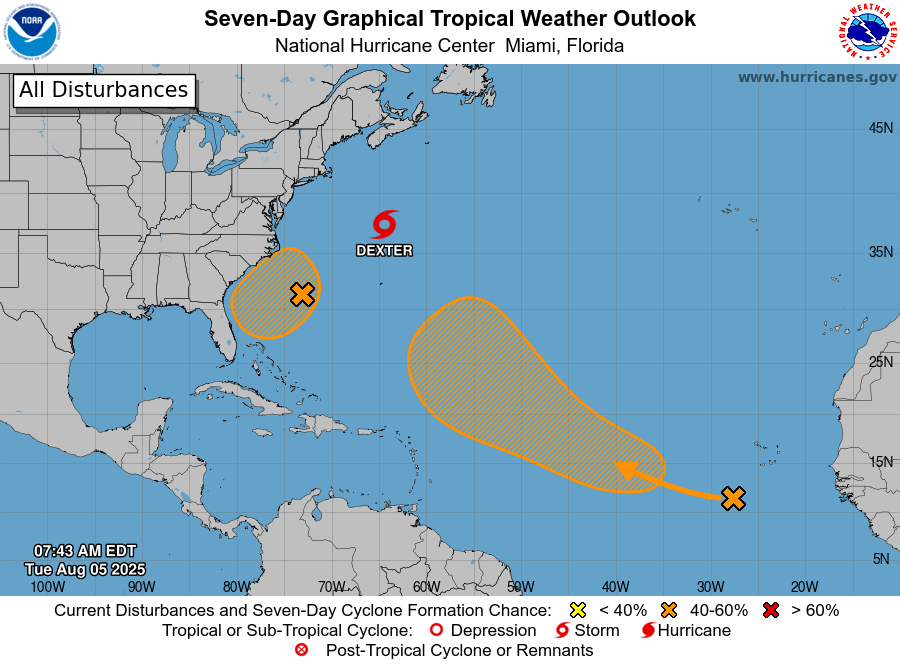
In brief: Tropical Storm Dexter is sloppy this morning but continues to head out to sea. An area just off the Carolinas now has a 40 percent chance of developing, and it will likely be a heavy rain, rip current, and tidal flooding risk. Deeper in the Atlantic, nothing looks overly concerning, but we continue to see signs of life and development chances in the future.

Tour de Tropics

UnambiDexterous

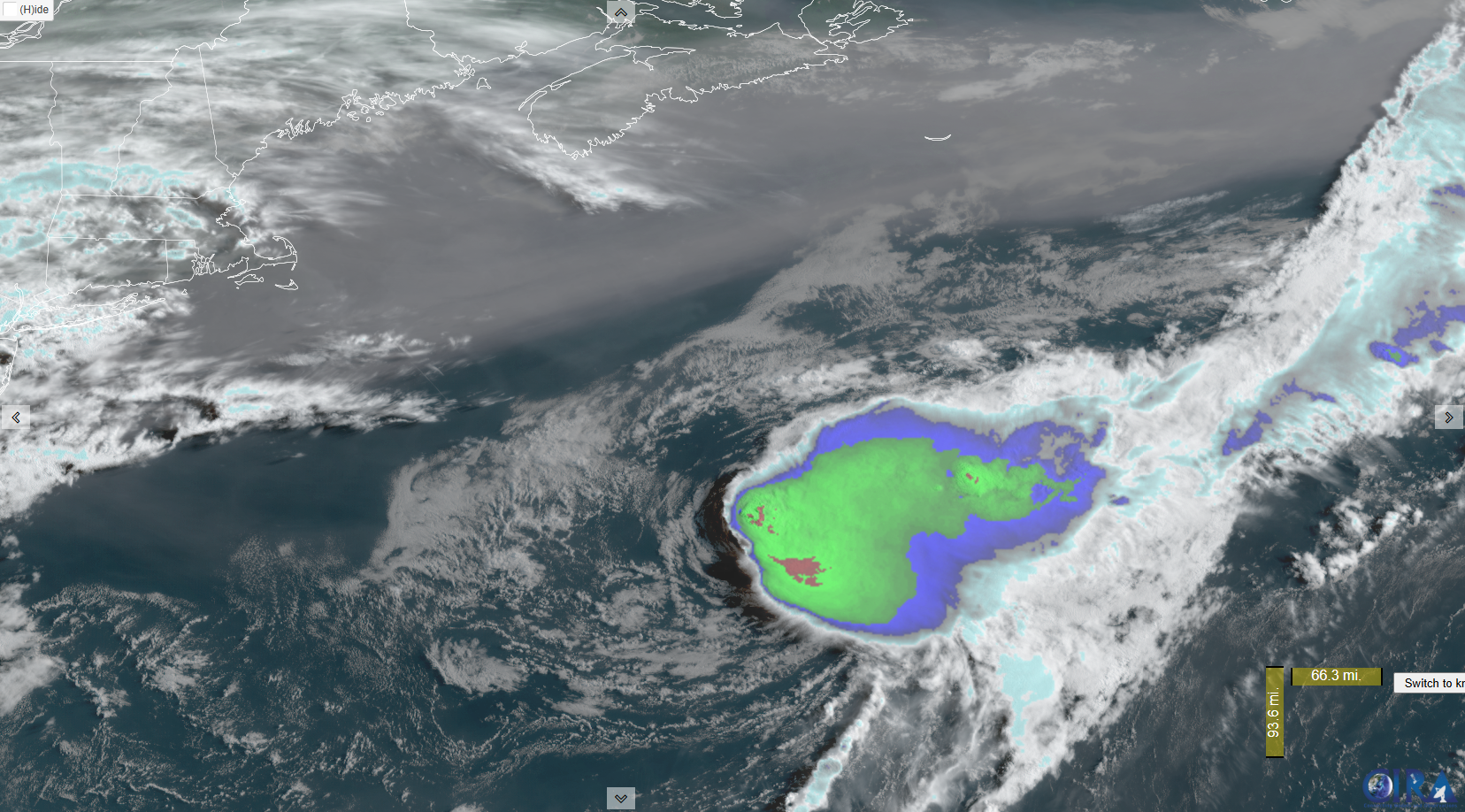
Dexter is only moving in one direction, and that’s out to sea.

Tropical Storm Dexter south of a massive plume of wildfire smoke over the open Atlantic. (Colorado State CIRA)

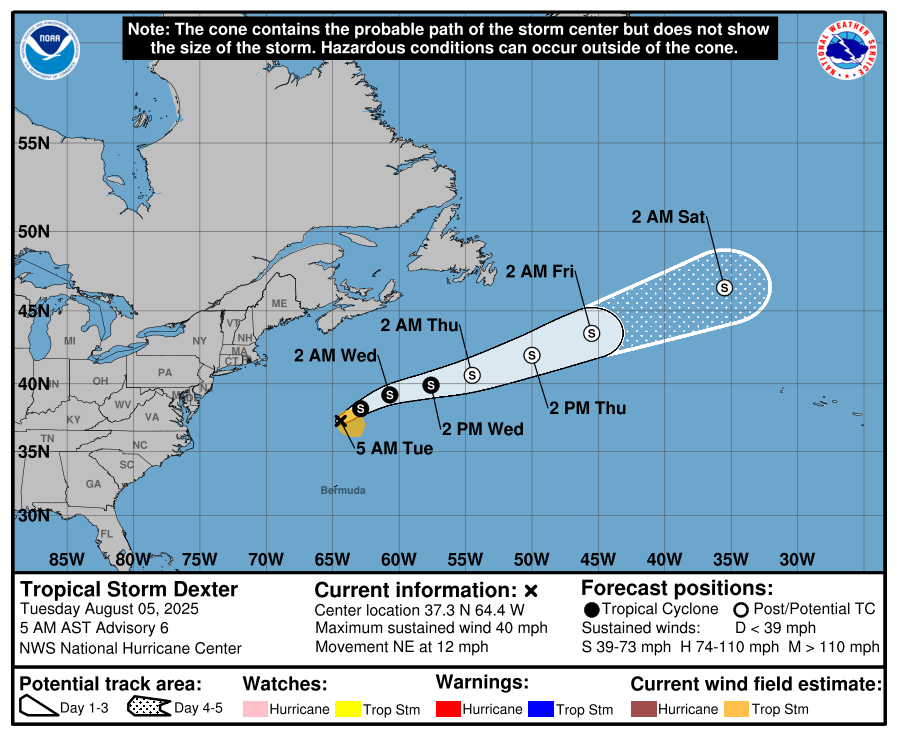
Dexter’s center was exposed some earlier this morning, but it appears that thunderstorms have blossomed back over it after sunrise. Still, this is trending downward overall, and it wouldn’t be a shock to see Dexter go post-tropical by tomorrow as it races out to sea.

(NOAA/NHC)

Dexter’s remnant circulation will probably be absorbed by a storm system moving into northwest Europe, most likely near or north of the British Isles by early next week.

Southeast coast

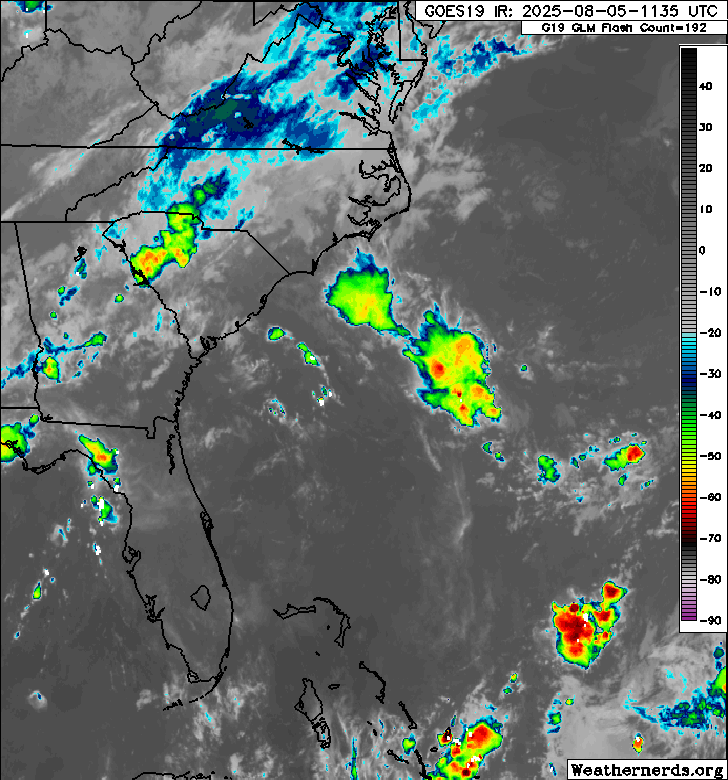
Next on our tour, we look close to home. There’s not much to see this morning with just some scattered clusters of thunderstorms off the coast of the Carolinas.

Disorganized clusters of thunderstorms sit off the Southeast coast on Tuesday morning. (Weathernerds.org)

Over the next 36 hours or so, low pressure may develop in this area, however, and that’s when things may get a touch more interesting. This area was just bumped to 40 percent odds of developing over the next several days. At least today, it does not appear that whatever develops in this region will get terribly strong. But the overall environment is favorable for slow strengthening, as are water temperatures. One interesting thing about this is that steering currents don’t exactly look strong in this area. In other words, whatever this is will probably not move a ton, at least not in the first few days.

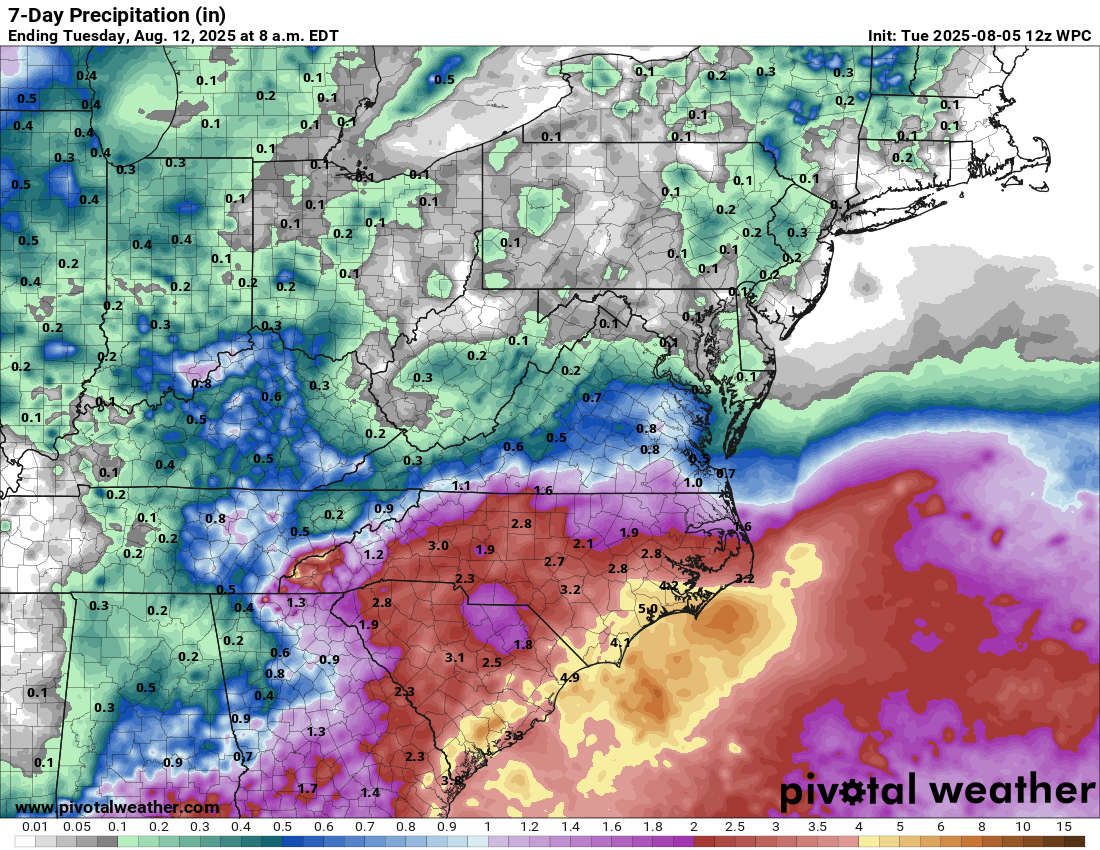
Heavy rain is likely on the coast of North and South Carolina, as well as perhaps over the Piedmont and in the Smokies. (Pivotal Weather)

The initial concern on this will be rip currents on the coast of North and South Carolina, as well as heavy rainfall. Should a system develop and organize some offshore, obviously we’d watch that for the direct tropical risks. If it just sits and spins offshore, we’ll probably want to watch for coastal flooding risks from Virginia into South Carolina.

Bottom line at this point: We should continue to monitor this area over the next couple days, especially because of its proximity to land. At this time, it seems as though rain, rip currents, and perhaps tidal flooding will be the primary issues from this area.

Wild card? A handful of ensemble members develop the low pressure area farther south, closer to Florida. While that is a minimal minority of ensemble members, it’s at least something to perhaps keep a side eye on. It’s far less likely than something off the Carolinas though.

Deep Atlantic

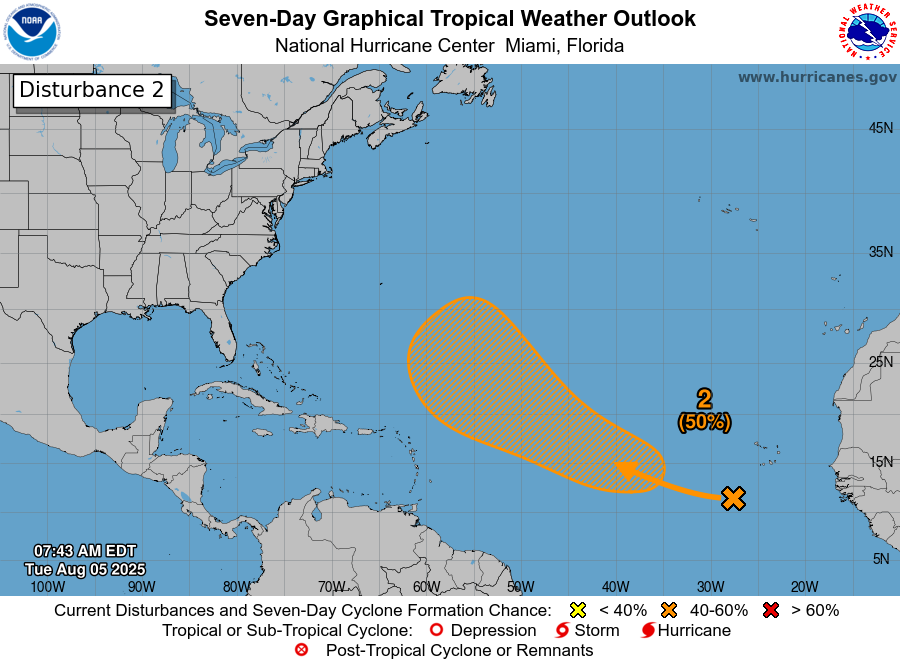
Last on our stop, the deep Atlantic, where the NHC continues to outline a broad 50 percent risk area.

(NOAA/NHC)

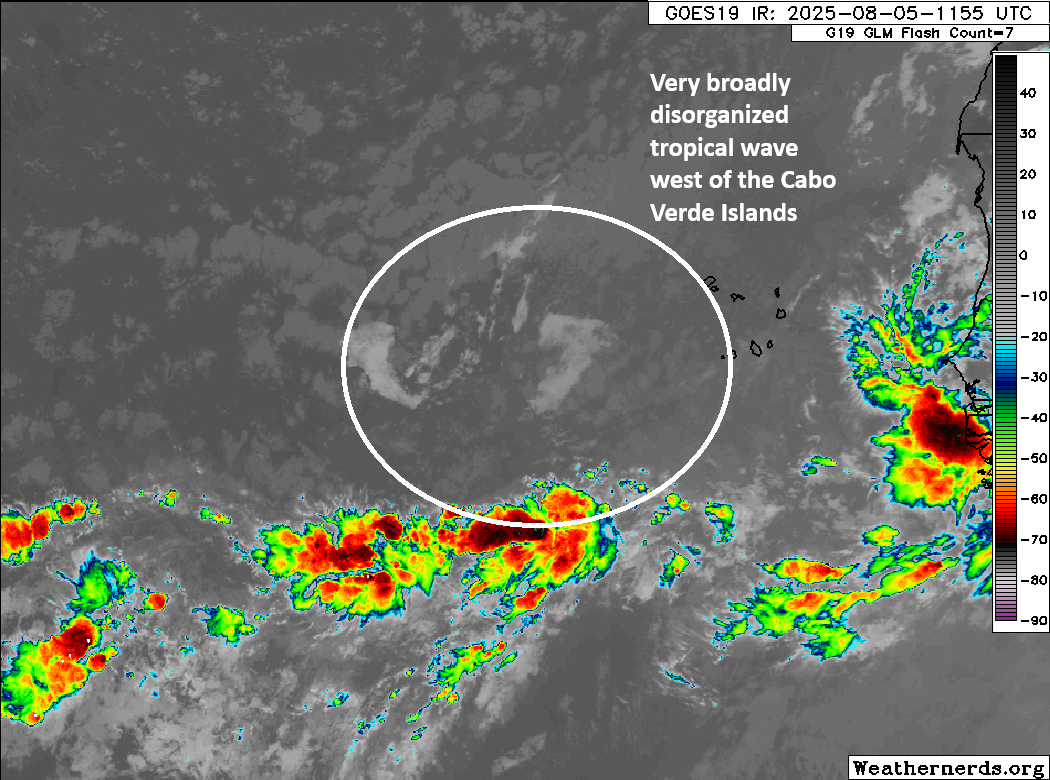
The tropical wave that is responsible for this area continues to produce little to no thunderstorm activity. There are storms to its south, but it’s spread so thin that there’s nothing to this at the moment. Over the next few days, we could see some gradual consolidation and organization occur.

There is virtually nothing to the tropical wave today. Over the next couple days, we could see some gradual consolidation. (Weathernerds.org)

This wave should move more to the west-northwest or northwest over the next few days as it makes an attempt to organize. The most likely scenario still takes this out to sea via a weakness in the subtropical ridge across the Atlantic.

More to come

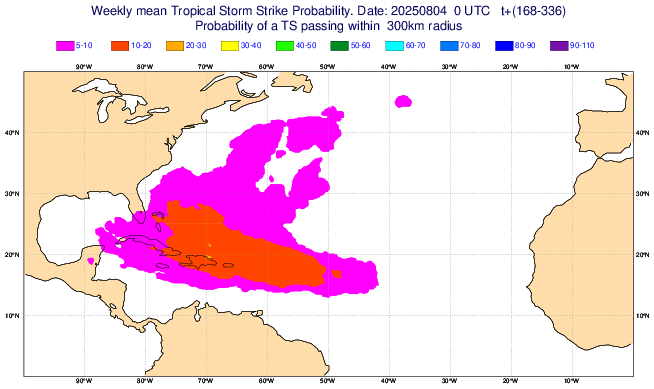
Interestingly, the next wave or two that emerge off Africa may carry a slightly better chance of organizing. In fact, if you look at yesterday’s European model subseasonal forecast for the week of August 11th through the 18th, you’ll see somewhat bolstered odds of development closer to the Caribbean islands.

Slowly increasing potential for tropical development later next week across the Southwest Atlantic or near the islands. (ECMWF)

I will say, the models have been a little overzealous this year in developing risks in the Atlantic MDR in particular. Given that it’s now August and forecasts are pushing into mid-August, we should give those forecasts respect, but thus far it’s been tough sledding out there for any tropical systems. Could that continue? Certainly. So nothing is a guarantee here, but again, as you would expect heading into mid-August, the Atlantic is a little noisy. Stay tuned.

06 Aug 01:05

SCW Q&A: Cool-ish summer, Gulf energy, NWS cuts, site donations, app crashes

by Dwight Silverman

Once again, you’ve asked and we’re answering. Here’s our latest Q&A. Got questions of your own? Hit the Contact link at the top of the blog, or leave a question here in the comments. We’ll consider it for next time.


Q: I’m not complaining at all, but it seems like this summer has been cooler than usual? I know we’ve had a lot of rain and maybe that’s kept things cooled off but is something bigger going on? Is there an overlying thing in the atmosphere that’s made June and July less than hellish?

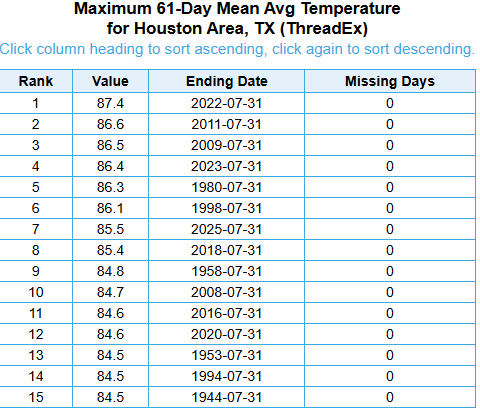
A: Good question! We’ve actually already answered it because we felt the same thing! So, ok. Let’s look at this again with July now in the record books. Through the end of July it was officially the 7th hottest summer to date on record in Houston dating back to the late 1800s.

June & July 2025 came in at #7 on the top list of hottest summers to date. (NOAA)

These temperatures are taken at Bush Airport, which about 20 percent of our audience thinks is complete blasphemy, another issue we addressed. And while Bush does have problems from a representation of Houston, when comparing to prior history at that specific location, it suffices. But, for those who would rather look at the data elsewhere as comparison, let’s do just that. At Hobby, it was the 15th hottest June & July on record back to 1931. In Galveston it was 4th hottest. College Station? 25th hottest. Corpus Christi was 9th. Beaumont was 44th! So, suffice to say there’s been variability across Southeast Texas. Was this really the 7th hottest start to summer “for Houston?” Officially, yes. In reality, probably not quite.

But it really depends on exactly where you are. And this gets to the reader’s mention of “a lot of rain.” Bush saw 9.46″ of rain in June and July, much less than last year of course, thanks especially to Hurricane Beryl. But if you took Beryl out of the equation it’s been a couple summers since we’ve had this routine amount of showers and storms. Hobby has had about 4 inches more rain this summer. Galveston has had far less, with about 4.5 inches officially. So it seems like the rankings of “hottest” are better correlated to rainfall than anything else. If you’ve seen more persistent daily storms in the Houston area, it’s been a good summer. If you haven’t, it hasn’t been horrible like 2022 and 2023, but it’s been a little hotter.

One thing I will note, that we’re basing this on average temperatures. When you look at nighttime lows, we’ve had more mornings at or above 78° this summer than in any prior summer in Houston. This persistence of warm nighttime lows is making a large impact on our overall average. This is for a number of reasons: A warming Gulf, urban sprawl and expanding heat island, and climate change. It’s just easier to have hot summers in Houston now than it used to be, even if the daytimes aren’t as bad as we’ve dealt with before.

Matt

Q. Seems like we’ve had several low pressure systems near us (near shore) in the Gulf that IMO has really helped us with rainfall since June. Any chance these little low systems have pulled energy out of the Gulf that would keep something bigger from happening the next month or so?

A. The short answer is no, sorry. For two reasons.

First of all, it takes a stronger storm, preferably a hurricane, to really churn up lots of colder water from below toward the surface. This raising of colder water can produce a lingering effect on sea surface temperatures that reduces the energy available for subsequent storms to intensify. None of the weak systems we’ve seen to date have really been potent enough to have this effect.

Second, the effect is temporary, usually lasting on the order of two to four weeks. So even if the June tropical systems had a significant cooling impact on seas (which they really didn’t), it would be long gone.

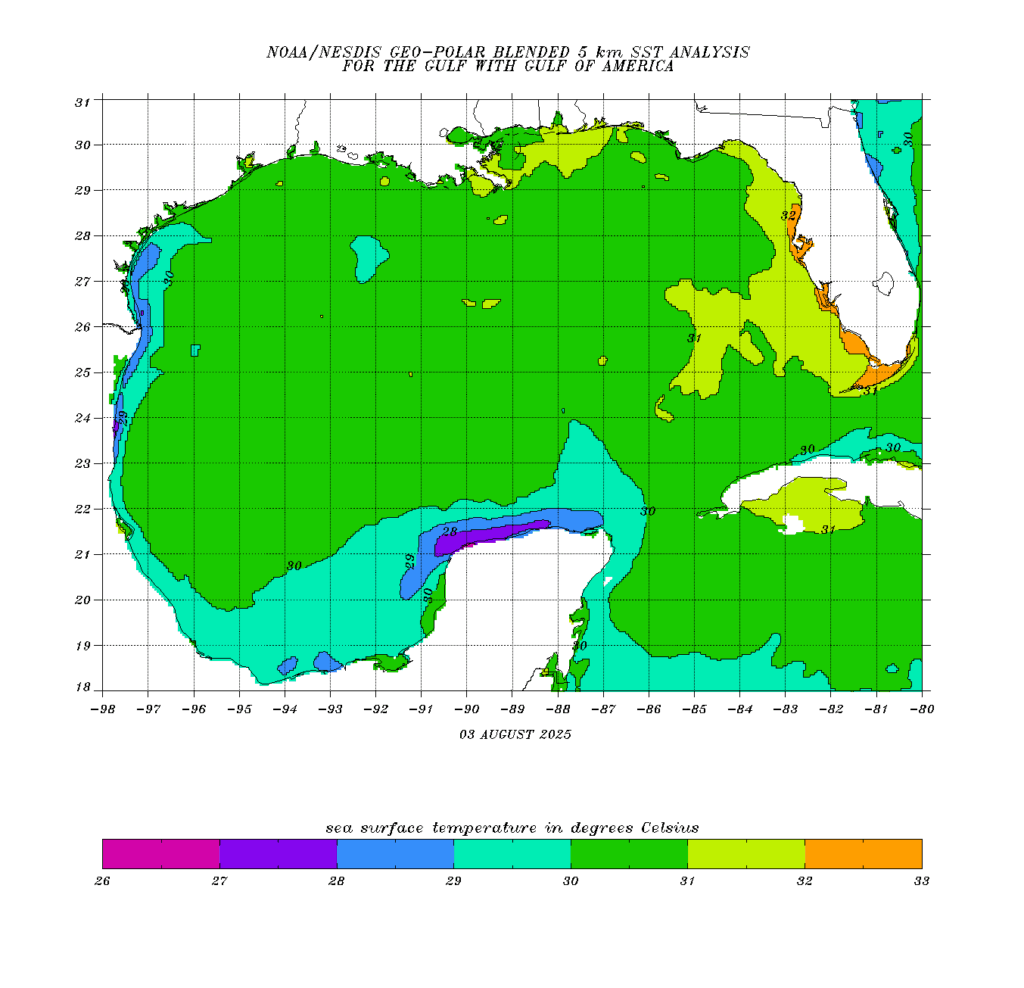
Speaking of Gulf sea surface temperatures, they are plenty warm. The vast majority of the Gulf lies at 30 degrees Celsius or higher, rather far above the threshold (roughly 26.5 degrees C) needed to support tropical system intensification. Buckle up!

Eric

Q: Matt, I know you have written about cuts to NOAA and NWS, and you’ve said the forecasting and warning around the Hill Country tragedy was not affected. But is there anything now you can point to and say, “That happened because of these cuts”?

A: I stand by my initial assessment. I don’t believe the cuts, as implemented thus far played much if any role in this disaster. As we’re learning from the state legislature’s special session, it appears there’s a fundamental problem with emergency response to significant weather in Kerr County in particular. While the NWS San Antonio office was without a warning coordination meteorologist at the time of the flood, the relationship building that occurs to help mitigate the toll from this sort of event occurs over a long period of time. Could it have helped here? Maybe a little? No one knows for sure. Would it have prevented it? No. I feel strongly that this was sort of a terrible situation, wrong place, wrong time, wrong leadership type of situation. Hopefully there are lessons learned from this.

I encourage you to read this by my friend and colleague, Alan Gerard, who really dug into what we know about the flood, the warnings, and the response.

The caution here, of course, is that the cuts that have been proposed to NOAA in the administration’s budget would be catastrophic to NWS and increase the risk profile across the board for events of this and lesser magnitudes. It made absolutely zero sense from a public safety standpoint. Thankfully, both legislative branches are playing the roles of grown-ups in the room and have come back and said those cuts aren’t happening. What this looks like in the end remains to be seen. But to this point, what is being said by Congress is actually net positive for NOAA and NWS and the country at large.

As far as other significant weather events and the current budget cuts, we have not noticed other cases where we can say with authority that the cuts have played a detrimental role in outcomes or forecasts. There was the instance of tornadoes earlier this year in Kentucky immediately after the Jackson, KY, office announced they’d stop staffing 24/7 due to the lack of staff. But the office was open and operational that night. The outcome was suboptimal, and the cuts may have played a role there — but like a lot of things, we can’t exactly prove it outright.

Same goes for the lack of weather balloons. On at least 2 or 3 occasions this year in forecasting for both the Houston area and for my day job in the Midwest, I have noticed a couple “surprise” outcomes that I strongly suspect are tied to the lack of upper air data provided by weather balloons that has been inconsistent from parts of the Rockies and Plains. But again, that’s speculation to some extent. We know for a fact that these are bad decisions, but proving what role they’ve played in any one event is difficult to do.

– Matt

Q. I was looking at my records and thought “hmm, haven’t done my annual contribution to SCW yet, let’s find a link on their website”. But no, couldn’t find one. Are donations only while you’re having your annual thing, or did I miss something?

A. You’re very kind to ask this. We hold an annual fundraiser over the course of three weeks in November. During this time period people can donate money to support the site and buy merchandise for the holiday season. Speaking of which, do you have any ideas for a t-shirt design this year? We want to do something fun for our 10th anniversary.

Why only November? We don’t have a year-round fundraiser because I don’t want the site to be seen as trying to capitalize during inclement weather events. In November, things are usually fairly calm, so there’s no pressure on people to support us.

– Eric

Q. Your app keeps crashing. What’s happening? I thought you fixed it!

A. Sigh. So did we!

When last we left our cute little weather app, we had released a new version that fixed the longstanding issue preventing notifications on Apple devices. As we wrote in June, it took a while to get this done because Hussain Abbasi, our developer, needed to switch to a new coding platform – something he wasn’t planning to do until next year but Microsoft dropped support for it.

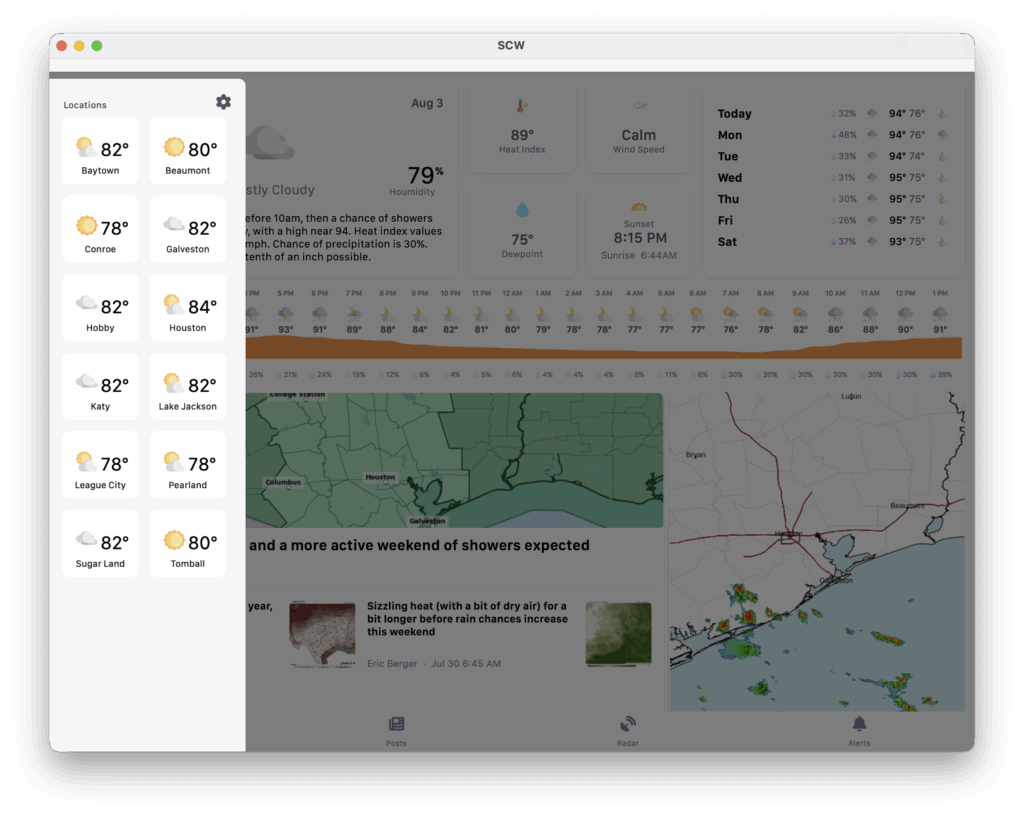
The notification problem was indeed solved, but as is often the case when you’re making a change as major as this, other bugs were introduced. After the new version had been out for a while, we began to get reports of crashes when the app launched. Hussain found the issue, having to do with how the locations in the city-picker drawer get sorted. A updated release with a fix for that is imminent – hang in there! (In the interim, deleting and redownloading from the App Store seems to solve the problem.)

See the list of cities you can choose on the left? That’s the cause of our latest iOS crash bug.

Meanwhile, he’s still in the process of getting the Android version working as it should via the new coding platform. Building Android apps can be more difficult because there are so many different hardware types and designs out there. In this case, you can blame folding Android devices for the delay – switching between tablet and phone layouts is creating, as he puts it, “inconsistencies.” (And there’s supposedly a folding iPhone coming next year. Yay?) Once we get an Android update out the door, it should also fix the issue of crashes on some Google Pixel phones.

It’s like playing whack-a-mole. Whack-a-bug!

Remember that you can send a bug report via the app. First make sure you’ve downloaded the latest version. Then tap the three-line icon next to the city name on the home page; tap the gear icon on the top right of the drawer that appears; tap the “Send Feedback” item. It sends a log with details on the crash to our developer, but it would help if you could provide as much detail as you can about what happened. (Details about your device are automatically sent.)

Does the app crash on launch so you can’t get to the Feedback button? Send as detailed a report as you can, including the device model and its operating system version, to bugs@spacecityweather.com.

And once again, just to be very clear: The spelling of Houmidity in the app is a feature, not a bug.

We appreciate your patience as Hussain works through these issues.

– Dwight

06 Aug 00:54

the fake hire, the campfire background, and other stories to cringe over

by Ask a Manager

It’s Mortification Week at Ask a Manager and all week long we’ll be revisiting ways we’ve mortified ourselves at work. Here are 13 mortifying stories to kick off today.

1. The fake hire

When in college, I was looking for a summer job. My friends had been hired at a very good hourly rate doing factory work. We came up with the idea that I would just show up to orientation saying I, too, had been hired. I even had to buy (or my parents did) steel toed boots for the job. On the first day, after about an hour, one of the managers pulled me aside and asked me who I was and what I was doing there. It was humiliating. What the #$%& were we thinking?

2. The campfire background

I was on a Teams call with my boss and several important collaborators from another org. They were discussing something really technical that didn’t have very much to do with me so I started zoning out of the conversation. I decided to mess around with the camera filters because I’d never really looked at any of them before. There’s a pop-up when you open the filter page that tells you that your camera won’t be changed on the live feed until you select “apply” (or something like that) so I went crazy checking out all of the different backgrounds and filters and flipping my camera around and just having a great time.

And then I saw together mode! They had a fun Minecraft one that made it look like everyone was sitting around a campfire! So I clicked it and … it turns out that together mode does not preview the backgrounds, it just pushes the update immediately, and also it applies it to everyone in the call. So suddenly seven scientific professionals found themselves sitting around a Minecraft campfire talking about FDA guidelines and funding streams.

Fortunately, I was able to turn it off almost instantaneously and as far as I know it didn’t announce that I was responsible. A few people made confused faces but no one mentioned it.

3. The brain freeze

My own mortification incident happened a little over a year ago, while interviewing within my large company for a higher position in another building. Met with my immediate boss with whom I have an excellent relationship (and for whom this promotion would allow me to keep working) and another upper admin that I knew well enough to chat with when she visited the building. Easy, right?

The interview room was hot and my face was a bit flushed, which always embarrasses me. The interview was going really well, conversational back and forth and pretty comfortable. The final question from the other upper admin was, “Why should we choose you for this position?” Softball, right? Well, I totally froze. I couldn’t think of one single reason why they should hire me. I hemmed and hawed a bit, then looked at my boss and asked, “Is it okay if I look at my notes?” He gave me the kindest smile, probably thinking internally what the hell is your problem, and said, “Of course.” I glanced at them, saw some key words that woke my brain up again, and proceeded to remember why – and share with them – I was the best choice.

4. The sniff

In a job interview, I was given a brochure to look at about their work and for some reason I decided to sniff it. They said it was a first! I made some rubbish up about telling what sort of paper it was printed on from the smell, but truly I have no idea why I did it. I did not get the job.

5. The career goal

I was interviewing at bank and the hiring manager asked me about my goals and I told him I wanted to be a poet.

6. The threat

Was on a conference call with about a dozen or so geographically scattered teammates working a large defense program. My dog started to bark just as I said, “Kevin…” and I muted myself, and said, “If you don’t shut up, I’m going to throttle you!” Well, of course I wasn’t muted, and poor Kevin asked, “What on earth did I DO???”

7. The glitter sperms

My office is very informal, lots of people with operations backgrounds. Also, my workplace has front of house and back of house areas, and our office is very close to the front of house area. So, when it was someone’s birthday (let’s call him James), his office friends just destroyed his office with sperm-shaped glitter. Like opening books and putting glitter between pages, inside his mini fridge, so on and so forth. Took him forever to clean up (he was good-humored about it, no hard feelings). He obviously couldn’t get all of it, though, and it would track outside his office.

One day, I was walking guest hallways and found one of the sperm glitter on the ground. Took it back into the office and announced to him and a few others, “Hey, I found one of James’ sperm in the guest hallway!”

He turns to me and half-jokingly says, “(My name), we are not calling these ‘James’ sperm’.”

This was almost a year ago and I still find some on the carpet every so often.

8. The freight elevator

Many years ago, I was a young and cute (I’ll say it) professional femalien working in a government building with offices on several floors throughout a 25-story building.

I prided myself on working long unpaid hours and looking well-groomed, with professionally tailored suits and expensive shoes I could not really afford.

One day, after a very long day starting at 6 am, it was now about 7 pm, which is very after hours in a government building, so I got on the “express” elevator, which was just the freight elevator that the bigwigs used during normal hours to rapidly go between floors since it didn’t stop for public patrons. Junk food lunch, constant moving between floor, go-go-go no time for stopping, and after a long day, there was quite a digestive buildup, and alone in the elevator I let loose the loudest, nastiest toxic gas imaginable.

Of course, OF COURSE, two floors later the elevator stops, doors open, and two caterers get on with carts containing the remains of a turkey and other food. I stare straight ahead and try vainly to convey with my body language that it was like this when I got on. No one says anything, but then I hear one caterer say in a low voice to the other in Spanish, “I think the little lady did something” and the other one replied, “Maybe she’s sick?”

There I stood in the corner, staring straight ahead, absolutely mortified but desperately trying to not turn red or sweat or give any indication that I understood what they were saying, while also trying not to burst out laughing because farts are funny.

They got off the elevator a few floors later. I got off a few floors after that and never rode in the freight elevator again.

9. The accident

I was manning the front desk at my office alone one day, meaning that I couldn’t be far away for long lest I miss a phone call or a walk-in client. I was also in charge of delivering the mail. I was rushing to get my bosses their mail, didn’t clock that their doors (floor to ceiling sliding glass doors) were closed, and ran directly into the glass face-first. I dented my glasses and left a nice makeup face-print on the glass. I went back to the front desk in shame after my bosses fussed over me for a minute.

The next day, I woke up to a bright purple bruise across the bridge of my nose that stayed for over a week and was seemingly immune to concealer. The cleaner didn’t notice the smudged make-up face on the glass for a few days, so it remained.

10. The back massage

My very close friend’s husband had a back injury and was experiencing a lot of back pain. He was working from home that day and attending a Zoom meeting with his camera off. She was massaging his back during the meeting to try to help his back injury. He made several comments of gratitude to her, along the lines of, “Wow, that feels great” and “Yes, right there” and various sounds of pleasure/gratitude. You see where this is going.

After several minutes of this, his colleagues said “Um, [name] you are NOT on mute.” Friend and husband weren’t doing anything … untoward, but it sure sounded like they were to all of his colleagues.

11. The hack

I fell in love and messaged my best friend at work about it … or so I thought. My boss came to my desk later that day to ask if there was something wrong with my computer. Whatever I said was vague enough (thank God) that only my friend would have understood. My boss simply thought I was hacked.

12. The interview question

I was conducting a face-to-face interview with a candidate for a job working as an aide to a woman who was partially sighted and had a guide dog living with her.

In this context, I intended to ask the candidate, “Are you a dog lover?” Except … for some deep unknown twisted Freudian reason what came out of my mouth was, “Are you a good lover?”

Cue blushing, stuttering, explanations that almost made it worse. Not sure which of us ended up more embarrassed.

13. The bird

I worked a job where phone duties were a part of my responsibilities, so I could only take lunch from 12-1 when we had an answering service take over. I also needed my lunch break to go home and take care of my animals (a dog and a cockatiel), and I was pet-sitting a relative’s dog.

One day there was a call that ended going long, so it was 12:20 before I was able to get off the phone. I raced to the car and drove home. It was about a 10-minute commute. I let the dogs outside to play and have a potty break. My little bird loved nothing more than sitting in my hair (it was normally styled in a high bun) while I did things around the house, so I got my bird out of her cage and put her on my bun. Then I had 20 minutes to make myself a sandwich, pay some bills, feed the dogs, and put the dishes in the dishwasher. Having finished all those things, I got in the car, and quickly drove back to work.

Just as I got back into the office, sat down in my chair, and started to put on my phone headset, two little eyes peer down into mine and I realize that I have walked into the office WITH A BIRD ON MY HEAD. In my lunchtime rush and extra animal responsibilities, I totally forgot to put my bird back in her cage. As I gasp and say “oh no” out loud, everyone in the cubicle farm also turns to look at me. Not sure what they were expecting to see, but it was not someone with a bird on their head.

The post the fake hire, the campfire background, and other stories to cringe over appeared first on Ask a Manager.

05 Aug 20:59

the hickey, the bad translation, and other stories to cringe over

by Ask a Manager

It’s Mortification Week at Ask a Manager and all week long we’ll be revisiting ways we’ve mortified ourselves at work. Here are 15 more mortifying stories to enjoy.

1. The bad translation

I used to volunteer at a thrift store where a lot of my work consisted of hanging up clothes that customers had left lying around. Once a woman started taking multiple items off their hangers, looking at them, and then dropping them on the floor. I could tell she was Sri Lankan, and so am I (originally, anyway), so I said to her in Sinhalese, “Please pick up those clothes.”

Unfortunately my Sinhalese is not very good. What I actually said to her was, “Please raise your skirt.”

I was advised to speak to the customers in English from then on.

2. The hickey

I worked at a bank’s wealth management department. Very conservative office. My husband and I were trying to conceive at the time. We did the deed one morning before work so we were both running late. I put my hair in a low ponytail, made peace with zero makeup and rushed in to work.

Later that day I’m chatting with 2 senior managers in one of their offices when one abruptly stops and yells, “Oh my gosh, what’s wrong with your neck!”

Just then I flash back to my morning’s activities and realized I must’ve had a huge hickey prominently on display. My hand shot to my neck, just as the commenting manager realized what it was and sputtered, “Oh wait, never mind…”

Second manager laughed it off and said something along the lines of “oh, newlyweds.” I’d been married for three years but decided to take the excuse and chime in, “Yeah, we’re very in love.”

I still want to crawl into a hole thinking about it.

3. The low morals

Back when I worked for a public library, they had a town hall session to which the public was invited to comment. One citizen stood up and went on a tirade about how poorly the staff was treated, leading us to have low “morals.”

She meant “morale.” Someone even questioningly corrected her, but she just kept going on about the librarians’ low morals.

4. The noxious cloud

I was working in IT, and my manager and I were standing very close together to look at a server rack. I realized I had to fart, but thought I could hold it and thought that would be better than suddenly excusing myself. However, the fart had other ideas. Suddenly, it was there — a terrible, terrible, silent but deadly, hot garbage fart. My manager was talking and I just stood there, frozen. He suddenly stopped talking and went, “UHHaggghh.” I stayed frozen and didn’t say anything.

There we stood, two people trapped in my toxic fart cloud. When it was clear I was ignoring it, he did too, and we never spoke of it.

5. The giant straw sunhat

Fond memories of an intern who once showed up to our (rather staid and conservative) office on “casual Friday” wearing a strapless mini-shorts romper and a giant straw sunhat, which she wore at her desk for the whole day.

6. The auto-correct

I once sent a text reply to a fairly new coworker that was supposed to say, “Don’t worry, I won’t rat you out!” but it autocorrected to, “Don’t worry, I won’t eat you out!”

7. The sign-off

Did you ever notice that “r” and “t” are close to each other on the keyboard? Also, “h” and “n.” Which is how I sent an irritable email to a colleague and signed it “Thanks, Satan” instead of Sarah…

8. The wet pants

At an office job, the accounting manager was scolding me for something (I disremember what; I was new and had made a mistake somewhere). She was quite grouchy and intimidating in general.

I had stopped by her desk but I was really on my way to the bathroom — after dancing about a minute, I excused myself, promised to be right back, and ran to the bathroom. When I turned on the water to wash my hands, it shot out with the force of a firehose, ricocheted off the basin, and splashed all over the crotch of my pants.

I stayed in the bathroom for a good 10 minutes trying to mop up with eleventy billion paper towels. I’m sure she thought she had scared me into peeing my pants, but it was the sink, Debbie!

9. The marshmallows

I’m a semi-professional theater actor and I once did a show where I had to eat what looked like old moldy food from a garbage dump. It was really just some marshmallows with black food coloring.

The theater world is not too large, so when my director told us her friend was coming, and that her friend just finished her originating role on Broadway as the wife of a certain founding father, we were excited.

So after the show, we meet her. She’s so kind and professional, and everyone does all the normal stage door pleasantries. She says, “Great show! I can’t believe you had to eat that moldy garbage!” Rather than responding like a human, I say, “Thanks! those marshmallows make my poop turn green.”

I guess I threw away my shot.

10. The Oompa-Loompa song

I once worked in a call center where a colleague (“Sam”) left a message for a client, forgot to hang up, and proceeded to sing the Oompa-Loompa song from Willy Wonka for a good five minutes. The elderly lady he’d dialed was very confused and called back to understand why her insurance company was leaving messages with songs in them. It sounded like it was a challenging conversation, but she eventually understood and called him “Singing Sam.”

11. The interview

A guy who applied for a job at the grocery store my partner works at came in to ask about his interview later that day … and actually shoplifted (in an obvious manner) on the way out. Right after informing everyone who he was.

When he came in for the actual interview later, they immediately confronted him about it and he asked “if this meant he couldn’t work there.”

12. The murder chair

This is secondhand mortification on behalf of someone I was interviewing. He came in clearly nervous as all get out. It was me and two coworkers interviewing him in a small conference room. He kept biting his nails and must have gone too far because then his thumb started bleeding. We all noticed, but didn’t want to make a big deal about it … but then he started rubbing his bleeding thumb under the table to clean off the blood. Like just kept it there the rest of the interview. At the end he shook our hands with his “clean” hand and left. We looked under the table and it was as if there was a murder at his chair. It was all over. Needless to say, we used quite a bit of sanitizer on that table.

13. The big dip person

A few months into my current job, I was confidently announced to my entire team, including my boss, that I’m a “big dick person” during a conversation about guacamole over lunch. My boss laughed so hard she cried when I tried to sink into the floor. She then made me repeat myself when a coworker who’d joined lunch late so she wouldn’t miss out on the hilarity.

14. The mute

I interviewed under the STAR format and was woefully unprepared for it. After the first question, I sat there in silence. The three interviewers returned the silence. After a full minute someone said, “I believe she’s on mute.” I piped up, “Nope!” and the silence resumed.

15. The spooky question (yes, I will reprint this every year because I love it)

I have horrible social anxiety, like, constantly thinking that everyone secretly hates me or is judging me. So, when I first started out in the working world, I had trouble coming up with small talk to bond with my coworkers. This was a very creative office, and I didn’t want to ask the same boring old questions, and it was near Halloween, so I decided to ask the ~spooky~ question of “Have you ever seen a ghost?” to one of my coworkers … except I panicked. HARD. I’m talking thoughts going 300 mph while I’m in the middle of the sentence. So, instead of asking “Have you ever seen a ghost,” I went (internally), “Oh gosh, did I already ask this the other day? What if she thinks it’s a weird question? It is kind of a weird question, isn’t it? I should ask something else, but I’m already halfway through this sentence. What can I replace ghost with? Ghosts are dead… dead people… zombies… zombies died… zombies are people who died – uh-”

And then, as casually as I had started the sentence, asked this poor, unsuspecting coworker… “Have you ever seen someone die?”

Cue a completely warranted incredulous reaction and a lifetime of cringing to myself. Thankfully I no longer work there or live near her.

The post the hickey, the bad translation, and other stories to cringe over appeared first on Ask a Manager.

05 Aug 20:51

Wow, look at all the Jujyfruits.

Wow, look at all the Jujyfruits.

05 Aug 20:51

In the Bin

by Reza
05 Aug 20:50

Desperate Trump Attempts To Flush 14-Year-Old Masseuse Down Toilet

by The Onion Staff

WASHINGTON—In a frantic bid to dispose of damaging evidence amid ongoing scrutiny of his relationship with the late child sex offender Jeffrey Epstein, a desperate President Donald Trump reportedly attempted to flush a 14-year-old masseuse down the toilet Tuesday.

“Oh Christ, c’mon, Ashley, don’t get stuck—uh, just gimme one second in here!” Trump said as he jiggled the handle in a futile attempt to pass the stuck high school freshman through the toilet’s 3-inch drainpipe, eventually grabbing a rubber plunger and turning on the sink to mask his sounds of panicked exertion from aides gathered outside the door. “Fuck, fuck, fuck. Why the hell did those woke toilet companies have to make their flushes so weak? This thing could barely handle a wad of toilet paper, let alone a teen massage therapist.”

According to sources, the president then squirted a bottle of massage oil around the bowl of the toilet in hopes of easing the adolescent’s passage through the pipes and scolded her in a harsh whisper for doing “absolutely nothing” to help him destroy any trace of her presence.

At press time, witnesses confirmed Trump had walked out of the bathroom unaware that he was trailing from his shoe a colorful friendship bracelet with the girl’s name on it.

The post Desperate Trump Attempts To Flush 14-Year-Old Masseuse Down Toilet appeared first on The Onion.

05 Aug 20:50

Corporation For Public Broadcasting To Shut Down

by The Onion Staff

The Corporation for Public Broadcasting announced it will begin shuttering operations in response to President Trump signing a law which clawed back $1.1 billion in funding for public broadcasting. What do you think?

“A pissed-off Big Bird with unlimited free time? This won’t end well.”

Randolph Phelps, Unemployed

“How could anyone trust a media institution without a profit motive?”

James Quinn, Microphone Adjuster

“What happened to that $20 donation I made in 2008?”

Lana McKinney, Butter Spreader

The post Corporation For Public Broadcasting To Shut Down appeared first on The Onion.

05 Aug 20:50

Australia Admits All Those Animals Made Up

by The Onion Staff

SYDNEY—Saying the ruse began as a harmless prank about the continent’s mammals having pouches, Australian Prime Minister Anthony Albanese admitted Tuesday that all those animals like wallabies, numbats, quokkas, and bandicoots were completely made up. “We just assumed everyone would have caught on by now, because these creatures are clearly imaginary,” said Albanese, adding that Australians were shocked that the rest of the world could be so gullible as to think there was actually an animal called a wombat whose poop came out in cubes. “I mean, come on—kultarrs, bettongs, wambengers? Their names sound like something out of Dr. Seuss. Once we realized people actually believed in kangaroos and koalas, we started making up even crazier stuff, just to see if they’d fall for it. Like the echidna, a spiny egg-laying mammal with a four-headed penis. You thought that thing was really running around in the Australian woods and not just a dumb joke we made up to amuse ourselves? In reality, our wildlife here is pretty boring: squirrels, some deer, a few bears. All pretty normal stuff.” At press time, the prime minister acknowledged that Australia had also made up Steve Irwin.

The post Australia Admits All Those Animals Made Up appeared first on The Onion.

05 Aug 20:50

august morning.

Life in San Francisco, California... and beyond.

Added by @jedda in Photography › Photo Blogs.

05 Aug 20:48

These public radio stations have built online audiences that’ll help them survive federal cuts

by Joshua Benton

I think you can excuse public radio’s station managers if web traffic isn’t quite top of mind these days. Many are too busy fighting for their continued existence.

Donald Trump’s May executive order to defund public media was of dubious legality. He’d proposed gutting the Corporation for Public Broadcasting in his previous budgets, but Congress was always there to save it when it was voting time. But not this year — Trump demanded Congress rescind all funding and pliant Republicans did just that. A billion dollars vanished by a three-vote margin. On Friday, the Corporation for Public Broadcasting announced it would shut down next month after nearly 60 years.

In that context, it’s probably an odd time to publish our first rankings of local public media websites. Everyone at these stations has something better to do than to look at Chartbeat. But nonetheless, here it is — the top 25 local public radio/TV websites, based on the estimated number of visits they received in June. (We recently published similar lists for both local newspapers and nonprofit news outlets.)

I won’t attribute any coherence to the reasoning behind the federal gutting. But one line of frequent complaint over the years has been that public radio and TV should be forced to compete in the commercial media marketplace, like every other outlet. If there’s demand for the work they do, the argument goes, they’ll be able to support themselves just fine.

Well, the public media outlets on this list are among those who’ve done the most to prepare for that fight. They’ve built syndication businesses, production studios, national programming, university partnerships, cross-media tie-ups, statewide networks, and a thousand other things meant to strengthen the institution. For them, the federal defunding will be painful but not fatal. According to station estimates, those federal dollars made up 3% of the annual budget at Boston’s WBUR, 5% at Seattle’s KUOW, 6% at Chicago’s WBEZ, and 8% at San Francisco’s KQED. The biggest stations, many of them on this list, are the best positioned to weather the storm. And part of that positioning is establishing a strong web presence that can compete, in its own way, with local newspapers and TV.

But it’s the stations that aren’t on this list that are in the most peril, the ones not lucky enough to be in a major metro area with a high population of college graduates and lots of civic capital. (Places like the No. 1 outlet on this list, Minnesota Public Radio, for instance.) According to the website Adopt a Station, federal funding makes up 23% of the budget at KEDM in Monroe, Louisiana; 29% at KMOS in Warrensburg, Missouri; 40% at WFIT in Melbourne, Florida; 57% at KGLP in Gallup, New Mexico; 80% at KGVA, a tribal station in Montana; and 91% at KNSA in Unalakleet, Alaska. (Those percentages are based on 2023 budget numbers and thus should not be treated as gospel.)

As I’ve tried to note in each of these rankings, these are not inherently fair competitions. All markets are not created equal; a station serving southern California is going to have a bigger potential audience than one serving southern North Dakota. All of these websites are connected to public radio stations, but some are twinned to public TV stations — some of which are really more national than local. And while all of these stations are NPR members, a few derive much (or all) of their audience for their music programming, not news.

But there’s still benchmarking value in seeing the numbers side by side. How about little Vermont Public — headquartered in the town of Colchester, population 17,524 — hitting No. 23? (Rankings aficionados may remember that VT Digger, the state’s hugely successful nonprofit news outlet, managed to hit No. 18 on our nonprofit rankings last week.) With that, here are the rankings for June, followed by a few highlights from the list.

Top 25 local public media sites, June 2025

Ranked by estimated monthly visits

Rank Website / News org / Parent June 2025
visits
± Rank
from May
± Visits
from May
1
mprnews.org
Minnesota Public Radio
Saint Paul
3,299,259 +52.6%
2
laist.com
Southern California Public Radio
Los Angeles
2,153,743 ▲ 3 +34.8%
3
opb.org
Oregon Public Broadcasting
Portland
1,883,653 ▼ 1 +0.4%
4
cpr.org
Colorado Public Radio
Denver
1,599,391 ▲ 3 +24.5%
5
wbur.org
WBUR
Boston
1,486,668 ▼ 2 -18.6%
6
kqed.org
KQED
San Francisco
1,324,170 +1.3%
7
kcrw.com
KCRW
Los Angeles
1,133,277 ▲ 2 -3.5%
8
whyy.org
WHYY
Philadelphia
1,084,211 -12.2%
9
wgbh.org
GBH
Boston
1,059,419 ▼ 5 -35.8%
10
wpr.org
Wisconsin Public Radio
Madison
873,333 -3.7%
11
wnyc.org
WNYC
New York City
700,629 ▲ 5 +14.8%
12
kpbs.org
KPBS
San Diego
661,278 ▲ 2 +2.7%
13
kcur.org
KCUR
Kansas City
575,076 ▲ 2 -8.9%
14
houstonpublicmedia.org
Houston Public Media
Houston
574,381 ▼ 3 -21.5%
15
tpr.org
Texas Public Radio
San Antonio
505,742 ▲ 21 +137.7%
16
kuow.org
KUOW
Seattle
446,367 ▲ 2 -17.2%
17
kut.org
KUT
Austin
444,788 ▼ 4 -38.6%
18
stlpr.org
St. Louis Public Radio
St. Louis
439,400 ▼ 6 -39.4%
19
wfuv.org
WFUV
New York City
434,420 +1.0%
20
kexp.org
KEXP
Seattle
396,566 -5.0%
21
wbez.org
WBEZ
Chicago
395,546 ▼ 4 -27.7%
22
mainepublic.org
Maine Public
Portland
354,056 ▲ 5 +30.6%
23
vermontpublic.org
Vermont Public
Burlington
347,553 ▲ 2 +10.1%
24
wusf.org
WUSF
Tampa
319,726 ▼ 3 -17.0%
25
gpb.org
Georgia Public Broadcasting
Atlanta
319,642 ▲ 1 +2.6%
Source: Similarweb estimates, June 2025. Eligible outlets are local radio and TV stations affiliated with NPR or PBS. (Otherwise, NPR.org would be No. 1 on the list with 80.8 million visits.) Locations listed represent the primary metro area the station serves; some have their headquarters in suburbs you’ve never heard of.

13. KCUR, Kansas City

Gabe Rosenberg, KCUR’s audience editor, said the site’s biggest story in June was about a tornado poised to strike Kansas City. “We had been watching the weather, and when we got the tornado warning notification, moved quickly to put up a very brief story with a focus on SEO,” he said. “I think we might have been the first in the area to publish, and saw an immediate spike in traffic.” The station’s been focusing on being more responsive to breaking news.

Another story that performed well, without life-or-death stakes? A compilation of the 22 times a Kansas City restaurant has been featured on Guy Fieri’s Diners, Drive-Ins and Dives. Originally part of a KCUR newsletter called Adventure!, Rosenberg said the piece and others like it tend to do well in search and are “funneling new-to-KCUR-readers into an email product.”

4. Colorado Public Radio

Kevin Dale, executive editor of CPR News, told me one particular story was a big part of its high web traffic in June: “A man threw a fire bomb at a peaceful walk meant to draw attention to the hostages in Gaza. It was a Sunday afternoon and more than a dozen of our staff immediately jumped into reporting and editing to get the news online for our digital readers.” Traffic to followup stories remained high for several days.

“We have moved digital stories to the head of the line — especially in critical breaking news stories like that,” he said. “And, sadly, our staff has experience with mass attacks in Colorado. We have an exceptional team of reporters, editors, hosts and digital producers who understand how to deliver on breaking news and then follow it up with deeper reporting that drives engagement and impact.”

3. Oregon Public Broadcasting

Lisa Garcia Grace , OPB’s senior VP for programming and audience engagement, described “increasing our digital presence today and in the future” as one of the station’s core strategies going forward. That’s included being more responsive to breaking news, doing more reporting beyond the Portland area, and doing more vertical video for social media. The federal funding cut will cost OPB about $5 million, she said, or about 9% of its annual budget. Like other stations, OPB has focused its fundraising messages on the impact of that cut, and she said “thousands of people” have given money to try to fill the federal hole.

Photo of a radio tower, seen from below, by Chanhee Lee.
05 Aug 20:45

Ghost makes it easier to publish to the social web

by Neel Dhanesha

The open-source publishing platform Ghost, which powers the websites and newsletters of many independent news outlets and positions itself as an alternative to Substack and Beehiiv, announced Monday that it’s introducing a number of upgrades aimed at increasing reach and understanding exactly what that reach looks like.

In the changelog for Ghost 6.0, the company also highlights one particularly interesting statistic: three years ago, when Ghost 5.0 launched, Ghost’s revenue was $4 million, while publisher earnings were a little over $10 million. As of Monday, Ghost’s annual revenue is “over $8.5 million” while publisher earnings have crossed the $100 million mark. “Indie media isn’t just surviving, it’s thriving,” they write.

Some notable changes from this update:

  • Ghost now uses the ActivityPub protocol, and publications can be natively distributed across social platforms like Bluesky, Threads, Mastodon, WordPress, Flipboard, and so on. Publishers will also get access to a built-in social feed — which looks a little bit like Substack’s notes, except it shows posts across multiple platforms — through which they can both read other publications and follow what users are saying across the internet.
  • “The social web turns your Ghost publication into a networked social profile that people can find, follow, like, reply, repost and interact with from anywhere — bringing network effects directly to decentralized publishing,” the company writes in its blog post announcing the update. “Popular posts can be shared, re-posted, and discussed by millions of social web users.”
  • “If you’ve been around on the web for a while, and you can remember back that far…you might even call it the return of the blogosphere,” Ghost says.

  • A new analytics suite, powered by a partnership with TinyBird, will give publishers insight into web traffic, newsletters, and member subscriptions in real time, without the need for any third-party integrations.
  • “Now you have the ability to filter all your data by audience to see what’s resonating across public visitors, free members, and paid members in real time, so you can understand what’s working, and make informed decisions about what to publish next,” the company writes.

Ghost is introducing some pricing changes to its cheapest plans, each of which support up to 1,000 subscribers; those plans are going from $9 and $25 per month to $15 and $29 per month. Existing users will be grandfathered into their current pricing structure, and pricing for accounts with the large numbers of subscribers is dropping, “in some cases by as much as 50%.” (By comparison, Substack takes a 10% cut of subscriptions and Beehiiv’s plans start at $43 per month for 1,000 subscribers. Neither Ghost nor Beehiiv, which itself recently hit $20 million in annual recurring revenue, take a cut of subscriptions.)

The full changelog, which also details a list of improvements that have been introduced in the three years since Ghost 5.0 came out, can be found here.

Images via Ghost
05 Aug 15:48

Pluralistic: Bragging about replacing coders with AI is a sales-pitch (05 Aug 2025)

by Cory Doctorow


Today's links


A group of miserable men walking in a circle (Van Gogh's 'Prisoners'); they are cupped in two giant hands, between which protrudes a raygun that is bathing them in a sinister yellow-red light. In one corner sits a supremely self-satisfied business man, reclining in a comfortable chair, surrounded by fluffy clouds. The background is a hellscape of red smoke and brimstone.

Bragging about replacing coders with AI is a sales-pitch (permalink)

We spend a lot of time talking about AI's technical capabilities: what it can do now, what it might do tomorrow, what it will never do. But AI is only secondarily a technological phenomenon; it is primarily a financial phenomenon, hundreds of billions of dollars in investment capital in search of a return.

The return on that capital only comes from one place: workers' wages. AI – as a financial phenomenon – represents that AI will a) replace, and/or; b) frighten workers to the point where more of the revenues generated by firms that buy AI tools will be returned to executives and shareholders, at the expense of their workforce.

This is why AI bosses are so eager to cite statistics – conjured out of thin air, without any backing – about how AI is about to replace the majority of workers:

https://news.harvard.edu/gazette/story/2025/07/will-your-job-survive-ai/

And it's why tech companies that are peddling AI tools boast so brazenly about how many programmers' work can be replaced by AI:

https://www.linkedin.com/posts/andy-jassy-8b1615_one-of-the-most-tedious-but-critical-tasks-activity-7232374162185461760-AdSz/

After all, tech workers were – until recently – the princes of labor. Despite infinitesimal union density in the tech sector, tech workers were in such high demand that they could tell their bosses to go fuck themselves – and keep their jobs. Those bosses knew that a worker who quit during the morning scrum could have a better job with a rival firm before evening cocktails.

While tech bosses cultivated a chumminess with these workers, treating them as peers (temporarily embarrassed founders, not employees) and sitting down for "town halls," they clearly hated this and wanted nothing more than to put these arrogant pismires in their place. The instant tech labor's supply caught up with demand, these bosses mass-fired their precious tech workers, canceled town halls ("Not a good use of my time" -M. Zuckerberg), and told workers that the "sweet spot" was a 60-hour work-week:

https://pluralistic.net/2025/04/27/some-animals/#are-more-equal-than-others

Facebook announced a 5% across-the-board layoff and doubled its executives' bonuses – on the same day. They fired thousands of workers and then hired a single AI researcher for $200m:

https://appleinsider.com/articles/25/07/10/meta-lured-ai-exec-away-from-apple-with-blockbuster-200m-pay-package

Whatever else all this is, it's a performance. It's a way of demonstrating the efficacy of the product they're hoping your boss will buy and replace you with: Remember when techies were prized beyond all measure, pampered and flattered? AI is SO GOOD at replacing workers that we are dragging these arrogant little shits out by their hoodies and firing them over Interstate 280 with a special, AI-powered trebuchet. Imagine how many of the ungrateful useless eaters who clog up your payroll *you will be able to vaporize when you buy our product!*

Which is why you should always dig closely into announcements about AI-driven tech layoffs. It's true that tech job listings are down 36% since ChatGPT's debut – but that's pretty much true of all job listings:

https://apnews.com/article/ai-layoffs-tech-industry-jobs-ece82b0babb84bf11497dca2dae952b5

And the major decline in tech hiring isn't the result of hiring far fewer programmers – the tech companies have mostly cut back on hiring marketers, administrative assistants, and HR staff.

The whole fucking economy is in freefall. It's so bad that Trump just fired the country's head labor statistician and pledged to replace her with a flunky who wouldn't produce numbers "that made him look bad":

https://www.youtube.com/watch?v=twNjon4tp84

The tech industry has changed. During the lockdowns, tech companies trumpeted their hiring sprees as a performance of growth, staged for pandemic-panicked investors. Now, tech companies trumpet their layoffs as a performance of AI's technical excellence, aimed at potential AI customers and credulous investors stampeded by FOMO.


Hey look at this (permalink)


A shelf of leatherbound history books with a gilt-stamped series title, 'The World's Famous Events.'

Object permanence (permalink)

#15yrsago Stuff: Oliver-Sacks-like account of pathological hoarders https://memex.craphound.com/2010/08/05/stuff-oliver-sacks-like-account-of-pathological-hoarders/

#10yrsago David Byrne explains the streaming music ripoff https://www.nytimes.com/2015/08/02/opinion/sunday/open-the-music-industrys-black-box.html

#10yrsago The only furniture you need is a single smooth stone that reminds you of your mother https://web.archive.org/web/20150809132854/http://the-toast.net/2015/02/24/get-rid-clutter-live-abundantly/

#10yrsago WATCH: Elizabeth Warren rescues Planned Parenthood, excoriates misogynist GOP creeps https://www.youtube.com/watch?v=DeilHs9kZ2g

#10yrsago India’s porn ban collapses in less than 48 hours https://www.bbc.com/news/world-asia-india-33783539

#10yrsago Parenting and the Internet: the smarter, missing third way https://www.theguardian.com/technology/2015/aug/05/what-is-missing-from-the-kids-internet

#10yrsago Idaho court strikes down anti-whistleblower “ag-gag” law https://www.acluidaho.org/en/news/idaho-ag-gag-law-ruled-unconstitutional-federal-court

#10yrsago Actual questions from my Green Card questionnaire https://memex.craphound.com/2015/08/05/actual-questions-from-my-green-card-questionnaire/

#10yrsago Germany’s top prosecutor fired for bringing “treason” charge against Netzpolitik https://web.archive.org/web/20150807201032/https://www.beaumontenterprise.com/news/world/article/German-prosecutor-accuses-gov-t-of-meddling-in-6423563.php

#5yrsago Qanon is magical thinking https://pluralistic.net/2020/08/05/behavioral-v-contextual/#magical-thinking

#5yrsago Trump wants to force you to invest in failing fossil fuel companies https://pluralistic.net/2020/08/05/behavioral-v-contextual/#crybabies

#5yrsago Cori Bush triumphs in Missouri https://pluralistic.net/2020/08/05/behavioral-v-contextual/#cori-bush

#5yrsago Qanon is an ARG https://pluralistic.net/2020/08/05/behavioral-v-contextual/#adrian-hon

#5yrsago GE's billion dollar tax-fraud https://pluralistic.net/2020/08/05/behavioral-v-contextual/#ge-fraud

#5yrsago Contextual ads can save media https://pluralistic.net/2020/08/05/behavioral-v-contextual/#contextual-ads

#1yrago Leveraged buyouts are not like mortgages https://pluralistic.net/2024/08/05/rugged-individuals/#misleading-by-analogy


Upcoming appearances (permalink)

A photo of me onstage, giving a speech, pounding the podium.


A screenshot of me at my desk, doing a livecast.

Recent appearances (permalink)


A grid of my books with Will Stahle covers..

Latest books (permalink)


A cardboard book box with the Macmillan logo.

Upcoming books (permalink)

  • Canny Valley: A limited edition collection of the collages I create for Pluralistic, self-published, September 2025
  • Enshittification: Why Everything Suddenly Got Worse and What to Do About It, Farrar, Straus, Giroux, October 7 2025
    https://us.macmillan.com/books/9780374619329/enshittification/

  • Unauthorized Bread: a middle-grades graphic novel adapted from my novella about refugees, toasters and DRM, FirstSecond, 2026

  • Enshittification, Why Everything Suddenly Got Worse and What to Do About It (the graphic novel), Firstsecond, 2026

  • The Memex Method, Farrar, Straus, Giroux, 2026

  • The Reverse-Centaur's Guide to AI, a short book about being a better AI critic, Farrar, Straus and Giroux, 2026


Colophon (permalink)

Today's top sources: Slashdot (https://slashdot.org).

Currently writing:

  • "The Reverse Centaur's Guide to AI," a short book for Farrar, Straus and Giroux about being an effective AI critic. (1053 words yesterday, 21600 words total).
  • A Little Brother short story about DIY insulin PLANNING


This work – excluding any serialized fiction – is licensed under a Creative Commons Attribution 4.0 license. That means you can use it any way you like, including commercially, provided that you attribute it to me, Cory Doctorow, and include a link to pluralistic.net.

https://creativecommons.org/licenses/by/4.0/

Quotations and images are not included in this license; they are included either under a limitation or exception to copyright, or on the basis of a separate license. Please exercise caution.


How to get Pluralistic:

Blog (no ads, tracking, or data-collection):

Pluralistic.net

Newsletter (no ads, tracking, or data-collection):

https://pluralistic.net/plura-list

Mastodon (no ads, tracking, or data-collection):

https://mamot.fr/@pluralistic

Medium (no ads, paywalled):

https://doctorow.medium.com/

Twitter (mass-scale, unrestricted, third-party surveillance and advertising):

https://twitter.com/doctorow

Tumblr (mass-scale, unrestricted, third-party surveillance and advertising):

https://mostlysignssomeportents.tumblr.com/tagged/pluralistic

"When life gives you SARS, you make sarsaparilla" -Joey "Accordion Guy" DeVilla

READ CAREFULLY: By reading this, you agree, on behalf of your employer, to release me from all obligations and waivers arising from any and all NON-NEGOTIATED agreements, licenses, terms-of-service, shrinkwrap, clickwrap, browsewrap, confidentiality, non-disclosure, non-compete and acceptable use policies ("BOGUS AGREEMENTS") that I have entered into with your employer, its partners, licensors, agents and assigns, in perpetuity, without prejudice to my ongoing rights and privileges. You further represent that you have the authority to release me from any BOGUS AGREEMENTS on behalf of your employer.

ISSN: 3066-764X

05 Aug 15:47

Review: “Navigating the Waves: Contemporary Cuban Photography” at The Museum of Fine Arts, Houston

by Joseph R. Wolin

The famous likeness of Che Guevara seen from below — scruffy and determined, an upside-down star adorning the beret worn over unruly longish hair, his eyes fixed either on an indeterminate point in the far distance or the bright future — long ago left the realm of documentary photography to become a pop icon. The visage of the revolutionary leader has been reproduced, altered, lionized, parodied, and embodied, appearing on countless T-shirts, dorm-room posters, and Madonna albums, a sign of Marxist sympathies, teenage rebellion, or radical chic. An outline of the portrait in sixteen tons of steel, nearly 100 feet high, even adorns the façade of the Ministry of the Interior on the Plaza de la Revolución in the center of Havana. The image remains the best-known Cuban photograph, and very possibly the most replicated photo ever taken.

An iconic portrait photograph of Che Guevara.

Alberto Korda, “Guerillero heroico (Heroic Guerrilla),” 1960, printed 1995, gelatin silver print. The Museum of Fine Arts, Houston, museum purchase funded by Dan and Mary Solomon. © Estate Alberto Korda

Made by the Cuban photographer Alberto Korda in 1960 when Guevara made a brief appearance onstage at a speech by Fidel Castro, the shot went largely unused until Guevara’s execution in Bolivia in 1967, when, in the words of Malcolm Daniel and Raquel Carrera, it “came to function like the secular image of a martyred saint.” A print of Korda’s original uncropped photograph, titled Guerillero Heroico (Heroic Guerrilla), pictures Guevara between palm fronds and Jorge Masetti, an Argentine journalist and later guerrilla fighter himself, seen in profile. It hangs near the entrance of The Museum of Fine Arts, Houston’s (MFAH) admirable exhibition Navigating the Waves: Contemporary Cuban Photography, a survey of work from the Caribbean island created after the Cuban Revolution overthrew the dictatorship of Fulgencio Batista in 1959. Curated by Daniel, the MFAH’s Curator of Photography, and Carrera, the exhibition is drawn entirely from the museum’s own impressive holdings of Cuban photography, a remarkably robust collection of nearly 400 works by more than eighty artists, assembled since 1994 and expanded by a recent gift.

The entrance to an exhibition of Cuban photography.

Installation view of “Navigating the Waves: Contemporary Cuban Photography” at The Museum of Fine Arts, Houston

Beginning in the 1960s, Korda and his contemporaries — young documentary photographers aligned with the ideals of the Revolution, who later were dubbed the “epic” generation — turned their lenses not only on political heroes and great events, but on previously downtrodden and overlooked segments of Cuban society. Mario Ferrer Mortimor, for instance, began a long-running series called Guajiros (Peasants) that portrayed rural people not as quaint ethnological “types,” as had previous photographers, but as hardworking individuals operating against considerable disadvantage to better themselves and their country at large. An untitled print from 1975 shows a tall smiling man in a straw hat, with a fabulous sideburn-mustache combo, leaning against an oxcart pulled by two zebus, showing both the backwardness of Cuban agriculture at the time and the fortitude of the island’s proletariat. Four images from Pedro Beruvides’ Los centenarios (The Centenarians) from 1981 present closely cropped portraits of Black elders born before the abolition of slavery in Cuba in 1886. Their weathered, stoic countenances cannot help but recall Richard Avedon’s 1963 William Casby, born in slavery, Algiers, Louisiana, which Beruvides may conceivably have known.

A complex architectural structure sits in an empty landscape.

Adrián Fernández, “Untitled No. 1 (Sin título No. 1),” from the series “Memorias pendientes (Pending Memories),” 2017, printed 2020, inkjet print. The Museum of Fine Arts, Houston, museum purchase funded by Photo Forum 2021. © 2017 Adrián Fernández

Such journalistic or essayistic images functioned as implicit propaganda for the Castro regime and earned official approval from it, making them a fitting introduction to the exhibition, which begins in the ‘60s, when the Cuban populace’s support for the Revolution reached a peak. The curators, however, also smartly hang two newer works near the entrance. Untitled No. 1 (2017), from the series Memorias pendientes (Pending Memories) by Adrián Fernández, shows a huge scaffold-like structure on a highway next to the sea. Unfinished or possibly obsolete, its monumental curves and angles recall the cooling towers and other relics in Bernd and Hilla Becher’s post-industrial landscapes, as well as Thomas Heatherwick’s unlovable Vessel in Manhattan. The enigmatic construction in Fernández’s photo also looks like the back of an enormous billboard.

A photo of an empty podium, in front of a crowd of people. Videographers film the podium.

Reynier Leyva Novo, “Un día feliz FC No. 11,” 2016, printed 2024, inkjet print. The Museum of Fine Arts, Houston, purchase funded by Joan Morgenstern, Jereann Chaney, and Carl Niendorff

Reynier Leyva Novo’s Un día feliz FC No. 11 (A Happy Day FC No. 11) (2016), from the series Un día feliz (A Happy Day), pictures a podium from behind, bristling with microphones, a large crowd gathered in front, and two photographers with cameras focused on the speaker — or, rather, where the speaker would be. No one stands at the podium. In fact, the artist appropriated one of Korda’s images of Fidel Castro addressing an audience and digitally erased him, a sly political-conceptual gesture only possible once Castro no longer held power. Novo’s large inkjet print, like that of Fernández, which is also a digital rendering, employs contemporary technology to consider the failed promise of Cuban politics and the Communist party that has monopolized the country for so long. Novo does this through the absence of a charismatic leader and the implied hollowing out of all he represented, Fernández through an imagined monumental modernist ruin. Between the optimism of the epic generation and the weary irony of these works lies much of the contemporary history of Cuban photography — and of the island itself — which the rest of the exhibition fleshes out.

An installation of framed photographs in a white gallery space.

Installation view of “Navigating the Waves: Contemporary Cuban Photography” at The Museum of Fine Arts, Houston

Beginning in the 1970s and ‘80s, uninterested in making work that supported the regime yet unable to flout the government’s repressive censorship, many artists turned to the wry depiction of everyday life, finding the small surrealisms that photography excels at and that had long been a hallmark of street photography in the U.S. and elsewhere. In Eduardo Muñoz Ordoqui’s Untitled (1990–92), from the series Zoo-Logos, an ape’s arm that reaches out plaintively from between the bars of a cage in Havana’s zoo appears both spectral and pathetic, creating a tacit commentary on the impoverished conditions of Cuban life. Mario Díaz’s Untitled (1995) captures a shirtless man working on a vintage car while sitting inside its hood. Parts lie scattered on the residential street. Díaz, too, hints at the situation on the island, where keeping generations-old machinery going proved an all-consuming necessity — so all-consuming that the car appears to swallow the man whole — but the configuration of the old Oldsmobile’s headlights, grill, and bumper also suggest a face, with the man’s doubled-over torso serving as a bulbous nose. The absurdist humor in such works feels as much a coping mechanism as the avoidance of overt political content.

A photo of a person's arm, stuck through the bars of a cage.

Eduardo Muñoz “Ordoqui,” from the series “Zoo-Logos,” 1992, gelatin silver print. The Museum of Fine Arts, Houston, museum purchase funded by Clinton T. Willour in honor of Mickey Marvins. © 1992 Eduardo Muñoz Oroqui

Other artists retreated into a realm of private myths and allegories. Juan Carlos Alom photographed a transparent glass or plastic box holding a pair of human skulls in Curando la tierra (Healing the Soil) (1996), from the series El libro oscuro (The Dark Book). Over them, a layer of dirt sprouts a row of knobby leafless twigs. Flipped and doubled in the final image, an expressionistic white smear swooshing across the bottom, the tableau experiments with the conventions of “straight” photography (partly necessitated by the lack of materials on the island), while hinting at esoteric meanings. Similarly, René Peña González implies hieratic significance in his untitled works from the series Ritos II (Rites II) from 1995. Picturing his own muscled, dark-skinned body with loaded objects — a dead chick, a fish hanging by its tail — these images evoke the spirituality of syncretic Afro-Cuban religions, yet remain unspecific and demonstrate a nascent sense of Black Cuban identity at a time when the government had officially declared racism nonexistent.

A photograph showing a hand on a white background; above the hand is five dolls.

Marta María Pérez Bravo, “La mano poderosa,” 1996, gelatin silver print. The Museum of Fine Arts, Houston, museum purchase funded by Photo Forum 1998

La mano poderosa (The Powerful Hand) (1996) by Marta María Pérez Bravo models itself on Mexican folk images of the Holy Family arrayed as the fingers of the hand of God, but here the figures take the form of rag dolls of men — and one woman — in business attire. The label explains that the artist saw the dolls as her gallery representatives at the time, which she imagined controlling through sympathetic magic. And, indeed, during the 1990s, at a moment when daily life on the island grew more precarious with the collapse of the Soviet Union and its longtime subsidies, the international art world (including Houston’s FotoFest) took a great interest in Cuban art and photography. This paradoxical situation produced artists such as Pérez Bravo, Peña González, and Alom, whose exploration of aspects of Cuban identity that included race, sexuality, and religion put them into direct conversation with contemporaries across the world, and at the forefront of a certain brand of Latin American and Caribbean photography that focused on the body and its mortifications — a focus heavily impacted by centuries of New World Catholicism. Yet, while successful and bracing in their era, these works now feel fairly sedate and dated.

A photo of a satellite dish, in a sink, wrapped in a trash bag.

Esterio Segura, “Untitled,” from the series “Lo secreto,” 2003, inkjet print. The Museum of Fine Arts, Houston, The Madeleine P. Plonsker Collection, Gift of Madeleine and Harvey Plonsker

In the current century, as the island has continued to open up to outsiders, Cuban artists have grown ever more conversant with international currents in art and photography. A strong documentary tradition persists, as the exhibition demonstrates with works such as Esterio Segura’s wonderful Untitled (2003), from the series Lo secreto (The Secret), a shot of a prohibited satellite dish mounted indoors in a white tiled sink and comically disguised by a large plastic trash bag. Many other photographers have opted for more-or-less conceptual ways of working that find pronounced parallels with better known artists in other countries. Four images from Alejandro González’s 2015 series Quinquenio gris (Gray Five-Year Period) show pivotal scenes from Cuban history in the early 1970s reenacted by toy figures à la David Levinthal. In Sin título #12 (Untitled #12) (2016), from the series 0:00:00, Linet Sánchez Gutiérrez photographs a small model of an empty stage she constructed, recalling similarly poignant and pregnant spaces in works by Thomas Demand. And Glenda León’s Entre el aire y los sueños (el cielo del mundo) (Between Air and Dreams [The Sky of the World]) (2003), a large color image of fluffy clouds digitally configured into a world map, updates Vik Muniz’s tongue-in-cheek Equivalents, made of cotton batting, from 1993.

This is not to say, however, that the recent work in the exhibition feels overly derivative, but rather that it speaks of a new phase in Cuban photography led by artists far more aware of the larger art world — and its attendant market — than in previous generations, far more willing to pursue personal interests of art for art’s sake. And yet, like the works at the entrance by Fernández and Novo, these photographers are still tied to their own country’s particular history and challenges. Navigating the Waves gives us an unprecedented look at the trajectory of photography in Cuba from the Revolution almost to the present. Best of all, it primes us to want to know what comes next.


Navigating the Waves: Contemporary Cuban Photography was on view at The Museum of Fine Arts, Houston through August 3, 2025. This review was made possible in part by a Travel Grant from The Dorothea and Leo Rabkin Foundation.

The post Review: “Navigating the Waves: Contemporary Cuban Photography” at The Museum of Fine Arts, Houston appeared first on Glasstire.

05 Aug 15:45

The Weight of What Remains: David Adickes and the Pursuit of Permanence

by Brandon Zech

Every family has its private signals. Ours unfolded on the highway, where anticipation built not from destination, but from a game played in glances. Holiday trips north, past the slow collapse of suburb into pine, found my brother and I watching for that first sliver of white through the windshield. Huntsville’s Sam Houston’s statue rarely arrived all at once; it crept in at the corner of the eye — a pale geometry behind branches, then suddenly a giant above the tree line, as if the forest itself was learning to accommodate him. Calling out “I see Sam Houston!” felt less like victory and more like confirmation, a reminder that some things, once noticed, shape how you see everything else. 

A photograph of a 67-foot-tall sculpture of Sam Houston by David Adickes.

David Adickes, “A Tribute to Courage.” Photo: Dreanne L. Belden.

That kind of attention — tuning in to what sits just beyond the ordinary — stayed with me. When I returned to The Woodlands as a curator, the old Home Finder’s Center had already begun its second life, its broad glass walls holding too much daylight, making each artwork live in public with nowhere to hide. Set among tall pines, the glass and steel structure once welcomed newcomers with a vision: a glowing scale model of The Woodlands, villages and parks mapped out in sprawling miniature. As the community matured, the building adapted — its bright interior shifting from home-finding hub to art gallery, where sunlight and memory play across the walls. What began as an invitation to imagine the future now serves as a vessel for what remains: a place where landscape, history, and the slow turn of seasons gather and endure. You notice the way light stains the floors, how the windows pick up the movement of clouds, and how every hour changes the look of what’s on display. It’s a challenge and a test: art that can withstand the weather, the wandering gaze, the slow abrasion of time.

A painting of a woman wearing a red coat.

A painting by David Adickes

David Adickes knew something about building for time. His paintings read as sketches for a future always slightly out of reach — figures with limbs extended, faces that carry both the memory of a joke and the patience of a monument. One portrait, a woman bracketed by the hard certainty of red, holds the room with the quiet gravity of a fixed star; another, softer at the edges, bears a resemblance to a museum founder that seemed to sharpen with each retelling, the likeness deepening into folklore. These were not images meant to dazzle and fade. They felt engineered to linger, to take root in memory the way a landmark draws a city’s streets toward it.

Adickes’s sculptures never settle for spectacle. They arrive big, but with a patience that suggests they intend to stay. You see it in the way concrete meets sunlight, in the faint shine along the curve of a jacket shoulder, in the way a thirty-foot figure can appear unhurried even as the city churns around it. He knew that scale alone doesn’t guarantee endurance; what lasts isn’t just what towers above, but what we allow to become part of the local weather. He built things to outlast the moment — to anchor memory when everything else is on the move, to hold their ground while roads widen, buildings rise and collapse, neighborhoods forget and remember themselves again.

He understood that permanence, the kind worth striving for, rarely announces itself. It slips in quietly, like a habit or a song you find yourself humming, unnoticed until it’s part of you. His monuments invite people to lean in, to inspect, to joke, to return; over time, the extraordinary gets worn down to something comfortable, the kind of strangeness you stop questioning. The Sam Houston statue, once an oddity, becomes a way of measuring distance — a pulse in the scenery, a checkpoint for the imagination. You drive past it often enough, and it’s not just a thing in the woods anymore. It’s the woods themselves, holding a shape long after memory fades.

When Adickes died at 98, something in the city’s outline loosened — a landmark feeling suddenly unanchored. His monuments, never quite content to fade into the background, left behind an absence you could sense in the shape of a plaza or the silence at the edge of a highway. Now, his remaining figures seem to hold their places with new intention: the empty air around them carries a little more weight, the streets readjust their lines to account for their potential kinsmen who will forever be missing.

A field is full of busts of U.S. Presidents.

David Adickes’ busts of U.S. Presidents

Yet the sculptures themselves — still, patient — invite us to watch them settle further into the land. The Sam Houston statue will keep its quiet watch as highways and seasons pass. The presidential heads, out in their field, will gather rain and moss with the same composure they offered crowds. Concrete will soften, shadows will grow longer, bronze will darken. The city will move and change, but these figures, built with a mind toward endurance, will remain — less as interruptions, more as fixtures slowly aging in place.

Adickes’s ambition endures in the way these monuments take on the weather, outlast the trends, and — over years — begin to look as if they always belonged. They do not flinch at time’s passing. They wait it out, growing quieter and more at home, reminders that some things are built not just to be seen but to endure, to persist until the landscape itself rearranges to meet them.

Even now, walking by one of his pieces, you might notice the small details — a patch where the sun has polished the surface smooth, a spot where weather patterns graze the same spot every season, the way a figure’s expression shifts in the evening light. Adickes aimed for a kind of permanence that feels earned, not imposed. He made work that expects the world to change and stands ready for it, content to remain as a landmark not only in space but in the memory of those who pass.

Maybe that’s the real lesson in the old family ritual. The first to spot the statue doesn’t just win a game; they become a witness. Adickes’s monuments, designed to stay put as the world reconfigures itself, remind us that some presences can outlast everything around them — not because they resist change, but because they know how to stand quietly and let the world move. Permanence, in his hands, doesn’t shout; it waits. And every now and then, if you’re watching, you see it first.

The post The Weight of What Remains: David Adickes and the Pursuit of Permanence appeared first on Glasstire.

05 Aug 13:22

Houston to feel the heat this week, but it’s normal for August; also expect to hear increased tropical hype

by Eric Berger

In brief: Rain chances will dial back, and temperatures will go up this week. But really, for this time of year, the heat could be significantly worse in Houston during the daytime. By the weekend much of the area could drop back into the lower 90s. Also, we discuss the likelihood of increased tropical noise.

Tuesday

There are some scattered showers along the coast this morning, and they should continue to push inland over the next couple of hours before dying out around Interstate 10. Later today mostly sunny skies should prevail across the Houston region, allowing high temperatures to push into the low- to mid-90s. Winds will come from the east at 5 to 10 mph. Low temperatures tonight will be in the upper-70s for most locations.

High pressure will be anchored over the southwestern United States this week. (Weather Bell)

Wednesday, Thursday, and Friday

There will not be much variability across Houston for the remainder of the week. A stout ridge of high pressure has established itself over the southwestern United States, but our area remains on the edge so we won’t experience the full force of its impact. Essentially, then, for the remainder of the week we are going to see mostly sunny days with high temperatures in the mid-90s, with inland areas possibly at risk of seeing the upper 90s. Humidity will, of course, be rather high. Each day will bring a slight chance of showers along the sea breeze, with higher chances of rain (maybe 30 percent) closer to the coast whereas inland areas see perhaps a 10 percent chance. These are the dog days of summer, and by golly they are going to feel like it. Please note it could be worse, however. Record highs for this time of year in Houston are generally in the 104 to 106-degree range.

Saturday, Sunday, and beyond

High pressure retreats a bit this weekend, and this will have a very subtle effect on our weather. Daily high temperatures will probably go a bit lower, so something like low- to mid-90s for much of Houston. And rain chances may go up slightly this weekend. Skies should still be mostly sunny, but there will be a chance for brief, passing showers on the daily. This overall pattern looks to hold at least into the middle of next week.

Tropical outlook for Tuesday morning. (National Hurricane Center)

Here comes the hurricane hype

As we noted yesterday, the Atlantic tropics are starting to heat up. And the seven-day outlook from the National Hurricane Center (shown above) indicates that. At present there are no threats to the Gulf, but looking at the longer range models there appears to be the potential for another tropical wave (which is still well over Africa, and not reflected in the map above) to move off into the Atlantic and follow a more westerly course over the next two weeks. This might eventually track toward the Gulf, but it’s a long ways off and there are a lot of ifs and maybes.

Nevertheless, you can probably expect to see a lot of noise from social media-rologists about this and other potential threats to the United States over the next two months. But right now, here’s all we can really say for sure: The Atlantic is heating up, and if Texas is going to be threatened by a hurricane, it will almost certainly happen in the next eight weeks. When there are more specific threats to discuss, you can rest assured that we will discuss them.

05 Aug 13:21

Norse Mythology for Bostonians: Tyr Takes Fenrir to a Dog-Training Class

by Rowdy Geirsson


Art by Matt Smith

- - -

In 2019, an abandoned smartphone was found partially buried beneath layers of sediment and urine in a South Boston alleyway. This forgotten relic was soon revealed to contain a remarkable audio text describing in great detail the religious beliefs of ancient Scandinavia. This oral manuscript was transcribed and released to the general public as Norse Mythology for Bostonians in early 2020 and translated into English and released as The Impudent Edda in late 2023.

During the global lockdown that followed the transcription’s initial release, archeologists, historians, and philologists continued to study the audio text as well as the device itself, now known simply as the Codex Bostonia. These researchers eventually uncovered an additional stash of hidden audio files stored in a previously secret location on the phone’s memory card. These recently recovered myths are being documented and made available to the public here as they become available in either transcripted or translated form. The breadth of their arcane lore, the depth of their spiritual insights, and the poignancy of their poetic revelations confirm that the collective audio texts of the Codex Bostonia remain the single most important contribution to our knowledge of pre-Christian Scandinavian religious beliefs to have emerged in a millennium.

- - -

Tyr Takes Fenrir to
a Dog-Training Class

So the thing is, Fenrir’s acting like a total fucking asshole day in and day out. I mean, not only does this deranged animal1 try to bite the hand off everyone who attempts to feed him, but he also just can’t stop humping the gods’ legs. And it’s worst of all for Hod since he can’t see shit,2 and so all he ever hears is Fenrir’s creepy panting right before he lunges, and then the next thing Hod knows, he’s been knocked to the ground and Fenrir is attempting to defile his fucking quadricep.

And to add insult to injury, now the postal service is threatening to stop delivering mail to all of Asgard because they’re sick and tired of this mean fucking animal attacking every goddamned mailman who shows up in the neighborhood. And so for Odin, this is the last fucking straw. I’m not sure why he cares so much about the mail since he mostly just gets a bunch of unsolicited life insurance ads and discount coupons for Market Basket that he never remembers to use.3 But whatever. He makes the executive decision that it’s finally fucking time to get Fenrir some proper training.

And, of course, Fenrir gets wind of this, and he’s like, “How about no, you fucking one-eyed freak.”

But then Odin threatens to invite a vet over to neuter him while he sleeps, and that was a pretty convincing argument, so Fenrir gave in. And naturally, the task falls to Tyr since, for some reason no one even understands, Tyr had kind of taken a liking to Fenrir.

So Tyr goes and he signs up for a dog-training class, which was way more expensive than he thought it would be since no one in Asgard is used to stupid fucking hyperinflation. Then the big day comes, and he and Fenrir go and get in the Jeep, but Fenrir refuses to be leashed, so he’s just sitting up there in the front seat in full-on dog-is-copilot mode, but with the added bonus of being in possession of a terrible temper and some serious fucking anger-management issues.

So anyway, they hit the road and Tyr’s driving stick since he still had two good hands at this point in time.4 And it’s a wicked nice day out in early June, so they got the top off and the wind blowing in their hair, and Fenrir’s head-banging and howling along to the lyrics of “We Drink Your Blood” by Powerwolf, which he knows by heart. Tyr was in more of a Led Zeppelin mood that day but Fenrir insisted on German power metal, and sometimes you just can’t win when you’re dealing with a demonic pet who doesn’t really want to get in the car in the first fucking place.

At some point, they pull up next to a Volvo full of girls in their twenties who are listening to Taylor Swift at a red light, and they’d clearly been thoroughly enjoying themselves up till then. But the German power metal blasting at top volume would have been enough to weird these girls out alone, even if the Jeep didn’t have a head-banging evil canine and stoic war god duo in it. So it’s no surprise they immediately rolled up their windows, locked the doors, and took the first turn they could after the light finally turned fucking green.

Eventually, Tyr and Fenrir get to the dog-training place. I think it was at a Petco, but I’m not sure. That part doesn’t fucking matter. What is important is that Fenrir walked into the establishment off-leash and immediately proceeded to bare his fucking teeth and start growling at all the other dogs. And then Tyr strolls in after him, and the guy running the class asks him if he’s the big guy’s dog dad and tells him he really needs to put him on a leash, especially before and after the training sessions.

And the part about the leash goes straight in Tyr’s one ear and out the other, but he fixates on the dog dad comment and is like, “Fuck no, I’m not his dad. I don’t even know where his dad is right now, but I’d guess he’s probably out in Iron Wood banging a bunch of fucking trolls and doing other treacherous shit.”5

Which caused an awkward silence, and all the other dog moms and dog dads all just kind of looked at each other. Meanwhile, Fenrir is prowling around, hiking his leg on everything in sight till he sees this tiny, little chihuahua that he goes up to and snarls at since he’s such an asshole.

And so the trainer guy is like, “Seriously, man, put your dog on a—“ but he never even finishes the sentence because then Fenrir jumps at him but Tyr rushes in and wrangles Fenrir to the ground before he can bite the trainer’s literal head off. And so Tyr pins Fenrir down and now he’s shouting “No! Bad Fenrir! Bad!” in Fenrir’s face, and then Fenrir eventually calms down and Tyr starts rubbing his belly in just the right spot so that his hind leg starts twitching. And all the dog moms and dads are capturing this entire fucking shitshow on their smartphones to upload to social media later on.

And the trainer looks like he’s just seen a fucking ghost and basically tells Tyr he needs to take his dog and leave, and that he’s going to report this to the humane society, since Fenrir clearly is in need of a better home. So Tyr and Fenrir get back in the Jeep and stop in Maynard for some maple walnut ice cream at Erikson’s6 on the way back to Asgard, and another embarrassing scene ensues in the parking lot there, but all the while Tyr just can’t stop thinking about how Odin’s going to lose his shit when he finds out that they got kicked out of the fucking training class before it even began.

- - -

1 Most sources identify Fenrir as a wolf, but the anonymous poet of this particular myth seems to think that he is just a very large dog instead. As with all Eddic literature, this myth was told and recorded at a time of heightened inebriation.

2 Hod is blind and also gullible, which is why it is so easy for Loki to manipulate him into committing the act of unsportsmanlike conduct/ deicide that sets in motion the events that pave the way for Ragnarök. For more on this, see The Impudent Edda chapter “Brady Gets Suspended.”

3 The implication that Odin does his grocery shopping at Market Basket is a groundbreaking new detail in the annals of Eddic scholarship, and a serious blow against supporters of the Hannaford theory. While conclusive evidence remains elusive, the two sides of the debate have historically been united in agreement that Odin does not shop at Whole Foods. Simply put: No self-respecting academic has ever found it even remotely plausible that Odin would support an upstart contender for global domination; such support would only serve to bolster a direct threat to his own hegemony. Furthermore—and somewhat contradictorily at first appearance—most researchers believe that Odin has no interest in striking down Jeff Bezos, because he would make such a pathetic warrior in the next life. The prevailing scholarly opinion suggests that Odin is interested in filling Valhalla only with honorable and mighty warriors, not sniveling billionaires, which is why they continue to run amok unchecked.

(It should be noted that in Boston saga literature, Bezos and his ilk are usually referenced via the use of kennings. A kenning is a poetic device in which a subject is mentioned by reference to its qualities, sometimes in a riddle-like manner. The best known is example is Beowulf’s kenning of the “whale road” in reference to the sea. Other kennings for Jeff Bezos include: Jerk-Off Jeff, One of the Guys Who Basically Owns You, the Dark Lord of the Rings of Power, and the Glittering False God of Small Business Bankruptcy.)

4 Tyr injures one of his hands so badly that he loses it entirely when he lets Fenrir bite it off as told in “Divine Hands Make Good Wolf Fodder” in The Impudent Edda.

5 Fenrir’s dad is Loki. Fenrir was conceived as a triplet when Loki cavorted with an ogress at an undisclosed location in the spooky mythological backwoods. For more on Fenrir’s monstrous snake and creepy half-dead woman siblings, the reader is once again referred to the relevant portions of The Impudent Edda.

6 Despite the etymological similarity, this ice cream shop shares no relation to Leif “Discoverer of Norumbega” Eriksson

- - -

WAIT!

One more thing!

Launching soon on Kickstarter!

Children of Tax and Tea is a special edition full-color, illustrated, hardback, humorous history book about the Vikings written in the charmingly profane tone of a foul-mouthed Bostonian. The book stems from McSweeney’s longest-running humor column, “Norse History for Bostonians,” written by Rowdy Geirsson since 2010 and illustrated by Matt Smith since 2017. Discounts will be available during the project’s first forty-eight hours, so follow it now to receive notification when it goes live!

05 Aug 13:18

Retail News: Kroger to close two West side stores in September

by Mike
Kroger has confirmed that it is closing two Houston locations by September 30th. The locations are 9325 Katy Fwy, Houston, TX 77024, and 2300 Gessner Rd, Houston, TX 77080, which are within about 3 miles of each other and have a similar shared heritage. The Kroger of the Villages (Katy Freeway) originally opened as a Safeway back in 1974, and the Gessner at Hammerly location opened in 1970, as one of the first Safeways in ...
05 Aug 11:39

Tropical Storm Dexter Graphics

by nhcwebmaster@noaa.gov (NHC Webmaster)
Tropical Storm Dexter 5-Day Uncertainty Track Image
5-Day Uncertainty Track last updated Tue, 05 Aug 2025 08:44:05 GMT

Tropical Storm Dexter 34-Knot Wind Speed Probabilities
Wind Speed Probabilities last updated Tue, 05 Aug 2025 09:21:58 GMT
05 Aug 11:38

performing on an unsafe stage, lunch during day-long interviews, and more

by Ask a Manager

It’s five answers to five questions. Here we go…

1. Is it normal to include a social lunch as part of interviews?

I have a friend who just went through a final round interview for a position at a small company. He was flown out and put up in a hotel on the company’s dime and had a whole afternoon of in-person interviews. This was after a couple virtual rounds.

Part of the schedule for the day was a lunch with the hiring panel. There wasn’t any discussion about work-related topics during the lunch, but it seems it was part of how he was being evaluated for if he was a good fit.

This seems off to me, but I’ve never interviewed for a position this senior before or been flown out for an interview, so maybe I’m just not familiar with this norm. But it seems to me that as long as you’re not spouting super offensive stuff that is out of line with the company values or doing something that would make you hard to work with, then the social side of things shouldn’t really come into play. It feels to me like they’re screening for someone who they would be friends with instead of a work colleague. Am I off-base?

Lunch during day-long interviews is common in a lot of fields. To some extent it’s seen as basic hospitality, but there’s also a component of checking out what the person is like in a more relaxed atmosphere and how they mesh with the team. For some jobs that doesn’t matter; for many senior jobs, it does. Plus, some candidates reveal highly relevant things in less formal settings that they’d never say in an interview. And it’s an opportunity for candidates to talk to potential future colleagues about the job and the company in a more casual environment.

It does introduce another opportunity for bias, so it’s important that companies that do this ensure everyone involved is trained on what they should and shouldn’t be assessing — for example, it doesn’t matter if someone is a picky eater or doesn’t share your hobbies or your non-professional interests; it does matter if they’re rude, or can’t connect well with people in a role that requires schmoozing clients over meals, or so forth.

2. Performing on an unsafe stage

My boyfriend and I are musicians. We are fortunate to be part of a vibrant and close-knit musical community, located near a popular tourist area, with many restaurants and other venues that offer live music (and gigs for us and our friends).

Recently, one of these venues built an outdoor stage. It’s about 15 feet above the audience, on a steep hillside, with the listeners located directly below. The walls and floor are built from pallets and other secondhand lumber. Boulders have been piled against the hillside as a retaining wall, below the performance area.

The stage floor is made of untreated wood planks, obviously used at some point before. They’re nailed in place with about an inch of space between each one. When you stand or walk across the stage, you definitely feel some “give” to those planks.

A wood wall, made of more secondhand planks, is nailed vertically to the front of the stage, between the performance area and the boulder retaining wall. Each plank extends about three inches above the level of the stage floor; there is no railing or other structure to prevent a performer from falling off and landing on the boulders below. There’s a metal roof above the stage, but it doesn’t have much of an overhang, so if it rains and the floor gets wet, the untreated wood will get wet, too (along with the musicians and their equipment).

The stage was built at the beginning of the summer, so it’s new to us musicians. At first, we had a choice between the new stage or a large tent at the other end of the outdoor dining area, where we would be safely on the ground. But now, the venue’s owner insists that we must use the new stage, an unpopular decision with the musicians. Not only is it hazardous — it also removes us from our audience and affects the quality of the performance. We have a hard time adjusting the sound quality from our audio equipment; we’re so far away from the listeners, we have no idea what they hear.

I find it hard to believe that this venue’s liability insurance company would allow this stage to be used, or even built. What can we do? If someone tells us to “break a leg,” are we destined to literally do that?

You should explain your concerns and refuse to play on the stage — and better yet, organize your fellow musicians in the area to do the same. There’s power in numbers, and if enough of you refuse you might get action. Either way, don’t be talked into doing something you don’t think is safe.

3. I’m on a board and a staff member got angry at my feedback

I am a representative on my organization’s board, soon to be finishing my one-year term. I’m part of a “next generation board” initiative, so there’s a significant age and experience gap between me and “regular” board members. They also get elected for three-year terms, while our positions are one year. Both roles are technically the same — both full voting members of the board — the regular members just have a lot more experience than I do.

As I have done with countless other issues, I recently highlighted an oversight in a policy that was being brought for approval to the board. The chair was grateful for the challenge, and an executive took it as an action to amend. However, the person whose team drafted the policy was not so grateful. Not even five minutes later, during the meeting I get what felt like a rather scathing message saying I had “blindsided” and “undermined” them and them asking me not to “lowball” them like that, citing a “no surprise culture.”

My first instinct is to find this message largely inappropriate. As a board member, it is my role to scrutinize the staff’s work output, and not speaking up would have meant a flawed policy being approved. I take their point about emailing beforehand, but I had neither the time nor the requirement to do so. I don’t think they would have sent this message to a regular (non representative) NED, and that “email first” expectation had never been raised before.

Furthermore, if this had happened to a more junior representative on the board, I’m sure they would have found it intimidating (due to the staff member’s seniority). Because of that, I’m inclined to bring this up with the chair to prevent a decline in board culture and morale. It feels like the right thing to do. Would you agree? I don’t want to sour my relationship with the chair.

Yes, you should raise it with the board chair. They should know the staff member is reacting defensively to board input, and if there is an expectation that board members should give feedback directly to staff before raising it with the whole board, that should be made clear. (But I doubt that’s the case, and it’s not unusual that the first time a board member has a chance to review something is at a board meeting.)

This shouldn’t sour your relationship with the board chair, assuming you bring it up calmly and just frame it as, “This seems like something you should be aware of.”

4. Should I tell the company that fired me to stop engaging with me?

I went from high performer to scapegoat after speaking up at my last job. I was the glue in my department who took on the work of others as they left when positions were not refilled, and the recipient of more work “because of my good work.” The environment was riddled with dysfunctional management. The situation was impossible and reaching out to upper management for help put a huge target on my back. My supervisor plotted to remove me, openly lied about me, and was successful because the whole process was biased. I watched him do this to someone before me, too, and 30% of my branch mates voluntarily departed in the time before I left because of the bad acting manager. I was planning my departure before I was fired, but once I received notification that my performance was being reviewed, I dug in and made them go through the entire process before they could officially fire me. I received a top award from another group that I supported for the past few years and received notification of my poor performance from my manager in the same week. I have had therapy to work through all this, and I am at peace out of this unhealthy environment.

In the six months since I left, I have noticed that my direct supervisor checks my LinkedIn profile about every two weeks. I do not post content in general and have purposefully kept my new role vague. I am not directly connected to him and also disconnected from most of my colleagues to have a clean break. Now I find out that I was used in a new promotional video, along with five others who also left, as if we are current employees. The video is available publicly. I was shocked, but not surprised, that they had the gall to include me after claiming I was not a cultural fit and firing me.

I am tempted to email some of the uppermost management, cc’ing my old supervisor, politely requesting that they stop engaging with me. My intent would be to let them know that I am aware and perhaps it will deter them from continuing out of embarrassment. I do not care about a response from them, as they will probably make up some narrative that suits them. My new role is in a completely different industry so this will not affect me professionally. Do I write a professionally worded email giving them the side eye about engaging with me? Or do I publicly mention my surprise at their actions since I left in the comments in the video they posted?

Eh, looking at your LinkedIn profile and including you in a video (that was presumably recorded while you were still an employee) isn’t really engaging with you. It would be different if they were actively presenting you as a current employee — like on a dated public statement or something — but this doesn’t sound like that.

The LinkedIn data isn’t necessarily even accurate.

Block your supervisor on LinkedIn if you want, but otherwise don’t waste any mental energy on this old job. They suck, you escaped, don’t get drawn back in.

5. Talking to my boss about time off for a clinical trial

I’m remote at a mostly remote company, and we have unlimited PTO. My team is generally exceptionally supportive about work/life balance in general and taking time off specifically.

Outside of work, I’ll hopefully be participating in a six-month long clinical trial to test a medication’s effectiveness for a diagnosed illness that I have. It’ll involve 10 trips throughout the 6 months to the lab located a 5-6 hour drive away (though I might fly/train). Each of those lab visits can take up to 3 hours per visit. I’m going to try my best to schedule the travel and lab visits on a weekend, but know that’ll be impossible. I am also trying to schedule these visits when I already otherwise have to be in that general direction. (Convenient, but leads me to be worried that it looks like I’m lying when I’m taking a few hours off for a “medical appointment” while my manager knows I’m traveling around those days. It seems shady to have a planned doctors appointment when you’re traveling, right?)

Finally, since I’ll be testing a new medication, I’m worried about being excessively drowsy on it and needing an afternoon crash-out nap — that’s happened before to me on other meds. Or any other unanticipated side effects!

I have my first lab visit coming up (during the workday) and am wondering how to address this and how much to share when I don’t want to talk about the trial specifics at all. This feels like it’s under the banner of receiving medical treatment, but the travel is a bit of a wild card.

You’re traveling for medical treatment; this is sick time like any other medical appointment would be. It’s not that different than if you had to travel to another state to consult with a medical specialist because that’s where the best specialists were located.

You don’t need to explain that you’re doing a trial at all if you’d rather not. You can simply say, “Every few weeks over the next six months, I’m going to need to travel five hours away for a medical treatment, and each of those will probably take up a full day. Do you want me to do anything special for that time, like filing for FMLA for it?” (In fact, even if your boss says you don’t need to use FMLA, consider claiming it anyway, since it protects your job in case anyone makes noises about this down the road.)

The post performing on an unsafe stage, lunch during day-long interviews, and more appeared first on Ask a Manager.

04 Aug 22:09

Tropical Storm Dexter Graphics

by nhcwebmaster@noaa.gov (NHC Webmaster)
Tropical Storm Dexter 5-Day Uncertainty Track Image
5-Day Uncertainty Track last updated Mon, 04 Aug 2025 20:42:45 GMT

Tropical Storm Dexter 34-Knot Wind Speed Probabilities
Wind Speed Probabilities last updated Mon, 04 Aug 2025 21:21:32 GMT
04 Aug 22:09

Texas House issues arrest warrants for Democrats who left state to block congressional redistricting

by By Eleanor Klibanoff
The warrants apply only within state lines, making them largely symbolic as most of the legislators in question decamped to Illinois, New York and Massachusetts.
04 Aug 22:08

Flood relief, THC regulation and more in limbo after House Democrats leave Texas

by By Colleen DeGuzman
Democrats fled the state to stop Republicans’ attempt to redraw congressional districts, but bills aimed at everything from a THC product ban to bolstering flood response are now in doubt.
04 Aug 22:07

I think I found the problem. I think there’s a tiny flaw in the coding substructure of the RISC…

I think I found the problem. I think there’s a tiny flaw in the coding substructure of the RISC processor. I’ll just swap this out and you should be right as rain.

04 Aug 22:07

Grounded

We should have you at the gate in just under two hours--two and a half if we get pulled over.