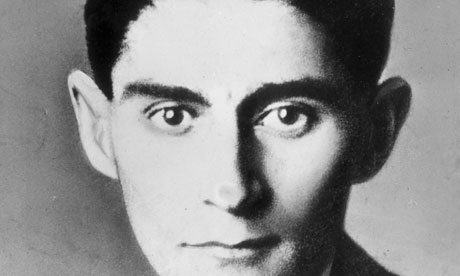
It’s easy to think of Franz Kafka as a celibate, even asexual, writer. There is the notable lack of eroticism of any recognizable sort in so much of his work. There is the prominent biographical detail—integral to so many interpretations—of his outsized fear of his father, which serves to infantilize him in a way. There is the image, writes Spiked, of “a lonely seer too saintly for this rank, sunken world.” All of this, James Hawes writes in his Excavating Kafka, “is pure spin.” Against such idolatry, both literary and quasi-religious, Hawes describes “the real Kafka,” including the fact that he was “far from an infrequent visitor to Prague’s brothels.” Though “tortured”—as his friend, biographer, and executor Max Brod put it—by guilt over his sexuality, Kafka nonetheless did not deny himself the frequent company of prostitutes and a collection of outré pornography.
But a part of the myth, Kafka’s extreme diffidence in romantic relationships with two women in his life—onetime fiancé Felice Bauer and Czech journalist Milena Jesenská—is not far off the mark. These relationships were indeed “tortured,” with Kafka “demanding commitment while doing his best to evade it.” His courtship with Felice was conducted almost entirely through letters, and his personal correspondence to both women, published in separate volumes by Schocken Books, “has all the earmarks of his fiction: the same nervous attention to minute particulars; the same paranoid awareness of shifting balances of power; the same atmosphere of emotional suffocation—combined, surprisingly enough, with moments of boyish ardor and delight.” So writes the New York Times’ Michiko Kakutani in her review of Letters to Felicein 1988.
A March 25, 1914 letter to Felice exemplifies these qualities, including Kafka’s tendency to “berate” his fiancé and to “backpedal” from the serious possibility of marriage. In answer to her seemingly unasked question of whether Bauer might find in him “the vital support you undoubtedly need,” Kafka writes,” there is nothing straightforward I can say to that”:
The exact information you want about me, dearest F., I cannot give you ; I can give it you, if at all, only when running along behind you in the Tiergarten, you always on the point of vanishing altogether, and I on the point of prostrating myself; only when thus humiliated, more deeply than any dog, am I able to do it. When you post that question now I can only say: I love you, F., to the limits of my strength, in this respect you can trust me entirely. But for the rest, F., I do not know myself completely. Surprises and disappointments about myself follow each other in endless succession.
The frustrated mystery, self-abasement, vague and fearful hints, and reference to dogs are all elements of the so oft-invoked Kafkaesque, though the frank proclamation of love is not. Not long after his 1917 diagnosis of tuberculosis, Kafka would break off the engagement. In 1920, he began his—also heavily scripted—affair with Jesenská, his side of which appears in the collected Letters to Milena. In these missives, the same set of personal and literary impulses alternate: tender expressions of devotion give way to dark and cryptic statements like “written kisses… are drunk on the way by the ghosts” and “I have spent all my life resisting the desire to end it.” One letter seems to have nothing at all to do with Milena and everything to do with Kafka’s project as a writer:
I am constantly trying to communicate something incommunicable, to explain something inexplicable, to tell about something I only feel in my bones and which can only be experienced in those bones. Basically it is nothing other than this fear we have so often talked about, but fear spread to everything, fear of the greatest as of the smallest, fear, paralyzing fear of pronouncing a word, although this fear may not only be fear but also a longing for something greater than all that is fearful.
Passages like these warrant the reduplication in Kakutani’s review title: “Kafka’s Kafkaesque Love Letters.” It is almost as if he used these letters as a testing ground for the tangled internal conflicts, doubts, and obsessions that would make their way into his fiction. Or that, in them, we see these Kafkaesque motifs distilled. It is during his engagement to Felice Bauer that Kafka produced “his most significant work, including The Metamorphoses,” and during his relationship with Milena Jesenská that my personal favorite, The Castle, took shape.
Although it has long been fashionable to resist the “biographical fallacy,” reading an author’s life into his or her work, the existence of hundreds of Kafka’s letters in publication makes this separation difficult. Elias Canetti described Kafka’s letters as a dialogue he was “conducting with himself,” one which “provide[s] an index of the emotional events that would inspire ‘The Trial’” and other works. Kafka’s unexpected bouts of romantic passion notwithstanding, these letters add a great deal of support to that critical assessment.
I suspect that among disinfonauts there will be more people wondering who Kylie Jenner is than what a chemtrail might be, but here anyway is Fusion‘s explanation of chemtrails and the shocking news that one of the Karsdashian clan is into them:
Even celebrities find time to get sucked into horrible Internet wormholes.
At least that’s what seems to have happened to Kylie Jenner, who...
[This is a short summary; please click the story headline to read the full story on our site]
Ray McDonald had a job
e-i-e-i-oh
On the bears a roster spot
e-i-e-i-oh
But an arrest here and an arrest there
here arrest there arrest
everywhere an arrest
Ray McDonald lost his job
good riddance you piece of crap
Well then. So he was an asshole all along.
I didn’t touch the Ray McDonald situation when it first came up last year because I already had enough fodder for the NFL’s terrible policies and McDonald’s situation wasn’t very clear. Now it isn’t. Dude gets a zero guaranteed money contract with the Bears, was told to behave to retain a roster spot, and can’t even go a few months before he gets arrested for assault. On a woman holding a child, no less. What a prick. The Bears cut him within hours of the news dropping. I’d wager he’s done. It doesn’t even matter what Roger punishes him with (either a 6 game suspension or a ban) because McDonald isn’t sniffing the field again.
Normally, community council meetings are intended to be opportunities for officers and civilians to meet face-to-face and discuss issues in the precinct, but on Wednesday May 20, the Lower East Side’s 7th Precinct hosted a special session, inviting the community to try out an NYPD firearms tactics training simulator. I was intrigued, because it seemed to be a rare opportunity for a civilian to see how the NYPD actually trains its officers in a time when the department’s firearms tactics are controversial. Going in, I didn’t know what to expect from the simulator: Would it be a mini-shooting range? Or a video game? If there were human-shaped targets, would I be allowed to put turbans on them?
The simulator is one part of firearms training that also includes actual time at the shooting range and in-person scenario role-playing. Basic firearms training for recruits is 13 days long, and some officers receive specialized training based on their assignment. Cops also have to get re-certified every other year. The NYPD does not heavily emphasize firearms training compared to other police departments, because its theory is that putting too much emphasis on guns will make officers more likely to shoot.
But NYPD firearms training is notoriously poor. A 2007 study by the high-level defense contractors at the RAND Corporation found that “training in complex policing skills” such as communication and decision-making “could be improved,” and that NYPD officers should carry tasers so that situations aren’t as likely to escalate to deadly force. In 2012, the Times investigated weapons training in the police academy and found that it’s “not taken seriously.” That same year, an officer took to Reddit and wrote, “any average CCW [concealed-carry weapon] citizen who practices more then [sic] twice a year pretty much has most of the department beat in terms of training.” Even Second Amendment advocates are critical of the NYPD: last year, after the accidental shooting death of Akai Gurley, gun blogger Bob Owens of Bearing Arms called the NYPD “poorly-trained” and “incompetent.”
Obviously, I was not expecting to learn “complex policing skills” from an hourlong demo, but I did expect to get a sense of how the NYPD views its guns, and under what conditions officers are meant to reach for them. Big surprise: I did not like what I saw.
The demo was led by Det. Joe Agosto, a firearms trainer from the police academy. He was very adamant about how the media misrepresents what being a cop is like, and how civilians don’t know what it’s like to be in a situation where you don’t know what’s going to happen and you might have to shoot someone. The whole demonstration felt very defensive, like the NYPD was invoking preemptive blamelessness for the next time it killed an unarmed person. Agosto ran down a list of things cops experience during such a stressful, adrenaline-soaked interaction, such as tunnel vision and distortion of time, and while there’s truth to that, it almost sounded like he was making excuses for when mistakes are made. He showed some infographics about how the NYPD kills less people per capita than other police departments, and then showed the first group of people using the simulator how to hold the gun, which was pretty much the extent of the practical training.
The training simulation itself is an interactive video. The officer at the computer queues up a scenario like a cop might encounter in the field, and recruits react to it. The action in the video reacts to whatever tool is used (pepper spray, baton, gun). Basically, it’s a choose-your-own-adventure computer game with a gun for a mouse. Trainees are instructed to talk to the people onscreen, but it’s not fully interactive, because they don’t respond to verbal commands. So it’s designed for trainees to resort to violence.
My scenario was responding to a burglar alarm at a commercial space after business hours. I was the second trainee to use this scenario. In the video, shot from the cops’ point of view, a man comes out from behind a desk. He’s saying he works there. One of his hands is shielding his eyes from the cops’ flashlights, and the other is hidden behind the desk. He does not respond to commands to show his hand. One of the trainees before me attempted to pepper spray him, and in this choose-your-own-adventure option, the suspect pulled out a gun and started shooting. So he was killed.
The duo before me got super violent very quickly, so I came in after to demonstrate a different possible outcome. I didn’t have a partner. Det. Agosto showed me how to hold the gun, and then I was in the scenario. The guy was standing there, hiding his hand, telling me to get the light out of his face. “Show me your hand,” I commanded. He didn’t comply. Since I knew I was talking to recording that wasn’t listening, I ran out of stuff to say very quickly. “Do you want me to show you my ID?” he said. “Yeah, show me your ID,” I answered awkwardly to the screen. Suddenly, he whipped his hidden hand from out behind the desk. He was moving like he had a gun, and he did, kind of. But it wasn’t a firearm, it was a staple gun. He pretended like he was shooting me with the staple gun.
“That’s not funny,” I said. “Put the stapler down.” I didn’t shoot him.
“Wow, wait here, I’m going to get you an application,” Det. Agosto said, impressed. “No one doesn’t shoot him” when he pulls out the stapler in this scenario, he told me.
Perhaps because I was prepped, perhaps because my reaction was slow, or perhaps because I’m by nature not a violent person, I was able to restrain myself and not exert deadly force. In the NYPD training academy, I would be an anomaly, because I would rather talk than shoot. They are trained first and foremost to neutralize threats. Not doing this through violence is apparently novel. But I showed that it can be done.
There were a few more scenarios, and then the meeting ended before the community had a chance to speak. This was an unscheduled, unilateral, undemocratic decision by community council president Don West that royally pissed off people who had come to air grievances, but that’s a story for another time.
TW: atheists? also i basically think about death all the time, soooo
What do you think of if/when you think of atheists? If you’re American there’s a good chance the thought of atheism inspires further thoughts about death, per Discovery News:
Atheists consistently rank among the lowest of the low in the court of American public opinion. Now, research suggests one reason why: Thinking about atheists reminds people of death.
Photo: Trish Steel...
[This is a short summary; please click the story headline to read the full story on our site]
Fifty years after the repeal of Jim Crow, many African-Americans still live in segregated ghettos in the country's metropolitan areas. Richard Rothstein, a research associate at the Economic Policy Institute, has spent years studying the history of residential segregation in America.
"We have a myth today that the ghettos in metropolitan areas around the country are what the Supreme Court calls 'de-facto' — just the accident of the fact that people have not enough income to move into middle class neighborhoods or because real estate agents steered black and white families to different neighborhoods or because there was white flight," Rothstein tells Fresh Air's Terry Gross.
"It was not the unintended effect of benign policies," he says. "It was an explicit, racially purposeful policy that was pursued at all levels of government, and that's the reason we have these ghettos today and we are reaping the fruits of those policies."
Interview Highlights
On using the word "ghetto"
One of the ways in which we forget our history is by sanitizing our language and pretending that these problems don't exist. We have always recognized that these were "ghettos." A ghetto is, as I define it, a neighborhood which is homogeneous and from which there are serious barriers to exit. That's the technical definition of a ghetto.
Robert Weaver, the first African-American member of the Cabinet appointed by President Johnson as his secretary of Housing and Urban Development, described many of the policies that I've described today in a book he published in 1948 called The Negro Ghetto.
The Kerner Commission referred to the ghetto.
This is a term that we no longer use because we're embarrassed to talk about it, and we need to confront our history and stop sanitizing our language and talk openly about what we've done as a nation and what we need to do to undo it. And we can't talk openly if we're going to use euphemisms instead of being explicit about what the reality is.
On how the New Deal's Public Works Administration led to the creation of segregated ghettos
Its policy was that public housing could be used only to house people of the same race as the neighborhood in which it was located, but, in fact, most of the public housing that was built in the early years was built in integrated neighborhoods, which they razed and then built segregated public housing in those neighborhoods. So public housing created racial segregation where none existed before. That was one of the chief policies.
On the Federal Housing Administration's overtly racist policies in the 1930s, '40s and '50s
The second policy, which was probably even more effective in segregating metropolitan areas, was the Federal Housing Administration, which financed mass production builders of subdivisions starting in the '30s and then going on to the '40s and '50s in which those mass production builders, places like Levittown [New York] for example, and Nassau County in New York and in every metropolitan area in the country, the Federal Housing Administration gave builders like Levitt concessionary loans through banks because they guaranteed loans at lower interest rates for banks that the developers could use to build these subdivisions on the condition that no homes in those subdivisions be sold to African-Americans.
On real estate agents' practice of "blockbusting"
In the ghettos, government policy — municipal policy, for example — denied adequate services, garbage wasn't collected frequently. African-Americans were crowded into neighborhoods in the ghetto because so much other housing was closed to them and as a result, housing prices in ghettos were much higher than similar housing in white areas. Rents were much higher than similar housing in white areas ... because you had a smaller supply. It's the basic laws of supply and demand. ... So this created slum conditions.
So when African-Americans managed to break out of those slums and buy a home in a neighboring area, whites could be persuaded that slum conditions were going to be brought with them. So the real estate agents would go into these neighborhoods and try to panic white families into selling their homes cheap to the real estate agents.
They used techniques: They would recruit blacks from the ghetto to walk around the neighborhood pushing baby carriages. They would phone call families in the white area and ask for names that were stereotypically African-American. ... All intended to give the impression that this was rapidly turning into another black slum.
The white families who panicked would then sell their homes to the real estate agents or the speculators at prices far below what they were worth. The speculators would then turn around and resell the homes to African-Americans at far more than they were worth because of the restricted supply, and this policy was called "blockbusting" and it was a policy that was condoned by state licensing boards throughout the country.
“They were everywhere and anywhere,” a police officer later testified. “They were all over the furniture, hanging from lampshades and even in the microwave, frying pan and cooker. It was like there had been an explosion in a sock factory and socks had blown all over the place.”
NSFW. i've seen the cello one numerous times and never known who it was.
Francisco José de Souto Leite también conocido bajo el seudónimo de Derbyblue, es un ilustrador brasileño que trabaja con diferentes soportes, que van desde lo tradicional como papel y lienzo hasta las mismas calles de la ciudad. Esta mezcla del graffiti junto con remembranzas del cómic de los 60’s y 70’s le da un toque único y característico a su obra.
Llena de colores, la sensualidad y erotismo que alberga el trabajo de Leite pareciera que roza con la vulgaridad; sin embargo no es por pura coincidencia sino que es el mensaje de la misma: la transgresión de lo moral, permitiendo así la crítica social.
Si deseas saber más de Francisco Leite, te dejamos su flickr:
A few weeks ago, thanks to my old friend George Leader, I was lucky enough to visit an archaeological dig at an eighteenth-century farmhouse on The College of New Jersey’s campus. I’d never been to a dig site before, so the technical details alone were fascinating: the reasoning behind determining where to dig in the first place, the standing sieve to strain buckets of earth for artifacts, the practice of wrapping fragile artifacts in foil (who knew!), the technology used to date wooden architectural features. I really dug it. (Sorry. Couldn’t resist.)
Seeing the farmhouse, getting to hold some of the artifacts unearthed that day – a metal button, a shard of blue and white pottery, and a small clay sphere that we theorized might have been a marble – made me think about this project and what we can uncover. I’m used to engaging with the past through words on a page. The archives always feel a little bit magical to me: these texts still exist centuries later, and I get to touch them, smell them, read them. I felt a similar tug at the dig, seeing artifacts being unearthed and thinking about our access to the past through what happens to have been left behind. At a basic level, archaeological investigation and archival literary research give us physical access to fragments of past lives, preserved deliberately or accidentally. You figure out where to look, but you don’t always know what you’re going to find.
This project is one of reconstruction from a distance and with pieces missing: the recipes are vestiges of what did get recorded, leaving little behind of what didn’t. Cooking from the archives creates a powerful bridge between me and the past. I will never stand in a kitchen without refrigeration, without even the possibility of electric lights, without having spent my whole baking life reaching automatically for ingredients like vanilla extract and uniform sticks of butter, but I can still approximate how Naples biscuits would have tasted nearly three hundred years ago.
There’s always a gap, though, related to how just far that bridge can reach. Working on this project has brought me up short at this gap time and again: reading handwritten manuscripts begs to know more about the person who wrote them, but there’s often little headway to be made. We can decipher handwriting, but identities are harder. This impulse isn’t just personal – it’s a question that comes up often for me and Marissa, of who wrote these recipes down, of what we know about them. Usually, not much. But this recipe left a faint trace of one of the individuals behind it.
This Herb Soop comes from UPenn MS Codex 1038, home to some of my favorites, like the Maccarony Cheese and Desart Cakes. The volume contains at least three separate hands, and we still don’t know anything about these writers. This handwriting is the second in the volume, probably written down sometime in the 1790s or early 1800s. The end of the recipe attributes it to “Lady Laroche.” (She is probably the source and not the writer of this recipe, since several subsequent recipes in the same handwriting are attributed to other women.) It is nearly impossible to know anything about the other women whose names accompany their recipes – the Mrs. Baker who gave the writer her recipe for Curd Cheescakes, the Mrs. Fordham who told her how “To make Flumery,” or the Mrs. Turner who showed how “To Dress a real Turtle as the[y] do in the West Indies,” for instance. “Lady,” however, provides direction in a way that “Mrs.” often cannot.
It turns out that this “Lady Laroche” can be one of only two women. James Laroche, a Bristol politician and slave-trader, was created baronet in August 1776. Since the baronetcy became extinct when he died in 1804 without any male heirs, this Lady Laroche has to have been one of his two wives. The first Lady Laroche was born Elizabeth-Rachel-Anne Yeamans in Antigua. An heiress (she brought at least one plantation to the marriage) and widow, she married James Laroche in 1764 and moved to England with him. After Elizabeth-Rachel-Anne died in 1781, James remarried; his second wife may also have been named Elizabeth. We know nothing else of her except that she survived her husband and died in Wales in 1824. Can we know how or even if this recipe writer and either Lady Laroche knew each other? What else they might have talked about, why this particular recipe was the one shared? No. But sometimes, even this small glimpse into archival identities feels like uncovering something satisfying.
The Recipe
To make Herb Soop
Take Parsley, Spinnach, Cabbage Lettice, Leaves of
White Beet, Sorrell, Cucumbers, Pease & small Onions
with the green ends to them, a little Mint, and a very
little Fennell. Wash them all clean, and Chop the
Herbs very small. Season them with Pepper & Salt,
Put them into a Pot to stew with a piece of Butter
according to your quantity, but no Water. Let
them stew quite tender. Have ready boiled some
Cream or Milk, with the Yolks of Eggs beat up in it,
Mix this gently with the Herbs and serve it up.
You must not let it boil, or be on the Fire after the
Eggs are put to it. You are to observe it is not to
be a thin liquid, but more herbs than Soop. that is,
thick of the Herbs. Less than half a pound of butter
will do unless the Terene is very large. There shoud
be Cellery chopped amongs the herbs if to be had &
—-
other herbs you like but not strong of any one in particular.
Some leave out the Fennell, as it is apt to be too strong.
Lady Laroche.
Our Recipe
3 generous handfuls of spinach (about 1 1/2 c. chopped)
1/2 c. parsley, chopped
a few mint leaves, chopped
1 large or 2 small cucumbers, diced (I also seeded mine)
1-2 celery stalks, sliced thinly
1 c. chopped cabbage
3/4 c. green peas (fresh or frozen)
3 scallions, sliced thinly
1/2 tsp. salt
a few grinds of pepper
1 tbsp. butter
1/2 c. milk
1 egg yolk
In a medium saucepan, combine all ingredients except for the milk and egg yolk. Cook them over low-medium heat, stirring often enough to prevent the greens from sticking. Cook until the greens are all wilted and the cucumbers are translucent; for me, this took about 20 minutes. (Though you could probably let them “stew” even longer.) Heat the milk in the microwave or on the stove until quite hot. In a small bowl, whisk the egg and then, still whisking, add the hot milk in a steady stream. Remove the herb mixture from the heat and stir in the milk. Serve immediately.
The Results
The Soop tasted green: stewed together, the herbs and vegetables made a pleasantly flavorful whole. I’d never had cooked cucumbers before and was curious – they softened but held their shape, rather like zucchini, and provided nice texture in the soup. I liked the zip from the scallions and the chewiness of the cabbage (even if cooking it did make my kitchen rather … fragrant). In its piling together of many different herbs and vegetables, the Herb Soop felt like a precursor to some of Yotam Ottolenghi’s recipes. I found it satisfying that what I was tasting was probably pretty close to some of the results this recipe would have yielded for eighteenth-century cooks: all of the ingredients remain available, the cooking technique was easily duplicated in my kitchen (albeit with the ease of a gas stove), and the methodology was specific enough that I could follow the recipe’s instructions closely.
In fact, this Herb Soop recipe is quite detailed in its ingredient list and instructions – it’s very helpful to know, for instance, that the end result should be “more herbs than Soop” – more so than many of the other recipes we’ve engaged with, like Artificial Potatoes. But it provides few precise measurements. I guessed at these proportions, determining them largely based on what I had and what I liked. (I don’t love fennel, so I’m one of those “some” the recipe mentions who “leave [it] out.” And my little produce market doesn’t carry sorrel, so I didn’t use it.) And I imagine that’s what early cooks did as well, making the soup slightly differently each time based on what needed to be used or what was available.
What else could you toss in here? Leeks, zucchini, basil, cilantro, green bell peppers – really, anything green that happens to be lurking in your crisper could make its way into this soup. Some hot pepper flakes would liven things up. I see the appeal behind the milk-and-egg liquid choice: it’s a rich addition and adds some depth to the greens. However, I might substitute some vegetable broth or chicken stock for a lighter soup. Basically, this recipe provides a wonderful alternative idea for using up the leftover greens that I normally toss into a grain salad, a stir-fry, or baked eggs.
Photographer Michael James O’Brien‘s Girlfriend exhibition—now showing at Liverpool’s international photography festival—is an absolutely captivating array of vintage 90’s queer aethetics. While his subjects explode with life (and are ostensibly color people), the drag queens featured in...
As the work on the next edition of Black Venus portraits continues, I am scheduling photo sessions and looking for natural women of African descent to be my subjects. The project, and subsequent book, is about celebrating black women from all walks of life. Mothers, mothers-to-be, daughters, sisters, wives, girlfriends, rebels — women of all shapes and sizes, younger and older, are welcome. No modeling experience is necessary.
All shoots take place in Charlotte, North Carolina. Please contact me via Tumblr, Facebook or Instagram for details and lets make beautiful portraits!
* Reblog now for a chance to win a copy of the final book!
time to start combing the local asian markets for peach chips i guess
If you thought traditional Japanese breakfasts were unusual, with their servings of fish, pickles, rice and soup, you’ll be in for a surprise when you see the new offering that’s coming to the table to greet you in the morning.
It’s time to say hello to the morning potato chip. Especially designed for breakfast consumption, these bags of fruity – yes, fruity – goodness are said to combine the energy-giving health benefits of the humble potato with two popular fruit flavours: peach and banana.
So how could these chips possibly fare as breakfast meals? Come with us as we head out into unchartered territory, pairing potato crisps with yoghurt, toast, and a bowl of granola and milk. Will the results be delicious? Read on to find out!
Currently on sale at convenience stores nationwide for 120 yen (US$0.98), these two unusual chip flavours will be hitting supermarket shelves from 1 June.
Opening the packets, we get our first glimpse of our morning meal. While they look like any other potato chip, the aroma’s certainly different. Rather than getting a big hit of salt, these give off a sweet, fruity aroma, more like a packet of gummies.
The banana crisps are covered in the powder of the fruit, giving them a slightly yellow hue. Koikeya, the company behind the unusual snack, prides itself on the fact that this chip variety has the energy-giving equivalent of 3.95 bananas.
The peach crisps, meanwhile, have a slight pink tinge to them and purportedly provide the same amount of energy as 3.73 Japanese-grown peaches. The fruity aroma of both these varieties is surprisingly alluring, even though it’s something we haven’t encountered from a bag of potato chips before.
Unlike more conventionally flavoured crisps, these ones contain unusual recipe ideas on the back of the pack. The suggested recipe for the banana crisps is marshmallow banana toast, drizzled with chocolate sauce.
The peach variety are said to pair nicely with fresh ham, alongside a cream cheese dip.
Having a quick look through the pantry, we found we were totally out of marshmallows and didn’t have any fresh ham or cream cheese. Instead, we decided to whip up a few inventive recipes of our own. We started off with our version of bananas on toast.
The first bite of this was, well, weird. From the look of it, there’s an expectation that this will taste like your regular chip sandwich. But then, the sweet banana flavour hits your tongue and everything gets thrown into disarray.
After a few bites, it becomes clear that this is a surprisingly good combination. The chewy texture of the toast goes well with the crunch of the potato chip, and the banana flavour permeates each mouthful, bringing a distinct sweetness to the bread. We can definitely see this working with marshmallows and chocolate sauce!
For our next course, what could go better with peaches than a bowl of fresh, plain yoghurt?
We decide to go for a ‘chips and dip’ style for this offering. The first bite made us laugh out loud, as the taste was exactly like a delicious peach yoghurt – only crunchy!
▼ Definitely a winner – thumbs up for yoghurt with peach chips!
Now, we’ve had granola with dried fruit before, so why not try them out with their nouveau chip versions?
We crumbled up both varieties of crisps and sprinkled them on top of an unsuspecting bowl of granola.
Adding milk to potato chips is certainly a first, but we had faith that this pairing might just work!
And it’s another surprising winner! The crisps work well as soft layers of fruit flavour, gently seeping out into the milk and making everything delicious. We can’t believe we’re saying this, but chips for breakfast actually works.
The verdict on Koikeya’s new fruit-flavoured potato chips? Strangely delicious! We must admit, we were dubious about this (as you probably still are!) when we started, but thanks to the minimal use of salt and the familiar fruit flavours, these work really well and are seriously pleasing to the palate. The only hurdle to get over is the fact that the product looks like something you’d normally snack on while watching a movie or with a couple of beers rather than your morning coffee.
Despite the unusual combination, these are a great example of the skill of Japanese snack manufacturers, who have an uncanny knack for blending some of the world’s most unassuming flavours. From past experience, these unique chip varieties won’t stay around for long, so get them now while you can!
When streaming players boast about their huge numbers of channels, I’m generally even less impressed than I am by the “wealth” of offerings on the grossly overpriced wasteland that is cable TV. I have absolutely no use for thousands of impossibly granular channels like The Christian Comedy Channel, Firewood Hoarders, NRA Women,...