06 Mar 16:12
Chem. Commun., 2017, 53,3669-3672
DOI: 10.1039/C7CC01114H, Communication
Cai-Ling Wang, Li Zhou, Lei Zhang, Jun-Feng Xiang, Brett M. Rambo, Jonathan L. Sessler, Han-Yuan Gong
Aminobenzene sulphonate species having different isomeric patterns act as substrates for a tetracationic molecular box.
The content of this RSS Feed (c) The Royal Society of Chemistry

05 Mar 12:43
by Matthias Trunk, Johannes F. Teichert and Arne Thomas

Journal of the American Chemical Society
DOI: 10.1021/jacs.6b13147

05 Mar 12:41
by Jens Niklas, Oleg G. Poluektov
Understanding charge separation and charge transport at a molecular level is crucial for improving the efficiency of organic photovoltaic (OPV) cells. Under illumination of Bulk Heterojunction (BHJ) blends of polymers and fullerenes, various paramagnetic species are formed including polymer and fullerene radicals, radical pairs, and photoexcited triplet states. Light-induced Electron Paramagnetic Resonance (EPR) spectroscopy is ideally suited to study these states in BHJ due to its selectivity in probing the paramagnetic intermediates. Advanced techniques like pulsed EPR and ENDOR spectroscopy allow the determination of hyperfine coupling tensors, while high-frequency EPR allows the EPR signals of the individual species to be resolved and their g-tensors to be determined. The magnetic resonance parameters of the various polymer donors reveal details about the delocalization of the positive polaron which is important for the efficient charge separation in BHJ systems. Time-resolved EPR can contribute to the study of the dynamics of charge separation, charge transfer and recombination in BHJ by probing the unique spectral signatures of charge transfer and triplet states. EPR also has the potential to allow characterization of intermediates and products of BHJ degradation.

Light-induced EPR spectroscopy is ideally suited to study charge separated states in BHJ since it selectively probes the paramagnetic charge carriers and excited states. This review focusses on the application of advanced EPR techniques to characterize the electronic structure of positive and negative polarons as well as dynamics of spin-dependent charge separation and charge recombination processes in organic photovoltaic materials.
02 Mar 19:37
Chem. Commun., 2017, 53,3213-3215
DOI: 10.1039/C7CC00672A, Communication
S. Guski, M. Albrecht, T. Willms, M. Albrecht, T. Nabeshima, F. Pan, R. Puttreddy, K. Rissanen
Extended acyl hydrazine based dipyrrine ligands lead to a specific colour response upon addition of metal ions.
The content of this RSS Feed (c) The Royal Society of Chemistry

01 Mar 16:04
by Luis Moreira, Beatriz M. Illescas and Nazario Martín

The Journal of Organic Chemistry
DOI: 10.1021/acs.joc.6b03030

01 Mar 08:24
by Xiangyi Zhang and Robert M. Waymouth

Journal of the American Chemical Society
DOI: 10.1021/jacs.7b00039

28 Feb 16:00
by Doriane Menigaux, Philippe Belmont, Etienne Brachet
Carbon–heteroatom bond formation is a long-standing hot topic in organic chemistry owing to the ubiquitous presence of these bonds in organic molecules. A major pathway to form them is the heterofunctionalization of unsaturated moieties mediated by transition metals or radical initiators. Recently, visible-light catalysis has become a powerful method for the synthesis of many chemical bonds, and carbon–heteroatom bond formation has attracted the particular attention of photochemists. In this review, we highlight recent advances in visible-light photocatalysis for the formation of C–N, C–O, C–S, and C–P bonds through the hydro- or carbo-heterofunctionalization reactions of unsaturated partners.

An overview of the visible-light-induced heterofunctionalization of unsaturated compounds is provided, and its usefulness as a powerful tool for the synthesis of complex molecules is demonstrated.
27 Feb 09:11
by Tomáš Šolomek, Natalia E. Powers-Riggs, Yi-Lin Wu, Ryan M. Young, Matthew D. Krzyaniak, Noah E. Horwitz and Michael R. Wasielewski

Journal of the American Chemical Society
DOI: 10.1021/jacs.7b00233

22 Feb 08:16
by Jeff M. Van Raden, Shayan Louie, Lev N. Zakharov and Ramesh Jasti

Journal of the American Chemical Society
DOI: 10.1021/jacs.7b00359

21 Feb 13:47
by Daniel Jasinski, Farzin Haque, Daniel W Binzel and Peixuan Guo

ACS Nano
DOI: 10.1021/acsnano.6b05737

21 Feb 10:16
by Sarah N. Spisak, Zheng Wei, Andrey Yu. Rogachev, Toru Amaya, Toshikazu Hirao, Marina A. Petrukhina

Cesium EncapsulationIn their Communication on page 2582 ff., A. Yu. Rogachev, T. Hirao, M. A. Petrukhina, and co-workers report unprecedented double concave encapsulation of a metal ion by two bowl-shaped sumanenyl carbanions.
20 Feb 09:08
by Yilei Wu, Matthew D. Krzyaniak, J. Fraser Stoddart and Michael R. Wasielewski

Journal of the American Chemical Society
DOI: 10.1021/jacs.7b00515

20 Feb 09:06
by Evan R. Darzi, Brittany M. White, Lance K. Loventhal, Lev N. Zakharov and Ramesh Jasti

Journal of the American Chemical Society
DOI: 10.1021/jacs.6b12658

17 Feb 10:46
Chem. Commun., 2017, 53,2756-2759
DOI: 10.1039/C6CC10328F, Communication
Soumen K. Samanta, Kimberly G. Brady, Lyle Isaacs
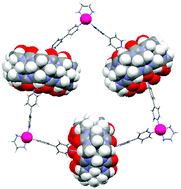
We report the synthesis of rigid rod (bis)dipyridinium ligand 1 and its self-assembly in the presence of M(en)(NO3)2 (M = Pd, Pt) and cucurbit[7]uril or motor 2 (M2) to yield triangular [4]molecular necklaces 7-10.
The content of this RSS Feed (c) The Royal Society of Chemistry

17 Feb 10:42
Chem. Commun., 2017, 53,3323-3326
DOI: 10.1039/C7CC00504K, Communication
Fangli Zhao, Lutz Grubert, Stefan Hecht, David Bleger
Azobenzene mixed-dimer rods have been prepared, whose four isomers can be orthogonally addressed with light and electrons.
The content of this RSS Feed (c) The Royal Society of Chemistry

17 Feb 10:40
by Hu Wang, Xiaofan Ji, Zhengtao Li, Feihe Huang
Fluorescent supramolecular polymeric materials are rising stars in the field of fluorescent materials not only because of the inherent optoelectronic properties originating from their chromophores, but also due to the fascinating stimuli-responsiveness and reversibility coming from their noncovalent connections. Especially, these noncovalent connections influence the fluorescence properties of the chromophores because their state of aggregation and energy transfer can be regulated by the assembly–disassembly process. Considering these unique properties, fluorescent supramolecular polymeric materials have facilitated the evolution of new materials useful for applications in fluorescent sensors, probes, as imaging agents in biological systems, light-emitting diodes, and organic electronic devices. In this Review, fluorescent supramolecular polymeric materials are classified depending on the types of main driving forces for supramolecular polymerization, including multiple hydrogen bonding, electrostatic interactions, π–π stacking interactions, metal-coordination, van der Waals interactions and host−guest interactions. Through the summary of the studies about fluorescent supramolecular polymeric materials, the status quo of this research field is assessed. Based on existing challenges, directions for the future development of this field are furnished.

Fluorescent supramolecular polymers are attracting increased attention currently due
to their dynamic fluorescent properties and potential applications. Recent studies on fluorescent supramolecular polymers depending on the type of main driving forces for supramolecular polymerization, including multiple hydrogen bonding interactions, electrostatic interactions, π–π stacking interactions, metal-coordination, van der Waals interactions and host−guest interactions are discussed.
17 Feb 08:57
Chem. Sci., 2017, 8,3019-3025
DOI: 10.1039/C7SC00201G, Edge Article

Open Access
Mahbod Morshedi, Michael Thomas, Andrew Tarzia, Christian J. Doonan, Nicholas G. White
Charge-assisted hydrogen bonds between a tetratopic receptor and terephthalate anions assemble a switchable supramolecular framework material in water.
The content of this RSS Feed (c) The Royal Society of Chemistry

17 Feb 07:46
by Jason Y. C. Lim, Igor Marques, Amber L. Thompson, Kirsten E. Christensen, Vítor Félix and Paul D. Beer

Journal of the American Chemical Society
DOI: 10.1021/jacs.6b12745

16 Feb 09:31
by Ryota Matsuoka, Ryota Sakamoto, Ken Hoshiko, Sono Sasaki, Hiroyasu Masunaga, Kosuke Nagashio and Hiroshi Nishihara

Journal of the American Chemical Society
DOI: 10.1021/jacs.6b12776

16 Feb 09:31
by Timothy P. Moneypenny, Nathan P. Walter, Zhikun Cai, Yu-Run Miao, Danielle L. Gray, Jordan J. Hinman, Semin Lee, Yang Zhang and Jeffrey S. Moore

Journal of the American Chemical Society
DOI: 10.1021/jacs.7b00189

09 Feb 10:53
by Ning Huang, Lipeng Zhai, Hong Xu and Donglin Jiang

Journal of the American Chemical Society
DOI: 10.1021/jacs.6b12328

30 Jan 15:43
by Fabian Lodermeyer, Rubén D. Costa, Dirk M. Guldi
Recent advances in dye-sensitized solar cells (DSSC), including the use of nanocarbons, resulted in breakthroughs relevant to both the academic and industrial sectors. Their relevance encompasses, on one hand, the development and integration of novel nanocarbon/dye hybrids for superior light-harvesting and improved charge injection properties and, on the other hand, the integration of nanocarbons into each part of DSSCs for enhancing the charge collection efficiency as well as the dye and electrolyte regeneration processes. In the context of the earlier, control over the electron injection and recombination rates is realized on the molecular level. In the context of the latter, i) the charge transport and charge collection efficiencies in the photoelectrode are increased, ii) the charge recombination processes are reduced, when used as a nanocarbon-based buffer layer, iii) the ion diffusion and catalytic effects into (quasi) solid-state electrolytes are improved, and iv) devices using Pt-free counter electrodes with similar device efficiencies are realized. Leading examples of nanocarbons are graphene, carbon black, multi-walled carbon nanotubes, and single-walled carbon nanotubes. In this review, the focus is on a novel carbon allotrope, namely single-walled carbon nanohorns (SWCNH), which is discussed in depth and in comparison with other nanocarbons.

Research on nanocarbon-based DSSCs is on the rise. SWCNHs stand out given their unique production, functionalization, and dispersibility. They are applied as i) SWCNH/dye hybrids, ii) buffer layers, iii) active components in photo- and counter electrodes, and iv) additives in solid-state electrolytes. This review summarizes the recent achievements concerning their use with respect to those realized with other nanocarbons.
28 Jan 22:09
by Peter Spenst, Ryan M. Young, Brian T. Phelan, Michel Keller, Jakub Dostál, Tobias Brixner, Michael R. Wasielewski and Frank Würthner

Journal of the American Chemical Society
DOI: 10.1021/jacs.6b11973

25 Jan 15:01
by José G. Hernández and Carsten Bolm

The Journal of Organic Chemistry
DOI: 10.1021/acs.joc.6b02887

24 Jan 02:37
by Midori Akiyama, Kyoko Nozaki
Abstract
Two types of ruthenocenes and a ferrocene coordinated by rac-9H-cyclopenta[1,2-c:4,3-c′]diphenanthrenyl anion(s), a [7]helicene with a cyclopentadienyl moiety at the center of its skeleton, were successfully synthesized: mono-helicene ruthenocene 1 and its iron analogue 1Fe with one [7]helicene ligand bound to the central metal, and bis-helicene ruthenocene 2 with two [7]helicenes. Starting from a racemic mixture of the ligand precursor, rac-2 and meso-2 were obtained in a 7:3 ratio. Since the [7]helicene has a high racemization barrier, enantiomers of the complexes were isolated in their pure forms; they showed large optical rotations and intense circular dichroism (CD) responses.

Jumbo sandwiches: Ruthenocenes and a ferrocene were successfully synthesized from [7]helicene(s) possessing a cyclopentadienyl anion at the center of its skeleton that coordinates to the metal atom. Since the [7]helicene has a high racemization barrier, enantiomers of the complexes were isolated in their pure forms; they showed large optical rotations and intense circular dichroism responses.
23 Jan 21:06
by Long Zhang, Lin Lin, Dong Liu, Yue-Jian Lin, Zhen-Hua Li and Guo-Xin Jin

Journal of the American Chemical Society
DOI: 10.1021/jacs.6b11968

20 Jan 20:36
by Akira Takahashi, Raita Goseki, Hideyuki Otsuka
Abstract
Intrinsically exchangeable dynamic covalent bonds that can be triggered by readily usable stimuli offer easy incorporation of their dynamic properties in various molecular systems, but the library of such bonds is still being developed. Herein, we report the dynamic covalent chemistry of 2,2,6,6-tetramethylpiperidine-1-sulfanyl (TEMPS) dimers derived from thermally reversible homolytic dissociation of disulfide linkages. High air stability of TEMPS was observed even at 100 °C, affording facile employment of thermal dissociation–association equilibria and adjustable bond exchange properties under atmospheric conditions. We also established an efficient synthetic route for a modifiable derivative of the dimer that enabled incorporation of dynamic properties into linear and network polymer structures. The obtained polymers showed controllable molecular weights, temperature-dependent swelling properties, healing ability, and recyclability, reflecting the thermally tunable dynamics of the dimer.

Air-stable radicals derived from thermally reversible homolytic dissociation of disulfide linkages were utilized to implement dynamic-covalent properties into linear and network polymer structures. The polymers show various inducible functions such as damage-healing and temperature-dependent swelling.
20 Jan 17:23
by Jinqiao Dong, Chunxia Tan, Kang Zhang, Yan Liu, Paul J. Low, Jianwen Jiang and Yong Cui

Journal of the American Chemical Society
DOI: 10.1021/jacs.6b11422

19 Jan 14:17
Chem. Commun., 2017, 53,1712-1714
DOI: 10.1039/C6CC10103H, Communication
Tsukasa Futagoishi, Michihisa Murata, Atsushi Wakamiya, Yasujiro Murata
Under photochemical irradiation conditions, structural rearrangements of 17-mem C60 took place to give novel 14-mem C60 with a small opening.
The content of this RSS Feed (c) The Royal Society of Chemistry

19 Jan 14:15
by Pradyut - Ghosh, Saikat Santra
A CuI-catalyzed azide–alkyne cycloaddition reaction between an azide-terminated NiII-templated [2]pseudorotaxane with an oxy-ether tris(amino) macrocycle (MC) and an alkyne-terminated triphenylene stopper unit produces a new [2]rotaxane (ROT) with multiple functional groups. A detailed mass spectrometry study and various 1D and 2D NMR spectroscopy studies confirm the interpenetration of the axle in the macrocycle of ROT. The tri-acetylation of the tris(amine) moiety of ROT produces AcROT with three tertiary amide functionalities. Prior to this selection, a detailed study of the dynamic properties was undertaken with the tertiary amide functionalized macrocycle MC1 and the tri-methylated derivative of MC, MC2. A 1H NMR study of AcROT at room temp. reveals multiple signals for most of the protons owing to the existence of multiple conformers and co-conformers in solution through tertiary amide bond rotations. Furthermore, the ethereal pocket of the heteroditopic macrocycle was explored to demonstrate the reversible locking and unlocking of the dynamic behaviour of AcROT through the addition and removal, respectively, of alkali-metal ions.

A new [2]rotaxane based on a tris(amino) ether macrocyclic wheel is functionalized with three tertiary amide groups and exhibits dynamic behaviour through rotamer formation as well as locking and unlocking properties in the presence of Na+ ions and 18-crown-6 inputs, respectively.