19 Jan 14:13
by Saibal Bera, Arghya Basu, Srinu Tothadi, Bikash Garai, Subhrashis Banerjee, Kumar Vanka, Rahul Banerjee
Abstract
Amine-linked (C−NH) porous organic cages (POCs) are preferred over the imine-linked (C=N) POCs owing to their enhanced chemical stability. In general, amine-linked cages, obtained by the reduction of corresponding imines, are not shape-persistent in the crystalline form. Moreover, they require multistep synthesis. Herein, a one-pot synthesis of four new amine-linked organic cages by the reaction of 1,3,5-triformylphloroglucinol (Tp) with different analogues of alkanediamine is reported. The POCs resulting from the odd diamine (having an odd number of −CH2 groups) is conformationally eclipsed, while the POCs constructed from even diamines adopt a gauche conformation. This odd–even alternation in the conformation of POCs has been supported by computational calculations. The synthetic strategy hinges on the concept of Schiff base condensation reaction followed by keto–enol tautomerization. This mechanism is the key for the exceptional chemical stability of cages and facilitates their resistance towards acids and bases.

Stable cages: A one-pot synthesis of four amine-linked porous organic cages is reported. These cages are exceptionally stable to acids and bases, and their odd–even effect on conformation was studied.
18 Jan 14:32
Chem. Commun., 2017, 53,1973-1976
DOI: 10.1039/C6CC09731F, Communication
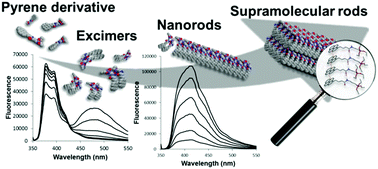
Mohamed El Idrissi, Simon J. Teat, Philippe F.-X. Corvini, Martin J. Paterson, Scott J. Dalgarno, Patrick Shahgaldian
A pyrene derivative was designed to form, through a hierarchical process, well-defined supramolecular nanorods.
The content of this RSS Feed (c) The Royal Society of Chemistry

18 Jan 00:32
by Bastiaan C. Buddingh’ and Jan C. M. van Hest

Accounts of Chemical Research
DOI: 10.1021/acs.accounts.6b00512

16 Jan 20:55
by Juan Marco-Martínez, Sara Vidal, Israel Fernández, Salvatore Filippone, Nazario Martín
Abstract
Chiral fullerene–metal hybrids with complete control over the four stereogenic centers, including the absolute configuration of the metal atom, have been synthesized for the first time. The stereochemistry of the four chiral centers formed during [60]fullerene functionalization is the result of both the chiral catalysts employed and the diastereoselective addition of the metal complexes used (iridium, rhodium, or ruthenium). DFT calculations underpin the observed configurational stability at the metal center, which does not undergo an epimerization process.

Chirality at the metal: Fullerene hybrids with iridium-, rhodium-, or ruthenium-centered chirality were prepared by precise control of four newly formed stereogenic centers. The resulting complexes are configurationally stable and do not undergo an epimerization process.
13 Jan 16:42
Energy Environ. Sci., 2017, 10,558-569
DOI: 10.1039/C6EE03456J, Paper

Open Access
Samuel E. Root, Nicholas E. Jackson, Suchol Savagatrup, Gaurav Arya, Darren J. Lipomi
Schematic diagram showing the information flow from molecular structure, to atomistic model, to a slice of the solid morphology under mechanical deformation and the stress-strain response.
The content of this RSS Feed (c) The Royal Society of Chemistry

12 Jan 21:36
RSC Adv., 2017, 7,2964-2970
DOI: 10.1039/C6RA25879D, Paper
Open Access
Paul Bazylewski, Ranjith Divigalpitiya, Giovanni Fanchini
Reversibility of disulphide formation and breakage on L-cysteine examined through vibrational modes using in situ Raman spectroscopy.
The content of this RSS Feed (c) The Royal Society of Chemistry

11 Jan 18:04
by Poonam Singh, Joseph H. Rheinhardt, Jarred Z. Olson, Pilarisetty Tarakeshwar, Vladimiro Mujica and Daniel A. Buttry

Journal of the American Chemical Society
DOI: 10.1021/jacs.6b10806

11 Jan 14:37
by Bilu Liu, Fanqi Wu, Hui Gui, Ming Zheng and Chongwu Zhou

ACS Nano
DOI: 10.1021/acsnano.6b06900

11 Jan 00:18
by Hongwei Wu, Yunyun Zhou, Liyuan Yin, Cheng Hang, Xin Li, Hans Ågren, Tao Yi, Qing Zhang and Liangliang Zhu

Journal of the American Chemical Society
DOI: 10.1021/jacs.6b10550

08 Jan 20:55
by Hiroshi Danjo, Toshi Nakagawa, Akio Morii, Yusuke Muraki and Koichi Sudoh

ACS Macro Letters
DOI: 10.1021/acsmacrolett.6b00972

06 Jan 16:03
Chem. Commun., 2017, 53,1688-1691
DOI: 10.1039/C6CC10089A, Communication
Peifa Wei, Haoze Wang, Kecheng Jie, Feihe Huang
We design a coumarin-containing bis(m-phenylene)-32-crown-10 derivative which efficiently controls the regio- and stereo-selectivity of the photodimerization of its two terminal coumarin groups templated by taco-type host-guest complex formation to selectively produce the syn-head-to-tail cryptand isomer in quantitative yield.
The content of this RSS Feed (c) The Royal Society of Chemistry

03 Jan 21:58
Chem. Sci., 2017, 8,2592-2596
DOI: 10.1039/C6SC05341F, Edge Article
Open Access
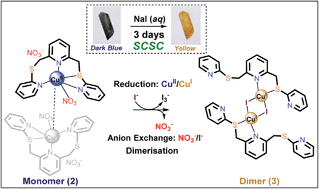
Hyeong-Hwan Lee, In-Hyeok Park, Seulgi Kim, Eunji Lee, Huiyeong Ju, Jong Hwa Jung, Mari Ikeda, Yoichi Habata, Shim Sung Lee
We report that the anion exchange induced conversion of the oxidation state of the central metal and the dimerisation in the complex via an SCSC transformation.
The content of this RSS Feed (c) The Royal Society of Chemistry

27 Dec 20:57
by Sudhakar Gaikwad and Michael Schmittel

The Journal of Organic Chemistry
DOI: 10.1021/acs.joc.6b02436

27 Dec 15:46
by Tailin Xu, Wei Gao, Li-Ping Xu, Xueji Zhang, Shutao Wang
Inspired by the swimming of natural microorganisms, synthetic micro-/nanomachines, which convert energy into movement, are able to mimic the function of these amazing natural systems and help humanity by completing environmental and biological tasks. While offering autonomous propulsion, conventional micro-/nanomachines usually rely on the decomposition of external chemical fuels (e.g., H2O2), which greatly hinders their applications in biologically relevant media. Recent developments have resulted in various micro-/nanomotors that can be powered by biocompatible fuels. Fuel-free synthetic micro-/nanomotors, which can move without external chemical fuels, represent another attractive solution for practical applications owing to their biocompatibility and sustainability. Here, recent developments on fuel-free micro-/nanomotors (powered by various external stimuli such as light, magnetic, electric, or ultrasonic fields) are summarized, ranging from fabrication to propulsion mechanisms. The applications of these fuel-free micro-/nanomotors are also discussed, including nanopatterning, targeted drug/gene delivery, cell manipulation, and precision nanosurgery. With continuous innovation, future autonomous, intelligent and multifunctional fuel-free micro-/nanomachines are expected to have a profound impact upon diverse biomedical applications, providing unlimited opportunities beyond one's imagination.

Fuel-free synthetic micro-/nanomachines powered by external stimuli are able to swim efficiently in biologically relevant environments. Tremendous progress made in the past decade to develop different synthesis strategies for designing and fabricating fuel-free micro-/nanomotors with different functionalities is reviewed. These artificial nanomachines can achieve predetermined tasks in biomedical applications.
26 Dec 21:59
by Karine Fournel-Marotte
Nature Chemistry.
doi:10.1038/nchem.2709
Authors: Karine Fournel-Marotte & Frédéric Coutrot
Molecular daisy-chain structures are typically made up of two interlocked components and can exhibit muscle-like contraction and extension in one dimension. Zinc-based multicomponent systems that can operate in two and three dimensions have now been designed and synthesized.
23 Dec 21:36
by Feng Wang, Michal Burck and Charles E. Diesendruck

ACS Macro Letters
DOI: 10.1021/acsmacrolett.6b00874

23 Dec 16:01
Chem. Commun., 2017, 53,298-312
DOI: 10.1039/C6CC07377H, Feature Article
James E. M. Lewis, Marzia Galli, Stephen M. Goldup
We discuss the properties and potential future applications in catalysis, sensing and materials of ligands based on mechanically interlocked molecules.
The content of this RSS Feed (c) The Royal Society of Chemistry

23 Dec 15:18
by Daniel Beaudoin, Frank Rominger, Michael Mastalerz
Abstract
An inherently chiral C3-symmetric triaminotribenzotriquinacene was condensed in racemic and enantiomerically pure form with a bis(salicylaldehyde) to form [2+3] salicylimine cage compounds. Investigations on the chiral self-sorting revealed that while entropy favors narcissistic self-sorting in solution, selective social self-sorting can be achieved by exploiting the difference in solubility between the homochiral and heterochiral cages. Gas sorption measurements further showed that seemingly small structural differences can have a significant impact on the surface area of microporous covalent cage compounds.

Sorted out: An inherently chiral C3-symmetric triaminotribenzotriquinacene was condensed in racemic and enantiomerically pure form with a bis(salicylaldehyde) to form [2+3] salicylimine cage compounds. Investigations revealed that entropy favors narcissistic self-sorting in solution, and selective social self-sorting can be achieved by exploiting the difference in solubility between the homochiral and heterochiral cages.
21 Dec 14:46
by Wolfgang Brenner, Tanya K. Ronson and Jonathan R. Nitschke

Journal of the American Chemical Society
DOI: 10.1021/jacs.6b11523

19 Dec 22:51
by Yi-Lin Wu

Nature Chemistry.
doi:10.1038/nchem.2689
Authors: Yi-Lin Wu, Noah E. Horwitz, Kan-Sheng Chen, Diego A. Gomez-Gualdron, Norman S. Luu, Lin Ma, Timothy C. Wang, Mark C. Hersam, Joseph T. Hupp, Omar K. Farha, Randall Q. Snurr & Michael R. Wasielewski
Using self-assembly to generate hydrogen-bonded organic networks is an under explored method when preparing functional framework materials. Now, taking cue from DNA, bio-inspired G-quadruplexes are used as both intrinsic electron donors and hydrogen-bonding linkers to assemble rylene diimide acceptors. The resulting rectangular grids form layered crystalline frameworks, in which photoexcitation produces long-lived mobile charge carriers.
19 Dec 22:48
Chem. Sci., 2017, 8,661-667
DOI: 10.1039/C6SC04048A, Edge Article
Open Access
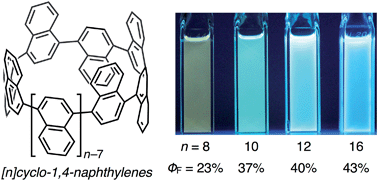
Keishu Okada, Akiko Yagi, Yasutomo Segawa, Kenichiro Itami
The synthesis and properties of various [n]cyclo-1,4-naphthylenes ([n]CNs, n = 8, 10, 12, and 16) are described.
The content of this RSS Feed (c) The Royal Society of Chemistry

19 Dec 18:23
by Joseph J. Armao and Jean-Marie Lehn

Journal of the American Chemical Society
DOI: 10.1021/jacs.6b11107

19 Dec 16:16
by Yago García-Rodeja, Miquel Solà and Israel Fernández

The Journal of Organic Chemistry
DOI: 10.1021/acs.joc.6b02424

14 Dec 17:03
by Gema de la Torre, Giovanni Bottari, Tomas Torres
The huge interest towards fullerenes and carbon nanotubes in molecular materials and materials science is closely related to the intriguing properties of these carbon nanostructures such as their excellent electrical conductivity and remarkable chemical stability, among others. In this connection, organic photovoltaics (OPVs) is one of the research fields where these carbon allotropes have been extensively employed, mainly as electron-accepting materials. Among the electron-donating counterparts, phthalocyanines (Pcs) and subphthalocyanines (SubPcs) are some organic compounds largely used for this pourpose mainly due to their intense light-harvesting ability in the red and near infrared region of the solar spectrum, and rich and tuneable redox chemistry. In this review, we summarize some of the most recent and relevant achievements in the preparation of fullerene- and carbon nanotube-based OPVs containing Pcs and/or SubPcs, paying a special attention to the effect that i) the structural and electronic modifications of the Pc and SubPc derivatives, ii) the different type of OPV architecture, and iii) the preparation method, have on the performance of the OPV devices. A section of this review has been also devoted to the used of SubPcs as electron-accepting materials in fullerene-free PV cells highlighting the great potential of these class of materials for the preparation of efficient organic solar cells.

Phthalocyanines and subphthalocyanines are optimal partners for fullerenes and carbon nanotubes in molecular photovoltaics. The latest advances on the incorporation of phthalocyanine/fullerene and subphthalocyanine/fullerene couples in different solar cell architectures are described and discussed in detail. Some examples on the functionalization of carbon nanotubes with phthalocyanines and the evaluation of their photovoltaic capability are also reviewed.
14 Dec 15:40
Chem. Commun., 2017, 53,561-564
DOI: 10.1039/C6CC09198A, Communication
Daniel T. Seidenkranz, Jacqueline M. McGrath, Lev N. Zakharov, Michael D. Pluth
The metal-assisted self-assembly of a phosphine-modified, deconstructed Hamilton receptor is reported as a new supramolecular ligand scaffold.
The content of this RSS Feed (c) The Royal Society of Chemistry

13 Dec 23:20
by Oleksandr Shyshov, René-Chris Brachvogel, Tobias Bachmann, Rubitha Srikantharajah, Doris Segets, Frank Hampel, Ralph Puchta, Max von Delius
Abstract
The integration of dynamic covalent bonds into macrocycles has been a tremendously successful strategy for investigating noncovalent interactions and identifying effective host–guest pairs. While numerous studies have focused on the dynamic responses of macrocycles and larger cages to various guests, the corresponding constitutionally dynamic chemistry of cryptands remains unexplored. Reported here is that cryptands based on orthoester bridgeheads offer an elegant entry to experiments in which a metal ion selects its preferred host from a dynamic mixture of competing subcomponents. In such dynamic mixtures, the alkali metal ions Li+, Na+, K+, Rb+, and Cs+ exhibit pronounced preferences for the formation of cryptands of certain sizes and donor numbers, and the selection is rationalized by DFT calculations. Reported is also the first self-assembly of a chiral orthoester cryptate and a preliminary study on the use of stereoisomers as subcomponents.

A lid for every pot: Cryptands based on orthoester bridgeheads offer an elegant entry to experiments in which a metal ion selects its preferred host from a dynamic mixture of competing subcomponents. In such dynamic mixtures the alkali metal ions Li+, Na+, K+, Rb+, and Cs+ exhibit pronounced preferences for the formation of cryptands of certain sizes and donor numbers.
12 Dec 20:43
by Amineh Aghabali, Sharon Jun, Marilyn M. Olmstead and Alan L. Balch

Journal of the American Chemical Society
DOI: 10.1021/jacs.6b10394

12 Dec 19:57
by Yingfeng Tu

Nature Chemistry.
doi:10.1038/nchem.2674
Authors: Yingfeng Tu, Fei Peng, Xiaofeng Sui, Yongjun Men, Paul B. White, Jan C. M. van Hest & Daniela A. Wilson
Effective regulation over the motion of self-propelled micro- and nanomotors is a challenging proposition. Now, self-assembled stomatocyte nanomotors with thermoresponsive polymer brushes have been designed that sense changes in local temperature and regulate the accessibility of the hydrogen peroxide fuel — thereby adjusting the speed and behaviour of nanomotor itself.
10 Dec 00:17
by Seán T. J. Ryan, Jesús del Barrio, Reynier Suardíaz, Daniel F. Ryan, Edina Rosta, Oren A. Scherman

Light-driven conformational changes in a macrocyclic host enable the controlled encapsulation and release of guest species. In their Communication on page 16096 ff., J. del Barrio, O. A. Scherman and co-workers describe the rational design and synthesis of a photoresponsive macrocycle that displays remarkable binding affinity towards a set of guest molecules, including N-oxides and carboxylates. The guest molecules are expelled from the macrocyclic cavity when the complex is exposed to UV light.
10 Dec 00:13
by Yuchao Deng, Xiao-Jing Wei, Hui Wang, Yuhan Sun, Timothy Noël, Xiao Wang
Abstract
A photocatalytic method for the aerobic oxidative cleavage of C=C bonds has been developed. Electron-rich aromatic disulfides were employed as photocatalyst. Upon visible-light irradiation, typical mono- and multi-substituted aromatic olefins could be converted into ketones and aldehydes at ambient temperature. Experimental and computational studies suggest that a disulfide–olefin charge-transfer complex is possibly responsible for the unconventional dissociation of S−S bond under visible light.

Mild and metal-free: A photocatalytic method for the aerobic oxidative cleavage of C=C bonds has been developed with electron-rich aromatic disulfides as photocatalyst. Upon visible-light irradiation, aromatic olefins were converted into ketones and aldehydes at ambient temperature. A disulfide–olefin charge-transfer complex is possibly responsible for the S−S bond dissociation.