23 Jan 11:45
by George M. Whitesides

Using curiosity as the starting point for careful observation of nature and society is a nontrivial skill, and a starting point for new intellectual endeavors and adventures. It is one essential contributor to creativity in science, and a start in forcing new ideas into inflexible professional orthodoxies.
18 Dec 11:20
Chem. Commun., 2018, 54,405-408
DOI: 10.1039/C7CC08947C, Communication
Tomokazu Umeyama, Kensho Igarashi, Daisuke Sakamaki, Shu Seki, Hiroshi Imahori
Decreasing the amount of a diastereomer of [small beta]-[70]PCBM with high aggregation tendency improved the performances of OPV devices with PffBT4T-2OD:[70]PCBM films.
The content of this RSS Feed (c) The Royal Society of Chemistry

14 Dec 08:45
by Satoshi Okada, Satori Kowashi, Luca Schweighauser, Kaoru Yamanouchi, Koji Harano and Eiichi Nakamura

Journal of the American Chemical Society
DOI: 10.1021/jacs.7b09776

06 Dec 16:13
Chem. Commun., 2017, 53,12402-12405
DOI: 10.1039/C7CC07836F, Communication
Marina Garrido, Joaquin Calbo, Laura Rodriguez-Perez, Juan Arago, Enrique Orti, M
a
Angeles Herranz, Nazario Martin
Dispersion forces govern the interaction of graphene with mono- and tripodal pyrene-[60]fullerene derivatives and direct the formation of graphene nanobuds.
The content of this RSS Feed (c) The Royal Society of Chemistry

06 Dec 16:08
Chem. Commun., 2017, Advance Article
DOI: 10.1039/C7CC08063H, Communication
Shuai Shao, Michael B. Thomas, Kyu Hyung Park, Zoe Mahaffey, Dongho Kim, Francis D'Souza
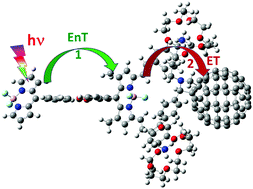
Occurrence of step-by-step energy transfer followed by electron transfer leading a charge separated state in a self-assembled, wide-band capturing triad is demonstrated as a photosynthetic antenna reaction-centre mimic.
To cite this article before page numbers are assigned, use the DOI form of citation above.
The content of this RSS Feed (c) The Royal Society of Chemistry

06 Dec 09:55
Chem. Commun., 2017, Accepted Manuscript
DOI: 10.1039/C7CC06683J, Feature Article
Raymond Dean Astumian
In the absence of input energy, a chemical reaction in a closed system ineluctably relaxes toward an equilibrium state governed by a Boltzmann distribution. The addition of a catalyst to...
The content of this RSS Feed (c) The Royal Society of Chemistry

06 Dec 08:50
Chem. Soc. Rev., 2018, 47,626-644
DOI: 10.1039/C6CS00907G, Review Article
Derrick A. Roberts, Ben S. Pilgrim, Jonathan R. Nitschke
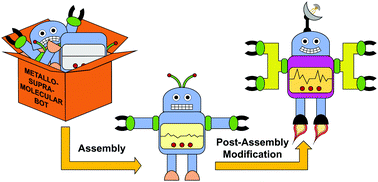
This review examines the growing variety of covalent reactions used to achieve the post-assembly modification of self-assembled metallosupramolecular complexes.
The content of this RSS Feed (c) The Royal Society of Chemistry

06 Dec 07:47
by Yoshifumi Hashikawa and Yasujiro Murata

Journal of the American Chemical Society
DOI: 10.1021/jacs.7b11322

05 Dec 16:42
by Eiichi Kayahara, Liansheng Sun, Hiroaki Onishi, Katsuaki Suzuki, Tatsuya Fukushima, Ayaka Sawada, Hironori Kaji and Shigeru Yamago

Journal of the American Chemical Society
DOI: 10.1021/jacs.7b11526

04 Dec 16:56
Chem. Sci., 2018, 9,15-21
DOI: 10.1039/C7SC04200K, Minireview

Open Access
Guillaume De Bo
Strong and stable under tension?
The content of this RSS Feed (c) The Royal Society of Chemistry

04 Dec 12:22
by Abil E Aliev, William Motherwell, Rafael Moreno, Ilias Pavlakos, Josephine Arendorf, Tanzeel Arif, Graham Tizzard, Simon Coles
Abstract
The relative strength of noncovalent interactions between a thioether sulfur atom and various π systems in designed top pan molecular balances was determined by NMR spectroscopy. Compared to its oxygen counterpart, the sulfur atom displays a remarkable ability to interact with almost equal facility over the entire range of π systems studied, with the simple alkene emerging as the most powerful partner. With the exception of the O⋅⋅⋅heteroarene interaction, all noncovalent interactions of sulfur with π systems are favoured over oxygen.

Sulfur tips the balance: The relative strength of noncovalent interactions between a thioether sulfur atom and π systems in molecular balances was determined by NMR spectroscopy. The sulfur atom displays a remarkable ability to interact with almost equal facility over the entire range of π systems studied. With the exception of the O⋅⋅⋅heteroarene interaction, all noncovalent interactions of sulfur with π systems are favoured over oxygen.
04 Dec 09:59
by Mark Freeley, Harley L. Worthy, Rochelle Ahmed, Ben Bowen, Daniel Watkins, J. Emyr Macdonald, Ming Zheng, D. Dafydd Jones and Matteo Palma

Journal of the American Chemical Society
DOI: 10.1021/jacs.7b07362

04 Dec 09:59
by Zonglong Li, Hui Li, Xinyu Guan, Junjie Tang, Yusran Yusran, Zhan Li, Ming Xue, Qianrong Fang, Yushan Yan, Valentin Valtchev and Shilun Qiu

Journal of the American Chemical Society
DOI: 10.1021/jacs.7b11283

04 Dec 06:41
by Michał Sawczyk and Rafal Klajn

Journal of the American Chemical Society
DOI: 10.1021/jacs.7b09111

01 Dec 16:07
New work also yields insight into bear ancestry
28 Nov 14:01
Chem. Sci., 2018, 9,819-824
DOI: 10.1039/C7SC04453D, Edge Article
Open Access
Hiroki Yokoi, Satoru Hiroto, Daisuke Sakamaki, Shu Seki, Hiroshi Shinokubo
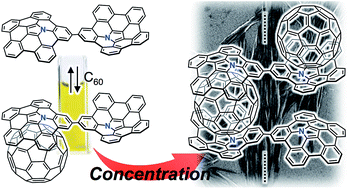
A directly connected azabuckybowl dimer forms a 1 : 1 complex with C60 in a diluted solution, while 1D chain supramolecular assemblies are obtained upon increasing the concentration.
The content of this RSS Feed (c) The Royal Society of Chemistry

22 Nov 07:18
Chem. Soc. Rev., 2017, Advance Article
DOI: 10.1039/C6CS00907G, Review Article
Derrick A. Roberts, Ben S. Pilgrim, Jonathan R. Nitschke
This review examines the growing variety of covalent reactions used to achieve the post-assembly modification of self-assembled metallosupramolecular complexes.
To cite this article before page numbers are assigned, use the DOI form of citation above.
The content of this RSS Feed (c) The Royal Society of Chemistry

17 Nov 12:59
Chem. Commun., 2017, Advance Article
DOI: 10.1039/C7CC07808K, Communication
Rong-Ran Liang, Shun-Qi Xu, Zhong-Fu Pang, Qiao-Yan Qi, Xin Zhao
Covalent organic frameworks bearing two different kinds of micropores have been constructed based on the orthogonal formation of dynamic covalent bonds. The orthogonal reactions result in an unprecedented self-sorted pore-formation in the polymerization process.
To cite this article before page numbers are assigned, use the DOI form of citation above.
The content of this RSS Feed (c) The Royal Society of Chemistry

14 Nov 17:24
by Richard Stevenson and Guillaume De Bo

Journal of the American Chemical Society
DOI: 10.1021/jacs.7b08895

10 Nov 08:27
by Michel Rickhaus, Andreas Vargas Jentzsch, Lara Tejerina, Isabell Grübner, Michael Jirasek, Timothy D. W. Claridge and Harry L. Anderson

Journal of the American Chemical Society
DOI: 10.1021/jacs.7b10710

13 Oct 07:38
by Gonzalo Abellán, Christian Neiss, Vicent Lloret, Stefan Wild, Julio C. Chacón-Torres, Katharina Werbach, Filippo Fedi, Hidetsugu Shiozawa, Andreas Görling, Herwig Peterlik, Thomas Pichler, Frank Hauke, Andreas Hirsch
Abstract
Black phosphorus intercalation compounds (BPICs) with alkali metals (namely: K and Na) have been synthesized in bulk by solid-state as well as vapor-phase reactions. By means of a combination of in situ X-ray diffraction, Raman spectroscopy, and DFT calculations the structural behavior of the BPICs at different intercalation stages has been demonstrated for the first time. Our results provide a glimpse into the very first steps of a new family of intercalation compounds, with a distinct behavior as compared to its graphite analogues (GICs), showing a remarkable structural complexity and a dynamic behavior.

Black to the future: The bulk intercalation of black phosphorus with alkali metals (namely: K and Na; black spheres) has been developed, showing a complex dynamic structural behavior. By in situ Raman spectroscopy and DFT calculations straightforward fingerprints for the identification of black phosphorus intercalation compounds (BPICs) have been demonstrated.
28 Sep 15:30
by Xian-Sheng Ke, Taeyeon Kim, Vincent M. Lynch, Dongho Kim and Jonathan L. Sessler

Journal of the American Chemical Society
DOI: 10.1021/jacs.7b08611

Hi and -1 others like this
26 Sep 15:43
Chem. Soc. Rev., 2017, 46,6905-6926
DOI: 10.1039/C7CS00516D, Review Article
Leilei Xu, Fangzhi Mou, Haotian Gong, Ming Luo, Jianguo Guan
This review summarizes the recent advances in light-driven micro/nanomotors and highlights the challenges and perspectives toward environmental, biomedical and micro/nanoengineering applications.
The content of this RSS Feed (c) The Royal Society of Chemistry

26 Sep 15:16
Chem. Sci., 2017, 8,7746-7750
DOI: 10.1039/C7SC03731G, Edge Article
Open Access
Albano Galan, Eduardo C. Escudero-Adan, Pablo Ballester
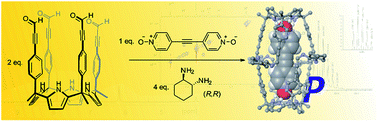
A covalent molecular capsule based on reversible imine bonds and polar interior is prepared by the template-directed self-assembly of a tetraaldehyde calix[4]pyrrole scaffold with a diamine linker.
The content of this RSS Feed (c) The Royal Society of Chemistry

26 Sep 07:43
by Yigit Altay, Meniz Tezcan and Sijbren Otto

Journal of the American Chemical Society
DOI: 10.1021/jacs.7b07346

21 Sep 12:53
by Sourav Chakraborty, Subrata Saha, Luís M. P. Lima, Ulrike Warzok, Sayan Sarkar, Bidyut Akhuli, Mandira Nandi, Somnath Bej, Nayarassery N. Adarsh, Christoph A. Schalley, Rita Delgado and Pradyut Ghosh

The Journal of Organic Chemistry
DOI: 10.1021/acs.joc.7b01431

19 Sep 15:08
by Jacques Lefebvre, Jianfu Ding, Zhao Li, Paul Finnie, Gregory Lopinski and Patrick R. L. Malenfant

Accounts of Chemical Research
DOI: 10.1021/acs.accounts.7b00234

19 Sep 10:27
by Vladimir A. Aksyuk
Nature Nanotechnology.
doi:10.1038/nnano.2017.185
Author: Vladimir A. Aksyuk
A thermally activated micromechanical switch delivers an electrical readout signal only when irradiated by a narrowband mid-infrared light, thanks to a metamaterial element that converts light into heat.

19 Sep 08:11
by Soumen De

Nature Chemistry.
doi:10.1038/nchem.2854
Authors: Soumen De, Bo Chi, Thierry Granier, Ting Qi, Victor Maurizot & Ivan Huc
Rationally designed arrays of hydrogen bonds between aromatic oligoamide segments have now been shown to generate abiotic helix-turn-helix and unexpected dimeric and trimeric helix bundle motifs. These structures show kinetic and thermodynamic stability, and cooperative folding in nonpolar solvents.
15 Sep 11:07
by Yasuyuki Yamada, Ryohei Ito, Sayaka Ogino, Tatsuhisa Kato, Kentaro Tanaka
Abstract
A multiply interlocked catenane with a novel molecular topology was synthesized; a phthalocyanine bearing four peripheral crown ethers was quadruply interlocked with a cofacial porphyrin dimer bridged with four alkylammonium chains. The supramolecular conjugate has two nanospaces surrounded by a porphyrin, a phthalocyanine, and four alkyl chains to accommodate guest molecules. Because the phthalocyanine can move along the alkyl chains, it acts as an adjustable wall, thus permitting the invasion of large molecules into the nanospaces without spoiling the affinity of the association. The dynamic molecular invasion allowed the intercalation of dianionic porphyrins into both nanospaces with high affinity. A photometric titration experiment revealed the two-step inclusion phenomenon. The multiply interlocked catenane complexed with three Cu2+ ions, and the spin–spin interaction was switched off by the intercalation of dianionic porphyrins.

An elevator for guests: A phthalocyanine molecule bearing four peripheral crown ethers was quadruply interlocked with a cofacial porphyrin dimer bridged by four alkylammonium chains to create a catenane with a novel topology. The phthalocyanine unit moved along the threads to enable the invasion of large guest molecules without affecting the affinity of the association (see picture).