Journal of the American Chemical Society
DOI: 10.1021/jacs.5b10855
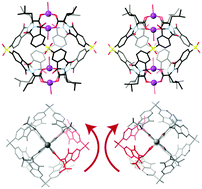
A molecular Solomon link was synthesized in high yield through the template-free, coordination-driven self-assembly of a carbazole-functionalized donor and a tetracene-based dinuclear ruthenium(II) acceptor. The doubly interlocked topology was realized by a strategically chosen ligand which was capable of participating in multiple CH⋅⋅⋅π and π–π interactions, as evidenced from single-crystal X-ray analysis and computational studies. This method is the first example of a two-component self-assembly of a molecular Solomon link using a directional bonding approach. The donor alone was not responsible for the construction of the Solomon link, and was confirmed by its noncatenane self-assemblies obtained with other similar ruthenium(II) acceptors.

Link up: A molecular Solomon link has been prepared by using the title reaction. This template-free approach favors the doubly interlocked [2]catenane because of multiple π–π and CH⋅⋅⋅π interactions, as evidenced by X-ray crystal structure and computational analysis.
Several five-component nanorotors ROT-3 that rotate at different rates were prepared by adding phenanthrolines of distinct lateral size as brake blocks to the four-component nanorotor ROT-2. The brake blocks interfere with the 180° rotor causing the rotational frequency to drop from 97 kHz to 5 kHz. The effect of the rotating brake blocks on the rotational frequency in ROT-3 is accurately predicted by a nanomechanical model called “conformational slippage”. For quantification, the interaction of the brake blocks with the trajectory of the main rotator is gauged based on the number of interfering vs. non-interfering conformations as computed by PM6.

The magic self-assembly of supramolecular machinery! When five components are mixed, supramolecular rotors form, which depending on the fifth component (=brake block) exhibit different rotational frequencies that are quantitatively predictable.

Nature Chemistry 8, 10 (2016). doi:10.1038/nchem.2383
Authors: Alessandro Aliprandi, Matteo Mauro & Luisa De Cola
The self-assembly of building blocks is an enticing route towards functional materials, yet understanding and controlling the mechanisms at play has remained challenging. Now the different morphologies and emission colours of the aggregates of a platinum(II) compound has enabled its assembly pathways into different structures to be controlled and visualized in real time.
Nature Chemistry 8, 6 (2016). doi:10.1038/nchem.2423
Author: Thorfinnur Gunnlaugsson
Supramolecular processes are attractive for the generation of functional materials, but managing multiple, competing self-assembly pathways has remained challenging. Now, the self-assembly of a platinum compound into three different aggregates has been elucidated, visualized in real time, and controlled.


The development of easy-to-implement protocols to spatially organize chromophores for mimicking natural antennae is a challenging task. In their Communication on page 15739 ff., D. Bonifazi et al. report on the organization of chromophores through the simultaneous use of three orthogonal dynamic covalent reactions: disulfide exchange, and boronate and acyl hydrazone formation. This methodology enables the creation of multichromophoric architectures with tailored absorption or emission wavelengths.
Nature Nanotechnology. doi:10.1038/nnano.2015.259
Authors: Kevin Yehl, Andrew Mugler, Skanda Vivek, Yang Liu, Yun Zhang, Mengzhen Fan, Eric R. Weeks & Khalid Salaita
In this work, we use a double-layered stack of TiO2 nanotubes (TiNTs) to construct a visible-light-triggered drug delivery system. The key for visible light drug release is a hydrophobic cap on the nanotubes containing Au nanoparticles (AuNPs). The AuNPs allow for a photocatalytic scission of the hydrophobic chain under visible light. To demonstrate this principle, we loaded ampicillin (AMP) into the lower part of the TiO2 nanotube stack, triggered visible-light-induced release, and carried out antibacterial studies. The release from the platform becomes most controllable if the drug is silane-grafted in the hydrophilic bottom layer for drug storage. Thus, visible light photocatalysis can also determine the release kinetics of the active drug from the nanotube wall.

A visible-light-triggered drug delivery system is constructed based on a double-layered stack of TiO2 nanotubes. The key for visible light drug release is a hydrophobic cap on the nanotubes containing Au nanoparticles, where SPR with the TiO2 conduction band provides the active species for chain scission. The system was tested in antibacterial experiments against E. coli.

Nature Chemistry 7, 1003 (2015). doi:10.1038/nchem.2392
Authors: Hao Li, Huacheng Zhang, Aaron D. Lammer, Ming Wang, Xiaopeng Li, Vincent M. Lynch & Jonathan L. Sessler
Purely organic molecules with complex interlocked architectures have proved difficult to prepare in water. Now, a three-dimensional organic [2]catenane has been obtained in a weakly acidic aqueous solution, through an almost quantitative self-assembly process relying on dynamic hydrazone linkages. The catenane is kinetically stable in neutral and weakly basic environments.
Nature Chemistry 7, 944 (2015). doi:10.1038/nchem.2409
Authors: Linyi Bai & Yanli Zhao
The quantitative self-assembly of mechanically interlocked molecules in water, instead of organic solvents, opens up the possibility of such systems being used in a biological context where their functions can be interfaced with biomolecular systems.

Structurally diverse macrocycles and medium-sized rings (9–24 membered scaffolds, 22 examples) can be generated through a telescoped acylation/ring-expansion sequence, leading to the insertion of linear fragments into cyclic β-ketoesters without performing a discrete macrocyclization step. The key β-ketoester motif is regenerated in the ring-expanded product, meaning that the same sequence of steps can then be repeated (in theory indefinitely) with other linear fragments, allowing macrocycles with precise substitution patterns to be “grown” from smaller rings using the successive ring-expansion (SuRE) method.

Expanding the family: Macrocycles can be generated using a telescoped acylation/ring-expansion sequence, leading to the insertion of linear fragments into cyclic β-ketoesters without performing a discrete macrocyclization step. The β-ketoester motif is regenerated in the ring-expanded product, therefore the same sequence of steps can be repeated, allowing macrocycles with precise substitution patterns to be “grown” from smaller rings.

Potential biomedicinal applications of graphene oxide (GO), for example, as a carrier of biomolecules or a reagent for photothermal therapy and biosensing, are limited by its cytotoxicity and mutagenicity. It is believed that these properties are at least partially caused by GO-induced oxidative stress in cells. However, it is not known which chemical fragments of GO are responsible for this unfavorable effect. We generated four GOs containing variable redox-active groups on the surface, including Mn2+, C-centered radicals, and endoperoxides (EPs). A comparison of the abilities of these materials to generate reactive oxygen species in human cervical cancer cells revealed that EPs play a crucial role in GO-induced oxidative stress. These data could be applied to the rational design of biocompatible nontoxic GOs for biomedical applications.

Guilty as charged: The biomedicinal application of graphene oxide (GO) is limited by its cytotoxicity and mutagenicity. To determine which chemical fragments of GO are responsible for this toxicity, GOs containing variable redox-active groups on the surface were generated and compared. The results reveal that endoperoxides play a decisive role in GO-induced oxidative stress.

Nature Nanotechnology. doi:10.1038/nnano.2015.246
Authors: C. Jung, P. B. Allen & A. D. Ellington
Molecular machines have previously been designed that are propelled by DNAzymes, protein enzymes and strand displacement. These engineered machines typically move along precisely defined one- and two-dimensional tracks. Here, we report a DNA walker that uses hybridization to drive walking on DNA-coated microparticle surfaces. Through purely DNA:DNA hybridization reactions, the nanoscale movements of the walker can lead to the generation of a single-stranded product and the subsequent immobilization of fluorescent labels on the microparticle surface. This suggests that the system could be of use in analytical and diagnostic applications, similar to how strand exchange reactions in solution have been used for transducing and quantifying signals from isothermal molecular amplification assays. The walking behaviour is robust and the walker can take more than 30 continuous steps. The traversal of an unprogrammed, inhomogeneous surface is also due entirely to autonomous decisions made by the walker, behaviour analogous to amorphous chemical reaction network computations, which have been shown to lead to pattern formation.

The Na+ concentration near membranes controls our nerve signals aside from several other crucial bioprocesses. Fluorescent photoinduced electron transfer (PET) sensor molecules target Na+ ions in nanospaces near micellar membranes with excellent selectivity against H+. The Na+ concentration near anionic micelles was found to be higher than that in bulk water by factors of up to 160. Sensor molecules that are not held tightly to the micelle surface only detected a Na+ amplification factor of 8. These results were strengthened by the employment of control compounds whose PET processes are permanently “on” or “off”.

The local Na+ concentration near an anionic tetramethylammonium dodecyl sulfate (TMADS) micelle surface was determined with new fluorescent photoinduced electron transfer (PET) sensors. Electrostatic interactions with the negatively charged sulfonate groups of the surfactant induce an increase in the Na+ concentration compared with bulk water.

Visible light is an easily achievable and mild trigger for self-healing materials. By incorporating dynamic diselenide bonds into polyurethane, visible-light-induced self-healing materials can be fabricated. Besides mild visible light, the healing process can also be realized using directional laser irradiation, which makes the system a remotely controllable self-healing system.