Shared posts

28 Apr 03:22

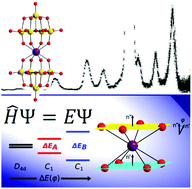
Toward Molecular 4f Single-Ion Magnet Qubits

by Kasper S. Pedersen, Ana-Maria Ariciu, Simon McAdams, Høgni Weihe, Jesper Bendix, Floriana Tuna and Stergios Piligkos

TOC Graphic

Journal of the American Chemical Society
DOI: 10.1021/jacs.6b02702
05 Mar 06:52

Metal-center exchange of tetrahedral cages: single crystal to single crystal and spin-crossover properties

Chem. Commun., 2016, 52,4796-4799
DOI: 10.1039/C6CC00711B, Communication
Feng-Li Zhang, Jia-Qian Chen, Long-Fang Qin, Lei Tian, Zaijun Li, Xuehong Ren, Zhi-Guo Gu
Effective SCSC metal-center exchange was observed in a tetrahedral metal-organic cage, in which the metal centers can be induced to display spin crossover behaviors.
The content of this RSS Feed (c) The Royal Society of Chemistry
05 Mar 06:51

A 3D MOF constructed from dysprosium(III) oxalate and capping ligands: ferromagnetic coupling and field-induced two-step magnetic relaxation

Chem. Commun., 2016, 52,4804-4807
DOI: 10.1039/C6CC00498A, Communication
Cai-Ming Liu, De-Qing Zhang, Dao-Ben Zhu
Field-induced two-step magnetic relaxation was observed in the first ferromagnetic 3D lanthanide(III) oxalate framework with a capping ligand.
The content of this RSS Feed (c) The Royal Society of Chemistry
19 Feb 01:08

Structural insights into the counterion effects on the manganese(III) spin crossover system with hexadentate Schiff-base ligands

Dalton Trans., 2016, 45,5676-5688
DOI: 10.1039/C5DT04824A, Paper
Shi Wang, Wu-Tan Xu, Wen-Rui He, Shinya Takaishi, Yong-Hua Li, Masahiro Yamashita, Wei Huang
The close stacking and arrangement preclude the spin transformation of the Mn(III) Schiff-base cations.
The content of this RSS Feed (c) The Royal Society of Chemistry
18 Feb 06:14

A four-coordinate cobalt(II) single-ion magnet with coercivity and a very high energy barrier

by Yvonne Rechkemmer

Article

Bistable single-molecule magnets potentially allow information storage at extremely high densities. Here, the authors study an air- and moisture-stable mononuclear tetrahedral cobalt(II) complex, elucidating the origin of its pronounced magnetic bistability.

Nature Communications doi: 10.1038/ncomms10467

Authors: Yvonne Rechkemmer, Frauke D. Breitgoff, Margarethe van der Meer, Mihail Atanasov, Michael Hakl, Milan Orlita, Petr Neugebauer, Frank Neese, Biprajit Sarkar, Joris van Slageren

18 Feb 06:14

Deciphering the origin of giant magnetic anisotropy and fast quantum tunnelling in Rhenium(IV) single-molecule magnets

by Saurabh Kumar Singh

Article

Rhenium(IV) complexes are magnetically anisotropic although the origin of this anisotropy is poorly explored compared to 3 d transition metals and lanthanides. Here, the authors computationally examine the effects of ligand donor ability and structural distortion on magnetic anisotropy for a series of rhenium(IV) complexes.

Nature Communications doi: 10.1038/ncomms10669

Authors: Saurabh Kumar Singh, Gopalan Rajaraman

18 Feb 02:24

Polarized Neutron Diffraction to Probe Local Magnetic Anisotropy of a Low-Spin Fe(III) Complex

by Karl Ridier, Abhishake Mondal, Corentin Boilleau, Olivier Cador, Béatrice Gillon, Grégory Chaboussant, Boris Le Guennic, Karine Costuas, Rodrigue Lescouëzec

Abstract

We have determined by polarized neutron diffraction (PND) the low-temperature molecular magnetic susceptibility tensor of the anisotropic low-spin complex PPh4[FeIII(Tp)(CN)3]⋅H2O. We found the existence of a pronounced molecular easy magnetization axis, almost parallel to the C3 pseudo-axis of the molecule, which also corresponds to a trigonal elongation direction of the octahedral coordination sphere of the FeIII ion. The PND results are coherent with electron paramagnetic resonance (EPR) spectroscopy, magnetometry, and ab initio investigations. Through this particular example, we demonstrate the capabilities of PND to provide a unique, direct, and straightforward picture of the magnetic anisotropy and susceptibility tensors, offering a clear-cut way to establish magneto-structural correlations in paramagnetic molecular complexes.

Thumbnail image of graphical abstract

Molecular Magnetism: The low-temperature molecular magnetic susceptibility tensor of the anisotropic low-spin [FeIII(Tp)(CN)3] complex (Tp=tris(pyrazolyl)borate; see picture) was determined by polarized neutron diffraction (PND). PND provided a unique, direct, and straightforward picture of the magnetic anisotropy and susceptibility tensors.

18 Feb 02:22

Symmetry-Supported Magnetic Blocking at 20 K in Pentagonal Bipyramidal Dy(III) Single-Ion Magnets

by Yan-Cong Chen, Jun-Liang Liu, Liviu Ungur, Jiang Liu, Quan-Wen Li, Long-Fei Wang, Zhao-Ping Ni, Liviu F. Chibotaru, Xiao-Ming Chen and Ming-Liang Tong

TOC Graphic

Journal of the American Chemical Society
DOI: 10.1021/jacs.5b13584
22 Dec 04:59

Ab initio calculations as a quantitative tool in the inelastic neutron scattering study of a single-molecule magnet analogue

Chem. Commun., 2016, 52,2091-2094
DOI: 10.1039/C5CC07541F, Communication
Michele Vonci, Marcus J. Giansiracusa, Robert W. Gable, Willem Van den Heuvel, Kay Latham, Boujemaa Moubaraki, Keith S. Murray, Dehong Yu, Richard A. Mole, Alessandro Soncini, Colette Boskovic
Ab initio calculations of the electronic structure of Na9[Tb(W5O18)2] have allowed interpretation of the inelastic neutron scattering spectra, revealing the subtle relationship between molecular geometry and magnetic properties of two isostructural species.
The content of this RSS Feed (c) The Royal Society of Chemistry
18 Dec 05:45

Surface induces different crystal structures in a room temperature switchable spin crossover compound

Dalton Trans., 2016, 45,134-143
DOI: 10.1039/C5DT03712C, Paper
Denis Gentili, Fabiola Liscio, Nicola Demitri, Bernhard Schafer, Francesco Borgatti, Piero Torelli, Benoit Gobaut, Giancarlo Panaccione, Giorgio Rossi, Alessandra Degli Esposti, Massimo Gazzano, Silvia Milita, Ilaria Bergenti, Giampiero Ruani, Ivan Salitros, Mario Ruben, Massimiliano Cavallini
We investigated the influence of surfaces in the formation of different crystal structures (polymorphs) of a room temperature switchable spin crossover compound.
The content of this RSS Feed (c) The Royal Society of Chemistry
18 Dec 05:36

Site-Resolved Two-Step Relaxation Process in an Asymmetric Dy2 Single-Molecule Magnet

by Li Zhang , Julie Jung, Peng Zhang, Mei Guo, Lang Zhao, Jinkui Tang, Boris Le Guennic

Abstract

Elaborate chemical design is of utmost importance in order to slow down the relaxation dynamics in single-molecule magnets (SMMs) and hence improve their potential applications. Much interest was devoted to the study of distinct relaxation processes related to the different crystal fields of crystallographically independent lanthanide ions. However, the assignment of the relaxation processes to specific metal sites remains a challenging task. To address this challenge, a new asymmetric Dy2 SMM displaying a well-separated two-step relaxation process with the anisotropic centers in fine-tuned local environments was elaborately designed. For the first time a one-to-one relationship between the metal sites and the relaxation processes was evidenced. This work sheds light on complex multiple relaxation and may direct the rational design of lanthanide SMMs with enhanced magnetic properties.

Thumbnail image of graphical abstract

One-to-one correspondence: Employing a new hydrazone ligand resulted in the self-assembly of an asymmetric Dy2 single-molecule magnet (SMM) displaying well-separated two-step relaxation with the anisotropic centers in fine-tuned local environments where the correspondence between the metal sites and the relaxation processes was evidenced (QTM=quantum tunneling of magnetization).

18 Dec 05:27

Temperature- and Pressure-Induced Spin Crossover in Co1+xCr2–xSe4 (x = 0.24): A Diffraction Study

by V. Svitlyk, D. Chernyshov, Y. Mozharivskyj, F. Yuan, O. Zaharko and M. Mezouar

TOC Graphic

Inorganic Chemistry
DOI: 10.1021/acs.inorgchem.5b02475
18 Dec 05:26

Magnetic and Photochromic Properties of a Manganese(II) Metal-Zwitterionic Coordination Polymer

by Teng Gong, Xiao Yang, Qi Sui, Yan Qi, Fu-Gui Xi and En-Qing Gao

TOC Graphic

Inorganic Chemistry
DOI: 10.1021/acs.inorgchem.5b01888
18 Dec 05:23

Synthesis, Crystal Structure, and Magnetic Properties of a Chiral Cyanide-Bridged Bimetallic Framework K3[MnII(l-asp)]6[CrIII(CN)6]·2H2O

by Li Li, Sadafumi Nishihara, Katsuya Inoue and Mohamedally Kurmoo

TOC Graphic

Inorganic Chemistry
DOI: 10.1021/acs.inorgchem.5b02399
15 Dec 12:36

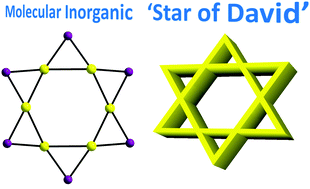
Dodecanuclear 3d/4f-metal clusters with a 'Star of David' topology: single-molecule magnetism and magnetocaloric properties

Chem. Commun., 2016, 52,1693-1696
DOI: 10.1039/C5CC09385F, Communication
Dimitris I. Alexandropoulos, Luis Cunha-Silva, Giulia Lorusso, Marco Evangelisti, Jinkui Tang, Theocharis C. Stamatatos
The first dodecanuclear [MII6LnIII6] clusters with a 'Star of David' metal topology have been synthesized with a variety of different divalent 3d-metal ions and lanthanides, and exhibited single-molecule magnetism and magnetic refrigeration.
The content of this RSS Feed (c) The Royal Society of Chemistry
15 Dec 10:46

Synthesis, structure and magnetic ordering of the mullite-type Bi2Fe4-xCrxO9 solid solutions with a frustrated pentagonal Cairo lattice

Dalton Trans., 2016, 45,1192-1200
DOI: 10.1039/C5DT04296H, Paper
M. G. Rozova, V. V. Grigoriev, I. A. Bobrikov, D. S. Filimonov, K. V. Zakharov, O. S. Volkova, A. N. Vasiliev, E. V. Antipov, A. A. Tsirlin, A. M. Abakumov
Highly homogeneous mullite-type solid solutions Bi2Fe4-xCrxO9 (x = 0.5, 1, 1.2) were synthesized using a soft chemistry technique followed by a solid-state reaction in Ar.
The content of this RSS Feed (c) The Royal Society of Chemistry
15 Dec 10:43

Qubit Control Limited by Spin–Lattice Relaxation in a Nuclear Spin-Free Iron(III) Complex

by Joseph M. Zadrozny and Danna E. Freedman

TOC Graphic

Inorganic Chemistry
DOI: 10.1021/acs.inorgchem.5b02429
15 Dec 10:38

Effect of Ligand Field Tuning on the SMM Behavior for Three Related Alkoxide-Bridged Dysprosium Dimers

by Yan Peng, Valeriu Mereacre, Amer Baniodeh, Yanhua Lan, Martin Schlageter, George E. Kostakis and Annie K. Powell

TOC Graphic

Inorganic Chemistry
DOI: 10.1021/acs.inorgchem.5b01793
15 Dec 10:29

An Experimental and Theoretical Investigation on Pentacoordinated Cobalt(III) Complexes with an Intermediate S=1 Spin State: How Halide Ligands Affect their Magnetic Anisotropy

by Deborah Brazzolotto, Marcello Gennari, Shengying Yu, Jacques Pécaut, Mathieu Rouzières, Rodolphe Clérac, Maylis Orio, Carole Duboc

Abstract

Invited for the cover of this issue are the groups of Maylis Orio at the Aix-Marseille University and Carole Duboc at the University of Grenoble Alpes. The image depicts the magnetic behavior dependence to the halide nature in CoIII species represented by ribbons as “double-well” diagrams, which are traditionally used to depict magnetization processes. Read the full text of the article at 10.1002/chem.201502997.

Thumbnail image of graphical abstract

The magnetic anisotropy of these complexes, the zero field splitting parameter (D), shows a dependence on the nature of the halide: the largest D value was obtained for the chloride compound and the smallest for the iodide one.” Read more about the story behind the cover in the Cover Profile and about the research itself on page ▪▪ ff. (DOI: 10.1002/chem.201502997).

15 Dec 10:14

Ferromagnetism Induced by Substitution of the Iron(IV) Ion by an Unusual High-Valence Nickel(IV) Ion in Antiferromagnetic SrFeO3

by Hayato Seki, Yoshiteru Hosaka, Takashi Saito, Masaichiro Mizumaki, Yuichi Shimakawa

Abstract

Novel cubic perovskites SrFe1−xNixO3 (0≤x≤0.5) with unusual high-valence iron(IV) and nickel(IV) ions were obtained by high-pressure and high-temperature synthesis. Substantial magnetic moments of NiIV, which is intrinsically nonmagnetic with a nominal d6 electron configuration, were induced by the large magnetic moments of FeIV through orbital hybridization with oxygen. As a result, ferromagnetism with the transition temperature (Tc) above room temperature could be induced.

Thumbnail image of graphical abstract

Under pressure: Cubic perovskite derivatives SrFe1−xNixO3 (0≤x≤0.5) with unusual high-valence FeIV and NiIV ions are obtained by high-pressure synthesis. In these compounds, the NiIV ion, which is intrinsically nonmagnetic, has a substantial magnetic moment, and ferromagnetism with a transition temperature (Tc) greater than room temperature is induced.

12 Dec 01:47

Solid-State Molecular Nanomagnet Inclusion into a Magnetic Metal–Organic Framework: Interplay of the Magnetic Properties

by Marta Mon, Alejandro Pascual-Álvarez, Thais Grancha, Joan Cano, Jesús Ferrando-Soria, Francesc Lloret, Jorge Gascon, Jorge Pasán, Donatella Armentano, Emilio Pardo

Abstract

Invited for the cover of this issue is the group of Emilio Pardo at the University of València and his collaborators. The image depicts the solid-state incorporation of a metalloporphyrin within the pores of a magnetic metal–organic framework. Read the full text of the article at 10.1002/chem.201504176.

Thumbnail image of graphical abstract

Many single-ion magnets, which are the smallest possible magnetic devices, need the application of an external magnetic field in order to avoid the presence of undesired quantum tunneling effects.” Read more about the story behind the cover in the Cover Profile and about the research itself on page ▪▪ ff. (DOI: 10.1002/chem.201504176).

12 Dec 01:47

Spin Crossover, Polymorphism and Porosity to Liquid Solvent in Heteroleptic Iron(III) {Quinolylsalicylaldimine/Thiosemicarbazone-Salicylaldimine} Complexes

by Wasinee Phonsri, Casey G. Davies, Guy N. L. Jameson, Boujemaa Moubaraki, Keith S. Murray

Abstract

Heteroleptic iron(III) complexes of formula [Fe(qsal)(thsa)]⋅solvent have been synthesized: [Fe(qsal)(thsa)]⋅0.4 BuOH (1), [Fe(qsal)(thsa)]⋅0.5 MeCN (2) and [Fe(qsal)(thsa)]⋅0.5 THF, (3). The latter two show partial solvent loss at room temperature to yield [Fe(qsal)(thsa)]⋅0.1 MeCN (2′) and [Fe(qsal)(thsa)]⋅0.1 THF (3′), respectively. This family maintains a structural integrity which is analogous over different degrees of solvation, a rare occurrence in discrete molecular species. Uniquely, removal of MeCN from compound 2 leads to retention of crystallinity yielding the isostructural, fully desolvated compound [Fe(qsal)(thsa)] (2′′) and a new high spin polymorph, 4. To the best of our knowledge, this is the first compound that forms polymorphs through a desolvation process. The desolvated mixture, 2′′ and 4, is porous and can reabsorb MeCN and give rise to 2′ again. This illustrates the reversible single-crystal-to-single-crystal transformation of two polymorphs back to a purely original phase, 2′′+4[LEFT RIGHT ARROW]2′. The structural, magnetic and Mőssbauer features of the various samples are described in terms of spin crossover.

Thumbnail image of graphical abstract

Sign of the cross: [Fe(qsal)(thsa)]⋅solvent complexes, where solvent is MeCN or THF, have been characterized. For MeCN compounds, spin crossover properties are observed in both the solvated and non-solvated compounds (see scheme). Interestingly, the desolvation process in [Fe(qsal)(thsa)]⋅n MeCN resulted in two new polymorphs of FeIII spin crossover systems, for the first time. The desolvated material is porous to liquid MeCN.

12 Dec 01:32

Odd-numbered cyclic single-molecule magnets: from heptanuclear to dimer of heptanuclear dysprosium clusters

Chem. Commun., 2015, Accepted Manuscript
DOI: 10.1039/C5CC08740F, Communication
Li-Min Zheng, Haiquan Tian, Song-Song Bao
A heptanuclear and a dimer of heptanuclear dysprosium clusters (Dy7 and Dy14) have been successfully synthesized by ingenious coalescence of the single and double pyrazinyl hydrazone as well as phosphonate...
The content of this RSS Feed (c) The Royal Society of Chemistry
10 Dec 09:45

Ligand effects in a heteroleptic bis-tridentate iron(III) spin crossover complex showing a very high T1/2 value

Chem. Commun., 2016, 52,1443-1446
DOI: 10.1039/C5CC08701E, Communication
Wasinee Phonsri, Victor Martinez, Casey G. Davies, Guy N. L. Jameson, Boujemaa Moubaraki, Keith S. Murray
The iron(III) bis-tridentate complex [Fe(3-OMe-SalEen)(thsa)] is the first heteroleptic iron(III) spin crossover complex and displays a very high T1/2 value and weak thermal hysteresis. Intermolecular structural details are related to the cooperativity features.
The content of this RSS Feed (c) The Royal Society of Chemistry
10 Dec 09:41

Metal–Metal Interactions in Trinuclear Copper(II) Complexes [Cu3(RCOO)4(H2TEA)2] and Binuclear [Cu2(RCOO)2(H2TEA)2]. Syntheses and Combined Structural, Magnetic, High-Field Electron Paramagnetic Resonance, and Theoretical Studies

by Andrew Ozarowski, Carmen J. Calzado, Raj Pal Sharma, Santosh Kumar, Julia Jezierska, Celestino Angeli, Federico Spizzo and Valeria Ferretti

TOC Graphic

Inorganic Chemistry
DOI: 10.1021/acs.inorgchem.5b02199
09 Dec 01:15

Magnetic Structure and Exchange Interactions in Quasi-One-Dimensional MnCl2(urea)2

by Jamie L. Manson, Qing-zhen Huang, Craig M. Brown, Jeffrey W. Lynn, Matthew B. Stone, John Singleton and Fan Xiao

TOC Graphic

Inorganic Chemistry
DOI: 10.1021/acs.inorgchem.5b02162
09 Dec 01:15

Magnetic Behavior of Heterometallic Wheels Having a [MnIV6M2O9]10+ Core with M = Ca2+ and Sr2+

by Luis Escriche-Tur, Jesús Jover, Mercè Font-Bardia, Gabriel Aullón and Montserrat Corbella

TOC Graphic

Inorganic Chemistry
DOI: 10.1021/acs.inorgchem.5b02131
09 Dec 01:06

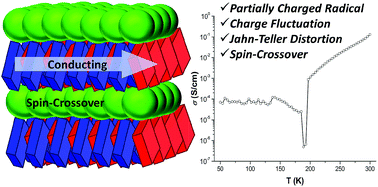
A cobalt(II) spin-crossover compound with partially charged TCNQ radicals and an anomalous conducting behavior

Chem. Sci., 2016, 7,1569-1574
DOI: 10.1039/C5SC03547C, Edge Article
Open Access Open Access
Xuan Zhang, Zhao-Xi Wang, Haomiao Xie, Ming-Xing Li, Toby J. Woods, Kim R. Dunbar
A spin-crossover conductor with partially charged TCNQ exhibits a high room temperature conductivity and an anomaly in conductivity.
The content of this RSS Feed (c) The Royal Society of Chemistry
08 Dec 12:32

Electronic Conductivity, Ferrimagnetic Ordering, and Reductive Insertion Mediated by Organic Mixed-Valence in a Ferric Semiquinoid Metal–Organic Framework

by Lucy E. Darago, Michael L. Aubrey, Chung Jui Yu, Miguel I. Gonzalez and Jeffrey R. Long

TOC Graphic

Journal of the American Chemical Society
DOI: 10.1021/jacs.5b10385
08 Dec 12:31

A 2D Semiquinone Radical-Containing Microporous Magnet with Solvent-Induced Switching from Tc = 26 to 80 K

by Ie-Rang Jeon, Bogdan Negru, Richard P. Van Duyne and T. David Harris

TOC Graphic

Journal of the American Chemical Society
DOI: 10.1021/jacs.5b10382