14 Oct 09:29
Chem. Commun., 2015, 51,15410-15413
DOI: 10.1039/C5CC06293D, Communication

Open Access
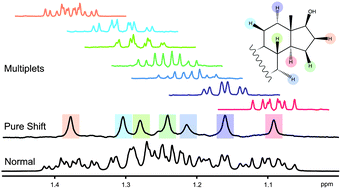
M. Foroozandeh, R. W. Adams, P. Kiraly, M. Nilsson, G. A. Morris
Integrating the PSYCHE method for pure shift NMR into 2D J spectroscopy allows each multiplet in a complex proton NMR spectrum to be cleanly extracted.
The content of this RSS Feed (c) The Royal Society of Chemistry

14 Oct 07:29
by Junling Sun, Yilei Wu, Yuping Wang, Zhichang Liu, Chuyang Cheng, Karel J. Hartlieb, Michael R. Wasielewski and J. Fraser Stoddart

Journal of the American Chemical Society
DOI: 10.1021/jacs.5b09274

14 Oct 07:28
Chem. Commun., 2015, 51,15542-15545
DOI: 10.1039/C5CC05344G, Communication
Open Access
Valentina Santolini, Gareth A. Tribello, Kim E. Jelfs
A general computational approach to predict the solvent effects on the structure of porous organic molecules is presented.
The content of this RSS Feed (c) The Royal Society of Chemistry

13 Oct 14:52
by Lutz Greb, Andreas Eichhöfer, Jean-Marie Lehn
Abstract
The thermal and photochemical E/Z isomerization of camphorquinone-derived imines was studied by a combination of kinetic, structural, and computational methods. The thermal isomerization proceeds by linear N inversion, whereas the photoinduced process occurs through C![[DOUBLE BOND]](http://onlinelibrarystatic.wiley.com/undisplayable_characters/00f8fe.gif) N bond rotation with preferred directionality as a result of diastereoisomerism. Thereby, these imines are arguably the simplest example of synthetic molecular motors. The generality of the orthogonal trajectories of the thermal and photochemical pathways allows for the postulation that every suitable chiral imine qualifies, in principle, as a molecular motor driven by light or heat.
N bond rotation with preferred directionality as a result of diastereoisomerism. Thereby, these imines are arguably the simplest example of synthetic molecular motors. The generality of the orthogonal trajectories of the thermal and photochemical pathways allows for the postulation that every suitable chiral imine qualifies, in principle, as a molecular motor driven by light or heat.

Naturally simple: The thermal and photochemical E/Z isomerization of camphorquinone-derived imines was studied by a combination of kinetic, structural, and computational methods. Based on these studies of configurational switching in imine derivatives, chiral imines such as camphorquinone-based imines are proposed to be the simplest example of synthetic molecular motors.
13 Oct 14:44
Energy Environ. Sci., 2015, 8,3477-3494
DOI: 10.1039/C5EE01388G, Review Article
M. Wild, L. O'Neill, T. Zhang, R. Purkayastha, G. Minton, M. Marinescu, G. J. Offer
Lithium sulfur batteries, review of current mechanistic understanding and the gap between experimentally derived mechanisms and those used for modelling.
The content of this RSS Feed (c) The Royal Society of Chemistry

07 Oct 08:06
by Prakash P. Neelakandan, Azucena Jiménez, John D. Thoburn, Jonathan R. Nitschke
Abstract
The functions of life are accomplished by systems exhibiting nonlinear kinetics: autocatalysis, in particular, is integral to the signal amplification that allows for biological information processing. Novel synthetic autocatalytic systems provide a foundation for the design of artificial chemical networks capable of carrying out complex functions. Here we report a set of FeII4L6 cages containing BODIPY chromophores having tuneable photosensitizing properties. Electron-rich anilines were observed to displace electron-deficient anilines at the dynamic-covalent imine bonds of these cages. When iodoaniline residues were incorporated, heavy-atom effects led to enhanced 1O2 production. The incorporation of (methylthio)aniline residues into a cage allowed for the design of an autocatalytic system: oxidation of the methylthio groups into sulfoxides make them electron-deficient and allows their displacement by iodoanilines, generating a better photocatalyst and accelerating the reaction.

Sensitive operation: The incorporation of oxidizable (methylthio)aniline residues in FeII4L6 cages comprising 1O2-sensitizing groups and dynamic-covalent imine bonds led to a system where photooxidation became autocatalytic: transformation of methylthio groups into sulfoxides renders the aniline residues electron-deficient enough for them to be displaced by iodoanilines, generating a better photocatalyst and accelerating the reaction.
28 Sep 06:18
by Sophie A. L. Rousseaux, Juliane Q. Gong, Renée Haver, Barbara Odell, Tim D. W. Claridge, Laura M. Herz and Harry L. Anderson

Journal of the American Chemical Society
DOI: 10.1021/jacs.5b07956

22 Sep 12:09
by Silvia Marchesan, Michele Melchionna and Maurizio Prato

ACS Nano
DOI: 10.1021/acsnano.5b04956

18 Sep 05:39
by Albert S. Y. Wong, Sjoerd G. J. Postma, Ilia N. Vialshin, Sergey N. Semenov and Wilhelm T. S. Huck

Journal of the American Chemical Society
DOI: 10.1021/jacs.5b08129

17 Sep 05:37
by Shigui Chen, Makoto Yamasaki, Shane Polen, Judith Gallucci, Christopher M. Hadad and Jovica D. Badjić

Journal of the American Chemical Society
DOI: 10.1021/jacs.5b06041

16 Sep 06:29
Chem. Commun., 2015, 51,14532-14535
DOI: 10.1039/C5CC05207F, Communication
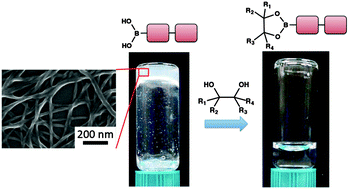
Brad H. Jones, Alina M. Martinez, Jill S. Wheeler, Bonnie B. McKenzie, Lance L. Miller, David R. Wheeler, Erik D. Spoerke
Boronic acid-modified phenylalanine dipeptide reversibly assembles into nanoribbon gels, triggered through variations in pH, ionic strength, and unique polyol interactions.
The content of this RSS Feed (c) The Royal Society of Chemistry

16 Sep 06:28
by Takahiro Sawano, Nathan C. Thacker, Zekai Lin, Alexandra R. McIsaac and Wenbin Lin

Journal of the American Chemical Society
DOI: 10.1021/jacs.5b09225

11 Sep 07:59
by Yang Ye, Timothy R. Cook, Shu-Ping Wang, Jing Wu, Shijun Li and Peter J. Stang

Journal of the American Chemical Society
DOI: 10.1021/jacs.5b07529

10 Sep 14:19
by Sanna Diemer
Dynamic combinatorial chemistry has emerged as a promising tool for the discovery of complex receptors in supramolecular chemistry. At the heart of dynamic combinatorial chemistry are the reversible reactions that enable the exchange of building blocks between library members in dynamic combinatorial libraries (DCLs) ensuring thermodynamic control over the system. If more than one reversible reaction operates in a single dynamic combinatorial library, the complexity of the system increases dramatically, and so does its possible applications. One can imagine two reversible reactions that operate simultaneously or two reversible reactions that operate independently. Both these scenarios have advantages and disadvantages. In this contribution, we show how disulfide exchange and boronic ester transesterification can function simultaneous in dynamic combinatorial libraries under appropriate conditions. We describe the detailed studies necessary to establish suitable reaction conditions and highlight the analytical techniques appropriate to study this type of system.
10 Sep 08:34
Publication date: 7 October 2015
Source:Tetrahedron Letters, Volume 56, Issue 41
Author(s): Palani Natarajan, Himani Sharma, Mandeep Kaur, Pooja Sharma
A novel method is developed for the oxidation of thiols to the corresponding disulfides using 20mol% haloacid (HBr or HI) in combination with dimethyl sulfoxide. A tentative mechanism is proposed for the oxidation. In addition to the advantages of cost-effectiveness, simple processes, and broad functional group tolerance, the exclusive formation of disulfides is the principle reward of this methodology while compared to known methods that further oxidize disulfides to S-oxides and other byproducts.
Graphical abstract

10 Sep 08:34
Publication date: 7 October 2015
Source:Tetrahedron Letters, Volume 56, Issue 41
Author(s): Dong Seob Lim, Suban K. Sahoo, Chan Sik Cho, Yang Kim, Heung-Jin Choi
With the aim to design a multidentate C 3v-symmetric trindane-based trisphosphine ligand 3 for Suzuki–Miyaura cross-coupling of 3-bromothiophene with phenylboronic acid, we observed the ability of this ligand to form an inclusion complex with buckyball C60. Along with its catalytic activity, the pyramidal inversion at phosphorous atoms of 3 and the formation of 3@C60 were investigated by
1H NMR,
31P{
1H} NMR and DFT methods.
Graphical abstract

09 Sep 07:24
Chem. Commun., 2015, 51,15514-15517
DOI: 10.1039/C5CC06324H, Communication
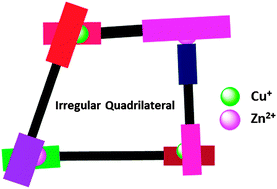
Nikita Mittal, Manik Lal Saha, Michael Schmittel
The 4-fold completive self-sorting of a ten-component library (7 dissimilar donors and 3 different acceptors) resulted in the clean self-assembly of four dynamic orthogonal complexes that were used as cornerstones in two novel six- and seven-component scalene quadrilaterals.
The content of this RSS Feed (c) The Royal Society of Chemistry

28 Aug 08:43
by Marie-Virgine Salvia, Giovanni Salassa, Federico Rastrelli and Fabrizio Mancin

Journal of the American Chemical Society
DOI: 10.1021/jacs.5b06300

26 Aug 13:56
by Anna K. H. Hirsch

The research group of Jean-Marie Lehn recently celebrated its 50th anniversary. Lehn, who shared the Nobel Prize in Chemistry 1987 with Donald J. Cram and Charles J. Pedersen, has been active in many initiatives in the European chemical community, and was instrumental in the founding of Chemistry—A European Journal and ChemBioChem. This Meeting Report summarizes the symposium that was recently held to commemorate the achievements of the Lehn group.
25 Aug 14:33
by Soonsang Hong, Md. Rumum Rohman, Jiangtao Jia, Youngkook Kim, Dohyun Moon, Yonghwi Kim, Young Ho Ko, Eunsung Lee, Kimoon Kim
Abstract
The porphyrin boxes (PB-1 and PB-2), which are rationally designed porous organic cages with a large cavity using well-defined and rigid 3-connected triangular and 4-connected square shaped building units are reported. PB-1 has a cavity as large as 1.95 nm in diameter and shows high chemical stability in a broad pH range (4.8 to 13) in aqueous media. The crystalline nature as well as cavity structure of the shape-persistent organic cage crystals were intact even after complete removal of guest molecules, leading to one of the highest surface areas (1370 m2g−1) among the known porous organic molecular solids. The size of the cavities and windows of the porous organic cages can be modulated using different sized building units while maintaining the topology of the cages, as illustrated with PB-2. Interestingly, PB-2 crystals showed unusual N2 sorption isotherms as well as high selectivity for CO2 over N2 and CH4 (201 and 47.9, respectively at 273 K at 1 bar).

Find a way: A new strategy for synthesis of shape-persistent organic cages based on porphyrins through rational design is reported. The size of cavities and windows of the organic cages can be modulated using different sized building units while maintaining the topology of the cages.
24 Aug 08:53
by Chuyang Cheng, Paul R. McGonigal, J. Fraser Stoddart and R. Dean Astumian

ACS Nano
DOI: 10.1021/acsnano.5b03809

21 Aug 10:31
by Bobin Lee, Zhenbin Niu, Junpeng Wang, Carla Slebodnick and Stephen L. Craig

Journal of the American Chemical Society
DOI: 10.1021/jacs.5b06937

21 Aug 10:18
by Marco Frasconi, Isurika R. Fernando, Yilei Wu, Zhichang Liu, Wei-Guang Liu, Scott M. Dyar, Gokhan Barin, Michael R. Wasielewski, William A. Goddard and J. Fraser Stoddart

Journal of the American Chemical Society
DOI: 10.1021/jacs.5b05618

gjchen and -1 others like this
21 Aug 10:12
by Euan R. Kay, David A. Leigh

They’re coming! From Feynman to ribosome mimics, the evolution of artificial molecular machines is told in terms of key inventions and the questions the field continues to face, including design philosophies and what to make and why.
20 Jul 09:28
Chem. Commun., 2015, 51,14435-14438
DOI: 10.1039/C5CC05189D, Communication
Yongsheng Gao, Tianyu Zhao, Dezhong Zhou, Udo Greiser, Wenxin Wang
The induction period and subsequent autoaccelerated polymerization of a Cu0/Me6TREN-catalyzed system originate from the accumulation of soluble copper species.
The content of this RSS Feed (c) The Royal Society of Chemistry

15 Jul 15:14
by Paul J. Thomassen, Shaji Varghese, Edward J. A. Bijsterveld, Pall Thordarson, Johannes A. A. W. Elemans, Alan E. Rowan, Roeland J. M. Nolte
Abstract
We describe a manganese porphyrin catalyst containing two adjacent cavities, which can be used for the epoxidation of alkenes by sodium hypochlorite. A pyridine ligand bound in one of the cavities regulates the rate and selectivity of the epoxidation reaction that takes place in the adjoining cavity. Pyridine binding studies suggest that site-to-site communication exists between the two cavities. The alkene substrates are completely converted into epoxides by the manganese double-cavity catalyst, but the observed epoxidation rates are low. These low rates are proposed to be a result of the energetically less favourable binding of the substrate into the cavity containing the active site due to an allosteric pinching effect. In the manganese double-cavity arrangement the catalytically active manganese complex is efficiently protected against decomposition, leading to a catalytic system with enhanced stability. The presented work may open a new route to the construction of highly stable catalysts of which the activity and selectivity may eventually be controlled by allosteric interactions.

A highly stable double-cavity-containing catalytic porphyrin host has been developed. A pyridine ligand bound in one of the cavities regulates the rate and selectivity of an epoxidation reaction that takes place in the other cavity. Binding studies suggest that site-to-site communication exists between the two cavities.
14 Jul 14:59
by Takuya Kuwabara, Jun Orii, Yasutomo Segawa, Kenichiro Itami
Abstract
Many optoelectronic organic materials are based on donor–acceptor (D–A) systems with heteroatom-containing electron donors. Herein, we introduce a new molecular design for all-carbon curved oligoparaphenylenes as donors, which results in the generation of unique shape-persistent D–A macrocycles. Two types of acceptor-inserted cycloparaphenylenes were synthesized. These macrocycles display positive solvatofluorochromic properties owing to their D–A characteristics, which were confirmed by theoretical and electrochemical studies.

I give this ring: Cycloparaphenylenes bearing acceptor units (anthraquinone and tetracyanoanthraquinodimethane) were synthesized. These macrocycles may be regarded as donor–acceptor (D–A) molecules, as evidenced by their solvatofluorochromic behavior, well-separated HOMO and LUMO, and electrochemical behavior. These findings provide a new molecular design strategy for D–A systems that makes use of curved π-electron ring systems.
13 Jul 08:11
by Koji Takagi, Kazuma Kusafuka, Yohei Ito, Koji Yamauchi, Kaede Ito, Ryoichi Fukuda and Masahiro Ehara

The Journal of Organic Chemistry
DOI: 10.1021/acs.joc.5b01028

29 Jun 08:42
by Martin Quernheim, Florian E. Golling, Wen Zhang, Manfred Wagner, Hans-Joachim Räder, Tomohiko Nishiuchi, Klaus Müllen
Abstract
The longitudinal extension of cycloparaphenylenes (CPP) towards ultrashort carbon nanotubes (CNTs) is essential for the solution based bottom-up synthesis of CNTs. Herein, the longitudinal extension of the CPP skeleton by the introduction of hexaphenylbenzene units towards polyarylated [n]CPPs is described. Further, the applicability of the Scholl reaction to selectively form graphenic sidewalls is demonstrated. The ring size and substitution patterns of the polyarylated [n]CPPs were varied to overcome strain-induced side reactions during the oxidative cyclodehydrogenation and cyclic para-hexa-peri-hexabenzocoronene trimers ([3]CHBCs) were selectively obtained. This concept is envisioned as an access to ultrashort carbon nanotubes subject to the condition that further benzene rings with the right connectivity will be inserted.

All that it′s cutout to be: Polyarylated [n]cycloparaphenylenes are intermediates on the way to ultra-short carbon nanotubes (CNT). Different polyarylated [n]CPPs can be prepared and their oxidative cyclodehydrogenation leads to CPPs that are cutouts from CNTs.
29 Jun 08:39
by Andreas Hirsch

“…The European Commission decided to launch the Graphene Flagship Project in 2013. The project brings together leading research laboratories from all over Europe with a wide span of different expertise. The Graphene Flagship (together with the Human Brain Project) is the largest collaborative research project that has ever been set up in Europe …” Read more in the Editorial by Andreas Hirsch.
   This article is licensed under a Creative Commons Attribution 3.0 Unported Licence.