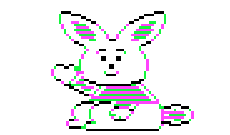
The New Yorker uses a strange kind of DRM on their archives — they layer PNG files over JPGs, so if you right click and save as, you just get this weird ghosted PNG (see above, left) But if you’re savvy, you can grab the JPG beneath, and when you layer them in Photoshop, you sort of have to bump them around to get them lined up right, and that gave me the idea of making really simple animated GIFs using just the PNG layer over the JPG background. Sort of cool. (These are from William Steig’s feature “A la recherche du temps perdu” in the September 26, 1959 issue.)
It’s funny how stuff like this makes one want to fiddle with IP MORE than if you just put the whole images up…
Google is sufficiently confident about its technology that its staff have discussed launching a fully autonomous taxi service in Mountain View as soon as next year, according to people familiar with the company’s thinking. The service may initially be restricted to Google employees, which might get around any legal and regulatory issues. Google has already run some tests with employees who are trained drivers.
I enjoyed this bit too:
Yet real life brings surprises no-one can anticipate. Last year, a Google car rounded a corner to find a woman in an electric wheelchair chasing a duck with a broom in the middle of the road. “We’d never tested the car against a woman and a duck,” Mr Urmson says, “and it was able to understand this was unusual, slow down, let that thing play out and then get on its way.”
General Motors Co. and Lyft Inc. will begin testing a fleet of self-driving Chevrolet Bolt electric taxis on public roads within a year, a move central to the companies’ joint efforts to challenge Silicon Valley giants in the battle to reshape the auto industry.
A robot is being designed to compete with 12th graders during the college entrance examination in 2017 and get a score qualifying it to enter first-class universities in China, according to Huaxi Metropolis Daily.
US researchers have developed what they say is the world’s first surgical robot that can outperform human surgeons when operating autonomously on soft tissues such as intestines, paving the way for clinical trials.
Airbus is working with French and Japanese researchers to develop humanoid robots able to work alongside humans on its assembly lines and inside aircraft, in what would be a step change in the use of industrial robotics.
Located in the woods near Stockholm, ‘The Six Walls’ house is a light-filled weekend home designed by architecture practice Arrhov Frick Arkitektkontor. The concrete building features a sleek rectangular design with walls that are more than five meters high. The same simplicity-guided approach goes for the interior, with a narrow entrance opening up to expansive living areas including a roof terrace overlooking the area’s pine trees.
Speaking of the process behind the concept, the architects say: “Perhaps as a contrast to the context, we wanted to build the house around a robust and clear material and concrete blocks with cement plaster became an important part. Simple geometry and detailing have been essential in order to build the house within a tight budget.” Based in Stockholm, the studio realizes projects with a simple and clean aesthetic across various disciplines, spanning from architecture to interior design.
President Barack Obama visited Hiroshima today and paid respect to the 140,000 lives killed by the atomic bomb dropped on the city in 1945. He became the first sitting US president to do so. He called for a world without nuclear weapons but did not apologize for the attack.
US President Barack Obama hugs Shigeaki Mori (front), a survivor of the 1945 atomic bombing of Hiroshima, during a visit to the Hiroshima Peace Memorial Park on May 27. Obama on May 27 paid moving tribute to victims of the world’s first nuclear attack.
(JIM WATSON/AFP/Getty Images)
At the rate computer technology is advancing, photographer Mark Richards’ collection of computers are indeed historical. These machines are officially antiques. As someone that enjoys pressing buttons, I enjoy the nostalgia of vintage computers; how unsubtle they are compared to modern designs, with a man-made, non mass-produced artisanal quality about them. Core Memory is a coffee table book that documents the most important and bizarre machines from the collection of the Computer History Museum in Silicon Valley. Now I know what to buy my tech guy for his birthday.
And just a reminder of how much we’ve evolved, a before (1950) & after…
“He’s the kind of guy who picks you up at the airport….”
“Viggo loves to drive. Sometimes he drives cross-country, just for the hell of it. And yet he has rented a Ford Fusion. ‘They always do this thing where they try to upgrade me to some fancy fucking car.’ But he doesn’t want a fancy fucking car. At times, he spontaneously pulls over to the side of the road for a good five or ten minutes to finish a train of thought—about life or death or demons or fears or his favorite soccer team in Argentina, San Lorenzo. About the time in the wilds of New Zealand when he skinned, cooked, and ate his own roadkill. (‘It was there.’)”
“He just doesn’t scream ‘I’m famous.’ Plus, he’s dressed like everyone around him, in a plaid flannel shirt, generic jeans (they’re not even Levi’s), and old black sneakers he got in Denmark a couple decades ago. (Mortensen doesn’t go in much for trappings. He has a flip phone!)”
“He lives in Madrid, and he works when he wants to work, doing whatever he feels like doing.”
“Mortensen is fifty-seven and has been at this drill since 1982—choosing to become an actor at age twenty-three after watching too many movies and thinking, I can do that.”
“His previous careers included driving a truck, delivering flowers, and loading ships in Denmark. For years he lived from gig to gig, check to check, mostly broke. It probably didn’t help that, on a whim, he left L. A. and moved to Idaho. He supported his acting career for years by bartending and waiting tables.”
“He had the world by the balls, with his pick of roles—big studio stuff, Clooney kind of stuff, paycheck stuff. He turned all of it down, choosing instead to do what he wanted to do, little of which was lucrative. ‘I mean, how much fucking money do you need?’ he asks.”
“He used some of his Lord of the Rings loot to start a publishing company—yes, a publishing company; it’s called Perceval Press, after one of King Arthur’s Knights of the Round Table—that would publish poets and other writers who might not otherwise get a book deal, and do so without having them ‘compromise.’ He could also afford to spend time on his other interests—writing poetry, taking photographs, painting.”
“…his ability to speak eight languages”
“‘I think about death all the time,’ he tells me as we both fire up another cigarette.”
“…the well-worn leather-bound journal he carries with him everywhere. He wants to ‘record life.’”
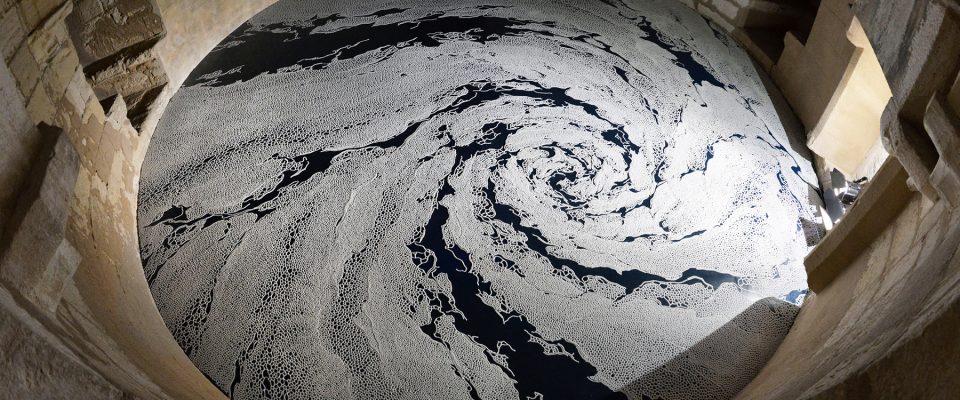
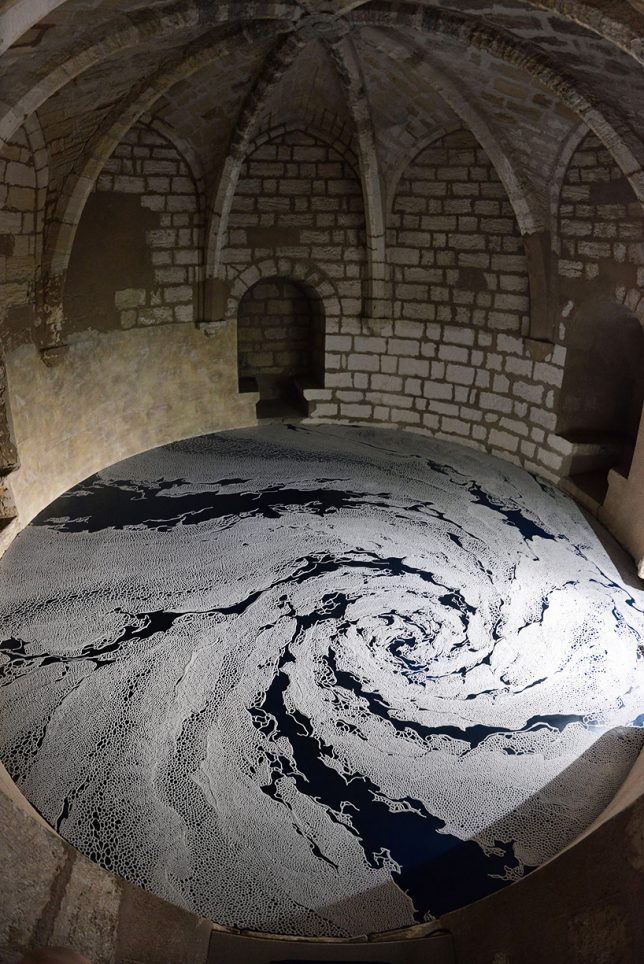
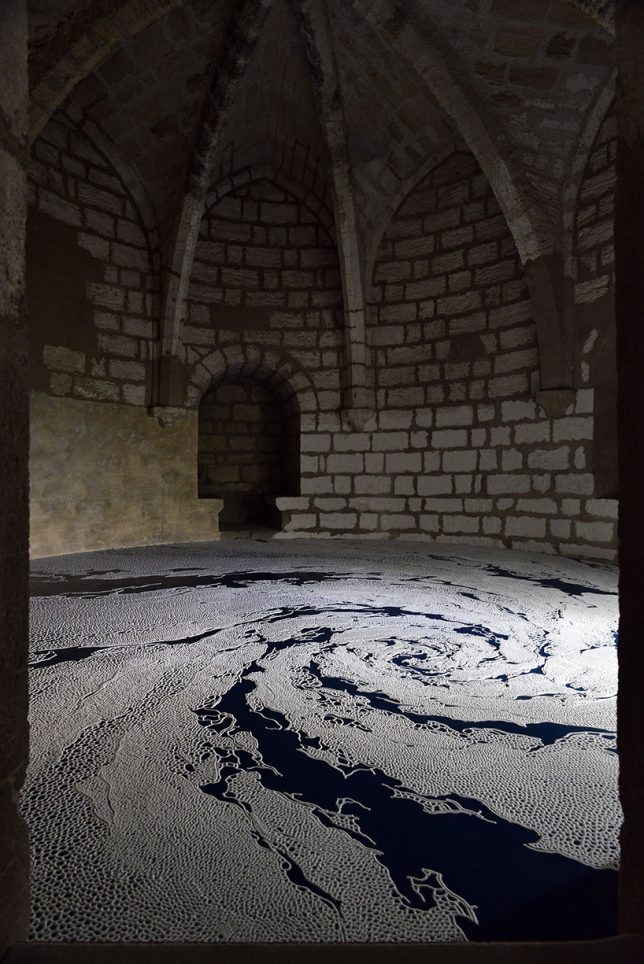
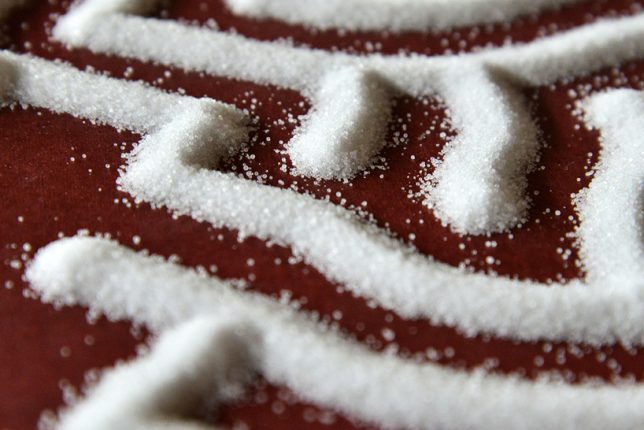
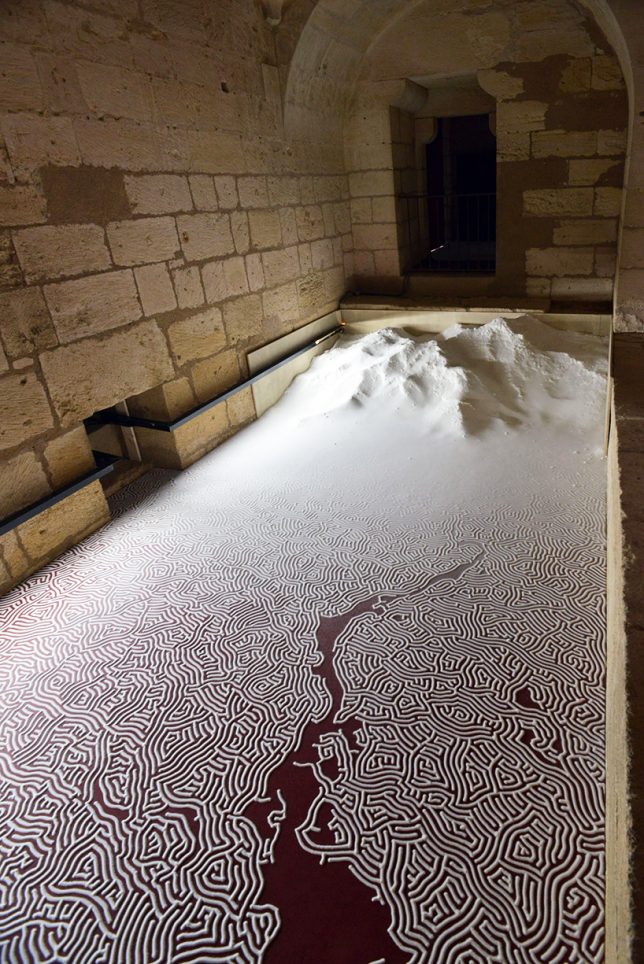
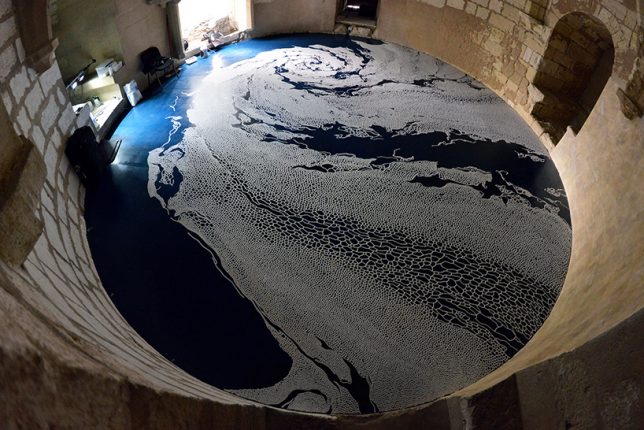
Gazing down at foamy-looking swirls of white on black from a niche in an ancient castle, you almost feel as if you’re an astronaut watching a hurricane form above the ocean on the distant Earth. These cellular arrangements form tentacular appendages of varying opacity, meeting in the center to create a vortex effect. They are, in fact, made of salt, with each grain symbolizing a memory or a moment in time. Artist Motoi Yamamoto installed ‘Floating Garden’ and ‘Labyrinth’ within the castle tower at Aigues-Mortes in Southern France for an exhibition called ‘Univers’ Sel,’ on display through the end of November.
The hurricane-like swirl of ‘Floating Garden’ is a motif commonly used to represent life, death, resurrection and rebirth in East Asia. To create it, Yamamoto started in the center of the black-floored space, shaking a container of salt in a calculated rhythm to produce just the right pattern, working for 45 hours over 5 days.
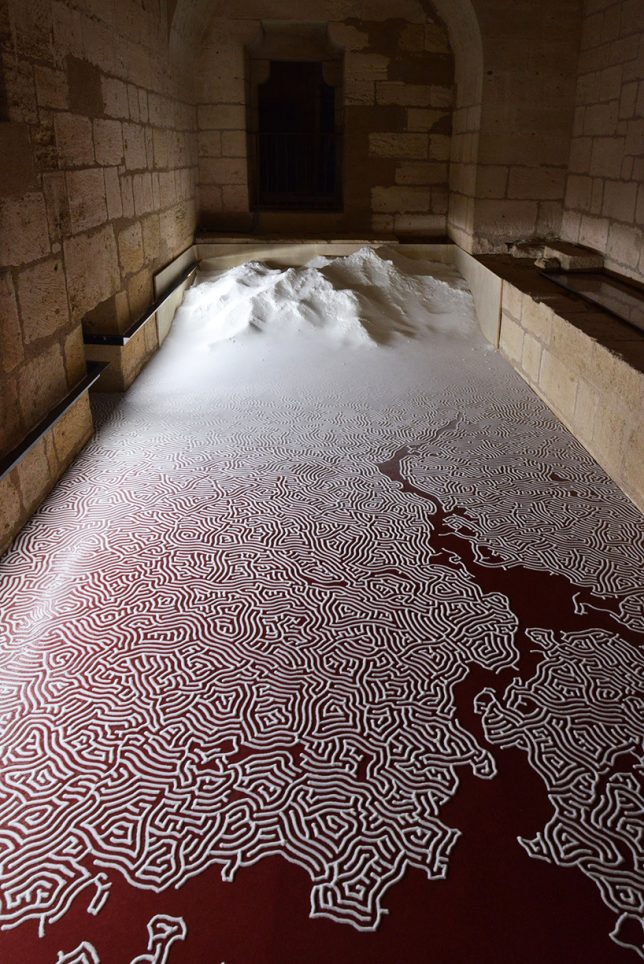
Within the ramparts, a labyrinth unfolds. Would you be able to wind your way from the outer edges of the pattern to the piles of salt that lie at the end? You’ll never find out, because to attempt it would mean destroying the work, with its intricately placed salt lines sensitive to the slightest movement. Like the sand mandalas of Tibetan monks, these salt sculptures are meant to exist temporarily, as vulnerable and ephemeral as human bodies moving through the hazardous world.
Both pieces are a continuation of series of the same names. The artist began working with salt as a medium after the loss of his sister to brain cancer at 24 years old, in rumination on time, transcendence and the notion of death. The salt structures act as an interstitial medium between our time and space within our physical world and whatever mysteries lie beyond.
“Drawing a labyrinth with salt is like following a trace of my memory,” says Yamamoto. “Memories seem to change and vanish as time goes by. However, what I seek is the way in which I can touch a precious moment in my memories that cannot be attained through pictures or writings. I always silently follow the trace, that is controlled as well as uncontrolled from the start point after I have completed it.”
For various reasons I recently downloaded snapshots of Wikipedia in various languages, and I'd like to share with you some discoveries, starting with article length in the English Wikipedia.
As of the May 3 version, which comprises 5,110,263 articles, the longest article (at 50,122 words) is "California Proposition 218 (1996)". The top ten in terms of length in words are::
Obviously you could substitute other wikinames for "enwiki" in order to get other languages. And perhaps someone will tell me that I should have used different flags for WikiExtractor.py in order to to get the full version of articles like "1918 New Year Honours"…
Short film by Keiichi Matsuda offers first person perspective in a highly saturated world of augmented reality - this really is worth six minutes of your time:
Our physical and virtual realities are becoming increasingly intertwined. Technologies such as VR, augmented reality, wearables, and the internet of things are pointing to a world where technology will envelop every aspect of our lives. It will be the glue between every interaction and experience,offering amazing possibilities, while also controlling the way we understand the world. Hyper-Reality attempts to explore this exciting but dangerous trajectory. It was crowdfunded, and shot on location in Medellín, Colombia.
Once upon a time, long before there were smartphones or emoji, computer graphics were crude, pixelated, and often came screeching out of a dot matrix printer.
Those who wished to use their computers to express themselves visually and without text had limited imagery. Three decades ago, there was no crying cat. There was no smiling poo. There was no suggestive eggplant. But in these otherwise dark ages, we had The Print Shop, a cultural phenomenon that infused an otherwise text-based world with images—part of a long tradition that can be traced from the rare emoticons of the 19th century to Zapf Dingbats to The Print Shop to emoji.
In 1984, The Print Shop was among the first class of publishing programs for personal computers. It was stationary software, in a way, designed for making banners, signs, greeting cards, and so forth—forms of communication that are, generally speaking, more about displaying a message than one-on-one communication, where emoji thrive. (That being said, performative emoji use is an art all its own.) Emoji was first created, according to its inventor, Shigetaka Kurita, as a way to add more texture and nuance to phone-based text. In the early 2000s, cellphone weather reports particularly bothered him, Kurita toldIgnition magazine, because they were all text-based with none of the icons—like sunshine or clouds—that he expected on other platforms.
Looking back, the relative lack of variety notwithstanding, The Print Shop’s image library wasn’t so different conceptually than today’s emoji. In my estimation, with the help of the Internet Archive’s emulated version of The Print Shop’s 1984 edition, about 80 percent of the collection of graphics from back in the day has a modern emoji equivalent. A lot of it is what you’d expect—holiday-themed imagery, for instance, and other designs that could be conceived as broadly applicable.
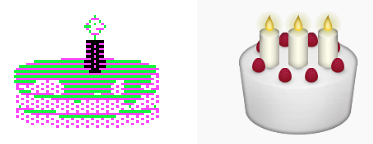
For instance, there is birthday cake:
The Print Shop’s birthday cake, left; Apple’s emoji cake, right
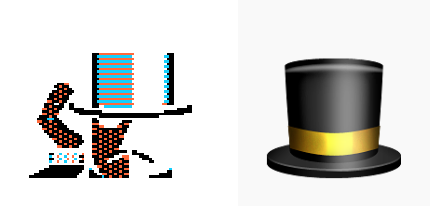
A top hat:
The Print Shop’s top hat, left; Apple’s emoji top hat, right
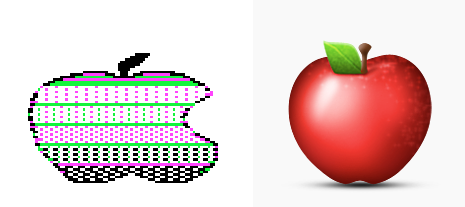
And an apple:
The Print Shop’s apple, left; Apple’s emoji apple, right
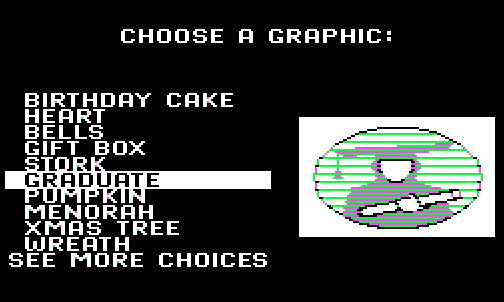
The Print Shop also had a heart, a gift box, a jack-o’-lantern, a menorah, a Christmas tree, a rose, ice cream, champagne, a candle, a light bulb, a piano, a trumpet, music notes, a skull, a sailboat, a train, a money bag, an alarm clock, a question mark, a yin-yang, and several other images that have carried over to the world of emoji. But there are some key differences between these visual worlds. The most obvious is the lack of people in The Print Shop. The top-hat figure, above, is representative of how awkwardly The Print Shop handles humans. Similarly, the software’s graduate is faceless:
Broderbund / Internet Archive
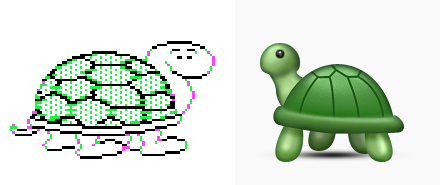
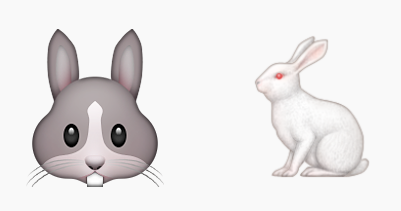
The only images with faces, in The Print Shop’s universe, are the animals—which raises another distinction. Both Print Shop and emoji deal with this category, but emoji creatures are (for the most part) more realistic, while The Print Shops’s critters are almost entirely cutesy and anthropomorphized.
The Print Shop’s turtle, left; Apple’s emoji turtle, right
A bunny from The Print Shop, 1984 (Broderbund / Internet Archive)
Emoji rabbits as they appear on Apple operating systems
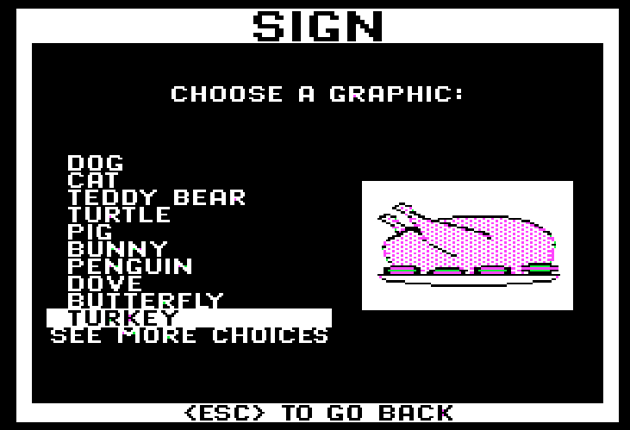
Except, of course, in one disturbing example from the 1980s. After a screenful of smiling beings—dog, cat, teddy bear, turtle pig, bunny, penguin, dove, butterfly—you get a carcass:
Broderbund / The Print Shop / Internet Archive
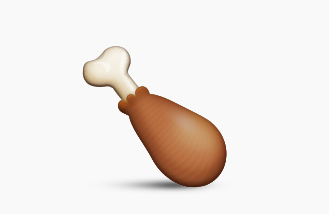
Which, to be fair, also exists in emoji form, only it’s grouped with food—not animals:
Emoji drumstick
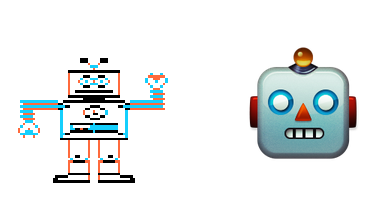
And though emoji clearly wins in numbers, The Print Shop had a few unique images of its own: a stork, a holiday wreath, a cupid, a drum, and a butterfly. The Print Shop still comes out on top in some other regards. It has a cooler robot than the Apple iteration of the emoji version:
The Print Shop’s robot, left; Apple’s emoji robot, right
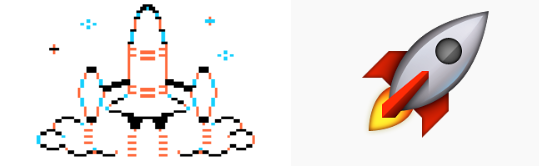
Same goes for The Print Shop rocket, which appears to be in the process of launching:
The Print Shop’s rocket, left; Apple’s emoji rocket, right
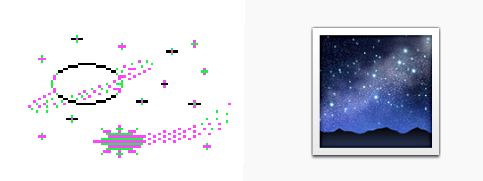
I also prefer The Print Shop’s spacescape, which is less Earth-centric or star-focused than similar views of space depicted in emoji.
The Print Shop’s spacescape, left; Apple’s emoji spacescape, right
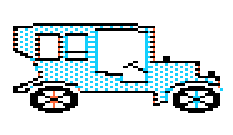
More broadly, both take a similar and decidedly nostalgic approach to technology. The Print Shop has an antique car and a quill and scroll; emoji has a CD, a pager, a VHS tape, a hard disk, and a fax machine.
An antique car from The Print Shop, 1984 (Broderbund / Internet Archive)
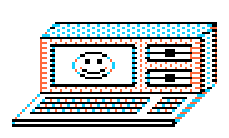
The Print Shop’s image library also has a delightfully old-school floppy disk. Of course, at the time when the software was popular, floppies were still new. My favorite technology imagery from Print Shop is probably the computer, which, incidentally, features the closest thing to a modern-day emoji on its screen.
A bunny from The Print Shop, 1984 (Broderbund / Internet Archive)
In 1984, when The Print Shop was released, graphics were a new and playful aspect of computing—one that at least one prominent tech critic at the time declared a passing fad. (He predicted, wrongly, that The Print Shop would never sell.) After all, the shift from text-heavy to graphical video games didn’t begin until around 1979. And the first graphics-oriented software for business presentations came out around the same time as The Print Shop.
Today, text and imagery—emoji, specifically—are coalescing, both in personal conversations and professional ones. Whether that represents the emergence of a new kind of language is up for debate. But the implications for human communication mean new shades of nuance, added layers of meaning, and, in some ways, a throwback to a time when computerized graphics were new.
compiled from a whole twitter spiel I had earlier. Let’s not get complacent about where we are with mental health awareness and uprooting stigma just cos one bit of the dialogue has opened up.
Today is Norway's national day or Constitution Day. On this day, children all over the country will participate in local parades that visit memorials, retirement homes, and civil centers. The largest parade is in Oslo, Norway's capital, with over 100 schools and their marching bands participating. The procession will pass the royal palace where the royal family will greet people from the main balcony. Today's Doodle gets in on the festivities with a depiction of the Eidsvoll — the historic building where the Norwegian Constitution was written.
Project by
Dmitry Ulyanov et al is a simplified demonstration of the Neural Doodle, which lets you compose Neural Net style transfers by defining territories of an image into another arrangement:
Can you draw like Monet? You probably can not. In fact you can with a little help of modern technologies. This little application presents the finest scientific approach which lets you to draw like famous artists. The drawing process is now reduced to sketching a five color doodle, everything else is done by a neural network.
More background about the project can be found here
Technological advancements could enable wheelchair users to stand up to reach high objects, zoom around on sandy and snowy landscapes, power up hills without an assistant and even climb stairs. Lightweight materials like carbon fiber, user-friendly adjustable components, seats customized to the user’s body measurements and electronic features like LED lights, collision sensors and built-in heating systems make these mobility solutions cooler and more functional than ever.
Go Wheelchair: Custom 3D-Printed for Each User
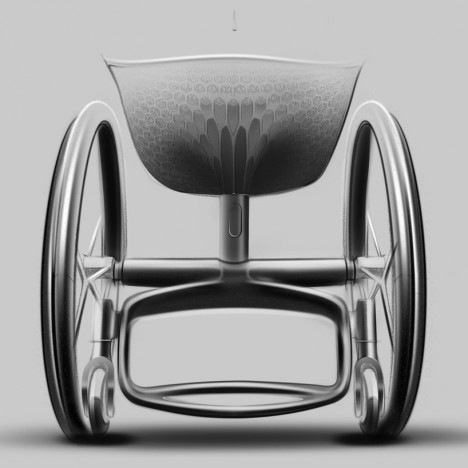
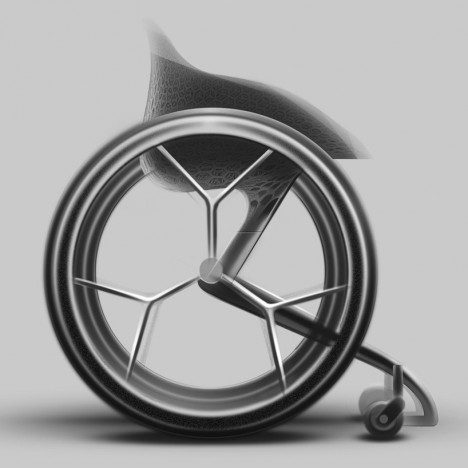
3D printing technology can customize the dimensions of a wheelchair to a specific user’s body measurements as well as giving them a choice of colors and additional components. The appearance can be specified with an app, and the finished product could be delivered in two weeks. “With the Go Wheelchair, we saw an opportunity to really progress the manual mobile category for users with disabilities, and to use 3D-printing technology to solve significant and meaningful problems,” says designer Benjamin Hubert of Layer.
Ultra-Tough Carbon Fiber Wheelchair
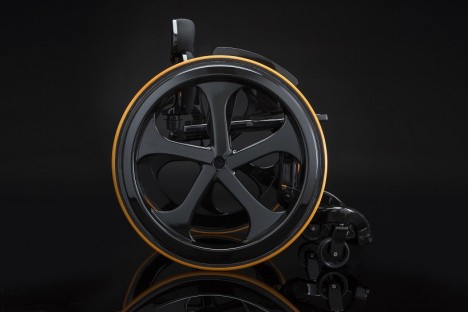
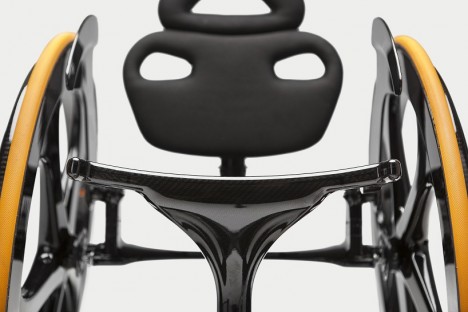
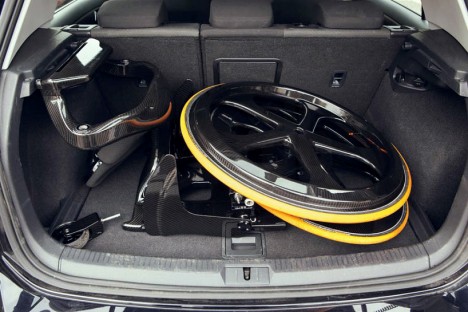
“I felt what wheelchairs were horrible medical devices, and couldn’t understand why companies didn’t advance their wheelchairs in the same way bike companies did with their products, says designer Andrew Slorance, who suffered a spinal injury at the age of 14. His desire for a better-looking, higher quality chair led him to create the ‘Carbon Black,’ which adds a lot of bike-like functionality including an optional LED system for night time travel. Minimal and lightweight, the wheelchair is made of carbon fiber and can be quickly and easily dismantled and reassembled for travel.
Off-Road Wheelchair for Adventurers
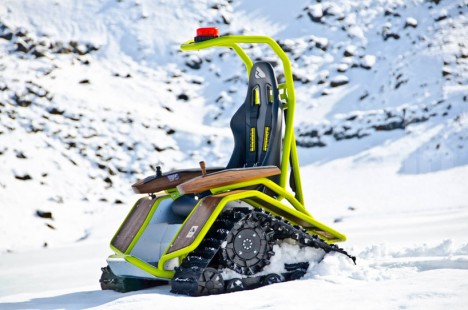
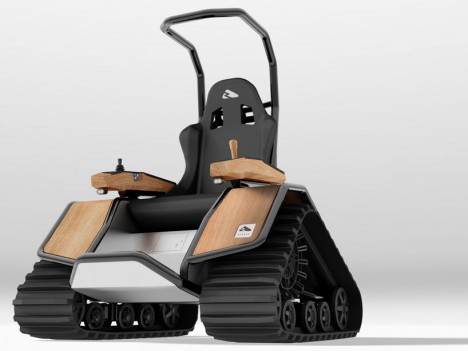
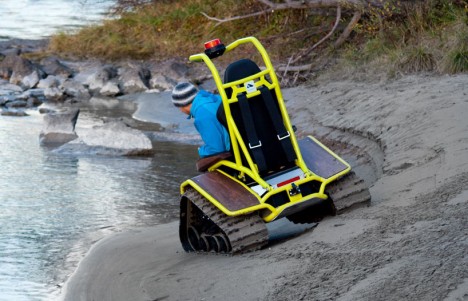
No sandy shore or snow-covered field is off limits when you’re in the Ziesel, an off-road outdoor mobility solution with 4-season rubber tracks and a high precision joystick. Made for exploring cross-country skiing tracks, hiking trails, beaches and dunes, the high performance chair by Mattro even has a fully automated heating system and can transport heavy loads on a trailer.
Transformable Wheel Chair by Caspar Schmitz
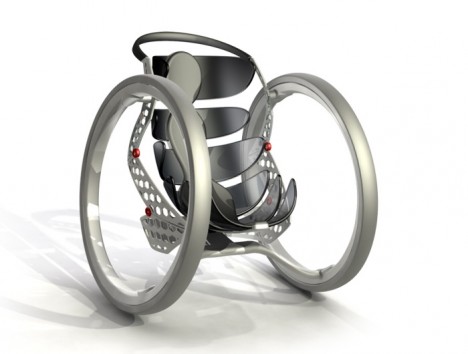
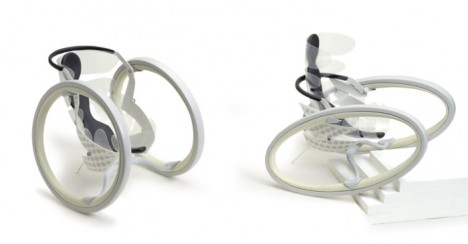
With flexible wheels that adapt to a variety of ground conditions, the lightweight and durable polyurethane Transformable Wheel can climb stairs and handle other rough terrain. While this design is just a concept, it’s an intriguing take on multifunctional wheelchairs that give users more independence.
Getting around the city in a wheelchair can be challenging, but a British company called Allgood Trio has devised an interesting way to help wheelchair users ...Click Here to Read More »»
All you need is an alien in a basket to make your biking experience just like a Spielberg film with this crazy flying bike and 13 other highly unusual, ...Click Here to Read More »»
Bikes are more than just a way to get around - there is a whole culture surrounding them. These futuristic ideas would take cyclists into the future in style.
Click Here to Read More »»
Because of an editing error, an article on Monday about a theological battle being fought by Muslim imams and scholars in the West against the Islamic State misstated the Snapchat handle used by Suhaib Webb, one of Muslim leaders speaking out. It is imamsuhaibwebb, not Pimpin4Paradise786. [link]
Not too long ago, we mentioned some hoverboards that don't really hover at all. But there actually are several examples of hovering devices that can transport people short distances. None of these contraptions are particularly practical means of transportation, but maybe when Mr. Fusion generators can supply enough energy, we'll all be hovering/flying around everywhere.
March 18th, 2016: I have a new book coming out! It is called Romeo and/or Juliet and I think you will like it. That's what I think! I'm not gonna lie about it!!