toomanypangalacticgargleblasters:
Well…you’re not wrong.

A series of sleek but whimsical models blend photorealism with fantastic concepts for treehouses, hilltop homes and even dwellings mounted on the sides of cliffs.

Santi Zoraidez is an art director and designer from Buenos Aires who does visual, graphic and architectural work, sometimes real and sometimes conceptual.

In this set of summer homes, he bends, twists, warps and cantilevers wood in amazing (if sometimes implausible) ways, putting houses on spindly stilts or hanging them from steep rocky surfaces.

The results are at once daring and provocative while retaining a sense of minimalism, that core feature common to Modernist Scandinavian designs.

By maintaining a simple palette of colors and textures, the artist manages to accomplish a natural aesthetic that makes sense for countryside dwellings while letting the details of designs – long horizontals and asymmetrical shapes – define each work.



The San Francisco Chronicle, in a very rare front-page editorial:
On one point we must all agree: The level and pervasiveness of homelessness in San Francisco is a disgrace. It is simply not acceptable to allow people to stay in the squalor of tent encampments or sleep in doorways, parks and freeway underpasses without attention to the underlying issues that prevent them from attaining shelter and stability in their lives. It’s bad for public safety, bad for public health, and bad as a matter of basic humanity.
Its reduction to the extent humanly possible should be this city’s No. 1 priority.
I only spend one week a year in San Francisco, and I’ve seen relatively little of the city. But every year, I’m increasingly struck by the widening class divide and disturbing contrast I see as tech workers (including myself) briskly walk past a lot of people for whom society has completely failed, pretending not to notice them, on our way to offices and events of some of the richest companies in the world.
We can’t continue boasting our industry’s “innovation” and how much we’re “changing the world” when we can’t even take care of people’s basic needs literally right outside these companies’ front doors.
This isn’t just a San Francisco or tech-industry problem, but there isn’t another place in America that illustrates the problem quite as clearly, sadly, and disturbingly.
Governments should be fixing this problem, but they have mostly failed due to public ignorance, judgment, and apathy. If you really want to be “disruptive” and have a meaningful impact on the world, disrupt the way our cities and citizens treat those less fortunate than the rich young people ordering overpriced burritos from their phones to avoid going outside.

Glenn McDonald attempts to graph the musical space in its entirety on a two-dimensional scale. He calls it Every Noise at Once.
This is an ongoing attempt at an algorithmically-generated, readability-adjusted scatter-plot of the musical genre-space, based on data tracked and analyzed for 1491 genres by Spotify. The calibration is fuzzy, but in general down is more organic, up is more mechanical and electric; left is denser and more atmospheric, right is spikier and bouncier.
Click on the genres for music samples, if you are like me and are not sure what rap metalcore or ghettotech sounds like. [Thanks, Namir]
Elie Wiesel died yesterday in NYC aged 87. He survived the Auschwitz and Buchenwald during WWII and later wrote and spoke extensively about the experience, not letting the world forget what happened to so many Jews under Hitler's boot. For his efforts, Wiesel won the Nobel Peace Prize in 1986 and this part of his acceptance speech remains as vital as when he spoke it:
And then I explained to him how naive we were, that the world did know and remain silent. And that is why I swore never to be silent whenever and wherever human beings endure suffering and humiliation. We must always take sides. Neutrality helps the oppressor, never the victim. Silence encourages the tormentor, never the tormented. Sometimes we must interfere. When human lives are endangered, when human dignity is in jeopardy, national borders and sensitivities become irrelevant. Wherever men or women are persecuted because of their race, religion, or political views, that place must -- at that moment -- become the center of the universe.
I am going to be thinking about that paragraph a lot in the next few months, I think.
Tags: Elie Wiesel Holocaust obituaries


For his project “Shots Fired,” photographer Mark Teiwes created images of gunshots. Instead of shooting the images with a camera, however, he shot the photo-sensitive paper with bullets.
(via These Gunshot Photos Were Shot with Bullets, Not Cameras)

Many generations have gone by since the world-riveting exploits of Charles Lindbergh, since the tragic mystery of Amelia Earhart, since the still underappreciated achievement of Jerrie Mock (the self-described flying housewife from Columbus, Ohio, who in 1964 became the first woman to fly solo around the world). But attempts at record-setting aviation feats continue.
The most notable of the past year has no doubt been the global flight of Solar Impulse, which has been crossing oceans, deserts, and mountain ranges powered by nothing but the sun. Here is a different kind of round-the-world event, coming up from Australia:
Lachlan “Lachie” Smart is an 18-year-old from Queensland who plans to set off on July 4 for a solo trip around the world. The planned route list is here, and a live-tracker for the flight will be here. A blog about his training flights and general preparation is here.
I’ll be following the updates. Safe flying and tailwinds to young Mr. Smart.

Update: As of mid-afternoon July 3 U.S.-Eastern time, the first leg of the flight is underway, and is trackable here on FlightAware.


Article from fashion smart search service Thread Genius discusses how machine learning and artificial intelligence plays a significant part of their product. It works just like Shazam - expose the app to an image of clothing and it will retrieve details of the exact or similar products.
Pictured above are DeepDream inspired renderings created using their custom fashion dataset.
If we presented the same number of clothing images to an artificial neural network, can it learn to see the world of fashion like Bill Cunningham does? Said in a less sensationalized way, what we’re proposing is training a neural network to recognize clothing from images and find us visually similar ones. Accomplishing this would be a good start towards creating our paisley shirt outfit-finder.
So let’s jump into it. The first thing we did was gather image data. Lots of image data. Since Robo Bill Cunningham has to recognize an article of clothing in as many ways as it would normally appear in the world, our training images had to contain clothing depicted as such: worn, unworn, held, folded, rotated, in front of a tree, under terrible lighting, etc.
It was a gargantuan data curation task, but after several months and thousands of man hours later, we ended up collecting and annotating millions of clothing images from various retail and social media websites, all hand-labeled and hand-cropped by skilled interns recruited from FIT and Parsons.
You can read more over at Medium here

“Stairwell, Chicago”, 2015. Spray Paint on Paper, 114 x 88 cm.
Hat tip to Jalabert Camille for this beautiful short. This is next level student work!
Decades before Google started outfitting Lexus SUVs with sensors and self-driving software, the driverless car du jour was an otherwise ordinary-looking Pontiac.
In the 1920s and 1930s, a driverless car was more commonly known as a “phantom auto,” and demonstrations of the technology drew thousands of spectators in cities across the United States.
These cars weren’t computer-driven, as they are today, but remote controlled. It’s not clear from newspaper archives and other written accounts how many were ever in existence, anyway, though we do get a general sense of how they worked: The person operating the car would often follow in a second vehicle some distance behind; or, in at least one case, in a low-flying airplane, according to a 1932 account in the Times Recorder of Zanesville, Ohio.
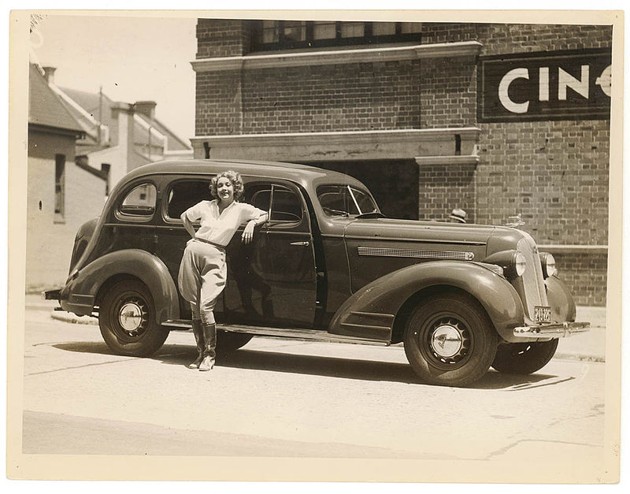
The car, which the newspaper called “one of the most amazing products of modern science,” could be operated from as far as five miles away, its inventor said. “It sounds unbelievable but it is true that the driverless car will travel about the city through the heaviest traffic—starting, stopping, sounding its horn, turning right or left, making U-turns and circles, and proceeding thus as though there were an invisible driver at the wheel,” the Times Recorder reported. To catch a glimpse of the phantom auto was to see “one of the most spectacular street events possible.”

The cars were driverless, in that they didn’t have a human behind the wheel, but they weren’t self-driving per se. This didn’t stop them from captivating the public. “From 1931 to 1949, [the radio engineer J.J.] Lynch gave demonstrations of the remote-controlled vehicle in 37 of the 48 US states,” wrote Fabian Kröger in a sprawling report on the technical, legal, and social aspects of self-driving cars. “He manipulated the brakes, steering wheel and horn of the vehicle driving in front of him with the aid of a morse key. A spherical antenna received the code, although there are also reports of a wire between the vehicles.”
At the same time, Kröger points out, driverless vehicles were cemented in the popular imagination through their depiction in fantasy novels like Werner Illing’s Utopolis, which features a self-steering car. “The most wonderfullest thing about it was that the car … behaved as if it had learnt all possible traffic rules by heart,” Illing wrote. In 1935, the writer David H. Keller wrote about a driverless car that was voice activated in The Living Machine:
Old people began to cross the continent in their own cars. Young people found the driverless car admirable for petting. The blind for the first time were safe. Parents found they could more safely send their children to school in the new car than in the old cars with a chauffeur.
Decades later, KITT, the sentient automobile from Knight Rider, became the best known fictional car you could talk to. Incidentally, it was a Pontiac; just like the actual phantom autos of the 1930s.
But when the concept of a driverless car first emerged, the thing people focused on most was the promise of improved safety at a time when vehicles were deadly—which is still the great promise of self-driving cars today. In fact, the driverless car’s first film appearance was in a 1935 educational road-safety movie commissioned by General Motors. But remote-controlled vehicles seemed to exist to make a point more than anything else: They were a way of demonstrating how safe cars ought to be, but still just a novelty and not a prototype for the near-future. In the film, The Safest Place, the driverless car’s traffic record is “exemplary,”Kröger says:
The vehicle always stays in its lane, never forgets to signal when turning, obeys all stop signs and never overtakes on dangerous corners. Lynch had given similar reasons for campaigning for safety with driverless vehicles. ... In ironic fashion, the film points here to the contradiction between safety and freedom: Is the car only safe when empty?
Such public education was sorely needed. In the 1920s and 1930s, automobiles were responsible for so many deaths that public officials began to debate whether cars were inherently evil. Cities across the country held safety parades in which disfigured survivors of accidents sat waving from automobiles—and thousands of children dressed up as the ghosts of the deceased. And though driverless cars—often referred to in the newspapers as “magic cars”—attracted public attention as a a technological marvel, public demonstrations were mostly intended to underscore the need for improved automotive safety. (It would take decades more for American attitudes toward automotive safety to shift, and decades more for people to begin to think of self-driving cars as a technology that might be adopted widely.)
“Regular safety lectures leave a sour taste in everybody’s mouth, especially when you start telling another fellow about his shortcomings as a driver,” J.J. Lynch, the phantom-auto operator, told The Daily Times-News of Burlington, North Carolina, in 1937. “But when you give them this kind of demonstration and talk safety at the same time, they listen to you and become interested.”
Driverless cars never ran yellow lights or veered into the wrong lane, Lynch added, and “that’s more than a lot of cars with drivers in them do.”
RoslynTerrifying
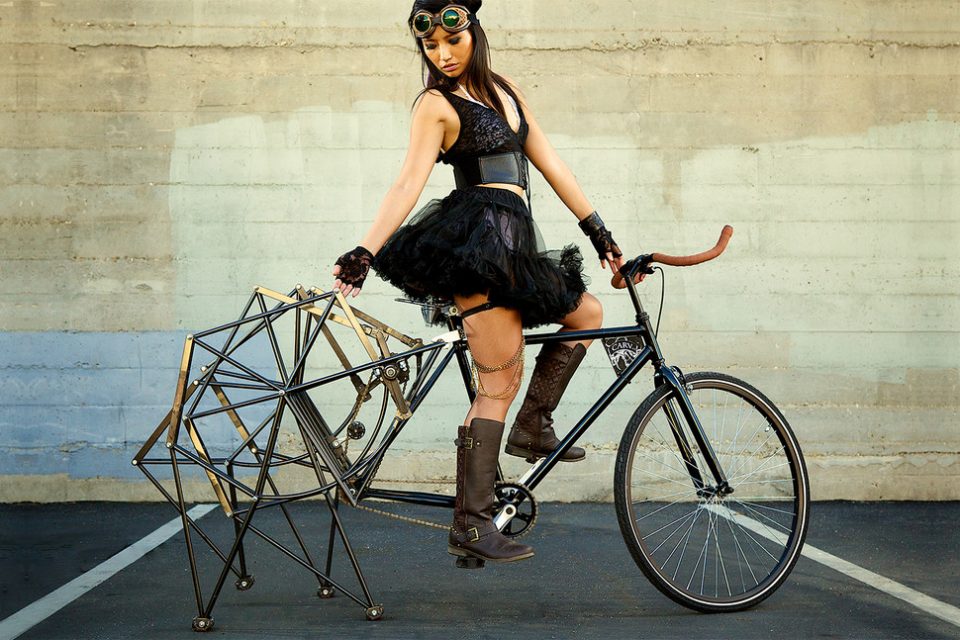
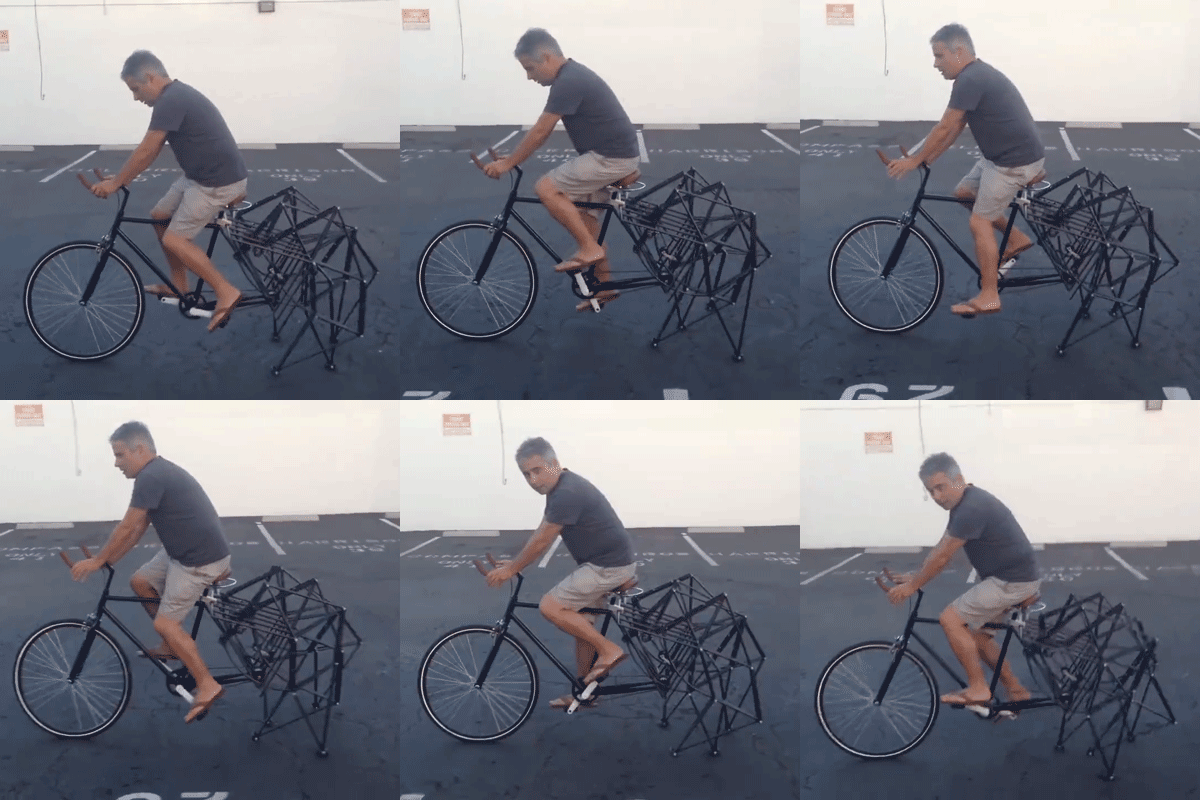
This bizarre new take on the Strandbeest bicycle isn’t going to get you from point A to point B much faster than a casual stroll, but it’s fun to watch, with the rear mechanical mechanism ‘walking’ in spider-like motions. Borrowing from the wind-powered kinetic sculptures pioneered by Dutch artist and engineer Theo Jansen, this new creation by Californian collective Carv is half bike, half beast with a front wheel, three functional legs and over 450 handmade components. The designers started with a simple blueprint of Theo Jansen’s rod-linking technique, which he describes as “skeletons which are able to walk on the wind.”
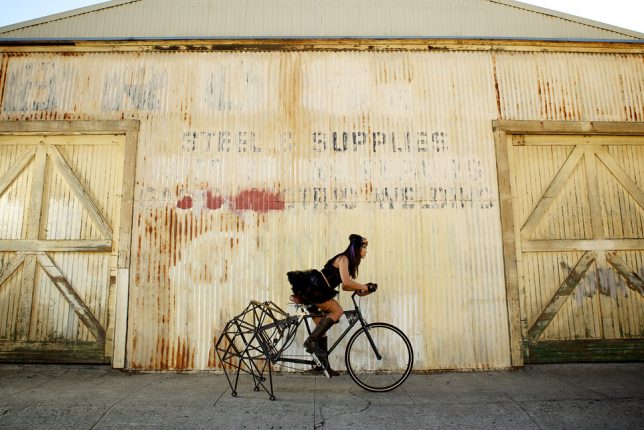
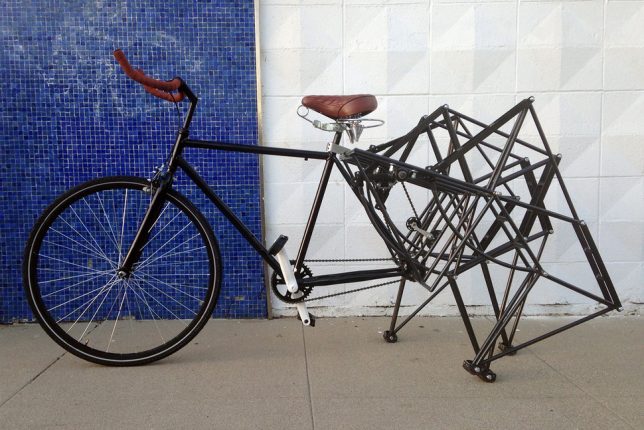
It took Carv a whole seven months to develop and build the bike, with the assembly of the rods alone taking three days. Whereas Jansen’s walking sculptures use sails and wind to generate movement, the bike uses pedal power. The designers used a single-speed bike from Walmart as the base and added the rear linkage. Get the technical details here.
An earlier version of the ‘walking bicycle’ by Hanno Smits also uses pedal power, but takes out both wheels, opting for a full walking mechanism that seems to navigate a little more smoothly. The Panterragaffe, a third version, is a two-person pedal-powered walking machine conceived as a public performance piece.

It’s hard to deny that Jansen’s original sculptures are just plain cooler and more interesting, though, no matter how many hybrid knock-offs people try to make. Still tempted to try it, or just want to know more about how they work? Jansen sells a few books as well as DVDs and miniature ‘beasts’ on the Strandbeest website.

FiveThirtyEight published their election forecast tracker this week, and it’s a beaut. It starts with the standard state map and most importantly the probability of each candidate winning the presidency. But after that, you can look into much detail on a state-by-state basis.
They currently give Hillary Clinton a 79 percent chance of winning and Donald Trump a 21 percent chance. I think many interpret this as Clinton is practically a lock, but it’s actually far from it. That 21 percent is freakin’ high.
As much as I want to forget, let’s remember that the Cleveland Cavaliers only had an 11 percent chance of winning the title, and I think we know what happened there.
In any case, check out the tracker. I like it. And find more details on where the numbers come from in the user’s guide.
Tags: election, FiveThirtyEight
RoslynIn case you missed it!
Either you’ll immediately get why this is crazy, or you won’t: Hillary Clinton wrote a thing for The Toast today.
Are you weeping? Did your heart skip a beat? Maybe your reaction was, “What. Whaaaat. WHAT,” or “Aaaaaaahhhhhhh!!!” or “OH MY GOD,” or simply “this is too much goodbye I'm dead now.”
Perhaps your feelings can only be captured in GIF form, as was the case for someone commenting on Clinton’s post under the name Old_Girl:

Reader comments like the ones above are arguably the best part of Clinton’s post, because they highlight just how meaningful hearing directly from Clinton is to The Toast’s community of readers. The Toast is a small but beloved feminist website known for its quirky literary humor. It announced last month it couldn’t afford to continue operating. Friday is its last day of publication.
“I know that today is the final day of The Toast, and I wanted to take a moment to reflect on what this space—and spaces like it—mean for women …” Clinton wrote. “As we look back at what this site has meant to so many of you, I hope you’ll also look forward and consider how you might make your voice heard in whatever arenas matter most to you.”
For the people who haven’t reacted with some variation of “!!!!!!!!!!!!!!!!!!!!!!!!!!!!!!!!!!!!!!!!!!!!!!!!!!!!!!!!!!!!!” or “what’s a toast?” there have been observations about how deeply weird it is to see Clinton pop up on a relatively small site with a seemingly personal message. It’d be a little like having her show up at the bar, scooch into the booth with your group of friends, and ask to try a sip of your IPA.
Or, you know, like having her do a cameo on Broad City, a show made by (and starring) women who occupy a similarly Toast-esque space. (Clinton appeared on the show in March.) Many Toast readers are likely already Clinton supporters, but they’re also more likely to be in the younger demographic of women who aren’t as enthusiastic about her as their mothers and grandmothers are. In fact, one poll found most Americans don’t view Clinton’s nomination for the presidency as historic—despite her being the first woman to clinch a major party’s nomination in U.S. history—a position that’s particularly pronounced among young people. A whopping 71 percent of people under age 30 said Clinton securing the Democratic nomination was not a “historic moment.” These are the voters Clinton needs, and she knows it.
Just the way the internet has made the micro-targeting of niche audiences possible in every other way—tracking ads that follow you with images of the products you’ve googled, for example—political campaigning in the 21st century has followed suit. Clinton’s byline on The Toast is an extension of “delete your account.” It takes personalized campaign emails to the next level. (Incidentally, the greatest thing I ever read about those emails appeared on The Hairpin, the site where The Toast’s founders met. “Subject Lines of Obama Campaign Emails That Sound Like a Stalker Wrote Them,” by my now-colleague Julie Beck.)
It’s essentially this: Hillary Clinton doesn’t just (hire people who) know the inside jokes to use on Twitter, she knows the inside jokes on Weird Twitter. And this is an attitude that reflects her campaign’s larger strategy; a bet that the so-called “national conversation” isn’t the thing that will carry Clinton to victory in the general election, as Emily Schultheis put it last year. Instead, her campaign is betting on making more intimate connections with small groups of voters, “the persona she builds in key areas, and the buzz she generates with local activists.” For anyone who has seen Clinton engage with a small crowd—and how warm and funny she can be, contrary to popular opinion—this approach will make sense. Clinton’s campaign has emphasized the importance of “meeting people where they are,” and it turns out that some of those people are online reading The Toast.
Writing for a small dying website may seem strange, but that’s the brilliance of the niche campaign play in the 2016 election: You trade little effort for slightly more reward. Hitting up high-profile donors at a fancy-shmancy dinner takes quite a bit of time and energy on the part of a candidate. Writing (or, not to be too cynical here, but maybe even just green-lighting) a heartfelt statement for a beloved website takes far less time. Readers of The Toast may not produce a windfall in campaign donations, but if Clinton can convert some of the site’s readers into contributors, it will have been worth the time.
"I HAVE NEVER BEEN PANDERED TO SO EFFECTIVELY BEFORE,” one commenter wrote.
And in a tweet from Nicole Cliffe, one of The Toast’s founders: “turns out that pandering to ME by NAME doesn't feel like pandering and now I am Team Hillary, let's get our lady president.” In a comment on the site, she added: “Asking if Hillary wanted to receive her fifty dollar freelancing payment via check or PayPal was one of the best moments of my life.”
I have also spent time in Istanbul more recently than in Paris and have more friends who have lived in Istanbul than in Paris.
I'm so heartbroken to hear about the attack in Istanbul, Turkey. This image is so sad, but so true. pic.twitter.com/TTUJB7bemC
— banksy (@thereaIbanksy) June 29, 2016


VR Project by Kaleidoscope (with art direction from Béatrice Lartigue) visualizes the audio diary of a man who became blind, an adaptation of the book ‘Touching The Rock’ by John M. Hull:
Some notes from Béatrice about the project in relation to VR:
The first thing I done was to read the book of John M. Hull, to understand his experience and discover his daily environment. What struck me first was the contrast between the simplicity of his writing and the strength of his words. There were also tackled issues of a man living with his family and a man exploring the meaning of life: it was like John was at the same time inside and outside his own body.
In virtual reality, the world around the viewer is concentric; all vanishing points refer to the viewer’s position. And it’s even more true when your perceptions of this world bring it to life.
John knows his daily environment (his study, his house…) but he feels his unknown surroundings to understand it. His senses and perceptions help him to figure out what the space looks like around him: the wind in his hair, the sun on is skin. The sound gives tangible form to his environment.
The point of view and the environment are voluntary realistic, but the visual translation of John’s world is more abstract. My first concern was to translate the idea of ‘an intermittent & fragmented world’.
You can read more background about the project here

The visualization featured here looks at these areas in terms of Internet penetration (i.e., the share of their population that have ‘used the Internet (from any location) in the last 12 months’ where ‘Internet can be used via a computer, mobile phone, personal digital assistant, games machine, digital TV etc.’ (United Nations (UN), 2015).
The Archipelago of Disconnection highlights all territories that either have Internet penetration below 10% (coloured yellow) or for which no data from the World Bank exist (orange)…
Among these very poorly connected Sub-Saharan nations there are some very populous countries – the three largest are Ethiopia (with 94 million inhabitants), the Democratic Republic of the Congo (68 million) and Tanzania (49 million) – with an overall Internet penetration of a mere 2.6%. [link]



Hey, Australian geeks!
So... we haven't gotten enough submissions to do BAHFest Sydney by our stated deadline. We've decided to give people another week and a half to submit. It should be a really fun show and we have some amazing guests, but we need a few more clever nerds to put forward some ideas we can help shape into talks. If you know someone who's funny and clever, please give them a nudge!



Project by Gabriel de Laubier turns a comic strip into an interactive 3D scene:
3D rendition of a Calvin & Hobbes comic strip (orginal strip by Bill Watterson). Backface culling and flat-shading are used to give life to the cartoon drawings. You can see it in realtime on Sketchfab
View for yourself here
RoslynYay, a new feed for me!
David Friedman created this website in March 2010 and ran it until September 2011 until he had a child and couldn’t keep this up with his busy schedule anymore. I’m not David Friedman. I’m Jesse Rifkin and I have David’s permission to take over this blog for a while, posting every week with interesting articles published in the New York Times Sunday Magazine section from precisely 100 years ago to the week.
Sometimes the articles will be serious, sometimes they’ll be funny, sometimes they’ll be strange, sometimes they’ll be nostalgic, but they’ll always be fascinating and engaging. I’ll try to post only the most interesting content with some context, modern parallels, and maybe an occasional aside or two from my own life. And I’ll try to do as good a job with this website as my predecessor David did — if that’s possible.
A quick bit about me. I’m a 24-year-old journalist living in Washington, D.C., where I work as a congressional reporter for GovTrack Insider and a box office analyst for Boxoffice Media. You can read a fun Daily Beast article I published from just earlier this week in which I interviewed the country’s top Donald Trump and Bernie Sanders impersonators.
So come along with me as we crank up the time machine, push the DeLorean to 88 miles per hour, and take a trip back every week to what made the “newspaper of record” a century ago. Let’s begin… again!