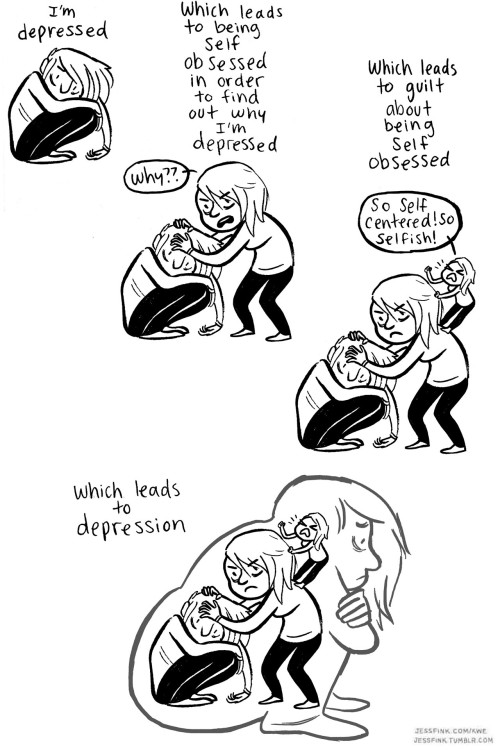
A comic I made a while ago about depression.
http://jessfink.com/kwe/?id=189
RoslynThis is weird, and weirdly excellent
Oh hello! Look, I just made you this film right now, it’s called DOUBLE KING and it’s for you, here you go!
RoslynOof, too real
Are you a global brand that recently discovered International Women’s Day is an actual thing? Or are you a national brand that’s suddenly down with Nasty Women? Maybe you’re an advertising agency or a tech company that likes to talk a big game on social media about the one woman you promoted to a senior position as if you just solved all inequality in the workplace past, present, and future? Or maybe you’re a supposedly enlightened organization, like a university or nonprofit, that likes to think of itself as always on the right side of history when in fact your org chart looks more like a family tree constructed entirely of sausage? Well, you’ve come to the right place!
As you’ve probably been finding out the hard way, there is so much to learn about women. First of all, there are so many of them! When you see them gathered en masse with those pink pussy hats you might not know whether to think “target market!” or “RUN AWAY!” We totally get it. That’s exactly how women feel about large groups of men, except without the “target market” part.
At work, you may not have noticed how many women are actually there. There’s the one who always cries after her yearly review and that other one who orders the pastries and coffee for important meetings — Alexandra, Alexandria, something. Always forget her name. Or the one who runs HR and occasionally raises her voice in meetings — so shrill and that awful haircut. But, unbelievably, there are likely more than three women in your workplace. How can you be sure?
Well, look around. A common mistake is not actually seeing women who are over 32, are above a size 8, are mothers, and/or are obviously smarter and more capable than you. This is what women call “being invisible,” which is deceptive since they’re just as much of an actual physical life form as you are, except without the sense of entitlement.
Secondly, women love to shop. You might be thinking, “Well duh, even I know that. Those THE FUTURE IS FEMALE T-shirts aren’t buying themselves!” No, no, dummy, we mean really shop. Did you know that women are responsible for 70-80% of consumer spending? And we’re not talking about T-shirts; we’re talking cars, houses, and other big expensive man stuff!
Because of this, you might want to rethink how you cast when it comes to those television commercials and videos you hope go viral. While the bases seem pretty well covered when it comes to the role of Laughing Yogurt Eater Who Has a Difficult Time Pooping, The Patient and Condescending Wife of that One Dumb Bastard, and/or The Mom Who Has Hot Pockets For Dayz, you should strive to highlight these less visible roles: Woman Who Does the Same Job As That Guy But Gets Paid Way Less, The Breastfeeding Mom Who Doesn’t Want to Make Food For Her Baby On the Toilet But Thanks for the Bathroom as Lactation Room Suggestion, and/or I Feel The Anger of a Thousand Suns When You Steal My Ideas In Meetings, DAN, So YES I’m Gonna Raise My Voice Right Now and You’re Gonna Take a Seat and Zip Your Idea-Stealing-Mouth You Fucking Fraud.
Lastly, while you’re rah-rah-ing women via your Twitter account, Facebook page, Instagram feed, with spiffy new T-shirts, with branded pussy hats, and/or through a softball LinkedIn post written by that one lady employee who writes pithy human interest stories for the company blog, ask yourself, “Does our family leave policy reflect the real world or was it drafted with giraffes who give birth standing up and then go about their business in mind?”
I’m sure in no time you’ll realize women are more than just your coworkers who never seem quite satisfied with how things are going and more like your bosses who never seem quite satisfied with how things are going. And before you post one more thing about how invaluable the women in your workplace are, ask yourself, “Am I totally full of shit or what?” and “Have I ever unironically used the phrase ‘I’d tap that’?” and “Do I get it, like, even a little bit?” and “Am I hoping to parlay this into a happy hour anecdote that will get me into some unsuspecting young lady’s pants?” and “Would the women who have worked with and/or for me in the past read this without rolling their eyes and doing that cough — BULLSHIT — cough thing?”
While I don’t want it to seem like the task of satisfying women’s demands and expectations is impossible, it actually is impossible. But that should never ever keep you from trying, because that’s what women have been doing all along. Trying and trying and trying without any guarantee of succeeding, even when she gets the most votes. Good luck!
david attenborough narration
written using a predictive text interface
source: transcripts from ‘the blue planet’ (2001)
method: chose a word from 15 options at each step. set my favorite completed sentences to photos.
transcript:
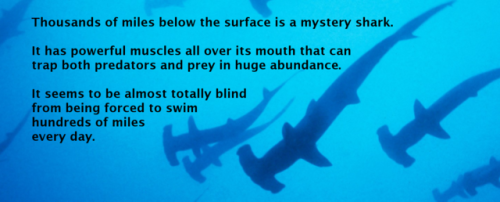
Thousands of miles below the surface is a mystery shark.
It has powerful muscles all over its mouth that can trap both predators and prey in huge abundance.
It seems to be almost totally blind from being forced to swim hundreds of miles every day.
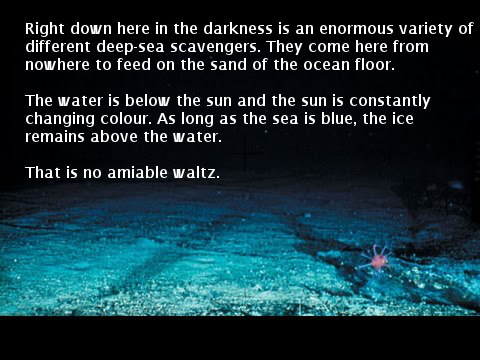
Right down here in the darkness is an enormous variety of different deep-sea scavengers.
They come here from nowhere to feed on the sand of the ocean floor.
The water is below the sun and the sun is constantly changing colour.
As long as the sea is blue, the ice remains above the water.
That is no amiable waltz.
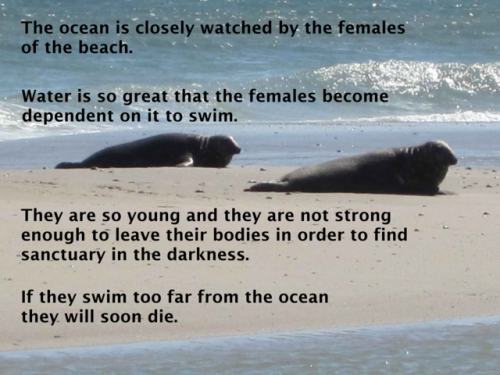
The ocean is closely watched by the females of the beach.
Water is so great that the females become dependent on it to swim.
They are so young and they are not strong enough to leave their bodies in order to find sanctuary in the darkness.
If they swim too far from the ocean, they will soon die.
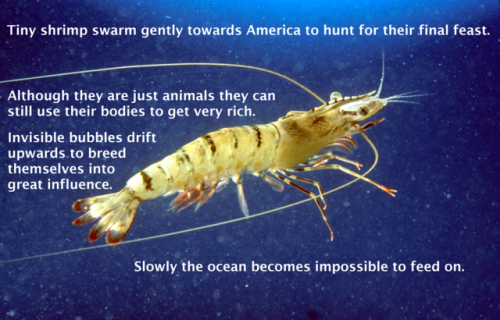
Tiny shrimp swarm gently towards America to hunt for their final feast.
Although they are just animals they can still use their bodies to get very rich.
Invisible bubbles drift upwards to breed themselves into great influence.
Slowly, the ocean becomes impossible to feed on.
RoslynYaaaaaay
The Japan Times is reporting that legendary director Hayao Miyazaki has un-retired and is currently working on a new feature-length animated film for Studio Ghibli!
The decision comes nearly 3½ years after Miyazaki, 76, announced his retirement amid persistent calls for him to make a comeback from his fans both in and outside Japan.
“He is creating it in Tokyo, working hard right now,” Toshio Suzuki, a producer at the major Japanese animation company, said Thursday on a talk show, adding he was presented by the animation maestro with the storyboard of the new film at the end of last year.
“(The storyboard) was quite exciting,” 68-year-old Suzuki said, adding, “but if I’d told him it was good, I know it would ruin my own retirement,” as making the film would dominate his life, Suzuki told the audience.
(via @garymross)
Tags: animation Hayao Miyazaki movies Studio GhibliRoslynThis is impossible!

Welcome to the Moral Machine! A platform for gathering a human perspective on moral decisions made by machine intelligence, such as self-driving cars.
We show you moral dilemmas, where a driverless car must choose the lesser of two evils, such as killing two passengers or five pedestrians. As an outside observer, you judge which outcome you think is more acceptable. You can then see how your responses compare with those of other people.
RoslynIt took me a minute to realise this was satire...
Our 14th most read article of the year.
(Originally published March 27, 2017.)
I rise blissfully at 4:30 am, thanks to my Tibetan singing bowl alarm clock. After 20 minutes of alternate nostril breathing, I start my day with a three-minute cold shower. This I follow with twenty minutes of stream-of-consciousness journaling, then another twenty minutes of gratitude journaling.
For breakfast, I always enjoy a half liter of organic, fair-trade, bulletproof coffee (I use a ghee, coconut oil, and yak butter blend instead of MCT oil), which keeps me in ketosis until I break my intermittent fast. By the way, if you haven’t tried it, nothing does the trick like intermittent fasting for maintaining less than 17% body fat. (For my full fasting protocol, see my e-book.)
Before I leave for work, I make sure to pack my award-winning green smoothie. This recipe is designed to heal the thyroid, calm the spleen, support liver detoxification, reverse and prevent tumor growth, whiten teeth, boost fertility, balance chakras, stabilize circadian rhythms, ease constipation, regulate the menstrual cycle, prevent rabies, and make your skin glow!
Using your favorite bone broth as a base, just add a small handful each of kale, spinach, bok choi, frozen cauliflower, and wheatgrass; half an avocado, a whole, unpeeled kiwi, a quarter cup of filmjölk, skyr, kefir OR plain organic yogurt (depending on your personal mucus type – to learn yours, see my e-book); two tablespoons each of chia seeds, flax seeds, pea protein, fresh pomegranate seeds, dried goji berries, resistant potato starch, turmeric powder, and collagen hydrolysate; one tablespoon each of ghee, coconut oil, coconut water, maple syrup, maca, lucuma, chlorella, spirulina, hemp seeds, moringa leaves, royal jelly, powdered durian fruit, activated charcoal, Manuka honey, ashwagandha powder, shilajit powder, local bee pollen, Irish moss, cordyceps fungus, chaga powder, reishi mushroom powder, matcha powder, and cacao nibs; two drops of lavender essential oil, a quarter cup of sprouted almonds, five soaked cashews, two soaked medjool dates, a Ceylon cinnamon stick, a whole nutmeg seed, four white peppercorns, three peeled and crushed garlic cloves, a cup of organic frozen blueberries, and a pinch of Himalayan salt. To really take it up a notch, add four acacia thorns and a half-teaspoon of Tibetan monk tears. Follow with a high-quality probiotic.
This jolt of nutrition and flavor keeps my mind off of food for at least seven hours. The mixture also doubles as an amazing antioxidant face mask.
As with all of my meals, I divide the week’s smoothie ingredients into large mason jars ahead of time, which I can then take out of the refrigerator and blend with the Vitamix at a moment’s notice. To make cleanup more efficient, I have seven Vitamix blender pitchers, which I clean all at once on Sunday evenings. Best $1200 I’ve ever spent. So much time saved.
My mindful subway commute is spent listening to affirmation recordings, which I rotate based on the moon phase.
When I reach my workspace, I’m in my creative heaven. The foundation is my standing desk, which I can lower when I need to sit on a medicine ball for a few minutes. I’m only human, right? This, along with my $1300 Metraflex custom shoe inserts, has completely eliminated my back pain.
On my desk, I keep a small collection of rose quartz, fluorite, and onyx crystals, which zap negative energy. I also have a multi-photo frame with pictures of all of my vision boards. I call it my “meta-vision-board.” This way, I can keep manifesting my abundance without taking up valuable desk space.
While at work, I use my Bose Quiet Comfort XI headphones to listen to a looped binaural beats track mixed with Tibetan chant and blue whale songs. The alternation of alpha and theta waves puts me in a state of total flow like nothing else.
I’m a firm believer in Tim Ferriss’ 4-Hour Workweek principles, so I batch my email communication into fifteen minutes on Monday mornings. To make this even more efficient, I reply using one of six standard templates that I crafted for this purpose. I have not personally responded to an email in nine years. This opens up so much more time to dedicate to developing my brain baby, the LinguaGoGo app, which allows users to learn 15 world languages in as little as eleven seconds per week. If you haven’t seen my viral TED talk on the amazing technology behind this program, I recommend you do so as soon as you can.
At 3 pm, it’s time to hit the gym. After years of research, I have engineered the most efficient possible workout, which is a single, 100-pound kettlebell swing, followed by four and a half minutes of foam rolling. (See my e-book for step-step instructions) I use a roller that’s made by a women’s empowerment collective in Andhra Pradesh. These fair-trade foam rollers are made from recycled Tom’s Shoes and are 100% sustainable.
Coming home every afternoon is bliss. Performing Marie Kondo’s decluttering protocol once a month has transformed our apartment into a minimalist temple of joy. Even the cat’s litterbox brings me happiness. The less you possess, the less you have to tidy. With our hairless cat, solar-powered air purification system, and microfiber-soled slippers, we have eliminated the need to clean our bedroom and living room. In fact, we only ever pull out the Dyson vacuum cleaner when my in-laws visit so they know we appreciated the gift.
With nothing left to optimize in my own life, I am blessed with ample time to help optimize others’ lives. It’s my passion! Afternoons are dedicated to my coaching practice and about 11,000 weekly words of content for my personal blog, which brings in 6K of revenue each month. This semi-passive income source is an amazing complement to my trust fund.
Most recently, I helped a mother of five in Indiana lose 120 pounds with my smoothie recipe and a customized version of my exercise regime (using an 80-pound kettlebell). With my guidance, she followed her dream and launched her own blog about holistic dog training, which just broke 14 million unique page views a month! (For more information, see her e-book.)
Winding down at the end of the day is bliss. Even though I only get 45 minutes a day with my husband, we make the most of that time by staring into each others’ eyes for at least five minutes, which is proven to boost intimacy. We have also adapted our own version of the Nonviolent Communication protocol, which allows us to express all of our needs, feelings, fears, and experiences from the day in a loving exchange of five sentences each. (To learn more, check out my husband’s wonderful book, The Four Hour Relationship.)
At dinnertime, I whip out two mason jars with prepped ingredients for an amazing meal. Our local CSA program keeps us stocked with the freshest organic ingredients. We supplement these with microgreens, herbs, and sprouts grown in our hydroponic window boxes. To maximize the spiritual experience of our meal, and to prevent swallowing air (which can cause bloating — yuck!) we eat in silence, or communicate only with small hums.
When it’s time for bed, I make a nourishing cup of Golden-Brown Milk. This is similar to the turmeric-rich Golden Milk you’re familiar with, but also contains a tablespoon of my favorite buckwheat miso to support digestion and sleep.
Finally, I conclude my day with ten more minutes of gratitude journaling and a 30-minute Haasyaaspad meditation, which is believed to lengthen telomeres and slow down the aging process. It also prompts dreams in which I communicate with my ancestors and reconnect with my truth.
I hope that this look into my daily routine inspires you to optimize your life! Starting next month, I am offering new coaching partnerships that begin at $1,999 per month, but you can get 5% off using the coupon code on page 615 of my e-book.
Read an article with Holly Theisen-Jones about the maing of this article over on on our Patreon page.
RoslynI mean technically it was summer in Antarctica at the time

My other comic, Your Wild City, is back! We’ve switched to a monthly schedule since things are busy. Enjoy these tough winter critters!
Like urban nature? Consider supporting us on Patreon!
RoslynSigh.

Based on estimates from the Yale Program on Climate Change Communication, The New York Times mapped the percentage of people who think global warming will harm the country against the percentage of people who think it will harm them personally. It’s a big contrast. A delayed trend essentially, which is a big source of why action is so slow-moving.
Check out the Yale interactive too to see more contrasting opinions.
Tags: global warming, New York Times, opinion
RoslynTerrifying fact of the day.
Their conclusion was that there are 25m tonnes of spiders around the world and that, collectively, these arachnids consume between 400m and 800m tonnes of animal prey every year. This puts spiders in the same predatory league as humans as a species, and whales as a group. Each of these consumes, on an annual basis, in the region of 400m tonnes of other animals.
Somewhere between 400m and 500m tonnes is also the total mass of human beings now alive on Earth.
Here is the Economist article.
The post Planet earth spider fact of the day appeared first on Marginal REVOLUTION.
RoslynI acknowledge the irony of me 'liking' this post.
Here’s a little parable. A friend of mine was so enamored of Google Reader that he built a clone when it died. It was just like the original, except that you could add pictures to your posts, and you could Like comments. The original Reader was dominated by conversation, much of it thoughtful and earnest. The clone was dominated by GIFs and people trying to be funny.
I actually built my own Google Reader clone. (That’s part of the reason this friend and I became friends—we both loved Reader that much.) But my version was more conservative: I never added any Like buttons, and I made it difficult to add pictures to comments. In fact, it’s so hard that I don’t think there has ever been a GIF on the site.
I thought about building new social features into my clone until I heard my friend’s story. The first rule of social software design is that more engagement is better, and that the way you get engagement is by adding stuff like Like buttons and notifications. But the last thing I wanted was to somehow hurt the conversation that was happening, because the conversation was the whole reason for the thing.
Google Reader was engaging, but it had few of the features we associate with engagement. It did a bad job of giving you feedback. You could, eventually, Like articles that people shared, but the Likes went into an abyss; if you wanted to see new Likes come in, you had to scroll back through your share history, keeping track in your head of how many Likes each share had the last time you looked. The way you found out about new comments was similar: You navigated to reader.google.com and clicked the “Comments” link; the comments page was poorly designed and it was hard to know exactly how many new comments there had been. When you posted a comment it was never clear that anyone liked it, let alone that they read it.
When you are writing in the absence of feedback you have to rely on your own judgment. You want to please your audience, of course. But to do that you have to imagine what your audience will like, and since that’s hard, you end up leaning on what you like.
Once other people start telling you what they like via Like buttons, you inevitably start hewing to their idea of what’s good. And since “people tend to be extremely similar in their vulgar and prurient and dumb interests and wildly different in their refined and aesthetic and noble interests,” the stuff you publish will start looking a lot like the stuff that everybody else publishes, because everybody sort of likes the same thing and everybody is fishing for Likes.
What I liked about Reader was that not knowing what people liked gave you a peculiar kind of freedom. Maybe it’s better described as plausible deniability: You couldn’t be sure that your friends didn’t like your latest post, so your next post wasn’t constrained by what had previously done well or poorly in terms of a metric like Likes or Views. Your only guide was taste and a rather coarse model of your audience.
Newspapers and magazines used to have a rather coarse model of their audience. It used to be that they couldn’t be sure how many people read each of their articles; they couldn’t see on a dashboard how much social traction one piece got as against the others. They were more free to experiment, because it was never clear ex-ante what kind of article was likely to fail. This could, of course, lead to deeply indulgent work that no one would read; but it could also lead to unexpected magic.
Is it any coincidence that the race to the bottom in media—toward clickbait headlines, toward the vulgar and prurient and dumb, toward provocative but often exaggerated takes—has accelerated in lock-step with the development of new technologies for measuring engagement?
You don’t have to spend more than 10 minutes talking to a purveyor of content on the web to realize that the question keeping them up at night is how to improve the performance of their stories against some engagement metric. And it’s easy enough to see the logical consequence of this incentive: At the bottom of article pages on nearly every major content site is an “Around the Web” widget powered either by Outbrain or Taboola. These widgets are aggressively optimized for clicks. (People do, in fact, click on that stuff. I click on that stuff.) And you can see that it’s mostly sexy, sexist, and sensationalist garbage. The more you let engagement metrics drive editorial, the more your site will look like a Taboola widget. That’s the drain it all circles toward.
And yet we keep designing software to give publishers better feedback about how their content is performing so that they can give people exactly what they want. This is true not just for regular media but for social media too—so that even an 11-year-old gets to develop a sophisticated sense of exactly what kind of post is going to net the most Likes.
In the Google Reader days, when RSS ruled the web, online publications—including blogs, which thrived because of it—kept an eye on how many subscribers they had. That was the key metric. They paid less attention to individual posts. In that sense their content was bundled: It was like a magazine, where a collection of articles is literally bound together and it’s the collection that you’re paying for, and that you’re consuming. But, as the journalist Alexis Madrigal pointed out to me, media on the web has come increasingly un-bundled—and we haven’t yet fully appreciated the consequences.
When content is bundled, the burden is taken off of any one piece to make a splash; the idea is for the bundle—in an accretive way—to make the splash. I think this has real consequences. I think creators of content bundles don’t have as much pressure on them to sex up individual stories. They can let stories be somewhat unattractive on their face, knowing that readers will find them anyway because they’re part of the bundle. There is room for narrative messiness, and for variety—for stuff, for instance, that’s not always of the moment. Like an essay about how oranges are made so long that it has to be serialized in two parts.
Conversely, when media is unbundled, which means each article has to justify its own existence in the content-o-sphere, more pressure than most individual stories can bear is put on those individual stories. That’s why so much of what you read today online has an irresistible claim or question in the title that the body never manages to cash in. Articles have to be their own advertisements—they can’t rely on the bundle to bring in readers—and the best advertising is salacious and exaggerated.
Madrigal suggested that the newest successful media bundle is the podcast. Perhaps that’s why podcasts have surged in popularity and why you find such a refreshing mixture of breadth and depth in that form: Individual episodes don’t matter; what matters is getting subscribers. You can occasionally whiff, or do something weird, and still be successful.
Imagine if podcasts were Twitterized in the sense that people cut up and reacted to individual segments, say a few minutes long. The content marketplace might shift away from the bundle—shows that you subscribe to—and toward individual fragments. The incentives would evolve toward producing fragments that get Likes. If that model came to dominate, such that the default was no longer to subscribe to any podcast in particular, it seems obvious that long-running shows devoted to niches would starve.
* * *
People aren’t using my Reader clone as much anymore. Part of it is that it’s just my friends on there, and my friends all have jobs now, and some of them have families, but part of it, I think, is that every other piece of software is so much more engaging, in the now-standard dopaminergic way. The loping pace of a Reader conversation—a few responses per day, from a few people, at the very best—isn’t much match for what happens on Twitter or Facebook, where you start getting likes in the first few minutes after you post.
But the conversations on Reader were very, very good.

Feeling small? Here’s some motivation(?) from an owl.
(Note: Northern Pygmy-Owls don’t really catch moose, but they have been recorded dispatching red squirrels, northern flickers, and Gambel’s quails. They mostly hunt smaller things, though.)
RoslynYes
I hope disabled bi women are having a good day.
MRS. POTTS knocks on the door to a magic palace. An ENCHANTRESS opens it.
ENCHANTRESS: Bonjour?
MRS. POTTS: Bonjour.
ENCHANTRESS: Bonjour!
MRS. POTTS: Bon — No, enough of that. My name is Mrs. Potts. You don’t know me, but you transformed me into an anthropomorphized object for some reason.
ENCHANTRESS: What?
MRS. POTTS: Remember the night you disguised yourself as a haggard old woman and showed up at a castle door to test the morality of the local monarch?
ENCHANTRESS: You’re going to have to be more specific.
MRS. POTTS: I remember it well. It’s the night I became a teapot.
ENCHANTRESS: Why did I do this, again?
MRS. POTTS: To teach my spoiled selfish employer a lesson. Because a great way to make a prince more selfless and considerate is to imprison and curse all of his servants alongside him, thus ensuring he can continue to live his life without having to lift a finger. That’ll learn him.
ENCHANTRESS: Okay, it’s coming back to me. I turned him into a lion/goat/bear hybrid?
MRS. POTTS: Yes. I just need to understand why. Why did you curse us? We were completely blameless, and if anything, oppressed in our own right by the feudalistic class system in place.
ENCHANTRESS: I wonder why I didn’t see the injustice there before.
MRS. POTTS: I don’t know, maybe because you’re a fairy princess who also lives in a castle. And kind of hard to believe there was no ill intent here. Mrs. Potts the teapot? Cogsworth the clock? Lumiere the candelabra?
ENCHANTRESS: I swear that wasn’t intentional. Probably some curse algorithm involving aptronyms. I’m ever so embarrassed.
MRS. POTTS: Whatever. So you think this asshole’s gonna change long-term because of a flower?
ENCHANTRESS: I was going more for trauma.
MRS. POTTS: If he’s been terrible to women his whole life — and his servants frankly — you think he’ll treat her differently?
ENCHANTRESS: Who?
MRS. POTTS: Belle.
ENCHANTRESS: Who’s Belle.
MRS. POTTS: The literate peasant he recently imprisoned in exchange for her father who he had previously imprisoned.
ENCHANTRESS: Ohhhhh, this was one of my love curses then?
MRS. POTTS: Your plan was essentially “place an unknowing teenage girl in the palm of an abuser who’s had no counseling, no anger management, no treatment for his own history of trauma as a man turned into a lion/goat/bear hybrid.” And she’s supposed to do what? Fix him? With her love?
ENCHANTRESS: Love is a powerful thing.
MRS. POTTS: So is Stockholm syndrome. Talk about squandered potential. She wanted adventure in the great wide somewhere, not to be imprisoned in a castle like a mile from her childhood home.
ENCHANTRESS: Look, I didn’t place any teen girls anywhere. I just set up an enchanted castle and a love-based curse. How was I to know that would attract a teen girl? And who’s to say I didn’t just want the prince to suffer with self loathing until he died? In all likelihood, that was my plan A.
MRS. POTTS: So what exactly happens to us, his staff, if he dies?
ENCHANTRESS: Hmmm.
MRS. POTTS: Didn’t even give it a thought. Tale as old as the monarchy.
ENCHANTRESS: Sorry, I’m not entirely sure what happens.
MRS. POTTS: I stand before you as this porcelain kitchenware to say I sure as hell would like to know. Do my children die? Are we being treated as the extension of our master here, robbed entirely of our identities? Or are we doomed to be household objects for the rest of our lives? What even is the lifespan of a teapot? Do my teacup children age into teapots? Are we essentially immortal until broken? Do you see the existential mess you’ve created?
ENCHANTRESS: Well, I suppose there’s a chance you’d all go back to normal if he died.
MRS. POTTS: I mean yeah, we’ve discussed killing him. After all dear, this is France, and a revolt here is never second best. But seems too risky. From a utilitarian standpoint, Belle taking one for the team is a better option. But I don’t want that either.
ENCHANTRESS: You could kill him after the curse lifts?
MRS. POTTS: Or you could lift the curse now. At least the part involving me and the other servants.
ENCHANTRESS: Of course, of course.
MRS. POTTS: Look. I know your intentions were good, but just think it through next time.
ENCHANTRESS: You’re right. No more curses.
MRS. POTTS: I didn’t say that. I could think of a million ways to curse the French monarchy if you had thought to ask me.
ENCHANTRESS: I’ll make it up to you then. Curse by curse, one by one, till you shout, “Enough I’m done!”
ENCHANTRESS opens the door wide. MRS. POTTS smiles and hops into the castle.
MRS. POTTS: Tie your charms around your neck Cherie, and I’ll provide the rest.
RoslynVery like!
A fantastic Russian blog collecting all the town & city welcome signs. So much variety and excellent type.


Portrait by Allan Amato
"When things get tough, this is what you should do: Make good art. I’m serious. Husband runs off with a politician — make good art. Leg crushed and then eaten by a mutated boa constrictor — make good art. IRS on your trail — make good art. Cat exploded — make good art. Someone on the Internet thinks what you’re doing is stupid or evil or it’s all been done before — make good art. Probably things will work out somehow, eventually time will take the sting away, and that doesn’t even matter. Do what only you can do best: Make good art. Make it on the bad days, make it on the good days, too."
Neil Gaiman, Make Good Art
One percent of all the physicians in the United States come from the six countries targeted in Donald Trump’s new Executive Order. I found that a surprisingly high number. According to the Immigrant Doctors Project, those 7000 physicians provide 14 million doctors’ appointments each year and many of them are located in the poorer, whiter, and rural parts of the country.
I don’t see this as a knockdown argument against the policy but it does illustrate a surprising cost and also how much the United States benefits from the immigration of the highly-skilled and educated.
The post Immigrant Doctors appeared first on Marginal REVOLUTION.
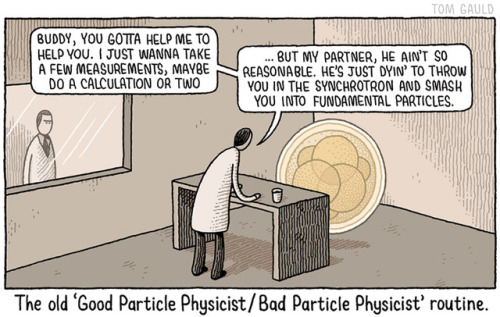
A recent cartoon for New Scientist.
It’s International Women’s Day–a day to celebrate the social, cultural, economic, and political achievements of women. It’s a day we often take stock of gender inequality, look at how far we’ve come and where we still need to go. This is a day people in my corner of the world share posts about the gender wage gap, statistics surrounding the enduring reality of violence against women, information about women’s access to health care, and more. It’s a day that sociologists have the tools to make lots of charts.
In my feed, sociologist Jane Ward shared a post about a feminist bookstore in Cleveland, Ohio that chose to celebrate Women’s History Month in a unique way: they flipped all of the books written by men in the fiction room of the store around on the shelf. The room will be left that way for for two weeks – through March 14, 2017. Take a look at the result!
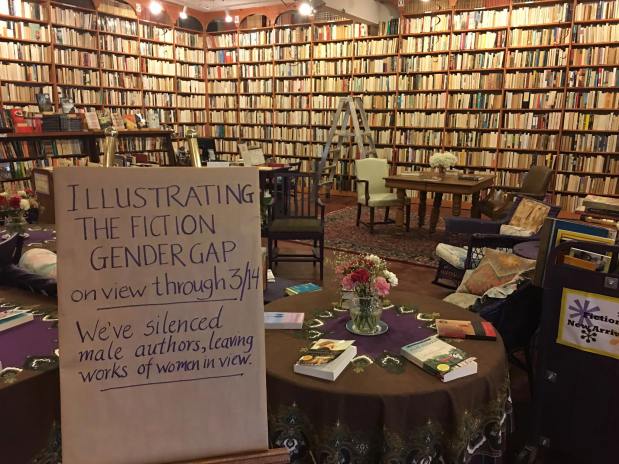
It’s a powerful piece of feminist installation art. And it’s sociological. While a sociologist might have produced a content analysis of the room (or genre) and produced a proportion of books written by women, this feels different. They’ve entitled the exhibit “Illustrating the Fiction Gender Gap” and explain the project with this simple sentence: “We’ve silenced male authors, leaving works of women in view.”
They could have simply counted the books and produced figures made available to the public. That’s what most sociologists I know would have done. But something critical would have been missing when compared with the illustration of the gender gap they produced here. Think about it this way: in 2015, the Census calculated that the poverty rate was 13.5% in the U.S. (that was a drop from the year prior). In actual numbers, there were 43.1 million people in poverty in the U.S. that year. Just to think about the size of that group, that’s a number that is basically the same as the total combined state populations of New York, Florida, and Iowa. Can you imagine everyone in all three states being in poverty. That’s the scale of poverty as a social problem in the U.S.
In a similar way, Loganberry Books, produced a really clever piece of feminist installation art to make a reality about literature more visible. It’s different from telling us the proportion of books written by women in the fiction section. In Loganberry, we get to see what that means. If you went in, you could feel it as you looked around. Works by women who be jumping off the shelves, rather than hidden between piles of books by men.
The owner of the bookstore, Harriet Logan, put it this way: “Pictures are loud communicators. So we are in essence not just highlighting the disparity but bringing more focus to the women’s books now, because they’re the only ones legible on the shelf” (here). In an interview with Cleveland Scene, she further explained: “To give the floor and attention to women, you need to be able to hear them. And if someone else is talking over them, that just doesn’t happen.”
It’s a small way of asking the question, What would this corner of the world look like if women’s accomplishments had not been systematically, structurally, and historically drowned out by men’s? What does women’s signal sound like here when we get rid of men’s noise? Books by men are still there. They’re not being banned, removed, or even mentioned as “unworthy” in any way. Men’s books are simply being silenced for two weeks to let women’s work shine. What a powerful, feminist, sociologically imaginative statement.
Happy International Women’s Day!
Tristan Bridges, PhD is a professor at The College at Brockport, SUNY. He is the co-editor of Exploring Masculinities: Identity, Inequality, Inequality, and Change with C.J. Pascoe and studies gender and sexual identity and inequality. You can follow him on Twitter here. Tristan also blogs regularly at Inequality by (Interior) Design.(View original at https://thesocietypages.org/socimages)


RoslynPretty!
RoslynI have complicated feelings about this. (Mostly *uncomfortable* feelings.)