Shared posts

08 Jan 12:19

Yet Another Reminder That Amy Poehler Is The Greatest

by Danger Guerrero

(via Getty Image)

Amy Poehler and Tina Fey will host the Golden Globes for the second year in a row this Sunday night. As part of the publicity tour for the festivities, the two of them sat down — separately — with The Hollywood Reporter for an interview. The whole thing is worth a read because every interview with Amy Poehler and Tina Fey is worth a read, and it’s mostly lighthearted and fun, but the real highlight here is Amy Poehler absolutely refusing to play along when the reporter tried to get cute or rope her into making a comment about a dicey issue. A sampling:

A challenge: $1,000 if both of you wear Amy Adams’ plunging blouse thing from American Hustle.

Fey: First of all, if you think my going rate for anything is $1,000 you are looking at an old catalog. I get at least $12,000 to dress up in sexual costumes for people. I would wear that for free. You would not have to pay me to wear that.

Poehler: Oh eww, I don’t want to even answer this question. Pass. Next. [...]

There was some carping about Seth MacFarlane’s Oscar hosting performance last year. What did you think of the “boobs” song?

Fey: If Seth MacFarlane answered a question about how he thought my bit was, I’d be furious. So I would never weigh in on somebody else’s bit. It’s not my burden to defend it or attack it. It’s not my problem.

Poehler: It’s so hard to host. I don’t want to comment on anybody else’s performance. Why would you think that we would say anything about anybody’s performance if we’re getting ready to do our own? It’s a hard to job to host anything. Period.

After a lot of public criticism, SNL has added an African-American women to the cast. Do you think that criticism was warranted?

Fey: I think Kerry Washington did such a great job on the [Nov. 2] show [in a sketch that addressed the controversy]. And you saw how great it was for Jay Pharoah to have someone playing Michelle Obama opposite [his President Obama]. So I feel like they registered that really quickly and they’ve acted on it really quickly.

Poehler: Ugh, I don’t want to talk about this. Pass.

I love that. I love it so much. Celebrities who are out promoting stuff usually fall all over themselves to give safe, diplomatic answers to any question anyone throws at them, and Amy Poehler just does not give a f*ck, Golden Globes or not. It reminds me a little of my favorite Amy Poehler story ever, from Tina Fey’s book, Bossypants:

Amy Poehler was new to SNL and we were all crowded into the seventeenth-floor writers’ room, waiting for the Wednesday read-through to start. There were always a lot of noisy “comedy bits” going on in that room. Amy was in the middle of some such nonsense with Seth Meyers across the table, and she did something vulgar as a joke. I can’t remember what it was exactly, except it was dirty and loud and “unladylike.”

Jimmy Fallon, who was arguably the star of the show at the time, turned to her and in a faux-squeamish voice said: “Stop that! It’s not cute! I don’t like it.”

Amy dropped what she was doing, went black in the eyes for a second, and wheeled around on him. “I don’t f*cking care if you like it.” Jimmy was visibly startled. Amy went right back to enjoying her ridiculous bit …

Anyway, yes, Amy Poehler is still the greatest.

07 Jan 16:48

Louis C.K. Revealed The Secret To Being In Love, Announced An Intriguing Project On ‘The Tonight Show’

by Ryan Perry
Amber

iiiiiiiiiiiiiiiii'm gonna have to get this movie.

louisck

Louis C.K. stopped by The Tonight Show last night for what will likely be his final appearance with Jay Leno behind the desk. The two talked a little about Louie’s life and larger projects, and discussed an intriguing project from his past that he’s putting on his website very soon.

Here’s the first segment, in which Louie discusses the diarrhea of happy people, the temptation to get his kids absolutely nothing for Christmas, and the horrible secret to knowing when you’re in love. He also talks about the black and white film he made in 1998 that will soon be released, for the first time, on his website.

Louie elaborated further on the film — “Tomorrow Night” — which stars the likes of Steve Carrell, Amy Poehler, Conan O’Brien, and JB Smoove, in the clip below. (I don’t know why The Tonight Show split the clips up in such a weird manner, but hop to the 1:10 mark to avoid the overlap from the previous clip.)

Louie closed his appearance by talking about his experience on American Hustle and giving Jay a heartfelt goodbye.

The Tonight Show

03 Jan 18:55

I Hired an Esteemed Cat Photographer to Take Photos of My Cat

by William Foster
Amber

these photos are hilarious

by William Foster


Originally published May 14, 2013

Where did your last $240.17 go, William Foster?

OVERALL ALLOCATION

ITEMIZED LIST

$3, large coffee at Oui Presse. Cream, no sugar, to go. $2.50 plus $0.50 tip.

$5.99, 6 oz. center-cut wild Coho salmon, for my cat. 1

$1, small bag of catnip.

$2.50, one cheese slice at Sizzle Pie. 2

$100, home session with Chanan. 3

$8.48, Chile relleno plate plus one mandarin Jarritos, at a middling but convenient Mexican restaurant.

$57.20, two tickets to Jon Lovitz at Helium Comedy Club. $25 each, plus $7.20 “handling fee.” Funny guy!

$12, two Mirror Pond Pale Ales. $4.50 each plus $3 tip, to fulfill the two-drink minimum.

$50, 90-minute session in a sensory deprivation tank, the following morning.

1 Back in The Billfold’s early youth, Logan posted this bit of asinine piffle. Although I took some liberties with the truth in my email (cats can’t play basketball; they have no regard for rules and systems, and no capacity for delayed gratification), I was in fact looking for a cat to adopt. I visited Stevie B at the Oregon Humane Society, but he was too riddled with health problems for me, still unsettled in a new city and job, and living alone in a studio apartment, to attend to.

In the comment section, I also expressed interest in a cat named Mr. Biscuit. Mr. Biscuit was clearly a desirable feline, but after my disheartening meeting with Stevie B, I realized that I wasn’t quite ready to adopt. Six months later, though, when I was better situated in my home and job, kitty-cat fever again welled up within me, and by the hand of fate Mr. Biscuit was still available at the adoption center.

Mr. Biscuit is a 12-year-old, purebred Blue Point Himalayan. He has papers certifying his lineage: “Sire: MR SASSY MIST Dam: CEDES CHOICE CARAMEL.” He’s also a tripod, having lost his rear port side leg to a tumor in 2010. Never in all my cat-fancying dreams did I intend to own anything but a common mutt, but a cat in need is indeed a cat in need, and I took the poor beast under my wing.

I bought the salmon in the above line item for Mr. Biscuit’s birthday meal. His twelfth birthday was, incidentally, the day after the events of this post. I baked the salmon, garnished his portion with catnip, and ate mine alongside him.
^Back

2 Sizzle Pie is convenient to the on-ramp to I-84E, which I took to the Red Lion Hotel at Portland International Airport to pick up Chanan.

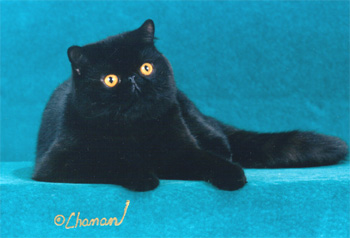
Chanan is arguably the preeminent cat photography team in the country. The name “Chanan” is a roundabout abbreviation and concatenation of the husband-wife duo’s first names, Richard and Nancy. Richard has been photographing cats as his primary occupation since 1976 (his entry into this improbable niche came by way of his mother, an avid cat breeder), and Nancy has assisted him for much of that time. Over the decades, Chanan have cultivated, and established themselves as the principal purveyors of, the favored portraiture aesthetic of cat breeders worldwide.

If you’ve ever been to a cat show, you may have seen Chanan in action. They’re almost constantly on the road, traveling to shows around the U.S. and occasionally in Japan and Europe, and their schedule is usually booked over a year in advance. If you’ve ever perused cat breeder web sites, then you’ve probably seen their work, the ubiquity of which testifies to their demand in the breeder community. The Cat Fancier’s Association features Chanan’s photos in their online breed profiles, and other cat photographers seem to imitate their style (of course, Chanan’s prominent signature precludes any doubt as to a portrait’s provenance). In this world, Chanan is king of the hill.

Chanan’s characteristic style places the subject in front of a jewel tone backdrop, and captures it in a wide-eyed state of alert. I had seen Chanan’s photos before, but I had never witnessed their process until 2008, when I encountered Richard working solo at the CFA Iams Cat Championship in Madison Square Garden. I watched him for nearly an hour, mesmerized, as he shot three ethereal show cats one after another. His left hand manipulated toys from an extensive arsenal of strings, feathers, and sticks, goading the cats into positions resembling poses, while his right hand snapped photos during the narrow windows of photogenicity. Sometimes he’d ask the owner for assistance (“Pet him again… now stand over there and call his name…”), and occasionally he’d emit a loud, sudden trilling noise to capture a cat’s attention. Eminently professional and efficient, Richard also seemed to maintain a constant sense of amusement about the whole thing, even after more than thirty years in the biz.

Breeders comprise the majority of Chanan’s customer base. For them, a Chanan photograph is a practical investment that they use to showcase their animals. But, as advertised on Chanan’s web site, home sessions are available to anyone willing to pay for it. Mr. Biscuit is the first cat I’ve owned as an independent adult, and with him I finally had an opportunity to indulge my longtime fascination with Chanan. I checked their schedule, saw that they were due to be in the Portland area, and emailed them to book a “type (A) session.” Richard replied that he would arrive at PDX at noon on a Friday, and that he was free until the show the following morning. We set the date, and I scheduled the day off from work.

When the day came, I arrived at the airport hotel, cheese pizza in my belly, to find Richard sans Nancy. It turned out that he’s been working the show circuit alone since his house was robbed just over a year ago, which he blames on having posted their home address and schedule online. I drove him back to my apartment to set up for the shoot, and he merrily talked cat shop the whole way there.
^Back

Mr. Biscuit is timid around strangers, and even more so when the stranger is accompanied by a large pile of photography equipment. It took a substantial amount of catnip, treats, and cooing to coax him out from beneath the couch, and even then he refused to cooperate with our agenda.

Richard pulled out all his tricks, but to little avail. He mainly relied on me to comfort Mr. Biscuit, but under his close direction: “Pet him… again… Do you have canned food? Go get a can and stand behind me… wait… now open the can… oh! better grab him… give him some food from the can… now put another bite in front of his face, but pull it away NOW… try again… uh oh, go grab him… give him a good petting… let’s try the catnip again,” and so on.

Richard only charged me $100 for the session because, in his words, “Mr. Biscuit is the worst subject I’ve ever had, aside from that one tabby in San Diego. I might not have a single usable shot here.”

Chanan’s trash is my treasure:

William Foster lives in Portland, Oregon.

0 Comments
03 Jan 18:39

Watch People Eat Their Most Hated Foods in Epic Slow-Mo

by Remy Robert
Amber

Hehe!

[Video: BuzzFeedVideo on YouTube]

Some of us have started the New Year with a resolution to eat more vegetables, but somewhere in the world, one kale-averse man is still recovering from his latest encounter with the leafy green. If he didn't manage to swallow the whole bite, he did at least capture the whole valiant (and cringe-inducing) effort on film in People Eating Foods They Hate In Super Slow Mo, along with several other heroes who faced everything from anchovies to a ladleful of mayonnaise all for your viewing pleasure. Their expressions of disgust, set to an epic soundtrack, are brutally sincere as they soldier through gags and gaze back at you through teary eyes. Whether you feel schadenfreude or empathy, you'll probably never look at mayo the same way again.

About the author: Rémy Robert is an editorial intern at Serious Eats and recent graduate of Brown University. She's a diehard New Orleanian and makes a point to start each day with a bite of chocolate.

03 Jan 17:36

Being a Cheesemonger Is Better and Worse Than You Think It Is

by Martha Grover
by Martha Grover


Originally published Aug. 24, 2012

This essay is excerpted from Perfect Day Publishing’s One More For the People by Martha Grover, available from our pals at Emily Books. We’re excerpting it because it’s a great book—honest, funny, enlightening, very Billfold-y (also: the publisher said we could). The book is a memoir from the period just after Grover was diagnosed with Cushing’s disease, a rare hormonal disorder, and includes: honest (and funny) accounts of her life and disease; notes from family meetings with Grover, her siblings (also adults), and their parents; an interview with her ex-convict grandfather about his work history. In this excerpt, she discusses her job as a cheesemonger.

I work in the cheese department of a busy, upscale grocery store. We sell around $3,000 worth of cheese a day. If you figure the average price of cheese is about $5 a piece, that means we sell 600 pieces of cheese a day. I personally cut, wrap, price, and label about a quarter of that. That means I wrap about 150 pieces of cheese a day. Multiply that by the four days a week I work and you get the figure of 600 pieces a week.

I can do this work with my eyes closed. I can cut, slice, and wrap cheese with the precision of a machine. While I work, it’s possible for me to hold long conversations with actual people, or if no one else is around, the people in my mind. Customers come in with their cheese problems, questions, and complaints. Sometimes I can help them.

“Can I help you find a cheese?” I say.

“I’m having friends over tonight and I want this certain cheese but I don’t remember the name,” the woman replies.

“Can you describe it?”

“Well, let me think … it was Italian and was kind of like a Parmesan but fruitier.”

“Was it the Piave Vecchio?”

“Yes! That was it.”

And I feel good. But often I can’t help customers—we don’t have what they’re looking for. Or, as is often the case, they don’t really know what they want. Something sharp and spreadable? (It doesn’t exist.) Something to use in place of a Cheddar in macaroni and cheese, but that has flavor—but not too much flavor? I sigh and try to be helpful. But sometimes I can only point them in the general direction of a good melter (Fontina, Gruyere) or something their in-laws from Michigan will like (Cotswold?). They leave, not dissatisfied necessarily, but confused, almost melancholy. 

My job wears on me, but it’s not dealing with customers that’s hard, it’s the fact that I have to stand in one place for eight hours a day twisting my arms and bending down to pick up wheels of cheese over and over until I have shooting back pain and tingling in my extremities. One summer my arms started going numb. More specifically, the ring and pinkie finger on my right hand. Sometimes, especially if I’d been on my bike for any length of time, my entire hand and arm would completely lose feeling. It’d take hours for it to come back and sometimes the persistent tingling would never completely go away.

I started to feel like my job was killing me. My back hurt all the time, and now, to make matters worse, I couldn’t feel my fingers. One of the cheese managers at another store had recently come down with an extremely rare bacterial infection in his spine. It ate away some of his vertebrae, he could barely walk, and he’d almost died. The doctors told him that it was very rare, there were only a couple known cases worldwide, and they had no idea how he’d gotten it. But one thing that all these cases had in common was that everyone who’d been infected had worked with dairy. All of us cheese workers whispered under our breath that it must’ve been the cheese.

Another one of our managers was allergic to the sanitizer we used for our cheese-cutting equipment. She had to continually apply an anti-inflammatory cream to her hands. The backs of them were covered by flakes and scabs.

Yet another manager went to the doctor and found that his cholesterol was so high that he would have to be put on medication if he didn’t change his diet. Still another manager, who was fond of saying that “you can eat as much cheese as you like as long as you eat fruit,” found out he had diverticulitis.

As is often the case with me, I started complaining about my numb hands to anyone who would listen. Finally, a friend of my parents told me to stop complaining and go to the doctor. He was right. It could be something serious. My sister Sarah told me it was probably the beginning of carpal tunnel syndrome. She’d got it from bartending and had had similar symptoms. The woman who worked at the coffee shop across the street from my house told me she’d had carpal tunnel and had to have surgery. “It was very simple,” she said, knocking the basket out of the espresso machine with one deft move of her wrist. “Snip snip, and I was cured.” My mother was convinced my back was going out.

I went to the doctor and found out that it was nothing. I told my grandfather about it and he told me that he’d had the same symp­toms for a year before they went away. And my numb fingers did eventually heal themselves.

Now, years later, I deal with a strange electro-shock sensation that runs down my right arm every time I move a piece of cheese from the scale to the cart we use for stocking. My knees crack every time I squat down. My lower back aches. But if this job didn’t create such strange disturbances in the body, any respite from them wouldn’t be so appreciated. I savor these breaks from pain in whatever form they appear to me. I squat behind the cheese case to clean a knife in the bucket of sanitizer. My knees crack on the way down and I feel the stretch along my calves and hamstrings. The feeling is beautiful and quiet. I pause here, my body frozen, half-crouched down where no one can see me. I let myself rest for 30 seconds until I hear a voice wafting over the case.

“Can I talk to someone who knows something about cheese?”

Bagel

It’s 8:00 a.m. A man walks up to me in the cheese section and these are the first words I hear this morning: “If I were a bagel and I didn’t want anyone to find me, where would I be?”

I stop what I’m doing and look up. “Well, if you were a bagel and you didn’t want anyone to find you, you wouldn’t be in the bakery, but that’s where you are.”

The man just looks at me confused.

“The bagels are in the bakery,” I say.

He frowns and walks away.

Fontina

“I found a fly in my cheese,” the woman says, handing me a bag across the counter. “I just thought you should know.”

Sure enough, there it is, half-encased in a wedge of Italian Fontina. It must’ve flown into the still-hardening cheese and drowned there. Well, there are worse ways to die than drowning in cheese. “Do you want your money back?” I say.

The woman frowns and shakes her head. “I just thought you should know,” she says.

It bothers me when customers do this. Just take the money. “It’s not a big deal,” I say. “Are you sure you don’t want your money back?”

“I just thought you should know there was a fly in your cheese.” She crosses her arms.

I look down at the bag of cheese. So now it’s MY cheese. That’s the way it always works. I feel like telling the woman that I don’t make cheese, I just cut it and wrap it, and even if I did there’d be nothing I could do to prevent this little guy from flying into my warehouse, landing in my cheese, and dying. And even if I were to call up the distributor and ask where they buy the cheese, and then I were to call the Italian cheese-makers and complain about the flies, they’d just shrug and tell me “Tough Titty.” Or something like that. I don’t speak Italian.

Entry Level Goat Cheese

“I’m looking for an entry level goat cheese,” the man says to me. He has some flour tortillas and a couple of chicken breasts in his shopping cart. He looks worried.

I wonder what an “entry level goat cheese” is. I know what a goat is. I know what cheese is. Goat cheese is the result of a process. It’s what happens when grass interacts with a goat, its hormones, a farmer, mold, and time. It’s what happens when a bodily fluid is ex posed to extremes in temperature, to centuries-old traditions and the market economy. Goat cheese is the result of an accident eons ago when early herding cultures started milking their goats and left some of the milk in a leather sack overnight, hanging from the eave of their hut, or in the corner of their cave. Goat cheese is what hap pens when you age the goat’s milk, then wrap it in wax, in leaves, or esophageal tubing. I know what this is.

But what is entry level? The point at which you enter? Where the grass enters mouths, stomachs, udders? Is it where the milk enters the world, hot and steaming from the teat? Is it where I enter the grocery store, enter my employee number into the time clock and don my hat, nametag, and apron? Is the entry level where the wire enters the cheese, splitting it in two? Is it where the cheese enters the plastic wrap, and gets entered into the scale at $15.99 a pound? Is entry level the place where I spend eight hours a day cutting, wrapping, weighing, and pricing the byproduct of an animal? The result of a process that begins and ends with digestion, that begins with the earth and ends with the earth? Is it where I package my own bodily fluids, my blood, sweat, and tears into eight-hour shifts, ten-minute breaks, and two-week pay periods?

I look at the man, his face impatient, eager to suckle at the teat of my vast cheese knowledge. I feel like telling him that every entry level is also an exit level. That all hierarchy is an illusion. That he should follow his heart. Instead I recommend the Goat Gouda, the Goat Jack, or if he’s in the mood for something saltier, the Murcia Curado.

My Vast Cheese Knowledge

1. My favorite grocery store joke goes like this. A man walks up to the register and unloads his basket. He slaps down some Hungry Man TV dinners, single serving ice cream tubs, a toilet paper four-pack, a single serving of macaroni salad, and one apple. The cashier looks at his groceries and says, “You must be single.”

The man looks up and says, “Can you tell because of what I’m buying?”

“No. I can tell because you’re ugly.”

2. We sell the most string cheese on Sunday nights.

3. Because of their longer commutes, suburbanites have less free time. They’re also more likely to have expensive nail jobs that they don’t want ruined by crumbling up Gorgonzola. The store will charge them on average about a dollar extra per pound to pour Gor gonzola from a five-pound bag into small tubs so that they don’t have to touch the cheese, so that all they have to do is open the plastic container and pour it into their salad bowls, dress the salads, toss, and consume. A dollar per pound so that besides the cow’s in testinal and mammary parts, not to mention the liberal amount of microorganisms in the blue cheese mold, the only things that will touch their Gorgonzola will be made of steel and plastic.

The company we buy the crumbled Gorgonzola from charges us about 50 cents extra a pound. Sounds like a bum deal until you remember that the cows work for free.

4. I am working in the cheese department with my back to the counter. I hear a man and a woman talking about cheese at the cheese case.

“Do you want to get a Camembert?” the man asks.

“No.”

“How about some Oregon Blue?”

“You know what I like?” she says. “I like the Gorgonzola that is already crumbled.”

Silence.

The woman speaks again. “By the look on your face I can tell that you think that’s not very good.”

“It’s just that what I like isn’t the same as what you like. It’s not better or worse, it’s just taste.”

From this I can tell that the two of them haven’t been dating very long.

5. A man walks up to the cheese case and says, “I was in Spain a month ago and I had this really good cheese called Queso. Do you have it?”

6. A woman walks up to the case and says, “I was in France a year ago and we had this really good cheese called Fromage. Do you have it?”

7. Women say, “I can’t find the cream cheese.”

Men say, “If I were looking for the cream cheese, where would I find it?”

8. Three men walk up to the counter. One of them points to the Flora Nell blue cheese and says, “Look! That cheese is named after me!” He looks up at me. “Is this good?”

“The Flora Nell? Yes, it is good.”

“Oh. Flora Nell. I thought it was Flora Neil. You should have said Flora Neil. You could’ve gotten a sale.”

“I thought your name was Nell,” I say.

“I am looking for an Italian cheese,” says one of the other men. “It was creamy—”

“Fontina?” I ask.

“No.”

“Was it a brie?”

“No.”

“Taleggio?”

“Yes! Fellatio!”

“Taleggio?” I say again.

9. I am trying to sell goat cheese with Oregon hazelnuts and Frangelico. I offer two women small samples. Their eyes close and their heads tip back slightly. “Oh my God! It’s like cheese ice cream! Where can I find it?”

I show them where it’s located in the case. Both of them pick it up and put it in their baskets.

A man walks up and is browsing the cheese case.

“Do you want to try something fabulous while you’re browsing?” I ask. The man nods and I hand him a sample of the Frangelico cheese.

He puts the sample in his mouth as I describe the cheese to him. His face suddenly turns sour. “It’s sweet,” he says, as if I’ve just given him a sample of his own semen. He spits the cheese into his palm and walks away in disgust.

11. I offer the old woman with the mustache a sample of the French triple cream Delice de Bourgogne.

“I love this creamy cheese,” she says. “Hard cheese really stops up my bowels.”

I don’t think I’ve heard her right. “I’m sorry. Hard cheese what?”

The woman licks the taster spoon and smiles at me. “IT STOPS UP MY BOWELS!”

“Oh,” I say. “Interesting.”

“After World War Two,” she continues, “I went out and bought a huge block of Tillamook cheese. During the war we couldn’t buy that stuff without stamps. Anyway I ate the whole thing. I’ve never been the same since.”

Two hours later an old man walks up to the case and I give him a sample of the Cabot Clothbound Cheddar. “That is so good,” he says.

“Isn’t that amazing?” I say.

I give him a sample of Shaft’s Bleu Vein.

“This is so tempting,” he says as he puts the cheese in his mouth. “But I shouldn’t be eating cheese.”

“Why not?” I ask. Why do I always ask?

“Because it makes my skin break out right here.” The man points to the space between his very bushy eyebrows.

Two women approach the cheese case with two children. They taste some eight-month Manchego from the counter and I offer them some Delice de Bourgogne. The older woman loves it. “This is so good!” she says. “Where is this in the case?”

I point it out for her.

“Boy, that is good cheese. How much salt is in that cheese?”

“I don’t know,” I say. “Probably a lot. You know, your best bet is Swiss cheese or a reduced sodium cheese.”

“I’m a diabetic and on chemo,” the woman says. “I’m not supposed to have a lot of salt. Those reduced salt cheeses are usually pretty awful.”

“I know,” I say.

Book Club Cheese

A couple years ago, when my mother first started attending a book club, she asked me to pick out some cheeses and give a little talk on them when it was her turn to host the meeting. The ladies were impressed, or at least they acted as if they were. Several years later, my aunt (who is in the same book club) called in a panic from Trader Joe’s wanting to know what I would recommend now that it was her turn to host. Over a spotty cell phone connection, I coached her through the Trader Joe’s cheese section. I talked her into a Manchego. She acted as though I’d just helped her perform brain surgery. “Martha!” she said. “You’re a lifesaver!”

A couple months later I’m cutting cheese while a woman brows es the case. She starts grunting and throws the brie down in dis­gust. “Do you have Delice de Bourgogne?”

“No, but we have this one. It’s very similar,” I say, pointing out another triple cream.

The woman ignores me and starts scanning the case as if she’s looking for the wire to cut to a ticking time bomb. “It’s my book club tonight!” she says. “You guys don’t have any of the cheeses I need!” She picks up a Camembert only to drop it half-heartedly. It rolls on top of the Red Dragon.

“Well, if you’d like to taste anything, let me know,” I say cheerfully.

She ignores my offer and frowns. “Is this good?” She holds up a cave-aged Gruyere.

“It’s great.”

The woman places it in her basket.

“What book are you discussing tonight?” I ask.

She doesn’t look up. “Angel Fire.

“Hmm, never heard of it.” I continue wrapping cheese.

The woman is rifling through the Scottish cheddars and I realize this is probably not the best thing to say. She groans again in frustration, throws a piece of cheese down, and walks away in a huff.

Later that day I go home thinking about the stress surrounding book clubs, how women are often more interested in impressing each other with their hosting abilities then they are in discussing the book. As a lover of books and writing, this irks me. But as a lover of cheese, I should be okay with it—right? And I wonder—what kept me from telling the woman at the cheese counter that I am a writer? That I am writing a book?

I have spent over half my life serving people, starting as a dishwasher when I was fifteen. In the past fifteen years I’ve been a busser, a hostess, a waitress, a cocktail server, a deli worker, a prep cook, and now a cheese clerk. Rule number one of the service industry is the same thing they tell nurses in nursing school: don’t talk about yourself to the patient. In other words, people are coming to you to ask your expert opinion about cheese or their blood pressure or whatever—they’re not coming to you to get to know you as a three-dimensional human being. They don’t care who you are.

Until I worked with a certain woman at a busy Italian restaurant in my early twenties, I’d always taken it for granted that everyone knew this rule. She was my own age but had never worked in a restaurant before. She’d just graduated from college with a degree in English and dance.

One night after work, she and I went out for a drink to commiserate. “I’m running around pouring people water,” she said, “and clearing their plates and everything, and it’s like—they don’t know anything about me. They don’t know I’m really a dancer.”

I stared at her for a minute and took another sip of beer. “You don’t want them to know that,” I said.

“But they look at me and think I’m just a hostess. That that’s all I am.”

“Honey,” I said, feeling for the first time like a veteran of the service industry, “that knowledge is what’s yours to keep. That’s your treasure. Keeping that private is the only way you’re going to keep from going crazy.” And it’s true: if you can’t deal with this, you might not last long serving people. In the customer service world, in the world of giving the most of yourself away on a daily basis, there’s this paradox where in the end, you really give people the least. You become a cut-out of yourself. You have neither great loves nor great hates. You are not a hater of Cotswold—you are just not a “fan” of Cotswold. You do not confess that you would give your left arm for a vacation in France, you only say that your customer’s week in the wine country sounds “fantastic.”

And so, I wonder, in the case of the book club cheese, with my own book finally coming out, will I break my own rule and tell customers that I am really a writer? That this cheese gig is only my day job? That they should care more about the book than the cheese? Or maybe I should be taking advantage of the fact that people care so much about cheese? I mull this over all day. As I label the Oscar Wilde Aged Irish Cheddar, his musing face stares out at me. “Look what they do,” he whispers. “You die in a gutter and they put your face on a piece of cheese.”

When I get home from work I ask my boyfriend if he thinks people would pay to have an in-home tasting and seminar on cheese. “Taught by me,” I say hopefully.

“I don’t think so, honey,” he says.

One More For The People is available at Emily Books and other fine book selling establishments. Martha Grover lives in Portland, Ore. 

0 Comments
03 Jan 01:59

American Bandstand: 1959

by Dave
        Shorpy wishes you a Rockin' New Year!
1959. "American Bandstand emcee Dick Clark with teenagers on the set of the show." From color transparencies by Phillip Harrington and Howell Conant for the Look magazine assignment "Dick Clark Talks to Teenagers." View full size.
01 Jan 14:48

R.I.P. The Blog, 1997-2013

by Jason Kottke
Amber

"Today, teens are about as likely to start a blog (over Instagramming or Snapchatting) as they are to buy a music CD. Blogs are for 40-somethings with kids."
So much truth, but I love blogs anyway!

Nieman Journalism Lab asked me to write a piece for their end of the year series, Predictions for Journalism in 2014. I don't know a whole lot about journalism, so I wrote about something I'm pretty familiar with: The blog is dead, long live the blog.

Sometime in the past few years, the blog died. In 2014, people will finally notice. Sure, blogs still exist, many of them are excellent, and they will go on existing and being excellent for many years to come. But the function of the blog, the nebulous informational task we all agreed the blog was fulfilling for the past decade, is increasingly being handled by a growing number of disparate media forms that are blog-like but also decidedly not blogs.

Instead of blogging, people are posting to Tumblr, tweeting, pinning things to their board, posting to Reddit, Snapchatting, updating Facebook statuses, Instagramming, and publishing on Medium. In 1997, wired teens created online diaries, and in 2004 the blog was king. Today, teens are about as likely to start a blog (over Instagramming or Snapchatting) as they are to buy a music CD. Blogs are for 40-somethings with kids.

I am not generally a bomb-thrower, but I wrote this piece in a deliberately provocative way. Blogs obviously aren't dead and I acknowledged that much right from the title. I (obviously) think there's a lot of value in the blog format, even apart from its massive influence on online media in general, but as someone who's been doing it since 1998 and still does it every day, it's difficult to ignore the blog's diminished place in our informational diet.

Through various blogrolls (remember those?) and RSS readers, I used to keep up with hundreds of blogs every day and over a thousand every week. Now I read just two blogs daily: Daring Fireball and Waxy. I check my RSS reader only occasionally, and sometimes not for weeks. I rely mainly on Twitter, Facebook, Digg, Hacker News, and Stellar for keeping up with news and information...that's where most of the people I know do their "blogging". I still read lots of blog posts, but only when they're interesting enough to pop up on the collective radar of those I follow...and increasingly those posts are on Medium, Facebook, or Tumblr.1

But anyway, I'll be here, blogging away until 2073. I figure 100 is a good age at which to retire. If I have a point to make, I'll have made it by then. Man, I wonder what crazy YouTube videos there will be to post in 30 years? Probably Wes Anderson filming trials riding in a wingsuit on Mars or something. I can't wait.

[1] And yeah, what about Tumblr? Isn't Tumblr full of blogs? Welllll, sort of. Back in 2005, tumblelogs felt like blogs but there was also something a bit different about them. Today they seem really different; I haven't thought of Tumblrs as blogs for years...they're Tumblrs! If you asked a typical 23-year-old Tumblr user what they called this thing they're doing on the site, I bet "blogging" would not be the first (or second) answer. No one thinks of posting to their Facebook as blogging or tweeting as microblogging or Instagramming as photoblogging. And if the people doing it think it's different, I'll take them at their word. After all, when early bloggers were attempting to classify their efforts as something other than online diaries or homepages, everyone eventually agreed. Let's not fight everyone else on their choice of subculture and vocabulary.

Tags: Jason Kottke   weblogs
26 Dec 01:09

December 25, 2013


BAM
25 Dec 15:02

Roasted Brussels Sprouts and Bacon in a Mustard Cream Sauce

by Kevin Lynch
Amber

Want!

Roasted Brussels Sprouts and Bacon in a Mustard Cream Sauce
Although the main course usually gets a lot of focus for special holiday dinners it's also important to have some tasty sides and these roasted brussels sprouts and bacon in a creamy mustard sauce are a great way to go! This brussels sprout side dish is super easy to make where you pretty much just need to roast the brussels sprouts, cook the bacon and make the sauce. You could go with steamed brussels sprouts for this dish but roasting them really helps to bring out their flavour. The sauce is nice and simple and yet it's just packed with flavour! It starts out with some onions and garlic followed by some flour to thicken the sauce, some milk, the grainy mustard and a hit of miso before it is finished off with some parmesan cheese. You really cannot go wrong with this roasted brussels sprout side dish as a side for your special holiday meal!

Read the recipe »
24 Dec 20:16

hermionejg: From @jlward3 on Instagram.


hermionejg:

From @jlward3 on Instagram.

24 Dec 20:08

The Best Gift I Ever Gave Cost $2

by Sam Riches
by Sam Riches


The best gift I ever gave was a ladle that cost $2 and came from the hardware store.

I was in grade school when I bought it, and young enough that every purchase up until that point had been a weighted decision between 10-cent and five-cent candy. This was something new, a first, and I’d been saving up for it.

Each December the village I grew up in would host Old Tyme Christmas, a night where the few stores that flanked the main street would stay open late, and Joe the barber would play Italian Christmas albums over tinny sounding speakers and old ladies from the church would hand out syrupy hot chocolate.

There wasn’t much to buy. There was a shop where you could order from a catalogue and your purchase would show up a few weeks later, arriving from a department store in the city. There was a gallery, with paintings by local artists, a shoe store filled mostly with construction boots, a pharmacy that always had candy bars on sale, and a women’s clothing shop, where you could hide in the racks of dresses—but it was all I knew, and exciting for that reason.

Usually, after awhile, I’d go to the library and sit on the step stool in the back corner and read the same book about sharks until it was time to go home. This year was different though. I had a purchase to make, so I went to the hardware store.

It smelled of rubber and steel and my boots squeaked on the linoleum tiles. I loitered up and down the aisles with the ladle in my hand, drumming the plastic handle against my chest. I was confident my Mom could find a use for it, even if I didn’t know what it was for.

When I got to the till, I reached up and set the ladle on the counter. A man in a red vest and matching Santa cap stood behind the register.

“That’ll be all?”

“Yes, sir.”

“And what are you going to do with this?”

“Give it to my Mom.”

“Well, I’m sure she’ll like that.”

“Yep.”

I doled the coins from my pocket, probably thinking, last minute, about all the candy I could buy instead, the measuring stick of every purchase when you’re a kid. The man in the red vest wrapped the ladle in white tissue.

When I walked out, I felt proud, like I’d made the right decision. The candy could wait. I put the ladle under the tree and the next week, when my mom opened it, she cradled it against her chest, like a baby in her arms. Now, decades later, the ladle still sits in a drawer in the kitchen.

A few weeks ago, I drove back through the village. My parents don’t live there anymore, and most of the people I grew up with have moved on. I was passing by, on my way to somewhere else. I didn’t get far before I turned the car around and went back. It was Old Tyme Christmas.

On the main street, kids ran up and down in howling packs and parents huddled together nearby, gloved hands holding ceramic mugs, steam drifting from the mouth of their cups. Christmas music mixed in with the chatter and the barber shop speakers sounded better than I remembered.

Now there were carollers, too, in knitted hats and bright scarves, their songbooks resting against their chests as they drank apple cider from a kettle. A horse drawn carriage was parked by the post office, a hay bale next to it.

The street lamps were wrapped with Christmas lights and the brick buildings—most of them hundreds of years old—were decorated with tinsel and tree branches and bright ornaments that hung from window sills and door frames. It was different and changed and more stores had opened, with new people occupying the spaces inside, but from the street—and at first glance—it mostly felt the same.

When I walked into the hardware store, the door chimed overhead, and my boots left snowy footprints on the welcome mat. The man at the register looked up; red vest on, Santa cap in place. He smiled and said hello, then put his head down and started folding tissue paper into squares, waiting to wrap the next gift.


Sam Riches is a frequent contributor to The Classical, where his work has been reprinted on Hazlitt and Salon. He’s also reported for the Canadian Press, and appeared on CBC North Radio One. He lives, sometimes, in Whitehorse, Yukon and sometimes in Toronto, Ontario. Photo: Waferboard

1 Comments
23 Dec 23:22

December 21, 2013


Yep
23 Dec 12:36

The Food Lab: The Science of the Best Chocolate Chip Cookies

by J. Kenji López-Alt

From Sweets

It's time for another round of The Food Lab. Got a suggestion for an upcoming topic? Email Kenji here, and he'll do his best to answer your queries in a future post. Become a fan of The Food Lab on Facebook or follow it on Twitter for play-by-plays on future kitchen tests and recipe experiments.

20131213-chocolate-chip-cookies-food-lab-03a.jpg

[Photographs: J. Kenji Lopez-Alt]

"Stop making cookies."

I'm sorry, what was that dear?

"I said, stop making cookies."

That's odd, I thought to myself. Why would she be saying that? Wouldn't any wife be pleased to be married to a husband who fills the house with the aroma of warm butter, caramelized sugar, and gooey chocolate? Indeed, wouldn't any human being in the right mind yearn to be constantly surrounded by sweet, crisp-and-chewy snacks?

Then, as I glanced around the apartment, wiping chocolate-specked hands against my apron, running a finger across the countertop and tracing a line into the dusting of white powder that coated every surface in the kitchen, eyeing the dozens of bags of failed experimental cookies that blocked the television, opening the refrigerator door to discover that more than half of its contents were batches of uncooked cookie dough in various stages of rest, I thought, maybe she does have a point.

For the past few months, I've had chocolate chip cookies on the brain. I wake up in the middle of the night with a fresh idea, a new test to run, only to discover that my 10 pound flour bin has been emptied for the third time. Did I really use it all up that fast? I'd put on my coat and walk out in the cold New York winter night, my sandals leaving tracks in the snow as I wander the neighborhood, an addict searching for a convenience store that will sell me flour at 3 in the morning.

You see, I've never been able to get a chocolate chip cookie exactly the way I like. I'm talking chocolate cookies that are barely crisp around the edges with a buttery, toffee-like crunch that transitions into a chewy, moist center that bends like caramel, rich with butter and big pockets of melted chocolate. Cookies with crackly, craggy tops and the complex aroma of butterscotch. And of course, that elusive perfect balance between sweet and salty.

Some have come close, but none have quite hit the mark. And the bigger problem? I was never sure what to change in order to get what I want. Cookies are fickle and the advice out there is conflicting. Does more sugar make for crisper cookies? What about brown versus white? Does it matter how I incorporate the chocolate chips or whether the flour is blended in or folded? How about the butter: cold, warm, or melted?

So many questions to ask and answers to explore! I made it my goal to test each and every element from ingredients to cooking process, leaving no chocolate chip unturned in my quest for the best. 32 pounds of flour, over 100 individual tests, and 1,536 cookies later, I had my answers.

How Cookies Crumble

Most traditional chocolate chip cookie recipes start with the same basic ingredients and technique: butter and sugar (a mix of white and brown) are creamed together with a touch of vanilla until fluffy, eggs are beaten in one at a time, followed by flour, salt, and some sort of chemical leavening (baking soda, baking powder, or a bit of both). The mixture is combined just until it comes together, then spooned onto a baking sheet and baked.

When you bake a cookie, here's what's going on, step-by-step.

  • The dough spreads:. As the butter warms, it slackens. The cookie dough begins to turn more liquid and gradually spreads out.
  • The edges set: As the cookie spreads, the edges thin out. This, coupled with the fact that they are fully exposed to the heat of the oven and are constantly reaching hotter areas of the baking pan, causes them to begin to set long before the center of the cookie does.
  • The cookie rises: As the butter melts and the cookie's structure loosens, this frees up water, which in turn dissolves baking soda. This baking soda is then able to react with the acidic components of brown sugar, creating gases that cause the cookies to rise up and develop a more open interior structure.
  • Egg proteins and starches set: Once they get hot enough, egg proteins and hydrated starches will begin to set in structure, finalizing the shape and size of the finished cookie.
  • Sugar caramelizes: At its hottest areas—the edges and the underbelly in direct contact with the baking dish—sugar granules melt together, turning liquidy before starting to caramelize and brown, producing rich, sweet flavors.
  • The Maillard reaction occurs: Proteins in the flour and the eggs brown along with the sugar in a process called the Maillard reaction—the same reaction responsible for giving your hamburger or bread a brown crust. It produces nutty, savory, toasted flavors.
  • The cookie cools. Once it comes out of the oven, the process isn't over yet. Remember that liquefied sugar? Well as the cookie cools, that liquid sugar hardens up, which can give the cookie an extra-crisp, toffee-like texture around the edges. Meanwhile, the air inside cools, which causes the cookie to deflate slightly, though when fully baked, the structure lent by eggs and flour will help it retain some of its rise.

It's a simple technique that hides more complicated processes underneath. So how do you decipher what's going on? My first course of action was to test out these basic ingredients one at a time in order to determine how they affect the final outcome.

Butter

creaming butter

[Photograph: Kumiko Mitarai]

Butter is where most recipes begin, and it provides several things to the mix.

It keeps cookies tender. When flour is mixed with water (such as the water found in eggs), it develops gluten, a tough, stretchy network of interconnected proteins that set up as they bake. Gluten can't form in fat, thus butter will inhibit its overall formation, leading to more tender results. The higher the proportion of butter to other ingredients, the more tender your cookie will be (and consequently, the more it will spread as it bakes). I found that a ratio of 1 part butter to 1 part sugar to .8 part flour was about right for a cookie that spreads moderately but doesn't end up cakey.


Cookie Fact #1: More butter = wider spread and more tenderness


Butter is essential for flavor. Substituting butter with a less flavorful fat like shortening, lard, or margarine yielded sub-par cookies. Butter is about 80 to 83% butterfat, 15% water, and 3 to 5% milk protein. These proteins brown as the cookie bakes, adding nuttiness and butterscotch notes to the final flavor of cookies.


Cookie Fact #2: Butter Gives The Most Flavor


Because of shortening's different melting qualities (and the fact that it has no water content), shortening-based cookies come out softer but more dense than those made with butter.

20131213-chocolate-chip-cookies-food-lab-38a.jpg

How butter is incorporated can also affect texture. In the early creaming stages of making a cookie, cool butter is beaten until it's light and fluffy. During the process, some air is incorporated and some of the sugar dissolves in the butter's water phase. This air in turn helps leaven the cookies as they bake, giving them some lift. Melting butter before combining it with sugar and eggs leads to squatter, denser cookies.


Cookie Fact #3: Melted Butter = Denser Cookies, Creamed butter = cakier cookies


I asked myself: if browning milk proteins provide extra flavor to cookies, how could I boost that flavor even more?

My friend Charles Kelsey, the man behind the fantastic Brookline, MA sandwich shop Cutty's, developed a simple chocolate chip cookie recipe for Cook's Illustrated magazine back in 2009. In his recipe, he made the ingenious discovery that browning the butter before adding it to the mixture would give the cookies a much more pronounced nuttiness.

But this created some other problems. Since the butter can't get hot enough to brown milk proteins until all of its water content has evaporated, brown butter adds no moisture to dough. This produces a couple of interesting results. Without water, sugar that is mixed into browned butter cannot dissolve (sugar molecules are highly hydrophillic and will dissolve readily in water, but not in fat), which makes it subsequently more difficult for them to melt into each other as the cookie bakes. The cookies ended up missing out on some of that caramelized toffee flavor I was after.


Cookie Fact #4: Less Dissolved Sugar = Less Caramel Flavor


With less water, you also end up with less gluten development, thus a cookie made with browned butter is softer and more tender than one made with creamed or plain melted butter. Soft and chewy is good, but I wanted a slightly better balance.


Cookie Fact #5: Creamed Butter = Lighter and firmer, Melted Butter = Denser and chewier


So how do I get the flavor benefits of browned butter while still allowing for sugar to dissolve and caramelize properly? The answer turned out to be in the eggs.

Eggs

20131213-chocolate-chip-cookies-food-lab-egg.jpg

Before we jump to the solution, let's take a quick look at what eggs have to offer in a cookie.

Egg whites provide a good amount of water, as well as protein. Egg proteins are particularly good at trapping and retaining bubbles of air or water vapor. The higher the proportion of egg white in a cookie, the more it rises during baking. Because of the extra water, you also get more gluten formation, which again leads to a taller cookie (provided you use enough flour to absorb that extra water). Other than the small amount in the butter, eggs are the main source of water in a cookie dough recipe.

Egg yolks also provide some moisture and protein, but more importantly they provide a well-emulsified source of fat. When cooked, egg yolk forms a tender protein coagulum that can keep cookies tender and fudge-like. A high proportion of egg yolk leads to a more brownie-like texture in a finished cookie.

20131213-chocolate-chip-cookies-food-lab-50a.jpg

By keeping the total mass of egg added to a dough the same but altering the proportion of white to yolk, you can achieve a variety of textures. Two whites and a yolk, for instance, produces the more open structure of the top cookie in the photo above, while three yolks and no whites produces the denser, fudgier texture of the cookie on the bottom.


Cookie Fact #6: Extra Egg Whites = Taller Cookies. Extra Egg Yolks = Fudgier cookies


Turns out that the combination I like best is actually a 1 to 1 ratio of egg whites to egg yolks, which conveniently is exactly how eggs naturally come. Ain't that something?

Going back to my initial problem of wanting the flavor of browned butter but disliking the way it prevented sugar from properly dissolving, I asked myself, what if I were to flip the script for these cookies: instead of creaming sugar and butter and adding eggs, why not beat together the eggs and sugar then add the butter?

I tried it, beating brown sugar, white sugar, and vanilla with whole eggs in a stand mixer until the mixture became pale, aerated, and ribbony, with a nearly completely smooth texture.* To this, I added my browned butter, which instantly cooked the eggs and curdled them, turning the mixture into an oddly sweet and vanilla-y scrambled egg custard. Lesson learned: let that browned butter cool before adding it.

*A sugar and water solution becomes fully saturated at room temperatures at a ratio of about 2 parts sugar by mass to 1 part water (that is, you can't dissolve any extra sugar because it will stay granular). My working recipe contained about 4 ounces of egg and 10 ounces of sugar, so perfect smoothness was an impossible goal.

My next attempt with cooled brown butter fared better, but the finished cookies ended up with an oddly uniform texture and a relatively smooth top rather than the cragginess I'd been getting earlier.

20131213-chocolate-chip-cookies-food-lab-57a.jpg

Turns out that you actually want a balance between dissolved sugar and undissolved sugar to keep things texturally interesting.


Cookie Fact #7: Too Much Dissolved Sugar = Uniform Texture and Less Cracking


I settled on beating half of the sugar with the eggs until it completely dissolved, then incorporating the rest when I added the brown butter. The degree to which the butter is cooled before adding it to the mix can also affect how well it holds air when being mixed with the eggs. Warm butter flows very easily and doesn't trap bubbles well. The cooler it is, the more viscous it becomes, and the better it can trap air. Even a few degrees can make a difference. By letting my browned butter cool down until it was almost at room temperature, it became firm enough to beat into the egg and sugar mixture without deflating it.


Cookie Fact #8: The Warmer the Butter, the Denser the Cookie


In order to get my browned butter to chill a little faster and to add back some of the moisture that's lost in the browning process, I discovered that whisking an ice cube into it after cooking killed both birds with one stone.

Sugar

There's more to sugar than just sweetness! The type of sugar you use and its method of incorporation can have a profound effect on the finished cookies. White sugar is crystallized sucrose, a complex carbohydrate consisting of a fructose molecule and a glucose molecule linked together. It is mildly hygroscopic (that is, it likes to retain moisture), and relatively neutral in pH.

Brown sugar is mostly crystallized sucrose, but also contains a good amount of glucose and fructose, along with trace minerals that give it its flavor and a slightly acidic pH. Glucose and fructose are far more hygroscopic than sucrose.

Check out what happens if you bake cookies that are made 100% with white sugar or brown sugar:

20131213-chocolate-chip-cookies-food-lab-23a.jpg

You can clearly see the difference in spread. This happens because the baking soda in my cookie recipe is a powdered base, and needs some form of acid to react with in order to create the bubbles that leaven the cookie. Slightly acidic brown sugar causes cookies to rise higher when baking, which limits their spread. You end up with a cakier end result. White sugar, on the other hand, adds no leavening power, so you end up with a cookie that spreads wide. Because white sugar-based cookies more readily give up moisture, they also end up more crisp.


Cookie Fact #9: White Sugar = Thin and Crisp, Brown Sugar = Tall and Moist


A mixture of the two provides a good balance, and as I noticed in my egg tests, dissolving too much sugar can lead to a texture that's too uniform. With sugar left in distinct grains, the pockets of melted sugar that caramelize within the cookie as it bakes remain irregular, giving the cookie more textural interest.

20131213-chocolate-chip-cookies-food-lab-35a.jpg

But brown sugar has another advantage over white: it caramelizes more readily, leading to more intense flavor. I wondered: could I bump up the intensity of the toffee flavor while still maintaining a good white and brown sugar balance by pre-caramelizing some of my white sugar?

I tried it, heating my white sugar up in a pot until it was a golden amber before adding cold butter to rapidly chill it and then incorporating it into my dough.

20131213-chocolate-chip-cookies-food-lab-44a.jpg

No dice. First off, it's a mess trying to scrape hot caramel out of a pan and prevent it from hardening into a single massive clump. Secondly, it made my cookies far too soft and chewy (I recalled that in the process of caramelizing sucrose, it breaks down into glucose and fructose, acquiring their hygroscopic properties).

A much simpler way was to blend only the white sugar with the eggs so that it was pre-liquefied, giving it a little jump start on caramelization, then adding in the brown sugar later on with the melted butter.

Incidentally, if you want the absolute chewiest, most uniformly textured cookies, try replacing some of the white sugar with corn syrup, a sugar that is even more hygroscopic.

20131213-chocolate-chip-cookies-food-lab-49a.jpg

You end up with wide, flat cookies that stay soft and flexible even when completely cooled. Not only that, but since corn syrup is made up of simpler sugars than granulated sugars, it caramelizes more readily, leading to darker overall color.


Cookie Fact #10: Corn Syrup = Soft, Wide, Dark, and Flexible cookies


Corn syrup is so darn powerful, in fact, that even a small amount of it will completely alter the texture of your cookie. In the cookies above, the batch on the left was made with 5 ounces each of white and brown sugar. The batch on the right was made with 5 ounces of brown sugar, 4 ounces of white sugar, and 1 ounce of corn syrup. A substitution of only 10%.

Next up: baking soda and baking powder.

Leavening

Leavening—the introduction of air to the internal structure of baked goods—can come in many forms. In bread, it's the carbon dioxide produced by yeast. In a cream puff, it comes from expanding water vapor. In the case of cookies, we get it from egg proteins capturing expanding gases, creamed butter, and most importantly, chemicals, namely baking powder and baking soda. What's the difference between the two?

20100621-pancakes-powder-vs-soda.jpg

Baking Soda is pure sodium bicarbonate—an alkaline powder (aka, a base). When dissolved in liquid and combined with an acid, it rapidly reacts, breaking down into sodium, water, and carbon dioxide.

Baking Powder, on the other hand, is baking soda with powdered acids built right in. In its dry state, it's totally inert. But once you add a liquid, the powdered acid and base dissolve and react with each other, creating bubbles of carbon dioxide without the need for an external acid source. Most baking powders these days are double acting, which means that it contains two different powdered acids. One that reacts immediately upon mixing with water, and another that only reacts after it's heated, giving cakes and cookies a little boost early on in the baking phase.

Making cookies with varying degrees of both soda and powder, I found that baking powder generally produces cakier cookies that rise higher during baking, producing smoother, shinier tops, while soda yields cookies that are craggier and denser in texture

Check out this post for more on the differences between baking powder and baking soda.


Cookie Fact #11: Soda = Craggy and Coarse, Powder = Cakey and Smooth


Cakey cookies are not for me, and the brown sugar I was using in my cookies provided plenty of acid for the baking soda to react with. I landed on 3/4 teaspoon as the right amount. Moreover, because the Maillard reaction takes place more readily in mildly alkaline environments, baking soda has a powerful effect on how rapidly foods darken and develop browned flavors. Browning is a good thing when it comes to cookies.

Flour

The main differences in flour varieties comes down to protein content. Cake flour contains a relatively low amount, which leads to less gluten formation. Cookies made with all cake flour will be very soft, almost mushy, even when you've cooked them to what would normally be a beyon-crisp stage. All-bread-flour cookies, on the other hand, come out ultra-chewy. Alton Brown has a recipe called The Chewy which utilizes this effect.


Cookie Fact #12: More Bread Flour = Chewier Cookies, More Cake Flour = Softer Cookies


The infamous Jacques Torres recipe from The New York Times calls for a mixture of low-protein cake flour and high-protein bread flour in an attempt to balance the two. I found that by working carefully with the ratio of other ingredients, you can get away with using regular old all-purpose flour with no problem.

20131213-chocolate-chip-cookies-food-lab-16a.jpg

Since flour provides the bulk of the structure in a cookie, the amount you use can alter the texture of the cookie. A small amount of flour compared to butter (a ratio of 1 to 1 or less) will give you cookies that spread out into a wafer-like lace cookie. Extra flour (a ratio of 1.3 to 1 or higher) will give you cookies that barely spread at all as they bake, with centers that stay dense and dough-like, even after being almost fully cooked.

This may be a good thing for some folks, but I like my cookies to have a nice balance between the two. I settled on a ratio of 10 ounces flour to 8 ounces of butter.


Cookie Fact #13: Less Flour = Lacier Cookies, More Flour = Doughier Cookies


Turns out that how you incorporate that butter also makes a difference (are you sensing a theme here? When it comes to cookies, apparently EVERYTHING MATTERS).

20131213-chocolate-chip-cookies-food-lab-26a.jpg

The dough above was made by really working the flour into the butter and egg mixture before subsequently folding in the chocolate chips. As you can see, it comes out very smooth and it bakes into correspondingly smooth cookies. Because extra kneading creates a stronger gluten network, the cookies also end up rather tough.

20131213-chocolate-chip-cookies-food-lab-27a.jpg

Much better is to barely work the flour in, folding it or mixing it with a stand mixer until it just pulls together into a dough. I incorporate the chocolate half way through this process, so that I don't accidentally overmix the dough while trying to fold the chocolate in.


Cookie Fact #14: Less Kneading = Craggier Cookies and Better Texture


The resultant scoops of dough should have a natural cragginess to them even before baking.

20131213-chocolate-chip-cookies-food-lab-01a.jpg

If you like extra craggy cookies, Baking Illustrated offers a neat tip for increasing that cragginess: tear the balls of dough apart with your fingertips and moosh'em back together with the jagged torn part facing outwards.

20131213-chocolate-chip-cookies-food-lab-02a.jpg

Provided you've used enough flour and your other ratios are spot on, those crags should appear in the cookies' final baked form.

The Chocolate

20131213-chocolate-chip-cookies-food-lab-48a.jpg

When I first started testing, I figured that the only real question when it came to chocolate would be what brand and what cacao percentage. Turns out that how the chocolate is incorporated can also affect texture.

Chocolate chips produce the most regular cookies, with small, melty pockets of chocolate. Chocolate discs and chunks will cause some degree of layering in the dough, creating a flakier cookie with larger sections of molten chocolate. Chopped chocolate produces the most contrast—the small bits of debris and chocolate shavings get dispersed throughout the cookie dough, disrupting its texture and giving a nice chocolatey flavor to the whole affair, while larger chunks still melt into large gooey pockets. The only way to get this effect is to hand-chop whole chocolate bars with a knife.


Cookie Fact #15: Hand-Chopped Chocolate = Most Intense Flavor and Interesting Texture


Hand chopping also gives you control over the exact size of your chocolate chunks. I quickly discovered that I like quite a bit of chocolate (a full 8 ounces), and I like it in large, 1/2- to 1/4-inch chunks.

20131213-chocolate-chip-cookies-food-lab-25a.jpg

I spent an awful lot of time experimenting with how the temperature of the dough during chocolate incorporation can affect the final outcome of the cookie. Properly tempered chocolate (if you're a chocolate nerd, I'm talking chocolate with type V crystals) will melt at a relatively high temperature—around 95°F or so.

20131213-chocolate-chip-cookies-food-lab-19a.jpg

By incorporating chocolate into dough that's been allowed to rest in a warm spot until it gets above 95°F (near my preheating oven worked), or by gently stirring already-made cookie dough that's been warmed to above 95°F, you end up dispersing some melted chocolate throughout the works.

20131213-chocolate-chip-cookies-food-lab-11a.jpg

The result is a sort of swirl effect that can be quite delicious if you do it carefully, though you miss out on the classic large melty pockets.

20131213-chocolate-chip-cookies-food-lab-42a.jpg

I quite like cookies made with dough that has been warmed to 80°F and gently swirled. This melts the very tiniest bits of chocolate, but leaves the larger chunks intact.


Cookie Fact #16: Stirring Warm Dough Alters Chocolate Dispersal


In the interest of not being labeled a total neurotic, I decided to leave this particular step out of the final recipe, but if you're anything like me, you'll wait until everyone leaves the kitchen before pulling out the thermometer you keep in your back pocket to test the temperature of your dough before folding it.

Fixing Flavor

Ok, we've been at this for a while. Time for a quick recap. So far we've covered butter, sugar, eggs, leavening, flour, and chocolate. As far as covering the major chemical and physical players in the cookies' final outcome, we're done.

Here's what we're working with so far: White sugar is beaten into whole eggs until it dissolves. Butter is browned and chilled with an ice cube to add back lost moisture and hasten its cooling, before being beaten into the egg mixture, along with brown sugar and. Flour and baking soda are folded in very gently, along with chocolate.

Salt (and quite a bit of it) is essential to balance the flavor of caramelized sugars, and a good amount of vanilla is a must (though, as our recent taste test has shown, even imitation vanilla flavoring will do just fine).


Cookie Fact #17: Cookies Need More Salt Than You Think


Cookie Fact #18: Inexpensive Vanilla is Indistinguishable From Fancy


Even with regular salt mixed into the dough, I like adding a little sprinkle of coarse sea salt to the tops of the cookies, gently pressing it in right as they come out of the oven for little crunchy bursts of salt that pop with each bite.

20131213-chocolate-chip-cookies-food-lab-07a.jpg

With flavor and ratios out of the way, it's time to talk thermodynamics.

Taking Temperature

We've already seen how the temperature of the dough can affect how chocolate is incorporated, but it can also affect how it bakes. Both the starting temperature of the dough and the oven temperature have an impact.

I baked cookies at various temperatures in 25°F increments ranging from 250°F up to 450°F. When baked at a lower temperature, the dough has more of a chance to spread out, leading to flatter, wider cookies. Conversely, cookies baked at higher temperatures spread less. Even a difference of as little as 50°F makes a big difference.

20131213-chocolate-chip-cookies-food-lab-08a.jpg

Moreover, the lower the oven temperature, the more evenly the cookie bakes, with less of a contrast between the edges and the center. In fact, when the oven temperature gets low enough (around 275°F and below), you completely lose any contrast, producing a cookie that's more or less homogenous across the board.


Cookie Fact #19: Cooler Oven = Wide Cookies. Hotter Oven = Compact Cookies


Beyond oven temperature, starting temperature of dough also affects the outcome.

20131213-chocolate-chip-cookies-food-lab-14a.jpg

As you can see, cookies cooked straight from the fridge will stay a little more compact, while those that are allowed to warm will spread more. By adjusting the starting temperature of the cookie dough and the temperature of the oven, you can create a wide variety of textures and contrasts.


Cookie Fact #20: Warmer Dough = Wide Cookies, Cooler Dough = Compact Cookies


I like the flexibility that being able to cook cookie dough straight from the fridge lends you, so my recipe is designed to make cookies from dough that starts at 40°F. I found that baking in a 325°F oven until the edges are nice and toasty brown will leave you with a cookie that's still plenty soft and chewy in the center.

Giving it a Rest

You still here? I haven't bored you with cookie talk yet? Good, because we're coming round third base and into the home stretch here. But not so fast. We gotta take our time with this one. Literally.

Back when the New York Times published that Jacques Torres recipe in 2008, I'd never heard of the concept of resting a cookie dough, yet Mr. Chocolate himself insisted that it was the secret to better flavor. Since then, I've talked to several pastry chefs and cookie experts who all agree: letting your cookie dough sit overnight in the refrigerator produces better tasting cookies.

It seems a bit finicky (and honestly, who wants to wait for cookies?), but after trying it dozens of times, the results are absolutely undeniable.

20131213-chocolate-chip-cookies-food-lab-20a.jpg

If there's one single thing you can do improve the flavor of your cookies, it's to let the dough rest. They bake up darker and more flavorful. That butterscotch note that was barely hinted at when you baked the dough right after mixing? It'll blow you away with its intensity and complexity by the second day.

So how does it work? Harold McGee explains it in Keys to Good Cooking. Turns out that during the resting process, both flour proteins and starches break down a bit. How does this help improve flavor?

It helps to think of proteins and starches as large LEGO structures. During the process of browning, those large structure are broken down into smaller parts and individual pieces and subsequently rearranged. Sort of like destroying that LEGO castle so you can build a dozen spaceships. Now, both of these phases—the breaking down and the reconstruction—take time.

By resting the dough, you give the deconstruction phase a head start. It's as if you left your LEGO castle sitting out over night and your annoying little sister came by and smashed it all, King of Tokyo-style. With the pieces separated, building your spaceships is much faster.

It's really the same thing, except instead of LEGOs, you've got proteins and flour. Instead of an annoying sister, you've got enzymes. And instead of awesome spaceships, you get awesome cookies. How awesome? We're talking, oh, a million puppies on the moon wearing superhero underpants under their little doggie spacesuits levels of awesome.


Cookie Fact #21: An Overnight Rest Yields Superior Flavor


20131213-chocolate-chip-cookies-food-lab-52a.jpg

And while it's tough to be patient, awesomeness is something worth waiting for in my book.

20131213-chocolate-chip-cookies-food-lab-55a.jpg

When all is said and done, my final recipe has ended up combining some unique techniques from a couple of my favorite recipes—the browned butter from Charles Kelsey's Cook's Illustrated recipe and the resting from Jacques Torres' New York Times recipe—along with a couple of my own novel twists—dissolving half the sugar in the eggs and chilling the melted butter with ice before incorporating—to produce a cookie that hits all the right notes. A deep, rich, butterscotch-and-toffee flavor, crisp edges, and a soft, chewy center, an irregular crumb structure with a craggy top, and a mix of chocolate dispersed through the cookie in fine threads and big gooey pockets, all with a nice sweet-and-salty balance.

Are they the simplest cookies in the world? No way. Are they worth the extra time and effort? I certainly think so.

20131213-chocolate-chip-cookies-food-lab-05a.jpg

"This is the last batch, I promise," is what I told my wife about a week ago. Since then I've gone through another 10 pounds of flour. Heck, if you want to know the truth, I've baked four batches of cookies while I was writing this article, which means that even as I hit that "publish" button, this recipe is already obsolete, a work in progress. My wife went to bed over 5 hours ago and left by giving me a gentle hug from behind and a soft whisper in my ear: "Please stop making cookies."

The beauty of understanding how ingredients interact with each other is that even if my definition of the "best" chocolate cookie isn't in line with yours, if you've come along this far, then you know what you need to do to adjust my recipe to suit your own tastes. Like your cookies chewier? Substitute some of that all-purpose flour for bread flour. Want your cookies to rise up a little taller? Add a touch of baking powder or replace the yolk of one of those eggs with an extra white. You like your chocolate in distinct pockets? Just use chocolate chips instead of hand-chopped. Want your cookies more flexible and chewy? Just replace some sugar with a touch of corn syrup.

You get the idea. Doesn't that make you feel all empowered and stuff?

"STOP MAKING COOKIES!"

I promise I will, dear... After this batch.

About the author: J. Kenji Lopez-Alt is the Chief Creative Officer of Serious Eats where he likes to explore the science of home cooking in his weekly column The Food Lab. You can follow him at @thefoodlab on Twitter, or at The Food Lab on Facebook.

Get the Recipe!
21 Dec 22:31

What It Feels Like to Have Lots of Money

by Mike Dang
by Mike Dang

My feelings of safety and immortality quickly gave way to scarcity. After all, I thought, if I could make 10 million dollars then it must be too easy. In fact, I honestly thought, everyone else had probably already made 11 million dollars. So then I felt poor again. I now needed 100 million dollars to be happy. I drove in a car with a friend of mine and his wife. I said, “everyone has 10 million dollars now.” She quickly said, “not everyone.” — James Altucher

There’s a fascinating thread on Quora asking, “What does it feel like to be financially rich?” The responses are revealing. Take author and investor James Altucher, who explains why a rich person with $10 million would feel poor, and how he had to be reminded that he’s not actually poor. (Live the life you want to live and stop comparing yourself to others or you’ll never be happy.)

Here’s another excerpt of an interesting response by Mona Nomura, who works in the tech industry:

When my parents finally divorced, she left my brother and me with our dad and succeeded career wise. So much so, she retired in her early 40s. After she attained what she thought was success, she was diagnosed with Stage IV cancer. She spent the days up until her death regretting almost all the choices she made and beat herself up day after day. One of her last journal entries included reflections on how unappreciative she was with the things in front of her, and finally realizing happiness does not lie within superficial matters a little too late.

More responses can be found in the thread. [Thanks to Katie for the link pointing me to this.]

Photo of James Altucher: Wikimedia Commons

1 Comments
18 Dec 16:06

Apple's best advertisement ever?

by Jason Kottke
Amber

*sniff*

So, there's the famous 1984 Super Bowl commercial for the Macintosh. There was the Think Different campaign. And the Mac vs. PC ads. But I think Apple's newest effort, Misunderstood, is perhaps their best ad ever:

Or maybe I'm the biggest sap in the world...either way, I'm totally crying at work.

ps. But of course, that can't be the best Apple advertisement ever because that title will always and forever be taken by a drunk Jeff Goldblum extolling the virtues of the iMac's internet capabilities:

Great, now I'm crying from laughing at work.

Tags: advertisements   Apple   crying at work   Jeff Goldblum   video
18 Dec 16:01

REVIEW: Kellogg’s S’mores Krave Cereal

by The Impulsive Buy
Amber

@kellygo: for Liam!

Kellogg's S'mores Krave Cereal

This time of the year, as the thermometer plummets and stuffing your hands in your crotch becomes an essential component of keeping warm, it’s customary to crave traditional warm foods like chili, roasted root vegetables, and a whole host of things capable of giving your tongue a third-degree burn.

Also capable of giving your tongue a third-degree burn: s’mores. Granted, the combination of chocolate, graham cracker, and marshmallow isn’t exactly associated with comfort food for the winter, but cereal companies need something to sell us after the post Thanksgiving and Christmas blitz of all things pumpkin and gingerbread. Might as well be hot sounding, right?

I have absolutely no problem with this concept. In fact, I happen to practice a strict doctrine of non-discrimination when it comes to empty carbohydrates and the seasons, and applaud Kellogg’s attempts to do the same. I speak, of course, of S’more Krave Cereal. The new cereal has jumped the gun in invading grocery stores in front of the new cereal blitz we see each January, replacing the classic also-ran Smorz cereal that’s been slowly disappearing from shelves. It’s a sad day in my household when one cereal dies, but in the case of Smorz, I won’t be mourning too long.

Kellogg's S'mores Krave Cereal Box Closeup

With box art featuring what one imagines to be a completely unrealistic marketing image of chocolate and marshmallow bursting forth from an oversized graham cereal biscuit, I naturally assumed Krave’s rendition of the classic campfire dessert would be far superior to Smorz. And in case it wasn’t, well, at least there’s always the trusty S’mores Pop-Tart.

Frequent readers may know I have something of an infatuation with that initial moment when you open up a cereal box and are greeted by that wonderfully processed yet always nostalgic smell of unadulterated empty carbs and “natural and artificial” flavor. I wouldn’t go so far to label it a fetish, but I won’t hold it against you if you call it weird. I also won’t hold it against you if you find Krave S’mores to smell something like dog food dessert, if such a thing exists. That’s because it does smell off, and this is coming from the guy who would make Lucky Charms into a cologne if he could.

Notwithstanding this highly questionable aroma, each biscuit is engrained (ha, food group pun!) with a sturdy shell of graham flour which yields a crunchier bite than the standard Krave pieces. I like the initial dry crunch of each biscuit, but the graham flavor leaves a lot to be desired. If, like me, you enjoy a bit of honey crunch in your graham (think Golden Grahams) you’ll be disappointed. It’s more whole-grainy graham than anything else, and not really sweet.

Kellogg's S'mores Krave Cereal Innards

The filling, on the other hand, tastes just like the insides of a S’mores Pop-Tart, with the welcomed addition of a slightly toasted flavor and viscosity you almost never see in cereals. The filling tastes and feels like a slightly melted marshmallow and milk chocolate square; in other words, a s’more.

If eating dozens of little S’mores Pop-Tarts for breakfast sound too good to be true, it is. See, the sheer logistical realities of Krave’s filling-to-shell ratio make delivering flavor in a single biscuit almost as impossible as lighting a fire in Siberia with nothing but two twigs and a prayer. I’m not saying it’s inconceivable, but the inconsistent filling ratio makes getting said s’more flavor really only possible by stuffing numerous biscuits in your mouth at one time.

Kellogg's S'mores Krave Cereal In Milk

However, there’s an enjoyable sweet fudgy quality to the biscuits in milk, but the biscuits do lose their toasted marshmallow and graham flavor. They also don’t leave very good end-milk, as the sturdy graham coating refuses to allow any of the scant chocolate and marshmallow filling to populate the lake of greying 2%.

Nevertheless, one could do much worse in attempting to recreate a s’more, especially this time of the year. Far be it for me to freeze my ass off trying to light a fire outside with nothing but two sticks and a prayer, it’s sometimes more practical to get one’s summertime dessert fix from the convenience of a cereal box than the genuine article.

While giving up my proverbial smoldering marshmallow on a cicada poop-laced twig is unfortunate, I must say that as a dry snack, I find S’mores Krave to be one of the more complete recreations of s’mores in prepackaged breakfast form to date. While I’d like the graham flavor to be more honey laced, crunchy, and basically like Golden Grahams, the truth is that it stills tastes better than the edgy crusts of a Pop-Tart. Not only that, but the filling more than makes up for the graham element.

Just be prepared to throw suggested serving sizes out the window, because to get the real flavor of s’mores, you’ll want to eat a lot of it, straight from the box.

(Nutrition Facts – 3/4 cup or 31 grams – 120 calories, 30 calories from fat, 3.5 grams of fat, 1 gram of saturated fat, 0 grams of trans fat, 105 milligrams of sodium, 0 milligrams of cholesterol, 24 grams of carbohydrates, 3 gram of dietary fiber, 10 grams of sugars, and 2 grams of protein.)

Item: Kellogg’s S’mores Krave Cereal
Purchased Price: $2.98
Size: 11 oz. box
Purchased at: Walmart
Rating: 8 out of 10
Pros: Authentic milk chocolate and toasted marshmallow flavor is breaking new ground for cereals. Crunchier than regular Krave. Better “crust” than S’mores Pop-Tarts. Doesn’t involve starting a fire in the snow. Actually kind of healthy when you think about it.
Cons: Graham flavor lags behind Golden Grahams. No honey glaze. Filling is really, really, really scarce in a single biscuit. Smells like dog food. Questionable winter warming strategies.

18 Dec 01:25

We Test the Anova, Sansaire, and Nomiku Sous-Vide Circulators

by J. Kenji López-Alt
Amber

Attn: floogee; bgarland

20131128-nomiku-anova-sansaire-three-way-6.jpg

[Photographs: J. Kenji Lopez-Alt]

It's been the year of the inexpensive water circulator. Previously, heating water circulators—the devices used to maintain the temperature of a water bath to 1/10th of a degree accuracy for sous-vide cooking—went for several hundred dollars. This year, three new devices targeted at the home cook have been released, all of them available for under $300. It seems that sous-vide cooking has finally come home.

But how do the three stack up against each other?

For the last few weeks I've been testing all three devices side by side, cooking with them in every type of situation a home cook is likely to run into (and some they aren't). Here's a feature-by-feature breakdown of the testing.

Both the Anova and the Nomiku can be ordered immediately through the links provided, while the Sansaire will be ready to ship in January.

Accuracy

20131128-nomiku-anova-sansaire-three-way-2.jpg

I tested the accuracy of each of the circulators by heating up 4 gallons of water to 140°F and testing the temperature of the water using multiple thermometers.

Once they'd reached their final holding temperature, all three units were accurate to within 2/10ths of a degree when measured at the water output port. I also tested temperature at various points around the water bath to confirm that the circulators were moving the water around enough to even out any temperature differentials. All three managed 4 gallons of water with no problem.

The one odd thing I noticed was that during the actual heating phase of the process, the Nomiku consistently registered temperatures that were 3 to 4°F higher than the actual water temperature. I'm not sure if this is a hardware or firmware issue, but in any case, so long as you only care about the final holding temperature, it doesn't seem to make much difference to overall operations.

Category Winner: Tie

Speed

The wattage of the heater in the device is a pretty good indication of how fast it'll bring water up to temperature (all three devices sport 1,000 watt heating elements), but design elements such as flow and temperature regulation algorithms can all effect how rapidly a circulator will heat.

I tested each of the devices by timing how long it took to bring 4 gallons of water from 80°F from 140°F.

The Sansaire was the fastest, taking only 16 minutes to complete the job.

The Anova came in second, taking 20 minutes.

The Nomiku came on strong right out of the gate, getting to above 139°F in just 16 minutes, but that final 1°F took an additional 7 minutes to achieve, putting it at a total time of 23 minutes.

Category Winner: Sansaire

Water Level

20131128-nomiku-anova-sansaire-three-way-5.jpg

All water circulators have minimum and maximum water levels for operation. The minimum ensures that water is being taken in by the input port so that the heater doesn't overheat. The maximum is to ensure that water-sensitive circuitry doesn't get wet. These relative minimum and maximum fill-lines can influence what vessels you can use to cook with. A wider range with lower lows and higher highs is generally better.

Having a wide range is also important if long-cooking foods are on the agenda. At 150° in a metal pot with a 10-inch diameter, 2 gallons of water will drop in height by about an inch every 8 hours due to evaporation in my apartment. Covering the top with foil or plastic wrap can cut this down, but the possibility that the water level will drop below the minimum line during an extended cook is a very real one.

All three devices have built-in automatic shut-offs if this happens, so there's no danger of breaking your device, but you are definitely in danger of ruining a cooking project if your bagged food ends up sitting in tepid water because the circulator shut off.

For this reason, a wide water level range is very important if prolonged cooking is on your agenda.

Both the Sansaire and Anova have ranges that span 3 1/2 inches or larger, while the nomiku's range is only 1 1/4 inches.

The Sansaire has a minimum fill line of 2.75 inches and a maximum fill of 6.5 inches. (3.75 inches total).

The Anova has a minimum fill line of 2.75 inches and a maximum fill of 6.25 inches. (3.5 inches total).

The Nomiku has a minimum fill line of 3.5 inches and a maximum fill of 4.75 inches. (1.25 inches total).

Category Winner: Sansaire

User Interface

20131128-nomiku-anova-sansaire-three-way-6.jpg

When judging this section, I asked myself these questions: Are the controls intuitive and easy to operate? How long does it take me to get the unit set up and ready to cook? Are there any extraneous features that distract from the overall experience? Does it give me quick and easy-to-read feedback?

Here are my thoughts:

The Sansaire uses a rotating dial at the top of the unit to adjust temperature. Its readout is large, easy to read (even from across the room or in a dark kitchen), and has no extraneous information. Think of this as the Apple of circulators: well designed, stripped down, and minimalist. There are three buttons: a power button, a °F/°C switch, and a button that tells you the target temperature the unit is set to (the readout tells you the actual temperature unless you are adjusting the temperature ring or you press the target temp button).

The dial is intuitive though the resolution of adjustment is very sensitive, making it a little tough to hit the exact temperature you want. I felt like I was turning the shower knob where the difference between too hot and too cold was only a hair's width. Bonus points for having an always-on temperature display. It gives me peace of mind when I can glance across the kitchen in the middle of a long, slow cook and know that everything is going right.

The Anova has a touch screen monitor with a number of more advanced functions that let you adjust temperature (in °F or °C) and cook time, as well as get diagnostic reports of how the system is functioning. The pixelated screen and touch interface makes me confident that in the future, firmware upgrades might increase its functionality even more. For instance, it'd be nice to have programmable cook settings which would let you cook a chicken breast at 145°F for a couple hours then drop the temperature down to a safe holding range of 130°F, which would allow you to start cooking in the morning and have properly cooked meat when you get home from work, even if you're late getting home.

The interface does require you to make more button presses from startup to cook compared to the Sansaire or the Nomiku, so if ultimate simplicity is important to you, you may not be happy with the Anova's interface. It also has a screen auto-shutoff, which requires you to touch the screen in order to confirm target and actual temperatures during a cook.

The Nomiku's controls are a blend of the two, with a small touch screen readout that also presents system diagnostics, and a rotating green temperature knob around the perimeter. The knob on the Nomiku runs on an infrared sensor and has dynamically shifting resolution, which means that if you turn it fast, it'll make rapid jumps, but turn it slow and you can easily make small 1/10th of a degree adjustments (think of it like the scroll wheel on an iPod in terms of dynamic resolution).

Category Winner: Tie

The Sansaire is great if you like simplicity, the Anova is the most adaptable, and the Nomiku lands in the middle.

Clip Design

20131128-nomiku-anova-sansaire-three-way-4.jpg

The clip is what keeps the unit secured to the side of your cooking vessel. When judging the clip, I was looking for one that felt sturdy and clamped securely. I don't want to worry about knocking the unit into the water bath by accidentally bumping the cooking vessel as I walk by, and I don't want something that looks or feels like it might break off or bend with repeated use.

The Sansaire has a spring-loaded metal clip that looks something like a giant hair clip. It has adjustable width. It also feels a little flimsy for the weight of the overall product, but the Sansaire has the added advantage of a wide, stable-feeling base, so the clip is really just a precautionary measure during use. The clip reaches all the way down to less than an inch above the bottom of the unit, which means that you can clip it onto basically any size pot.

The Anova has a rubberized screw that allows you to get a very firm lock onto pots and containers of any width up to an inch or so. You can move your container around with absolutely no fear of the Anova tipping over or moving around. Its only problem is that it's not heigh-adjustable, which means that your pots need to have a minimum height of about 7 inches if you want to attach the unit securely.

The Nomiku has a rubberized plastic clip that feels nice and secure, though it's not actually powerful enough to hold the unit against a pot without letting it slip down. Like the Anova, pot size is limited to a minimum height of about 6 inches or so.

Category Winner: Anova

Noise

All three units are relatively quiet (I had them running in my kitchen with the door open while I took a nap on the couch about 20 feet away and could barely hear them), but the Nomiku is the loudest of the three. I've heard reports from other users that occasionally the Nomiku's stirring wand makes little scraping noises against the base of the unit, though I haven't noticed this in my own model.

Category Winner: Sansaire and Anova

Capacity

Both the Sansaire and Anova have recommended maximum container capacities of 22 liters (5.8 gallons), while the Nomiku is designed for containers up to 20 liters (5 gallons). In reality, these numbers are estimates. Insulation, outside temperature, and water flow can affect how efficiently they heat. For what it's worth, I did test each unit at its full capacity using a beer cooler as my heating vessel while cooking a dozen 6 ounce portions of protein. All performed as well as advertised.

Category Winner: Sansaire and Anova

General Design

In this category, I considered my overall user experience. Are there features that I like about one more than another? Does the unit feel like it's built to last? Is it attractive? Does it store and set up easily?

Sansaire: The greatest advantage the Sansaire has over the Anova and the Nomiku is better drainage at the bottom of the unit. This means you can lift the Sansaire out of the water and within a few seconds, all excess water will drip out, allowing you to rest it on a kitchen towel or drying matt to drip-dry on its own. The downside of the Sansaire? Its all-plastic chassis feels a little fragile. I can imagine the casing cracking with an accidental spill, or perhaps the clips that hold that back panel in place cracking off with normal opening and closing for cleaning. This hasn't happened to me yet, but I can see it happening down the road.

Anova: This thing feels solid as a rock. It's heavy, sturdy, and just a really tight feeling piece of hardware. It's made by a company with a long history of high-quality products, which shows in its no-nonsense, solid design. In terms of functionality, it's the only unit that lets you adjust the direction of water output, and the easiest to open up for cleaning or maintenance. The impeller is all-metal and built to last.

Nomiku: Another tight feeling piece of hardware, the oddest design choice might be the power brick that is always attached to the main unit. It'd be nice if that power brick were attached to the cord that plugs into the outlet, reducing the storage profile of the unit itself. Opening and closing the Nomiku is also not possible, which means if you accidentally break a bag and gunk gets up in there... you're out of luck.

Category Winner: Anova

Reliability

I tested reliability over the course of a 72-hour cook with all three units. The final copies I received of all three devices performed without flaw.

The only reliability issues I've had with any unit were with an early tester copy of the Sansaire, which would inexplicably shut down after a few moments of cooking. To be fair, the unit had been used by several other testers before me and was quickly replaced with a new unit (and an apology). Since then I've had no problems at all.

The Nomiku offers a nice feature: it tells you if there were any power interruptions during a prolonged cook. It won't tell you how long the interruption lasted or if your food dipped down into dangerous territory, but it's at least one layer of feedback that the others don't offer.

Category Winner: Tie

Cleaning

Water circulators all require occasional cleaning even with careful use to remove lime scale from hard water. All you have to do is run the machines with a de-scaler in the water for a few minutes. Easy. The bigger problem is if a bag breaks and gunk leaks out into the circulating water. Both the Sansaire and Anova feature a removable chassis, which makes cleaning out after a disaster relatively easy. This is not possible with the Nomiku.

Category Winner: Sansaire and Anova

Price

The Sansaire and Anova both sell for $199, while the Nomiku goes for $299.

So Which One?

It really depends on your needs. All three are strong products that, for the most part work. work as advertised, and any problems I've had with them were quickly solved either by troubleshooting with the manual, or emailing the manufacturers. I can't tell you for sure whether my personal experiences were identical to what others can expect, but from all reports I've heard, customer service for all three products has been responsive and helpful thus far.

The larger size and faster heating of the Anova and the Sansaire will appeal to more serious cooks and chefs who have big projects planned, while the more compact design and cuter look of the Nomiku makes it a better option for more casual home cooks who are looking to cook smaller meals and host the occasional larger party.

The lower price point of the Anova and Sansaire is very appealing to me, and personally I prefer the slightly smaller profile of the Anova—it lets me slip it into a cabinet just a bit more easily than the bulkier Sansaire. You should also ask yourself which interface you like. The Sansaire and Nomiku are simpler to operate, but the Anova has more potential for features down the road.

As for me? With all three devices currently residing in my kitchen, I've found myself reaching for the Anova most often.

For more details, check out our early review of the Sansaire here and our review of the Anova here.

How to Buy

All devices are available for online order and delivery.

17 Dec 17:38

December 17, 2013


17 Dec 00:45

Taste Test: Is Better Vanilla Extract Worth the Price?

by J. Kenji López-Alt
Amber

Surprising!

From Sweets

20131215-vanilla-taste-test-fake-real-fancy-bean-primary.jpg

[Photographs: J. Kenji Lopez-Alt]

Real vanilla extract doesn't come cheap. Depending on where you buy it, it can range from a little under a buck an ounce all the way up to several dollars. Add real vanilla beans into the mix and prices can climb even higher. But does more expensive vanilla make for better flavor? Tastier cookies and better vanilla ice cream? Where does artificial vanilla extract figure into it? We decided to find out.

First off, what makes vanilla so expensive? It largely has to do with the environment needed to grow natural vanilla, a flavoring extracted from the seed pods of a variety of orchid that grows only in tropical climates. Originally from Mexico, the vanilla orchid is very difficult to cultivate artificially because of the ways in which it needs to be pollinated. It wasn't until the 19th century that the hand-pollination techniques currently in use allowed for worldwide cultivation. Still, it's a laborious process, all of which figures into making vanilla one of the most expensive food items per-ounce in the world, up there with saffron and truffles. It's a good thing a little goes a long way.

Vanillin is the primary chemical component responsible for the unique aroma of vanilla beans, though natural vanilla also gets flavor from piperonal, and several hundred other minor constituents, all of which add complexity to the aroma. Artificial vanilla, on the other hand, is made with pure vanillin diluted with water and alcohol, and while the vanillin is chemically identical to that found in real vanilla, it's extracted from coal tar or wood pulp as a by-product of paper production and is thus extremely inexpensive to produce. Does this lower price come at a cost to flavor?

The Contenders

20131215-vanilla-taste-test-fake-real-fancy-bean-7.jpg

For our taste test, we decided to limit ourselves to four options: standard supermarket-grade pure vanilla extract (McCormick brand), fancy vanilla extract from Nielsen-Massey, imitation vanilla extract, and whole vanilla beans.

  • McCormick Real Vanilla Extract ($.82/ounce, via Amazon)
  • McCormick Imitation Vanilla Extract ($.30/ounce, via Amazon)
  • Nielsen-Massey Madagascar Bourbon Vanilla Extract ($2.25/ounce, via Amazon)
  • Whole Vanilla Beans ($2.73 each, via Amazon)

Going in, we knew right away that the taste test would be a difficult one to judge, not least because judging concentration is tough. How many whole vanilla pods equal a teaspoon of extract? Does one teaspoon of the artificial stuff have as much vanillin as pure extract? Are all pure extracts the same concentration, and does concentration matter more than the effects of the minor constituents of real extract?

For the sake of comparison, we decided at the outset to use the extracts as a home cook would: with a teaspoon-for-teaspoon equivalency between the real extracts and the artificial, and using a conversion of a half teaspoon of scraped real vanilla seeds per teaspoon of extract.

The Criteria

20131215-vanilla-taste-test-fake-real-fancy-bean-5.jpg

We tasted the vanillas three ways: baked into sugar cookies, cooked into an ice cream base and churned, and stirred into eggnog. Tasters were asked for their overall preference, as well as to rank each vanilla on intensity and complexity of flavor.

The Results

After tallying up all the scores, there was one immediately obvious fact: with cooked items like cookies and a cooked ice cream base, tasters could not decide which type of vanilla was best. Either between the fancy stuff and the regular stuff, or even between imitation vanilla extract and real vanilla bean. In fact, out of all of the scores, almost all were less than a standard deviation away from the mean—that is, most of the scores were close enough that any variance can be attributed to pure chance, not on actual preference. The one exception? Real vanilla beans scored significantly lower in our ice cream taste test than either extract or artificial vanilla.

I have a theory to explain that which we'll get to in a moment.

Similarly, when we look at scores for strength of vanilla flavor and complexity, there are no clear winners or losers. When combined with other flavors and cooked, all subtlety goes out the window.

20131215-vanilla-taste-test-fake-real-fancy-bean-primary.jpg

On the other hand, in a subsequent test in which real vanilla was tasted against extract in a cold, uncooked preparation (in this case, as the primary flavoring in eggnog), the real extract came out as the clear, nearly unanimous winner thanks to a more intense flavor and increased complexity. Some tasters also noted its booziness, a result of the fact that real vanilla extract is required by law to contain at least 35% alcohol. Imitation extracts have no such requirement, though they do contain some amount of alcohol (vanillin is alcohol soluble).

Interestingly, some tasters associate this boozy aroma with the flavor of real vanilla, which could partly explain why the real stuff scored higher in un-cooked applications. That alcohol would mostly evaporate with cooked products, and is not present at all when using actual vanilla beans.

These results reminded me of a milk taste test in which tasters overwhelmingly preferred the sweeter flavor of ultra-pasteurized milk over the milder flavor of un-pasteurized milk. Alcohol in vanilla is not a general indicator of overall quality, but is so intrinsically linked with the flavor of pure vanilla extracts in our minds that if it's absent, we think of it as less real.

20131215-vanilla-taste-test-fake-real-fancy-bean-4.jpg

In a quick subsequent test, I tried making a couple batches of eggnog using imitation extract with the addition of vodka in order to add some of the expected booziness. And guess what? When added in sufficient quantities, the extra alcohol helped produce a flavor that was almost indistinguishable from the real stuff!

So what's the final word? It depends on your usage patterns. If you use vanilla regularly in baked goods like cookies and cakes, there's no reason to spring for the fancy stuff, or even the real stuff—artificial extract will do just fine. If you drink a lot of nog or make uncooked ice cream bases or cold desserts like panna cotta, you might consider buying real extract. But if all you've got on hand is artificial extract? Don't worry, just add a touch of booze to the mix (a teaspoon of vodka or bourbon for every teaspoon of extract works), and you'll do just fine.

Our Tasting Methodology: All taste tests are conducted completely blind and without discussion. Tasters taste samples in random order. For example, taster A may taste sample 1 first, while taster B will taste sample 6 first. This is to prevent palate fatigue from unfairly giving any one sample an advantage. Tasters are asked to fill out tasting sheets ranking the samples for various criteria that vary from sample to sample. All data is tabulated and results are calculated with no editorial input in order to give us the most impartial representation of actual results possible.

About the author: J. Kenji Lopez-Alt is the Chief Creative Officer of Serious Eats where he likes to explore the science of home cooking in his weekly column The Food Lab. You can follow him at @thefoodlab on Twitter, or at The Food Lab on Facebook.

16 Dec 14:13

We Try The HomeMade Gin Kit

by Nick Guy
Amber

$50 + the cost of a bottle of vodka? Good grief, if I'm spending that much money, I might as well just buy a bottle of Old Raj gin...

From Drinks

20131111ginkitpic.jpg

You bring the vodka, and The HomeMade Gin Kit does the rest!

For many, the phrase "homemade gin" may conjure up images of bathtub distilleries during Prohibition, and rotgut stuff not really fit for human consumption. Sarah Maiellano and her husband Joe see it differently. They're the folks behind The HomeMade Gin Kit, a package that transforms your self-supplied vodka into gin. It's a lot safer than actually distilling at home, and legal, too.

The $50 kit includes a tin of juniper berries, and one of mixed botanicals, plus 250 mL and 500 mL glass swing-top bottles, a fine strainer, and a plastic funnel, all in a gift box. That price seems high to us. If you already have the tools on hand, or are ready for a refill, the cost for new spices and juniper is only $10, and that's the way to go. It's cheaper to buy your own bottles, such as Ikea's Korken, and the funnel and strainer may already be hanging around your kitchen, but as a collection, it makes a nice gift set.

20131111steeping.jpg

[Photo: Nick Guy]

The process for making the gin couldn't be easier. Grab your 750mL of vodka—"Something midrange works well. Smirnoff is usually what we use," says Maiellano—add the juniper berries, and give it a good shake. After 24 hours, do the same thing with the botanicals. In 12 more hours, it's ready to be strained into the bottles and consumed.

It's kind of a cool process, but we were more concerned about how the final result tastes. And thankfully, it's pretty good! The herbaceous botanicals, including coriander, rosemary, lavender, fennel, and Tellicherry black pepper, are very strong, resulting in a spicy gin; don't go into it expecting something as smooth and refined as, say, Hendrick's. That's not a bad thing though; this is a greenish-yellow gin with some vivid flavor, ready to stand up to your favorite tonic (or your own homemade version, now that you're all into DIY.)

This isn't the right gift for a mixology enthusiast who is already making six kinds of homemade bitters, but for someone looking to dip a toe into making their own custom cocktail ingredients, the HomeMade Gin Kit is a fun introduction.

About the author: Nick Guy is the accessories editor for iLounge, and covers barware and drinking accessories for The Sweethome. He is based in Buffalo, NY, and on Twitter is @thenickguy.

Testing sample provided for review consideration.

15 Dec 18:02

Overture to Death: 1943

by Dave
Amber

Smooth!

October 1943. Washington, D.C. "Servicemen and girl at a party." Our title comes from the bookshelf, although it could be from the girl. Strategically, her companion has the right idea: Get your lady comfortable with food and drink, and maybe a pillow. Add conversation and stir. Operationally, though, we'd say the execution needs work. Photo by Esther Bubley, Office of War Information. View full size.
13 Dec 12:43

French cafe charges extra for rudeness

by Jason Kottke

French Rude Cafe

A cafe in Nice, France charges rude customers five times more for a cup of coffee than those who say hello and please.

"A coffee" will set you back €7, according to the sign, while "a coffee please" is a little more affordable, at €4.25.

If you want keep your expenses down, and stay friends with your local barista, however, the best option is "Hello, a coffee please," which will only cost you €1.40.

The manager says that although the pricing scheme has never been enforced, customer civility is up. Cheekiness is on the rise as well:

"Most of my customers are regulars and they just see the funny side and exaggerate their politeness," he said, adding "They started calling me 'your greatness' when they saw the sign."

(via eater)

Tags: economics   food   France
11 Dec 15:31

Gift Guide: Grilling Gadgets

by Joshua Bousel
Amber

customizable branding iron?!

20131111-273304-grilling-gadgets.jpg

Grilling is big business, and there seems to be a gadget to perform every task you can dream of on the grill. Being a grilling minimalist, I find so many of these frivolously and see no need to have them or gift them. The little guide I compiled here are a lot of (mostly) honest grilling accessories and gadgets that almost all outdoor cooks would love to own, if they don't already. From the small set of sturdy extra-long tongs, to the large KettlePizza Pro kit, there's a grilling gadget to elicit a smile from any backyard chef.

Grill Press

20131111-273304-grilling-gadgets-press.jpg

Grill-pressed sandwiches have become a favorite of mine. I've been cooking them so much that I should really upgrade from my foil wrapped bricks to a grill press more fit for the job. Sturdy cast iron construction makes this press one that should last a lifetime and it has the weight and heat retention needed to handle most grill-pressing tasks.

16" Tongs

20131111-273304-grilling-gadgets-tongs.jpg

A great pair of tongs are an indispensable tool for grilling. Extra long tongs, like this 16" pair from OXO, are perfect for grilling, where keeping a safe distance from a scorching fire is key.

Chimney Starter

20131111-273304-grilling-gadgets-chimney.jpg

If you know someone still lighting a fire with lighter fluid, a chimney starter is a great gift to politely tell them to stop. Just add a piece of newspaper in the bottom, dump some charcoal in the top, light, and you'll have a fire ready to use in 20 to 30 minutes. This model from Weber is made to last and has a large capacity that makes it stand out from the competition.

Branding Iron

20131111-273304-grilling-gadgets-branding-iron.jpg

Ok, so I threw in one pretty impractical gadget, but a branding iron where you can set your own type—that's pretty sweet.

Weber Gourmet BBQ System

20131111-273304-grilling-gadgets-grate-system.jpg

A grill grate with a removable center disc seems like an oddity, but it's actually quite useful. You can nestle a wok into the middle for optimal wok performace, or switch it out with a crosshatched cast iron grate or a griddle to expand what can be cooked on your grill.

Torch

20131111-273304-grilling-gadgets-torch.jpg

A chimney starter is a great way to get a fire started, but to further satisfy those pyro tendencies, there's nothing quite like a blowtorch. Pitmasters love a torch connected to a large tank of propane to quickly get a batch of coals going, but this downsized version is a little more practical, using cans of camping fuel instead.

Meat Injector

20131111-273304-grilling-gadgets-injector.jpg

Meat injectors are serious business at barbecue competitions. It seems like every pitmaster is injecting every piece of meat from chicken to brisket to pump as much flavor and moisture into their barbecue as possible. For that type of big task, an appropriate tool is required, which is where The SpitJack Magnum comes in.

Weber Charcoal Kettle Rotisserie

20131111-273304-grilling-gadgets-rotisserie.jpg

The single greatest grilling gift I've ever gotten was the Weber rotisserie attachment. You may not realize you need it, but once you have it, you'll never be able to live without it. Slowly rotating meat self bastes and cooks evenly to create delectable chickens, ribs, gyros, and so much more.

KettlePizza Serious Eats Addition Kit

20131111-273304-grilling-gadgets-kettle-pizza.jpg

After a patient wait until the KettlePizza reached its full potential, I finally got one this summer, and boy did it ever live up to the hype. Reaching temperature upwards of 900°F, it transforms a kettle grill into a pizza cooker with a performance that comes close to traditional brick ovens. Serious Eaters have probably read all about this gadget already, so isn't it time you get one for the pizza lover in your family, or better yet, as the ultimate gift to yourself.

BBQ Boat

20131111-273304-grilling-gadgets-bbq-boat.jpg

I know the feeling all too well, simultaneously trying to figure out what to get the griller who has everything and also wondering the best way to spend that extra $50k just laying around. For anyone else suffering a similar predicament, your prayers have been answered with the barbecue dining boat.

About the author: Joshua Bousel brings you new, tasty condiment every other Wednesday and a recipe for weekend grilling every other Friday. He also writes about grilling and barbecue on his blog The Meatwave whenever he can be pulled away from his grill.

11 Dec 14:44

We Try Ron Burgundy's Scotchy Scotch Scotch from Ben & Jerry's

by Todd Brock
Amber

I'm sold.

From Sweets

20131204-275847-ben-and-jerrys-scotchy-scotch-scotch-fireside.jpg

[Photos of prepackaged Ron Burgundy-labeled pints: Ben & Jerry's; All others: Todd Brock]

Leave it to Ron Burgundy to play hard to get.

Sweets Czarina Carrie emailed me on October 22, asking if I had any interest in trying the new limited-batch flavor from Ben & Jerry's. Duh. There was no way I'd say no to that. But then I found out what the flavor was: butterscotch ice cream with butterscotch swirls. AND it's an officially-branded tie-in with Anchorman 2: The Legend Continues (opening in theaters on December 18) . While I tried to be cool and professional as I accepted Carrie's offer (I even waited an hour to make it look like I was mulling it over), what I was actually thinking about Ron Burgundy's Scotchy Scotch Scotch was:

I want to be on you.

Okay, I swear that will be the last movie quote here. 'Cos while it would be easy to just play along with the obvious theme, I wouldn't be able to do it better than Ferrell himself has been in promoting this flick—everywhere from Dodge commercials to actual TV newscasts. And the truth is, this ice cream deserves better than an easy-punch-line schtick.

20131204-275847-ben-and-jerrys-scotchy-scotch-scotch-2box.jpg

As you might be able to deduce from this photo, getting my hands on a pint of Scotchy Scotch Scotch was no small feat. I spent a full month after Carrie's invite scouring the shelves of every grocery store, drugstore, and convenience store I could find, all to no avail.

I even fired up the Flavor Locator on Ben & Jerry's website. Anchorman 2 was shot here in my city of Atlanta, but that was apparently the last we've seen of Ron Burgundy for a while; a Circle K in Columbus, Georgia is the closest place his ice cream has been spotted. That's a two-hour drive... and felt like a bit of a long shot.

Nashville, Tennessee is four hours away, but there's a high-traffic Ben & Jerry's scoop shop right on Vanderbilt University's campus, just a few miles off the interstate. And my wife just happened to be driving right through town. So I sent her with a cooler and a mission.

The brick-and-mortar's freezer was out of Scotchy Scotch Scotch in the branded pints, but an anonymous friendly scooper—my nominee for Employee Of The Month—was kind enough to hand-pack two containers—a full hour before the store even opened for the day. (Stupid time difference. I thought I had it all planned so perfectly.)

20131204-275847-ben-and-jerrys-scotchy-scotch-scotch-closeup.jpg

Back at home, it was obvious that B&J's had taken this new concoction seriously. The rich egg nog-colored ice cream was liberally striped with deep golden-orange streaks. The butterscotch flavor was unmistakable: strong yet smooth, and instantly triggering the need for another spoonful. Or seven.

20131204-275847-ben-and-jerrys-scotchy-scotch-scotch-butterscotch.jpg

Some of those butterscotch swirls proved to be enormous—huge globs of sweetness with little crunchy bits hidden inside. I realize that some people don't like butterscotch. Those people are flawed to their core and should not be trusted. And they certainly have no business coming anywhere near this ice cream. It is butterscotch overload, and I mean that in the very best way possible.

Movie tie-in products are always iffy. I used to work closely with movie companies, promoting their new titles when they came to town, and I can assure you that the more tie-in products for a flick, the better the branded swag, the more elaborate the PR leading up to opening night... the worse the movie. The Dodge commercials and the relentless media blitz that Ferrell's been on lately had me mildly concerned that Anchorman 2 would suck. This ice cream is killer—and therefore has me seriously worried that I'm right.

But even if the movie is a flop, I have one reserve pint of Scotchy Scotch Scotch to come home to; to enjoy out of a crystal goblet as I lounge by the fire in an inappropriately short man-kimono and my rich Corinthian leather easy chair as I groom my glorious mustache and pretend to read impressive hardbound books that feature very large words in very small type. You stay classy, Serious Sweeters.

About the Author: Todd Brock lives the glamorous life of a stay-at-home freelance writer in the suburbs of Atlanta. Besides being paid to eat cheeseburgers for AHT, pizzas for Slice, and desserts for Sweets, he's written and produced over 1,000 hours of television and penned Building Chicken Coops for Dummies. When he grows up, he wants to be either the starting quarterback for the Dallas Cowboys or the drummer for The Gaslight Anthem. Or both.

11 Dec 00:15

Cost-Benefit Analysis of Getting Laid When You’re Over 60

by Meaghan O'Connell
Amber

hehehe

by Meaghan O'Connell

Joyce Wadler, my new hero, shares via the NYT the kind of calculus she does when deciding whether to pop a $35 pill that will help her get to knockin’ boots:

The older woman’s cost of love: $880 a year. I am not the sort of person who would ever put a dollar value on intimacy, but $880 is a winter coat. Two nights in a Paris hotel. Dinner for two at the most expensive restaurant in New York, although that gave my companion such heartburn he couldn’t lie down until three in the morning and would have negated any love drug benefits, were we able to afford both and had that sort of relationship.

Happily, I am not one of those women who has to decide between cat food and hormones.

Also, after crunching the numbers, I realized things were not as bad as I had thought. Dividing the annual cost of product ($880) by estimated number of encounters (conservatively, twice a week or 104), I saw it would be only $8.46 per event. And if the guy surprises you with a trip to the Caribbean in February you could probably get it down to $7.

All I can think is 1. that’s a really nice coat, and 2. that we should all be so lucky to have sex (“conservatively”!!) twice a week when we are over 60 / me right now. Oh and 3. I want to be Joyce Wadler’s best friend.

Photo: See-ming Lee

1 Comments
09 Dec 20:11

Gift Guide: High End Kitchen Tools

by J. Kenji López-Alt

20131205-gift-guide-expensive-kitchen-tools-primary.jpg

Sure, every wedding registry's got a Kitchenaid stand mixer and a Cuisinart food processor on the list, and both are invaluable tools in the kitchen, but there are other fancy-pants tools that help make preparing great food more fun. Easier, prettier, more foolproof.

Your giftee might not require a $300 Dutch oven, but if they've been extra good this year, you should consider spoiling them. Every item on this list is something I use in my own kitchen at least once a week, if not every single day, and most I've had for years and plan on using for the rest of my life.

A Baking Steel

20120828-baking-steel-pizza.jpg

The Baking Steel is a thick-gauge steel sheet that is designed to replace a traditional baking stone in your oven for baking pizzas and breads. Because of steels superior thermal properties, it delivers more energy to your dough, resulting in crisper crusts, better charring, and superior pizzas.

When I first opened the box and tested this guy out last year, it was one of the first times in my life I remember testing a product and saying to myself, holy crap, this is a great idea. It truly changed the home pizza game and will make you wonder how you ever lived with less-than-perfectly-crisp-and-charred crusts your whole life.

And if you've got a backyard pizza-maker in your life, check out the Serious Eats KettlePizza and Baking Steel Special Edition, a device designed to convert your existing Weber Kettle grill into a full-blown wood-fired pizza oven capable of reaching temperatures of over 1000°F!

A Large Enameled Dutch Oven

20121127-carne-adovada-pork-chili-stew-13.jpg

A Dutch oven is the best vessel for anything that requires some heavy searing followed by gentle, even cooking—slow-cooked braises like pot roast, carne adovada, or better-than-Chipotle's barbacoa. It's also handy for soups, like spicy pork, green pepper, and pork soup, hearty escarole and barley, or roasted cauliflower and barley. And, of course, it's great for the best chili ever.

You can't beat the durability, good looks, and cooking power of a French-made Le Creuset. It heats the most evenly, sears the best, and lasts the longest. At over $300, it's not a cheap toy, but it'll last you or your lucky giftee a lifetime. Upgrade it with a stainless steel replacement handle to make it oven safe at high temperatures for recipes like no-knead bread

Best Buy: Lodge makes a fine enameled Dutch oven that consistently scores well in professional reviews and I've met many happy Lodge users. On the other hand, those reviews often neglect to account for longevity. I've personally seen two Lodge dutch ovens with heavily cracked and chipped enamel after only a few years of use. If you're willing to play a bit of roulette to save a couple hundred bucks, this may be the pot for you.

A 12-inch Straight-Sided Sauté Pan

20131202-gift-guide-pots-and-pans-all-clad-saute-pan.jpg

Unlike a skillet, a sauté pan has tall sides set at a right angle to the base, which makes for a larger bottom surface for searing, better protection against splattering, and plenty of volume. A sauté also features a tighter fitting lid, which makes it great for slow-cooked braises or in-the-oven cooking. Want to wilt a whole mess of greens? This is the pan for you. It excels at searing or frying large batches of food, like a whole chicken's worth of parts.

All-Clad is the gold standard here with a relatively lightweight pan that still manages to pack in the power. Better design and construction helps it heat faster and more evenly while still delivering plenty of searing power.

Best Buy: The Tramontina 5-Quart Tri-Ply Clad Sauté Pan available from Wal-Mart perform nearly as well as the All-Clad at just about a third of the price. The All-clad heats faster and cooks a little more evenly, but most folks will be perfectly satisfied with the performance of this more economical option.

A High-Output Torch

20101210-prime-rib-primer-torching.jpg

Forget those puny kitchen torches designed to make crème brûlée for ants. they're more of a pain than their worth. If you want some serious torching power in the kitchen for bruleeing desserts or for finishing off a sous-vide steak, you want a real industrial-style torch designed for house work.

The Bernzomatic High Intensity Torch Head has an adjustable flame knob, an instant trigger so you don't have to worry about a separate sparker, and a trigger lock so your finger doesn't get tired when you're searing off a whole primal. It takes standard propane fuel cylinders (not shippable in all states).

A Large Casserole Dish

20121010-vegetarian-lasagna-spinach-mushroom-whole.jpg

What it's good for: Since they're intended both for cooking and serving tableside, a good casserole dish should be both functional and attractive. A good one should be made with high quality glazed ceramic, so not only do they heat foods evenly (and more importantly, store that heat so your food stays hot while you're trying to corral the family to the table), but their smooth glaze is practically non-stick, making them simple to clean up afterward, even with gooey foods like this Spinach and Mushroom Lasagna.

Which one? The Le Creuset Stoneware looks as beautiful as it performs.

Best Buy: The Pyrex 9- by 13-inch Oblong Baking Dish might be lacking in the looks department, but it's a fine choice for casseroles if pure performance is your only concern.

A Sous-Vide Circulator

20130916-anova-6.jpg

[Photograph: J. Kenji Lopez-Alt]

There are a number of new low-price/high-quality water circulators on the market designed for cooking foods sous-vide. I'm currently in the process of testing the , the Sansaire, and the Nomiku (stay tuned for full results next week!). While all three do the job they're designed for, the Sansaire is not yet available and the Nomiku costs $100 more than the other options, which makes the Anova a very attractive option.

With a portable circulator like this, any pot or large container in your house becomes a restaurant-quality water bath that will give you unparalleled control over how your food is cooked. Check out our Sous-Vide 101 page for recipes and more info on how it works.

The Splash-Proof Thermapen

20100319-splashproofthermapen-yellow_water.jpg

A good instant-read thermometer is the only way to ensure that your roasts, steaks, chops, or burgers come out that perfect medium-rare every time. Forget about poking with your finger, relying on inaccurate timing guides, or the nick-and-peek method. Buy a high-quality, fast, accurate digital thermometer, and never have a piece of over or undercooked meat again.

The Splash Proof Super-Fast Thermapen by Thermoworks has a hefty price tag, but it's money well-spent. It's head-and-shoulders above the competition with a stunning range of -58 to 572°F (-50 to 300°C), 1/10th of a degree precision, unparalleled accuracy, and a read time of under three seconds. Because of its wide range, you won't need a separate meat, candy, or deep-fry thermometer—a singe tool does all three tasks, and how.

Asides from my knives, it's my favorite piece of kit, and it rarely leaves my side while I'm in the kitchen.

Splashproof Thermapen
Via Thermoworks

Your purchase helps support Serious Eats. Learn more


FoodSaver V2244 Advanced Design Vacuum Sealer

20121213-gift-guide-kitchen-tools-over-50-foodsaver.jpg

Sure, you'll need a vacuum sealer to cook food in your new water oven, but a brand new FoodSaver V2244 Vacuum Sealer is useful for so much more. I like to season whole steaks, pork chops, and chicken breasts, seal them, then throw them in the freezer. They keep for months and months with no freezer burn, and when I want to cook them, I can drop them directly into my water oven. Soups, stews, brases, vegetables, and ground meats can be sealed in the bag, then flattened and frozen to maximize surface area. This leads to rapid freezing and defrosting (not to mention optimizing storage space in the freezer), for better quality food on the table much, much faster.

An Immersion Blender

20100319-handblender.jpg

I use my hand blender at least 20 to 30 times more than my full-sized blender. For smaller, everyday blending tasks, an immersion hand blender is the tool for the job. I've owned mine for 10 years now, and use it at least three times a week.

It's great for pureeing soups directly in the pot or rapidly breaking up whole tomatoes into rough chunks for sauce. I also use it to make fool-proof beurre monté, or perfect two-person servings of whipped cream. Ever get annoyed at those stubborn large pieces of egg white you come across when breading food? Blend the eggs for a few seconds and they'll be perfectly uniform and smooth. You like that froth on your hot chocolate? Heat it up in the pot and buzz it to create a luxurious foam. Lumps in your bechamel? All gone. You can even make foolproof mayonnaise or hollandaise in just about a minute.

How about if you want to make just a few ounces of perfectly smooth cauliflower puree or a half-cup of fresh mayonnaise? Impossible with a regular blender or food processor. But with the sturdy plastic cup that ships with the Kitchenaid Immersion Hand Blender, small, real-life-sized portions of food are easy to prepare.

Presto Pro Stainless Steel Pressure Cooker

20121213-gift-guide-kitchen-tools-over-50-pressure-cooker.jpg

You think to yourself, "A pressure cooker? That's for like making beans and stews and stock and stuff, right? I'm not going to use that every day." The reality is, once you get a pressure cooker, suddenly all of those things become everyday foods. Make stocks in half an hour. Cook beef to tender braised perfection in under an hour. Cook dry beans in 45 minutes. It's a staple of most South American kitchens for these very reasons, and there's no reason why you shouldn't use one in your own kitchen. While top-of-the-line models can set you back over $200, the Presto Pro Stainless Steel Pressure Cooker is sturdy and heavy-duty with a thick bottom for even cooking (I use it as a normal pot all the time), with a firmly locking lid that won't leave you thinking, "Is this going to blow?"

Vitamix Professional Series 200

20121213-gift-guide-kitchen-tools-over-50-blender.jpg

However good their blender is, it's not as good as the Vitamix 1723 Professional Series 200, unless of course, it is that blender. With a ridiculous 2 horsepower of power, an unbreakable 64-ounce polycarbonate container, a tamper for pushing down stubborn vegetables, and a fully analog control dial that lets you adjust the speed from slow mix to pulverize-the-crap-out-of-anything-turn-Chunk's-hand-into-Goonie-mush and every state in between, this, my friends, is the blender that dreams are made of. No, it's the blender that makes liquid blender soup out of the blenders that dreams are made of.

About the author: J. Kenji Lopez-Alt is the Chief Creative Officer of Serious Eats where he likes to explore the science of home cooking in his weekly column The Food Lab. You can follow him at @thefoodlab on Twitter, or at The Food Lab on Facebook.

09 Dec 20:09

Spaghetti Junction: The $4 Spaghetti That Tastes Almost as Good as the $24 Spaghetti From Roy Choi's 'L.A. Son'

by Kate Williams
Amber

This sounds so good.

20131203-275428-cook-the-book-roy-chois-spaghetti.jpg

[Photograph: Bobby Fisher]

Spaghetti in marinara sauce is not the first meal that comes to mind when I think of Roy Choi. Where does Italian food fit into his Korean-Mexican-American cuisine, and why is it featured in his new cookbook, L.A. Son? Marinara was one of the first dishes Choi mastered once he recovered from his gambling stint in the 1990s—and his sauce certainly has his own flair. To amp up the umami in the tomato sauce, Choi stirs in an earthy mushroom broth. He also adds a rich elixir of garlic confit and its fragrant oil. All of this takes a long, slow simmer to reduce and thicken.

Why I picked this recipe: While I've had garlic and mushroom marinara, I'd never thought to use mushroom broth and garlic confit.

What worked: The addition of the garlic confit was the real winner here, adding sweet whiffs of pungency to the sauce. I'll definitely be adding this trick to my tomato sauce rotation.

What didn't: I couldn't find the flavor of mushroom broth in the final sauce. It would have been more apparent had the recipe called for dried shiitake or porcini mushrooms instead of fresh buttons.

Suggested tweaks: Short of upping the mushroom flavor, there's not much to tweak with this sauce. You could add some browned Italian sausage, or serve the sauce with meatballs if you're looking to add some protein.

As always with our Cook the Book feature, we have five (5) copies of L.A. Son to give away this week.

About the author: Kate Williams is a freelance writer and personal chef living in Berkeley, CA. She is a contributor to The Oxford American, KQED's Bay Area Bites, and Berkeleyside NOSH. Follow her @KateHWiliams.

Get the Recipe!
08 Dec 17:05

"She met Sunny Obama, America’s First Dog."Submitted By:...


"She met Sunny Obama, America’s First Dog."

Submitted By: Chris J.  (via Gawker.com)  

08 Dec 11:19

Earlywood Handcrafted Utensils (+A Giveaway!)

Amber

How gorgeous are these ladles??

Earlywood Utensils
All photos in this post are by Dan Armstrong.

When Brad Bernhart got in touch a few weeks ago to tell me about his Montana-based woodworking operation, I was instantly drawn to his tone and philosophy. Brad is a trained mechanical engineer who took to carving wooden utensils in his spare time, and found that people were so enthused by his innovative designs that he decided to launch his own company, Earlywood, two years ago.

I feel a natural kinship with people who take a leap of faith and reinvent themselves, and I am also deeply drawn to beautifully crafted wooden objects, so I enthusiastically accepted Brad's offer to send me a few of his best-sellers.

When the package arrived I disrobed the items from the tissue paper one by one, and as I first held the biggest spoon in my hand -- a ladle made of jatoba wood -- I felt a flutter, a thrill, unlike anything I've ever felt holding a kitchen utensil.

The heft of it in my palm, the simple elegance of the shape, the fine grain of the wood, all conspired to make this feel like an extraordinary object, one that is equal parts beauty and function.

Earlywood Utensils

In the selection there were also different-size sauté spatulas made of Mexican ebony, which have quickly displaced the wooden spoons I normally use; gorgeous bloodwood scrapers designed to comfortably handle the toughest jobs in your kitchen; and a set of attractive spreaders, which look like wooden butter knives and have already become a favorite to spread almond butter on my morning toast.

In addition to being smitten with the products themselves, I am also impressed with Brad's approach: in how much detail he describes the different wood types he uses, how he's gotten involved with a reforestation effort to help compensate for the resources he uses, how forthcoming he was when I inquired about the food-safe mineral oil he uses to finish his utensils**, and how remarkably affordable his products are.

Earlywood Utensils

And now, for the giveaway!


Continue reading "Earlywood Handcrafted Utensils (+A Giveaway!)"
View comments

Copyright Clotilde Dusoulier © 2003-2012. This feed is for personal enjoyment only, and not for republication.
If you are not reading this in a news aggregator, the site you are viewing is guilty of copyright infringement. Please alert Clotilde Dusoulier.


06 Dec 21:49

Freaky optical illusion

by Jason Kottke

Which gray block is actually darker? Hold something over the seam to find out.

Optical Illusion Blocks

Mindblowing, right? Now for the fun science part: how does this effect work? Well, it works because whoever made this thing is a fucking witch. I mean, Jesus. QED. (via ★interesting-links)

Tags: optical illusions