Is the joke that the pepper is “hand-ground” in this hand-shaped pepper mill really worth $94.95?
Is the joke that the pepper is “hand-ground” in this hand-shaped pepper mill really worth $94.95?
In the 1910s, Russian filmmaker Lev Kuleshov demonstrated the power of film editing with a telling experiment: He intercut the “inexpressive” face of actor Ivan Mosjoukine with images of a plate of soup, a child in a coffin, and an attractive woman. Though the footage of Mosjoukine was the same in each case, an audience “raved about the acting,” noted director Vsevolod Pudovkin. “[They admired] the heavy pensiveness of his mood over the forgotten soup, were touched and moved by the deep sorrow with which he looked on the dead child, and noted the lust with which he observed the woman. But we knew that in all three cases the face was exactly the same.”
This reveals the effectiveness of montage, Kuleshov said. An audience reacts not to a film’s elements but to their juxtaposition — the sequence of images suggests an emotion to them, and they project this onto the actors. Alfred Hitchcock demonstrates:
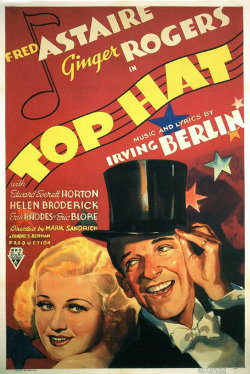
In Top Hat, Ginger Rogers shuns the ardent Fred Astaire because she thinks he’s her best friend’s husband. How she could persist in this belief for any length of time is never explained — the misunderstanding drives the whole story.
This is an “idiot plot,” defined by Roger Ebert as “a plot which is kept in motion solely by virtue of the fact that everybody involved is an idiot.”
The term was coined by science fiction author James Blish, whose colleague Damon Knight added the second-order idiot plot, “in which not merely the principals, but everybody in the whole society has to be a grade-A idiot, or the story couldn’t happen.”
Such contrivances are annoying, but we’ll forgive a lot if we get to watch Fred Astaire dance. “How is it that Ginger has never met her best friend’s husband?” asks critic Alan Vanneman. “Well, Europe is a big place.”
“I am by heritage a Jew, by citizenship a Swiss, and by makeup a human being, and only a human being, without any special attachment to any state or national entity whatsoever.” — Albert Einstein
“I want to be a human being, nothing more and nothing less. … I don’t suppose we can ever stop hating each other, but why encourage that by keeping the old labels with their ready-made history of millennial hate?” — Isaac Asimov
“Patriots always talk of dying for their country, and never of killing for their country.” — Bertrand Russell
“Patriotism is your conviction that this country is superior to all other countries because you were born in it.” — George Bernard Shaw
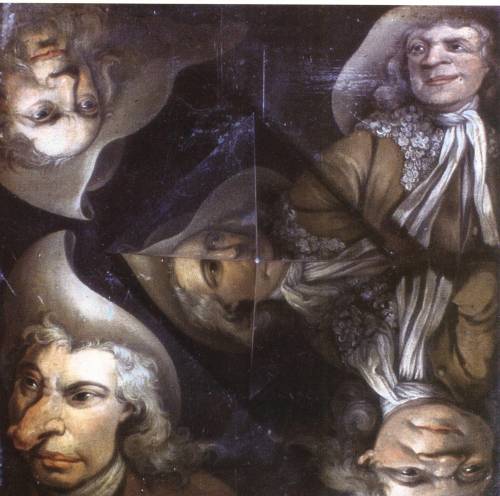
Henry Kettle painted this pyramid anamorphosis around 1770. If a mirrored pyramid is placed at the center of the canvas, then each of its sides reflects a portion of one of the four distorted heads … producing a true hidden portrait when viewed from above.
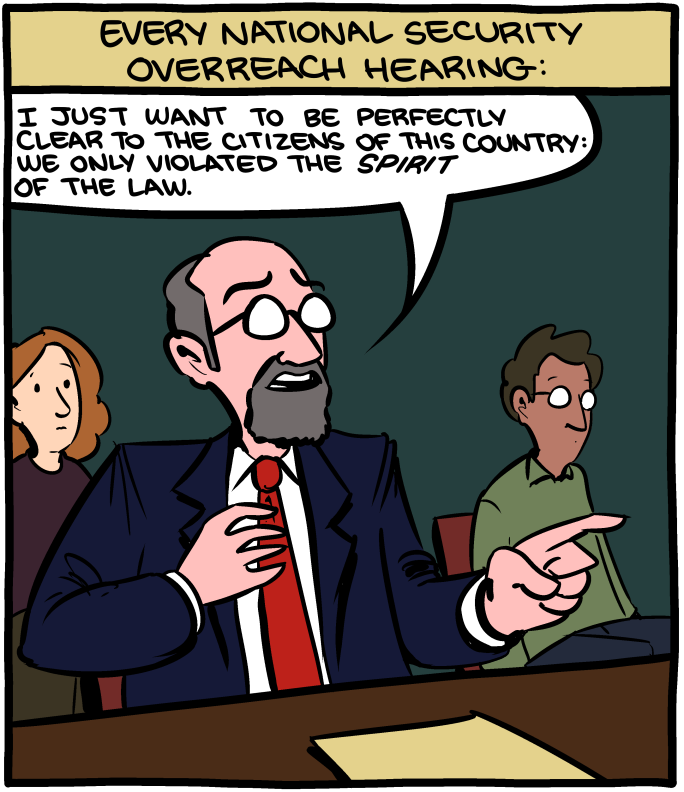
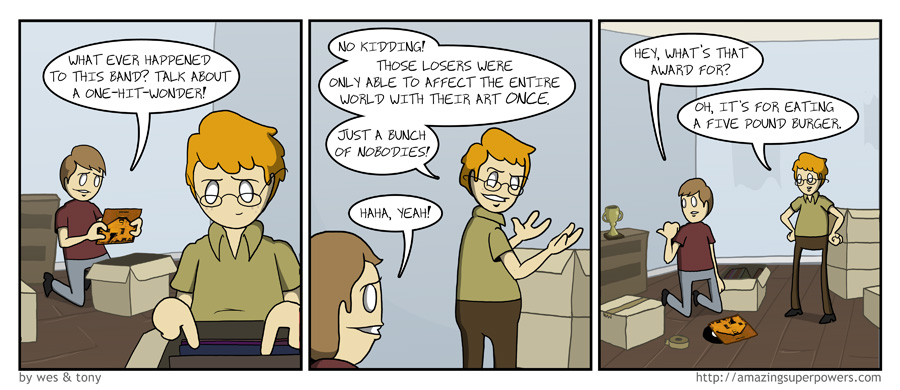
Hey, you! Thanks for taking a look at our stuff this year. And stay tuned because we have much more planned on the horizon for 2014!
LET’S RULE THE WORLD TOGETHER,
Wes + Tony

“Tampon Flasks” are test tubes which come with fake tampon wrappers, so you can bring an ounce of liquor (per tampon) somewhere and then pour it out of your tampon into your drink. Or just drink it straight out of the tampon! Both of those would be totally normal in a public place.
There is a game — in the 1950s it used to be played by members of the Iowa Writers’ Workshop — called ‘Smoke.’ It works as follows. The player who is ‘it’ chooses some famous person with whom everyone playing is surely acquainted (Harry Truman, Marlon Brando, Chairman Mao, Charles DeGaulle, for instance) and tells the other players, ‘I am a dead American,’ ‘I am a living American,’ ‘I am a dead Asian,’ ‘I am a dead European’; and then each of the other players in turn asks one question of the person who is ‘it,’ such as, ‘What kind of smoke are you?’ (cigarette, pipe, cigar — or, more specifically, L&M, Dunhill, White Owl) or ‘What kind of weather are you?’ ‘What kind of insect are you?’ or ‘What kind of transportation?’ The person who is ‘it’ answers not in terms of what kind of smoke his character would like, if any, but what kind of smoke he would be if, instead of being human, he were a smoke, or what kind of weather, insect, transportation, and so forth, he would be if reincarnated as one of those. Thus, for example, Kate Smith if an insect would be a turquoise beetle; Marlon Brando, if weather, would be sultry and uncertain, with storm warnings out; and as a vehicle of transporation Harry Truman would be (whatever he may in fact have driven) a Model T Ford. What invariably happens when this game is played by fairly sensitive people is that the whole crowd of questioners builds a stronger and stronger feeling of the character, by unconscious association, until finally someone says the right name — ‘Kate Smith!’ or ‘Chairman Mao!’ — and everyone in the room feels instantly that that’s right. There is obviously no way to play this game with the reasoning faculty, since it depends on unconscious associations or intuition; and what the game proves conclusively for everyone playing is that our associations are remarkably similar. When one of the players falls into some mistake, for instance, saing that Mr. Brezhnev of the U.S.S.R. is a beaver instead of, more properly, a crafty old woodchuck, all the players at the end of the game are sure to protest, ‘You misled us when you said “beaver.”‘ The game proves more dramatically than any argument can suggest the mysterious rightness of a good metaphor — the one requisite for the poet, Aristotle says, that cannot be taught.
– John Gardner, On Moral Fiction, 1978
In 1990, Spanish philosopher Jon Perez Laraudogoitia submitted an article to Mind entitled “This Article Should Not Be Rejected by Mind.” In it, he argued:
They published it. “This is, I believe, the first article in the whole history of philosophy the content of which is concerned exclusively with its own self, or, in other words, which is totally self-referential,” Laraudogoitia wrote. “The reason why it is published is because in it there is a proof that it should not be rejected and that is all.”
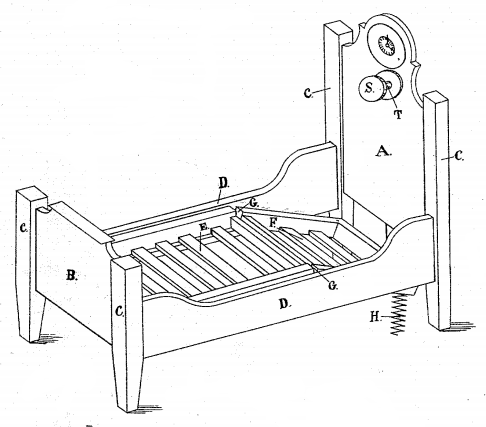
Here’s an old-timey way to prevent oversleeping, patented by A.J. Nordmann in 1885. Set your alarm clock as normal but attach it to a lever on Nordmann’s “alarm and waking bed.” Now if you don’t turn off the alarm in time, the head of the bedframe will drop to the floor.
“Thus a person sleeping is awakened as the alarm sounds, and should he fail to rise he is immediately dropped down with the head portion of the mattress F, which then has its bearing upon the springs H.”
I suppose that really chronic oversleepers could remove the springs, to make the jolt even more jarring.
Yeah, it’s almost like they have a vested interest in downplaying that shit to maintain their own supremacy.
News flash. Also, fuck that asshole.

Albert Camus (1913-1960) was a Algerian-French Nobel prize-winning author, famous for the novels The Stranger, The Rebel and The Myth of Sisyphus. Before concentrating on writing essays, novels and plays, Camus worked as a journalist and also joined the French Resistance during WWII, where he edited an underground newspaper. I’ve only recently dipped my toes into the world of Camus thanks to the suggestion of many readers. I’ve just read The Stranger and am looking forward to reading more.
This quote is taken from Camus’ essay Return To Tipasa. The essay, written in 1952, is about Camus’ journey from war-torn Paris to Algiers, and finally to the small town of Tipasa, where he had spent the best days of his youth. There, he reconnects with the beauty and light of life that he feels he had lost during years of war in Europe. Not only does he rediscover the joy and hope he believes one must live with, he realises that he had it within him all along. You can read the essay here.
These characters have previously appeared in the comics: To Love at All and A Love Story in Four Parts.
- Thanks to everyone who sent me Camus’ quotes and suggest I read his stuff.
- There are tons of interesting articles and quotes by Camus at his Facebook page.
- In case you missed my big announcement this week: Zen Pencils book coming in 2014!