
Ioan Dumitrescu.
I think this person may have done a cover design for Mainspring, by Jay Lake, but I’m not sure. The art style looks very similar.
Ioan Dumitrescu.
I think this person may have done a cover design for Mainspring, by Jay Lake, but I’m not sure. The art style looks very similar.

To commemorate his 200,000th YouTube subscriber, Hevesh5 created one of the most spectacular displays of domino toppling dominance we've ever seen. But even more gratifying than that is watching the whole darn thing in reverse.


Jim Cook wrote this touching piece on the space shuttle Discovery and how a question he had pondered for years finally came to be answered.
They are perhaps the most easily recognizable tiles in space shuttle history. For shuttle watchers, when you see them, you know exactly which shuttle you are looking at. Only space shuttles Columbia and Enterprise are more recognizable. The four other shuttles — Challenger, Discovery, Atlantis and Endeavour — aside from their names being painted on them, appear in photos, on TV, film, and videos to be essentially the same. That is — except for those black tiles right below the corner pilot-side window on Discovery.
I noticed them immediately while watching the evening news back in October, 1983, when Discovery was rolled out for the first time at the Rockwell hanger in Palmdale, California, where she and all the shuttles underwent final assembly. I squinted and thought, “she has a tear in her eye.” I’ve thought of those black tiles below the pilot’s window as Discovery’s “teardrop” ever since. Had they been located someplace else, perhaps I might have thought of them as a beauty mark. But, as a teardrop, it quickly became one of the reasons Discovery so endeared herself to me all these years. After all, any shuttle with a tear in her eye has to be pretty special. She has feelings.
People have historically given ships and planes (and often their cars) human attributes. They give them names. They christen them. They talk to them. They are typically thought of as female. I thought of Discovery’s teardrop that way, too. Was she afraid of launching? After all, her very first attempt was rather scary — the first ever shutdown on the pad after main engine start. I could see how an infant shuttle might get a bit teary-eyed thinking about her first step. Or, later on, was it there for her lost sisters, Challenger, and then Columbia? She was always the one chosen to bravely lead the way after their loss. Or maybe it’s just a tear of joy for the thrill of going into orbit, like when she did the first ever backflip in space?
Still, I’ve always wondered why those tiles below window No. 5 (if I’m correct) were there at all? On every other orbiter, those tiles are white. Discovery’s alone are black. Whenever I happened to meet someone in the NASA shuttle program or an astronaut who had flown aboard Discovery, I would ask about them, but no one ever knew. That is, until Discovery was finally retired; with so many of Discovery’s astronauts and all the NASA shuttle program people there at the Smithsonian’s Udvar-Hazy Center in Virginia to commemorate Discovery’s arrival, I knew this had to be my last, best chance to find out. And there, finally, I found the right person to ask. “You know, I don’t think anyone’s ever asked that question.” “Now you have me curious. I’ll try to find out.”
Go here to see the answer and read more.


Dutch design firm Ontwerpduo has created a furniture line that blurs the line between fantasy and reality. The designs draw from common fantasy tropes such as magic forests, candles, and the distortion of everyday objects, from dezeen:
The name of the What It Is, It Isn’t cabinet references a quote from Lewis Carroll’s story Alice in Wonderland: “If I had a world of my own, everything would be nonsense. Nothing would be what it is, because everything would be what it isn’t. And contrary wise, what is, it wouldn’t be. And what it wouldn’t be, it would. You see?,” said Alice in the book.
The limited-edition wood, pewter and polyurethane cabinet is constructed to look like a traditional cabinet reflected in a distorted mirror, but in fact the cabinet itself is distorted.


Fastcoexist published a piece on Petomato, which is a Japanese bottle cap redesign that transforms any water bottle into a mini-planter:
As a gardening-obsessed college student in Japan, Takuya Hasegawa wanted to figure out how to help more people start growing their own food–even if, like many people living in crowded Japanese cities, they didn’t have a yard or much room inside their apartment. He was studying aquaponics, and decided to make the smallest aquaponic garden possible: A system that could grow tomatoes or peppers inside a single water bottle. The Petomato was born.
The kit itself is fairly simple–a regular bottle cap is replaced with a small tube that holds the plant and a fibrous core that draws water inside–but it takes a few more steps than an ordinary garden. You have to follow a regular routine of changing and fertilizing the water, prune the plants so they can fit inside the tiny space, and even hand-pollinate your tomatoes so they can bear fruit.

Letters of Note: The Skills of Leonardo da Vinci via Kottke. 1483/84 – 32 years old.
My Most Illustrious Lord,
Having now sufficiently seen and considered the achievements of all those who count themselves masters and artificers of instruments of war, and having noted that the invention and performance of the said instruments is in no way different from that in common usage, I shall endeavour, while intending no discredit to anyone else, to make myself understood to Your Excellency for the purpose of unfolding to you my secrets, and thereafter offering them at your complete disposal, and when the time is right bringing into effective operation all those things which are in part briefly listed below:
1. I have plans for very light, strong and easily portable bridges with which to pursue and, on some occasions, flee the enemy, and others, sturdy and indestructible either by fire or in battle, easy and convenient to lift and place in position. Also means of burning and destroying those of the enemy.
2. I know how, in the course of the siege of a terrain, to remove water from the moats and how to make an infinite number of bridges, mantlets and scaling ladders and other instruments necessary to such an enterprise.
3. Also, if one cannot, when besieging a terrain, proceed by bombardment either because of the height of the glacis or the strength of its situation and location, I have methods for destroying every fortress or other stranglehold unless it has been founded upon a rock or so forth.
4. I have also types of cannon, most convenient and easily portable, with which to hurl small stones almost like a hail-storm; and the smoke from the cannon will instil a great fear in the enemy on account of the grave damage and confusion.
5. Also, I have means of arriving at a designated spot through mines and secret winding passages constructed completely without noise, even if it should be necessary to pass underneath moats or any river.
6. Also, I will make covered vehicles, safe and unassailable, which will penetrate the enemy and their artillery, and there is no host of armed men so great that they would not break through it. And behind these the infantry will be able to follow, quite uninjured and unimpeded.
7. Also, should the need arise, I will make cannon, mortar and light ordnance of very beautiful and functional design that are quite out of the ordinary.
8. Where the use of cannon is impracticable, I will assemble catapults, mangonels, trebuckets and other instruments of wonderful efficiency not in general use. In short, as the variety of circumstances dictate, I will make an infinite number of items for attack and defence.
9. And should a sea battle be occasioned, I have examples of many instruments which are highly suitable either in attack or defence, and craft which will resist the fire of all the heaviest cannon and powder and smoke.
10. In time of peace I believe I can give as complete satisfaction as any other in the field of architecture, and the construction of both public and private buildings, and in conducting water from one place to another.
Also I can execute sculpture in marble, bronze and clay. Likewise in painting, I can do everything possible as well as any other, whosoever he may be.
Moreover, work could be undertaken on the bronze horse which will be to the immortal glory and eternal honour of the auspicious memory of His Lordship your father, and of the illustrious house of Sforza.
And if any of the above-mentioned things seem impossible or impracticable to anyone, I am most readily disposed to demonstrate them in your park or in whatsoever place shall please Your Excellency, to whom I commend myself with all possible humility.

When you think of princesses in Legend of Zelda, Princess Zelda probably comes to mind first. She’s not the only one though; Princess Hilda appears in The Legend of Zelda: A Link Between Worlds. She looks almost exactly like Zelda except that the color pink is replaced with the color purple. Cosplayer Guhzoontight fell in love with the character as she played the game and worked on preparing the costume for PAX East this year. She built every part of the cosplay, including drafting the pattern and sculpting all the armor and making the staff.
After sculpting the crown, armor pieces, and jewels, she covered them in gesso before painting them. She used several layers of gold acrylic paint and added a glossy finish to make the fake metal look shiny. To get the right pattern for the decorated fabric piece on the front of the dress, she made a paper stencil and used it to paint directly on the fabric.
You can see more making of photos at Guhzoontight’s Facebook page.

via Geek x Girls


Robin, 12cm tall. Copper wire and telephone cabling.

Swallow study.

Egret, 48cm tall. Steel wire and telephone cabling. / Peacock, 110cm Tall. Steel bar, copper wires and telephone cabling

Mumeration of Starlings. Installation of 60 wire birds dimensions variable. Paper coated telephone wires and steel wire.

Lapwings. 30cm high. Copper wire and telephone cabling.

Swirling Lapwings. 1.5m X 1.5m steel wire and telephone cabling.

Starling Wreath. 100cm diameter. Paper coated telephone wires and steel wire.
UK artist Celia Smith works with various forms of wire to create delicate bird sculptures and installations. While somewhat abstract in appearance, the pieces are almost lifelike in form and scale as if drawn with a pen. You can see over 50 different pieces by the artist on her website, and catch an interview over on Ideas in the Making. Not shy about her process or methods, she also offers wire sculpting workshops.
Girders and Gears is the place for fanatical hobbyists and collectors of metal construction sets. Serious enthusiasts show off what they build with their sets, and share their knowledge about building techniques, history of the sets, and how to restore the old ones. They work in every historical and contemporary construction set. Not all construction sets are toys. Heavy duty ones can be used for prototyping.
Constructor sets come in 3 categories:
Repetitive Hole Beam
Consistently space holes along the length permit modular connections.
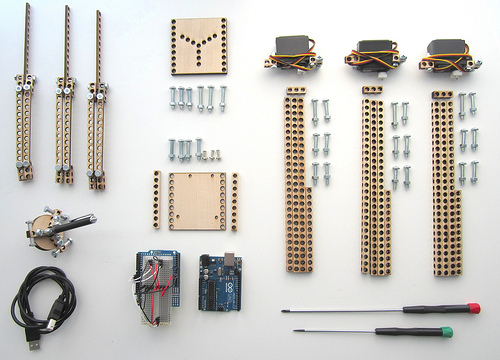
Bitbeam - LEGO Technic-compatible building technology. Bitbeam can be printed on a 3D-printer or cut with a CNC router or laser-cutter, which means it can be made out of plastic, wood, or aluminum.

Contraptor – Make your own. Contraptor is a DIY open source construction set for experimental personal fabrication, desktop manufacturing, prototyping and bootstrapping. Not sold. Make your own, with Sketchup files.
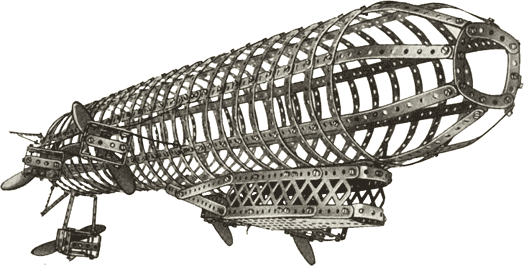 Meccano – In the US called Erector Sets. Steel girders, bolts to bind them.

Merkur – Metric-based Meccano/Erector-like system , made in Czech, popular in Europe.
Slot Beam
A long slot in the beam permits a secure connection with infinite adjustment of spacing.
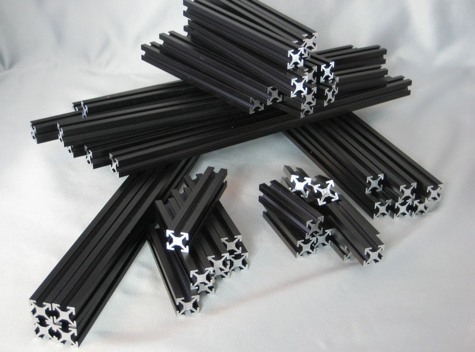
T-Slots – Industrial scale and strength. Both fractional and metric.

Makerbeam – Mini-T is a miniature version of larger T-slot building systems.
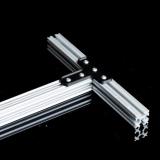
OpenBeam – Smaller version of industrial t-beam, with free plans that you can manufacture yourself or purchase.
Makeblock – Hybrid: Repetitive holes and slots. Various special shapes.
Beams and Connectors
Complicated rods — more than simple beams — slip into complicated connectors
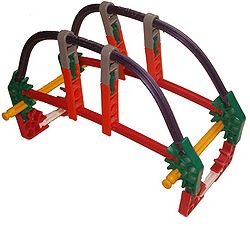
K’Nex – Flexible rods with plastic connects allow non-grid structures.

Lego/Technic – Highly crenelated beams and smaller parts with repetitive holes plug into different shaped connectors.
-- KK
 Calligraphy is a rewarding hobby that is fairly inexpensive to get in to. For someone just starting out, poster nibs are a great way to practice making letterforms without worrying about applying the proper pressure required to use nibs that split. With a few tools, you can even make your own poster nibs like [advicevice] does in this Instructable.
Poster nibs are typically made with a single piece of brass that’s folded at the point where the nib touches the paper. The backside forms a reservoir that holds the ink. The other end is formed into a semicircular shank that is inserted into a nib holder. The nibs that [advicevice] made consist of two pieces of flat brass stock plus a section of brass tubing for the shank of the nib. One side of the nib is slightly thinner than the other to act as a reservoir. This keeps ink clinging to the nib through the magic of surface tension.
Nib construction is fairly simple. [advicevice] cut the brass stock to the desired length and width, cut notches with a jeweler’s saw to allow the ink to flow, and cut a piece of tubing that holds the nib snugly. He recommends using three grades of sandpaper on the edges of the brass stock and tubing. After soldering the nib to the shank, he beveled the business end by rubbing it on 150-grit sandpaper. He followed this with 350- and 600-grit papers to avoid injury and tearing the paper when writing.
If you simply must spend more money, build a machine that writes calligraphy for you.


Greater freedom in plastic material choices will help fuel growth in 3-D printing markets, according to Lux Research. But use of plastics in 3D printing has been confined mainly to making prototypes since the achived parts are not strong enough.
This article Strengthening your 3D prints with carbon nanotubes and microwaves is first published at 3ders.org.

The Mighty Atom Starring Reddy Kilowatt: The Story of Electricity from Amber to Atoms, is a promotional comic produced by the Reddy Kiliowatt Co. for distribution by the nation’s electric power companies. As Reddy sings in his song:
“I’m a real, live wire and I never tire. Yes, sir–I’m a red-hot shot. I can cook your meals, turn the factory wheels, ’cause I’m Reddy Kilowatt. When you toast your toast, or your roast your roast, it is I who makes ‘em hot…I’m in your TV set with every show you get ’cause I’m Reddy Kilowatt! I’m the little man who’s always there; I’m a powerful high voltage guy. I”m so full of spark I can light up the dark, and you should see me when I wink my ‘lectric eye. I wash and dry your clothes, play your radios, I can heat your coffee pot. I’m always there with lots of power to spare, ’cause I’m Reddy Kilowatt!”


We Are Now In Command of the ISEE-3 Spacecraft.
The ISEE-3 Reboot Project is pleased to announce that our team has established two-way communication with the ISEE-3 spacecraft and has begun commanding it to perform specific functions. Over the coming days and weeks our team will make an assessment of the spacecraft’s overall health and refine the techniques required to fire its engines and bring it back to an orbit near Earth.
Finding LEGO builds of iconic spaceship Serenity is kind of like shooting fish in a barrel these days. And Evan B (Lego Junkie) admits the same is probably true of it’s diminutive companion, the UCS MF-813 Flying Mule land speeder. Which is why his idea of building it to Miniland scale and adding all the characters is pure genius!

And for Firefly fans who just really wanna see the vehicle, here you go, since I know we don’t cover space stuff on this blog very often…

Bunker.jordanterrifying


Ceremonial Dagger (Purbha)
Made of bronze, the dagger features a rare depiction of a deity with three faces and wings, featuring four weapons and a animal head, holding another purbha dagger in the front hands.
Source: Copyright © 2014 Czerny’s International Auction House S.R.L.
This landscape diorama by Patrick Massey (MassEditor) conveys a foreboding sense of emptiness and silence. The integration of the rocks and the tiered rise of the landscape is very skillfully made.


Parrying Dagger
Source: Copyright © 2014 The Fitzwilliam Museum, University of Cambridge

Thanks to a recent study, bad dreams of forgetting your high school locker combination or giving a work presentation in your underwear could be a thing of the past. According to the study, applying specific electrical current to a sleeper’s brain through electrodes on the scalp allows the sleeper to experience controlled lucid dreams. From Reuters:
For the study, scientists led by psychologist Ursula Voss of J.W. Goethe-University in Frankfurt, Germany, built on lab studies in which research volunteers in the REM (rapid-eye movement) stage of sleep experienced a lucid dream, as they reported when they awoke. Electroencephalograms showed that those dreams were accompanied by telltale electrical activity called gamma waves.
Those brain-waves are related to executive functions such as higher-order thinking, as well as awareness of one’s mental state. But they are almost unheard of in REM sleep.
Voss and her colleagues therefore asked, if gamma waves occur naturally during lucid dreaming, what would happen if they induced a current with the same frequency as gamma waves in dreaming brains?
When they did, via electrodes on the scalp in a technique called transcranial alternating current stimulation (tACS), the 27 volunteers reported that they were aware that they were dreaming. The volunteers were also able to control the dream plot by, say, throwing some clothes on their dream self before going to work. They also felt as if their dream self was a third party whom they were merely observing.

Back in 1970, Soviet nuclear physicist Vitaly Efimov had a theory regarding trios of particles that was just recently proven by a group of experimental physicists. via Quanta Magazine:
More than 40 years after a Soviet nuclear physicist proposed an outlandish theory that trios of particles can arrange themselves in an infinite nesting-doll configuration, experimentalists have reported strong evidence that this bizarre state of matter is real.
In 1970, Vitaly Efimov was manipulating the equations of quantum mechanics in an attempt to calculate the behavior of sets of three particles, such as the protons and neutrons that populate atomic nuclei, when he discovered a law that pertained not only to nuclear ingredients but also, under the right conditions, to any trio of particles in nature.
While most forces act between pairs, such as the north and south poles of a magnet or a planet and its sun, Efimov identified an effect that requires three components to spring into action. Together, the components form a state of matter similar to Borromean rings, an ancient symbol of three interconnected circles in which no two are directly linked. The so-called Efimov “trimer” could consist of a trio of protons, a triatomic molecule or any other set of three particles, as long as their properties were tuned to the right values. And in a surprising flourish, this hypothetical state of matter exhibited an unheard-of feature: the ability to range in size from practically infinitesimal to infinite.
“It’s a pretty wild idea,” said Randy Hulet, a physics professor at Rice University in Houston. “You get this infinite series of molecules.”
Efimov had shown that when three particles come together, a special confluence of their forces creates the Borromean rings effect: Though one is not enough, the effects of two particles can conspire to bind a third. The nesting-doll feature — called discrete scale invariance — arose from a symmetry in the equation describing the forces between three particles. If the particles satisfied the equation when spaced a certain distance apart, then the same particles spaced 22.7 times farther apart were also a solution. This number, called a “scaling factor,” emerged from the mathematics as inexplicably as pi, the ratio between a circle’s circumference and diameter.
“It’s like layers of an onion,” Hulet said. “You see molecules at one layer. Peel the layer away, and you see that there’s a molecule there 22.7 times smaller. Every time you peel away a layer, you find another molecule.”
Efimov published his theory in a Soviet journal as well as the Western publication Physics Letters B. At first, almost no one believed it.

“Blind Eye Sees All (No Secrets Anymore)” – 2014 by Jud Turner via BB.
“Blind Eye Sees All (No Secrets Anymore)” is a sculpture about the illegal surveillance activities of the United States and the NSA. For a very limited time, 50 original mini-sculptures based on this master work are available, and 1/3 of the proceeds will be donated to the Electronic Frontier Foundation to help protect our digital freedoms.
Bunker.jordanI haven't watched the video, but I really think this is a *terrible* idea.

Your Kickstarter Doesn’t Suck: Solar Roadways Edition
Solar Roadways is a modular paving system of solar panels that can withstand the heaviest of trucks (250,000 pounds). These Solar Road Panels can be installed on roads, parking lots, driveways, sidewalks, bike paths, playgrounds… literally any surface under the sun. They pay for themselves primarily through the generation of electricity, which can power homes and businesses connected via driveways and parking lots.
I hope this reaches it’s goal. What a kick ass idea.
Bunker.jordanIT'S OVER 9000!!!!

NASA's sun-observing IRIS spacecraft has gotten its first close-up look at a colossal coronal mass ejection erupting from the sun, and boy howdy is it beautiful.

Originally from The People’s Atlas, produced by the London Geographical Institute.


