
Sophianotloren
Shared posts
11 Aug 00:10
Petunia and Pals Wins The Morning!
by tengrain
Petunia and Pals will be confused about toys? Brian Kilmeade (the Dumb One) is confused by which side of the burger goes on the grill first, too, so there’s that.Filed under: People Dumber than Dolphins
Sophianotloren likes this
11 Aug 00:09

Hylics, by Mason Linderoth, is one of the best RPGs made in the last decade. Imagine a game finely distilled so as to consist solely of the weird funk of Earthbound plus some David Cronenberg technoflesh plus the young dread of Gumby... and when you've completely imagined that, now look in your weathered dusty hands to find the freshest nugget you've ever seen.
You should make it your duty to play it, and it's (refreshingly) short for an RPG at 2-3 hours, so go to it. (WARNING 1: SPOILERS FOLLOW. WARNING 2: LOTS OF HYLICS GIFS...)

There are a lot of things to like about Hylics. The randomly generated dialog text both exposes the emptiness of most RPG NPC dialog while simultaneously showing how much better and more poetic it can be. But maybe the art style is the most obvious thing to love, a bold mix of dithered stopmotion that feels soft but crunchy. Much like how the most superficial observation you can make about Stephen Lavelle's masterpiece Slave of God is that it's like drugs or something, the most superficial observation you can make about Hylics is that it's surreal or "trippy."
What impresses me about this look is the way it still establishes visual hierarchy and has very readable character / world design, it is some very superbly structured messiness. "Ambient" character are given a 1-bit black and white sprite treatment, while talkable NPCs get color, and hostile NPCs get jittery animation.

Oh my god, the animation! This is where Hylics really shines. Stop motion styled photo stuff is so often about playing with time, but because Hylics is digital, it's much more interested in playing with the material.
So many things melt and disintegrate in Hylics, from the first time you "accidentally crush" a trash can, to the way you unwrap a warm burrito during battle -- one of the most beautiful RPG animations of all time. In fact, just about every battle animation here makes Final Fantasy summons smell like dad.

Cacti plunge into the ground and "ambulatory skulls" disintegrate at your touch. Clay sigils pulse out of televisions, your body and face melt upon (fairly frequent) death, and in the last dungeon you're basically just plowing through all this meat and making a mess on the floor. It makes you realize how "gibs" in games are usually so dry, rigid, and motionless.
Hylics is a world of flesh, a game that congeals and melts in your hand. And it is stunning.
The molten rituals of Hylics
by Robert Yang
Hylics, by Mason Linderoth, is one of the best RPGs made in the last decade. Imagine a game finely distilled so as to consist solely of the weird funk of Earthbound plus some David Cronenberg technoflesh plus the young dread of Gumby... and when you've completely imagined that, now look in your weathered dusty hands to find the freshest nugget you've ever seen.
You should make it your duty to play it, and it's (refreshingly) short for an RPG at 2-3 hours, so go to it. (WARNING 1: SPOILERS FOLLOW. WARNING 2: LOTS OF HYLICS GIFS...)
There are a lot of things to like about Hylics. The randomly generated dialog text both exposes the emptiness of most RPG NPC dialog while simultaneously showing how much better and more poetic it can be. But maybe the art style is the most obvious thing to love, a bold mix of dithered stopmotion that feels soft but crunchy. Much like how the most superficial observation you can make about Stephen Lavelle's masterpiece Slave of God is that it's like drugs or something, the most superficial observation you can make about Hylics is that it's surreal or "trippy."
What impresses me about this look is the way it still establishes visual hierarchy and has very readable character / world design, it is some very superbly structured messiness. "Ambient" character are given a 1-bit black and white sprite treatment, while talkable NPCs get color, and hostile NPCs get jittery animation.
Oh my god, the animation! This is where Hylics really shines. Stop motion styled photo stuff is so often about playing with time, but because Hylics is digital, it's much more interested in playing with the material.
So many things melt and disintegrate in Hylics, from the first time you "accidentally crush" a trash can, to the way you unwrap a warm burrito during battle -- one of the most beautiful RPG animations of all time. In fact, just about every battle animation here makes Final Fantasy summons smell like dad.
Cacti plunge into the ground and "ambulatory skulls" disintegrate at your touch. Clay sigils pulse out of televisions, your body and face melt upon (fairly frequent) death, and in the last dungeon you're basically just plowing through all this meat and making a mess on the floor. It makes you realize how "gibs" in games are usually so dry, rigid, and motionless.
Hylics is a world of flesh, a game that congeals and melts in your hand. And it is stunning.
bernot, Sophianotloren likes this
11 Aug 00:09
Why the Planned Parenthood Videos Won’t Change Public Opinion
by Scott Lemieux

You may have heard that American reactionaries have an exciting new strategy in their war against reproductive freedom: EXCLUSIVE VIDEOS showing that abortion clinics PERFORM ABORTIONS and the personnel who work in them are aware of this fact. The fact that medical procedures sound gross is a deeply silly reason to believe they should be restricted. And as Rebecca Traister points out, it’s not telling women anything they don’t already know:
The videos are likely to have an impact: not on public opinion about abortion, which rarely changes meaningfully, but perhaps
on Planned Parenthood’s funding, and almost certainly on laws made by state legislatures in the parts of America where abortion has already become so inaccessible — thanks to elaborate facility requirements, waiting periods, parental-consent-and-notification laws, earlier gestational cutoffs, and a dwindling number of providers — that it might as well be illegal.But as a broader strategy, the notion that educating women in the grotesqueries of termination will be a game-changer is absurd. As Richards could tell Daleiden if he asked her his question, women already know what abortion is. We know more about blood, innards, fetuses, and the babies they may become — in short, about life in reproductive bodies — than anti-abortion activists seem to understand.
The average age of menarche in the United States is 12; the average age of menopause, 51. During the intervening decades, most women bleed regularly, and if you think we emit that chlorinated blue water in the maxi-pad ads, you are incorrect. I was in high school the first time a friend joked about a “period chunk.” I was also in high school when I first heard that an acquaintance had had a grapefruit-size dermoid cyst removed from an ovary; as is not uncommon with those cysts, it contained teeth, hair, and skin.
[…]
Women do not need real talk about bodies; our adult days brim with the effluvia, the discomforts, the weirdness and emotional intensity and magnitude of our medical choices. Then there is pregnancy itself, wanted or not, and its attendant risks. Women pass early pregnancies into toilet bowls and sadly collect the remains of later ones in Tupperware containers to bring to their doctors. Most of us know of someone who has suffered the excruciating pain of stillbirth. One friend, bleeding 13 weeks into a deeply desired pregnancy, was told by her doctor not to worry unless she passed a clot bigger than her fist.
The first quoted paragraph gets the strategy right. The real target here isn’t public opinion; it’s giving state legislators a pretext to enact the arbitrary restrictions on abortion they want to pass anyway.
Sophianotloren likes this
11 Aug 00:08


![Pierre Huyghe. "Untilled (Liegender Frauenakt) [Reclining female nude]" (2012), concrete with beehive structure, wax, and live bee colony; figure: 29 1/2 x 57 1/16 x 17 11/16″ (75 x 145 x 45 cm), base: 11 13/16 x 57 1/16 x 21 5/8″ (30 x 145 x 55 cm), beehive dimensions variable, the Museum of Modern Art, New York, purchase (© 2015 Pierre Huyghe, photo by Jonathan Muzikar)](http://hyperallergic.com/wp-content/uploads/2015/08/moma_huyghe_238_2015_ab_web.jpg) After I watched the short film, I felt sad, strangely altered. I knew nature was being destroyed by humans, but I hadn’t ever seen it in action. Absorbing the film, I had been changed. I walked away from the alcove, and from the corner of my eye I thought I saw a beautiful white dog, but my brain said “no.” And yet: I walked in the direction I thought the ghost dog had walked in. Soon, I was at a glass door that led outside. Before me stood a statue of a reclining nude woman, her head a beehive. I was too afraid to leave the gallery (would I be allowed back in? would I sound an alarm? would the bees attack me?), so instead I stood alone at the precipice, staring at the statue’s strange golden head. The “hive” is the mind: this is where all the activity occurs. But the hive is also where the bees live — and the bees are dying. Without bees, humans won’t survive. I know this and yet I forget all the time. (The sculpture, “Untilled [Liegender Frauenakt]” [2015] is currently on view at the Museum of Modern Art [MoMA].)
After I watched the short film, I felt sad, strangely altered. I knew nature was being destroyed by humans, but I hadn’t ever seen it in action. Absorbing the film, I had been changed. I walked away from the alcove, and from the corner of my eye I thought I saw a beautiful white dog, but my brain said “no.” And yet: I walked in the direction I thought the ghost dog had walked in. Soon, I was at a glass door that led outside. Before me stood a statue of a reclining nude woman, her head a beehive. I was too afraid to leave the gallery (would I be allowed back in? would I sound an alarm? would the bees attack me?), so instead I stood alone at the precipice, staring at the statue’s strange golden head. The “hive” is the mind: this is where all the activity occurs. But the hive is also where the bees live — and the bees are dying. Without bees, humans won’t survive. I know this and yet I forget all the time. (The sculpture, “Untilled [Liegender Frauenakt]” [2015] is currently on view at the Museum of Modern Art [MoMA].)


Pierre Huyghe and the Art of the Rupture
by Cynthia Cruz
Installation view of ‘The Roof Garden Commission: Pierre Huyghe’ at the Metropolitan Museum of Art, 2015 (photo by Hyla Skopitz, the Photograph Studio, the Metropolitan Museum of Art, © 2015)
Last summer I viewed Pierre Huyghe’s retrospective at the Ludwig Museum in Cologne. At the threshold of the show stood a young man who, when he saw me, asked for my name. “Cynthia,” I said. “Cynthia,” he announced. On the carpet beneath my feet was a worn path, presumably from the feet of previous visitors. I followed the path, which led to a series of large rooms that were empty for the most part. In one room stood a large tank; in another, nothing. Along the walls were holes where, it appeared, paintings had been previously hung. The rooms were darkened; visitors stood inside in small groups, as if trying to figure out what was happening. I stared awhile at the tank, which was filled with tiny hermit crabs, and then walked further.
Pierre Huyghe, “Zoodram 5 (after ‘Sleeping Muse’ by Constantin Brancusi)” (2011), glass tank, filtration system, resin mask, hermit crab, arrow crabs, and basalt rock (image courtesy LACMA) (click to enlarge)
The tank is a repeated object in many of Huyghe’s works. They featured prominently in his retrospective, and a massive fish tank currently sits on the roof of the Metropolitan Museum as part of the Roof Garden Commission. Huyghe’s tanks are filled with strange, beautiful creatures. On the roof of the Met are tadpole shrimp, while inside the tanks in the retrospective were hermit crabs. The tank is an enclosed space. The viewer stands outside it, watching the creatures engage in their everyday activities. The tank is a lens through which we can better see Huyghe’s overall project. In an interview with Emily Nathan for Art in America, Huyghe stated:
The work is not “displayed” under a narrative — that’s a system I avoid. I could not imagine a chronological order, either. As you say, most of what I have done is construct situations that happen within a given body. Every one is a constellation network of process, all sorts of heterogenous and anachronistic things come together or are associated within a constructed situation, and so it is difficult to present them in a site where they were not originally, or to organize them in a linear way.
The contained space of the museum gallery is akin to a tank. The visitor makes her way through the rooms of the museum, absorbing and processing what she sees.
At the Ludwig Museum, three women were sitting in an alcove on a large white block, a makeshift sofa, watching a screen. I joined them. “Streamside Day (2003),” a film that takes place during the construction of a town, was playing. To watch nature change into the suburban before one’s eyes is an eerie, rather melancholic experience. And yet, it is also a cause for celebration. In an interview with George Baker for October magazine, Huyghe explained, “Streamside Knolls is a new village in upstate New York on the Hudson River. Streamside Day is the celebration of a custom invented for this new place, and it took place a month before the opening of the exhibition at the Dia called Streamside Day Follies.” In the film characters in plush animal costumes, horses and rabbits, appear alongside the new inhabitants of the town. The cinéma vérité style creates a sense of reality (this is actually taking place as it is being filmed), but the absurdity of the costumed characters creates a puncture, a rip in the narrative. The strangeness of the costumed characters enacts the folly of what is taking place.
Pierre Huyghe, “Untilled (Liegender Frauenakt) [Reclining female nude]” (2012), concrete with beehive structure, wax, and live bee colony; figure: 29 1/2 x 57 1/16 x 17 11/16″ (75 x 145 x 45 cm), base: 11 13/16 x 57 1/16 x 21 5/8″ (30 x 145 x 55 cm), beehive dimensions variable, the Museum of Modern Art, New York, purchase (© 2015 Pierre Huyghe, photo by Jonathan Muzikar)
After awhile, I felt calmed: I’d be using my mind to figure out what the hive-as-head meant. I turned around and from the ceiling was hanging a beautiful fur jacket. I thought of trying it on, and then I wondered why it was hanging here. As I was wondering, the dog walked by. It had a spray of bright pink paint on its body, but seemed happy. I followed it.
Shot over the corse of three days, Huyghe’s film The Host and the Cloud (2010), shown at MoMA last month, is a construction of a series of scenarios rather then scenes. Taking place inside a former ethnographic museum on the grounds of a former amusement park on the outskirts of Paris, the project is a series of both scripted and unscripted rituals and events, an experiment in human behavior. What occurs in the film — characters performing and then other characters “trying on” these character’s performances, characters in costume, rituals and interactions — are the very behaviors we engage in when we are inside the confined, continued space of Pierre Huyghe’s shows. For example, after what appears to be a freak storm, the inhabitants of the building become aware of nature: a room is filled with butterflies, a man looks closely at a tank of animals, and so on. These encounters mirrored my own as I meandered through Huyghe’s retrospective. And the tanks within the museum space are microcosms of the human interactions.
Along with the large, oversized tank of creatures, Huyghe’s work on the roof of the Metropolitan Museum consists of lifted and moved stone panels from the pavement. The spaces where the panels once sat are now holes filled with small puddles of water and newly blossoming green weeds. As with his other works, what we have here is a kind of puncture: placing the tank on the roof and pulling the stones away from it are both means of disruption, like the costumed characters in “Streamside Day.” But what is the message of the disruption?
Installation view of ‘The Roof Garden Commission: Pierre Huyghe’ at the Metropolitan Museum of Art, 2015 (photo by Hyla Skopitz, the Photograph Studio, the Metropolitan Museum of Art, © 2015)
Also at the Metropolitan Museum is Huyghe’s film “Untitled (Human Mask)” (2011–12). In the short film, what appears to be a young girl wearing a mask and wig, her arms and legs covered in animal fur, roams the rooms of an abandoned home in Japan. The camera follows the girl as she stares into space in bouts of reverie. When she isn’t daydreaming, she limps strangely from room to room. As I watched the film, I was ashamed because I couldn’t discern whether I was watching a young girl dressed as a monkey dressed as a young girl or simply a monkey dressed as a girl. The implications were troubling: Was I calling the girl a monkey? I knew this was insulting, and yet I wondered why. What did it mean if I couldn’t tell the difference between a girl and a monkey — are we truly that different, anyway?
“Human Mask” was filmed partially by drone camera in Fukushima in 2011, after the earthquake and tsunami which caused the meltdown of the three nuclear reactors. These scenes showing deserted, quarantined neighborhoods are deeply unsettling. They bleed into those of the monkey/girl wandering the rooms. Amid the footage of the deserted neighborhoods comes a muffled announcement, presumably recorded over a loudspeaker. As the scene changes to that of the girl/monkey, the sound of the announcement is still heard, giving the impression that the girl/monkey is inside one of the deserted buildings.
Pierre Huyghe, still from “Untitled (Human Mask)” (2011–12), HD video in color with sound, 19 min (image courtesy the Metropolitan Museum of Art) (click to enlarge)
The rupture in Huyghe’s work, via costumed characters or distraction (fur jacket, dog in gallery), is an opportunity to think or rethink. The giant fish tank on the roof of the Metropolitan changes suddenly, like a blink: in one moment, the walls are white, akin to frosted windows on a car; in the next, the inside of the tank is visible and the strange characters swimming inside can be seen. What struck me when I noticed this blinking was the way our minds work. I know, for example, that the panda bear is endangered, that the beautiful creatures are on their way to extinction. I think of this, I feel sad, and then my mind blinks. Denial sets in. Apathy, laziness.
In an interview with Doug Aitken for BOMB magazine, Huyghe talked about “the blink”:
The show itself was a kind of organism. L’Expédition Scintillante can be translated as “The Blinking Expedition.” When I did the French pavilion in Venice [2001 Biennale], the whole exhibition was a set of events happening and then disappearing again. It was a blinking, pulsating exhibition where these glass doors separated all the rooms. Sometimes you could see through them and connect things and sometimes not. One situation can be transformed into another without losing something in the translation. It can be different but also equivalent. Something may appear then reappear somewhere else. So it’s a blinking organism.
Pierre Huyghe’s work is an invitation to enter the gutter between (worlds, meanings, languages) and remain in that space for awhile: to pause and interrogate both the inexplicable and the known world, to absorb it, to take in the experience and, like a mineral interacting with another mineral, to be changed.
Pierre Huyghe took place at the Museum Ludwig (Heinrich-Böll-Platz, Cologne, Germany) from April 11 to July 13, 2014. Huyghe’s The Host and the Cloud screened at the Museum of Modern Art (11 W 53rd Street, Midtown, Manhattan) on July 14–16, 2015. Huyghe’s “Untilled (Liegender Frauenakt)” remains on view at MoMA through August 19. The Roof Garden Commission: Pierre Huyghe continues at the Metropolitan Museum of Art (1000 Fifth Ave, Upper East Side, Manhattan) through November 1.
Sophianotloren likes this
11 Aug 00:08
Bending Gender to Make a Sale
by Ian MacAllen
The process of selling writing can do funny things to people, like the male authors writing under female pseudonyms. Catherine Nichols went the other way, taking on a male persona to sell her novel:
I sent the six queries I had planned to send that day. Within 24 hours George had five responses—three manuscript requests and two warm rejections praising his exciting project. For contrast, under my own name, the same letter and pages sent 50 times had netted me a total of two manuscript requests. The responses gave me a little frisson of delight at being called “Mr.” and then I got mad. Three manuscript requests on a Saturday, not even during business hours! The judgments about my work that had seemed as solid as the walls of my house had turned out to be meaningless. My novel wasn’t the problem, it was me—Catherine.
Related Posts:
Sophianotloren likes this
11 Aug 00:08
And Please Let the Door Hit You on the Way Out
by Scott Lemieux

One very clear implication of Roberts’s surprisingly forceful rejection of ACA trooferism was that a majority of the Supreme Court was uninterested in having any further frivolous lawsuits rise up from the fever swamps. The lower courts appear to have gotten the message:
On Friday, however, four Republican federal appeals court judges, including at least one of the most conservative judges in the country, laid that threat to rest in an opinion signaling that federal courts will no longer give comfort to lawyers seeking to wipe out Obamacare.
[…]
This is an important development not just because it suggests that this lawsuit is unlikely to prevail, but because of the identity of some of the judges who decided not to pick this fight. One judge who joined Judge Kavanaugh’s opinion is Judge Thomas Griffith, the author of a divided three-judge panel’s decision in Halbig v. Burwell, which embraced the same legal arguments presented by the plaintiffs in King. These arguments were just as weak as the arguments presented by Sissel’s attorneys — King and Halbig rested on the unique legal argument that much of the text of the Affordable Care Act does not count. So Griffith’s willingness to sign onto Kavanaugh’s opinion suggests that Griffith’s tolerance for extravagant challenges to Obamacare has waned since he handed down his opinion in Halbig.
Another judge who joined Kavanaugh’s opinion was Judge Janice Rogers Brown a staunch economic libertarian who once argued that courts should treat all labor or business regulation with a great deal of constitutional skepticism. Brown labeled the New Deal a “socialist revolution,” and claimed that Social Security is a kind of intergenerational cannibalism (“Today’s senior citizens blithely cannibalize their grandchildren because they have a right to get as much ‘free’ stuff as the political system will permit them to extract”). So if any judge in the country would be sympathetic to an attack on Obamacare, it is Janice Rogers Brown.
There comes a time when it’s time to pack up your crusade to use litigation to strip millions of people of their health insurance and go home. Janice Rogers Brown finding your arguments too weak to proceed is, in fact, that time.
bernot, Sophianotloren likes this
11 Aug 00:07
All Over Coffee, The Eviction Series #6
by Paul Madonna

I realized I had not been home in two days. At least not inside. Not since I’d found the eviction notice on my door. Seeing that had made me panic. I ran out to find a new place to live only to see how cutthroat the market really was. Now I felt beaten and needed to rest.
Back home I found my front door plastered with nine more eviction notices. Did my landlord think I couldn’t read? A bicycle tour group pulled up in front of my building. A dozen or so people, all on rental bikes with fanny packs strapped to the front. The leader pointed to my building and announced through a megaphone: “This is number 54 on this week’s no-fault eviction tour.” Then he chuckled. “But of course it will be available at market rate in no time.”
Inside, the flat felt different. I was keenly aware of all my things, that I would have to touch every object and decide what to keep and what to toss. The thought was overwhelming. Because the truth was, I had way too much stuff. Ten years had turned my place into a stuff hotel. Items checked in, but they didn’t check out.
I went into the bedroom. It was afternoon and warm sunlight glowed at the southern window. I laid on the bed and stared at the view that would be mine no more. A silly thing to be sentimental about. It wasn’t like the view was going to miss looking at me.
I was surprised by how hard I was taking this. Yes the flat was charming, but it was far from perfect. The windows were drafty, the electrical outlets were both two-pronged and too few, and the heater was a joke. I called the place home, but was it? After a decade, living here was more habit than choice. I could probably walk every inch in complete darkness and not bump into any walls or furniture, but was that really something to be proud of? How much did routine behavior create routine thought? Maybe I was stuck in a rut here and didn’t know it. Maybe this eviction was just what I needed. Wow, I thought. Look at me. Mister Lemonade.
This interlude of optimism must have just been me dozing, though, the result of my mind hovering in that place where you think you’re conscious but are actually asleep, because a loud pounding jolted me awake. I looked out the window to see the bike tour group on the roof next door. One of the guys was trying to plant a flag. Over and over he kept jabbing at the roof until finally the pole broke through and stuck.
I couldn’t make out any emblem. The fabric was white and the wind was whipping but the flag looked as though it might be blank. Which would have been pretty cool. After all, San Francisco had been allowing itself to be remade for centuries, which was one of the things I loved about the place. But then I realized the flag wasn’t actually blank. There was an emblem, but something was preventing me from seeing it. A sort of blurred out-ness, like when the local news showed footage of nudity. Suddenly a face popped in my window and I jumped back. It was one of the bikers. She held up her phone and pointed to the screen. “To continue,” she said, “You’ll need to give us your email and click this box. It’s our terms and conditions.”
***
GO HERE to view all the pieces in this series in chronological order.
Related Posts:
Sophianotloren likes this
11 Aug 00:06
Exonerate Ethel Rosenberg
by Erik Loomis

One of the greatest injustices of the Cold War in the U.S. was the execution of Ethel Rosenberg, primarily because she wouldn’t divulge information that would implicate her husband. President Obama should pardon her.
Plus conservatives would flip out if he did.
Sophianotloren likes this
11 Aug 00:05
Bruce Springsteen & Jon Stewart Forever
by Liz Wood
It’s become a pretty much universally acknowledged fact that there was no greater way for The Daily Show to go out than with Bruce Springsteen and his E Street Band. Jon Stewart and the Boss have been mutual fans for years, something publicly cemented in their 2012 interview for Rolling Stone, where Springsteen told the journalist megafan, “your show is basically an interpretive media class.” Springsteen and his band played “Land of Hope and Dreams” at Stewart’s request, then ended the show’s long run with “Born to Run.” If you haven’t caught the final show yet, haven’t quite dealt with the fact that the show’s over, or just feel the need to see the Boss, watch the video after the jump.
https://youtu.be/8c1Sstu7uQQ&w=580
Related Posts:
Sophianotloren likes this
11 Aug 00:05


The Painter Infiltrating ‘Good Morning America’ and ‘The Today Show’
by Benjamin Sutton
One of Christie Blizard’s appearances on ‘The Today Show’ (all photos courtesy the artist unless indicated otherwise)
Christie Blizard‘s paintings have been on national television more than a dozen times in the past year. Millions of viewers in the US have seen her work on Good Morning America (GMA) and The Today Show, though they may not have realized that what they were seeing was contemporary painting. As part of her ongoing interest in devising alternative ways of making and displaying paintings, outside of conventional art contexts — from incorporating mud-wrestling into her process to spray-painting canvases strapped to her back while she takes hours-long walks — the San Antonio–based artist has been creating enigmatic text works to brandish in the backgrounds of the popular morning shows for the past year.
Blizard intends to continue the project through the end of the 2015, but in the meantime, a display of the paintings and footage of their brief TV appearances recently opened at the McNay Art Museum, which will host an artist talk on Thursday. Hyperallergic spoke to Blizard about the impetus for the project, her interactions with the droves of other sign wielders, and the responses she’s had from the programs’ staff and security.
One of Christie Blizard’s appearances on ‘The Today Show’
* * *
Benjamin Sutton: Where did the idea for this project come from? What attracted you to show your work in this kind of 21st-century national town square that is the backdrop of Good Morning America and The Today Show?
Christie Blizard: The project started in late June 2014. For several years, I had been doing various performances with paintings to address alternative frameworks, accessibility, and how paintings can be made through everyday activities such as walking. I gradually moved into more humorous and absurd actions to reframe painting, such as mud wrestling and skydiving (I jumped out of an airplane with a de Kooning drawing). In retrospect, I think I was building up a kind of fearlessness and objectiveness that this project needed. The idea came to me when I was having lunch with a friend in New York City, and I mentioned that I would love to see a television show in NYC, since I had never done that. I often watch these morning shows when I am visiting my parents in Indiana.
I was drawn to GMA and The Today Show as the background, mainly to get the greatest amount of exposure for the work. I was interested in the popularity of these morning shows and how tourists use them both as a means to communicate to people back home and as their 15 minutes of fame. These shows generously offer an opportunity for national exposure that I felt was interesting for the work I was doing. It is important for me to do work that exists outside traditional art institutions yet in pre-established contexts, such as holding signs on The Today Show. I grew up in the Midwest, so I had little exposure to art as a kid, and it is important for me to try to connect with people as efficiently and unassumingly as possible.
BS: How do you come up with the phrases you paint for GMA and Today?
One of Christie Blizard’s appearances on ‘The Today Show’
CB: For the first round of signs that began last summer, I would ask friends on Facebook to send ideas. I then started to keep notes of phrases I overheard and read. I try to find sayings that are both personal and ambiguous. When I was younger, I wanted to be a poet. Some of the phrases seem very personal, such as “I feel like you know” and “without you I have no mirror,” but the “you” is never explicitly named, so I intend for the television viewers to feel that these messages could be for them somehow, even if just for a moment. Some of the phrases critique America and/or television, such as “Your deep shadow” and “Nothing’s wasted.” I do not intend for the critique to be overt, however. I look for sayings that can contain multiple levels of meaning, from personal to interrogative. I use black writing on a white ground so that it will be highly visible.
BS: What has been the response from other sign holders?
CB: Some of the other sign holders have been interested in my signs. Most of the time, however, they look a little disconcerted when I show them the sign. They usually ask me what it means, and I say that it is an art project and is meant to be ambiguous, etc. I try to remain somewhat vague. There is a camaraderie between us, mainly because we stand there together for four hours. I have been there when it was zero degrees and raining, so we commiserate on the weather. I am from Texas, and there are a lot of Texans who do this.
BS: Did you interact much with the people working on the shows, either the hosts or the tech crew?
One of Christie Blizard’s appearances on ‘Good Morning America’ (click to enlarge)
CB: For Today, I have to go through security, so members of the security crew read everyone’s signs as we transition into the plaza. The crowd-warmer has talked to me several times. Mostly, I think they tend to ignore me. I try to find phrases that are non-threatening and open ended. I do not want to get the security guards or anyone into trouble. It is important for me to play by the rules as outlined on the website, mainly that the signs cannot be profane, political, or trying to sell something. At GMA there is no security or lines, so the process was different there. They did not like the “I am not a ghost” sign, however. During the live filming, a security guard tapped my shoulder and asked me to lower it. That was the last one I did in NYC. This sign was taken from Walt Whitman’s poem, “I am the Poet.” He writes: “I say the earth is not an echo / Nor man an apparition.”
BS: From a purely logistical perspective, being that you’re based in Texas, this seems like it must be a very time-consuming project; do you intend to continue doing it, and how do you go about it?
CB: I received a grant from the Artist Foundation of San Antonio in February to do about 25 appearances through 2015, so that has been very financially helpful to the project. I will continue it up through December of this year for sure, and hope to continue it until I am asked by the television shows not to participate any longer. I fly to NYC and stay in hostels during my trips. I have my parents record it live on their DVR system.
BS: Your work often involves video and performance, but with paintings or the process of painting as the focus; do you consider one of these your primary medium?
CB: Currently, I view myself as a painter foremost. Although it is difficult for me to make traditional paintings due to a suspicion of art institutions, this has helped me find a way for painting to exist in a context that I find challenging. I view my performances as “non-performances” in a way, and use their popularized scenarios to create new points of viewership. I view the paintings as both material evidence with the aura of the event and as catalysts for the performance, such as a painting equating to a held sign. I see this balance possibly shifting in the future with performance becoming more important.
BS: What makes you suspicious of art institutions? Does the fact of this project, which was motivated in part by a suspicion of art institutions, now being on view in an art institution pose a problem for you?
An installation of Christie Blizard’s ‘Good Morning America’ and ‘Today Show’ paintings at the McNay Art Museum (photo courtesy the McNay Art Museum) (click to enlarge)
CB: In my opinion, the biggest issue for contemporary artists is the idea of branding and how this affects the meaning of art for the artist and how they in turn make decisions. I personally see a misalignment here and I know others see it differently, but the only way for me to come to terms with this is to try to find new frameworks for the viewership and participation of art. I have focused on painting, primarily because of its deep and complex relationship with art history, and I am fascinated by the idea of de-institutionalizing painting. I think that gesture itself can be meaningful.
I do not think it is possible to fully escape branding because, as I mentioned, when you are an artist there are certain things that must happen for the work to gain any kind of recognition, and this will inevitably involve art institutions. Duchamp already made the last move of quitting all together, but that does not seem an option for me.
BS: Many artists who have become frustrated with the stasis and safeness of art institutions seem to be turning to performance as a way of catching the public off guard or getting them out of their comfort zones, which can make for some really wonderful and unexpected encounters with contemporary art. Do you think there’s any danger of oversaturating these unexpected places and moments?
CB: Yes, there could be a danger of oversaturating these public venues as pop-up art sites, but I think television in particular has a lot to offer, and I think the poetics of how art can compete with television have not been fully investigated.
Christie Blizard will discuss her work at the McNay Art Museum (6000 North New Braunfels Avenue, San Antonio, Texas) on August 13 at 6:30pm. The installation of her Good Morning America and The Today Show paintings is on view through October 4.
Sophianotloren likes this
11 Aug 00:04
Weimar’s Book Jacket Renaissance
by Kyle Williams
In a fascinating article for the Design Observer Group, Steven Heller shares some beautiful book jackets from the Weimar Republic: a veritable outpouring of artistry backed by young liberals pushing the boundaries of acceptability to look for art wholly original. Perhaps something Mendelsund owes debts to, as do other book designers.
Related Posts:
Sophianotloren likes this

10 Aug 23:59
me with a cursed amulet
me: but it makes me look cute and the shadow that follows me makes me active, i get out more
mturovskiy, Sophianotloren likes this

10 Aug 23:59
Welcome to The Internet of Compromised Things
by Jeff Atwood
This post is a bit of a public service announcement, so I'll get right to the point:
Every time you use WiFi, ask yourself: could I be connecting to the Internet through a compromised router with malware?
It's becoming more and more common to see malware installed not at the server, desktop, laptop, or smartphone level, but at the router level. Routers have become quite capable, powerful little computers in their own right over the last 5 years, and that means they can, unfortunately, be harnessed to work against you.
I write about this because it recently happened to two people I know.
.@jchris A friend got hit by this on newly paved win8.1 computer. Downloaded Chrome, instantly infected with malware. Very spooky.
— not THE Damien Katz (@damienkatz) May 20, 2015
@codinghorror *no* idea and there’s almost ZERO info out there. Essentially malicious JS adware embedded in every in-app browser
— John O'Nolan (@JohnONolan) August 7, 2015
In both cases, they eventually determined the source of the problem was that the router they were connecting to the Internet through had been compromised.
This is way more evil genius than infecting a mere computer. If you can manage to systematically infect common home and business routers, you can potentially compromise every computer connected to them.

Hilarious meme images I am contractually obligated to add to each blog post aside, this is scary stuff and you should be scared.
Router malware is the ultimate man-in-the-middle attack. For all meaningful traffic sent through a compromised router that isn't HTTPS encrypted, it is 100% game over. The attacker will certainly be sending all that traffic somewhere they can sniff it for anything important: logins, passwords, credit card info, other personal or financial information. And they can direct you to phishing websites at will – if you think you're on the "real" login page for the banking site you use, think again.
Heck, even if you completely trust the person whose router you are using, they could be technically be doing this to you. But they probably aren't.
Probably.
In John's case, the attackers inserted annoying ads in all unencrypted web traffic, which is an obvious tell to a sophisticated user. But how exactly would the average user figure out where this junk is coming from (or worse, assume the regular web is just full of ad junk all the time), when even a technical guy like John – founder of the open source Ghost blogging software used on this very blog – was flummoxed?
But that's OK, we're smart users who would only access public WiFi using HTTPS websites, right? Sadly, even if the traffic is HTTPS encrypted, it can still be subverted! There's an extremely technical blow-by-blow analysis at Cryptostorm, but the TL;DR is this:
Compromised router answers DNS req for *.google.com to 3rd party with faked HTTPS cert, you download malware Chrome. Game over.
HTTPS certificate shenanigans. DNS and BGP manipulation. Very hairy stuff.
How is this possible? Let's start with the weakest link, your router. Or more specifically, the programmers responsible for coding the admin interface to your router.
They must be terribly incompetent coders to let your router get compromised over the Internet, since one of the major selling points of a router is to act as a basic firewall layer between the Internet and you… right?
In their defense, that part of a router generally works as advertised. More commonly, you aren't being attacked from the hardened outside. You're being attacked from the soft, creamy inside.

That's right, the calls are coming from inside your house!
By that I mean you'll visit a malicious website that scripts your own browser to access the web-based admin pages of your router, and reset (or use the default) admin passwords to reconfigure it.
Nasty, isn't it? They attack from the inside using your own browser. But that's not the only way.
Maybe you accidentally turned on remote administration, so your router can be modified from the outside.
Maybe you left your router's admin passwords at default.
Maybe there is a legitimate external exploit for your router and you're running a very old version of firmware.
Maybe your ISP provided your router and made a security error in the configuration of the device.
In addition to being kind of terrifying, this does not bode well for the Internet of Things.
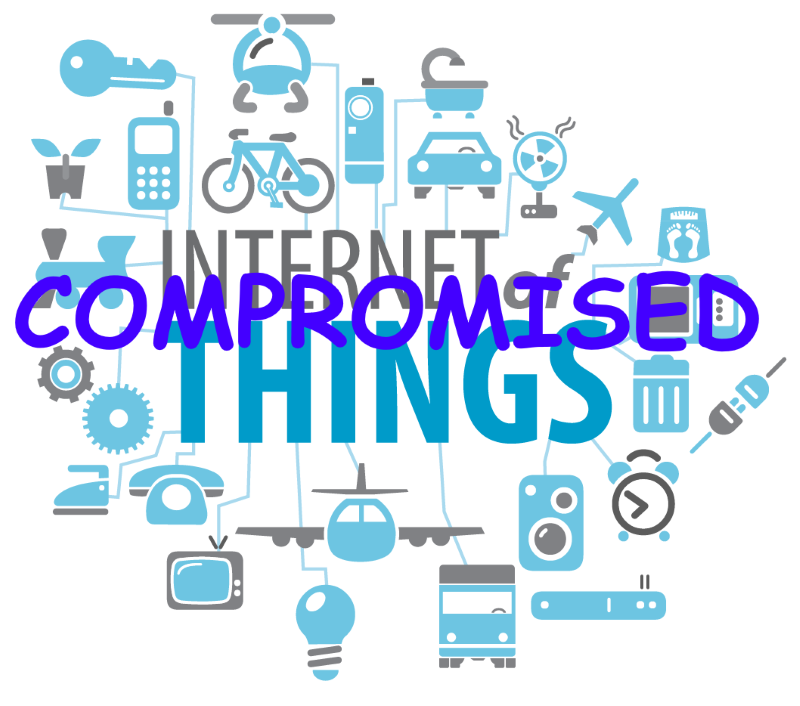
Internet of Compromised Things, more like.
OK, so what can we do about this? There's no perfect answer; I think it has to be a defense in depth strategy.
Inside Your Home
Buy a new, quality router. You don't want a router that's years old and hasn't been updated. But on the other hand you also don't want something too new that hasn't been vetted for firmware and/or security issues in the real world.
Also, any router your ISP provides is going to be about as crappy and "recent" as the awful stereo system you get in a new car. So I say stick with well known consumer brands. There are some hardcore folks who think all consumer routers are trash, so YMMV.
I can recommend the Asus RT-AC87U – it did very well in the SmallNetBuilder tests, Asus is a respectable brand, it's been out a year, and for most people, this is probably an upgrade over what you currently have without being totally bleeding edge overkill. I know it is an upgrade for me.

(I am also eagerly awaiting Eero as a domestic best of breed device with amazing custom firmware, and have one pre-ordered, but it hasn't shipped yet.)
Download and install the latest firmware. Ideally, do this before connecting the device to the Internet. But if you connect and then immediately use the firmware auto-update feature, who am I to judge you.
Change the default admin passwords. Don't leave it at the documented defaults, because then it could be potentially scripted and accessed.
Turn off WPS. Turns out the Wi-Fi Protected Setup feature intended to make it "easy" to connect to a router by pressing a button or entering a PIN made it … a bit too easy. This is always on by default, so be sure to disable it.
Turn off uPNP. Since we're talking about attacks that come from "inside your house", uPNP offers zero protection as it has no method of authentication. If you need it for specific apps, you'll find out, and you can forward those ports manually as needed.
Make sure remote administration is turned off. I've never owned a router that had this on by default, but check just to be double plus sure.
For Wifi, turn on WPA2+AES and use a long, strong password. Again, I feel most modern routers get the defaults right these days, but just check. The password is your responsibility, and password strength matters tremendously for wireless security, so be sure to make it a long one – at least 20 characters with all the variability you can muster.
Pick a unique SSID. Default SSIDs just scream hack me, for I have all defaults and a clueless owner. And no, don't bother "hiding" your SSID, it's a waste of time.
Optional: use less congested channels for WiFi. The default is "auto", but you can sometimes get better performance by picking less used frequencies at the ends of the spectrum. As summarized by official ASUS support reps:
Set 2.4 GHz channel bandwidth to 40 MHz, and change the control channel to 1, 6 or 11.
Set 5 GHz channel bandwidth to 80 MHz, and change the control channel to 165 or 161.
Experts only: install an open source firmware. I discussed this a fair bit in Everyone Needs a Router, but you have to be very careful which router model you buy, and you'll probably need to stick with older models. There are several which are specifically sold to be friendly to open source firmware.
Outside Your Home
Well, this one is simple. Assume everything you do outside your home, on a remote network or over WiFi is being monitored by IBGs: Internet Bad Guys.

I know, kind of an oppressive way to voyage out into the world, but it's better to start out with a defensive mindset, because you could be connecting to anyone's compromised router or network out there.
But, good news. There are only two key things you need to remember once you're outside, facing down that fiery ball of hell in the sky and armies of IBGs.
-
Never access anything but HTTPS websites.
If it isn't available over HTTPS, don't go there!
You might be OK with HTTP if you are not logging in to the website, just browsing it, but even then IBGs could inject malware in the page and potentially compromise your device. And never, ever enter anything over HTTP you aren't 100% comfortable with bad guys seeing and using against you somehow.
We've made tremendous progress in HTTPS Everywhere over the last 5 years, and these days most major websites offer (or even better, force) HTTPS access. So if you just want to quickly check your GMail or Facebook or Twitter, you will be fine, because those services all force HTTPS.
-
If you must access non-HTTPS websites, or you are not sure, always use a VPN.
A VPN encrypts all your traffic, so you no longer have to worry about using HTTPS. You do have to worry about whether or not you trust your VPN provider, but that's a much longer discussion than I want to get into right now.
It's a good idea to pick a go-to VPN provider so you have one ready and get used to how it works over time. Initially it will feel like a bunch of extra work, and it kinda is, but if you care about your security an encrypt-everything VPN is bedrock. And if you don't care about your security, well, why are you even reading this?
If it feels like these are both variants of the same rule, always strongly encrypt everything, you aren't wrong. That's the way things are headed. The math is as sound as it ever was – but unfortunately the people and devices, less so.
Be Safe Out There
Until I heard Damien's story and John's story, I had no idea router hardware could be such a huge point of compromise. I didn't realize that you could be innocently visiting a friend's house, and because he happens to be the parent of three teenage boys and the owner of an old, unsecured router that you connect to via WiFi … your life will suddenly get a lot more complicated.
As the amount of stuff we connect to the Internet grows, we have to understand that the Internet of Things is a bunch of tiny, powerful computers, too – and they need the same strong attention to security that our smartphones, laptops, and servers already enjoy.
| [advertisement] At Stack Overflow, we help developers learn, share, and grow. Whether you’re looking for your next dream job or looking to build out your team, we've got your back. |
Will Harden, Sophianotloren and 4 others like this
10 Aug 23:53
"Pixels" DMCA Takedown Even Worse Than We Thought
by timothy
ForgedArtificer writes: So we all know about the Pixels takedown on Vimeo, and that it was pretty bad in a lot of ways. But did you know that they took down the short film that inspired the movie? Turns out, the 2010 Pixels, which was taken off Vimeo due to copyright notice, was responsible for inspiring the entire Adam Sandler flick. Unlike Sandler's film, it's critically-acclaimed and has won awards. Talk about kicking someone when they're already down. First Patrick Jean gets to watch them violate his work and now they're claiming that his work violates theirs.


Read more of this story at Slashdot.
Randy Laue, Sophianotloren and 2 others like this
10 Aug 23:53

by Annabelle LovLoree

by Annabelle LovLoree

by Annabelle LovLoree

by Annabelle LovLoree

by Annabelle LovLoree

by Annabelle LovLoree

by Annabelle LovLoree

by Annabelle LovLoree

by Annabelle LovLoree

by Annabelle LovLoree
floralls: Le Jardin Secret by Annabelle LovLoree
by Annabelle LovLoree
by Annabelle LovLoree
by Annabelle LovLoree
by Annabelle LovLoree
by Annabelle LovLoree
by Annabelle LovLoree
by Annabelle LovLoree
by Annabelle LovLoree
by Annabelle LovLoree
by Annabelle LovLoree
Le Jardin Secret by Annabelle LovLoree
10 Aug 23:52
So when do I get paid(Buy a print of this comic)

Sophianotloren, Tertiarymatt and 2 others like this
10 Aug 23:51


#1149; The Prodigal Slur
by David Malki

Scott Akerman, Sophianotloren and 5 others like this
10 Aug 23:51
Tupac Startup
An incredibly promising new company that unexpectedly dies at it's prime.
Sophianotloren likes this
10 Aug 23:51
If Daniel Radcliffe Were Your Boyfriend
by Miranda Dubner
If Daniel Radcliffe were your boyfriend, he would be turned on by the fact that you win whenever you arm-wrestle. He’d look for excuses to arm-wrestle.
If Daniel Radcliffe were your boyfriend, you would wake up really early on purpose, just so you would have more time to laze around in bed together, reading. Sometimes he’d nudge you awake before dawn so the two of you could watch the sunrise on the roof with a blanket around your shoulders. You’d be grumpy at first, but he’d already have tea ready for you, and he’d be so scruffy and rumpled and earnest you’d just let yourself relax and sink into the morning with your head on his shoulder.
If Daniel Radcliffe were your boyfriend, he would beg you, from the bottom of his heart, never to make Harry Potter spell jokes in bed.
If Daniel Radcliffe were your boyfriend, he’d be endlessly in awe of how you don’t seem to mind that his life is very peculiar and different from yours, and he'd hate dragging you into it but love being with you whether he’s in “movie star mode” or not. You’d just smile and tell him it’s all an adventure, and it’s a fine trade-off for everything you have together that when you go to Comic-Con he’s always wearing costumes with hoods or helmets.
If Daniel Radcliffe were your boyfriend, whenever you were in a bookstore (which would be very often) he’d nudge the books shelved around where your last name would be, leaving a gap. He would whisper, “That’s where you’re going to be someday,” with such confidence and affection that you’d melt and have to hide your blush behind a stack of Poirot novels.
If Daniel Radcliffe were your boyfriend, there would be a much higher concentration of show tunes in your life. He’d want to sing every duet with you.
Read more If Daniel Radcliffe Were Your Boyfriend at The Toast.
Sophianotloren, Tertiarymatt likes this
10 Aug 23:49
Link Roundup!
by Nicole Cliffe
Preschool assistance is SO important. You now have to make under $630 a month to qualify for help, can you imagine making $650 a month with CHILDREN and being told you're too rich? The old bar was at $2000, it's been absolutely gutted:
That’s because Gov. Bruce Rauner’s administration has frozen admissions to the state’s Child Care Assistance Program and enacted new eligibility guidelines that will put the program out of reach for 90 percent of families who previously would have qualified.
Yes, I’ve been writing a lot about this topic. It’s important. Screwing up this program could have a negative ripple effect for months and years to come.
*
I really do hope you read the first of Ella's Bisto Legs Diaries about her boyfriend's nasty blood cancer and share it all over social media, because I'm hoping a wolf-like super-agent will swoop in and snatch her up and make her very famous and out of our league and also find a perfect bone marrow match for Tall Man.
*
Read more Link Roundup! at The Toast.
Sophianotloren likes this
10 Aug 23:49


This type of container was held in the hand and served as either...
This type of container was held in the hand and served as either a perfume burner or hand warmer. Inside is a small brass cup that held a small quantity of smouldering charcoal. The cup is suspended within a set of gimbals which kept it level and prevented the burning charcoal from touching the surface of the container. Sometimes incense was added to the charcoal to perfume the air.
This brass piece was made in Venice and has the elaborate decoration associated with the city that was influenced by trade with the Muslim empires that bordered the Mediterranean. Unlike Northern European brass work, Venetian brass wares were almost always engraved and often inlaid with silver wire. This technique was known as damascening and was a speciality of Saracen artists. In this case, the maker has further defined the pattern by adding inlaid black lacquer.
The decoration on Venetian brass wares was extensive, often covering the entire surface of an object. It sometimes featured the arabesque pattern, based on a stylised plant with a winding stem. Contemporary Italian artists studied and copied the arabesque and by about the 1550s it was beginning to influence designers and craftsmen all over Europe.
10 Aug 23:49


thisisaadl: Gorgeous marine life illustrations from Shells and...
Gorgeous marine life illustrations from Shells and other Marine Life from Albertus Seba’s Cabinet of Natural Curiosities (1734) (via Public Domain Review)


10 Aug 23:46

IG: @Lohfashion
IG: @Lohfashion
Adam Victor Brandizzi, Sophianotloren and one other like this
10 Aug 23:39
Inside UIUC’s War on Academic Freedom
by Scott Lemieux
 Above: Texas governor Coke Stevenson, the ideal leader for the modern administator
Why was Steve Salaita fired, without the process he was due, because of political views he expressed, in obvious defiance of the most basic norms of academic freedom? John Wilson, who has been doing fantastic work on this from the beginning, has a long and very useful look at the emails sent by disgraced former president Phyllis Wise. Not surprisingly, former Board of Trustees chair Christopher Kennedy emerges as a particularly villainous figure. First, on his view of academic freedom:
Under “Obligation to Meet Norms of Society,” Kennedy writes: “the University, as the state’s public university, needs to, in many ways, reflect the values of the state.” He warns of a backlash if they are “too cavalier,” one that will “hinder our ability to free ourselves of unwanted procurement rules” and similar important values of the University. Kennedy seemed mostly interested in the state de-regulating economic decisions of the University, and felt that controversial professors would interfere with his goal.
We must destroy academic freedom in order to preserve our ability to get rid of economic regulations. Universities must reflect the values of the state government! Coke Stevenson couldn’t have said it better.
Where an argument that free speech cannot be tolerated if it disagrees with the values of public officials, complaints about civility are highly likely to follow:
Finally, under “Civility,” Kennedy wrote, “Our campus in Urbana is plagued right now with a civility issue. We are all, of course, perplexed by the lack of civility that our students showed in their criticism of an administrative decision. Perhaps we shouldn’t be so surprised by their conduct, given the fact that we have held up to the students examples people like this fellow who thought it was ok to target cops and non-combatants for murder as an expression of political disagreement.”
The problem with allowing free speech is that peons might get the idea that they are permitted to criticize the actions of their superiors and betters, which is inherently uncivil!
I’m also amused that Kennedy thinks that Salaita is comparable to Bill Ayers. Tweets that Christopher Kennedy disagrees with are pretty much like setting off multiple bombs, apparently.
Even worse is when faculty members repeat this we-must-destroy-academic-freedom-in-order-to-save-it nonsense:
The Kilgore case also reveals another major influence on Wise: education professor Nicholas Burbules, who had gained Wise’s trust and support. On Feb. 11, 2014, Burbules wrote an email to Wise discussing ways to ban people like Kilgore from being hired: “A related policy might address the question of ‘controversial’ hires—this is murkier, because people’s ideas of what is controversial will differ. But a crude rule of thumb is, if you think someone’s name is going to end up on the front page of the newspaper as a U of I employee, you can’t make that decision on your own say so. You need to get some higher level review and approval.” As a standard of academic freedom, this is simply appalling: Burbules wanted to explicitly make the controversial status of someone grounds for banning their hiring without permission from top administrators. And that permission would almost never be granted, since he called for “policy changes or new procedures that tell people, ‘We’ve looked into how this happened and here’s what we’re doing to make sure it doesn’t happen again.’”
Burbules advocated “a more principled statement of what the U of I stands for: that we welcome the widest possible range of viewpoints and positions, but not all positions. And that there are some things that are not consistent with our values.” It certainly took chutzpah for Burbules to call his demand for firing controversial faculty “more principled” and welcoming the “widest possible range” of ideas.
“We must tolerate the widest range of views that are sufficiently anodyne that they would not generate any controversy. The principles of free speech and academic freedom should apply only to cases when they are not necessary.” Ye gods.
Wilson’s conclusion:
But it is clear that COM and the Kilgore cases caused Wise and Board to act quickly to decide to fire Salaita, without ever examining his record or hearing from anyone who might disagree with their decision. The disastrous decision to get rid of Salaita was an impulsive reaction by powerful people who understood almost nothing about academic freedom and shared governance, and surrounded themselves with yes men who never questioned their opinions.
Precisely so, and how embarrassing for the academics who defended the firing. Alas, the Illinois taxpayers whose money Wise decided to piss away as she sacrificed academic freedom for other institutional goals won’t get a golden parachute.
Sophianotloren likes this
10 Aug 23:39
Georgia Is Segregating Troublesome Kids in Schools Used During Jim Crow
by Marian Wang
Georgia has been illegally and unnecessarily segregating thousands of students with behavioral issues and disabilities, isolating them in run-down facilities and providing them with subpar education, according to an investigation by the United States Department of Justice.Some of the students in ...

Sophianotloren likes this