Shared posts

07 Jun 08:52

HeavyM - KickstarterProject to bring the easiest to use...


HeavyM - Kickstarter

Project to bring the easiest to use projection mapping software has launched a Kickstarter campaign to fund new features such as an improved interface, MIDI compatibility for audio / visual effects, a Mac version and much more:

HeavyM is an intuitive and easy to use software. You plug in your projector and direct it towards the surface you wish to dress up. You can build your own setting or use an interesting volume in the room. Then, the shapes you draw on HeavyM will magically appear in reality in front of you. 

We prepared you a whole lot of visual effects already integrated in HeavyM that will allow you to express all your creativity. No need to be a graphist, all the animations are available in a click! All these effects will give you the possibility to make your canvas alive: rotation, shaking, colorization, movement on the borders are already implemented! Have fun combining all of them :D

You want to play it your way? You can also import your own videos and project them on your volumes. HeavyM also contains a sound synchronisation feature that makes your visual effects interact with the environing music. Which will make your shapes change colors and adapt your effects to the music.

Looks like a great way to get into projection mapping, for home parties and small clubs (or even installation work).

You can find out more at the Kickstarter page here, or at the HeavyM website here

28 May 06:19

Painting a Kangaroo When You’ve Never Seen One

by Allison Meier
Strange Creatures: The Art of Unknown Animals

George Stubbs, “The Kongouro from New Holland (Kangaroo)” (1772), (courtesy National Maritime Museum, Greenwich, London)

To show animals of distant locales to the public in centuries before photography, artists were sometimes enlisted to recreate exotic fauna through secondhand descriptions or some scrap of skin or skeleton. Strange Creatures: The Art of Unknown Animals, opened in March at the Grant Museum of Zoology at University College London, examines this often inaccurate first glimpse of an unknown animal.

The centerpiece is George Stubbs’s “The Kongouro from New Holland (Kangaroo)” (1772), considered the oldest European painting of a native Australian animal. The 18th-century marsupial and its companion painting of a dingo (not included in Strange Creatures) almost left the UK, but in 2013 were stopped in an export ban and purchased through a donation by the National Maritime Museum. Slightly misshapen, as it was based on a puffed up skin and skull acquired by Captain Cook, the kangaroo with its dark canny eyes is now on a British tour. After the Grant Museum, the painting visits London’s Horniman Museum and Gardens, the Captain Cook Memorial Museum in North Yorkshire, and then the Hunterian Museum in Glasgow.

Strange Creatures: The Art of Unknown Animals

Enea Vico, “A Rhinceros” (after Albrecht Dürer) (1558) (courtesy UCL Art Museum, University College London)

Strange Creatures is installed amidst the Grant Museum’s zoological specimens: a herd of intact and partial belated animals hovering in jars. This is a purposeful contrast between the biological specimens and those artistic interpretations. The most famously wrong and wildly popular Dürer’s rhinoceros is shown copied in 1558 by Enea Vico, a mammalian version of a tank, sporting skin that weighs like armor with an extra horn on its shoulders. Neither artist had ever seen the animal in person.

Strange Creatures: The Art of Unknown Animals

Bernhard Siegfried Albinus, “From Tabulae scleti et Muscularum Corporis Humani” (1747), showing Clara the rhinoceros in the background (courtesy Wellcome Library, London) (click to enlarge)

The Dürer-inspired rhino is contrasted against a much gentler beast in the background of a 1747 anatomical illustration by Bernhard Siegfried Albinus, the rumple-skinned animal grazing while a flayed skeleton poses in the foreground. This later depiction was based on the rhinoceros Clara, who toured Europe for 17 years in the 18th century, and was the first rhinoceros to appear on the continent since 1579.

Similarly, the first elephant illustrated by Matthew Paris for the 13th-century Chronica Maiora shows a comically long beast with a pudgy belly drawn in 1241, while in the same work a much more accurate elephant from 1255 was modeled on a real-life animal that was at the Tower of London.

In later centuries, models and dioramas turned the skins of animals into more dimensional interpretations, although they still often got it wrong, like the overstuffed 1860s Horniman Museum walrus with not a wrinkle on its inflated body. The Grant Museum emphasizes that despite our greater capacity for communication, inaccuracies continue, such as with toy dinosaurs that perpetuate the 19th-century view of lizard-like dinosaurs with dragging tails, something now disproved.

Strange Creatures: The Art of Unknown Animals

“Dinosaur and other extinct animal models of varying accuracy,” showing how although the 19th-century view of lizard-like dinosaurs with dragging tails was disproved, they still appear in 20th-century toys (courtesy UCL Grant Museum of Zoology)

And going back to the Stubbs kangaroo, the anatomically-imperfect animal is still has a presence, from appearing on Australia’s first coat of arms to inspiring numerous engravings. Now we can Google all the kangaroo photographs we like (an activity that’s recommended), but it’s still worth looking back at these first impressions and considering their shadow, based more on artistic interpretation than live science.

Strange Creatures: The Art of Unknown Animals

Elephant illustration by Matthew Paris before he saw one in person, from ‘Chronica Maiora’ (13th century) (courtesy Master and Fellows of Corpus Christi College, Cambridge)

Strange Creatures: The Art of Unknown Animals

Elephant illustration by Matthew Paris, after he saw an elephant at the Tower of London, from ‘Chronica Maiora’ (13th century) (courtesy Master and Fellows of Corpus Christi College, Cambridge)

Strange Creatures: The Art of Unknown Animals

Anonymous (Dutch), “A Lion in a Landscape” (late 17th century) (courtesy UCL Art Museum, University College London)

Strange Creatures: The Art of Unknown Animals continues at the Grant Museum of Zoology at University College London (21 University Street, London) through June 27.

28 May 06:18

“But there is one thing in this story that checks out. There does appear to be a University of California Los Angeles.”

by Scott Lemieux

Shattered Glass

Oh my:

In that section, he lists as one of his awards: “Emerging Instructor Award, UCLA Office of Instructional Development, 2013-2014. One of three UCLA graduate student instructors selected for excellence in their first year of teaching” (formatting his). But a staffer in the office of instructional development told Science of Us that it does not give out an award of that name. “I don’t know if he either misnamed our department or if it’s from another department,” said the staffer, who only agreed to be quoted if I didn’t use her name. “I’m not clear on what happened.”

[…]

I emailed LaCour for comment, and he asked if I’d hold off on publishing this until he released a planned statement about the whole affair. I told him I couldn’t unless the statement contained information pertinent to the nonexistent teaching award. Shortly thereafter, a browser extension I installed to notify me when his website changed pinged me. His website’s link to his CV, which he’d taken down from his site recently, is now back up. This version no longer lists the Emerging Instructor Award, and the entire “Original Grants & Data” section has been cut.

Somehow, I don’t think his allegedly forthcoming explanation is going to be convincing. (See also this.) You almost have to feel bad for the guy at this point.

Further thoughts on the larger issue from Azari and Drezner.

27 May 22:47

Exculpating the Republican Party, 1960s Edition

by Scott Lemieux

e99fa6219d25428080785aac6cd1640e-e99fa6219d25428080785aac6cd1640e-0

One thing that many people “know” about the 1964 Republican presidential nomination is that Nelson Rockefeller lost, despite being a frontrunner, because of his marriage to the late Happy Murphy. One obvious problem with the narrative is that if the rejection of Rockefeller was based on “character” reasons, the support should logically have gone to ideologically similar candidates like Romney or Hatfield. Instead, it went to Goldwater. This is because more important than his affair and marriage was that he was a liberal on civil rights:

The day before the Rockefeller wedding, and the day after Birmingham exploded, Joseph Alsop of the Washington Post, one of the era’s leading pundits, concluded that “Rockefeller’s heaviest single handicap” was his aggressive and consistent liberal record on race. This was especially true after Birmingham, which shocked the nation and convinced many in the Republican Party that they needed to stay far away from the controversial issue of civil rights. Alsop noted that Rockefeller’s strength as a candidate was a concern among party professionals, who believed his nomination would forfeit all support from southern states—and a fair amount of support in other regions, too, for that matter—in the general election. A remarriage, in Alsop’s opinion, would give some Republicans cause to rethink Rockefeller’s nomination and to reconsider Goldwater, who, they believed, could successfully carry every southern and border state. While nominating Goldwater would most likely mean losing the urban North, some Republicans preferred to take that chance.

If we’re going to pretend that Rockefeller getting steamrolled by Goldwater was about something other than his ideology being too liberal for Republicans in 1964, I’d prefer that we cite his fascist architectural tastes and leave poor Happy alone…

27 May 22:47

All of your feline fantasies come true in 'Catlateral Damage'

by Jessica Conditt
Life would be so much easier as a cat. Few humans recognize the potential for feline bliss better than Chris Chung, the creator of Catlateral Damage, a first-person cat simulator. As a kitty locked up in a house full of annoying human things, your go...
27 May 22:24

Amazon Faces Off Against Penguin Random House

by Ian MacAllen

Last year’s battle between Amazon and Hachette over book prices and online sales seems only to have been a portent of an ongoing crisis between publishers and the online retailer. While HarperCollins was able to rather quickly negotiate a deal earlier this year with the online retailer, Amazon is now in a similar showdown with Penguin Random House. Penguin Random House was formed by the merger of two already huge publishers, Penguin and Random House (who disappointingly did not become Random Penguin). This negotiation with Amazon is its first as a combined company. Melville House breaks down the latest sticking points of the negotiation, including rumors that Penguin Random House might block book sales on the site.

Related Posts:

27 May 22:23

amazingexplodingwoman: inkyubus: [on diversity in media] I...


amazingexplodingwoman:

inkyubus:

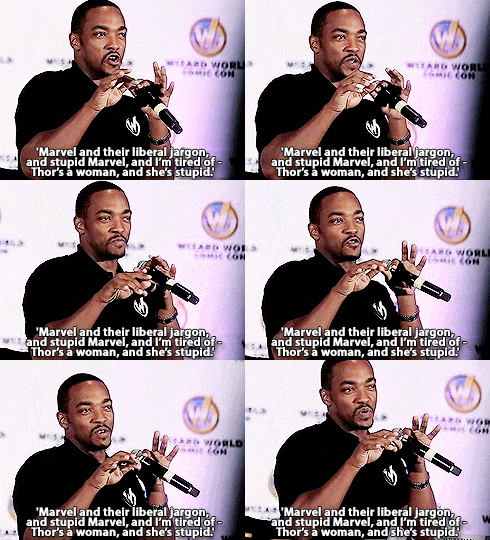
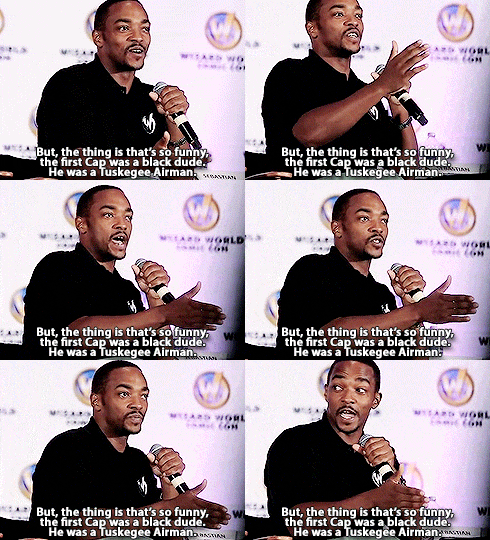
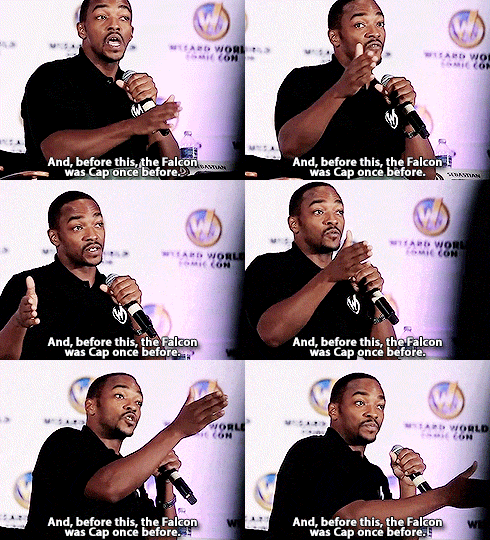
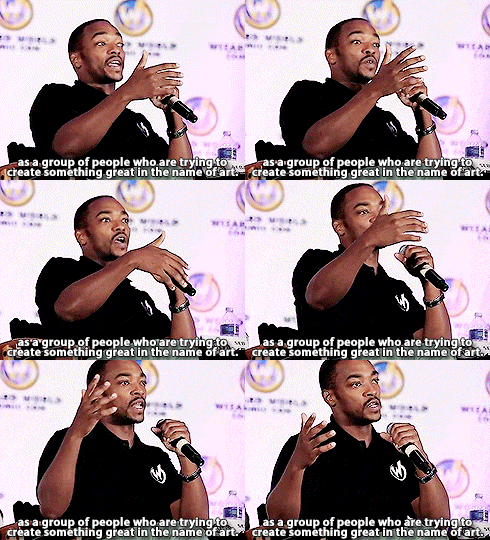
[on diversity in media] I think its social responsibility. I think it’s our responsibility to stand up and say what we want. It think if you look at television in the past two years, it’s becoming the decade of the female. Like, all these new shows with female leads. Even if you look at television, as well as cable, as well as films, there’s been a resurgence, as far as the leading woman in Hollywood, which is great. And I think we’re also at the point now…you know, it’s interesting…x

GOD BLESS THE ANGEL THAT IS ANTHONY WHERE DO I FIND A MAN LIKE THIS

Gods save us from fake geek boys

27 May 22:22

Wait, FIFA officials take bribes? Next you’ll tell me bankers rig the financial system

by Paul Campos

renault

Acting on an indictment by the U.S. Justice Department, Swiss police arrested several top FIFA officials, including two vice presidents, during an overnight raid in Zurich on charges of corruption Wednesday.

The U.S. investigation targets alleged wrongdoing that spans 24 years. U.S. prosecutors issued arrest warrants for 14 people, on charges ranging from money laundering to fraud and racketeering. They include FIFA officials who took bribes totaling more than $150 million and in return provided “lucrative media and marketing rights” to soccer tournaments as kickbacks.

A few hours later, Swiss authorities said they have opened a separate criminal investigation into FIFA’s operations, this one pertaining to the 2018 and 2022 World Cup bids, which went to Russia and Qatar respectively. Ten people are being questioned.

The criminal proceedings come as members of soccer’s scandal-plagued governing body gathered for an election Friday that could give its leader Sepp Blatter a fifth term.

Blatter isn’t among those being charged. But he was among those investigated, and officials say that part of the probe continues.

The election will go on as planned, FIFA said — as will the games in Russia and Qatar.

“The timing may not obviously be the best, but FIFA welcomes the process,” FIFA spokesman Walter De Gregorio told reporters.

27 May 22:22

Is It Still Robbery If You Just Ask Nicely?

by Kevin

Let's say you walk into a bank, go up to a teller and say something like, "Hi, I was just passing by your bank and thought I'd stop in and see if you'd be willing to give me some money. Could I have some money?" The teller looks at you for a minute and then gives you $28,000. You leave.

Problem?

According to this report, that'll be the issue in the trial of Michael Hadar, an Israeli man indicted a couple of weeks ago for robbing at least eight banks in the last five months. Here's what he did:

In each case, his "modus operandi" was the same: He would walk into the bank and choose a likely looking teller. He would instruct her (it was usually a woman he chose) to gather up some cash and place it into the bag he very politely slid over the counter, as he told her that he had no plans—or means, for that matter—of hurting her or anyone else. There was no running or exciting chase scenes; when his business was done, Hadar walked quietly out of the bank.

In total, he was able to get $28,000 this way. The indictment describes this "modus operandi" as "a very effective method that has proven itself." Yes, it is a very effective method for getting something—it's called asking.

We use a variety of terms to refer to illegal ways of getting stuff from people. "Robbery" means taking something from a person by means of violence or a threat of violence. For example, California defines it as "the felonious taking of personal property in the possession of another, from his person or immediate presence, and against his will, accomplished by means of force or fear." If the threat is of something other than violence, like disclosing something they want kept secret, that's extortion. If you get the property through fraud rather than by "force or fear," that's larceny. And so forth.

I am hardly an expert on Israeli law, but if this is in fact an accurate translation of the Israeli Penal Code, it defines "robbery" in similar terms:

If a person steals a thing and, while he does so or immediately before or immediately thereafter, performs or threatens to perform an act of violence ... in order to obtain the stolen thing or to retain it or to prevent or to prevent or overcome resistance to its being stolen, then that constitutes robbery ....

Well, he didn't do that.

Not only did he not threaten to perform an act of violence, he specifically said he wasn't going to do that and made clear that he did not have a weapon of any kind. The report doesn't suggest that he tried to be intimidating or that any of the tellers actually felt intimidated. He just politely asked for money, and they gave it to him. That's not robbery, extortion, larceny, or any other crime that I can think of. It's just a successful request.

That wouldn't mean that our hero would be able to keep the money, since the tellers were giving away money that didn't belong to them and that they didn't have the authority to give. It doesn't seem that different from a case in which an ATM mistakenly spits out a lot of money and the recipient promptly spends it all, because the law says you can take advantage of bank errors in your favor, right? Nope. That's Community Chest you're thinking of there, my friend.

Bankerr

The bank teller may or may not have made a "mistake," but the principle I think is the same: there was no authority for the transfer, and so the bank is entitled to get it back. But that doesn't mean there was a "robbery" in the first place. If he doesn't have the money anymore, I'm sure they'd find a way to charge him with theft or conversion after the fact, as in this case. But I'm not seeing these as "bank robberies."

Do I need to mention that you should not rely on this (or on Monopoly cards) as legal advice the next time you visit the bank? Or that the odds that a teller would later claim to have been intimidated, no matter how polite you were, would approach 100 percent? I don't? Okay, good.

27 May 22:20

f(o)etus and f(o)etal --and a bit on sulfur/sulphur

by lynneguist
If you're looking for discussion of other (o)e or (a)e words, please click here to see/comment at the more comprehensive post on the topic.

So, as we've seen in that aforementioned blog post, British and American spelling differ sometimes in the use of the ligature (connected letter) œ, or as it's more often written now, the digraph (two letters for one sound) oe. To give a quick summary of the story so far:
  • English took a lot of its œ words from Latin.
  • Latin got them from Greek. œ is Latin's way of representing the Greek .
  • American English (following Noah Webster and other spelling reformers) usually simplifies the Latin/Greek oe to e
But then there's foetus (or fœtus). This is a British spelling of the Latin word fetus. That is to say, the œ might look like it comes from a classical language, but it just doesn't. Sometime in the 16th century, someone (mistakenly, one might say) started spelling it with an œ, and it stuck.

This creates a dilemma for British spellers who know a bit about Latin. Spell it foetus and commit a little etymological crime. Spell it fetus and get accused of Americanization by people who don't know about the Latin--and maybe even by some who do know about it. And if there's one thing worse than committing Latin sins, it's being accused of spelling like an American.

But still, brave British doctors have fought to get rid of the o, mostly by writing letters to the editor of major medical journals. Here's one:

I shall resist to the  last ditch any movement for the general replacement of diphthongs* by single vowels – the American practice. But when, etymologically, the foreigner is correct and we are wrong, it would seem that by adhering obstinately to a false diphthong we are weakening our case for maintaining our justifiable diphthongs in the face of contrary “common usage” by far more than half the English-writing world. (Napier, L. Everard. 1 Nov. 1952. The correct spelling of medical terms [Letter to the Editor]. The Lancet vol. 260, pp. 885-6.)

The Lancet and the British Medical Journal now consider fetus and fetal the ‘correct’ spellings, and the Oxford Dictionaries entry for fetus remarks:
The spelling foetus has no etymological basis but is recorded from the 16th century and until recently was the standard British spelling in both technical and non-technical use. In technical usage fetus is now the standard spelling throughout the English-speaking world, but foetus is still found in British English outside technical contexts

At the foetus entry, it just says: "Variant spelling of fetus (chiefly in British non-technical use)."

How true is this, that it's the accepted technical spelling in the UK? In The Lancet and the BMJ, it's doctors writing for other doctors. What about the rest of the medical professions? What about when medical types communicate with patients?

My first stop was the NHS Choices website, where the readers are would-be patients. A search for foetus brings up 27 hits, but fetus has 7. But, going the other way, foetal has 66 hits and fetal 82. What's going on?

I contacted the website to ask if they had a policy on this and they were extremely helpful (as the NHS always has been for me ♥♥♥). They put me in contact with their Head of Editorial Production, who sent me both a link to their style guide (which has fetus as an Americanism to be avoided) and his own document entitled 'Fetality', which he wrote when the Fetal Anomaly Screening Programme (so spelled) asked if the rest of the website could switch to fetal/fetus. In his paper he gives several arguments for retaining foetus/foetal, even on pages where it will conflict with the FASP program(me)'s spelling, but I think this first one is key:
NHS Choices is a ‘British English’ service and, as stated in its Editorial Style Guide, is bound to:
·       Write plain English
·       Avoid medical jargon and technical terms as far as possible
On the basis of those two points, if it is accepted that foetus is the general spelling and fetus the technical-medical, NHS Choices should use foetus.
(Bolton, Barry. 2014. Fetality. Internal document, NHS. Received with thanks from the author.)
Looking again at the o-less hits on the NHS Choices site, many of them seem to be in comments from site users--so the house style doesn't apply. Are they misspelling it, or do they know the 'technical' spelling? Why so many more fetals? Possibly because it's in the name of a lot of things, not just the FASP program(me), such as the 'Fetal Medicine Unit team at St George's Hospital', which is indeed how the hospital spells that unit's name.

It's an interesting mixture: the NHS website keeps the traditional British spelling in communication with patients in order to avoid technical language, but the hospitals and such seem quite happy to foist the technical spelling on patients in the names of units and program(me)s.

To investigate this a little further, I did a little survey in which I asked for UK medical personnel to tell me which spelling they would use in a work context: foetus or fetus, sulphur or sulfur and amoeba or ameba. F(o)etus was the only one that respondents disagreed about:

 
(The 'it depends' person gave that answer for every question and said they'd use the American spelling if they were writing to an American.)

I invited respondents to explain their preferences to me, but unfortunately only four did, and two of those used the space to tell me about words I hadn't asked about. The two relevant comments were:
I am an allied health professional who wouldn't use these words much in my work, but these were how I was taught to spell them at school. I've heard in the past that "foetus" is completely wrong, though I can't quite remember why and I write the word so infrequently that I wouldn't change my spelling of it anyway!
and apparently not knowing about the etymology of fetus:
Homogenisation of the English language to accommodate American English is a pernicious assault on the richness and diversity of English usage. It shouldn't be tolerated!
Unfortunately, I didn't ask for demographic information beyond country of abode, so I can't see whether the people who prefer fetus are in professions in which they need the word more often than the ones who prefer foetus.

But my impression is that fetus/fetal seems to be something of a medical shibboleth in the UK now. Doctors use the e spelling and it sets them apart as 'in the know', and maybe they don't mind that the rest of the country goes about putting the o in it. All the better to tell who the truly educated are. I'd love to hear from people 'in the know' in the comments. Have I got that wrong?

And before I leave, a note about the other false etymological form that readers of The Lancet (well, at least one) have tried to change. Here's another letter to the editor:
SIR,-Spelling is a curious blend of phonetics, etymology, tradition, and nonsense ; we should take care not to let the last preponderate. Dr. Napier (Nov. 1) is to be congratulated on his attack on the absurd o which it is customary now to insert into fetus. I would like to raise support for a similar attack on the ph with which we generally mis-spell sulfur and the other words derived from it. Sulfur comes from a Latin word. Undeniably some Latin authors used the ph form, but there is good reason to think that this was a blunder, and most of the European languages that use the Latin root have not followed the erroneous spelling. The spelling sulfur was common in Britain from the 14th to 18th centuries, and this presumably explains its present day use in the U.S.A. It is in no sense an American innovation.  (Pirie, N.W. 15 Nov. 1952.The correct spelling of medical terms [Letter to the Editor]. The Lancet vol. 260, pp.987-8.)

The argument for sulfur seems not to have been heard—sulphur still rules Britannia absolutely.


Footnote
*It's a digraph, not a diphthong, but what do doctors know?


In other news...
Votes, please? I failed to be self-promotional enough to make it to the voting round for Bab.la's Top Language Lovers blog competition this year. (I foolishly assumed being nominated was enough to get to the voting round.) But I did get to the finals for my Twitter feed, under my name (Lynne Murphy), rather than my Twitter handle (@lynneguist). But if you (BrE) fancy helping me out with a vote (or sabotaging me with a vote against!), please click here to go to the voting page.

Cheeky Nando's: Marking season is to blame for many things, including my failure to do a timely, topical post on the Buzzfeed 'Cheeky Nando's' phenomenon. But happily Ben Yagoda has done one at the Chronicle of Higher Education Lingua Franca blog, so now I probably don't have to!  (To discuss cheeky Nando's, I recommend leaving comments at his post.) What I have done a post on is the BrE use of 'a [fast-food type]' to refer to a fast-food meal (a Chinese, a Burger King and, of course, a Nando's).

Thanks for reading to the bottom--this is longer than the (BrE) first-year essays I assign!
27 May 22:15

Mad Men, Religion, and Why We Need to Talk About More than Don Draper

by Sarah Veale

Exodus  With Mad Men wrapping up, the media has been buzzing, not just with dissecting the series’ ending, but also about the religious overtones of the final episode: The show’s lead, Don Draper, winds up at a meditation retreat and maybe finds inner peace. (I say maybe because I watch Mad Men on Netflix and have been trying like hell to avoid spoilers for the second half of season seven!)

While this episode (or what I know of it from various pictures and headlines) certainly memorializes America’s shift into New Age/Eastern practices, it is not the first time Mad Men has incorporated religion into the show. In fact, the series has examined the intersection of religion and modernity throughout its run.

OlsenPriestBoth regular characters (Peggy Olsen, Michael Ginsberg, Paul Kinsey) and tertiary figures (Rachel Menken, Sylvia Rosen) have brought religion to the fore front of the show. Menken, in conversation with Don about “What Jewish people want,” notably described herself as Jewish—but not that Jewish. A move which highlighted the cultural, rather than religious, dimensions of faith. Rosen, citing Catholic values, criticized Megan Draper (Don’s second—or is it third?—wife) for considering an abortion while carrying on an affair with her husband behind her back, evoking a number of tut-tuts from viewers who already knew she was selective in her interpretation of religion.

Take it Break It Share ItThe early seasons of the show illustrated the tension of Olsen’s Catholic upbringing and her desire to unshackle herself from past values and chart her course as a professional woman. Not only was this overtly seen in episodes wither her family or parish—uncomfortable exchanges which had her confront the priesthood and her family head-on, but this was also expressed in her approach to advertising, which often highlighted the ritual dimension of activities. Her pitch for Popsicles featured a mother dispensing treats to her children in a Virgin Mary-esque pose, and her pitch for Burger Chef was centered on the idea of breaking bread—the central eucharistic ritual of the Catholic mass. The incorporation of faith into Olsen’s character both professionally and privately illustrated how intertwined religion was (and is) with other areas of life, both as a social practice and collective mythology.

Ginsberg, too, was a character who was compelled to redefined religion in a changing world. His biography seethes with adjustment: born in a concentration camp during the holocaust, he had a difficult relationship with his conservative father, and was acutely aware of his outsider Jewish status. Nevertheless, no matter how much Ginsberg rebelled against his upbringing, he still played the role of dutiful son, skillfully blending time-worn values of faith and family with his success in the secular world.

And, of course, there was that time when Paul Kinsey had joined the Hare Krishnas.

KrishnaMad Men portrayed religion as both a cultural touchstone as well as an institution in transition, as a new generation redefined their relationship to ideas of the past. Mad Men has always looked to religion to provide, if not its main story line, fill in some of the details on the people who inhabited the show’s world, enriching their characters with a personal depth that mirrored the complexity of the relationships on the show.

So sure, Don Draper went to Esalen (or somewhere similar, from what I hear). Like other treatments of religion in Mad Men, it was a way of reflecting the rapidly changing times. Religious themes, expressed through the character development of both key figures and walk-on characters, brought into the open the assumptions, entrenchments, beliefs, and prejudices which surrounded religion both new and old in the latter half of the twentieth century.


Filed under: Culture
27 May 22:13

The Aftermath of a Moops Invasion

by Scott Lemieux

Aftermath.rollingstones.usalbum.cover

Should the Supreme Court declare that the card says “Moops!”, I’m inclined to paint the resulting scenario black. Certainly, most people in red states will have to take Flight 505 to another state if they want to be able to purchase health insurance on a functional exchange. I am waiting for the media to accurately report that this would be a crisis created by a highly partisan Republican Supreme Court and the failure of Republican legislators to act, but they remain under the thumb of “Both Sides Do It” narratives. There may be some rays of optimism — doncha even bother congressional Republicans with acting to put more pressure on Obama, and it’s not always going to be easy for one of the two frontrunners for the Republican nomination when he’s goin’ home to chaos. But the servant of the Koch Brothers he (and the rest of the Republican leadership) is and will humbly remain, and despite the disastrous consequences I think we’d probably be left high and dry.

27 May 22:13

Notable San Francisco: 5/27–6/2

by Charles Kruger

Wednesday 5/27: Jan Ellison will discuss her new novel, A Small Indiscretion, with Kirsten Jones Neff. Ellison was a recipient of a 2007 O. Henry Prize for her first story to appear in print, and has been short listed for The Best American Short Stories and a Puschart Prize. Free, 7 p.m., Book Passage Corte Madera.

Thursday 5/28: Poetry Flash presents The Marin Poetry Center’s Traveling Show featuring Barbara Swift Brauer, Rafaella Del Bourgo, Gerald Fleming, Connie Post, Ann Robinson, and Jeanne Wagner. Free, 7:30 p.m., Moe’s.

Friday 5/29: Nomadic Press, which has been taking Oakland by storm, presents Maw Shein Win and Tim Donnelly. Free, 7 p.m., Nomadic Press.

Saturday 5/30: Jayinee Basu celebrates the release of Asuras. Free, 6 p.m., Press: Works On Paper.

Sunday 5/31: The Oakland Book Festival! This is a biggie: One day. Seven hours. 90 Writers. 40 Events. Can’t list all 90 writers, but it is an amazing line up. You don’t need to take our word for it: check out the link, and make your way to Oak Town, where the scene is exploding. Free, 11 a.m.–6 p.m., City Hall and Frank Ogawa Plaza in Oakland.

Tuesday 6/2: The newest iteration of Inside Storytime (Perversions) will feature David Corbett (The Mercy of the Night), Bich Minh Nguyen (Stealing Buddha’s Dinner), Faith Adiele (The Nigerian-Nordic Girl’s Guide to Lady Problems), Stephen Beachy (boneyard), and Jenny Bitner. Hosted by James Warner (All Her Father’s Guns).

This week’s theatre recommendation is Cutting Ball’s world premier of Mount Misery, a comedy of enhanced interrogations, by resident playwright Andrew Saito. When Andrew Saito heard of Donald Rumsfeld’s purchase of a former plantation house where Frederick Douglass had served as a slave (“Mount Misery”) to serve as a weekend retreat, he wondered what it would be like if Rumsfeld encountered the ghost of Frederick Douglass. This astonishing, surrealistic, black comedy is the remarkable result. For ticket information, click here. Read a review here.

*

Also, check out the San Francisco International Arts Festival! More than 70 ensembles and individual artists are participating. The best of the best: world class! Continues through June 7.


*

This week’s featured local author is A. D. Winans. Read an interview here.

Related Posts:

27 May 22:12

Dante for Days

by Dinah Fay

All of Italy, it seems, is gearing up for a serious, extended celebration in honor of the 750th birthday of the beloved poet Dante Alighieri. John Kleiner writes for the New Yorker about the festivities and the country’s intense relationship with Dante, and attempts to put it all in context for an American audience:

The obvious comparison is to Shakespeare, but this is like trying to make sense of Mozart by means of Coltrane: the number of centuries that divide Dante from Shakespeare is practically as large as the number that separates Shakespeare from us.

Related Posts:

27 May 22:10

Cleveland Police Agree to Stop Hitting People on the Head With Guns

by Kevin
Sophianotloren

le sigh...

No, it's The Onion that makes up fake news stories, not me. In this case, I barely even had to tweak the headline:

Seriously
Cleveland Plain Dealer

Seriously. According to the report, officers of the Cleveland Division of Police (CDP) hit people on the head with guns so routinely that the city has now had to enter into a binding contractual agreement saying that they aren't going to do that anymore:

The Justice Department found in a 21-month investigation that began in 2013 that Cleveland police routinely bash people on the head with their guns, sometimes accidentally firing them, according to a 58-page report released in December.

The report didn't include the underlying data, so it's hard to know how routine this has been. In the section discussing this—a section entitled, "CDP officers hit people in the head with their guns in situations where the use of deadly force is not justified"—DOJ included two anecdotes but no statistics. Overall, DOJ reviewed almost 600 use-of-force reports filed in a three-year period. It didn't say how many of these involved hitting people in the heads with guns, but it was more than two because the report noted that an "accidental discharge" caused by hitting people in the heads with guns "has happened on more than one occasion" but only one of the anecdotes involved this. It seems safe to infer, though, that there are a significant number of examples of officers hitting people in the heads with guns, because the report concluded overall that "CDP officers engage in excessive force far too often" and that their use of excessive force is "neither isolated nor sporadic."

This may not surprise you, given the Tamir Rice case (fake gun, dead sixth-grader), and the recent news about the Brelo case. Although Brelo was acquitted of voluntary manslaughter—on the grounds that the State hadn't proved beyond a reasonable doubt that his shots killed the victims—let us consider the facts of that incident for a moment:

  • Two unarmed people were shot dead in their car
  • By thirteen police officers
  • Who collectively fired 137 shots
  • Hitting each person more than 20 times
  • An unknown number of which were shots fired by Brelo
  • Who emptied two 17-round magazines
  • And then climbed onto the hood and fired 15 more times into the windshield
  • This following a chase that involved 62 vehicles and over 100 officers
  • Which started by mistake
  • Because the car backfired and someone thought it was a gunshot.

Doesn't really sound like a department that is—what's the word?—judicious in its use of force. And so the DOJ concluded. In addition to hitting people in the heads with guns a lot, the report found, CDP officers have a pattern and practice of:

  • Shooting at people who don't pose an imminent threat
  • Hitting people they have already subdued or handcuffed
  • Tasing or pepper-spraying such people
  • Using Tasers or pepper spray routinely and immediately
  • Using unreasonable force against the mentally ill or disabled
  • Firing their weapons "carelessly" or "accidentally"
  • Failing to report many uses of force
  • Using boilerplate language or euphemisms when they do report it, like saying that the subject "took an aggressive stance" or that they "escorted [the subject] to the ground"

Shockingly, supervisors also reportedly failed to investigate claims that force was used and to discipline almost anybody ever for using unreasonable force. Investigations that were conducted were substandard. "It is almost as if," the report stated, "the goal of the chain of command in many incidents is not to create a complete record of the incident that can be subjected to internal and external review, instead of the opposite." Yes, it is almost as if that is the goal.

The consent decree (available here) accordingly includes more than 20 pages explaining what CDP has agreed to do and not do regarding the use of force. Officers will be trained, for one thing, that hitting someone in the head with a gun or other hard object could actually kill them. Pointing a gun at someone will now be considered a "reportable use of force" (no, until now it hasn't been)—unless the officer is on a SWAT team, because ... that's not a use of force?

Also, as noted CDP officers use Tasers a lot. They have agreed to cut back, though, and also agree that they "will not intentionally target [Tasers] to a subject's head, neck, or genitalia." So apparently they've been doing that too.

27 May 22:09

When Unions Take Stupid Positions

by Erik Loomis

Head in Hands

With leadership like this, it’s hard to believe the American labor movement is in decline:

Labor leaders, who were among the strongest supporters of the citywide minimum wage increase approved last week by the Los Angeles City Council, are advocating last-minute changes to the law that could create an exemption for companies with unionized workforces.

The push to include an exception to the mandated wage increase for companies that let their employees collectively bargain was the latest unexpected detour as the city nears approval of its landmark legislation to raise the minimum wage to $15 an hour by 2020.

For much of the past eight months, labor activists have argued against special considerations for business owners, such as restaurateurs, who said they would have trouble complying with the mandated pay increase.

But Rusty Hicks, who heads the county Federation of Labor and helps lead the Raise the Wage coalition, said Tuesday night that companies with workers represented by unions should have leeway to negotiate a wage below that mandated by the law.

“With a collective bargaining agreement, a business owner and the employees negotiate an agreement that works for them both. The agreement allows each party to prioritize what is important to them,” Hicks said in a statement. “This provision gives the parties the option, the freedom, to negotiate that agreement. And that is a good thing.”

One can make the argument that such a position makes sense for local unions, in that the idea is to incentivize employers accepting a union in return for lower wages. Except that is a terrible idea for everyone is not a union official. First, it’s not good for the actual workers, who would now be making LESS money thanks to their union representation. Not more, not equivalent, but less. Second, it undermines labor solidarity since it is providing an out for employers who don’t want to pay that wage, albeit with a significant cost. Third, the optics are just terrible. While I don’t have data, I am sure that for most activists, minimum wages are more important than unionization rates. This looks like labor selling out low-wage workers. Because that’s what they are doing. Fourth, it reinforces right-wing talking points about minimum wages. Now conservatives can say that not even unions support higher minimum wages.

Terrible.

27 May 22:08

Building Tiny Houses for the Homeless

by Laura C. Mallonee
Houses in Eugene, Oregon's Opportunity Village (Image via Facebook)

Tiny houses in Eugene, Oregon’s Opportunity Village (image via Facebook)

Most of us tend to associate the tiny-house phenomenon more with hipsters than with the homeless, but the architectural trend may offer a way to help people on the streets get back on their feet. The Guardian recently took a look at Eugene, Oregon’s Opportunity Village, a sustainable community of 30 transitional homes for homeless people, where each dwelling clocks in at just 60 square feet. It’s not the only development of its kind, as Andrew Heben, the man behind the project, observed in his recent book Tent City Urbanism. In the past few years, temporary dwellings for the homeless have been installed in cities across the United States, from Los Angeles to Madison, Wisconsin. That many of them are unique illustrates the important role that smart, efficient design can play in helping to improve the quality of life for those in need.

Here are a few examples from around the country:

occupy madison

(image via Facebook)

In Wisconsin, Occupy Madison has built three 98-square-foot houses for the homeless, and the group plans to complete six more soon. With their gabled roofs, wood cladding, and bright colors, the houses exude a welcoming air. Each costs $4,500.

u-dome

(image courtesy World Shelters)

In Ventura, California, 24 weatherproof U-Domes have provided shelter to the city’s homeless population for the past four years. “River Haven is a unique partnership between the City of Ventura and Turning Point Foundation that provides a drug-free community with supporting social services for persons unsheltered,” World Shelters founder Bruce LeBel said. The structures are based on Buckminster Fuller’s modular geometry, and each costs roughly $1,500.

canvas-sided-cottage

(screen grab via YouTube)

The nonprofit Mobile Loves & Fishes is currently building a homeless village in Austin that it says will provide housing for “the disabled, chronically homeless in Central Texas.”  The community will include 100 RVs, 100 micro-houses, and 25 of these unique canvas-sided cottages. Each measures approximately 144 square feet and contains a single bed, chair, and table. The home has electrical power for light, but the kitchen, bathrooms, showers, and laundry facilities are communal.

intershelter

(image courtesy Intershelter)

“Intershelters” are another form of transitional housing for the homeless; beginning in the early 2000s, 20 units were installed in downtown Los Angeles for about 13 years, until the project lost its lease on the parking lot where it was located. The prefabricated units are made from interlocking shingles that form 196-square-foot domes. “We could put an end to homelessness in America as we know it today, all with renewable energy and a near net zero carbon foot print,” the company founder Don Kubley said. Each costs about $7,000.

Quixote Village in Olympia, Washington, started out as a protest in a downtown parking lot in 2007, and it now has 30 traditional, 144-square-foot cottages, as well as a vegetable garden, community building, showers, and laundry. Because of a city ordinance, the camp moves from one church parking lot to another every 90 days.

(image via Facebook)

Quixote Village in Olympia, Washington, started out as a protest in a downtown parking lot in 2007, and it now has 30 traditional, 144-square-foot cottages, as well as a vegetable garden, community building, showers, and laundry. Because of a city ordinance, the camp (run by the organization Panza) moves from one church parking lot to another every 90 days. “There is a strong conviction that people should not have to live in tents, and that as a country and a community, we can do better,” says a statement on Panza’s Facebook page.

This adobe structure is one of several tiny houses built in Dignity Village, a homeless community in Portland, Oregon that was one of the earliest tiny house villages when it opened in 2001. The 120-square-foot space is constructed from mud and straw and clad in weatherproof adobe.

(image via Wikimedia)

This adobe structure is one of several tiny houses built for the homeless in Portland, Oregon’s Dignity Village, which was one of the earliest tiny house communities when it opened in 2001. The 120-square-foot space is constructed from mud and straw and clad in weatherproof adobe.

27 May 22:08

Does Adding Filters Make Your Photos More or Less Popular?

by Benjamin Sutton
Sophianotloren

#NoFilter :P

Installation view of 'America Is Hard to See' at the Whitney Museum treated with different filters. (photo by the author for Hyperallergic)

Installation view of ‘America Is Hard to See’ at the Whitney Museum treated with different filters. (photo by the author for Hyperallergic)

Filters, those in-camera photo editing presets that turn your so-so iPhone snapshots into Cartier-Bresson-esque encapsulations of the human spirit, have a direct impact on the popularity of the images shared on social media. According to a new study of the ways photographers do (or don’t) apply filters to the images they post online, certain types of filters tend to elicit more comments, while others can boost popularity. However intriguing, the study should be taken with a grain of salt. It uses Flickr as its main source of data and was conducted by Georgia Tech interactive computing professor Eric Gilbert along with Saeideh Bakhshi, David Ayman Shamma, and Lyndon Kennedy, all employees of Yahoo Labs, a division of Yahoo, Flickr’s parent company.

The results of the study’s first half, devoted to the testimony of 15 Flickr mobile users who participated in hour-long interviews about their filter usage, can be painfully self-evident. Filter users fall into one of two categories: “serious photography hobbyists” and “casual photographers.” The latter apply filters to their images more liberally and have a generally less precious attitude toward their photos, whereas the former use filters sparingly, and then only to highlight or accentuate existing features of their photos.

“I don’t want the treatment of the image to detract from what’s happening in the photograph,” said one serious photography hobbyist. “A lot of these apps, they just pile stuff on top of stuff on top of stuff, so they have scratchy lens, scratchy film, vignetted, soft on the edges, hyper saturated, super desaturated, super high contrast. Basically, pardon my French, they’re taking a really shitty photograph, and they’re putting so much stuff on top of it that it doesn’t really matter anymore. You don’t even see the image.”

Jean Dubuffet's "Monument with Standing Beast" (1984) treated with, from left to right, no filter, the type of filter the study suggests will make it popular, and the type of filter that would make it unpopular. (photo by the author for Hyperallergic)

Jean Dubuffet’s “Monument with Standing Beast” (1984) treated with, from left to right, no filter, the type of filter the study suggests will make it popular, and the type of filter that would make it unpopular. (photo by the author for Hyperallergic)

The study’s testimony from filter admirers and abstainers can be entertaining, but its findings regarding how the use of filters effects the popularity of a photo, both in terms of the number of other users who look at it and how many take the extra step to comment on it, are far more illuminating. The most compelling conclusions, drawn from analysis of 7.6 million photos uploaded to Flickr between late 2012 and mid-2013 — either through its mobile app (3.5 million) or through Instagram (4.1 million) — include:

  • Overall, photos with filters are 21% more likely to be looked at than non-filtered photos and 45% more likely to elicit comments.
  • The filters most likely to boost images’ popularity are those “that impose warm color temperature, boost contrast, and increase exposure.”
  • Filters that effect the saturation of a photo inexplicably have a small and negative impact on the number of views, but a positive impact on the number of comments garnered.
  • Filters that give an image an aged look — your sepia-tone and black-and-white filters, for instance — boost the number of views while decreasing images’ chances of garnering comments.

One can only hope that, based on this information, Instagram and Flickr will introduce a Komar-and-Melamid-esque “Most Wanted Filter.”

27 May 22:04

cowscratch: crinoline-gremlin: rowsdower-saves-us: enbylebeau: xcziel: kabber: So I just woke...

Sophianotloren

via Burly.Thurr

cowscratch:

crinoline-gremlin:

rowsdower-saves-us:

enbylebeau:

xcziel:

kabber:

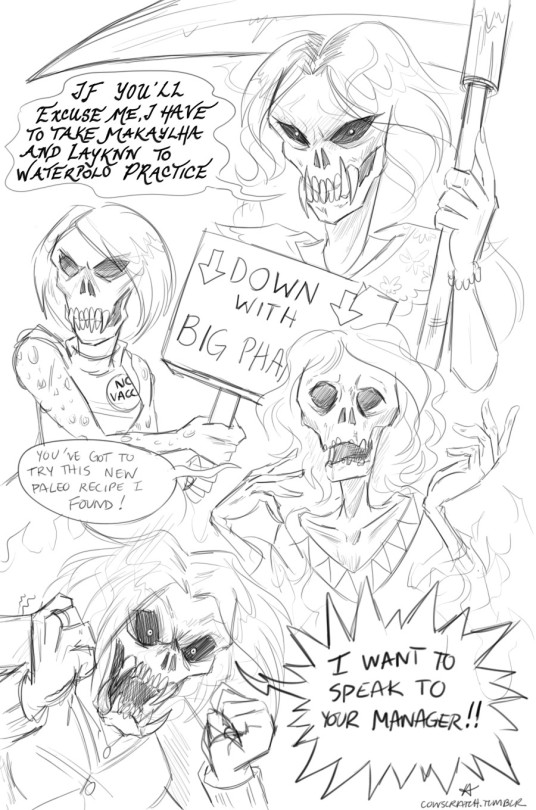
So I just woke up and my first thought was “what if in the four horsemen of the apocalypse, pestilence was one of those anti-vax moms?”

quite frankly the four white suburban soccer-moms of the apocalypse would scare me way more

War is the one constantly screaming at retail workers

Famine is a diet nut, one of the really annoying ones who is all ‘OMG PALEO IS THE TRUE WAY TO EAT AND IF YOU DON’T EAT PALEO YOU’RE GOING TO DIE OF CANCER’

Death drives a minivan

image

I’m sorry I just really had to draw this _(:’3_)_

27 May 22:03

lonelinessispornography: A Dadaist Manifesto (1920)


lonelinessispornography:

A Dadaist Manifesto (1920)

27 May 22:02

Loreen - Heal (2013 Edition) Full Album

Buy here : https://itunes.apple.com/gb/album/hea... Tracklist : We Got The Power : 0:00 - 03:25 My Heart Is Refusing Me : 03:27 - 07:06 Everytime : 07:09 - 1...
27 May 21:55

How to turn a liberal hipster into a capitalist tyrant in one evening

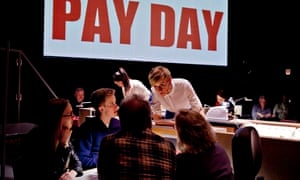
World Factory … how would you cope?
World Factory … how would you cope? Photograph: photograph by David Sandison

The choices were stark: sack a third of our workforce or cut their wages by a third. After a short board meeting we cut their wages, assured they would survive and that, with a bit of cajoling, they would return to our sweatshop in Shenzhen after their two-week break.

But that was only the start. In Zoe Svendsen’s play World Factory at the Young Vic, the audience becomes the cast. Sixteen teams sit around factory desks playing out a carefully constructed game that requires you to run a clothing factory in China. How to deal with a troublemaker? How to dupe the buyers from ethical retail brands? What to do about the ever-present problem of clients that do not pay? Because the choices are binary they are rarely palatable. But what shocked me – and has surprised the theatre – is the capacity of perfectly decent, liberal hipsters on London’s south bank to become ruthless capitalists when seated at the boardroom table.

The classic problem presented by the game is one all managers face: short-term issues, usually involving cashflow, versus the long-term challenge of nurturing your workforce and your client base. Despite the fact that a public-address system was blaring out, in English and Chinese, that “your workforce is your vital asset” our assembled young professionals repeatedly had to be cajoled not to treat them like dirt.

Related: World Factory review – interactive play smartly unravels fashion industry

And because the theatre captures data on every choice by every team, for every performance, I know we were not alone. The aggregated flowchart reveals that every audience, on every night, veers towards money and away from ethics.

Svendsen says: “Most people who were given the choice to raise wages – having cut them – did not. There is a route in the decision-tree that will only get played if people pursue a particularly ethical response, but very few people end up there. What we’ve realised is that it is not just the profit motive but also prudence, the need to survive at all costs, that pushes people in the game to go down more capitalist routes.”

In short, many people have no idea what running a business actually means in the 21st century. Yes, suppliers – from East Anglia to Shanghai – will try to break your ethical codes; but most of those giant firms’ commitment to good practice, and environmental sustainability, is real. And yes, the money is all important. But real businesses will take losses, go into debt and pay workers to stay idle in order to maintain the long-term relationships vital in a globalised economy.

Why do so many decent people, when asked to pretend they’re CEOs, become tyrants from central casting? Part of the answer is: capitalism subjects us to economic rationality. It forces us to see ourselves as cashflow generators, profit centres or interest-bearing assets. But that idea is always in conflict with something else: the non-economic priorities of human beings, and the need to sustain the environment. Though World Factory, as a play, is designed to show us the parallels between 19th-century Manchester and 21st-century China, it subtly illustrates what has changed.

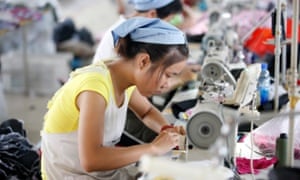
A worker in a Chinese clothing factory
A worker in a Chinese clothing factory Photograph: Imaginechina/Corbis

A real Chinese sweatshop owner is playing a losing game against something much more sophisticated than the computer at the Young Vic: an intelligent machine made up of the smartphones of millions of migrant workers on their lunchbreak, plugging digitally into their village networks to find out wages and conditions elsewhere. That sweatshop owner is also playing against clients with an army of compliance officers, themselves routinely harassed by NGOs with secret cameras.

The whole purpose of this system of regulation – from above and below – is to prevent individual capitalists making short-term decisions that destroy the human and natural resources it needs to function. Capitalism is not just the selfish decisions of millions of people. It is those decisions sifted first through the all-important filter of regulation. It is, as late 20th-century social theorists understood, a mode of regulation, not just of production.

Yet it plays on us a cruel ideological trick. It looks like a spontaneous organism, to which government and regulation (and the desire of Chinese migrants to visit their families once a year) are mere irritants. In reality it needs the state to create and re-create it every day.

Banks create money because the state awards them the right to. Why does the state ram-raid the homes of small-time drug dealers, yet call in the CEOs of the banks whose employees commit multimillion-pound frauds for a stern ticking off over a tray of Waitrose sandwiches? Answer: because a company has limited liability status, created by parliament in 1855 after a political struggle.

Related: Chinese factory activity slumps to lowest for a year as demand slows

Our fascination with market forces blinds us to the fact that capitalism – as a state of being – is a set of conditions created and maintained by states. Today it is beset by strategic problems: debt- ridden, with sub-par growth and low productivity, it cannot unleash the true potential of the info-tech revolution because it cannot imagine what to do with the millions who would lose their jobs.

The computer that runs the data system in Svendsen’s play could easily run a robotic clothes factory. That’s the paradox. But to make a third industrial revolution happen needs something no individual factory boss can execute: the re-regulation of capitalism into something better. Maybe the next theatre game about work and exploitation should model the decisions of governments, lobbyists and judges, not the hapless managers.

Paul Mason is economics editor of Channel 4 News. Follow him @paulmasonnews Read his blog here. World Factory runs at the Young Vic until 6 June.

27 May 21:53

khaleexa: theverge: Developer Will Herring has blessed the...


khaleexa:

theverge:

Developer Will Herring has blessed the earth with My Garbage Cat Wakes Me Up At 3AM Every Day, a simulator that puts you at the controls of a feline in the same room as its human victim, who happens to be asleep. It’s your job to recreate the same chaos that is happening in millions and perhaps billions of households around the world each night.

Unlike trying to understand the motives of a cat, the controls and aim of the game are delightfully simple:

  • Knock everything over until your owner wakes up. 
  • Use the arrow keys to move and jump. 
  • Press Z to meow and cry all the time. 
  • Press X to knead with your dumb little paws. 
  • Do your worst.

Winning in this game means your human being awoken at 3AM, and the prize is his agony and sadness.

image

it’s me

27 May 21:53

DOING FIELDWORK THE DAY AFTER THE LAB PARTY

image

credit: Sarah

27 May 11:02

Photo


27 May 10:52

i-am-an-adult-i-swear: Being an adult is scouring the Internet...

Sophianotloren

via Clauaud


i-am-an-adult-i-swear:

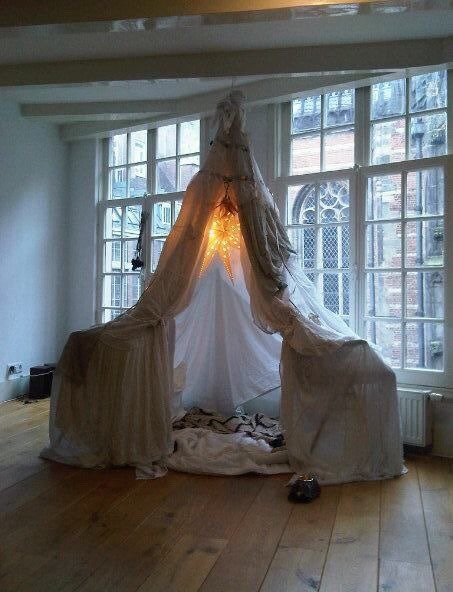
Being an adult is scouring the Internet for blueprints of the perfect pillow fort and being absolutely delighted in seeing that they actually exist

27 May 10:49

yrbff: Only one sleep until a different day. (by booksofadam...

Sophianotloren

via Rosalind

I've had a few days where these were my best options...


yrbff:

Only one sleep until a different day. (by booksofadam for yrbff)

27 May 09:53

ex0skeletal: by Pierre Schmidt

Sophianotloren

via Carnibore

I love surreal/WTF stuff like this!

27 May 09:22

Photo


27 May 07:13

You can add up the parts, but you won’t have the sum.

by Sophia, NOT Loren!

It makes me kinda sad, honestly, seeing all the celebration that happens every time there’s some legal victory towards what gets laughingly called “equality.”

Like, look… yeah, white cis* middle- and upper-class gay folks can assimilate into the dominant power structures, woo-hoo! More “Nuclear Families” with two-point-five children to fit the existing capitalist dream, to buy a cozy apartment and fill it with stuff! They can have a wedding, and more money goes to photographers and bakers and wedding planners and whatnot — I see that argument used to support this “marriage equality” thing pretty often: see, letting gays marry is good for capitalism, therefore you shouldn’t oppose it!

And honestly I’m left wondering how this is “equality” when there are trans* women being killed so often, especially trans* women of color, when

According to the [2011 National Transgender Discrimination Survey], respondents were nearly four times more likely to live in extreme poverty, with household incomes of less than $10,000. Respondents were twice as likely to be unemployed, and one in four reported being fired over their gender identity or expression. Half said they had experienced harassment or other mistreatment in the workplace. One in five respondents experienced homelessness because of their gender identity or expression, and 19% said they had been refused a home or apartment. Some 19% also reported being refused health care, and 31% reported harassment or bullying by teachers.”

So forgive me if I’m not jumping for joy at the fact that Ireland voted to let more people get married than could get married before. Forgive me if I’m not avidly following what’s up with the US Supreme Court and whatever cases are coming up with them about marriage. I get that being married is important to a lot of folks out there — because being married is the primary way that people get acknowledged as full citizens with way more rights than not being married, and since the “Relationship Escalator” is seen as the right way (and often the only way) to do things, and getting married is the top of the escalator, I understand why people want to get married.

I just think that there was a serious wrong turn somewhere between “WE’RE HERE! WE’RE QUEER! GET USED TO IT!” and “Hey, we’re just like you, no need to worry, no need to fear us just because we’re gay! Love is love!” The wide acceptance for some queer folks getting married is because they’re no longer seen as a threat to the status quo, because — as mentioned above — it’s just more people willingly taking part in the same fucked-up broken money-making system. And those who won’t — or can’t — assimilate… well, we’re being murdered. We’re living on the streets. We’re unemployed. We’re here, we’re queer, you’re trying to make us disappear.


Filed under: General