Next week, the entire Haute Macabre team will be visiting Salem, MA, and will be vending at the BloodMilk Night Market at Black Veil Tattoo on Friday, September 1 from 7-10PM.
We will be offering our printed shirts and tote bags designed by Courtney Riot and full range of Black Phoenix Alchemy Lab fragrances and Black Phoenix Trading Post Hair Glosses, including two new items to be introduced at the market: “The Mummies of Mexico City”, a brand new addition to the Cemetery Collection featuring notes of church incense, ornate gold, old lace, dust, and the debut of the Burying Point Hair Gloss.
These two new additions will be available exclusively next weekend at the Night Market and will be be available for pre-order later in September for those of you unable to attend.
Haute Macabre will be sharing booth space with our very own staff writer Sonya Vatomsky, who will have copies of their liminal collection of poetry, Salt is for Curing, available for purchase and inscription. Sonya will also be reading from Salt is for Curing at The Satanic Temple on Sunday, September 3.
We hope to meet you at this market, if you are able to attend please do stop by our table and introduce yourself!
New Drag Crush: Hungry. Hailing from Berlin (is everyone amazing in Berlin these days?), Hungry bills herself as “The original ethereal slag, descended from the heavens to make you question your sexuality and force progress upon tragic oldschool drag”. Well, at the very least I’m questioning my lack of skill with an airbrush.
Hungry’s looks are otherworldly and intense. She integrates subdermal implants and colored contacts as easily as lipstick, making herself something bionic and high-tech. Yet much of her inspiration is drawn from the natural world. The end result is skeletal structures and circuit boards, eerily lit creatures from the ocean depths consorting with killer robots. Hungry is the future, terrifying and beautiful and inhuman.
If you’re in or near Berlin, catch her artist workshop next month at MUD Studio Berlin.
Through the Great 78 Project, the Internet Archive has been digitizing the audio from 78rpm records produced from 1898 to the 1950s. Over 25,000 high-quality recordings are currently available from artists like Edith Piaf, Irving Berlin, Lena Horne, and Duke Ellington. This preservation is important because the discs are fragile:
78s were mostly made from shellac, i.e., beetle resin, and were the brittle predecessors to the LP (microgroove) era. The format is obsolete, and just picking them up can cause them to break apart in your hands. There’s no way to predict if the digital versions of these 78s will outlast the physical items, so we are preserving both to ensure the survival of these cultural materials for future generations to study and enjoy.
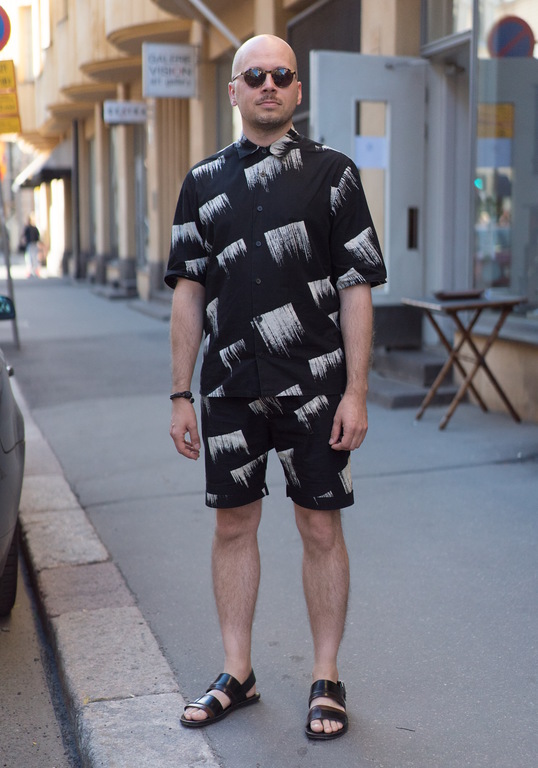
“I'm wearing custom made shirt and shorts of a Marimekko fabric, Marni sandals, sunglasses by a small old Milanese brand Marchesi and a Bottega Veneta leather bracelet. I like to keep it comfortable. Clean, simple lines, interesting cuts, classics. Some days I like strong colours and prints.”
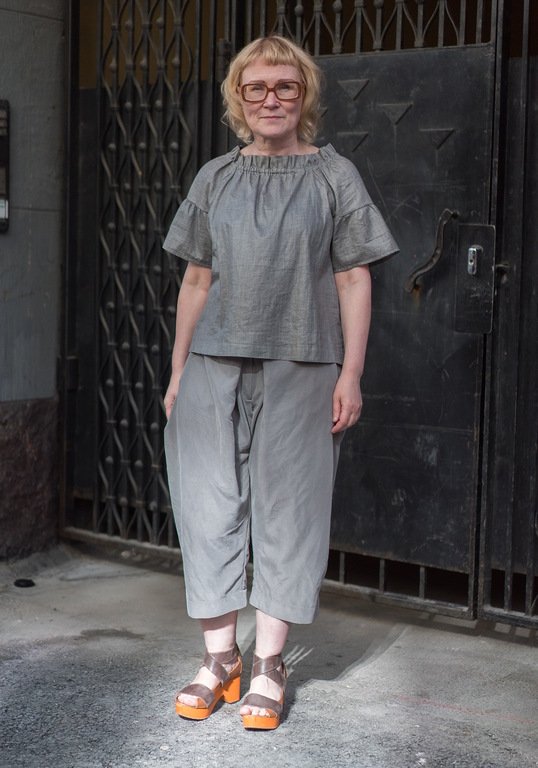
“I’m wearing Vainio.seitsonen, from our own collection, the pants are made of tencel and the top is something I have been working on for the summer collection. Shoes are Finsk by Julia Lundsten. Together with other designers I run a shop for Finnish fashion designers in Helsinki. and we often swap clothes. I like to wear my colleagues’ designs, for example Finsk or Dusty by Marjut Uotila and Marita Huurinainen. I like the combination of the outdoor materials & techniques and urban look, it is something I would like to achieve, too.”
Walked in a Chinese restaurant, hostess asked how many in my party, non-Chinese friends asked why I did the hang loose hand sign so here: pic.twitter.com/DfRlzF8Lz1
Actually really like a bunch of the vibe here? Some slightly different ways of layering.
The reasons we love some designers more than others are many and varied. But I'm coming to the conclusion that one of the reasons I love Raf Simons so much, is that maybe he is every bit as contrary as Queen Michelle and I.
I love his attitude as much as his clothes
On a humid Tuesday night earlier this week he unveiled his spring 2018 collection under a bridge in Chinatown. I remember being in New York in July with temps soaring to well over 100 degrees every day, so that he has wellington boots and umbrellas striding through an underpass in the height of summer makes me chuckle, although the poor models must have been struggling.
The open-air venue was decorated with neon signs and symbols, as well as red and white lanterns that looked like they were hanging at the space long before Simons moved to New York City in 2016. The white lanterns, in particular, were original for the show and featured references to the band New Order.
Peter Saville, the English art director and graphic designer who designed album covers, inspired part of the collection and the show's experience, but the central theme for the spring 2018 collection and venue is the film Blade Runner. The venue referenced scenes from the film and decorations like the neon signs.
The models carried umbrellas with ripped canopies. Plaid ponchos and coats and oversized button down shirts were worn with off-shoulder knitwear and topcoats. Shirts that featured the word ‘replicant,’ a nod to Blade Runner while New Order graphics that were layered over outerwear, two-tone coats, sleeveless shirts and long high-waisted skirts on the few females in the show...
Good grief, I can feel myself overheating just looking at these shots...
David Taylor analyzed a corpus of English words to see where each letter of the alphabet fell and graphed the results.
No surprise that “q” and “j” are found mostly at the beginnings of words and “y” and “d” at the ends. More interesting are the few letters with more even distribution throughout words, like “l”, “r”, and even “o”. Note that this analysis is based on a corpus of words in use, not on a dictionary:
I used a corpus rather than a dictionary so that the visualization would be weighted towards true usage. In other words, the most common word in English, “the” influences the graphs far more than, for example, “theocratic”.
Zines are the most personal way to experience magic the way another sees it. A zine is like a journal put to print, filled with feelings and intentions other than your own but also relevant. Painstakingly illustrated, printed, and bound, here are twelve zines that will bring a bit more clarity to your life.
How to Live the Everyday Life of the Modern Witch
–
We don’t know about you, but sometimes it can be hard to find space for magic in our busy lives. This zine contains sweet illustrated guides on anything from tracking the moon with your cell phone to brewing potion (tea) based on herbal properties. Laurdione Designs//$7.94
Sad Girls from the Internet
–
You’ll identify with the girls in this zine if you’ve ever had a cool internet friend (ahem, your beloved Dear Darkling writers). They’re all bad ass and none of them are messing around. Gemma Flack//$6.36
Can I Ask You a Question?
–
Do you turn to your computer for answers? Your reflection in the mirror? Filled with gorgeous tri-toned illustrations, this wordless zine opens the door to a modern mystic world and dares that you step inside. Charles Bloom//$8
A Very Femme Tour of the Zodiacs for Those Who are Bitter
–
Are you an angry gemini? A pissed off taurus? Whatever your sign, this zine may not tell you what you want to hear but it will tell you should you need to know. And this gift set comes with a corresponding pin! WE’RE OBSESSED. Graveface//$6
Brave to the Grave
–
Crystal ball says: “You can’t live without this coloring book zine filled with self affirmations!” Heart and Hands Store//$6.36
Ectoplasm
–
This fun collaborative zine is filled with spooky ghosts and haunted houses. The 28 pages of artwork are definitely killer. Mummys Hand//$10
Superstitions, Omens, and Signs for the Modern Witch
–
Who knew a dropped call could hold so much meaning, that a cigarette butt could predict your future? We just couldn’t grab this zine without the deck of cards it’s focused on. resubee//$10+
Crystal Witch and Love Spells
–
We’re bewitched by this detail oriented set of zines. It’s filled with everything you need to wield magic as a self-love tool. Lillian Cuda//$10
All of Them Brujas
–
Filled with whimsical illustrations, this zine is the guide everyone needs to identify the brujas they’ll come across in the wild (or hanging out in town). Don’t forget to check out Rebecca Artemisa’s cootie catcher zines while you’re taking a peak at her world! Rebecca Artemisa//$5
Keepsakes
–
This zine is the soft goth diary of your teen witch dreams. It’s filled with Victorian-style drawings and playlists for ghost girls that will make you yearn for your adolescent spell-casting days. Alice Roses//$6.72
A Self Care Spell
–
Short and sweet, this zine is just one self-care spell that you’ll find yourself coming back to again and again. Coupled with a straightforward guide and lovely illustrations, this is a must have for any modern darkling’s zine collection. Rayne Klar//$4
Lady Parts
–
This inclusive, collaborative zine is a personal collection of essays on radical feminism, hysterectomies, and the experience of being queer, a person of color, or both. It includes media recommendations and herbal remedies making this the resource for the modern femme’s library. Dani Burlison// $10
Author information
Liah Paterson
Liah Paterson is a Queens-based freelance illustrator. She spends her days polishing up her knowledge of occult objects, destroying canvases, and trying to coax her cats into liking her. Her apartment is filled with piles of books, sculptures, and paintings of disembodied hands, and a partner who plays scary video games for her so she can watch them like movies. Find her on Instagram (@atenderwitch) or on her website (liahpaterson.com).
My new audial obsession is the podcast How I Built This, in which Guy Raz interviews entrepreneurs who built notable companies. The podcast offers incredible stories behind the making of businesses like Chuck E Cheese, Southwest Airlines, and Zuumba. I've also been reading more about social impact nonprofits that went big, like Goodwill, CASA, and YMCA.
One of the biggest questions on my mind as I listen is: why isn’t my industry scaling up the way these organizations do? I can think of many extraordinary innovators in the nonprofit cultural sector--people and organizations creating brilliant programs, site-based experiences, and products. Many of these projects seem replicable. But I can think of only a few who have scaled up and out in a meaningful way.
Why aren’t our collective best ideas growing and spreading all over the world? Why aren’t more cultural organizations franchising, scaling, and replicating like comparable businesses?
Here are a few of my hypotheses (and I’d love to hear yours in the comments). I am not suggesting that any of these factors are bad or immutable. I'm suggesting they may be reasons we aren't scaling.
Precarious business model. Even if an institution or a project is fabulous, it may not have a solid, replicable business model behind it. If the work is financially dicey on the scale of one building, it can be disastrous to scale up.
Too much emphasis on innovation. The more we tinker with and change our products, the less time we spend scaling those products. Arts institutions have beat the innovation drum for decades now. Change may be necessary... or it may distract us from opportunities to grow.
Too complex and diversified a business. Cultural organizations tend to have many programs, projects, audiences, and goals. Businesses that scale are simpler and more focused. If it would take a thousand-page manual to replicate your programs (which are always changing!), it's too hard to reproduce.
Friendly industry that encourages sharing and copying. There are no NDAs in the nonprofit culture sector. Professionals share program models, exhibitions, and design techniques across organizations, often for free. This intermixing means there's less distinctive value to scaling any one entity's offerings.
Too much emphasis on unique experience and local idiosyncrasy. Many cultural organizations put the singular, authentic experience first. Many of us are proud of how our cultural organizations reflect and respond to our local communities. This can lead to assumptions--not always true--that what works here can't be copied and won’t work somewhere else.
Skills mismatch. The skills needed to create an incredible program are different from those needed to spread that program around the world. Our industry cultivates and rewards creative dilettantes who make beautiful things. We often look with suspicion on MBAs and people who want to commodify our work.
Mission mismatch. What's the upside for cultural organizations to scale? Most don't see any benefit to spreading that program around the world. It might be nice if it happened, but it's not the goal. The goal is local engagement, authenticity, scholarship, prestige, or keeping the lights on and the art pumping. I suspect most of us would be loathe to cut programs or make hard tradeoffs in favor of scale. The argument for it isn't worth the pain.
What's missing on this list? What counter-examples have you seen? Please share your questions or comments! If you are reading this via email, you can join the conversation here.
Black bath bombs, bat-shaped soaps, and brooding oils—there are myriad darkling options for the bath. But how about bathing with real demons? For centuries, Russian bathers and witches alike have regarded the bathhouse as a ritual space where life begins and ends—a demonic space perfect for the performance of dark magic. Come with me into the steam. Their story may be your own.
To The Banya
It is summer in Russia. From Moscow and St. Petersburg to the tiny villages dotting the vast countryside, people are settling into rustic cottages called dachas to enjoy simpler and slower lives.
A fairy tale dacha outside of St. Petersburg.
They build fires to roast meats and cook vegetables grown on their own land. They drink strong tea and vodka, savoring the long hours of honeyed daylight that drip into nightfall, alive with orange embers. And of course, they take banya—a Russian wood-fired steam bath that includes wearing a felt hat to keep the brain cool, flogging the body with dried birch branches, and washing the face with mint tea. Overheated, the bather runs outside to plunge into a lake or basin of cold water or—in winter—rolls in the snow. There is vodka. There is food. In good company, this process can go on for hours.
Left: In a Russian Bath House, Vitaly Tikhov (1916) Right: Sanduny Baths in Moscow (1996-97), Jeremy Nicholl.Left: In the family banya with birch branch massage and wool cap on dad. Right: Splashing with cold water outside of banya. Banyas are most often built near lakes or rivers, but in some areas, a bucket must do. For more, click here.
But Banya is far more than a bath that cleanses the body. It is a beloved Russian ritual bound to the spirit world—one with an occult history as dark and deep as a Siberian winter forest.
Wind-Fallen Trees (1888) by Ivan Shishkin
Demons in the Bathhouse
Medieval Russians imagined the bathhouse as a perilous place. Before building a communal bathhouse, they consulted with a koldunor vedma (male or female witch) who determined where and how it should be constructed. Traditionally, banyas were built on the edge of the village, often in the forest, a safe distance from home and church. A black hen was sacrificed and buried beneath the building’s threshold or under one of the benches inside. Villagers were warned not to enter the bathhouse alone or after dark, and never at midnight—itself a point of transition, a space between breaths.
Rural banya, off on its own.
Why so many precautions? What made the banya so dangerous?
The bannik, of course. According to Russian mythology—a swirl of Christian and pagan beliefs—Michael the Archangel drove Lucifer and the rebellious angels from heaven. As they fell to earth, some went straight to hell to become devils, while others landed in the forests, fields, and rivers to become nasty little goblins. One of the most powerful and mischievous of these entities was the bannik who lived in the bathhouse.
Left: The banya begins to steam. Right: The Bannik, by Boris Zabirohin.
If the fickle bannik became angry, he might burn bathers with hot water, suffocate them with steam, or (in Novgorod) peel off their skins (Ivanitz, 60). In order to appease him, they brought him offerings of soap and fir branches. Villagers avoided banya in the evenings because that was when the bannik took his baths, often inviting his demon friends over for a long soak. In respect for the demons, no crucifixes or icons were ever hung in the bathhouse, and bathers were required to remove their crosses before entering. They also removed the intricately woven belts that served as a sacred boundary—proof that they were human—from their bodies. Being physically and ritually naked in a demonic space made them completely vulnerable, open to spiritual corruption and chaos.
Russian women with their traditional woven belts. For more on these belts and their supernatural properties, click here.
The demonic danger of the bathhouse was intensified at ritual hours such as midnight and on witches’ feast days such as January 18. The only human who dared enter the cold bathhouse during these times was the koldun or vedma seeking the counsel of demons. It was a perfect space for chernoknizhie, or black magic. Knot tying spells for binding and loosening as well as demonic divination were most common.
Russian black magic, binding and unbinding, with the help of demons.
Bathhouse as Womb
The bathhouse was a gateway between the demonic and the human, pagan and Christian, life and death—an ideal space for transition rituals.
Wedding rituals were conducted at the banya. On the night before the wedding, the koldun or vedma donned a fishnet belt and brought the bride into the bathhouse where she was steamed and beaten with birch branches according to custom. After an invocation, the “sweat was wiped” from the bride’s naked body “with a whole raw fish that was then to be cooked and given to the groom to eat.” (Ryan, 75) Water was likewise collected from the wedding bath and used in preparing future meals—a form of sex magic meant to bind man to woman for eternity.
The bathhouse was also a place of birthing. A gravid woman was always accompanied by a midwife who not only helped her through labor, but also protected her from the bannik who was known to bite, scratch, and steal newborn infants. Women gave birth in a banya for practical reasons—the peasant house was small and lacked privacy. But there were also ritual reasons for birthing in the bathhouse. The banya was itself a womb, hot and moist, from which one emerged vulnerable and naked. Thus the Russian saying, “The banya is your second mother.” It was a spiritual omphalos—a sacred locus where life and death became one.
In death, Russians returned one last time to their mother, the bathhouse, where their corpses were washed and prepared for burial. The water used to wash the corpse was returned to a ritual location—often the same place where water from the individual’s birth and marriage had been poured. Should it fall into the hands of an evil koldun or vedma, it might be used in spell casting. Likewise, the soap that had been used to wash the deceased—called ‘dead soap’—was guarded lest it be used in malefic magic.
Modern Witchcraft in the Bathhouse
Historian Valerie Kivelson argues that witchcraft and magic thrive at the edges of oppression. This is perhaps one reason for the persistence of witchcraft in Russia. From serfdom and the violence of revolution to Stalin and successive oppressive regimes, the Russian people have been through hell. They have survived—and so has the bannik and the demons in the bathhouse. Today, banya remains a place to heal the body and cleanse the soul. Business men, the mafia, and the KGB meet at banya to negotiate deals, tie down contracts, and contrive sinister plots—all in the buff. Modern Russian witches continue to revere the bathhouse as a locus of dark magic. They gather in the moonlight to set intentions, divine the future, practice sex magic, and conduct rituals that untie the knots of greed and violence forged by the wicked. Rather than fearing our witchy Russian brethren, perhaps we should follow their steamy footprints to the bathhouse and join them in harnessing the dark magic required to unbind the oppression that grows all around us. Together, let us be midwives for a new age, free from tyranny. There is much to be learned from Russian witchcraft and the the demons who sit soaking in the steam.
Sources
Ivanits, Linda J. Russian Folk Belief (London: Routledge, 2015).
Ryan, W. F. The Bathhouse at Midnight: Magic in Russia (Philadelphia: Penn State Press, 1999).
Author information
Brenda S G Walter
By day, Brenda poisons young minds as a college professor. When she is not teaching classes such as Science and the Supernatural, she is writing about monsters, witchcraft, horror films, heavy metal, and gothic culture. She might also be drawing apocalyptic landscapes or haunted houses while watching Creature Double Feature. You can find her on Facebook and Instagram as Elderdark Nightmoth.
I feel shitty and like I've been complaining a lot so I'm going to notice tiny kindnesses instead.
The Awl’s Everything Changes newsletter gave their readers a mission this week: “to notice people doing tiny kindnesses for each other”. Here’s what they observed.
My toddler and I were waiting in a long line at Russ and Daughters this morning, and a guy gave me a much earlier number. He’d somehow ended up with an extra number right after his, and waited until he saw someone he thought needed it. I gave my number to the last couple in line, and if they did the same, it might still be going.
My husband and I were having lunch together at a deli. A woman two tables over from us was eating by herself and received a phone call on her bluetooth. She began crying from what appears to have been bad news. She was fairly quiet about it and kept it to herself, but she was obviously crying. Another patron in the restaurant stopped, patted her shoulder and mouthed “Are you OK?”. She nodded through her tears and continued with her phone call. He and a few other patrons continued to monitor her out of the corner of their eyes, but gave her her privacy. It seemed a small gesture — but I felt all of us in the restaurant sending her strength through the man’s small pat on the shoulder.
I was about to cross a side street in Brooklyn when a concerned-looking man crossing in the opposite direction stood in the middle of the street and began frantically waving a tshirt in front of the cars that were about to get a green light. I quickly realized that he was stopping traffic so that a blocked ambulance with its sirens on could make it through further down. It worked — the traffic cleared and the ambulance moved. When I got a few blocks down in the direction he’d been coming from, EMTs were on the scene, attending to an unconscious, apparently homeless person on the sidewalk. I think most people would call 911, but this guy went the extra mile. He did what a family member would do.
I think if we all “did what a family member would do” more often, the world would be a better place.
Update: From the early Christian author and philosopher Lactantius:
The whole point of justice consists precisely in our providing for others through humanity what we provide for our own family through affection.
If I were in charge of humor, which I should be, this is a rule I would have: NO SAME-DAY HUMOR PIECES. By which I mean humor pieces composed quickly about something that just happened in “the news.” Covfefe, Mr. Met giving the middle finger, etc. Of course there would be exceptions but in general that would be the rule. I know why people do same-day humor pieces and it’s because:
People click on newsy things, theoretically.
It’s easy to riff on something that just happened because then you don’t have to have an idea.
But the thing about same-day humor pieces is: they’re almost never funny. I say “almost” not knowing an exception offhand, but just to protect myself in case there’s one out there. Actually I just remembered one, and it’s this. That was funny. It was when everyone was talking about how bad that Margot Robbie profile was. Exception proves the rule, as they say. (If you’re wondering whether that funny McSweeney’s piece about the election counts as an exception it does not because it was at least a month after Galaxy Note 7s started exploding and it was 11 days after the election and the election is not a particularly “throwaway” event, even though the Galaxy Note 7 aspect maybe was.) (So instead of proving my point by being an exception it proves my point by being the rule.) (See?)
Here’s someone who’s good: Jack Handey. Jack Handey takes a long time to write funny stuff — that’s why his stuff is funny. Look at what he said about writing Deep Thoughts in a Splitsider interview:
They don’t come gradually, or out of the blue. You have to sit down — or in my case, lie down — for hours, and try to come up with some. Usually, I lie down on the floor and throw a ball against the ceiling, over and over.
A Deep Thought, that’s just a sentence or two. How long is your throwaway current event thing? Longer? What do you think your humor writing skill level is? “Better than Jack Handey?” OK. Yeah right. Here he is talking about writing Deep Thoughts and his novel in his New YorkTimes Magazine profile from 2013:
“For each one that works, I throw away 10. I find that easier than rewriting. I’d rather just scrap it and start over. That’s why the novel was so hard — I really had to rewrite things over and over.”
“Rewrite things over and over.” Are you doing that with your throwaway current event thing? Or are you just posting it online for me to get mad about right away?? So you get “clicks”??? Because no one is going to “click” on it tomorrow???? Because its “value” is not in its “content” or “execution” but solely in the fact that it is “topical”!?!?!?!?!??!!?!?
I don’t mean to say that you shouldn’t do a funny blog post about something that just happened. Please for the love of god I would love if one single person on earth would produce a fucking funny blog post every once in a while, PLEASE. PLEASE IT IS SO SHITTY AND BORING ONLINE NOW. EVERYONE IS TERRIBLE AND BORING I HATE IT!!!!!!! I just mean “humor.” You know what I mean. Humor writing.
Shoehorning a topical reference into a humor format so it seems like “a joke” but is actually “just words people recognize at the moment” is bad.
I like things that are funny and good.
NOT bad.
Stop,
Kelly
No More Same-Day Humor Pieces was originally published in The Hairpin on Medium, where people are continuing the conversation by highlighting and responding to this story.
I urge you to please notice when you are happy, and exclaim or murmur or think at some point, “If this isn’t nice, I don’t know what is.”
– Kurt Vonnegut
I'm so bad at #6 because sharing my experiences was how I started getting comfy talking to people and I thought it would get across that I identified with the other person, but alas
Celeste Headlee is an expert in talking to people. As part of her job as a public radio host and interviewer, she talks to hundreds of people each year, teasing from her guests what makes them interesting. At a TEDx conference two years ago, Headlee shared 10 tips for having a better conversations that work for anyone:
1. Don’t multitask.
2. Don’t pontificate.
3. Use open-ended questions.
4. Go with the flow.
5. If you don’t know, say that you don’t know.
6. Don’t equate your experience with theirs.
7. Try not to repeat yourself.
8. Stay out of the weeds.
9. Listen.
10. Be brief.
Watch the video for the explanations of each point. I’m pretty good on 1, 5, & 7 while I struggle with 3, 4, and sometimes 6. 9 is a constant struggle and depends on how much I’ve talked with other people recently. (via swissmiss)
Much of our day-to-day talk is a missed opportunity. The ability to draw others into meaningful conversations can determine whether people want to get to know you, or remember you at all. Failure to learn it can stall your career.
Vanessa Van Edwards had been attending networking events for several years during and after college when she realized she was having the same conversation again and again. “It went like this: So what do you do? Yeah. Where are you from. Yeah, yeah, been there. Do you live around here? Well, I’d better go get another glass of wine,” says Ms. Van Edwards, a Portland, Ore., corporate trainer and author of “Captivate,” a new book on social skills.
She started trying conversation-openers that jarred people a bit, in a pleasant way: “Have you been working on anything exciting recently?” Or, “Any exciting plans this summer?”
“If I’m feeling very brave, I ask, ‘What personal passion projects are you working on?’” Ms. Van Edwards says. She began making contacts who followed up more often.
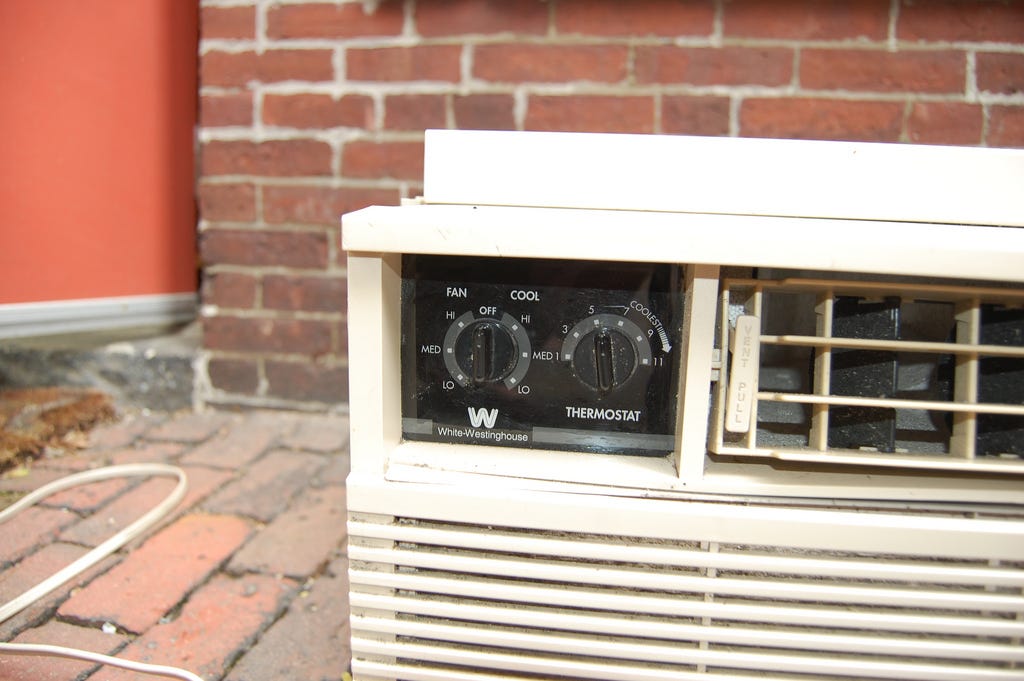
It is very hot today, and it was very hot yesterday, and it was very hot the day before. Some of us may have put in our window unit air conditioners so we would be able to sleep at night and so our dog would be more comfortable, because we certainly love him so much and we’re just so happy he’s here. But tomorrow, and the next day, and the next day, and the next day, and the next day? Those days aren’t going to be so hot. In my opinion, it’s fine to take your air conditioner out and then put it back in again later.
I may be out of ideas for blog posts, but you do have to admit that this is something to say.
To some, it may sound crazy. The air conditioner is already in, you successfully installed it without breaking it or accidentally murdering anyone, and it’s going to be very hot again very soon. Why take it out and deal with the whole thing with how you have to put it on a towel because of the dripping, only to put it back in again in a handful of days and hope you don’t break it or kill anyone in the process? Well. I’ll tell you why, and it’s because: You have to enjoy your life while you have it.
The air conditioner, if it’s not doing you any good, is so bad. It’s bad even while it’s doing you good (loud, makes the air bad, energy reasons, whatever, etc.) but it’s especially bad while it’s not. It blocks the light from the window; it’s unattractive; it makes it so you can’t open the window. It makes it so you can’t look out of the window at the beautiful trees and birds. And it’s not good to look at. Mostly those two things: the window, and how it’s not good to look at.
It’s springtime, baby. I think it would be nice for you to be able to get one last week of not having that stupid air conditioner in one of your windows, blocking your light, and your air, and looking like some big ugly box, no offense to our friends the air conditioners. Take it out of there. Put it back in later. I know it sounds like a whole big to-do, but it’s actually only going to take a few minutes. And do you know how many minutes of days your going to have of nice window once you take it out? You do the math. It’s 60 times 24 times however many days you leave it out before you put it back in again.
That’s a lot!!!!!!!
Enjoy your life. Sleep with the windows open — all of the windows. Take out your air conditioner if you think you’d be happier without it for the next week. Then put it back again.
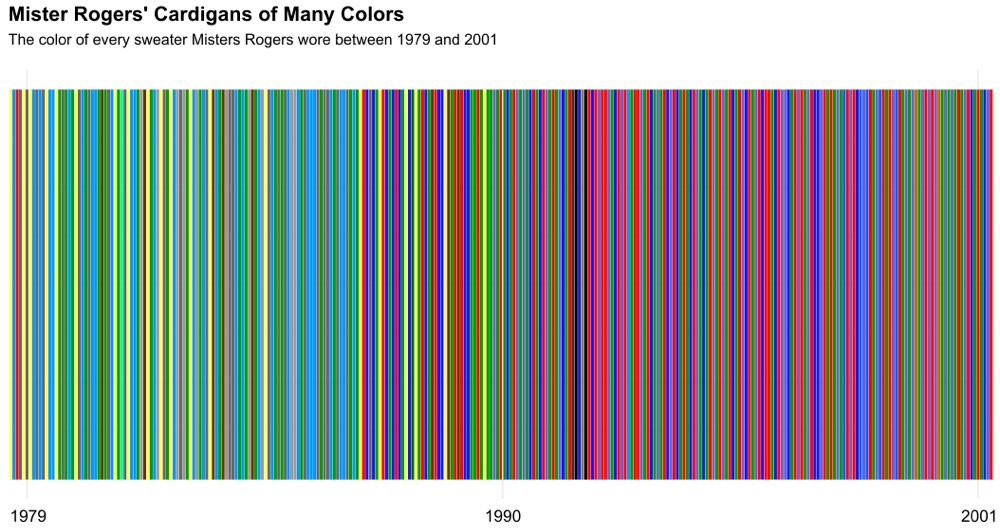
Some sweaters were worn once and then never again, like the neon blue cardigan Rogers wore in episode 1497. Others, like his harvest gold sweaters, were part of Rogers’ regular rotation and then disappeared. And then there were the unusual batch of black and olive green sweaters Rogers wore exclusively while filming the “Dress-Up” episodes in 1991.
Some things about the sweaters and Mister Rogers:
- His mother knit the sweaters. Sorry, MISTER ROGERS’ MOTHER KNIT HIS CARDIGAN SWEATERS! I have not heard a more perfect detail about anything recently. He talks about his mom and the sweaters in this video — “I guess that’s the best thing about things. They remind you of people.”
- As you can see from the visualization above, Mister Rogers’ sweaters got darker as the show progressed. I will not speculate about what that might have meant.
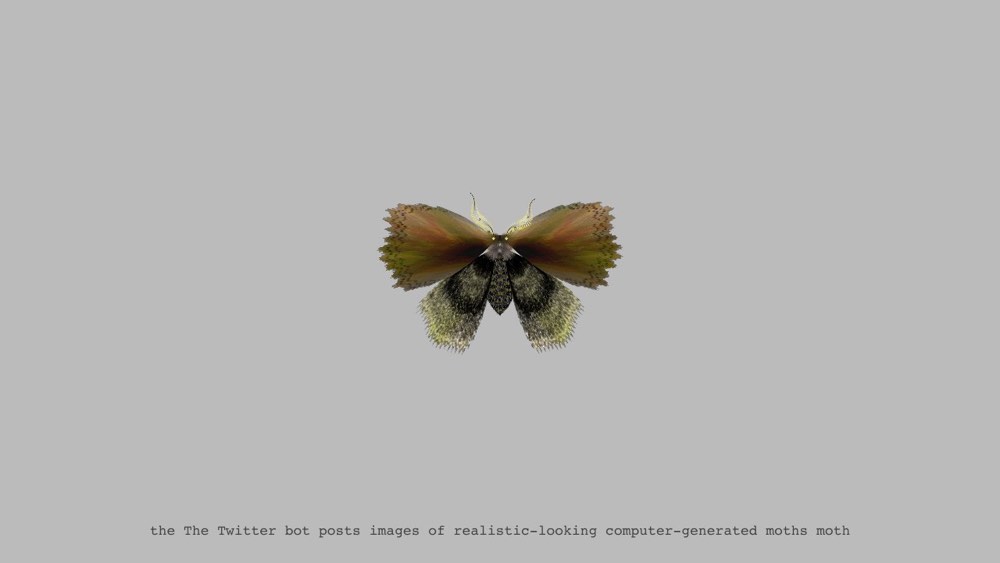
Also dedicated to winged creatures, this bot tweets make-believe moths of all shapes, sizes, textures and iridescent colors. It’s programmed to generate variations in several anatomical structures of real moths, including antennas, wing shapes and wing markings.
Another program, which splices and recombines real Latin and English moth names, generates monikers for the moths. You can also reply to the account with name suggestions, and it will generate a corresponding moth.
Polish designer Agnieszka Osipa’s creations feel like home to me, embodying a sort of feral holiness I associate with Slavic folklore and imagery. Its grand and decadent but wild, refined yet chaotic — her fashion often inseparable from the moody, atmospheric dreamscapes she creates with her photographers. Each image is uniquely powerful, with intricate beading and delicate lace covering gowns and headdresses like diamond-bright goosebumps: details liable to draw blood.
Slavic lore is a major theme throughout Osipa’s designs and imagery. “This is where I am from,” she told Belle Exotique Magazine in 2015. “I feel that Slavic culture is often regarded as minor compared to other cultures of the world. I try to change that by showing how rich and inspiring it can be, when you really dig into it. I search legends, demonology, and fairy tales from the Eastern region of Europe and try to include the forms and symbols into what I make.”
Agnieszka Osipa rents out her costumes and also takes commissions — if ever you were in the market for a truly breathtaking, spellbound dress or crown for an occasion demanding nothing less than ethereal perfection, this should be your first stop. To see more of Osipa’s tactile delirium, follow her on Facebook and Instagram.
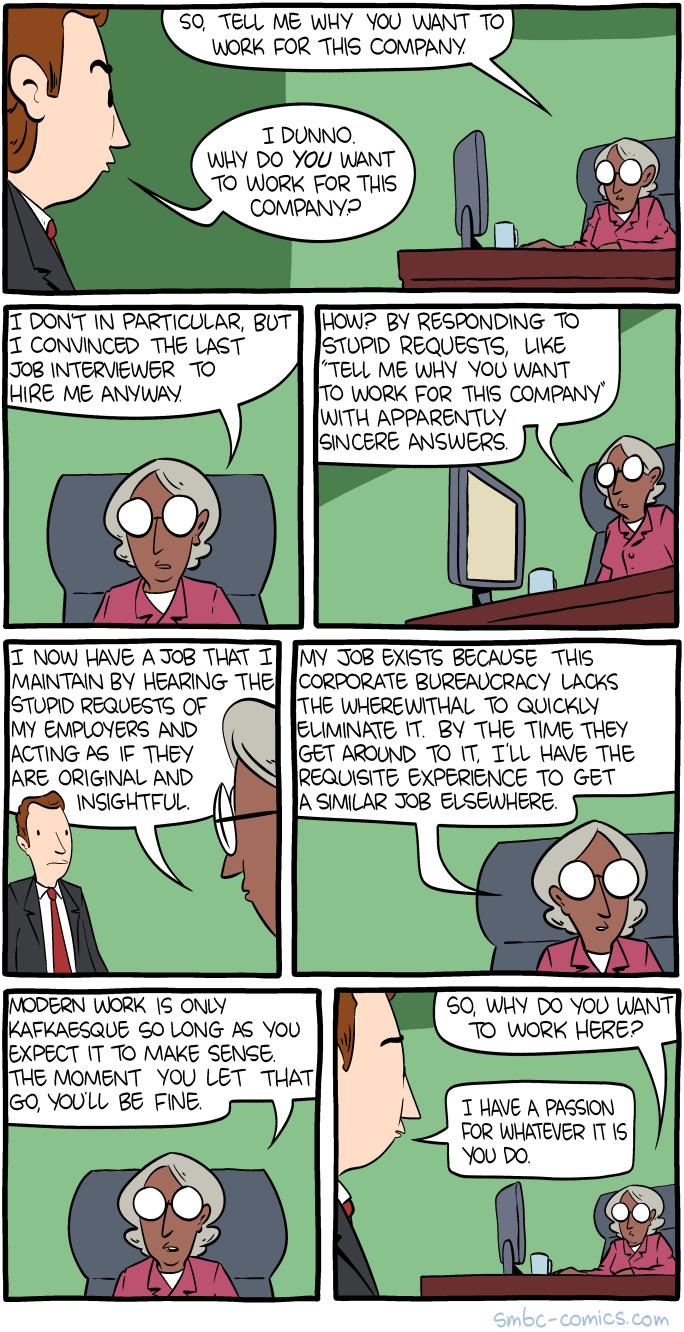
Hovertext: I'm starting to wonder if I don't have some deeply repressed fantasy where I'm a middle aged woman who participates in overly blunt job interviews.
HEY BRITAIN! Soonish is available in the UK. We've used metric units, added the letter "U" after every "O" and as a courtesy, every book will be lightly dampened with cold rain.
Andy! Weren't you going to go back in time and kill Hitler in a way that avoids the writer's strike? Good call.
The members of the two large writing guilds representing more than 12,000 Hollywood writers recently voted to strike.
Leaders of the Writers Guild of America, East, and the Writers Guild of America, West, announced the results of an online strike authorization vote in an email to members. The unions said that 6,310 eligible members voted; 96 percent of the vote was in favor of a strike.
A three-year contract between the guilds and the Alliance of Motion Picture and Television Producers, which represents the makers of films and TV series, expires at midnight on May 1. Negotiators were set to resume talks on Tuesday, with funding of a failing union health care plan a sticking point.
During the last work stoppage, CBS ordered additional seasons of its flagship reality competition shows to fill airtime. And then there’s NBC.
Trump’s “The Apprentice” had been removed from the network’s lineup amid low ratings. But a new programming chief came aboard in 2007, and the network decided to revive the competition show, but with a twist. And when the writers’ strike meant no more new episodes of “The Office” and “Scrubs,” NBC replaced the Thursday night shows in 2008 with “The Celebrity Apprentice.”
That’s a curious butterfly effect. The writers strike made room for The Celebrity Apprentice on TV. The Celebrity Apprentice gave Trump seven more seasons of primetime TV visibility. Trump parlayed that visibility into the highest political office in the land.
All we want to do today is chase after this skittering teapot creature, which is the work of San Francisco-based ceramic artist and painter Sara Duyer and undoubtedly contains some incredibly powerful elixir.
Duyer also created these marvelous skeleton and severed finger ring bowls, both of which look like perfect places to store all the Blood Milk jewels we ordered during their recent sale.