Shared posts

23 Aug 12:43

The 6 best Nvidia GPUs of all time

by Digitaltrends

Nvidia sets the standard so high for its gaming graphics cards that it’s actually hard to tell the difference between an Nvidia GPU that’s merely a winner and an Nvidia GPU that’s really special.

Contents

  • GeForce 256
  • GeForce 8800 GTX
  • GeForce GTX 680
  • GeForce GTX 980
  • GeForce GTX 1080
  • GeForce RTX 3080
  • So what’s next?Show 2 more items

Nvidia has long been the dominant player in the graphics card market, but the company has from time to time been put under serious pressure by its main rival AMD, which has launched several of its own iconic GPUs. Those only set Nvidia up for a major comeback, however, and sometimes that led to a real game-changing card.

It was hard to choose which Nvidia GPUs were truly worthy of being called the best of all time, but I’ve narrowed down the list to six cards that were truly important and made history.

GeForce 256

The very first

VGA Museum

Although Nvidia often claims the GeForce 256 was the world’s first GPU, that’s only true if Nvidia is the only company that gets to define what a GPU is. Before GeForce there were the RIVA series of graphics cards, and there were other companies making their own competing graphics cards then, too. What Nvidia really invented was the marketing of graphics cards as GPUs, because in 1999 when the 256 came out, terms like graphics card and graphics chipset were more common.

Nvidia is right that the 256 was important, however. Before the 256, the CPU played a very important role in rendering graphics, to the point where the CPU was directly completing steps in rendering a 3D environment. However, CPUs were not very efficient at doing this, which is where the 256 came in with hardware transforming and lighting, offloading the two most CPU intensive parts of rendering onto the GPU. This is one of the primary reasons why Nvidia claims this is the first GPU.

As a product, the GeForce 256 wasn’t exactly legendary: Anandtech wasn’t super impressed by its price for the performance at the time of its release. Part of the problem was the 256’s memory, which was single data rate, or SDR. Due to other advances, SDR was becoming insufficient for GPUs of this performance level. A faster dual data rate or DDR (the same DDR as in DDR5) launched just before the end of 1999, which finally met Anandtech’s expectations for  performance, but the increased price tag of the DDR version was hard to swallow.

The GeForce 256, first of its name, is certainly historical, but not because it was an amazing product. The 256 is important because it inaugurated the modern era of GPUs. The graphics card market wasn’t always a duopoly; back in the 90s, there were multiple companies competing against each other, with Nvidia being just one of them. Soon after the GeForce 256 launched, most of Nvidia’s rivals exited the market. 3dfx’s Voodoo 5 GPUs were uncompetitive and before it went bankrupt many of its technologies were bought by Nvidia; Matrox simply quit gaming GPUs altogether to focus on professional graphics.

By the end of 2000, the only other graphics company in town was ATI. When AMD acquired ATI in 2006, it brought about the modern Nvidia and AMD rivalry we all know today.

GeForce 8800 GTX

A monumental leap forward

VGA Museum

After the GeForce 256, Nvidia and ATI attempted to best the other with newer GPUs with higher performance. In 2002, however, ATI threw down the gauntlet by launching its Radeon 9000 series, and at a die size of 200mm squared, the flagship Radeon 9800 XT was easily the largest GPU ever. Nvidia’s flagship GeForce4 Ti 4600 at 100mm had no hope of beating even the midrange 9700 Pro, which inflicted a crushing defeat on Nvidia. Making a GPU was no longer just about the architecture, the memory, or the drivers; in order to win, Nvidia would need to make big GPUs like ATI.

For the next four years, the size of flagship GPUs continued to increase, and by 2005 both companies had launched a GPU that was around 300mm. Although Nvidia had regained the upper hand during this time, ATI was never far behind and its Radeon X1000 series was fairly competitive. A GPU sized at 300mm was far from the limit of what Nvidia could do, however. In 2006 Nvidia released its GeForce 8 series, led by the flagship 8800 GTX. Its GPU, codenamed G80, was nearly 500mm and its transistor count was almost three times higher than the last GeForce flagship.

The 8800 GTX did to ATI what the Radeon 9700 Pro and the rest of the 9000 series did to Nvidia, with Anandtech describing the moment as “9700 Pro-like.” A single 8800 GTX was almost twice as fast as ATI’s top-end X1950 XTX, not to mention much more efficient. At $599, the 8800 GTX was more expensive than its predecessors, but its high level of performance and DirectX 10 support made up for it.

But this was mostly the end of the big GPU arms race that had characterized the early 2000s for two main reasons. Firstly, 500mm was getting pretty close to the limit of how large a GPU could be, and even today 500mm is relatively big for a processor. Even if Nvidia wanted to, making a bigger GPU just wasn’t feasible. Secondly, ATI wasn’t working on its own 500mm GPU anyway, so Nvidia wasn’t in a rush to get an even bigger GPU to market. Nvidia had basically won the arms race by outspending ATI.

That year also saw the acquisition of ATI by AMD, which was finalized just before the 8800 GTX launched. Although ATI now had the backing of AMD, it really seemed like Nvidia had such a massive lead that Radeon wouldn’t challenge GeForce for a long time, perhaps never again.

GeForce GTX 680

Beating AMD at its own game

Nvidia

Nvidia’s next landmark release came in 2008 when it launched the GTX 200 series, starting with the GTX 280 and GTX 260. At nearly 600mm squared the 280 was a worthy monstrous successor to the 8800 GTX. Meanwhile, AMD and ATI signaled that they would no longer be launching high-end GPUs with big dies in order to compete, rather focusing on making smaller GPUs in a gambit known as the small die strategy. In its review, Anandtech said “Nvidia will be left all alone with top performance for the foreseeable future.” As it turned out, the next four years were pretty rough for Nvidia.

Starting with the HD 4000 series in 2008, AMD assaulted Nvidia with small GPUs that had high value and almost flagship levels of performance, and that dynamic was maintained throughout the next few generations. Nvidia’s GTX 280 wasn’t cost effective enough, then the GTX 400 series was delayed, and the 500 series was too hot and power hungry.

One of Nvidia’s traditional weaknesses was its disadvantage when it came to process, the way processors are manufactured. Nvidia was usually behind AMD, but it had finally caught up by using the 40nm node for the 400 series. AMD, however, wanted to regain the process lead quickly and decided its next generation would be on the new 28nm node, and Nvidia decided to follow suit.

AMD won the race to 28nm with its HD 7000 series, with its flagship HD 7970 putting AMD back in first place for performance. However, the GTX 680 launched just two months later, and not only did it beat the 7970 in performance, but also power efficiency and even die size. As Anandtech put it, Nvidia had “landed the technical trifecta” and that completely flipped the tables on AMD. AMD did reclaim the performance crown yet again by launching the HD 7970 GHz Edition later in 2012 (notable for being the first 1GHz GPU), but having the lead in efficiency and performance per millimeter was a good sign for Nvidia.

The back and forth battle between Nvidia and AMD was pretty exciting after how disappointing the GTX 400 and 500 series had been, and while the 680 wasn’t an 8800 GTX, it signaled Nvidia’s return to being truly competitive against AMD. Perhaps most importantly, Nvidia was no longer weighed down by its traditional process disadvantage, and that would eventually pay off in a big way.

GeForce GTX 980

Nvidia’s dominance begins

Bill Roberson/Digital Trends

Nvidia found itself in a very good spot with the GTX 600 series, and it was because of TSMC’s 28nm process. Under normal circumstances, AMD would have simply gone to TSMC’s next process in order to regain its traditional advantage, but this was no longer an option. TSMC and all other foundries in the world (except for Intel) had an extraordinary amount of difficulty progressing beyond the 28nm node. New technologies were needed in order to progress further, which meant Nvidia didn’t have to worry about AMD regaining the process lead any time soon.

Following a few years of back and forth and AMD floundering with limited funds, Nvidia launched the GTX 900 series in 2014, inaugurated by the GTX 980. Based on the new Maxwell architecture, it was an incredible improvement over the GTX 600 and 700 series despite being on the same node. The 980 was between 30% and 40% faster than the 780 while consuming less power, and it was even a smidge faster than the top-end 780 Ti. Of course, the 980 also beat the R9 290X, once again landing the trifecta of performance, power efficiency, and die size. In its review, Anandtech said the 980 came “very, very close to doing to the Radeon 290X what the GTX 680 did to Radeon HD 7970.”

AMD was incapable of responding. It didn’t have a next-generation GPU ready to launch in 2014. In fact, AMD wasn’t even working on a complete lineup of brand-new GPUs to even the score with Nvidia. AMD instead was planning on rebranding the Radeon 200 series as the Radeon 300 series, and would develop one new GPU to serve as the flagship. All of these GPUs were to launch in mid 2015, giving the entire GPU market to Nvidia for nearly a full year. Of course, Nvidia wanted to pull the rug right from under AMD and prepared a brand-new flagship.

Launching in mid 2015, the GTX 980 Ti was about 30% faster than the GTX 980, thanks to its significantly higher power consumption and larger die size at just over 600mm squared. It beat AMD’s brand-new R9 Fury X a month before it even launched. Although the Fury X wasn’t bad, it had lower performance than the 980 Ti, higher power consumption, and much less VRAM. It was a demonstration of how far ahead Nvidia was with the 900 series; while AMD was hastily trying to get the Fury X out the door, Nvidia could have launched the 980 Ti any time it wanted.

Anandtech put it pretty well: “The fact that they get so close only to be outmaneuvered by Nvidia once again makes the current situation all the more painful; it’s one thing to lose to Nvidia by feet, but to lose by inches only reminds you of just how close they got, how they almost upset Nvidia.”

Nvidia was basically a year ahead of AMD technologically, and while what they had done with the GTX 900 series was impressive, it was also a bit depressing. People wanted to see Nvidia and AMD duke it out like they had done in 2012 and 2013, but it started to look like that was all in the past. Nvidia’s next GPU would certainly reaffirm that feeling.

GeForce GTX 1080

The GPU with no competition but itself

Nvidia

In 2015, TSMC had finally completed the 16nm process, which could achieve 40% higher clock speeds than 28nm at the same power or half the power of 28nm at similar clock speeds. However, Nvidia planned to move to 16nm in 2016 when the node was more mature. Meanwhile, AMD had absolutely no plans to utilize TSMC’s 16nm but instead moved to launch new GPUs and CPUs on GlobalFoundries’s 14nm process. But don’t be fooled by the names: TSMC’s 16nm was and is better than GlobalFoundries’s 14nm. After 28nm, nomenclature for processes became based in marketing rather than scientific measurements. This meant that for the first time in modern GPU history, Nvidia had the process advantage against AMD.

The GTX 10-series launched in mid-2016, based on the new Pascal architecture and TSMC’s 16nm node. Pascal wasn’t actually very different from Maxwell, but the jump from 28nm to 16nm was massive, like Intel going from 14nm on Skylake to 10nm on Alder Lake. The GTX 1080 was the new flagship, and it’s hard to overstate how fast it was. The GTX 980 was a little faster than the GTX 780 Ti when it came out. By contrast, the GTX 1080 was over 30% faster than the GTX 980 Ti, and for $50 less, too. The die size of the 1080 was also extremely impressive, at just over 300mm squared, nearly half the size of the 980 Ti.

With the 1080 and the rest of the 10-series lineup, Nvidia effectively took the entire desktop GPU market for itself. AMD’s 300 series and the Fury X were simply no match. At the midrange, AMD launched the RX 400 series, but these were just three low to mid-range GPUs that were a throwback to the small die strategy, minus the part where Nvidia’s flagship was in striking distance like with the GTX 280 and the HD 4870. In fact, the 1080 was nearly twice as fast as the RX 480. The only GPU AMD could really beat was the mid-range GTX 1060, as the slightly cut down GTX 1070 was just a little too fast to lose to the Fury X.

AMD did eventually launch new high-end GPUs in the form of RX Vega, a full year after the 1080 came out. With much higher power consumption and the same selling price, the flagship RX Vega 64 beat the GTX 1080 by a hair but wasn’t very competitive. However, the GTX 1080 was no longer Nvidia’s flagship; with relatively small die size and a full year to prepare, Nvidia launched a brand-new flagship a whole three months before RX Vega even launched; it was a repeat of the 980 Ti. The new GTX 1080 Ti was even faster than the GTX 1080, delivering yet another 30% improvement to performance. As Anandtech put it, the 1080 Ti “further solidifie[d] Nvidia’s dominance of the high-end video card market.”

AMD’s failure to deliver a truly competitive high-end GPU meant that the 1080’s only real competition was Nvidia’s own GTX 1080 Ti. With the 1080 and the 1080 Ti, Nvidia achieved what is perhaps the most complete victory we’ve seen so far in modern GPU history. Over the past 4 years, Nvidia kept increasing its technological advantage over AMD, and it was hard to see how Nvidia could ever lose.

GeForce RTX 3080

Correcting course

After such a long and incredible streak of wins, perhaps it was inevitable that Nvidia would succumb to hubris and lose sight of what made Nvidia’s great GPUs so great. Nvidia did not follow up the GTX 10 series with yet another GPU with a stunning increase in performance, but with the infamous RTX 20 series. Perhaps in a move to cut AMD out of the GPU market, Nvidia focused on introducing hardware accelerated ray tracing and A.I. upscaling instead of delivering better performance in general. If successful, Nvidia could make AMD GPUs irrelevant until the company finally made Radeon GPUs with built-in ray tracing.

RTX 20-series was a bit of a flop. When the RTX 2080 and 2080 Ti launched in late 2018, there weren’t even any games that supported ray tracing or deep learning super sampling (DLSS). But Nvidia priced RTX 20-series cards as if those features made all the difference. At $699, the 2080 had a nonsensical price, and the 2080 Ti’s $1,199 price tag was even more insane. Nvidia wasn’t even competing with itself anymore.

The performance improvement in existing titles was extremely disappointing, too; the RTX 2080 was only 11% faster than the GTX 1080, though at least the RTX 2080 Ti was around 30% faster than the GTX 1080 Ti.

The next two years were a course correction for Nvidia. The threat from AMD was starting to become pretty serious; the company had finally regained the process advantage by moving to TSMC’s 7nm and the company launched the RX 5700 XT in mid-2019. Nvidia was able to head it off once again by launching new GPUs, this time the RTX 20 Super series with a focus on value, but the 5700 XT must have worried Nvidia. The RTX 2080 Ti was three times as large yet was only 50% faster, meaning AMD was achieving much higher performance per millimeter. If AMD made a larger GPU, it could be difficult to beat.

Both Nvidia and AMD planned for a big showdown in 2020. Nvidia recognized AMD’s potential and pulled out all the stops: the new 8nm process from Samsung, the new Ampere architecture, and an emphasis on big GPUs. AMD meanwhile stayed on TSMC’s 7nm process but introduced the new RDNA 2 architecture and would also be launching a big GPU, its first since RX Vega in 2017. The last time both companies launched brand-new flagships within the same year was 2013, nearly a decade ago. Though the pandemic threatened to ruin the plans of both companies, neither company was willing to delay the next generation and launched as planned.

Nvidia fired first with the RTX 30-series, led by the flagship RTX 3090, but most of the focus was on the RTX 3080 since at $699 it was far more affordable than the $1,499 3090. Instead of being a repeat of the RTX 20-series, the 3080 delivered a sizeable 30% bump in performance at 4K over the RTX 2080 Ti, though the power consumption was a little high. At lower resolutions, the performance gain of the 3080 was somewhat less, but since the 3080 was very capable at 4K, it was easy to overlook this. The 3080 also benefitted from a wider variety of games supporting ray tracing and DLSS, giving value to having an Nvidia GPU with those features.

Of course, this wouldn’t matter if the 3080 and the rest of the RTX 30-series couldn’t stand up to AMD’s new RX 6000 series, which launched two months later. At $649, the RX 6800 XT was AMD’s answer to the RTX 3080. With nearly identical performance in most games and at most resolutions, the battle between the 3080 and the 6800 XT was reminiscent of the GTX 680 and the HD 7970. Each company had its advantages and disadvantages, with AMD leading in power efficiency and performance while Nvidia had better performance in ray tracing and support for other features like A.I. upscaling.

The excitement over a new episode in the GPU war quickly died out though, because it quickly came apparent that nobody could buy RTX 30 or RX 6000 or even any GPUs at all. The pandemic had seriously reduced supply while crypto increased demand and scalpers snatched up as many GPUs as they could. At the time of writing, the shortage has mostly ended, but most Nvidia GPUs are still selling for usually $100 or more over MSRP. Thankfully, higher-end GPUs like the RTX 3080 can be found closer to MSRP than lower-end 30 series cards, which keeps the 3080 a viable option.

On the whole, the RTX 3080 was a much-needed correction from Nvidia. Although the 3080 has marked the end of Nvidia’s near total domination of the desktop GPU market, it’s hard not to give the company credit for not losing to AMD. After all, the RX 6000 series is on a much better process and AMD has been extremely aggressive these past few years. And besides, it’s good to finally see a close race between Nvidia and AMD where both sides are trying really hard to win.

So what’s next?

Unlike AMD, Nvidia always keeps its cards close to its chest and rarely ever reveals information on upcoming products. We can be pretty confident the upcoming RTX 40 series will launch sometime this year, but everything else is uncertain. One of the more interesting rumors is that Nvidia will utilize TSMC’s 5nm for RTX 40 GPUs, and if this is true then that means Nvidia will have parity with AMD once again.

But I think that as long as RTX 40 isn’t another RTX 20 and provides more low-end and mid-range options than RTX 30, Nvidia should have a good enough product next generation. I would really like for it to be so good that it makes the list of best Nvidia GPUs of all time, but we’ll have to wait and see.

The post The 6 best Nvidia GPUs of all time appeared first on AIVAnet.

15 Aug 08:53

Confronting an Ancient Indian Hierarchy, Apple and IBM Ban Discrimation By Caste

by EditorDavid
"Apple, the world's biggest listed company, updated its general employee conduct policy about two years ago to explicitly prohibit discrimination on the basis of caste," reports Reuters, "which it added alongside existing categories such as race, religion, gender, age and ancestry. Apple has more than 165,000 full-time employees, the article points out, and "The inclusion of the new category, which hasn't been previously reported, goes beyond U.S. discrimination laws, which do not explicitly ban casteism." The update came after the tech sector — which counts India as its top source of skilled foreign workers — received a wake-up call in June 2020 when California's employment regulator sued Cisco Systems on behalf of a low-caste engineer who accused two higher-caste bosses of blocking his career.... Since the suit was filed, several activist and employee groups have begun seeking updated U.S. discrimination legislation — and have also called on tech companies to change their own policies to help fill the void and deter casteism.... Elsewhere in tech, IBM told Reuters that it added caste, which was already in India-specific policies, to its global discrimination rules after the Cisco lawsuit was filed, though it declined to give a specific date or a rationale. Meta, Amazon, and Google do not mention caste in internal polices, the article points out — but they all told Reuters it's already prohibited by their current policies against discrimination. And yet, "Over 1,600 Google workers demanded the addition of caste to the main workplace code of conduct worldwide in a petition, seen by Reuters, which they emailed to CEO Sundar Pichai last month and re-sent last week after no response."

Read more of this story at Slashdot.

13 Aug 00:23

Twitter Exposes Personal Information for 5.4 Million Accounts

by Bruce Schneier

Twitter accidentally exposed the personal information—including phone numbers and email addresses—for 5.4 million accounts. And someone was trying to sell this information.

In January 2022, we received a report through our bug bounty program of a vulnerability in Twitter’s systems. As a result of the vulnerability, if someone submitted an email address or phone number to Twitter’s systems, Twitter’s systems would tell the person what Twitter account the submitted email addresses or phone number was associated with, if any. This bug resulted from an update to our code in June 2021. When we learned about this, we immediately investigated and fixed it. At that time, we had no evidence to suggest someone had taken advantage of the vulnerability.

In July 2022, we learned through a press report that someone had potentially leveraged this and was offering to sell the information they had compiled. After reviewing a sample of the available data for sale, we confirmed that a bad actor had taken advantage of the issue before it was addressed.

This includes anonymous accounts.

This comment has it right:

So after forcing users to enter a phone number to continue using twitter, despite twitter having no need to know the users phone number, they then leak the phone numbers and associated accounts. Great.

But it gets worse… After being told of the leak in January, rather than disclosing the fact millions of users data had been open for anyone who looked, they quietly fixed it and hoped nobody else had found it.

It was only when the press started to notice they finally disclosed the leak.

That isn’t just one bug causing a security leak—it’s a chain of bad decisions and bad security culture, and if anything should attract government fines for lax data security, this is it.

Twitter’s blog post unhelpfully goes on to say:

If you operate a pseudonymous Twitter account, we understand the risks an incident like this can introduce and deeply regret that this happened. To keep your identity as veiled as possible, we recommend not adding a publicly known phone number or email address to your Twitter account.

Three news articles.

03 Aug 22:10

Earth sets record for the shortest day

June 29, 2022 broke records for Earth's shortest day, but does this mean our planet is spinning faster?
03 Aug 21:40

Having Rich Childhood Friends is Linked To a Higher Salary as an Adult

by msmash
Children who grow up in low-income households but who make friends that come from higher-income homes are more likely to have higher salaries in adulthood than those who have fewer such friends. From a report: "There's been a lot of speculation... that the individual's access to social capital, their social networks and the community they live in might matter a lot for a child's chance to rise out of poverty," says Raj Chetty at Harvard University. To find out if that holds up, he and his colleagues analysed anonymised Facebook data belonging to 72.2 million people in the US between the ages of 25 and 44, accounting for 84 per cent of the age group's US population. It is relatively nationally representative of that age group, he says. The team used a machine-learning algorithm to determine each person's socio-economic status (SES), combining data such as the median income of people who live in the same region, the person's age and sex and the value of their phone model as a proxy for individual income. The median household income was found to be close to $58,000. The researchers then split the individuals into two groups: those who were below the median SES and those who were above. If people made friends randomly, you would expect half of each person's friends to be in each income group. But instead, for people below the median SES, only 38 per cent of their friends were above the median SES. Meanwhile, 70.6 per cent of the friends of people above the median SES were also a part of the same group.

Read more of this story at Slashdot.

01 Aug 11:15

How to subscribe to YouTube RSS Feeds without third-party services

by Martin Brinkmann

YouTube, at one time, supported RSS feeds. Anyone could subscribe to channel feeds to receive updates in any RSS reader.

youtube channel rss feed

Google made it harder over the years to subscribe to channels, likely to push YouTube's own subscriptions feature. Unlike feeds, subscriptions requires that users are signed in to an account to receive updates.

Third-party apps like NewPipe for Android or the Vivaldi web browser support subscriptions out of the box. Even Microsoft is experimenting with a "follow creator" feature in its Edge browser.

While those options are great, some users prefer to use a dedicated feed reader instead. Ideally, they'd subscribe to all their favorite channels to receive notifications whenever new videos are posted. One extra benefit of that is that there is no artificial limit in place.

How to subscribe to YouTube creator RSS feeds manually

It takes a bit of code digging to reveal the RSS feed of a channel or a playlist without third-party tools.

The core URL that you require is https://www.youtube.com/feeds/videos.xml?channel_id=CHANNELID.

You need to replace CHANNELID with the ID of the channel, and that is where it may get tricky for some.

Most YouTube channels use personalized names in the URL and not the channel ID. While you may access a YouTube channel using the personalized name and the channel ID, you can't access the RSS feed using the personalized name.

One example:

  • Mr. Beast Channel ID URL: https://www.youtube.com/channel/UCX6OQ3DkcsbYNE6H8uQQuVA
  • Mr. Beast Personalized URL: https://www.youtube.com/user/MrBeast6000

Reveal the YouTube channel ID

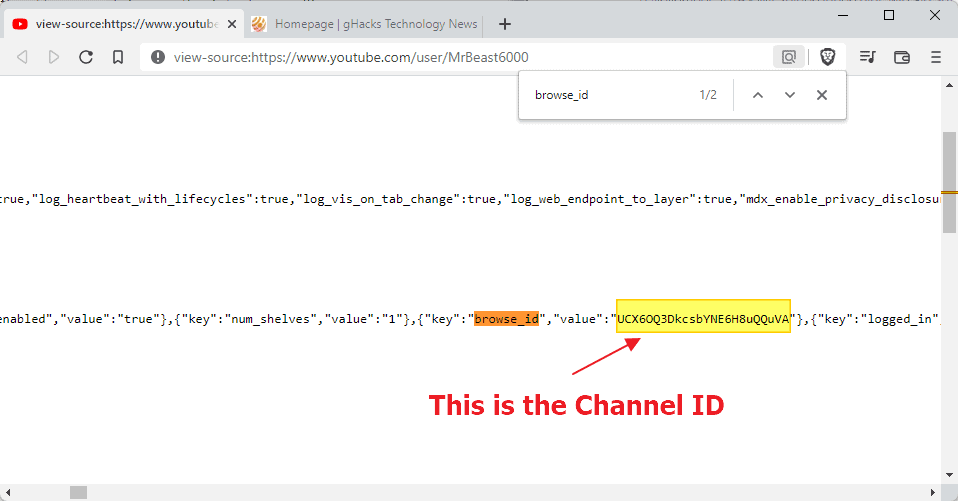
youtube channel id

You need to display the source code of the channel on YouTube to reveal the ID. Here is how that is done:

  1. Open the creator channel on YouTube, e.g., https://www.youtube.com/user/PewDiePie
  2. Right-click on a blank part of the page and select "view page source". Depending on the browser that you use, it may have a slightly different name. Alternatively, prepend view-source: before the URL and hit the Enter-key.
  3. Search for browse_id. You may open the search option with Ctrl-F, or from the browser's main menu.
  4. The browser jumps to the first instance of browse_id in the source code. Copy the string of the value field that is right next to it; this is the channel's ID.

Create the YouTube channel RSS feed URL

Now that you have the channel ID and the default feed address, you can combine the two to create a working feed address:

  • Default URL: https://www.youtube.com/feeds/videos.xml?channel_id=CHANNELID
  • Channel ID: UCX6OQ3DkcsbYNE6H8uQQuVA
  • Working Feed URL: https://www.youtube.com/feeds/videos.xml?channel_id=UCX6OQ3DkcsbYNE6H8uQQuVA

The easiest way to test the feed URL is to load it in the browser. The browser should display the content of the XML file. You may subscribe to the channel using that URL in any feed reader that supports it.

Create a YouTube playlist RSS feed URL

youtube playlist rss feed

You may create RSS feed URLs of playlists on YouTube as well. Thankfully, this is easier as the IDs of playlists are already visible in playlist URLs.

The default feed address for playlists: https://www.youtube.com/feeds/videos.xml?playlist_id=PLAYLISTID

Here is how that is done:

  1. Open the playlist on YouTube, e.g., https://www.youtube.com/watch?v=ktxBUqy6PT4&list=PLYH8WvNV1YEnOwmzyWz4vR0HsX1Qn0PoU
  2. The ID begins after list=; in the case above, it is PLYH8WvNV1YEnOwmzyWz4vR0HsX1Qn0PoU
  3. Replace PLAYLISTID of the default feed address with the real ID to create the RSS feed for the playlist. In the example above, you get https://www.youtube.com/feeds/videos.xml?playlist_id=PLYH8WvNV1YEnOwmzyWz4vR0HsX1Qn0PoU

Now You: are you subscribe to YouTube channels?

Thank you for being a Ghacks reader. The post How to subscribe to YouTube RSS Feeds without third-party services appeared first on gHacks Technology News.

28 Jul 14:02

Larry Gelbart

"One doesn't have a sense of humor. It has you."
24 Jul 21:35

RSS Support For MarkDown

by Ton Zijlstra

Favorited dev Notes for Markdown in RSS by Dave Winer

As part of celebrating twenty years of RSS, Dave Winer adds the ability to incorporate markdown in RSS feeds. Essentially this was always possible, but there was no way to tell a RSS reader that something was to be interpreted not as HTML but as Markdown. Doing this makes it possible to provide both HTML and Markdown in the same feed, if Markdown is e.g. the way you’ve written a posting and want to be able to also edit it again in Markdown, and not in HTML.

After my hiatus I think this is worth an experiment to see if I can generate an RSS feed directly from my markdown notes on my local system. Just like I already can generate OPML feeds and blogposts or website pages from my notes. Chris Aldrich recently asked about using WordPress and Webmention as a way of publishing your own notes with the capability of linking them to other peoples notes. Could RSS play a role there too? Could I provide selected RSS feeds for specific topics directly from my notes? Or for specific people? For them to read along? Is there something here that can play a role in social sharing of annotations, such as Hypothes.is provides? I need to play with this thought. RSS is well understood an broadly used, providing not just HTML but also Markdown through it sounds like a step worth exploring.

21 Jul 17:26

Critical Vulnerabilities in GPS Trackers

by Bruce Schneier

This is a dangerous vulnerability:

An assessment from security firm BitSight found six vulnerabilities in the Micodus MV720, a GPS tracker that sells for about $20 and is widely available. The researchers who performed the assessment believe the same critical vulnerabilities are present in other Micodus tracker models. The China-based manufacturer says 1.5 million of its tracking devices are deployed across 420,000 customers. BitSight found the device in use in 169 countries, with customers including governments, militaries, law enforcement agencies, and aerospace, shipping, and manufacturing companies.

BitSight discovered what it said were six “severe” vulnerabilities in the device that allow for a host of possible attacks. One flaw is the use of unencrypted HTTP communications that makes it possible for remote hackers to conduct adversary-in-the-middle attacks that intercept or change requests sent between the mobile application and supporting servers. Other vulnerabilities include a flawed authentication mechanism in the mobile app that can allow attackers to access the hardcoded key for locking down the trackers and the ability to use a custom IP address that makes it possible for hackers to monitor and control all communications to and from the device.

The security firm said it first contacted Micodus in September to notify company officials of the vulnerabilities. BitSight and CISA finally went public with the findings on Tuesday after trying for months to privately engage with the manufacturer. As of the time of writing, all of the vulnerabilities remain unpatched and unmitigated.

These are computers and computer vulnerabilities, but because the computers are attached to cars, the vulnerabilities become potentially life-threatening. CISA writes:

These vulnerabilities could impact access to a vehicle fuel supply, vehicle control, or allow locational surveillance of vehicles in which the device is installed.

I wouldn’t have buried “vehicle control” in the middle of that sentence.

18 Jul 22:26

Why HDR gaming on PC is such a mess, according to a Ubisoft developer

by Digitaltrends

HDR has been an embarrassment for PC gaming for years. The state of affairs isn’t much better in 2022 than it was five years ago, but to really understand what has gone wrong, I needed to speak to an authority on the game development side of the story.

Contents

  • Not a ‘first-class citizen’
  • Platform-agnostic
  • HDR is a premium, even for developers

So, I spoke with a technical developer over at Ubisoft to get their take on the matter. It’s an issue that large developers like Ubisoft are well aware of, and have even developed tools to combat — but they also say we’re making progress, even if we have a long way to go.

Not a ‘first-class citizen’

Nicolas Lopez is a rendering technical lead working on Ubisoft Anvil — the engine behind Assassin’s Creed Valhalla, Rainbow Six Extraction, and the upcoming Prince of Persia: The Sands of Time Remake, among others. Lopez leads the charge on getting all of the art, mechanics, and code into a final image, and he didn’t mince words about HDR: “HDR is not treated as the first class-citizen it should be in the game industry.”

A big reason why is adoption, according to Lopez. HDR on PC monitors hasn’t been a focal point like it has on consumer TVs, and for a multiplatform studio like Ubisoft, that means focusing much of the effort on the SDR result. Lopez says that the teams at Ubisoft “are very confident about our SDR workflows and outputs, but we know that the mileage may vary when working with HDR on PC.”

The vast majority of HDR monitors available today only meet the lowest DisplayHDR 400 level.

The mileage on PC varies so much because PC monitors have unstable standards for what constitutes HDR (even among the best HDR monitors). The DisplayHDR standard from VESA attempts to standardize the appearance of HDR on gaming monitors, but it has some major loopholes. Take the Samsung Odyssey G7 and MSI MPG32-QD as two examples. Both have DisplayHDR 600 certification, but the MSI monitor has twice as many local dimming zones. That leads to a much more natural HDR image despite the fact that both monitors have the same certification.

To make matters worse, the vast majority of HDR monitors available today only meet the lowest DisplayHDR 400 level — a certification that doesn’t even come close to the requirements of HDR. TVs, on the other hand, have much better HDR at a much lower price. The Hisense U8G, for example, gets much brighter than a gaming monitor and comes with full array local dimming (a feature you can only find on gaming monitors north of $1,200).

Riley Young/Digital Trends

Lopez says developers are acutely aware of the difference between gaming monitors and TVs, and the teams at Ubisoft prioritize accordingly: “We assume the vast majority of players who are going to play our games on a HDR display will do so on a console plugged to a HDR TV, so it’s our main target. However we make sure all platforms look good in the end.”

Platform-agnostic

With the vast differences between HDR gaming monitors in mind, Lopez says the teams as Ubisoft “try to make the process as transparent and platform-agnostic as possible” to avoid duplicating work and speed up production pipelines. For that, Ubisoft uses the Academy Color Encoding System (ACES), which is a device-independent color space developed by the Academy of Motion Picture Arts and Sciences (yes, the Oscars people).

The main benefit of ACES is that it takes in all of the data and processes it down to the color space of the display you’re using. “Thanks to ACES, you can technically grade your game on an SDR display, and it will still be valid in HDR,” Lopez says. However, he also clarified that “it’s still better to master on an HDR display.”

Although a generalist approach is good for a multiplatform studio like Ubisoft, it can’t solve the issues that HDR gaming monitors have today. “HDR support on PC monitors has been lagging behind for quite a while compared to consumer TVs,” Lopez says.

Outside of the panels themselves, a key feature missing from all but a few gaming expensive gaming monitors is dynamic metadata. HDR 10+ and Dolby Vision are widely supported on TVs like the LG C2 OLED and consoles, which both offer dynamic metadata to adjust the color and brightness on a scene-by-scene or even frame-by-frame basis.

With static metadata, Lopez says that games set the minimum and maximum brightness values once at the start, essentially covering the entire spectrum of color possible for every possible lighting situation. “With dynamic metadata, we can determine the optimal range of min/max brightness per frame … and produce more accurate colors.”

Ubisoft, and likely most AAA studios, color games to look great on as many display as possible. But all of the effort still can’t reproduce the exact same image on every display, an issue that’s compounded by the fact that HDR gaming monitors are behind TVs in terms of panel technology and dynamic metadata. The result: Wildly different HDR experiences despite the developer’s intentions and effort.

HDR is a premium, even for developers

Dan Baker/Digital Trends

It’s easy to assume that a multibillion-dollar company like Ubisoft has a fleet of high-quality HDR displays to calibrate games with, but I still posed the question to Lopez. He says the vast majority of work still happens on SDR displays, while HDR is “usually assigned to a few key people equipped with consumer HDR TVs, or very specific calibrated HDR monitors.”

Lopez even shared a story about running game builds across the street to a different company to test HDR performance. “At some point, we had a deal with a high-end electronic product review company on the other side of the street. Some teams would take their game builds over there and have the opportunity to test on a wide range of consumer displays.”

“I’m confident we’re getting there.”

Although a large developer like Ubisoft has access to high-quality HDR displays, it’s safe to assume that smaller developers don’t have the same luxuries (especially given some of the hoops a developer like Ubisoft has needed to jump through). Lopez said this gap became all the more apparent during the pandemic, when the team had to lean on ACES as developers remotely connected to their SDR work desktops.

At the end of my Q&A, Lopez reiterated that HDR is not treated like the first-class citizen it should be. Much more development time and effort goes toward making a high-quality SDR version that, hopefully, offers a solid HDR experience on consumer TVs. Lopez seemed confident that HDR is improving, though: “It’s been a slow transition and adoption, but with the new generation of HDR consoles and vendors ramping up their production lines, I’m confident we’re getting there.”

The post Why HDR gaming on PC is such a mess, according to a Ubisoft developer appeared first on AIVAnet.

14 Jul 17:01

New Browser De-anonymization Technique

by Bruce Schneier

Researchers have a new way to de-anonymize browser users, by correlating their behavior on one account with their behavior on another:

The findings, which NJIT researchers will present at the Usenix Security Symposium in Boston next month, show how an attacker who tricks someone into loading a malicious website can determine whether that visitor controls a particular public identifier, like an email address or social media account, thus linking the visitor to a piece of potentially personal data.

When you visit a website, the page can capture your IP address, but this doesn’t necessarily give the site owner enough information to individually identify you. Instead, the hack analyzes subtle features of a potential target’s browser activity to determine whether they are logged into an account for an array of services, from YouTube and Dropbox to Twitter, Facebook, TikTok, and more. Plus the attacks work against every major browser, including the anonymity-focused Tor Browser.

[…]

“Let’s say you have a forum for underground extremists or activists, and a law enforcement agency has covertly taken control of it,” Curtmola says. “They want to identify the users of this forum but can’t do this directly because the users use pseudonyms. But let’s say that the agency was able to also gather a list of Facebook accounts who are suspected to be users of this forum. They would now be able to correlate whoever visits the forum with a specific Facebook identity.”

11 Jul 12:29

What Makes Workers 'Thrive'? Microsoft Study Suggests Shorter Workweeks and Less Collaboration

by EditorDavid
Microsoft describes "thriving" at work as being "energized and empowered to do meaningful work." So Microsoft's "people analytics" chief and its "culture measurements" director teamed up for a report in Harvard Business Review exploring "as we enter the hybrid work era... how thriving can be unlocked across different work locations, professions, and ways of working." ZDNet columnist Chris Matyszczyk took special note of the researchers' observation that "Employees who weren't thriving talked about experiencing siloes, bureaucracy, and a lack of collaboration," asking playfully, "Does that sound like Microsoft to you?" Klinghoffer and McCune were undeterred in their search for the secret of happiness. They examined those who spoke most positively about thriving at work and work-life balance. They reached a startling picture of a happy Microsoft employee. They said: "By combining sentiment data with de-identified calendar and email metadata, we found that those with the best of both worlds had five fewer hours in their workweek span, five fewer collaboration hours, three more focus hours, and 17 fewer employees in their internal network size." Five fewer collaboration hours? 17 fewer employees in their internal network? Does this suggest that the teamwork mantra isn't working so well? Does it, in fact, intimate that collaboration may have become a buzzword for a collective that is more a bureaucracy than a truly productive organism? Klinghoffer and McCune say collaboration isn't bad in itself. However, they say: "It is important to be mindful of how intense collaboration can impact work-life balance, and leaders and employees alike should guard against that intensity becoming 24/7." If you're a leader, you have a way to stop it. If you're an employee, not so much. The Microsoft researchers' conclusion? "Thriving takes a village" (highlighting the importance of managers), and that "the most common thread among those who were not thriving was a feeling of exclusion — from a lack of collaboration to feeling left out of decisions to struggling with politics and bureaucracy." Matyszczyk's conclusion? "It's heartening to learn, though, that perhaps the most important element to making an employee happy at work is giving them time to, well, actually work."

Read more of this story at Slashdot.

24 Jun 00:36

On the Subversion of NIST by the NSA

by Bruce Schneier

Nadiya Kostyuk and Susan Landau wrote an interesting paper: “Dueling Over DUAL_EC_DRBG: The Consequences of Corrupting a Cryptographic Standardization Process“:

Abstract: In recent decades, the U.S. National Institute of Standards and Technology (NIST), which develops cryptographic standards for non-national security agencies of the U.S. government, has emerged as the de facto international source for cryptographic standards. But in 2013, Edward Snowden disclosed that the National Security Agency had subverted the integrity of a NIST cryptographic standard­the Dual_EC_DRBG­enabling easy decryption of supposedly secured communications. This discovery reinforced the desire of some public and private entities to develop their own cryptographic standards instead of relying on a U.S. government process. Yet, a decade later, no credible alternative to NIST has emerged. NIST remains the only viable candidate for effectively developing internationally trusted cryptography standards.

Cryptographic algorithms are essential to security yet are hard to understand and evaluate. These technologies provide crucial security for communications protocols. Yet the protocols transit international borders; they are used by countries that do not necessarily trust each other. In particular, these nations do not necessarily trust the developer of the cryptographic standard.

Seeking to understand how NIST, a U.S. government agency, was able to remain a purveyor of cryptographic algorithms despite the Dual_EC_DRBG problem, we examine the Dual_EC_DRBG situation, NIST’s response, and why a non-regulatory, non-national security U.S. agency remains a successful international supplier of strong cryptographic solutions.

21 Jun 09:50

Ambrose Bierce

"There is nothing new under the sun but there are lots of old things we don't know."
17 Jun 14:53

Tracking People via Bluetooth on Their Phones

by Bruce Schneier

We’ve always known that phones—and the people carrying them—can be uniquely identified from their Bluetooth signatures, and that we need security techniques to prevent that. This new research shows that that’s not enough.

Computer scientists at the University of California San Diego proved in a study published May 24 that minute imperfections in phones caused during manufacturing create a unique Bluetooth beacon, one that establishes a digital signature or fingerprint distinct from any other device. Though phones’ Bluetooth uses cryptographic technology that limits trackability, using a radio receiver, these distortions in the Bluetooth signal can be discerned to track individual devices.

[…]

The study’s scientists conducted tests to show whether multiple phones being in one place could disrupt their ability to track individual signals. Results in an initial experiment showed they managed to discern individual signals for 40% of 162 devices in public. Another, scaled-up experiment showed they could discern 47% of 647 devices in a public hallway across two days.

The tracking range depends on device and the environment, and it could be several hundred feet, but in a crowded location it might only be 10 or so feet. Scientists were able to follow a volunteer’s signal as they went to and from their house. Certain environmental factors can disrupt a Bluetooth signal, including changes in environment temperature, and some devices send signals with more power and range than others.

One might say “well, I’ll just keep Bluetooth turned off when not in use,” but the researchers said they found that some devices, especially iPhones, don’t actually turn off Bluetooth unless a user goes directly into settings to turn off the signal. Most people might not even realize their Bluetooth is being constantly emitted by many smart devices.

13 Jun 10:14

Sir William Osler

"The greater the ignorance the greater the dogmatism."
13 Jun 09:37

Vytal: browser extension to spoof your location and user agent

by Martin Brinkmann

Vytal is an open source browser extension for Google Chrome and other Chromium-based browsers, that will spoof the location, locale, timezone and user agent manually or automatically.

vytal spoof location user agent

Vytal uses the chrome.debugger API, which the developer believes makes the use of the extension undetectable by websites and will spoof the data during the initial loading of webpages as well as in iframes and web workers.

One of the main ideas behind Vytal was to give VPN users a tool at hand to match location-based identifiers to the VPN's location. Sites may use scripts to find discrepancies between the VPN's location, based on the IP address, and other location data, which the browser may provide.

The Vytal extension is available in the Chrome Web Store. Just visit its profile page there and install it, just like any other Chrome extension. You may check the source code of the extension on GitHub.

Installation adds an icon to Chrome's main toolbar that you may interact with. A click displays the available options and information about the current IP address and region. The profile menu lists dozens of regional profiles that you may apply manually, e.g., to spoof your location, timezone and locale to Houston, Jersusalem, or Bangkok.

You also find an option to match the regional settings to the active IP address; this is what VPN users may want to activate, as it automates the process of matching the VPN server location to the spoofed data of the browser.  A custom option is available next to that, to enter data manually into the fields.

There is an option to randomize the data every 60 minutes, or any other period that you set the randomizer to.

Last but not least, you may also set a different user agent, but none appears to be provided, which means that you need to set it manually.

Vytal has two shortcomings that users need to be aware of. Chromium-based browsers display a "started debugging this browser" message at the top when extensions are active that use the debugging API. The notification is displayed at the top in the browser when Vytal is being used.

Chrome and other Chromium-based browsers support the command line switch --silent-debugger-extension-api, which supresses the message in the browser.

The second issue weights more heavily. There is a slight delay between opening a new tab and the start of the debugger. Sites may use this delay to retrieve information before the actual spoofing takes place. Since this is tab-based, users might get around this by loading safe sites in tabs first before loading sites that might detect spoofing this way.

The browser extension is not available for Firefox, as the browser does not support the debugging API according to the developer.

Closing Words

The browser extension Vytal may be useful to Internet users who run into location-based issues when using sites; this may affect users who are abroad on vacation or because of their job, and users who use VPN's to access content in different locations in the world.

Sites have other means to block access to content, for example, by detecting that IP addresses that are linked to a VPN service are being used.

Still, it may be worth a shot for users who can't use certain services because of their location.

Now you: do you use VPNs to spoof your location?

Thank you for being a Ghacks reader. The post Vytal: browser extension to spoof your location and user agent appeared first on gHacks Technology News.

01 Jun 09:33

Ralph Waldo Emerson

"Wit makes its own welcome, and levels all distinctions. No dignity, no learning, no force of character, can make any stand against good wit."
23 May 11:19

Ronald Reagan

"Politics is supposed to be the second oldest profession. I have come to realize that it bears a very close resemblance to the first."
21 May 14:44

Google 'Private Browsing' Mode Not Really Private, Texas Lawsuit Says

by BeauHD
The Google search engine collects data on users who think they can be anonymous if they use a "private browsing" mode, Texas Attorney General Ken Paxton claimed on Thursday, filing an amended privacy lawsuit against the Alphabet unit. Reuters reports: Texas, Indiana, Washington State and the District of Columbia filed separate suits against Google in January in state courts over what they called deceptive location-tracking practices that invade users' privacy. Paxton's filing adds Google's Incognito mode to the lawsuit filed in January. Incognito mode or "private browsing" is a web browser function that Paxton said implies Google will not track search history or location activity. The lawsuit said Google offers the option of "private browsing" that could include "viewing highly personal websites that might indicate, for example, their medical history, political persuasion, or sexual orientation. Or maybe they simply want to buy a surprise gift without the gift recipient being tipped off by a barrage of targeted ads." The suit said "in reality, Google deceptively collects an array of personal data even when a user has engaged Incognito mode." Paxton previously alleged Google misled consumers by continuing to track their location even when users sought to prevent it. Google has a "Location History" setting and informs users if they turn it off "the places you go are no longer stored," Texas said.

Read more of this story at Slashdot.

18 May 18:54

Google Blocks File Manager Total Commander From Allowing Users To Sideload Apps

by msmash
Maxim Bange

What is an Operating System these days?

An anonymous reader shares a report: Total Commander has been around since the 90s, eventually expanding into Android after the platform launched over a decade ago. The app has more than 10 million downloads on the Play Store, still supporting OS versions as far back as Android 2.2. With a new update, developer Christian Ghisler has removed the ability to install APK files on Android, blaming Google Play policies in the patch notes for the app. It's a shocking twist for the service and, seemingly, a bad omen of things to come for other mobile file managers. A forum post from Ghisler sheds some more light on what's going on here, as Google sent him a notice warning of his app's removal from the Play Store within a week if the app went unmodified. The company's automated response pointed the developer to the "Device and Network Abuse" policy.

Read more of this story at Slashdot.

18 May 10:43

Unconvincing Criticism of Data Altruism

by Ton Zijlstra

Bookmarked Data altruism: how the EU is screwing up a good idea (by Winfried Veil)

I find this an unconvincing critique of the data altruism concept in the new EU Data Governance Act (caveat: the final consolidated text of the new law has not been published yet).

“If the EU had truly wanted to facilitate processing of personal data for altruistic purposes, it could have lifted the requirements of the GDPR”
GDPR slackened for common good purposes? Let’s loosen citizen rights requirements? It asumes common good purposes can be well enough defined to not endanger citizen rights, turtles all the way down. The GDPR is a foundational block, one in which the author, some googling shows, is disappointed with having had some first hand experience in its writing process. The GDPR is a quality assurance instrument, meaning, like with ISO style QA systems, it doesn’t make anything impossible or unallowed per se but does require you organise it responsibly upfront. That most organisations have implemented it as a compliance checklist to be applied post hoc is the primary reason for it being perceived as “straight jacket” and for the occurring GDPR related breaches to me.
It is also worth noting that data altruism also covers data that is not covered by the GDPR. It’s not just about person identifiable data, but also about otherwise non-public or confidential organisational data.

The article suggests it makes it harder for data altruistic entities to do something that already now can be done under the GDPR by anyone, by adding even more rules.
The GDPR pertains to the grounds for data collection in the context of usage specified at the time of collection. Whereas data altruism is also aimed at non-specified and at not yet known future use of data collected here and now. As such it covers an unaddressed element in the GDPR and offers a path out of the purpose binding the GDPR stipulates. It’s not a surprise that a data altruism entity needs to comply with both the GDPR and a new set of rules, because those additional rules do not add to the GDPR responsibilities but cover other activities. The type of entities envisioned for it already exist in the Netherlands, common good oriented entities called public benefit organisations: ANBI‘s. These too do not absolve you from other legal obligations, or loosen the rules for you. On the contrary these too have additional (public) accountability requirements, similar to those described in the DGA (centrally registered, must publish year reports). The DGA creates ANBI’s for data, Data-ANBI’s. I’ve been involved in data projects that could have benefited from that possibility but never happened in the end because it couldn’t be made to work without this legal instrument.

To me the biggest blind spot in the criticism is that each of the examples cited as probably more hindered than helped by the new rules are single projects that set up their own data collection processes. That’s what I think data altruism is least useful for. You won’t be setting up a data altruism entity for your project, because by then you already know what you want the data for and start collecting that data after designing the project. It’s useful as a general purpose data holding entity, without pre-existing project designs, where later, with the data already collected, such projects as cited as example will be applicants to use the data held. A data altruistic entity will not cater to or be created for a single project but will serve data as a utility service to many projects. I envision that universities, or better yet networks of universities, will set up their own data altruistic entities, to cater to e.g. medical or social research in general. This is useful because there currently are many examples where handling the data requirements being left to the research team is the source of not just GDPR breaches but also other ethical problems with data use. It will save individual projects such as the examples mentioned a lot of time and hassle if there’s one or more fitting data altruistic entities for them to go to as a data source. This as there will then be no need for data collection, no need to obtain your own consent or other grounds for data collection for each single respondent, or create enough trust in your project. All that will be reduced to guaranteeing your responsible data use and convince an ethical board of having set up your project in a responsible way so that you get access to pre-existing data sources with pre-existing trust structures.

It seems to me sentences cited below require a lot more thorough argumentation than the article and accompanying PDF try to provide. Ever since I’ve been involved in open data I’ve seen plenty of data innovations, especially if you switch your ‘only unicorns count’ filter off. Barriers that unintentionally do exist typically stem more from a lack of a unified market for data in Europe, something the DGA (and the GDPR) is actually aimed at.

“So long as the anti-processing straitjacket of the GDPR is not loosened even a little for altruistic purposes, there will be little hope for data innovations from Europe.” “In any case, the EU’s bureaucratic ideas threaten to stifle any altruism.”

Winfried Veil

18 May 10:36

How America Reached One Million Covid Deaths | Jeremy White, Amy...


How America Reached One Million Covid Deaths | Jeremy White, Amy Harmon, Danielle Ivory, Lauren Leatherby, Albert Sun and Sarah Almukhtar

The virus did not claim lives evenly, or randomly. The New York Times analyzed 25 months of data on deaths during the pandemic and found that some demographic groups, occupations and communities were far more vulnerable than others. A significant proportion of the nation’s oldest residents died, making up about three-quarters of the total deaths. And among younger adults across the nation, Black and Hispanic people died at much higher rates than white people.

Understanding the toll — who makes up the one million and how the country failed them — is essential as the pandemic continues. More than 300 people are still dying of Covid every day.

“We are a country with the best doctors in the world, we got a vaccine in an astoundingly short period of time, and yet we’ve had so many deaths,” said Mary T. Bassett, the health commissioner for New York State.

“It really should be a moment for us all to reflect on what sort of society we want to have,” she added.

17 May 23:31

Adding Unoffice Hours

by Ton Zijlstra

Matt Webb has been keeping UnOffice hours for a few years, a few timeslots in his week during which anyone can come by and talk to him. Several people in my network similarly have opened parts of their weekly schedule for others to be able to plan a conversation with them. Using a tool like Calendly, it saves the back and forth of finding a time. More importantly it is a clear signal you don’t have to ask if it’s ok to have a conversation. You can just go ahead and plan it if you want to talk to them.

I like that idea. A few times in the past I’ve mailed a selection of my own contacts to ask them for a conversation, just to catch up and hear what they are doing. It always leads to some new insights or connections, and sometimes it generates a next step. It’s a serendipity aid.

As an experiment I’ve created a schedule in which anyone can book a conversation on Wednesday afternoons (Central European Time). You can find the link to my Calendly schedule in the right hand side bar.

12 May 07:24

Cleaner Air Leads To More Atlantic Hurricanes, Study Finds

by BeauHD
Cleaner air in United States and Europe is brewing more Atlantic hurricanes, a new U.S. government study found. The Associated Press reports: The National Oceanic and Atmospheric Administration study links changes in regionalized air pollution across the globe to storm activity going both up and down. A 50% decrease in pollution particles and droplets in Europe and the U.S. is linked to a 33% increase in Atlantic storm formation in the past couple decades, while the opposite is happening in the Pacific with more pollution and fewer typhoons, according to the study published in Wednesday's Science Advances. NOAA hurricane scientist Hiroyuki Murakami ran numerous climate computer simulations to explain change in storm activity in different parts of the globe that can't be explained by natural climate cycles and found a link to aerosol pollution from industry and cars -- sulfur particles and droplets in the air that make it hard to breathe and see. Scientists had long known that aerosol pollution cools the air, at times reducing the larger effects of greenhouse gases from the burning of fossil fuel and earlier studies mentioned it as a possibility in increase in Atlantic storms, but Murakami found it a factor around the world and a more direct link. Hurricanes need warm water -- which is warmed by the air -- for fuel and are harmed by wind shear, which changes in upper level winds that can decapitate storm tops. Cleaner air in the Atlantic and dirtier air in the Pacific, from pollution in China and India, mess with both of those, Murakami said. In the Atlantic, aerosol pollution peaked around 1980 and has been dropping steadily since. That means the cooling that masked some of the greenhouse gas warming is going away, so sea surface temperatures are increasing even more, Murakami said. On top of that the lack of cooling aerosols has helped push the jet stream -- the river of air that moves weather from west to east on a roller-coaster like path -- further north, reducing the shear that had been dampening hurricane formation.

Read more of this story at Slashdot.

08 May 19:42

I kind of miss how pretty Nokia Lumia Windows phones looked

by Usama Jawad
Having a colorful exterior on a Nokia Lumia was pretty much a given in the good old days of Windows phone. Now that the brand is dead, I can't help but reminisce how pretty those handsets looked. Read more...
04 May 09:53

Allan Goldfein

"Only exceptionally rational men can afford to be absurd."
03 May 14:20

Joint Statement on the Invasion of Ukraine and the Importance of Freedom of Expression and Information

by ATaylor

In the light of the invasion of Ukraine by the Russian Federation and the continuation of the Russian war of aggression against Ukraine, the monitors for freedom of expression and freedom of the media for the United Nations (UN), the African Commission of Human Rights (ACHR), the Inter-American Commission for Human Rights (ItACHR), and the Organization for Security and Co-operation in Europe (OSCE) issued the following joint statement:

We collectively condemn the invasion of and continuous aggression against Ukraine, its sovereignty and territorial integrity by the Russian Federation. The actions of the Russian Federation violate international law and the common UN, OSCE, ItACHR and ACHR commitments and the very principles on which our organizations are based.

We are outraged about the continuous atrocities and the resulting grave human rights and humanitarian crises, which have a massive detrimental impact on civilians’ lives, safety and well-being. We stand in solidarity with the people of Ukraine in these difficult times.

We recall that it is precisely during times of war and armed conflict that the right to freedom of expression and free access to information must be vigorously defended, as it is instrumental for the promotion of lasting peace, understanding the nature of the conflict and  ensuring accountability.

In this connection, we highlight the following:

First, we are profoundly concerned about the safety of journalists, media workers and associated personnel in Ukraine, who are carrying out their work under unprecedented conditions, and are now at a very high risk. There are numerous reports that journalists and they are being targeted, tortured, kidnapped, attacked and killed, or refused safe passage from the cities and regions under siege. Such actions are abhorrent and must be stopped immediately. We recall that under international humanitarian law, during armed conflict journalists are considered to be civilians and must be afforded protection as such. An attack to kill, wound or abduct a journalist constitutes a war crime. Those responsible for direct or indiscriminate attacks on civilians, including journalists, should be held accountable and brought to justice under national and international law. Measures must also be taken to trace missing journalists, ascertain their fate, provide appropriate assistance and facilitate their return to their families. States have the duty and obligation to protect and guarantee human rights, to conduct effective investigations and to guarantee effective remedies and reparations.

Second, we are alarmed by reports that Ukraine’s media and internet infrastructure may be intentionally targeted by the Russian forces in an effort to disrupt access to information, including by means of cyberattacks. We appreciate that access to Ukraine's internet infrastructure has remained largely resilient. It is crucial to ensure that people in Ukraine have continued access to the internet, broadcasting and other means of communication. We call for the adoption of all feasible measures to protect the media, media organisations, and internet infrastructure from attacks and hostile take overs. We also call for increased support in various forms by the international community to ensure media sustainability in Ukraine at a time when a number of national and local media outlets have lost their premises and equipment or have been damaged or destroyed. Initiatives that enable Ukrainian journalists and media in exile to continue their professional work should also be supported in a manner that is sustainable and adapted to the exceptional conditions they are facing.

Third, we underline that  propaganda for war and national hatred which constitutes incitement to discrimination, hostility or violence are profoundly harmful and   prohibited  under article 20 of the International Covenant on Civil and Political Rights. We call on the Russian Federation to immediately refrain from these unlawful practices.

Fourth, we are concerned at the spread of disinformation concerning the conflict in Ukraine in Russian state-owned media. However, we believe that disinformation cannot be addressed by blocking or banning media outlets. Any restriction of freedom of expression should respect scrupulously the three-part test of legality, legitimate aim, and necessity and proportionality. We are concerned that the EU’s decision to ban two Russian state-owned media outlets may have been a disproportionate response to disinformation. It has been used as a pretext for additional closure of independent media outlets in the Russian Federation. Promoting access to diverse and verifiable information, including ensuring access to free, independent and pluralistic media, is a more effective response to disinformation.

Fifth,  we believe that the erosion of the right to freedom of expression and other human rights over a prolonged period of time and the silencing of critical voices  in the Russian Federation have contributed to creating an environment that facilitates Russia’s war against Ukraine.   We are alarmed at the further tightening of censorship and repression of dissent and pluralist sources of information and opinion in the Russian Federation, including the blocking of social media platforms and news websites, disruption of services from foreign content and service providers, massive labeling of independent journalists and media as “foreign agents”, introduction of criminal liability and imprisonment of up to fifteen years for spreading so-called “fake” information about the war in Ukraine or questioning Russian military action in Ukraine or simply standing for peace or even mentioning the word “war”. We deplore the systematic crackdown on political opponents, independent journalists and the media, human rights activists, protesters and many others opposing the Russian government’s actions. All these measures amount to the creation of a state monopoly on information in blatant violation of Russia’s international obligations. They must stop. We call on the Russian government to fully implement its international human rights obligations, including by respecting, promoting and protecting the freedom to seek, receive and impart information regardless of frontiers, and by ensuring a safe working environment for independent media, journalists and civil society actors.

Six, we note that the war in Ukraine has further highlighted the risks of the proliferation of disinformation, misinformation  and incitement to violence and hatred and restrictions of lawful speech  on digital and social media  platforms as a result of their business models, policies and practices.  While we appreciate that dominant companies recently made some efforts to address these problems, we urge them to strengthen their human rights due diligence and impact assessment, accountability, transparency and equal and consistent application of policies to uphold the rights of all users.

* The freedom of expression mandates are: Mrs. Irene Khan, Special Rapporteur on the promotion and protection of the right to freedom of opinion and expression; Mrs. Teresa Ribeiro, OSCE Representative on Freedom of the Media, Mr. Pedro Pedro Vaca Villarreal, Inter-American Commission on Human Rights Special Rapporteur for Freedom of Expression, and Hon. Ourveena Geereesha Topsy-Sonoo, African Commission Special Rapporteur on Freedom of Expression and Access to Information.

01 May 13:03

Razer co-founder and gaming mouse pioneer Robert Krakoff has passed away

by Sean Hollister
Maxim Bange

R.I.P.

Robert “Razerguy” Krakoff | Image: Razer

Robert “Razerguy” Krakoff, the co-founder and former president of gaming hardware company Razer, passed away last week at the age of 81. Maybe you’ve never heard Krakoff’s name, but it’s possible you’ve been impacted by his far-reaching legacy.

In 1999, Krakoff was behind the first-ever gaming mouse: the Razer Boomslang. Not only was it the foundation of Razer’s now-massive lineup of gaming mice, it arguably jumpstarted the entire gaming peripheral industry. Below, you can see Krakoff himself in an ad promoting the Razer Boomslang mouse in 2002 — alongside professional gamer Johnathan “Fatal1ty” Wendel, who signed a historic sponsorship deal with Razer long before the word “esports” entered the lexicon.

Origin stories can be...

Continue reading…

28 Apr 07:40

All of the Bases In DNA, RNA Have Now Been Found In Meteorites

by BeauHD
Space rocks that fell to Earth within the last century contain the five bases that store information in DNA and RNA, scientists report April 26 in Nature Communications. Science News reports: These "nucleobases" -- adenine, guanine, cytosine, thymine and uracil -- combine with sugars and phosphates to make up the genetic code of all life on Earth. Whether these basic ingredients for life first came from space or instead formed in a warm soup of earthly chemistry is still not known. But the discovery adds to evidence that suggests life's precursors originally came from space, the researchers say. Scientists have detected bits of adenine, guanine and other organic compounds in meteorites since the 1960s. Researchers have also seen hints of uracil, but cytosine and thymine remained elusive, until now.

Read more of this story at Slashdot.