Shared posts

19 Mar 18:59

Purposeful discussion in geoscience

by Matt Hall

Regular readers will remember the Unsolved Problems Unsession at the GeoConvention in Calgary last May. We think these experiments in collaboration are one possible way to get people more involved in progressing geoscience at conferences, and having something to show for it. We plan to do more — and are here to support you if you'd like to try one in your community.

Last Thursday was the 2014 CSEG Symposium. The organizers asked me for a short video to sum up what happened at the unsession for the crowd, and to help get them in the mood for some discussion. I hope it helped...

Getting better

Conferences seem so crammed with talks these days. No time for good conversation, in or out of the sessions. The only decent discussion I remember recently (apart from the unsession, obvsly) was at EAGE in 2012, when a talk finished early and the space filled with a fascinating discussion between two compressed sensing clever-clogs.

I think there are a few ways to get better at it:

  • Make more time for it, preferably at least 40 minutes.
  • Get people into smaller groups, about 4–12 people is good.
  • Facilitate with some ground rules, provocative questions, and conversation management.
  • Capture what was said, preferably in real time and using the participants' own words.
  • Use lots of methods: drawing, sticky notes, tweets, video, and so on.
  • Reflect the conversation back at the participants, and let them respond.
  • Read up on open space, knowledge café, charrettes, and other methods.
  • Don't shut it down with "I guess we're out of time..." — review or sum up first.

Think about when you have been part of a really good conversation. How it feels, how it flows, and how you remember it for days afterwards, and mention it to others later. I think we can have more of those about our work, and conferences are a great place to help them happen.

Stay tuned for details of the next unsession — again, at the Calgary GeoConvention.

19 Mar 18:48

Is Torosaurus Triceratops? The debate rages on!

by Jon Tennant

This was originally posted at: http://blogs.egu.eu/palaeoblog/?p=1138

For some time now, there has been much debate about whether our beloved dinosaur, Triceratops, is a distinct species, or a younger version of a bigger ceratopsian, Torosaurus – the great Toroceratops’ debate. Proponents of both sides of the argument have made detailed quantitative and qualitative points, and there doesn’t really seem to have been any resolution. Check out the video below for a great discussion of the issues, or this link or this link.

FIGHT! (source)

FIGHT! (source)

Enter geometric morphometrics (GM). Everyones’ favourite-sounding method, GM is essentially a way of analysing the shape of objects, like fossils, using co-ordinate data. There are a range of statistical ways of spanking your data into shape once you have a digital version of it, and have converted an object into a series of point co-ordinates (decent-ish explanation in the methods section here).

What it is for scientists is a way of introducing statistical rigour to test a hypothesis. It’s really frickin’ useful, pretty much. The hypothesis which Maironi et al. wanted to test was whether Triceratops, Torosaurus, and Nedoceratops, another dino that might be just a younger Torosaurus, were distinct enough to not be regarded as a single growth series of the same species. Using geometric morphometrics, it is possible to visit the shape variation that specimens exhibit, as well as whether they truly represent discrete groups.

Different or the same..? Image: Nobu Tamura

Different or the same..? Image: Nobu Tamura

I didn’t want to this post to be critical of the methods for this paper, but they have missed a few essential steps. If you want to test for discrete clusters or groups within your data, principal components analysis (PCA) is not really the right method, as this study uses. PCA is a way of taking a high-dimensional data set, as you usually get using GM, and reducing it into fewer variables that represent a high proportion of the variance within that data set – usually, 95% of the variance is the accepted minimum required to be represented by a number of principal components.

Distribution of Torosaurus and Triceratops specimens in North America (source)

Distribution of Torosaurus and Triceratops specimens in North America (source)

In this case, 12 (!) PCs represented 95% of the variance in the reconstructed digital dinos. The first two only represent about 60% of the data – it is, then, entirely inappropriate to analyse just these two when they represent such a small proportion of the original data. What the study essentially does, is attempts to interpret distinctiveness of the different species, in a ‘morphospace’ that firstly isn’t designed to test for distinctiveness, but also fails to faithfully represent the data. Ideally, you’d want to analyse the dispersion pattern of all of the specimens with respect to the first 12 axes – this would tell you about the shape changes that are being represented by each axis.

The next step should have been to use a form off discriminant analysis – these tests are designed to test for group distinctiveness, as they incorporate group-level information as an additional variable; in this case, the species’ ID. Performing this would tell you how accurate, or distinct, your supposedly different groups are, and you can test the proportion of specimens that are correctly ‘assigned’ to each group. I go into this protocol in some detail in a forthcoming paper, and will discuss it more then. For now, I feel a bit bad saying, but this is really only half an analysis, and a lot more could have been and should have been done with it.

Nonetheless, there are some interesting results, if not based on an entirely substantial analysis (imo). Importantly, Torosaurus and Triceratops, in the context of the first two principal components, occupy different morphospaces, which suggests that they can be delimited based on shape as well as their sizes. That’s pretty much it. Another piece of the puzzle suggesting that we can keep Triceratops alive, for now!

Fortunately, the authors have been jolly decent uploaded their raw data, so I’m gonna go have a play with it and see what we get.. BRB

Reference:

Maiorini, L., Farke, A. A., Kotsakis, T. and Piras, P. (2013) Is Torosaurus Triceratops? Geometric morphometric evidence of Late Maastrichtian ceratopsid dinosaurs, PLOS ONE, 8(11), e81608 (OA link)


Filed under: Fossils, Homology, Palaeontology Tagged: Geometric Morphometrics, Toroceratops, Torosaurus, Triceratops

17 Mar 22:44

Rock-physics modeling guided by depositional and burial history in low-to-intermediate-porosity sandstones

GEOPHYSICS, Volume 79, Issue 2, Page D115-D121, March-April 2014.
17 Mar 22:08

Sperl of Wisdom

by Brooks Riley

by Brooks Riley

Sperl of Wisdom sphinx tallWe didn't want a second cat. That said, we got a second cat, succumbing to the desperate pleas of a friend with two litters to give away. By the time we capitulated, she was the only kitten left.

If there were an antonym for ‘runt', it would have applied to Sperl, as we finally named her (see T.S. Eliot's ‘The Naming of Cats'). She was the biggest kitten of the two litters, a black-and-white, gangly thing with a strange face. Like a mother who loves one child more than another, I did my best to hide my antipathy. Our other cat, after initial outrage, lapsed into a state of chronic resentment behind a mask of indifference.

Sperl was huge, a gentle giant with muscles, not fat. Anthropomorphically speaking, she could have been a Valkyrie (with an operatic voice to match), or a female wrestler. When she was nearly grown, it dawned on me that she had become a great beauty. But something else made me sit up and take notice: It was that presence, so much greater than her body mass. I fell in love.

When she died eight years later (was it gigantism?), it was one of the saddest days of my life. She had brought us so much pleasure, and more: She had taught me a thing or two. In memory of Sperl I have written down the Sperl Commandments, as I learned them from her.

The Sperl Commandments

1. If they don't like it, don't do it.

There was almost nothing Sperl did that I didn't like. She was a considerate cat, unlike others I've known. She never used her claws, even when she was kneading my stomach in a show of affection. She knew instinctively what I liked and what I didn't. If I reprimanded her for something just once, she never did it again.

2. Don't be forced to do something you don't want.

Sperl didn't like to be held. She might curl up on my lap, but if I picked her up, she would struggle to get down, using her muscles to get free, not her claws, not her teeth. Because I was so besotted, I sometimes picked her up anyway, just to hold that great bulk in my arms (I had yet to learn Commandment number 1). Over time, to please me, she would remain still in my arms a bit longer—one second, then four, in the end ten whole seconds--before she began to squirm.

3. Show concern for others..

Sperl looked after the other cat, not that her concern was much appreciated. Once, when we came home late from work, the other cat, furious, flew out the apartment door. Because we were having an intense discussion, we forgot about her. A short time later, we heard Sperl yodeling in the foyer. When I went to check, I found her  sitting in front of the full-length mirror beside the front door, looking at her reflection and speaking to it. How adorable! And then it hit me: The other cat was not in the apartment. We had locked her out and forgotten about her. Sperl wasn't speaking to her reflection in the mirror: She was sounding the alarm and trying to look through the mirror to the cat on the other side.

4. Develop your language skills.

Sperl never meowed. ‘Meow' can't do justice to the enormous vocabulary and musical range she had at her disposal. Some of her sounds were imitations of me. If I said ‘ah, ah, ah' to warn her not to do something, she would answer back with ‘ah, ah, ah'. Her other utterances were definitely syntactic. She could put a question mark on a sound, and I might know what she meant. She often talked to herself, trying out different melodious combinations, like any good composer. When she spoke to us, it was in whole sentences. If only we could have understood it all.

5. Be polite.

In my lap, the other cat was like Putin in the Crimea, hard to shake off. If I wanted her to move, she became a dead weight, or dug her claws into my thighs if I tried to stand up. Sperl, on the other hand, always got up immediately if she sensed I wanted her to go away. She was an affectionate cat, but it was not in her nature to be stubborn or try to get her way at all costs.

6. Be observant 

As the new kid on the block, Sperl had a lot to learn. Her mirror neurons picked up some of the other cat's dubious behaviors, such as disappearing when the doorbell rang, without her ever knowing quite why she had to disappear. Eventually she found her own way, going for the ‘good cat' role in a ‘good cat-bad cat' mood dialectic which perfectly reflected the status quo. 

7. Beware the camera: It might capture your soul.

ScreenHunter_561 Mar. 17 10.32The moment Sperl saw a lens, she turned her head or walked away. She didn't even fall for the cell phone camouflage. Most of my pictures of her were taken while she slept. It was mean of me to take advantage of her like that, (I was still struggling with Commandment number 1) but even asleep, Sperl oozed charisma. 

8. Initiate the fun: Bring them the idea.

Working at the computer, I'd hear a contorted yowl from the living room. Soon after, Sperl would show up with a pathetic felt mouse in her maw (hence the guttural glottal stop) and drop it at my feet. I was requested to throw the mouse and I did. Rather than chase it, she ambled off in its direction. Moments later she reappeared and dropped it at my feet again, turning the art of fetch into a slow-motion gif.

9. Don't abuse your size.

Sperl could have inflicted serious damage on the other cat during their occasional turf wars. But she didn't. In spite of her size, she deferred to the other cat, granting her the equivocal advantage of ‘age before beauty'.

10. Cultivate a sense of humor.

Like any good performer, Sperl had her routines. One of her favorites was dipping her head and rolling onto her back, then lifting her head off the floor to see if I was watching. If I chanted, "Sperli Sperli Sperli", she wriggled around on her back and sang. 

11. Take time out to meditate.

Sperl rarely slept. She preferred to meditate, Sphinx-like, front paws crossed, the perfect Cleopatra marking on her head reinforcing the impression that she was an ancient deity. In the zone, she was what T.S. Eliot would have called ‘ineffable effable effanineffable'.

12. Don't force yourself on others.

Sperl understood the word ‘No'. If she wanted to climb in my lap while I was reading, that one word would send her away without a grudge.

13. If someone calls, answer.

Sperl could be anywhere in the house, but if I called her name, she always answered. It went like this:

Me:  Sperl?

Sperl:  Yeah? 

It worked both ways: She would call me from somewhere in the house, and I would answer. She just wanted to know I was there.

14. If you have something to say, say it.

Sperl was never one to hold back. She tried to tell us things. Sometimes we knew what she wanted to say, most times not. Because she had so much to say, we were transfixed, a couple of tourists trying to understand directions in a foreign language.

15. If you want something from someone, try the gentle approach.

Both cats woke us up in the morning: The other cat employed a whole arsenal of tricks: playing soccer with my shoes, overturning wastebaskets, reaching under the covers to claw our legs, pouncing on our stomachs. Not Sperl. She simply gave us a gentle nudge on the arm with her paw, claws sheathed. Did it work? It made you want to get up, just to please her.

17 Mar 21:57

Don't run for the doorway: Debunking earthquake myths

by Maggie Koerth-Baker
A 4.4 magnitude earthquake hit the Los Angeles area this morning. Yesterday, northern Chile was rocked by a 6.7 bone shaker. This seems like a nice time to link to Michelle Lanz' piece from earlier this year chronicling some common earthquake myths. One big one: Doorways aren't actually sanctuary. That idea has its origins in a time and place where most houses were made out of adobe. Today, you're better off dropping to the floor and crawling underneath something sturdy.


17 Mar 21:55

Teju Cole Tweets 4,000-Word Essay

by Marisa Siegel

Last week Teju Cole published a 4,000-word non-fiction essay on immigration, titled “A Piece of the Wall,” entirely on Twitter. BuzzFeed spoke with Cole about his decision to share the piece via the social media platform, the challenges in doing so, and his views on immigration reform:

I’m not getting my hopes up, but the point of writing about these things, and hoping they reach a big audience, has nothing to do with “innovation” or with “writing.” It’s about the hope that more and more people will have their conscience moved about the plight of other human beings. In the case of drones, for example, I think that all the writing and sorrow about it has led to a scaling back of operations: It continues, it’s still awful, but the rate has been scaled back, and this has been in specific response to public criticism. I continue to believe the emperor has a soul.

Related Posts:

17 Mar 21:07

Business school must help develop women leaders

by Mary Lea McAnally
It seems that at least once a year the voices of an outraged few raise the topic of women’s underrepresentation in leadership positions. But just as quickly, the subject retreats underground for a prolonged period of chilly status quo, like Punxsutawney Phil after spying a shadow. This happened again last month when Catalyst reported another year of essentially no growth for women in corporate leadership positions. According to the nonprofit focused on women and business, women held 16.9 percent…
17 Mar 21:06

Documentary film about industrial music

by David Pescovitz

Industrial Soundtrack for the Urban Decay is a forthcoming documentary about industrial music featuring BB pals Throbbing Gristle and V Vale (RE/Search) along with Cabaret Voltaire, NON, Z'EV, Sordide Sentimental, SPK, and many more artists/thinkers. Directed by Amélie Ravalec and Travis Collins, the film is in post-production and slated for release later this year.


17 Mar 17:57

Tell us about your beloved geosites

by Maggie Koerth-Baker

What are your favorite geosites — cool geologic formations, awe-inspiring landscapes of rock, related museum exhibits, or even buildings made from particularly fascinating stones?

The Geological Society of London is asking people to submit their favorite geosites in the UK and Ireland. You can get in on that challenge via Twitter, Facebook, or emailing the Society at 100geosites@geolsoc.org.uk. But that got me thinking about geosites elsewhere. What would you nominate for a list of the best geosites in the world?

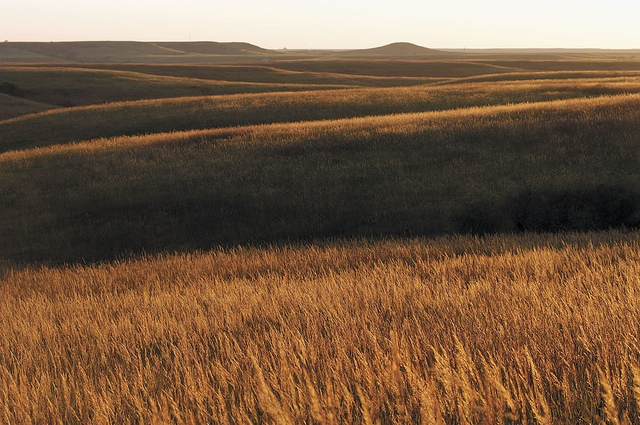
One of my favorites is definitely the Flint Hills, rolling limestone hills in central Kansas that are cut through with narrow, deep creek ravines and covered with tallgrass prairie.

You can see neat cutaways of the Flint Hills geology, where highway workers blasted through some of the hills to clear the path of I-70 between Topeka and Salina. Despite the lush look the prairie gives the hills, in reality there's not much dirt for growing anything here. Just layer upon layer of rock with a fuzz of grass on top, like a giant chia pet.

The Flint Hills are the remains of one of the times that Kansas was part of a shallow, inland sea — in this case, during the Permian, about 286 to 245 million years ago. All that limestone is made from the skeletons, shells, and other calcium-rich structures of oysters, coral, sea urchins, and more.

Image: Jim Minnerath / USFWS


17 Mar 16:09

St. Patrick’s Science Limericks

by oambrogio
Enjoy the greatest tradition of the holiday: science-themed limericks!
13 Mar 22:26

This odd-looking cloaking device could make you invisible to sonar

by George Dvorsky

This odd-looking cloaking device could make you invisible to sonar

Controlling the spread of sound and how it bounces off objects is not easy. But by using a few perforated sheets of plastic and a complex algorithm, researchers at Duke University have developed the world's first 3D acoustic cloaking device.

Read more...


13 Mar 22:20

FOX Affiliate Cuts Evolution Reference in Cosmos

by Carolyn Cox

neil

For a show as all-encompassing as Cosmos, it’s surprising that the series’ only reference to evolution so far lasted less than a minute. And if you live in Oklahoma City, Fox News affiliate KOKH-TV didn’t even want you to see that.

Youtube user Adam Bates recorded the news outlet’s painfully obvious attempt to edit out Neil deGrasse Tyson’s poetic words:

Before watching the clip I was willing believe KOKH-TV’s conveniently placed ad was an act of stupidity and not censorship, but the unbelievably bizarre editing makes it pretty clear that this commercial break was just a poorly disguised attempt to cut some science out of a science show. Honestly, I’m surprised the news clip doesn’t claim that “their biggest earthquake” was punishment for the Spaceship of the Imagination.

If  you were one of the Oklahoma viewers whose broadcast was rudely  interrupted, here’s Cosmos‘ entire text thus far on evolution:

We are newcomers to the Cosmos…Our own story only begins on the last night of the cosmic year…Three and a half million years ago, our ancestors — your and mine left these traces. We stood up and parted ways from them. Once we were standing on two feet, our eyes were no longer fixated on the ground. Now, we were free to look up and wonder.

As far as a statement of beliefs on evolution goes, Cosmos‘ script could have been far more divisive. If those relatively mild 30 seconds offended KOKH-TV, they should hire better editors and strap in for a wild ride. As one Youtube commenter points out, “just wait until they start addressing man-made climate change”.

(via Uproxx, images via Cosmos)

Meanwhile in related links

13 Mar 22:19

Metadata = Surveillance

by schneier

Ever since reporters began publishing stories about NSA activities, based on documents provided by Edward Snowden, we've been repeatedly assured by government officials that it's "only metadata." This might fool the average person, but it shouldn't fool those of us in the security field. Metadata equals surveillance data, and collecting metadata on people means putting them under surveillance.

An easy thought experiment demonstrates this. Imagine that you hired a private detective to eavesdrop on a subject. That detective would plant a bug in that subject's home, office, and car. He would eavesdrop on his computer. He would listen in on that subject's conversations, both face to face and remotely, and you would get a report on what was said in those conversations. (This is what President Obama repeatedly reassures us isn't happening with our phone calls. But am I the only one who finds it suspicious that he always uses very specific words? "The NSA is not listening in on your phone calls." This leaves open the possibility that the NSA is recording, transcribing, and analyzing your phone calls -- and very occasionally reading them. This is far more likely to be true, and something a pedantically minded president could claim he wasn't lying about.)

Now imagine that you asked that same private detective to put a subject under constant surveillance. You would get a different report, one that included things like where he went, what he did, who he spoke to -- and for how long -- who he wrote to, what he read, and what he purchased. This is all metadata, data we know the NSA is collecting. So when the president says that it's only metadata, what you should really hear is that we're all under constant and ubiquitous surveillance.

What's missing from much of the discussion about the NSA's activities is what they're doing with all of this surveillance data. The newspapers focus on what's being collected, not on how it's being analyzed -- with the singular exception of the Washington Post story on cell phone location collection. By their nature, cell phones are tracking devices. For a network to connect calls, it needs to know which cell the phone is located in. In an urban area, this narrows a phone's location to a few blocks. GPS data, transmitted across the network by far too many apps, locates a phone even more precisely. Collecting this data in bulk, which is what the NSA does, effectively puts everyone under physical surveillance.

This is new. Police could always tail a suspect, but now they can tail everyone - suspect or not. And once they're able to do that, they can perform analyses that weren't otherwise possible. The Washington Post reported two examples. One, you can look for pairs of phones that move toward each other, turn off for an hour or so, and then turn themselves back on while moving away from each other. In other words, you can look for secret meetings. Two, you can locate specific phones of interest and then look for other phones that move geographically in synch with those phones. In other words, you can look for someone physically tailing someone else. I'm sure there are dozens of other clever analyses you can perform with a database like this. We need more researchers thinking about the possibilities. I can assure you that the world's intelligence agencies are conducting this research.

How could a secret police use other surveillance databases: everyone's calling records, everyone's purchasing habits, everyone's browsing history, everyone's Facebook and Twitter history? How could these databases be combined in interesting ways? We need more research on the emergent properties of ubiquitous electronic surveillance.

We can't protect against what we don't understand. And whatever you think of the NSA or the other 5-Eyes countries, these techniques aren't solely theirs. They're being used by many countries to intimidate and control their populations. In a few years, they'll be used by corporations for psychological manipulation -- persuasion or advertising -- and even sooner by cybercriminals for more illicit purposes.

This essay previously appeared in the March/April 2014 issue of IEEE Security and Privacy.

EDITED TO ADD (3/14): This study of cellphone meta-data (news article here) demonstrates the point nicely. So does this amicus brief I signed in the ACLU v. Clapper case (press release here).

13 Mar 22:19

Our Friend Bill Nye Talks About His Origin Story and Becoming “The Science Guy”

by Glen Tickle

As “The Science Guy,” Our Friend Bill Nye helped shape a lot of young minds. (Ours included.) In this new promo for his upcoming episode of the PBS series NOVA: The Secret Lives of Scientists, he talks about how he moved from engineering to science entertainment.

We’ll have some exclusive Bill Nye videos coming your way soon that we shot with him at SXSW, but for now, you’re just going to have to settle for this one. If this isn’t enough for you, PBS will be releasing more videos with Bill over the next two weeks, and so will we!

(via NOVA: The Secret Lives of Scientists)

Meanwhile in related links

13 Mar 17:21

Astrophysicist Confirmed as NSF Director

France Cordova takes the helm of the National Science Foundation at a time of tight federal budgets for science

-- Read more on ScientificAmerican.com
13 Mar 17:21

A Close Look at the NSA's Most Powerful Internet Attack Tool

by Nicholas Weaver
We already knew that the NSA has weaponized the internet, enabling them to "shoot" exploits at anyone they desire. But the Edward Snowden slides and story published yesterday convey a wealth of new detailed information about the NSA's technology and its limitations.


07 Mar 18:50

Angry Nerd: Mr. Peabody and Other Idiotic Reboots of Classic Toons

by Chris Baker
Pertinent question about the blockbuster Mr. Peabody & Sherman animated feature: Why?
    
07 Mar 18:49

Stanford Team Tries For Better Wi-Fi In Crowded Buildings

by samzenpus
alphadogg writes "Having lots of Wi-Fi networks packed into a condominium or apartment building can hurt everyone's wireless performance, but Stanford University researchers say they've found a way to turn crowding into an advantage. In a dorm on the Stanford campus, they're building a single, dense Wi-Fi infrastructure that each resident can use and manage like their own private network. That means the shared system, called BeHop, can be centrally managed for maximum performance and efficiency while users still assign their own SSIDs, passwords and other settings. The Stanford project is making this happen with inexpensive, consumer-grade access points and SDN (software-defined networking)."

Share on Google+

Read more of this story at Slashdot.


07 Mar 18:22

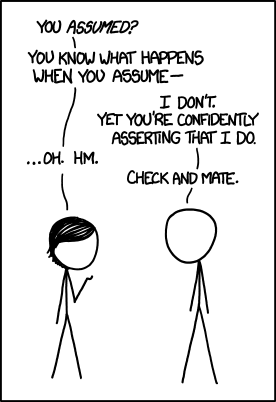
When You Assume

You know what happens when you assert--you make an ass out of the emergency response team.
07 Mar 17:15

Relentlessly practical

by Matt Hall

This is one of my favourite knowledge sharing stories.

A farmer in my community had a problem with one of his cows — it was seriously unwell. He asked one of the old local farmers about the symptoms, and was told, “Oh yes, one of my herd had the same thing last summer. I gave her a cup of brandy and four aspirins every night for a week.” The young farmer went off and did this, but the poor cow got steadily worse and died. When he saw the old farmer next he told him, more than a little accusingly, “I did what you said, and the cow died anyway.” The old geezer looked into the distance and just said, “Yep, so did mine.”

Incomplete information can be less useful than no information. Yet incomplete information has somehow become our specialty in applied geoscience. How often do we share methods, results, or case studies without the critical details that would make it useful information? That is, not just marketing, or resumé padding. Inded, I heard this week that one large US operator will not approve a publication that does include these critical details! And we call ourselves scientists...

Completeness mandatory

Thankfully, Last month The Leading Edge — the magazine of the SEG — started a new tutorial column, edited by me. Well, I say 'edited', I'm just the person that pesters prospective authors until they give in and send me a manuscript. Tad Smith, Don Herron, and Jenny Kucera are the people that make it actually happen. But I get to take all the credit.

When I was asked about it, I suggested two things:

  1. Make each tutorial reproducible by publishing the code that makes the figures.
  2. Make the words, the data, and the code completely open and shareable. 

To my delight and, I admit, slight surprise, they said 'Sure!'. So the words are published under an open license (Creative Commons Attribution-ShareAlike, the same license for re-use that most of Wikipedia has), the tutorials use open data for everything, and the code is openly available and free to re-use. Complete transparency.

There's another interesting aspect to how the column is turning out. The first two episodes tell part of the story in IPython Notebook, a truly amazing executable writing environment that we've written about before. This enables you to seamlessly stich together text, code, and plots (left). If you know a bit of Python, or want to start learning it right now this second, go give wakari.io a try. It's pretty great. (If you really like it, come and learn more with us!).

Read the first tutorial: Hall, M. (2014). Smoothing surfaces and attributes. The Leading Edge, 33(2), 128–129. doi: 10.1190/tle33020128.1. A version of it is also on SEG Wiki, and you can read the IPython Notebook at nbviewer.org.

Do you fancy authoring something for this column? Wonderful — please do! Here are the author instructions. If you have an idea for something, please drop me a line, let's talk about how to make it relentlessly practical.

07 Mar 17:14

On the female dungeoneer

by Rob Beschizza

Female representation in games is mired in toxic archetypes, so much so that even conscious efforts to avoid or neutralize them tends to end up mirroring the problem. The makers of Desktop Dungeons, however, are taking a more considered approach.

It wasn’t good enough for us to simply react with deliberate ugliness or typically masculine factors – the idea was for Desktop Dungeons to remove the gender binary entirely instead of just making everyone a man. In de-emphasising sex as much as possible, we hoped that players would be able to enjoy a more gender agnostic environment in general. Some of our proudest mechanical tweaks involved removing notices and choices in particular areas. ... .Shorthands for the feminine kept crawling into our work when we weren’t paying attention – smooth skin, homogenised facial structures, evidence of makeup, you name it. Even characters who we thought would easily sidestep trouble (like the female wizard) simply looked like young, pretty women in grunge costume rather than hardboiled dungeoneers. Portraits for some species went through several drafts just to deprogram our subconscious idea of what felt normal and right.


07 Mar 17:13

Physics Forum At Fermilab Bans Powerpoint

by Unknown Lamer
Hugh Pickens DOT Com writes "Amanda Solliday reports at Symmetry that six months ago, organizers of a biweekly forum on Large Hadron Collider physics at Fermilab banned PowerPoint presentations in favor of old-fashioned, chalkboard-style talks. 'Without slides, the participants go further off-script, with more interaction and curiosity,' says Andrew Askew. 'We wanted to draw out the importance of the audience.' In one recent meeting, physics professor John Paul Chou of Rutgers University presented to a full room holding a single page of handwritten notes and a marker. The talk became more dialogue than monologue as members of the audience, freed from their usual need to follow a series of information-stuffed slides flying by at top speed, managed to interrupt with questions and comments. Elliot Hughes, a Rutgers University doctoral student and a participant in the forum, says the ban on slides has encouraged the physicists to connect with their audience. 'Frequently, in physics, presenters design slides for people who didn't even listen to the talk in the first place,' says Hughes. 'In my experience, the best talks could not possibly be fully understood without the speaker.'"

Share on Google+

Read more of this story at Slashdot.


25 Feb 22:02

Choosing a Secure Password

by Bruce Schneier
 Choosing a Secure Password

As insecure as passwords generally are, they're not going away anytime soon. Every year you have more and more passwords to deal with, and every year they get easier and easier to break. You need a strategy.

By Bruce Schneier

The best way to explain how to choose a good password is to explain how they're broken. The general attack model is what’s known as an offline password-guessing attack. In this scenario, the attacker gets a file of encrypted passwords from somewhere people want to authenticate to. His goal is to turn that encrypted file into unencrypted passwords he can use to authenticate himself. He does this by guessing passwords, and then seeing if they’re correct. He can try guesses as fast as his computer will process them – and he can parallelize the attack – and gets immediate confirmation if he guesses correctly. Yes, there are ways to foil this attack, and that's why we can still have four-digit PINs on ATM cards, but it's the correct model for breaking passwords.


There are commercial programs that do password cracking, sold primarily to police departments. There are also hacker tools that do the same thing. And they're really good.


The efficiency of password cracking depends on two largely independent things: power and efficiency.


Power is simply computing power. As computers have become faster, they're able to test more passwords per second; one program advertises eight million per second. These crackers might run for days, on many machines simultaneously.  For a high-profile police case, they might run for months.


Efficiency is the ability to guess passwords cleverly. It doesn't make sense to run through every eight-letter combination from "aaaaaaaa" to "zzzzzzzz" in order. That's 200 billion possible passwords, most of them very unlikely. Password crackers try the most common passwords first.


A typical password consists of a root plus an appendage. The root isn't necessarily a dictionary word, but it's usually something pronounceable. An appendage is either a suffix (90% of the time) or a prefix (10% of the time). One cracking program I saw started with a dictionary of about 1,000 common passwords, things like "letmein," "temp," "123456," and so on. Then it tested them each with about 100 common suffix appendages: "1," "4u," "69," "abc," "!," and so on. It recovered about a quarter of all passwords with just these 100,000 combinations.


Crackers use different dictionaries: English words, names, foreign words, phonetic patterns and so on for roots; two digits, dates, single symbols and so on for appendages. They run the dictionaries with various capitalizations and common substitutions: "$" for "s", "@" for "a", "1" for "l" and so on. This guessing strategy quickly breaks about two-thirds of all passwords.


Modern password crackers combine different words from their dictionaries:


What was remarkable about all three cracking sessions were the types of plains that got revealed. They included passcodes such as "k1araj0hns0n," "Sh1a-labe0uf," "Apr!l221973," "Qbesancon321," "DG091101%," "@Yourmom69," "ilovetofunot," "windermere2313," "tmdmmj17," and "BandGeek2014." Also included in the list: "all of the lights" (yes, spaces are allowed on many sites), "i hate hackers," "allineedislove," "ilovemySister31," "iloveyousomuch," "Philippians4:13," "Philippians4:6-7," and "qeadzcwrsfxv1331." "gonefishing1125" was another password Steube saw appear on his computer screen. Seconds after it was cracked, he noted, "You won't ever find it using brute force."

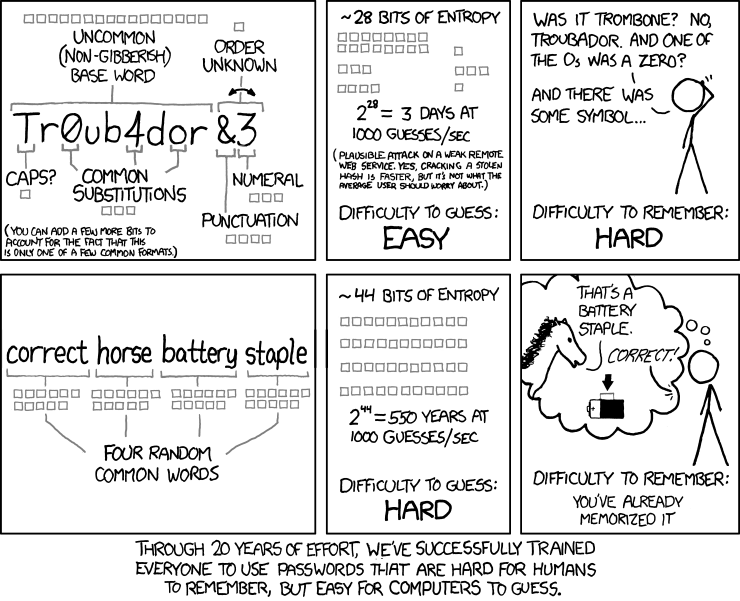
This is why the oft-cited XKCD scheme for generating passwords -- string together individual words like "correcthorsebatterystaple" --  is no longer good advice.  The password crackers are on to this trick.


The attacker will feed any personal information he has access to about the password creator into the password crackers.  A good password cracker will test names and addresses from the address book, meaningful dates, and any other personal information it has. Postal codes are common appendages.  If it can, the guesser will index the target hard drive and create a dictionary that includes every printable string, including deleted files. If you ever saved an e-mail with your password, or kept it in an obscure file somewhere, or if your program ever stored it in memory, this process will grab it. And it will speed the process of recovering your password.


Last year, Ars Technica gave three experts a 16,000-entry encrypted password file, and asked them to break as many as possible. The winner got 90% of them, the loser 62% -- in a few hours.  It's the same sort of thing we saw in 20122007, and earlier.  If there's any new news, it's that this kind of thing is getting easier faster than people think.


Pretty much anything that can be remembered can be cracked.


There's still one scheme that works.  Back in 2008, I described the "Schneier scheme":


So if you want your password to be hard to guess, you should choose something that this process will miss. My advice is to take a sentence and turn it into a password. Something like "This little piggy went to market" might become "tlpWENT2m". That nine-character password won't be in anyone's dictionary. Of course, don't use this one, because I've written about it. Choose your own sentence -- something personal.


Here are some examples


WIw7,mstmsritt... = When I was seven, my sister threw my stuffed rabbit in the toilet.


Wow...doestcst = Wow, does that couch smell terrible.


Ltime@go-inag~faaa! = Long time ago in a galaxy not far away at all.


uTVM,TPw55:utvm,tpwstillsecure = Until this very moment, these passwords were still secure.


You get the idea. Combine a personally memorable sentence with some personally memorable tricks to modify that sentence into a password to create a lengthy password.  Of course, the site has to accept all of those non-alpha-numeric characters and an arbitrarily long password.  Otherwise, it's much harder.


Even better is to use random unmemorable alphanumeric passwords (with symbols, if the site will allow them), and a password manager like Password Safe to create and store them. Password Safe includes a random password generation function.  Tell it how many characters you want -- twelve is my default -- and it'll give you passwords like y.)v_|.7)7Bl, B3h4_[%}kgv), and QG6,FN4nFAm_.  The program supports cut and paste, so you're not actually typing those characters very much.  I'm recommending Password Safe for Windows because I wrote the first version, know the person currently in charge of the code, and trust its security.  There are ports of PasswordSafe to other OSs, but I had nothing to do with those.  There are also other password managers out there, if you want to shop around.


There's more to passwords than simply choosing a good one:


1. Never reuse a password you care about.  Even if you choose a secure password, the site it's for could leak it because of its own incompetence.  You don't want someone who gets your password for one application or site to be able to use it for another.


2. Don't bother updating your password regularly.  Sites that require 90-day -- or whatever -- password upgrades do more harm than good.  Unless you think your password might be compromised, don't change it.


3. Beware the "secret question."  You don't want a backup system for when you forget your password to be easier to break than your password.  Really, it's smart to use a password manager.  Or to write your passwords down on a piece of paper and secure that piece of paper.


4. One more piece of advice: if a  site offers two-factor authentication, seriously consider using it.  It's almost certainly a security improvement.


DISCUSS ON BBS

Bruce Schneier is the CTO of Co3 Systems.  He blogs at schneier.com. His latest book is  Carry On: Sound Advice from Schneier on Security


20 Feb 23:48

Paralyzed Woman Walks Again With 3D-Printed Robotic Exoskeleton

by Soulskill
Zothecula writes "3D Systems, in collaboration with Ekso Bionics, has created a 3D-printed robotic exoskeleton that has restored the ability to walk in a woman paralyzed from the waist down. The Ekso-Suit was trialled and demonstrated by Amanda Boxtel, who was told by her doctor that she'd never walk again after a skiing accident in 1992. 'Designers from 3D Systems scanned her body, digitizing the contours of her spine, thighs, and shins, a process that helped them mold the robotic suit to her. Then they combined the suit with a set of mechanical actuators and controls made by EksoBionics. ... One problem that the designers faced in this case was that a paralyzed person like Boxtel often can't know that bruising is happening because she can't feel it. That's dangerous, Summit said, because undetected bruises or abrasions can become infected. "So we had to be very careful with creating geometry that would dodge the parts of the body that it had to dodge...[designing] parts that wouldn't impede circulation or cause bruising."'"

Share on Google+

Read more of this story at Slashdot.


20 Feb 21:57

Does oil and gas need more data scientists? The answer may not be that simple

by Molly Ryan
One topic that was emphasized over and over again at the MIT Enterprise Forum Texas chapter’s Feb. 19 discussion on big data was that continuing advances in data science are going to impact every single industry. Although some may consider “big data” a fad, it is actually a technology discipline that is leading to self-driving cars, programs that can grade student essays and even programs that can determine the best places to drill for oil and gas, explained Anthony Goldbloom, founder and…
20 Feb 21:49

Baby universe rumbled with thunder of Higgs bubbles

Sonic booms made as the Higgs boson boiled into being could point to new physics if gravitational wave detectors can find the ripples they left behind    

Source: New Scientist - Discipline: Physics
20 Feb 16:21

The Nine Levels of Work Hell

by Stephanie Vozza

Dante's got nothing on the endless loops of interruptions, overwhelming emails and pointless formalities that plague workplaces. Here's how to break free.

Mind-numbing meetings, overflowing inboxes and urgent projects that require you to drop everything--do ever feel like parts of your workday are a personalized form of hell? If you're frustrated by ineffective work processes--and complaining to coworkers over drinks--you're not alone.

Read Full Story


20 Feb 16:09

The Life of Jordan Davis

by Ta-Nehisi Coates

Here is a short piece from yesterday's Morning Edition with a conversation between Steve Inskeep, Gene Demby, Jamelle Bouie, and myself. Embedded below is a much longer conversation covering Stand Your Ground, the logic of twice as good, and a little misquoting of King Lear. I wish Jamelle's ruminations on the work of Tony Judt had made it in. But this is still very good. It was also very therapeutic. This blog has been dressed in all black for some months now. I'm starting to get used to it.


19 Feb 23:05

Creating in the classroom

by Evan Bianco

The day before the Atlantic Geoscience Colloquium, I hosted a one-day workshop on geoscience computing to 26 maritime geoscientists. This was my third time running this course. Each time it has needed tailoring and new exercises to suit the crowd; a room full of signal-processing seismologists has a different set of familiarities than one packed with hydrologists, petrologists, and cartographers. 

Easier to consume than create

At the start of the day, I asked people to write down the top five things they spend time doing with computers. I wanted a record of the tools people use, but also to take collective stock of our creative, as opposed to consumptive, work patterns. Here's the result (right).

My assertion was that even technical people spend most of their time in relatively passive acts of consumption — browsing, emailing, and so on. Creative acts like writing, drawing, or using software were in the minority, and only a small sliver of time is spent programming. Instead of filing into a darkened room and listening to PowerPoint slides, or copying lectures notes from a chalkboard, this course was going to be different. Participation mandatory.

My goal is not to turn every geoscientist into a software developer, but to better our capacity to communicate with computers. Giving people resources and training to master this medium that warrants a new kind of creative expression. Through coaching, tutorials, and exercises, we can support and encourage each other in more powerful ways of thinking. Moreover, we can accelerate learning, and demystify computer programming by deliberately designing exercises that are familiar and relevant to geoscientists. 

Scientific computing

In the first few hours students learned about syntax, built-in functions, how and why to define and call functions, as well as how to tap into external code libraries and documentation. Scientific computing is not necessarily about algorithm theory, passing unit tests, or designing better user experiences. Scientists are above all interested in data, and data processes, helped along by rich graphical displays for story telling.

Elevation model (left), and slope magnitude (right), Cape Breton, Nova Scotia. Click to enlarge.

In the final exercise of the afternoon, students produced a topography map of Nova Scotia (above left) from a georeferenced tiff. Sure, it's the kind of thing that can be done with a GIS, and that is precisely the point. We also computed some statistical properties to answer questions like, "what is the average elevation of the province?", or "what is the steepest part of the province?". Students learned about doing calculus on surfaces as well as plotting their results. 

Programming is a learnable skill through deliberate practice. What's more, if there is one thing you can teach yourself on the internet, it is computer programming. Perhaps what is scarce though, is finding the time to commit to a training regimen. It's rare that any busy student or working professional can set aside a chunk of 8 hours to engage in some deliberate coaching and practice. A huge bonus is to do it alongside a cohort of like-minded individuals willing and motivated to endure the same graft. This is why we're so excited to offer this experience — the time, help, and support to get on with it.

How can I take the course?

We've scheduled two more episodes for the spring, conveniently aligned with the 2014 AAPG convention in Houston, and the 2014 CSPG / CSEG convention in Calgary. It would be great to see you there!

Eventbrite - Agile Geocomputing  Eventbrite - Agile Geocomputing

Or maybe a customized in-house course would suit your needs better? We'd love to help. Get in touch.

19 Feb 23:02

The Man who made Mountains

by David Bressan
WILLIS_1891_Mechanics_Appalachian_wax_folds U.S.G.S. engineer Bailey Willis († February 19, 1949) was known for his unorthodox approach to geological questions. Puzzled by the geological structures he discovered in mountain ranges, long before computer-models were available, he constructed a machine to simulate the mountain-forming process.