Elizabeth Holmes dropped out of Stanford and founded a company called Theranos with her tuition money. Now, instead of vials of blood, Theranos requires only a pinprick and a drop of blood. With that they can perform hundreds of tests, ...
Neuroscientists have taken us one step closer to an Avatar-like world after demonstrating a brain-to-spinal-cord interface that allowed a "master" monkey to remotely control the hand movement of an "avatar" monkey who was completely unconscious.
The works of the Greek polymath Plato have kept people busy for millennia. Mathematicians have long pondered Platonic solids, a collection of geometric forms that are highly regular and are frequently found in nature.
Platonic solids are generically termed equilateral convex polyhedra. In the millennia since Plato's time, only two other collections of equilateral convex polyhedra have been found: Archimedean solids (including the truncated icosahedron) and Kepler solids (including rhombic polyhedra). Nearly 400 years after the last class was described, mathematicians claim that they may have now identified a new, fourth class, which they call Goldberg polyhedra. In the process of making this discovery, they think they’ve demonstrated that an infinite number of these solids could exist.
Platonic love for geometry
Equilateral convex polyhedra share a set of characteristics. First, each of the sides of the polyhedra needs to be the same length. Second, the shape must be completely solid—that is, it must have a well-defined inside and outside that is separated by the shape itself. Third, any point on a line that connects two points in the shape must never fall outside of it.
We're hosting another hackathon! This time, we're inviting geologists in all their colourful guises to come and help dream up cool tools, find new datasets, and build useful stuff. Mark your calendar: 5 & 6 April, right before AAPG.
On 4 April there's the added fun of a Creative geocomputing course. So you can learn some skills, then put them into practice right away. More on the course next week.
What's a hackathon?
It's not as scary — or as illegal — as it sounds! And it's not just for coders. It's just a roomful of creative geologists and friendly programmers figuring out two things together:
What tools would help us in our work?
How can we build those tools?
So for example, we might think about problems like these:
If you think Rock Hack sounds like a fun way to spend a weekend, please drop us a line or sign up at Hacker League. If you're not sure, please come anyway! We love visitors.
If you think you know someone who'd be up for it, let them know with the sharing buttons below.
Texas has surpassed California for the first time to become the largest tech exporting state in America, according to a report by TechAmerica Foundation.
Technology exports from Texas increased 7 percent from 2011 to 2012, the latest year that figures are available, to total of $45 billion.
Technology exports, such as semiconductors, computer equipment and communications equipment, accounted for 17 percent of all exports from Texas in 2012, significantly higher than the national average of 13 percent.
Texas’…
I like this because it's not snide and because it makes a big deal out of a very important point: In science, "I don't know yet" is a perfectly acceptable answer.
Everyone has to start somewhere, and for many directors, that start was in short student films. Let's dive way back into the catalogue of science fiction, fantasy, and horror directors and see the films that they made when they first sat in the director's chair.
The first computer in Law & Order that is turned on. Season 1, Episode 9. (NBC)
Sometime soon after Netflix's streaming service launched, Jeff Thompson found himself watching episode after episode of Law & Order. It was so easy. An episode would end and he'd click "next." We've all been there. You can watch a lot of Law & Order that way.
But Thompson's approach was different than your average binge-TV viewer's. Thompson brought an archivist's flair to his hours watching. As he'd go, he'd screenshot "oddities": scenes taken from a first-person perspective, or those portrayed in an unusual split-screen fashion.
After a bit, most of the oddities melted away and just one thing—one single thing—kept popping out of the frame to grab Thompson's attention: computers. There's a computer. There's another. And there's another. He kept screenshotting them. "It didn’t take long," Thompson wrote to me, "to realize this should be extended to an exhaustive project."
So in 2012 Thompson applied for, and received, a commission from Rhizome, an organization in New York City that supports work at the intersection of arts and technology.
And that's when his work really began.
Thompson set out to document every single computer that appears in Law & Order over the course of the series' run. He ended up finding about 2,500 of them. He took five screenshots of each instance, which means that, all told, Thompson collected 11,000—yes, you read that right: 11,000—screenshots. Which, he admits, "sounds pretty insane." (The best of those screenshots, one per computer appearance, will eventually be published to Thompson's Tumblr http://computersonlawandorder.tumblr.com/.)
To understand just how "insane" this undertaking this was, let's begin with the basics: Law & Order ran for 20 years. It is tied with Gunsmoke for the longest-running live-action show of all time. There are 456 episodes. When Thompson received the complete DVD box set he ordered from NBC (Netflix's quality was too unreliable), it weighed in at 20 pounds. Thompson suspects that NBC hadn't mailed all 120 DVDs together too often: "They shipped it to me and they seemed to have no idea how to pack it, because it came with all the boxes all torn up and stuff," he told me. (The complete set, which cost $700, was purchased with funds from the Rhizome commission.)
Now, each Law & Order episode is around 45 minutes long. To watch all of them would take about 319 hours, or about two straight months of watching 40 hours per week.
But that's not how Thompson did it. Thompson parsed out his Law & Order consumption over a one-and-a-half-year period, during which time he watched about an episode a day, and sometimes five or six on a weekend. He watched these episodes, not like a casual Law & Order viewer (Thompson, after all, is no casual viewer) but at 150 percent speed, reducing each episode to a mere 30 minutes, "which," Thompson admits, "sounds kind of crazy but it's totally watchable that way. It did drive my wife crazy, in the background, but ... it saved me over 100 hours of watching time. So it was kind of obvious that that was the way to go."
Looking back, Thompson says that for the first 10 seasons or so, the project was new and exciting. "After that, it became more and more of a drag," he told me. "By the end it was really just work."
"This kind of binge watching requires specialized equipment," Thompson told me. He custom-built himself a device to capture the screenshots as he went. "I would touch it and it would interface with some software I wrote that would pause the video and take five sequential screenshots and then continue playing." The software would automatically tag the images with the episode number and where in the episode the image was from. (Jeff Thompson)
Law & Order, Thompson says, is in some ways a perfect artifact for exploring the history of our relationship to computers. For one, the show's run covers what is perhaps the significant period for this relationship, the two decades during which computers arrived at and gradually became central features of our lives. But Thompson says that the show's value is more than that. It's "also the format of the show: It's ripped from the headlines. It's meant to mirror things that are happening right now, to be really reflective of culture."
Additionally, unlike other crime procedurals, Law & Order,in contrast with CSI, tends to give a pretty realistic portrayal of our technological capabilities. Thompson said there are really only two exceptions to this: the classic "zoom and enhance" trick, which works way better on TV than in reality, and the elegance of software such as facial-recognition programs. "The real thing often is really boring looking, or really technical," Thompson says. For the show, they hire a designer who makes software that looks like what your "mom might think facial-recognition software would look like."
But beyond those little efforts, most of the technology on the show seems to have come as an afterthought. "No one was probably thinking about, you know, what kind of mouse should we use, or where should it go in the room," says Thompson. They just represented whatever was the norm of the time, and, in doing so, documented details of computer history that perhaps no one at the time could have articulated—details that were so commonplace they went totally unnoticed.
For instance, when computers appear on Law & Order in the early '90s they are often not on. Who at the time would have said, "We have these new machines in the office. We only turn them on when we need to use them, and they are off the rest of the time." The fact that computers tended to be off is only noticeable in light of today's habit of leaving them on, even during a task that is not specifically on a computer (which may not even happen that often anyway). People's work-streams were not computer-based, and computers only were booted up for a specific task.
The first Law & Order computer. Blurry, but not on, according to Thompson. Season 1, Episode 1. (NBC)
Another shift Thompson noticed is that over time, computers attained more prominent physical locations within a room. Early on, computers tended to be off to the side, on a specialized desk, perhaps for many people to share, using it for one specific task. If a character had his or her own computer, it would be located on a separate table behind his or her desk, not on the desk itself. It's not until 1995 that the first computer makes the leap from behind the desk to its central "desktop" position we all are so familiar with today.
A typical early-'90s computer—off to the side and not powered up. Season 1, Episode 22. (NBC)
By the fifth season, computers began appearing on characters' desks. Season 5, Episode 89. (NBC)
That shift, from out-of-sight-out-of-mind to office-place centrality, dovetails with another: Over time, people became more social as they interacted with their machines. What does this mean? In the '90s, Thompson says, it's very infrequent that you'll see someone using a computer with another person present. If a computer is on, it's running in the background, as though to indicate that someone got interrupted while using it solo. In more recent seasons, people seem to be more comfortable using computers in the company of others. You'll often see two detectives working on two laptops sitting right across from one another, and, ubiquitously, people nonchalantly checking their phones mid-conversation with those around them.
A modern pose: A character checks her phone in close proximity to other humans. Season 18, Episode 411. (NBC)
When all was said and done, Thompson decide to run the math: How much of Law & Order had he captured? His calculations are a bit back-of-the-envelope, but illustrative nevertheless. The show ran for roughly 1,149,120 seconds. Standard video frame-rate is 29.97 frames per second, and he had 11,000 frames, or 0.007 percent of Law & Order. Of course, he didn't capture every single frame in which a computer appears, but, he says, "it gives you an idea of actually how little time the computers are on screen, compared with the whole rest of the show."
Which, for Thompson, points to a central observation about his project: It wasn't really about Law & Order at all—"It's about technology, and our culture, and ways that we can look for records of our relationship to those things in places we wouldn't normally think to look for them, which we wouldn't be able to find elsewhere." For 20 years, Law & Order documented the air around us. We don't have books or academic articles about the details Law & Order captured; they were invisible at the time.
What factors impact the comprehensibility of code? In this blog post, I'll
describe an experiment I did with my advisors Andrew
Lumsdaine (Computer Science) and Rob
Goldstone (Cognitive Science) at
Indiana University.
We asked 162 programmers to predict the output of 10 small Python
programs. Each program had 2 or 3 different
versions, and we used subtle differences between program versions to
demonstrate that seemingly insignificant notational changes can have big
effects on correctness and response times. I'll go over some of the results
here, hopefully to whet your appetite for the
paper.
A proposal before the administration is expected to arrive in early 2017, before President Obama leaves office.
New cars could be required to come equipped with technology that allows them to communicate with each other. Transportation Secretary Anthony Foxx said Monday the Obama administration plans to push forward a proposal in early 2017 that requires new vehicles to come standard with crash-avoidance systems.
In January 2012, I reviewed a new book from Observer business/tech columnist John Naughton, called From Gutenberg to Zuckerberg: Disruptive Innovation in the Age of the Internet. It's a great, fast read aimed at smart people who don't quite get the net -- the kind of thing you'd want to slide under your boss's door to forestall more well-intentioned and frustrating questions about What Should Be Done about this Internet thing.
Now the book is out in the USA and Quercus, the US publisher, is giving away 15 copies of the book in a random drawing. I highly recommend it -- my original review is below the jump!
Gutenberg to Zuckerberg fills an important gap in the published literature of the Internet: a fast, thoughtful, thought-provoking read for intelligent people who don't quite get the Internet. We all know these sorts of people -- often powerful and accomplished, but at a disadvantage in that they got their start before the net came along. These people struggle to put the Internet in perspective, buffeted on the one side by colleagues who reassure them by telling them that the transformative nature of the net is overstated; on the other by juniors, analysts and press who tell them that they're doomed unless they rebuild their lives around the net.
Naughton, a seasoned business journalist, sums up the big, important effects that the Internet has in a very quick read, placing them in historical perspective, projecting to their plausible futures, warning of their imminent dangers. From copyright to collective action, from governance to ecommerce, Naughton's book sets out, in reasonable, measured tones, the systemic underpinnings of the net's disruptive power, and promises attentive readers the theoretical and practical grounding they need to separate hype from hope.
Ron Miller posts a gallery of stunning, if rather small images at io9: "In the beginning there were sketches...thousands of sketches. Almost all of these were done by the brilliant production designer Tony Masters. ... These were eventually incorporated into the production paintings I created.."
Dungeons & Dragons, that ground-breaking role-playing game, celebrates its 40th anniversary this year.
Specifically, the game's big "4-0" comes this month. It was in January of 1974 when the game's co-creator, Gary Gygax, officially announced in a newsletter that "the Lake Geneva Tactical Studies Association has now released its set of fantasy campaign rules (Dungeons and Dragons)." In that announcement, Gygax invited folks to drop by his Lake Geneva, Wisconsin, home some Sunday afternoon to experience Dungeons & Dragons themselves.
But lo, those four decades ago, when D&D first debuted, no one knew what to make of it. D&D was intended to be a new twist on traditional war games. New, because "role-playing" games as a category did not exist. Newcomers found D&D to be weird and complex and confusing and trippy. You want me to "play" a dwarf fighter named Frowndorf? You want me to tell you how my hobbit thief is going to kill the gang of orcs? These dice have how many sides? WTF?
But to those who were intrigued, the “Huh?"s of doubt quickly turned to “Hey, this is fun.” No one guessed Dungeons & Dragons would be revolutionary.
Never before had a game asked players to assume roles of individual characters and jointly imagine the world where those adventures would take place. With D&D, you don't beat your fellow players, you cooperate. Sure, there were war games with miniature figurines and maps. But here was a game that said that there's no "win"—there's just the ongoing story, and the next adventure.
I first played D&D back in the 1970s and 1980s. Like millions of mostly male and young American proto-geeks, I too got sucked into the game's vicarious derring-do and heroics, playing wizards and warriors —idealized versions of myself — who wielded incredible power, acquired cool stuff, killed nasty monsters, cast spells, and inhabited fantastical places.
Today, deep in the digital age, I'm happy to report that the game still exists. In fact, the new edition of D&D's rules is slated for release this August. And only now, as a 47-year-old who still plays the game, can I appreciate why Dungeons & Dragons still matters in 2014.
To be sure, there's lots to say about how D&D was a game-changer and eternally influenced geek culture. Much has been said about how the game practically cemented the foundation for the modern video game industry. D&D pioneered concepts like avatars, characters, and levels. It measured armor, health, and personal attributes numerically—hence, my elf's 17 charisma makes him hotter (and a better leader) than your 11 charisma loser. Each iteration of D&D, and its many copycats and variations, also made ubiquitous that "dungeon crawl" experience that so many electronic games—from Doom, Quake and Myst, to World of Warcraft, Halo, Portal and Call of Duty—have all employed to such addictive effect. D&D also encouraged the popularization of Tolkien and fantasy. Dress-up "cosplay" and story-based live-action role-playing came from roots steeped in D&D. The game inspired the first interactive fiction.
Like a 3rd level Spell of Suggestion, D&D generated subtle repercussions through the culture. The role-playing game opened new pathways for creativity, new ways for kids and young adults to entertain themselves. The game led a DIY, subversive, anti-corporate revolution, a slow-building insurrectionist attack against the status quo of leisure time and entertainment.
The conceptual space that D&D organized was infinite. Suddenly, for kids who "got" the game and understood how it worked, options for "play" were no longer limited to basic board games such as Risk or Monopoly. The game “board” was limitless. This game was played with words scribbled on character sheets, and books, even as its world existed largely in your head. Like a new movement in theater or literature, D&D invented not only a venue for homegrown storytelling, but a new game genre: the role-playing game.
The lesson of Dungeons & Dragons has always been this: make your own entertainment. By sitting around a table, face to face, and arming yourself with pencils, graph paper, and polyhedral dice, you can tap into what shamans, poets and bards have done all the way back to the Stone Age. Namely, the making of a meaningful story where the tellers have an emotional stake in the telling, and the creating of a shared experience out of thin air.
To go on this new adventure, you don't absorb a movie or TV show passively, on the couch, or merely "read" a book. Nor are your options for “interacting” with a fantasy experience limited to collecting merchandise or playing with action figures. Best of all, the essential quality of this unique, narrative gaming experience can't be co-opted as commercial entertainment. Role-playing games like D&D are a way to experience unstructured free time while imposing upon it a structure, a story.
The rules books are guidelines, not stone tablets. Don't agree with how much damage a long sword should do, as listed in The Dungeon Master's Guide? Make up a new rule. If you want more of this swords and sorcery world, the tools are there to build addenda and archipelagoes yourself. Try that with Clue or Stratego. D&D became not just entertainment, but an art form.
Along the way, D&Ders like me learned about stuff. We discussed hit dice and saving throws, ballistas and halberds. We studied, without encouragement from our parents or teachers, arcane subjects such as architecture, history, languages, and statistics. I learned how to draw and map. I learned battle tactics, how to bargain, how to empathize and negotiate with those not like me—be it undead kings or jocks. And a lot of introverted, socially-inept kids found friends and fellowship. I got socialized, and I learned how to be a leader. Bored and dissatisfied with my real life, I created a more exciting one, again and again, where I got to save the day and have agency.
The tools of D&D gave me permission to imagine a better me, and a better story for myself. They gave me the courage to imagine a different future. And taught me how to change myself. Not happy with lowly Level 1 Ethan, I worked hard to level up to my better, stronger, faster level 17 version today.
As a result of the many millions who logged countless hours with their Monster Manuals in dungeons dark and deep—with nary an iPad, iPhone, or screen in sight—Dungeons & Dragons created a generation of dreamers, do-ers, and writers. Would-be actors and historians and programmers flocked to the game. Those who "got" D&D were people who were curious about the workings of the world—but also other worlds.
Today, we're proud of how sophisticated and immersive electronic games have become. But D&D beats digital hands down. Video games are limited to what the programmers can program. In D&D, the virtual game board and the place where is all takes place was always the players' collective imaginations, huddled around a table in a living room, den, or basement, fueled not by venture capital or terabytes, but Mountain Dew, Doritos, and banter.
D&D is still my springboard into dreaming. Me and four other guys, all in our forties, embark upon these imaginary adventures on Sunday nights. How can I give this up? I leave my computer behind and dip into an amorphous, enigmatic current of magical thinking that humans rarely swim in: something epic and unknown. The other night, my character, Renn, revealed to his compatriots that he is not fully human, but a half-elf in hiding. In a world where elves are outlawed, this is not only a plot complication, it's a big deal for my character, his group, my group, game, the world.
We need D&D and role-playing more than ever. If for no other reason than to help us take back our creativity, our storytelling mojo, from the things that take them from us: Hollywood, publishing, even social media.
Just choose your enemy, roll a 20-sided die to hit, and then, tell us what happens next.
There’s much more to geological mapping than colouring in, but a big part of the process of reconstructing the geological history of an area is spending a lot of time examining the exposed rocks to work out how to distinguish the different units in the field, and then marking their distribution on your map using easily distinguishable colours, that enable you to more easily see the regional patterns that reveal sandstones and limestones; stratigraphy and structure; and faults and folds. It can be a lot of hard, meticulous work.
But then, there are places where the Earth just decides to do all that work for you.
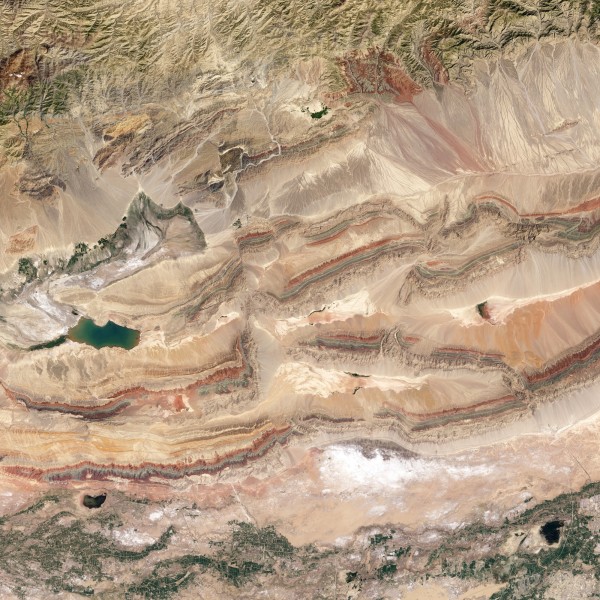
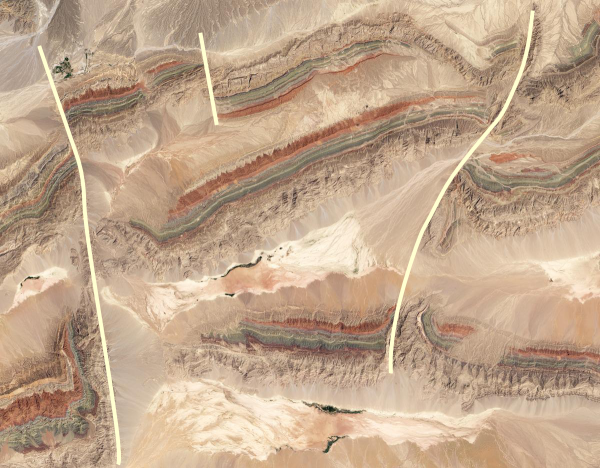
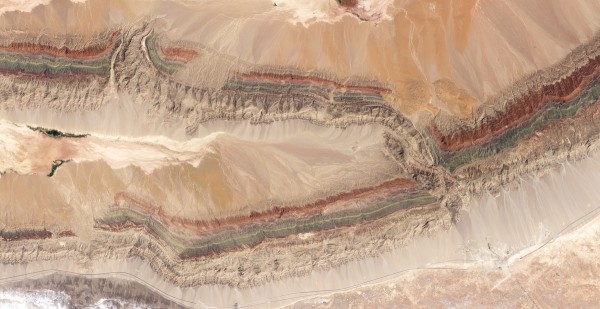
Satellite view of the foothills of the Tien Shan mountains, northern Tarim Basin, Xinjiang province. Click to enlarge. Source: NASA Earth Observatory
This amazing Landsat 8 image was an Image of the Day at the NASA Earth Observatory last week, and it’s pretty much a geological map all on its own. A convenient combination of active tectonics that leads to erosion and exposure of fresh surfaces (the Tien Shan mountains on the northern edge of this image are a distant product of the ongoing collision of India and Eurasia), virtually no obscuring vegetation due to the arid climate, and some extremely distinctive rock units formed in very different environmental conditions 400 to 500 million years ago, allow us to easily identify the different rock units. We can easily trace the horizons of tan Cambrian and Ordovician limestones, green Silurian marine sandstones and red Devonian terrestrial sandstones as they get contorted by a complicated set of faults and folds.
Just like a man-made geological map, the arrangement of colourful strata contains a lot of information about the structure and geological evolution in this area – information that can be retrieved. The easiest things to spot are the places where the linear ridges jump sideways, offset by strike-slip faults.
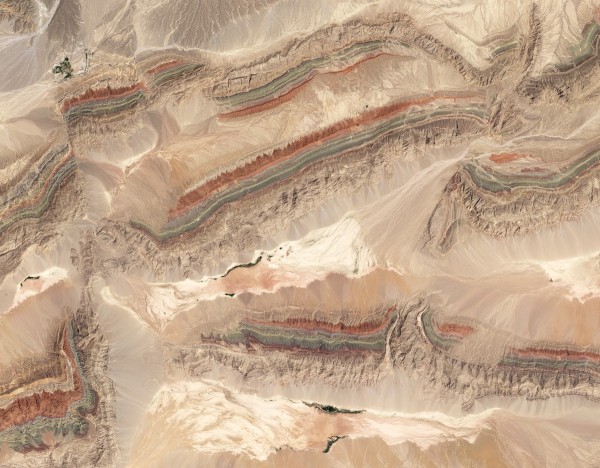
Strike-slip faults cutting through and displacing the multiple ridges composed of multicoloured, dipping Paleozoic rocks.
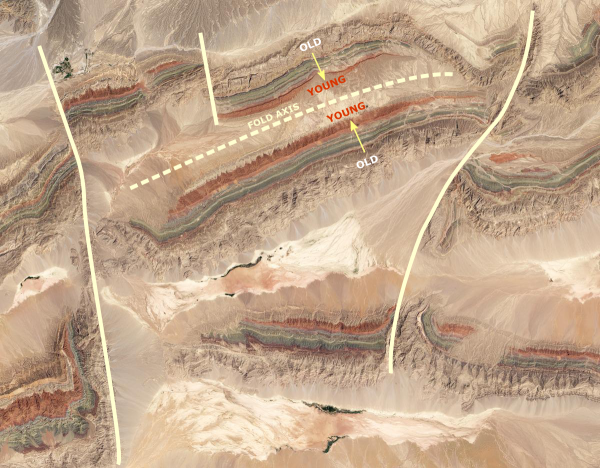
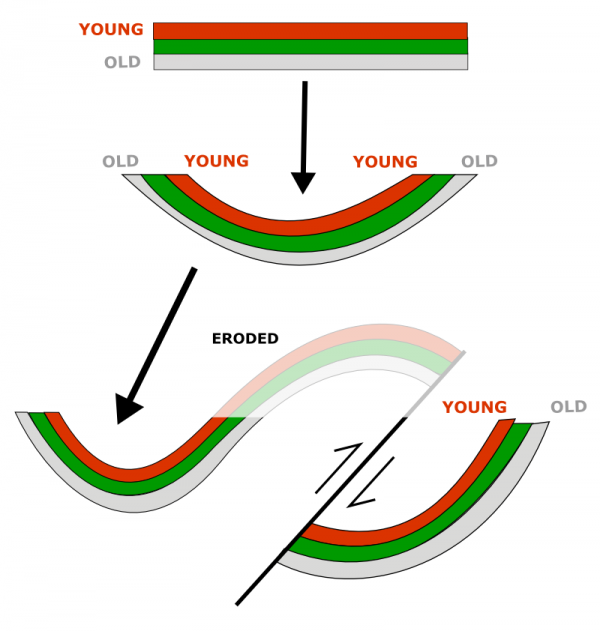
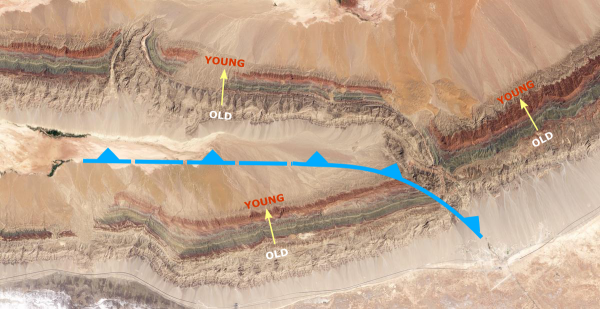
But what of the ridges themselves? There are a number, all running parallel to each other in the same east-west direction, all with the same tan-green-red striping that suggests that we are seeing the same units geologically cut-and-pasted across the landscape. This repetition of the same layers of rock over and over tells us that faults and folds are afoot. Heading south from the top of the image, on the first ridge you would encounter you would cross cream, then green, then red, going up section from the oldest unit to the youngest. But then on the next ridge the order is reversed: continuing south you would cross red, then green, then cream, going down-section from youngest to oldest. This apparent reversal in the flow of geological time tells us that we have crossed a trough-like fold – a syncline. The edges of the trough have been tilted up and eroded, exposing the older rocks, whereas the younger rocks are preserved in the less tumultuous middle. Thus the sequence is mirrored on either side of the east-west trending fold axis, which indicates this fold was formed by north-south compression.
The change from moving up section to moving down section as you traverse the two northern ridges indicates the presence of a syncline – a trough or bowl shaped fold.
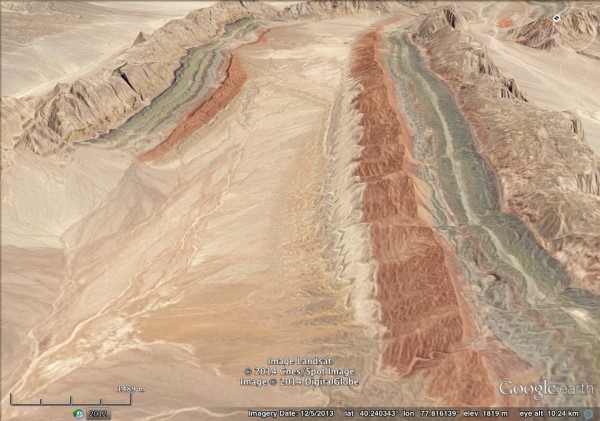
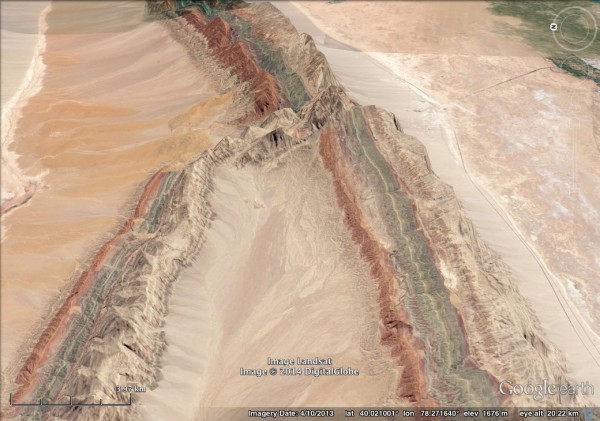
An oblique view clearly shows beds dipping towards the centre of the image, which marks the axis of a syncline.
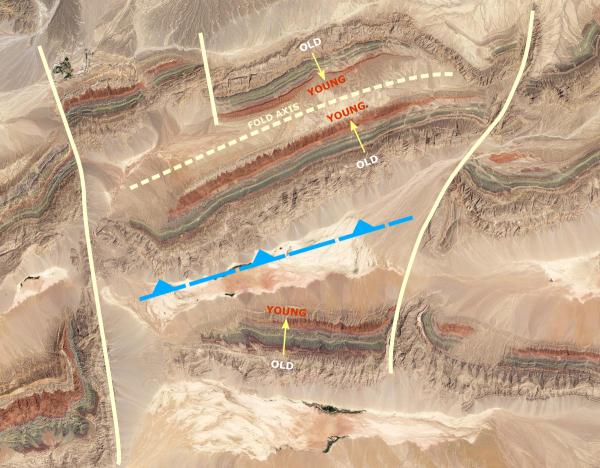
But what of the third ridge, to the south? Here, the sequence is repeated but not reversed: you would again go down section, crossing red, then green, then cream rock units. Not a simple traverse over another fold axis, then: this repetition is most likely due to faulting. Even when tectonic compression starts off by forming a serious of gentle folds, continued convergence and shortening will make the rocks continue to crumple up: eventually the rock units refuse to bend any more and break up into faulted segments that can then get stacked more closely (imbricated) together.
Interpreted compressional (thrust or reverse fault) between the southernmost two ridges.
Originally flat lying sediments form a syncline in the northern part of the image, and have been broken apart and stacked by thrust faulting in the south.
For proof of this, we just need to go a little further east, where we get three ridges apparently meeting at a central point.
It’s a bit of a geometrical headache, until you realise that what we really have is a single ridge running across the top of the image, and the ridge entering from the bottom left simply terminates against it – clear evidence of a fault.
Interpretation of the fault that has caused two ridges to ‘merge’.
It’s even more obvious in oblique view.
An oblique view clearly shows how the ridge on the right terminates against the ridge on the left – a clear sign of a faulted contact.
The Sierra Nevada of California is one of the great mountain ranges of the world. The soaring granite peaks, the deep glacial valleys, and the towering Sequoia trees represent some of the most beautiful sights to be seen anywhere on the planet. What is less known is that a portion of the Sierra Nevada is present elsewhere in the state. Around 30 million years ago the San Andreas fault system became active and sliced off a portion of the southern Sierra Nevada batholith and carried it northwest for several hundred miles. It now makes up a considerable portion of the Central California coastline, stretching from Big Sur on the south to Bodega Bay on the north. It is in my humble opinion one of the most beautiful and dynamic coastlines to be found anywhere on planet Earth.
I recently finished my latest blog series, and I present here a compilation of the fifteen entries in the series. If you missed any, here is the place to find them!
A sneak peak at the coming series. At this point I hadn't fully appreciated that I was going to be covering the entire Salinian Terrane, so I didn't mention the Sierra Nevada connection in the first post.
With the second post I hit upon the idea of the Sierra Nevada connection with my exploration of Limekiln State Park in the southern part of the Big Sur coast. It is a stunningly rugged stretch of coastal cliffs, and amazingly, the state of California almost shut down this beautiful place.
I punted on this one. I wrote this blog four months earlier about what may be the prettiest cove along the prettiest coast in the world. But the post fit well with the theme and scope of this series, so here it is: one of California's two tidal falls. And gigantic landslides.
A short distance inland from the coast we discover a gem of a state park, Pfeiffer Big Sur. The Sierra Nevada has the Sequoia trees, Big Sur has Coast Redwoods. And both the Sierra Nevada and Big Sur have huge wilderness areas. The wildlands around Big Sur are far less crowded.
Big Sur has some nice beaches, and not all of them are on the main highway. You have to be a bit of a sleuth to find Pfeiffer Beach, but it's worth the effort. And...garnet sand beaches!
One of the lesser known beach parks of the central California coast, Garrapata is a beautiful place that belies its horrendous name ("tick" beach). It has some of the nicest exposures of "Sierran" granite in the region.
Point Lobos was named for the seals and sea lions, not for terrestrial canines. It is another gem along the coast with unique exposures of conglomerates that accumulated in deep underwater canyons that rival Yosemite in their depths.
We finish our journey through Point Lobos and move north onto the Monterey Peninsular. Here it is trees that take up some of the geologic story. Monterey Pines grow naturally only in a few places, mainly on the Peninsula, but have become one of the most widely planted trees in the world. The Monterey Cypress is another unique species in the region.
We take a look at coastline of totally different character as we reach the Half Moon Bay region. There are prominent marine terraces that make for gentle scenery (and apparently great golf courses). There are some nice tidepools in the area, and during the right time of year, the Mavericks hit, the gigantic waves that bring surfers from around the world.
The San Andreas fault looms large in the history of the Central California coastline, but hasn't made an appearance on our journey until now. At Mussel Rock in Daly City, the fault trace moves offshore. The epicenter of the 1906 San Francisco may have been close by. And there is a famous folk song about the cookie-cutter houses on the high, unstable slopes...
Maybe you haven't heard that there is a big bridge that connects the city of San Francisco with the Marin Headlands and the rest of Northern California. It's not likely, but it's possible. There is some interesting geology going on underneath the bridge abutments.
The Marin Headlands expose rocks that were once part of the midocean ridge, the vast planet encircling mountain range that no mountain climber can ever hope to climb. The scenery on the Marin is majestic. And to invaders in World War II, the cliffs would have been deadly.
The Point Reyes Peninsula has wide sandy beaches, sand spits, a bay that may have been a landing for Sir Francis Drake, Tule Elk, and a lighthouse that has to put up with some really rotten weather.
If the Point Reyes Peninsular bears the brunt of violent Pacific Storms, the mountains of the peninsula shelter the lands to the east. Two bays along the San Andreas fault are peaceful and serene, which belies their violent origin.
We wrap up our exploration of the Sierra that rises from the sea with a look at Bodega Head, the site of a classic horror movie, and a horror story with a nuclear reactor as the main character. A reactor that was almost built on top of the San Andreas fault. It's also the northernmost exposure of the Salinian/Sierra Nevada rocks.
Israel Fraier, who founded ScanTask in 2008 describes the just-out-of-stealth mode company as the Waze of agriculture. Waze, the crowdsourced traffic and mapping tool from Isreal was acquired by Google last year. ScanTask uses crowdsourced data from farmers along with weather data to... Continue reading
Facebook's Paper focuses on content curation and a full-screen experience.
Facebook announced Thursday a new app that will revamp the presentation of content on the site into a more streamlined format. The app, called Paper, presents content from both users and brands in a new interface and organizes it into sections for browsing.
The announcement of Paper has been rumored for some time, but its release as a new standalone app comes as a surprise. Facebook has a mixed track record in this area: its Messenger app was a grand success, but Home was a disaster and Poke was virtually ignored (Zuckerberg now calls this foray a “joke,” according to an interview in Bloomberg Businessweek).
Paper presents user updates as “stories:” captions overlaid on large-format photos, auto-playing videos, and even long or short text screeds all in an edge-to-edge, full-screen format. The default “section” in the app is the user’s Facebook news feed, but users can pull new sections up from a set of cards, such as “Headlines” or Tech,” and browse between them in one pane.
Lord Kelvin (Smithsoinian Instituion Libraries collection)
Kelvin calculated that the Earth was probably around 24 million years old, from how fast it is cooling. Rutherford believed that Kelvin’s calculation was wrong because of the heat generated by radioactivity. Kelvin was wrong, but so was Rutherford. The Earth is indeed many times older than Kelvin had calculated, but for completely different reasons, and the heat generated by radioactive decay has nothing to do with it.
Disclosure: in my introduction to the Scientific American Classic, Determining the Age of the Earth, and elsewhere, I have like many other authors repeated Rutherford’s argument with approval, without paying attention to Rutherford’s own warning that qualitative is but poor quantitative, and without bothering to check whether the amount of heat generated by radioactivity is enough to do the job. He thought it was but we now know it isn’t. It was only when chatting online (about one of the few claims in the creationist literature that is even worth discussing) that I discovered the error of my ways.
On the face of it, things could not be plainer. Kelvin had calculated the age of the Earth from how fast heat was flowing through its surface layers. An initially red hot body would have started losing heat very quickly, but over geological time the process would have slowed, as a relatively cool outer crust formed. His latest and most confident answer, reached in 1897 after more than 50 years of study, was in the range of around 24 million years.[1]
Yet on May 20, 1904, there was Rutherford, at the lectern of the Royal institution, talking about a piece of Cambrian rock, and announcing, on the basis of how much of its uranium had decayed to give lead and helium, that its age was some 500 million years. We even have Rutherford’s much quoted account of what happened next:
I came into the room which was half-dark and presently spotted Lord Kelvin in the audience, and realised that I was in for trouble at the last part of my speech dealing with the age of the Earth, where my views conflicted with his. To my relief, Kelvin fell fast asleep, but as I came to the important point, I saw the old bird sit up, open an eye and cock a baleful glance at me.
Then a sudden inspiration came, and I said Lord Kelvin had limited the age of the Earth, provided no new source [of heat] was discovered. That prophetic utterance referred to what we are now considering tonight, radium! Behold! The old boy beamed upon me.
This all seems clear enough. Rutherford is referring to Kelvin’s cooling argument. But this argument is invalid, because it assumes no new source of heat, and such a source exists, namely radioactivity.
The process that was overlooked in Kelvin’s calculations was also, indirectly, responsible for producing these folds.
Or so says the popular myth. The truth is more complex, and more interesting. For a start, Kelvin’s “prophetic utterance” did not refer to the Earth at all, but to a separate calculation of the age of the Sun. We know how brightly the Sun shines, and hence how rapidly it emits energy. If we knew how much energy it had to start with, and assumed that it wasn’t being added to, we could simply divide the initial amount by the rate of depletion, to estimate how long it would be able to shine. Kelvin performed such a calculation many times. As source of energy, he invoked the most intense source known to him, namely the gravitational energy released when the Sun collapsed from a diffuse cloud of gas to its present size. This led him to conclude in 1862 that the age of the Sun was in the range of 10 million to 100 million years (subsequently refined to around 20 million), and that “inhabitants of the earth can not continue to enjoy the light and heat essential to their life for many million years longer unless sources now unknown to us are prepared in the great storehouse of creation [emphasis added].” These are the prophetic words that Rutherford was referring to.
If Rutherford thought that the energy of radioactive decay was fuelling the Sun, he was greatly mistaken. The philosopher Auguste Comte had written in 1835 that we would never know the internal composition of the heavenly bodies.[2] He was wrong. Pass electricity through a gas or vapour, and it will emit light at specific frequencies that depend on the elements present (one familiar example is the sodium yellow of street lights). There are dark lines in the solar spectrum, and by 1860 the German chemist Kirchoff had shown that their frequencies match these characteristic emission lines.[3] So the chemical composition of the Sun’s outer layers was already well-known, and the fractional abundances of the heaviest elements, including almost all those that exhibit radioactivity, are quite negligible. And we now know, as Rutherford could not, that radioactive decay does not generate enough energy. Even if abundant supplies of the radioactive elements were concealed within the Sun’s interior, they would not suffice to fuel the Sun for Rutherford’s 500 million years, let alone the 4,500 million years, with as much still to come, required by current estimates.[4] It was not until 1920 that the source of the Sun’s energy was correctly identified as the fusion of hydrogen to helium, and while this was soon generally accepted, quantitative confirmation by measurements on the neutrinos produced had to wait until 2001. Using Einstein’s famous mass/energy equation and the masses of the isotopes involved, it is easy for us to calculate that the fusion of hydrogen to helium is some thirty times more productive of energy than the decay of the same mass of uranium to helium and lead; but Rutherford in 1904 could not have known of the relationship between mass and energy, or the precise masses of the relevant isotopes, or even that such things as isotopes existed.
But what about the age of the Earth itself, and Kelvin’s cooling calculation? This is what I had for many years assumed that Rutherford was talking about, and it turns out that radioactive decay is no real help here either. Measurements on granite in the early years of the 20th century suggested that radioactivity could fully account for the amount of heat being radiated out to space, and that the Earth might even be heating up. But we now know that granite is not representative of the Earth as a whole. The total rate of heat production by radioactive decay is currently estimated at around half the amount that the Earth emits to space, so simplemindedly we might imagine that this extends Kelvin’s calculation by a factor of two. Maybe a bit more, since by their nature radioactive materials would have been more abundant in the remote past, but this will not make much difference over the few tens or even hundreds of millions of years then under discussion. And even this grossly exaggerates the potential significance of radioactive heating, since all we need to consider is the heat generated in the outermost layers, from which heat has had time to diffuse the surface.
So how could Kelvin’s cooling argument be refuted? The correct argument had been put forward a decade earlier, before radioactivity had even been discovered, by John Perry, one of Kelvin’s own former pupils, and Kelvin had partly accepted the principle of Perry’s reasoning.
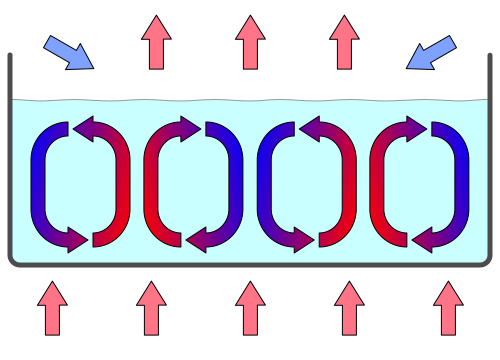
To understand what is really happening, we need to consider the different ways in which heat can be transferred. You may remember from school that there are three processes available; radiation, conduction, and convection. Radiation is the process by which the Sun, or the filament of an incandescent light bulb, glows yellow hot; or at lower temperatures the embers of a fire or the coals of a barbecue glow red hot; or, at yet lower temperatures, the Earth loses energy to the coldness of outer space by glowing in the infrared. It is not really relevant to the transmission of energy through opaque material such as rock. Conduction is simply the diffusion of heat through material, as the faster moving atoms of the hotter region jostle against, and share their energy with, their cooler neighbours. The third, and most efficient, heat transfer mechanism is convection. This is the physical movement of hotter material, carrying its heat with it, as in the roiling that takes place in the water when you boil an egg on a stove, or the pattern that forms in the film of oil in the pan if you prefer your eggs fried. Hotter material expands, making it less dense, so it rises to the surface, bringing cold material closer to the heat source.
Convection in a pan over a heat source. Warm (red) material is less dense and rises, allowing cold (blue) material to sink. Image by Eyrian through http://en.wikipedia.org/wiki/File:ConvectionCells.svg
Radiation is only relevant when we are talking about the transfer of heat through empty space, or through some transparent medium. Diffusion is simply the statistical spreading out of the extra heat in the hotter material, and is an inefficient process over long distances. By far the most efficient heat transfer mechanism is convection, but this can only take place in a fluid, where hotter and colder material can physically change places.
Back to Kelvin’s cooling rate calculation. This depended, among other things, on assuming heat transfer by conduction, and the rate of conduction was determined by actual measurements on rocks. Now imagine what would happen to Kelvin’s calculation if the actual heat transfer process were more efficient than this. The effect is the opposite of what you would at first imagine. Commonsense suggests that more rapid heat transfer would imply more rapid cooling. Not so. If heat transfer is limited, only a relatively shallow layer near the surface will have had time to contribute. If heat transfer turns out to be more efficient, the cooled layer will be correspondingly thicker, heat will have been conveyed from greater depths, and the total amount of heat conducted through the surface and lost to space will be correspondingly greater. But we know the total rate at which heat is being transferred, from the conductivity experiments and the rate at which temperature increases when we go down a mine, and this acts as a constraint on the calculation. Fixed rate, but a greater total amount because of more efficient heat transfer, implies a longer time. The cooling calculation can therefore be brought into line with Rutherford’s results, and indeed with the even longer times that we now know to be involved, if heat at depth is sufficiently more mobile than Kelvin had imagined.
In 1894, Kelvin’s former pupil and protégé, John Perry, had suggested higher heat transfer as a way of reconciling Kelvin’s age estimates with the hundred million years or so then required by the geologists. Kelvin, rather grudgingly, agreed in principle, and undertook to examine whether the thermal conductivity of rocks did increase as required at high temperature. [5] Within a few months, Kelvin reported a colleague’s response to this question; they did not. Indeed, Kelvin took the opportunity to review the entire question in the most extreme possible light, triumphantly lowering his best estimate of the age of the Earth to around 24 million years, noting that this was in good record with his estimates for the age of the Sun, and claiming that the burden of proof was now back with the geologists. Perry, in reply, drew attention to the fact that Kelvin had totally ignored the possibility that the Earth’s interior was or had been fluid enough to support convection, but Kelvin seems to have passed over this suggestion in silence.
A pity. Convection in the mantle, as we now call the region between the solid crust and Earth’s metallic core, is a cornerstone concept of modern geology. The implications of this, together with an explanation of why Perry waited until 1894 to challenge Kelvin’s calculations (which went back, as we have seen, to 1862 and earlier), and how I belatedly stumbled upon this story as a result of chatting online about the creationist literature, will be the subject of my next posts.
[1] Detailed (and sometimes mildly discordant) scholarly studies here, here, here and here, and references therein.
[3]Annalen der Physik185, 148–150, 275-301 (1860).
[4] Some radioactive elements, such as the newly discovered radium that Rutherford was referring to, do generate heat quickly, but that is because of their rapid decay rate, which implies short half-lives and rules them out as candidates.
[5] Perry, Nature51, 224-227 (1895); Kelvin’s acknowledgement is at p. 227, his dismissive rebuttal at p. 438, and Perry’s final attempt at persuasion at p. 582.
Judging by the headlines over the past week, one would think
that the Federal Communications Commission (FCC) was dealt a
crushing blow when the DC Circuit Court of Appeals struck down the
agency’s net neutrality rules.
Under the headline “Net neutrality is dead. Bow to Comcast and
Verizon, your overlords,” Los Angeles Times business
columnist Michael Hiltzik
reported that the ruling “was worse than the most dire
forecasts” and “thoroughly eviscerated” the FCC. At Slate,
longtime net neutrality advocate Marvin Ammori
wrote that “the court loss was even more emphatic and
disastrous than anyone expected.”
The reality is that the court decision is disastrous, but not
because it struck down the net neutrality rules.
The suit by Verizon challenging the 2010 rules was ultimately a
challenge of the FCC’s statutory authority to regulate the
Internet. It had been an open question how far the FCC could go.
The ruling answered that question, as Ammori would say,
emphatically. While the court found that the Commission could not
issue net neutrality rules the way it did, thus striking them down,
it nevertheless made it clear that Congress gave the FCC (and also
state public utility commissions) broad powers to regulate in the
name of encouraging broadband deployment.
That means that the FCC can reintroduce net neutrality rules as
long as they make a colorable argument that they “encourage the
deployment … of advanced telecommunications services,” as the
Telecommunications Act reads. In
fact, under the ruling there’s little the FCC and state commissions
can’t do as long as it is meant to “encourage deployment.” This
includes setting rates not just for broadband, but also potentially
for services offered over broadband, such as video services like
Netflix.
The FCC might even have the authority now to require
blocking of sites suspected of hosting pirated content, just
as the rightly defeated Stop Online Piracy Act would have done.
After all, a case could be made that piracy affects the viability
of music services like iTunes or Pandora, and the health of those
services contributes to the demand for broadband, which the FCC is
now empowered to “encourage” with any “regulating methods that
remove barriers to infrastructure investment.”
The Wall Street Journal’s Tom Gara captured the real
meaning of the decision best by
quoting Obi-Wan Kenobi telling Darth Vader, “If you strike me
down, I shall become more powerful than you can possibly imagine.”
And yet, even though their putative Jedi champion, the FCC, has
grown more powerful, proponents of net neutrality should also be
worried.
In a prophetic 2009
article, written at time that the net neutrality rules were
first being proposed, Corynne McSherry wrote for the pro-neutrality
Electronic Frontier Foundation that proponents should be careful of
what they wished. “‘Net neutrality’ might very well come to be
remembered as the Trojan Horse that allowed the FCC take over the
Internet,” she warned, noting that if the FCC was allowed to claim
broad authority “for net neutrality regulations (something we might
like) today, it could just as easily be invoked tomorrow for any
other Internet regulation that the FCC dreams up (including things
we won’t like).” For example, it wouldn’t be difficult to imagine a
future FCC using new broad powers to regulate for “decency” online
the way it does in broadcasting, she wrote.
In his first statement
after the ruling, FCC Chairman Tom Wheeler felt compelled to
reassure us that the Commission will be judicious with its new
powers.
“The government, in the form of the FCC, is not going to take
over the Internet,” he said. “It is not going to dictate the
architecture of the Internet. It is not going to do anything that
gratuitously interferes with the organic evolution of the Internet
in response to developments in technology, business models, and
consumer behavior.” But he also stressed that the FCC “is not going
to abandon its responsibility to oversee that broadband networks
operate in the public interest.”
Japanese astronomers have learned that merging galaxies can contain at least a pair of active and luminous supermassive black holes. Typically, only one of the two black holes are activated like this, leading the astronomers to speculate that something unique is happening in the environment to get them going.
I will be teaching this a 3D seismic interpretation workshop in Fayetteville based on the (free) OpendTect software that runs native on windows, mac, or linux. We will be using Geoscience Department PC computers, but you can also run it on a laptop! Hope you can join us. On Monday, I will also be chairing a special session on the Mississippian.
Interpretation of 3D Seismic Data with Open Source (free) Software.
Sunday, 16 March, 2014. US$100. Max: 25 Christopher Liner, University of Arkansas.
This one-day short course — designed for those with a general understanding of 3D seismic data — provides an introduction to the free OpendTect seismic interpretation system. The principle objectives for participants are to understand the overall system and support documents, data navigation, display, fundamentals of horizon tracking, and geobody extraction. Each participant is encouraged to bring a USB stick (8GB or larger) to take project results home for further self-study.
We will be learning opendtect using this data set.
Would a planet terraformed fifteen million years ago have any petroleum or coal reserves? If so, how would the extent of the deposits compare to Earth?
So, in order to get petroleum or coal, you need the following:
Lots of organic matter building up
Heat and pressure via burial
Time
How much time? That’s kind of the question. You need enough time for geologic processes (normally subsidence) to bury the deposits of organic matter deeply enough that they get pressure cooked at around 49-149C, and then those deposits need to stay cooking long enough for the heat and pressure to crack the organic matter into more familiar hydrocarbons. How long is that going to take precisely? To be honest, we don’t precisely know. Probably hundreds of thousands of years, not counting the sheer time it’s going to take to bury everything deeply enough.
That said, we at least have an idea of a minimum time, just because we can look at the youngest oil and coal deposits in the world, which are Oligocene to Miocene in age–that gives us a range between about 5.3 and 36.6 million years old.
So yes, as long as your terraforming ramped up quickly enough that you had lots of plants and plankton to die and get buried on land and in the ocean, and your planet was tectonically active enough for active burial (and the temperature and pressure curves line up appropriately for burial) you could potentially have petroleum and coal.
There would probably be a lot less in the way of reserves than we have on Earth, just because your production window would be so much shorter than the one we’ve got. On Earth, we’ve had coal deposits forming since the Carboniferous (a ~355 million year window) and petroleum deposits go back even further, into the Proterozoic (a >565 million year formation window). Just how big the difference will be depends also on how much organic matter your new world is pumping out–if you’re having a mini carboniferous for all 15 million of those years, for example, it still won’t be that much in comparison, but it would be more significant than if your world looks like the Permian.
eggboard writes "Public libraries are starting to build labs that let patrons experiment with new arts, crafts, and sciences, many of them associated with the maker movement. It's a way to bring this technology and training to those without the money or time to join makerspaces or buy gear themselves. It extends the mission of libraries to educate, inform, and enrich. Many are now experimenting with experimenting."
David Lynch's Dune premiered thirty years ago. Sometime in 1983, I was sitting in my studio, wondering where my next cheeseburger was coming from, when I got a call from Raffaella de Laurentiis' office. "We're making a movie of Dune. We think your paintings of Mars in the book, The Grand Tour, look a lot like Arrakis. Would you care to come out and talk about working for us?"
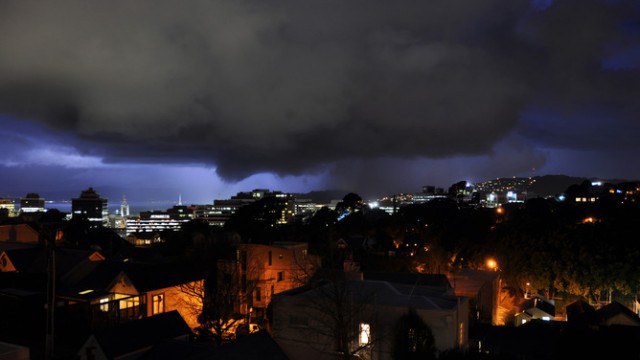
Stormy weather hits Wellington, the capital of New Zealand.
Sean Hamlin
A recent headline—"Failed doubters trust leaves taxpayers six-figure loss"—marked the end of a four-year epic saga of secretly funded climate denial, the harassment of scientists, and a tying-up of valuable government resources in New Zealand.
It’s likely to be a familiar story to my scientist colleagues in Australia, the UK, the US, and elsewhere around the world.
But if you’re not a scientist and are genuinely trying to work out who to believe when it comes to climate change, then it’s a story you need to hear, too. Because while the New Zealand fight over climate data appears to finally be over, it’s part of a much larger, ongoing war against evidence-based science.




 If you think Rock Hack sounds like a fun way to spend a weekend, please drop us a line or sign up at Hacker League. If you're not sure, please come anyway! We love visitors.
 Texas has surpassed California for the first time to become the largest tech exporting state in America, according to a report by TechAmerica Foundation.
Technology exports from Texas increased 7 percent from 2011 to 2012, the latest year that figures are available, to total of $45 billion.
Technology exports, such as semiconductors, computer equipment and communications equipment, accounted for 17 percent of all exports from Texas in 2012, significantly higher than the national average of 13 percent.
Texas’…
Texas has surpassed California for the first time to become the largest tech exporting state in America, according to a report by TechAmerica Foundation.
Technology exports from Texas increased 7 percent from 2011 to 2012, the latest year that figures are available, to total of $45 billion.
Technology exports, such as semiconductors, computer equipment and communications equipment, accounted for 17 percent of all exports from Texas in 2012, significantly higher than the national average of 13 percent.
Texas’…


 In January 2012, I reviewed a new book from Observer business/tech columnist John Naughton, called From Gutenberg to Zuckerberg: Disruptive Innovation in the Age of the Internet. It's a great, fast read aimed at smart people who don't quite get the net -- the kind of thing you'd want to slide under your boss's door to forestall more well-intentioned and frustrating questions about What Should Be Done about this Internet thing.


 Ron Miller posts a gallery of stunning, if rather small images at io9: "In the beginning there were sketches...thousands of sketches. Almost all of these were done by the brilliant production designer Tony Masters. ... These were eventually incorporated into the production paintings I created.."


 There’s much more to geological mapping than colouring in, but a big part of the process of reconstructing the geological history of an area is spending a lot of time examining the exposed rocks to work out how to distinguish the different units in the field, and then marking their distribution on your map using easily distinguishable colours, that enable you to more easily see the regional patterns that reveal sandstones and limestones; stratigraphy and structure; and faults and folds. It can be a lot of hard, meticulous work.
 A sneak peak at the coming series. At this point I hadn't fully appreciated that I was going to be covering the entire Salinian Terrane, so I didn't mention the Sierra Nevada connection in the first post.
  With the second post I hit upon the idea of the Sierra Nevada connection with my exploration of Limekiln State Park in the southern part of the Big Sur coast. It is a stunningly rugged stretch of coastal cliffs, and amazingly, the state of California almost shut down this beautiful place.
 I punted on this one. I wrote this blog four months earlier about what may be the prettiest cove along the prettiest coast in the world. But the post fit well with the theme and scope of this series, so here it is: one of California's two tidal falls. And gigantic landslides.
 A short distance inland from the coast we discover a gem of a state park, Pfeiffer Big Sur. The Sierra Nevada has the Sequoia trees, Big Sur has Coast Redwoods. And both the Sierra Nevada and Big Sur have huge wilderness areas. The wildlands around Big Sur are far less crowded.
 Big Sur has some nice beaches, and not all of them are on the main highway. You have to be a bit of a sleuth to find Pfeiffer Beach, but it's worth the effort. And...garnet sand beaches!
 One of the lesser known beach parks of the central California coast, Garrapata is a beautiful place that belies its horrendous name ("tick" beach). It has some of the nicest exposures of "Sierran" granite in the region.
 Point Lobos was named for the seals and sea lions, not for terrestrial canines. It is another gem along the coast with unique exposures of conglomerates that accumulated in deep underwater canyons that rival Yosemite in their depths.
 We finish our journey through Point Lobos and move north onto the Monterey Peninsular. Here it is trees that take up some of the geologic story. Monterey Pines grow naturally only in a few places, mainly on the Peninsula, but have become one of the most widely planted trees in the world. The Monterey Cypress is another unique species in the region.
 We take a look at coastline of totally different character as we reach the Half Moon Bay region. There are prominent marine terraces that make for gentle scenery (and apparently great golf courses). There are some nice tidepools in the area, and during the right time of year, the Mavericks hit, the gigantic waves that bring surfers from around the world.
 The San Andreas fault looms large in the history of the Central California coastline, but hasn't made an appearance on our journey until now. At Mussel Rock in Daly City, the fault trace moves offshore. The epicenter of the 1906 San Francisco may have been close by. And there is a famous folk song about the cookie-cutter houses on the high, unstable slopes...
 Maybe you haven't heard that there is a big bridge that connects the city of San Francisco with the Marin Headlands and the rest of Northern California. It's not likely, but it's possible. There is some interesting geology going on underneath the bridge abutments.
 The Marin Headlands expose rocks that were once part of the midocean ridge, the vast planet encircling mountain range that no mountain climber can ever hope to climb. The scenery on the Marin is majestic. And to invaders in World War II, the cliffs would have been deadly.
 The Point Reyes Peninsula has wide sandy beaches, sand spits, a bay that may have been a landing for Sir Francis Drake, Tule Elk, and a lighthouse that has to put up with some really rotten weather.
 If the Point Reyes Peninsular bears the brunt of violent Pacific Storms, the mountains of the peninsula shelter the lands to the east. Two bays along the San Andreas fault are peaceful and serene, which belies their violent origin.
 We wrap up our exploration of the Sierra that rises from the sea with a look at Bodega Head, the site of a classic horror movie, and a horror story with a nuclear reactor as the main character. A reactor that was almost built on top of the San Andreas fault. It's also the northernmost exposure of the Salinian/Sierra Nevada rocks.