Google’s G Suite business is gaining enormous traction among enterprise users. G Suite usage has more than doubled in the past year among large business customers. Today, there are more than 3 million paying companies that use G Suite.
G Suite’s Gmail is already not used as input for ads personalization, and Google has decided to follow suit later this year in our free consumer Gmail service. Consumer Gmail content will not be used or scanned for any ads personalization after this change. This decision brings Gmail ads in line with how we personalize ads for other Google products. Ads shown are based on users’ settings. Users can change those settings at any time, including disabling ads personalization. G Suite will continue to be ad free.
The value of Gmail is tremendous, both for G Suite users and for users of our free consumer Gmail service. Gmail is the world’s preeminent email provider with more than 1.2 billion users. No other email service protects its users from spam, hacking, and phishing as successfully as Gmail. By indicating possible email responses, Gmail features like Smart Reply make emailing easier, faster and more efficient. Gmail add-ons will enable features like payments and invoicing directly within Gmail, further revolutionizing what can be accomplished in email.
G Suite customers and free consumer Gmail users can remain confident that Google will keep privacy and security paramount as we continue to innovate. As ever, users can control the information they share with Google at myaccount.google.com.
by Michael Jetter, Lecturer in Economics, University of Western Australia
In the fight against terrorism, seemingly easy conclusions may be drawn too quickly. Reuters/Jon Super
Recent events in London, Manchester and elsewhere highlight that Western societies are vulnerable to terrorist attacks – and political decision-makers need to find solutions.
Two key questions to consider are:
How likely are you to fall victim to terrorism?
What increases or decreases that likelihood?
Our natural way of thinking about the first question should be similar to considering crime (murder or robbery, for instance), mortality (infant mortality at birth, or cancer), car accidents, or other threats. And the salient point is not so much the total number of murders in a large country, but rather the total number in relation to the size of the population.
Put simply, we should consider the number of affected people on a per-capita basis – that is, murder rates, or mortality rates.
For example, from a policy perspective, it makes sense that ten murders in a populous country like China (which has 1,371,000,000 citizens) would be much less significant than ten murders in a tiny country like Liechtenstein, with its 37,000 citizens.
Terror per capita vs total terror
However, when it comes to terrorism, almost all the knowledge that drives policy decisions comes from studies analysing the total number of terror casualties in a given country and year.
But the average Indian need not be particularly worried about terrorism. The country is home to 1.27 billion people, and terrorism kills only one in 2,500,000 people – or 0.0000004% of the population – per year, once we translate total terror deaths to terror deaths per capita. The likelihood of dying from crime or in a road accident is far higher.
India ranks only 82nd in the world when we compare terrorism victims per capita.
So, although India has a relatively high number of terrorist attacks, an individual’s likelihood of dying in such an attack is minimal – because India has such a large population.
Once we switch from focusing on total terror deaths (or attacks) per country to terror deaths per capita, relevant conclusions about what drives terrorism change dramatically. And thus potential policy reactions also change when focusing on terror deaths per capita.
Democracy, Muslims and terrorism
A somewhat baffling conclusion from a long list of research articles states that terrorism is more likely to emerge in democracies, rather than non-democracies. This idea is difficult to reconcile with our intuition of democracy giving people political (and usually religious) freedom – so why should we see terrorism in such free countries?
It turns out that once we analyse terror per capita, democratic nations are less likely to witness terrorism. Again, take India, a large democracy that, at first glance, suffers a lot from terrorism. But, in per-capita terms, terrorism becomes less important.
Another popular belief states that countries with a sizeable Muslim population – such as Pakistan, Indonesia, Bangladesh or Nigeria – are experiencing more terrorism than non-Muslim countries. This is true when looking at the total numbers of deaths.
But that result is also overturned once we consider terror per capita. A larger share of Muslims in a given country relates to marginally less terrorism. Pakistan (202 million people), Indonesia (258 million), Bangladesh (156 million) and Nigeria (186 million) all feature exceptionally large populations.
This result is informative for the current policy debate. More caution is needed before classifying certain countries as more prone to terrorism based on their religion.
Another – admittedly simplistic – way of considering the link between Islam and terrorism comes from comparing the share of terror attacks conducted by Muslim groups with the share of the world population identifying as Muslim. If Muslims were more likely to be terrorists, we should expect the latter figure to be lower.
Approximately 23% of the world population identifies as Muslim. But, since September 11, Islamist groups have conducted about 20% of terrorist attacks worldwide. Thus, terrorist attacks are – historically and today – less likely to be conducted by a Muslim than by a non-Muslim group.
Where to go from here?
Our results suggest it may be time to rethink the way we approach terrorism.
The likelihood of dying at the hands of a terrorist is comparable to the odds of drowning in one’s own bathtub.
This does not mean we should be afraid of bathtubs, nor does it mean terrorism is not among the problems that need to be solved with a high priority.
Rather, in the fight against terrorism, seemingly easy conclusions may be drawn too quickly – and we should not forget other matters that affect people’s lives far more than terrorism does.
David Stadelmann previously received funding from the Germand Research Foundation (DFG). He is a research fellow at CREMA – Center for Research in Economics, Management and the Arts (Switzerland), an ordinary member of the Walter Eucken Institut (Germany) and a reserarch fellow at QuBE – Queensland Behavioural Economics Group (Australia). David Stadelmann has no conflict of interest and if readers look at the article, there should be no suspicion of any ulterior interest apart from helping to improve the world.
Michael Jetter does not work for, consult, own shares in or receive funding from any company or organisation that would benefit from this article, and has disclosed no relevant affiliations beyond the academic appointment above.
The economy is held back by persistent illusions – such as the idea Britain spends a lot on welfare
Befitting a surprise election, the manifestos from the main parties contained surprises. Labour is shaking off decades of shyness about nationalisation and tax increases for the rich and for the first time in decades has a policy agenda that is not Tory-lite. The Conservatives, meanwhile, say they are rejecting “the cult of selfish individualism” and “belief in untrammelled free markets”, while adopting the quasi-Marxist idea of an energy price cap.
Despite these significant shifts, myths about the economy refuse to go away and hamper a more productive debate. They concern how the government manages public finances – “tax and spend”, if you will.
Je vous annonce aujourd'hui en exclu la naissance d'un nouveau studio d'animation français spécialisé dans l'animation ado/adulte ...
[English : BobbyPills is hiring. New french studio dedicated to animation for adults. Founded by David Alric (Les Kassos) and BlackPills french VOD platform. First series projects by Jeremie Perin, Balak, Gobi (Lastman) ...]
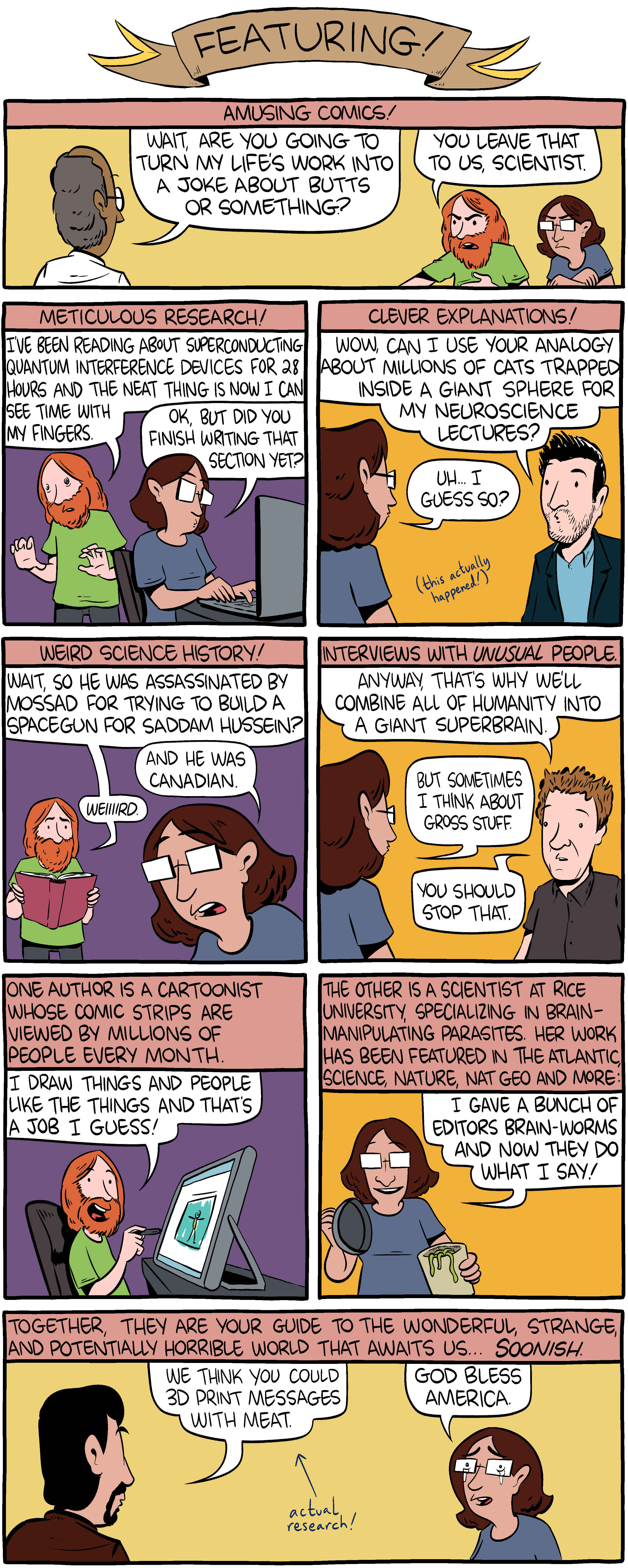
Thanks for buying, geeks! For this project in particular, it means a lot to us. For those of you who somehow haven't seen me mention the book, here's a little comic exlpainer:
Hovertext: Anyone caught emailing me in regards to the accuracy of today's comic shall be tarred, feathered, and made to carry a sign that reads 'No fun.'
Also, in case you missed it, I'll be signing books prior to the show at MIT Press Bookstore, from 3-430. If you don't want to wait in line after the show, this is the way to go. <3


.png)


.png)

 (
( Heath Ledger qui fait un kickflip au-dessus de Christian Bale lors d'une pause sur le tournage de Batman: The Dark Knight, 2007.
.png)