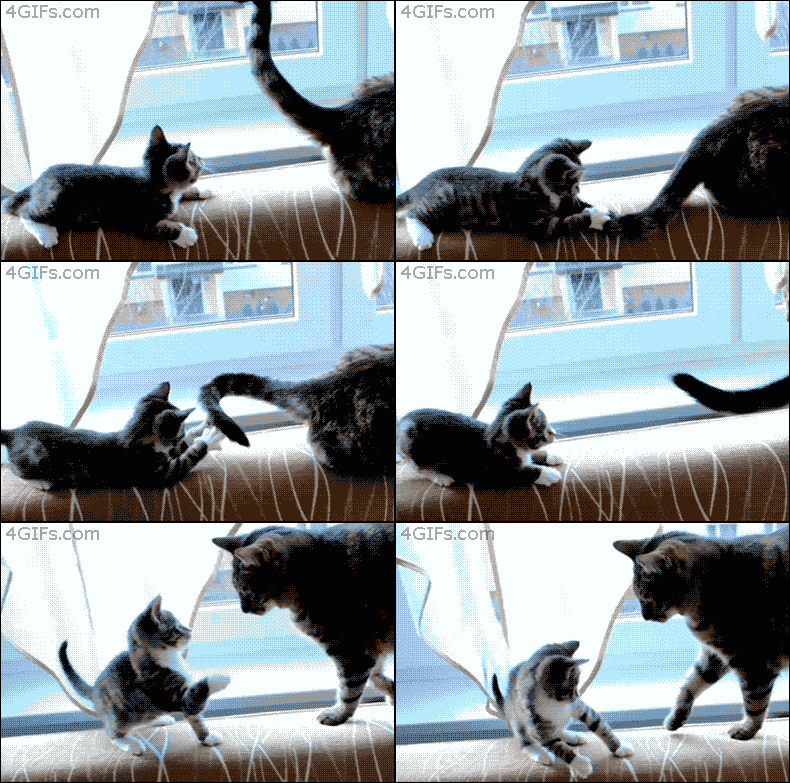


This has been a cat spam. Please imagine all these cats curled up on you in a big pile. Drown in their purrs. I hope your day improves.
This has been a cat spam. Please imagine all these cats curled up on you in a big pile. Drown in their purrs. I hope your day improves.

image captured from yahoo news
i don’t even eat cookies (i’m more a chips & salsa kinda gal), but you’d better bet i’m going to be picking up a few boxes this time around.
and to clarify, according to the article, the boycotting groups take issue with Girl Scouts highlighting women in positions of leadership as part of a civic involvement campaign… or more specifically, they’re boycotting because they don’t like some of the womens’ politics.
so apparently the *girl* scouts can highlight some women, but not those who actively support *women’s* rights.
gotcha.
more cookies please.

If you're in the camp that thinks the official Twitter app sucks, there's a good chance you're using Talon. It's a relatively new app that has received a lot of press, and it got one hell of an update this evening.
In addition the the KitKat-inspired "design that makes sense" the app has always sported and its wealth of eye-candy, the developer has added in support for crowd favorites like TweetMarker and TwitLonger support, and tweaked some of the UI buttons to make the app stand out from the crowd even more.
If you're a Tweeter, it's probably worth the buck ninety-nine to give Talon a try if you haven't already. Grab it from the Google Play link above, and check out the huge change log after the break.
Source: Kilnker Apps

    
|
 If you've ever made the faux pas of contacting foreign coworkers while they're out celebrating national holidays, you'll appreciate the latest update to Google Calendar. The service now accounts for special occasions in 30 more countries, including ...
 Concerned that not enough is being done to help kids with STEM (Science, Technology, Engineering and Math) subjects? Kentucky's Senate has just passed a bill that would count computer-programming classes as foreign language credits. That way, if ...
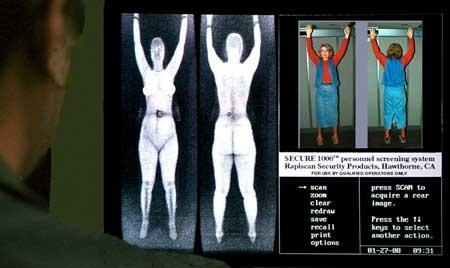 Jason Edward Harrington, the former TSA officer who revealed the uselessness of the Rapiscan body scanners the federal government squandered $40 million on, has written an article for Politico about his time working at the TSA and his run-ins with the apparatchiks and nomenklatura in charge. Included in the article is a list of code words used by TSA officers he's compiled. Here are a few:
Alfalfa: TSA malespeak for an attractive female passenger.
BBC: Bogus Bag Check, or Bullshit Bag Check. What happens when a not-too-bright x-ray operator decides to call a bag search.
Code Red: Officer malespeak. Denotes an attractive female passenger wearing red.
Fanny Pack, Lane 2: Code for an attractive female passenger.
Retaliatory wait time: What happens when a TSA officer doesn’t like your attitude. There are all sorts of ways a TSA officer can subtly make you wait longer to get through security, citing imaginary alarms, going “above the SOP” for “a more thorough screening,” pretending that something in your bag or on your full body image needs to be resolved—the punitive possibilities are endless, and there are many tricks in the screener’s bag.
Xray Xray Xray!: Code for an attractive female passenger, general.
Yellow Alert: Code for an attractive female passenger, yellow clothing.
Ziptop baggie: A magical thing that renders liquids safe for airplanes.
(Cory posted about this article as well, highlighting some other aspects.) Dear America, I Saw You Naked - And yes, we were laughing. Confessions of an ex-TSA agent.
|
|
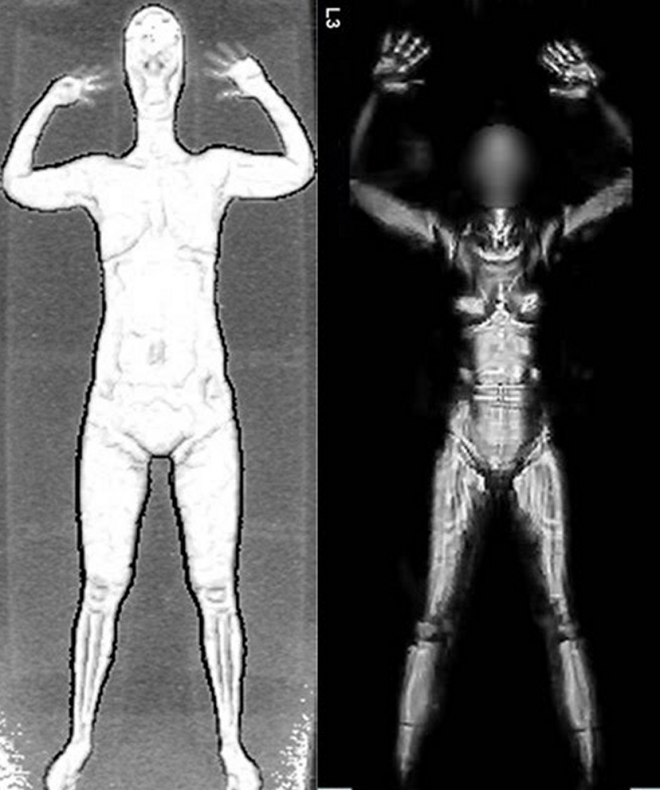
In Jason Edward Harrington's Dear America, I Saw You Naked, he reveals that he was the anonymous TSA agent who wrote the Taking Sense Away tell-all/whistleblower blog. Harrington's piece is a shocking and eye-opening look into the world of TSA agents, especially the section dealing with the "IO room" where the nude photos of travellers who used the Rapiscan machines were displayed:
Most of my co-workers found humor in the I.O. room on a cruder level. Just as the long-suffering American public waiting on those security lines suspected, jokes about the passengers ran rampant among my TSA colleagues: Many of the images we gawked at were of overweight people, their every fold and dimple on full awful display. Piercings of every kind were visible. Women who’d had mastectomies were easy to discern—their chests showed up on our screens as dull, pixelated regions. Hernias appeared as bulging, blistery growths in the crotch area. Passengers were often caught off-guard by the X-Ray scan and so materialized on-screen in ridiculous, blurred poses—mouths agape, à la Edvard Munch. One of us in the I.O. room would occasionally identify a passenger as female, only to have the officers out on the checkpoint floor radio back that it was actually a man. All the old, crass stereotypes about race and genitalia size thrived on our secure government radio channels.
There were other types of bad behavior in the I.O. room—I personally witnessed quite a bit of fooling around, in every sense of the phrase. Officers who were dating often conspired to get assigned to the I.O. room at the same time, where they analyzed the nude images with one eye apiece, at best. Every now and then, a passenger would throw up two middle fingers during his or her scan, as though somehow aware of the transgressions going on.
But the only people who hated the body-scanners more than the public were TSA employees themselves. Many of my co-workers felt uncomfortable even standing next to the radiation-emitting machines we were forcing members of the public to stand inside. Several told me they submitted formal requests for dosimeters, to measure their exposure to radiation. The agency’s stance was that dosimeters were not necessary—the radiation doses from the machines were perfectly acceptable, they told us. We would just have to take their word for it. When concerned passengers—usually pregnant women—asked how much radiation the machines emitted and whether they were safe, we were instructed by our superiors to assure them everything was fine.
Dear America, I Saw You Naked [Jason Edward Harrington/Politico]
(via Sean Bonner) 
|
|
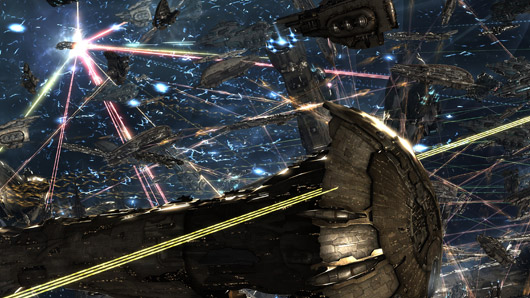 A skirmish over an unpaid bill in CCP Games' spacefaring MMORPG EVE Online escalated to a battle of epic proportions on Monday, costing its participants an estimated $500,000 in real-world cash so far, according to a USA Today report.
When a missed ...
A skirmish over an unpaid bill in CCP Games' spacefaring MMORPG EVE Online escalated to a battle of epic proportions on Monday, costing its participants an estimated $500,000 in real-world cash so far, according to a USA Today report.
When a missed ...
 The total number of Grand Theft Auto 5 copies Take-Two has shipped to date now exceeds 32.5 million. The number comes from the company's fiscal third quarter 2014 earnings report, in which it declared its money-making game the "best-selling video ...
 Microsoft announced Satya Nadella as its new CEO this morning. Nadella joined Microsoft in 1992, and is now upgrading from his previously-held position as Executive Vice President of the company's Cloud and Enterprise group. The new CEO is credited...
 Drones delivering your latest George R.R Martin instalment? Cute. But the real work of autonomous vehicles is being pioneered in the military. Lockheed Martin has recently completed testing of full autonomous convoys in Fort Hood, Texas. The test is ...
 If you were one of those 110 million who tuned into this year's Super Bowl, you probably have some thoughts on those ads -- ads that cost a whole load of cash. This year, we had the predictable heart-tug from a soda brand, a shirtless Brooklyn ...

|
|

|
|

|
|



Here's a great piece of bar trivia: The first-ever Porsche was ... an electric car.
While any ardent Porschephile knows that the first Porsche-branded vehicle was the 356 sports car of 1948, the first car designed by Ferdinand Porsche was actually the 1898 "Egger-Lohner electric vehicle, C.2 Phaeton model," or the P1 for short.
The P1 was recently recovered from a warehouse where it had reportedly sat untouched since 1902. It will be displayed in original, unrestored condition at the Porsche Museum in Zuffenhausen, Germany.
Designed by Ferdinand Porsche when he was 22 years old, the P1--or Porsche, number one--is powered by a rear-mounted electric drive unit that produces 3 horsepower, harnessed to a 12-speed controller.
The 2,977-pound vehicle had a reported range of 49 miles, and could briefly reach a top speed of 21 mph when in "overdrive" mode, which extracted a full 5 hp from the motor.
One unique feature was the Lohner "alternating" body, which was designed to be detached from the chassis and swapped for another body depending on the driver's needs.
The P1 debuted on the streets of Vienna on July 26, 1898, and competed in the international motor-vehicle exhibition in Berlin the next year. Porsche and three passengers took part in a 24-mile race against other electric cars.
His creation took first place, and consumed the lowest amount of energy of any vehicle in the competition.
Ferdinand Porsche went on to found the car company that would make his name legendary, but not before designing the 1900 Semper Vivus--widely considered to be the world's first hybrid-electric vehicle.
The company recently re-created the Semper Vivus, showing the running replica at media events to launch Porsche's first modern hybrid car, the Panamera S Hybrid model
That car has now been replaced in the U.S. by the Panamera S E-Hybrid, its first modern plug-in vehicle.
After 60 years of gasoline-powered cars, it's now--at last--convenient for Porsche to tout its hybrid and electric heritage, to underscoring the pedigree of modern green Porsches like the 918 Spyder and Panamera S E-Hybrid plug-in hybrids.
This article, written by Stephen Edelstein, was originally published on Green Car Reports, a publishing partner of Popular Science. Follow Green Car Reports on Facebook, Twitter, and Google+.
Obama Promotes Natural-Gas Fueling Stations In State Of The Union Address
Search For Used Cars
VL Buying Leftover New Fisker Karmas To Yank Out Electric Parts

|
|

In a new study, researchers gave 85 kids a tiny amount of peanut protein, and then gradually ramped up that amount over the course of six months. At the end of that period, 88 percent of them could tolerate eating the equivalent of five peanuts without suffering an allergic reaction. And 58 percent could eat the equivalent of 10 peanuts without incident. The study consisted of two six-month periods; in the first span, half the kids were first given a placebo. None of them became tolerant to peanuts, showing the study results weren't due to the placebo effect.
One of the study authors, Andrew Clark, told The Guardian that it dramatically transformed some of the kids' lives. "This treatment allowed children with all severities of peanut allergy to eat large quantities of peanuts, well above the levels found in contaminated snacks and meals, freeing them and their parents from the fear of a potentially life-threatening allergic reaction," he said.
Others warned that, although it was promising, it shouldn't yet be considered a cure, and definitely shouldn't be tried at home. "This is a really important research step in trying to improve our management of peanut allergy, but is not yet ready for use in clinical practice," Gideon Lack, who is running a peanut allergy trial at the Evelina Children's Hospital in London, told the BBC. "We need a proper risk assessment to be done to ensure we will not make life more dangerous for these children."
The study was published online today (Jan. 30) in The Lancet.
[BBC]

|
|
Regular ol' reading is so passé. E-readers? Not good enough. Try harder, science.
Here's a good example: suit up and wire yourself into a book with this sensory fiction device.

Brought to you by the relentlessly experimental folks at the MIT Media Lab, the gadget is a combination sensor-suit and connected book. As the suit wearer flips the pages of the book, the device makes the reader physically experience what's happening to the protagonist. (Instead of, you know, experiencing it through his or her brain-thoughts.) The book's cover changes in response to a passage's atmosphere, and the suit can increase temperature in certain parts of the body, or vibrate around the heart, to simulate the feeling in the pages. The book, appropriately, is James Tiptree's The Girl Who Was Plugged In, about a person being steered in their emotions and actions.
It's... wow. It's certainly something. Part--maybe most--of the joy that comes from fiction is figuring out what's happening in the subtext, the motivations and underlying feelings that propel the plot. As cool as this is, maybe having Siri belt out a siren and scream ACTIVATE TEAR DUCTS, HUMAN isn't what most people are looking for in a novel.

|
|
 A 12-year-old boy from St. Catherines, Ontario, Canada, was stopped by border police while attempting to cross into the United States in his grandmother's stolen Nissan Altima.
|
|
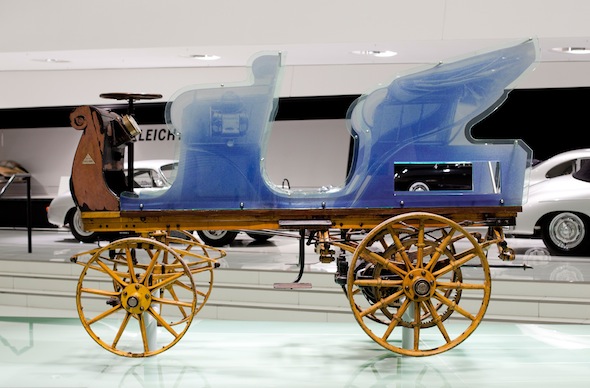 The very first car designed and produced by Ferdinand Porsche, the founding father of one of Germany's most famous marques, is set to go on display at the Porsche Museum in Stuttgart, Germany.
|
|


 A spoonful of sugar helps the medicine go down.