
A large part of the West Antarctic Ice Sheet, a massive expanse of frozen water that flows into the Amundsen Sea, is likely already in the process of collapsing, probably irreversibly. A pair of studies show that part of the sheet is melting more quickly than previously thought, and that several of its large glaciers will probably melt into the ocean, raising global sea levels at least 10 feet in the coming centuries. And it cannot be stopped.
The first study, to be published May 16 in the journal Science, suggests that the Thwaites Glacier, a relatively fast-moving part of the ice sheet, will likely melt away into the ocean within several centuries, enough by itself to raise sea levels 2 feet. Another study to be published in the journal Geophysical Research Letters looked more broadly at Thwaites and other glaciers bordering the Amundsen Sea, and likewise concluded they are collapsing.
The term "collapsing" is perhaps not the best one, because it implies something sudden. These glaciers are expected to melt in the next several centuries, and both studies suggest there is little chance that their runaway melt and slide into the sea will slow down. While not sudden in normal everyday language, it is still quite rapid in geological terms.
The second study, done in part by NASA researchers, concerns three lines of evidence--collected over the last 40 years--that suggest the glaciers will soon melt away: the changes in their flow speeds, how much of each glacier floats on seawater, and the slope of the terrain they are flowing over and its depth below sea level. Regarding the first, they are flowing more quickly toward sea than before, and this pace is accelerating. Likewise, the amount of floating ice is increasing, and the shape of the sea floor under the ice doesn't appear capable of stopping this increased flow. Specifically, the "grounding line"--where the glaciers cease to lay atop land, and begin rather to float over water, is moving inland quicker than thought, an observation reached by satellite measurements.
Part of the reason this is happening, the researchers think, is because melting makes the ice weigh less, thus causing more of it to float rather than rest on the sea floor. (And as you probably know, floating ice displaces as much water as melted ice.)
"The collapse of this sector of West Antarctica appears to be unstoppable," said Eric Rignot, a UC Irvine glaciologist who is also with NASA's Jet Propulsion Laboratory, in a statement. "The fact that the retreat is happening simultaneously over a large sector suggests it was triggered by a common cause, such as an increase in the amount of ocean heat beneath the floating parts of the glaciers. At this point, the end appears to be inevitable."
For more on what the studies say, head over the NBC News.

 In case you hadn't heard, stimulation of the brain with mild electrical currents can in some people induce lucid dreaming: the ability to become self-aware in dreams, and to sometimes control them.

 Twitter has just announced a new mute feature that'll let you shut up the annoying people in your feed, at least temporarily. If, say, one of your friends is at a conference and is just babbling non-stop about the parties he's attending, you can now...
 Ask any smoker: quitting is hard. Cigarettes become a part of your daily life, a habit that's not only hard to break, but hard to keep track of. "Tracking is one of the most important factors in one's health," Ata Ghofrani told us at a recent Haxlr8r...










 Smucker's, believe it or not, has a patent for the process of making a peanut butter and jelly sandwich. You should see the filing, too -- based on the complex diagrams you'd think it detailed architectural concepts or maybe even some weird new...
 After years of testing, the FDA today approved a new type of prosthetic arm that its makers claim will bring a whole new level of control to amputees. Known as the "Luke" arm or DEKA Arm System, Segway inventor Dean Kamen has been involved in its...
 Taxi companies aren't pleased with Uber and Lyft, but they could be making way better use of ride-sharing technology themselves, according to researchers. A study by MIT and Fujitsu examined why cabs are usually underutilized, but never available...


 As a group of journalists huddled together in a function room, deep within a central London hotel, a wide, framed display stands before them. Walled on three sides, a long, Bang & Olufsen-branded curtain hangs across the front-facing section --...

In Denmark, it's someone's job to monitor and maintain a replica of the country in megapopular exploration game Minecraft. If you take away one thing from this piece, make it that.
Now that we've gotten that out of the way, apparently the...
In Denmark, it's someone's job to monitor and maintain a replica of the country in megapopular exploration game Minecraft. If you take away one thing from this piece, make it that.
Now that we've gotten that out of the way, apparently the...
 Uber's no stranger to disputes with traditional taxi firms in Europe; it's already been banned in Belgium and French lawmakers want to take its tracking tech and hand it over to regular cab firms. Discontent has been growing the other side of the...
 The United States is lagging behind most of the world when it comes to credit card technology, but luckily it's about to catch up. In the next 18 months, the US is gearing up to transition debit and credit cards away from the magnetic stripe to...
 Apple insists that the US government doesn't have backdoor access to its data (despite signs to the contrary). So what happens when law enforcement comes knocking at the company's door, then? We have a fairly good idea as of this week. The company...
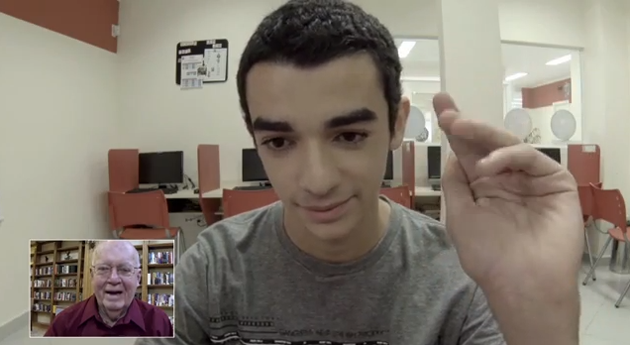 Folks living in retirement communities around the US may have just been given another activity option. As part of the Speaking Exchange project for language schools, creative agency FCB Brazil paired language students with elderly Americans in...
 It turns out that your biology teacher (and a certain 1997 sci-fi flick) got something wrong -- DNA isn't necessarily limited to four letters. Scripps Research Institute scientists tell Wired that they've created living cells which include two...
 It's good that Lockheed Martin's ADAM laser can shoot down drones and rockets, but there are threats much closer to Earth -- say, small boat crews bent on destroying large warships. Never fear, though, as we now know that ADAM can take care of those...


 What do you do when you're running for prime minister of one of the most populous nations on Earth and need to reach over 800 million people? How can you possibly shake every hand and kiss every baby, occasionally appearing in several locations at...
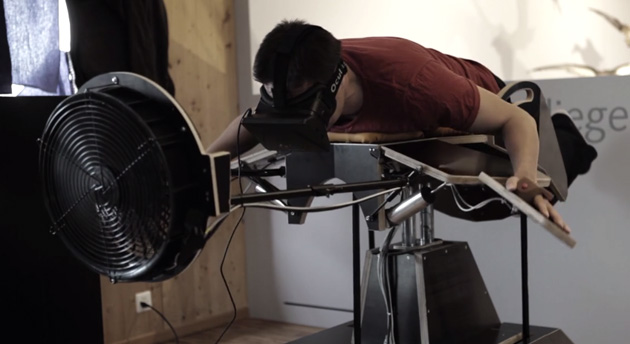 Current technology and human anatomy may prevent you from soaring like a bird in real life, but a team at the Zurich University of the Arts may just have the next best thing. Their Birdly machine lets you flap your way through the air much like the...
 Taiwan is considering ticketing people who cross the street paying more attention to their iPhone than the cars around them. No, seriously. Taiwan currently has over 14 million mobile internet users, many of whom lawmakers consider "addicted" to...