

Corvus.coraxI'm really enjoying whenever these guys come up on the Current's rotation. Also just made a Jungle Pandora station and it is nice.
Corvus.coraxmore distopics for Stefan...
"This one really spoke to me because it is about a girl my age from Vermont. And I loved the opportunity to teach him words like bitchcakes.”
Chris Bohjalian’s apocalyptic novel, “Close Your Eyes, Hold Hands,” got a rave review recently in The Washington Post. The story about a teenage girl fending for herself after a nuclear plant melts down in Vermont marks a dramatic new direction for Bohjalian.
Read full article >>
Corvus.coraxTuring=autoshare

Corvus.coraxhigh culture in the trending feed...






VAN EYCK
I lost it at the end.
Okay, I had to check out the Van Eyck thing. I was a bit in denial because, come on, every single person can’t look like President Putin!
There are no words to describe how wrong I was.
Reblogging this for my art history class this semester
buwhahaha
The art historian in me had to reblog this.


Read more of this story at Slashdot.

Corvus.coraxokay so he's apparently doing 8 in 8 days.
-like the "π" reference

Corvus.coraxmy sister was saying something about there being proof that food colors can cause mood swings- you guys ever seen/read evidence of that?

Contrary to popular belief, sugar doesn't make kids hyper. The science is beyond settled on this issue.
The only types of studies that truly "settle" science are randomized controlled trials. Considered the gold standard in research, they do the best job of controlling for factors that could bias study results.
No fewer than twelve of these studies have been conducted to figure out whether sugar causes hyperactivity. "That's probably more randomized controlled trials than most drugs go through," says Aaron Carroll, director of the Center for Health Policy and Professionalism Research at Indiana University School of Medicine and blogger at The Incidental Economist.
And in every case the trials show that sugar simply doesn't cause hyperactivity.
He lays out the evidence in this video:
"it's not the sugar, parents just believe it is."
In one study that Carroll highlights, a group of kids were all given something to drink, and parents were asked to rate their children's behavior. Parents who were told that their children were given a sugary drink were significantly more likely to report that their children were acting hyper than parents who were told their kid had been given something sugar-free to sip on.
The twist? The researchers had lied to the parents — every single child actually received a drink that was sugar-free.
"It is not the sugar, parents just believe it is," Carroll says. "This myth is entirely in their heads."
That means sugar "crashes" could be a myth, too, though there doesn't seem to be as much of a scientific literature on it. Insulin levels, which control glucose (blood sugar) in the body, would adjust quickly after a massive intake of sweets. If there's no "high" level of glucose in the body to start with, there shouldn't be a crash or withdrawal later.
"The body works hard to keep glucose levels pretty regular, Carroll said.
Corvus.coraxtwo terry Gilliam items in one week... hmmm

Corvus.coraxI knew it was only a matter of time before Courtney reblogged some gifs


Kristen Stewart in Jenny Lewis’ One Of The Guys Music Video x
I had to notify my spouse that I was leaving him for KStew in this video and he said he understood.
Corvus.coraxThat's two parody videos in one week, not bad Mr Y.
Psst. He makes fun of mouth breathers Bjorn...

Corvus.coraxI fucking love Jenny Lewis.
Someone needs to tell Vox editors what a 'bass' looks like- that's a guitar KS is playing.
And does anyone else think that the guy version of Kristen Stewart looks like a young DiCaprio?

Rainbow blazer wearing, indie-rock darling Jenny Lewis released a music video this morning staring Kristen Stewart, Anne Hathaway, Brie Larson, and The Like's drummer Tennessee Thomas. While Jenny Lewis stands front-and-center strumming her guitar, the four women dance around her dressed in shiny track suits, wearing fake facial hair. Kristen Stewart looks moodily into the camera as she did for all of the Twilight movies. Anne Hathaway does a jump kick. All in all, it's very strange.
The song, "One of the Guys," is the first released single from Lewis's forthcoming album The Voyager, which is her first album in six years. Just in case you couldn't make it through the whole 4 minutes of this nonsense, here are some gifs to recap the experience.







GIFs by Alex Abad-Santos
Corvus.coraxthere's some funny stuff here, but I laughed more at the Hawking interview:
https://www.youtube.com/watch?v=T8y5EXFMD4s

The facts about economic inequality in America are pretty staggering. The top 1 percent of Americans brings home close to 20 percent of income. Income inequality is the highest it's been since 1928. And Pew found that by a 60 to 36 percent margin, Americans believe they live in a country with a system that unfairly favors the wealthy.
So the big question is: Why do Americans allow this to happen? Why do Americans ignore their own best interests?
The answer, in John Oliver's estimation, is the American sense of optimism.
He notes that a shocking percentage of Americans feel the economic system unfairly favors the wealthy, but still believe that they will be wealthy if they put in the hard work. "I can clearly see this game is rigged, which makes it so sweet when I win this thing," Oliver summarized the thinking.
"If American wealth is a lottery, we are increasingly playing two different games," Oliver said. And the optimism Americans have, Oliver says, doesn't allow them to see that they're getting played.
Corvus.coraxI asm listening to this one now and I have to say I like it quite a lot. Bjorns and Bryan there is a lot of cool future finance interstellar banking that you may find dry or interesting or both. No sex-bots this time around though.
For the month of July, while it's on the Hugo shortlist for best novel, my British publisher Orbit have discounted the ebook edition of "Neptune's Brood" to £1.99. (UK Kindle store: for some reason Waterstones still list it at £4.99 but hopefully that'll be fixed shortly: Apple iBooks store.)
(Note that the book is published by a different company—Ace, an imprint of Penguin Random House—in North America; while the price dropped at the end of June, when the paperback was released, it still costs $6.83, or about £3.99 at today's exchange rate. The special offer is, alas, available to UK/EU folks only.)
Read more of this story at Slashdot.

Corvus.coraxyeah, I've been hearing that one is worth it. I'd have to stream the first reboot first...

There’s a new US trailer for Terry Gilliam‘s latest film, The Zero Theorem, and some release info for the US, too. After months in limbo the movie finally has a Stateside release date of August 19th for digital and VOD, with a theatrical release set for September 19. Christoph Waltz stars as a troubled man tasked with a potentially impossible problem, and Mélanie Thierry, David Thewlis, Lucas Hedges, Ben Whishaw, Tilda Swinton and Matt Damon all play roles as well. Check out the new Zero Theorem US trailer below.Sure, the film has been dinged in overseas release, and there are things in this trailer (and in all of the trailers, really) that makes me feel some concern for the film. But still, I’m still going to give Gilliam a shot, as he’s one of the last true maverick weirdos working on a big scale.
Trailer via Apple.
Acclaimed director Terry Gilliam (Brazil, 12 Monkeys, Fear and Loathing in Las Vegas) returns with the visually stunning sci-fi epic The Zero Theorem, starring Academy Award winner Christoph Waltz as Qohen, an eccentric and reclusive computer genius. Living in isolation, Qohen is obsessively working on a mysterious project personally delegated to him by Management (Matt Damon) aimed at discovering the meaning of life – or the complete lack of one—once and for all. Increasingly disturbed by visits from people he doesn’t fully trust, including the flirtatious Bainsley (Mélanie Thierry), his unpredictable supervisor Job (David Thewlis), and would-be digital therapist Dr. Shrink-Rom (Tilda Swinton), it’s only when he experiences the power of love and desire that he’s able to understand his own reason for being.

The post ‘The Zero Theorem’ US Trailer appeared first on /Film.
Corvus.coraxfyi dads of non-babies...

Corvus.coraxlook past all the typos, and there's some basic but interesting ideas here. Anyone know much about this argument?
Our techniques for measuring economic performance are obsolete. So we reach improper conclusions about the state of the economy.
The economic recovery is probably more robust than we realize. It is possible that the standard of living for many members of the middle class is improving while their incomes shrink. Many economists, policy makers, and politicians think otherwise, because they are using 20th-century methods to analyze our 21st-century economy.
The problem is caused by the fact that we live in two worlds, physical and virtual.
The physical economy is anemic, struggling, biased toward inflation, and shrinking in many developed countries. Almost everything we do in the physical economy is paid for with money. We use dollars to measure most of the activity. If more dollars are spent or earned, we conclude that the economy is growing.
The virtual economy is robust, biased toward deflation, and growing at staggering rates, everywhere. A lot of the services provided to us in the virtual economy are free. If we paid dollars for those services, they would be counted as part of the GDP and would add to economic growth. But we don’t so they are not counted.
Using the virtual economy in place of the physical economy enables consumers to save lots of money. For example, consumers can substitute Google News for their newspaper. The cost of a USA Today subscription is $275. His earnings will look the same, but he has more money at his disposal and more or less the same consumption. Essentially, he is earning more, but neither his income nor GDP will show it.
For a very long time, economists have realized, understood, and debated this measurement problem. Nobel Prize winner Joseph Stiglitz has advocated an overhaul of our economic statistics. Others have advocated the use of a human development index to compensate for some of the problems associated with the use of GDP.
For numerous reasons, government scorekeepers have chosen to ignore many of the issues associated with free goods and declining costs. They are difficult to measure. Even more importantly, in the past, they did not appear to have an important effect so they could be safely disregarded. This is no longer the case.
The big change is the virtual economy. It has become very large and is having a broad impact. We must take it into account. Failure to do so will cause us to reach wrong conclusions, make policy errors, and feel unduly pessimistic about the state of things.
The current measurement systems ignore our virtual salaries. We earn these salaries by selling our privacy and attention for zero and spending hours deleting targeted emails. Using those salaries, we purchase services that are worth billions—searches on Google, residences on social networks, free email, information storage on Dropbox, phone calls on Skype, free text messages on WhatsApp, free music, reviews on Yelp, and free movies and viewing of TV series.
If advertisers paid us directly for the sale of our privacy and attention and we turned around and spent the money to purchase Google searches, music, and phone calls, the government would count both our pay as income and the sale of the services as part of the GDP.
There are no accurate numbers for the aggregate value of those services but a proxy for them would be the money advertisers spend to invade our privacy and capture our attention. Sales of digital ads are projected to be $114 billion in 2014, about twice what Americans spend on pets.
The forecasted GDP growth in 2014 is 2.8 percent and the annual historical growth rate of middle quintile incomes has averaged around 0.4 percent for the past 40 years. So if the government counted our virtual salaries based on the sale of our privacy and attention, it would have a big effect on the numbers.
The typical middle class family spends about four percent of their income on entertainment and publications or about $2,500 per year. If the consumer opts to entertain himself using free movies, YouTube videos, get his music from streaming services like Pandora, and get his news from Google, he can probably save half that expenditure—$1,250—or about two percent of his income.
Frequently the virtual world intersects with the physical one. At those intersections, the cost of obtaining physical services often times drops precipitously. The sharing economy is one of those intersections. Consumers, for example, can achieve great economies by car- and ride-sharing.
The annual cost of a Honda Civic used for, say, 75,00 miles per year, is around $6,500 per year, or 85 cents per mile. Using a Zipcar for 500 hours a year, approximately the same amount of driving, would cost only $4,250, a saving of $2500—equal to about 4 percent of a middle class families’ income.
While Zipcar only affects a small portion of the economy, the next turn of the screw, the self-driving car will undoubtedly have far-reaching effects. It has been estimated that an “instant” on demand driving service, more convenient than Zipcar, will carry consumers a mile for only 50 cents. At that rate, many city dwellers will decide to give up a car and many two-car families will be able to get by with one automobile.
These are just a few of many examples but they amount to real savings for many Americans.
It is important to realize, the effects of the virtual economy do not fall evenly across the economic spectrum. The lower your income, the more likely it is that you are paying a greater portion of your salary for essentials such as food and healthcare in the physical economy. The cost of these items has been rising. Unfortunately, the average incomes of the least-well-off have been falling fastest. According to Pew Research the incomes for the highest quintile of the middle class fell by 2 percent from 2007 to 2012, the middle quintile by 8 percent.
But even though the effects of the virtual economy may not be evenly distributed, they are nevertheless too large to be ignored. Forecasts about our ability to pay entitlement benefits and deal with the national debt are based obsolete measurement techniques. We have to figure out how to incorporate the impact of the virtual economy in our economic models. We have to start making policy decisions based on the new metrics. Failure to do so will lead to many serious mistakes.

Corvus.coraxsurface scanned, but seems to be related to the NYRoB post by Bryan on Wed.
Stiglitz argues that the fiscal crisis of the liberal state is to be attributed squarely to three interrelated phenomena: rising income inequality, *money power in politics*, and systemic tax avoidance by the superrich and globalized corporations.
On Thursday, the Senate Judiciary Committee approved a resolution to amend the US Constitution to allow greater regulation of political spending, on a 10-8 party line vote. This clears the way for a vote by the full Senate later this year.
The amendment rolls back the Supreme Court's Citizens United ruling
The proposal, sponsored by Senator Tom Udall (D-NM), is intended to reverse recent Supreme Court rulings that have deregulated the campaign finance system, such as Citizens United and McCutcheon v. FEC. It states that both Congress and the states would "have power to regulate the raising and spending of money" on elections. Specifically, it would allow limits on outside spending in support of candidates, which the Court has struck down. You can read the amendment's full text here.
Republicans on the committee were harshly critical of the measure, and emphasized that it was the first time the Bill of Rights would ever have been amended. Senator John Cornyn (R-TX) called the proposal "surreal and hysteric," and Ted Cruz (R-TX) called it "a proposal that would allow Congress to ban books, to ban movies, and to ban the NAACP."
The proposal remains 20 votes short in the Senate, and is sure to fail in the House
But Senator Chuck Schumer (D-NY) scoffed at his analysis, saying, "Since we banned child pornography — which I imagine my colleagues support — a limitation on the First Amendment, has free speech been hampered in any way? Absolutely not." And he said the measure would limit spending from both liberal and conservative funders: "The Soroses and the Steyers will be just as banned as the Kochs and the others. And they should be."
It's the first constitutional amendment approved by a Senate committee in recent years. In 2004, when Republicans controlled the chamber, they pushed a constitutional amendment that would ban gay marriage nationwide — but could not win committee approval for it, and sent it directly to the Senate floor instead (where it fell far short of passage).
Activists have taken to the states instead
But the amendment's prospects look dim. If every Senate Democrat supports the amendment — so far, 8 haven't signed on — it would still need 12 GOP votes to reach the 67 needed for passage. And so far, Republicans have been unanimously opposed. Furthermore, the measure has no support in the House. The approval of both chambers is needed to send the proposal to the states. 38 states would then need to ratify it to put it into effect.
So instead, some activists have focused on amending the Constitution through another route — by getting state legislatures to call for a Constitutional convention. Two legislatures have done this so far. For more information about how this process works, click here.
Vox's interview with Professor Lawrence Lessig
Corvus.coraxsome news about voyager 1 got me thinking about Jupiter, and I found this good explanation of the interior.
Want to stay on top of all the space news? Follow @universetoday on Twitter
Jupiter is like a jawbreaker. Dig down beneath the swirling clouds and you’ll pass through layer after layer of exotic forms of hydrogen. What’s down there, deep within Jupiter?
What’s inside Jupiter? Is it chameleons? Candy? Cake? Cheddar? Chemtrails? No one knows. No one can ever know.
Well, that’s not entirely true… or even remotely true. Jupiter is the largest planet in the Solar System and two and a half times the mass of the other planets combined. It’s a gas giant, like Saturn, Uranus, and Neptune. It’s almost 90% hydrogen and 10% helium, and then other trace materials, like methane, ammonia, water and some other stuff. What would be a gas on Earth behaves in very strange ways under Jupiter’s massive pressure and temperatures.

Jupiter Credit: Christopher Go
So what’s deep down inside Jupiter? What are the various layers and levels, and can I keep thinking of it like a jawbreaker? At the very center of Jupiter is its dense core. Astronomers aren’t sure if there’s a rocky region deep down inside. It’s actually possible that there’s twelve to forty five Earth masses of rocky material within the planet’s core. Now this could be rock, or hydrogen and helium under such enormous forces that it just acts that way. But you couldn’t stand on it. The temperatures are 35,000 degrees C. The pressures are incomprehensible.
Surrounding the core is a vast region made up of hydrogen. But it’s not a gas. The pressure and temperature transforms the hydrogen into an exotic form of liquid metallic hydrogen, similar to the liquid mercury you’d see in a thermometer. This metallic hydrogen region turns inside the planet, and acts like an electric dynamo. Similar to our planet’s own iron core, this gives the planet a powerful magnetic field.
The next level up is still liquid hydrogen, but the pressure’s lower, so it’s not metallic any more. And then above this is the planet’s atmosphere. The upper layers of Jupiter’s atmosphere is the only part we can see. Those bands on the planet are clouds of ammonia that rotate around the planet in alternating directions. The lighter color zones are colder ammonia ice upwelling from below. Here’s the exciting part. Astronomers aren’t sure what the darker regions are.

This animated gif shows Voyager 1′s approach to Jupiter during a period of over 60 Jupiter days in 1979. Credit: NASA.
Still think you want to descend into Jupiter, to try and walk on its rocky interior? NASA tried that. In order to protect Jupiter’s moons from contamination, NASA decided to crash the Galileo spacecraft into the planet at the end of its mission. It only got point two percent of the way down through Jupiter’s radius before it was completely destroyed.
Jupiter is a remarkably different world from our own. With all that gravity, normally lightweight hydrogen behaves in completely exotic ways. Hopefully in the future we’ll learn more about this amazing planet we share our Solar System with.
What do you think? Is there a rocky core deep down inside Jupiter?
And if you like what you see, come check out our Patreon page and find out how you can get these videos early while helping us bring you more great content!
Tagged as: ammonia, Astronomy, galileo, helium, Hydrogen, Jupiter, Methane, Solar System, space
Read more of this story at Slashdot.

Corvus.coraxHere you are Bryan, thoughts?
This error in judgment would be less worrisome in a presumptive presidential candidate if she seemed to have learned foreign-policy lessons from it. But Clinton's remarks on Monday provide the latest evidence that she remains prone to military interventions of choice even when the likely outcome of intervening is unclear.
On Iraq, she told the audience, "I really believe that I made the best choice I could at the time given what I thought would ensue if we passed the authorization." It's hard to say if Clinton was capable of making a better choice. But lots of Americans did make a better choice. And it is clear that Clinton herself had access to information that called the competence and trustworthiness of the Bush administration, the existence of WMDs, and the possibility of a successful occupation into question. So it is worrisome that she continues to insist that she made the best choice that she could at the time, especially given the way that Clinton speaks about American intervention in Syria today.
Syria presents "a wicked problem," she said. And she sensibly acknowledged that such problems are inevitably addressed by "imperfect people making decisions based on imperfect information."
In hopes of solving the problem, she explained, she got together at her house one Saturday with David Petraeus "to figure out how we could vet the moderates." She favored arming them, she explained, out of a belief that "if the moderates were quickly diminished and defeated, there would be a vacuum opening up for extreme groups."
What would happen if a subset of anti-government fighters were armed? "There was no guarantee that we were right," Clinton said. "We were making what we thought of as a very careful calculation of the odds .... There was no clear line where, if you do what we say this is what will follow." Shouldn't more confidence be required to intervene?
It would be striking that uncertainty didn't cause Clinton to err on the side of not intervening, save for the fact that it's hard to think of any instance where humility caused her to take a dovish position. As president, she would likely be a reflexive hawk.
What would I have her say instead?
The Iraq War taught me my own limits, and the limits of all foreign-policy decision-makers, to accurately foresee the future. Even after studying decisions about war and peace from inside the White House during my husband's two terms, I didn't even come close to correctly forecasting the Iraq War. I underestimated the costs of the war in Iraq. I overestimated the benefits. I cannot promise that will be the last mistake that I'll make, but I've learned from it. I'll never make the same mistake. I've learned that a war of choice gone wrong does more damage to the United States than any other mistaken policy. So while the United States may well be forced to wage a war of necessity in the future, whether to defend the nation after an attack or to prevent an imminent one, I'll never again favor a war if choice.
If the consequences of foreign intervention are so unclear that experts are deeply divided, I will err on the side of nonintervention after that wise physicians' guidepost: "First do no harm." There are a lot of very smart people working at the highest levels of the U.S. government. So in a country like Syria, it's tempting to imagine that we can funnel weapons to the particular rebels that are most aligned with the values and interests of the United States. It's tempting to think that we can know the consequences and the possible unintended consequences of intervening in Syria. But Iraq taught me that of course we can't.

Corvus.coraxWith Kayla and Felix out on the bike a lot these days and the terrible story with the mom getting killed while biking, this one caught my eye.
Read more of this story at Slashdot.

Corvus.coraxand as long as I'm poking around the eastsidereview, here's the lesbian brewery that's on the way...
Four East Side gay women are looking to add some business diversity to the East Side.
Though there’s not exactly a shortage of small taprooms opening up in the Twin Cities, there’s only one to speak of on the East Side, Flat Earth Brewing, and it just opened.
But the women who are starting Sidhe Brewing Company are hoping to change that, by putting in what will likely be the smallest taproom in the Twin Cities right on East Seventh Street, across from the developing St. Paul Port Authority’s Beacon Bluff parcels at 1000 E. Seventh St.
“It will be smaller by a factor of five,” says head brewer Kathleen Culhane proudly.
Culhane, an East Sider, is working seven days a week to get the operation going.
“This has been all-consuming,” she says. “It’s not going to fail due to lack of effort!”
Culhane’s been a hobby beer brewer since the mid-1990s, and has honed a set of four beers that will be the brewery’s mainstays. There’s a dry Irish stout, a cream ale, an American nut-brown ale, and a Belgian golden strong ale.
Culhane’s longtime brewing hobby came to the fore a couple years ago. “I kind of came to the realization that there are an awful lot of breweries opening,” she says.
Last summer, after a contract job at 3M ended, she found herself going full steam after her dream of making a living at craft beer.
Her basement is a well-organized beer-brewing chamber, where she tries out new brews and makes sample batches of beer to share among friends.
With a background in chemistry, she’s got quite an elaborate setup, including a computerized control panel she built herself that will control the brewing operations.
Culhane proudly touts the brewery’s all-women lineup, comprised of herself, her partner, and two close friends.
“It’s time for some diversity,” she says.
Though they won’t be the first female-run brewery in the state, they look to be one of the first.
Throw into the mix that the group is openly gay and Pagan, and you’ve got a unique addition to the neighborhood’s business community.
Culhane is quick to note the group is hoping the brewery will provide a warm welcome to all types.
“Our goal is to provide an East Side destination,” Culhane says. “The East Side needs more stuff to do.”
Along those lines, Erica Rogers, the group’s information technology specialist, says they’ll hopefully have space available for community meetings, movie nights, trivia nights, and other neighborhood-friendly activities.
It will be “more than just a bar,” she says. In fact, to start with, the group is planning to only be open Thursday, Friday and Saturday nights.
Permits for opening a taproom are filed at the federal, state, and city levels, and Culhane says she hopes to open the place by the end of the summer, although a lot remains to be seen. The vacant auto parts store they’ll be moving into, however, needs a substantial makeover before they’re able to set up shop, and could delay the opening.
She says, the city’s been very helpful with the process, and so far “no one has said anything but ‘when do you open?’”
Contact Patrick Larkin at 651-748-7816 or at eastside@lillienews.com. Follow him on Twitter at @ESRPatrickLark.
Corvus.coraxhappening in my neighborhood-
http://www.eastsidereviewnews.com/articles/2014/06/30/st-john%E2%80%99s-church-finds-new-owner#.U7ROgnROWV0
For a laugh, scroll down to the sentence that starts "Once the muslims..."
Stay classy Lillie News.
In early June, I visited my hometown of Glendale Heights, about 25 miles west of Chicago. Making my way through the old avenues that had marked my childhood, I noticed something curious: The churches that had dominated the street corners of my suburban youth—from magnificent stone structures with ornate stained glass windows to homey, unmarked brick buildings—were either getting demolished or being sold to become Hindu temples.
As strange as it may be to see "Gayatri Gyan Mandir" on the outside of a building that could be the dictionary entry for what a suburban church "should" look like, it's part of a larger story of the changing demographics of American society. It’s not just in Chicago, and it’s not a unidirectional trend. Synagogues are becoming mosques, Baptists are changing hands with Korean congregations, pagodas are moving into office buildings.
The handover in houses of worship across the country is not a straightforward case of an increase in non-Christian immigrants in the United States. In fact, many church sales can be attributed to shifts among Christian denominations. Roman Catholic weekly service attendance has slid from 75 percent in 1955 to 45 percent in the mid-2000s, while Southern Baptist and Evangelical churches have seen big drops in attendance, partially due to a split within the Protestant church between mainline Protestantism and Evangelicals. Meanwhile, Pentecostal churches have seen spikes in attendance.
Much of this shift can be attributed to a growing Latino population. Historically Roman Catholic, nearly one in three Latinos today identify as former Catholics. Ex-Catholics tend to veer in one of two directions: they either become Pentecostals or Evangelical Protestants, or they identify themselves as agnostic or atheist. According to Pew Research Center’s 2013 National Survey of Latinos and Religion, only 40 percent of Hispanic Catholics attend weekly services; comparatively, 71 percent of Hispanic Evangelical Protestant Catholics do so.
Beyond the Christian faith, immigration is shaping the religious landscape of America and influencing the church purchasing process. A recent map from the Association of Statisticians of American Religious Bodies of the second most popular religions in states across the country showed that Islam, Judaism, and Buddhism were represented strongly across the country. Though Christianity remains the overwhelmingly dominant religion of choice in the U.S., other faiths are quickly growing, such as Hinduism in Arizona and Delaware and the Baha'i faith in South Carolina.
Mary Raphael, co-owner along with her husband Dave of Raphael Realty, knows this. Their southern California realty firm has dealt solely with sales of religious properties for 35 years.
Raphael traces the most recent upswing in church sales to the burst of the housing bubble in 2008. While parishioners were struggling with making mortgage payments and impending foreclosures, churches too dipped into their reserves to pay off refinanced properties. But this method sometimes backfired.
“So many people were losing their jobs and churches can’t continue for years on their reserves,” Raphael said. “Tithings to churches had declined so much for such a long period that a number of churches used up reserves and refinanced properties. We had foreclosures on churches.” Raphael's observation matches statistics: Giving USA released a recent report noting that donations to smaller churches had fallen by 10 percent during the past year and hadn't yet recovered from pre-recession era donation rates.
What made finances more complicated for churches is that banks often don’t like to be associated with lending to religious institutions, fearing it might isolate their consumer base who might not agree with being associated with a religious organization views, says Raphael.
“It makes it very difficult,” Raphael said of the banking process for churches. “It’s hard to document income for churches since they keep their own records and [finances] must be verified by an outsider. Lenders avoid [churches] since it’s bad PR.”
This puts churches in a bind: They can’t maintain their properties, and despite wanting to stay open—sometimes very desperately—they end up stumbling into foreclosure. Churches have the added obstacle of legally being nonprofits and requiring a very different legal system than businesses or individuals buying and selling property.
In the Raphaels' home base of California, for example, “You have to verify with the Secretary of State in southern California that the church is capable of holding a title, is a legal entity, and is incorporated as a nonprofit. Otherwise, you can’t get a title insurance, and you can’t do the transaction by the laws and articles of incorporation. Then you have to adopt a resolution.”
And finances are a difficult subject for churches, too, as many rely on tithings, fundraising, and private donations to keep their places of worship afloat. Money becomes even more of an hurdle for religious organizations seeking to either start anew or re-establish themselves in a brand new space. “Some of these groups have their own financials,” Raphael said. “Some are ready with a 30 to 40 percent down payment, but it’s hard for groups to have that in cash. Different religious groups also have credit unions.”
The recession fundamentally changed the way the Raphaels engage in business with churches.
“The first 32 years or so, we never thought about asking if your loan is current or in default,” Raphael said. “Now if a church calls, that’s the first thing we ask.”
Though sales of churches has picked up during the recent recession, it's not a new phenomenon. Look to synagogues, says Ellen Levitt, author of The Lost Synagogues, a series of books and tours exploring the changing of hands of the Jewish place of worship to churches, community centers, and schools.
Levitt pinpoints the trend of selling houses of worship to other groups to the late 1800s, when Jews were restricted to tenements and built congregations as a way to stimulate community in a foreign land.
“After World War II, certain neighborhoods became less desirable for Jews,” Levitt explained, pointing to Queens, a classically Jewish borough, that had become more Latino, black, and Asian over the years. “They [Jews] would move [to the suburbs]. ‘I want a house, I don’t want to live in a tiny apartment in the city anymore.’ In the early 1950s, it escalated. Some synagogues in Brooklyn held out 'til the ‘80s, but most of them moved to neighborhoods. You know Flatbush? It’s all trendy now, but there aren’t many Jews left in Flatbush anymore.”
Today, old synagogues in former Jewish neighborhoods have second lives as many other things, mostly churches—Baptist, Adventist, Pentecostal, nondenominational—though in Queens, for example, they often host non-Christian congregations, too.
“There is a former synagogue that is now a mosque,” Levitt said. “At least two former synagogues are now Asian churches, and at least one former synagogue is now a Hindu temple.” Also common: synagogues not becoming a religious establishment at all, instead reinventing themselves as “private residences, non-profit organizations, schools, medical facilities, restaurants or bars… even a museum (the Bronx) and an art gallery (Manhattan)," said Levitt.
A similar pattern holds true today in southern California.
“Neighborhoods have changed quite a bit,” Raphael noted. “There are certain cultures, groups of people that live in certain areas. Koreans now want to be in Orange County, and Indians want to be in the LA County area. They used to have churches there that are moving out.”
It’s not just because of immigration patterns—religions are also changing, creating ripples in the church sales market. Christian Science groups, for example, have reported declining attendance. Korean-based Christian congregations have reported spikes in worshipers, while Mormonism is the fastest growing religion in America.
But finding a new place to worship presents a dual problem: getting a brand new building for many groups is out of reach, while the smaller churches that are being sold are just too small for growing congregations. Most state rules require that a building be established as a church for fire code reasons, which means buying a house and turning it into a church is off. And parking, particularly in space crunched California, is precious.
So what’s a group to do when they want to continue worshiping but can’t afford to have their own space? A popular solution is to share space.
“We have lots of people who want to rent or share buildings,” Raphael said. “They allow someone to use it Sunday afternoon when they’re not using it, or weekdays or evenings. They might also rent out to AA groups or counseling groups.”
An overlooked part of the religious property market is interior design, which plays a surprisingly key role in how religious groups use their space and what types of buildings they’re looking into.
“A lot of these [declining or smaller] groups are merging their buildings,” Raphael said. “The style of building is also changing. Chapel groups generally don’t want kitchens but they want to be close to the freeway so people can come in, go to service, grab a coffee, and leave. For other types of congregations, kitchens and fellowships are really important, so you need fully equipped kitchens and halls.”
Technology has also entered the spiritual sphere, bringing modern worship to the digital age. The latest trend is to have iPad capabilities in seating areas instead of the Bible folder that’s commonly found in pews.
The cultural clash that may be expected in selling a building of one religion to another crop up quite often, Raphael says. She recalled an incident where her being a woman was told not only to not shake hands with the priest of the religion but also to remain in the parked car while her husband showed the property.
The utmost tenet, however, is to respect the diverse cultures involved in the process.
“We try to respect the groups traditions and beliefs and cultures,” she emphasized. “Some churches think they are being discriminated against because their offer isn’t accepted. [But] I don’t see that much. I think everyone gets a fair chance.”

Corvus.coraxwe cultured. take that 19th century.
It’s been said (and said and said) that poetry’s influence is on the wane. Nonsense. Americans are mad for poetry. They call it rap… more»
Corvus.coraxlook out xcel...
Read more of this story at Slashdot.

Corvus.coraxdo this with yer wife.
That is from Christina Sterbenz. Here are the words women are most likely to recognize over men:
…The male words tend to center on transportation, weapons, and science, while the female words mostly relate to fashion, art, and flowers.
The article is here, hat tip Yana.
Corvus.coraxWow.
Read more of this story at Slashdot.

Corvus.coraxUh oh.

International mergers and acquisitions may not be your thing, but if you drink whiskey (and especially if you drink whisky) Diageo's successful bid on June 18 to purchase a majority share in the Indian company United Spirits is a huge deal. Not so much because you are likely to start drinking Indian spirits in the near future, as because your favorite brands may be getting more expensive as they are introduced to the gigantic Indian market.
The key to understanding this deal is that as Roberto Ferdman pointed out in January, India is about half the world's whiskey market by volume:
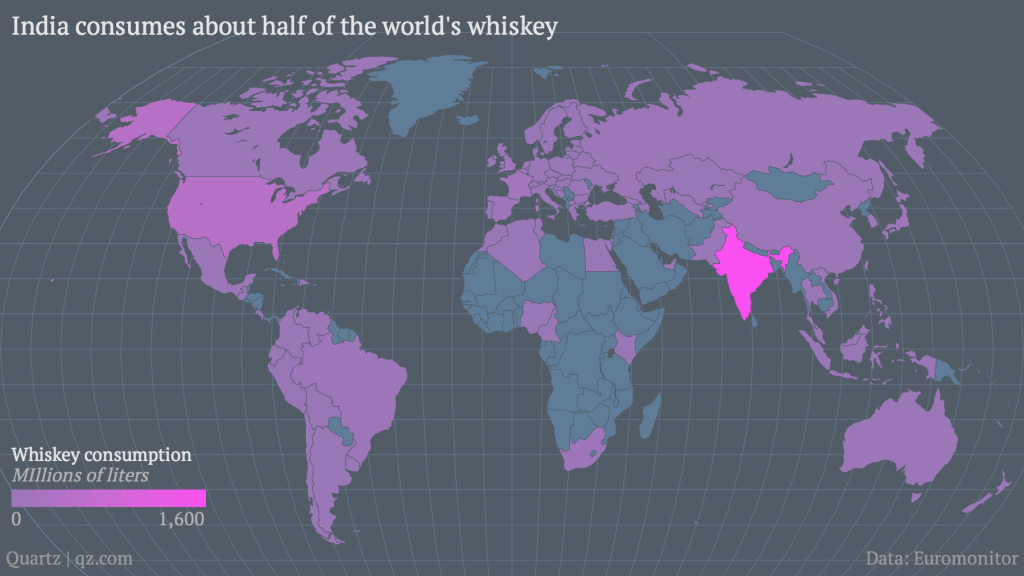
But even though Indians are drinking all this whiskey, they aren't a big factor in the whiskey market outside the United States. That's because Indian whiskey consumption is overwhelmingly derived from domestic brands — with United Spirits brands leading the way — that are not popular internationally.
One reason Indian whiskeys aren't a big deal in the global marketplace is that by American or European standards they're not even whiskey at all. Typical Indian whiskies are produced with methods that involve molasses, neutral alcohol, and limited aging. Which is to say they're more like what we would call rum, even though the brands are often given Scotland-themed names like the popular McDowell's No. 1 Reserve.
The big advantage of this rum-esque production process is that it's a lot cheaper, and as India is a lot poorer than the United States or Scotland a cheaper beverage is more suited to the market than a proper bourbon or Scotch. But as India gets richer, it seems very likely that its growing middle class that's already accustomed to drinking something called "whiskey" will have a growing interest in higher-quality global whiskies. And yet many international firms find it challenging to distribute products in the Indian market.
This is where buying United Spirits comes in.

Diageo's brands
Diageo has a large portfolio of Scotch whiskies plus Bulleit, Bushmills, and Crown Royal. Meanwhile, United Spirits has enormous expertise in distributing bottles of liquor to Indian people. A combined entity will be extremely well-positioned to start marketing more upscale brands to the growing Indian market — a classic case of business synergies. It's much easier for Diageo to buy an existing company that build a brand new distribution network, and much easier for United Spirits to team up with a high-end distillery than to develop expertise in making whole new product categories.
The problem for those of us who aren't Indian, is that the nature of the aged whiskey market is that supply is rather inelastic. Diageo can't travel back in time and increase the volume of alcohol they started aging in the past. So when distillers find new markets to exploit, the impact is felt almost exclusively through higher prices (and profit margins) rather than large quantities.
In other words, better drinks for the Indian market means more expensive drinks for the United States and Europe.


.jpg)


