


Read more of this story at Slashdot.

Corvus.coraxHey hospitals, it seems a bit like an overreach to use data for these purposes. Besides, since when is it in your interest to prevent sickness from getting out of hand and expensive?
Any thoughts guys?
Read more of this story at Slashdot.
Corvus.coraxbig claims...
Read more of this story at Slashdot.

Corvus.coraxscrew mars- let's go to europa!
Read more of this story at Slashdot.

Corvus.corax@bjornG- work toonz

Corvus.coraxI suppose you guys all saw this already. It's long, but he's got a lot of funny stuff here.

This past week has been rather embarrassing for celebrity health guru Mehmet Oz — or just Dr. Oz to fans. He was taken to task in front of Senate for selling, in his own words, a "magic weight loss cure for every body type." Oz's testimony was mainly a whirlwind of self-contradiction, telling Senators that there was no such magical cure after all.
Last night, John Oliver walked through the highlights of the proceedings, adding, "If you want to keep spouting this bullshit, that's fine, but don't call your show Dr. Oz. Call it Check his Shit Out with some Guy Named Mehmet."
But Oliver's main complaint here isn't with the weight loss-peddling doctor. It's with the organizations, lawmakers, lobbyists and the powerful dietary supplement industry that allow him to do that. "Dr. Oz is just a symptom of the problem," he said, explaining the relative and terrifying freedom that supplement companies have when it comes to giving us things like Dr. Oz's snake oil.
Corvus.coraxHuh

Corvus.coraxPart one of some antibac news. Here's the other http://feeds.wired.com/c/35185/f/661370/s/3bd4e45d/sc/7/l/0L0Swired0N0C20A140C0A60Cglobal0Eantibiotics0Eaction0C/story01.htm
Read more of this story at Slashdot.

Corvus.coraxI was searching for a crafty idea for a summer camp- thinking about making something from one of the weeds we have a lot of at work (reed canary grass) and good old google's related searches told me that I can apparently extract DMT from the grass. the huffpo article also caught my attention for the reference to Gaspar Noé's film Enter the Void...
that is all.
Drug researchers have found evidence that a hallucinogenic compound used in shamanic rituals in the Amazon is growing in popularity. Dimethyltryptamine (DMT), the active ingredient in ayahuasca, a plant-based mixture, can also be used by itself, often by smoking it.
Working off of answers provided in the ongoing Global Drug Survey, researcher Adam Winstock and his co-authors found in a November article published in the Journal of Psychopharmacology that DMT "had a larger proportion of new users" compared to other powerful drugs like magic mushrooms, LSD and ketamine -- "suggesting its popularity may increase."
The global survey's findings are supported by numbers from another survey administered by the U.S. government, the National Survey on Drug Use and Health. That sampling found that the number of people in the U.S. who have used DMT in some form has been up almost every year since 2006 -- from an estimated 688,000 in 2006 to 1,475,000 in 2012.
The newest users, the global survey found, were more likely to be young, male, and in school.
"Mainstream interest since the release of the cult film "Enter the Void" in 2009 and the 2010 documentary "DMT: The Spirit Molecule", followed by a recent article in the influential youth magazine Vice featuring young people who had just smoked DMT will have raised awareness," Winstock's study said, suggesting why use might be on the rise.
The anonymized annual Global Drug Survey provides a rare look into how illegal drugs are actually consumed by users. Twenty-five news organizations around the world are partnering with the survey this year to provide greater insights into how and why people use drugs.
Because the survey is not a random sample, it cannot provide accurate data of the prevalence of the use of a certain drug. However, it is possible to identify some trends from the study.
The 2012 Global Drug Survey, conducted between November and December that year, found that DMT users have a relatively low urge to use more. The drug doesn't offer a casual high, but rather an extreme hallucinatory experience. Winstock and his partners found that a "bad trip" was a commonly cited risk for the drug, and that "the majority of users rated the effect of DMT as stronger than ketamine, magic mushrooms and LSD." Users of ayahuasca don't use the term "high" or even "trip" to describe the experience, in fact. They rely on "journey" to get across how different in kind, not just in degree, it is from other drugs, even other psychedelics.
The use of ayahuasca itself has been on the rise over the last decade. L.A. Weekly recently reported that its home city hosts at least three active ayahuasca subcommunities and that on any given night, some 50 to 100 "ceremonies" where the drug is used are underway in New York City.
Ayahuasca brew, a combination of two plants that grow in South America, has long been known to the readers of Beat literature as yage. “I was a vomiting snake," early adopter Allen Ginsberg wrote of one ayahuasca journey. "I vomited with eyes closed and sensed myself a Serpent of Being ... covered with Aureole of spiky snakeheads miniatured radiant & many colored around my hands & throat -- my throat bulging like the Beast of Creation, like the Beast of Death.”
The drug first came to the attention of Western scientists in 1851, but Amazonian tribes have probably used it as a medicine and religious aid for centuries. One of the plants in the brew, Psychotria viridis, contains dimethyltryptamine -- or DMT -- which is listed as a Schedule I drug under the U.S. Controlled Substances Act. By itself, though, dimethyltryptamine has no real effect. Indeed, many common plants contain DMT; so does the human body, though the brain is wired to neutralize it. Thus the second plant in the brew -- Banisteriopsis caapi, which knocks down the brain's ability to neutralize DMT.
Without reliable survey data, it's impossible to know exactly how much ayahuasca use might be growing in the United States. But beginning around the turn of the millennium, folks unable to find acid in their hometowns -- or those just looking for something new -- started hopping flights to Peru, Ecuador, or Brazil, hoping to experience an ayahuasca journey, as the experience is known. "Before 2001, I never saw an American come down," a Peruvian shaman said during an interview for the 2009 book , requesting anonymity so as not to go to prison.
Such psychedelic tourism grew so quickly that ayahuasca journeys are now offered in Latin American countries that have no native tradition of using the brew. Tommy Thomas, a farmer who lives in Costa Rica, also spoke about the trend for the 2009 book. A real estate developer from Washington, D.C., Thomas moved to the country more two decades ago hoping to earn a living growing hallucinogenic plants. The market turned out to be less lucrative than he'd imagined. Thomas now grows mostly traditional crops, dedicating only a small portion of his farm to mind expansion, on a four-acre plot he calls an "ethnobotanical garden." He said that he first noticed the ayahuasca trend take a major upswing in 2005. The local version of the ceremony involves flying in a Peruvian, Ecuadorian, or Brazilian shaman, because their Costa Rican counterparts never used ayahuasca.
“It kind of pisses them off,” Thomas said of the native Costa Ricans, “but it’s good money.” Indeed, the retreats, mostly organized by Americans, can cost thousands of dollars per head.
Another sign that ayahuasca vacations have hit a critical mass is media exposure. National Geographic and a number of other outlets have run chronicles of their writers' mind-blowing excursions to South America, complete with harrowing bus/plane/boat rides, stays in mosquito-ridden camps, and much vomiting. The New York Times finally covered the journeys in 2010. But there's really no need for Americans to travel to go on an ayahuasca journey. In the '90s, the Peruvian shaman said, he brought his brew to places such as Spain, Italy, and India, but not to the United States. "I didn't even consider coming to America," he said. "I didn't think the people would be open to it." He eventually met a few Americans who persuaded him to come to San Francisco. Today, he goes almost nowhere but the United States. Now, he said, there are more towns asking him to come than he has time to accommodate.
Corvus.coraxguess who's back? http://www.shelf-awareness.com/ar/readers/2014-06-17/robogenesis.html
Genevieve Valentine weaves a mesmerizing, surreal retelling of “The Twelve Dancing Princesses” in her latest novel, The Girls at the Kingfisher Club (Atria, $24). In 1920s New York, the wealthy Mr. Hamilton keeps his daughters prisoners in the upper rooms of his mansion while he breeds their mother to death in hopes for a boy. The eldest sister, Jo — or the “General” as she is called — attempts to keep them all in line to avoid their father’s fury, but after a special excursion to the opera, she discovers dancing. “Cabs leave at midnight” becomes her new battle call as the years grow more oppressive and her younger sisters threaten to run away. Together they storm the dance halls, not giving anyone their names and answering mostly to “princess” to stay anonymous. Soon, the Kingfisher Club becomes their second home, but their father suspects his daughters are up to no good and sets a plan in motion to marry his girls off to the highest bidder — or send them away to an even darker fate. Jo must devise an escape for her sisters even as her father’s madness makes him more desperate. Valentine’s dreamlike narrative brings the Brothers Grimm tale alive with intrigue and gritty descriptions of the Roaring Twenties.
Read full article >>
Corvus.corax22 percent is pretty good.
Read more of this story at Slashdot.

Corvus.coraxkind of scary if true- "extracting all the intelligence he possesses" sounds fairly ominous.
Read more of this story at Slashdot.

Corvus.coraxneato materials science
Read more of this story at Slashdot.

Corvus.coraxprobably you saw this news- I'm listening to a phantogram album I've been meaning to buy, but now....

There have been rumors about a new audio streaming feature to be added to Prime membership for a while now. Well, Amazon has finally made it official.
With Prime Music, Prime members have unlimited, ad-free access to over a million songs at no additional cost to their membership. Prime Music includes tens of thousands of albums from top artists like Daft Punk, P!nk, Bruno Mars, Blake Shelton, The Lumineers, Bruce Springsteen and Madonna. And we’re just getting started—more music is being added all the time. Prime members can choose exactly which songs and albums to listen to, or they can sit back and listen to hundreds of expert-programmed Prime Playlists. Discovering music is easy thanks to Amazon’s personalized recommendations. Music fans will find tons of music they’ll love, from Grammy winners to indie breakout singers, along with a huge music catalog that can easily be combined with their own collection. Prime members can also download songs from the Prime Music catalog to their mobile devices for offline playback on planes, trains and anywhere they’re without an internet connection.

Free Amazon Music for PC or Mac App
“Over a million songs” sounds like lot (to me, anyway), but doesn’t include any produced in the last six months. The main competition appears to be Spotify, a service that boasts 20 times that amount. Spotify has a basic service which is free, but has embedded advertising. The appeal of Prime Music is that it is free for Prime members, has no advertising embedded, and has some usability features that are not found in some of the competing services such as Pandora.
The streaming audio market is pretty hot right now, and this new service may make Prime membership more appealing to a fairly large demographic, and could be the tipping point for a lot of them. That is obviously the bet Amazon is making.
Is a million enough? Seems like a pretty good start, and it’s likely to already be critical mass. I’m also guessing that number will expand rapidly.
Corvus.corax"in principle they could make their own state, but only if they'd be willing to starve. It'd be a permanent downward economic spiral — like Gaza, basically"

The ongoing vicious fighting in Iraq is often characterized as a battle between the Islamic State in Iraq and the Levant (ISIS) and the Iraqi government. Many people think of that as simply being a proxy war between Iraq's Sunni Muslim minority and Shia majority.
But it's much, much more complicated than that. There are Sunnis on both sides of the conflict, and some who are neutral. There are multiple insurgent groups that aren't ISIS. And the Kurds— non-Arab Sunni Muslims who have a semi-autonomous state in northeast Iraq — have a totally unique role in the ongoing fighting, and may actually be benefitting from it.
To untangle some of these threads, I spoke to Kirk Sowell, a political risk analyst and expert on Iraqi politics. Sowell's firm, Utcensis Risk Services, publishes Inside Iraqi Politics, a biweekly publication covering the latest developments in Iraq. Sowell walked me through the divisions within the Sunni groups, why both ISIS and Iraq's Prime Minister are probably going to fail, and how the Kurds are the big winners of this conflict. What follows is a transcript of our conversation, edited for length and clarity.
Zack Beauchamp: One of the major drivers of the rise of ISIS has been Prime Minister Nuri al-Maliki's policy towards the Sunni Muslim minority. Can you talk about the reasons his government has persecuted Sunnis and why that's such a major problem for the country?
Kirk Sowell: The Sunnis have lots of different grievances. As someone who considers himself a neutral analyst, there are some that I think are fairly reasonable and there are others that I don't think are.
at this point, it's hard to see how Maliki survives this
The ones I think are pretty reasonable are illegal arrest and treatment of prisoners. It's not just that Sunni prisoners are treated badly, but that they're disproportionately the ones who are prisoners. There's no transparency in terms of prosecution.
Last year, there were a series of operations to counter what was then a rising insurgency. It was part of the same insurgency, the second Sunni insurgency. They arrested 800 people in a month — nobody knows what happened to these people, how many were innocent, how many were guilty, or if they were prosecuted. Oftentimes Iraqis sit in prisons for years without a trial. Sometimes they're tortured; sometimes people, especially Sunnis, have to pay ransoms to get their family members out of prisons even if they didn't do anything wrong.

Members of Asaib Ahl al-Haq attend a funeral for soldiers killed in Syria. Hamdar Hamdani/AFP/Getty Images
There's also been an increasing and very unwise reliance on Shia militias by the Maliki government, particularly their alliance with Asa'ib Ahl al-Haq (AAH), translated as League of the Righteous, a [radical Shia leader] Moqtada al-Sadr splinter group. Then there's the Badr Organization, which is part of Maliki's coalition and controls the Transportation Ministry. It was founded as the military wing of the Iran-backed Shia group called the Supreme Council for Islamic Revolution in Iraq.
ZB: So is Maliki's policy responsible for all of the Sunni anger at the Iraqi government?
KS: Even if Maliki weren't in power, there are some Sunni grievances than any Shia government would have problems with. For example, there's a perception problem that exists from the senior leaders to the bottom: Sunnis think they're the demographic majority even though they're not. This was a belief promoted under Saddam, and it's amazingly survived. Typically, when people say that they include the Kurds — they say Sunni Arabs are the plurality and Sunni Arabs plus Kurds are a majority.
This matters because one of the basic demands of the Sunni protest movement last year — and probably the thing Parliament Speaker Osama al-Nujayfi, perhaps the most important Sunni politician in the country, talks about the most — is this concept of "balance." Balance [between Sunnis and Shias] in the institutions of government. There's some justification for this; de-Baathification [the removal of members of Saddam Hussein's Baath Party members from government] has been taken too far.

Azher Shallal/AFP/Getty Images
This counts in the legitimate grievance category. But it's not just a problem with Maliki. There are some problems Maliki is responsible for. There's certain problems that would exist whether it's Maliki or whatever. You have protestors out there flying the Baathist flag, sometimes talking positively about the old regime or the Iraqi army under Saddam. They want there to be balance, meaning a [Sunni] majority.
So to sum up: there's two categories of Sunni grievances. One is the legitimate grievances and others which are problems of expectation or perception.
ZB: Let's talk about the cleavages inside the Sunni community. Do most Sunnis support ISIS?
KS: There's three major groups, and then I'll subdivide them.
One group are those who are in the insurgency. A second group would be those who are in the political process, but opposed to Maliki. And a third group would be those who are in the political process and aligned with Maliki.
There's no scientific polling, but I would say that a clear majority of Sunnis at the grassroots level believe in the political process. There's also a lot of people on the borderline, who are willing to vote but they're also willing to support the insurgency.
Of those Sunnis that are in the political process, the clear majority are opposed to Maliki
In those who are part of the insurgency, you've got ISIS, who is the most radical element. Then you've got more nationalist-focused groups like the Jaysh Rijal al-Tariqa al-Naqshbandia (JRTN), which means "The Army of the Men of the Naqshbandia Way." It's headed by Izzat Ibrahim al-Duri, who was the former deputy of Saddam Hussein. Reportedly, he's in Tikrit now — Saddam's hometown and where the Baath was strongest. Also southwest Kirkuk and Mosul. They're an important group. Their goal to restore a centralized Sunni dictatorship, but more secular than the jihadist caliphate the ISIS would put in place.
You've got other groups, but ISIS and JRTN are the two biggest. Some of the other groups are very small, and I don't think any of them have a national organization. More like isolated pockets of support here and there.
I can't really give you numbers, but I can say that ISIS is not a majority on the grassroots level. That said, they're the most organized and their fighters are very battle-hardened, having spent years fighting in Iraq and Syria. The JRTN is also very well organized, but they're not as large and they don't have the financial resources. ISIS has an extensive extortion racket and a large segment of Syria's oil industry. The extortion racket is based in Mosul, which is going to weaken because [as the fighting goes on] the money's going to dry up.
Of those Sunnis that are in the political process, the clear majority are of the second group I mentioned earlier: those opposed to Maliki. Of those who are opposed to Maliki, Nujayfi's Mutahidun is the largest group — they won 27 seats in the last election. That's down from 45 in the previous. But nonetheless, Mutahidun and the factions that make it up clearly represent the plurality of Sunnis in the political process.
You've also got Iyad Allawi's cross-sectarian, but mostly Sunni, Nationalist Coalition. They won 21 seats; I think about 15 or 16 were Sunni. Allawi himself is Shia, but his key allies were Sunni. Then you've got Salih Al-Mutlak's Arab Coalition, which has 11 seats. There, they're closer to Maliki — they don't support Maliki per se, but they're willing to work with him.
Ahmad al-Rubaye/AFP/Getty Images
Finally, you've got another category: Maliki-aligned Sunnis, most of whom are basically bought and paid for or threatened. You've got people like like Saadoun al-Dulaimi, the acting Defense Minister, whose people are basically paid for. Then you've got some groups who've been forced to flip based on legal threats, based on crimes genuine or fabricated. Maliki will just sit on the criminal files until they become useful. That's what happened with [prominent Sunni politician] Jamal Al-Karbuli.
These bribed and threatened politicians only represent an extremely, extremely limited portion of Sunni Iraq. They're a very, very small percentage — probably no more than those who support ISIS, frankly.
ZB: So, given these wide sets of divisions inside the Sunni population, what does that tell you about the prospects for ISIS and the other Sunni insurgent groups to carve out a semi-autonomous state? Many people are saying they have the power to partition Iraq.
KS: The insurgents can only win if they get the Shia to give up.
The mainstream Sunnis are divided and extremely weak. The units that just dissolved when fighting the insurgency were heavily Sunni, and there was clearly some collaboration going on [between them and the insurgents].
But if you have a Shia unit, highly motivated, they have huge advantages in hardware and numbers. They're going to sweep all before them. That doesn't mean they'll exterminate the insurgency, but they'll guarantee the insurgency can't control a region.
Now, if they just keep fighting over two or three years, and the Shia just give up and just let them go, then sure.
The Sunnis will suffer more from this than anyone
But there's no money [in northwest Sunni Iraq]. All these provinces are dependent on Baghdad for their budgets. This is what held Iraq together all these years — it would have fallen apart years ago had it not been for this financial dependence. Anbar [an insurgent-contested Sunni province] is totally dependent; over 95 percent of their money comes from Baghdad. They got a little bit of money from customs when they controlled the [Syrian] border, but they don't even get that now. Ninevah [the insurgent-controlled province containing Mosul] is going to suffer a complete economic collapse.
My point is that, in theory, the insurgents could just keep fighting until the Shias give up and form a region. But the regions they control are not viable entities. The Kurds would annex the north and northeastern parts of Ninevah. Most of the oil there is in the Kurdish controlled area or on the borderline already.

Sovfoto/UIG/Getty Images
And even if the insurgents had some oil, they couldn't develop it. They're able to make use of the Syrian oil infrastructure because it's already developed; but to the extent that there are oil reserves in the insurgent-controlled territory they're not developed. So there's nothing to sell.
So in principle they could make their own state, but only if they'd be willing to starve. It'd be a permanent downward economic spiral — like Gaza, basically.
ZB: Let's talk a little bit about the Kurds. So far, it seems like they're the winners of the crisis. They've managed to take Kirkuk, an oil-rich city, and have carved out this zone where they can pump even more oil than they've been able to pump before. Do you think that's accurate? And what is the Kurdish role going to look like in the crisis going forward?
KS: Yes, that's completely accurate. Their role going forward will be the same it is now: they'll take actions that will serve their interests, but they're not going to go out and fight for the Arabs.
And understandably so. Before this happened, Maliki was starving them out because of a dispute over the Kurds exporting oil to Turkey. In January, Maliki cut off their monthly payments. And they're almost as economically dependent on Baghdad as Anbar is.
Maliki made half payments for January and February. Then for March, April, and May, he didn't make the payments because the Kurds wanted to export oil to Turkey without Baghdad's approval.

Kurdish peshmerga. Safin Hamed/AFP/Getty Images
So, coming in to this crisis, the Kurds were on the verge of insolvency. Like, complete insolvency. The only thing that kept them alive was that the Barzanis and the Talabanis [leading Kurdish families] have massive amounts of money stored back that they'd been stealing all of these years. They used it to keep the Kurdish region afloat, or at least pay the peshmerga [independent Kurdish militias].
This crisis is a lifeline for the Kurds
They've developed their economy on the sort-of Saudi or Emirati model of expanding the public sector based on oil income, because that maintains the support of the two major political parties: the Kurdistan Democratic Party and the Patriotic Union of Kurdistan. While that may work well politically, it doesn't work as an economic model. When Baghdad cuts off their money, they're in a hole.
This crisis is a lifeline for the Kurds. Maybe they can get Baghdad to restore their payments, maybe they can't. If Baghdad doesn't restore their payments, they might as well declare independence right now. Now that they control Kirkuk, they can export the oil they control to Turkey. They don't yet have the infrastructure to replace what they were getting from Baghdad, so it would be rough for a year or two. But eventually they'd do OK. So they're really the big winners here.
ZB: Can you explain what the Shia religious establishment's role in the Iraqi politics is and how they play in to this crisis?
KS: Their role has not been as great as it was several year ago. Ali al-Sistani is the highest clerical authority, and he's sort of taken a step back. And there are other clerics, some of them are only semi-legit: Muqtada al-Sadr is really a politician, not a religious authority per se.
Ali al-Sistani is the highest clerical authority, and he's sort of taken a step back
Really it's Sistani and the clerical establishment in the city Najaf that matters. I don't view them as absolutely crucial. It is a big deal that Sistani's representative made a statement saying "we call on Iraqis to defend the country," but they were definitely going to do that. Now what's going to happen is that the Maliki government is going to make a reserve army that's all Shia. And then there's militias; there's going to be multiple parallel armies. That said, this all would have happened if Sistani said nothing.
I should be clear that Sistani has always encouraged support of the national military, not militias. But nonetheless, this very general statement about taking up arms — different factions can use this statement to justify picking up guns.
ZB: Is there anything really critical to understanding Iraqi politics that we haven't talked about yet?
KS: Maliki was having a tough fight in his reelection campaign; it's hard to imagine he has any credibility at all after this complete disaster. Our assessment was already that the main challenge was already going to come from within his State of Law coalition. For all we know, there could already be an agreement on his replacement.
None of this has been announced. The Shia leaders have not come out with a resolution yet, they want to get through this. But at this point, it's hard to see how Maliki survives this.
One last thing. Look out for lots of sectarian cleansing in Baghdad.

Dan Kitwood/Getty Images
This is a real disaster for Sunnis. There are Sunnis cheering this, but it's really foolish. The Sunnis will suffer more from this than anyone. The Kurds will benefit, Iran will benefit, and the Shia will suffer but not as much. Life is going on in the Shia provinces; this crisis is not disrupting daily life in Karbala or Basra.
For those who are in Baghdad, it's a security threat — not that the insurgents will overturn Baghdad, but that the number of attacks in Baghdad will increase. The Sunnis will be further cleansed in Diyala and Baghdad, and to the extent that their areas fall out of government control, they will just go into absolute, total socio-economic ruin.
Corvus.coraxlittle companion to the silly atlantic piece- interesting for filing away the movie title, and the pairing of Krauss and Dawkins.

Corvus.coraxsomewhat silly, but who doesn't need a little lite atheism this morning?
The young, educated Brooklynite tweaks his sardonic bow tie and gently tugs the laces of his newly polished Oxfords. He spent the afternoon picking out just the right flowers for the mother of his young, educated girlfriend—tonight's the night he'll ask her to be his gal for life.
He's got a kick in his step as he strides up the walk to her Staten Island home. The door opens to shouts of greetings and mom-ish kisses and surprisingly pushy offers of food and drink. They nosh, they gab, and things are grand—that is, until they sit down for dinner.
Over bowls of matzo balls, dear Dad-To-Be brings up metaphysics, as one often does over soup. "So, my boy, what does God have in store for your career, you think?" DTB asks.
"Oh," coughs the Brooklynite, mildly, "I don't think God has much to do with it, but I'm very excited—"
DTB interrupts. "But, son: Don't you believe in God?"
Suddenly, the room is silent, much silenter than a Jewish household in the New York suburbs was ever meant to be. Bubbe isn't even singing softly to herself anymore.
"Uhhh," the young atheist says.
A gray light falls over the room, which is odd, because it's only 5 pm. If only our young Brooklynite were Jewish, he might have made a mental comparison to a room where people are sitting Shiva, or maybe a Bar Mitzvah luncheon after the lox have run out. Needless to say, this doesn't bode well for future vacations with happy in-laws.
Our poor Brooklynite isn't alone; it's hard out there for single atheists. In general, Americans don't like the idea of atheists in certain parts of public life, like politics, but they definitely don't like the idea of an atheist shacking up with their kid for life. In a new Pew survey, nearly half of respondents said they would be unhappy if a member of their immediate family married an atheist, including 73 percent of conservatives, 51 percent of moderates, and 24 percent of liberals. In fact, liberals were only slightly more likely to be unhappy if a family member married a born-again Christian.
Marrying an Atheist vs. a Born-Again Christian

Unfortunately for our atheist hero, his relationship ended. He lived out his life in solitude, save the company of his cat, named Zarathustra.

Corvus.coraxwow- what a team.

Corvus.coraxiran? can't imagine it's all good news, but I had a sort of fleeting brotherly-help feeling when i first read this.
The Wall Street Journal is reporting that Iran sent two battalions of Iranian Revolutionary Guards to help the Iraqi government in its battle against the Islamic State in Iraq and the Levant (ISIS). Not to put too fine a point on it, but this is hugely important, if not totally surprising given Iran's intervention in Syria. Iran has the power to crush ISIS in open combat. But Iranian intervention could also make the conflict inside Iraq much worse.
combined Iranian-Iraqi forces have already retaken about 85 percent of Tikrit
These aren't just any old Iranian troops. They're Quds Force, the Guards' elite special operations group. The Quds Force is one of the most effective military forces in the Middle East, a far cry from the undisciplined and disorganized Iraqi forces that fled from a much smaller ISIS force in Mosul. One former CIA officer called Quds Force commander Qassem Suleimani "the single most powerful operative in the Middle East today." Suleimani, the Journal reports, is currently helping the Iraqi government "manage the crisis" in Baghdad.
According to the Journal, combined Iranian-Iraqi forces have already retaken about 85 percent of Tikrit, a city in north-central Iraq and Saddam Hussein's birthplace. That alone demonstrates the military significance of Iranian intervention: Iraqi forces have previously floundered in block-to-block city battles with ISIS.
a strong Sunni support base is the key to ISIS building up a powerful enough force to maintain an effective rebellion
But these sorts of victories could prove ephemeral quickly, as Shia Iran's intervention could infuriate the Sunni Muslims whose allegiance ISIS needs to win in the long run. The internal Iraqi conflict is firmly sectarian: ISIS is a Sunni Islamist group, and the Iraqi government is Shia-run (a majority of Iraqis are Shia). Iran is also a Shia state.
Iranian intervention in the conflict could convince Sunni Iraqis who don't currently support ISIS to shift their allegiances. The perception that the Iraqi government is far too close to Iran is already a significant grievance among Sunnis. That's part pure sectarianism and part nationalism. Many Iraqis don't like the idea of a foreign power manipulating their government, particularly Iran (memories of the Iran-Iraq war haven't faded).
Iranian participation in actual combat risks legitimizing ISIS' propaganda line: this isn't a conflict between the central Iraqi government and Islamist rebels, but rather a war between Sunnis and Shias.
That risk becomes much higher if joint Iraqi and Iranian units kill Sunni civilians during the fight against ISIS — which the Iraqi military has done in the past. Indeed, the Iraqi government's brutal repression of Sunnis is one of the core reasons ISIS managed to recruit enough troops to challenge the Iraqi government in the first place. And a strong Sunni support base is the key to ISIS building up a powerful enough force to maintain an effective rebellion, as Brookings Doha's Charles Lister explains:
Iranian intervention in the Syrian conflict has helped Syrian dictator Bashar al-Assad hold on to power when it looked like all was lost for him. We'll see if it ends up similarly helping the Iraqi government — or undermining it.
Corvus.coraxi'm sorry, but could it be that most american's don't know shit about social security, and the policy making 'elites' have studied it and have coalesced on the same kind of sensible solution- taking a longer-living population into account in the formula that was set so long ago? huh?
I hate to sound like a technocrat but I always wonder at these polls if they ask any questions to determine how familiar the respondents are with the policy in question.

The Pew Center is out with an amazing series of charts and graphs on growing partisan and ideological polarization in America, but since the trend toward polarized viewpoints is so strong I thought the most interesting finding was one area where there's no polarization — Social Security:
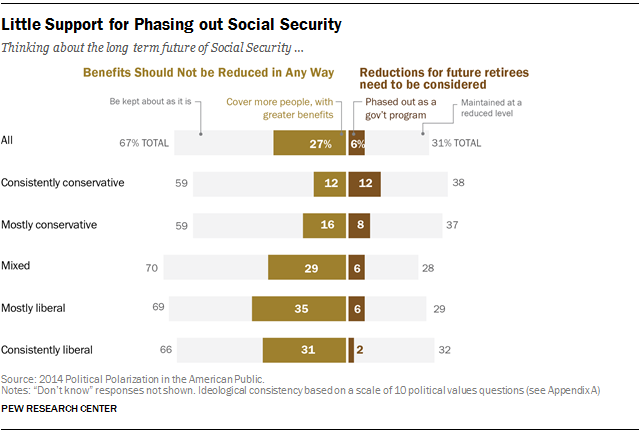 Among the most highly ideological, most consistent conservative voters in the country most people don't want to see cuts. Moderates don't want cuts. Liberals don't want cuts. Nobody wants cuts. The big gap is that there's a substantial bloc of liberal support for increasing benefits, while conservatives like the status quo better.
This is interesting because I think it underscores the limited relevance of public opinion to practical politics. Among policymaking elites, there's near-universal consensus that Social Security should adjust to population aging at least in part through benefit cuts. That's President Obama's view, it was supported by the Center for American Progress the last time they took a big look at Social Security, and it's taken for granted whenever pundits gather at roundtables that one of the sad things about congress today is that members can't sit down across the aisle and agree on a plan to cut benefits.
But at a time when Americans can't agree on anything, this is something they agree on.
Corvus.coraxsounds like AT has been reading Deutsch or Beinhocker. I have a friend in Cleveland who had to sign a NCA and it sounded crappy.
The NYTimes has a good piece today on the increasing use of noncompete clauses, clauses that say that if you leave a firm you cannot work for a competitor typically for a period of 1 or more years.
Noncompete clauses are now appearing in far-ranging fields beyond the worlds of technology, sales and corporations with tightly held secrets, where the curbs have traditionally been used. From event planners to chefs to investment fund managers to yoga instructors, employees are increasingly required to sign agreements that prohibit them from working for a company’s rivals.
Non competes agreements (NCAs) are dangerous in my view because they put firms into a prisoner’s dilemma: Non competes benefit firms but harm industries by reducing innovation.
Today we all know about Silicon Valley but in the 1950s and 1960s the place for technology was Route 128 in Massachusetts which Business Week called “the Magic Semicircle”. The magic semicircle contained technological leaders like DEC and Raytheon and intellectual powerhouses like Harvard and MIT – this was at a time when Silicon Valley was mostly fruit trees.
When William Shockley left Bell Labs for the Valley it was not considered a promising move. And indeed something strange happened. Shockley wasn’t a very nice person, he couldn’t get any of his former colleagues to come work for him, and within a year of starting his firm in Mountain View, eight of Shockley’s researchers, who called themselves the “traitorous eight,” resigned. The traitorous eight, started Fairchild Semiconductor. Two of them, Robert Noyce and Gordon E. Moore, later left Fairchild to form Intel Corporation. Other people leaving Fairchild Semiconductor started National Semiconductor and Advanced Micro Devices. So it was in this branching off process of new firm creation that Silicon Valley was born.
Now here is the point, if Shockley had started his firm in Massachusetts or in pretty much any other state, the traitorous eight probably would not have left to start their own firm because they would have signed a standard non-compete agreement prohibiting them from competing with their former employer for 18 to 24 months. In California, however, the courts have consistently refused to enforce non-compete agreements. An employee who leaves one company can join a new company and start work the next day and they can do so regardless of any agreement.
Silicon Valley could not operate if non-compete agreements were enforced. Silicon Valley is a hyper-mobile workforce. Moreover, it’s precisely in the circulation of workers that Silicon Valley has one of its advantages the diffusion of new ideas. The key to Silicon Valley and much innovation today is the diffusion, the combination, the integration of different sorts of knowledge and worker mobility has been a big part of this. Not just worker mobility between firms in Silicon Valley but also immigrants, circulation between different countries, university-firm partnerships and so forth.
Firms who come to Silicon Valley know that they cannot use NCA to protect their innovations but they come anyway because the opportunity to learn from other people exceeds the costs of other people learning from you. Thus, worker mobility and the inability to protect IP by restricting mobility is bad for an individual firm but good for the industry as a whole, good for innovation, good for workers and good for consumers.
(Drawn from a talk I gave at a Google Big Tent event in Korea.) Hat tip to Loweeel in comments for some edits.
Corvus.coraxwisdom from Neal. ahhhh.
So says Neal Stephenson:
In both games and movies the production of visuals is very expensive, and the people responsible for creating those visuals hold sway in proportion to their share of the budget.
I hope I won’t come off as unduly cynical if I say that such people (or, barring that, their paymasters) are looking for the biggest possible bang for the buck. And it is much easier and cheaper to take the existing visual environment and degrade it than it is to create a new vision of the future from whole cloth. That’s why New York keeps getting destroyed in movies: it’s relatively easy to take an iconic structure like the Empire State Building or the Statue of Liberty and knock it over than it is to design a future environment from scratch. A few weeks ago I think I actually groaned out loud when I was watching OBLIVION and saw the wrecked Statue of Liberty sticking out of the ground. The same movie makes repeated use of a degraded version of the Empire State Building’s observation deck. If you view that in strictly economic terms–which is how studio executives think–this is an example of leveraging a set of expensive and carefully thought-out design decisions that were made in 1930 by the ESB’s architects and using them to create a compelling visual environment, for minimal budget, of a future world.
As a counter-example, you might look at AVATAR, in which they actually did go to the trouble of creating a new planet from whole cloth. This was far more creative and visually interesting than putting dirt on the Empire State Building, but it was also quite expensive, and it was a project that very few people are capable of attempting.
…That [dystopian] environment also works well with movie stars, who make a fine impression in those surroundings and the inevitable plot complications that arise from them. Again, the AVATAR counter-example is instructive. The world was so fascinating and vivid that it tended to draw attention away from the stars.
There is more here, via Morgan Warstler.
Corvus.coraxthis one is very long, but I appreciated that it added some sense of fallibility (we don’t have slam-dunk evidence on any of it") to the sugar/diet debate, plus I love the last sentence which smells like a beginning of infinity,
"What if our whole approach to this epidemic has been part of an ongoing investigation into understanding the complex nature of human metabolism and nutrition, and there’s some validity to most of it, and it’s all building on itself?"
“Over the past few months, I’ve become increasingly concerned about a sweetener that I’ve recommended on my show in the past,” Mehmet Oz lamented in an apology earlier this year. Oz, the practicing cardiac surgeon and professor at Columbia University who hosts an eponymous daytime-television extravaganza, is given to emphatic food recommendations. Either run and buy something, or throw it away. Throw it as far from you as possible. “After careful consideration of the available research, today I’m asking you to eliminate agave from your kitchen and your diet.”
That’s a stark difference from 2011, when fans of Oz’s show listed their “all-time favorite tips” from Doctor Oz, and number one was “Agave Nectar as a Sugar Substitute.” Number one. Agave flooded “natural” food isles. By 2012, agave nectar sales were projected to double within the decade, as they had the decade prior. America’s Doctor was at the helm.
“What I like is agave,” Oz said in one of his first-ever appearances on Oprah in 2004.
“Agave? I don’t know what that is, agave.” Winfrey looked to the audience with a puzzled brow, to comedic effect.
“Agave is a natural sugar, but it’s really, really powerful. It’s very sweet to the palate,” Oz explained, recommending it specifically as a substitute for high-fructose corn syrup. “It’s actually a natural product, it’s really, really sweet. You just put a little bit in your tea or whatever you’re eating, so you don’t get many calories.”
Agave has about 60 calories per tablespoon, compared to 48 calories for the same amount of table sugar, though less agave is required to deliver the same sweetness.
In a subsequent 2009 appearance on Oprah, Oz made a strikingly similar recommendation in responding to a question about stevia.
Oz: I actually like agave, personally.
Oprah: I love agave.
Oz: It's very, very sweet, so you don't need very much of it and you can add it in there. It's [made from] the same root as tequila, so I guess you could ferment it and drink it. But [pause for laughter] … but the agave is great for tea.
Oprah: Is that why it makes margaritas so good?
Oz: Maybe that's it.
Oprah: That's when I first—no, really, that's where I first ever heard of it because somebody was at my house and they were making tequila and they had the agave instead of the—
Oz: I bet that's why they gave it to you.
That same year, Oprah’s “Ask Dr. Oz” segment spun off to become The Dr. Oz Show, where agave came up again and again. “The next time that you’re craving something sweet,” Oz said, “try using agave nectar as a natural sugar substitute.”
In his recent retraction of these endorsements, Oz offered the explanation, “It turns out that although agave doesn’t contain a lot of glucose, it contains more fructose than any other common sweetener, including high-fructose corn syrup.” Fructose is the sweetest naturally-occurring carbohydrate, so that’s why agave syrup is sweeter-per-volume than competitors.
By that time, other health-media giants had also withdrawn from agave-lauding. “I've stopped using agave myself and no longer recommend it as a healthy sweetener,” Dr. Andrew Weil wrote in a 2012 blog post. His explanation was strikingly similar to Oz’s: “As it turns out, agave has a higher fructose content than any other common sweetener, more even than high fructose corn syrup.”
Of course, the fructose content of agave nectar, or syrup, is an empiric piece of data that has long been available. What hasn’t been widely available is a clear understanding of what fructose actually does to our bodies. Doctors like Oz and Weil championed agave not just because it seemed to be “natural,” but because it has a low glycemic index, meaning it increases your blood-glucose levels more slowly than other types of sugars. The glycemic index, introduced by Dr. David Jenkins at the University of Toronto in the 1980s, categorizes carbohydrates based on their impact on our blood-glucose levels and insulin release after eating a particular carb, with less impact long understood to be a virtue. But to put all your stock in glycemic index is to deify fructose. Agave contains between 70 and 90 percent fructose by weight, and fructose has the lowest glycemic index of any sugar.

High-fructose corn syrup, which has been used commercially since the late 1960s, can be misleading as a name in that the fructose content is only high relative to regular old corn syrup. High-fructose corn syrup has fructose content similar to that of table sugar (sucrose)—55 and 50 percent, respectively—so their glycemic indices are higher than that of agave. Since the “natural” food craze took hold, agave has been marketed as an alternative to the laboratory evils of HFCS. Pretty much without fail there’s a picture of a plant or Earth on the label, and you can buy yoga mats in an agave palate.
Agave is a plant, but the syrup we make from it is like any sweetener, a mixture of fructose and glucose. After growing for around seven years, a mature blue agave plant sprouts a pyramidal flower that dangles up to twenty feet in the air, where it can be pollinated by bats. The succulent is a relative of yucca, and it was used by people as far back as the Aztec empire. William H. Prescott described agave’s many uses in 1843’s The History and Conquest of Mexico, “The agave, in short, was meat, drink, clothing, and writing materials for the Aztec!” Today in factories the blue agave plant is crushed and its aguamiel (honey water) collected. The natural plant fiber inulin is processed into fructose and glucose using thermal hydrolysis, which involves quickly heating the juice to a high temperature and then cooling it. (In the case of agave that is sold as “raw,” the hydrolysis happens at a lower temperature for a much longer time.) The process yields a product amber in color, with a consistency like maple syrup and flavor like honey, only more delicate. Despite the processing it undergoes, the plant origins made agave popular as a sweetener in “natural” and “wholesome” nutrition bars, sugary drinks, and other foods.
What turned the media against agave was the recent demonization of fructose.
In a 2010 article headlined, “Shocking! This ‘Tequila’ Sweetener Agave Is Far Worse Than High-Fructose Corn Syrup”—which has been viewed online more than half a million times—the quixotic Dr. Joseph Mercola, proprietor of a “natural health” website that claims to reach millions of readers daily, wrote, “In case you haven't noticed, we have an epidemic of obesity in the U.S. and it wasn't until recently that my eyes opened up to the primary cause: fructose.”
“Excessive fructose consumption deranges liver function and promotes obesity,” Weil declared en blog in 2012. “The less fructose you consume, the better.”
“Initially, we thought moderate amounts of fructose weren’t unhealthy, but now we know better,” Oz corroborated earlier this year.
On an even larger platform, Dr. Sanjay Gupta said in a grave voice on 60 Minutes, “New research, coming out of some of America’s most respected institutions, is starting to find that sugar, the way many people are eating it today, is a toxin.” Gupta shot straight into the heart of the fructose story to talk with Dr. Robert Lustig, a professor of pediatrics at UCSF whose viral anti-fructose lecture is credited with the popularization of the idea. Lustig used the terms “toxin” and “poison” 13 times in the 90-minute lecture, which now has 4.5 million views on YouTube.
“Do you ever worry that just sounds a little bit, over the top?” Gupta asked Lustig, of the claim that fructose is toxic.
“Sure, all the time. But it’s the truth.”
He added later, “I think one of the reasons evolutionarily is because there's no food stuff on the planet that has fructose that is poisonous to you. It is all good. So when you taste something that's sweet, it's an evolutionary Darwinian signal this is a safe food.”
Gupta: “We were born this way?”
Lustig: “We were born this way.”
The concern is that when a person consumes too much fructose the liver gets overwhelmed and converts some of it into fat that ends up in our blood as small dense LDL that lodges in blood vessels, causing atherosclerosis and, therefore, heart attacks.
Lustig is a gifted talker, and he has his points down. He has called sugar “the Professor Moriarty” of the obesity epidemic, before upping the metaphor and calling fructose “the Darth Vader of this sordid tale, beckoning you to the dark side.” It’s this narrative that emerged as the backbone of the documentary Fed Up, which premiered at Sundance in January and is now in widespread release. Produced and narrated by Katie Couric, the film takes us through interviews with more than 20 nutrition experts, basically a who’s who of New York Times Magazine nutrition articles in the last decade—Marion Nestle, Michael Pollan, Gary Taubes, Michael Moss, Michele Simon, David Ludwig—and others who constitute what Times food columnist Mark Bittman calls “the professional sane eating brigade.”
In building a case that “everything we’ve been told about food and exercise for the past 30 years is dead wrong,” the film’s anti-fructose message came through as Lustig was quoted again and again. The basis of the “We’ve been lied to” conspiracy appeal of Fed Up is what Lustig calls an ongoing, ruinous myth: A calorie is a calorie. As stated on the Centers for Disease Control and Prevention’s site, “A calorie is a calorie, regardless of its source.” That has long been the basic tenet of weight loss. The American Beverage Association, which represents the soda industry, echoes that dismissiveness on its site: “Quite simply, overweight and obesity are a result of an imbalance between calories consumed and calories burned.”
“It’s not about the calories,” Lustig said in his famous lecture, and reiterates in Fed Up. “It has nothing to do with the calories.” The film says that is the myth we’ve been fed. Lustig says fructose “is a poison by itself.”
Many in the sane eating brigade have also written that a calorie is not a calorie, not just because some calories are empty and some are accompanied by valuable antioxidants or vitamins, but because sugars influence satiety, metabolic rate, brain chemistry, and hormone release in different ways than other sugars and other macronutrients. (Marion Nestle is not among them; her recent Why Calories Count argues that a calorie is indeed a calorie.) When researchers have given animals enough pure fructose, their livers convert it to the saturated fatty acid palmitate, which increases LDL cholesterol levels in their blood, increasing their risk for heart attacks. Fat also accumulates in the liver itself, which results (over time) in insulin resistance and metabolic syndrome. Colorado State University biochemist Michael Pagliassotti observed these changes in as little as a week when animals were fed huge amounts of fructose or sucrose. When he stopped giving the animals sugar, their fatty livers and insulin resistance went away.
Kimber Stanhope, a nutritional biologist at the University of California Davis, has produced similarly compelling research that showed subjects who consumed pure fructose as 25 percent of their calorie intake had higher levels of triglycerides in their blood than people who consumed the same amount in pure glucose. That’s more fructose than almost any person would even be able to eat, though Stanhope says around 10 percent of Americans do get at least a quarter of their daily calories from added sugars of one kind or another, which is unsettling. Stanhope said recently that the abundance of epidemiological evidence suggests sugar could be a cause of heart disease. “Do we need to wait for these results [of studies showing a causal relationship] before we revise the Dietary Guidelines for Americans and start educating the public accordingly?”

Probably, because if there is a problem in all of this, it’s that speaking definitively before definitiveness is due can spread more confusion. Some find the “sugar is the enemy” message to be an oversimplification that makes the same mistake as the “fat is the enemy” message it is replacing: Advocating nutrient-focused eating instead of a holistic approach to eating nutritious foods, and less of it.
In “Is Sugar Toxic?”, a popular 2011 feature story for The New York Times Magazine, brigade member Gary Taubes offered the provocation, “If what happens in laboratory rodents also happens in humans, and if we are eating enough sugar to make it happen, then we are in trouble.” Reasonable people disagree on the size of those ifs.
“To say that fructose is toxic is a total misconception of the nature of the molecule,” Fred Brouns, a professor of Health Food Innovation at Maastricht University in the Netherlands, recently told me. “If you have too much oxygen, it is toxic. If you get too much water, you have water intoxication. That doesn’t mean we say oxygen is toxic.”
In March, Brouns published a challenge in the journal Nutrition Research Review titled “Misconceptions About Fructose-Containing Sugars and Their Role in the Obesity Epidemic.” It took the fructose story to task, noting the integral role that popular media plays in science:
“Since the recent publications of Lustig and co-workers, in which it was suggested that fructose is toxic and should be ‘treated as alcohol,’ the daily news all over the world highlighted fructose in sugar-sweetened beverages as a potential poison. ... The metabolic effects of fructose presented in ordinary human diets remain poorly investigated and highly controversial. ... One may rather aim at reducing the consumption of energy-dense foods.”
Brouns’ makes a call for skepticism, not absolution. “There have been studies that show fructose, when consumed in isolation, can be toxic,” he told me, “but we never consume fructose in isolation. It is eaten with glucose.”

Stanhope conceded the same thing when we spoke. Her study also showed that people who consumed a quarter of their daily calorie requirement as high-fructose corn syrup in a laboratory setting (55 percent fructose, 45 percent glucose) did have elevations in triglyceride and cholesterol levels similar to those who ate as much in pure fructose. As for looking at something closer to what people regularly consume, Stanhope has completed forthcoming research (currently under review by the Journal of the American Medical Association) that looks at what happens to our livers at lower levels of consumption. She declined to foreshadow the findings.
Even Barry Popkin, who was investigating fructose long before Lustig, recommends caution. Popkin, a distinguished professor of nutrition at the University of North Carolina, co-authored a widely-read academic article in 2004 titled “Consumption of High-Fructose Corn Syrup in Beverages May Play a Role in the Epidemic of Obesity.” That paper was followed by many popular articles that cited it, and a lot of research down this road. But he didn’t mean for it to lead to all-out fructose terror.
All that Popkin really wrote in the original article was that metabolism of fructose, unlike glucose, favors production of fat in our livers. That leads to a condition known as fatty liver, which affected at least 70 million Americans at the time, and affects many more now. Fatty liver is linked to insulin resistance and cardiovascular disease.
Popkin also noted that eating fructose doesn’t induce a chemical signal that tells our brains we’re full. “Unlike glucose, fructose does not stimulate insulin secretion or enhance leptin production,” Popkin explained in 2004. “Because insulin and leptin act as key afferent signals in the regulation of food intake and body weight (to control appetite), this suggests that dietary fructose may contribute to increased energy intake and weight gain.”
A recent review of many large meta-analysis studies did find that calories from sugar are all the same in terms of obesity outcomes. Be it bread, pasta, or pixie sticks, the researchers found that at least when it comes to carbs and weight, a calorie is a calorie. “Intake of sugars is a determinant of body weight in free living people consuming ad libitum diets,” authors led by Jim Mann, professor of human nutrition and medicine at the University of Otago in New Zealand, write, referring to the fact that people advised to eat less sugar all seem to lose an average of two pounds. The study’s conclusion corroborated the traditional wisdom about calories and weight loss: “Change in body fatness that occurs with modifying intake of sugars results from an alteration in energy balance,” not from metabolic consequence of particular sugars. They found that replacing sugars with other carbohydrates “did not result in any change in body weight.” Roughly translated, for body weight, a calorie of carbs is a calorie of carbs. Though, this didn’t take into account fatty liver or heart disease that Lustig notes can well be present in the skinniest of people.
But even Popkin says the evidence isn’t really clear that high-fructose sweeteners are worse than others. “Our article was really a call for research,” Popkin told me recently, “and it’s led to years of intensive research on the effects of fructose in our diets.”
The amount of sugar Americans consumed before the late twentieth century was trivial compared to what we eat today, Popkin noted. “We’re in a whole new world of sugar consumption. It’s not just beverages; it’s in all the foods. And we don’t really know what that means to our health. We know that we face an epidemic of things like fatty liver disease. Not just obesity, not just diabetes, but many other problems that could potentially be related to all the sugar. We think from some studies that fructose could be responsible, but we don’t have slam-dunk evidence on any of it.”

Popkin cautioned me that arguments downplaying the dangers of sugar may be swayed by soda-industry lobbying. Suspicion of industry influence intrude on many discussions of what should be basic biochemical science. Popkin assured me, unprompted, that while he is against a specific tax on sugar-sweetened beverages, he is “still seen as a scholar not bought off by industry.”
When Brouns makes comments like, as he did when we spoke, “Fructose is not the enemy; the main cause of obesity is overall lifestyle and eating too much of everything,” he is marked as a potential industry shill, perpetuating the same myth that the government purportedly force-fed us for years. In fact, Brouns did work with Cargill until 2008, but he maintains no ties.
Skepticism about the safety of processed food lends an air of nobility to the anti-HFCS crowd, and gives a health halo to “natural” sugars. In “Five Reasons High-Fructose Corn Syrup Will Kill You” [29,000 Facebook likes], Dr. Mark Hyman, chairman of the Institute for Functional Medicine, recently noted, “The average American increased their consumption of HFCS (mostly from sugar sweetened drinks and processed food) from zero to over 60 pounds per person per year. During that time period, obesity rates have more than tripled and diabetes incidence has increased more than seven fold. Not perhaps the only cause, but a fact that cannot be ignored.” Hyman likens the corn industry calling its product corn sugar to calling tobacco in cigarettes a natural herbal medicine. (The Corn Refiners Association applied to officially rebrand high-fructose corn syrup "corn sugar" in 2010, but the request was denied by the FDA in 2012, to the applause of natural-food advocates.)
“I don't think there's any doubt that Americans consume much too much fructose, an average of 55 grams per day (compared to about 15 grams 100 years ago, mostly from fruits and vegetables),” Weil wrote in his definitive agave takedown on DrWeil.com. “The biggest problem is cheap HFCS, ubiquitous in processed food.”
“The rates of shark attacks in Australia also increase with the rates of ice eating,” Brouns told me. “Because when it is hot out, more people go swimming. There is also a correlation between grey hair and osteoporosis.”
High-fructose corn syrup can’t be a particular driver of the obesity epidemic in the U.S., Brouns says, “because obesity has grown just as quickly in countries that barely use HFCS. It is a misconception.” For one example, Coca-Cola in Mexico famously contains sucrose in place of high-fructose corn syrup. “Natural” sodas at places like Whole Foods advertise that they, too, have sucrose or fruit-juice concentrate instead of HFCS. But Mexico has recently been jockeying with the United States for claim to the most obese country in the world.
Others argue that HFCS is worse than table sugar because the fructose in table sugar is “actually attached to other sugars and molecules and needs to be broken down before it is absorbed, which limits the damage it causes,” as Mercola wrote in his popular anti-agave article. “In HFCS, it is a free fructose molecule, just as the glucose. Because these sugars are in their free forms their absorption is radically increased and you actually absorb far more of them than had they been in their natural joined state.”
Popkin told me that is not a well-substantiated claim. “Clinical trials haven’t shown that mattered one iota. People might make those arguments. But there’s no clinical trial showing a difference.”
Popkin’s real concern at the moment is the use of fruit-juice concentrate as a purportedly healthy natural sweetener. “Starting about six or seven years ago, we started seeing a huge spike in the amount of fruit-juice concentrate that was added to foods. Is that because people think it’s quote-un-quote natural?”
In Spike Jonze’s film Her, the proselytizing neighbor-character Charles reminded Joaquin Phoenix’s character Theodore Twombly, “By juicing the fruits, you lose all the fibers, and that’s what your body wants. That’s the important part. Otherwise, it’s just all sugar, Theodore.”
Not everyone who juices will spiral into technophilic romantic turpitude, but from an overall health standpoint, it can’t hurt your odds to stop. Though it definitely does take eating a lot of fresh fruit to consume the amount of sugar that’s in fruit juice. “Nobody has shown that we have any reason to worry about the fructose that naturally occurs in fruit,” Stanhope told me. It’s true that the fiber that comes along with the sugar in fruit slows its sugars’ digestion to a “natural” rate. It’s extremely difficult to eat enough fruit for the sugar to become nutritionally consequential. Dr. David Katz, director of Yale’s Prevention Research Center, wrote in a 2012 U.S. News and World Report column, “You find me the person who can blame obesity or diabetes on an excess of carrots or apples, and I will give up my day job and become a hula dancer!” He is still director of Yale’s Prevention Research Center.
One day in her lab, Stanhope actually had her staff try to eat enough fruit to get 25 percent of their daily calories from sugar (the quantity she has shown to be harmful). She said four of the seven people were unable to complete the task. “It was more fruit than they could bear to eat.”
As Stanhope puts it, “Nature provided fructose in quite dilute packages compared to what we’ve done with our food.” Even raw sugar cane is only about ten percent sucrose. So, chomp on sugar-cane stalks all you like. “We have concentrated that fructose in ways I suspect nature never meant us to eat it.”
That line of reasoning that merits an important distinction. Agave nectar and fruit-juice concentrate are not “natural” in the sense that whole fruit is natural, but they defend themselves the same way. The recently proposed FDA nutrition labels include the suggestion that the nutrition information panel add in a line that notes how many “added sugars” are used in a product. Many food companies, especially those that operate in the organic and “natural” space, are lobbying that fruit-juice concentrate should not be included as an added sugar on labels. Popkin says fruit juices are at least as dangerous as any other kind of sweetener. To even consider not including it as an added sugar on labels concerns Popkin deeply.
Brouns, similarly, says that industry can help by cutting down on added sugars, but “blaming added sugar as the main cause of obesity is totally wrong. I think that is misleading the public. Pretty soon everybody will be focusing on sugars in the same way that, years ago, everybody was focusing on fat.”
The glycemic index concept told us that foods high on the scale (high in glucose or anything that quickly breaks down into glucose) cause our blood sugar to spike and fall, to ill effect. It was this same glycemic-index that led Oz to recommend agave nectar to Oprah. The glycemic index has proven to be a very rough indicator of a food’s quality—for example, carrots have a high glycemic index, and lard has a glycemic index of zero—as will fructose content. Isolated metrics can justify one way of eating or another, to make claims on packages and in commercials. Trends in nutrient-based eating come and go, but everything we knew is not wrong.
Yesterday agave was in, and today it’s out. “Natural” has no meaning for health outside a produce isle. Eliminating sugars from a diet can’t constitute playing it safe, in that it means getting calories elsewhere—just as the advice to cut out fat in the 1980s is blamed for making people increase their consumption of sugar. Too much fat is bad, too much protein is bad, and too much starch is bad. Everything is good, and everything is bad. Even looking back, the basic tenets of the original 1980 USDA nutrition guidelines really do seem to hold up today: “Eat a variety of foods; avoid too much fat, saturated fat, and cholesterol; eat foods with adequate starch and fiber; avoid too much sugar; avoid too much sodium.” And, of course, “Food alone cannot make you healthy.”
In Fed Up, Katie Couric refers to the 1992 food pyramid, which was all carbs at the bottom, but also to the popular practice of calorie balancing, which she says is based in misunderstanding. “What if the solutions weren’t really solutions at all? What if they were making things worse? What if our whole approach to this whole epidemic has been dead wrong?”
Rhetorical questions are a great way to make extraordinary implications at a distance. What if our whole approach to this epidemic has been part of an ongoing investigation into understanding the complex nature of human metabolism and nutrition, and there’s some validity to most of it, and it’s all building on itself?

Corvus.coraxI'm not sure I totally followed this so please comment Bjorno and others if you know/understand more about it.
It touched a nerve to think about the fed testing investors' beliefs. And not because I don't think they should be, but more due to my own suspicion that investors are so relieved to see positive signs in the market that they blasted right on through the fed's little nudge without noticing it was supposed to freak out some of them.
Are the investors that respond to the tiniest perturbations really the ones we should be nudging? They're the spazzes who usually cause all the problems, right?
Wall Street’s “fear gauge” has fallen to a seven-year low, helping propel US stocks to a record peak but suggesting investor complacency reigns over financial markets.
The CBOE Vix equity volatility index, a barometer of investor sentiment, slipped below 11 on Friday, nearly half the long-term average and its lowest level since February 2007. The Vix has fallen in recent years in conjunction with a robust recovery in equity prices from crisis levels as central banks pumped money into the financial system.
Now, it seems the Fed would be less afraid if it saw investors being more afraid, or at least that is the new conventional wisdom. That is a coherent view if the Fed knows that it doesn’t know what it is doing with the unwind of the taper and the like. The Fed has private information that things may be screwy, but private investors don’t have that same information. The Fed then thinks that investors might thus be overextending themselves and then the Fed gets worried all the more.
But is that, taken alone, a coherent equilibrium of beliefs? Not yet, because it seems someone’s beliefs should have to budge.
So how does all this hang together? The Fed doesn’t want to crush the market, it just wants to test whether investors might in fact have some private information of their own. By “leaking” that it is worried about low volatility in the market, the Fed can see whether investors suddenly panic or whether they have a relatively firm basis for not feeling so worried.
And so far investors have not panicked, quite the contrary. The relatively sanguine beliefs of private investors thus seem to have a fair amount of depth. The Fed has nudged investors, to learn something about the shape of the response curve, and those investors have held their place or warmed to the data all the more.
So if you believe in rational actor models (a big if, admittedly), you should be bullish about asset prices looking forward. Maybe about the real economy too. We’re seeing lots of good numbers about credit for the United States and that is a significant leading indicator.
Read more of this story at Slashdot.

Corvus.coraxhere's some weekend reading..

Picture the world through the eyes of the jerk. The line of people in the post office is a mass of unimportant fools; it’s a felt injustice that you must wait while they bumble with their requests. The flight attendant is not a potentially interesting person with her own cares and struggles but instead the […]
The post A theory of jerks appeared first on Aeon Magazine.
Corvus.coraxthis one is super long, but interesting, here's one to whet the appetite: "When the journalist Glenn Greenwald attacked me as an Islamophobe, insisting that my concerns about Islam were both irrational and a symptom of my own bigotry and white privilege, I responded by challenging him on Twitter to a duel of cartoon contests. He could hold one for Islam, and I would hold one for any other religion on earth. That shut him up immediately."

(Photo via Getty Images)
Ayaan Hirsi Ali was born in Mogadishu in 1969. The daughter of a political opponent of the Somali dictatorship, she lived in exile, moving from Saudi Arabia to Ethiopia and then to Kenya. Like 98 percent of Somali girls, Ayaan was subjected to female genital mutilation. She embraced Islam while she was growing up, but eventually began to question aspects of the faith. One day, while listening to a sermon about the many ways in which women must be obedient to their husbands, she couldn’t resist asking, “Must our husbands obey us too?”
In 1992, Ayaan was married off by her father to a distant cousin living in Canada. In order to escape this forced marriage, she fled to the Netherlands where she was granted asylum and then citizenship. In her first years in Holland she worked in factories and as a maid—but she quickly learned Dutch and was then able to study at the University of Leiden. She soon began working as a translator for Somali immigrants, where she witnessed firsthand the clash between liberal Western values and those of Islamic culture.
After earning her M.A. in political science, Ayaan began working as a researcher for the Wiardi Beckman Foundation in Amsterdam. She eventually served as an elected member of the Dutch parliament from 2003 to 2006. While in parliament, she focused on furthering the integration of non-Western immigrants into Dutch society and on defending the rights of Muslim women. She campaigned to raise awareness about violence against women, including honor killings and female genital mutilation—practices that had followed Muslim immigrants to Holland. In her three years in government, she found her voice as an advocate for an “enlightened Islam.”
In 2004, Ayaan gained international attention following the murder of Theo van Gogh, who had directed her short film, Submission, depicting the oppression of women under Islam. The assassin, a radical Muslim, left a death threat for Ayaan pinned to Van Gogh’s chest.
In 2006, Ayaan was forced to resign from parliament when the Dutch minister for immigration revoked her citizenship, arguing that she had misled the authorities at the time of her asylum application. However, the Dutch courts later reversed this decision, leading to the fall of the administration. Disillusioned with the Netherlands, Ayaan then moved to the United States.
Ayaan is a fellow with the Future of Diplomacy Project at the Belfer Center for Science and International Affairs at Harvard Kennedy School. She is also a visiting scholar at the American Enterprise Institute, currently researching the relationship between the West and Islam. Her willingness to speak out for the rights of women, along with her abandonment of the Muslim faith, continue to make her a target for violence by Islamic extremists. She lives with round-the-clock security.
In 2005, Ayaan was named one of TIME magazine’s “100 Most Influential People,” one of the Glamour Heroes, and Reader’s Digest’s European of the Year. She is the author of The Caged Virgin, Infidel, and Nomad. She is now working on Short-cut to Enlightenment, a dialogue between Mohammed, the founder of Islam, and three of her favorite Western thinkers: John Stuart Mill, Karl Popper, and Friedrich Hayek.
A few weeks ago, Ayaan and I had a long conversation about her critics and about the increasingly pernicious meme of “Islamophobia”—which our inimitable friend Christopher Hitchens once dubbed “a word created by fascists, and used by cowards, to manipulate morons.” [NOTE 5/11/14: This wonderful sentence seems to have been wrongly attributed to Hitch (who was imitable after all). I’m told these words first appeared in a tweet from Andrew Cummins. Well done, Andrew!]
The following text is an edited transcript of our conversation.
* * *
Harris: Ayaan, it’s great to speak with you. This conversation is obviously timely, given recent events. Unfortunately, a conversation about Islam is now always timely—and, I fear, will remain so for the rest of our lives.
We happen to be speaking just after the first anniversary of the Boston Marathon bombing. The Islamic militant group Boko Haram has also been targeting innocent civilians in Nigeria—even going so far as to massacre schoolboys and kidnap schoolgirls. Needless to say, their justification for this barbarity is explicitly religious. There have also been atrocities carried out by jihadists in several other countries in recent weeks, notably in Iraq and Pakistan. So that is the context in which we are having this conversation.
Hirsi Ali: One just needs to open the newspaper on any given morning. It’s that crazy.
Harris: I know, and it has been this way for years. Of course, most of this suffering is visited on Muslims themselves, and on their neighbors in the developing world. In the West, we tend to focus on the threat that Islamic terrorism poses to our own societies. But as galling as that is, radical Islam currently causes much more suffering elsewhere, in the form of sectarian violence, the repression of women, and the suppression of free thought in dozens of countries that can ill afford to stifle so much of their populations—mired as they are in economic and political conditions akin to what Europe and America left behind 150 years ago. For reasons that are not especially mysterious, the House of Islam remains the most ramshackle house on the street.
There are two main issues I want us to tackle in this conversation. First, I’d like to talk about the way you’ve been treated by your critics. Second, I’d like us to address the issue of “Islamophobia”—which has become the catchall criticism applied to anyone who is more worried about Islam than, say, Mormonism.
Increasingly, questioning Islam results in a person’s being vilified as an “Islamophobe” and a “bigot”—or, in a ridiculous but omnipresent misuse of the term, as a “racist.” These charges come from Muslims themselves and from their apologists on the Left. Even major news sites, such as The Guardian and Salon, frequently publish these attacks.
Let’s begin with your experience as a public figure. There are certain aspects of your journey about which you are repeatedly and unfairly attacked. I’d like to address three of them in particular. The first relates to a comment you once made in a talk about Anders Behring Breivik, the lunatic who massacred nearly a hundred young people in Norway. The second relates to your immigration interview in the Netherlands. The third is your affiliation with the American Enterprise Institute.
The reason why I think it’s important to deal with these personal attacks—apart from your being a dear friend—is that you are also an incredibly valuable symbol. Unlike almost any other person on earth, you have fully recapitulated the Enlightenment in your own life. You went from being a devout Muslim standing barefoot in a village in Somalia to being a secular Member of Parliament in the Netherlands in a few short years. It’s astonishing to me what you managed to accomplish and the speed with which you accomplished it. If I had been obliged to follow in your footsteps, I’d still be struggling to learn Dutch.
I also find it very depressing, and rather ominous, that liberal women are not celebrating you as the best example in a generation of what could and should happen for nearly a billion of their sisters currently living under Islam. Your lack of feminist allies is alarming. And the fact that so many liberals ditch their commitment to gender equality and attack you in the name of “religious sensitivity,” despite all that you’ve been through—making your life both less pleasant and more dangerous in the process—is just infuriating.
Hirsi Ali: Thank you, Sam. I’m very happy to talk to you. Well, on the topic of Breivik, it goes without saying that I was horrified by his actions. He is one of the worst mass murderers in history, and there’s no question about that. Like most people, I had never heard of him before he went on his killing spree. However, he did write a thousand-page manifesto in which he quoted John Stuart Mill and other thinkers, and even me. Trying to use other people to justify your own actions is not unusual in mass murderers. Osama bin Laden quoted Noam Chomsky with approval. Does that make Chomsky in any way culpable for the behavior of bin Laden? Of course not. Just as no one quoted by Breivik is responsible for him.
In any case, I gave a speech at an award ceremony in Berlin, in the spring of 2012, on the shortcomings of policies based on the theory of “multiculturalism,” and I said that Breivik was one deeply unfortunate product of these policies, as are the rising number of European jihadis. They are unintended products, to be sure, because multiculturalism is all about good intentions. But an analysis of Breivik’s writing and testimony shows that he complains bitterly of seeing no way to engage in politics other than to use violence. I also said that I have come across many other people who complained in this way. Instead of violence, for now, these people preach apathy, distrust of the system, and “white flight.” But it is all too easy to see the progression from this type of thinking to violence, and that is a very dangerous place for society to be. Sadly, in extreme cases, until something changes, I think we should expect more violence.
My remarks in Berlin were a plea to lift the iron curtain of political correctness so that citizens can engage in politics through peaceful means and debate, and thus channel their frustrations with immigration and Islam through the system. This is elementary political science—but, of course, Islamists and their friends on the Left have twisted my words to make me sound like I was applauding an atrocity. Multiculturalist policies and political correctness make it easier for radical Muslims to preach, inspire, mobilize, and target immigrant communities on the grounds of religious freedom. And those who criticize them in Europe are silenced or branded as racist Islamophobes. In the long run, you get more jihadist ghettoes and intolerant right-wing enclaves. That is the tragic outcome of decades of policies that had good intentions in theory, but in reality have instead cemented divisions between groups and bred too much insularity and mistrust. We cannot be so afraid of causing verbal offense that we lose the ability to have open debate—because that debate will still be had, but by less peaceful means.
Harris: The unfair treatment you’ve received on this point illustrates the terrible irony of Breivik’s existence: He was obsessed with the problem of Islam in Europe, but his psychopathic behavior has made that problem much more difficult to speak about. The man has been a gift to jihadists and Islamists everywhere.
Let’s talk about the misconceptions surrounding your asylum in the Netherlands.
Hirsi Ali: When I arrived in the Netherlands, in 1992, I misrepresented the year of my birth at my intake interview. I said I was born in 1967, but I was born in 1969. I also changed my grandfather’s name. In many tribal societies, instead of a surname you have a string of names—I am Ayaan; my father is Hirsi; and my father’s father, when he was born, was named Ali. But later on, when he grew up and became a warrior, he was called Magan (Somali for “protection” or “refuge”), because he protected some of the peoples whom he conquered. Magan is, basically, a nickname that he acquired later in life. Technically, I did not lie about Ali, because that was also his name. I used it deliberately, because I figured that if I could get this intake interview, then my father or the man he married me off to could come and say that they were looking for Ayaan Hirsi Magan, born November 13, 1969, and they would find me very easily. I wanted to prevent that, so I called myself Ayaan Hirsi Ali and changed my birth year to 1967. I was trying to cover my trail just enough that I wouldn’t have the fear of being immediately found. I had never before lived in a system where there were any protections put in place for me.
Harris: So you did this because you were afraid that someone would come to the Netherlands for the purpose of harming you?
Hirsi Ali: Oh, yes. Absolutely. I was terrified that either my father or some of our clansmen—or the man whom I had been married off to—would come looking for me and find me. And they did come! My ex-husband was accompanied by three other men when he showed up at the asylum center where I was. But by then I had been in the country for something like four to six months, and even in that very, very short period, I came to understand that I had rights.
On the day that they showed up, I went to the reception center and confessed everything to one of the people working there. Her name was Sylvia, and she said, “You don’t have to go with him if you don’t want to. You’re over the age of 18. In fact, here in the Netherlands, your marriage isn’t even recognized, because he is Canadian and the marriage took place somewhere else. So we will just protect you. I’ll simply call the police.” It was in this period that I found my independence. I had been able to live on my own for months, so I thought I could live on my own for longer.
I don’t know whether things have since changed, but back then, if you asked for asylum, a member of the legal-aid community was referred to your case to prepare you for your interview. I told my legal-aid lawyer about my forced marriage, and she said that it was not sufficient grounds for asylum and that I would have to come up with something else. So, based on the information she gave me, I adapted my story.
In 1992, the civil war in Somalia was at one of its worst points, and most European governments were giving asylum to Somalis. In fact, it was almost enough to just say that you were Somali. So, during my interview, instead of talking about my forced marriage, or about living in Saudi Arabia, Ethiopia, and Kenya, I just pretended I came straight from Somalia, and that I was fleeing the civil war.
Then, in 2002, the VVD, the liberal party, asked me to enter Parliament to help work on human rights issues related to Muslim immigrants—and I said yes. As a party, they give an in-depth interview to all potential MPs to determine whether there is anything in a person’s background that could produce a scandal. I was very honest with them and told them everything. The party leaders consulted lawyers to find out how problematic the details of my immigration might be, and the lawyers said, “Oh, no, voters will be far more interested in the fact that she has adapted so well to our society. No one will care about this white lie.”
So, when it became possible to tell the truth, I told the truth. Back in 2002, I was no longer afraid. I had found my way. I felt strong. I had a network of friends. So there was no need to keep up the lie. And since that time, I have given hundreds of interviews in which I have openly told the truth—that I had lived in other countries after Somalia and that I came to Holland fleeing a forced marriage.
The scandal arose only when the Minister of Immigration and Integration used what I had said in my original asylum interview as a political tool to take away my citizenship. The government forced her to give it back to me, and that’s what led to a political crisis. When she gave me back my citizenship, a member of a smaller coalition demanded that the minister resign, and threatened to pull out of the government. This coalition did pull out, and the government fell. That’s how that part of my life became a news story.
Harris: Clearly, you told the immigration officials what they needed to hear to ensure your own safety. You were fleeing people who scared you for reasons that are completely understandable. I don’t see how any serious person can hold this against you.
Hirsi Ali: They’re not holding it against me. It’s just an instrument. For a vilification campaign to be effective, you need material, and that’s one of the things they use. If she wasn’t always completely honest, then her statements about Islam must be a lie, too.
Harris: As though the claims you make about Islam are difficult to confirm. I sometimes think that it would be great, as an act of performance art, for you to come forward and say, “You caught me! I’ve been lying about Islam. Women have full equality with men under its doctrines—and there’s no problem for apostates or blasphemers either!”
Hirsi Ali: Yes—and honor killings, denying girls an education, denying women the right to leave their homes without permission from a male relative, performing marriages on girls as young as age 9, the continued practice of female genital mutilation for “purity,” the stoning of homosexuals, those are all just coincidences.
Harris: The last personal issue I want to address is your affiliation with the American Enterprise Institute. Tell me how you came to work at the AEI and why that made sense for you.
Hirsi Ali: Back in 2005, I already knew that I did not want a second term in the Dutch parliament. In my first term, I promised to address the issues of women’s rights and the integration of Muslims into Dutch society, and I felt that going back for a second term wouldn’t add much to what I had done already. In the Dutch system, you address a certain issue in one term and then you move to another issue in the next. But I didn’t want to move on to other issues. And I didn’t want a career in politics.
So I reached out to Cynthia Schneider, who had served under President Bill Clinton as ambassador to the Netherlands. I told her that I was going to be in New York, working on a book, and asked if she could introduce me to various think tanks, because I wanted to get back into academia. I also wanted to have a life, because in 2004 and 2005, the level of security that the Dutch government had me under was like living in a prison. It was also accompanied by considerable notoriety. I had paparazzi following me, and I couldn’t walk outside without being recognized. Holland is a very small country. I wanted a quiet life in academia, and I wanted to be safe.
So I approached Cynthia, and she took me to the Brookings Institute, and to Rand, and to Johns Hopkins, and to Georgetown—she took me to all these institutions, and there was no interest. They didn’t say it to my face, but I got the feeling that they were uncomfortable with what I had been saying about Islam.
Then, on the last day, just before I left the country, Cynthia suggested that we try the AEI. And I said something like “I can’t believe you’d take me there. It’s supposed to be a right-wing organization.” And she said, “Oh, come on. You Dutch people are too prejudiced against the U.S. Things here are really very different than you think. I was a Clinton appointee, and one of my best friends—one of Clinton’s best friends—Norm Ornstein, is there. So it’s not what you think it is. And it’s definitely not religious.”
So we went to the AEI, and I met with Norm Ornstein and a woman named Colleen Baughman, and they were so enthusiastic. They immediately introduced me to their president, who suggested that we talk again in a month. And we just kept talking. I spoke about my work; they told me about what they do. And I didn’t hear back from any of the other institutions that I had solicited.
Harris: So the truly mortifying answer to the question of why you are at the AEI is that no liberal institution would offer you shelter when you most needed it—and when your value to the global conversation about free speech, the rights of women, and other norms of civilization was crystal clear. And ever since, your affiliation with the one institution that did take you in has been used to defame you in liberal circles. Perfect.
Hirsi Ali: Well, it certainly seemed at the time that none of the other institutions were willing to talk about Islam in the way that I do—and specifically about its treatment of women.
Harris: And they still won’t. I consider this one of the great moral scandals of our time. How you’ve been treated reminds me of what many liberals did during the Salman Rushdie affair, blaming him for his recklessness in the face of the hair-trigger sensitivities of the Muslim community.
I’m a liberal by nearly every measure. Give me a list of liberal values and prejudices, and I will check almost every box.
Hirsi Ali: So will I.
Harris: But because of your association with the AEI, many people don’t know this about you. I remember what it was like when the Dutch government withdrew your security detail, and your friends—among whom I was very proud to count myself—were faced with the task of raising money to pay for your security. Without the AEI’s help at that moment, it would have been an even scarier time than it was. So the fact that liberals hold this affiliation against you is just shameful.
Hirsi Ali: I find it sad. And you should know that during all my interviews with the AEI and my subsequent years there, they’ve always understood that I’m a liberal. No one within the organization has tried to change my mind about anything—not about Islam, or euthanasia, or abortion, or religion, or gay rights, or any of the other things that many of my colleagues have problems with. They’ve never opposed my atheism or confronted me with anything I have said in public. It’s a wonderful institution.
Harris: As a relevant counterpoint, I should say that when I was raising money for your security, I got in touch with some of my contacts in the “moderate” Muslim community. In particular, I reached out to Reza Aslan, with whom I was on entirely cordial terms. I said, essentially, “Reza, wouldn’t it be great if the vast majority of Muslims who are moderate helped protect Ayaan from the minority who aren’t?” It seems to me undeniable that if people like Reza are going to argue that Islam is just like any other religion, they have a real interest in ensuring that people can safely criticize their faith—or even leave it.
But all Reza did was attack you as a bigot and deny, against all evidence, that you had any security concerns worth taking seriously. His response came as quite a shock to me, frankly. I was unprepared to encounter this level of moral blindness and ill will, especially at a moment when I was reaching out for help.
Hirsi Ali: Here’s the thing, Sam. Some moderate Muslims hate me—and yes, that’s a strong word, but I think what they’ve said supports it—because I make them feel uncomfortable. The things I talk about put them in a state of dissonance that they can’t live with. Many of them seem to hate me more than they hate al-Qaida.
Harris: Let’s explore why that might be the case, and turn to the subject of Islam in general. I doubt there is any daylight between us on this topic, but let’s go into it in some detail.
Hirsi Ali: When I read the work of my critics, whether it’s a blog or an article or a full book, they introduce me as a “controversial figure.” I’ve been trying to wrap my head around what I say, exactly, that makes me controversial.
Consider my views about the treatment of women under Islam. Where is the controversy? Can anyone argue that women are treated well in traditional Muslim societies? Under Islam, every woman is a second-class citizen. She can inherit only half as much as her brother. Her testimony in court—say, in the case of her own rape—is worth half that of her rapist. A Muslim woman has to ask a male guardian for permission to get married or have a child—in some places to even leave the house. And all these various oppressions are justified using the core texts of Islam: the Koran and the hadith. I’m amazed by the accusation that something I’ve said on this topic is controversial. It’s simply horrible to treat women like this. Is that a controversial thing to say? Is it controversial to say that men and women should be equal? I would have thought this was the most boring statement a person could make.
Harris: It certainly should be. That’s what is so crazy about this Islamophobia charge. The people who commit the worse offenses—the honor killers, the suicide bombers, the Taliban gunman who attempted to murder Malala Yousafzai—are absolutely clear about their motives and articulate them at every opportunity. They are motivated by Islam. Yes, other religions have problematic doctrines. We can even concede that the Old Testament is the most barbaric scripture of them all. But Christians and Jews don’t tend to take the worst of its passages seriously, for reasons that can be explained both by the centuries during which these Western faiths have been weathered by science and secularism and by crucial elements of their own theology. Most important, in my view, is the fact that Christianity and Judaism do not have clear doctrines of jihad, nor do they promise, ad nauseam, that martyrs go straight to Paradise. Islam is truly unique in this respect, which helps explain the fanaticism and violence we see throughout the Muslim world. Of course, your focus has been on the plight of women and girls under Islam, many millions of whom live in conditions that are antithetical to the most basic human happiness, as you know all too well. And the rationale for their oppression is drawn directly from scripture.
Hirsi Ali: Absolutely. And when I expose these oppressions, along with their cultural and religious underpinnings in Islam, I’m not doing it just to annoy people. I’m working in the hope that debating and discussing these issues is going to lead to some form of positive change. Even for the people who disagree with me—even for those who call me naïve or stupid—I remain hopeful that their thinking around these issues will change. Clearly, I’m not doing this work for the fun of it. I take absolutely no pleasure in talking about Islam at all.
In the Netherlands, where the debate was a little more intense because I was in Parliament, at some point my critics shifted from discussing the substance of these issues to “It’s not what you say, but how you say it. We agree, Ayaan, there’s this problem with treatment of women under Islam, but we just don’t like how you say it.” So we would get into these absurd conversations where I would say, “Okay. How exactly do you want me to say it?”
How can you say these things in a way that is inoffensive to the very people who think that women are second-class citizens? There is just no way. I am surprised sometimes that we cannot find more common ground. Liberals notice these same oppressions, but they attribute them solely to economics or politics.
Harris: That’s a point I really wanted us to cover. Most liberals think that religion is never the true source of a person’s bad behavior. Even when jihadists explicitly state their religious motivations—they believe that they have an obligation to kill apostates and blasphemers, and they want to get into Paradise—liberal academics, journalists, and politicians insist on looking for deeper reasons for their actions. However, when people give economic, political, or psychological reasons for doing whatever it is they do, everyone accepts those reasons at face value.
If a man murders his neighbor because he wants to steal his property and doesn’t want to leave a witness, everyone accepts the killer’s account of his actions. But when he says, as every jihadist does, that he was driven by a sense of religious obligation and a yearning for Paradise, liberals insist that the search for an underlying motive must continue. So the game is rigged. If you’re always going to look beneath a person’s religious convictions for something else, of course you’ll never see that religion is an important driver of human behavior.
Hirsi Ali: And that’s where it becomes truly painful. All these Western apologists, no matter where they are on the political spectrum—left, center, or right—are robbing Muslims of the opportunity to reflect. It is very, very difficult in Muslim households, communities, and countries to reflect on Islam. Such a process of introspection and self-criticism has led to the reformations we have seen in other religions—and it’s being denied to Muslims by this focus on economics, politics, and all these other variables that are, in many cases, the result of Islamic doctrine. For instance, there is a very strong case to be made that the desperate economic situation in the Middle East is largely a product of religion.
Harris: You’ve pointed out similar ironies before. The very people who call us bigots are practicing a bigotry of low expectations with respect to the Muslim community. For instance, when those cartoons came out in Denmark, the message from liberal politicians was that Islam is a peaceful and noble religion that should be respected and that the West has callously overindulged its freedom of speech. Meanwhile, these same leaders were busily ramping up security or simply closing their embassies in anticipation of violence in dozens of countries. As you’ve pointed out, secular liberals are not holding the Muslim community to the same standards of civility and reasonableness that they demand of everyone else.
Hirsi Ali: Absolutely. And if we want the Muslim community in America to feel truly American, we have to apply the same standards to them that we apply to everyone else.
We criticize the Catholic Church for its treatment of women, for its sheltering of pedophiles, and for other harms it has caused. And we do this for the purpose of improving people’s lives. But we’re not doing this for the Muslim community. Meanwhile, there’s this assumption that if you engage in satire, or even serious debate, Muslims will fly into a rage and commit acts of violence. It then becomes this perverse process whereby the people who imagine that they are protecting the feelings of Muslims are actually hurting the most vulnerable Muslims, who now don’t have a voice; they are making it more dangerous for women especially to come forward and say, look, sharia law is being applied in parts of the U.S. These women have a much harder time than Mormons, Jews, and Christians do. In any of these other communities, if a woman summons the courage to leave her husband, or her faith, she will find the rest of America on her side. But Muslim women have no one to talk to. Even to address an incident of domestic violence as a policeman, for instance, is to risk being branded a racist. This is one of the problems that we address at the AHA Foundation. We talk to pediatricians, policemen, and other service providers who worry about being perceived as bigots when responding to the obvious suffering of women and girls in the Muslim community. Naturally, these people would rather not be accused of what you and I are accused of all the time. So they generally take a hands-off approach.
Harris: You’ve just exposed another painful irony here. When our critics insist on cultural or religious “sensitivity,” imagining that they are protecting a vulnerable population, they are really protecting thuggish men who are oppressing women, spreading hate, and stifling freedom of thought within their own communities and freedom of expression everywhere else. Anyone who likens the criticism of Islam as a doctrine to a hatred of Muslims as people—or to anti-Semitism, racism, and other forms of bigotry—has made it more difficult for Muslims who are truly suffering to speak about their problems. It never ceases to amaze me that when one complains about Muslim theocrats abusing Muslim women and freethinkers, one inevitably gets accused of anti-Muslim bigotry.
It will probably seem tendentious to many readers for me to put it this way, but our critics are just dishonest. Which reminds me of something you said at the end of one of your public lectures: Someone was challenging you and insisting that Islam is no different from every other religion, and I think you said something like “If it’s the same as every other religion, why do I have to walk around with armed bodyguards?”
Hirsi Ali: Yes, yes. I think that was at the Intelligence Squared debate with Douglas Murray, three years ago.
Harris: Those kinds of reversals are often hilarious, and they ought to flat out end the argument. When the journalist Glenn Greenwald attacked me as an Islamophobe, insisting that my concerns about Islam were both irrational and a symptom of my own bigotry and white privilege, I responded by challenging him on Twitter to a duel of cartoon contests. He could hold one for Islam, and I would hold one for any other religion on earth. That shut him up immediately.
This disparity between Islam and every other religion is so obvious, in fact, that it is somehow considered a low blow to point it out. However, it remains the case that only the Muslim community reliably threatens its critics with violence—not just in the Middle East, but everywhere. Having observed the risks and hassles you’ve had to endure because of this, I find liberal obscurantism on this point just maddening.
Hirsi Ali: There’s also a sophisticated and well-financed radical Muslim lobby that is engaged on this front. These groups, including even so-called mainstream ones like CAIR, have found that people in the West are highly sensitive to accusations of racism. I’ll give you a concrete example: A couple of years ago, in El Cajon, California, an Iraqi woman named Shaima Alawadi was beaten to death. Her own daughter found her dying in a pool of blood. Beside her body was a note that read, “You terrorists, go home.” The interesting part of this case is that CAIR and other Muslim organizations pounced on it and started campaigning against Islamophobia and racism—explicitly linking it to the Trayvon Martin case. On the flimsy basis of this note, there were campaigns called “Hijabs and Hoodies.” And they succeeded in marketing it as a hate crime. Weeks later, of course, the husband was arrested. And just yesterday he was convicted of murdering his wife. She had asked for a divorce, so he beat her to death with a tire iron. It was a plain honor killing.
This sort of thing happens in the U.S., and CAIR and these other organizations don’t say a word about it. When they attack me, they sometimes concede that honor killings, female genital mutilation, and other acts of oppression are legitimate concerns—but somehow the most pressing issue is to silence people like me. And this is where they direct their energy and resources.
Harris: I have long considered CAIR to be an Islamist pressure group masquerading as a human rights organization. Is that too paranoid a description? The moment one says that a person or group is pretending to be one thing while trying to advance an Islamist agenda by stealth, one begins to sound like a right-wing crackpot. What do you think is true in the case of CAIR?
Hirsi Ali: Again, reasonable people need only look at the evidence. CAIR and these other organizations have mission statements, and these statements make it very clear that their agenda is to spread Islam. Initially, CAIR was collecting money for Hamas, and they were exposed for this during the Holy Land Foundation trial. They evolved and started to change their messaging, but today they are basically an arm of the Muslim Brotherhood. This isn’t something that frightened people are just making up. It’s right there in their own paperwork.
Harris: I guess the most amazing thing, from my point of view, is that secular liberals act as though a person’s deeply held religious or moral beliefs do not matter.
Hirsi Ali: Well, they seem to make the greatest exceptions for Muslims.
Harris: Correct. In almost every other context, everyone understands that a person’s beliefs largely determine his behavior. For instance, last week, a former grand dragon of the Ku Klux Klan murdered three people outside a Jewish community center in Kansas. This man spent his entire adult life espousing his hatred for Jews, and upon his arrest he shouted, “Heil Hitler.” There is not a person on earth at this moment who is wondering whether his beliefs about Jews were the effective cause of his behavior. And yet, if he had been a Muslim shouting “Allahu Akbar,” most liberals would say that his behavior had nothing to do with his religious beliefs.
Hirsi Ali: That’s the paradox of their argument. I saw someone being interviewed by CNN who made exactly the same statement, to the opposite effect: “If he had shouted ‘Allahu Akbar,’ we would spend so much time and money worrying about jihadist terrorism, when we face a much bigger threat from white-supremacist hatred in this country.” Which, obviously, is empirically not true.
Harris: Especially if one considers the global reality of jihadist violence, the incredibly destructive aspirations of groups like al-Qaeda, the eagerness of their members to be martyred, and the support they have from millions of otherwise ordinary people in the Muslim community. The Ku Klux Klan and other white-power groups are a fringe phenomenon. But how many Muslims truly believe that apostates should be put to death? Is it 300 million? Or is it triple that number? It’s just a false comparison.
Hirsi Ali: And yet that is the way the comparison is used. Clearly, everyone understands that this white supremacist was driven by his beliefs. But for Muslims, we make excuses. And we ignore the fact that the idea of jihad is backed even by rich Muslim states like Saudi Arabia and Iran, and that Islamist movements across the world are destabilizing international politics, from Africa to Asia. You mentioned the Boko Haram in Nigeria that abducted more than 200 girls from their school. I’m going to quote from the reporting of PBS’s NewsHour, hardly a place of conspiracy theories and extremism: “Boko Haram insurgents have been trying for at least five years to turn Nigeria into a strict Islamic state. Lately, they have stepped up attacks on communities, most recently by burning a school and bombing a bus station in addition to the abductions.” The reporter, Larisa Epatko, goes on to say, that prior to the latest and largest school abduction, Human Rights Watch documented the kidnapping of women and young girls from the streets of Maiduguri in November. Boko Haram fighters would brazenly pick up the girl of their choice and throw a bit of money at the parents and declare they had taken the girl as a wife. And Human Rights Watch says the fighters are now using these women and girls “to take the place of their wives for domestic chores or sexual services.” How can speaking out about these kinds of atrocities possibly be seen as an assault on Islam?
Harris: One thing we should say at this point is that neither of us is arguing that Islam is the only source of terrorism or sectarian conflict. In fact, Islam doesn’t even have a monopoly on suicidal violence. Consider the kamikaze pilots in World War II, or the Tamil Tigers of Ceylon. Of course, these examples are frequently submitted as proof that suicide bombing has nothing, in principle, to do with Islam. But that is a logical fallacy. We can freely acknowledge that there are other paths to becoming a suicide bomber without denying the link between jihadist violence and the doctrine of Islam. Also, the kamikazes and the Tamil Tigers were local and idiosyncratic phenomena—and they no longer exist. With jihadism, we are talking about a worldwide movement supported by a theology that is accepted by most Muslims. What’s more, this ideology is contagious.
We now have myriad examples of ordinary Westerners becoming convinced of the necessity of waging jihad because they have converted to Islam. If they became Buddhists or Scientologists, there would be no possibility of their acquiring this belief. Again, we’re not talking about a distortion of the “true” Islam. The ideology that gives us jihadism is arguably the most plausible version of the faith available, according to an honest reading of the scriptures. That’s why millions of people venerate jihadis as martyrs when they die. Presumably, many of these people would never wage jihad themselves, but they understand it to be a central tenet of their religion. Similarly, I trust that most Muslims would not personally murder one of the Danish cartoonists, but vast numbers of them—a majority in many countries—would consider such a murder fully justified.
In fact, you’re in a position to talk about this with some authority, because you used to share this mind-set. Remind our readers how you felt about Salman Rushdie when you were twenty.
Hirsi Ali: I think of myself back then as analogous to a sheep. Everyone in my community believed that Rushdie had to die. After all, he had insulted the Prophet. I believed that if you insult the Prophet, well, then you have to face the consequences—which means you have to be killed. I didn’t question the merits of that idea. I thought it was moral for Ayatollah Khomeini to take steps to ensure that this apostate who had insulted the Prophet would be punished, and the appropriate punishment was death. I didn’t make that up, of course, and I didn’t just get the idea from my friends; it came from scripture and from my religious teachers.
Harris: Funny enough, that was something you had in common with Cat Stevens. Incredibly, it’s possible for a Western rock star, who has every advantage in life, to acquire such a view. And this is not an accident. Death for apostasy really is a tenet of Islam.
Hirsi Ali: Yes, absolutely. But I think the good news is that an increasing number of Muslims are growing uncomfortable with Muhammad and the Koran as moral guides. I don’t know if you recall the story of Hamza Kashgari, the twenty-three-year-old Saudi journalist who tweeted something like “Muhammad, I love you, but I’m not sure I follow everything you said.”
Harris: Yes, I remember.
Hirsi Ali: Everyone called for his death, and he fled. The Saudi government used its influence to get him back from Malaysia. But recently I heard that he was quietly released from prison. Examples like these reveal that I’m not the only one who has questioned the morality of her father’s and mother’s religion. More Muslims in more places are doing it.
I’ve been following what has been called the Arab Spring and its aftermath as closely as I can. Right now, in Tunisia, you have a face-off between people who want sharia law and people who don’t—all of them Muslims. In Egypt, we saw the same thing. They demonstrated against the first elected Muslim government, and there was a coup. But what this shows is that a substantial number of Muslims in Egypt do not want to live under sharia. And yet they think of themselves as Muslims. So, is there hope? Yes.
Muslims who do not want to live under sharia law are attempting to separate religion from politics. But they won’t be able to do that unless they address these doctrinal issues. They won’t be able to win the argument against the Muslim Brotherhood, for instance, because like every other Islamist or jihadist organization, the Brotherhood is delivering a message consistent with what’s really in the Koran and the hadith. If you want to stand up to these people, you have to address the doctrine. You have to look at the Koran and say that there are parts of it you don’t consider moral anymore.
Harris: Which is obviously a very heavy lift. It requires that Muslims repudiate some of the central doctrines of their faith.
One thing I think we should concede is that the political grievances of Islamists, and even jihadists, are often perfectly understandable—or at least they would be understandable if these people weren’t being driven morally insane by their religious beliefs. Take Boko Haram, for instance: The Nigerian state is hopelessly corrupt. Who wouldn’t want to rebel against a government that has stolen something like half a trillion dollars from the people? But what explains the fact that these particular rebels are now kidnapping girls and blowing up children in their schools? The explanation is simple: Members of Boko Haram are not merely at war with a corrupt state. They are at war with what they consider the sin of Western-inspired secularism—and this delusional commitment is the direct result of their religious beliefs. So Western liberals are right to point out that corrupt dictatorships, which our governments often support, are part of the problem. But many of the people who are inclined to rebel against these dictatorships want to replace them with theocracies. The alternative to authoritarianism is often worse, given what the people believe about God.
Hirsi Ali: In a way, it’s easier for Muslims and their friends on the Left to go after people like me and you than it is to go after Boko Haram, the Muslim Brotherhood, or any of these other groups who say they are going to fight corruption by creating some kind of puritanical utopia based on scripture, because moderate Muslims share the teachings of the Koran and hadith. So, intellectually, they never get beyond the point of saying, “Oh, those passages have been misinterpreted.” That’s as far as they ever go.
The reason the so-called Muslim “extremists” are so successful at recruiting, keeping, inspiring, and mobilizing people—and then finally getting them to wage jihad—is that what they’re saying is fully consistent with the teachings of Muhammad. For an intelligent 20-something-year-old, if you say, “Don’t believe me; just read it in the Koran,” he will understand. And then he must make a choice. He must choose whether to stick with Islam or not. And those who stick with it tend to get sucked into this way of life. The moderates don’t do anything about this. They just come after people like you and me.
Harris: But this is the core issue: The moderates can’t reasonably claim to be representing Islam, because the faith has no truly moderate wing. There’s no branch of Islam that says, “Say whatever you want about our Prophet. He’s a big boy. He can take it!” Unlike Christianity and Judaism, every branch of Islam insists that scripture is infallible and that apostasy is a serious crime. Where are the moderate Muslims who will honestly discuss the gravity of this problem? Where are the moderates who have grasped its implications, realized that they are calamitous, and are working to transform Islam itself?
I’d like to recall a point that Paul Berman made in his great book, Terror and Liberalism. I think he was specifically talking about the Israeli/Palestinian conflict, but it applies across the board. He pointed out that liberals tend to assume that people everywhere want the same things and that they behave badly only when they’re treated badly. (Of course, this applies only to powerless people; people with power can more or less be counted on to be evil.) This liberal intuition suggests that if one sees otherwise powerless people acting in extraordinarily barbaric ways—practicing suicidal terrorism against noncombatants or using human shields, for instance—they must have some commensurately enormous grievances against the people they’re attacking. Thus, the nihilistic behavior of some Palestinians can only be explained by how extraordinarily badly they’re being oppressed by the Israelis. The same holds for 9/11 or any other jihadist atrocity—the fault must lie with Israel or U.S. foreign policy, because nothing else could account for the willingness of ordinary Muslims to murder innocent civilians and throw their own lives away so casually in the process.
Hirsi Ali: Yes, and every time there’s an incident, that reasoning is torn apart. Look at the Boston bombers: The brother who’s alive now and on trial clearly says that he was moved to act in this way by his religious convictions as a Muslim. He says, “As Muslims, we are one body. If you hurt one, you hurt everyone else.” And yet for a full year, we have heard the most ridiculous analysis about how this was a dysfunctional family. There are dysfunctional families all over the world—why doesn’t every one of them produce this type of violence?
Harris: The Boston bombing was an especially interesting case for me because I had just had a very public fight with Glenn Greenwald over his tarring me as an Islamophobe. Ten days later bombs exploded in Boston, and in the immediate aftermath, Greenwald wrote another silly article saying how terrible it was that there had been a rush to judgment defaming Islam.
Apart from one Saudi man who was briefly a suspect, not only was there no rush to judgment but we still can’t get people to admit that this was jihad. People seem to imagine that ethnic Chechens who were devoted to Islam could have a thousand motives for murdering and maiming their neighbors in Boston. The Tsarnaev brothers had every reason to be grateful for their chance to live in America. They had received a lot of help from this country and were living far better than they would have in Chechnya. Given their religious beliefs, however, it is no mystery that they felt a murderous hatred for infidels and a kinship with jihadists everywhere. Rather than a rush to judgment against Islam, we still see this commitment to discounting the role that its doctrines played in their thinking, even a full year after the bombing—and even with the surviving brother, Dzhokhar, still rattling on about jihad.
Everyone reports that the brothers were motivated by our wars in Iraq and Afghanistan—the implication being that U.S. foreign policy is to blame. And yet, as you point out, the only plausible reason that a Chechen American would murder innocent people in protest over the wars in Iraq and Afghanistan would be that he accepted the Islamic doctrine of jihad. Islam is under attack. The infidels have invaded Muslim lands—these grievances are not political. They are religious.
Hirsi Ali: It makes you wonder, when the surviving brother repeatedly says he was waging jihad, why hasn’t there been a single headline calling it jihad?
Harris: I remember what it was like to not know who had set those bombs and to wonder whether it was a homegrown terrorist like Timothy McVeigh or some other psychopath who had no connection to Islam. Everyone seemed poised to use this case to show that all forms of violence are equivalent, and that Islam really isn’t ever the problem.
But if the Boston Marathon bombing had been the work of someone like Timothy McVeigh, that wouldn’t exonerate Islam for all the other crimes that are clearly linked to its central doctrines—of which, once again, Muslims are the most frequent victims. Some young Sunni will wake up tomorrow morning, and despite the fact that he has other prospects in life—and probably a wife and 4.2 children—he will blow himself up in a Shia mosque somewhere. This act will have nothing to do with U.S. foreign policy. It will be based entirely on his belief that Shiites are apostates and that a person can get to Paradise by killing them.
Hirsi Ali: You know, Organization of the Islamic Conference countries send diplomats to the West to dictate what our newspapers may or may not write about Islam—restricting the use of the word “jihad,” for instance. That’s what I find so ridiculous: The leaders of these governments work harder at censoring the media in the U.S. and Europe than they do at addressing the problem of jihadis in their own countries.
Harris: And, of course, many of these states—Saudi Arabia in particular—actively export the ideology of jihadism and Salafi-style Islamism to mosques all over the world.
Hirsi Ali: And sadly, both Western governments and the Western press stay silent.
Harris: Well, Ayaan, I think we’ve gotten ourselves sufficiently worked up. There are surely many other things we could talk about, but this has already been a very long conversation, so I think we should leave it here. Thank you for taking the time to do this. I know that I speak for thousands of our readers in wishing you the greatest happiness and encouraging you to keep up your important work. When I announced that I would be speaking with you this week, many people wrote to me asking how they can support you. I believe I can answer that question: They can donate to your foundation and they can read your wonderful books. I hope they will do both. Thanks again, Ayaan.
Hirsi Ali: Thank you, Sam. It was great speaking with you.


Corvus.coraxcouldn't help but share it
[didn't read the source article]
Read more of this story at Slashdot.

Corvus.coraxteach your children well
Corvus.coraxBrother Sam and I were doing the finger poke test on Morellis' butterknife steaks last Friday. It worked fine. I can maybe see the use for smokers.... maybe I could get really good at texas bbq

Corvus.coraxStart hanging out near airports with douchebags and you could be $10k richer!
Read more of this story at Slashdot.


