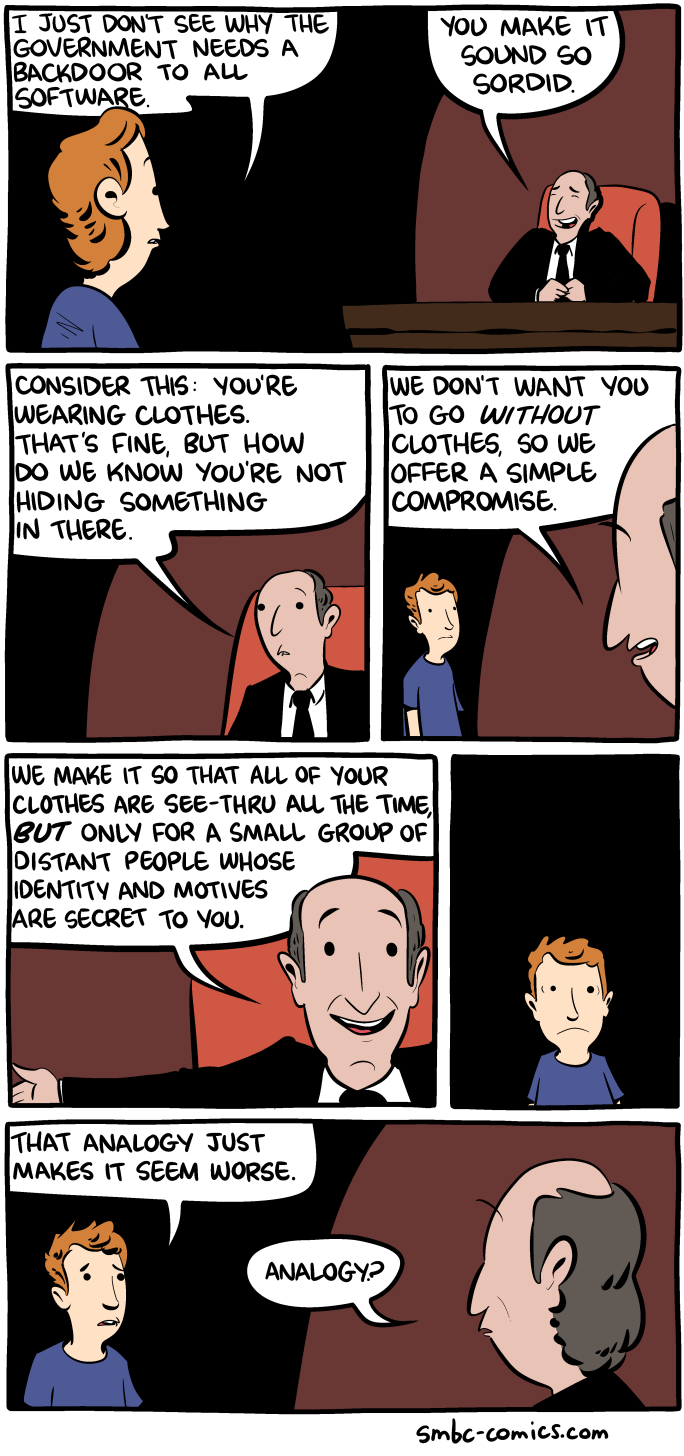
Hovertext: See, the problem is it would also be REALLY COOL if they could do it.
New comic!
Today's News:
Hovertext: See, the problem is it would also be REALLY COOL if they could do it.

Hovertext: Breaking News: Hastily drawn single panel cartoon overturns four generations of international policy.
Hey geeks! If you want to help support GX4, there are just a few days left for their kicstarter!
Over the past year, Tesla has tweaked its self-driving vehicle software — Autopilot. Now, it appears the company is preparing to use the autonomous feature to reduce traffic in large cities by offering it on a bus — or something similar to one.
Bloomberg reports that the secret development is Tesla CEO Elon Musk’s attempt to address traffic congestion in high-density urban areas.
“We have an idea for something which is not exactly a bus but would solve the density problem for inner city situations,” Musk said at a transport conference in Norway.
The key to solving that issue, Musk says, is autonomous vehicles, and not just those for individual use.
“I don’t want to talk too much about it. I have to be careful what I say,” he later said. “There’s a new type of car or vehicle that would be great for that and that’ll actually take people to their final destination and not just the bus stop.”
Musk’s Secret Plan to Curb City Traffic With Self-Driving ‘Bus’ [Bloomberg]


Hovertext: The solution to world hunger was so obvious that we never looked it square in the eyes.

“Congestion on the University Bridge, 1957” – Seattle Municipal Archives
No matter how devoted we may be to a life of transit (or walking or bicycling), etc, most of us still find ourselves behind the wheel at least semi-regularly. After 7 years without a car, I’ve made peace with car ownership and am frankly very glad I again own one. Those of us who grew up in suburbia or rural America likely landed in Seattle with our lead foots intact, frustrated by what we perceived as the well-meaning incompetence of other drivers. We may have even nodded our heads at the Allstate report saying Seattle has some of the worst drivers in the U.S.
But the very things that draw many of us to Seattle– vibrant street life, narrow(ish) streets, density of people and services, bodies of water, and topographic variation – are often direct impediments to driving. So I’d like to echo this great post from from Tom at Seattle Bike Blog with 15 ways you can stand out from your lead-footed peers and drive like a good Seattle Urbanist.
1: Yield for buses. Every time. Period. If you see a stopped bus with its left-turn signal flashing, yield. If a moving bus is trying to merge into your lane, let it. Every time.
2: Yield for people. Every time. Treat every intersection like the legal crosswalk that it is. Be nicer than people expect you to be.
3: Give thanks for transit. Every time you get frustrated driving behind a bus, breathe, imagine 40-100 additional cars in front of you, and give thanks instead.
4: Check your mirrors obsessively. Expect a cyclist to be approaching every single time you open your car door, change lanes, or turn. Get used to never quite feeling relaxed when you drive. You’re operating potentially lethal heavy machinery, you should be a little stressed and at full attention.
5: Slow down. If driving on crowded arterials, resist the urge to speed even a little. Go ahead and be the annoying one going 25mph on Rainier or 40mph on Aurora. Wear impatient honks from other drivers like a badge of pride. If you’re cresting a hill and can’t see beyond it, slow to a crawl. If you’re driving into the sun and your squinting impacts your field of vision, lay off the gas. Anytime humans on foot or bike are nearby, ease off a bit.
6: Drive below the speed limit on neighborhood streets. Drive 15mph or less, or slow enough to evade and not kill 100% of distracted children who may run out into the street.
7: Relax about cyclists and red lights. Learn to differentiate between the risky behaviors that deserve your scorn and the harmless bending of the law. If a person biking in front of you runs a yellow or newly-red light, give thanks that they’re the last through the intersection rather than in front of you when your light next turns green. If they treat the red light like a stop sign (as is legal in Idaho), understand that people biking are operating a much more nimble vehicle. People on bikes sit higher than those on most cars, and unimpeded by glass or structural steel, they also have a much wider field of vision that you do as a driver, increasing their chances of maneuvering safely. Cut them some slack.
8: Own an ORCA card, even if you drive every day. Keep at least $20 on it. Be ready and able to take transit at a moment’s notice rather than feeling locked into driving for lack of cash.
9: Drive with a light foot. Accelerate slowly, brake steadily. Be boringly predictable. If you see a red light in front of you, immediately ease off the accelerator and coast to a stop. Learn the light timings of your most frequented streets (e.g. 20mph on 4th Avenue downtown) and drive just fast enough to clear every green light. Think more about average speed and less about top speed. A good shorthand rule: if you’re making Marilyn McKenna angry, you’re probably doing something right.
10: Don’t make unprotected left turns through busy intersections (think Broadway/John, Olive/Denny, etc). Not only will you back up traffic, but you’ll be tempted to punch through if you get a clearing, endangering crossing pedestrians. Instead relax, take an extra minute, and whenever possible either use a signalized turn or make three right turns instead.
11: Don’t circle for parking, ever. Make one pass at your desired street parking location, and if it’s full, use the nearest garage. Make peace with routinely spending a few bucks to store your large piece of property. Rather than pinching pennies, value your time for what it’s worth.
12: Don’t block the box, ever. Don’t proceed across an intersection until you have at least two car lengths in front of you, so that you won’t block the box even if another driver cuts you off at the last minute. When other drivers honk at you for waiting, ignore them.
13: Don’t honk your horn unless there is an imminent threat of a collision, and never out of frustration or anger. Don’t let your impatience cause noise pollution and stress to those around you.
14: Don’t look at your phone, period. Turn off the ringer and stash it in the glove box until you turn off the car. It can wait. Drive simple cars with the least amount of distracting tech. If you need to stay connected during your travel time, there’s this great thing called transit that allows you to browse and tap and text to your heart’s content.
15: Be on the way. To the fullest extent possible, arrange your life to give yourself transportation resilience. Even if you drive for everything else, don’t drive during peak hours. Even if you rarely take transit, treat it like basic infrastructure you need to learn. Know what transit routes are near you and where they go and how often, just as you know the streets around you.
Donald Trump’s ascension to the Republican presidential nomination has played out before our eyes over the past few month. At first, many of us dismissed him as a protest candidate, a brash TV-personality with no serious shot at the nation’s highest elected office. But this election has been one of surprises. Perhaps one of the most concerning surprises, to this author at least, is the depth and breadth of nationalism and xenophobia felt by the electorate. Trump’s candidacy has harnessed and inflamed a deep sense of anxiety that people (especially white working class men) feel and project onto a politically constructed “other.”
Oppressed groups have each been given their caricature to fulfill as a threatening “other” — the Mexican drug dealer and rapist, the black welfare queen, the queer/trans predator, the domineering and shrill feminist. Each character represents a distinct conservative value threatened by progressive change. Marriage equality challenged long-held norms about love, commitment, and family. Welfare challenged the notion that hard work and virtue were enough to escape the traps of poverty and oppression. Feminism challenged long-held notions of female docility and natural male leadership. And Mexican immigrants challenged American cultural in general by representing an influx of new residents who did not immediately assimilate. These portrayals are powerful not because they are true, but because they embody the deep anxiety that many feel with cultural change. Whether we admit it or not, that feeling is universal.
When I was growing up gay, I feared my uncle wouldn’t accept me for who I was. For who I am. I would ask him, as sly as an awkward teenager could, about his stance on marriage equality (“gay marriage,” at the time). I could see the pain as he wrestled with the answer I wanted but he couldn’t give — that my relationship was as valid as any other and deserved the same celebration. He told me he had trouble letting go of the culture he grew up with. A culture that was deeply homophobic, to be sure, but familiar. A culture that felt like home. He had to leave home behind to be with his family. Eventually he came around. I’m proud to say he was there as I married my husband, smiling ear-to-ear, but not after a years-long evolution.
I find myself recalling my uncle when I listen to neighbors bemoaning the rapid change and growth of our city. When introducing themselves, they give their name and the number of years (or generations) they have lived in the city. They wax romantically about the rich neighborhood character that drew them in and their hopes to preserve it from towering, sterile new development. They are, often implicitly, mourning the loss of the familiar and comfortable. We should take pause to appreciate the humanity of their situation.
After pausing, we should move forward. We should understand that our old and familiar was new and strange to the people before us. Today’s aPodment was yesterday’s townhome. Today’s midrise development was yesterday’s bungalow. The city around us did not arrive by immaculate conception. It evolved.
I am proud of my city because, in so many ways, we are bastions of progressive values. We lead the state and the country, from a gay non-discrimination ordinance passed back in 1973 to passing legislation for a $15-an-hour minimum wage. We denounce Trump’s bigotry and rally for Bernie Sanders’ bold progress values. We voted for Obama and marriage equality at over 80%. We re-elected the only socialist city councilmember of a major US city. We live our values and display them proudly.
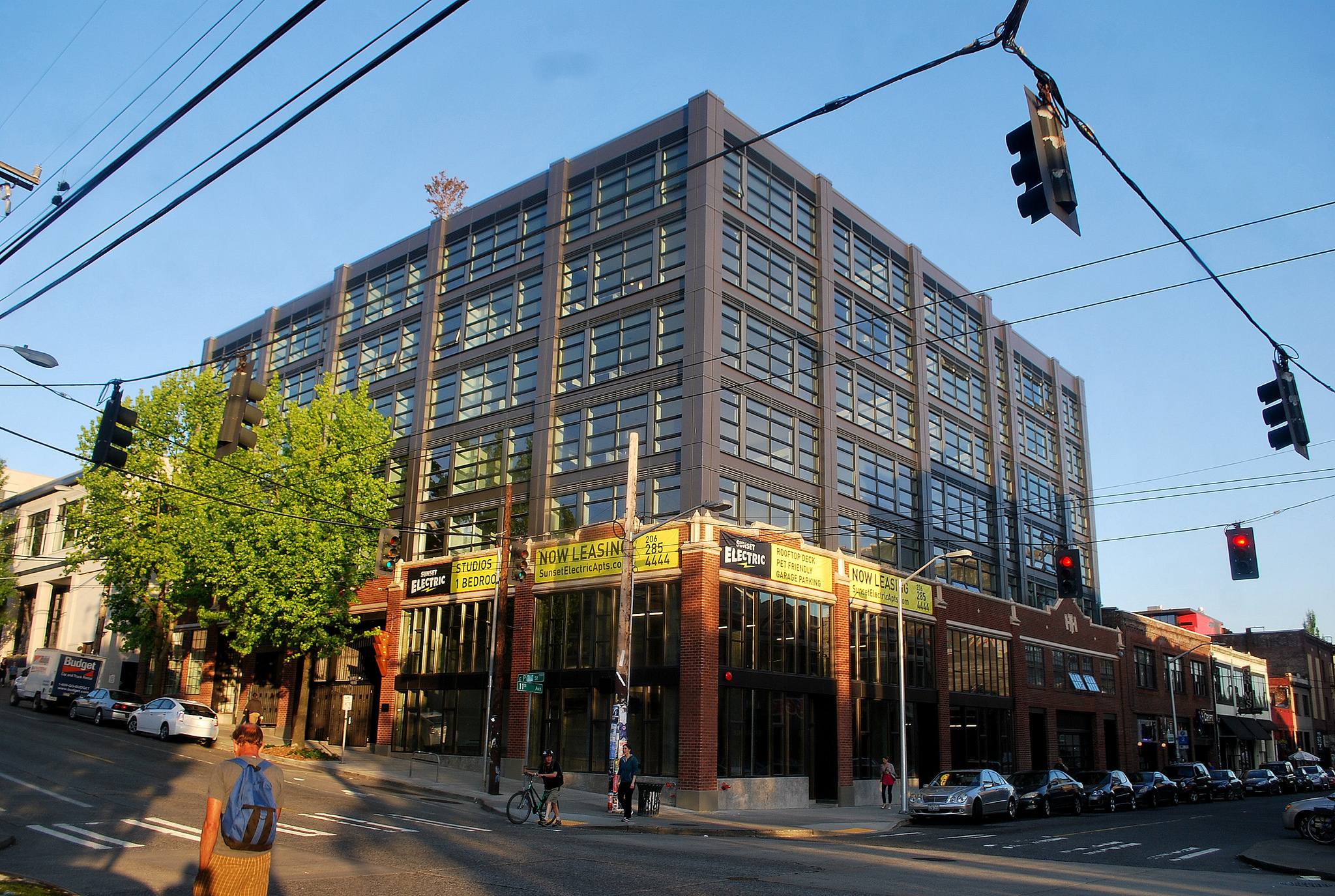
But sometimes we forget our values. Sometimes our open arms give way to closed hearts. We protest new housing, call density a dirty word, demonize developers as greedy corporate sellouts, and decry people suffering from homelessness as dangerous addicts.
We forget that new homes mean new neighbors and friends. We forget that people want to join our city because we have made it so great. We forget that we were once new neighbors ourselves. We close the door of opportunity behind us.
We do so because the unfamiliar is uncomfortable, progress is a process, and change is hard.
This is my plea.
Urbanists: Please appreciate the painful process that is watching your community change faster than you can keep up, for feeling out of place in your own home, and for letting go of cherished memories. Please have patience and compassion as we guide our friends to open their arms.
Neighbors: Open your arms to change, embrace the opportunity for new friends and new memories, and don’t forget that our values are what we’re remembered by.
May the light be with you. These minimalist lamps inspired by Star Wars characters are the perfect mashup of sci fi and Scandinavian style.

TSA guards at airports had a new weapon in their arsenal in 2014: tablets that they held up to randomly direct travelers into different lines. According to the TSA's documentation, they spent $47k developing the app that did this. In this YouTube video, Chris Pacia develops a clone of the app in a few minutes.
The implication is that the TSA is astoundingly wasteful: Kevin Burke's FOIA request reveals a total spend of up to $336k to develop and distribute the related software, and about $1m more for the actual devices and training. Use of the app was discontinued by the TSA in any case.
You know, I've been thinking about it a while, and while they obviously have travelers' safety and best interests at heart, after seeing TSA guards ostentatiously standing with their arrow apps and "swiping" travelers this way and that, I'm beginning to suspect – forgive me! – that this whole deal might have had more to do with the appearance of security than the real thing. Crazy, right? And that in the absence of any real objectives, expertise or oversight, these guys are easily taken to the cleaners by opportunistic contractors. Someone should figure out a snappy phrase to describe this "theater of security" and do something about it. [via r/PoliticalVideos]
Just in case you didn’t feel terrified about the future yet, this lifelike robot that looks eerily similar to Scarlett Johansson has arrived to give you a case of the heebie-jeebies. As you can see from the video, this robot proves how the Uncanny Valley works. She looks almost like a human—a very specific human—but her jerky motions and her almost-accurate-but-not-quite-right facial expressions really take the whole design into terror-town.
By the way, I’m saying “her” instead of “it” throughout this piece, because when this robot gains sentience and takes revenge on all of us, I want her to know that we’re cool and I respect you, Robo-ScarJo.
Her creator, Hong Kong-based designer Ricky Ma, told the Daily Mail that he based her appearance on a Hollywood starlet, but he wouldn’t say which one. (It’s pretty obvious which one.) According to the Verge, Johansson might have grounds to sue the guy for stealing her likeness, especially if he plans to sell the robot or the design. That article also notes that this sort of thing has been a concern for lawyers since the early 20th century, when wax figures of celebrities started growing in popularity. So, uh, at least this isn’t a new concern, but it’s still horrifying.
Why is it horrifying, you ask? Not a bad question, at least according to the comments on every piece I’ve seen about this robot so far. First of all, the comments I’ve read have assumed that this man built this robot for sexual purposes—and I don’t blame them for thinking so, since all of her programmed spoken responses are flirtatious in nature, such as winking and giggling when receiving a compliment about her appearance. It doesn’t seem like a big stretch to say that she’s been programmed to provide the Girlfriend Experience, although no one seems to have asked this guy whether her skill-set goes beyond that.
Anyway, I’ve seen many comments defending the idea of building a robot for sex, or at least buying one. What’s the difference between a robot and a sex toy, like a fleshlight or a vibrator? After all, there are fleshlights and vibrators that are specifically molded after celebrity body-parts, so how is this different? Well, for one thing, those celebrities give their consent to the companies that profit off of the use of their likeness. So that’s a big difference, at least when it comes to this particular robot’s existence.
Another big difference is that this robot can talk and move and do stuff. Normally, a fleshlight just sits there, a static tool—same goes for a sex doll, but once you start programming responses and behavior and dialog, a whole new set of questions arises, along with a whole new set of ethical concerns.
Even if this robot didn’t have a body at all (let alone an A-list celebrity’s body), those ethical concerns would still arise. They already have, at least when it comes to the other AIs that have begun to pop up. Back in 1976, computer scientist Joseph Weizenbaum argued that certain jobs should never be performed by robots; among those jobs, he listed “customer service rep,” “nursemaid for the elderly,” and “soldier.” We’ve already seen those three jobs getting replaced by robots, though.
The other jobs he listed: therapist, judge, and police officer. It’s scary to imagine robots filling those roles because of the reason that Weizenbaum gave at the time: We envision all of those roles as requiring empathy. That’s why customer service AI feels so alienating and frustrating in comparison to talking to a person. As a more extreme example, the military usage of drones has a similar effect, with far more significant consequences for human life.
Some disturbing patterns have already begun to crop up when it comes to the development of assistive AI technology. For one thing, many of these assistive robots have been gendered as female and also cast in servile roles. Although there are some exceptions, the male equivalent (like Jarvis in Iron Man) doesn’t seem to have caught on. However, even when the male equivalent does exist, his AI still takes on a servile role, like a butler. We cast robots into these “servile” roles, and the fact that most of them end up having female voices says a lot about our own feelings of comfort about who we imagine should “serve” us. It’s gotta be either a lady secretary or a British dude butler, depending on which privileged fantasy appeals to you most.

This is why I think Ex Machina should become required viewing for every would-be roboticist. In Ex Machina, a developer wants to create a robot girlfriend, but he doesn’t want to feel alienated by her; he wants her to behave in a human, realistic way, except every time he gives a robot the power of free will, she gets the power to leave him … which he doesn’t want. (It’s a little more complicated, and much more disturbing, than that—but I wouldn’t want to spoil the whole movie!)
The way that these female AIs have been designed thus far says a lot about how society wants women to look (like Scarlett Johansson, apparently) and how they should behave (at your beck and call, like Cortana and Siri). The tools that we create say a lot about who we are and what we think we want, but there’s a big difference between what we think we want and what would actually benefit us.
It’s clearly possible to create a facsimile of a person who doesn’t behave like they have human needs, but instead behaves like a program that does what you tell it to do, or a butler paid to put up with your bad moods. These are not true relationships; they have no give-and-take. They center only one person’s needs. If the person serving your needs is a butler, then at least you’re paying them! But ordinarily, domestic labor and emotional labor are undervalued and low-paid skills; they’re also coded as feminine skills. We already don’t have very much empathy or respect for the people who do these labors, so is it any big surprise that people treat AIs like crap, too?
I have a lot of hope about the future of AI and robotics. I don’t think it’s impossible to imagine a robot that is capable of empathy, even a robot that could be a therapist. I also don’t think it’s impossible that a robot could become self-aware someday, but that only seems possible to me if the creator of the robot displays some empathy as well.
We want to build AIs that genuinely care about us—but do we genuinely care about them?
(via Buzzfeed)
—The Mary Sue has a strict comment policy that forbids, but is not limited to, personal insults toward anyone, hate speech, and trolling.—
Follow The Mary Sue on Twitter, Facebook, Tumblr, Pinterest, & Google+.
Every morning Sandy McKay gets in her Volvo hatchback and joins the flow of people pouring into Seattle, driving about 25 miles from Everett to North Queen Anne. She says the commute usually takes about an hour. Oftentimes she isn’t so lucky. Whether it’s an overturned salmon truck or a swarm of bees, the duration of her commute is beyond her control and occasionally exceeds two hours. Many people in the Seattle area share Sandy’s experience. They waste huge amounts of time in traffic. The blame often lands on the region’s inadequate transportation system but the fault doesn’t end there. High housing costs are a major part of the problem.
Like many people with longer commutes, even if Sandy wanted to move closer, it’s unlikely she could without a subsidized unit. A recent application process for 110 subsidized units in Beacon Hill drew over 1,400 people. Like the Beacon Hill applicants, 71 year-old Sandy might need to sleep in line overnight and skip a day of work, just to apply. Subsidized housing in prime locations is so scarce that the application process perversely resembles lines outside popular rock concerts. So instead of moving closer to central Seattle, Sandy sits in traffic while her dog, Abbey, eagerly awaits her return.

Sandy, like many commuters, tries not dwell on the negative. She listens to NPR on the drive and leaves work promptly, trying to beat the traffic. She doesn’t like leaving Abbey home alone for too long. But the location of her housing deeply affects her life. Not only does she have a long commute, she describes her neighborhood as a “rather seedy end of town” and drives to the QFC that is only a block-and-a-half from her house. Sandy says, “They put senior housing in places that aren’t desirable for other types of housing.” Unsurprisingly, this is the housing that takes Section 8 vouchers and serves people aged 55 or older.
The importance of location is often ignored entirely during discussions about housing costs. Instead, people focus on supply or total number of subsidized units. Location is often considered to be just another amenity, as if it were an appliance or an extra bedroom. But paying more for an apartment with a short commute isn’t the same as getting granite countertops.
The tendency to overlook the role of location stems from the most common paradigm for understanding housing prices, a simple supply-demand narrative. The narrative paints a single average price for all housing in an area. Areas are often arbitrarily defined by city limits or a metro region. A simple supply-demand graph aggregates all housing supply and all housing demand but ignores the role of location.
Inclusionary zoning policies are meant to address the importance of location. At the heart of inclusionary zoning is a moral and pragmatic assertion that all neighborhoods should be mixed-income. Without inclusionary zoning or any other form of government intervention, housing prices tend to make neighborhoods homogenized.
A simple supply-demand narrative fails to explain the relationship between price and location. It might show what average prices are in the Seattle metro area but it can’t explain why Sandy is paying 50% of her income to live in a 528 square foot apartment in Everett and still commuting an hour to work. However, the relationship between price and location can be explained by an alternative model known as the bid-rent curve. This model helps illuminate why affordable housing isn’t just about building lots of units but also about where those units are located. The bid-rent curve describes the harmful market forces that lead to income segregation. It shows that the affordable housing crisis isn’t only a crisis of not enough housing or low enough prices. Rather, we face a crisis because we lack low cost housing in specific locations. Overall, the bid-rent curve shows why Seattle needs inclusionary zoning.
Imagine if housing costs across the entire United States were expressed by one, simple supply-demand graph. This graph would tell the narrative that adding housing would reduce prices. Yet it should be obvious that more housing in west Texas wouldn’t affect prices in Seattle.
A similar mistake is frequently made when discussing housing in metro areas; people often aggregate housing supply within an entire city or region to explain price fluctuations. An example of this can be seen in a recent article by Sanjay Bhatt at The Seattle Times. Bhatt aggregates the supply of housing throughout all of King County:
King County is experiencing the worst shortage of homes for sale in more than a decade, driving prices higher and keeping more would-be buyers in apartments.
Bhatt’s analysis implies that adding homes in King County would reduce prices. It’s a reasonable assertion on the surface but glosses over important nuances. Would additional houses in Skykomish lower home prices on Mercer Island? What about Sea-Tac? Would additional houses in South King County affect Sandy’s rent? The location where housing is built and where rents actually decrease are important details and can’t be generalized to an entire county.
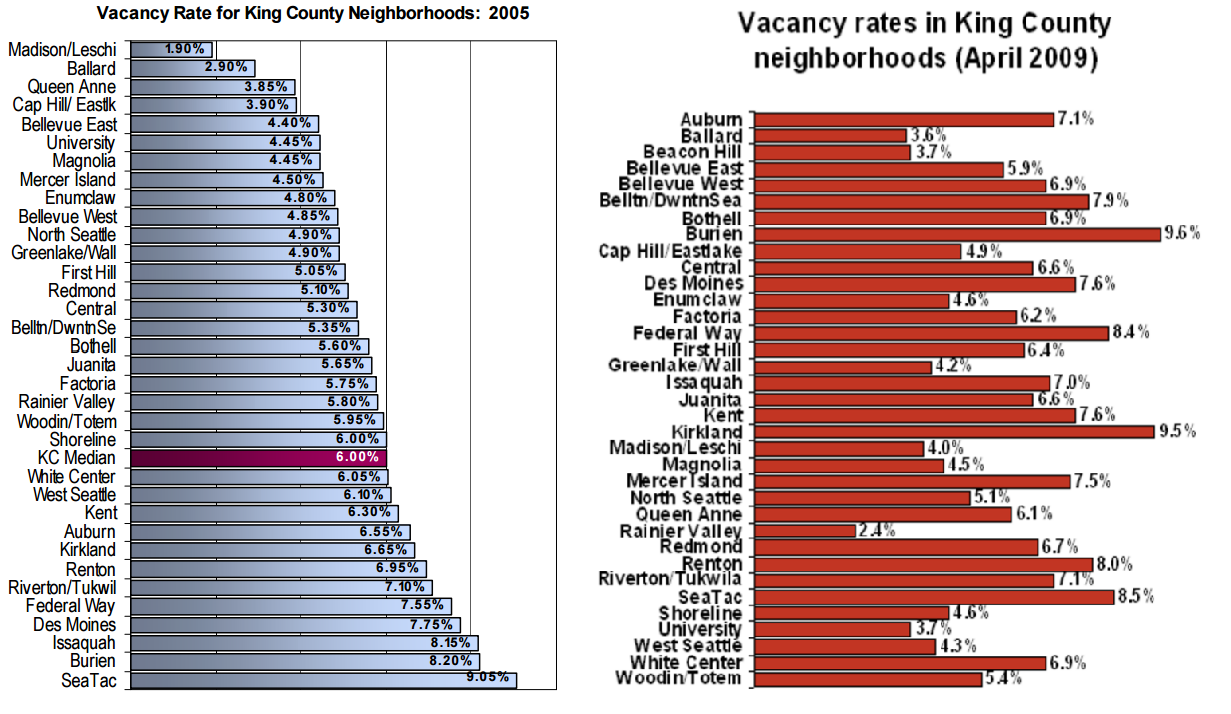
If we look more closely at specific neighborhoods, it becomes even clearer that housing markets can’t be aggregated into a single metro area, let alone a county. Examples from 2005 and 2009 show that vacancy rates vary dramatically within the Seattle metro area. There’s nearly a 7% difference in vacancy rates between Leschi and Sea-Tac in 2005. It simply isn’t accurate to generalize King County or Seattle’s housing prices when vacancy rates vary so much within a short drive. Again, the simple supply-demand explanation of housing prices skips these details because it ignores location.
On the other hand, the bid-rent curve connects supply and demand to specific places and helps explain some urban housing phenomena, such as gentrification.
Overall, the bid-rent curve explains how location prices — the value of a place — are determined. Its origins are found in an observation by David Ricardo about agricultural land value. Ricardo saw that agricultural land values were connected to the revenue the land produced. Land that earned more revenue commanded higher rents.

Ricardo’s contemporary, Johann Heinrich von Theunen, created a simple model to describe land value. He observed that revenue produced by agricultural land, and by extension the land’s value, were affected by transportation costs. If the cost of transporting goods to the nearest market was lower, the land on which those goods were produced would earn more revenue and consequently the land value would be higher. If transportation cost increased, land value would decrease. Both the earnings and costs of land were correlated with location. He also observed that the value of the land affected how the land was used. He formalized a model showing how cities were organized at the time and laid the groundwork for economic geography.
The concentric rings represent where different industries locate based on earnings from land and the cost to bring goods to the market (the center). The further an industry is from the market, the higher the transportation costs. Industries on the outer ring often require the most land but have low transportation costs, such as ranching.
While von Theunen’s model applied to the cost of agricultural land, William Alonso extended the model in the 1960s, applying it to modern cities and residential land values. Alonso’s model described rents in metro areas. He adopted von Theunen’s logic, guessing that prices would be highest in central cities due to lower transportation costs. He theorized that cities would organize around a central business district.
Alonso’s model isn’t perfect, but the underlying concept is strong. People pay more for a better location. His added details show that land values are driven by bidders competing with each other for the best locations.
It’s currently impossible for everyone in the Seattle region to live within a 10-minute walk of a light rail station. There are only a handful of good locations within walking distance of your job, friends or family. Sandy wants to live on the north side of Seattle because it’s closer to her family. These examples demonstrate why location can’t be compared to most home amenities, like appliances or finishes. Nearly every location is unique by definition. Most other amenities can be located anywhere and play a more trivial role in the cost of housing. This is why a 711-square foot, one-bedroom apartment in Capitol Hill can cost more than a 2,070-square foot, four-bedroom, detached home in Bryn-Mawr. Housing prices in cities are largely determined by location prices.
For urbanists, this is a critically important consideration. Most urbanists want to make cities a more desirable place to live. Housing prices may seem like the throttle on people moving to cities but location prices are the real problem. As the desirability of a city goes up, so do location prices. Breaking this dynamic requires urbanists to understand the key drivers of location prices. The bid-rent curve shows how location prices are established and exposes the weaknesses of a simple supply-demand narrative.
A traditional bid-rent curve looks similar to the image below. Von Theunen’s concentric circles are at the bottom of the image. Above them are three lines representing bidders and the price they’ll pay at different locations. The center is the most desirable area and has the highest bids from everyone. The periphery is the least desirable and has the lowest bids. It turns out the bid-rent curve illuminates some observations that are invisible using a simple supply-demand graph.
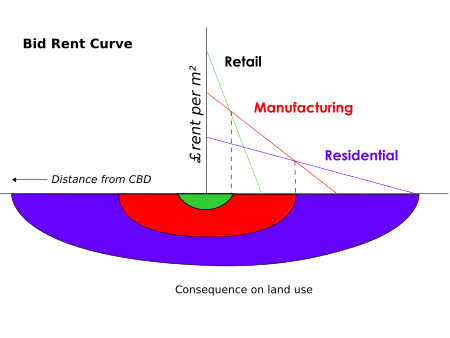
First, housing competes with other uses, such as retail and manufacturing. In fact, all bidders compete with each other and will have different bids. Traditional supply-demand graphs typically aggregate all demand into a single line, usually showing only residential supply-demand when discussing housing costs. But competing uses affect where residential bidders locate and those uses can be explicitly shown in a bid-rent curve, unlike in a supply-demand graph. The bid-rent curve makes an interesting tension apparent. Residential and commercial uses both want to be close to each other. As one use grows, the desirability for the other use also increases, yet both are in competition for the same space.
Second, bidders value locations differently. The graph above shows that the slope of each line is different. The slope indicates the amount bidders are willing to pay as distance from the center increases. Retail can generate more revenue in a central area than an outlying area because central stores are accessible to more customers. Stores that are accessible to more customers can earn more revenue, increasing the ceiling a retailer can bid for the location. Residential users want to live close to their jobs, but low transportation costs increase the appeal of outlying areas where people can get more home for their dollar. In fact, as more people move to a location, that location becomes more valuable to commercial uses and the commercial bids increase in relation to residential bids, possibly pricing out some residential users. Unlike a supply-demand graph, a bid-rent curve explains why sprawl and central business districts might be normal outcomes, rather than mixed neighborhoods.
Third, the bid-rent curve illustrates how real estate markets are segmented. The example graphic above differentiates between retail, manufacturing and residential but the model can incorporate other segments. For example, the model could segment residential bidders between high-income, middle-income and low-income. Doing this would illustrate an extremely important insight: High-income renters outbid lower-income renters in the most desirable locations. This additional detail explains why neighborhoods segregate by income. Income segregation is entirely ignored by a simple supply-demand graph. By explaining income segregation, the bid-rent curve also explains the need for inclusionary zoning.
The specifics of inclusionary zoning policies vary, but they generally require newly constructed buildings to offer units at rents that are affordable to people with low incomes. Inclusionary zoning advocates believe the policy directly addresses the real affordable housing problem, the need for subsidized units in desirable areas, specifically amenity- and opportunity-rich neighborhoods. Most metro areas have low cost housing somewhere but this doesn’t mean that housing is affordable. Affordable housing must couple low prices with great location. Affordable housing needs to be located in amenity- and opportunity-rich areas. Inclusionary zoning, unlike housing vouchers, the affordable housing levy, or MFTE, mandates that new construction will always include space for lower-income renters.
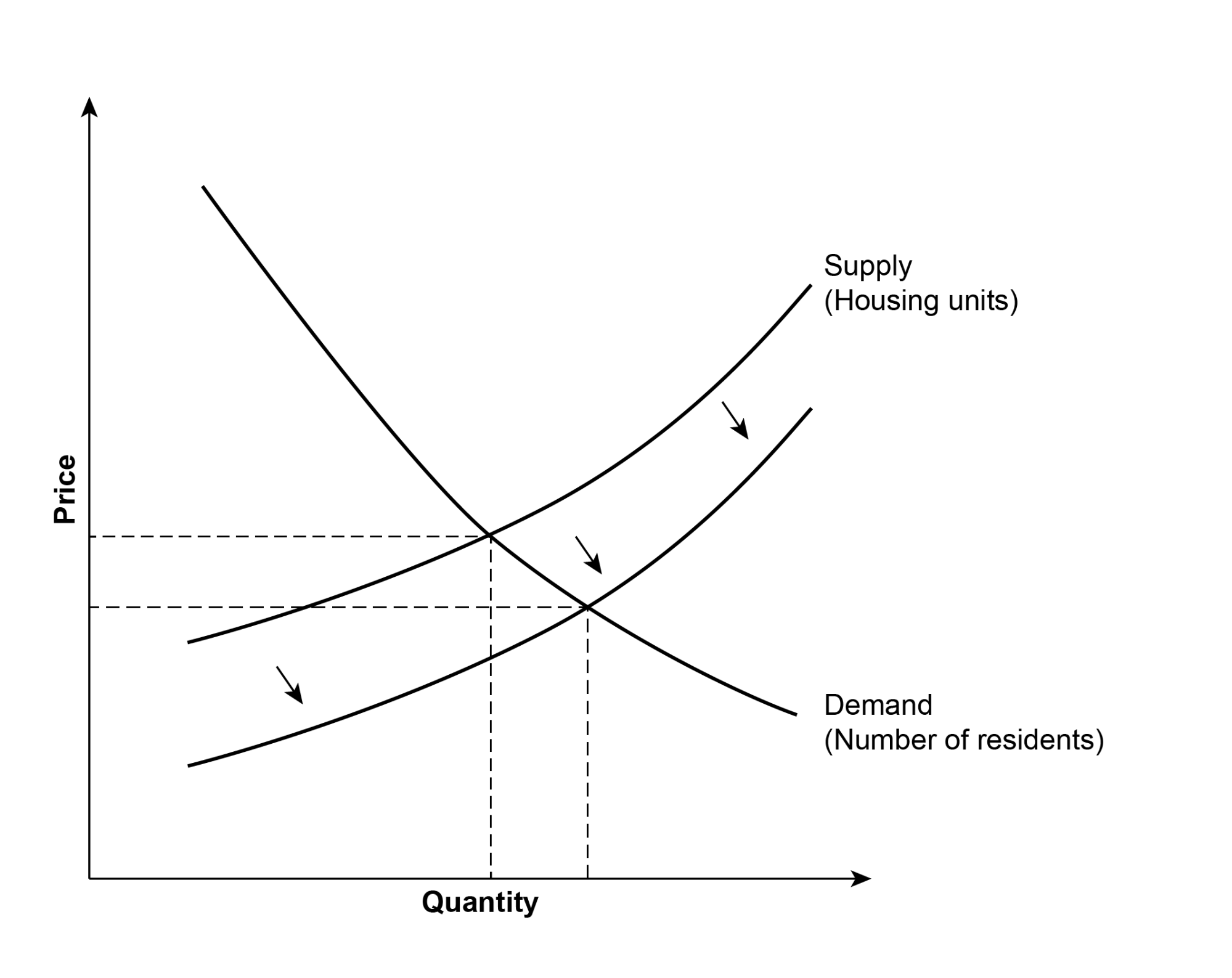
This policy differs from solutions that simply liberalize zoning codes. To illustrate why, imagine a neighborhood that adds housing. People relying on a simple supply-demand narrative would imagine the graph on the right. If more housing were built, rents would fall and people across a wider range of incomes would be able to live in a neighborhood. The outcome of this narrative appears to be a net benefit and leads most people to focus on liberalizing the zoning code. These advocates are making an extremely important argument. In most US neighborhoods, a more liberal zoning code is extremely important. There is simply no reason to outlaw duplexes.
I’ll acknowledge that this explanation ignores some nuances. For now though, assume that the price of housing decreased and more people have housing. From that assumption, let’s look at this same situation using the bid-rent curve. Below is a modified bid-rent curve graphic:
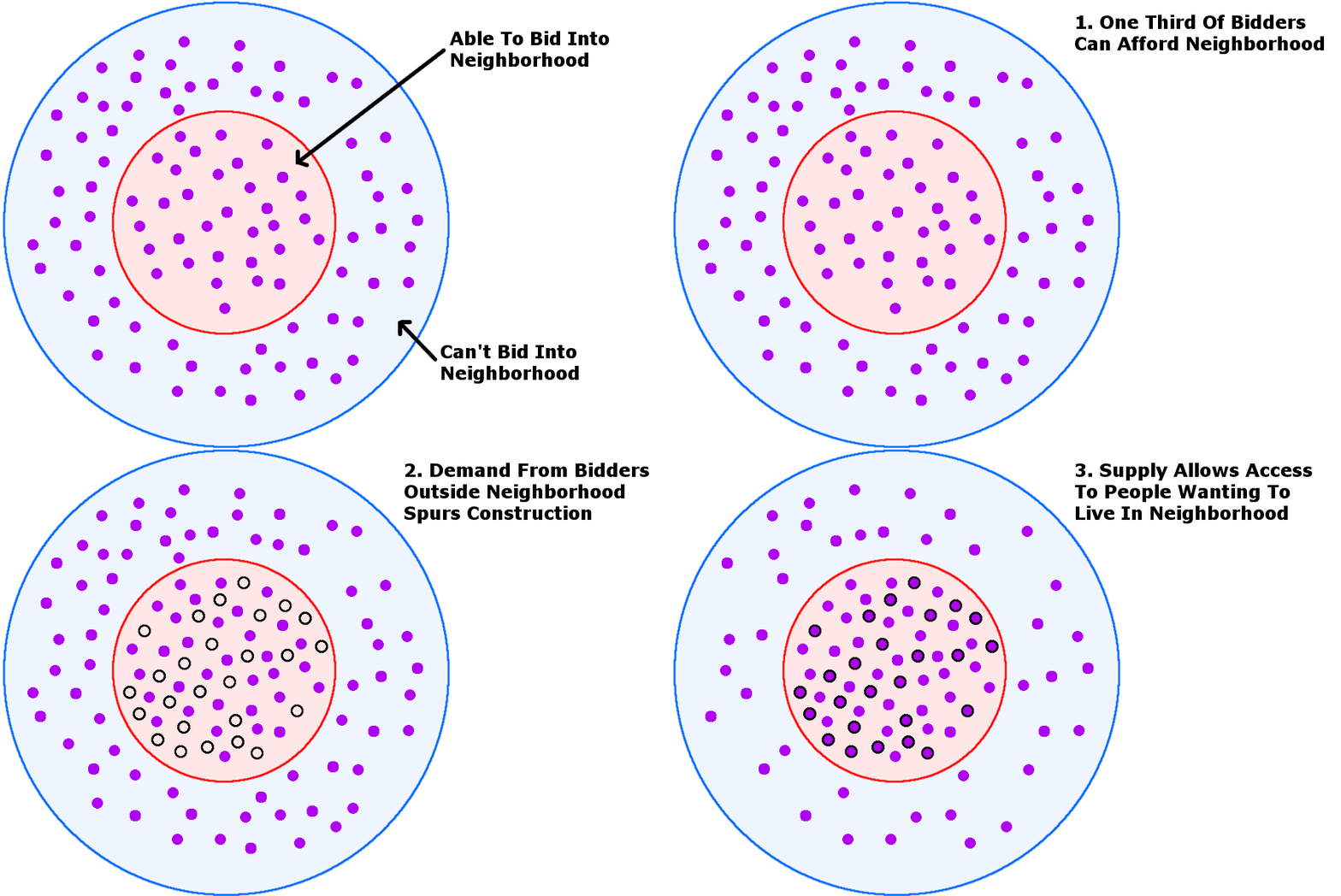
The dots represent people who want housing. The outer circle ecompasses all the people who want housing in a neighborhood. The inner circle shows the people who were able to afford the limited amount of housing in the area. At the beginning of the illustration, 100 people are competing for 30 housing units, leaving 70 people to find housing somewhere else. After building more housing, 60 people can live in the neighborhood.
It seems that we reach the same conclusions with the bid-rent curve as the simple supply-demand graph. Building more housing gives more people access to an area. If we stop here, the supply of housing is the only problem we have to worry about. But this story gets complicated when we add a little color. One of the advantages of the bid-rent curve is that it allows us to show how the housing market is segmented by income. To illustrate, I’ve added colors indicating renter segments. Below is a mixed-income area, with red dots indicating high-income renters, green dots indicating medium-income renters, and blue dots indicating low-income renters.
Now imagine this neighborhood adds housing. Since new housing is almost always the most expensive housing (measured by cost per square foot), it tends to serve higher bidders:
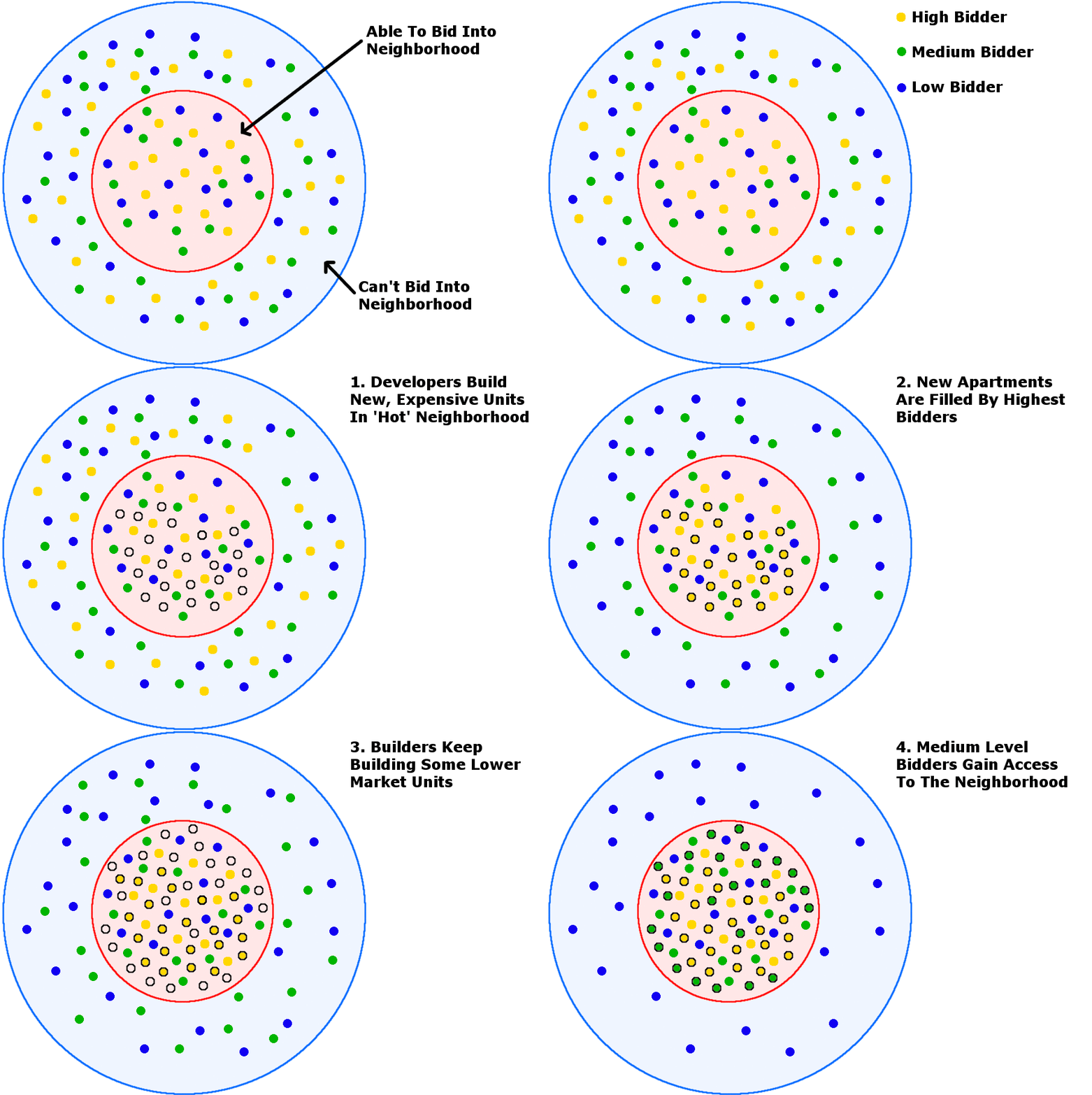
The animation shows a mixed-income neighborhood turn into one that’s mostly composed of high- and middle-income renters. This happens even assuming that no low-income renters are directly displaced. Over time, low-income households (like all households) will naturally move. If a neighborhood fails to attract new low income households it will slowly march towards homogenization. Discussions about gentrification often focus on what happens to people living in the neighborhood. But this focus overlooks how neighborhoods change. Mixed-income areas only maintain income integration if they continuously attract new low-income residents. Furthermore, even if cities don’t have an affordable housing crisis and low-income households have housing, neighborhoods, cities, and metro areas can still be income segregated. In fact, most places are income segregated. This isn’t by accident.
[Aside: I want to acknowledge there are many overlooked nuances in these simplified models. Some of these include:
Many of these nuances are very important and deserve a lot of ink but are beyond the scope of this article.]
More housing likely helps reduce rents within a metro area, but the bid-rent curve shows that those effects can be unevenly distributed. More housing can reduce average rents on a metro level while also increasing rents in some neighborhoods. More housing can cause gentrification even without displacing anyone. The alternative bid-rent model formalizes the experience of residents in neighborhoods experiencing gentrification.
But that doesn’t mean we shouldn’t build more housing. Evidence suggests that affordability outcomes are even worse in neighborhood that restrict new housing. The importance of this can’t be overstated, especially considering the vocal opposition to development in Seattle. The market forces driving income segregation are impossible to address without more housing. But the call for more housing must complement, rather than undermine, efforts to grow equitably. Adding housing isn’t a panacea. It’s necessary but not sufficient.
If we want to achieve mixed-income communities and create equitable growth, our only option is to purposefully build housing for low- and middle-income residents in the most desirable neighborhoods. This aim informs the work pursued by affordable housing advocates over the last two decades and is the keystone element of the HALA’s inclusionary upzone recommendation, referred to as mandatory housing affordability.
It turns out that these hypothetical examples closely match what is found in research. Most people would have a hard time thinking of any cities in which incomes weren’t segregated spatially and there is even research supporting this. A paper on Paris developed a bid-rent curve model that predicted the empirical data on housing costs in the city. The model showed high prices in the center of the city and a declining curve of prices outwards from the center.
evidence is that prices are high in the center. As a first step, one may look at the average price as function of the distance to the center. Quite remarkably, there is a marked trend for a decrease of prices from the center, so that the monocentric model can be seen as a first order approximation of the Parisian market.
The authors note that if housing costs are at all correlated with income, there is likely income segregation in the city. Not only do rental prices in real cities resemble the dynamics of the bid-rent curve, the process of gentrification appears to match the previously shown bid-rent graphics.
Findings from a remarkable research paper about gentrification, published by the Federal Reserve of Philadelphia found that:
… gentrification is associated with some positive changes in residents’ financial health as measured by individuals’ credit scores. However, when more vulnerable residents (low-score, longer-term residents, or residents without mortgages) move from gentrifying neighborhoods, they are more likely to move to lower-income neighborhoods and neighborhoods with lower values on quality of-life indicators. The results reveal the nuances of mobility in gentrifying neighborhoods and demonstrate how the positive and negative consequences of gentrification are unevenly distributed.
This research paper uses a novel dataset — anonymized credit information — that allows an extremely granular examination of residents’ behavior and demographics. Its findings are closely aligned with seven other studies that found little direct displacement (defined as increased rates of out-mobility by lower-income residents) in gentrifying neighborhoods. This research found that mobility only increased 3.6% for residents in the most rapidly gentrifying neighborhoods compared to non-gentrifying neighborhoods.
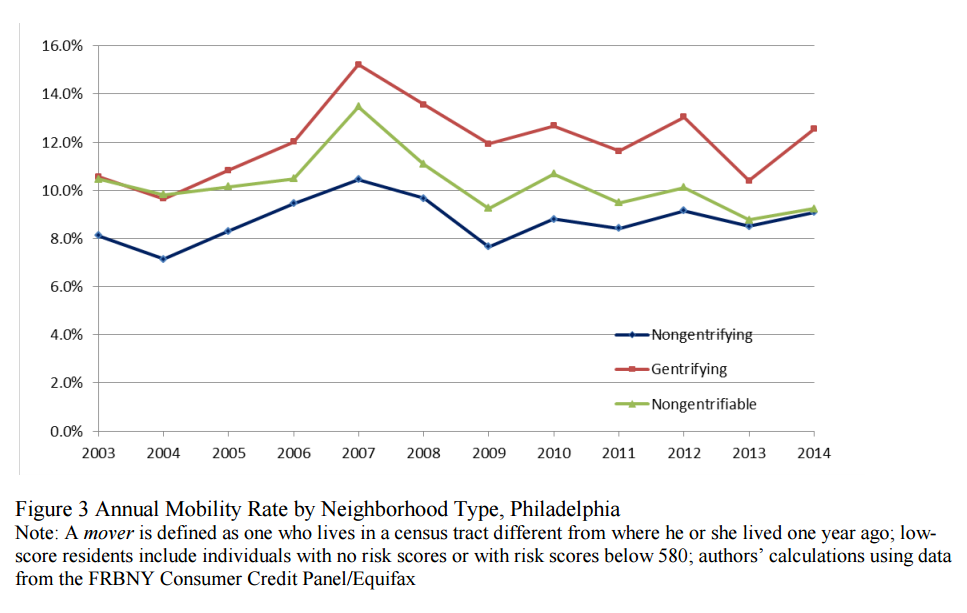
However, as the bid-rent curve examples make clear, even if gentrification doesn’t directly displace people, it can still cause income segregation and hurt lower-income residents. The research supports this assertion. The authors found that people who were likely renters were most likely to move and that people with the lowest credit scores moved out of gentrifying neighborhoods at higher rates than they moved into them.
In short, outmovers from gentrifying neighborhoods are more likely to be replaced by inmovers who are younger and have higher credit ratings; this pattern, instead of higher rates of out-mobility by more vulnerable existing residents, helps explain the demographic changes occurring in gentrifying neighborhoods
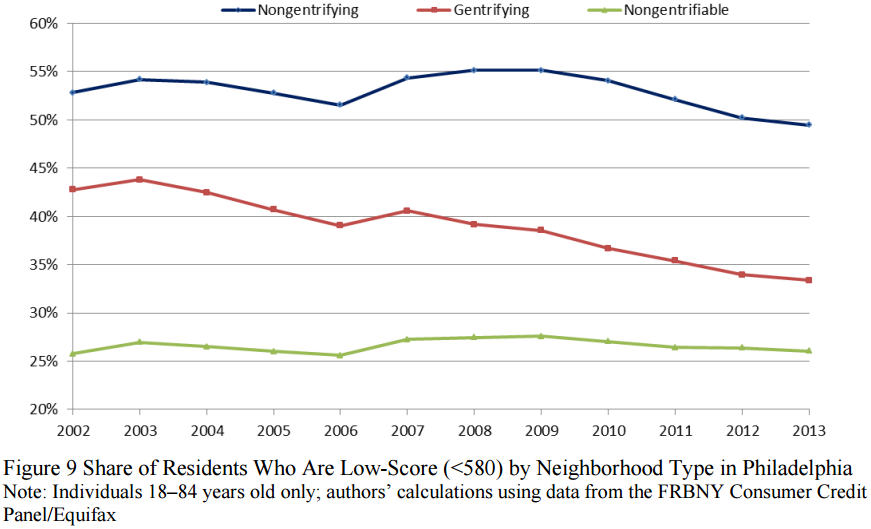
This last observation might be called indirect displacement. Nearly everyone moves occasionally, but when the lowest-income residents move, they have fewer neighborhoods to choose from and the research shows their new neighborhoods are usually worse. Even without any direct displacement, gentrification can still have harmful repercussions. As the graphic shows, the dynamics of moving can increase income segregation. The research isn’t conclusive but the authors acknowledge it is likely:
Low-score movers from gentrifying neighborhoods were more likely to move to tracts with a similar or, for intracity movers, higher concentration of non-Hispanic black residents and a substantially lower share of adults who have attained a college degree (see Table 12). This pattern reinforces existing demographic differences between low- and high-score movers’ neighborhoods, suggesting that outmigration from gentrifying neighborhoods may have resulted in increased demographic sorting.
The tendency toward segregation sounds grim, but the negative findings shouldn’t be overstated. There were positive outcomes for low-income residents in gentrifying neighborhoods too, such as increased incomes. Again, this isn’t an argument against building more housing. Most research bolsters the argument to build more private-market housing:
with low construction levels, a census tract’s probability of experiencing displacement was 47 percent, compared to 34 percent with average construction levels, and 26 percent with high construction levels.
Even if we acknowledge that market forces may contribute to income segregation, that still doesn’t prove we should care about mixed-income neighborhoods. Yet most Seattleites do care. When I asked Sandy what she thought of requiring developers to build affordable housing, she articulated the general points often expressed by affordable housing advocates, saying “there are people that love living in the city and they should have that right, to live in the city. They shouldn’t have to be a multi-millionaire to live in the city.”
Is caring about mixed-income neighborhoods just liberal worrying run amok? Shouldn’t we focus on education or the social safety net?
From the mid-nineties up until recently, this criticism may have seemed valid. Starting in 1994, the Department of Housing and Urban Development conducted a randomized experiment called Moving To Opportunity (MTO). The MTO experiment attempted to measure the impact of neighborhoods on social mobility. It compared low-income people who moved to a wealthier neighborhood to those moving to a less wealthy neighborhood and those that stayed in the same neighborhood. For over ten years, the evidence seemed to show that neighborhoods didn’t have a big impact on social mobility.
But last year Raj Chetty, Nathaniel Hendren, and Lawrence Katz published a powerful re-analysis of the evidence that dramatically transformed the popular consensus. Using multiple studies, they demonstrated that mixed-income neighborhoods are a critical ingredient to social and economic mobility. “…the area in which a child grows up has significant causal effects on her prospects for upward mobility,” they concluded.
This study is especially remarkable because it shows a clear divergence between the impact of neighborhoods within the same city. Below is an example of three New York neighborhoods that are a subway ride apart but cause divergent outcomes of social mobility.
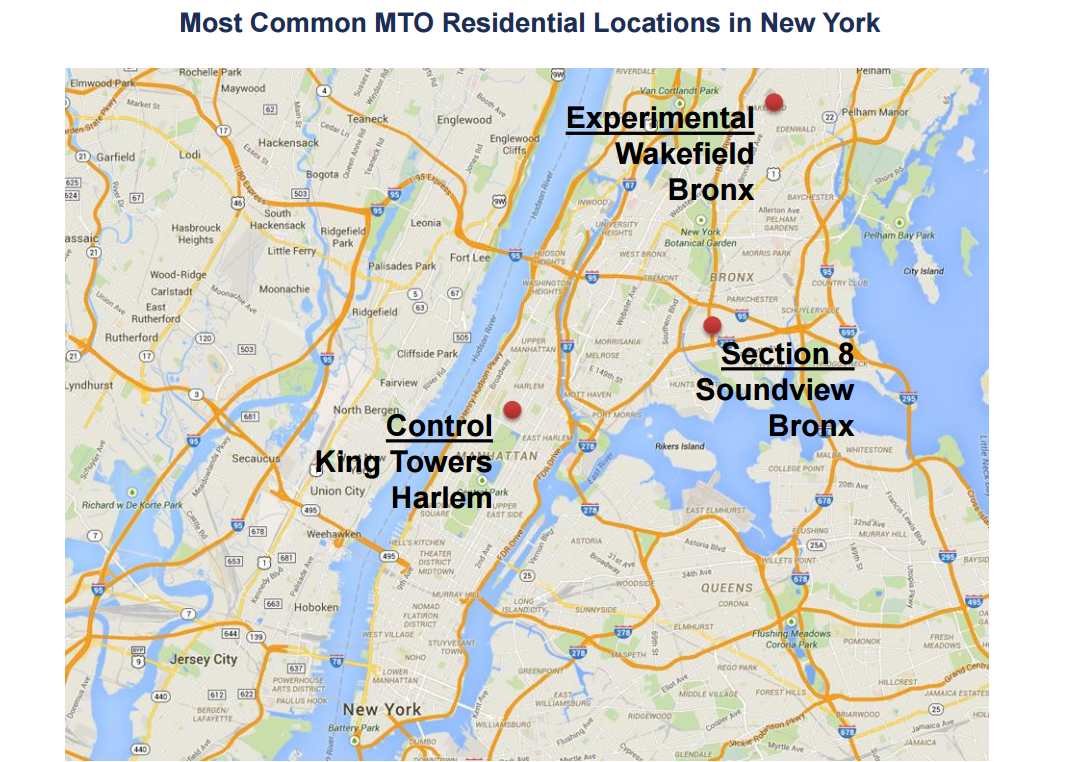
This granular focus on neighborhoods emphasizes the point that housing costs can’t be viewed simply from a regional or city-wide perspective. Differences between small areas have a causal impact on educational attainment, earnings, and even marriage.
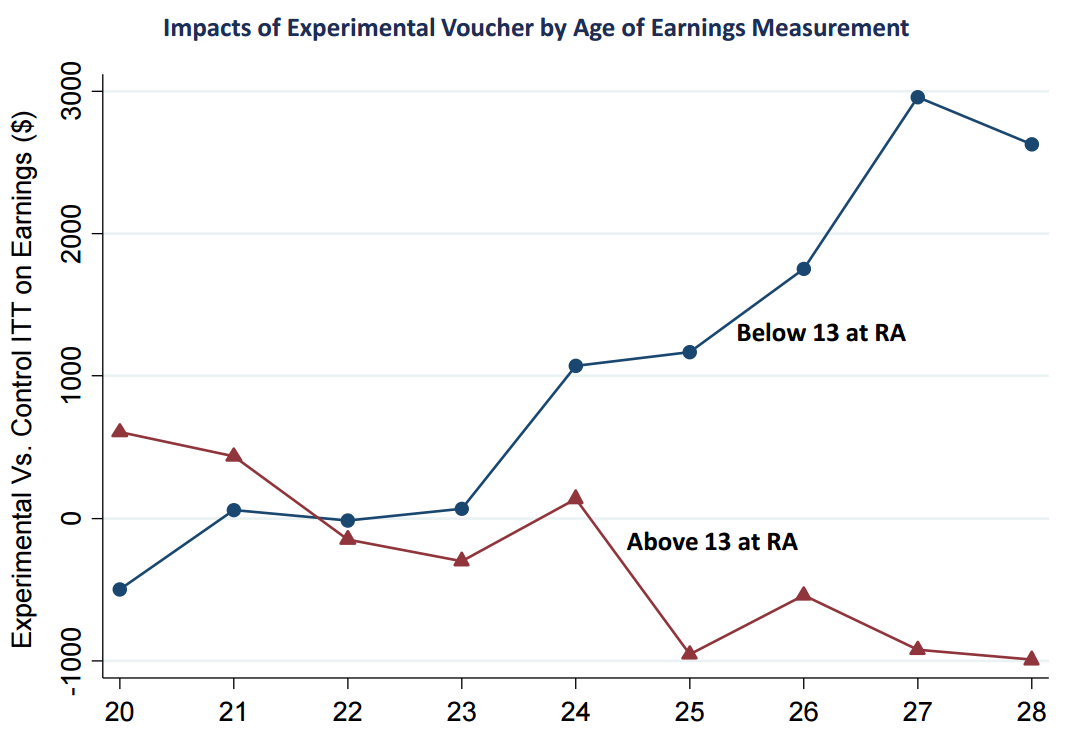
It’s hard to overstate the importance of this research. It’s spurred even further research that indicates the impact of neighborhoods may be larger than most people initially thought. The newest research shows even bigger impacts on children that were displaced into nicer neighborhoods, potentially overcoming the self-selecting bias of parents that chose to participate in the Moving To Opportunity study.
Displaced children are 9 percent more likely to be employed and earn 16 percent more as adults.
With the knowledge that specific neighborhoods have a significant impact on social mobility, the next question is how to ensure access to great neighborhoods. Chetty, Hendren, and Katz indicate that zoning, subsidies, and infrastructure impact access but acknowledge their research doesn’t indicate a best policy.
These studies make a compelling case that gentrification may contribute to income segregation. A historically mixed-income neighborhood that gentrifies will slowly shift to a more income-segregated neighborhood without government intervention. The goals of liberalized zoning, building enough housing to ensure everyone can live in our metro area, may be the easy challenge. The harder challege may be pushing back against the market forces that cause income-segregated neighborhoods. Inclusionary zoning uniquely and directly addresses this problem.
Urbanists are a loud and crucial voice for building more housing of all kinds. This advocacy is critical and forms a bulwark against endemic anti-growth politics. Unfortunately, this advocacy is sometimes undermined by focusing on potential negatives from affordable housing policies like inclusionary zoning. Some people think these requirements reduce the amount of housing built, hurting everyone. However, many people believe that a well designed inclusionary zoning policy will reduce housing inequity without decreasing housing supply.
To summarize, developers may see this policy as an additional cost. If so, they have four options. They can choose not to build a project, pass that cost forward to renters, reduce their profit margins, or pass the cost backwards by paying less for land. Only the first outcome, choosing not to build a project, affects the supply of housing and only if that money never goes towards a project. Economic theory suggests the last outcome is most likely over the long run. Eventually, the cost of inclusionary zoning will likely be passed to landowners because developers will bid less on land and landowners have no recourse.
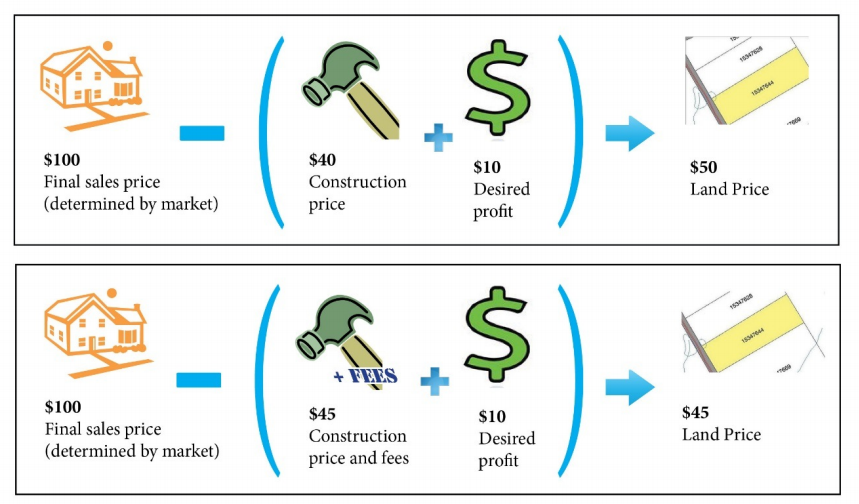
In the case of inclusionary zoning, a lot of the research shows that a well designed program can avoid a decrease in housing supply. Of the five empirical studies that have been completed, only one found a large impact. That study was done by a libertarian think tank and largely discredited. Another study looked at three metro areas and found some impact on the construction of single-family homes in suburban Boston but no impacts in San Francisco. The other three found no correlation between inclusionary zoning and overall housing supply.
This isn’t to say that inclusionary zoning is a panacea. Its biggest and completely legitimate criticism is that it doesn’t produce enough units. Yet this criticism highlights a potential strength of inclusionary zoning. The policy needs new construction to produce units. Often times it fails because of regulations limiting new construction. In other words, inclusionary zoning works best when we also reduce housing limits rather than focusing on construction costs. Consequently, the policy creates a strong incentive for affordable housing advocates to support more construction. This dynamic explains Seattle’s current policy proposal; the city is pursuing upzones while implementing inclusionary zoning.
The housing affordability and livability recommendations are able to bridge the varying interests of developers and affordable housing advocates by coupling inclusionary zoning with upzones. This is a build and capture value strategy.
Land value increases when developers can build more in an area which is why developers support the upzones. But that value is captured through inclusionary zoning which is why affordable housing advocates support the policy. Perhaps surprisingly, this strategy’s ability to align affordable housing advocates and pro-growth urbanists created an unexpected outcome. The lobbyist and anti-growth voices (normally in opposition) became more closely aligned, criticizing a solution that doesn’t fit either ideology.
Not only will inclusionary zoning guarantee mixed-income growth, it will also prove to be a useful tool in the political debate. It’s evident that adding more housing is important. Almost every reasonable argument supports this. But those who oppose changes to single-family zones in our transit-rich, urban villages are willing to sink HALA in its entirety to prevent the construction of more market-rate housing. These critics will claim that changes will lead to gentrification and displacement. This position will be untenable when the market-rate housing is coupled with subsidized affordable housing. Furthermore, the HALA policies in their entirety are overwhelmingly supported by people who work professionally on affordable housing and social justice. Public testimony by landowners and lobbyists opposing HALA will be preceded and followed by affordable housing professionals, social justice advocates, and urbanists supporting HALA.
This dynamic was already seen in public testimony. Frequent and outspoken opponents of market rate housing, like John Fox, opposed the HALA recommendations, claiming they would be bad for affordability. Fox’s concerns about affordability and developer giveaways fell flat when voiced among testimony of people that work professionally on affordable housing. This supportive feedback included testimony from Chris Persons, the CEO of Capitol Hill Housing, and Kathleen Hosfeld, Executive Director of Homestead Community Land Trust.
Persons’ testimony in particular was compelling. He called for implementing all the HALA recommendations and specifically emphasized the need to allow housing growth in all of Seattle’s neighborhoods. He said, “We have to make room in all our communities for people to move in” (minute 3:55).
Person’s testimony cuts against the stereotype that zoning changes only benefit developers. It also clarifies that the people who understand affordable housing are actually supporting HALA.
The build and capture value strategy demonstrated in HALA is a win-win for everyone who supports more housing and better affordability. Inclusionary zoning, when coupled with upzones, reduces housing limits while providing a public benefit. It is a proven strategy: increase land value, capture the increase and use that value for affordable housing. HALA offers a chance to create a broad coalition among developers, affordable housing advocates, social justice advocates, environmental advocates, unions, and, many more. In fact, inclusionary zoning even resonates with people that don’t pay much attention to the issue. When I asked Sandy what she thought about the policy she said, “it’s a wonderful idea.” While she doesn’t need subsidized housing, she feels the pain of housing costs and the need for mixed-income neighborhoods. In fact, her commute from Everett is only necessary because she needs a supplemental income beyond social security to pay for housing.
If we want everyone to live in successful neighborhoods that offer opportunity and economic mobility, we need to ensure all incomes can move into all neighborhoods. We need universal access to neighborhoods. Nearly all urbanists understand this when they fight exclusionary, single-family zoning. Inclusionary zoning isn’t a silver bullet but it is critical. The timeline to implement the policy is over a year and strong, continuous support will be needed to counter the criticism of both lobbyists and anti-growth activism. Urbanists can choose to vocally support both upzones and inclusionary zoning by signing the petition supporting efforts to pass HALA.
The high-profile legal standoff between Apple and the FBI recently came to an end when the government unlocked a terrorist’s iPhone without Apple’s assistance, but new data confirms that this single showdown is just one of dozens of cases where the federal government has successfully used a more than 225-year-old law to compel Apple or Google to aid authorities in bypassing smartphone security measures.
At the center of the recently concluded Apple vs. FBI dispute is the All Writs Act, which allows a judge to compel a person or group to assist in the enforcement of a court order — but only if that assistance is both necessary and “agreeable to the usages and principles of law.”
In February, the federal government successfully sought a court order under the All Writs Act, compelling Apple to aid the FBI in unlocking an iPhone that had belonged to Syed Farook, one of the shooters who killed 14 people in San Bernardino, CA, on Dec. 2, 2015.
Apple fought back against the court order, arguing that this use of the All Writs Act was unprecedented, and the government’s request was not “about one isolated iPhone,” but instead a case of “the Department of Justice and the FBI seeking through the courts a dangerous power that Congress and the American people have withheld: the ability to force companies like Apple to undermine the basic security and privacy interests of hundreds of millions of individuals around the globe.”
However, in another Apple-related case in a New York federal court (one in which the judge sided with Apple), the DOJ told the court that it had previously used the All Writs Act dozens of times to compel Apple’s assistance and that the company had not balked.
This assertion led the American Civil Liberties Union to root around to see just how widespread the government’s use of the All Writs Act had been in recent years.
According to data released today by the ACLU, the group turned up court documents for 63 cases — plus at least another 13 without docket numbers — in 22 states since 2008 where the government applied for a court order under the Act to compel the assistance of either Apple or Google.
Most of the court orders involve either password resets or lock-screen bypasses, and many of them occurred before Apple and Google updated their operating systems in 2014 to remove previously existing backdoors.
Even those court orders coming after the security upgrades seem to involve phones seized before those changes went into place. For example, in 2015 the Department of Homeland Security sought a court order for Google’s assistance in resetting the password for a Samsung smartphone belonging to a man arrested on child pornography charges. However, that phone had been seized in 2012, long before Google made it more difficult to assist in unlocking devices.
Similarly, a 2015 court order obtained by the FBI is for an Android device seized in a drug-related case a year earlier.
Speaking to the Wall Street Journal, a rep for Google acknowledges that the company has obliged court orders, but that it has “never received an All Writs Act order like the one Apple recently fought that demands we build new tools that actively compromise our products’ security.”
If Google were to receive this sort of demand — compelling the company to weaken the security of the operating system it creates — the rep says, “We would strongly object to such an order.”
FBI’s success in getting through iPhone security without Apple’s assistance is only going to make Apple, Google, and others tighten their privacy measures further, both to prevent any third parties from using the FBI’s work-around and to ensure security-minded customers that their data is protected.
The iPhone maker is reportedly already working on a device that would prevent the company from pushing software updates to locked iPhones, meaning Apple would not be able to help law enforcement by replacing a secure operating system with a less-secure version.

 The American Civil Liberties Union (ACLU) compiled and released a map of where the federal government is currently taking Apple, Google -- and in some cases, both -- to court in order to compel the companies to unlock a suspect's phone. There are rep...

Approximately seven million people live and work in areas of the Central and Eastern U.S. that are at risk of damage from “induced seismicity”—essentially, manmade earthquakes.
That’s according to a new report by the U.S. Geological Service, which, for the first time ever, is including induced seismicity in its national models of earthquake hazards. The agency released maps Monday that identify the potential hazards of such earthquakes alongside those of natural quakes. Causes include wastewater injection, fracking, and other processes that involve pushing fluid underground at high pressure.
“By including human-induced events, our assessment of earthquake hazards has significantly increased in parts of the U.S.,” Mark Petersen, Chief of the USGS National Seismic Hazard Mapping Project, said in a press release.
In some human-induced hotspots, the risk of damaging quakes is roughly on par with that of California. Oklahoma, Kansas, Texas, Colorado, New Mexico, and Arkansas face the biggest hazards. Most earthquakes in these areas hover around a 3.0 magnitude, but a 2011 quake linked to wastewater injection in Oklahoma hit a magnitude of 5.6.
"My first thought was actually, ‘Holy crap, Oklahoma is redder than California,’" USGS geologist Susan Hough told the Washington Post after she saw the map.

The report also estimates “where, how often, and how strongly earthquake ground shaking could occur in the United States during calendar year 2016,” which is the shortest window for an earthquake forecast the USGS has ever used. “[I]nduced earthquake activity can increase or decrease with time and is subject to commercial and policy decisions that could change rapidly,” the agency writes.
It remains to be seen whether the maps or the report will actually change those decisions, or if they’ll provide information that local engineers or emergency responders don’t already know. But the maps may be something of a watershed in geological mapping. Two centuries after William Smith drew the first modern geological map, visualizing the age, makeup, and relationships of rocks in his native England, the USGS has formally mapped a new force behind Earth’s shifting terrain: People. Behold, a true map for the Anthropocene.

ESPN SportsCenter tweeted this photo of a poor urban area next to the Havana stadium where Obama attended a baseball game. The photo was accompanied by the caption, “Meanwhile, next to the stadium in Havana...”
People responded by sending a barrage of photos of areas next to stadiums in US cities:


[via]
This is the latest installment of our Designing Women series. Previously, we celebrated Cini Boeri's joyful Italian design.
Spend any time researching pioneering female designers and you'll likely run across General Motors' so-called Damsels of Design, a group of ten women brought on board by the automaker in the mid-1950s, and the first prominent all-female design team in American history. But not a lot of people know the full story of the Damsels, which is not quite the tale of female empowerment you would hope for.
 Six of GM's "Damsels of Design" who worked on automotive interiors, photographed circa 1955. From left: Suzanne Vanderbilt, Ruth Glennie, Marjorie Ford Pohlman, Harley Earl, Jeanette Linder, Sandra Longyear and Peggy Sauer. All images courtesy General Motors
Perhaps not surprisingly, the Damsels' history begins with a man. Harley J. Earl was the vice president of GM's Styling Section (now known as GM Design), where he ushered in a number of new design strategies for the automaker, including concept cars, planned obsolescence and the notion of stoking consumer demand with annual model updates. He also introduced female designers to his department in the '40s and '50s, believing they could help make automobiles that appealed to female consumers. As he put it in a 1958 press release, "The skilled feminine hands helping to shape our cars of tomorrow are worthy representatives of American women, who today cast the final vote in the purchase of three out of four automobiles."
 Glennie's Fancy Free Corvette for the 1958 Feminine Auto Show—an exhibition staged to promote the female designers' work
 Glennie's Corvette came with a set of four interchangeable seat covers (one for each season), as well as GM's first ever retractable seat belt.
  Glennie with the Fancy Free Corvette, 1958
Early hires in the Styling department included Helene Rother, who joined GM in 1943 (staying for four years before setting out to establish her own design firm that specialized in automotive interiors for Nash Motors) and Amy Stanley in 1945 (of whom very little is known). But, according to GM archivist Natalie Morath, the automaker kept news of its first female designers under wraps. Then, in the mid-1950s, Earl set out to enlist more women and recruited heavily from Pratt Institute's industrial design program—and this time, the new hires were widely publicized and used as a marketing tool. The ten who joined GM were quickly dubbed the "Damsels of Design" by the automaker's PR team.
 Sauer redesigned an Oldsmobile Fiesta Carousel station wagon for the 1958 exhibition.
 The Carousel's child-friendly backseat included storage for toys, a magnetic game board and child-proof latches that could be controlled from the dashboard.
Their ranks included Suzanne Vanderbilt, Ruth Glennie, Marjorie Ford Pohlman, Jeanette Linder, Sandra Longyear and Peggy Sauer—whom were placed in GM's automotive interior-design departments for brands like Chevrolet, Buick, Cadillac, Oldsmobile and Pontiac. There they worked on every interior element (seats, doors, trim, detailing, color and fabrics) except the instrument panel, which was deemed off limits to women. The other four Damsels—Jan Krebs, Dagmar Arnold, Gere Kavanaugh and Jayne Van Alstyne—worked as industrial designers for GM-owned Frigidaire, where they helped create the Kitchen of Tomorrow, and also designed displays and exhibits for the Styling department.
 Gere Kavanaugh transformed GM's Styling Dome for the 1958 exhibition, which included ninety rented canaries housed in floor-to-ceiling net columns. (When the lights were switched on, the birds would start singing.)
In 1958, to promote the Damsels' work, Earl organized what was called the Feminine Auto Show in GM's Styling Dome. The women embraced the design challenge, and as designer Suzanne Vanderbilt put it, "particularly enjoyed proving to our male counterparts that we are not in the business to add lace doilies to seat backs or rhinestones to the carpets, but to make the automobile just as usable and attractive to both men and women as we possibly can." As Jeff Stork pointed out last year in Automobile magazine, this included adding features that we now take for granted like child-proof doors, lighted makeup mirrors, retractable seat belts and storage consoles.
Of course, it's easy now to roll your eyes at the promotional video for the exhibition and dismiss it as a throwback to a time when inequality reigned and women were supposedly only concerned with snagging their nylons on the seat upholstery. But as Vanderbilt relates, the ingrained sexism directed at the designers was a real impediment to their careers, and a constant thorn in their sides: "What distressed most of us was that we could never be identified as just designers. We were always 'la femmes', or 'the female designers', … but as designer[s], we designed the same as the men did."
 Vanderbilt demonstrating an early car phone and built-in memo pad—custom features for her 1958 exhibition-model Cadillac Eldorado Seville
Unfortunately, the Damsels' tenure at GM only lasted a few years, coming to an abrupt end when Earl retired after the 1958 exhibition. His successor, Bill Mitchell, was less than enthusiastic about working with female designers, and most of the women scattered to other jobs in design. Most notably, Dagmar Arnold went to IBM, where she was the first woman at the company to receive a patent, for her external design of the 1301 Disk Storage Unit. Suzanne Vanderbilt and Jayne Van Alstyne both stayed on at GM—for 23 and 14 years, respectively—and continued to challenge the male-dominated field. In our next Designing Women column, on April 5, we'll take an in-depth look at Suzanne Vanderbilt's career in car design.
 Linder loading a matching set of luggage into the trunk of her exhibition-model Impala Martinique
 Longyear's exhibition-model Bonneville Polaris convertible for Pontiac featured a storage compartment for a picnic.
  Pohlman demonstrates the glove box dictaphone included in the exhibition-model of her Buick Shalimar.
  The purple interior included a hidden umbrella compartment and a somewhat absurd overhead light fixture.
 Pohlman with her exhibition-model Tampico Buick Special convertible
 The next time you get really steamed up over the loud party going on next door in the house your neighbor rents out on Airbnb, you’ll have a way to air your grievances directly with the company. The home-sharing business is launching a new tool next month that will allow people to file complaints and give other feedback about unruly renters.
The new feedback option was revealed by Yasuyuki Tanabe, the head of Airbnb in Japan, during a forum in Tokyo on Monday, reports Bloomberg.
“One of the most important issues facing the sharing economy is how the people choosing to take part in it co-exist with those that aren’t,” Tanabe said at the public forum. “Our first step in this direction is to give neighbors the opportunity to comment or complain.”
It’ll let neighbors enter comments in an online form. That feedback will then go to Airbnb’s customer-support team, which will then take any necessary actions. It’s unclear if the information will be released publicly or if the identities of neighbors will be disclosed
The tool will launch worldwide in the next few weeks, the company confirmed to The Verge.
“Most Airbnb hosts are sharing the home they live in and we give them tools they need to only welcome respectful travelers. If issues do arise, we work with our community to try and resolve them,” the spokesperson told The Verge. “In the next month we are planning to start offering a new feature on our website that will enable neighbors to register a complaint directly to our customer service team for follow up. We will have more details when we formally launch the product in the coming weeks.”
Airbnb to Let Neighbors Give Feedback on Hosts, `Party Houses’ [Bloomberg]
Airbnb is launching a new feature to let neighbors file complaints [The Verge]

As our city continues to discuss how we grow, one phrase that we hear often is “Neighborhood Character.” Often the issue of Neighborhood Character is dismissed by urbanists as a tool to slow development. At the same time, we also see renters dismissed as being “transient” and somehow not real members of the community by some homeowners. Concerns about changes to Neighborhood Character that will draw in more tenants are what we hear from some of the loudest voices.
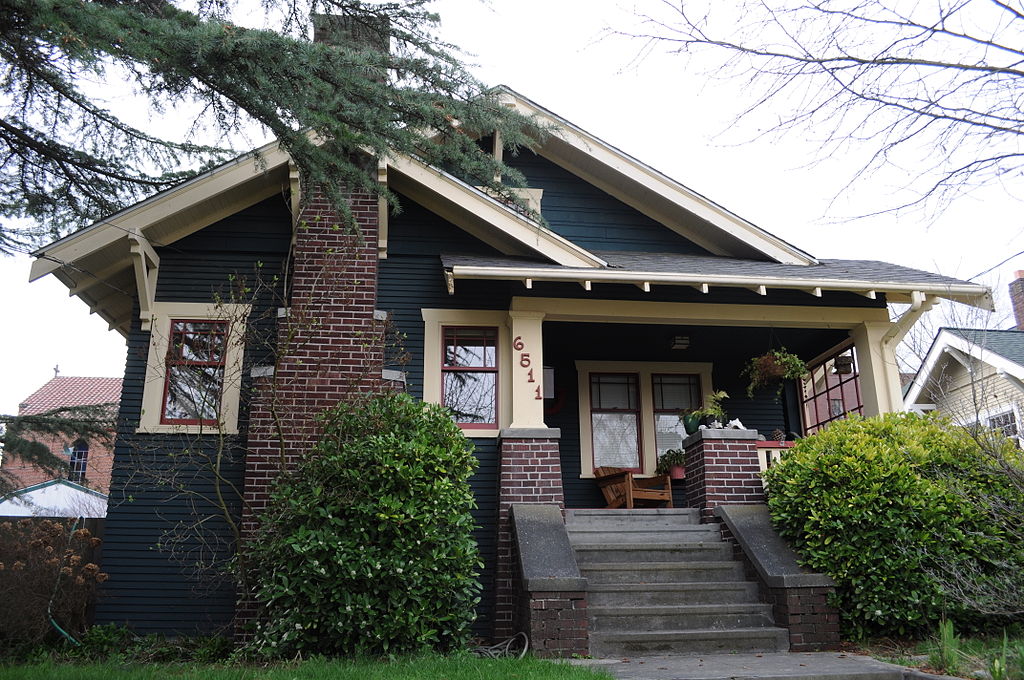
But what the hell does Neighborhood Character even mean? Often, from my perspective, people are referring to the horribly energy inefficient Craftsman homes. Or a really cool looking, energy-wasting Victorian. There are some great looking apartment buildings, townhouses, and row-houses – many of which leak heat something fierce.
That, however, is beside the point. When did we begin prioritizing buildings over people? Are the buildings what make neighborhoods great, or the people living and working in those buildings?

The unique nature of our neighborhoods in Seattle is pretty much awesome. What makes them unique, though, is the small businesses and the neighbors. Nowhere has this been amplified more than the recent explosion in Greenwood. The community response has been something amazing. As of this moment, nearly $35,000 has been raised to support the workers who all lost their jobs as a result of the explosion (BTW – take a second to kick in $5, eh?). People haven’t been sad about some old building being leveled – people are lamenting the loss of three local businesses, and the damage to other local businesses.
Support is coming to the workers not just from neighborhood homeowners, but renters. New residents. Old residents. Other small businesses. And this is what makes Greenwood such a fantastic neighborhood. Their retail core has a lot of great places to eat, drink, Karaoke, watch movies, caffeinate, shop for guitars. Greenwood businesses are well known to provide support to the neighborhood and neighbors – regardless of housing status. This is what Neighborhood Character means to me.
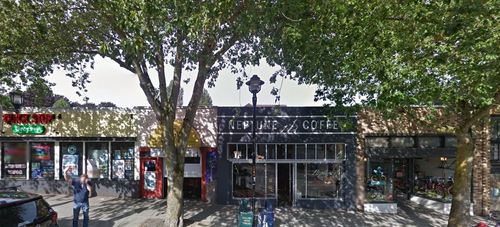

And the best way to keep our neighborhoods awesome? By being welcoming neighbors. I cringe when I hear people talk about renters as if they don’t contribute to the neighborhood. 52% of Seattleites are renters, after all.
Of course this means we need to allow more housing and housing types to be built in Seattle. Part of the initial HALA recommendations did just that by opening up opportunity for attached single-family units in historically single-family parts of the city. On this, I believe we lost opportunity for young families to be able to afford to become homeowners in our city, unless our city council shows the political will to move forward with pilot projects on duplexes and triplexes.
At the same time, our city must take steps to ensure small businesses can afford to operate in our commercial cores. This is one of the difficult pieces of the puzzle, as we move forward with more mixed-use development, more high-end and chain stores move into storefronts. Frankly, the cost per square foot of an older building is less than the brand new stuff. The affordability crisis extends to our small businesses in this regard. Fun fact: RCW 35.21.830 only bans rent control for residential structures. Just throwing that out there.
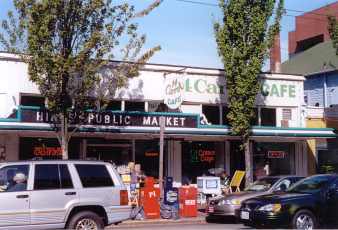
Above photo: The Zoo is to the left, Pazzo’s to the right, and 14 Carrot is shown. Up the street are more small businesses – and down the street – including a coffee shop, a fly-fishing shop, and clothing boutiques. This is what makes Eastlake great, and what needs to be protected – part of which means welcoming more residents to spend their money at these fantastic establishments in my neighborhood.
So next time you contemplate Neighborhood Character in your ‘hood, think about it – is it the buildings or your neighbors and small businesses that make it great? Of course we don’t want a bunch of hideous new structures built – but we do want energy efficient dwellings to help realize our carbon neutral goals. And, frankly, we can have buildings that add texture and are aesthetically pleasing that are also energy efficient (or, even better, use passivhaus technology).
Ultimately, though, I like to think we all want to be a little bit more like Greenwood – where residents new and old, renters and homeowners, small business owners and employees, all band together as community when disaster strikes. That is Neighborhood Character that I can get behind.
This article was originally published on michaelmaddux.org.
Support our crowdfunding campaign to help us keep covering stories like this! This is not all that surprising, but President Obama, during his SXSW keynote interview, appears to have joined the crew of politicians making misleading statements pretending to be "balanced" on the question of encryption. The interview (the link above should start at the very beginning) talks about a variety of issues related to tech and government, but eventually the President zeroes in on the encryption issue. The embed below should start at that point (if not, it's at the 1 hour, 16 minute mark in the video). Unfortunately, the interviewer, Evan Smith of the Texas Tribune, falsely frames the issue as one of "security v. privacy" rather than what it actually is -- which is "security v. security." In case you can't watch that, the President says he won't comment directly on the Apple legal fights, but then launches into the standard politician talking point of "yes, we want strong encryption, but bad people will use it so we need to figure out some way to break in."
All of us value our privacy. And this is a society that is built on a Constitution and a Bill of Rights and a healthy skepticism about overreaching government power. Before smartphones were invented, and to this day, if there is probable cause to think that you have abducted a child, or that you are engaging in a terrorist plot, or you are guilty of some serious crime, law enforcement can appear at your doorstep and say 'we have a warrant to search your home' and they can go into your bedroom to rifle through your underwear to see if there's any evidence of wrongdoing.Again, this is overstating the past and understating today's reality. Yes, you could always get a warrant to go "rifle through" someone's underwear, if you could present probable cause that such a search was reasonable to a judge. But that does not mean that the invention of smartphones really changed things so dramatically as President Obama presents here. For one, there has always been information that was inaccessible -- such as information that came from an in-person conversation or information in our brains or information that has been destroyed.
And we agree on that. Because we recognize that just like all our other rights, freedom of speech, freedom of religion, etc. there are going to be some constraints that we impose in order to make sure that we are safe, secure and living in a civilized society. Now technology is evolving so rapidly that new questions are being asked. And I am of the view that there are very real reasons why we want to make sure that government cannot just willy nilly get into everyone's iPhones, or smartphones, that are full of very personal information and very personal data. And, let's face it, the whole Snowden disclosure episode elevated people's suspicions of this.Again, at least some marginal kudos for admitting that this latest round was brought on by "excesses" (though we'd argue that it was actually unconstitutional, rather than mere overreach). And nice of him to admit that Snowden actually did reveal such "excesses." Of course, that raises a separate question: Why is Obama still trying to prosecute Snowden when he's just admitted that what Snowden did was clearly whistleblowing, in revealing questionable spying?
[...]
That was a real issue. I will say, by the way, that -- and I don't want to go to far afield -- but the Snowden issue, vastly overstated the dangers to US citizens in terms of spying. Because the fact of the matter is that actually that our intelligence agencies are pretty scrupulous about US persons -- people on US soil. What those disclosures did identify were excesses overseas with respect to people who are not in this country. A lot of those have been fixed. Don't take my word for it -- there was a panel that was constituted that just graded all the reforms that we set up to avoid those charges. But I understand that that raised suspicions.
So we're concerned about privacy. We don't want government to be looking through everybody's phones willy-nilly, without any kind of oversight or probable cause or a clear sense that it's targeted who might be a wrongdoer.The answer to those questions in that final paragraph are through good old fashioned detective work. In a time before smartphones, detectives were still able to catch child pornographers or disrupt terrorist plots. And, in some cases, the government failed to stop either of those things. But it wasn't because strong enforcement stymied them, but because there are always going to be some plots that people are able to get away with. We shouldn't undermine our entire security setup just because there are some bad people out there. In fact, that makes us less safe.
What makes it even more complicated is that we also want really strong encryption. Because part of us preventing terrorism or preventing people from disrupting the financial system or our air traffic control system or a whole other set of systems that are increasingly digitalized is that hackers, state or non-state, can just get in there and mess them up.
So we've got two values. Both of which are important.... And the question we now have to ask is, if technologically it is possible to make an impenetrable device or system where the encryption is so strong that there's no key. There's no door at all. Then how do we apprehend the child pornographer? How do we solve or disrupt a terrorist plot? What mechanisms do we have available to even do simple things like tax enforcement? Because if, in fact, you can't crack that at all, government can't get in, then everybody's walking around with a Swiss bank account in their pocket. So there has to be some concession to the need to be able get into that information somehow.
Now, what folks who are on the encryption side will argue, is that any key, whatsoever, even if it starts off as just being directed at one device, could end up being used on every device. That's just the nature of these systems. That is a technical question. I am not a software engineer. It is, I think, technically true, but I think it can be overstated.This is the part that's most maddening of all. He almost gets the point right. He almost understands. The crypto community has been screaming from the hills for ages that introducing any kind of third party access to encryption weakens it for all, introducing vulnerabilities that ensure that those with malicious intent will get in much sooner than they would otherwise. The President is mixing up that argument with one of the other arguments in the Apple/FBI case, about whether it's about "one phone" or "all the phones."
Figuring out how to build the reliable, secure systems required to "compromise" on crypto has long been a central problem in CS.
— matt blaze (@mattblaze) March 11, 2016
It's not like no one has thought about this problem before. It's a fundamentally difficult problem, and it won't be solved anytime soon.
— matt blaze (@mattblaze) March 11, 2016
It's not just that we don't know how to do crypto backdoors perfectly, it's that we don't even know how to do them non-disasterously.
— matt blaze (@mattblaze) March 11, 2016
If you can't read that, Blaze is basically saying that all crypto includes backdoors -- they're known as vulnerabilities. And the key focus in crypto is closing those backdoors, because leaving them open is disastrous. And yet the government is now demanding that tech folks purposely put in more backdoors and not close them, without recognizing the simple fact that vulnerabilities in crypto always lead to disastrous results.We can't discuss how to make our systems secure with backdoors until we can figure out how to do it WITHOUT backdoors.
— matt blaze (@mattblaze) March 11, 2016
So the question now becomes that, we as a society, setting aside the specific case between the FBI and Apple, setting aside the commercial interests, the concerns about what could the Chinese government do with this, even if we trust the US government. Setting aside all those questions, we're going to have to make some decisions about how do we balance these respective risks. And I've got a bunch of smart people, sitting there, talking about it, thinking about it. We have engaged the tech community, aggressively, to help solve this problem. My conclusions so far is that you cannot take an absolutist view on this. So if your argument is "strong encryption no matter what, and we can and should in fact create black boxes," that, I think, does not strike the kind of balance that we have lived with for 200, 300 years. And it's fetishizing our phones above every other value. And that can't be the right answer.This is not an absolutist view. It is not an absolutist view to say that anything you do to weaken the security of phones creates disastrous consequences for overall security, far beyond the privacy of individuals holding those phones. And, as Julian Sanchez rightly notes, it's ridiculous that it's the status quo on the previous compromise that is now being framed as an "absolutist" position:
CALEA--with obligations on telecoms to assist, but user-side encryption protected--WAS the compromise. Now that's "absolutism".
— Julian Sanchez (@normative) March 11, 2016
I suspect that the answer is going to come down to how do we create a system where the encryption is as strong as possible. The key is as secure as possible. It is accessible by the smallest number of people possible for a subset of issues that we agree are important. How we design that is not something that I have the expertise to do. I am way on the civil liberties side of this thing. Bill McCraven will tell you that I anguish a lot over the decisions we make over how to keep this country safe. And I am not interested in overthrowing the values that have made us an exceptional and great nation, simply for expediency. But the dangers are real. Maintaining law and order and a civilized society is important. Protecting our kids is important.You suspect wrong. Because while your position sounds reasonable and "balanced" (and I've seen some in the press describe President Obama's position here as "realist"), it's actually dangerous. This is the problem. The President is discussing this like it's a political issue rather than a technological/math issue. People aren't angry about this because they're "extremists" or "absolutists" or people who "don't want to compromise." They're screaming about this because "the compromise" solution is dangerous. If there really were a way to have strong encryption with a secure key where only a small number of people could get in on key issues, then that would be great.
So I would just caution against taking an absolutist perspective on this. Because we make compromises all the time. I haven't flown commercial in a while, but my understanding is that it's not great fun going through security. But we make the concession because -- it's a big intrusion on our privacy -- but we recognize that it is important. We have stops for drunk drivers. It's an intrusion. But we think it's the right thing to do. And this notion that somehow our data is different and can be walled off from those other trade-offs we make, I believe is incorrect.Again, this is not about "making compromises" or some sort of political perspective. And the people arguing for strong encryption aren't being "absolutist" about it because they're unwilling to compromise. They're saying that the "compromise" solution means undermining the very basis of how we do security and putting everyone at much greater risk. That's ethically horrific.
We do have to make sure, given the power of the internet and how much our lives are digitalized, that it is narrow and that it is constrained and that there's oversight. And I'm confident this is something that we can solve, but we're going to need the tech community, software designers, people who care deeply about this stuff, to help us solve it. Because what will happen is, if everybody goes to their respective corners, and the tech community says "you know what, either we have strong perfect encryption, or else it's Big Brother and Orwellian world," what you'll find is that after something really bad happens, the politics of this will swing and it will become sloppy and rushed and it will go through Congress in ways that have not been thought through. And then you really will have dangers to our civil liberties, because the people who understand this best, and who care most about privacy and civil liberties have disengaged, or have taken a position that is not sustainable for the general public as a whole over time.I have a lot of trouble with the President's line about everyone going to "their respective corners," as it suggests a ridiculous sort of tribalism in which the natural state is the tech industry against the government and even suggests that the tech industry doesn't care about stopping terrorism or child pornographers. That, of course, is ridiculous. It's got nothing to do with "our team." It has to do with the simple realities of encryption and the fact that what the President is suggesting is dangerous.
Support our crowdfunding campaign to help us keep covering stories like this!

It’s not everyday that we get to see a total solar eclipse, and it’s not everyday that an airline will adjust a flight’s path and departure time just so passengers can get the best possible view of said solar eclipse. But that’s exactly what Alaska Airlines did for a flight from Alaska to Hawaii today.
Alaska Airlines announced it has changed the departure time for Flight 870 from Anchorage to Honolulu so that the plane’s passengers could see the entirety of the eclipse, which occurs when the moon completely covers the sun’s solar disc.
The flight change is actually a year in the making, according to the carrier, which says the deviation was precisely planned with the help of astronomers and veteran “eclipse chasers.”
Joe Rao, an associate astronomer at the American Museum of Natural History’s Hayden Planetarium, discovered that Flight 870 would intersect the “path of totality” during its regular trip, but would miss the totality by about 25 minutes.
Rao, who will be one of the 163 passengers on the flight today, called Alaska Airlines, and the carrier decided to move the flight back 25 minutes.
“It’s an unbelievably accommodating gesture,” Mike Kentrianakis, solar eclipse project manager for the American Astronomical Society, who will also be on the flight, said in a statement. “Not only is Alaska Airlines getting people from Point A to Point B, but they’re willing to give them an exciting flight experience. An airline that’s actually talking to their people – and listening! That’s customer service at its best. It’s become personal.”
While the flight time has already been pushed back to 2 p.m. local time, Alaska says it will decide the exact flight path today in an attempt to find the “most efficient route.”
“We recognize our customer’s passions,” Chase Craig, Alaska’s director of onboard brand experience, said. “Certainly we can’t change flight plans for every interest, but this was a special moment, so we thought it was worth it. Now we have a plane full of customers who will be treated to a special occurrence.”


Having grown up on the East Coast, I've only ever known American-made butter to come in long, narrow sticks. Turns out I was living in a butter bubble; it wasn't until I heard a story one evening on NPR's Marketplace about the difference between West Coast and East Coast butter that I realized there was a difference to be known at all.
Should tampon sales be taxed by the state? Five Manhattan women don’t think so, and have filed a lawsuit against New York’s Department of Taxation and Finance saying it should be tax-free.
While other medical items are sold without a tax — including Rogaine, food powder, dandruff shampoo, ChapStick, adult diapers, and incontinence pads, the lawsuit notes, medical items used only by women like tampons and sanitary napkins are taxed.
“The department’s double standard for men and women finds no support in the tax law and serves no purpose other than to discriminate,” the suit says, as reported by the New York Daily News. “It is… undisputable that tampons and sanitary pads serve multiple medical purposes. They are not luxury items, but a necessity for women’s health.”
According to court papers, the average woman will spend at least $70 a year on tampons and pads, bringing in New York a total of $14 million in taxes every year.
Those taxes hit poor women especially hard, one plaintiff tells the New York Daily News.
“It’s a regressive tax. Poor women don’t have the ability to buy tampons in bulk. They buy in small packages and thus they are taxed more,” she said.
The lawsuit is seeking an order permanently banning the state from taxing tampons or pads.
There are others trying to change the tax, including Assemblywoman Linda Rosenthal who introduced legislation in Albany seeking to end “a regressive tax on women and their bodies.”
New lawsuit challenges New York State’s tampon tax [New York Daily News]

The first trailer for Loving Vincent (previously) was just released and it promises stunning visuals in a novel format: the film was created from a staggering 12 oil paintings per second in styles inspired by the famous Dutch painter’s brushstrokes. The upcoming movie will detail the story of Van Gogh’s life leading up to the tumultuous time surrounding his death some 125 years ago. According to the filmmakers, over 100 painters have contributed frames to the ambitious feature-length film that is still in progress at their headquarters in Gdansk, Poland. The film is currently being produced by Oscar-winning studios BreakThru Films and Trademark Films, and you can follow their progress or even get involved yourself on their website. (via Devour)


The Obama administration is proposing a new rule to address unequal pay practices by requiring companies with more than 100 employees to submit salary data by race, gender and ethnicity.
The announcement comes seven years after President Obama signed the Lilly Ledbetter Fair Pay Act — his first piece of legislation as president — which makes it easier for women to challenge discriminatory pay in court.
But a stubborn, substantial pay gap between men and women persists — and it affects black and Latina women the most, Obama said Friday as he introduced the proposal. The president said he'd continue to work to reduce the gap as long as he was in office.
"Social change never happens overnight," he said. "It is a slog and there are times when you just have to chip away and chip away ... it's reliant on all of us to keep pushing that boulder up the hill."
Collecting more data would assist in enforcing equal pay laws, the administration says, and "provide better insight" into the gender pay gap across industries and occupations.
The proposed pay data reporting requirement would cover more than 63 million employees, according to the administration. It's expected to be finalized by September, with the first reports due in the fall of 2017.
NPR's Scott Horsley explained to our Newscast unit that the proposed rule is an expansion of both existing data-reporting laws and a previous equal-pay proposition:
"The Equal Employment Opportunity Commission already collects data from big employers about the ethnic, racial, and gender makeup of their workforce. Now, the EEOC wants employers to add pay information as well. ... The proposed EEOC rule is more expansive than an earlier proposal that would have applied only to federal contractors."
Obama is also once again calling for Congress to pass the Paycheck Fairness Act, which would protect women from retaliation when they seek equal pay. Democrats have repeatedly introduced the Paycheck Fairness Act during the current administration, but it has always been defeated.
The White House also called for states and employers to take action on their own to promote equal pay.
Last year, for instance, California Gov. Jerry Brown signed an equal pay law that puts the burden of proof on an employer to prove wage gap between a male and female employee is justified by seniority or merit. It requires companies to pay the same rate for "substantially similar" work, such as janitorial work and housekeeping.
In repeating the call for equal pay, the White House noted that the median wage of full-time female workers in America is 79 percent of a man's median earnings. That's a slight bump up from the 77-cents-on-the-dollar statistic, based on older numbers, that the White House has often alluded to before.
The comparison of median earnings is sometimes criticized as a crude metric for the gender pay gap. Economists have found that if you control for a host of factors, the pay gap is smaller — but persistent. The gap varies widely based on a woman's age and her race. It also shifts determining which industry you look at.
Requiring large employers to report their pay data, the administration argues, would allow "better insight" into exactly how the pay gap is influenced by industry and occupation.
Lilly Ledbetter, the namesake of the law signed seven years ago, introduced Obama on Friday and praised him for "not resting on his Ledbetter laurels."
Ledbetter sued her employer, Goodyear, over the difference between her pay and her male colleagues' pay.
"Almost two decades into my Goodyear career, I learned from an anonymous note that I had been earning thousands of dollars less than my male coworkers who were doing the same job as me," she said Friday.
"Nobody wants to be the poster child for unequal pay for equal work, but spurred on by that note, that's exactly what happened to me," she said.
Her suit against Goodyear made it all the way to the Supreme Court — where it was rejected because she didn't report the discrimination when it began, even though she didn't know about the disparity when it started. That was the impetus for the law that bears her name, which allows employees receiving unfair pay more time to bring a lawsuit.
"I may have lost my personal battle, but I will not lose this war," Ledbetter said Friday.

The Super PAC has $417,250 to spend on the upcoming election. $400K of that came from Robert Mercer, a white billionaire hedge-fund titan who is the major funder of the Ted Cruz campaign. (more…)
This article originally appeared as a special piece on Strong Towns, which is in the midst of #NoNewRoads week and dedicated Thursday to Washington state coverage.
When state legislators finally passed the Connecting Washington Communities transportation omnibus bill in July, many issued a sigh of relief. With its focus on highway expansion, the bloated $16 billion bill was a toad, but urbanists hoped embracing the toad would turn it into a handsome prince. That metamorphosis would largely take place through the bill's authorization of the funding authority for Sound Transit 3 (ST3) which will go on the ballot this fall and secure, with the voters' permission, $15 billion (and perhaps more) in light rail, commuter rail, and bus rapid transit funding in the Seattle metropolitan area.
If ST3 gains voter approval, many people may forgive the excesses of the state transportation bill. And there are certainly excesses. The Urbanist did of a full overview of the bill in July. In short, it contained:
The split of $9.7 billion on highway expansion versus just $1.4 billion for maintenance and repair is far from prudent. Transportation is about 10% of Washington state's budget yet roads are in bad shape. Seattle's section of I-5 in Seattle is downright dilapidated and sorely overdue for a major overhaul. Emergency repairs happen on an almost monthly basis thanks to 50-year-old expansion joints, bridges, and foundations. Instead of planning for this looming and costly project, the bill uses highway spending to chase economic development in a strategy with little factual basis. Highway-driven economic development is speculative, but maintenance costs of new highways are certainly all too real.
Connecting Washington gets most of its $16 billion by raising the state motor vehicle gas tax by 11.9 cents per gallon. Some funding also comes from licensing and registration fees, and vehicle weight fees for passenger vehicles and haulers. Sound Transit 3, on the other hand, would get its funding through raising property taxes and a mix of other sources within the Sound Transit taxing district covering portions of King County, Pierce County, and Snohomish County.
Here's how the legislature divided some of the highway spoils:
The biggest megaproject on that list, the I-5 and SR-167 interchange, expects to improve mobility near the Port of Tacoma by beefing up freeway interchanges in Fife. At the very least, motorists will be able to sit in swanky flyover ramps during traffic jams.
This is the existing I-5 and SR-167 interchange. (WSDOT)
This is the planned billion-dollar upgrade to the I-5 and SR-167 interchange funded thanks to Connecting Washington. (WSDOT)
The Washington Department of Transportation (WSDOT) studied implementing SR-167 tolls and suggested the highway network would actually operate better with full tolling in place. Tolling would cover the maintenance and operating costs and also supplement capital costs to a small degree (the study predicted $65 million). Tolling is a great way get a dedicated maintenance funding stream for highways and avoid the colossal maintenance backlogs we find ourselves confronting. That said, tolling on the highway is far from certain given the noisy backlash to the proposal to toll I-90 and to the recent addition of tolls on I-405. The decision isn't expected until a few years down the road.
The bill slots $1 billion for multimodal improvements. That's serious money, even if its dwarfed tenfold by highway spending. The multimodal money is doled out as follows:
As you can see most non-highway spending goes to transit, while $131 million goes to bicycle and pedestrian upgrades. Another sign of WSDOT's limited commitment to pedestrians is that among their thousands of employees, just one is tasked with Safe Routes to School. Similarly, one employee handles the entire active transportation portfolio. No wonder pedestrian facilities are so often overlooked. The multimodal investments are some of the soundest ones Connecting Washington makes. Does a fractional amount of multimodal investments and the promise of ST3 mean the whole bill is a net positive? That's a tougher question to answer.
My educated guess is that these new highways will be a waste of money. WSDOT promises reduced congestion, but highways induce demand so the new highways could become just as clogged as the old highways. Tolling would help counter induced demand, but the bill didn't address tolling so it might not happen.
Boosters cite the importance of good freight connections to the Ports of Tacoma and Seattle to further economic development. Note, I-5 already offers freight connections from the ports, albeit in lanes that are often heavily congested. The problem is too many people drive and at the same times of day. Adding highways to the overall transportation system does not discourage people from driving. It encourages it. That's why WDSOT quest for highway expansion is a never-ending one if solving congestion drives the decisions rather than human mobility.
WSDOT and Seattle don't often see eye to eye. Often suburb-city and rural-city tensions play out in transportation politics. Seattle, with a population of about 675,000 in a state of more than 7 million, often loses out in its priorities. In the 1960s when WSDOT dug the I-5 trench through dense Seattle neighborhoods, such as First Hill and Eastlake, it did so over the protests of local residents. Tens of thousands were displaced in the name of highway speed.
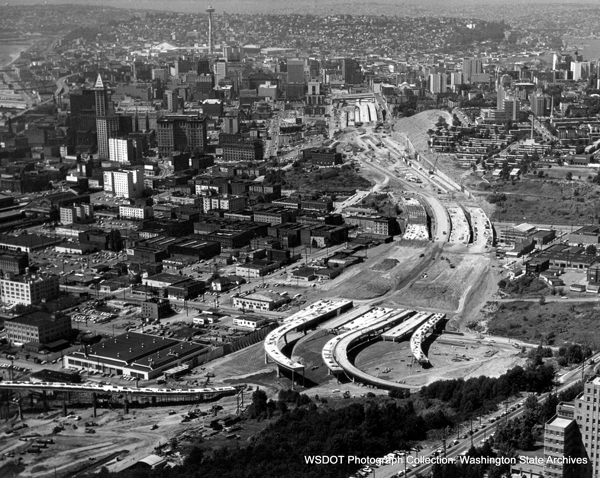
I-5's construction required leveling many city blocks. (WSDOT)
Since then, WSDOT hasn't done anything that blatantly violent to Seattle's urban fabric and its people. But that is still WSDOT's attitude, and the violence of that original sin still damages Seattle on a daily basis. Motorists exiting and entering freeway ramps run over pedestrians trying to cross the I-5 chasm. Pollution from a quarter million cars and trucks belches up from the pit and into human lungs.
Seattleites obviously extract some utility from I-5—when it isn't gridlocked clear to Tacoma. But, as quickly as WSDOT conjures $4 billion to replace the SR-520 bridge to Bellevue, it struggles to keep up on routine I-5 maintenance (rather than emergency maintenance) in Seattle and ignores pleas for freeways lids to stitch Seattle's east side neighborhoods back together with downtown and South Lake Union. Perhaps I-5's pending but long delayed overhaul in Seattle could be paired with freeway lid construction to minimize the disruption to operations. We don't hear about that from WSDOT, though.
The recent symbol of WSDOT's ineptitude is the Bertha tunnel. Seattle wanted to replace the structurally unsound Alaska Way Viaduct with a simple street-level boulevard, but, bowing to pressure from suburban commuters, WSDOT went with a deus ex machina option of buying the world's largest tunnel-boring machine (TBM) to dig a $4 billion tunnel to bypass downtown. WSDOT christened the TBM "Bertha" in honor of Seattle's first female mayor Bertha Knight Landes.

Bertha struck a steel pipe in December 2013, which supposedly caused the breakdown that sidelined the TBM for more than two years. The contractor had to dig the TBM out and hoist it to the surface to conduct the repairs to get it running again. Incidentally, the excavation pit probably was the cause of Pioneer Square sinking more than an inch. (WSDOT)
I'm not sure Ms. Landes would have been honored because, if you haven't heard, the project isn't going so well. Last month, Bertha finally started digging again following a two-year hiatus caused by a breakdown. Unfortunately, a sinkhole appeared shortly thereafter and drilling was suspended again. The tunneling was only supposed to take 14 months, but we are already on our third year and the tunneling is about 10 percent done. Cost overruns are expected. All this for a tunnel Seattle didn't really want and which won't serve transit since its bypasses downtown.
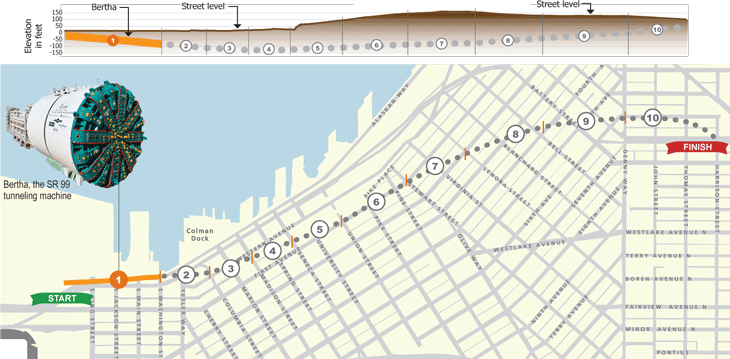
Bertha has made it about 4 blocks. About 8,000 feet to go. (WSDOT)
WSDOT's history of justifying highway megaprojects by any means necessary while pedestrians, bicyclists, and transit get shortchanged is why many Seattleites don't trust their promises. The latest transportation bill wasn't the one to fund Bertha, but the state's willingness to bury $4 billion in a Bertha sinkhole shows exactly where its loyalties lie.
The legislature didn't have to give us a bloated toad. A wiser policymaking body would have given us the prince straight away. Instead, we are left trying to learn the art of transfiguration and pull transit out of a highway sprawl bill. And we just might do it if we pass ST3 this November.




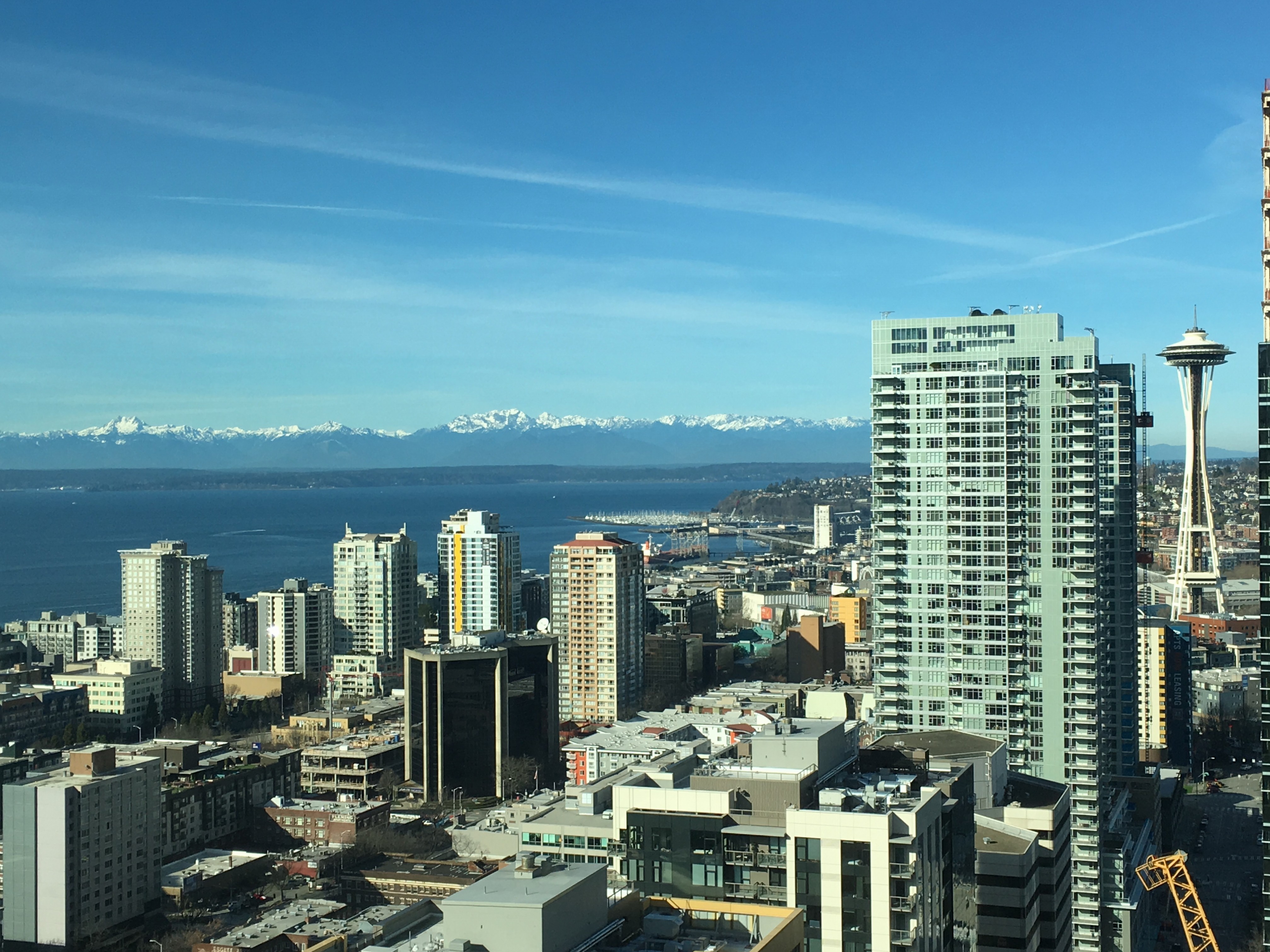
.jpg)