Shared posts

22 Jul 20:49

How Conservation Ideologues Attack Scientists Who Don’t Agree With Them - Facts So Romantic

by Molly Lutcavage

I’d like to think that it’s not personal. I like to think it’s because an environmental writer needs to make a living and sell his books, any way he/she can. And needs to rack up awards for saving the planet, or the fish, or the sea turtles…

In science, there’s always disagreement among experts and well-respected, conscientious non-governmental organizations (NGOs) working on tough questions. We are used to that. And we work things out as a team using objective scientific methods and evidence. A good scientist should be ready to make mistakes, to be wrong sometimes, to be called out, or to miss something obvious that someone else runs with and gets credit for. Or to get lucky with research, to be in the right place at the right time—we experience it all. And women scientists that make it all the way to professional positions most likely have already been hit on or harassed or received unfair treatment, because there are fewer of us. Women scientists know plenty of these stories. We receive training for that too, even though it rarely helps.

But I was not trained how to respond to environmental bullies. Or scientific fraud. How do you react…
Read More…

21 Jul 18:44

Global Warming Expedition Stopped In Its Tracks By Arctic Sea Ice

by Tyler Durden

Submitted by Craig Boudreau via The Daily Caller,

A group of adventurers, sailors, pilots and climate scientists that recently started a journey around the North Pole in an effort to show the lack of ice, has been blocked from further travels by ice.

The Polar Ocean Challenge is taking a two month journey that will see them go from Bristol, Alaska, to Norway, then to Russia through the North East passage, back to Alaska through the North West passage, to Greenland and then ultimately back to Bristol. Their objective, as laid out by their website, was to demonstrate “that the Arctic sea ice coverage shrinks back so far now in the summer months that sea that was permanently locked up now can allow passage through.”

There has been one small hiccup thus-far though: they are currently stuck in Murmansk, Russia because there is too much ice blocking the North East passage the team said didn’t exist in summer months, according to Real Climate Science.

Real Climate Science also provides a graph showing that current Arctic temperatures — despite alarmist claims of the Arctic being hotter than ever — is actually below normal.

The Polar Ocean Challenge team is not the first global warming expedition to be faced with icy troubles. In 2013, an Antarctic research vessel named Akademik Shokalskiy became trapped in the ice, the problem was so severe that they actually had to rescue the 52 crew members.

In 2015 a Canadian ice breaking ship, the CCGS Amundsen, was forced to reroute and help a number of supply ships that had become trapped by ice.

The icy blockade comes just over a month after an Oxford climate scientist, Peter Wadhams, said the Arctic would be ‘completely ice-free’ by September of this year. While it obviously isn’t September yet, he did reference the fact that there would be very little ice to contend with this summer.

“Even if the ice doesn’t completely disappear, it is very likely that this will be a record low year,” Wadhams told The Independent in June.

Wahdams says he expects less than one million square kilometers by summers end, but the current amount of Arctic sea ice is 10.6 million square kilometers, according to data from the National Snow and Ice Data Center (NSIDC). The NSIDC puts the rate of ice loss for June at just about 60,ooo square kilometers a day. If that number were to hold, it would take approximately 160 days for the Arctic to dip down to the predicted one million square kilometers.

20 Jul 14:35

"Not A White Problem"

by Tyler Durden

Submitted by Jim Quinn via The Burning Platform blog,

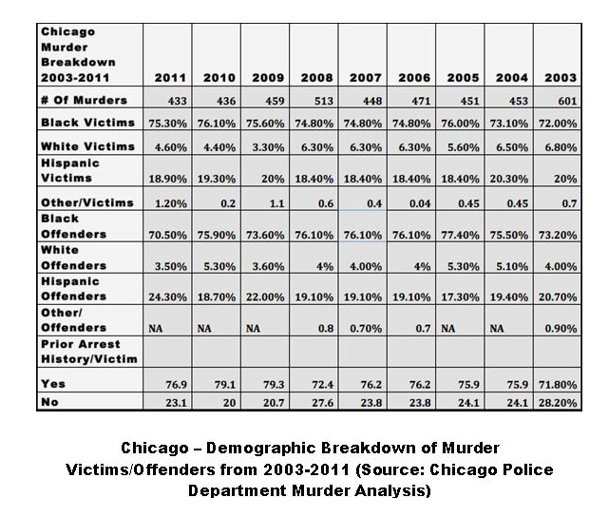
The statistics in the chart below are representative of every Democrat controlled urban shithole city in America. Obama and his anti-gun activist minions are peddling a false narrative about guns because they understand most Americans are dumber than a sack of hammers and easily manipulated by propaganda. Obama uses every high profile shooting to blame guns, in order to deflect people from seeing the truth. And the truth is guns are not a problem in white America.

It’s only a problem in the urban ghettos with the toughest gun laws run by Democrat mayors and city councils. Chicago is a perfect example of Obama ignoring the real problem. Fifty years of welfare programs and treating black people like victims has created a dysfunctional system leading to hopelessness, crime, and perpetual poverty. Chicago is 32% white, but they commit only 3.5% of the murders. Over 96% of the murders are committed by non-whites. Essentially, it is young black men murdering other black men. White people are not in the equation and are not part of the problem. It’s a black problem framed as a gun problem by Obama and his lying apparatchiks.


There are approximately 8,000 gun related homicides annually in the U.S. The vast majority occur in the urban ghettos and are committed by blacks and hispanics against other blacks and hispanics. They use illegally acquired guns, so more gun laws will do nothing. Their lawless culture, requiring no personal responsibility by those who father children, creates the dysfunction and crime. The urban ghetto kill zones all have the same thing in common – run by liberal Democrats for decades, with poverty created by their welfare policies, dreadful public schools, and a black population who don’t work and take no personal responsibility for their lives or their children.

Here are the murders by city for a sampling of these shitholes:

  • Los Angeles – 587
  • Chicago – 508
  • NYC – 333
  • Detroit – 316
  • Phila – 248
  • Baltimore – 233
  • New Orleans – 150
  • Indianapolis – 129
  • Memphis – 124
  • St. Louis – 120
  • Newark -112
  • Milwaukee – 104
  • Washington DC – 103

There are dozens of other shitholes like Camden, Kansas City, Atlanta, Oakland, Pittsburgh, and Miami with extremely high murder rates, and in every case more than 90% are committed by non-whites. Why don’t you hear Obama giving speeches about black communities policing themselves and taking responsibility for the crime, drugs and murder in their neighborhoods? He has no problem with proclamations about white people clinging to their guns in middle America where there are virtually no murders.

The entire gun narrative peddled by liberals is false. The crime rate has been falling for 25 years. There were 24,703 murders in 1991 when the population was 253 million. Murders in 2014 totaled 14,249 with a population of 317 million. The willfully ignorant American public completely buys the falsehoods presented by Obama and believes murders and crime are skyrocketing.

Today, the national crime rate is about half of what it was at its height in 1991. Violent crime has fallen by 51 percent since 1991, and property crime by 43 percent. In 2013 the violent crime rate was the lowest since 1970. And this holds true for unreported crimes as well. According to the National Crime Victimization Survey, since 1993 the rate of violent crime has declined from 79.8 to 23.2 victimizations per 1,000 people.

So, with homicides at a 25 year low and completely confined to the urban ghettos where young black men kill other young black men, we need new gun laws to restrict what white people can own? It makes you wonder. Why has the government militarized local police forces across the country in white communities when crime and murder is virtually non-existent in those communities? Why is Obama and his liberal nazi hordes trying to ban any gun capable of providing defense against a tyrannical government? Why has this become a war on whites when it is solely a black problem? It’s almost as if the government is treating working class whites with guns as the enemy. I wonder.

20 Jul 14:14

It Is A Smoking Gun - Prince Bandar And Other Saudis Financed The 9/11 Terrorists

by Tyler Durden

Submitted by Justin Raimondo via Anti-War.com,

News reports about the recently released 28 pages of the Joint Inquiry into the 9/11 attacks are typically dismissive: this is nothing new, it’s just circumstantial evidence, and there’s no “smoking gun.” Yet given what the report actually says – and these news accounts are remarkably sparse when it comes to verbatim quotes – it’s hard to fathom what would constitute a smoking gun.

To begin with, let’s start with what’s not in these pages: there are numerous redactions. And they are rather odd. When one expects to read the words “CIA” or “FBI,” instead we get a blacked-out word. Entire paragraphs are redacted – often at crucial points. So it’s reasonable to assume that, if there is a smoking gun, it’s contained in the portions we’re not allowed to see. Presumably the members of Congress with access to the document prior to its release who have been telling us that it changes their entire conception of the 9/11 attacks – and our relationship with the Saudis – read the unredacted version. Which points to the conclusion that the omissions left out crucial information – perhaps including the vaunted smoking gun.

In any case, what we have access to makes more than just a substantial case: it shows that the Saudi government – including top officials, such as then Saudi ambassador to the US, Prince Bandar bin Sultan, and other members of the royal family – financed and actively aided the hijackers prior to September 11, 2001.

Support for at least two of the hijackers when they arrived in the US was extended by three key individuals:

  • Omar al-Bayoumi – Bayoumi was clearly a Saudi intelligence agent: the FBI all but identifies him as such. His salary was paid for by companies directly owned and operated by the Saudi government, although he apparently rarely showed up for “work.” He was directly subsidized by the wife of then Saudi ambassador Prince Bandar, and these subsidies were substantially increased when the hijackers arrived in the US. It was Bayoumi who hovered over two of the hijackers – Nawaf al-Hamzi and Khalid al-Midhar – as soon as they arrived in the United States. He got them an apartment, co-signed the rental agreement, chauffeured them around – and helped them obtain information on flight schools.

  • Osama Bassnan – This individual, who, according to the report, has “many ties to the Saudi government,” boasted to an informant that he did more for the two hijackers than Bayoumi. He was certainly in a position to do so, since he lived directly across the street from them in San Diego. The FBI characterized him as “an extremist and supporter of Osama bin Laden”: like Bayoumi, his longtime associate – with whom he was in constant communication at the time of the hijackers’ American sojourn – Bassnan was subsidized by the Saudi royal family, and specifically Prince Bandar and his wife. A search of Basnan’s apartment turned up indications that he had cashiers checks amounting to $74,000. Bandar’s wife’s account had a standing arrangement to send monthly checks to Basan’s wife for “nursing services.” There is no evidence that such services were ever performed. The suppressed 28 pages cite direct payments from Prince Bandar to Basnan:

    “On at least one occasion, Bassnan received a check directly from Prince Bandar’s account. Accordion to the FBI, on May 14, 1998, Bassnan cashed a check from Bandar in the amount of $15,000. Bassnan’s wife also received at least one check directly from Bandar She also received one additional check froth Bandar’s wife, which she cashed on January 8, 1998 for 10,000.”

  • Shayk Fahah al-Thumairy – He was a diplomat at the Saudi consulate in Los Angeles and imam of the King Fahad mosque, which is a focal point of Muslim-Saudi activity in the area. US intelligence avers that “initial indications are that al-Thumairy may have had a physical or financial connection to al-Hamzi and al-Midhar.” Both attended the King Fahad mosque. Thumairy was interviewed by US law enforcement after fleeing to Saudi Arabia, and denied having any contact with the two hijackers – in spite of evidence that he was in telephonic contact with them. This, he asserted, was an attempt to “smear” him.

The two hijackers had extensive contacts with Saudi naval officers in the United States, according to telephone records. And when Abu Zubaydah, one of the accused 9/11 conspirators, was captured in Pakistan, they found the phone number of a Colorado company that managed “the affairs of the Colorado residence of the Saudi Ambassador.” Prince Bandar is practically the star of the suppressed 28 pages – no wonder the Bush administration, which had close ties to him, fought so hard to keep this secret.

The 28 pages also reveal that an individual – name redacted – associated with al-Qaeda and the hijackers sneaked into the US, avoiding Customs agents and the INS due to the fact that he was traveling with a member of the Saudi royal family. We are also told that “Another Saudi national with close ties to the Saudi Royal Family, [redacted], is the subject of FBI counterterrorism investigations and reportedly was checking security at the United States’ southwest border in 1999 and discussing the possibility of infiltrating individuals into the United States.”

The Saudi government’s financial and operational ties to at least two of the 9/11 hijackers are myriad, and largely substantiated. Furthermore, although some of these links as detailed in the 28 pages are tentative, it’s important to remember that this report was written in 2002, and that the intelligence community was strongly admonished to follow up because lawmakers deemed the lack of investigation into the Saudi connection “unacceptable.” So what did they find out in the fourteen years after that admonition was delivered? Inquiring minds want to know….

Prince Bandar went on to become head of Saudi intelligence: his personal relationship with the Bush family is well-known, and his access to US government officials – and his powerful influence in Washington – makes his starring role in the nurturing of the two hijackers into a gun that, while not quite smoking, is exuding vapors of a highly suggestive nature.

“Circumstantial evidence”? Perhaps – but people have been convicted of murder on the basis of such evidence, and, in this case, there is such a preponderance of evidence that a guilty verdict is unavoidable.

It would not be stretching the evidence to bluntly state that the suppressed 28 pages of the Joint Inquiry report on the 9/11 terrorist attacks places agents of the Saudi government at the epicenter of the plot. In short, there’s no two ways about it: the Saudis did 9/11.

Why did our government cover up this shocking evidence for so long?

The reason is because they had no desire to retaliate against the real perpetrators of 9/11. Instead, as we now know, they were determined to pin the blame on Saddam Hussein: indeed, the Bush administration pressed this talking point relentlessly, until it was forced to backtrack. We attacked Iraq, in the words of neocon grise eminence and top Bush administration official Paul Wolfowitz, because it was “doable.” A years long neoconservative campaign to target Iraq gained new impetus in the wake of 9/11, and the administration and its journalistic camarilla pushed the lie that Iraq was behind the attack. The evidence that the Saudis were involved had to be suppressed – because the Bush administration’s war plans depended on it.

Now that we know the truth, what do we do about it?

To begin with, if any other government had connections to a terrorist attack on the US of this nature, their capital would’ve been a smoking ruin. I’m not suggesting we do that, but at the very least the Saudis must be made to pay a high price for their complicity, starting with a moratorium on all US aid and arms sales to the Kingdom. We imposed trade sanctions on Russia for far less. Cutting off the Saudis from the US banking system should put a crimp in their extensive international network of terror-financing and money-laundering. And I know it’s too much to expect a public statement from our President pointing out that a US “ally” aided and abetted those who murdered over 3,000 people on 9/11, but I can dream, can’t I?

The Saudis aren’t our allies: as the 28 pages make all too clear, they are our deadly enemies. And they ought to be treated as such.

20 Jul 09:34

So What Did The ECB Buy? "In Short, Almost Everything"

by Tyler Durden

Yesterday for the first time, the various central banks of the Eurosystem disclosed which bonds the ECB had bought under its CSPP program. Specifically, we broke down the purchases of the Bundesbank, which revealed some of the most prominent public company debt issuers in Europe. However, we were curious to get a more detailed look at what Mario Draghi's trading desk was spending their time BWICing all day. For that we went to the undisputed master when it comes to tracking what the ECB does in the bond realm (because the ECB is not buying equities just yet), BofA's Barnaby Martin.

Here is the big picture as revealed in his report today titled "CSPP: Buying Frenzy" - "in just over a month of the Corporate Sector Purchase Programme, the ECB have bought 458 bonds, with virtually no stone left unturned.With the monthly run-rate of buying hovering around the €8.5bn mark, our conclusion for CSPP is, bluntly, that it is too big, too powerful and ultimately too bullish for spreads."

But the best part was Martin's answer to the key question: "So what did they buy?" His answer: "In short, almost everything."

But we don’t think this should be particularly surprising – the weekly CSPP buying numbers continue to suggest a monthly run rate for corporate purchases of between €8bn-€9bn (with the buying pace picking up over the last week). Yet, we think this is too big an amount for a market devoid of supply and thus we continue to believe that CSPP is a very bullish technical for non-financial spreads.


What caught our attention on the ECB’s shopping list?

  • They bought “topical” credits such as VW, Glencore and EdF.
  • They bought “high-yield” credits such as Telecom Italia and Lufthansa.
  • They bought “foreign” credits such Bunge and Schlumberger (US), Nestle and ABB (Swiss).
  • They bought long-dated bonds (2036s), but they also bought plenty of short-dated bonds. In fact, 35% of the bonds that they bought are negative yielding.
  • The Central Bank of Italy seems to be the most “active” central bank thus far, purchasing 43% of their eligible universe (55 out of 127 bonds).
  • The Banque de France seems to be relatively “lagging” at the moment, purchasing just 29% of their eligible universe (115 out of 399 bonds). In addition, the BdF has shied away from buying issuers such as Alstom and Legrand.
  • The ECB has been involved in primary – buying recent supply from Bunge, Repsol, ASML, Iberdrola, Tennet, Total and Air Liquide.

Ironically, the most popular name seems to be Deutsche Bahn where 12 bonds from the issuer have been purchased. And yet, Deutsche Bahn bonds have some of the most negative yields in the Euro IG market (DBHNGR 18s yield -25bp).

They bought (almost) everything!

Since June 8th the ECB has bought 440 corporate bonds, which is around 35% of our estimated universe. By issuer, we find that the ECB has bought bonds from 158 different corporates.


The most popular bonds appear to be Deutsche Bahn (12 bonds bought), Telefonica (11 bonds bought), BMW (10 bonds bought), Daimler (9 bonds bought), ENI (9 bonds bought), Orange (9 bonds bought), Air Liquide (8 bonds bought), Engie (8 bonds bought), Iberdrola (8 bonds bought), Total (7 bonds bought) and Enel (7 bonds bought).


But in relative terms, we find that the ECB has bought relatively more of Snam (7 out of 10 eligible bonds have been purchased), Deutsche Post (5 out of 8 bonds), Repsol (5 out of 8 bonds), Total (7 out of 12 bonds), Telefonica (11 out of 19 bonds), EDP (5 out of 9 bonds), RWE (5 out of 9 bonds) and Deutsche Bahn (12 out of 24 bonds).


A glance through the individual names shows that there is very little that the ECB have held back on. In particular:

  • Names with “event risk” have been bought, such as VW, Glencore, EdF and Repsol.
  • Plenty of BBB3 rated credits have been bought, such as RWE, Metro, EdP, Renault, A2A, Pernod and REN (55% of names purchased were BBBs). Although not every BBB was bought – note that KPN and Alstom have yet to be purchased.
  • Foreign issuers have been bought due to their issuing entities being Dutch, for instance. For us, this underscores the point that we made a few months ago that CSPP is really “QE for the world”. Plenty of Swiss credits have been bought (such as Nestle, Novartis and Adecco) as have UK credits (Unilever) and US credits (Schlumberger and Bunge).
  • The ECB even dipped into high-yield, buying bonds from Telecom Italia (Fitch rating of BBB-) and Lufthansa (S&P rating of BBB-).

The next chart shows the total number of bonds purchased by country. Issuers are classified based on their ultimate country of risk (rather than issuer entity, such as a Dutch SPV, for example).

  • The ECB seems to be lagging a bit in its buying of French credits, with only 115 bonds bought so far. This compares to 122 German bonds bought. Yet our previous work suggested that the ECB would weight CSPP purchases 30% towards French names and just 25% towards German ones.
  • Likewise the ECB seems to be a little bit ahead in its buying of Swiss credits, and behind in its buying of US credits.
  • The chart also suggests that the Bundesbank and the Banque de France are buying smaller clips, on average, than the central banks of Italy and Spain.


Is the ECB mostly focusing on the highest-rated issuers? Nope. As Martin puts it, "No “softly, softly” for CSPP"

Chart 5 shows the percentage of eligible bonds that the ECB has bought to date, by rating. It’s clear that the ECB has not shied away from taking credit risk. Already they have bought between 36%-52% of eligible BBB bonds, but only 16%-36% of eligible single-As. The ECB has also bought 31% of eligible BB bonds


Chart 6 uses the same methodology and shows the ECB’s purchases by duration. The ECB has bought across the curve, although it does appear that they have tended to stay in the 2-10yr region, and have avoided going very long (10+yr).


Chart 7 shows ECB purchases split by issue size. The ECB has, by far, focused their efforts on “big issues”. For instance, they have already purchased 86% of eligible bonds that have an issue size greater than €2bn. This tells us that a) the ECB is going for the most liquid bonds first, and b) the ECB is cognizant of its desire not to distort asset markets.


Chart 8 splits purchases by yield bucket. We thought it was interesting as it somewhat contradicts chart 5 and suggests that the ECB have been a little tentative in their buying. It highlights that the ECB have bought relatively more of low or negativelyyielding bonds as opposed to higher-yielding bonds. For instance, the ECB has already bought 162 negative yielding bonds (€130bn), meaning 35% of their total purchases thus far have been negative yielding.

What did the ECB not buy?

While the ECB has bought a lot, there are some names which are yet to show up on the shopping list. Chart 9 is a graphical description of what the ECB has bought and not bought, ranking eligible issuers’ debt from highest to lowest. While not every ticker is visible on the x-axis, it does appear that the ECB has tended to avoid buying the smaller names (perhaps they have struggled to buy them?), but has tried its best to buy most of the larger names.

For those eager to frontrun the ECB, Table 1 shows some of the high profile issuers that are yet to appear on the ECB’s shopping list. Note that some of these are French, which ties in with the analysis in chart 4 that French credits have been under-purchased so far.


Finally, here is why - as we hinted last week - corporate yields are set to go even lower, perhaps even dipping below their respectively sovereigns: simply, because the ECB is completely price and yield indescriminate, and it will prioritize volume and liquidity (over price and yield). As a result, we would bet lots of money that in the coming months, Deutsche Bahn will end up trading "through" the matched-maturity Bund, as corporations end up being "safer" than governments, and all thanks to the ECB's trading desk, first profiled here.

The growth of negative yielding corporate debt has been dramatic post the announcement of CSPP earlier in March. As of today, €445bn of Euro IG corporate bonds trade with a negative yield (note that our universe here includes less than 12m bonds).


While there is only around €5bn of IG bonds yielding below -40bp, we calculate a 20bp rally in Euro IG spreads would push this number up to around €55bn, for instance. The significance of this, in our view, is that as spreads rally further, the ECB will be forced to take more duration risk as part of the CSPP.

Because nothing screams financial stability than the European central bank buying not only government bonds, but corporates at negative yields, in the process assuring that virtually all corporate bonds will trade with negative yields.

19 Jul 20:52

Which Countries Have The Most Immigrants?

by Tyler Durden

Submitted by Dan Kopf via Priceonomics.com,

Immigration is now at the center of American and British politics. 

One of the primary reasons the British voted to leave the European Union was anti-immigration sentiment. Donald Trump’s rise as a major political figure – with over 40% of voting public supporting him – is largely attributable to his insistence that curtailing immigration is the way to regain America’s “greatness”. 

Nigel Farage, former leader of the anti-immigration UK Independence Party, says foreign-born residents have made his country “unrecognizable.” “The U.S. has become a dumping ground for everybody else’s problems,” Trump said in reference to immigration during his announcement that he was running for President.

Trump and Farage see immigration as an existential threat. But do the United Kingdom and the United States have especially large foreign-born populations? Is the number of foreign-born residents in those countries rising at rates faster than in other countries? And how is the composition of the foreign-born population changing?

We can answer these questions because every five years, the United Nations Population Division publishes estimates of the size and birthplace of every country’s foreign-born population. These data are obtained primarily from population censuses done by these nations. These estimates include unauthorized immigrants.

Our analysis of the data shows that, among large countries, the United Kingdom and United States do in fact have very high proportions of foreign-born residents and that these populations are growing quickly. The U.S. and UK are changing, and it should not be shocking that it has provoked a reaction.

But the UK and U.S. are not alone. Foreign-born residents make up a similar share of the population—and are growing at a similarly high rate—in countries like Canada, Germany, and Spain. Though anti-immigration groups have emerged within these countries, they have not seen mainstream nativist political movements as intense as those in the United States and United Kingdom. 

Anti-immigration sentiment contibuted to Donald Trump’s rise in American politics.

***

So what is a “normal” amount of immigration? Well, as of 2015, about 3.3% of the world’s population lived in a country they were not born in. 

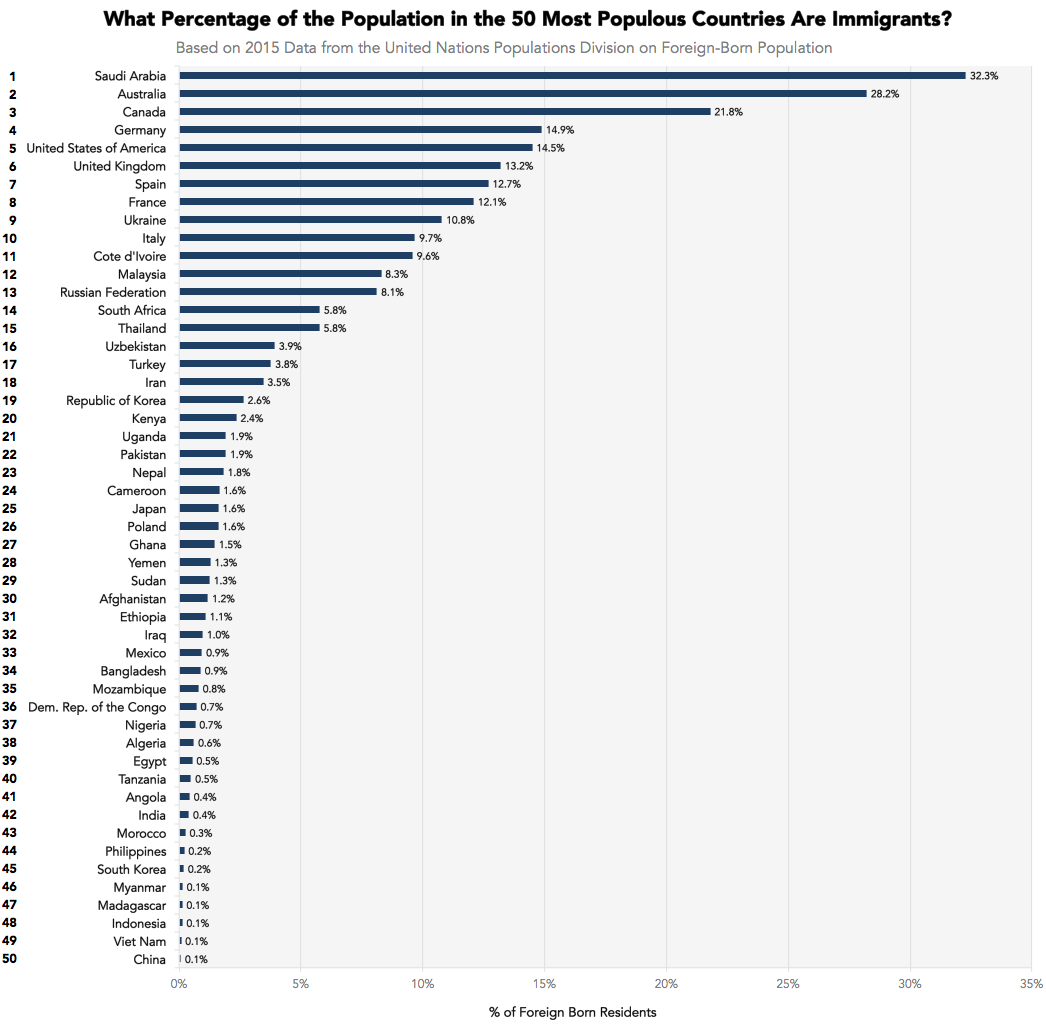
The variation across countries is stark. In nine of the world’s 50 most populous nations, more than 10% of the population is foreign-born. In contrast, foreign-born residents make up less than 1% of the population in eighteen of those 50 countries. Countries with large foreign-born populations tend to be high-income, and countries with fewer immigrants are low-income. (Wealthy Japan and less affluent Ukraine buck the trend.)

The following table ranks the world’s 50 most populous countries by percentage of foreign-born residents. Had we included all countries, the Vatican, where nearly all residents are foreign-born, would be number one.
Data: United Nations Population Division 

With nearly one third of its residents born outside its borders, Saudi Arabia has the most foreign-born residents of any large country. Saudi Arabia has a long history of allowing low-skilled foreign laborers to work in its construction sector, but rarely grants these migrants citizenship. 

While the United States (14.5%) and United Kingdom (13.2%) rank 5th and 6th respectively, Australia, Canada, and Germany all rank above them.

For most of the 20th Century, Australia (28.2%) has had one of the world’s highest rates of foreign-born residents. Over the last several decades, Australia has combined strict policies barring unauthorized immigration with a more expansive legal migration policy. Although it is emerging as a contentious political topic, concern about immigration has not reached the boiling point there as it has in the US and UK.

Canada (21.8%) is unique among the countries with a high foreign-born population in that there are few signs of increasing xenophobia. Canada has welcomed Syrian immigrants at a rate unlike any other country, and only a small minority of the country sees immigration as more of a problem than an opportunity.

Germany (14.9%) was the European leader in terms of taking in asylum seekers from 2008 to 2014. Though the country, which has an obvious history of nationalism and xenophobia, has recently seen the rise of an anti-immigration party, the mainstream parties in the country continue to be pro-European Union and pro-immigration.

The data suggests that the U.S. and UK do have large amounts of immigration, but so do others, and this cannot fully explain their mainstream, anti-immigrant backlash.

***

Perhaps the current political upheaval concerning immigration in the UK and U.S. is less related to the absolute number of immigrants, but rather in how quickly that number is increasing. As The Economist noted, the areas of the UK most likely to vote for Brexit were not the places with the highest proportion of immigrants, but areas that had seen the largest proportional increase.

The overall percentage of the world’s population living in a foreign country grew from 2.9% in 1990 to 3.3% in 2015. The following table shows which of the world’s most populous countries have seen the largest absolute change in their foreign-born population during that period. 1990 is the earliest year for which comprehensive data is available.

Data: United Nations Population Division 

With a 10.6% change in its foreign-born population, Spain moved from the 26th ranked country in 1990 in terms of share of foreign-born residents to 7th in 2015. This was largely due to Spain’s need for workers in the service and construction industries, sectors that could not attract native-born residents in sufficient quantities. So far, the country does not appear to be experiencing a marked rise in anti-immigration sentiment.

The four top countries, in terms of the absolute change in the proportion of foreign-born residents, are in the European Union.

Formally established in 1993, one of the precepts of the European Union is that its members’ citizens are free to immigrate to other member countries for education or work. This led to large migrations of citizens within the European Union from the poorer countries, mostly in the Eastern part of the continent, to stronger economies – such as the massive movement of Polish people to the United Kingdom.

Meanwhile, the United States saw the 6th largest increase in the proportion of foreign-born residents. Though the U.N. data is only available from 1990 onwards, older U.S. Census data shows that the current growth in the foreign-born population is the highest for the United States since the 19th Century.

The chart below from the Pew Research Center shows the relative size of the foreign-born population along with future projections. The share of the population that was not born in the United States reached a low around 1970, but has been steadily climbing since. This followed a change in policy in 1965 that ended country origin quotas and focused immigration policy on reuniting families and attracting immigrants with strong employment opportunities.

Source: Pew Research

The largest contributor to this growth of the foreign-born population in the United States is Mexico. In 2015, around 26% of the foreign-born residents in the United States came from our neighbor to the south. Of the ten large countries with the highest proportion of foreign-born residents, only the percentage of Russians in Ukraine (68% of the foreign-born population) exceeds Mexico’s share in the United States.

The table below displays the fifty most populous countries in the world along with the three countries where the largest proportion of its foreign-born residents come from. For example, at the very top of the table, we can see that 19% of Saudi Arabia’s foreign-born residents are from India, 13% from Indonesia, and 11% from Pakistan.

Data: United Nations Population Division 

Unlike in the United States, no one country accounts for more than 10% of the United Kingdom’s foreign-born population. People born in India (9%) account for the largest percentage of foreign-born people, followed by Poland (8%) and then Pakistan (6%)

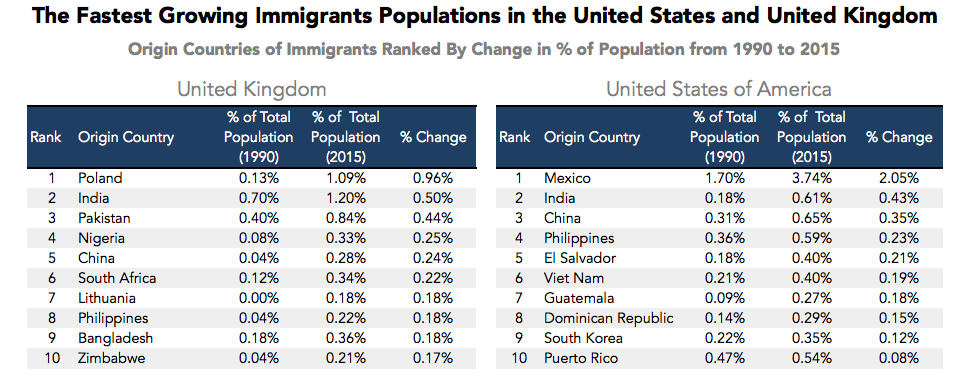
The following table displays a closer examination of the composition of the foreign-born population in the UK and U.S. Instead of showing the percentage of the foreign-born population from each country, here we show the share of the total population. For example, whereas people born in Mexico make up 26% of the foreign-born population, they make up only around 3.7% of the total U.S. population.

Data: United Nations Population Division – Territories such as Puerto Rico are listed separately from their home country.

Whereas all of the countries contributing the most migrants to the United States are low income, for the United Kingdom, a number of the sources of foreign-born residents are high income countries like Ireland (4th), Germany (5th) and the United States (9th). 

Yet if we look at which countries of origin have seen the greatest growth in the UK in terms of the proportion of the total population that comes from there, none of these countries appear. In other words, the composite of the current generation of immigrants is different from the last.
Data: United Nations Population Division

The percentage of the American population that was born in Mexico jumped from 1.7% in 1990 to above 3.7% in 2015. This 2% rise is almost five times greater than the change in the proportion of any other country. The increased number of Mexican-born residents accounts for almost 40% of the total increase in the foreign-born rate. When Americans speak about their concerns about immigration, they are largely speaking of the increased presence of Mexicans and other Central Americans.

Poland is the largest contributor of the growth in foreign-born residents in the UK. Only 0.13% (1 in 750 residents) in the UK were born in Poland in 1990; now it is well over 1% (1 in 90). Combined, the South Asian countries of India, Pakistan and Bangladesh increased from 1.28% of the population to 2.4%.

Meanwhile, very little has changed in terms of the percentage of people from rich countries. The proportion of the American population from Canada, the United Kingdom, and Germany has remained relatively flat. The number of people in Britain from Germany, France and the United States is growing, but each by 0.14% or less.

The changes in the UK and the United States are quite representative of trends in developed countries. While the proportion of foreign-born residents has increased dramatically in what the United Nations calls “More Developed Regions” – this includes Europe, the U.S., Canada, Australia, New Zealand, and Japan – the proportion of foreign-born residents in the “less developed regions” – including Africa, Latin America and Asia (except Japan) – has barely changed.

Data: United Nations Population Division

***

So is what is happening in the U.S. and UK unique?

The movement of people from poor to rich countries has been a part of world migration patterns for hundreds of years. In the 19th and early 20th centuries, immigrants from poor countries flocked to the United States for its economic opportunities. In the early 20th century, around 1% of the British population was born in less wealthy Ireland.

Most research suggests that, in aggregate, this pattern of immigration is very good for the economies of the United States, the United Kingdom and other high income countries. While American and British-born workers tend to be “mid-skilled”, immigrants are disproportionately high and low skilled workers who plug gaps in the labor force. Immigration has also been the source of much of the culture that Americans and British are most proud of.

But while immigration may be primarily positive, it is important to acknowledge that the proportion of foreign-born residents in the UK and U.S. is different – or, at least in the case of the United States, it is different from what most of the people alive today are used to. American Baby Boomers have seen the number of foreign-born residents steadily rise. The levels of foreign-born residents in the U.K. are probably higher than they have ever been.

***

In parts of the UK and U.S., anti-immigration sentiment has reached a fever pitch. For those who see immigration favorably, it is worth considering why that might be. The fact that the size and growth of the foreign-born population is reaching new heights is a likely contributor. But given that the same levels of nativism have not reached the mainstream in other countries with similar immigration growth rates, it is not the only explanation.

19 Jul 05:56

Supervisor of Elections Removes Radical Boca Mosque as Polling Site

by Joe Kaufman

After designating the Islamic Center of Boca Raton (ICBR) as a polling site for 2016, Palm Beach County Supervisor of Elections Susan Bucher reversed course and transferred the voting site to a library instead. Bucher claimed that her office received dozens of complaints about the mosque being used as a voting site, and the complaints are warranted, as ICBR has a plethora of ties to terror.

The Islamic Center of Boca Raton was incorporated in October 1998. Among its three founding directors is Syed Khawer Ahmad, a website designer for Hamas. Ahmad designed and was the webmaster for the official website of the Islamic Association, al-Jamia al-Islamiya, the charitable arm of Hamas that runs Hamas’ kindergartens and youth camps.

Another of ICBR’s founders and current ICBR President is Florida Atlantic University (FAU) associate professor Bassem Alhalabi. Prior to arriving at FAU, Alhalabi was located in Tampa at the University of South Florida (USF), working as an assistant to USF professor Sami al-Arian. This, while al-Arian was actively creating an American infrastructure for Palestinian Islamic Jihad (PIJ). In May 2006, al-Arian would plead guilty to providing services to PIJ. Alhalabi co-authored publications with al-Arian and, when applying to FAU, he used al-Arian as a reference.

Under Alhalabi’s leadership, for three years, the ICBR website had a violently anti-Semitic essay posted on it, titled ‘Why can’t the Jews and Muslims live together in peace?’ It stated, “Jews are people of treachery and betrayal… As the Muslims and Jews are enemies residing in opposing religious and doctrinal camps, it is not possible for them to be brought together unless one is made to submit to the other by force… [Muhammad] said, ‘You will fight the Jews and will prevail over them, so that a rock will say, O Muslim! There is Jew behind me, kill him!’”

In June 2003, the US Department of Commerce charged Alhalabi with illegally shipping a $13,000 military-grade thermal imaging device to Syria, a state sponsor of terrorism. Alhalabi has, as well, been arrested for assault.

A number of other ICBR associates have been arrested.

In October 2010, former ICBR imam Ibrahim Abdelrahman Dremali, who had been previously placed on the federal “no-fly” list, was arrested by federal immigration agents on charges of conspiracy to defraud the US and unlawful procurement of citizenship or naturalization. In May 2007, then-ICBR member Rafiq Sabir was sentenced to 25 years in prison for conspiring to provide material support to al-Qaeda. In July 2005, then-ICBR spokesman Daniel “Abderahman” McBride was arrested for his role in a wide-ranging insurance fraud scheme.

In November 2002, Dremali’s replacement as ICBR imam, Muneer Arafat, was arrested by INS and FBI agents in Sarasota, Florida for overstaying his visa. Prior to Sarasota, Arafat lived in Saint Louis, where he became acquainted with Sami al-Arian and where he roomed with al-Qaeda operative Ziyad Khaleel, the man who delivered the satellite phone that was used by Osama bin Laden to plan the 1998 bombings of US embassies in Kenya and Tanzania. In June 2005, while giving courtroom testimony about al-Arian, Arafat stated under oath that he himself was a member of Palestinian Islamic Jihad and that he was in favor of “destroying Israel.”

In January 2000, the Global Relief Foundation (GRF), a now defunct al-Qaeda-related charity, gave $600 thousand to ICBR as seed money towards the construction of a new 27-thousand-square-foot ICBR mosque, which has since been built. According to Ibrahim Dremali, who was a court witness for convicted GRF fundraiser Adham Amin Hassoun, ICBR gave close to $17 thousand to GRF in the year 2000. In December 2001, the US Treasury Department froze GRF’s funds, stating, “GRF has connections to, has provided support for, and has provided assistance to Usama Bin Ladin, the al Qaida Network, and other known terrorist groups.”

Palm Beach County Supervisor of Elections Susan Bucher, who had originally appointed ICBR as a polling place for the 2016 elections, has now reversed her decision. As stated by her, “We have moved our polling location from the Islamic Center to Spanish River Library due to complaints from the public. I do not have any other comment.”

Certainly all of the above information would warrant such complaints. Indeed, it would warrant shutting down the mosque completely – for voting or anything else.

The Council on American-Islamic Relations (CAIR), though, has labeled Supervisor Bucher’s action “religious bias” and a decision based on “discrimination.” The group has threatened to use “every legal avenue to prevent” the Supervisor’s decision.

About the issue, CAIR-Florida attorney Omar Saleh stated, “People of religion need to understand that we all have a common enemy – those who do violent acts in the name of religion.”

But why should anyone listen to Mr. Saleh, when CAIR and its local Florida office have been involved in and/or promoted terror themselves?

CAIR was established in June 1994 as part of a terrorist umbrella group headed by then-global head of Hamas, Mousa Abu Marzook. In 2007 and 2008, CAIR was named by the US Justice Department a co-conspirator for two federal trials dealing with the financing of millions of dollars to Hamas. A number of CAIR representatives have served jail time and/or have been deported from the United States for terrorist-related crimes. And in July 2014, CAIR-Florida co-sponsored a pro-Hamas rally in Downtown Miami, where rally goers shouted, “We are Hamas,” “Let’s go Hamas,” and “Hamas kicked your ass.”

The Supervisor of Elections has very legitimate reasons to rescind ICBR’s ability to act as a polling place for the upcoming election, whether CAIR likes it or not. The mosque’s laundry list of terror-related activities and individuals poses a significant security threat to the public.

The Islamic Center of Boca Raton should never have been considered an appropriate place for voters to enter and its Islamist and terrorist-related history disqualifies it from having any share in the democratic process.

Beila Rabinowitz, Director of Militant Islam Monitor, contributed to this report.

18 Jul 20:55

It’s the Middle East’s Turn to Buy American Hydrocarbons

by Jamie

Hydrocarbon trade between the Middle East and the United States has historically been something of a one-way street, as petrostates have made billions selling off their prodigious oil reserves and Qatar has solidified its position as the world’s largest exporter of liquified natural gas (LNG). But the American shale revolution is shaking up the status quo, and two recent shipments of LNG have recently punctuated that shift. The FT reports:

Two cargoes of US liquefied natural gas from Cheniere Energy’s Sabine Pass plant in Louisiana have been delivered to Kuwait and Dubai in recent months to meet the rapidly growing demand for energy.

This reversal of the well-established flows of hydrocarbons from the Middle East to the US reflects the boom in American gas production caused by the development of previously uncommercial shale reserves, and the soaring demand for energy in economies from the Gulf to north Africa.“We’re in a time of huge change in LNG shipping routes,” said Ted Michael of Genscape, a market data provider. “The old order is being overturned, and we haven’t seen the dust settle yet.”

A decade ago, the United States was busy building massive, costly LNG import facilities along its Gulf Coast. What a difference ten years and an energy revolution can make, as those import projects have been idled in favor of export terminals, where workers are chilling America’s substantial stores of shale gas into liquid form and sending them off to ports around the world. The first shipment went to Brazil, but since then cargoes have made their way to Europe and, now, the Middle East.

Like its oil counterpart, the global LNG market is well supplied at the moment, with Qatar and Australia already exporting larger and larger volumes while the United States looks to become a major player in the coming years as more export terminals come online. It’s a buyer’s market, too, as prices have steadily come down both as a result of contracts that have included linkages to oil prices (which are today less than half of what they were two years ago) as well as sluggish demand coupled with surging supplies.Selling LNG to Kuwait and Dubai won’t suddenly make the Middle East beholden to U.S. suppliers, but it does signal an important and ongoing change in global energy dynamics. And, as more Middle Eastern countries look to derive less of their electricity from costly and relatively inefficient oil-fired power plants, LNG demand should rise in the region. If and when that happens, there will be plenty of producers here in the United States willing to step up and subvert the traditional energy flows between the Middle East and America.
18 Jul 20:50

Black Milwaukee Sheriff Lashes Out At CNN's "Civility To Black Lives Matter's Hateful Ideology"

by Tyler Durden

Milwaukee Sheriff David Clarke lost his patience with CNN’s Don Lemon after the murder of three police officers in Baton Rouge, calling 'Black Lives Matter' a "hateful ideology" and, as he said on CNN,  demanding to know why the media has failed to focus on the epidemic of black-on-black violence.

The shockingly real exchange continued...

Asked if he would parrot a “message of peace and coming together for the country,” Clarke refused to regurgitate the usual rhetoric.


“You don’t believe that for one moment do you?” Clarke asked Lemon, before continuing, “Any protests over the deaths of these cops today in Baton Rouge? Any riots or protests over the police officers in Dallas, Texas?”


“What are you asking?” responded Lemon, to which Clarke shot back, “It’s a pretty simple question.”


Clarke then went for the jugular of ‘Black Lives Matter”.


“My message has been clear from two years ago – this anti-cop sentiment from this hateful ideology called ‘Black Lives Matter’ has fueled this rage against the American police officer – I predicted this two years ago.”


Lemon then suggested that the murders in Baton Rouge had little to do with ‘Black Lives Matter’, but Clarke wasn’t having any of it.


This anti-police rhetoric sweeping the country has turned out some hateful things inside of people that are now playing themselves out on the American police officer,” he asserted, before slamming BLM for ignoring black on black violence.


“When the tragedies happened in Louisiana and Minnesota, do you know that 21 black people were murdered across the United States – was there any reporting on it?”


Lemon then tried to shut down that line of conversation, before Clarke became more irate.


“I’m looking at three dead cops this week and I’m looking at five last week – you’re trying to tell me to keep it down?” he asked Lemon, who responded by demanding more “civility”.


“Don, I wish you had that message of civility toward this hateful ideology, these purveyors of hate,” said Clarke.


Lemon then kept speaking over Clarke before throwing to a commercial break.


Read more here...

Simply put, the CNN-sponsored narrative that black lives matter, of white privelege, and police racism just won't stand up to a) the misery, b) the statistics, and c) real people seeing through the farcical divisive lies.

Perhaps Don Lemon will wake up to the "service" he is doing to the American public by playing the politically-correct patsy?

18 Jul 18:24

Anatomy of Activism

by admin

There is one thing that activists can never, ever do:  declare victory and go out of business.   For activists, their chosen problem is always worse than ever and continuing to go downhill.

Here is an example, the book "Failing at Fairness," written in 1994 to make the case that education was failing girls.  Here is one summary of the book:

Drawing on findings from 20 years of research on sexism in American classrooms, this book examines the history of women's education and its shortcomings. The hidden curriculum, the effect of gender bias on self-esteem, test results, and professional orientation of girls from primary education through college were examined through naturalistic observation. The results suggest that girls are systematically denied opportunities in areas where boys are encouraged to excel, often by well-meaning teachers who are unaware that they are transmitting sexist values. Girls are taught to speak quietly, to defer to boys, to avoid math and science, and to value neatness over innovation, appearance over intelligence. In the early grades, girls, brimming with intelligence and potential, routinely outperform boys on achievement tests, but by the time they graduate from high school they lag far behind boys--a process of degeneration that continues into adulthood.

All of this will seem familiar, as women's groups typically claim that things have gotten worse on all of these fronts since 1994.   I have no doubt that these flaws exist, along with many others, in the government education system.  You certainly won't get me defending the public schools.  But I thought of this book today when I saw the chart below from Mark Perry, which I annotated with the publication date for Failing at Fairness:

college-degrees-annotated

It takes some work to look at this situation and decide that the main issue you want to highlight is how girls are getting hosed. But trust an activist to be up to the task.

Postscript:  This seems relevant (it has been around the net for a while, so I don't know what source to link, sorry)

stemwomen

17 Jul 19:56

The Turkish Witch-Hunt Begins: Erdogan Begins Arresting Government Critics

by Tyler Durden

Having arrested those who were supposedly directly involved in the attempted coup, which at last count this morning amounted to over 6,000 individuals of which 3,000 members of the army (or less than 1% of Turkey's 315,000-strong forces) and the Turkish legal system, including judges and prosecutors. That Erdogan was so quick in assembling a list of enemies in the judicial branch, whose arrests started early on Saturday even before the coup was fully doused, is the clearest indication that Erdogan was not only prepared for the "coup", but its inevitable outcome.

The video below released by the government Anadolu Agency, shows Turkish police interrogate senior army officers allegedly involved in the failed coup.

However, it was the next step that was the critical one: the one where Erdogan - having cracked down on his immediate military and legal opponents - took his crusade against everyone else, including the press and the educational system.

The first inkling of the upcoming "witch hunt" took place earlier today, when the Turkish police asked "citizens" to report those who support terrorism and crime. In other words, McCarthyism reborn, only this time the bogeyman is not communism.


And then, just hours later, we found out that the first casualty of this expanded witch hunt was none other than a person who had absolutely no involvement in the coup: a former university record, whose only crime was being a government critic, who moments ago tweeted that he was being arrested.


What happens next: an acceleration of the counter-putsch of course, with many more arrested, whose only crime is being guilty of criticizing the government.

The endgame is simple - it is shown in the "chart" below.

17 Jul 18:14

Who is Rodrigo Duterte?

by Harry Zieve Cohen

After a day of silence, Philippines President Rodrigo Duterte finally did something in response to the Hague’s South China Ruling. The Jakarta Post reports:

Philippine President Rodrigo Duterte asked former president Fidel V. Ramos on Thursday night to head the Philippines’ negotiation with China in the wake of an international court’s ruling recognizing the country’s maritime claims over the South China Sea.

Speaking at the testimonial dinner held in his honor at Club Filipino in Greenhills, San Juan City, the president reiterated that “war is not an option” in dealing with Beijing.He said he would seek the advice of several individuals, among them Ramos, in determining the next step for the government.

Putting the former president in charge of Manila’s biggest foreign policy problem is an unusual move, but Duterte is an unusual man.

A few days ago, we pointed out that the effect of the ruling would, in many ways, pivot on Duterte’s response. By putting Ramos in charge, Duterte hands the South China Sea off to the man who led the Philippines on its present collision course with Beijing. But does that mean Duterte will stand up to Beijing? It’s hard to tell, and a big part of the reason is that Duterte is himself a mystery.Duterte has been called a Filipino Donald Trump, but that undersells him. After all, Trump has never pushed anyone out of a flying helicopter or forced a tourist to swallow a cigarette butt. According to stories (perhaps circulated by the man himself), Duterte has done both. Trump threatens to sue journalists he doesn’t like; Duterte says he might kill them.Duterte is often considered an outsider, and he has assembled a motley coalition of allies that includes Muslim insurgents, members of the LGBT community (who have few rights in this conservative majority-Catholic country), communists, and many members of the middle class who believe the police do not have crime under control. Duterte’s electoral coalition was smaller than the reformist vote, which was split by Grace Poe and Mar Roxas. Out of eighteen districts in the Philippines, Duterte won only three and fewer than one in four voters preferred him to Poe and Roxas. If there had been runoff elections, Duterte likely would have lost. Out of twenty-four Senate seats, Duterte’s party has only one.Like many “outsider” candidates, Duterte has a long history in politics. His father was the mayor of Danao, a city on Cebu island. His cousin is the mayor of Cebu City. Duterte himself served as the mayor of Davao, a city of 1.5 million, for three separate stints. During two interval periods, Duterte’s daughter served as Mayor while her father “advised” her, first as a district representative and later as Vice Mayor. In Davao, Duterte was widely hailed for turning the “murder capital of the Philippines” into what tourism organisations now describe as “the most peaceful city in southeast Asia.”As President, he’s promised to bring the same tough-on-crime policies countrywide. In Davao, he formed a vigilante death squad group which was widely considered responsible for the disappearance of over 700 individuals between 2005 and 2008. People ominously whisper he may be planning to use similar tactics as president. In a 2012 press conference, Mr Duterte offered a $120,000 reward for whoever could bring him the decapitated head of an alleged gang leader. He offered an extra $24,000 if the head could be brought in a bag of ice, “so it won’t smell so bad”. He has promised that his presidency, which is limited to a single term of six years, will be “bloody”.On foreign policy, however, Duterte has almost no record of words or deeds. He has long used anti-American and anti-Australian rhetoric, and he once made people laugh (in a Catholic country) by saying Pope Francis’ mother is a whore. But that’s about it. Aside from suggesting on the campaign trail that he would be open to negotiating a deal with China, Duterte doesn’t seem to have many thoughts about foreign policy.When a group of business leaders presented Duterte with an economic plan, he said he wasn’t an economist and so would defer to their expertise while focused his policy energy on fighting crime. Is that Duterte’s model for foreign policy too? Will he let Ramos and those who developed Manila’s China policy keep the country on its previous course? Time will tell.
17 Jul 17:30

Illinois Obamacare Co-Op Goes Bust Leaving Tens of Thousands At Risk

by Tyler Durden

Submitted by Mike Krieger via Liberty Blitzkrieg blog,

The fact that Obamacare is a gigantic train wreck barreling uncontrollably into a brick wall is pretty much undeniable at this point. I’ve covered this reality from several angles in 2016, with one of the more popular posts being, The Health Insurance Scam – “Coverage” Doesn’t Mean Affordability or Access, in which I noted: 

Politicians, particularly those of the Democratic persuasion, love to throw around statistics about how many additional people have healthcare coverage without ever talking about the cost of such coverage, or whether it actually translates into actual access in the real world.


While a greater number of Americans having health insurance is a good thing when it comes to protecting against unexpected catastrophic events or extended hospital stays, it doesn’t tell you anything about two very important variables: 1) How much does it cost? 2) What kind of access does it provide? As usual, the devil is in the details.


We’ve all seen headlines about higher monthly premiums, but that’s just the tip of iceberg. Once you’ve paid your premium, you’re far from off the hook. Another one-two punch of deductibles, copays and out of pocket maximums appear which can collectively run into the thousands if not tens of thousands of dollars for families.

In my opinion, the above situation represents the number one failure of Obamacare, but there are others. Today’s piece focuses in on the state of Obamacare co-ops, which were “created under the federal health law to provide cost-effective coverage and competition in state insurance markets.”

Just like with Obamacare in general, stark reality is not living up to the sales pitch, and 16 of the 23 nonprofit cooperatives created nationwide have now failed.

As the Chicago Tribune reports:   

The Illinois Insurance Department moved Tuesday to shut down Land of Lincoln because of its unstable financial health, leaving about 49,000 policyholders in a lurch. They will lose coverage in the coming months, but neither regulators nor the company have said exactly when.


Policyholders will be able to buy insurance from a different carrier to cover them for the rest of 2016, according to the state Insurance Department. But switching plans is going to cost them.


The co-pays and deductibles enrollees have been paying since January will not transfer to new plans. A new plan will reset deductibles and out-of-pocket maximums paid by consumers.


Beyond the impact on consumers, the demise of Land of Lincoln is a significant setback for the Affordable Care Act in Illinois. The insurer was one of 23 nonprofit cooperatives nationwide created under the federal health law to provide cost-effective coverage and competition in state insurance markets. With Land of Lincoln’s failure, the list of co-ops has shrunk to seven.


Just last week, Connecticut took control of its health insurance co-op, but policyholders will have coverage until the end of the year, avoiding the disruption that is coming to Illinois, disruption that Illinois’ top insurance regulator warned the federal government about two weeks ago.


After a slow start in 2014, Land of Lincoln grew rapidly last year, finishing 2015 with more than 35,000 individual policyholders and about 15,000 members in small and large employer plans. The co-op captured about 6 percent of the individual market in Illinois, which was good for second place but well behind Blue Cross’ 83 percent market share.

Pretty massive concentration for a “free market.”

But Land of Lincoln lost more than $90 million in 2015, as the premiums it collected fell well short of the health-care costs of its enrollees. The shortfall in premium revenue was a problem also experienced by large, established insurers like Blue Cross that also participated in the restructured individual markets.


Shortfalls in anticipated levels of federal funding also put Land of Lincoln in a bind. While big insurers have the financial reserves to cushion against losses, Land of Lincoln was in a precarious condition at the end of last year. Still, Illinois insurance regulators allowed the company to sell plans for 2016 to consumers.


The company has continued to lose money this year, even after increasing rates by an average of 29.7 percent. Through May, the co-op lost more than $17 million, according to the state Insurance Department.


Land of Lincoln is the latest casualty in the health-care law co-op program. According to Americans for Tax Reform, the company is the 16th co-op to fail. The federal government financed co-ops with low-interest loans totaling $2.4 billion. In Illinois, the Metropolitan Chicago Healthcare Council, a hospital trade association, received $160 million in funding to start Land of Lincoln.


The company’s collapse will hit hospitals and physicians throughout Illinois. The company had nearly $49 million in unpaid claims at the end of the first quarter.

Very sad for the people affected. Obamacare is a dead man walking.


17 Jul 10:11

What are young men doing?

by Tyler Cowen

Here is Erik Hurst, from an excellent piece profiling Erik Hurst:

Right now, I’m gathering facts about the possible mechanisms at play, beginning with a hard look at time-use by young men with less than a four-year degree. In the 2000s, employment rates for this group dropped sharply – more than in any other group. We have determined that, in general, they are not going back to school or switching careers, so what are they doing with their time? The hours that they are not working have been replaced almost one for one with leisure time. Seventy-five percent of this new leisure time falls into one category: video games. The average low-skilled, unemployed man in this group plays video games an average of 12, and sometimes upwards of 30 hours per week. This change marks a relatively major shift that makes me question its effect on their attachment to the labor market.

To answer that question, I researched what fraction of these unemployed gamers from 2000 were also idle the previous year. A staggering 22% – almost one quarter – of unemployed young men did not work the previous year either. These individuals are living with parents or relatives, and happiness surveys actually indicate that they quite content compared to their peers, making it hard to argue that some sort of constraint, like they are miserable because they can’t find a job, is causing them to play video games.

This problem, if that is the right word for it, will not be easily solved.

The post What are young men doing? appeared first on Marginal REVOLUTION.

17 Jul 05:53

Cold, Dead Hands

by Kate

Things you'll never see on the CBC.

gundeaths.jpg

US stats of course, via Wretchard

16 Jul 16:25

What Brexit Means for British Shale Ambitions

by Jamie

One of the more interesting and less-discussed implications of Brexit has to do with British energy security—more specifically what lies ahead for the country’s dormant shale industry. As Reuters reports, the new Prime Minister Theresa May may be able to do what the recently-departed David Cameron couldn’t: namely, start bringing to market some of Britain’s estimated 1.3 quadrillion cubic feet of shale gas:

Britain’s shale gas industry could get a helping hand from a falling pound and a supportive new prime minister just as it is gearing up for its first production this year, after facing economic and political challenges that slowed its start. […]

In the speech launching her campaign for the leadership on Monday, May stressed the importance of secure energy supplies, which shale advocates say is one of their industry’s strengths. “I want to see an energy policy that emphasizes the reliability of supply and lower costs for users,” May said.

May shook things up in a different way on Thursday when she dissolved the country’s department of energy and climate change and created a new ministry. The FT has more:

Mrs May has shifted responsibility for energy issues to a new Department of Business, Energy and Industrial Strategy headed by Greg Clark, formerly secretary of state for communities and local government. Separately, former energy minister, Andrea Leadsom, a prominent Brexit campaigner who initially challenged Mrs May for the Tory leadership, has been promoted to secretary of state for the environment. Mr Clark said he was looking forward to “delivering affordable, clean energy and tackling climate change”, along with a comprehensive industrial strategy.

This is all so new that we still don’t know quite what it will mean yet, but it’s significant that energy concerns are no longer being grouped with environmental ones, but rather with business and industry. That certainly seems to send a signal that energy policy decisions will be evaluated more on economic merits than green concerns.

If that’s the case, then Britain’s shale potential could be one step closer to being realized.That said, the Cameron administration was itself fracking friendly—opposition to shale in the UK hasn’t come from the top-down, but rather from the bottom-up. Landowners lack the mineral rights that American property owners do, and therefore don’t have the same financial incentives to agree to shale operations in their communities. Moreover, Britain’s population density is higher than America’s, which necessarily increases the likelihood that NIMBYism might derail drilling efforts.May has already spent a notable amount of time in her short time as Prime Minister talking up the importance of energy security, and she’s right to label that a priority: with the end of North Sea oil production rapidly approaching, the UK desperately needs some good domestic energy news. Shale gas can be just that, but it’s going to take more than rhetoric from 10 Downing to make that a reality. May certainly has her work cut out for her.
16 Jul 15:15

Who Gave Us Justice Ginsburg?

by Tyler Durden

Submitted by Patrick Buchanan via Buchanan.org,

“Her mind is shot.”

That was the crisp diagnosis of Donald Trump on hearing the opinion of Justice Ruth Bader Ginsburg on the possibility he might become president.

It all began with an interview last week when the justice was asked for her thoughts on a Trump presidency. Ginsburg went on a tear.

“I can’t imagine what this place (the Supreme Court) would be — I can’t imagine what the country would be — with Donald Trump as our president. For the country, it could be four years. For the court, it could be — I don’t even want to contemplate that.”

Yet she had contemplated the horror of it all, as she quoted her late husband as saying of such a catastrophe, “It’s time for us to move to New Zealand.”

This week, Ginsburg doubled down.

“Trump is a faker,” she vented in chambers on Monday, “He has no consistency about him. He says whatever comes into his head. … He really has an ego. … How has he gotten away with not turning over his tax returns? The press seems to be very gentle with him on that.”

Sounding like Democratic Party Chair Debbie Wasserman Schultz, Ginsburg attacked the Senate for not voting on Judge Merrick Garland to fill the seat of the late Justice Antonin Scalia.

“That’s their job. There’s nothing in the Constitution that says the president stops being president in his last year.”

True, your honor, but there is also nothing in the Constitution that says the Senate must vote expeditiously, or at all.

Ginsburg hailed Justice Anthony Kennedy as “the great hero of this term” for his votes upholding abortion rights and affirmative action.

“Think what would have happened had Justice Scalia remained with us,” she added, which comes close to saying the death of the great jurist was not entirely unwelcome to the leading liberal on the court.


“I’d love to see Citizens United overruled,” Ginsburg volunteered, which gives us a pretty good idea how she will vote when that question comes before the court again.

As the Wall Street Journal notes, under Section 28 US Code 455, “(a)ny justice, judge or magistrate judge of the United States must disqualify himself in any proceeding in which his impartiality might reasonably be questioned.” Since “himself” and “his” refer to men, perhaps Ginsburg does not think the rules apply to her.

The federal code of judicial conduct for U.S. judges, says the Chicago Tribune, states that a “judge should not … publicly endorse a candidate for public office.”

But does not Ginsburg’s relentless trashing of Trump constitute a political attack on him, to help his opponent Hillary Clinton?

Ginsburg “should resign from the Court before she does the reputation of the judiciary more harm,” says the Journal.

There is a precedent. Justice Abe Fortas resigned in 1969 in a scandal when his ties to a convicted swindler became known.

But a dissent here. Why should Ginsburg resign? Did anyone doubt she held these views? Did she hide her radical liberalism from the Senate that confirmed her 96-3 in 1993, with only three Republicans dissenting, led by the venerable Jesse Helms?

Ginsburg was an ACLU lawyer and feminist-activist when she was named to the appellate court by Jimmy Carter. Her views were no secret to anyone when the Senate confirmed her.

Let us not pretend we did not know. Thus, why should she step down for airing political and ideological views everyone knew she held?

Liberal angst is understandable. Ginsburg is giving away the game.

How can liberals credibly uphold the pretense that Supreme Court decisions, where the left is the majority, represent judgments based on the Constitution, when Ginsburg, the leading leftist, has revealed herself to be a rabid partisan who can’t wait to use her judicial power to impose her ideology upon the United States?

Ginsburg detests Trump. She wants to kill super PACs. She thinks discrimination against white males is fine if it advances diversity. She thinks Republican Senators are blockheads who do not know their duties.

She thinks the death penalty is barbaric, and that abortion on demand and same-sex marriage are progressive. She is waiting for a case to come before her so she can restrict gun rights.

In a democratic republic, she has a right to hold and air these views.

But a democratic republic no longer exists when justices of the mindset of Ginsburg, who have never been elected, but serve for life, can impose these views, anti-democratically, upon the country.

Since the Earl Warren era, the Supreme Court has usurped the legislative power and imposed social policies, and Congress, which has the power under Article III to shackle the Ruth Bader Ginsburgs and restrict the court’s jurisdiction, has lacked the courage to do so.

This is the problem, not Ginsburg. She does what leftist ideologues do. The problem is elsewhere.

Pogo said it best, “We have met the enemy — and he is us.”

16 Jul 15:07

French Government Forced To Admit It "Suppressed News Of Gruesome Torture" At Bataclan Massacre

by Tyler Durden

Authored by Louise Mensch, originally posted at HeatStreet.com,

A French government committee has heard testimony, suppressed by the French government at the time and not published online until this week, that the killers in the Bataclan appear to have tortured their victims on the second floor of the club.

The chief police witness in Parliament testified that on the night of the attacks, an investigating officer, tears streaming down his face, rushed out of the Bataclan and vomited in front of him just after seeing the disfigured bodies.

The 14-hour testimony about the November attacks took place March 21st.

According to this testimony, Wahhabist killers reportedly gouged out eyes, castrated victims, and shoved their testicles in their mouths. They may also have disemboweled some poor souls. Women were reportedly stabbed in the genitals – and the torture was, victims told police, filmed for Daesh or Islamic State propaganda. For that reason, medics did not release the bodies of torture victims to the families, investigators said.

But prosecutors at the hearing claimed these reports of torture were “a rumor” on the grounds that sharp knives were not found at the scene. They also claimed that maybe shrapnel had caused the injuries.

Q. For the information of the Commission of Inquiry….can you tell us how you learned that there had been acts of barbarism within the Bataclan: beheadings, evisceration, eyes gouged out …?


Investigator: After the assault, we were with colleagues at the passage Saint-Pierre Amelot when I saw weeping from one of our colleagues who came outside  to vomit. He told us what he had seen.


Q. Acts of torture happened on the second floor?

Further on the investigator described how this was kept from relatives:

A. Bodies have not been presented to families because there were beheaded people there, the murdered people, people who have been disemboweled . There are women who had their genitals stabbed.


Q. All this would have been videotaped for Daesh !


A. I believe so. Survivors have said so.

Elsewhere, the investigator says, women were sexually tortured, stabbed in the genitals, and their eyes were plucked out. People were decapitated.

The clerk of the inquiry (or “rapporteur”) pressed the chief of committee for clarity on whether victims were decapitated or mutilated. The committee chief replied that the authorities had given out conflicting information that said victims were merely shot or blown up. He then added this damning statement about one victim’s father discovering the gruesome truth in the morgue:

Mr. President Georges Fenech Indeed, the Committee is troubled by this information which has appeared nowhere [in the media]. Thus, the father of one of the victims sent me a copy of a letter he sent to the investigating judge, which I quote in summary: “On the causes of the death of my son A., at the forensic institute in Paris, I was told, and what a shock it was for me at that moment, they had cut off his testicles, had put them in his mouth, and he was disemboweled. When I saw him behind glass, lying on a table, a white shroud covering it up to the neck, a psychologist was with me. He said: This is “the only presentable part, your son’s left profile.” I found that he had no right eye. I made the remark; I was informed that they had punctured his eye and  sliced down the right side of his face, where there was a very large hematoma that we could all see. ”


This particular witness could corroborate the statements that we heard from one of the BAC officials, that one of his investigators vomited immediately on leaving the Bataclan after finding a decapitation and evisceration. Are you aware of such facts?

A prosecutor appearing before the inquiry replied lamely that no sharp knife had been found at the scene that could have been used for torture. Perhaps shrapnel had caused the mutilation, he said. The head of the committee asked if an explosion would have placed testicles in a victim’s mouth:

Prosecutor: I specify, for the sake of clarity: some of the bodies found at the Bataclan were extremely mutilated by the explosions and weapons, to the point that it was sometimes difficult to reconstruct the dismembered bodies. In other words, injuries described this father may also have been caused by automatic weapons, by explosions or projections of nails and bolts that have resulted.


Q. Would those have put a man’s balls in in his own mouth?


Prosecutor: I do not have that information.

The news follows reports that German police sat on the huge number of sexual assaults committed by Islamist migrants in Cologne, which a secret report estimated at thousands, not hundreds.

* * *

What is there to add? Why suppress it? Is this just more disgusting appeasement, pandering, and suppression to ensure some fear-based control.. but not total economically-crushing terror? Tell The Truth!!

16 Jul 02:19

New York Times Climate Fraud – Called Out By The New York Times

by tonyheller

The New York Times claims that last year’s 10.1 million acres of fires was the most on record, even though it was a quiet year outside of Alaska and California.

Screen-Shot-2016-04-18-at-11.17.07-AM-down-1

Wildfires, Once Confined to a Season, Burn Earlier and Longer – The New York Times

Their claim is completely fraudulent. The New York Times reported twice as much burn acreage in 1937. Even worse, the 1937 data probably did not include Alaska, like the 2015 data did.

CgXAEhsVAAAmxCx

October 9, 1938 – NYTimes

The US Forest Service reported that five times as many acres burned in the 1930’s

figure16-1

Indicator 3.16: Area and percent of forest affected by abiotic agents

But New York Times fraud gets much worse. When CO2 was at pre-industrial levels, forest burned almost fifteen times as much land in the US.

2016-01-08-13-35-22

2016-01-08-13-34-55

https://www.nifc.gov/PIO_bb/Policy/FederalWildlandFireManagementPolicy_2001.pdf

There is zero evidence that “climate change” is increasing wildfires. We are having our fourth consecutive very quiet fire year here in Colorado. Newspapers like the New York Times lie about climate nearly every day as their standard operating procedure.

16 Jul 02:16

A Decades-old Product Can Stop 80% of Cavities, and the FDA Only Just Now Approved It

It's been used for decades in Japan, and it instantly stops hypersensitivity and tooth decay, as well as preventing cavities.

15 Jul 17:55

Are Republicans or Democrats More Anti-Science?

by Zach Weissmueller

It's popular to portray the GOP as the anti-science party and Democrats as the sane, "party of science" alternative.  And only 6 percent of scientists identified as Republicans, according to a 2009 Pew Research poll, which seems to be the most recent one on the topic. But the truth is that when science and politics meet, the result often isn't pretty, regardless of partisan affiliation.

Reason TV asked locals in Venice, California about their thoughts on various scientific policy questions and compared their answers to public opinion poll data. We found that many people favored mandatory labeling of food that contains DNA, the stuff of life contained in just about every morsel of fruit, vegetable, grain, or meat humans consume. Yet a recent survey out of the University of Florida found that 80 percent of respondents favor mandatory DNA labeling, only slightly below the 85 percent that favor labeling of genetically modified organisms (GMOs). While Republicans are divided evenly on the GMO question, Democrats rate them unsafe by a 26-point margin, despite almost 2,000 studies spanning a decade saying otherwise. 

Republicans are more skeptical of the theory of evolution, though by a surprisingly slim margin with 39 percent of them rejecting it as compared to 30 percent of Democrats. When it comes to other scientific matters, the waters are even muddier. For instance, Democrats and Republicans believe in the false link between vaccines and autism at roughly equal levels.

And it's largely liberal Democratic politicians pushing anti-vaping laws, despite public health agencies estimating e-cigarettes to be around 95% safer than conventional tobacco cigarettes and early evidence they help smokers quit. And vaping products don't contain any tobacco or its resultant tar, yet the FDA still wants to treat them as tobacco products.

The big science policy issue of the day, though, seems to be global warming. Sixty-four percent of Democrats believe in man-made global warming, while only 22 percent of Republicans do. But when it comes to realistic solutions to reduce greenhouse gas emissions, Democrats still aren't always science-minded.

Only 45 percent of Democrats support expanding the use of nuclear energy, as compared to 62 percent of Republicans, despite the fact that except for Chernobyl, not a single person, including nuclear workers, has ever died due to a commercial nuclear reactor accident.

Burning natural gas extracted through fracking is cleaner than oil or gasoline, and far more economically viable than non-nuclear renewable sources. And it emits half as much carbon dioxide, less than one-third the nitrogen oxides, and 1 percent as much sulfur oxides as coal combustion.

The ongoing switch from coal to natural gas to generate electricity is a primary driver of the reduction in U.S. greenhouse gas emissions by half a billion tons over the last decade, according to the EPA, which also has found no systemic evidence that fracking contaminates water tables. The U.S. Geological Survey found that fracking can cause "extremely small earthquakes, but they are almost always too small to be a safety concern," though larger earthquakes can result when operations dispose of wastewater by injecting it deep into the ground. 

So maybe it's not that Republicans are dumber than Democrats when it comes to science, or the other way around, but that both sides have blind spots when data-based evidence contradicts their political preferences.

Watch the full video above, or scroll down for downloadable version. Subscribe to Reason TV for daily content like this.

Produced by Zach Weissmueller and Justin Monticello. Additional graphics by Josh Swain. Music by Adam Selzer and Chris Zabriskie. Approximately 8 minutes.

14 Jul 09:03

Hillary Clinton Never Changes and Always Skates

by Andrew Napolitano

Hillary skates againWhen FBI Director James Comey publicly revealed his recommendation to the Department of Justice last week that former Secretary of State Hillary Clinton not be prosecuted for espionage, he unleashed a firestorm of criticism from those who believe that Clinton was judged by different standards from those used to judge others when deciding whether to bring a case to a grand jury.

The FBI investigation had a bizarre ending to it. FBI recommendations are never made public as this one was. Attorney General Loretta Lynch had been compromised by her politically disastrous but legally consequential meeting out of the view of the media with Bill Clinton just one week before Comey's announcement. Whatever they discussed, the overwhelming public impression was such that Lynch removed herself and her senior aides from the case, effectively leaving the FBI to have the final say. This is unheard of in the post-Hoover FBI.

The Comey announcement itself gave two reasons for recommending against indictment. One was that "no reasonable prosecutor" would take the case. That is not a judgment the FBI gets paid to make. The FBI's job is to gather, present, and evaluate facts and evidence, not predict what prosecutors might do with it. The other stated reason for recommending against indictment was that though Clinton may have been "extremely careless" in handling state secrets, she was not "grossly negligent," which is the standard required by the espionage statute.

Yet Comey also acknowledged that Clinton sent state secrets to nongovernmental colleagues who lacked national security clearances, that those people were hacked by hostile intelligence services, and that she used her numerous non-secure mobile devices recklessly while inside the territorial borders of those hostile governments. If all that is somehow extremely careless but not grossly negligent, then many who have done far less than Clinton — and have been prosecuted and convicted — were wrongly prosecuted.

Since Comey's announcement last week, several new factors have come to light. One is that the DOJ never presented any evidence to a grand jury. It never sought subpoenas from a grand jury. This is unheard of in major criminal investigations because the FBI alone has no subpoena power and needs a grand jury to issue subpoenas for it.

The absence of a sitting grand jury also makes one wonder about the circumstances under which and the purpose for which the DOJ obtained immunity for Bryan Pagliano, Clinton's internet technology adviser. She paid him $5,000 to migrate her public and her secret State Department email streams from the government's secure servers to her own non-secure servers. Immunity, which is essentially the pre-indictment permanent forgiveness of criminal behavior, cannot be given lightly and can only be given in return for testimony — usually to a grand jury or a trial jury. Strangely, that was not the case here.

Nevertheless, Clinton's persistent problems with personal honesty have brought her face to face with three more criminal investigations. One is for public corruption. The second is for perjury. And the third is for misleading Congress.

The public corruption investigation has been underway for a few months. The allegations are that she exercised the powers of her office as secretary of state to enrich her husband and herself. The evidence here is ample. There are dozens of documented instances in which foreign governments and individuals received beneficial treatment from her State Department — usually exemptions from compliance with American laws or — and then collectively gave hundreds of millions of dollars to the Clinton Foundation at a time when it was not a registered lawful charity.

The second investigation Clinton faces is for perjury. This arises out of a Freedom of Information Act (FOIA) civil lawsuit during which she swore in writing and under oath, citing the phrase "under penalty of perjury," that she surrendered all of her work-related emails to the State Department. When she left the State Department, she effectively took all of her emails with her. Then, when the FOIA cases began, she returned about half of what she had taken, claiming that the other half was personal.

The FBI found that she failed to return thousands of work-related emails, some of which she and her lawyers attempted to destroy and some of which they succeeded in destroying. Who ordered the destruction?

Finally, Clinton will most likely be confronted with charges of misleading Congress. Misleading Congress consists of intentionally creating a false impression in response to material congressional questions. She did this when she denied to the House Select Committee on Benghazi that she had sent or received emails via her home servers that contained state secrets.

The FBI found 110 emails in that category, at least two dozen of which were at the highest level of protection that the government accords its secrets. She also told that same committee that she had surrendered all her work-related emails to the State Department.

Former New York Yankees pitching great Roger Clemens was tried twice (after a trial that ended with a hung jury, he was ultimately acquitted) for misleading Congress when he was forced to speak to a House committee about the contents of his blood and urine as a baseball player. Clinton has misled Congress about her lawful obligations as secretary of state, and she skates free.

Back in the Whitewater days, when the propensity of both Bill and Hillary Clinton to lie routinely and naturally first became apparent to the media and the public, the late, great New York Times columnist William Safire referred to Mrs. Clinton by a moniker that enraged her husband. He became so fearful of the truth and so furious with Safire that he publicly threatened to punch Safire in the nose.

Safire called Hillary Clinton a congenital liar. He was right. That was 20 years ago. Some people never change.

COPYRIGHT 2016 ANDREW P. NAPOLITANO | DISTRIBUTED BY CREATORS.COM

12 Jul 21:26

The New York Times and the Left Have Blood on Their Hands

by Dennis Prager

It was very appropriate that on Friday, the day after the massacre of five Dallas police officers, The New York Times devoted nearly the whole top half of its front page to four enormous photos of the death of Philando Castile, a black motorist killed by a Minnesota police officer.

Of course, the paper was printed prior to the Dallas murders; and even The New York Times might not have so prominently featured the Minnesota killing on its front page had the Dallas murders occurred a few hours earlier.

Nevertheless, it was completely appropriate. The New York Times has been in the forefront of the left's hysterical, hate-filled attacks on police officers and whites.

Also appropriately, on the day of the Dallas murders, the Times published two white-hating, police-hating pieces. 

One was by Michael Eric Dyson, a radical black professor of sociology at Georgetown University. 

The Dyson column is nothing more than a racist hit piece on "white America."

An example:

"At birth, (whites) are given a pair of binoculars ... Those binoculars are privilege; they are status, regardless of your class. In fact the greatest privilege that exists is for white folk to get stopped by a cop and not end up dead when the encounter is over."

Dyson wrote these words based on the police killings of two blacks last week, about which he knows nothing except the narrative of the (left-wing) media and what he has seen on some grainy phone videos.

And not once does Professor Dyson mention that the Minnesota police officer was Latino. Why would he? That would suggest that Latinos, too, are given racist binoculars at birth. But Dyson would never say so, because it is white America he loathes.

Nor does he note, or perhaps even know — because of his left-wing binoculars — facts such as these:

In 2015, of the 990 people shot dead by police, 93 were unarmed and 38 of them were black. Of the 505 people shot dead by police thus far in 2016, 37 were unarmed and of them 13 were black. Given that blacks murder and rob more than whites — they committed 62 percent of robberies, 57 percent of murders and 45 percent of assaults in the 75 biggest counties in the country in 2009 (despite comprising about 15 percent of the population in these counties) — an unarmed black is less likely to be killed by police than an unarmed white. (Data from the Washington Post.)

Does Dyson, a professor of sociology, not know these statistics? Does he not know that, statistically, whites have more reason to fear being murdered by a black than vice versa? If he doesn't, he shouldn't be teaching sociology. If he does, students should be aware that he is a left-wing, black nationalist propagandist, not a teacher.

The same day the Times published Dyson's piece, it published a second anti-white, anti-cop, hate-America piece by the mother of Michael Brown, the young black man killed in Ferguson, Missouri. That black grand jurors and even Obama's Department of Justice found the policeman who killed Brown was acting in self-defense after being attacked and thus justified him in doing so means nothing to The New York Times. So it published the grieving mother's anti-cop hate.

The blacks and whites of the left have led much of America, especially black America, to believe that cops are generally racist, that there is "systemic" racism and that whites are privileged and racist. It's all a lie that has had — and will continue to have — murderous consequences.

America has become the least racist multiracial, multiethnic country in world history. This drives the America-hating left crazy. That's why leftists manufacture fantasies like "microaggressions" — non-racist statements that the left labels racist, foolishness like "white privilege" and the dangerous rhetoric of "Blacks Lives Matter."

Just yesterday The New York Times published the results of a study conducted by a black Harvard professor of economics that shows that "when it comes to the most lethal form of force — police shootings — the study finds no racial bias."

"It is the most surprising result of my career," said Roland G. Fryer Jr., the author of the study. 

One assumes that this Harvard professor has never read Heather Mac Donald or any other conservatives who have been writing this for years.

The New York Times — as the flagship publication of the left — and the rest of the left have the blood of police on their hands. And not just cops' blood — the blood of the blacks murdered because of police reticence to vigorously patrol black areas. What is known as the "Ferguson effect" was created entirely by the left.

09 Jul 00:23

Observations on Communist Cuba

by Casey B. Mulligan

Background to these observations

Fidel Castro took power in 1959 (“the Revolution”) and soon thereafter made the country Communist (i.e., most assets were owned by the government).  Cuba allied with the USSR from which Cuba received large subsidies until the USSR collapsed (1989).  Fidel’s brother, Raul, succeeded him in 2008, and since then a few more types of private ownership have been permitted.  The POLITY IV international study of governments assigns Cuba the absolute lowest democracy score, going back to 1955.


The U.S. government only permits its citizens to travel to Cuba for specific reasons, and tourism is not one of them.  My family took a one-week trip (to Havana, suburbs, and Pinar del Rio) that fit into the “person-to-person” category.  The trip was organized by a U.S. tour company, which chose from a list of activities presented to them by the Cuban government.  We had free time during which we could, say, walk or take a taxi anywhere we wanted.  Most of the people we encountered during the organized part of the tour were presumably screened by the Cuban government at the same time that they were competing to be chosen by the tour company.


Outward appearances

 “next to bombing, rent control seems in many cases to be the most efficient technique so far known for destroying cities.” Assar Lindbeck (1971, p. 39)

Lindbeck could have been describing the buildings – both housing and structures used for production – in Havana Cuba as they appear today.[1]  I saw buildings that were just piles of rubble.  Others that were half standing, half rubble pile.  Many others had major holes in the roof (in multi-story units, which are the norm in Havana, a hole in one family’s ceiling is often a hole in an above-neighbor’s floor).  Frequently there is no external paint (perhaps they were painted in the 1950s).  A rainy afternoon means that electricity will be lost and more homes will collapse.  Other buildings are newly renovated or in the process of renovation.  The above description applies just as well to the waterfront structures (i.e., in the tourist area) as to inland ones.


Many porches, balconies and windows have barred or wired covering.  In America, such covering would be understood as an anti-trespassing device, and this was obviously the case for some of the Cuban windows.  But in other cases I suspect that the covering is intended to prevent occupants and their possessions from falling out.


Structures’ disrepair is less obvious in rural areas.  Part of the reason is that even many rural American structures have obvious disrepairs.  Another reason is a differential maintenance incentive in rural areas (discussed below).


      I saw hardly any advertisements for products, services, or activities.  Essentially all advertisements are propaganda from the government, such as “Socialismo o muerte” (socialism or death) written in four-foot letters on a wall along the road, or “Orgullossos de nuestra revolucion” (proud of our revolution) and “Dos grandes titanes de nuestro hemisferio” (two great titans of our hemisphere, describing pictures of Che Guevara and Antonio Maceo) on 3-by-8 foot signs, or “Hasta la victoria siempre” (keep fighting until victory, a quote from Che Guevara) written on the side of a building and on large signs.


            Automobiles have license plates that distinguish private from government owners.  Private-owned cars appear to be a large minority of all cars.  Essentially all private-owned cars predate the revolution (i.e., 1959) and do not have seatbelts.  A number of those are painted beautifully and used to entertain tourists.  Those used by locals are typically missing much of their paint.  The government-owned cars, which include all of the official taxis, are typically circa 1980 and of socialist origin (e.g., USSR or Poland).  I saw a few 21st century cars that appeared to be owned by diplomats.  The overall number of cars appears to be low in comparison with the number of people.


            The automobiles share the road with buses (almost always full with people), motorcycles and other small-scale motor vehicles, and horse-drawn vehicles.  There are not many bicycles.  Outside the city, the ratio of horse-drawn vehicles to automobiles is greater.


            Lots of people are not in a vehicle, but appear to be waiting for one.  Many people have smartphones that capture their attention (not with live internet – more on this below), but hardly anyone uses them as a listening device while they are waiting.


            The dress of the people is not remarkable, especially considering that the weather is often hot, although a number of people appear to be off-duty military personnel with sharp but uncomfortable-appearing uniforms.  Whether at home or in transit, people make an effort to stay out of the sun.  The nontourists – ie, people standing outside of homes or driving in the private cars – all appear to be of Cuban origin.


            A number of women are overweight.  It is less common for men to be overweight.  I did not see people who appeared underfed, but most livestock appear that way.


Asset ownership

            A lack of private property is perhaps the distinguishing feature of communism.  Here is what I saw and learned regarding asset ownership in Cuba:


Residences

Until recently, Cubans could own their home but could only sell a home to the government.  In other words, it was more like living as a tenant for zero rent and being paid something for vacating.  Now Cubans tell me that they have a right to buy and sell homes (since 2011; even now Cubans cannot own more than two homes), and that Cubans typically live in a home owned by a family member.  They do not pay property taxes and often do not have mortgages, but they do pay for metered electricity and gas.  For multi-unit buildings, it has never been clear who has the property rights (does the roof of an apartment building belong only to those who live on the top floor?).[2]


The urban residences are densely populated.[3]  They were originally constructed in the 1920s or 1950s with tall ceilings and room sizes that would be familiar to Americans.[4]  But since the Revolution the rooms and hallways have been subdivided many times, including vertical subdivisions known as barbeques.[5]  Not much lighting is used.  One of the images below shows a picture of a barbeque from the inside (and underneath).  The other is an image taken from outside the building through the window.


The disrepair and proliferation of subdivisions are to be expected when quality housing is prohibited from commanding a price or rent premium in the marketplace and when property rights are lacking, as during the half-century before 2011.


The government says that a large majority of residences are owner occupied.  I don’t know how this statistic counts the barbeques and other subdivisions.


Automobiles

            A number of automobiles are privately owned.  Those used by tourists are sometimes owned by a group of people (i.e., a business).  Because the old cars had to be owned by someone during all of the years of the revolution, it would not surprise me to learn that private automobile ownership is not at all new.[6]


            The official taxis are government owned.  Drivers pay for fuel and pay a daily rental to the government and keep the residual.[7]  Taxi driving is one of the high-paying jobs: doctors are known to drive taxis in their spare time (known as “left-hand jobs”).


            The lack of Asian- or Western-European-made automobiles, even for government ownership, suggests that the U.S. embargo (which the Cubans call a blockade) may be working at preventing the important of even non-American products.


Boats

            Government permission is needed to have a boat.  The fishermen’s boats are smaller than a normal rowboat and therefore too small to take far from shore (e.g., to another country).  Most seafood has to be imported.  This is a clear case where the regime has sacrificed productivity in order to exercise control over its people.


Livestock

            Cows are still government owned.  They cannot be killed for beef; all beef is imported.[8]  It is also illegal to sell beef in some situations.  I believe that Cubans can own chickens and other birds.  Urban dwellers may even be encouraged to own chickens.  I do not know who owns the horses.


Land

            Rural families can own up to 10 hectares (i.e., 25 acres) of land or so.  The land has sometimes been owned by a family for generations – predating the revolution – but the Revolution subdivided large plots and left their original owners with just one of those.


Businesses

            The government does not acknowledge businesses per se, but there are small-scale private employers who are officially referred to as the “self-employed.”  For example, restaurant owners (including partnerships) may hire waiters.  Automobile owners/partnerships also hire drivers, although perhaps this is not legal because the official taxis are government owned.


            There are families who are permitted to rent out space in their homes to tourists.  A blue emblem marks such homes.  These homes are nicely maintained.


A private person or business cannot own a hotel.  Hotels are owned by the military, and some of them are managed by international hotel companies.[9]


            Professionals, such as doctors, architects, or teachers, have to do that work as government employees.  In other words, there are no private-sector professional-service businesses.


Labor

            Cubans own their labor in the sense that they get wages for most of their work.[10]  However, their employer is typically the government and those wages are far below their productivity (which is itself low).  Government employees were paid about $20 per month in 2014, whereas monthly national income per worker was $839, which suggests that government employees keep about five percent of the value of what they produce.[11]


            Although some Cuban athletes have defected to the United States (see below), some of them were legally employed by (non-US) international teams as Cuban citizens, in which case their entire salary belonged to the Cuban government.  That policy was changed recently, and now the internationally-employed Cuban athletes keep 80 percent of what they earn.


            A number of physicians have been internationally employed and their salaries also belonged 100 percent to the Cuban government.  I don’t know whether physicians currently enjoy the 80-percent rule that applies to internationally-employed athletes.


            Cuba has a military draft, applicable to both men and women, and the draftees must serve two years.


Computers

            People may own a computer and have it in their home.  But, with the exception of doctors and some others, they cannot have internet access at home.  There are now public wifi hotspots, which the people commonly use with their smartphone.  E.g., it is common to see families in a public wifi park using Skype to show themselves to a friend or family member elsewhere.  I did not see anyone in those parks with a laptop computer.


            The internet at my hotel was heavily password protected, but once online appeared to be unrestricted.  I could not reach a few sites, but likely because of the (poor) quality of the connection and not overt censorship (to be experienced by international visitors).


            Smart phone ownership is common.  People keep pictures on them, and also use them to view material that they downloaded at their previous hotspot visit.


Working Conditions

            The workweek probably varies by occupation, but the factory workweek is Monday through Friday and every other Saturday.  I don’t think that this counts the “volunteer work.”


            It is hot in Cuba, but I don’t think that workplaces typically have air conditioning.  We visited a tobacco-leaf factory.  The only decoration on the walls was (plenty of) propaganda, as in the images below.


            The government pay scale does not vary by region.  I am not sure what is the incentive to live in dense urban areas, except perhaps the lack of transportation or access to tourists.


Shopping

            Cuban families receive a ration book that allows them to obtain food (for ten days a month?) at regulated prices in quantities according to the size and composition of their family.


            We were told not to take pictures in the food stores.  I visited one of them and was encouraged to leave because “it was not for tourists.”  I sat outside another as customers came and went.


            The stores sell less than two dozen distinct items in large quantities.  E.g., large containers of canned mangos, three-liter bottles of soda, three-liter bottles of water, eggs in trays of 30.  There was no refrigeration, even though it was hot.  There are plenty of flies and stockouts.  The image below was taken from the street through the store window.


            Large containers are probably not what people would pay for in a market setting, given that so few of them have cars (although I saw a couple of customers pull up in horse-drawn carts) and the small size of their living places.  But packaging, availability, variety, and refrigeration are all good examples of non-price product attributes that can be expected to disappear when prices are regulated (Mulligan and Tsui 2016).


            Clothing and electronics are, and market exchange rates, cheaper in the U.S. than in Cuba.  Many of these items are obtained when Cuban-American family members visit.  I don’t know if or how they were obtained prior to 2009, when the family visits began to be permitted.


Health and Healthcare

            The usual calculations of average life expectancy put Cuba next to the United States (and Puerto Rico).  This is touted – by the UN, the World Bank, the Kaiser Foundation, and others – as an example of how a socialist system can even make a poor country one of the healthiest in the world.


            Based on what I saw, I am dubious that Cuban health is anywhere near what it is in developed countries.  The people are short.  I guessed that diabetes was high, and upon return home learned from the International Diabetes Federation web site that the prevalence of diabetes is high by worldwide standards.


Cubans commonly practiced almost every unhealthy habit.  They ride motorcycles, they don’t wear seatbelts, and they walk in traffic.  I saw a motorcyclist drinking a beer and driving by a policewoman, with no consequence.  They eat lots of eggs.  Cigarettes are cheap and people smoke.  I doubt any of the vehicles would pass EPA emission standards.  An oil refinery operates in Havana and spews out far more smoke than a stack in, say, Joliet IL.  Nutrition was poor in the 1990s, when starvation was a real concern.


            Healthcare, including plastic surgery and abortion, is free.  However, the hospitals are severely lacking equipment and patients rely on family for food, pillows, aspirin, etc.[12]


            Under the theory that health is a lifelong accumulation of experiences and investment – including experiences in the mother’s womb, at birth, and early childhood – the official life expectancy statistics are dubious.  World Bank data, sourced from individual-country governments on the basis of age-mortality profiles at the time of reporting, show Cuba’s life expectancy catching up to the United States already by 1973.[13]  How could the post-Revolution Cuban system have that effect, when in 1973 the large majority of Cubans had lived the large majority of their lifetimes under pre-Revolution conditions?  Why hasn’t Cuban life expectancy far surpassed American, now that, in contrast to 1973, most Cubans have lived most of their lives post-Revolution?  Perhaps the main effect of the Revolution was to change the way that Cuba reported life expectancy to international organizations.


Politics

            To be blunt, my overall impression is that Fidel Castro is like an abusive father with several million “children” that he abused.  Many of them ran away from home and still hate him many decades later (you can meet them here in America).  Others stayed, continue to take the abuse, and focus on a few apparently good things that he does/did.  To put it another way, the Cubans still in Cuba obtain a significant amount of some kind of psychic value from Castro and the Revolution that partly offsets the large tax they implicitly pay in terms of foregone freedom and material goods and services.


            Cuba had a literacy campaign in 1961 in which the government sent (drafted?) primarily urban (schooled) teenagers into the country to help farmers with the farm work during the day and teach farmers to read in the evening.  The final project for the newly literate citizens was to write a letter to Fidel.  It had a real impact on literacy.  The persons involved now fondly remember their experience.  They give Fidel (and Che Guevara) credit for this.


            Crime, including “victimless” crimes such as narcotics and prostitution, appears to be low (but there is bicycle theft; see also above regarding bars on windows).  Guns are permitted at isolated hunting clubs.  Until recently, Cubans were not even allowed in hotel rooms.[14]


            The Cuban people also see some (supposed) wisdom in “agricultural diversification” policies (i.e., trying to substitute non-sugar agricultural production for the production of sugar) of early in the Revolution.[15]  They also appreciate Fidel’s modesty (e.g., little of the propaganda refers to Fidel directly).


            The Cubans seem to appreciate Che Guevara, which I find ironic because Che is the member of the Revolution who thought that he would help the poor with Communism when in fact he harmed them.  I would ask “¿te gusta Che?” and they would reply affirmatively.  I saw memorials to him in the neighborhoods, away from tourist areas, made by the residents.  A couple of people (probably not screened by the government) mentioned that Che set a good example by living an austere life and participating in the forced “volunteer work.”  Nevertheless, judging from the souvenir shops, Che is more popular among tourists than among the locals.


            Of course, Castro initially said that he was not a Communist and would not take people’s property.  But, they say, the world was being divided between the USSR and the USA, and the USA’s policies left Cuba no choice but to choose USSR and Communism.


When Fidel was the official head of government, he would give eight-hour speeches.  People would be quizzed by party officials on the contents of those speeches!


            We heard from a university professor who had worked in Cuba’s State Department.  She made a big deal that Cuba participates in various international conferences (as if that makes any difference to a regular citizen).


She also blamed Spanish imperialism for Cuba’s troubles.  I asked her how then to explain Puerto Rico’s trajectory.  She thought that the Philippines were a better benchmark.[16]  But she also said that one of her students wrote a paper arguing that Cuba would have been better off to have become a U.S. territory, and that she awarded the student an A on the paper.  I think that was a delicate way of agreeing that Cuba should have been able to do as well as Puerto Rico.


Cubans want the U.S. embargo to end, have opportunities to enter the U.S. in the future, and have a thriving tourism industry.  These are a couple of reasons why they follow U.S. elections closely, and hope that Donald Trump loses.  The university professor also said that “Cubans follow your elections, not their own.”[17]


All media belongs to the government.  My favorite article in the official newspaper Granma is one about how Cuban athletes excel in international rowing competitions!


In order to make opposition more difficult, paper is scarce throughout the country.  This is another clear case where the regime has sacrificed productivity in order to exercise control over its people.


Dissidents distribute their writings by typing offline, connecting to a hotel’s wifi (intended for international visitors), and uploading content to a server outside of the reach of the government.  I asked about one of the more famous of these bloggers, Yoani Sanchez.  People did not express specific disagreements with her, but emphasized that she was tainted by funders outside of Cuba.[18]


Defection from Cuba is a vivid example of the social multiplier.  We met Cuban national pitching legend Rolando Macias.  Circa 1970 he was asked to sign with the Brooklyn Dodgers, the Cincinnati Reds, and the New York Giants.  At that time, no athlete had yet defected.  Macias said no to all three teams, and played his career in Cuba.  If he had defected, perhaps the government would have caused trouble for his family?  Today he clearly enjoys being a famous person in Cuba, and says that the government treats him (and players like him) well.[19]


Now defection among athletes is more common and accepted by those in Cuba as a “economic decision.”  Now there are also large Cuban-American communities that can be joined by a defector.


            Another way of limiting defection is to provide education locally, so that it is less desirable for students to seek training abroad, and then never return.  Moreover, the government has no control over the content of internationally-located programs.


A bit of interpretation

A Third-World Benchmark?


            Some readers might think that the conditions described above are not a particular consequence of Communism, because much of the third-world has these conditions without being Communist.  I disagree.  There are at least four things that make Cuba different from noncommunist third-world countries.  First, most Cubans can do better outside their country, and they know it.  This is why so many of them try to escape, and the government does so much to stop them.  Some of them even escape to other third-world countries.  Second, Puerto Rico far outpaced Cuba while the latter was practicing Communism.  In 1950, both were former Spanish colonies and had annual GDP per capita of about $350.  In 2014, Puerto Rican GDP per capita was more than quadruple Cuba’s.  Havana is now far more densely populated than San Juan is.  And a number of people escaped Cuba to begin a new life in Puerto Rico, with hardly anyone doing the reverse.


            Third, even if we ignore the gains enjoyed by people who manage to leave Cuba, indicators of Cuban human capital suggest that they would be surpassing third-world status if it were not for Communism.  Literacy and school attendance appears to be high.  The official statistics say that Cubans are more literate and have spent more time in school than Argentinians, yet the Argentinians are twice as rich.[20]


            Fourth, Cubans once had nice things (by international standards), such as new cars and apartments newly built without barbeques.  Cuba circa 1950 ranked among Western European countries in terms of per capita calorie consumption and automobile ownership.  Cuba fell into the ranks of the third world, as opposed to failing to ever rise out of them.


Blame the Embargo?

            The U.S. embargo appears to have harmed the Cuban people.  It has also allowed the Cuban government to blame the situation on something other than Communism.  Perhaps it even increases the harm done by Communism, because property rights would be especially valuable for an economy that is prevented from specializing in a few tasks/products.  I doubt that eliminating the embargo would be more helpful than eliminating Communism, because the later not only restricts international trade, but also intranational trade.  Moreover, the embargo does not stop Cuba from all international trade: "just" direct trade with any business that also has enough of a U.S. presence that it can expect its U.S> operations to be punished (indirect trade is possible, but more costly).  But I don’t have a good way to estimate the separate impacts of Communism and the embargo on Cuba.  For what it is worth, the Cuban government and the Cuban people I met now believe that Cuba can blame only part of its situation on the U.S. embargo.


[1] Block and Olsen (1981) present a sequence of photographs that alternately show buildings that experienced rent control and buildings that experienced bombing, and ask their readers to guess which is which.  I had thought that they were exaggerating, but after visiting Cuba I see their point.

[2] Urban residences are essentially all multi-unit.  Residences outside of the city are commonly, but not exclusively, multi-unit.

[3] A government architect who is part of the department of renovation told me that Old Havana is about 23,000 square meters of land (including non-residential parcels, which are about 1/3 of all buildings in the area) and houses 70,000 people. But note that the 23,000 estimate seems orders of magnitude too small.

[4] A government architect who is part of the department of renovation told me that 80 percent of residences in Old Havana were originally constructed in the 1920s or 1950s; only 8 percent were originally constructed after the revolution.

[5] As a New York Times writer put it “Many residents have subdivided their apartments to Alice in Wonderland proportions.”

[6] Although businessinsider.com reported that person-to-person automobile sales were prohibited prior to 2011.  New York Daily News reported that Cubans were prohibited from buying automobiles from the state prior to 2014.  But a number of Cuban families may have retained the cars that they owned prior to the Revolution.

[7] Fuel is cheaper in the U.S., and more expensive in Europe, by comparison to Cuba.  At prevailing exchange rates, a taxi fare in Havana is pretty similar to an UberX fare in Miami.

[8] It is sometimes said that cow murder is punished more severely than human murder.

[9] The military ownership is not visible to tourists.

[10] There are instances of “volunteer work” that citizens must perform on weekends.

[11] http://latino.foxnews.com/latino/news/2014/06/17/average-salary-in-cuba-rose-1-pct-last-year-to-20-month/.  National income per person was $462 (http://www.brookings.edu/blogs/brookings-now/posts/2015/07/ten-economic-facts-about-cuba ) and employees per person were about 0.55 (http://data.worldbank.org/indicator/SL.EMP.TOTL.SP.ZS).   Assuming a ratio of average productivity to marginal productivity of 2, that makes labor’s marginal product $420 per month.

[12] The Cuban hospital is another good example of the dearth of non-price product attributes when prices are regulated (at zero in this case).

[13] https://www.google.com/publicdata/explore?ds=d5bncppjof8f9_&met_y=sp_dyn_le00_in&idim=country:CUB:USA&hl=en&dl=en

[14] There was no tourism prior to 1989.

[15] The policies may have been wise from the point of view of the government survival: the world price of sugar affects the opportunity cost of members of the Cuban opposition (Mulligan and Tsui 2015).

[16] GDP per capita grew at about the same rate in the two countries.  However, total GDP grew far more (i.e., population grew far more) in the Philippines.

[17] Cuba has a one party system, so the voting is of little consequence (hence minimum democracy score from POLITY IV).

[18] The Cuban government emphasizes this point, too.

[19] Later we accidentally crossed paths with Macias.  He was eating (on Father’s Day) with his family at a fancy restaurant, where the meal would cost the equivalent of a couple of month’s salary for an average Cuban (by that metric, something like a $10,000 restaurant bill in the United States!).

[20] They are more literate than Puerto Ricans and Taiwanese (I did not find years of schooling for these two comparator regions).  Of course, the Cuban government may be exaggerating the amount of education of its people more than other governments do.

07 Jul 11:30

Where the Professors Are Moving Right

by Jason Willick

American academics has been hurtling to the Left over the last generation and it’s unclear why. Heterodox Academy speculates that the shift has to do with generational replacement; we’ve suggested that the 1990s canon wars might have discouraged conservatives from entering the profession.

To add to the mystery, it turns out that this shift has not been evenly distributed geographically, according to new research from Samuel J. Abrams of Sarah Lawrence College. The move to the Left has been most pronounced, by far, in New England—and it has not taken place at all in the Mountain West:

The one region that bucks the national liberal trend is not the South (as some might assume) but rather the Rocky Mountain region: Idaho, Montana, Utah, Colorado and Wyoming. Here, between 1989 and 2014, the liberal to conservative professor ratio dropped to 1.5 to 1, from 2 to 1. To be sure, social science professors became marginally more liberal, with a liberal to conservative ratio rising to 3 to 1, from 1.5 to 1, but fields such as engineering and business became more conservative. (Engineering went from 27 percent conservative in 1989 to 52 percent in 2014. Business went from 26 percent conservative in 1989 to 51 percent conservative in 2014.)

It’s anyone’s guess why this region has been immune to academia’s march to the far Left. But it seems worth noting that this region has also been singularly immune to a very different kind of political extremism: Trumpism. Trump was crushed in the Rocky Mountain region, losing all the states mentioned above—often by wide margins—except Montana (after he had already clinched the nomination). Is this a coincidence? Or could it be that the same factors—say, high levels of religious observance and social cohesion—temper identity politics on both the Left and the Right?

In any case, one thing is clear: For Americans repelled by Trump’s demagoguery, but also repelled by the growing intolerance and anti-intellectualism of the academic Left, the Rocky Mountains seem like an increasingly appealing destination.
06 Jul 09:27

Hillary Clinton vs. James Comey Email Scandal Supercut: New at Reason

by Reason Staff

Hillary Clinton 2015 vs FBI Director James Comey 2016.

Watch above or click the link below for downloadable versions and more.

View this article.

05 Jul 19:06

Mumford & Sons ‘Disgusted’ by Wave of ‘Migrant’ Sex Assaults at Swedish Festivals

by Scott Norvell

Apparently, the Don’t-Grope-Me bracelets didn’t work. Police in Sweden are investigating reports that dozens of young women and girls, some of them as young as 12, were sexually assaulted at separate music festivals over the weekend.

Five rapes and a number of sexual assaults were reported at the Bråvalla festival in Norrkoping over the weekend, and dozens of incidents of groping were reported to police at the Putte i Parken festival in Karlstad. Witnesses at the Putte i Parken festival reported seeing a gang of “foreign young men” groping the breasts and genitals of females in the audience.

Members of the award-winning British band Mumford & Sons, which played the Bråvalla event, said Tuesday that they would not return to the venue until police and organizers put forth concrete plans to prevent such incidents in the future.

“We’re appalled to hear what happened at the Bråvalla Festival last weekend,” the group posted on its Facebook page. “Festivals are a celebration of music and people, a place to let go and feel safe doing so. We’re gutted by these hideous reports.”

“We won’t play at this festival again until we’ve had assurances from the police and organizers that they’re doing something to combat what appears to be a disgustingly high rate of reported sexual violence,” the band said.

In describing the perpetrators, Swedish police said they were from “diverse backgrounds” with the common denominator that they were all “young men.” Victims interviewed by Swedish newspapers, however, described many of the assailants as “foreign youths.”

Police in Sweden came under fire earlier this year when a liberal newspaper, Dagens Nyheter, reported that officials knew such groping and sexual harassment of young girls by refugee youths had been occurring at festivals for at least two years running but failed to notify the public to avoid stoking anti-immigrant sentiment. Sweden has taken in more migrants per capita than any other country in Europe.

Earlier this year, police in Sweden began distributing colored bracelets that read “Don’t Grope” as a means of engaging young people on the subject of unwanted sexual advances ahead of the summer festival season. “No one should accept sexual molestation,” said national police chief Dan Eliasson. “So do not grope. And file a police report if you have been a victim.”

04 Jul 08:38

Full Transcript: Nigel Farage’s Post Brexit Speech to the EU Parliament

by Louise Mensch

To Booing in the EU Parliament:


Nigel Farage: Well, thank you Mr Schultz. Isn’t it funny? You know, when I came here seventeen years ago, and I said that I wanted to lead a campaign to get Britain to leave the European Union, you all laughed at me. Well, I have to say, you’re not laughing now, are you? The reason you’re so upset, the reason you’re so angry, has been perfectly clear from all the angry exchanges this morning. You, as a political project, are in denial. You’re in denial that your currency is failing. You’re in denial … Well, just look at the Mediterranean. No, no, no. As a policy to impose poverty on Greece and the rest of the Mediterranean you’ve done very well, and you’re in denial over Mrs Merkel, or Mrs Merkel’s call last year for as many people as possible to cross the Mediterranean into the European Union has led to massive divisions between countries and within countries. The biggest problem you’ve got, and the reason, the main reason the United Kingdom voted the way that it did, is because you have by stealth, by deception, without ever telling the truth to the British, or the rest of the peoples of Europe, you’ve imposed on them a political union. You’ve imposed upon them a political union.
When the people in 2005 in the Netherlands and France voted against that political union, when they rejected the constitution, you simply ignored them and brought the Lisbon treaty in through the back door. What happened last Thursday was a remarkable result, it was indeed a seismic result, just just for British politics, for European politics, but perhaps even for global politics too. Because what the little people did, all the ordinary people did, what the people who have been oppressed over the last few years and seen their living standards go down, they rejected the multinationals. They rejected the merchant banks, they rejected big politics, and they said, “Actually, we want our country back. We want our fishing waters back, we want our borders back. We want to be an independent, self governing, normal nation.” That is what we have done, and that is what must happen.

So the question, the questions is, what do we do next? Now, it’s up to the British Government to invoke Article 50, and I have to say, that I don’t think we should spend too long in doing it.

I totally agree with Mr. Juncker. The British people have voted. We need to make sure that it happens, but what I would like to see, is a grown up and sensible attitude to how we negotiate a different relationship. Now, I know, I know that virtually none of you have ever done a proper job in your lives, or worked in business, or worked in trade, or indeed ever created a job, but listen, just listen –


Martin Schulz: Mr. Farage, just a second. Ladies and gentlemen, I do understand that you’re getting emotional, but you’re acting like UKIP normally acts in this chamber, so please don’t imitate them. Mr. Farage, however, I would say one thing to you, the fact that you’re claiming nobody has done a decent job in their life, you can’t really say that. I’m sorry.

 Nigel Farage: 

You’re quite, sir, you’re quite right, Mr. Schulz. UKIP used to protest against the establishment, and now the establishment protests against UKIP – so something has happened here. Let us listen to some simple pragmatic economics. We, between us, between your countries and my country, we do an enormous amount of business in goods and services. That trade is mutually beneficial to both of us. That trade matters. If you were to decide to cut off your noses to spite your faces, and to reject any idea of a sensible trade deal, the consequences would be far worse for you than it would be for us, and I, even no deal is better for the United Kingdom than the current rotten deal that we’ve got. But, if we were to move to a position where tariffs were re-introduced on products like motor cars, then hundreds of thousands of German workers would risk losing their jobs, so why don’t we just be pragmatic, sensible, grown up, realistic, and let’s cut between us, let’s cut between us a sensible tariff free deal and thereafter, and thereafter, recognize that the United Kingdom will be your friend. That we will trade with you, we will cooperate with you, we will be your best friends in the World, but do that, do it sensibly and allow us to go off and pursue our global ambitions in future. Thank you.

03 Jul 16:57

11 Countries Gearing Up to Strike Trade Deals With Britain

by Lukas Mikelionis

While Brexit doom-mongers have been focussing on the challenges of keeping access to the EU’s single market (16% of global trade – less once we’re gone), they forget there is a world elsewhere.

Green shoots are already emerging, as other countries start to realise the possibilities of free trade deals with a newly-liberated Britain, less than a week after the referendum:

The United States: We take it back

Many still remember Barack Obama’s interjection into the referendum debate, in which he told voters to stay in the EU – and was promptly ignored.

In one veiled threat he claimed an independent Britain, would be at the “back of the queue.”

Since Friday, however, the tune has changed and he assured the special relationship between the countries hasn’t suffered. He hasn’t mentioned queues (a British word that raised suspicions it was a Remain campaign plant) since.

“The ‘back of the queue’ statement will be forgotten by the next administration, if not sooner,” claims Gary Hufbauer, a senior fellow at the Peterson Institute of International Economics.

A former deputy U.S. Trade Representative, Miriam Sapiro, thinks it might be even easier for the US to negotiate a trade deal with Britain, a “like-minded” country that is more open to free trade than other EU member states.

Meanwhile, members of Congress are already openly and seriously discussing the possibilities of a U.S-UK trade deal.

Iceland: First!

Iceland was the first country to offer Britain a trade deal following the referendum.

Olafur Ragnar Grimsson, Iceland’s president, said the UK can join a “triangle” of non-EU countries, including Greenland, Iceland, Norway and the Faroe Islands in the European Free Trade Area (EFTA).

Despite confessing himself not in love with the idea of Brexit, he talked up the opportunities it could bring to the North Atlantic in an interview with Icelandic media.

India: Can we finally have a deal with someone in Europe?

The one-time colony (which has almost three times as many citizens as the EU) is looking forward to striking a deal, according to reports in the Financial Times.

The EU’s last attempt at a deal began nine years ago and has stalled with no obvious prospect of resumption.

Indian deputy finance minister Jayant Sinha said: “The UK is going to look to build its relationships with the rest of the world, and will seek to pursue new opportunities with us.”

Prime Minister David Cameron shakes hands with his Indian counterpart Narendra Modi

Germany: Free trade, please, but don’t tell Merkel

Although as an EU member it has no power to strike its own deal, Germany – Britain’s biggest trade partner – is keen to keep the doors open.

The German Finance Ministry advised the EU to enter into negotiations aiming at making the UK an “associated partner country” of the trade block.

This comes after Germany industry giants pressed the government to strike a free trade deal in the event of Britain leaving the EU.

New Zealand and Australia: Commonwealth pals

Two more former colonies – with whom Britain has very close cultural ties – have shown interest in striking trade deals with Britain.

Both countries have been negotiating with the EU, but Britain’s surprise withdrawal has made the deal less attractive – and encouraged them to think about embracing the UK.

New Zealand First party leader Winston Peters said “a trade deal with the UK is an absolute priority” and “New Zealand must be the first country in the queue for a trade deal with a liberated United Kingdom.”

Labour Party leader Andrew Little suggested New Zealand should draw on its long and historic relationship with the UK to ensure future trade.

Meanwhile, Australian PM Malcolm Turnbull suggested New Zealand and Australia could team up to negotiate a single deal with the UK.

Ghana

The African nation was quick out of the traps to propose a trade deal. Ghanaian foreign minister Hannah Tetteh said she was working up a delegation already.

The West African nation already has a trade deal with the EU, but wants to keep seamless access to Britain. Brexit could offer a chance to tweak the arrangements to suit both nations better.

Protectionist EU agricultural policies penalise African countries, meaning freer trade with the UK could help them to prosperity through trade.

Canada: We are cautious outside, but can’t wait inside

The Justin Trudeau administration has reacted with caution to the news of Britain leaving the EU – but assured continuing ties.

“The UK and the EU are important strategic partners for Canada with whom we enjoy deep historical ties and common values. We will continue to build relations with both parties as they forge a new relationship,” a government statement said.

The Sun also reported today that Canadian officials had approached the Foreign Office for talks.

Mexico: We already have a draft

While Iceland was the first one to offer a trade deal to Britain, Mexico has beaten it by already drafting a trade pact between the countries.

Fearing temporary economic instability that Brexit could bring, the finance minister was encouraged to draft a trade agreement with the UK.

Switzerland: “Interested and open”

The president of Switzerland, Johann Schneider-Ammann, has reached out to Britain and would support our attempt to join EFTA (European Free Trade Association).

At a media conference, the President was asked “Whether the UK would be welcome in the EFTA family?”

He responded: “We are interested and open.”

South Korea

Business Secretary Sajid Javid has also revealed today that South Korea contacted the government to begin bilateral trade talks as soon as possible.

Featured image: USAID/Flickr

01 Jul 03:34

Explaining catch-up growth with China and commodities

by Andrew

The World Bank’s latest Global Economic Prospects report may be a 194-page document, but most of the attention it got was for one little infographic. The Financial Times focused its coverage on the chart, and the Economist also made it one of their charts of the day. As the bank helpfully made the underlying data available, it is easy to reproduce, so here is the original:

World-Bank-EM-catchup

That’s indeed a very nice chart, showing that catch-up growth is not a constant phenomenon, but one that has risen and fallen over the last couple of decades. I like the chart too, but when I first looked at it, I thought: I’ve seen that curve somewhere before. Because I’m interested in regional growth patterns, I have been looking at catch-up growth within China: how quickly have poorer provinces been closing the income gap with the wealthier provinces? (I chose Shanghai as the reference point, since it has been the most developed part of China for many decades.) And when I took my provincial catch-up data and overlaid it with the World Bank’s global data, this is what I got:

catch-up-comparison

I would say those trends are pretty much the same: fewer places experiencing catch-up growth in 1997-2001, a widening of catch-up growth to more places from 2002-2012, and more recently a sharp fall off. So that’s pretty interesting: catch-up growth within China, and catch-up growth across lots of other developing countries, seems to follow the same pattern.

One possibility is that catch-up growth is just a function of growth, and so when global/China GDP growth is slow, catch-up growth is less widespread. But this doesn’t explain why catch-up growth has faded so sharply in the last couple of years: while both global growth and trade volumes are not doing that great, they also have not gotten suddenly worse. What has declined very sharply are commodity prices, thanks to an oversupply generated by producers who thought China’s housing construction boom would go on longer than it actually did. So I think commodities may be more important for the pattern of emerging-market catch-up growth than the World Bank acknowledges.

This does not mean that I’m arguing commodity exports are actually a great thing and that it’s really too bad that commodity prices have fallen. I firmly agree with the conventional wisdom that commodity exports are not an effective or sustainable way for developing countries to become rich. But remember what is being measured in these lovely charts: not the number of people whose incomes are converging with developed-country standards, but the number of countries (basically a diffusion index). And my intuition would be that more developing countries are, if only by default, commodity exporters, simply because the alternative development model–exporting manufactured goods–is in fact quite hard to do.

The data support this intuition. If I split developing countries into two baskets, manufactures exporters and commodity exporters, on the simple criterion of having more or less than half their exports in manufactured goods (a concept I borrowed from Jon Anderson), the majority of developing countries are in fact commodity exporters. For the low and middle-income countries in the World Bank’s World Development Indicators database, only 33 of 96 countries had more than 50% of their exports in manufactured goods in 2011. The same pattern holds internally within China: while most of China’s population is concentrated along the coast, most of its provinces are not. Of China’s 31 provinces, only 10 are officially classified as “Eastern.” The diffusion index for catch-up growth within China will therefore be dominated by the central and western provinces, and these provinces have more commodity-driven economies. To be precise, I estimate that the mining and metals share of GDP is higher than the national average in all but four of the 21 central and western provinces.

This pattern of catch-up growth is not just a statistical artifact, but gets at a real phenomenon. The same economic role has been played by a group of provinces within China’s borders, and a large group of countries outside China’s borders. Both prospered by supplying materials for China’s housing boom (the underlying cause of the commodity boom), and both are seeing that prosperity erode now that the housing boom is fading. I keep discovering that housing is the answer to many economic questions about China; it seems that Chinese housing also explains a lot about the patterns of global growth.