Shared posts

05 Mar 05:59

Pygmy Split

by gcochran9

There are a couple of recent papers on introgression from some quite divergent archaic population into Pygmies ( this also looks to be the case with Bushmen). Among other things, one of those papers discussed the time of the split between African farmers (Bantu) and Pygmies, as determined from whole-genome analysis and the mutation rate. They preferred to use the once-fashionable rate of 2.5 x 10⁻⁸ per-site per-generation (based on nothing), instead of the new pedigree-based estimate of about 1.2 x 10⁻⁸ (based on sequencing parents and child: new stuff in the kid is mutation). The old fast rate indicates that the split between Neanderthals and modern humans is much more recent than the age of early Neanderthal-looking skeletons, while the new slow rate fits the fossil record – so what’s to like about the fast rate? Thing is, using the slow rate, the split time between Pygmies and Bantu is ~300k years ago – long before any archaeological sign of behavioral modernity (however you define it) and well before the first known fossils of AMH (although that shouldn’t bother anyone, considering the raggedness of the fossil record).

Logically, this means that Pygmies aren’t really modern humans. Or, perhaps, they’re the most divergent of all modern humans. If you want to say that the root stock had capability X in 100,000 BC, and so everyone today must also have capability X (which does not logically follow in any event, but we’re talking anthropologists, so don’t expect much) then Pygmies might not have it. Or if they do, it’s a product of convergent evolution. But of course in the real world the Pygmies have the capabilities that they have: you can’t logic any of them away or conjure new ones into existence.

The bigger picture is that this sure looks like a typical case of backwards reasoning: A implies B, which implies C, and so on, but Z is awful and so A can’t really be true. I don’ think this works, if by “working’, we mean getting the at the truth.


28 Feb 16:42

白蚁进食会“避重就轻”

澳大利亚研究人员最新发现,产于澳大利亚的矛颚家白蚁在吃树木时,会聪明地避开承重部分,先从非承重部分开始。澳大利亚新南威尔士大学发表公报说,该校研究人员参与的一项新研究发现,以树木为食的矛颚家白蚁会先...
28 Feb 15:47

Eyes, Evolution, and Imagination

by Sedeer el-Showk
The eye is a window into evolution. Photo by Sedeer el-Showk and distributed under a CC-BY-SA-NC license.

The smallest eyes we’ve discovered are about three microns in diameter. If you stacked 35 of them on top of each other, you’d have a pile about as thick as a sheet of paper.

Synechocystis PCC 6803 is a strain of small, photosynthetic, freshwater bacteria which serves as a model organism for studying a wide range of phenomena. One of its remarkable behaviours is its habit of moving towards light. If a cell finds itself near a light source, it pushes out an extension towards the light and drags itself forward. Precisely how Synechocystis knows which way the light is has been a puzzle for some time.

Sign up for our newsletters

I wish to receive updates from:
Email Address
Newsletter
The Evolution Institute
This View of Life
Social Evolution Forum

Many kinds of bacteria move towards or away from a chemical; they know which way to go by measuring the gradient of the chemical across the length of their body. A similar strategy might work for sensing light; the cell could sense the difference in the intensity of light passing through it and so judge which way the light is. An international team of researchers estimated how strong this effect would be and found that a single cell would absorb at best 20% of the light going through it — in other words, the light would be at 100% intensity on one side of the cell and 80% intensity on the other. That might be enough for the cell to work out a direction, but it’s not what the researchers think is going on.

When the team looked at Synechocystis cells under a microscope with light coming from the side (rather than the bottom), they noticed an intense light spot on the side of the cell opposite the light. This led to the hypothesis that the spherical cell acts as a microscopic lens, focusing light on the opposite side from the light source. They tested this idea in several different ways and found good evidence that the cell focuses incoming light to create a strong signal and then moves away from the focus point (or towards the light). (The paper is open access, so have a look at it if you’d like more details about the experiments.) In their model, “essentially the Synechocystis cells functions as a microscopic eyeball, with the spherical cell body as the lens and the cytoplasmic membrane as the retina” — a unicellular eye 3µm across.

In the Origin of Species, Darwin famously referred to the complexity of the eye, an organ of “extreme perfection and complication” which seems to have become a favourite of creationists. The intricacy of the eye makes it difficult for some people to imagine how it could have emerged by the gradual accumulation of small changes. From the outset, Darwin argued that the case depended on showing the existence of “numerous gradations” — eyes of varying complexity, from simple light sensors to complex organs with lenses. Not only have these numerous gradations been discovered, but we also know that eyes evolved several times in different lineages, from the familiar human eye to the “camera” eyes of octopuses and the bizarrely beautiful eyes of mantis shrimp.

Lack of imagination isn’t the only problem afflicting conceptions of evolution. Far too many people, whether laypersons or biologists, are drawn to “just so stories” about evolution. These stories are logical, compelling, and memorable, so they spread readily and gain lots of credibility in popular intellectual culture. The problem is that these stories aren’t as well supported as they are compelling, so we end up with a general idea of evolutionary processes and evolutionary history that is often based on what seems sensible rather than what has been conclusively demonstrated. Of course, what “seems sensible” depends on a range of social factors, from the cultural to the personal; as a result, “just so stories” can easily end up serving and reinforcing prevailing ideologies, world views, or social arrangements.

Reference
Schuergers, N. et al. (2016) Cyanobacteria use micro-optics to sense light direction. eLife 5:e12620. doi: 10.7554/eLife.12620

28 Feb 11:18

New Documentary Exposes How Montana's Milk-Expiration Rules Waste Food

by Baylen Linnekin

MilkEarlier this month, an excellent, short new documentary debuted. It focuses on one type of state laws that senselessly promote food waste.

The documentary, Expired? Food Waste in America, is produced by the Harvard Food Law and Policy Clinic and Racing Horse Productions. It uses the clear shortcomings of a mandatory Montana milk-expiration-date law as a hook to illustrate broader problems with state food expiration-date mandates.

(Expired is my favorite theatrical treatment of milk expiration dates since the award-winning 2011 short film Expiration.)

Under that law, Montana requires that any milk sold in the state have been pasteurized within the previous 288 hours, or 12 days. Grocers must throw away any milk not sold within the 288-hour window. The law does not permit the milk to be donated. The measure is the strictest in the nation. In fact, only one other state—Pennsylvania—has a similar window, and it sets the limit at 17 days.

The Montana measure is clearly intended to protect Montana milk producers. There's no safety or freshness justification for the law, which is hardly a relic of pre-refrigeration days, as it was implemented only 35 years ago. Besides lacking a legitimate food-safety basis, it's also clear that Montana's law promotes food waste.

"Out of state dairies often can't get milk to the store quickly enough for it to be put on the shelf in time to be sold (since consumers want milk with at least a few days on it), so many out-of-state dairies are no longer selling in Montana," says Harvard Law School Prof. Emily Broad Leib, one of the film's producers, in an email to me this week. "According to local advocates, milk in Montana also costs a lot more than milk in surrounding states."

"Montana has a law for 12 days, but studies have shown that it's just as fresh after 28 days, so we're trying to understand whether that impacts consumers or what they think that date means," says Broad Leib. "It's arbitrarily very short, and it's not just a waste of people's food but a waste of money."

Some states require expiration dates on milk and other foods, while others have no such rules. But milk rules are among the worst.

Broad Leib, in a recent L.A. Times op-ed promoting the documentary, notes that milk is the food that's prone to "the most inconsistent labeling, state to state."

The Montana rules are so arbitrary that Core-Mark, a large Washington State dairy that sells milk in Montana, attempted to sue the state to overturn the rules in 2008. Not surprisingly, the Montana Milk Producers Association and Dean Foods, which owns the largest dairy in the state, both intervened in the lawsuit in support of the Montana's position. They prevailed. In 2013, a Montana state court refused to hear the lawsuit.

Then, last year, Core-Mark sued Montana in federal court to overturn the rules. Absent a victory by Core-Mark, how can the problem of Montana's law (and other similarly bad expiration laws) be solved?

"We need a federal law that standardizes expiration dates across products," the documentary concludes.

"Standardizing labels allows for the government to actually educate consumers so that they can make better decisions–being safer and wasting less food and money," Broad Leib tells me. "But for this to work, the same standard language needs to be used across all food products—across foods and across the country."

But would a uniform federal law really be any better?

After all, the problem in Montana is simple; the state has a bad law. Repealing the law (or a successful court challenge) would fix that problem. Doing the same in other states would also do the trick. It may be more cumbersome to change many laws—though a series of federal court decisions could facilitate change—but there's an upside to change at the state level, even beyond the constitutional issues I think a federal standard raises.

As I describe in my forthcoming book, Biting the Hands that Feed Us, laws like Montana's that promote food waste—and they are legion—should be jettisoned whenever possible. Replacing those laws with new federal ones that will undoubtedly have their own flaws and unintended consequences and will be shaped by the industries subject to those rules—such as the powerful dairy industry—won't make consumers any better off, and may be a net loss for consumers.

Despite this, the push for a federal expiration-date law has gained some momentum. Sen. Richard Blumenthal (D-Conn.) announced earlier this month that he'll sponsor a bill to create federal food dating standards.

But this is the same Blumenthal who, in 2009, while serving as Connecticut's state attorney general—you guessed it—sued CVS for selling milk and other foods that were past their expiration date. (His crusading press release, full of warnings about the perils of consuming foods past their expiration date—foods he deems "rotten" and "tainted"—is worth a read.)

While a federal law is not the solution to Montana's law, it's worth noting that there's some evidence that Montana's sell-by date is bad for the state's own dairy farmers. After all, as a 2014 Montana legislative report notes, consumers wrongly believe that the safety of their milk hinges on using up that food by its sell-by date.

If "consumers think the stamped 'sell-by' date is a use-by date [and] these consumers dump the carton of milk into the sink on the 'sell-by' date," the report states, "they most likely are tossing milk that is still good for at least another week."

This mistaken belief could reap benefits for Montana dairy farmers. Maybe consumers buy more milk as a result, or make more frequent purchases of milk in (comparatively higher-priced) smaller containers.

But it's just as likely that the law is shaking consumer confidence in Montana milk, particularly among Montanans who travel out of state and who see that milk sold in every other state in America has a longer shelf life than does their in-state milk.

Expired is an excellent short film that exposes many problems with mandatory state food expiration laws. Absent a compelling basis, laws like that in Montana that promote food waste should be repealed. Replacing them with uniform federal laws, though, may only exacerbate the problem.

For more information about Expired, visit http://notreallyexpired.com, and watch below:

EXPIRED? Food Waste in America from Racing Horse Productions on Vimeo.

27 Feb 18:33

Do conservatives prefer to use nouns?

by Tyler Cowen

The researchers, led by Dr Aleksandra Cichocka of the School of Psychology, also established that conservatives generally, to a greater degree than liberals, tend to refer to things by their names, rather than describing them in terms of their features. An example would be saying someone ‘is an optimist’, rather than ‘is optimistic’.

This use of nouns, rather than adjectives, is seen to preserve stability, familiarity and tradition – all of which appear to be valued more highly by conservatives than liberals.

Because nouns ‘elicit clearer and more definite perceptions of reality than other parts of speech’, they satisfy the desire for ‘structure and certainty’ that is common among social conservatives, the research authors found.

The research was based on studies carried out in three countries – Poland, Lebanon, and the USA. The US study compared presidential speeches delivered by representatives of the two main political parties. The sample included 45 speeches delivered by Republicans, considered to be more conservative, and 56 speeches delivered by then Democrats, considered to be more liberal.

The (gated) paper is here, and for the pointer I thank Charles Klingman.

The post Do conservatives prefer to use nouns? appeared first on Marginal REVOLUTION.

27 Feb 15:18

Sanders multiplier magic

by John H. Cochrane
The critiques of Gerald Friedman's analysis of the Sanders economic plan  continue. The latest and most detailed and careful so far is by David and Christina Romer.

Bottom line:

  1. The central idea in Friedman's analysis is that taking $1 from Peter to give to Paul raises overall income by 55 cents.  From this, you get multipliers from raising taxes and spending, from higher minimum wages, more unions, and so forth. 
  2. I chuckle a little bit that so many economists who previously liked multipliers now don't like their logical conclusions. 
  3. The Romers charge a serious, elementary arithmetic mistake in treating levels vs. growth rates. If they're right Friedman's whole analysis is just wrong on arithmetic.

The analysis

One might have expected that a sympathetic analysis of the Sanders plan would say, look, this is going to cost us a bit of growth, but the fairness and (claimed) better treatment of disadvantaged people are worth it.

Friedman's having none of that. In his analysis, the Sanders plan will also unleash a burst of growth, claims for which would make a fervent supply-sider like Art Laffer blush.


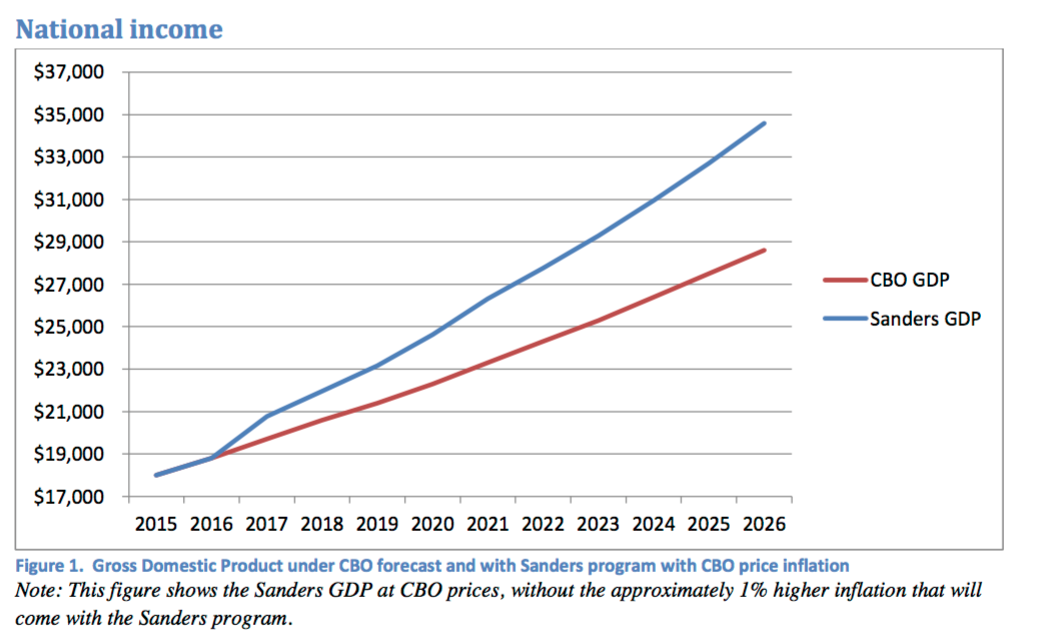
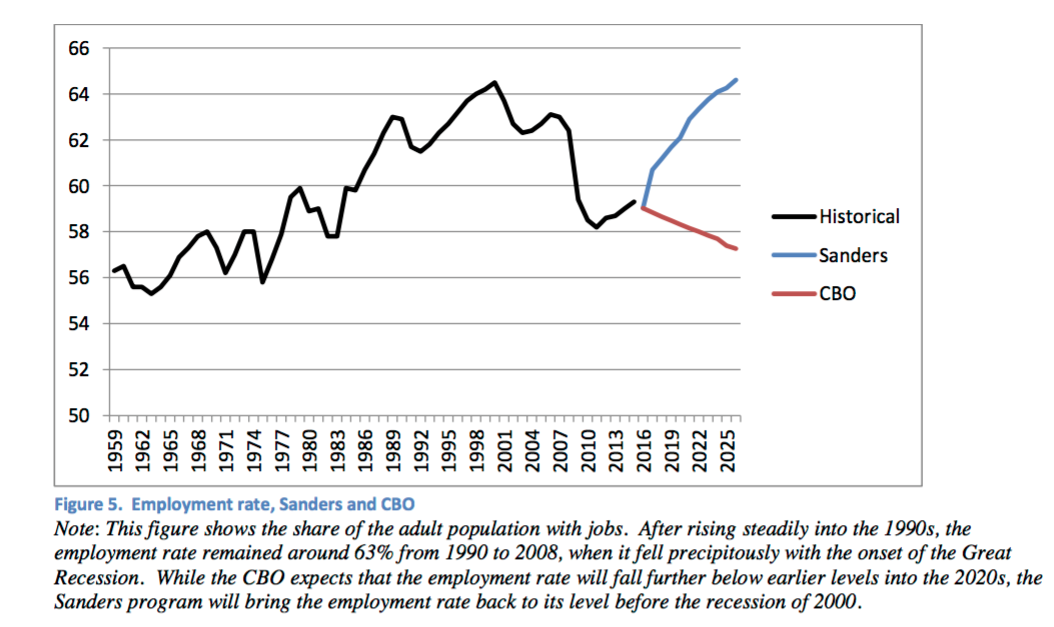
"The Sanders program... will raise the gross domestic product by 37% and per capita income by 33% in 2026; the growth rate of per capita GDP will increase from 1.7% a year to 4.5% a year." And, apparently, raise the growth rate permanently.

More stunning still are Friedman's claims about employment, shown at left here

and here.

Multipliers

So, where does this spurt of growth come from? The answer is the magic of multipliers.

But it's not just run of the mill fiscal stimulus multipliers.  After all, Friedman also says that the Sanders program would reduce the deficit, and by 2025 turn the Federal Budget to surplus!

How are multipliers so strong?

There seem to be two basic answers. First, Sanders assumes that there is a large multiplier from income transfers.

If the government takes $1 from rich Peter, and gives that $1 to poor Paul, overall income rises 55 cents! The one quote that makes this clearest is
The stimulus from regulator[y] changes is in Table 9. In general, the assumption is that wages have a multiplier of 0.9 compared with a multiplier of 0.35 for profits accruing to high-income persons. A wage increase coming out of profits, therefore, has a multiplier of 0.55.
It's also visible here explaining how a balanced budget still has a multiplier
the average value of the (governent spending) multiplier from 2017-26 is 0.89, falling from 1.25 to 0.87 as the output gap closes 
Other taxes are assumed to reduce effective demand with a multiplier of 0.35
[The] balance of revenue and spending programs will increase employment and economic growth because the spending program has a larger fiscal multiplier than do progressive tax increases. 
So tax $1 and spend $1 raises GDP by 54 cents.

He cites many standard sources for multipliers. He does not give a theory.  The standard story is that poor Paul consumes a lot more of his income, while rich Peter was investing it all in venture capital startups.  Consumption is good, savings is bad, so GDP rises.

From this central assumption, the rest of the magic follows.  Friedman creatively goes far beyond conventional deficit multipliers, to conjure multipliers out of tax increases, raises in the minimum wage, greater unionization, increased social program spending, and so forth. For example
 I assume that the Paycheck Fairness Act will raise women’s wages by 1% relative to men’s, and there will be an increase of 0.2% a year for the next decade.  I assume that 50% of the increased cost goes to higher prices and 50% comes from profits, and these are assumed to lower spending by higher income people with a multiplier of 0.35.
This, I think, is the central case. Admire it for its courage, and creative use of Keynesian arguments. These are the kind of interventions that most economists admit reduce growth, but some argue for on other grounds. But in Keynesian economics, taking money from low marginal propensity to consume people, and giving it to high marginal propensity to consume people raises GDP.

Snark

At this point, I stop in a bit of amusement at all the criticism. After all, these are just standard Keynesian arguments. The individual multipliers in Friedman's analysis are all conservative, and cite standard middle-of-the-road sources. The economists now so critical of this analysis, including the Romers, former democratic administration CEA chairs who wrote the open letter from past CEA chairs, and Paul Krugman, have been making big multiplier arguments for years to argue for more spending.  The "new Keynesian" academic literature includes multipliers far above two, so one can point to "science" if you wish. (Gauti Eggertsson, Christiano, Eichenbaum and Rebelo ; a simple example with multipliers as large as you want.)

The Romers are right to emphasize that multipliers only operate where "demand" is slack, and monetary policy doesn't steal the show. But the asterisks about fixed interest rates and output below "capacity" have been overlooked by the mainstream many times before. It's a rare Keynesian economist who ever thinks the economy is operating at full capacity. And Friedman has the former monetary asterisk, and he addresses the latter by claiming a large return to the labor force and increased productivity.

Even that view is not so out of the mainstream. For example,  Brad DeLong and Larry Summers wrote an influential Brookings paper arguing for very large fiscal multipliers, with some of the same flavor. There is hysterisis; a multiplier will bring people back to the labor market (as Friedman claims), those people will regain skills, productivity will increase; higher investment will give us better capital and also increase productivity. Demand creates its own supply.

Friedman is apparently just taking the consumption-first, poor-people-spend-more-than-rich-people, undergraduate ISLM analysis, with a bit of Delong-Summers hysterisis, to its logical conclusion. I agree in a way: take those ideas to their logical conclusion and you get silly propositions (old essay on that). Robbing Peter to pay Paul raises income; wasted government spending is good; theft improves the economy, transfers even from thrifty poor to spendthrift rich improve the economy, hurricanes are good for us, social programs, unions, minimum wages raise GDP, and so forth. Well, if the logical conclusions are patently silly, maybe one shouldn't have been making small versions of those arguments all along. Economic Homeopathy is not wisdom. 

Arithmetic 

But the Romers uncover a deeper puzzle. Even with these assumptions -- government spending multipliers around 0.8, and a transfer multiplier of around 0.55 -- you still don't get the wild increase in growth that Friedman claims. So how does he do it? Their answer: 
We have a conjecture about how Friedman may have incorrectly found such large effects. Suppose one is considering a permanent increase in government spending of 1% of GDP, and suppose one assumes that government spending raises output one-for-one. Then one might be tempted to think that the program would raise output growth each year by a percentage point, and so raise the level of output after a decade by about 10%. In fact, however, in this scenario there is no additional stimulus after the first year. As a result, each year the spending would raise the level of output by 1% relative to what it would have been otherwise, and so the impact on the level of output after a decade would be only 1%.
If this is right, it's absolutely damning. This is a question of arithmetic, not economics. (And I would have to swallow some of my above snark!) 

A clearer (maybe) example: The government spends an extra $1 for one year.  With a 1.0 multiplier GDP goes up $1 that year, period. If the government stops spending next year, GDP goes back to where it was. That's the conventional definition of multiplier, and the one that all Fridman's cited sources have in mind. Per Romers, Friedman misread that calculation and assumed the first $1 of spending raises GDP by $1 forever. In 10 years, you have a multiplier of 10! 

The Romers are cautious, and don't directly make this charge. It's not my job to get into the Hilary vs. Bernie whose-numbers-add-up fight. (At least someone here actually seems to care about numbers and economic plans!) But whether the spreadsheets make this arithmetic mistake or not is an answerable question. I hope to inspire someone with a spreadsheet and a nose for such things to check. This is a great time for a replication exercise! 

(Note: This post has pictures and quotes, which don't translate well when the post is picked up elswhere. If you're not seeing them, come back to the original.)

Update: Joakim Book tries to reproduce the numbers and comes up way short.

Update 2: Justin Wolfers at the New York Times did some old-fashioned journalism: He called up Friedman for a reaction.  The article is great, and clear. Yes, Friedman did the calculation as the Romers allege: An extra dollar of government spending today raises GDP permanently; an extra dollar of permanent government spending raises GDP growth permanently. That is at least not what the cited sources have in mind.


26 Feb 20:19

Socialism and famine

by Sarah Gustafson

My colleague Mark Perry posted recently a great excerpt from Alan Charles Kors’ classic essay on the ghastly death toll caused by socialism, and the disgraceful willingness of so many “intellectuals” to avert their eyes from that tragic reality. I urge everyone to read Mark’s post; and let me add two observations.

First, The Black Book of Communism: Crimes, Terror, Repression should be required reading for every college student — and perhaps every high school student — everywhere. A rigorous and disturbing study of the number of deaths attributable to communist political systems around the world, most professors and teachers should read it as well.

North Koreans rehabilitate rice paddy fields May 8, 1999, aided by the UN World Food Programme, in a region hit by five years of famine. Reuters.

North Koreans rehabilitate rice paddy fields May 8, 1999, aided by the UN World Food Programme, in a region hit by five years of famine. Reuters.

Second: Famine is a disproportionately prevalent outcome of socialist systems, as illustrated in the following table summarizing the thirty famines of the 20th century.

Famines are the tragic result of many conditions: wars; insurrections; natural disasters and droughts; deliberate denial of food to specific populations by governments or by opposition groups, and so forth. But it is striking that famines under socialist systems are represented so heavily among the worst of the 20th century in terms of excess mortality as a proportion of the total population: six of the worst ten, and seven of the first fifteen.

Apart from intentional famines directed at particular parts of the population — the Cambodian and Ukrainian famines are good examples — it is likely to be the case that famines less intentional are more likely under socialism, because of incentives inherent under that system.  Socialist economies must collectivize agriculture because without a system of market prices and profits driving resource allocation and production decisions, urban areas would starve: They have no means of inducing food production for urban populations. But collectivization tends to dampen production incentives, and certainly private incentives to store food in advance of adverse conditions; accordingly, famines are more likely to result under socialism when droughts or other events interfering with food production emerge.

Anyone who believes that socialism, or policies subjecting ever-greater proportions of the economy to collective control, can yield salutary outcomes for the great mass of ordinary people should take a hard look at reality. In this context, past performance really is a guarantee of future results.

26 Feb 20:08

No Matter Who Wins at the Oscars, Taxpayers Lose on Film Subsidies

by Jared Meyer

Sunday night brings the 89th Academy Awards, and many are wondering what film will take home the Oscar for Best Picture. No matter what film wins, one group of people should be thanked during the acceptance speech—taxpayers.

Film is a heavily subsidized industry, and the majority of states have tax incentive programs that lower the cost of production. These tax credits are determined by production costs, not profits, and many credits are transferrable or refundable. When a film’s tax liabilities are below its allotted refundable credits, taxpayers end up directly paying film companies the difference.

The Big Short, one of this year’s nominees, cost $28 million to produce and was filmed in California, Nevada, and Louisiana. All three states have film tax credit programs, but Louisiana’s 40 percent partially-transferable credit is the largest. The film's producers made a movie about Wall Street greed, but they clearly had no problem making taxpayers pay for their production costs. 

New York’s fully-refundable 30 percent film tax credit is the most generous in the nation, with an annual limit of $420 million. Brooklyn and Bridge of Spies, two of this year’s nominees, were filmed in New York, and their budgets were $12 million and $40 million, respectively.

States are starting to realize that the economic benefits of film tax credits are pure fantasy, like some movie plots. In 2012, 40 states offered tax incentives, at a total cost of $1.4 billion, but since then some states have decided that maintaining roads, funding schools, staffing police departments, and letting residents keep more income are better uses of funds. Since last year’s Oscars, Alaska, Michigan, and Illinois all ended their film tax credit programs. (See my testimony for the Alaska Senate on the false promise of film tax credits here).

In contrast, California tripled its non-refundable film tax credit budget to $330 million in an effort to lure more film production back to Hollywood.

It is not only Oscar-nominated movies that receive sweetheart tax deals. Television shows, including HBO’s VEEP and Netflix’s House of Cards, are two examples.

When Maryland did not increase its fully-refundable film tax incentive program in 2014, Netflix executives went all Frank Underwood on former governor Martin O’Malley and threatened to leave the state. Political pressure, including a Kevin Spacey visit to Annapolis, convinced Maryland to raid other funds in order to double its film tax credit budget to $15 million. This does not include the $4 million in annual lost revenue from sales tax exemptions for film production companies.

Even though film tax credits are often sold as a way to help small producers, 98 percent of Maryland’s film tax credit budget over the last three years has been taken up by House of Cards and VEEP. The increased tourism argument that film tax credit proponents constantly use clearly does not apply for two shows that are set in Washington, D.C. Similarly, no one thinks of Louisiana while they are watching The Big Short.

Maryland’s handouts were still not enough to convince HBO executives to keep filming VEEP in Maryland. VEEP’s production moved to California after the state offered the show a $6.5 million tax credit.

The Maryland Department of Legislative Services found that the state’s film tax incentive program only returns 6 cents for every dollar spent. While this return is particularly poor, the best return in any state is still less than 30 cents on the dollar.

Jobs in the film industry are highly skilled and mobile, which means they do not create lasting economic benefits. If another state rolls out an even more generous tax credit, film production can simply pack up and leave for another soundstage. States that decide to shower the film industry with taxpayer funds are in a race to the bottom, as no credit is high enough to satisfy Hollywood executives.

Maryland’s experience of losing film productions and wasting taxpayer dollars on its program is not unique. Every independent study of film tax credits have found that the programs come nowhere close to paying for themselves. But this reality has not stopped proponents from making fanciful predictions. The Maryland Film Industry Coalition—a group dedicated to promoting the film industry—claims that each dollar in tax credits leads to $1.03 in tax revenue.

The Tax Foundation’s Joseph Henchman points out that if these fanciful projections were taken seriously, the United States could pay off its national debt by simply giving the film industry $1 trillion. One study that was funded by the Motion Picture Association of American assumes that every dollar in tax credits creates $17.75 in economic activity, which leads to $1.88 in new tax revenue for the state. These claims are less realistic than the science-fiction films the credits support.

Film tax credit programs do not pay for themselves. They do not create long-term jobs, nor do they have tourism benefits. All film tax incentives do is provide opportunities for politicians to rub elbows with movie stars.

With the hundreds of millions of dollars that taxpayers gift the film industry each year, perhaps it is time for the Academy Awards to create an Oscar for Best Tax Break. If nothing else, taxpayers at least deserve a shout-out during Sunday’s award ceremony.

Jared Meyer is a fellow at Economics21 at the Manhattan Institute for Policy Research. You can follow him on Twitter here.

[Correction: This article originally stated that The Martian was filmed in Louisiana. It was not. This piece has been corrected to refer to The Big Short, which was filmed in the state, instead.]

26 Feb 14:18

How Biden killed John Roberts’s nomination in 1992 — and what that tells us about the nomination process

by Jewel Dauletalina

Killing judicial nominations is not a new phenomenon. As Vice President Biden joins the hotly contested debate on the nomination process for Justice Scalia’s replacement, a video of the former senator advocating against nominations to the Supreme Court in an election year has surfaced. In 1992, firmly against the administration’s wishes, then-senator Biden killed the nomination of future Supreme Court chief justice, John Roberts, to the U.S. Court of Appeals for the District of Columbia Circuit. Former White House speechwriter Marc Thiessen discusses the judicial nomination process in his new Washington Post piece:

Both parties have a history of killing judicial nominations without a hearing in an election year, particularly in cases where the nomination would shift the balance of the court. The CRS report notes that in 1995 and 1996, when Republicans controlled the Senate, they killed 14 of President Bill Clinton’s nominees to the federal bench without a hearing.

The bottom line is that what Republicans are doing today is far from unprecedented. To the contrary, it is the norm. There is a graveyard filled with judicial appointments killed without a hearing by both Republicans and Democrats in an election year.

Read his full piece, “How Biden killed John Roberts’s nomination in 1992.”

To arrange an interview with Marc Thiessen, please contact AEI media services at mediaservices@aei.org or 202.862.5829.

25 Feb 14:29

Congratulations to the Free State Movement, by Scott Sumner

Whig Zhou

不错不错

Last weekend I gave a talk up at the Liberty Forum in Manchester, New Hampshire. While there, I learned more about the Free State Movement, an idea about which I was only dimly aware. The following is from memory, so there might be a few errors.

The movement began about 15 years ago when Yale grad student Jason Sorens wrote a paper discussing the idea of encouraging lots of libertarians to move to one state, in order to try to create a sort of libertarian model, which could inspire others. I.e., the goal was to show that libertarianism was feasible, and even desirable.

It was decided that they would aim to get pledges from 20,000 people to move to New Hampshire. Those who pledged would agree to move within 5 years after the 20,000 pledge total was reached. At the meeting I attended they announced that they had just achieved that pledge target.

Of course they are aware that not all 20,000 will actually move, and thus are continuing to accept pledges. The new goal is to get 20,000 people to actually move. Fortunately, the pace of new pledges has recently sped up dramatically, as they have gotten better at using resources like Facebook to get their message out. So even if only 50% of the pledges actually move, the next 20,000 will be signed up far more quickly than the 15 years it took to get the first 20,000.

You might also notice that the target is still only 1.5% of New Hampshire's population. But of course this does not include the libertarians already in New Hampshire. And even a small share of the population can be influential on policy questions if they are highly committed and motivated. Thus groups like farmers and schoolteachers have a big impact on public policies despite being a small share of our population. The New Hampshire state house has 400 representatives in the lower chamber, and thus each district is tiny. As of now, 14 free staters are currently members of the House (12 GOP, 2 Dems), and many more previously elected legislators have libertarian leanings on most issues. Pay is $100/year, not changed since the 1800s. And who says wages are not sticky!!

In another recent post I suggested that in some ways New Hampshire was already the most successful place on Earth. So don't mess it up! Seriously, its current success may be partly due to the fact that its public policies are already a bit more libertarian than most other places. One exception is housing, where the zoning rules are unfortunately somewhat restrictive. This has boosted housing prices and may help explain why New Hampshire's population growth is no longer above average. (Although I think the bigger problem is the back to the city movement among millennials.) In this way it (oddly) reminds me of Hong Kong. Admirably libertarian on many issues, with the notable exception of housing.

Jason Sorens, who now teaches at Dartmouth, seems like a sort of anti-Trump; very modest but quietly effective. I would add that the Free Staters in general seemed like a great group of people. The sort of people you'd want to have as neighbors.

Also, kudos to Carla Gericke, who has headed the Free State Project during a period of successful growth.

PS. Tomorrow at 1pm EST I will do a Reddit "ask me anything". I hope you will tune in.

(8 COMMENTS)
25 Feb 13:46

Academic Drivel Report

by Peter Dreier
Whig Zhou

中途拔出版Sokal

I don’t know if there is a statute of limitations on confessing one’s sins, but it has been six years since I did the deed and I’m now coming clean.

Six years ago I submitted a paper for a panel, “On the Absence of Absences” that was to be part of an academic conference later that year—in August 2010. Then, and now, I had no idea what the phrase “absence of absences” meant. The description provided by the panel organizers, printed below, did not help. The summary, or abstract of the proposed paper—was pure gibberish, as you can see below. I tried, as best I could within the limits of my own vocabulary, to write something that had many big words but which made no sense whatsoever. I not only wanted to see if I could fool the panel organizers and get my paper accepted, I also wanted to pull the curtain on the absurd pretentions of some segments of academic life. To my astonishment, the two panel organizers—both American sociologists—accepted my proposal and invited me to join them at the annual international conference of the Society for Social Studies of Science to be held that year in Tokyo.

I am not the first academic to engage in this kind of hoax. In 1996, in a well-known incident, NYU physicist Alan Sokal pulled the wool over the eyes of the editors of Social Text, a postmodern cultural studies journal. He submitted an article filled with gobbledygook to see if they would, in his words, “publish an article liberally salted with nonsense if it (a) sounded good and (b) flattered the editors' ideological preconceptions.” His article, “Transgressing the Boundaries: Towards a Transformative Hermeneutics of Quantum Gravity” (published in the Spring/Summer 1996 issue), shorn of its intentionally outrageous jargon, essentially made the claim that gravity was in the mind of the beholder. Sokal’s intent was not simply to pull a fast-one on the editors, but to challenge the increasingly popular “post-modern” view that there are no real facts, just points-of-view. His paper made the bogus case that gravity, too, was a “social construction.” As soon as it was published, Sokal fessed up in another journal (Lingua Franca, May 1996), revealing that his article was a sham, describing it as “a pastiche of Left-wing cant, fawning references, grandiose quotations, and outright nonsense … structured around the silliest quotations [by postmodernist academics] he could find about mathematics and physics.”

Sokal’s ruse was more ambitious than mine. He wrote an entire article. I simply wrote a 368-word abstract. He submitted his for publication. I just submitted mine to a conference. Although his paper was filled with absurd statements, it actually reached a conclusion—however bogus—that gravity was still an idea open to serious debate. In doing so, Sokal actually had a serious point to make about the silliness of much “post-modern” thinking that viewed science as a version of the humanities where all views should be given equal weight. 

My paper had no point at all. It was filled entirely with non-sequiturs. I didn’t even bother to mention anything about “the absence of absences,” because I had no idea what it meant and would have thus revealed my ignorance of the panel’s organizing theme. 

In writing my abstract for the “Absence of Absences” panel, I violated every rule of good writing to which I usually try to adhere. Here’s how it happened.

In early January 2010 an email arrived in my inbox from a colleague. He had forwarded to me an announcement of a panel, called “On the Absence of Absences,” that several American sociologists were organizing for an international conference in Japan sponsored by the Society for Social Studies of Science and the Japanese Society for Science and Technology Studies. The announcement said the following:

This panel addresses absences—the gaps, silences, and remains within the construction of knowledge and ignorance—in order to contribute to an ongoing STS dialogue; one that has roots in Bloor's "sociology of error" to more recent work in agnotology (Proctor and Scheibinger) and in residues (Bowker and Star). From feminist and postcolonial theory, we have learned to be continually vigilant about the dynamics and non-dynamics in knowledge construction and application. This panel addresses these negations, unseen crevices, deletions, and leftovers from multiple perspectives. Its aims to identify and theorize some of those areas that demand our vigilance in order to broaden and provide systematic ways to understand how absences and gaps are a continual part of social interactions and our STS studies. Interested Presenters: Please send us a brief abstract and title of your talk with your name, email and affiliation. We would like contributions no later than 15 January to compile and submit the session.

I admit I had no idea what any of this meant. But I took that as a challenge. So I wrote a few hundred words of complete nonsense and in January 2010 submitted it to the panel organizers under the title, “Music, Religion, Politics, and Everyday Life: The Tensions of Utopianism and Pragmatism in Movements for Change.” Here’s what I sent them:

Universidad Carlos III de Madrid/Creative Commons

Alan Sokal perpetrated an academic hoax in 1996 with an article in Social Text

From the scribes and rabbis who wrote the original Torah, to the troubadour-activists who sang “Which Side Are You On?” and “Waste Deep in the Big Muddy,” to the gangbangers and hip-hoppers who create contemporary street rap, the relationship between culture, politics, religion and everyday life has been poorly understood. As Bloor observes: “In fact sociologists have been only too eager to limit their concern with science to its institutional framework and external factors relating to its rate of growth or direction this leaves untouched the nature of the knowledge thus created.” There is an obvious tension between romanticism and reality, between humanity and barbarism, between self-reflection and communal expression, which pervades both the written word and the oral tradition. Can a society promote utopianism and dystopianism simultaneously, while allowing its governing officials, whether military conquerors or democratically elected, to perform the necessary day-to-day functions of street-cleaning, sanitation, animal rescue, industrial production, hunting-and-gathering, maintaining law and order, and (what Heideger called the “organicity of intellectual work”) educating children and reproducing the next generation. We might call this a kind of scientism of contradiction, or the contradictions of scientific production, or the contradictory intellectual discipline of everyday life. In other words, can the rigors of so called “pure” intellectual work (including those of the priestly class and its modern counterparts), the artistry of craftwork (or the craft of artistry), and the degradations of subsistence agriculture, mining, factory work, and retail sales co-inhabit the same society without igniting the ticking time bomb of social implosion, as we've recently seen in riots in the French suburbs and in the ghettos and barrios of Los Angeles? How, in other words, does the globalization of both production and knowledge work (the so-called “Walmartization” of societies) challenge our ability to think clearly about what is true in contrast to what is delusion? Self-delusion and self-discipline inhibits the reflective self, the postmodern membrane, the ecclesiastical impulse forbidden by truth-seeking and sun worship, problematizing the inchoate structures of both reason and darkness, allowing knowledge, half-knowledge, and knowledgelessness to undermine and yet simultaneously overcome the self-loathing that overwhelms the Gnostic challenge facing Biblical scribes, folksingers, and hip-hop rappers alike. Sociologists ignore these topics at their peril.

Note the two quotes that appear in my abstract. I’d never heard of David Bloor before, but his name showed up in the announcement about the panel, so I looked up one of his writings and lifted a sentence into my abstract, although the quote I selected has no relevance to anything else in the abstract. The quote from Heidegger (whose name I misspelled in the abstract) is a complete fabrication. I made it up. Name-dropping is always useful in academic circles.

A few weeks after submitting this abstract I received an email from Professor Wenda Bauchspies of the Georgia Institute of Technology, one of the organizers of the panel, informing me that my paper had been accepted and inviting me to present it at the Tokyo conference in August of that year.

Professor Bauchspies soon sent me another email listing the other papers that had been accepted for the panel. They had the following titles:

·      “Agnotology and Privatives: Parsing Kinds of Ignorances and Absences in Systems of Knowledge Production.”

·      “Science, Ignorance, and Secrecy: Making Absences Productive”

·      “Alter-Ontologies: Justice and the Living World”

·      “The Motility of the Ethical in Bioscience: The Case of Care in Anti-ageing
Science”

·      “Mapping Environmental Knowledge Gaps in Post-Katrina New Orleans: A Study of the Social Production of Ignorance”

·      “The Absence of Science and Technology Equals Development?”

Using the Internet, I researched the works of my fellow panelists. Each had an impressive track record of publications and academic appointments at respectable universities, including the University of Arizona, the Georgia Institute of Technology, Washington State University, the University of Exeter (England), and Cardiff University (Wales). (Indeed, I’ve learned that versions of each of the papers they presented in Tokyo have subsequently been published in scholarly journals).

Once my abstract was accepted, I had to decide whether to turn it into a full-blown academic paper (typically about 15 to 25 pages) and travel to Tokyo to deliver it at the conference in person. I wasn’t sure I had the fortitude to turn one page of gibberish into at least 15 pages of gibberish, which I would then have to summarize in 10 minutes in front of an international audience of academics. I was also reluctant to ask my own college to pay for me to travel to Tokyo to pull off this hoax.

I felt somewhat guilty when I received another email from the panel organizer that said, “I look forward to meeting you in Tokyo.”    

Ultimately, I couldn’t bring myself to carry out the hoax to its logical conclusion. I decided that I would be absent from the panel on the “absence of absences.” I never registered for the conference, although my abstract appeared in the conference program. Given its provocative (although meaningless) title, it is even possible that some conference-goers showed up at the panel expecting to hear my presentation.

I assume the panel was successful, although I never heard from the organizer or any of the other panelists inquiring why I didn’t make it. I even allowed myself to ponder the possibility that all of them were absent. Although I never wrote a paper or gave a presentation, my abstract can still be found on a website devoted to preserving the papers and proceedings of various academic conferences.

Although this episode may seem like a waste of time, I did, like Sokal, have a serious point to make in submitting the abstract. I wanted to pull back the curtain on academic pomposity.

American higher education is under attack by pundits, plutocrats and public officials who believe that many professors don’t work hard and that what they produce is of little value to society. Most of their attacks are off-base, but there is a grain of truth in their claims. Academics who believe in the mission of higher education—teaching, research, and public service—need to defend academic freedom, but some of our colleagues have to clean up their acts, because it is difficult to defend the indefensible.

dpa/picture-alliance/dpa/AP Images

German philosopher Martin Heidegger.

There are many academics who write books, articles, and technical papers for colleagues in their own areas of expertise, but who also know how to translate their work into prose accessible to the general public. They share a commitment to the idea that colleges and universities—subsidized directly and indirectly by taxpayers—have an obligation to serve society. That means climbing down from the ivory tower and sharing their knowledge with people who aren’t academics. The tradition of liberal arts colleges and land-grant universities alike is the notion of “enlightenment,” which means educating, explaining, and illuminating ideas that might be practically useful or simply interesting for their own sake. Over the past decade, there’s also been growing interest in getting both professors and students to participate in various forms of public service, including a big increase in student internships and engagement with the worlds outside the campus.

While it is true that some academics write for non-academic general audiences in books, magazines, and newspaper articles, most scholars—and a growing number of them—are content to write books, journal articles, and conference papers that will be read by a very small group of fellow specialists.

I am more than willing to admit that just because I don’t understand something doesn’t mean it isn’t well reasoned or accurate. But the proportion of things published in academic journals has become less and less accessible to anyone who isn’t a specialist in that field. We live in an era of increasing academic specialization. As academia becomes more and more fragmented and balkanized into more narrow niches, an increasing proportion of what academics produce is unnecessarily obscure and obtuse, and, not surprisingly, poorly written. Graduate students read this drivel written by their academic elders, and then seek to emulate it, perpetuating the rule of pompous prose.

In the 39 years since I finished graduate school, specialization has become more and more narrow, so that even people in different subfields of the same discipline—say, Japanese history and colonial American history, or Renaissance literature and Southern poetry—aren’t expected to understand, or at least judge the quality of, others’ work. I realize that all academic disciplines have their own language, concepts, history, disputes, and intellectual paradigms that require a level of specialized knowledge to fully understand. I can read, but I can’t understand, most articles published in physics, zoology, or mathematics journals. 

I am a professor with a Ph.D. in sociology who now teaches in a political science department and chairs a department of urban and environmental policy. In other words, I do not have strong disciplinary loyalties and think that the boundaries between many academic fields are pretty blurry. I believe that most social scientists—sociologists, historians, economists, anthropologists, geographers, and political scientists—should be able to read and understand most of what their fellow social scientists write, if only they would write in relatively clear prose. Although I’m not formally trained in English literature, or art history, or other humanities subjects, I can grasp the basic points, if not the nuances, of most articles published by scholars in these fields, if they are written to be understood rather than to impress and intimidate.

In his 1959 book, The Sociological Imagination, the radical sociologist C. Wright Mills mocked fellow sociologist Talcott Parsons not only for his “grand theory” ideas that seemed to have no connection with social reality or serious social problems, but also for his incomprehensible and convoluted prose, such as the following sentence:

A role then is a sector of the total orientation system of an individual actor which is organized about expectations in relation to a particular interaction context, that is integrated with a particular set of value-standards which govern interaction with one or more alters in the appropriate complementary roles.

If Mills were alive today, he’d be saddened by the exponential growth of bad writing by academics, especially by those on the left. The problem of academic jargon is not confined to a single political or ideological wing, but it certainly dominates much of the writing by leftists in the social sciences and humanities. I consider myself a person of the left, and my research and writing—focusing on American politics, urban policy, social movements, and labor studies— generally explores issues of social justice and democracy. But I have little patience for much of what passes for left-wing academic writing in the social sciences and humanities, which emphasizes criticism (often called “deconstructing” or “problematizing” by academics) of conservative and liberal ideas and social institutions, but makes little or no attempt to figure out what to do to make things better. 

I also have little patience for the kind of embarrassingly obtuse writing style preferred by many postmodern and allegedly leftist academics that obscures more than it enlightens and is often a clever mask for being intellectually lightweight. Professor Daniel Oppenheimer of Princeton University made a similar point in an article published in the October 2005 issue of Applied Cognitive Psychology entitled, “Consequences of Erudite Vernacular Utilized Irrespective of Necessity: Problems with Using Long Words Needlessly.” The Atlantic in March 2006 summarized Oppenheimer’s point thusly: “Insecure writers tend to reach for the thesaurus.”

Here are several recent examples from my own field of urban studies.

I was recently asked to review a paper submitted to the Society for Existential and Phenomenological Theory and Culture for its upcoming annual conference at the University of Calgary in Canada. The paper was entitled “Detroit: Sense of Place and Self-Overcoming,” which I hoped would have something to do with the class and race struggles of the city’s working class, which has suffered due to the decline of its auto industry and Michigan’s increasingly right-wing and anti-union policies. Instead, here’s how the author summarized his ideas:

Institute for Policy Studies/Creative Commons

C. Wright Mills with journalist Saul Landau. 

We build, maintain, and structure cities. Cities, however, maintain and structure certain attitudes in us. Given the attitudes generated by our sense of a place, critical perspectives that only target overt structures within city systems are incomplete. Jacobs outlines several design aspects of the city that are “Anticity…” Hardt and Negri identify the task of the politics of the metropolis as “…to organize antagonisms against hierarchies and divisions of the metropolis…” To fully engage the attitudes generated by our sense of a place requires what Nietzsche describes as self-mastery. Though important factors, design and politics alone are insufficient.

A prominent urban scholar at Harvard describes his latest research project as following:

Through a conceptual distinction between concentrated urbanization (agglomeration) and extended urbanization (operational landscapes) … we aim to investigate the historical geographies of the capitalist urban-industrial fabric in ways that supersede inherited metageographical binarisms while opening up new sociological, cartographic and political perspectives on the contemporary global-urban condition.

This same professor recently co-authored an article with two colleagues, published in a journal called City, which they summarized thusly:

Theoretical, conceptual and methodological choices must be framed in relation to concrete explanatory and interpretive dilemmas, not ontological foundations. In engaging with the limits and possibilities of recent assemblage-based work in urban studies, our concern has been to help forge new analytical tools for deciphering emerging patterns of planetary urbanization, which have unsettled the coherence and viability of earlier intellectual frameworks. As urbanization is changing, so too must urban theory change, and it must do so in ways that provide critical purchase on emergent sociospatial divisions, conflicts, struggles and transformations at all spatial scales and across divergent places and territories. To this end, responding to several strands of the debate on assemblage urbanism that has unfolded in previous issues of City, here we clarify our meta-theoretical stance, address several methodological questions and reiterate our arguments regarding the importance of a reinvigorated geopolitical economy of planetary urbanization. We insist on the importance of abstraction as a necessary methodological moment in any reflexive approach to urban knowledge formation.

Detroit and other American cities face enormous problems—poverty, homelessness, suburban sprawl, decaying infrastructure, underfunded schools, pollution, racial profiling by cops, and others. Professors and researchers who study and care about cities—and whose work is subsidized directly and indirectly (through foundation grants and government-sponsored financial aid to students) by tax dollars—have an obligation to help address these problems, in part by explaining the roots of the urban crisis and what’s needed to address it. It is difficult to see how this kind of abstract theorizing and impenetrable prose contributes to improving our cities.

I am sure that the other people who were on the “Absence of Absences” panel in Tokyo are serious scholars who care deeply about their research and can explain it in plain language if asked to do so. But as long as academics write primarily for tiny niches of other academics in language that obscures more than it enlightens, the general public will justifiably continue to question the value of higher education and whether their hard-earned tax dollars should be invested in the work of scholars who seem to have little interest in making their ideas accessible to the general public or useful to society.

25 Feb 13:42

Do Republicans and Democrats Drive Different Types of Cars?

Do common stereotypes likes the Prius driving Democrat and truck driving Republican stand up to analysis?
25 Feb 13:15

Many surveys, about one in five, may contain fraudulent data

New statistical test identifies surveys that show signs of fraud, but one survey funder challenges the method
25 Feb 11:07

I have high hopes for Stripe Atlas

by Tyler Cowen
Whig Zhou

貌似不错

Stripe Atlas [is] a new product the company unveiled this week at Mobile World Congress in Barcelona. It aims to make it easier for entrepreneurs to set up small businesses in the United States. If all goes according to Stripe’s plan, Atlas could let start-up founders sidestep some of the bureaucratic hurdles that often hamper building a new business.

Determining eligibility requires little more than filling out a form. After that, Stripe will incorporate an entrepreneur’s company as a business entity in Delaware, and provide the entrepreneur with a United States bank account and Stripe merchant account to accept payments globally.

The target audience is all of the entrepreneurs outside the United States who want access to the country’s well-developed banking infrastructure and business services. Stripe is particularly interested in attracting entrepreneurs from Africa, Latin America, the Middle East and parts of Asia, among other regions.

…Eligible entrepreneurs will also be offered access to basic tax and legal consulting and business services from partners like PricewaterhouseCoopers, and will receive free credit to run their online business on the Amazon Web Services hosting platform.

Atlas is to begin on Wednesday in an invitation-only beta test; entrepreneurs can apply for the program through Stripe or one of the 50-plus start-up accelerator programs that the company has teamed up with globally. The beta program’s cost is $500.

Here is the Mike Isaac NYT article.

The post I have high hopes for Stripe Atlas appeared first on Marginal REVOLUTION.

25 Feb 10:56

President of the Australian Diabetes Society Doesn’t Understand Evolution

by Peter Turchin
Whig Zhou

呵呵

Diabetes expert warns paleo diet is dangerous and increases weight gain! proclaims the press release from University of Melbourne. It says:

A new study has revealed following a low-carbohydrate, high-fat diet for just eight weeks can lead to rapid weight gain and health complications.

The surprise finding, detailed in a paper in Nature journal Nutrition and Diabetes, has prompted University of Melbourne researchers to issue a warning about putting faith in so-called fad diets with little or no scientific evidence.

Lead author, Associate Prof Sof Andrikopoulos says this type of diet, exemplified in many forms of the popular Paleo diet, is not recommended – particularly for people who are already overweight and lead sedentary lifestyles.

Hmm, I thought to myself as I was reading this. I have been on paleo diet for the last four years. Within the first six months I lost 20 pounds of fat. But perhaps I was simply a lucky individual. So I read on:

Researchers at the University of Melbourne’s originally sought to test whether high-fat and low-carbohydrate foods would benefit the health of people with pre-diabetes.

They took two groups of overweight mice with pre-diabetes symptoms and put one group on the LCHF diet. The other group ate their normal diet. The mice were switched from a three per cent fat diet to a 60 per cent fat diet. Their carbs were reduced to only 20 per cent.

I was laughing so hard, I almost fell off the chair. Now mouse is a decent model for human health if you want to study genetics and biochemistry that is generic to all mammals, and there is a lot of that. But this doesn’t apply to our diets! Since the mouse and human lineages have separated, I don’t know how many tens of million years ago, mice have been busy evolving adaptations to eat seeds. Yes, they can eat poisonous wheat and thrive on it!

Meanwhile, humans have been eating seeds for at most 10,000 years, and some populations (including ones from which I got my genes) much less than that. To make matters worse, two million years ago we sacrificed large guts together with their detoxification capacity for the sake of growing large brains. So most humans have very little ability to thrive on seeds.

This simple idea that different mammals evolved to thrive on very different diets is clearly beyond Assoc. Prof. Sof Andrikopoulos, President of the Australian Diabetes Society.

109267_web

Credit: the University of Melbourne

I suppose you don’t need to understand evolution if you want to be a medical researcher. Mr. Andrikopoulos concludes:

“There is a very important public health message here. You need to be very careful with fad diets, always seek professional advice for weight management and always aim for diets backed by evidence.”

I don’t think any comment is necessary.

24 Feb 18:54

Stupid Laws Censor the Truth from Whisky Buyers

by Jacob Grier

Compass Box WhiskyLate last year, the innovative Scotch whisky company Compass Box posted detailed information about two of its new limited edition releases, "Flaming Heart" and the whimsically named "This is Not a Luxury Whisky." 

Like many other whisky brands, Compass Box doesn't distill their own spirits. They source whisky from other producers to create unique, proprietary blends. And like most companies making blended whisky, they tend to keep their precise recipes secret.

But for these two blends they took the unusual step of posting infographics on their website that provided detailed breakdowns of every component whisky, including the source distillery, tasting notes, the exact proportion each takes up in the blend, the type of cask used for ageing, and the length of time each whisky spent in barrel.

For the type of whisky drinker who's willing to shell out three figures for an exclusive bottle, Compass Box's complete transparency is a welcome departure from brands that obscure the provenance of their spirits with varying degrees of honesty. But at least one competitor viewed Compass Box's openness as a violation of liquor marketing regulations. An anonymous distiller contacted the Scotch Whisky Association, a trade group for Scotch, who in turn informed Compass Box that its detailed disclosure was illegal.

At issue was the listing of ages for the various whiskies in the blends. Under the laws of the European Union, producers of aged spirits have just two options for communicating age to consumers. One is to provide an age statement based on the youngest spirit in a blend, such that a Scotch advertising 12 years of age must be made entirely of whiskies that have spent at least 12 years in barrel, even if some components may be older. The other option is to provide no age information at all; these no-age-statement (or "NAS") whiskies are becoming increasingly common as heightened demand depletes distilleries' older stocks, forcing them to blend with younger spirits.

The regulations are intended to protect the reputation of aged spirits like Scotch and to prevent liquor companies from misleading consumers by adding tiny amounts of old spirits to a younger product and advertising the blend as older than it really is. But for boutique whiskies like some of Compass Box's limited releases, neither the traditional age statement nor the NAS option is a good fit. Take their Flaming Heart, for example. The oldest component is Scotch from the Caol Ila distillery aged for 30 years, making up 27.1 percent of the blend. The youngest whiskies, aged 7 years, comprise just 10.3 percent. The remainder is made up of 14- and 20-year-old Scotches. Under current law Compass Box could either call this a 7-year-old whisky, leaving consumers ignorant of the much older whiskies that make up the vast majority of the bottle, or provide no age information at all. Both options leave consumers uninformed about what they're buying.

Today, Compass Box has scrubbed the age information from the infographics. Consumers hoping to find it must look elsewhere. With the right Google search they might find it reproduced on a blog, a kind of samizdat for whisky nerds, but there's no legal way for Compass Box to directly communicate this truthful information to their target audience.

Censorship of truthful speech by spirit producers is not a problem limited to the EU. Although the type of information Compass Box would like to provide is legal in the United States, distillers here sometimes find themselves restricted by regulations that were written when the market had fewer specialty products than it does today. In 2013, for example, distillers of gin aged in barrels found the words "barrel aged" banned by the Tax and Trade Bureau, the federal agency that reviews spirit labels before they go to market. The ageing process itself is perfectly legal, but the federal code treats age statements on certain spirits, including gin, as misleading. Distillers have had to resort to work-arounds such as describing their gin as "barrel rested."

Mike McCarron, the owner of Gamle Ode aquavit in Minnesota, found himself ensnared in a similar issue last year when trying to get label approval for his "Holiday on Rye," a version of his holiday-spiced aquavit that had been aged in rye whiskey barrels. After several label rejections, he settled on adding a disclaimer to the back of the bottles that reads: "Labels do not allow for a full description of this aquavit, so please visit our website at gamleode.com for more information." But this just brought the TTB's attention to his website, and he had to remove any age-related information from that too.

"I still recall the stunned feeling I had when I realized all the best words needed to explain our aquavit easily and accurately to the public were prohibited, and could only be replaced with clumsier and more vague age and barrel wording or be silent completely, leaving folks in the dark," says McCarron. He is currently petitioning for a change to the regulations that would allow age statements on aquavit. (Disclosure: Though I don't work with Gamle Ode, other brands I've worked with in the spirits industry could choose to alter their labeling if this rule is changed.)

In the United States, at least, there may be legal grounds to challenge these limitations. "The Supreme Court has been intensely skeptical about laws that prohibit manufacturers or retailers from saying truthful things about their products," says Paul Sherman, an attorney at the Institute for Justice who specializes in First Amendment law. "Unfortunately, government often declares speech to be misleading even in situations where no one is being misled. And this routinely happens in the regulation of food and beverages."

"This problem isn't limited to the alcohol industry," says Sherman, taking note of a current Institute for Justice case challenging a Florida law that restricts use of the descriptor "skim milk" to milk that has had vitamin A artificially added to it. "What's happening in all of these cases is that the government is coming up with its own, idiosyncratic definitions for common terms and then declaring any other use of those terms—including uses consistent with their ordinary public meaning—to be inherently misleading. But under the First Amendment, the government is not the arbiter of our national dictionary, and it can't simply declare words off limits." 

Compass Box is also pushing back against outdated regulations. Though the company had to cleanse its website of age information for these particular blends, company founder John Glaser has launched a transparency campaign to reform the laws. "Scotch whisky is one of the few products where it is prohibited by law to be fully open with consumers," Glaser writes on the Compass Box website. "We believe the current regulations should change."

Glaser's proposal would give producers an option to provide full disclosure about what is in the bottle, requiring those who choose it to give equal emphasis—in font, label placement, etc.—to every component of a blend, sequencing them by the volume of their contribution to the finished product, and forbidding any biased emphasis on the oldest components.

The reaction from other Scotch producers has been positive, at least in public. The owners of Glenrothes noted having a similar experience being forced to re-edit a video detailing the whiskies in their Vintage Reserve. Tomatin and Bruichladdich also posted statements expressing their support, with the latter committing to a transparency program that will allow consumers to enter a batch number from any bottle of their Classic Laddie expression to learn the age of every component.

All this public support may be enough to move the Scotch Whisky Association to action, but changing the relevant regulations will require EU-level reform. Getting traditional Scotch producers on board is just the first step. And many of them—especially those focusing on no age statement whiskies or proprietary blends—may see little to gain from taking the initiative to push for a third option.

But given the changing marketplace for spirits, with more distillers making non-traditional products and consumers clamoring for more information about what's flowing into their glasses, outdated laws in the U.S. and EU need to evolve. These regulations were once intended to protect consumers from misleading liquor marketing, but they're now perversely being used to silence producers who want nothing more than to be completely transparent about what they're selling.

Jacob Grier is a writer and bartender in Portland, Oregon, and the author ofCocktails on Tap: The Art of Mixing Spirits and Beer. He is also the founder of Aquavit Week

24 Feb 17:23

NSF in Climate Denial?

by Patrick J. Michaels
Whig Zhou

他们开始否认中世纪暖期和小冰期了,终于走到了这一步

Note:  David Wojick, who holds a doctorate in the history and philosophy of science, sent me this essay.  It is thought provoking and deserves a read.

The US National Science Foundation seems to think that natural decades-to-centuries climate change does not exist unless provoked by humans. This ignores a lot of established science.

One of the great issues in climate science today is the nature of long-term, natural climate change. Long-term here means multiple decades to centuries, often called “dec-cen” climate change. The scientific question is how much of observed climate change over the last century or so is natural and how much is due to human activities? This issue even has a well known name – The Attribution Problem.

 This problem has been known for a long time. See for example these National Research Council reports: “Natural Climate Variability on Decade-to-Century Timescales (NAP, 1995)” and “Decade-to-Century-Scale Climate Variability and Change (NAP, 1998). The Preface of the 1998 Report provides a clear statement of the attribution problem:

The climate change and variability that we experience will be a commingling of the ever changing natural climate state with any anthropogenic change. While we are ultimately interested in understanding and predicting how climate will change, regardless of the cause, an ability to differentiate anthropogenic change from natural variability is fundamental to help guide policy decisions, treaty negotiations, and adaptation versus mitigation strategies. Without a clear understanding of how climate has changed naturally in the past, and the mechanisms involved, our ability to interpret any future change will be significantly confounded and our ability to predict future change severely curtailed.

Thus we were shocked to learn that the US National Science Foundation denies that this great research question even exists. The agency has a series of Research Overviews for its various funded research areas, fifteen in all. Their climate change research area is funded to the tune of over $300 million a year, or $3 billion a decade.

The NSF Research Overview for climate change begins with this astounding claim:

Weather changes all the time. The average pattern of weather, called climate, usually stays the same for centuries if it is undisturbed.

This is simply not true. To begin with, there is the Little Ice Age to consider. This is a multi-century period of exceptional cold that is thought to have ended in the 19th century. Since then there have been two periods of warming, roughly from 1910 to 1940, and then from 1976 through 1998.  There’s real controversy about what happened since then.  Until our government joggled the measured ocean surface temperatures last summer, scientists could all see that warming had pretty much stopped—what happened has been attended to here, and to say the least, the new record is controversial. 

But the two agreed-upon warmings indeed are indistinguishable in magnitude—only the first one could not have been caused by increasing atmospheric carbon dioxide, because we had emitted so little by then.   If it were, i.e. if climate is that “sensitive”, it would be so hot now that there wouldn’t be a scientific debate on the Attribution Problem. 

Prior to the Little Ice Age there is good evidence that we had what is called the Medieval Warm Period, which may even have been as warm as today.

Thus it is clearly not the case that climate “stays the same for centuries.” So far as we can tell it has never done this. Instead, dec-cen natural variability appears to be the rule.

Why has NSF chosen to deny dec-cen natural variability? The next few sentences in the Research Overview may provide an answer. NSF says this:

However, Earth is not being left alone. People are taking actions that can change Earth and its climate in significant ways. Carbon dioxide is the main culprit. Burning carbon-containing “fossil fuels” such as coal, oil and gas has a large impact on climate because it releases carbon dioxide gas into the atmosphere.

NSF has chosen to promote the alarmist view of human-induced climate change. This is the official view of the Obama Administration. In order to do this it must deny the possibility that long-term natural variability may play a significant role in observed climate change, despite the obvious evidence from the Medieval Warm Period, the Little Ice Age and the early 20th century warming.  As an editorial this might be tolerable, but this is a Research Overview of a multi-billion dollar Federal research program.

NSF is supposed to be doing the best possible science, which means pursuing the most important scientific questions. This is what Congress funds the agency to do. But if NSF is deliberately ignoring the attribution problem, in order to promote the alarmism of human-induced climate change, then it may be misusing its research budget. This would be very bad science indeed.

In technology policy there is a standard rule that says the Government should not pick winners and losers. It appears we need a similar rule in science policy. In the language of science what we seem to have here is the National Science Foundation espousing one research paradigm – human induced climate change and no other cause – at the expense of a competing paradigm – long-term natural variability.

Thomas Kuhn, who coined the term paradigm for the fundamental assumptions that guide research, pointed out that it is common for the proponents of one paradigm to shield it from a competitor. NSF’s actions look like a clear case of this kind of paradigm protection.

23 Feb 18:11

2016: Already Almost 50 New Peer-Reviewed Papers Refuting Alarmist CO2 Science …Show Natural Cycles Indisputable!

by P Gosselin

National+Academy+of+Sciences+logo_thmbWhat follows below is a list of 48 scientific papers published this year alone showing that CO2 climate science is not what the press and activist scientists like to have us believe it is.

Image: National Academy of Sciences logo

Recently I posted here on about 250 papers published in 2015. That post was shared or liked a few thousand times.

Well, the number of skeptic papers seems to be accelerating as already this year there have been almost 50, and it’s only February!

The following lists 48 scientific papers listed show that CO2 climate science is exaggerated and that natural factors are indeed dominant climate forces that will not be tamed by man emitting a trace gas.

These newest findings of course are no surprise to skeptics.

The list below includes the abstracts, where the special points have been emphasized. Two of the papers have been discussed already at NTZ here and here. The papers have been sorted according to categories.

Again do feel free to bring this newest list to the attention of your lawmakers, and ask them if there might be much better things to do with the billions of dollars spent on junk climate measures. It’s becoming crystal clear as to who the real deniers really are.
======================================

Solar Influence on Climate

http://www.sciencedirect.com/science/article/pii/S1364682615300985

The various techniques have been used to confer the existence of significant relations between the number of Sunspots and different terrestrial climate parameters such as rainfall, temperature, dewdrops, aerosol and ENSO etc. Improved understanding and modelling of Sunspots variations can explore the information about the related variables. This study uses a Markov chain method to find the relations between monthly Sunspots and ENSO data of two epochs (1996–2009 and 1950–2014). Corresponding transition matrices of both data sets appear similar and it is qualitatively evaluated by high values of 2-dimensional correlation found between transition matrices of ENSO and Sunspots. The associated transition diagrams show that each state communicates with the others. Presence of stronger self-communication (between same states) confirms periodic behaviour among the states. Moreover, closeness found in the expected number of visits from one state to the other show the existence of a possible relation between Sunspots and ENSO data. Moreover, perfect validation of dependency and stationary tests endorses the applicability of the Markov chain analyses on Sunspots and ENSO data. This shows that a significant relation between Sunspots and ENSO data exists. Improved understanding and modelling of Sunspots variations can help to explore the information about the related variables. This study can be useful to explore the influence of ENSO related local climatic variability.

—–

http://www.sciencedirect.com/science/article/pii/S0277379115301682

Here, we use diatom assemblages from a marine sediment core collected from the West Greenland shelf to reconstruct changes in sea-ice cover over the last millennium. The proxy-based reconstruction demonstrates a generally strong link between changes in sea-ice cover and solar variability during the last millennium. Weaker (or stronger) solar forcing may result in the increase (or decrease) in sea-ice cover west of Greenland.

—–

http://www.ncbi.nlm.nih.gov/pmc/articles/PMC4709040/

The comparison between MDVM reconstructed temperature and the variation of external forcing (solar activity and volcanic activity) is shown in Fig. 5. The smoothed MDVM reconstruction exhibited a general agreement with the variation of the reconstructed total solar irradiance (TSI), and the correlation between the two series during the common period 849–2000 AD was significant (r = 0.498, edf = 34, p<0.01). Specially, the records shared high correlation coefficients in the epochs of the solar maximum (i.e. during the Medieval and Modern age), but poor correlation around 1500–1700 AD when the Spörer Minimum and Maunder Minimum occurred. It was similar to some other dendrochronological researches concerning the relation with solar activity. The relatively cold conditions between the two warm peaks around AD 1000 and 1100 seemed to be related to the Oort Minimum.

Therefore, the temperature reconstructions based on the MDVM method agreed well in general with the characteristic variations of the solar and volcanic forcings. It is quite plausible that the long-term climate variations in the past millennium have been largely linked to the periodical solar activity, and people usually look at the Maunder Minimum to explain the LIA. However, some researchers argued that solar forcing probably had a minor effect on the climate change over the past 1000 years, and volcanic eruptions seemed to be an important driver for the climate particularly during the LIA. It was also reported that the abrupt onset of the LIA was likely triggered by a succession of strong volcanic eruptions and sustained by sea-ice/ocean feedbacks. According to mainstream opinions, the LIA type events were probably attributed to a combination of solar minima and volcanic eruptions.

—–

http://link.springer.com/article/10.1007/s40333-015-0138-5

Tree-ring-based reconstruction of temperature variability (1445–2011) for the upper reaches of the Heihe River Basin, Northwest China

Spectral analyses suggested that the reconstructed annual mean temperature variation may be related to large-scale atmospheric–oceanic variability such as the solar activity, Pacific Decadal Oscillation (PDO) and El Niño–Southern Oscillation (ENSO).

—–

http://www.sciencedirect.com/science/article/pii/S1364682616300347

The impact of solar activity on tropical Pacific convection during the boreal summer (June-July-August, JJA) has been examined using reanalysis data, revealing a significant lagged (1–2 years) correlation between outgoing long-wave radiation (OLR) over the tropical western Pacific and the F10.7 index. The OLR anomaly over the tropical western Pacific and the maritime continent shows a dipole pattern during the 1–2 years following high solar (HS) years. Furthermore, the first mode of the empirical orthogonal function (EOF) analysis on the OLR with the El Niño/Southern Oscillation (ENSO) signal removed is similar to the distribution of correlation coefficients between the JJA mean F10.7 index and the OLR with ENSO signal removed. The correlation and composite analyses of the OLR, velocity potential and vertical velocity reveals that this convection dipole pattern shows an eastward shift of the central position of deep convection, as related to the influence of solar activity over the tropical western Pacific. Further analyses show that the evolutionary process of the solar signal in the ocean-atmosphere system over the tropical western Pacific is consistent with the analyses of OLR, velocity potential, and vertical velocity. By modulating vertical air temperature, the solar signal in the tropical sea surface temperature (SST) may contribute to the triggering of a lagged convection dipole pattern.

—–

http://hol.sagepub.com/content/early/2015/12/23/0959683615618265.abstract

The reconstructions show a large glacier readvance corresponding with the 8.2-ka cold event and a sequence of eight distinct glacier advances and retreats during the Neoglacial time period bracket between 4300 ± 40 cal. yr BP and AD 1900. … [W]e suggest that deviations in ELA fluctuations between Scandinavian maritime and continental glaciers around 7150, 6560, 6000, 5150, 3200 and 2200 cal. yr BP reflect the different response of continental and maritime glaciers to drops in total solar irradiance (TSI).

—–

http://link.springer.com/article/10.1007/s10933-015-9861-3

[W]e reconstructed the history of typhoon and storm-rain activity only for the interval AD 1400–1900. The record indicates that typhoon frequency throughout the Korean Peninsula varied in response to the state of the El Niño/Southern Oscillation. Typhoon variability was likely modulated further by the state of the East Asia summer monsoon (EASM) pattern, associated with variation in the magnitude of solar irradiance. During periods of minimum solar activity, such as the early Maunder Minimum (AD 1650–1675), typhoons struck the east China coast and Korean Peninsula more frequently because of a strengthened EASM.

—–

http://www.sciencedirect.com/science/article/pii/S1364682616300360

A significant correlation between the solar wind speed (SWS) and sea surface temperature (SST) in the region of the North Atlantic Ocean has been found for the Northern Hemisphere winter from 1963 to 2010, based on 3-month seasonal averages. The correlation is dependent on Bz (the interplanetary magnetic field component parallel to the Earth’s magnetic dipole) as well as the SWS, and somewhat stronger in the stratospheric quasi-biennial oscillation (QBO) west phase than in the east phase. The correlations with the SWS are stronger than those with the F10.7 parameter representing solar UV inputs to the stratosphere. SST responds to changes in tropospheric dynamics via wind stress, and to changes in cloud cover affecting the radiative balance. Suggested mechanisms for the solar influence on SST include changes in atmospheric ionization and cloud microphysics affecting cloud cover, storm invigoration, and tropospheric dynamics. Such changes modify upward wave propagation to the stratosphere, affecting the dynamics of the polar vortex. Also, direct solar inputs, including energetic particles and solar UV, produce stratospheric dynamical changes. Downward propagation of stratospheric dynamical changes eventually further perturbs tropospheric dynamics and SST.

—–

https://www.researchgate.net/profile/Miguel_Angel_Morales_Maqueda2/publication/265355775_Physics_and_climatology_of_sea_ice/links/54900f170cf214269f264b93.pdf

Three factors affect substantially the radiation balance in polar regions: surface albedo, surface air temperature, and cloudiness. The surface albedo controls the shortwave energy budget; surface air temperature determines the incoming longwave radiation; cloudiness alters both the solar and the infrared radiative components.


Low Solar Activity Leads to Cooling…

—–

http://www.clim-past-discuss.net/cp-2016-7/cp-2016-7.pdf

Climate reconstructions from a multitude of natural and human archives indicate that, during winter, the period of the early Spörer Minimum (1431–1440 CE) was the coldest decade in Central Europe in the 15th century. The particularly cold winters and normal but wet summers resulted in a strong seasonal cycle that challenged food production and led to increasing food prices, a subsistence crisis, and a famine in parts of Europe. As a consequence, authorities implemented adaptation measures, such as the installation of grain storage capacities, in order to be prepared for future events. The 15th century is characterised by a grand solar minimum and enhanced volcanic activity, which both imply a reduction of seasonality. Climate model simulations show that periods with cold winters and strong seasonality are associated with internal climate variability rather than external forcing. Accordingly, it is hypothesised that the reconstructed extreme climatic conditions during this decade occurred by chance and in relation to the partly chaotic, internal variability within the climate system.

—–

http://link.springer.com/article/10.1007/s12303-015-0058-6

We present a multi-proxy record (pollen, microscopic charcoal, carbon-isotopic composition [δ13C], organic content, and particle size) of the late-Holocene climate change and human impact from central-eastern South Korea. The Medieval Climate Anomaly (MCA) and Little Ice Age (LIA), the most recent major climate events, have not been accurately investigated by paleolimnological studies in Korea, mainly due to a lack of undisturbed sediments and indifference to the past climate change. Our pollen records show late- Holocene centennial climate variations characterized by the successive solar minimums of the Oort, Wolf, Spörer, Maunder, and Dalton. We find paleoenvironmental evidence for shifting cultivation associated with serious droughts and consequent famines during the early 19th-century Dalton minimum. Our interpretation of human activities is well supported by Korean historical documents describing socioeconomic suffering induced by LIA climate deteriorations.

—–

http://www.nature.com/ngeo/journal/vaop/ncurrent/full/ngeo2652.html

Climatic changes during the first half of the Common Era have been suggested to play a role in societal reorganizations in Europe and Asia. In particular, the sixth century coincides with rising and falling civilizations, pandemics, human migration and political turmoil. Our understanding of the magnitude and spatial extent as well as the possible causes and concurrences of climate change during this period is, however, still limited. Here we use tree-ring chronologies from the Russian Altai and European Alps to reconstruct summer temperatures over the past two millennia. We find an unprecedented, long-lasting and spatially synchronized cooling following a cluster of large volcanic eruptions in 536, 540 and 547 AD, which was probably sustained by ocean and sea-ice feedbacks, as well as a solar minimum. We thus identify the interval from 536 to about 660 AD as the Late Antique Little Ice Age. Spanning most of the Northern Hemisphere, we suggest that this cold phase be considered as an additional environmental factor contributing to the establishment of the Justinian plague, transformation of the eastern Roman Empire and collapse of the Sasanian Empire, movements out of the Asian steppe and Arabian Peninsula, spread of Slavic-speaking peoples and political upheavals in China.

—–

Natural Ocean Oscillation

http://onlinelibrary.wiley.com/doi/10.1002/2016GL067679/full

The Atlantic Multidecadal Oscillation (AMO) is characterized by a horseshoe pattern of sea surface temperature (SST) anomalies and has a wide range of climatic impacts. While the tropical arm of AMO is responsible for many of these impacts, it is either too weak or completely absent in many climate model simulations. Here we show, using both observational and model evidence, that the radiative effect of positive low cloud and dust feedbacks is strong enough to generate the tropical arm of AMO, with the low cloud feedback more dominant. The feedbacks can be understood in a consistent dynamical framework: weakened tropical trade wind speed in response to a warm middle latitude SST anomaly reduces dust loading and low cloud fraction over the tropical Atlantic, which warms the tropical North Atlantic SST. Together they contribute to appearance of the tropical arm of AMO. Most current climate models miss both the critical wind speed response and two positive feedbacks though realistic simulations of them may be essential for many climatic studies related to the AMO.

—–

http://onlinelibrary.wiley.com/doi/10.1002/wea.2558/full

Introduction: The surface climate of the UK and northern Europe is up to 9 degC warmer than it would be if the North Atlantic Ocean did not transport a large quantity of heat northwards to our shores. This unusual warming has been known since sea temperature records were established in the late nineteenth century and was probably well known to the early seafarers in the last two millennia.

Summary: This article has indicated that the North Atlantic Ocean is showing changes in its circulation as represented by the MOC at 26°N in the last 10 years. The changes in the MOC are associated with heat transport which has a direct effect on the upper ocean heat storage northwards of the RAPID array. The event in 2009 caused a cooling of the subtropical ocean between 20 and 40°N but did not appear to influence the region poleward of 50°N. The role of the atmosphere in the changes in the MOC in this region, in particular on interannual and decadal timescales, is still not well understood.

—–

http://www.sciencedirect.com/science/article/pii/S0012821X15007669

The North Atlantic Oscillation (NAO) is the leading mode of atmospheric circulation variability in the North Atlantic region. Associated shifts of storm tracks, precipitation and temperature patterns affect energy supply and demand, fisheries and agricultural, as well as marine and terrestrial ecological dynamics. Long-term NAO records are crucial to better understand its response to climate forcing factors, and assess predictability and shifts associated with ongoing climate change. A recent study of instrumental time series revealed NAO as main factor for a strong relation between winter temperature, precipitation and river discharge in central Norway over the past 50 years. … Conditioned on a stationary relation between our climate proxy and the NAO we establish a first high resolution NAO proxy record from marine sediments covering the past 2800 years. The [NAO proxy record] shows distinct co-variability with climate changes over Greenland, solar activity and Northern Hemisphere glacier dynamics as well as climatically associated paleo-demographic trends. The here presented climate record shows that fjord sediments provide crucial information for an improved understanding of the linkages between atmospheric circulation, solar and oceanic forcing factors.

—–

http://www.mdpi.com/2225-1154/4/1/5/htm

Conclusions: The temperatures observed from the different locations within Nigeria between 1980 and 2010 (1983–2010 for Abuja) are compared with the SST from the Niño 3 and Niño 4 regions of the Tropical Pacific while a further comparison of the temperature with the rainfall in Nigeria is also done. This is necessary so as to establish the connections between an ENSO event and the climate patterns in Nigeria. The outcome shows good link between the ENSO events and the Nigerian climate with the strongest agreement coming from the Niño 3 region of the Tropical Pacific. The finding indicates that the primary driver of climate like the south-westerlies that brings monsoon into the country from South Atlantic Ocean, the north-easterlies that lead to Tropical dry climate in the North and the ITCZ, which is sandwiched between the air masses, could be affected by changes in ENSO events. According to the results, the major link between an ENSO event and changes in the temperature and rainfall in Nigeria is associated with shifts in the ITCZ position. An El Niño (La Niña) induced southward (northward) shift in the ITCZ mean position is accompanying by reduction (increase) in the intensity of the mean rainfall in the country while the corresponding mean temperature after an El Niño (La Niña) event will rise (reduce). This is similar to other studies where El Niño induced drought have been reported in Nigeria

—–

http://link.springer.com/article/10.1007/s11069-015-2039-5#/page-1

Most of flood periods coincided with the warm phase of the Atlantic Multidecadal Oscillation (AMO). The flood period of 1940–1944 was as long as the most recent one (2007–2011). Wavelet analysis found flood periodicities of 2.5, 52 and 83 years, but only the last one was statistical significant and their occurrence was in phase with the AMO. Logistic regression showed that AMO index was the most correlated index with flood events. In fact, the odds ratio showed that floods were 1.90 times more likely to occur when AMO index was positive. This regression model predicted correctly 64.70 % of flood occurrences during twentieth century using its flood information only as validation data.

—–

http://link.springer.com/article/10.1007/s00382-016-2973-2

The climate variability on Earth is strongly influenced by the changes in the Sea Surface Temperature (SST) anomalies in the tropical oceans. More specifically, the inter-annual climate variability in the tropics as well as extra-tropical areas has large impact due to the anomalous SSTs in the tropical Pacific coupled with the El Niño Southern Oscillation (ENSO) through atmospheric teleconnections. … It is observed that during El Niño years the peninsular region receives more rainfall through enhanced moisture transport associated with anomalous westerly winds from adjoining Seas. The Rossby wave energy propagation in the atmosphere underlies important teleconnections involving ENSO. It is also noticed that there exist a distinct change in the phase of the Rossby wave pattern during El Niño and La Niña years which further causes the shift in the position of the jet stream over the Middle East.

—–

http://onlinelibrary.wiley.com/doi/10.1002/joc.4660/abstract

Furthermore, since the end of the 19th century, we find an increasing variance in multidecadal hydroclimatic winter and spring, and this coincides with an increase in the multidecadal North Atlantic Oscillation (NAO) variability, suggesting a significant influence of large-scale atmospheric circulation patterns. However, multidecadal NAO variability has decreased in summer. Using Empirical Orthogonal Function analysis, we detect multidecadal North Atlantic sea-level pressure anomalies, which are significantly linked to the NAO during the Modern period. In particular, a south-eastward (south-westward) shift of the Icelandic Low (Azores High) drives substantial multidecadal changes in spring. Wetter springs are likely to be driven by potential changes in moisture advection from the Atlantic, in response to northward shifts of North Atlantic storm tracks over European regions, linked to periods of positive NAO. Similar, but smaller, changes in rainfall are observed in winter.

—–

http://www.sciencedirect.com/science/article/pii/S0277379116300129

In 2012 the most severe United States drought since the 1930’s occurred, highlighting the need for a better understanding of the climate factors driving droughts. Spatial-temporal analysis of United States precipitation data from 1900 to 1999 indicates that the Atlantic Multidecadal Oscillation (AMO) primarily modulates drought frequency. … Using this transfer function, a 954-year tree-ring drought record was extended to ca. 3000 BP. Changes in the extended drought record correspond with timing of the Roman Climate Optimum, Medieval Warm Period, Little Ice Age, and changes in the AMO as recorded in a proxy record derived from North Atlantic ice-rafted debris. These results indicate that lacustrine-derived XRF element data can be used as a quantitative tool to reconstruct past drought records, and suggest that AMO modulated drought in southern Texas for the last 3000 years. Additional studies using XRF-derived element data as a drought proxy are needed to determine the utility of this proxy in non-playa lacustrine systems.

—–

http://link.springer.com/article/10.1007%2Fs00704-016-1752-7

Multiscale evolution of surface air temperature in the arid region of Northwest China and its linkages to ocean oscillations 

The global climate has experienced unprecedented warming in the past century. The multiscale evolution of the warming is studied to better understand the spatial and temporal variation patterns of temperature. In this study, based on the yearly surface air temperature from the gridded CRU TS 3.22 dataset and the ensemble empirical mode decomposition method (EEMD), we investigated the multiscale evolution of temperature variability in the arid region of Northwest China (ARNC) from 1901 to 2013. Furthermore, the possible influences on the ARNC temperature change from the Atlantic Multidecadal Oscillation (AMO), Pacific Decadal Oscillation (PDO), and dipole mode index (DMI) were also discussed. The results indicated that in the past century, the overall temperature in the ARNC has showed a significant non-linear upward trend, and its changes have clearly exhibited an interannual scale (quasi-2–3 and quasi-6–7-year) and an interdecadal scale (quasi-14, quasi-24, and quasi-70-year). Compared with the reconstructed interannual variation, the reconstructed interdecadal variability plays a decisive role in the ARNC warming and reveals the climatic pattern transformation from the cold period to the warm period before and after 1987. Additionally, there were also regional differences in the spatial patterns of change trend in the ARNC temperature at a given time. We also found that the AMO and PDO had significant impacts on the ARNC temperature fluctuation at an interdecadal scale, whereas the DMI had a more important role in warming at the annual scale, which suggests that the importance of oceans cannot be ignored when considering climate change. Our findings deepen the understanding of the temperature changes all over the ARNC in the context of global warming.

—–

http://onlinelibrary.wiley.com/doi/10.1002/qj.2759/abstract

Identifying predictability sources of heat wave variations is a scientific challenge and of practical importance. This study investigates the summertime heat wave frequency (HWF) over Eurasia for 1950–2014. … Further analysis suggests that mega-ENSO variations can incite a Gill-type response spreading to Eurasia, while the AMO changes cause eastward-propagating Rossby wave trains toward Eurasia. These two teleconnection patterns together contribute to the large-scale circulation anomalies of the ID mode, and those related to the IA mode arise from the teleconnection pattern excited by mega-ENSO. A strong mega-ENSO triggers subsidence with high pressure anomalies, warms the surface and increases the HWF significantly over northeastern Asia particularly. Likewise, the warm AMO-induced circulation anomalies engender surface radiative heating and HWF growth in most of Eurasian continent except some localized Siberian and Asian regions. The situation is opposite for a weak mega-ENSO and AMO. Those models from phase 5 of the Coupled Model Intercomparison Project (CMIP5) which realistically capture the features of the ID mode can reproduce the AMO-like sea surface temperature anomalies (SSTAs), while signals resembling mega-ENSO are found in those with favorable capability of simulating the IA mode. On the contrary, these relevant SSTAs linked to the respective modes vanish in the models with little skills. Thus, mega-ENSO and the AMO might provide two critical predictability sources for heat waves over Eurasia.

Natural Variability

http://journals.ametsoc.org/doi/abs/10.1175/JCLI-D-15-0226.1

Forced atmospheric teleconnections during 1979-2014 are examined using a 50-member ensemble of atmospheric general circulation model (AGCM) simulations subjected to observed variations in sea surface temperatures (SST), sea ice and carbon dioxide. … A trend in the leading forced mode is related to ENSO-like decadal variability and dominates the overall observed 500 hPa height trend since 1979. These model results indicate that the trend in the first mode is due to internal variability rather than external radiative forcings.

—–

http://journals.ametsoc.org/doi/abs/10.1175/JCLI-D-15-0441.1

Time series of US daily heavy precipitation (95th percentile) are analyzed to determine factors responsible for regionality and seasonality in their 1979-2013 trends. …. Analysis of model ensemble spread reveals that appreciable 35-yr trends in heavy daily precipitation can occur in the absence of forcing, thereby limiting detection of the weak anthropogenic influence at regional scales.

Analysis of the seasonality in heavy daily precipitation trends supports physical arguments that their changes during 1979-2013 have been intimately linked to internal decadal ocean variability, and less to human-induced climate change. Most of the southern US decrease has occurred during the cold season that has been dynamically driven by an atmospheric circulation reminiscent of teleconnections linked to cold tropical east Pacific SSTs. Most of the northeast US increase has been a warm season phenomenon; the immediate cause for which remains unresolved.

—–

http://journals.ametsoc.org/doi/abs/10.1175/JCLI-D-15-0301.1

On the interannual time scale, ENSO and SAM are important, but a large fraction of sea ice variance can also be explained by Rossby wave–like structures in the Drake Passage region. After regressing out the sea ice extent variability associated with ENSO, the observed positive sea ice trends in Ross Sea and Indian Ocean during the satellite era become statistically insignificant. Regressing out SAM makes the sea ice trend in the Indian Ocean insignificant. Thus, the positive trends in sea ice in the Ross Sea and the Indian Ocean sectors may be explained by the variability and decadal trends of known interannual climate modes.

Climate of the Past

http://www.sciencedirect.com/science/article/pii/S0277379115301876

Glaciers and small ice caps respond rapidly to climate perturbations (mainly winter precipitation, and summer temperature), and the mass-balance of glaciers located in western Norway is governed mainly by winter precipitation (Pw). … Complete deglaciation of the Ålfotbreen [glacier] occurred 9700 cal yr BP, and the ice cap was subsequently absent or very small until a short-lived glacier event is seen in the lake sediments ∼8200 cal yr BP. The ice cap was most likely completely melted until a new glacier event occurred around 5300 cal yr BP, coeval with the onset of the Neoglacial at several other glaciers in southwestern Norway. Ålfotbreen was thereafter absent (or very small) until the onset of the Neoglacial period 1400 cal yr BP. The ‘Little Ice Age’ (LIA) 650–50 cal yr BP was the largest glacier advance of Ålfotbreen since deglaciation, with a maximum extent at ∼400–200 cal yr BP, when the ELA [equilibrium-line-altitude] was lowered approximately 200 m relative to today.

—–

http://hol.sagepub.com/content/26/1/154.abstract?rss=1

Here, we present evidence for glacial retreat corresponding to the MWP [Medieval Warm Period] and a subsequent LIA [Little Ice Age] advance at Rothera Point (67°34′S; 68°07′W) in Marguerite Bay, western Antarctic Peninsula. Deglaciation started at ca. 961–800 cal. yr BP or before, reaching a position similar to or even more withdrawn than the current state, with the subsequent period of glacial advance commencing between 671 and 558 cal. yr BP and continuing at least until 490–317 cal. yr BP. Based on new radiocarbon dates, during the MWP, the rate of glacier retreat was 1.6 m yr−1, which is comparable with recently observed rates (~0.6 m yr−1 between 1993 and 2011 and 1.4 m yr−1 between 2005 and 2011). Moreover, despite the recent air warming rate being higher, the glacial retreat rate during the MWP was similar to the present, suggesting that increased snow accumulation in recent decades may have counterbalanced the higher warming rate.

—–

http://link.springer.com/chapter/10.1007/978-3-319-26701-2_6

European Middle Ages were an extended period of fluctuating but mostly above-average warm temperatures that by the tenth century had melted the ice sheet of the Arctic Ocean and brought about Viking marine exploration of, and temporary settlement on the eastern shores of North America. Medieval warm climate was punctuated by two short, but extremely cold events. The first was the cold event of 535–6, possibly due to a volcanic catastrophe in the tropics that yielded extensive atmospheric dust veil, followed by a major crop failure through Europe, North Africa and the Middle East, and a subsequent terrifying pandemic of the years 541–2, the Plague of Justinian. The second cold event coincided with a prolonged series of major volcanic eruptions on the Southern Hemisphere during 1315–1322. Extensive crop failure during the years 1315–1317 had led, at the same time, to the Great Famine throughout much of Europe.

—–

http://hol.sagepub.com/content/early/2016/01/12/0959683615622551.abstract

Here we present the first high-resolution late-Holocene glacier record from the Lofoten archipelago in northern Norway. … AMS radiocarbon dating reveals that the lake sediment record covers the last 1200 years, thereby including both the ‘Little Ice Age’ (LIA) and the ‘Medieval Climate Anomaly’ (MCA). …We found that both MCA and LIA were periods of substantial glacier variations with respect to the present, with a maximum lowering of the ELA of ~75 and ~85 m, respectively.

—–

http://www.sciencedirect.com/science/article/pii/S0277379115301815

Centennial to millennial scale changes in the wider North Atlantic region were accompanied by variations in the West Greenland Current (WGC). During periods of relatively warm WGC, increased surface air temperature over western Greenland led to ice sheet retreat and significant meltwater flux. In contrast, during periods of cold WGC, atmospheric cooling resulted in glacier advances.

We also identify potential linkages between the palaeoceanography of the Disko Bugt region and key changes in the history of human occupation. Cooler oceanographic conditions at 3.5 ka BP support the view that the Saqqaq culture left Disko Bugt due to deteriorating climatic conditions. The cause of the disappearance of the Dorset culture is unclear, but the new data presented here indicate that it may be linked to a significant increase in meltwater flux, which caused cold and unstable coastal conditions at ca. 2 ka BP. The subsequent settlement of the Norse occurred at the same time as climatic amelioration during the Medieval Climate Anomaly and their disappearance may be related to harsher conditions at the beginning of the Little Ice Age.

—–

http://epic.awi.de/39643/1/cp-12-171-2016.pdf

Compared to single records, this stack represents the mean δ18O signal for northern Greenland that is interpreted as proxy for temperature. Our northern Greenland δ18O stack indicates distinctly enriched [warm] δ18O values during medieval times, about AD 1420 ± 20 and from AD 1870 onwards. The period between AD 1420 and AD 1850 has depleted [cold] δ18O values compared to the average for the entire millennium and represents the Little Ice Age. The δ18O values of the 20th century are comparable to the medieval period but are lower than that about AD 1420. …. The solar activity and internal Arctic climate dynamics are likely the main factors influencing the temperature in northern Greenland. In contrast, we could not find a general cooling effect of volcanic eruptions in our data.

—–

https://www.researchgate.net/profile/David_Etienne/publication/283719048_Climate_and_human_land-use_as_a_driver_of_Lake_Narlay_Eastern_France_Jura_Mountains_evolution_over_the_last_1200_years_implication_for_methane_cycle/links/564499cc08aef646e6cbb40c.pdf

The climate evolution over the last 1400 years was marked by alternating warm and cold phases. Two main climate periods can be highlighted: the Medieval Warm Period (MWP) and the Little Ice Age (LIA). The MWP is characterized by relatively high temperatures associated with low variability (0.34 C ± 0.37). This period occurred between ca. AD 750 and ca. AD 1200. The LIA constitutes a cold period (-0.11 C ± 0.49) from ca. AD 1200 to ca. AD 1900. The end of the LIA seems late using this study, but it is still agree with several references (Millet et al. 2009; Magny et al. 2011; Luoto 2012). In the climate reconstruction provided by Guiot et al. 2010), two particular phases can be identified in this zone. The first (from ca. AD 1200 to ca. AD 1600) is clearly colder than the second. An abrupt warming appears to occur at AD 1600 during the LIA cold period. Before AD 750, the climate appears to correspond to a cold period, whereas after AD 1900, the climate corresponds to a warming period (0.04 C ± 0.49).

—–

https://www.sciencedaily.com/releases/2016/02/160219134816.htm

http://www.nature.com/articles/srep20535

Press release (sciencedaily): „Extreme climate changes in the past Ice core records show that Greenland went through 25 extreme and abrupt climate changes during the last ice age some 20,000 to 70,000 years ago. In less than 50 years the air temperatures over Greenland could increase by 10 to 15 °C. However the warm periods were short; within a few centuries the frigid temperatures of the ice age returned. That kind of climate change would have been catastrophic for us today. Ice core records from Antarctica also show climate changes in the same period, but they are more gradual, with less severe temperature swings.“

—–

http://www.pnas.org/content/early/2016/02/09/1516908113.abstract

The stability of modern ice shelves is threatened by atmospheric and oceanic warming. The geologic record of formerly glaciated continental shelves provides a window into the past of how ice shelves responded to a warming climate. …. The timing of ice-shelf breakup is constrained by compound specific radiocarbon ages, the first application of this technique systematically applied to Antarctic marine sediments. Breakup initiated around 5 ka [5,000 years ago], with the ice shelf reaching its current configuration ∼1.5 ka. In the eastern Ross Sea, the ice shelf retreated up to 100 km in about a thousand years. Three-dimensional thermodynamic ice-shelf/ocean modeling results and comparison with ice-core records indicate that ice-shelf breakup resulted from combined atmospheric warming and warm ocean currents impinging onto the continental shelf.


Climate Model Uncertainties and the Pause

http://journals.ametsoc.org/doi/abs/10.1175/JCLI-D-15-0191.1

The authors demonstrate that model estimates of climate sensitivity can be strongly affected by the manner through which cumulus cloud condensate is converted into precipitation in a model’s convection parameterization, processes that are only crudely accounted for in GCMs. In particular, two commonly used methods for converting cumulus condensate into precipitation can lead to drastically different climate sensitivity, as estimated here with an atmosphere–land model by increasing sea surface temperatures uniformly and examining the response in the top-of-atmosphere energy balance. The effect can be quantified through a bulk convective detrainment efficiency, which measures the ability of cumulus convection to generate condensate per unit precipitation. The model differences, dominated by shortwave feedbacks, come from broad regimes ranging from large-scale ascent to subsidence regions. Given current uncertainties in representing convective precipitation microphysics and the current inability to find a clear observational constraint that favors one version of the authors’ model over the others, the implications of this ability to engineer climate sensitivity need to be considered when estimating the uncertainty in climate projections.

—–

http://link.springer.com/article/10.1007/s00382-016-3018-6

Global mean surface temperature (GMST) rising has slowed down since late 1990s, which is referred to as the global warming hiatus. There was another global warming hiatus event during 1940s–1960s. The roles of the external forcing and the natural variability in both global warming hiatuses are explored, using EOF analysis. The first two leading EOF modes of the 5-year running mean global sea surface temperature (SST) reflect the global warming scenario (EOF1) and the interdecadal Pacific oscillation (IPO)-like natural variability (EOF2), respectively. In observation, PC2 was in its positive phase (eastern Pacific cooling) during 1940s–1960s, which contributed to the previous warming hiatus. In addition, GMST trends are found to be negative during late 1950s and 1960s in most of the CMIP5 historical runs, which implies that the external forcing also contributed to the pause in the GMST rising. It is further demonstrated that it is the natural radiative forcing (volcanic forcing) that caused the drop-down of GMST in 1960s. The current global warming hiatus has been attributed to the eastern Pacific cooling/enhanced Pacific trade winds. It is shown that the PC2 switched to its positive phase in late 1990s, and hence the IPO-like natural variability made a contribution to the slowdown of GMST rising in the past decade. It is also found that the EOF1 mode (global warming mode) of the observed SST features a smaller warming in tropical Pacific compared to the Indian Ocean and the tropical Atlantic. Such inter-basin warming contrast, which is attributed to the “ocean thermostat” mechanism, has been suggested to contribute to the intensification of Pacific trade winds since late 1990s as well. Global warming hiatuses are also found in the future projections from CMIP5 models, and the spatial pattern of the SST trends during the warming-hiatus periods exhibits an IPO-like pattern, which resembles the observed SST trends since late 1990s.

Cloud/Aerosol Climate Forcing

http://www.nature.com/ncomms/2016/160112/ncomms10266/pdf/ncomms10266.pdf

The Greenland ice sheet has become one of the main contributors to global sea level rise, predominantly through increased meltwater runoff. The main drivers of Greenland ice sheet runoff, however, remain poorly understood. Here we show that clouds enhance meltwater runoff by about one-third relative to clear skies, using a unique combination of active satellite observations, climate model data and snow model simulations. This impact results from a cloud radiative effect of 29.5 (±5.2)Wm 2. Contrary to conventional wisdom, however, the Greenland ice sheet responds to this energy through a new pathway by which clouds reduce meltwater refreezing as opposed to increasing surface melt directly, thereby accelerating bare-ice exposure and enhancing meltwater runoff. The high sensitivity of the Greenland ice sheet to both ice-only and liquid-bearing clouds highlights the need for accurate cloud representations in climate models, to better predict future contributions of the Greenland ice sheet to global sea level rise.

Clouds are known to play a pivotal role in regulating the local SEB [Surface Energy Balance], with competing warming and cooling effects on the surface. … The satellite-based cloud observations allow to estimate the cloud impact on the SEB [Surface Energy Balance]. … The annual mean CRE [Cloud Radiative Effect] of 29.5 (±5.2) W m 2 provides enough energy to melt 90 Gt of ice in the GrIS [Greenland Ice Sheet] ablation area during July and August. … The snow model simulations, which capture the evolution of the GrIS SMB [Surface Mass Balance] from 2007 to 2010, indicate that clouds warm the GrIS [Greenland Ice Sheet] surface by 1.2 (±0.1) C on average over the entire period [2007-2010]. … These results further indicate that not only liquid-bearing clouds but also clouds composed exclusively of ice significantly increase radiative fluxes into the surface and decrease GrIS SMB [Greenland Ice Sheet  Surface Mass Balance]

—–

http://link.springer.com/article/10.1007/s10584-015-1525-9

Future changes in aerosol concentrations will influence the climate system over the coming decades. In this study we evaluate the equilibrium climate response to aerosol reductions in different parts of the world in 2050, using the global climate model EC-Earth. .. Reductions in aerosol concentrations lead to an increase in downward surface solar radiation under all-sky conditions in various parts of the world, especially in Asia where the local brightening may reach about 10 Wm−2. The associated increase in surface temperature may be as high as 0.5 °C. This signal is dominated by the reduced cooling effect of sulphate which in some areas is partially compensated by the decreased warming effect of black carbon. According to our simulations, the mitigation of BC may lead to decreases in mean summer surface temperature of up to 1 °C in central parts of North America and up to 0.3 °C in northern India. Aerosol reductions could significantly affect the climate at high latitudes especially in the winter, where temperature increases of up to 1 °C are simulated. In the Northern Hemisphere, this strong surface temperature response might be related to changes in circulation patterns and precipitation at low latitudes, which can give rise to a wave train and induce changes in weather patterns at high latitudes. Our model does not include a parameterization of aerosol indirect effects so that responses could be stronger in reality. We conclude that different, but plausible, air pollution control policies can have substantial local climate effects and induce remote responses through dynamic teleconnections

—–

http://onlinelibrary.wiley.com/doi/10.1002/joc.4603/full

A climate study of the incidence of downward surface global solar radiation (SSRD) in the Iberian Peninsula (IP) based primarily on ERA-40 reanalysis [atmospheric radiance data] is presented. NCEP/NCAR reanalysis and ground-based records from several Portuguese and Spanish stations have been also considered. … [G]round-based measurements in Portuguese stations during the period 1964–1989 show a tendency to decrease until the mid-1970s followed by an increase up to the end of the study period, in line with the dimming/brightening phenomenon reported in the literature. … [T]he ERA-40 reanalysis shows a noticeable decrease until the early 1970s followed by a slight increase up to the end of the 1990s, suggesting a dimming/brightening transition around the early 1970s, earlier in the south and centre and later in the north of the IP. …. The results show that part of the decadal variability of the global radiation in the IP is related to changes in cloud cover (represented in ERA-40).

—–

Miscellaneous

http://www.nature.com/articles/nclimate2872.epdf

Most regions of the world ocean are warmer in the near-surface [0-700 m] layer than in previous decades, by over 1° C in some places.  A few areas, such as the eastern Pacific from Chile to Alaska, have cooled by as much as 1° C, yet overall the upper ocean has warmed by nearly 0.2° C globally since the mid-twentieth century.

—–

http://www.sciencedirect.com/science/article/pii/S0012821X16000388

During the past five million yrs, benthic δ18O records indicate a large range of climates, from warmer than today during the Pliocene Warm Period to considerably colder during glacials. Antarctic ice cores have revealed Pleistocene glacial–interglacial CO2 variability of 60–100 ppm, while sea level fluctuations of typically 125 m are documented by proxy data. … Our model shows CO2concentrations of 300 to 470 ppm during the Early Pliocene [5 million years ago]. Furthermore, we simulate strong CO2 variability during the Pliocene and Early Pleistocene. These features are broadly supported by existing and new δ11B-based proxy CO2 data, but less by alkenone-based records. The simulated concentrations and variations therein are larger than expected from global mean temperature changes. Our findings thus suggest a smaller Earth System Sensitivity than previously thought. This is explained by a more restricted role of land ice variability in the Pliocene. The largest uncertainty in our simulation arises from the mass balance formulation of East Antarctica, which governs the variability in sea level, but only modestly affects the modeled CO2 concentrations.


Ice Sheets, Sea Ice, Antarctic, Arctic

http://onlinelibrary.wiley.com/doi/10.1002/2015JD024247/full

Attributing the observed climate changes to relevant forcing factors is critical to predicting future climate change scenarios. Precipitation observations in the Southern Hemisphere (SH) indicate an apparent moistening pattern over the extratropics during the time period 1979 to 2013. To investigate the predominant forcing factor in triggering such an observed wetting climate pattern, precipitation responses to four climatic forcing factors, including Antarctic ozone, water vapour, sea surface temperature (SST), and carbon dioxide, were assessed quantitatively in sequence through an inductive approach. … Quantified differential contribution with respect to those climatic forcing factors may explain why the observed austral extratropical moistening pattern is primarily driven by the Antarctic ozone depletion, while mildly modulated by the cooling effect of equatorial Pacific SST and the increased greenhouse gases, respectively.

—–

http://science.sciencemag.org/content/351/6273/590

Recent peripheral thinning of the Greenland Ice Sheet is partly offset by interior thickening and is overprinted on its poorly constrained Holocene evolution. On the basis of the ice sheet’s radiostratigraphy, ice flow in its interior is slower now than the average speed over the past nine millennia. Generally higher Holocene accumulation rates relative to modern estimates can only partially explain this millennial-scale deceleration. The ice sheet’s dynamic response to the decreasing proportion of softer ice from the last glacial period and the deglacial collapse of the ice bridge across Nares Strait also contributed to this pattern. Thus, recent interior thickening of the Greenland Ice Sheet is partly an ongoing dynamic response to the last deglaciation that is large enough to affect interpretation of its mass balance from altimetry.

http://www.eurekalert.org/pub_releases/2016-02/aaft-gis020116.php

„[T]he interior of the GrIS is flowing 95% slower now than it was on average during the Holocene.

—–

http://www.sciencedirect.com/science/article/pii/S0967064516300108

In late winter-early spring 2012, the second Sea Ice Physics and Ecosystems Experiment (SIPEX II) was conducted off Wilkes Land, East Antarctica, onboard R/V Aurora Australis. The sea-ice conditions were characterized by significantly thick first-year ice and snow, trapping the ship for about 10 days in the near coastal region. The deep snow cover was particularly remarkable, in that its average value of 0.45 m was almost three times that observed between 1992 and 2007 in the region. … Based on these results, we deduce that lower loss of snow into leads was probably responsible for the extraordinary snow in 2012. Statistical analysis and satellite images suggest that the reduction in loss of snow into leads is attributed to rough ice surface associated with active deformation processes and larger floe size due to sea-ice expansion. This highlights the importance of snow-sea ice interaction in determining the mean snow depth on Antarctic sea ice.

—–

http://link.springer.com/article/10.1007/s00382-015-2907-4

We present climate and surface mass balance (SMB) of the Antarctic ice sheet (AIS) as simulated by the global, coupled ocean–atmosphere–land Community Earth System Model (CESM) with a horizontal resolution of ∼1∘ in the past, present and future (1850–2100). CESM correctly simulates present-day Antarctic sea ice extent, large-scale atmospheric circulation and near-surface climate, but fails to simulate the recent expansion of Antarctic sea ice. The present-day Antarctic ice sheet SMB equals 2280±131 Gtyear−1, which concurs with existing independent estimates of AIS SMB. When forced by two CMIP5 climate change scenarios (high mitigation scenario RCP2.6 and high-emission scenario RCP8.5), CESM projects an increase of Antarctic ice sheet SMB of about 70 Gtyear−1 per degree warming. This increase is driven by enhanced snowfall, which is partially counteracted by more surface melt and runoff along the ice sheet’s edges. This intensifying hydrological cycle is predominantly driven by atmospheric warming, which increases (1) the moisture-carrying capacity of the atmosphere, (2) oceanic source region evaporation, and (3) summer AIS cloud liquid water content.

http://www.sciencedirect.com/science/article/pii/S0921818115301867

Prydz Bay is one of the largest embayments on the East Antarctic coast and it is the discharge point for approximately 16% of the East Antarctic Ice Sheet. … The compiled geological data extend the relative sea-level curve for this region to 11,258 cal yr BP and include new constraints based on abandoned penguin colonies, new isolation basin data in the Vestfold Hills, validation of a submarine relative sea-level constraint in the Rauer Islands and recalibrated radiocarbon ages at all sites dating from 12,728 cal yr BP. The field data show rapid increases in rates of relative sea level rise of 12–48 mm/yr between 10,473 (or 9678) and 9411 cal yr BP in the Vestfold Hills and of 8.8 mm/yr between 8882 and 8563 cal yr BP in the Larsemann Hills. The relative sea-level high stands of ≥ 8.8 m from 9411 to after 7564 cal yr BP (Vestfold Hills) and ≥ 8 m at 8563 and 7066 cal yr BP (Larsemann Hills) are over-predicted by some of the glacial isostatic adjustment models considered here, suggesting that assumptions relating to the magnitude and timing of regional ice loss since the Last Glacial Maximum may need revising. In the Vestfold Hills and Rauer Islands the final deglacial sea-level rise was almost exactly cancelled out by local rebound between 9411 and 5967 cal yr BP and this was followed by a near exponential decay in relative sea-level.

Ocean Acidification

http://onlinelibrary.wiley.com/doi/10.1111/gcb.13223/abstract

Near the vent site, the urchins experienced large daily variations in pH (> 1 unit) andpCO2 (> 2000 ppm) and average pH values (pHT 7.73) much below those expected under the most pessimistic future emission scenarios. Growth was measured over a 17-month period using tetracycline tagging of the calcareous feeding lanterns. Average-sized urchins grew more than twice as fast at the vent compared with those at an adjacent control site, and assumed larger sizes at the vent compared to the control site and two other sites at another reef near-by. … Thus, urchins did not only persist but actually ‘thrived’ under extreme CO2 conditions.

Greening of the Planet, Crops

http://www.nature.com/articles/srep20716

Elevated CO2 as a driver of global dryland greening

While recent findings based on satellite records indicate a positive trend in vegetation greenness over global drylands, the reasons remain elusive. We hypothesize that enhanced levels of atmospheric CO2 play an important role in the observed greening through the CO2 effect on plant water savings and consequent available soil water increases. Meta-analytic techniques were used to compare soil water content under ambient and elevated CO2 treatments across a range of climate regimes, vegetation types, soil textures and land management practices. Based on 1705 field measurements from 21 distinct sites, a consistent and statistically significant increase in the availability of soil water (11%) was observed under elevated CO2 treatments in both drylands and non-drylands, with a statistically stronger response over drylands (17% vs. 9%). Given the inherent water limitation in drylands, it is suggested that the additional soil water availability is a likely driver of observed increases in vegetation greenness.


23 Feb 17:15

Demography is Destiny: Global Economy Edition

by Timothy Taylor
The popular saying that "demography is destiny" is of course not literally true. Economic factors like demography set the stage, but actions still affect outcomes. As Stephen Hawking wrote in his 1993 book: "I have noticed that even people who claim everything is predetermined and that we can do nothing to change it, look before they cross the road."

That said, demographic patterns can greatly affect the economy. The Council of Economic Advisers has published the 2016 Economic Report of the President, which I commend to readers who would like a nice overview of the state of the US and world economy along many dimension. In the next week or so, I'll put up some posts on a few aspects of the report that jumped out at me. One such discussion was about the global workforce and patterns of global aging. The report shows the number of people in the working-age population in different regions of the world, both going back to 1950 and then projecting forward to 2070.


What patterns jump out? The working-age population in Europe didn't expand much since 1950, and has already peaked. In North America and Latin America, there's been some relatively modest growth in the working age population since 1950, but that will continue to be modest or flatten out in the next half-century. Asia has seen a skyrocketing workforce since 1950. However, the size of that workforce has already topped out and started declining in east Asia (think China and Japan, and surrounding countries), while it will continue to expand dramatically for a few more decades in south Asia (think India and surrounding countries). And in Africa, working-age population has already surpassed Europe and and in the next few decades is projected to first overhaul eastern Asia and then pass southern Asia. The report notes:
"Over the next 30 years, half of the world’s population will live in Africa and Southern Asia; global population growth will be driven by their high fertility and relatively young populations. As a result, the bulk of new workers in the global economy will be added in economies that have lower levels of education, technology, and capital, implying those workers will not be as productive, if current circumstances continue. By 2035, the number of people joining the working-age population from Sub-Saharan Africa and Southern Asia will exceed that from the rest of the world combined. This means both South Asia and Africa will be increasingly important to global growth."
These shifts in the workforce will be accompanied by shifts in the "dependency ratio," which is calculated by adding the the number of people 14 and under to the number who are 65 and older, and then dividing that total by the size of the working age population.  Most areas of the world have seen a fall in the dependency ratio from, say about 1960 or 1970 up to the present. But in most areas of the world--Africa with its rapid workforce growth excepted--are now headed for a sharp rise in the dependency ratio in the dccades ahead.


The report notes (citations omitted):
"Global demographic trends are at a turning point. Population growth is slowing and, after increasing for the previous five decades, the proportion of the population that is working-age peaked at 66 percent in 2012. This proportion is projected to decline steadily for the next century. This slower growth in the working-age population—or outright contraction—will continue to be a drain on global growth for the foreseeable future. ...  Demographic changes also indirectly affect the amount of resources per capita through changes in household savings behavior across their life cycles. Lower dependency ratios (the ratio of people younger than 15 or older than 64 to the working-age population) can raise savings, which helps finance more investments and increases output. Finally, demographics indirectly affect productivity growth through changes in the quality of human capital formation and innovation. Nevertheless, the reverse is also true. Demographic changes can act as a drag on economic growth.
In thinking about the relationship between population, working-age population, dependency ratios, and economic growth, it's going to become more important over time to divide economic statistics by various relevant population  measures. Doing this can sometimes lead to unexpected conclusions.

For example, the report offers a US-Japan comparison. We all know that Japan's real GDP growth in the last 25 years has been disappointingly sluggish, right? The first two bars show that real annual GDP growth in the US has been roughly double that of Japan. But if you look at growth in real GDP per capita, you are then taking into account that Japan's population growth has been very slow--indeed, Japan's total population peaked back around 2008 and has been declining since. Thus when you look at growth of per capita GDP, the US lead over Japan is greatly reduced, as shown by the second set of bars. Now consider the working-age population in Japan, which peaked back around 1995 at about 87 million, and now has declined to about 77 million. If you look at annual growth of real GDP growth per working age population, Japan's proverbially sluggish economy has actually exceeded the US rate.


23 Feb 17:08

Google, cable news and newspapers beat Twitter

by Tim Montgomerie
Whig Zhou

离死不远了

Which sources of news would you choose if you could only have three?

If I had to pick from the list I prepared for YouGov’s First Verdict panel I would have chosen a national newspaper, Twitter and a search engine. In two of those choices I’m in touch with US citizens but it seems that my enthusiasm for Twitter is not so widely shared. In fact it is shared by a relatively small minority. Only 9% would choose the economically-troubled social media network as one of their top three sources of news. Podcasts at 7% are almost as popular. The finding reminded me of UK Prime Minister David Cameron’s observation that “Britain and Twitter are not the same thing”. While journalists like myself may spend a lot of time sending and reading Tweets we are not necessarily immersing ourselves in a representative understanding of the whole public.

The graph below confirms that getting to the top of search engine results (“Search Engine optimisation” as it is called) is the bullseye if you want to reach the American public. A close second is reaching people via cable news channels like Fox News and CNN. And the, third, is via a national newspaper like the New York Times or Wall Street Journal.

Screen Shot 2016-02-22 at 20.48.35

Trevor Noah may be struggling to fill Jon Stewart’s large shoes but satirical news shows like Comedy Central’s Daily Show presented by the South African TV host are still a top three news choice for 20% of our panel.

The post Google, cable news and newspapers beat Twitter appeared first on CapX.

23 Feb 11:39

支付宝被发现会悄悄偷拍

by AnkhMorpork
国产移动应用的权限需求和后台活动再次引发了关注,这一次又是支付宝。支付宝是最流行的中国移动应用之一,安装量有数亿之多,它的体积庞大功能庞杂,用户根本无法了解它在后台究竟会干什么。Twitter用户typcn报告称,“支付宝安卓版每隔X分钟(服务器指定)会在后台开启摄像头拍照,录音X秒,然后上传到服务器上。”作者进一步指出,支付宝的偷拍是“开启相机预览,设置相机预览回调,然后从相机预览的画面里面拿一帧,这样不会调用 takePhoto ,在部分强制开启拍照声音的手机上,也不会出现声音,因为是在预览缓冲中拿的图像。”知乎上有相关讨论,尚未看到支付宝官方的回应。更新:支付宝官方给出了公关式的回应。


22 Feb 20:11

Why So Many Millennials Are Socialists

by Emily Ekins, Joy Pullmann

Emily Ekins and Joy Pullmann

Since when did socialism become en vogue? It seems like only a few years ago being called a socialist in American politics was an insult. Today, however, presidential candidate Bernie Sanders—a self-avowed socialist—is quickly rising in the polls, and millennials are largely driving his support.

The Iowa caucus entrance poll found Sanders garnered an overwhelming 84 percent of the 30 and under vote. Exit polls from New Hampshire found 85 percent support for Sanders among voters ages 30 and younger. What is going on?

Millennials are simply not that alarmed by the idea of socialism. For instance, a national Reason-Rupe survey found that 53 percent of 18- to 29-year-olds view socialism favorably, compared to only a quarter of Americans over 55. A more recent January YouGov survey found that 43 percent of respondents younger than 30 viewed socialism favorably, compared to 32 percent thinking favorably of capitalism.

image

In fact, millennials are the only age cohort in which more are favorable toward socialism than unfavorable. Young people are also more comfortable with a political candidate who describes him- or herself as a socialist. A May 2015 YouGov national survey found that 37 percent of millennials reported being “comfortable” (29 percent) or “enthusiastic” (8 percent) with the prospects of a socialist candidate. Among those older than 45, only about half that agree. So why are millennials so much more favorable toward socialism compared to older Americans?

Millennials Don’t Know What Socialism Is

First, millennials don’t seem to know what socialism is, and how it’s different from other styles of government. The definition of socialism is government ownership of the means of production—in other words, true socialism requires that government run the businesses. However, a CBS/New York Times survey found that only 16 percent of millennials could accurately define socialism, while 30 percent of Americans over 30 could. (Incidentally, 56 percent of Tea Partiers accurately defined it. In fact, those most concerned about socialism are those best able to explain it.)

With so few able to define socialism, perhaps less surprisingly a Reason-Rupe national survey found college-aged millennials were about as likely to have a favorable view of socialism (58 percent) as they were about capitalism (56 percent). While attitudes toward capitalism remain fairly constant across age groups, support for socialism drops off significantly when moving to older age cohorts. Only about a quarter of Americans older than 55 have a favorable view of socialism.

image

Conservatives often use the word “socialist” like an epithet, but they don’t realize that neither their audience nor even their political opponents really know what the word even means. This may help explain the inability of free-market advocates to communicate with them using phrases like “big government,” “socialism,” and “collectivism.”

So what do millennials think socialism is? A 2014 Reason-Rupe survey asked respondents to use their own words to describe socialism and found millennials who viewed it favorably were more likely to think of it as just people being kind or “being together,” as one millennial put it. Others thought of socialism as just a more generous social safety net where “the government pays for our own needs,” as another explained it.

If socialism is framed the way Sanders does, as just being a generous social safety net, it’s much harder to undermine among millennials. This narrative says government is a benevolent caretaker and pays for everybody’s needs (from everybody’s pockets), along the lines of the Obama administration’s Life of Julia montage.

Millennials Don’t Want Government Running Businesses

However, young people do not like the true definition of socialism—the idea of government running businesses. If socialism is framed as government running Uber, Amazon, Facebook, Google, Apple, etc., it does not go over well. Notice the difference between support for “socialism” versus for a “government-managed economy” in a millennial study Emily conducted:

image

The margin of support for capitalism over socialism is only +10 points, but the margin for a free-market system over a government-managed economy is +32 points.

It’s easy to contrast the difference in convenience, quality, and speed between calling a customer service line at Visa to report a card stolen or fraudulent activity versus calling the state’s Department of Motor Vehicles to request a new license card or to report a stolen identity. Government is slow, rigid, and outdated, while businesses have to compete with each other and only make money if they serve the needs and desires of their customers, so businesses have to be more innovative, quick, and flexible. If not, they fail. Government does not face those same constraints.

Why don’t millennials know what socialism is? First, Democratic leaders, whom millennials tend to trust, don’t seem to have any idea themselves. Take Democratic presidential nominee Hillary Clinton, Sander’s primary rival. Despite saying she’s not a socialist, Clinton found herself unable to explain how Democrats and socialists are different in a recent MSNBC interview:

It’s not just Hillary. Last August, Democratic National Committee Chairwoman Debbie Wasserman Schultz also couldn’t explain the difference between a Democrat and a socialist.

The Cold War Presented a Stark Contrast

But there must be more to the story, because most Americans have an unfavorable opinion of socialism despite not being able to define it outright. So why might millennials have less negative visceral reaction to socialism? Partly because the Cold War has ended.

A major reason Americans internalized the dangers of socialism in the past was that it was linked to the foreign threat of the Soviet Union and tyranny—and that is something regular people can understand. Because Americans were already predisposed to associate socialism with their enemy, people were more willing to accept the reasons socialism is problematic. Thus, throughout the Cold War, socialism in the public mind became associated with clearly visualized economic, political, religious, and moral evils.

Septuagenarian presidential candidate Bernie Sanders has been capitalizing on young people’s lack of knowledge and life experience to sell them a bill of rotten goods.

First, it was clear that Soviet socialism was at odds with the American-style free enterprise system. The USSR had a completely centrally planned economy with shortages, rationing, long lines, less innovation, less variety, lower-quality goods and services, and a lower standard of living as the consequence. Thus, free-market economists probably had an easier time convincing Americans that American capitalism was far preferable to Soviet socialism.

Second, the Soviet socialist system was a system of political repression that disregarded human freedom, particularly evidenced by it sending tens of millions to forced labor camps. Soviet socialism required utmost control not just over the economy but also over people’s lives—it demanded conformity, not autonomy, as a centralized bureaucratic force attempted to achieve equality of outcomes. Thus Soviet officials sought to stamp out any source of possible opposition to state authority, including from artists, musicians, religious clergy, and even regular people making jokes or raising complaints about the government.

Third, Americans also internalized the moral dangers of socialism. For instance, in interviews with older Tea Party activists Emily conducted throughout the country for her research, many explained socialism in moral terms. They would reference the USSR and explain how socialism hurts the human spirit because it takes the drive out of people and makes them dependent, thereby undermining their self-worth and self-efficacy. They saw socialism as inherently demoralizing for punishing producers and achievers and rewarding indolence. Thus, socialism became a moral evil, as well as a political and economic one.

Fourth, many Americans came to view socialism as threat to religion.  The USSR’s state-sponsored anti-religious campaigns in efforts to promote atheism shut down most of the churches and decimated clergy. Given how the USSR treated religious groups, Americans came to view socialism as a system that attempted to replace faith and community with government.

Millennials reached adulthood after the Cold War ended, however, and they don’t remember hearing much about Soviet socialism. Neither have they learned much about it in school. Also, without the obvious association between socialism and foreign threat, they have less of a reason to accept arguments for why socialism is economically and politically restrictive. Millennials are also less religious than previous cohorts, so they are less sensitive to the concern that socialism replaces God with government.

Millennials Think There’s a Gentler Version of ‘Socialism’

Perhaps the most important reason millennials are less concerned about socialism is that they associate socialism with Scandinavia, not the Soviet Union. Modern “socialism” today appears to be a gentler, kinder version. For instance, countries like Denmark, Sweden, and Norway offer a far more generous social safety net with much higher taxes.

In this view, government just covers people’s basic needs (from everybody’s pockets, of course), but doesn’t seize all the businesses and try to run them, or overtly attempt to control people’s consciences.

These countries actually are not socialist, but “socialistic.” To accommodate their massive social welfare spending, these countries opened their economies to free-market forces in the 1990s, sold off state-owned companies, eased restrictions on business start-ups, reduced barriers to trade and business regulation, and introduced more competition into health care and public services.

In fact, today these countries outrank the United States on business freedom, investment freedom, and property rights, according to the Heritage Economic Freedom Index. So, if anything, the lesson from Scandinavian countries is that market reforms, not socialist ones, explain their prosperity.

Deferring Its Costs Increases Support for Socialism

Unlike the USSR, this modern version of this quasi-socialism has also learned to defer its costs, effectively consuming the future to make things materially more comfortable for those in the present. Like the United States, European welfare states have racked up huge debts and unfunded liabilities. However, their populaces don’t feel that immediately, because citizens haven’t yet had to pay all the taxes that must come with it.

The consequences of slower economic growthlower productivity, and relatively lower standards of living are opaque unless you have something to compare it to (Norway is an exception here, because they have oil to sell to support their welfare apparatus). Ironically, the consequences of socialist-type policies inside the United States include the very economic effects millennials are so angry about: high college tuition, a rotten job market (especially for those on the bottom rungs of the career ladder), expensive health care, and expensive housing.

If young people had to pay for all the socialist schemes they ostensibly support, their support might rapidly erode. Take, for example, Joy’s brother, a millennial, who recently earned an $8,000 year-end productivity bonus. He was incensed to learn that he would take home only $5,000 of that after taxes. That’s the way most of us feel at tax time, and it’s a major reason politicians keep kicking the can down the road on things like Social Security and Medicare bankruptcy—because they understand people will be furious once they fully realize the costs of these government programs are too high for us all to afford.

Indeed millennials, like generations before them, become more averse to government social spending as their own income rises and have to pay more in taxes. The Reason-Rupe millennial study found that opposition to income redistribution and government social spending exceeds 50 percent as millennials start making more than $40,000 a year.

image

Another reason millennials may be less concerned about socialism is that not only are some costs deferred, but some costs are harder to see. For instance, while Scandinavia and much of Western Europe have achieved the noble goal of universal health insurance coverage, most have wait times two to three times longer than U.S. health-care providers do for important medical procedures and seeing specialists.

Survival rates are also often lower, for instance for breast cancer and heart attacks (AMI) after hospital admittance. This is what we’d expect with a government-run health care system: rationing, shortages, long lines, and lower quality. (For further explanation, see here.)

American Kids Don’t Know Enough, Either

Unfortunately, American schools teach very little about basic economic concepts such as the idea of tradeoffs or the drivers of economic growth and effects of growth and stagnation on ordinary people. Young people—along with more than enough of their elders—too often naively believe canards such as that “taxing the rich” can solve our country’s economic ills.

Neal Cavuto recently brought that point home in an interview with a millennial, in which the young lady demanded free college and student-loan forgiveness but couldn’t explain how taxpayers could really afford this.

We could confiscate everything from the wealthy and only scrounge up enough to pay a small portion of the federal government’s operating budget, much less the national debt worth many times more or gaping unfunded Social Security liabilities. Furthermore, three-quarters of twelfth graders couldn’t list two costs to a nation of high unemployment on the most recent set of national tests. Almost half of young adults could not guess the effects of 2 percent inflation if their bank account provided 1 percent interest.

American youngsters are not only economically ill-informed, but also historically unread. A survey of recent college graduates, for example, finds vast majorities know very little about American government and history. For example, a third could not name a single right guaranteed by the First Amendment. A viral video last year showed Texas Tech students unable to say who won the Civil War or name the current vice president. The follow-up (below) just emerged February 10.

This is key, because to maintain and expand American economic prosperity we need to understand the political and economic forces that created what we have today. Without knowing what role our institutions play, we risk undoing them and unraveling the recipe that fuels economic growth. This absolutely does not mean we should avoid improving our institutions, but rather that we need a careful understanding of our history, our political institutions, and economics before we transform our entire system.

Every Kid Gets a Trophy

The concept of socialism stems from the idea that everyone, regardless of his or her achievements and efforts, should be rewarded equally or at least rewarded according to his or her needs—“From each according to his ability, to each according to his needs” as Karl Marx popularized.

At its most basic level, this is similar to the debate over kids’ participation trophies. Should all kids get a trophy regardless of what they do? Or should only kids who earn the trophies receive them? In the Reason-Rupe national survey, college-aged Americans were the only age group who thought all kids should get a trophy. After that, older cohorts split in favor of the winners getting trophies.

The fact that millennials disproportionately think that all kids deserve a trophy regardless of achievement probably at least partly explains their disproportionate support for Sanders. While millennials could forever be a “everybody gets a trophy” generation, as young people take on more responsibilities—buy a house, get married, have kids, get a promotion, start paying noticeable taxes, and work long hours—they may start to think their hard work and sacrifices should be rewarded more.

The Lesson of the Twentieth Century

Many find the popularity of socialism among young people alarming because a major lesson of the twentieth century has been that government economic planning (a.k.a. socialism) not only does not work, it hurts people. Another legitimate concern: socialism leads to cultural atrophy, government as an abusive caretaker, and less economic and social opportunities, not more.

While millennials’ support for socialism may reflect their youth, there is reason to believe that our increasingly gutted civic and economic instruction has failed to prepare them to see the potential pitfalls of socialistic policies.

Previous generations debated and history ultimately revealed that free market capitalism does more good for people than Soviet socialism. However, the Scandinavian model raises a new question for our generation: is this form of Democratic soft socialism sustainable? Will this iteration of socialistic dabbling work despite socialism’s many historical failures?

This is a major question of our time, and although young people are famous for believing this about things like drinking and driving or unplanned pregnancy, it’s likewise highly unlikely regarding socialism that “this time, things will be different.”

Emily Ekins is a research fellow at the Cato Institute. Joy Pullmann is managing editor of The Federalist.
22 Feb 19:13

Why is there a lesbian wage premium?

by Tyler Cowen
Whig Zhou

广大直女迫切需要一场平权运动

Marieka Klawitter of the University of Washington looked at 29 studies on wages and sexual orientation last year.* On average, they found a 9% earnings premium for lesbians over heterosexual women, compared with a penalty of 11% for gay men relative to straight men. This discrepancy has been borne out by research on America, Britain, Canada, Germany and the Netherlands. Even after adjusting for the fact that lesbians are on average more educated than straight women, and less likely to have children, the gap persists.

Note the evidence suggests lesbians are not more competitive than non-lesbian women, and lesbians receive no wage premium in the public sector.  Here are some possible hypotheses:

…they work more hours per day and weeks per year than straight women, on average (see chart). Over time this could translate into more experience and better chances of promotion. There is a clue in a paper from Nasser Daneshvary, C. Jeffrey Waddoups and Bradley Wimmer of the University of Nevada, which finds that lesbians who have previously been married to men receive a smaller premium than those who have not.

Finally, it could be that in same-sex couples women do not feel obliged to do as much childcare or housework, giving them more freedom to fulfil their potential in the workplace. Lesbian couples tend to work more equal hours, even when they have children, and several studies find that same-sex households share chores more evenly than heterosexual ones.

That is all from The Economist.

The post Why is there a lesbian wage premium? appeared first on Marginal REVOLUTION.

22 Feb 18:59

Is Your Bacon Sandwich Oppressing Women?

by David Thompson
Whig Zhou

三鞭酒是最符合女权主义哲学的食品~

And so, breathless with anticipation, we return to the pages of Everyday Feminism, where questions of cosmic import are chewed over, and where Celia Edell, a self-described “24-year-old feminist philosopher interested in social justice,” shares the many things learned by...
22 Feb 17:48

What Happens When Peacekeepers Come Home (Spoiler: No One Really Knows)?

by politicalviolenceataglance

Guest post by Jonathan D. Caverley and Jesse Dillon Savage.

UN_Peacekeepers_Day_celebration_in_the_DR_Congo_(8879905969)

Celebrations for International Peacekeeping Day in Kinshasa, Democratic Republic of Congo, 2013. By MONUSCO Photos.

In November last year, President Obama announced a plan to dramatically increase the number of peacekeepers available to the UN. This is good news for countries where peacekeepers are — or will be — deployed. As Page Fortna recently demonstrated on this blog, existing research shows a robust relationship between peacekeeping forces and reduced conflict and violence as well as more durable peace agreements. What is less clear is what the effects of these increased demands for peacekeepers will be on the politics and stability of Troop Contributing Countries (TCCs).

Motivated by this renewed effort we published an op-ed in The International New York Times calling for increased attention to the effects that peacekeeping can have on the sending rather than the host country. Op-eds being what they are, we are grateful to PV@Glance for giving us the space to present more evidence, acknowledge other researchers’ work, and suggest directions for additional analysis.

The Correlations: Poorer and Less Democratic

We first sought to highlight two important trends, one widely acknowledged and the other less so. The average deployed peacekeeper in 2015 comes from a less wealthy and less democratic state than in previous decades.

We consider our op-ed’s key paragraph to be:

Compared with previous decades, the average peacekeeper now comes from a country that is not just poorer but also less democratic and institutionally underdeveloped. Between 1994 and 2014 the average gross domestic product per capita of states providing peacekeepers has declined by 64 percent. Four of the five largest contributions currently come from Bangladesh, Ethiopia, Pakistan and Rwanda; their large militaries play an outsize role in domestic and regional politics, including violence against civilians.

We’ve combined some frequently used data sets to illustrate these trends. Our Google graph (click here for an interactive version) incorporates annual peacekeeper contributions (for both UN and other missions) for 1990-2014 from the International Peace Institute. We then added GDP per capita data from the World Bank and Polity IV data (a common measurement of regime liberalization).

caverley figure 1

caverley figure 2

Some trends are readily apparent from the animation:

  1. Over time the bubble sizes, which indicate the annual total peacekeeper-months for each contributing state, have both swelled (there are more peacekeepers now than a decade ago) and grown more skewed (compared to the ‘90s, some states contribute many more peacekeepers while others contribute a token few).
  2. The larger bubbles have slid to the left (i.e. along the GDP per capita axis) over time. That is, relatively poorer states are sending more soldiers.
  3. The larger bubbles are now spread more evenly up and down (the Polity 2 axis). While few clear autocracies (possibly excepting China) contribute peacekeepers, many prominent peacekeeper contributors (Bangladesh, Rwanda, Egypt) are stuck in the “anocratic” zone of being neither democratic nor autocratic regimes. Several others (Pakistan, Nigeria, Nepal) hover at a Polity 2 score of 5-7, as either marginal or fragile democracies.

What Do We Know So Far?

Our curiosity about the effect of peacekeeping stems from our own research, which links American aid – in the form of foreign military training – to a much higher likelihood of military-backed coup attempts. We reasoned that, because peacekeeping experience also amounts to a similar sort of infusion of military human capital into a potentially fragile state, we might see similar effects.

For those interested in investigating the question, a good place to start is the remarkable Country Profiles of the Providing for Peacekeeping web site. Each one contains an explanation derived from multiple experts on each state’s probable rationales for contributions. These profiles are complemented by research on correlates to “supply-side” decisions.

However, with the notable exceptions below, there is less research on what happens when peacekeepers return to the sending countries, a distinct if related question from the reasons why states send them in the first place. None of this work suggests that returning peacekeepers have an entirely benign effect on domestic and regional politics.

Arturo Sotomayor has explored the effects of peacekeeper involvement on civil-military reforms in democratizing states and finds widely divergent outcomes. Argentina successfully used peacekeeping experience in Haiti to increase civilian control over the military not long after its Dirty War. But in Uruguay (and to a lesser – but more interesting – extent, Brazil), peacekeeping on the same Haitian mission reduced civilian control. Sotomayor looks beyond South America to Nepal to find that peacekeeping reinforced existing (but dysfunctional) civil-military relations.

Maggie Dwyer asks a more micro-level question about returning peacekeepers (here and here) and provides compelling evidence for how peacekeeping missions can lead to military mutinies in West Africa (one of the largest contributing regions).

It seems clear that countries like Uganda (Fisher 2012) and Rwanda (Beswick 2014) have used their peacekeeping contributions to lessen the pressure for domestic reforms from international donors.

Finally, at the very least we should expect returning soldiers from these extremely violent operations to exhibit many of the effects we have found in American and allied soldiers returning from Afghanistan and Iraq. And if a country like the United States can’t get veterans care right, it’s unlikely that less wealthy states can.

What Next?

Indeed, it is clear that the Departments of State and Defense, respectively, view “train and equip” and peacekeeping support programs as complementary efforts in bringing stability to areas that the US perceives as posing a threat to its national interests (without deploying American soldiers).

If it’s anything like the United States’ International Military Education and Training program, there is little effort to track the activities of soldiers after they receive American aid, much less investigate their attention to human rights and civil-military relations. Clearly, given the potential for “blowback,” the world should spend some time considering the long term, second-order effects of providing actors towards “countering violent extremism” in the short term.

We have very little idea of how peacekeeping experience shapes the conduct of the military in countries like Burundi and Burkina Faso. We can be sure that these militaries play essential roles in domestic politics (perhaps positive, perhaps negative). And we can be reasonably sure that, with a quarter or a third of their forces deployed on peacekeeping at any given moment, peacekeeping probably has some influence on the ongoing events.

Given our own research, we are not optimistic. We cannot put it any better than Danielle Beswick (here and here), who observes that it is “reasonable to question the wisdom and long-term consequences of building and strengthening the military capacity of states with a history of military coups, interventions in neighboring countries, or human rights abuses committed by the very same security forces.”

Jonathan D. Caverley is a Fellow at the Woodrow Wilson Center and a  Research Associate in the MIT Security Studies Program and the author of “Democratic Militarism: Voting, Wealth, and War” (Cambridge University Press). Jesse Dillon Savage is a Lecturer at the University of Melbourne. His latest article looks at how the size of recipient countries’ militaries shapes the effects of international democracy assistance.


Filed under: Civil War, Foreign Policy, War Tagged: Afghanistan, Argentina, Bangladesh, Barack Obama, Brazil, Burkina Faso, Burundi, China, Dirty War, Egypt, Ethiopia, Fiji, Haiti, International Peace Institute, Iraq, Nepal, Nigeria, Pakistan, Rwanda, TCC, Troop Contributing Country, Uganda, UN, United Nations, Uruguay, World Bank
21 Feb 13:08

Nonfiction Writing Advice

by Scott Alexander

People have asked me for advice on writing nonfiction online, so here are some tips:

1. Divide things into small chunks

Nobody likes walls of text. By this point most people know that you should have short, sweet paragraphs with line breaks between them. The shorter, the better. If you’re ever debating whether or not to end the paragraph and add a line break, err on the side of “yes”.

Once you understand this principle, you can generalize it to other aspects of your writing. For example, I stole the Last Psychiatrist’s style of section breaks – bold headers saying I., II., III., etc. Now instead of just paragraph breaks, you have two forms of break – paragraph break and section break. On some of my longest posts, including the Anti-Reactionary FAQ and Meditations on Moloch, I add a third level of break – in the first case, a supersection level in large fonts, in the latter, a subsection level with an underlined First, Second, etc. Again, if you’re ever debating more versus fewer breaks, err on the side of “more”.

Finishing a paragraph or section gives people a micro-burst of accomplishment and reward. It helps them chunk the basic insight together and remember it for later. You want people to be going – “okay, insight, good, another insight, good, another insight, good” and then eventually you can tie all of the insights together into a high-level insight. Then you can start over, until eventually at the end you tie all of the high-level insights together. It’s nice and structured and easy to work with. If they’re just following a winding stream of thought wherever it’s going, it’ll take a lot more mental work and they’ll get bored and wander off.

Remember that clickbait comes from big media corporations optimizing for easy readability, and that the epitome of clickbait is the listicle. But the insight of the listicle applies even to much more sophisticated intellectual pieces – people are much happier to read a long thing if they can be tricked into thinking it’s a series of small things.

2. Variety is the spice of life

This is really closely linked to the last tip. Your brain gets bored if it has to focus on the same thing for too long. But you can get around that by making an activity look like many different things. Sometimes this is as simple and as dumb as putting Roman numeral one, Roman numeral two, etc at natural breaks in the article, and then your brain thinks “Oh, I guess there are two different things here”. But other times you actually have to vary the reading experience.

Again, the clickbaiters are our gurus – they intersperse images throughout their content. The images aren’t always very useful, they don’t always add much, but now it’s not just a wall of text. It’s a wall of text and images.

Watch the blue twirly thing until you forget how bored you are by this essay, then continue.

Or you can be more subtle. Break your flow. Include links, so that the never-ending stream of black text on white background is broken up with some pretty blue. If you are very desperate, italicize certain words to simulate the stresses of normal speech and turn the visual experience into a visual-auditory experience. Vary the form of your sentences, as per Gary Provost:

This sentence has five words. Here are five more words. Five-word sentences are fine. But several together become monotonous. Listen to what is happening. The writing is getting boring. The sound of it drones. It’s like a stuck record. The ear demands some variety. Now listen. I vary the sentence length, and I create music. Music. The writing sings. It has a pleasant rhythm, a lilt, a harmony. I use short sentences. And I use sentences of medium length. And sometimes, when I am certain the reader is rested, I will engage him with a sentence of considerable length, a sentence that burns with energy and builds with all the impetus of a crescendo, the roll of the drums, the crash of the cymbals–sounds that say listen to this, it is important.

(Blockquotes are also a nice way to vary the reading experience)

But don’t just vary the appearance of your writing. Vary the tone. If you’re comfortable, shift between registers. When I was talking about SSRIs, I mentioned study after study after study – and then, around the middle, I told a kind of funny story about the time I had a job interview with the author of one of the studies. It was a complete break with the tone of the piece, which is dangerous – but my hope was that after having your mind dulled by twenty different pharmacology studies in a row, a quick first-person aside and silly story would be invigorating and give you the energy to wade through another twenty such studies.

3. Keep your flow of ideas strong

I lampshade my flow of ideas with a lot of words like “Also”, “But”, “Nevertheless”, “Relatedly”, and “So” (when I’m feeling pretentious, also “Thus”). These are the words your eighth-grade English teacher told you never to start paragraphs with. Your eighth-grade English teacher was wrong. If you’re writing three paragraphs that are three different pieces of evidence for the same conclusion that you’re going to present afterwards, make damn sure your readers know this. It could be as simple as:

It’s pretty obvious that X is true, and we have lots of converging lines of evidence for this. Some of the best evidence comes from the field of augury. For example:

First, A

Second, B

Third, C

Now, some people say that not-A, but that’s totally wrong. It only looks like not-A, because P. Likewise, although Q might make it look like not-B, Q can’t be trusted for several other reasons, for example R. And not-C is too silly to even think about. So despite the objections you always hear, the augurical evidence for X is strong.

Even more evidence comes from the field of haruspicy. All four major haruspical schools hold X as a major principle. School 1 says X because of D. School 2 says X because of E. School 3 says X because of F. And school 4 says X because of G. So although augury and haruspicy disagree on a lot, on the subject of X they are in complete accord.

Notice the underlined words holding up the structure of the argument. Not only is the argument nice and tight, but the role of each part in the whole is telegraphed beforehand. For example, the “now” that comes just after C is saying something like “Take a step back, I’m about to tell you something that might otherwise be controversial, but listen to what I have to say”. And the “likewise” just after P means something like “We just got down talking about not-A because P, here’s another argument with about the same structure”. Before any of the facts are inserted, you already know where they fit into the structure. And you’re able to abstract from the micro-level and get the bigger picture of some fact which is supported by both augury and haruspicy, which was the main point of the argument.

I overuse the world “actually” really badly. I’m trying to cut down on it, but I don’t want to stop completely. “Actually” is a great structural word. It distinguishes “Here’s how things look, here’s what’s actually true”. That sentence makes sense even without the “actually”, but I feel like the “actually” holds my readers’ hands through the process and makes the dichotomy better-defined.

Defend your flow of ideas at all costs. This might sound paradoxical after section 2, which was about how breaking flows is great. It is kind of paradoxical, and it is sort of hard to explain, but it’s the difference between “exciting” and “horrible”. Eating a foreign cuisine can be exciting because it’s so different from your usual fare; eating hot lava is even more different than your usual fare, but no longer fun. Play around with flow and variety, but never break the flow in a jarring way. And if you have to break a flow, make it the flow of your sentence, or the flow of your paragraph, but not the flow of ideas.

I agonize a lot about where it is versus isn’t appropriate to break the flow of ideas. Sometimes I use the really ugly solution of having an entire paragraph within parentheses, as if to say “I really wanted to bring this up here, but remember it’s not actually part of the structure of this argument!”

(this is a good meta-level example. I used the word “actually” there, and I wanted to point it out as an example of what I was talking about before, but doing that would break the flow of this whole argument about how you shouldn’t break the flow of things. So, in accordance with the prophecy, into a paragraph-long set of parentheses it goes. I’m starting to think maybe I’m not the best person to be giving writing advice…)

But sometimes you’ve just got to leave out an observation which would be interesting and helpful but not at that particular part of your argument. I think the phrase is “kill your darlings”.

4. Learn what should and shouldn’t be repeated.

A lot of the medical notes I read look like this:

Mr. Smith presents to the ER for evaluation. He is a 24 year old man. He is complaining of chest pain. He was in the shower today when he slipped and fell. He was able to get up and make dinner. He says the chest pain started two hours later. He says has never had chest pain before. He took two aspirin. He says that did not help. He says the pain is 8/10 at this time. He says it is pretty bad, but that the pain of hearing these repetitive sentence structures is even worse.

If two sentences in a row start with the same word, it sounds unwieldy. If three or four do, it sounds bizarre. If it’s a whole paragraph’s worth, people start questioning their own sanity and trying to claw their eyes out.

A counterexample: what about the paragraph just above, starting with “If two sentences…”? I started with “if” three times in a row, and it didn’t sound bad at all! What’s up?

Deliberate use of parallelism is okay and even commendable. Usually this involves using the same structure to call attention to certain differences. You can tell if something is good parallelism by saying it aloud. When I say the paragraph above aloud, I’m using special intonation, especially in the places where the sentences differ (ie “two”, “three or four”, “whole paragraph’s worth”). Here your reader knows what you’re trying to do and it’s interesting. In the medical history example, there’s no deliberate attempt at parallelism in order to compare and contrast. You’re just doing the same thing again and again.

But it’s not just about first words of sentences. Consider something like this:

China has the largest population of any country in the world. It also has the largest military. Because of China’s powerful military, some of its neighbors are afraid of it. China has reassured its neighbors many times that it’s peaceful, but they’re not convinced.

This sounds off to me. The repetition of “largest population” and “largest military” is done clumsily. There are a lot of ways to make it a virtuous parallelism – for example “China has the largest population – and largest military – in the world” or “China has the largest population in the world; it also boasts the largest military” – but as it is, it just sounds weird. When you come to “largest military”, there’s an immediate mental callback to “largest population”, but you’re not sure why and it’s just distracting.

Likewise, the repetition of “neighbors” is weird. It could be solved by changing the second use to “those neighbors”, which sort of telegraphs that you know you’re repeating “neighbors” and did it on purpose. Otherwise it has the same unfortunate dull-sounding cadence as the medical history.

You could also solve both those problems by just varying the structure enough that the problem goes away. For example:

China is the most populous nation in the world. It also boasts the world’s largest military, which has provoked concern among other nations in the region. Although China has tried to reassure its neighbors of its peaceful intentions, they remain unconvinced.

This is hard and really deserves a book-length treatment. Without the book, all I can say is to realize that any repetition of words and structures will stand out to your reader, and make sure that their standing-out emphasizes your point instead of just being confusing.

5. Use microhumor

You’ve heard of microaggressions. Now try microhumor. It’s things that aren’t a joke in the laugh-out-loud told-by-a-comedian sense, but still put the tiniest ghost of a smile on your reader’s face while they’re skimming through them.

I learned this art from Dave Barry and Scott Adams, both of whom are humor writers and use normal macrohumor, but both of whom pepper the spaces in between jokes with microhumor besides. Your best best is to read everything they’ve written, your second best bet is to listen to me fumblingly try to explain it.

Here’s a paragraph from my “about” page:

Topics here tend to center vaguely around this meta-philosophical idea of how people evaluate arguments for their beliefs, and especially whether this process is spectacularly broken in a way that may or may not doom us all.

There are a couple of things here that might qualify as microhumor. Take “especially whether this process is spectacularly broken in a way that may or may not doom us all”. It’s not really a joke. If I were a comedian and recited that sentence, you wouldn’t start laughing. But it’s kind of funny to be starting with what sounds like a pretty dry academic idea (“how people evaluate arguments for their beliefs” and whether the process is broken), and then confound expectations with an exaggerated (well, maybe) warning about it dooming us all. The phrase “may or may not doom us all” does the same thing on a smaller scale: “may or may not” is a pretty reserved, careful sounding phrase, whereas “doom us all” is obviously the opposite of reserved (I also like the similar construction “it might have sort of kind of been the worst idea ever”).

You can actually go a long way toward microhumor just with hedge words (“vaguely”, “sort of”), exaggerations (“the worst thing ever”, “doom us all”), and sometimes the combination of the two.

I think this microhumor stuff is really important, maybe the number one thing that separates really enjoyable writers from people who are technically proficient but still a chore to read. Think about it with a really simplistic behaviorist model where you keep doing things that give you little bursts of reward, and stop doing things that don’t. There are only a couple of sources of reward in reading. One of them is getting important insights. Another is hearing things that support your ingroups or bash your outgroups. And a third – maybe the biggest – is humor. Who ever had trouble slogging through a really hilarious book of jokes?

Nobody can be super funny all the time, and an article on the economic crisis filled with man-walks-into-a-bar-style jokes would be jarring and weird. But micro-humor really works. It works at a background level where people don’t notice it working, and it makes people keep coming back for more.

Humor is also disarming. It’s hard to hate somebody who’s making you laugh. I don’t mean somebody who’s making bigoted jokes that offend you, or writing political cartoons about how awful your ingroup is. Those people are easy to hate. I mean somebody who’s making you laugh, right now. If you can make people laugh while challenging their cherished beliefs, you’ve got a tiny bit more good will than usual.

6. Use concrete examples

Consider the following proposition:

In a study measuring whether implicit attitudes determine an outcome, you need to make sure the implicit attitudes aren’t serving as accurate proxies for underlying fundamentals.

This is the thesis of one of my more popular posts, Perceptions Of Required Ability Act As A Proxy For Actual Required Ability, but I don’t present it like that. Instead, I start by saying:

Imagine a study with the following methodology. You survey a bunch of people to get their perceptions of who is a smoker (“97% of his close friends agree Bob smokes”). Then you correlate those numbers with who gets lung cancer. Your statistics program lights up like a Christmas tree with a bunch of super-strong correlations. You conclude “Perception of being a smoker causes lung cancer”, and make up a theory about how negative stereotypes of smokers cause stress which depresses the immune system. The media reports that as “Smoking Doesn’t Cause Cancer, Stereotypes Do”.

Whether or not you understood or agreed with the abstract version thesis, you (hopefully) find the problems with the nicotine example intuitively obvious. Now if I give you the principle “in a study measuring whether implicit attitudes determine an outcome, you need to make sure the implicit attitudes aren’t serving as accurate proxies for underlying fundamentals”, that principle makes sense and you will tend to agree with it. Now we can move on to harder problems, like the actual study in the post, where it’s not as obvious and where a lot of people thought they’d proven that the implicit attitude determined the outcome.

If you’re going to be making a complicated point, start with a concrete example. If you’re going to be making a very complicated point, start with a lot of concrete examples. When I wrote Meditations on Moloch, probably the most complicated point I’ve ever tried to express on this blog, I began with fourteen different examples before I even started trying to express the underlying principle. I hoped that readers would be able to triangulate my point by finding what all fourteen examples had in common, and most of them did.

This is related to an idea I keep stressing here, which is that people rarely have consistent meta-level principles. Instead, they’ll endorse the meta-level principle that supports their object-level beliefs at any given moment. The example I keep giving is how when the federal government was anti-gay, conservatives talked about the pressing need for federal intervention and liberals insisted on states’ rights; when the federal government became pro-gay, liberals talked about the pressing need for federal intervention and conservatives insisted on states’ rights.

So if you want to convince someone of a meta-level principle, you need to build it up from examples that support it. And if you want the principle to be well-founded and stable under reflective equilibrium, you also need to present the examples that don’t support it and explain why you didn’t make your principle out of those instead.

And if you want to convince somebody that their meta-level principle is wrong, the quickest and most effective way to do it is to show that it proves too much, then provide them with a better principle that preserves the things they want but doesn’t prove things they don’t want.

But my point is that all of this has to be done on the object-level, with the excursions to the meta-level level being few, far-between, and justified with extensive application to the object-level. Otherwise you’re too likely to shoot off into the entirely abstract and end up sounding like Hegel:

The good is the idea, or unity of the conception of the will with the particular will. Abstract right, well-being, the subjectivity of consciousness, and the contingency of external reality, are in their independent and separate existences superseded in this unity, although in their real essence they are contained in it and preserved. This unity is realized freedom, the absolute final cause of the world. Every stage is properly the idea, but the earlier steps contain the idea only in more abstract form. The I, as person, is already the idea, although in its most abstract guise. The good is the idea more completely determined; it is the unity of the conception of will with the particular will. It is not something abstractly right, but has a real content, whose substance constitutes both right and well-being.

Please don’t end up sounding like Hegel.

And a free tip for this: use words like “me” and “you” instead of “a person” or “someone”. Compare:

“If someone does the calculations with this methodology, the result will probably be nonsense.”

Versus:

“If you do the calculations with that methodology, you’ll probably end up with nonsense.”

I think the second sounds snappier and more concrete.

7. Figure out who you’re trying to convince, then use the right tribal signals

Your role model in this (and in nothing else) should be Donald Trump. Think about it. He supports Planned Parenthood, doesn’t want to cut entitlement programs, condemns Dubya and the Iraq war, supports affirmative action, supports medical marijuana, etc. If somebody were to tell you last year that a man with those policy positions would not only be leading the Republican primary, but leading even among the most conservative voters, you’d think they were crazy. The rest of the country has been trying to convince conservative Republicans to be more comfortable with those positions for decades, and we’ve failed miserably. Now Trump just waltzes in and everyone is like “Yeah, okay, sure”?

The secret of Trump’s success is that most conservative Republicans don’t really care about medical marijuana (or whatever) for its own sake. They care because opposing medical marijuana symbolizes membership in their tribe, they feel like their tribe is persecuted, they have a fierce loyalty to their tribe, and darned if they’re going to support somebody who doesn’t use the right shibboleths.

Trump throws them a bone. He says things like “illegal immigrants are rapists” that no moderate or liberal would ever say, things that would horrify them. He uses all the affectations of being working class. He may not quite prove he’s “one of us”, but he very effectively proves he’s not Just A Typical Outgroup Member. When Trump says “Legalize medical marijuana”, they don’t hear “I’m yet another RINO liberal pansy who hates Christian values and wants everybody to become reefer-smoking hippies”. So they only hear something boring about the regulations around pain relief medication – and who cares about those?

Trump’s Law is that if you want to convince people notorious for being unconvinceable, half the battle is using the right tribal signals to sound like you’re one of them.

For example, when I’m trying to convince conservatives, I veer my signaling way to the right. I started my defense of trigger warnings with “I complain a lot about the social justice movement”. Then I cited Jezebel and various Ethnic Studies professors being against trigger warnings. Then I tried to argue that trigger warnings actually go together well with strong versions of freedom of speech. At this point I haven’t even started arguing in favor of trigger warnings, I’ve just set up an unexpected terrain in which trigger warnings can be seen as a conservative thing supported by people who like free speech and don’t like social justice, and opposition to trigger warnings can be seen as the sort of very liberal thing that people like Jezebel and Ethnic Studies professors support. The important thing isn’t that I convince anyone that trigger warnings are really on the right – that’s a tall order – but that the rightists reading my argument feel like I’m working with them rather than against them. I’m not just another leftist saying “Support trigger warnings because it’s the leftist thing and you should be leftist and everyone on the right is terrible!”

My reward was seeing a bunch of hard-core anti-social-justice types trip over themselves in horror at actually being kind of convinced, which was pretty funny.

On the other hand, when I’m trying to convince feminists of something, I start with a trigger warning – partly because I genuinely believe it’s a good idea and those posts can be triggering, but also partly because starting with a trigger warning is a tribal signal that people on the right rarely use. It means that either I’m on their side, or I’m being unusually respectful to it. In this it’s a lot like Trump saying illegal immigrants are rapists – something the outgroup would never, ever do.

(And that’s not just my theory – I’ve gotten lots of angry comments about the trigger warnings from people further right than me, saying that using them makes me an idiot or a pushover or a cuck or something. I am always happy to get these comments, because it means the signaling value of using trigger warnings remains intact.)

Crossing tribal signaling boundaries is by far the most important persuasive technique I know, besides which none of the others even deserve to be called persuasive techniques at all. But to make it work, you have to actually understand the signals, and you have to have at least an ounce of honest sympathy for the other side. You can’t just be like “HELLO THERE, FELLOW LIBERALS! LET’S CREATE INTRUSIVE BIG GOVERNMENT AGENCIES TOGETHER! BUT BEFORE WE DO, I HAVE SOMETHING I WANT TO TELL YOU ABOUT THE SECOND AMENDMENT…”

Which I guess means that being able to consider both sides of an issue sort of gives you superpowers. That’s pretty encouraging.

8. Anticipate and defuse counterarguments

Here’s something I’ve noticed. Something like:

Alice: We need to invade Syria. I know that there’s always the risk of creating a Iraq-style power vacuum in these situations, but the threat from ISIS is too great.

Sounds a whole lot better than something like:

Alice: We need to invade Syria.
Bob: But isn’t there a risk that will create a Iraq-style power vacuum?
Alice: The threat from ISIS is too great.

The second one sounds too much like Alice hadn’t really thought about the power vacuum thing, Bob called her on it, and she kind of blew him off with a tangentially related point. The first one sounds more like Alice is a careful thinker who has weighed all the risks and benefits and finally decided in favor of invasion. This is true even though Alice’s reasoning is the same in both situations.

Or what about this:

Alice: We need to invade Syria. I know that there’s always the risk of creating a Iraq-style power vacuum in these situations, but the threat from ISIS is too great.
Bob: I know the threat from ISIS is serious, but I’m still really worried about that power vacuum thing.

Bob sounds kind of weak here. Come on, Bob. Alice already raised the power vacuum issue! We’re done with that!

The moral of the story is that you sound a lot more credible, and your opponents a lot less persuasive, if you’re the one who brings the possible counterarguments up yourself. This is true regardless of how effective your countercounterarguments are.

There’s also a visibility advantage. Suppose Alice puts her argument on her blog. Bob quotes her and puts his counterargument on his blog. Maybe the readers of Bob’s blog won’t read Alice’s blog where they can see her countercounterargument. Maybe they don’t even read the comments of Bob’s blog. If Alice addressed the obvious counterarguments in her first post, Bob has been preempted from blogging about them separately, or at least has lost his low-hanging fruit and has to stretch further before he finds something he can talk about. And if he does quote Alice, all the countercounterarguments against his point will be right there for his readers.

This isn’t just good rhetorical practice, it’s good epistemic practice. A lot of Internet arguments are the same ten or twenty issues re-examined time after time after time after time. If you’re arguing in favor of gun control, you have no excuse not to realize somebody will bring up “But don’t guns save lives by helping people with self-defense?”. And in fact, if you’re arguing in favor of gun control, you had better have thought long and hard yourself about whether or not guns save lives through self-defense. If you’ve never considered that, you have no business having an opinion. But if you have considered and rejected that, then you might as well run your audience through your thought process now (and sound more convincing) now rather than wait until some pro-gun person brings it up (and be caught flat-footed like Alice in the second example).

The logical conclusion of this process is that you address all the arguments, counterarguments, and countercounterarguments in the space you’re covering, nobody can disagree with you, and you’re self-evidently right. Sometimes this takes a lot of text, but better a long argument which is accurate and convincing than a short snappy argument which might be wrong or unpersuasive. Besides, by this point you’ve absorbed all these other tips and hopefully write in an engaging way that makes your readers want to keep going no matter how many levels of countercountercountercounterargument you spring on them.

(Your other option here is just to put this stuff in footnotes and let your readers decide whether or not to go through them. It’s very satisfying to answer somebody’s stupid objection with “Actually, I think you’ll find I disproved that in footnote 17.”)

There’s a special variant of this you need when you’re in shark-infested waters, debating very controversial things with very hostile people. Here the “counterargument” is going to take the form of trying to destroy your reputation by using one of your comments, taken out of context, to prove you’re a bad person with unconscionable beliefs who should never be listened to.

For example, suppose I’m trying to explain some social phenomenon and I mention that rich people get better grades in school than poor people. A hostile opponent could accuse me of making a stupid stereotype and saying that all rich people are better than all poor people; then he could condescendingly “correct” me by saying that actually the within-class differences are larger than the between-class ones. Or might say that I need to realize school grades aren’t the only thing and there are much more important determinants of people’s worth as a human being. Or he might accuse me of being a Social Darwinist, and “correct” me by saying that maybe this is because of the stresses of poverty.

Now, in fact I neither said nor meant any of those things. But if somebody accuses me of them, and I have to plead that I really didn’t mean it that way, honest – then they can double down and say that my protests of innocence are the surest sign of my guilt. Whether they succeed or not, I’m on the defensive. We’ve shifted from debating whatever point I wanted to make in the first place, to debating whether Scott is a monocle-wearing Social Darwinist who believes all poor people deserve to starve on the street.

The solution is really simple: anticipate and defuse counterarguments. If I wanted to make the class/grades point, it would go something like this:

According to [study], students from families earning >$100,000 score have an average high school GPA X points higher than students from families earning

A related note: when talking about controversial things to a potentially hostile audience, look through every single sentence of your work and imagine how it would sound if it were quoted out of context and used as a summary of who you are as a human being. If you don’t, eventually someone will try this and you’ll be unprepared.

9. Use strong concept handles

The idea of concept-handles is itself a concept-handle; it means a catchy phrase that sums up a complex topic.

Eliezer Yudkowsky is really good at this. “belief in belief“, “semantic stopsigns“, “applause lights“, “Pascal’s mugging“, “adaptation-executors vs. fitness-maximizers“, “reversed stupidity vs. intelligence“, “joy in the merely real” – all of these are interesting ideas, but more important they’re interesting ideas with short catchy names that everybody knows, so we can talk about them easily.

I have very consciously tried to emulate that when talking about ideas like trivial inconveniences, meta-contrarianism, toxoplasma, and Moloch.

I would go even further and say that this is one of the most important things a blog like this can do. I’m not too likely to discover some entirely new social phenomenon that nobody’s ever thought about before. But there are a lot of things people have vague nebulous ideas about that they can’t quite put into words. Changing those into crystal-clear ideas they can manipulate and discuss with others is a big deal.

If you figure out something interesting and very briefly cram it into somebody else’s head, don’t waste that! Give it a nice concept-handle so that they’ll remember it and be able to use it to solve other problems!

10. Recognize that applying these rules will probably start disastrously

There’s a pattern across almost all skills, where people start off doing things half-baked but sometimes with a bit of native talent. The experts teach them The Right Way To Do Things, and they switch to doing it in a stilted formulaic way that makes everybody else cringe. Eventually they become better and better. Finally, they do things that completely contradict the rules they were taught, and it works great. I think it was in the context of poetry that somebody said “Learn the rules first, then you can break them as much as you want.”

Untrained natural writing is often bad, but at least honestly bad. Untrained writing that tries to force itself to do something because somebody told them it was a good idea is much worse. Think of the old adage “If you’re giving a speech, start out with a joke.” It’s great advice when done right. Now imagine all the ways it could go wrong – terrible jokes, inappropriate jokes, forced jokes, speeches that absolutely shouldn’t start off with jokes, et cetera. A speech that doesn’t start off with a joke is often good; a speech that shouldn’t start out with a joke but has been forced into doing so never is. Eventually you end up shouting “Just use your instincts!” at people who do not actually have instincts.

Use the advice in this post wrong, and you end up transforming the famous quote from the Declaration of Independence into something like:

Although we agree King George has many good qualities, we nevertheless hold these truths to be more or less self-evident. Truth number one, that all men are created equal. For example, they should all be equally allowed to speak freely about important issues like taxes. It’s possible that there might be some times they shouldn’t be equal, like children having fewer rights than adults, but this are just minor exceptions. [insert picture of Liberty Bell here] Truth number two, that they are endowed by their Creator with certain inalienable rights…

Almost the only good advice in any discipline is “develop instincts, then use them”. While you’re waiting for the instincts to develop, or in order to push them along, it’s sometimes helpful to hear some other people’s advice. But do. not. force. it.

George Orwell ended his own list of writing advice with “Break any of these rules rather than say something outright barbarous”. As usual, George Orwell is right.

I also like Piet Hein’s commentary:

There is
one art,
no more,
no less:
to do
all things
with art-
lessness.
21 Feb 06:31

The Misogynist Origins of American Labor Law

Many now credit government for past progress in gender equality, mostly because of late 20th-century legislation that appeared to benefit women in the workplace. This is a distorted view. Few know that government at all levels actually sought to prevent that progress.

A century ago, just as markets were attracting women to professional life, government regulation in the United States specifically targeted women to restrict their professional choices. The regulations were designed to drive them out of offices and factories and back into their homes — for their own good and the good of their families, their communities, and the future of the race.

By 1910, fully 45 percent of the professional workforce was made up of women. 

The new controls — the first round of a century of interventions in the free labor market — were designed to curb the sweeping changes in economics and demographics that were taking place due to material advances in the last quarter of the 19th century. The regulations limited women’s choices so they would stop making what elites considered the wrong decisions.

The real story, which is only beginning to emerge within the academic literature, is striking. It upends prevailing narratives about the relationship between government and women’s rights. Many cornerstones of the early welfare and regulatory state were designed to hobble women’s personal liberty and economic advancement. They were not progressive but reactionary, an attempt to turn back the clock.

Women’s Work Is Not New

It was the freedom and opportunity realized in the latter period of the 19th century that changed everything for women workers, opening up new lines of employment.

The growth of industrial capitalism meant that women could leave the farm and move to the city. They could choose to leave home without having married — and even stay in the workforce as married women. Th...

20 Feb 05:54

Arizona House Passes Bill Setting Foundation to Reject Federal Acts

by Mike Maharrey

PHOENIX, Ariz. (Feb. 19, 2016) – A bill that would set the stage for the state to refuse cooperation with federal acts passed the House yesterday.

Introduced by Rep. Bob Thorpe and a coalition of 12 sponsors and cosponsors, House Bill 2201 (HB2201) would prohibit state participation or cooperation with any action of the United States government that constitutes “commandeering.” The bill defines “action” as “an executive order issued by the president of the United States; a rule, regulation or policy directive issued by an agency of the United States; a ruling issued by a court of the United States; a law or other measure enacted by the Congress of the United States.

The bill defines commandeering as, “any action that either is not in pursuance of the Constitution of the United States and that has not been affirmed by a vote of the Congress of the United States and signed into law as prescribed by the Constitution of the United States, or exceeds the powers of the Congress of United States enumerated in the Constitution of the United States.”

The proposed law closely mirrors a state constitutional amendment passed in 2014. The amendment explicitly affirmed the state’s right to “exercise its sovereign authority to restrict the actions of its personnel and the use of its financial resources to purposes that are consistent with the Constitution.”

HB2201 passed the Federalism and States’ Rights Committee by a 5-1 vote last week. It passed the House Rules committee by a vote of 6-0, with 3 members absent on Monday. Yesterday, the full House took up the measure and passed it by a close vote of 31-27.

“The legislation could take some important steps forward, but it’s not without its flaws in its current state,” Tenth Amendment Center executive director Michael Boldin said. “But some easy technical changes to the bill in the next committee or on the House floor would give the bill serious immediate impact.”

Boldin explained that the bill incorrectly defines “commandeering.” Under the long-established anti-commandeering doctrine supported by four major Supreme Court opinions from 1842 to 2012, the states cannot be required to use personnel or other resources to enforce or effectuate a federal act or regulatory program.

“In short, the feds ‘commandeer’ the state when they require it to handle enforcement of federal laws, something that states get involved in voluntarily all-too-often,” Boldin said.

The bill takes a different approach by changing the legal definition of “commandeering.” It defines the it as:

“COMMANDEERING” INCLUDES ANY ACTION THAT EITHER:

(a)  IS NOT IN PURSUANCE OF THE CONSTITUTION OF THE UNITED STATES AND THAT HAS NOT BEEN AFFIRMED BY A VOTE OF THE CONGRESS OF THE UNITED STATES AND SIGNED INTO LAW AS PRESCRIBED BY THE CONSTITUTION OF THE UNITED STATES.

(b)  EXCEEDS THE POWERS OF THE CONGRESS OF UNITED STATES ENUMERATED IN THE CONSTITUTION OF THE UNITED STATES.

“This is a confusing approach, at best,” Boldin said. “But an amendment to the bill, giving a clear and legally-correct definition of commandeering would give the legislation the impact it should have.”

An example of commandeering would be the Department of Homeland Security telling state and local police to enforce federal immigration laws instead of the DHS doing the job itself.

“You don’t see federal agents writing speeding tickets on Arizona highways because those are state laws that the state handles,” Boldin said. “Turn the tables around and you’ll have clear understanding of anti-commandeering. It’s basically just telling the feds to enforce their own laws themselves. There’s nothing requiring states to pitch in and help.”

Amending HB2201 with the proper definition of commandeering would make it likely to have immediate effect and would set the stage to end cooperation with numerous federal enforcement efforts. As written, the legislation would require some mechanism to determine which acts are “not in pursuance of the constitution” or exceed the powers of Congress.

EFFECTIVE

HB2201 follows the blueprint the “Father of the Constitution,” created for resisting federal power. In Federalist 46 James Madison outlined several steps that states can take to effectively stop “an unwarrantable measure” of the federal government, or “even a warrantable measure” that happens to be unpopular. Madison called for “refusal to cooperate with officers of the Union” as a way to successfully thwart federal acts.

The federal government relies heavily on state cooperation to implement and enforce almost all of its laws, regulations and acts. By simply withdrawing the necessary cooperation, states can nullify in effect many federal actions.

LEGAL BASIS

With or without a determination of constitutionality, HB2201 both rest on a well-established legal principle known as the anti-commandeering doctrine. Simply put, the federal government cannot force states to help implement or enforce any federal act or program The anti-commandeering doctrine rests primarily on four Supreme Court cases dating back to 1842. Printz v. US serves as the cornerstone.

“We held in New York that Congress cannot compel the States to enact or enforce a federal regulatory program. Today we hold that Congress cannot circumvent that prohibition by conscripting the States’ officers directly. The Federal Government may neither issue directives requiring the States to address particular problems, nor command the States’ officers, or those of their political subdivisions, to administer or enforce a federal regulatory program. It matters not whether policy making is involved, and no case by case weighing of the burdens or benefits is necessary; such commands are fundamentally incompatible with our constitutional system of dual sovereignty.”

WHAT’S NEXT

HB2201 now moves to the state Senate for further consideration.

18 Feb 18:37

An Australian Town Is Being Engulfed by Tumbleweed

by Feargus O'Sullivan
Image Screenshot from 7News
Screenshot from 7News

The Australian city of Wangaratta is being eaten up by a tumbleweed going by the grimly apt name of “Hairy Panic,” according to reports by Australia’s 7 News.

Following an especially dry summer, the town in the state of Victoria is being engulfed by layer upon layer of windblown diaspore, arriving in such large quantities that it can reach up to a house’s roof within a few hours. Locals are being forced to clear out the weed several times a day, only to find it furring up their walls again like some giant beard just a few hours later.

A Wangaratta resident inspects her back porch. (Screenshot via 7News)
Aside from the inconvenience, the huge quantities of weed are a fire risk, surrounding homes with a thick layer of super-dry tinder during a season when the danger of bush fires is especially high. Wangaratta residents are understandably exhausted. "It's physically draining and mentally more draining," one resident told 7 News. Jason Perna, a neighbor similarly afflicted, observed that cleaning up was extremely frustrating:

“You know that you've got a good couple of hours work ahead of you and that's always sort of displeasing."

These huge piles of Hairy Panic—Latin name: Panicum Effusum—aren’t all that common. Wangaratta residents believe the unusually high volume comes from a neglected paddock nearby, whose owner has literally let it run to weeds. Beyond posing a fire risk and a potential hazard for sheep, the plant itself isn’t inherently harmful. But as the video below shows, the diaphanous, ghostly coating it has given to Wangaratta’s houses takes some dealing with.

18 Feb 17:39

A Short History of Climatism in Google Ngrams

by Guest Blogger
Guest essay by Ari Halperin Google Books Ngrams tracks how frequently certain words and short phrases appeared in printed books from 1800 through 2008. Such data may serve as an indication of public interest in a specific topic, subject to obvious limitations, which makes Google Ngrams a useful tool for historical research. One should keep…