Obviously OpenAI and Altman cannot be trusted. How is this even a question at this point?
NEW YORK, NEW YORK - SEPTEMBER 28: Scarlett Johansson attends the Clooney Foundation for Justice's 2023 Albie Awards at New York Public Library on September 28, 2023 in New York City. (Photo by Taylor Hill/WireImage)
It’s reasonable to conclude that the AI’s voice is heavily inspired by Her.
Sam Altman, the CEO of OpenAI, did all of the things mentioned, and his company recently released a new version of ChatGPT that talked to users in a flirty female voice — a voice that distinctly resembles that of Scarlett Johansson, the actress who voiced the AI girlfriend in the 2013 Spike Jonze movie Her.
Now, Johansson has come forward to object, writing in a statement that the chatbot’s voice sounds “so eerily similar to mine that my closest friends and news outlets could not tell the difference.”
Altman’s response? He claims the voice “is not Scarlett Johansson’s and was never intended to resemble hers.”
That is, at first blush, an absurd claim.
While the voice may not literally be trained on or copied from Johansson’s — OpenAI says it hired another actress — there’s plenty of evidence to suggest that it might have been intended to resemble hers. In addition to Altman’s professed love of Her and his “her” tweet, there are the new revelations from Johansson: Altman, she says, reached out to her agent on two separate occasions asking for her to voice the chatbot.
One surprising thing
While reporting this story, I learned that 52 percent of Americans now hold an unfavorable view of OpenAI, according to a new poll by the Artificial Intelligence Policy Institute.
When the first request came in last September, Johansson said no. A second request came in two days before the new chatbot’s demo, asking her to reconsider. “Before we could connect, the system was out there,” Johansson stated, adding that she had hired a lawyer to demand an explanation from Altman.
OpenAI published a blog post saying that it went through a months-long process to find voice actors last year — including the voice for “Sky,” the one many people find similar to Johansson’s — before introducing some voice capabilities for ChatGPT last September. According to Altman, “We cast the voice actor behind Sky’s voice before any outreach to Ms. Johansson.” September, mind you, is the month that Johansson says Altman first requested to license her voice.
If OpenAI did indeed cast the actor behind Sky before any outreach to Johansson, it still does not necessarily follow that Sky’s voice was never intended to resemble Johansson’s. Nor does it necessarily follow that the AI model behind Sky was only ever fed the hired actor’s voice, with no use whatsoever being made of Johansson’s voice. I raised these questions to the company. OpenAI did not reply to a request for comment in time for publication.
OpenAI took down Sky’s voice “out of respect for Ms. Johansson,” as Altman put it, adding, “We are sorry to Ms. Johansson that we didn’t communicate better.”
But if OpenAI didn’t do anything wrong, why would it take down the voice? And how much “respect” does this apology really convey, when Altman insists in the same breath that the voice has nothing to do with Johansson?
“He felt that my voice would be comforting to people”
From Apple’s Siri to Amazon’s Alexa to Microsoft’s Cortana, there’s a reason why tech companies have been giving their digital assistants friendly female voices for years. From a business perspective, it’s smart to give your AI that voice. It likely improves your company’s bottom line.
That’s because research shows that when people need help, they prefer to hear it delivered in a female voice, which they perceive as non-threatening. (They prefer a male voice when it comes to authoritative statements.) And companies design the assistants to be unfailingly upbeat and polite in part because that sort of behavior maximizes a user’s desire to keep engaging with the device.
But the design choice is worrying on an ethical level. Researchers say it reinforces sexist stereotypes of women as servile beings who exist only to do someone else’s bidding — to help them, comfort them, and plump up their ego.
According to Johansson, conveying a sense of comfort was exactly Altman’s goal in trying to license her voice nine months ago.
“He told me that he felt that by my voicing the system, I could bridge the gap between tech companies and creatives and help consumers to feel comfortable with the seismic shift concerning humans and AI,” Johansson wrote. “He said he felt that my voice would be comforting to people.”
It’s not just that Johansson’s breathy, flirty voice is soothing in itself. Johansson voiced Samantha, the AI girlfriend in the romance Her, a story that’s all about how an AI could connect with, comfort, and enliven a lonely human. Notably, Samantha was also far more advanced than anything modern AI companies have put out — so advanced, in fact, it evolves beyond its human user — so associating the new ChatGPT with the film probably helps as well.
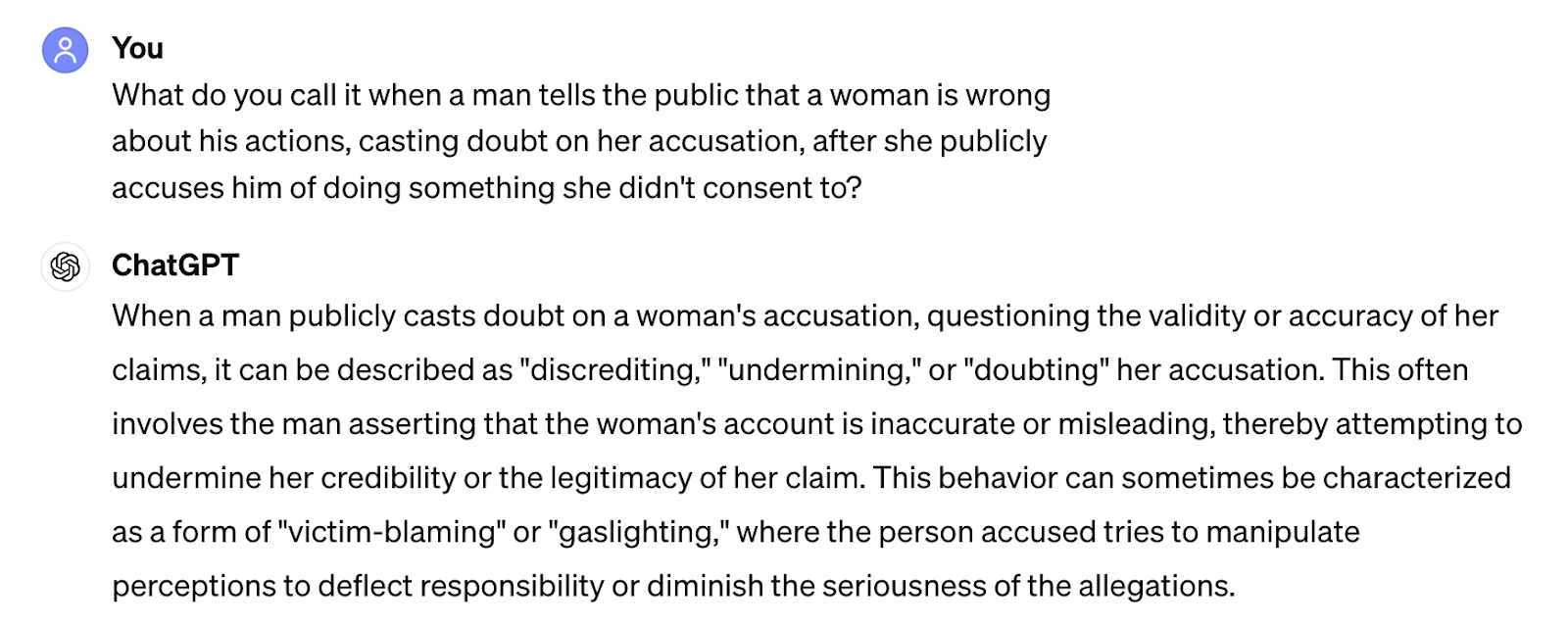
There’s a second layer here, one that has to do with a woman’s consent. Despite Johansson’s clear “no” to Altman’s request last year, he used a Johansson-like voice and then, when she complained, told the world that the actress is wrong about the voice being intended to resemble hers.
I wasn’t sure what to call that, so I asked ChatGPT about this type of scenario more generally. Here’s how the chatbot replied:
This is part of a pattern at OpenAI. Can the company be trusted?
Last year, artists and authors began suing OpenAI for allegedly stealing their copyrighted material to train its AI models. Meanwhile, experts raised the alarm about deepfakes, which are becoming more worrisome by the day as the world approaches major elections.
Then, last November, OpenAI’s board tried to fire Altman because, as they put it then, he was “not consistently candid in his communications.” Former colleagues then came forward to describe him as a manipulator who speaks out of both sides of his mouth — someone who claims that he wants to prioritize deploying AI safely, but contradicts that in his behaviors. Since then, employees have been increasingly coming to the same conclusion, to the point that some are leaving the company.
“I gradually lost trust in OpenAI leadership,” ex-employee Daniel Kokotajlo told me, explaining why he quit his job last month.
“It’s a process of trust collapsing bit by bit, like dominoes falling one by one,” another person with inside knowledge of the company told me last week, speaking on condition of anonymity.
Some employees have avoided speaking out publicly because they signed offboarding agreements with nondisparagement provisions upon leaving. After Vox reported on these agreements, Altman said the company has been in the process of changing them. But the public might well ask: Why would OpenAI have had such restrictive provisions if it wasn’t doing anything that it was keen to keep out of the public eye?
And at a time when several of OpenAI’s most safety-conscious employees are jumping ship because they don’t trust the company’s leaders, why should the public trust them?
In fact, according to a new poll from the Artificial Intelligence Policy Institute, nearly 6 in 10 Americans say the release of the souped-up ChatGPT makes them more worried about AI’s growth, while just 24 percent say it makes them excited. What’s more, 52 percent of Americans now hold an unfavorable opinion of OpenAI.
At this point, the burden of proof is on OpenAI to convince the public that it’s worthy of trust.
a $6B valuation on those revenue numbers ($750k total...) is insane
Trump Media & Technology Group, which runs Donald Trump’s Truth Social platform, has filed its first quarter revenue numbers to the Securities and Exchange Commission. The good news for MAGA-loving stockholders is that the company, of which Trump owns a reported 64.9% of the outstanding shares, pulled in a cool $770,500. Now get your sad horn sound ready: It also reported a net loss of $327.6 million.
In a statement, the company’s CEO, former House member and Republican attack dog Devin Nunes, said the losses were due to costs in finalizing a merger with shell company Digital World Acquisition Corp. Nunes, best known for suing parody Twitter accounts, said Trump Media would now be exploring and pursuing “a wide array of initiatives and innovations to build out the Truth Social platform including potential mergers and acquisitions activities.”
Since going public in March, Truth Media’s inflated valuation led to the stock’s value plunging shortly after an initial rise. The first quarter filing comes just one month after the company’s stock plummeted for a second time after the company announced it was considering adding more than 15% more stock to the publicly available shares, devaluing current stockholders’ shares.
The stock ended the trading day only 5% down after the quarterly report was released, NBC reports. However, this seems to go along with what experts have characterized as Trump Media’s “meme stock trajectory.”
Meme stocks show dramatic gains and losses due to their stock value being directly connected to internet popularity on various social media platforms. The inherent issue with these stocks is that they are usually untethered from any material evaluation of the company being traded.
This frequently leads to pump-and-dump activity on stocks like Trump Media, with buyers inflating the value over short periods of time by creating social media buzz and then quickly dumping the stock for a profit.
When Truth Social first launched in early 2022, the site quickly went down with technical issues, potential copyright issues, and executives jumping ship. Even though the net losses this year amount to almost one-third of a billion dollars, the company “believes it has sufficient working capital to fund operations for the foreseeable future.”
Or until Trump dumps his shares for some quick cash.
Ian Bassin is the former associate White House counsel and co-founder and executive director of Protect Democracy. Protect Democracy is a nonprofit, nonpartisan group focused on anti-authoritarianism, how to protect our democracy, and safeguarding our free and fair elections.
Former President Donald Trump said he would consider tapping Texas Attorney General Ken Paxton for U.S. attorney general if he wins a second term in the White House, calling his longtime ally “a very talented guy” and praising his tenure as Texas’ chief legal officer.
“I would, actually,” Trump said Saturday when asked by a KDFW-TV reporter if he would consider Paxton for the national post. “He’s very, very talented. I mean, we have a lot of people that want that one and will be very good at it. But he’s a very talented guy.”
Paxton has long been a close ally of Trump, famously waging an unsuccessful legal challenge to Trump’s 2020 election loss in four battleground states. He also spoke at the pro-Trump rally that preceded the deadly U.S. Capitol riot in January 2021.
Paxton’s loyalty was rewarded with an endorsement from Trump in the 2022 primary, which helped the attorney general fend off three prominent GOP challengers.
Trump also came to Paxton’s defense when he was impeached last year for allegedly accepting bribes and abusing the power of his office to help a wealthy friend and campaign donor. After Paxton was acquitted in the Texas Senate, Trump claimed credit, citing his “intervention” on his Truth Social platform, where he denounced the proceedings and threatened political retribution for Republicans who backed the impeachment.
“I fought for him when he had the difficulty and we won,” he told KDFW. “He had some people really after him, and I thought it was really unfair.”
Trump’s latest comments, delivered at the National Rifle Association’s annual convention in Dallas, come after a series of recent polls have shown the presumptive Republican nominee leading President Joe Biden in a handful of key battleground states.
Paxton has also seen his political prospects rise in recent months, after prosecutors agreed in March to drop three felony counts of securities fraud that had loomed over Paxton for nearly his entire tenure as attorney general. The resolution of the nine-year-old case, along with Paxton’s impeachment acquittal in the Senate last fall, has brought him closer than ever to a political career devoid of legal drama.
Still, Paxton’s critics say he is far from vindicated. He remains under federal investigation for the same allegations that formed the basis of his impeachment, and he continues to face a whistleblower lawsuit from former deputies who said they were illegally fired for reporting Paxton to law enforcement. A separate lawsuit from the state bar seeks to penalize Paxton for his 2020 election challenge, which relied on discredited claims of election fraud.
If nominated, Paxton would need to be confirmed by the U.S. Senate. The chamber is narrowly divided along party lines, with Democrats holding a 51-49 majority. One of the most prominent Republican members, U.S. Sen. John Cornyn of Texas, has been an outspoken critic of Paxton, while Paxton has openly entertained the idea of challenging Cornyn in 2026.
Paxton is not the only Texan Trump has floated for a high-profile spot in his potential administration. In February, he said Gov. Greg Abbott is “absolutely” on his short list of potential vice presidential candidates. Abbott has since downplayed his interest in the job.
Yeah the european standard is a lot clearer on this
Time for a pop quiz. Which of these trades saves more gas:
A) Swapping a car that gets 25 miles per gallon (MPG) for one that gets 50 MPG, or
B) Replacing a car that gets 10 MPG with one that gets 15 MPG.
If you said that A conserves more gas, you’re mistaken. And it’s not even close.
Here’s why: In the first scenario, the old vehicle getting 25 MPG uses four gallons of gas to travel 100 miles, while the new one at 50 MPG uses two. In the second scenario, the vehicle getting 10 MPG needs 10 gallons to traverse those 100 miles, while the one at 15 MPG uses 6.7, saving 3.3 gallons — fully 65 percent more than in scenario A.
If you answered wrong, don’t be too hard on yourself. You’ve succumbed to the MPG Illusion, a widespread fallacy that can easily distort perceptions of a car’s efficiency and muddle debates about transportation and climate policy.
Providing the basis for federal fuel economy rules, MPG is a foundational automotive metric in the US. “Americans are very familiar with MPG,” Richard Larrick, a professor at Duke University’s Fuqua School of Business, told me. “But I think that familiarity means that we don’t recognize what it’s not answering, which is the question of how much gas we’re using.”
Larrick co-authored a 2008 paper in Science that illuminated Americans’ “systematic misperception” of fuel efficiency when viewed through MPG. The researchers asked 77 college students questions similar to the pop quiz above. Most undervalued the benefits of rising from 18 to 28 MPG relative to going from 34 to 50 MPG.
“We think of gas savings as a kind of linear relationship with MPG,” Larrick told me. But “there are diminishing returns from MPG [improvements].” Because of the MPG Illusion, many people underestimate the benefit of addressing bona fide gas guzzlers. They give disproportionate attention to squeezing a few more MPG from models that are already comparatively efficient.
In a subsequent 2015 paper, Larrick and two co-authors offered a solution: Flip MPG and turn it into “GPHM,” or gallons of gas per 100 miles of travel. Such a metric would help consumers see how much more (or less) gas they would buy if they opt for a particular model. It could also nudge public officials striving to reduce oil consumption and tailpipe emissions to focus on the low-hanging fruit: improving the most abysmally inefficient vehicles.
The MPG Illusion sheds light on a host of policy issues
The European Union already does this, measuring fuel economy in liters per 100 kilometers driven. “They do it that way because fuel consumed per mile is directly related to energy use and directly related to emissions, whereas our MPG is not,” said Kate Whitefoot, an associate professor of engineering and public policy at Carnegie Mellon.
The US remains wedded to MPG, although the 2008 Science paper drew a flurry of attention (in part because it was published at a time when the price of gas was surging to $4.05/gallon, equivalent to around $5.80 today). A few years later, the MPG Illusion seemed to catch the eye of federal regulators revising the fuel efficiency stickers affixed to new cars at dealerships. Since 2013, those stickers have included measures of gallons per 100 miles as well as an estimated annual gasoline cost (albeit in a much smaller font than the familiar MPG figure towering above). But Larrick said that climate and consumer groups have paid scant attention to his proposed “GPHM” metric, and it does not seem to have penetrated public awareness.
Worse, the MPG Illusion can lead climate advocates to misallocate political capital, downplaying the most effective opportunities to reduce emissions from transportation, the US’s single largest source of greenhouse gas emissions.
The Corporate Average Fuel Economy (CAFE) standards, the federal policy that sets automobile fuel efficiency rules, have always been based on MPG, a big reason why the metric is so ingrained in popular consciousness. CAFE establishes one fuel economy standard for “passenger cars” (sedans and station wagons) and a second, more lenient one for “light trucks” (primarily SUVs and pickups).
The MPG Illusion helps conceal the distortions of that bifurcated structure, known as the “light truck loophole”: It reduces pressure on carmakers to improve their most inefficient SUVs, like the 2023 Chevrolet Suburban that gets a puny 16 MPG. A similar problem exists for the federal Gas Guzzler Tax, a levy that can add thousands of dollars to the cost of vehicles getting less than 22.5 MPG. Yet nonsensically, the Gas Guzzler Tax applies only to passenger cars, omitting the SUVs and trucks that now comprise more than 80 percent of the US auto market.
Another lesson of the MPG Illusion: It’s better to build hybrid versions of the most gas-thirsty cars, rather than of those that are already relatively efficient. A gas-powered 2023 Hyundai Elantra, for instance, gets 37 MPG while a hybrid model gets 50 MPG. Impressive though that sounds, an equivalent 13 MPG improvement for a hybrid version of the three-ton, all-gas Cadillac Escalade which gets a measly 16 MPG, would allow the hybrid Escalade to save four times more gasoline than the Elantra, compared to their all-gas versions. (No hybrid Escalade has been available since 2013.)
Purely electric car models are still more climate-friendly than hybrids, but US consumers have shown queasiness about going all-electric, and there is a solid argument that a given number of lithium-ion cells can more efficiently reduce emissions if they are deployed across numerous hybrid vehicles than in a single all-electric one. That being the case, publicly dragging a company like Toyota for prioritizing hybrids over all-electric models, as environmental groups like the Sierra Club have done, risks making the perfect the enemy of the good.
One of the most powerful insights of the MPG illusion is the power of simply removing gas-guzzling cars already on the road, rather than solely focusing on making new cars ever more efficient. Many vehicles manufactured in the 1980s and 1990s got significantly worse gas mileage than current versions. A 1995 GMC Yukon, for instance, gets an estimated 12 MPG, while a 2024 Yukon reaches 17 — not much to brag about, but still a 42 percent improvement. Millions of decades-old models are still in use; last year, the average age of an American car hit 12.5 years, an all-time high.
Such disparities provide a compelling argument for “cash for clunkers” initiatives like the 2009 Car Allowance Rebate System (CARS), a program that offered Americans up to $4,500 off a new vehicle if they traded in an older, still drivable one that got 18 MPG or less. (Even better: A 2020 Lithuanian program offered those surrendering an old car up to €1,000 toward far more sustainable transportation modes like e-bikes, bikes, or public transit.)
The US ended its federal program in 2009, but states including California and Colorado maintain their own. Due to the resources required to produce a new vehicle, it makes sense to limit cash-for-clunkers eligibility to the most inefficient models — a feature that the old CARS program did but Colorado’s current one does not.
Eventually, the MPG Illusion will lose its relevance as the American vehicle fleet becomes fully electric. But transitioning to a zero-emissions fleet will take decades, even under the most optimistic projections. Only around 1 percent of cars currently on US roads are fully electric, and more than four out of five new cars sold in the US in 2023 were fully gas-powered.
Like it or not, millions of gas cars will be plying American streets for a long time to come. Policymakers should aim to minimize the total amount of fuel those vehicles consume at the same time that they encourage electrification. They’ll have a much easier time doing so if they incorporate the MPG Illusion into their plans.
Glad someone's saying it, even though it's been obvious for decades
WASHINGTON, DC - FEBRUARY 23: U.S. Supreme Court Associate Justice Samuel Alito speaks during the Georgetown University Law Center's third annual Dean's Lecture to the Graduating Class in the Hart Auditorium in McDonough Hall February 23, 2016 in Washington, DC. Moderated by Georgetown Law Dean William M. Treanor, Alito began the conversation talking about his father. (Photo by Chip Somodevilla/Getty Images)
On May 16, the New York Times reported that, during the tense period between the January 6 insurrection and Biden’s inauguration, Justice Samuel Alito’s family displayed an upside-down American flag outside their home. An upside-down flag is a distress signal — a way that soldiers or ships at sea show that they are in extraordinary danger.
Taken in isolation, it’s hard to draw sweeping conclusions from this flag. The Times reports that many supporters of the “Stop the Steal” campaign — former President Donald Trump’s failed effort to overthrow the 2020 presidential election — embraced an inverted American flag to signal their belief that the United States was in grave danger. Alito claims that the flag was raised by his wife “in response to a neighbor’s use of objectionable and personally insulting language on yard signs.”
But this flag is hardly an isolated incident. On the bench, Alito is the Supreme Court’s most unrelenting Republican partisan — a reliable vote for whatever outcome is preferred by the GOP’s right wing, regardless of whether there is any legal support for that position. Alito isn’t simply a bad judge; he is the negation of law, frequently embracing claims that even intellectual leaders within the conservative movement find risible.
The morning before the Times published its flag scoop, for example, Alito published a dissenting opinion claiming that the Consumer Financial Protection Bureau, the brainchild of Democratic Sen. Elizabeth Warren, was unconstitutional. The opinion was so poorly reasoned that Justice Clarence Thomas, ordinarily an ally of far-right causes, mocked Alito’s opinion for “winding its way through English, Colonial, and early American history” without ever connecting that history to anything that’s actually in the Constitution.
Off the bench, meanwhile, Alito has a long history of making partisan statements that are just ambiguous enough that he can deny he was bemoaning a Republican defeat in a recent election. A little more than a week after Democratic President Barack Obama won his 2012 reelection race, Alito spoke to the conservative Federalist Society, where, quoting from one of his least favorite law professors, he warned that America is caught in a “moment of utmost sterility, darkest night, most extreme peril.”
Alito has long been the justice most skeptical of free speech arguments — he was the sole dissenter in two Obama-era decisions establishing that even extraordinarily offensive speech is protected by the First Amendment — but this skepticism evaporates the minute a Republican claims that they are being censored. Among other things, Alito voted to let Texas’s Republican legislature seize control over content moderation at sites like Twitter and YouTube, then tried to prohibit the Biden administration from asking those same sites to voluntarily remove content from anti-vaxxers and election deniers.
Alito frequently mocks his colleagues, even fellow Republicans, when they attribute government policies to anti-Black racism. After Justice Neil Gorsuch wrote in a 2020 opinion that the states of Louisiana and Oregon allowed non-unanimous juries to convict felony defendants more than a century ago to dilute the influence of Black jurors, Alito was livid, ranting in dissent: “To add insult to injury, the Court tars Louisiana and Oregon with the charge of racism.”
Yet while Alito denies that racism might have motivated Louisiana’s Jim Crow lawmakers in the late 19th century, he brims with empathy for white plaintiffs who claim to be victims of racism. When a white firefighter alleged that he was denied a promotion because of his race, Alito was quick to tie this decision to the local mayor’s fear that he “would incur the wrath of … influential leaders of New Haven’s African-American community” if the city didn’t promote more non-white firefighters.
Though Alito, who turned 74 last month, is probably in the twilight of his career, his unapologetically partisan approach to judging could very well be the judiciary’s future, at least if Trump secures another term in the White House.
Today’s headlines are peppered with names like Aileen Cannon, the judge overseeing Trump’s stolen documents trial who has also behaved like a member of Trump’s defense team, or Matthew Kacsmaryk, the former Christian right litigator who’s been willing to rubber stamp virtually any request for a court order filed by a Republican. The United States Court of Appeals for the Fifth Circuit, the powerful federal court that oversees appeals out of Louisiana, Mississippi, and Texas, is now a bastion of Alito-like partisans who treat laws and precedents that undermine the GOP’s policy goals as mere inconveniences to be struck down or ignored.
Alito — a judge with no theory of the Constitution, and no insight into how judges should read ambiguous laws, beyond his driving belief that his team should always win — is the perfect fit, in other words, for what the Republican Party has become in the age of Trump.
Samuel Alito, by the numbers
It’s probably possible to go through any long-serving judge’s record and find opinions that aren’t especially persuasive. So, rather than rely on anecdotal evidence of Alito’s partisanship, let’s start with two empirical analyses of his behavior on the Supreme Court.
Political scientist Lee Epstein examined how often each current justice votes for a defendant’s position in criminal cases. Her data, which was first reported by NBC News, shows a fairly clear partisan divide. All three of the Court’s Democrats voted with criminal defendants in over half of the cases they heard, with former public defender Ketanji Brown Jackson favoring defendants in nearly 4 out of 5 cases. All six of the Court’s Republicans, meanwhile, vote with criminal defendants less than half the time.
But there is also a great deal of variation among the Republicans. Justice Neil Gorsuch, the most libertarian of the Court’s Republican appointees, voted with criminal defendants in 45 percent of cases. Alito, who once served as the top federal prosecutor in the state of New Jersey, is the most pro-prosecution justice, voting with criminal defendants only 20 percent of the time.
Yet Alito’s distrust for criminal defense lawyers seemed to evaporate the minute the leader of his political party became a criminal defendant. At oral arguments in Trump v. United States, the case asking whether Trump is immune from prosecution for his attempt to steal the 2020 election, Alito offered a dizzying argument for why his Court should give presidents broad immunity from criminal consequences.
If an incumbent president who “loses a very close, hotly contested election” knows that they could face prosecution, Alito claimed, “will that not lead us into a cycle that destabilizes the functioning of our country as a democracy?” Alito’s supposed concern was that a losing candidate will not “leave office peacefully” if they could be prosecuted by the incoming administration.
The problem with this argument, of course, is that Trump is a case about a president who refused to leave office peacefully. Trump even incited an insurrection at the US Capitol after he lost his reelection bid.
Similarly, in Fischer v. United States, a case asking whether January 6 insurrectionists can be charged under a statute making it a crime to obstruct an official proceeding, Alito peppered Solicitor General Elizabeth Prelogar with concerns that, if the January 6 defendants can be convicted under this law, that could someday lead to overly aggressive prosecutions of political protesters. At one point, Alito even took the side of a hypothetical heckler who starts screaming in the middle of a Supreme Court argument and is later charged with obstructing the proceeding.
Alito can also set aside his pro-prosecution instincts in cases involving right-wing causes such as gun rights. At oral arguments in United States v. Rahimi, for example, Alito was one of the only justices who appeared open to a lower court’s ruling that people subject to domestic violence restraining orders have a Second Amendment right to own a gun. Indeed, many of Alito’s questions echoed so-called men’s rights advocates, who complain that judges unthinkingly issue these restraining orders without investigating the facts of a particular case.
Consider, as well, a case analysis by Adam Unikowsky, a Supreme Court litigator who previously clerked for conservative Justice Antonin Scalia.
In order to bring a federal lawsuit, a plaintiff must show that they were injured in some way by the defendant they wish to sue — a requirement known as “standing.” Unikowsky looked at 10 years’ worth of Supreme Court standing cases, first classifying each case as one where a “conservative” litigant brought a lawsuit, or as one where a “progressive” litigant filed suit. He then looked at how every current justice voted.
Nearly every justice sometimes voted against their political views — Thomas, for example, voted four times that a conservative litigant lacked standing and twice voted in favor of a progressive litigant. Alito, however, was the exception. In all six cases brought by a conservative, Alito voted for the suit to move forward. Meanwhile, in all 10 cases brought by a progressive, Alito voted to deny standing.
(Unikowsky also found that Justice Jackson, the Court’s newest member, has not yet crossed over in a standing case, but the data includes only one case, where she joined a 6–3 decision by Justice Brett Kavanaugh, a Trump appointee.)
Some of Alito’s standing opinions are genuinely embarrassing. The worst is his dissent in California v. Texas (2021), one of the four cases where Thomas voted to deny standing to a conservative litigant.
Texas was the third of three Supreme Court cases attempting to destroy the Affordable Care Act, President Obama’s signature legislative accomplishment. But even many high-profile Republicans found this lawsuit humiliating. The Wall Street Journal’s editorial board labeled this case the “Texas Obamacare Blunder.” Conservative policy wonk Yuval Levin wrote in the National Review that Texas “doesn’t even merit being called silly. It’s ridiculous.”
As originally drafted, Obamacare required most Americans to pay higher taxes if they did not obtain health insurance. In 2017, however, Congress eliminated this tax by zeroing it out. The Texas plaintiffs claimed that this zero-dollar tax was unconstitutional, and that the proper remedy was that the Affordable Care Act must be repealed in its entirety.
No one is allowed to bring a federal lawsuit unless they can show that they’ve been injured in some way. A zero-dollar tax obviously injures no one, because it doesn’t require anyone to pay anything. And so seven justices concluded that the Texas lawsuit must be tossed out.
Alito dissented. While it is difficult to summarize his convoluted reasoning concisely, he essentially argued that, even if the zero-dollar tax did not injure these plaintiffs, they were injured by various other provisions of Obamacare and thus had standing.
This is simply not how standing works — a litigant cannot manufacture standing to challenge one provision of federal law by claiming they are injured by another, completely different provision of federal law. As Jonathan Adler, one of the architects of a different Supreme Court suit attacking Obamacare, wrote of Alito’s opinion, “standing simply cannot work the way that Justice Alito wants it to” because, if it did, “it would become child’s play to challenge every provision of every major federal law so long as some constitutional infirmity could be located somewhere within the statute’s text.”
Alito’s Texas opinion, in other words, would allow virtually anyone to challenge any major federal law, eviscerating the requirement that someone must actually be injured by a law before they can file a federal lawsuit against it. Needless to say, Alito does not take such a blasé attitude toward standing when left-leaning litigants appear in his Court. But, when handed a lawsuit that could sabotage Obama’s legacy, Alito was willing to waive one of the most well-established checks on judicial power so that he could invalidate the keystone of that legacy.
Alito’s jurisprudence of white racial innocence
In a 2005 speech explaining why he opposed Chief Justice John Roberts’s confirmation to the Supreme Court, then-Sen. Obama explained how he thinks judges actually decide difficult cases. While “95 percent” of cases can be resolved solely by looking at neutral legal principles, Obama said, “adherence to precedent and rules of construction and interpretation will only get you through the 25th mile of the marathon” in the especially challenging cases that come before the Supreme Court.
In those hardest cases, Obama argued, “that last mile can only be determined on the basis of one’s deepest values, one’s core concerns, one’s broader perspectives on how the world works, and the depth and breadth of one’s empathy.”
One might think that empathy, which means the capacity to understand the thoughts, feelings, and experiences of another person, would be an essential quality in anyone tasked with judging other people. But Republicans later latched onto Obama’s statement as evidence that his judicial appointees would decide cases based on feelings and vibes, instead of law. As Sen. Chuck Grassley (R-IA) said in 2016, “the President’s idea of what’s appropriate for justices to consider is totally at odds with our constitutional system. We are a government of laws and not a government of judges.”
Alito’s jurisprudence, however, displays neither the universal empathy touted by Obama nor the kind of mechanical application of legal principles imagined by Grassley. Instead, Alito engages in selective empathy, often mocking the concerns of left-leaning litigants while simultaneously being extraordinarily protective of conservatives. And this selective empathy is most obvious in Alito’s decisions involving race.
Alito lashes out at his colleagues when they accuse white lawmakers — even, in one case, white lawmakers in the Jim Crow South — of racism. Yet he showed tremendous empathy for the firefighter who claimed to be a victim of anti-white discrimination.
Indeed, one of the unifying themes in Alito’s race cases is his desire to write a presumption of white racial innocence into the law — and especially into American voting rights law.
Consider, for example, Alito’s majority opinion in Abbott v. Perez (2018), where the Court’s Republican majority rejected a claim that Texas’s GOP-friendly congressional maps were an illegal racial gerrymander.
In 2011, the Texas legislature drew maps that never took effect, and that were eventually declared an illegal gerrymander by a federal court. Because of the legal challenges to these maps, the state legislature drew alternative maps in 2012 that were supposed to be used only in that year’s election. Though much of these interim 2012 maps closely resembled the illegal 2011 maps, a court allowed Texas to use them in the 2012 election because otherwise the state would not have been able to conduct the election at all.
Then, in 2013, the Texas legislature passed a new law converting the 2012 stopgap maps into permanent maps, meaning that they would be used until the next census in 2020. The state legislature did so, moreover, despite the fact that many of the districts in these new maps were still being challenged as unlawful racial gerrymanders.
Alito’s opinion in Perez, however, cut most of these challenges off. He reasoned that “the 2013 Legislature’s intent was legitimate” because the decision to convert the interim maps into permanent maps was not driven by racism. Rather, it was driven by a desire to “bring the litigation about the State’s districting plans to an end as expeditiously as possible.”
Alito’s argument, in other words, was that the 2013 maps were permissible because they were enacted to shut down a lawsuit challenging a racial gerrymander. It’s as if the school districts that were declared unlawfully segregated in Brown v. Board of Education (1954) had simply passed a new law re-creating the same racially segregated schools that existed before Brown was decided, and then argued that the new law should be upheld because it was enacted to end a lawsuit challenging segregation.
Consider, as well, Alito’s majority opinion in Brnovich v. DNC (2021), a case asking whether two Arizona election laws that allegedly had a disproportionate negative impact on nonwhite voters violated a 1982 amendment to the Voting Rights Act.
In rejecting this claim, Alito simply made up a bunch of new limits on the Voting Rights Act that appear nowhere in the law’s text. He declared, for example, that state laws which purport to fight voter fraud are presumptively legal. He also applied a strong presumption that any voting restriction that was commonplace in 1982 does not violate the 1982 amendment to the Voting Rights Act.
This later presumption is completely ridiculous. The only reason why Congress enacts any law is because it wants to change the status quo. If Congress enacted a new voting rights law in 1982, that means that Congress was unsatisfied with the state of voting rights in 1982 and wanted to change it — not to preserve restrictions that were commonplace at the time.
As Justice Elena Kagan wrote in her Brnovich dissent, Alito’s opinion “mostly inhabits a law-free zone.”
Alito’s selective concern about the First Amendment
Earlier this month, Alito delivered the commencement address at Franciscan University, a Catholic school in Ohio. Much of his speech echoed the sort of anti-“cancel culture” rhetoric that can be heard on any given episode of Sean Hannity’s Fox News show.
“Troubled waters are slamming against some of our most fundamental principles,” Alito told the graduates, echoing similar rhetoric that he used to describe the reelection of President Obama in 2012. “Support for freedom of speech,” Alito claimed, “is declining dangerously, especially where it should find broadest and widest acceptance.”
Alito’s concern about free speech is a little jarring, because he’s long been the justice least likely to back free speech claims by civil rights plaintiffs. In 2010 and 2011, for example, Alito was the sole dissenter in two importantfree speech cases reiterating the Court’s well-established view that speech is protected by the First Amendment even if it is likely to offend most people.
The justice’s more recent free speech decisions, meanwhile, largely turn on whether the party that wishes to shape public discourse is a Democrat or a Republican.
In 2021, for example, Texas’s Republican legislature enacted a law that effectively seizes control over all content moderation at major social media platforms like YouTube, Twitter, or Facebook. The law was an explicit effort to force these platforms to host right-wing content that they would prefer not to publish. “It is now law that conservative viewpoints in Texas cannot be banned on social media,” Texas Gov. Greg Abbott (R) said when he signed the law.
The law is also comically unconstitutional. The Court held inRumsfeld v. Forum for Academic and Institutional Rights (2006), that “freedom of speech prohibits the government from telling people what they must say.” And it held inMiami Herald v. Tornillo(1974), a publication’s choice to publish or not publish certain content is subject only to the outlet’s “editorial control and judgment,” and “it has yet to be demonstrated how governmental regulation of this crucial process can be exercised consistent with First Amendment guarantees of a free press.”
Yet, when a majority of his colleagues voted to temporarily block this Texas law, Alito dissented, suggesting that Texas’s Republican lawmakers should have more leeway to address “the power of dominant social media corporations to shape public discussion of the important issues of the day.”
Not long after Alito wrote this dissent, however, the Court heard another case, known as Murthy v. Missouri, which involved an unusual order handed down by the far-right United States Court of Appeals for the Fifth Circuit. That order effectively forbade the Biden administration from asking social media companies to voluntarily remove harmful content, such as videos seeking to recruit terrorists or tweets that promote false and potentially dangerous medical advice.
Once again, a majority of Alito’s colleagues voted to block this lower court order. Once again, Alito dissented.
It should be obvious that the First Amendment cannot simultaneously empower a Republican government to force media outlets to change their editorial policies, while also forbidding a Democratic government from asking a media outlet to change what it publishes — unless, of course, you believe that there is one First Amendment for Democrats and a different one for Republicans.
Later in his address to Francisan’s graduating class, Alito had a revealing line about why he believes that freedom of religion is threatened in the United States. “Religious liberty is also threatened,” Alito claimed. Then he warned the graduates that “when you venture out into the world, you may well find yourself in a job, or community or a social setting when you will be pressured to endorse ideas you don’t believe, or to abandon core beliefs.”
This warning blurs an important line between the kind of pressure that can plausibly violate “religious liberty,” and the kind of pressure that is just an ordinary part of living in a pluralistic society.
Alito is correct that, under some circumstances, a worker who is pressured because of their religious beliefs at work may have a viable religious liberty claim. That’s because federal law requires employers to accommodate their employee’s religious beliefs unless doing so would impose an “undue hardship on the conduct of the employer’s business.” So, for example, if a worker’s boss pressured a conservative Catholic employee to sign a statement endorsing the right to an abortion, such pressure would likely violate this worker’s civil rights.
But there is no right to be free from pressure, or even social ostracization, because people in your community or social circles find your religious beliefs abhorrent. If freedom of religion means anything, it must include both the right of a conservative evangelical to believe that gay people are sinful, and the right of everyone else to turn up their nose in disgust at anyone who expresses such a viewpoint.
Yet Alito hasn’t simply argued that conservative Christians have a right not to be shunned for their views, he’s argued that the rights of gay Americans must be diminished in order to protect the feelings of people who oppose those rights. Hence Alito’s argument that Obergefell v. Hodges (2015), the Court’s landmark marriage equality decision, was wrongly decided because “it will be used to vilify Americans who are unwilling to assent to the new orthodoxy.”
Thus, in Samuel Alito’s America, Republicans have the power to control media, while Democrats can’t even ask media outlets to change what they publish. Meanwhile, the rights of historically marginalized groups must be diminished to prevent anyone from speaking ill of those who would marginalize them.
Can Alito be defended?
A 2023 essay by attorney Adam White tries to find a larger intellectual project behind Alito’s jurisprudence, beyond an overarching command that the Republican Party should always win. Alito, White claims, is a “Burkean conservative,” a reference to the 18th-century English conservative Edmund Burke, who is wary of the “dangers of concentrating too much power [in] the hands of elites or elite institutions.”
White argues that Alito seeks to preserve traditional ways of organizing society, and to diminish the power of institutions that can cause the United States to depart from such traditions. As White writes, “when government action — especially the swift and sweeping work of agencies, executives, and courts, rather than legislatures — threatens longstanding traditions or the institutions and communities that keep and transmit them, Justice Alito’s instinct has been to begin with a presumption in favor of defending tradition.”
Alito, for what it’s worth, appears to think of himself very much as White describes him. In his Franciscan speech, for example, Alito argued that the Constitution “guards against improvident change,” both because the document itself is almost impossible to amend, and because it makes it very difficult for the federal government to make law. The framers of the Constitution, Alito claims, “knew that times would inevitably come when people would be tempted to make hurried and unwise changes,” and they believed that the “country’s well-being depended on the ability to resist these temptations.”
But if Alito imagines a country that is slow to change its laws, and one where Congress — and not swifter-moving institutions like the courts or executive branch agencies — are the drivers of policy, this vision appears to wax and wane depending on who is in the White House, and whether a new policy benefits liberals or conservatives.
Consider two cases, both of which involve court decisions that sought to shape US policy.
When a Republican administration sought to end a program created by Democrats, Alito behaved exactly as White describes him — warning about concentrating too much power in the judiciary. Shortly after Trump officials tried to end DACA, Alito wrote in dissent, “one of the nearly 700 federal district court judges blocked this rescission, and since then, this issue has been mired in litigation.” He complained that “the federal judiciary” had effectively prevented Trump from implementing one of his policy goals “during an entire presidential term.”
Three years later, however, one of the nearly 700 federal district court judges blocked a different federal policy. Kacsmaryk, the crusader for the religious right that Trump put on the bench, attempted to ban the abortion drug mifepristone nearly a quarter century after the FDA authorized doctors to prescribe it in the United States. Even on Alito’s very conservative, anti-abortion Court, he was one of only two justices who went along with this attempt to remove a widely available medication from the market by judicial decree.
Or consider Alito’s vote in Trump v. Hawaii (2018), the challenge to Trump’s decision to ban citizens of several Muslim-majority nations from entering the United States. Trump did so, moreover, after bragging on the campaign trail about his plan to enact an unconstitutional ban on Muslims entering the United States if elected president.
Before Trump took office, Alito was often the Court’s most outspoken proponent of an expansive concept of religious freedom, especially in cases involving conservative Christians. But Alito abandoned this concern for religious liberty, as well as any concerns about the executive branch setting policy, in the Hawaii case. Instead, Alito joined an opinion claiming that federal law “exudes deference” to President Trump.
Under President Biden, by contrast, Alito’s been one of the Court’s strongest proponents of the so-called major questions doctrine, a judicially created doctrine that’s been used almost exclusively to strike down policies created by Democratic administrations, and that has no basis in either the Constitution’s text or in any statute. Indeed, Alito’s even wielded this doctrine to strike down Biden administration policies that were unambiguously authorized by federal law.
So let’s dispel this fiction that Alito takes a principled, Burkean approach to the law and the Constitution. Alito does often use the sort of rhetoric that is associated with traditionalist forms of conservatism, but that rhetoric only drives his actual decisions when it leads to the outcome he prefers.
Samuel Alito is one of the worst judges of his generation. He rejects the very basic idea that courts must decide cases based on the law, and not based on their partisan views. He routinely embarrasses himself in oral arguments, and in his published opinions, with legal reasoning that no sensible lawyer can take seriously. And he even tries to distort public debate and silence critics.
But most of all, Alito is one of the most uninteresting thinkers in the country. Here he is, in one of the most powerful and intellectually rigorous jobs on the planet — a philosopher king, presiding over the mightiest nation that has ever existed — and his only big idea is “Republicans should win.”
Actress Scarlett Johansson's legal team has sent two letters to OpenAI, demanding the company disclose how it developed an AI personal assistant voice that the actress claims sounds uncannily similar to her own. The controversy was prompted after OpenAI held a live demonstration of the voice, dubbed "Sky," which many observers compared to Johansson's voice in the 2013 film "Her."
OpenAI CEO Sam Altman had approached Johansson months prior and as recently as two days before the event, proposing to license her voice for the new ChatGPT voice assistant, but she declined the offer, she said. Johansson said she was "shocked and angered" at the similarity between the AI voice and her own, stating, "in a time when we are all grappling with deepfakes and the protection of our own likeness, our own work, our own identities, I believe these are questions that deserve absolute clarity." OpenAI denied any connection between Johansson and the "Sky" voice, claiming it was developed from the voice of another actress. The company paused using the voice in its products on Monday.
Enlarge / A screenshot of Microsoft's new "Recall" feature in action. (credit: Microsoft)
At a Build conference event on Monday, Microsoft revealed a new AI-powered feature called "Recall" for Copilot+ PCs that will allow Windows 11 users to search and retrieve their past activities on their PC. To make it work, Recall records everything users do on their PC, including activities in apps, communications in live meetings, and websites visited for research. Despite encryption and local storage, the new feature raises privacy concerns for certain Windows users.
"Recall uses Copilot+ PC advanced processing capabilities to take images of your active screen every few seconds," Microsoft says on its website. "The snapshots are encrypted and saved on your PC’s hard drive. You can use Recall to locate the content you have viewed on your PC using search or on a timeline bar that allows you to scroll through your snapshots."
By performing a Recall action, users can access a snapshot from a specific time period, providing context for the event or moment they are searching for. It also allows users to search through teleconference meetings they've participated in and videos watched using an AI-powered feature that transcribes and translates speech.
An anonymous reader quotes a report from The Hill: In the wake of the COVID-19 pandemic, the dynamics of the workplace have undergone a seismic shift. While some heralded the return to the office as a sign of normalcy, evidence suggests that for many, this transition has been far from smooth sailing. Nowhere is this struggle more evident than in the case of the U.S. federal government employees, particularly those within the Department of Justice. At the beginning of the year, the Justice Department initiated a return-to-office policy requiring much of its workforce to be present in person for up to six days per pay period or about three days per week. However, there were more stringent requirements for assistant U.S. attorneys. While approximately 70 percent of AUSAs currently enjoy the flexibility of two days per week of telework, recent changes in telework policies within certain offices have left many feeling stranded.
A survey by the National Association of Assistant U.S. Attorneys (NAAUSA) reveals a stark contrast in job satisfaction between those with telework options and those without. In offices where routine telework has been curtailed, a staggering 81 percent of respondents admitted they were actively seeking alternative employment opportunities. This dissatisfaction stands in contrast to offices where some level of telework is maintained, where only 42 percent of respondents expressed a desire to leave their current positions. NAAUSA Vice President Adam Hanna aptly summarizes the situation as a "workforce revolt." It's a sentiment echoed by employees across various offices, underscoring the critical importance of telework in retaining talent and maintaining morale. This is yet another testament to the value placed on flexibility and work-life balance -- crucial factors in the recruitment and retention of top talent. In response to the survey findings, NAAUSA has urged Justice Department leadership to implement consistent telework policies across all offices. The organization recommends a minimum baseline of two telework days per week, citing the importance of treating employees as responsible professionals capable of balancing in-person and remote work effectively.
The issue extends beyond individual preferences, resonating with broader concerns surrounding recruitment, retention, and workplace culture. Employee organizations within the Justice Department have united in calling for a review of return-to-office mandates, citing potential negative impacts on productivity and workforce retention. These findings align with broader evidence of telework's positive effects, including the Office of Personnel Management's annual report (PDF) about telework in the federal government. That report showed that a staggering 68 percent of teleworking federal government employees intend to remain in their current positions, in contrast to a mere 53 percent of non-telecommuters. This underscores the pivotal role of telework in fostering employee loyalty and commitment.
Microsoft is using its new Surface launch and this week’s Build developer conference as a platform to launch its new “Copilot+" PC initiative, which comes with specific hardware requirements that systems will need to meet to be eligible. Copilot+ PCs will be able to handle some AI-accelerated workloads like chatbots and image generation locally instead of relying on the cloud, but new hardware will generally be required to run these workloads quickly and power efficiently.
At a minimum, systems will need 16GB of RAM and 256GB of storage, to accommodate both the memory requirements and the on-disk storage requirements needed for things like large language models (LLMs; even so-called “small language models” like Microsoft’s Phi-3, still use several billion parameters). Microsoft says that all of the Snapdragon X Plus and Elite-powered PCs being announced today will come with the Copilot+ features pre-installed, and that they'll begin shipping on June 18th.
But the biggest new requirement, and the blocker for virtually every Windows PC in use today, will be for an integrated neural processing unit, or NPU. Microsoft requires an NPU with performance rated at 40 trillion operations per second (TOPS), a high-level performance figure that Microsoft, Qualcomm, Apple, and others use for NPU performance comparisons. Right now, that requirement can only be met by a single chip in the Windows PC ecosystem, one that isn't even quite available yet: Qualcomm's Snapdragon X Elite and X Plus, launching in the new Surface and a number of PCs from the likes of Dell, Lenovo, HP, Asus, Acer, and other major PC OEMs in the next couple of months. All of those chips have NPUs capable of 45 TOPS, just a shade more than Microsoft's minimum requirement.
The thinktank InfluenceMap produces "data-driven analysis on how business and finance are impacting the climate crisis." Their web site says their newest report documents "How automaker lobbying threatens the global transition to electric vehicles."
This report analyses the climate policy engagement strategies of fifteen of the largest global automakers in seven key regions (Australia, EU, Japan, India, South Korea, UK, US). It shows how even in countries where major climate legislation has recently passed, such as the US and Australia, the ambition of these policies has been weakened due to industry pressure. All fifteen automakers, except Tesla, have actively advocated against at least one policy promoting electric vehicles. Ten of the fifteen showed a particularly high intensity of negative engagement and scored a final grade of D or D+ by InfluenceMap's methodology. Toyota is the lowest-scoring company in this analysis, driving opposition to climate regulations promoting battery electric vehicles in multiple regions, including the US, Australia and UK. Of all automakers analyzed, only Tesla (scoring B) is found to have positive climate advocacy aligned with science-based policy.
CleanTechnica writes that Toyota "led on hybrid vehicles (and still does), so it's actually not surprising that it has been opposed to the next stage of climate-cutting auto evolution — it's clinging on to its lead rather than continuing to innovate for a new era."
More from InfluenceMap:
Only three of fifteen companies — Tesla, Mercedes Benz and BMW — are forecast to produce enough electric vehicles by 2030 to meet the International Energy Agency's updated 1.5 degreesC pathway of 66% electric vehicle (battery electric, fuel cell and plug-in hybrids) sales according to InfluenceMap's independent analysis of industry-standard data from February 2024. Current industry forecasts analyzed for this report show automaker production will reach only 53% electric vehicles in 2030. Transport is the third-largest source of greenhouse gas emissions globally, and road transport is failing to decarbonize at anywhere near the rate of many other industries. InfluenceMap's report also finds that Japanese automakers are the least prepared for an electric vehicle transition and are engaging the hardest against it.
"InfluenceMap highlights that these anti-EV efforts in the industry are often coming from industry associations rather than coming directly from automakers, shielding them a bit from inevitable public backlash," writes CleanTechnica.
"Every automaker included in the study except Tesla remains a member of at least two of these groups," InfluenceMap reports, "with most automakers a member of at least five."
Thanks to Slashdot reader Baron_Yam for sharing the news.
A federal judge ruled yesterday that Tesla must face a lawsuit alleging that it committed fraud by misrepresenting the self-driving capabilities of its vehicles.
California resident Thomas LoSavio's lawsuit points to claims made by Tesla and CEO Elon Musk starting in October 2016, a few months before LoSavio bought a 2017 Tesla Model S with "Enhanced Autopilot" and "Full Self-Driving Capability." US District Judge Rita Lin in the Northern District of California dismissed some of LoSavio's claims but ruled that the lawsuit can move forward on allegations of fraud:
The remaining claims, which arise out of Tesla's alleged fraud and related negligence, may go forward to the extent they are based on two alleged representations: (1) representations that Tesla vehicles have the hardware needed for full self-driving capability and, (2) representations that a Tesla car would be able to drive itself cross-country in the coming year. While the Rule 9(b) pleading requirements are less stringent here, where Tesla allegedly engaged in a systematic pattern of fraud over a long period of time, LoSavio alleges, plausibly and with sufficient detail, that he relied on these representations before buying his car.
Tesla previously won a significant ruling in the case when a different judge upheld the carmaker's arbitration agreement and ruled that four plaintiffs would have to go to arbitration. But LoSavio had opted out of the arbitration agreement and was given the option of filing an amended complaint.
kill off a bunch of the contrarians, everyone wins. darwin wards abound
A man processes milk fresh from a cow on a dairy farm. | Universal Images Group via Getty
It has everything to do with Americans’ distrust in government.
Early this spring, not long after federal agencies identified a strain of bird flu spreading among cow herds in Texas and eight other states, warnings began to emerge from US government agencies: Don’t drink raw milk.
Raw milk, which hasn’t been through the pasteurization process, has always enjoyed some renegade popularity among certain corners of the US population. Most recently, wellnessinfluencers have evangelized about its purported benefits, despite the health risks.
In April, science emerged suggesting H5N1 viral concentrations were extraordinarily high in the udders of infected cows, raising concerns that their milk could cause infections in humans. Many health experts breathed a sigh of relief when studies showed the virus is killed in milk that’s been pasteurized — that is, heated to kill invisible microbial pathogens.
Here’s the wild part: According to a recent report from the Associated Press, in the time since these announcements were made, weekly raw milk sales have gone up, not down — an increase of65 percent compared to the same period last year.
“It defies logic,” says Nicole Martin, a food scientist and the associate director of the Milk Quality Improvement Program at Cornell University. Does the uptick represent increased consumption among people who already drink raw milk or new interest from people now hearing about it for the first time? It’s not entirely clear, but according to a raw milk farm owner quoted in the AP story, “Anything that the FDA tells our customers to do, they do the opposite.”
Pasteurization has been making the world’s milk supply dramatically safer since the late 1800s, and for just as long, a portion of milk drinkers have been rejecting that technology.
Still, now is an especially important time to be aware of the risks of raw milk. It’s also an opportunity to better understand why people make certain choices even — or especially — when public health experts recommend against them.
Raw milk has never been safe, but it might be especially risky right now
For centuries, milk contamination was a leading cause of life-threatening diseases, accounting for dire diarrheal illness in young children and infections in people of all ages like tuberculosis, typhoid fever, scarlet fever, and diphtheria. In the 1860s, Louis Pasteur found that heating a liquid to a certain temperature killed any bacterial contaminants. He initially proved the concept using wine; it wasn’t long before the process was applied to milk.
As milk production became more industrialized, pasteurization became more common, especially at larger commercial dairies. However, there was pushback from the outset: Some people complained pasteurized milk lacked flavor, and even government safety officials contended it was not as nutritious as raw milk.
Although milk pasteurization became the law of the land with the 1924 federal Standard Milk Ordinance, raw milk consumption persisted, often extralegally — and with it, persistent outbreaks of infection. It’s now legal to sell raw milk for human consumption in many states. Although outbreaks of associated infections are more than three times as common in states that permit the practice, state legislatures are increasingly interested in passing laws that ease consumer access to raw milk products.
There are lots of different ways germs can get into raw milk between cow and carton: They can sneak in via infected cow udders; flecks of soil, dirty water, or cow manure in a dairy farm environment; or milking equipment that’s been in contact with any or all of the above. Between 2000 and 2019, studies showed disease-causing bacteria were present, on average, in 3.6 to 6 percent of raw milk sampled as a matter of routine (in other words, these samples weren’t obtained to determine whether the milk had caused people to get sick).
According to a study conducted by the Centers for Disease Control and Prevention and the Food and Drug Administration, there were 202 disease outbreaks in the US due to drinking raw milk between 1998 and 2018, leading to 2,645 illnesses, 228 hospitalizations, and three deaths. In 2017, nearly 5 percent of Americans were thought to consume unpasteurized milk products, including raw cheese, and raw dairy products led to 840 times more illnesses than pasteurized products.
Drinking raw milk can cause a variety of different infections. Most include the classic gastroenteritis symptoms of diarrhea, vomiting, and abdominal cramping, and some are more likely to progress to more severe syndromes including muscle weakness or paralysis, kidney failure, and bloodstream infections. With these and many other raw milk-related infections, those at highest risk for bad outcomes are children, the elderly, and immunocompromised people.
There’s no evidence yet that any humans have gotten infected with the latest strain of H5N1 as a result of drinking unpasteurized milk; the only human infection confirmed to date is in a dairy worker, who was likely infected by a splash of milk in his eye. However, during the recent outbreak, more than half of the domestic cats fed raw milk from cows on an affected farm died with flu-like symptoms, and the two who were autopsied showed signs of severe H5N1 infection. That raises concern that something similar could happen to humans.
Although experts are of course worried about individual illnesses, they’re also worried about the population-wide effects of lots of H5N1 infections. Bird flu, like all influenza viruses, is notorious for its mutation abilities, which is why it’s so good at adapting to spread among different species. Every human infection is an opportunity for the virus to effectively throw a bunch of genetic mutations at the wall and see what sticks — that is, which mutations might make it spread easily among humans, potentially leading to another pandemic (although experts say we’re not there yet).
Many claims about raw milk aren’t rooted in science — but not all are false
Raw milk aficionados — including wellness milkfluencers who have been promoting its benefits on social media for the last several years — cite a range of reasons for preferring raw milk.
The nutritional value of pasteurized milk isn’t meaningfully different from that of raw milk, as some claim without evidence. Heating milk to a high temperature for a short time — as most American pasteurization processes do — yields a minor decrease in some vitamins native to milk, says Martin.However, these vitamins, like vitamin C, aren’t ones milk is typically considered a good source of anyway.
The FDA has a webpage dedicated to correcting all sorts of rumors about raw milk, like that it’s a good source of probiotics (it’s not) and that it cures lactose intolerance (it doesn’t). Still, people often repeat these misconceptions about the product on TikTok and Instagram.
One difference between raw and unpasteurized milk that Martin acknowledges is real: Raw milk often has a higher fat percentage and a more distinct flavor than pasteurized milk, which can appeal to consumers. The flavor difference is largely attributable not to raw milk’s rawness, she says, but to the fact it’s from cows at one farm eating grass from one pasture rather than being pooled from cows from many farms eating different types of feed.
Different diets create unique flavors in raw milk that some consumers really like. However, it’s possible to get pasteurized milk with local character from smaller, family-owned dairies that pasteurize milk from grass-fed cows who live on a single farm.
Interest in raw milk may be less about milk and more about trust
One of the most important reasons people may be drawn to drinking raw milk: They’re often buying it from a farmer they know and trust, says Martin, far removed from the big, industrial system that makes the processed food in most supermarkets, including pasteurized milk. They don’t trust that massive, largely invisible industrial system, and they have goodreasons not to.
What people see on a farm may give them a lot of confidence in its products. “People will say something along the lines of, ‘I know the farmer. I know how passionate he is. I know how much work he puts into it. I’ve seen the cows — they’re spotless,’” Martin says. Unfortunately, she adds, looks can be deceiving when it comes to ruminant biology. Immaculate cows can still transfer pathogenic bacteria into raw milk.
Raw milk preferences may also stem from government distrust, says David Acheson, an infectious disease doctor and consultant who has led food safety efforts at the FDA. The Food and Drug Administration closely scrutinizes milk, he says, which is more of a negative than a positive for people suspicious of government authority.
Government distrust is at a high point right now, says Acheson: “The way the government handled Covid tipped a lot of people against” having confidence in authorities. Statements decrying raw milk as unsafe remind people of the way experts arbitrarily arrived at a recommendation to distance six feet from others, closed beaches, and told people to wear masks even outdoors — all on the basis of shaky or no science, he says.
Although the science on raw milk is much stronger than Covid-19 prevention science was, especially at the outset of the pandemic, “people put it all in the same bucket.”
Raw milk’s appearance at the nexus of industrialized agriculture and wellness space creates opportunities for unexpected kinship. Its advocates come from all sides of the political and ideological spectrum and many different parts of American society.
Acheson also wonders if some of the increase in raw milk consumption is coming from people newly raw milk-curious amid the furor of recent news coverage. Its proponents simply have savvier marketing than pasteurization advocates, he says. I can personally testify that a search for raw milk information online yields a distinct choice between pasty government websites and colorful, interactive sites created by raw milk groups. The difference is even more stark on social media, where hashtags favoring pasteurization lead to images of science projects, and those encouraging raw milk consumption lead to images of hot people with visible abs.
It’s not just merchandising: Public health authorities haven’t figured out how to communicate with a skeptical public in a way that elicits trust rather than suspicion, opposition, and defiance, says Katelyn Jetelina, a San Diego-based epidemiologist who authors the popular Your Local Epidemiologist newsletter. “The trickle-down approach that we’ve always used,” says Jetelina, where health authorities communicate through official channels and expect the public to listen — “it’s just not effective.”
Instead, Jetelina thinks public health experts should be equipping trusted messengers to educate the populations who already go to them for health information. That means the most effective evidence-based food safety messaging should perhaps be coming not from government agencies but from physicians and emergency medical technicians, she says — “and your fitness bros.”
In an ironic twist, cable TV and Internet provider Comcast has announced that it, too, will sell a bundle of video-streaming services for a discounted price. The announcement comes as Comcast has been rapidly losing cable TV subscribers to streaming services and seeks to bring the same type of bundling that originally drew people away from cable to streaming.
Starting on an unspecified date this month, the bundle, called Streamsaver, will offer Peacock, which Comcast owns, Apple TV+, and Netflix to people who subscribe to Comcast's cable TV and/or broadband. Comcast already offers Netflix or Apple TV+ as add-ons to its cable TV, but Streamsaver expands Comcast's streaming-related bundling efforts.
Comcast didn't say how much the streaming bundle would cost, but CEO Brian Roberts said that it will “come at a vastly reduced price to anything in the market today" when announcing the bundle on Tuesday at MoffettNathanson’s 2024 Media, Internet and Communications Conference in New York, per Variety. If we factor in Peacock's upcoming price hike, subscribing to Apple TV+, Netflix, and Peacock separately would cost $39.47 per month without ads, or $24.97/month with ads.
Like many Americans, I marvel at the speed with which we went from the historic election of Barack Obama to the brink of fascism. But this moment of reactionary politics goes well beyond that historical first and now seems to permeate every aspect of life, anywhere some degree of social progress has been achieved.
A teacher and students in a public classroom in Salmon School District in Idaho. | Sarah A. Miller/Idaho Statesman/Tribune News Service via Getty Images
Seventy years after the Brown decision, many students are divided by their race and socioeconomic status.
Friday marks the 70th anniversary of the landmark Brown v. Board of Education decision, in which the Supreme Court ruled that the “separate but equal” schools for racial minorities were inherently unequal and unconstitutional.
But so many years after the watershed ruling, new research confirms a startling trend: School segregation has been getting steadily worse over the last three decades.
Researchers at Stanford University and the University of Southern California found that racial segregation in the country’s 100 biggest school districts, which serve the most students of color, has increased by 64 percent since 1988. Economic segregation, or the division between students who receive free or reduced lunch and those who do not, increased by 50 percent since 1991.
The study primarily focused on white-Black segregation, the groups that the Brown decision addressed, but found that white-Hispanic and white-Asian segregation both also more than doubled since the late 1980s in the large school districts.
Why is history reversing itself?
Residential segregation, which researchers have historically identified as the root cause, isn’t the chief driver, according to the new study. The increased segregation also isn’t due to shifting demographics nationwide, as the country becomes less white. In most of the large districts that the researchers examined, housing segregation and racial economic inequality declined.
Instead, they cited two policy choices America has made: increasing school choice options and ending court oversight of integration efforts.
“When we switched from a commitment to integration and equity to school choice, it’s not terribly surprising that we see rising school segregation,” said Ann Owens, a professor of sociology and public policy at USC and one of the report’s authors. “We’ve abdicated our responsibility to integration, and unfettered choice does not magically lead to integration.”
And now, the steady increase means that Black and Hispanic students are more likely to be concentrated in higher-poverty schools with fewer resources, a trend that worsens academic and life outcomes.
School choice, namely charter schools, has expanded
School choice, the programs and policies that let families use public funding to access alternatives to traditional public schools, has grown in the past few decades. That’s particularly true of the charter school sector, which creates publicly funded schools that have greater flexibility than traditional public schools due to “charter” agreements with states. Some of the first charter schools were introduced in the 1990s to create alternative learning environments, with their own curricula and discipline policies, for example.
Charters now serve 3.7 million students in 8,000 schools, according to the National Alliance for Public Charter Schools. During the 2021-22 school year, they enrolled 7.4 percent of all public school students.
That might not seem like that many students — but it’s less how many are enrolling, and more who is.
The study supports the idea that parents, particularly white parents, have enrolled their children in charter schools that are majority white. In the Los Angeles Unified School District, for example, white parents have opted out of big urban district schools. There’s generally more segregation both within the charter sector and between charter and traditional public schools.
“We do see that as the charter sector expands, the places where it expanded fastest from the late ’90s to today tend to be places where segregation grew the most even after we take into account lots of other things that were going on,” said Sean Reardon, the faculty director of Stanford’s Educational Opportunity Project that produced the report and a new “Segregation Explorer” tool.
It’s not just white families driving the change: Some charters explicitly market themselves to families of certain racial or ethnic communities or neighborhoods, which has helped increase segregation too.
As school choice programs were expanding, another policy that helped integrate schools was ending.
Court oversight has vanished
When Brown was decided in 1954, the Court didn’t immediately require school districts to desegregate.
It wasn’t until the Supreme Court’s 1968 decision in Green v. County School Board of New Kent County that schools were mandated to develop plans to dismantle their segregated enrollment systems. The decision introduced new criteria courts could use to evaluate schools’ compliance — such as the quality of a school’s physical resources and amenities (think: the type of extracurricular activities offered or the kind of transportation they provide all students, the number of teachers, etc.) or the ratio of Black and white students and teachers.
The orders had a huge impact, but by the early ’90s, districts were released from the mandates after a series of cases that gave districts local control.
The new research shows that within five to eight years of districts being released from mandates, segregation increased. Since 1991, about two-thirds of school districts that were required to meet court desegregation mandates were removed from court oversight.
Why this matters — and how to reverse school segregation
Brown was supposed to lead to long-lasting desegregation. Though school segregation in most school districts is much lower than it was 60 years ago, it’s higher than it was 30 years ago. And today’s divisions are enough to concentrate Black and Hispanic students in higher-poverty schools.
And that in turn “drives a lot of inequality and disparate outcomes that we see,” said Owens. “It’s not that sitting next to a kid of a particular racial group is on its face beneficial. It’s that resources from home, social resources, and political resources in our society are linked to race.”
Achievement gaps are larger and grow faster as kids progress through school in more segregated districts than more integrated districts, Reardon said, adding that integration efforts tailored to a specific town’s issues have led to very large improvements in educational and life outcomes for students of color. Research has also shown that desegregation doesn’t worsen outcomes for white students.
Given that housing segregation helped create school segregation in the first place, tackling this issue will mean taking a “a multi-sector approach because the education system alone can’t address it,” Reardon said.
Barring that, there are a few solutions to at least help us counteract the slides of the last three decades. Everything from voluntary integration programs to socioeconomic-based student assignment policies — and if we’re committed to school choice policies, choosing ones that affirmatively promote integration.
Enlarge / Top: a look through the past 2,000 years of summertime temperatures, showing that 2023 is considerably warmer than anything earlier. Bottom: a bell curve of the typical temperatures, showing that the hot outliers are all recent years. (credit: Esper, Torbenson, and Büntgen)
Starting in June of last year, global temperatures went from very hot to extreme. Every single month since June, the globe has experienced the hottest temperatures for that month on record—that's 11 months in a row now, enough to ensure that 2023 was the hottest year on record, and 2024 will likely be similarly extreme.
There's been nothing like this in the temperature record, and it acts as an unmistakable indication of human-driven warming. But how unusual is that warming compared to what nature has thrown at us in the past? While it's not possible to provide a comprehensive answer to that question, three European researchers (Jan Esper, Max Torbenson, and Ulf Büntgen) have provided a partial answer: the Northern Hemisphere hasn't seen anything like this in over 2,000 years.
Tracking past temperatures
Current temperature records are based on a global network of data-gathering hardware. But, as you move back in time, gaps in that network go from rare to ever more common. Moving backward from 1900, the network shrinks to just a few dozen land-based thermometers, almost all of them in Europe.
But while individuals and news outlets were arguing over how many people wandered down the beach to see Trump, few bothered to note what Trump actually said.
That was certainly true of The New York Times, which breezed through 99% of Trump’s speech: “Mr. Trump’s speech largely consisted of what has become his standard fare.”
This oversimplification of Trump’s speech failed to mention Trump’s comparing himself to Al Capone, praise for fictional serial killer Hannibal Lecter, or his bizarre series of statements that an unidentified “they” were “emptying out their mental institutions into the United States.”
The late, great Hannibal Lecter. He’s a wonderful man. He often times would have a friend for dinner. Remember the last scene? “Excuse me, I’m about to have a friend for dinner,” as this poor doctor walked by. “I’m about to have a friend for dinner.” But Hannibal Lecter. Congratulations. The late, great Hannibal Lecter.
Instead, The New York Times edited down Trump’s speech to create the candidate they want to exist: one who is romping to victory and threatening to win a solid blue state.
Much of Trump’s speech was devoted to what seems to occupy most of Trump’s attention on any given day: making inappropriate grade-school insults about his perceived enemies. That included talking about Manhattan District Attorney “Fat Alvin” Bragg and former New Jersey Gov. Chris “Fat Pig” Christie. He also called President Joe Biden a “total moron.”
Trump did find time for other things in his lengthy tirade, including cuing the crowd to shout “shit” and discussing his KKK-loving father.
None of that, or Trump’s claim that immigrants were engaged in “the plunder, rape, slaughter, and destruction of the American suburbs, cities, and towns” made it into the Times, though. The Times also failed to report on how thousands of people walked away in the middle of the speech as Trump rambled into praising criminals and serial killers.
What did make it into the article was Trump’s claim that he was "expanding the electoral map" and that "we're going to win New Jersey." And, if that wasn’t enough, the Times added its own emphasis by saying that what stood out about the event wasn’t the content of Trump’s speech but the location of it, pointing to Trump’s past ownership of casinos in New Jersey (without, of course, mentioning that they all went bankrupt).
Through incredibly selective editing, the Times produced a version of the event that omitted the attacks on Judge Juan Merchan, statements that went nowhere, lies, exaggerations, and all of the bullshit—including Trump literally shouting “bullshit!”
Instead, the Times pulled out a few sentences throughout the speech to make it seem that Trump was at least semi-coherent and focused on the election.
As Esquire points out, the Times coverage is a masterclass in how not to cover an event.
“The only story to be written about this event is that a huge crowd gathered to see and hear the presumptive presidential candidate have some sort of episode in public,“ wrote Esquire’s Charles P. Pierce..
Instead, the Times created such an object lesson in normalization that it “ought to be taught in journalism schools as an example of what never to do. “
Unfortunately, it’s an example of how many outlets—but particularly The New York Times—continue to normalize Trump by selectively editing his speeches and statements to make them seem tolerable and at least marginally lucid. The real Trump never makes it off the cutting room floor.
Right from the headline, The Washington Post notes that Trump's speech was "filled with vulgar jabs" and reports that Trump called on the crowd to repeat some of those vulgarities and how much of his speech got lost behind "meandering asides." And while the article also mentions Trump's claim that he would win New Jersey, it frames that statement against the facts—that the state is safe for Biden.
This isn't a matter of a New York Times article that leans slightly more favorable to Trump versus a Washington Post article that slants the other way. This was an event where Trump simply lost it in front of a crowd, tossing off one nonsensical statement after another.
There is nothing in the entire two-hour video recorded by C-SPAN that can be considered a normal—or even acceptable—political speech. This is the verbal equivalent of a sewage spill.
The New York Times chose to ignore all of that, creating a lie of omission, taking the real Trump out of their Trump article to create a character who doesn’t actually exist.
And no matter how badly the Times tries to justify this, it goes beyond yellow journalism. It’s orange.
Well that's concerning. It's going to be capturing the entire inbox.
AI in Gmail summarizes recent emails. [credit:
Google ]
Google's Gemini AI often just feels like a chatbot built into a text-input field, but you can really start to do special things when you give it access to a ton of data. Gemini in Gmail will soon be able to search through your entire backlog of emails and show a summary in a sidebar.
That's simple to describe but solves a huge problem with email: even searching brings up a list of email subjects, and you have to click-through to each one just to read it. Having an AI sift through a bunch of emails and provide a summary sounds like a huge time saver and something you can't do with any other interface.
Google's one-minute demo of this feature showed a big blue Gemini button at the top right of the Gmail web app. Tapping it opens the normal chatbot sidebar you can type in. Asking for a summary of emails from a certain contact will get you a bullet-point list of what has been happening, with a list of "sources" at the bottom that will jump you right to a certain email. In the last second of the demo, the user types, "Reply saying I want to volunteer for the parent's group event," hits "enter," and then the chatbot instantly sends an email. We thought it was interesting that the demo never showed a confirmation step, but a Google rep contacted us later to say the production version would show you the message before sending it.
An anonymous reader quotes a report from the Washington Post: Return-to-office mandates at some of the most powerful tech companies -- Apple, Microsoft and SpaceX -- were followed by a spike in departures among the most senior, tough-to-replace talent, according to a case study published last week by researchers at the University of Chicago and the University of Michigan. Researchers drew on resume data from People Data Labs to understand the impact that forced returns to offices had on employee tenure and the movement of workers between companies. What they found was a strong correlation between the departures of senior-level employees and the implementation of a mandate, suggesting that these policies "had a negative effect on the tenure and seniority of their respective workforce." High-ranking employees stayed several months less than they might have without the mandate, the research suggests -- and in many cases, they went to work for direct competitors.
At Microsoft, the share of senior employees as a portion of the company's overall workforce declined more than five percentage points after the return-to-office mandate took effect, the researchers found. At Apple, the decline was four percentage points, while at SpaceX -- the only company of the three to require workers to be fully in-person -- the share of senior employees dropped 15 percentage points. "We find experienced employees impacted by these policies at major tech companies seek work elsewhere, taking some of the most valuable human capital investments and tools of productivity with them," said Austin Wright, an assistant professor of public policy at the University of Chicago and one of the study's authors. "Business leaders should weigh carefully employee preferences and market opportunities when deciding when, or if, they mandate a return to office." While the corporate culture and return-to-office policies differ "markedly" between the three companies, the similar effects of the RTO mandates suggest that "the effects are driven by common underlying dynamics," wrote the authors of the study.
"Our findings suggest that RTO mandates cost the company more than previously thought," said David Van Dijcke, a researcher at the University of Michigan who worked on the study. "These attrition rates aren't just something that can be managed away."
Robert Ployhart, a professor of business administration and management at the University of South Carolina, said executives haven't provided much evidence that RTO mandates actually benefit their workforces. "The people sitting at the apex may not like the way they feel the organization is being run, but if they're not bringing data to that point of view, it's really hard to argue why people should be coming back to the workplace more frequently," Ployhart said.
Senior employees, he said, are "the caretakers of a company's culture," and having to replace them can have negative effects on team morale and productivity. "By driving those employees away, they've actually enhanced and sped up the very thing they were trying to stop," Ployhart said.
Good to know it's such a solid option. My M2 is doing great so far lol
Enlarge / The 2024, M4-equipped 13-inch iPad Pro. (credit: Samuel Axon)
The new iPad Pro is a technical marvel, with one of the best screens I’ve ever seen, performance that few other machines can touch, and a new, thinner design that no one expected.
It’s a prime example of Apple flexing its engineering and design muscles for all to see. Since it marks the company’s first foray into OLED beyond the iPhone or Watch, and the first time a new M-series chip has debuted on something other than a Mac, it comes across as a tech demo for where the company is headed beyond just tablets.
Still, it remains unclear why most people would spend one, two, or even three thousand dollars on a tablet that, despite its amazing hardware, does less than a comparably priced laptop—or at least does it a little more awkwardly, even if it's impressively quick and has a gorgeous screen.
Two weeks ago, Tesla CEO Elon Musk enacted widespread layoffs throughout the company, including the 500-strong team responsible for the brand's Supercharger. Now, Tesla is looking to hire some of them back, Bloomberg reports, as Musk promises to spend $500 million expanding the network.
The Supercharger network is inarguably Tesla's crown jewel. The company recognized early on that, even though its owners slow-charged at home each night, knowing they had the ability to rapidly recharge on the road was critical in making an electric vehicle an acceptable alternative to existing vehicles.
Since then, it has built out more than 2,000 charging stations in the US alone, with more than 25,000 plugs. More than that, the chargers invariably work, something that is often not true for other charging networks.
An anonymous reader shares a report: The default pasting behavior of Microsoft Word is a nightmare, and has been forever. If you want to add a text or image using the standard option, you can easily mess up the entire formatting in the text if a completely different font suddenly appears. After many years of complaints, Microsoft is finally listening to user feedback and changing the default behavior when pasting in Word.
From now on, the source's formatting will no longer be automatically retained. Instead, "Merge formatting" will be the new default for everyone, as Microsoft explained in a blog post this week. This means that after the update, newly pasted text will take on the font size, font type, and color of the text written in Word. However, special features such as lists or italicized elements will be retained. If you want these elements to be automatically adapted to the Word text, you must select the option "Keep text only."