Read more of this story at Slashdot.
James.galbraithewwww
Read more of this story at Slashdot.
James.galbraithUmm good luck. See Resident Evil mods ;)

Enlarge / This screenshot of a "Cloud in a dress" mod is being used in place of some other Final Fantasy PC mods that are way too inappropriate for publication on Ars. (credit: Nexus Mods)
Final Fantasy XVI finally arrives on Windows PCs today, over a year after its launch on the PlayStation 5. That means expanded access for a game that sold below Square Enix's expectations on console. But it also means the first opportunity for modders to add their own content to the game.
For game producer Naoki Yoshida, though, that new opportunity comes along with a plea for the user community to behave themselves when modifying the game. In a recent interview with PC Gamer, Yoshida felt the need to step in when director Hiroshi Takai was asked about what "goofy mods" he would like to see in the game.
"If we said, 'It'd be great if someone made xyz,' it might come across as a request, so I'll avoid mentioning any specifics here!" Yoshida told PC Gamer. "The only thing I will say is that we definitely don't want to say anything offensive or inappropriate, so please don't make or install anything like that."
James.galbraithWait what?

Enlarge / An ambulance arrives at the site after wireless communication devices known as pagers exploded in Sidon, Lebanon, on September 17, 2024. (credit: Ahmad Kaddoura/Anadolu via Getty Images)
A massive wave of pager explosions across Lebanon and Syria beginning at 3:30 pm local time today killed at least 11 people and injured more than 2,700, according to local officials. Many of the injured appear to be Hezbollah members, although a young girl is said to be among the dead.
Anonymous officials briefed on the matter are now describing it as a supply chain attack in which Israel was able to hide small amounts of explosives inside Taiwanese pagers shipped to Lebanon. The explosive was allegedly triggered by a small switch inside the pagers that would be activated upon receiving a specific code. Once that code was received, the pagers beeped for several seconds—and then detonated.
New York Times reporters captured the chaos of the striking scene in two anecdotes:
James.galbraithEvery accusation is a confession with these clowns
Donald Trump’s reaction to Sunday’s apparent assassination attempt on him has been to blame Democrats, baselessly insisting that the purported gunman was inspired by “the rhetoric of [President Joe] Biden and [Vice President Kamala] Harris.”
And in a social media post on Monday, Trump made it clear that while he wants everyone else to shut up, he intends to only ramp up his own vitriol. In that statement, Trump blamed “the Rhetoric, Lies, as exemplified by the false statements made by Comrade Kamala Harris during the rigged and highly partisan ABC Debate,” along with the court cases he is facing, for taking the country to “a whole new level of Hatred, Abuse, and Distrust.”
“Because of this Communist Left Rhetoric, the bullets are flying, and it will only get worse!” he added.
If this seems like the ultimate exercise in hypocrisy, it is. If it seems like an effort to muffle his opponents while he ramps up attacks … yes.
On Sunday, a 58-year-old building contractor with a large criminal history hung around outside the fence of Trump’s Florida golf course for more than 12 hours before allegedly aim a rifle through the fence. At that point, Secret Service agents fired at him, and he fled the scene and was soon arrested. So far, he has been charged with possession of a firearm by a convicted felon and possession of a firearm with an obliterated serial number.
The man reportedly never came in sight of Trump or fired his weapon. But assuming he had intentions of harming Trump, there’s obviously a cause for deep concern.
But rather than briefly flirt with a “unity” message, Trump used a Monday interview with Fox News Digital to keep up the all-the-blame-for-them, no-rules-for-me divide.
"He believed the rhetoric of Biden and Harris, and he acted on it," Trump said of the suspected gunman. "Their rhetoric is causing me to be shot at, when I am the one who is going to save the country, and they are the ones that are destroying the country—both from the inside and out."
Trump wants to go on calling Harris “Comrade Kamala.” He wants to say that Democrats are “destroying the country.” He wants to say the debates were rigged, that Harris is a liar, and the court cases are political. And he wants opponents to be silenced.
Just one day before the incident in Florida, Trump running mate JD Vance was on CNN to talk about the racist lies that both he and Trump have been promoting about Haitian immigrants in Springfield, Ohio. Those lies have led to at least 33 bomb threats in the small Ohio city, as well as threats of other forms of violence, according to the state’s Republican governor. The lies have caused the closure of schools and universities and led to the cancellation of “Springfield Culture Fest,” which celebrated the city’s diversity.
When confronted on CNN about the safety concerns that his words were generating, Vance had a quick response, asking, "Are we not allowed to talk about these problems because some psychopaths are threatening violence?”
That was early on Sunday, before the apparent assassination attempt on Trump. And one day later, Vance put out a very long tweet in which he claimed that “The rhetoric is out of control.” He went on to blame the media first for not giving enough attention to events in Florida, then for not sufficiently attacking Harris for things she said about Trump.
“The double standard is breathtaking,” Vance wrote. Then, after complaining that the media’s coverage of the Russian invasion of Ukraine had inspired the incident in Florida—and that “BigTech” had censored the Hunter Biden laptop story—he complained that any efforts to calm his racist statements was censorship.
“It is one thing to say that pets are not, in fact being eaten, and another thing to say that anyone who disagrees is trying to murder people,” Vance wrote. “Dissent, even vigorous dissent, is a great tradition of the United States. Censorship is not.”
Except neither the media nor any Democratic lawmaker said that Vance was trying to murder people. They said that his statements were creating a threat to both Haitian immigrants and others by painting them with disgusting, dehumanizing terms. Which Vance dismisses in the same statement.
“In Springfield, a psychopath (or a foreign government) calls in a bomb threat,” Vance wrote, “so they blame that on President Trump (and me).”
A suspected gunman in Florida poses a potential threat to Trump, and even though that man reportedly supported many Republican candidates and backed Trump in at least one of the last two elections, Vance and Trump both blame Democratic statements for his actions.
In Springfield, statements made by Trump and Vance are directly inspiring a campaign of terror. But they don’t accept any blame.
Either they accept no responsibility, or they are concerned about violence only when it’s directed at them. Either way, this isn’t just hypocrisy, it’s perversion.
James.galbraithFascinating

Enlarge (credit: Andriy Onufriyenko via Getty Images)
OpenAI truly does not want you to know what its latest AI model is "thinking." Since the company launched its "Strawberry" AI model family last week, touting so-called reasoning abilities with o1-preview and o1-mini, OpenAI has been sending out warning emails and threats of bans to any user who tries to probe how the model works.
Unlike previous AI models from OpenAI, such as GPT-4o, the company trained o1 specifically to work through a step-by-step problem-solving process before generating an answer. When users ask an "o1" model a question in ChatGPT, users have the option of seeing this chain-of-thought process written out in the ChatGPT interface. However, by design, OpenAI hides the raw chain of thought from users, instead presenting a filtered interpretation created by a second AI model.
Nothing is more enticing to enthusiasts than information obscured, so the race has been on among hackers and red-teamers to try to uncover o1's raw chain of thought using jailbreaking or prompt injection techniques that attempt to trick the model into spilling its secrets. There have been early reports of some successes, but nothing has yet been strongly confirmed.
James.galbraithWell that's horrifying

Enlarge (credit: Getty Images)
A supply chain failure that compromises Secure Boot protections on computing devices from across the device-making industry extends to a much larger number of models than previously known, including those used in ATMs, point-of-sale terminals, and voting machines.
The debacle was the result of non-production test platform keys used in hundreds of device models for more than a decade. These cryptographic keys form the root-of-trust anchor between the hardware device and the firmware that runs on it. The test production keys—stamped with phrases such as “DO NOT TRUST” in the certificates—were never intended to be used in production systems. A who's-who list of device makers—including Acer, Dell, Gigabyte, Intel, Supermicro, Aopen, Foremelife, Fujitsu, HP, and Lenovo—used them anyway.
Platform keys provide the root-of-trust anchor in the form of a cryptographic key embedded into the system firmware. They establish the trust between the platform hardware and the firmware that runs on it. This, in turn, provides the foundation for Secure Boot, an industry standard for cryptographically enforcing security in the pre-boot environment of a device. Built into the UEFI (Unified Extensible Firmware Interface), Secure Boot uses public-key cryptography to block the loading of any code that isn’t signed with a pre-approved digital signature.
James.galbraithlol
James.galbraithThat they have already failed miserably
The accusation that Haitian immigrants in a small Ohio city are abducting and eating their neighbors’ cats and dogs relies not on one falsehood but on a web of them. The rhetoric evokes racist tropes about “savages” who do not conform to our civilized Western world. There’s also a religious angle: the idea that Haitian refugees are voodoo occultists who might be worshipping the devil. As an evangelical Christian who actually believes in the existence of Satan, I agree that we can indeed see the work of the devil at play here, only it’s not on the menu of the Haitian families but rather in the cruelty of those willing to lie about them.
There is little ambiguity about whether Springfield, Ohio, is a hellscape of raptured pets, held at the mercy of marauding refugees. Law enforcement has told the world that there’s no evidence of this behavior, and the mayor and governor have confirmed this. But in the social-media age, none of that matters against A friend I know there knew somebody who said that she knew somebody whose cat was gutted and hanging from a tree. Other conflict entrepreneurs, when asked to provide evidence, sound like a radical deconstructionist in a 1990s faculty lounge, appealing to the “larger reality” of immigrant crime that is so true that the facts of the particular case, even if shown to be untrue, are beside the point.
If this were just about the readiness of some Americans to believe grifters who want to keep them angry and scared, we could perhaps ignore it, putting it into the category of the friend from high school whose Facebook posts claim to have “the receipts” on the alien corpses the government is hiding from us in Roswell. This falsehood, though, was given voice by a former and perhaps future president of the United States in a televised debate and afterward. And the real-world consequences are chilling. The mayor of Springfield confirmed to reporters that elementary schools were evacuated in his town this week because of threats directly tied to lies about the Haitian community there.
When we are willing to see children terrorized rather than stop telling lies about their families, we should step back, forget about our dogs and cats for a moment, and ask who abducted our consciences. That’s especially true for those of us who, like me, claim to be followers of Jesus of Nazareth, who told us that on the Day of Judgment, “people will give account for every careless word they speak” (Mt 12:36).
The Bible’s Book of James tells us, “How great a forest is set ablaze by such a small fire! And the tongue is a fire, a world of unrighteousness” (Jas 3:5). The Bible goes on to say that the words we use for other people are not just rhetoric to be deployed against our would-be opponents. The words themselves reveal the moral state of our soul. Of our capacity for words, James wrote: “It is a restless evil, full of deadly poison. With it we bless our Lord and Father, and with it we curse people who are made in the likeness of God. From the same mouth come blessing and cursing. My brothers, these things ought not to be so” (Jas 3:8–10).
To sing praise songs in a church service while trafficking in the bearing of false witness against people who fled for their life, who seek to rebuild a life for their children after crushing poverty and persecution, is more than just cognitive dissonance. It’s modeling the devil himself, whom Jesus called “the father of lies” (Jn 8:44). That’s especially true when the lies harm another person. “Everyone who hates his brother is a murderer,” the apostle John wrote, “and you know that no murderer has eternal life abiding in him” (1 Jn 3:15).
[Russell Moore: The evangelical Church is in crisis. There’s only one way out.]
Christians have heard for years that we should be “values voters” who can hold the country back from immorality. On many moral issues, Americans of good will can bear with one another as we wrestle through how best to live up to what our conscience tells us is right. Even those of us who base our core principles on the Bible have many issues with much room for disagreement. The Bible tells us to care for the poor but doesn’t set a minimum wage. The Bible tells us to steward the Creation but doesn’t give us a policy paper on renewable energy. The Bible tells us the state should protect its people but doesn’t propose a Pentagon budget.
The cruelty to Haitian immigrants—and with it, the implicit incitement of potential violence—is not one of those debatable issues. And Christians do not need to struggle to figure out what Jesus would have us do here. If we see children sheltering at home because they fear violence, we know that’s wrong. And when we see that this fear comes from the incitement of hatred against those children because of where their parents came from, surely we can smell the brimstone.
James.galbraithOh yeah, he's David Duke with a haircut
Following Tuesday’s presidential debate, Trump campaign adviser Stephen Miller was caught on video screaming at a reporter who asked him to provide data backing up his claims about immigration.
“The crime rate in Venezuela is down, I believe, a little bit over 60% over the last several years,” Miller asserted while discussing crime in the United States.
José María Del Pino, a reporter for Colombia-based news channel NTN24, asked Miller if he was relying on figures released by the Venezuelan government, currently led by dictator Nicolás Maduro. Maduro has become an international pariah during his time in power and has been criticized for limiting civil liberties and free expression.
Miller declined to directly answer the question, so Del Pino persisted and repeated his query.
“I am trusting the fact that Kamala Harris is letting illegal immigrants into this country who are raping and murdering children,” Miller responded, raising his voice.
Del Pino continued to ask Miller for the source of his data, but the Trump insider instead filibustered, yelling at the reporter about crimes purportedly connected to immigrant groups. Eventually, Miller walked away from the cameras instead of backing up his argument.
I asked Stephen Miller, one of Donald Trump's top advisors, what is the evidence for saying that Caracas and Venezuela are safer than the United States. He began by answering that it is the government's numbers. I asked him if he trusted Maduro's numbers. And this was his… pic.twitter.com/qkXTNiGmt0
— José María Del Pino (@josemdelpino) September 11, 2024
Trump has made similar claims about Venezuela in an attempt to attack President Joe Biden’s administration over immigration.
“Crime is down in Venezuela by 67% because they’re taking their gangs and their criminals and depositing them very nicely into the United States,” Trump said in an April speech.
Politifact rated the statement as false, noting that crime in the U.S. has gone down since Biden took office and that crime data from Venezuela is not reliable. In fact, the Venezuelan government has not published data on murders or robberies in a decade.

Before his role on the Republican campaign, Miller served as a senior adviser to Trump in the White House. When he was not being ridiculed for appearing on television with spray-on hair, Miller spearheaded some of Trump’s harshest anti-immigrant policies.
Miller was the architect of Trump’s Muslim travel ban and advocated for the heartbreaking policy of separating immigrant children from their families at border crossings. As part of the Trump team, Miller also pushed for restrictions that cut the number of people who could seek refuge in the United States, and he advocated for denying green cards to immigrants who might seek public assistance.
Miller even used his time in Trump’s White House to decry the famous Emma Lazarus poem “The New Colossus,” which is posted at the Statue of Liberty.
When a reporter asked Miller how the Trump administration’s approach to immigration seemed to run contrary to the poem’s plea of “give me your tired, your poor, your huddled masses,” Miller said, “The poem you were referring to was added later. It's not actually part of the originally Statue of Liberty.”
After the Trump administration ended, Miller has led the conservative legal group America First Legal, which is currently trying to prevent the federal government from compensating Black farmers who have been historically disadvantaged.
Before teaming up with Trump, Miller was an aide to former Alabama Sen. Jeff Sessions. Leaked emails released in 2019 showed that while working for the senator, Miller promoted racist immigration stories and white supremacist literature, and complained about attempts to remove symbols of the pro-slavery Confederacy from the public sphere.
Campaign ActionJames.galbraithGood fucking luck. They decided to set the company on fire for their greed, it's definitely smoldering
Read more of this story at Slashdot.
James.galbraithThey're just plain racist. How difficult is that to say?

There’s something eerily familiar in Donald Trump’s and JD Vance’s lies about Haitians eating dogs and cats in Springfield, Ohio.
Part of it is that American nativists have a long track record of fearmongering about what immigrants eat — with jeers about dog meat, in particular, regularly showing up in bigotry directed at new Asian arrivals. Wong Chin Foo, a late 19th-century Chinese immigrant activist, once quipped, “I never knew that rats and puppies were good to eat until I was told by American people.”
But there’s something else: the glee with which Republicans are spreading an obviously bigoted lie, the joy in demonizing a vulnerable migrant population.
After Vance kicked off the pet-eating panic with a tweet, the pro-Trump internet almost immediately flooded with memes and AI-generated images of Trump protecting animals from Haitian hordes. After Rep. Eric Swalwell (D-CA) condemned the fearmongering, Rep. Nancy Mace (R-SC) shared one of these images to taunt him:
Just gonna leave this here … @ericswalwell pic.twitter.com/nDTqN0IZ6Y
— Nancy Mace (@NancyMace) September 10, 2024
Vance has since admitted he had no proof of Haitian pet slaughter in Springfield, saying “It’s possible, of course, that all of these rumors will turn out to be false.” Yet he nonetheless urged his allies to keep pushing the claims.
“Don’t let the crybabies in the media dissuade you, fellow patriots. Keep the cat memes flowing,” he tweeted.
This juxtaposition, between the old-school racism of the allegation and the relish with which the falsehood spread, reminded me of a political phenomenon from the recent past: the ascendant alt-right circa 2016. The alt-right’s online legions rose to prominence alongside Donald Trump, trolling his enemies with death threats and “ironic” Nazi memes.
It even briefly attempted to move into real-world politics by staging real-life rallies, most infamously in Charlottesville in 2017. The negative attention and legal fallout following Charlottesville proved to be its undoing as an organized political force. Today, there are no major alt-right institutions, and the term “alt-right” itself has largely fallen out of favor on the extreme right.
Yet the way in which people like Vance and Mace have aped their style, the enjoyment they take in spreading hate through a sheen of “just joking” plausible deniability, show the movement’s enduring influence.
The alt-right grew out of a collision between two internet subcultures: intellectualized racism, represented by the namesake web publication Alternative Right, and the culture of trolling and shock humor on message boards like 4chan. Alternative Right founder Richard Spencer and his ilk dreamt of a white American ethnostate; the “channers” loved to share shocking material for the pure joy of transgression.
“Making Nazi jokes was itself a joke [on 4chan], a way to keep away outsiders,” the journalist Elle Reeve writes in Black Pill, her recent history of the internet fringe. “Over time, new people came to the site and interpreted those jokes as sincere, and eventually the group became the thing they’d once satirized, a herd of brainwashed swastika-posting sheep.”
This “herd” adopted Trump as their cause celebre in the 2016 cycle, correctly seeing his rise as a moment where the boundaries of what was possible in American politics were wide open. And it worked: Reeve’s book, as well as a mountain of contemporary reporting, shows that the lines between the Trump movement and the alt-right became quite porous.
One small but telling example: In July 2016, the Trump campaign released a graphic that referred to Hillary Clinton as “the most corrupt candidate ever” — while slapping a Star of David atop a pile of money right next to her face. While the Trump campaign claimed it was a “sheriff’s star,” reporters quickly sussed out the graphic was created by antisemitic alt-righters on 8chan, an even more extreme 4chan offshoot. Trump’s team was literally disseminating alt-right propaganda.
While the organized alt-right fell apart after Charlottesville, with Spencer and others facing financial ruin from lawsuits, its style of gleeful “just kidding” racism and neo-Nazi imagery remained — simply folded into the argot of the online right.

Last year, for example, Florida Gov. Ron DeSantis’s primary campaign for president got in trouble for pushing a video that contained an obscure neo-Nazi symbol called the sonnenrad. It’s the sort of thing you’d only know about if you spent time in the right’s online circles, where this kind of edging-toward-fascism is considered fun and even cool (as long you maintain just enough plausible deniability to keep your job).
The origin story of the Haitian dogs and cats meme appears to be remarkably similar. Two reporters, Zaid Jilani and Kate Ross, traced the panic about Haitians in Springfield back to an August march staged by the nearby neo-Nazi group Blood Tribe. One of its leaders, Drake Berentz, spoke at an August 27 city commission meeting to warn that “crime and savagery will only increase with every Haitian you bring in.”
But it’s not just that the preoccupations of the extreme are making their way into the mainstream. It’s their style, the spreading of memes in ecstatic indifference to truth, that is so distinctively alt-right — yet now so normalized in the Trump movement as to be almost banal.
One X user perceptively compared the Haitians-eating-dogs meme to Jean-Paul Sartre’s analysis of “bad faith” in mid-century antisemitic rhetoric. The philosopher wrote:
Never believe that anti-Semites are completely unaware of the absurdity of their replies. They know that their remarks are frivolous, open to challenge. But they are amusing themselves, for it is their adversary who is obliged to use words responsibly, since he believes in words. The anti-Semites have the right to play. They even like to play with discourse for, by giving ridiculous reasons, they discredit the seriousness of their interlocutors. They delight in acting in bad faith, since they seek not to persuade by sound argument but to intimidate and disconcert. If you press them too closely, they will abruptly fall silent, loftily indicating by some phrase that the time for argument is past.
I’m familiar with this quote. It made the rounds among media types in 2016, as a description of both the way that Trump and his alt-right fans use language to spread bigotry.
That it applies to much of the GOP today shows that we’re still living in a political moment the alt-right helped create.
James.galbraithyup
Sign up for The Decision, a newsletter featuring our 2024 election coverage.
Vice President Kamala Harris walked onto the ABC News debate stage with a mission: trigger a Trump meltdown.
She succeeded.
Former President Donald Trump had a mission too: control yourself.
He failed.
Trump lost his cool over and over. Goaded by predictable provocations, he succumbed again and again.
Trump was pushed into broken-sentence monologues—and even an all-out attack on the 2020 election outcome. He repeated crazy stories about immigrants eating cats and dogs, and was backwards-looking, personal, emotional, defensive, and frequently incomprehensible.
Harris hit pain point after pain point: Trump’s bankruptcies, the disdain of generals who had served with him, the boredom and early exits of crowds at his shrinking rallies. Every hit was followed by an ouch. Trump’s counterpunches flailed and missed. Harris met them with smiling mockery and cool amusement. The debate was often a battle of eyelids: Harris’s opened wide, Trump’s squinting and tightening.
Harris’s debate prep seemed to have concentrated on psychology as much as on policy. She drove Trump and trapped him and baited him—and it worked every time.
Trump exited the stage leaving uncertain voters still uncertain about whether or not he’d sign a national abortion ban. He left them certain that he did not want Ukraine to win its war of self-defense. He accused Harris of hating Israel but then never bothered to say any words of his own in support of the Jewish state’s war of self-defense against Hamas terrorism. In his confusion and reactiveness, he seemed to have forgotten any debate strategy he might have had.
Something every woman watching the debate probably noticed: Trump could not bring himself to say the name of the serving vice president, his opponent for the presidency. For him, Harris was just a pronoun: a nameless, identity-less “she,” “her,” “you.” It’s said that narcissists cope with ego injury by refusing to acknowledge the existence of the person who inflicted the hurt. If so, that might explain Trump’s behavior. Harris bruised his feelings, and Trump reacted by shutting his eyes and pretending that Harris had no existence of her own independent of President Joe Biden, whose name Trump was somehow able to speak.
Hemmed, harried, and humiliated, Trump lost his footing and his grip. He never got around to making an affirmative case for himself. If any viewer was nostalgic for the early Trump economy before its collapse in his final year in office, that viewer must have been disappointed. If a viewer wanted a conservative policy message, any conservative policy message, that viewer must have been disappointed. When asked whether he had yet developed a health-care plan after a decade in politics, Trump could reply only that he had “concepts of a plan.”
Almost from the start, Harris was in control. She had better moments and worse ones, but she was human where Trump was feral. She had warm words for political opponents such as John McCain and Dick Cheney; Trump had warm words for nobody other than Viktor Orbán, the Hungarian strongman whom Trump praised for praising Trump. It was an all-points beatdown, and no less a beating because Trump inflicted so much of it on himself.
At a minimum, this display will put an end to the Trump claim that Harris is a witless nonentity unqualified to engage in debate. Harris met Trump face-to-face before tens of millions of witnesses. She dominated and crushed him, using as her principal tools her self-command and her shrewd insight into the ex-president’s psychic, moral, and intellectual weaknesses.
Will it matter that Harris so decisively won? How can it not? But it may matter more that Trump so abjectly lost to a competitor for whom he could not utter a syllable of respect.
James.galbraithNo surprises there

A brutal police encounter involving Miami Dolphins football player Tyreek Hill is the latest to underscore the enduring problem of violence by law enforcement and how force has been disproportionately used against Black Americans.
On Sunday morning, officers pulled Hill over for a traffic stop near the Dolphins’ Hard Rock Stadium in Miami Gardens and quickly escalated the situation. After Hill handed over his identification, he rolled his window up. When he was slow to roll it back down, an officer violently dragged him out of the car, threw him to the ground, and handcuffed him.
Hill was then forced to sit on the side of the road while cuffed and received two traffic citations, before getting released prior to the start of that afternoon’s game. Two of Hill’s teammates, Calais Campbell and Jonnu Smith, also stopped their cars after seeing police confront Hill. Because he didn’t respond to a request to move his car, Campbell was also handcuffed and later released without a ticket.
Hill has told reporters that he was “shell-shocked” by the entire exchange, noting that it went rapidly from “zero to 60.” He spoke, too, of fears that things could have escalated further had he not been a famous football player. “What if I wasn’t Tyreek Hill?” he asked.
The Miami Dolphins lambasted the officers’ “overly aggressive and violent conduct,” in a statement as well, noting that it was “maddening” and “heartbreaking” to “watch the very people we trust to protect our community use such unnecessary force and hostility toward these players.”
— Miami Dolphins (@MiamiDolphins) September 10, 2024
The Miami-Dade Police Department released body camera footage of the disturbing encounter on Monday evening, and has placed one of the officers involved on administrative duties. It’s also conducting an Internal Affairs investigation on the incident, Chief Stephanie Daniels said in a statement.
SLATER SCOOP: Tyreek Hill body-cam video from Miami-Dade Police. pic.twitter.com/aJvD4SamZk
— Andy Slater (@AndySlater) September 9, 2024
The violence directed at Hill puts another spotlight on the pervasiveness of police brutality and systemic racism — including the threat that traffic stops can pose to Black Americans. According to a Washington Post tracker, 810 people have been fatally shot by police in 2024, and that figure reached a record high of 1,163 people in 2023. Black Americans are also twice as likely to be killed by police than white Americans, the Post notes.
“Lord knows, I probably would have been, like, worst-case scenario, I would have been shot or would have been locked up,” Hill told NBC News.
Hill was driving to the Dolphins game when police pulled him over for speeding and reckless driving.
An officer knocked on his window and Hill handed him his identification, rolling the window back up after doing so. The officer then knocked on his window multiple times and asked him to keep it down.
Hill then rolls the window down part way, and the officer states: “Keep that window down, or else I’m going to get you out of the car.” Without waiting for Hill to roll the window further, the officer then says, “As a matter of fact, get out of the car,” and goes to pull the driver’s side door open.
While he does this, a second officer comes up and starts yelling, “I’ll break that freaking window.” That second officer pulls the door open and starts yanking Hill out of the car, slamming him to the ground. Once he’s on the ground, one of the officers uses his knee to pin Hill to the ground as the two pull his arms behind his back and handcuff him.
“I’m getting arrested, Drew,” Hill can be heard saying to Drew Brooks, the head of Miami Dolphins’ security.
“When we tell you to do something, you do it, you understand? Not what you want, but what we tell you,” one of the officers says. “You’re a little fucking confused.”
“Take it easy, bro, do what you gotta do,” Hill says.
The officers bring Hill up to his feet as two of his teammates — Campbell and Smith — pass by in other cars. “They beating on my window, like he crazy. I didn’t do nothing,” Hill says.
The officers then try to make Hill sit down on the curb on the side of the road, while he asks them to “hold on.” “I just had surgery on my knee,” Hill says, as one of the officers hooks his arm around his neck and upper body, dragging him to a seated position. “I just had surgery on my knee,” Hill repeats.
“Really, what a coincidence. Did you have surgery on your ears when we told you to put the window down?” the officer yells.
“Bro, chill,” Hill says.
Smith’s car pulls up a few meters down the road and he then gets out and calls someone, saying “They got Tyreek. The cops over here beating on him.” The officers confront Smith and ask him not to park there, and to get back in the car. An officer starts yelling at Smith for his license, and says “or I’m going to lock you up.”
Campbell also parks his car on the side of the road behind the police officers’ motorcycles, and he’s repeatedly yelled at to “leave” or risk the consequences. “If you don’t leave, I’m going to take you to jail,” one officer says. That officer then proceeds to handcuff Campbell and force him to sit down as well.
While Campbell is down and kneeling, the officer says, “I told you to leave. Why didn’t you leave?” “Because you have my friend in handcuffs,” Campbell says. The officers eventually release Campbell, and then later release Hill.
“It’s crazy that me and my family had to go through this,” Hill told CNN.
The regional police union has claimed that officers’ conduct was due to Hill not complying quickly enough with their demands. “Upon being stopped, Mr. Hill was not immediately cooperative with the officers on scene who, pursuant to policy and for their immediate safety, placed Mr. Hill in handcuffs,” Steadman Stahl, president of the South Florida Police Benevolent Association, said in a statement.
“I think the officers felt like I wasn’t doing it on they time, but I was doing it,” Hill said in the CNN interview. After his release, Hill and his teammates went on to play in their season opener against the Jacksonville Jaguars, during which Hill scored a pivotal touchdown. After he scored, Hill put his hands behind his back to mimic being arrested.
Sunday’s violent traffic stop adds to systemic problems law enforcement has long had with use of force.
Police use force on at least 300,000 people annually, according to a review by Mapping Police Violence, a nonprofit research organization. These incidents include the use of stun guns, chokeholds, and dog attacks, among other methods. The data, like the FBI’s, is incomplete, because it only includes information from the police departments that voluntarily responded to a request from Mapping Police Violence.
The report also determined that Black people were more than three times as likely to be the subjects of force from police officers than white people. “All the inequities we’ve identified about police deadly force appear to be even more extreme in the context of overall police force,” Mapping Police Violence founder Samuel Sinyangwe told The Guardian. As Vox’s Marin Cogan has explained, traffic stops are also a common mode of interaction people have with police, and turn deadly at a concerning frequency, particularly for Black drivers.
These disparities and violence by police were the subject of massive protests in 2020, following officers’ murder of George Floyd in Minnesota. Such outrage has persisted as police killings, including those of Sonya Massey and Roger Fortson this year, have continued.
“Let’s make a change,” Hill wrote in a post on X, formerly known as Twitter, after the body-camera footage was released on Monday. When asked to elaborate on his post in a CNN interview, he said he was trying to figure out a way forward to address these abuses. “We done tried it all. We done protested. We even took a knee. … So, what’s next?” Hill said.
James.galbraithAnother excellent answer
Questioned by presidential debate moderator David Muir about his racist attack on Vice President Kamala Harris’ ethnicity, Donald Trump suddenly got cold feet.
Muir asked Trump about his statement in July that Harris “happened to turn Black.”
Muir: Why do you believe it’s appropriate to weigh in on the racial identity of your opponent?
Trump: I don’t and I don’t care. I don’t care what she is. I don’t care. You make a big deal out of something, I couldn’t care less. Whatever she wants to be, is okay with me.
Muir: But those were your words.
Trump: I don’t know. I don’t know, I mean all I can say is I read where she was not Black, that she put out, and – I’ll say that – and then I read that she was Black and that’s okay. Either one was okay with me. That’s up to her.
Harris responded to Trump’s rambling statement, noting that the racist attack is part of a long-standing pattern of behavior by the Republican candidate.
“Honestly, I think it’s a tragedy that we have someone who wants to be president who has consistently over the course of his career attempted to use race to divide the American people,” Harris said.
James.galbraithShe did great
Donald Trump’s attempts to paint Vice President Kamala Harris as weak on crime backfired at Tuesday’s debate when Harris, a former prosecutor, reminded everyone that Trump is an actual convicted criminal.
“I think this is so rich coming from someone who has been prosecuted for national security crimes,” Harris said, adding, “economic crimes, election interference has been found liable for sexual assault. And his next big court appearance is in November at his own criminal sentencing.”
Body blow after body blow.
James.galbraithDisqualifying. as if anyone needed yet another reason
JD Vance said on Monday that if he was vice president during the 2020 election cycle, he would have accepted fraudulent slates of electors that were presented by allies of Donald Trump, an action that would have invalidated millions of votes.
Trump’s running mate made the statement during an interview at the All-In Summit, a tech conference in Los Angeles.
Moderator and “All-In” podcast host Jason Calacanis noted that in January 2021, former Vice President Mike Pence defied Trump’s wishes and went ahead with certifying the electoral votes that led to Joe Biden and Kamala Harris officially being elected president and vice president. Calacanis asked Vance if he would have done the same.
“I would have asked the states to submit alternative slates of electors,” Vance replied, while also asserting that he believed Pence “could have played a better role” during the proceedings.
Under the Electoral College and as mandated by the Constitution, electors are selected by each state to vote for the candidate who won the majority of votes in the state. Vance’s proposal would have invalidated the choices of millions of voters who picked the Biden-Harris ticket over the Trump-Pence slate.
Following his election loss, bogus electors were submitted on Trump’s behalf in an attempt to subvert the result in Trump’s favor. Several states, including Arizona, Georgia, and Wisconsin, have since brought criminal charges in relation to the fake elector schemes.
The Harris-Walz campaign slammed Vance for promoting and validating the election conspiracy theory that inspired Trump supporters to storm the Capitol in an attempt to “stop the steal” on Jan. 6, 2021.
“The Trump-Vance ticket is spending the days before the debate ratcheting up their dangerous lies, the same lies that inspired a mob to attack the Capitol and try to overturn the 2020 election,” spokesperson Ammar Moussa said in a statement.
A recent campaign ad from the Harris camp highlighted the fracture between Trump and Pence that has led to Pence opposing Trump’s third presidential campaign.
“Anyone who puts himself over the Constitution should never be president of the United States,” Pence said in an interview clip excerpted in the ad.
The ad also highlights other former Republican officials who worked under Trump who are now opposed to him, citing his undemocratic impulses.
Harris’ campaign has emphasized a message of “freedom” to contrast her approach to governing over Trump’s frequent embrace of policies and rhetoric associated with dictatorships—including ignoring and trying to subvert unfavorable election results.
Vance’s controversial comments are the latest in a series of stumbles for Trump’s running mate. The Ohio senator has been criticized for describing Democratic leaders and voters as “childless cat ladies,” referring to school shootings as merely a “fact of life,” and promoting a racist conspiracy theory about Haitian immigrants living in his state.
Indicating to millions of voters that he would ignore their votes is unlikely to boost Vance’s favorability ratings, which have been negative in every poll taken since Trump selected him.
Sign the petition: Stop Republican sabotage of the election process
James.galbraithIt's the only thing they actually do.
The Republican-led House of Representatives is back in session, just in time to push a short-term spending bill that ties six months of government funding to racist legislation that would require proof of citizenship for people registering to vote. Led by Speaker Mike Johnson, the spending proposal is the GOP’s latest attempt to use the specter of a government shutdown to score political points with Republican presidential nominee Donald Trump.
The House Freedom Caucus is pushing the stopgap bill in the hopes that Trump wins in November and Republicans grow their House majority, enabling them to pass steep spending cuts and increasingly extreme legislation with the support of a new administration. For his part, Trump has openly encouraged Republicans to shut the government down if the latest spending bill doesn’t include the proof-of-citizenship provision.
House Minority Leader Hakeem Jeffries called the proposal “unserious and unacceptable” in a letter to his Democratic colleagues and made it clear that it is a politically motivated stunt.
“In order to avert a GOP-driven government shutdown that will hurt everyday Americans, Congress must pass a short-term continuing resolution that will permit us to complete the appropriations process during this calendar year and is free of partisan policy changes inspired by Trump’s Project 2025,” Jeffries said, referring to the extremist government blueprint that was engineered by more than 100 of Trump’s minions.
Senate Majority Leader Chuck Schumer seconded Jeffries’ sentiment in a “Dear Colleague” letter on Sunday.
“Despite Republican bluster, that is how we’ve handled every funding bill in the past, and this time should be no exception,” Schumer wrote. “We will not let poison pills or Republican extremism put funding for critical programs at risk.”
To that end, Defense Secretary Lloyd Austin sent a letter to the chairs and ranking members of the House and Senate Appropriations Committees warning that further uncertainty around budgets could impair our military.
“These actions subject Service members and their families to unnecessary stress, empower our adversaries, misalign billions of dollars, damage our readiness, and impede our ability to react to emergent events,” Austin said.
Johnson doesn’t have room for much political theater. His thin House majority is further weakened by extremists like Rep. Thomas Massie of Kentucky, who voiced his dissent on social media and vowed to vote against the proposed spending bill.
“I’m voting Hell No on the ‘Continuing Appropriations and Other Matter Act’ this week,” Massie wrote. “I don’t care which bright shiny object is attached to it, or which fake fight we start and won’t finish. Congress is spending our country into oblivion, and this bill doesn’t cut spending.”
Much like the voter ID laws pushed by conservatives, requiring proof of citizenship for newly registered voters promises to fix problems that don't exist. These laws are a shameless attempt to disenfranchise voters of color and weaken democracy.
James.galbraithFascinating work going on and will be going on for at least another decade on this case alone.
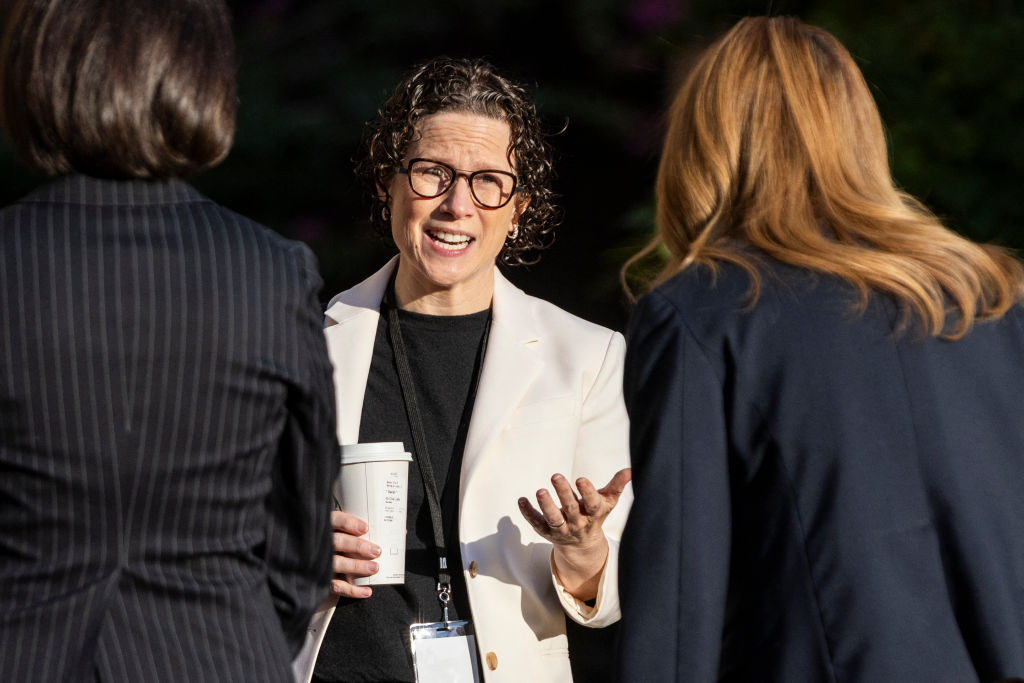
Enlarge / Karen Dunn, one of the lawyers representing Google, outside of the Albert V. Bryan US Courthouse at the start of a Department of Justice antitrust trial against Google over its advertiing business in Alexandria, Virginia, on September 9, 2024. (credit: SAMUEL CORUM / Contributor | AFP)
On Monday, the US Department of Justice's next monopoly trial against Google started in Virginia—this time challenging the tech giant's ad tech dominance.
The trial comes after Google lost two major cases that proved Google had a monopoly in both general search and the Android app store. During her opening statement, DOJ lawyer Julia Tarver Wood told US District Judge Leonie Brinkema—who will be ruling on the case after Google cut a check to avoid a jury trial—that "it’s worth saying the quiet part out loud," AP News reported.
"One monopoly is bad enough," Wood said. "But a trifecta of monopolies is what we have here."
James.galbraithAs always, the GOP is the "fuck you, I got mine" party.
Eric Hovde, the Republican Senate candidate in Wisconsin, has described himself as an “outsider” and a self-made entrepreneur, but an examination of his business dealings shows that Hovde benefited from insider connections at the highest levels of political power in Washington, D.C.
In 1987, a year after graduating from college, Hovde and his father, Donald Hovde, launched Hovde Financial. And the elder Hovde had connections at the highest level of American politics.
Donald Hovde served as undersecretary of Housing and Urban Development under President Ronald Reagan, and in 1983, Reagan nominated him to serve as a member of the Federal Home Loan Bank Board. The board, which existed from 1932 to 1989, governed federal banks that provide liquidity to other financial institutions. Reporting in a 1986 edition of the Asheville Citizen-Times described Donald Hovde as having a “position of considerable power.”
By 1988, Donald Hovde began using his Washington connections. He hired former regulators from the Federal Savings and Loan Insurance Corp. to work at Hovde Financial, according to a report in American Banker magazine.
Eric Hovde referred to his father’s position of power in a March 2024 interview that aired on the radio station WCLO.
“Moved out to Washington, D.C., for a bit because my father was in the Reagan administration, highest ranking official in the Reagan administration,” Hovde told the host.
Hovde Financial was a success and eventually led to Eric Hovde acquiring a stake in Sunwest Bank, where he became CEO and majority shareholder by 2006.
According to his official financial disclosure filings, Eric Hovde is worth anywhere from $195 to $564 million, which would make him among the wealthiest senators if his campaign is successful. That wealth has roots in his family connections and his father’s status, which does not quite fit the self-made image that Hovde has portrayed.
The revelations about Hovde echo recently released information about Sam Brown, the Republican candidate in the Nevada Senate race. Brown has referred to himself as a “small town” guy from the working class, but his family has an ownership stake in the NFL’s Cincinnati Bengals, a franchise with an estimated worth of $4 billion.
Hovde’s wealth and how he acquired it also stand in contrast to his views on middle-class finances. In a discussion with a voter at a Wisconsin fair in July, Hovde said that he supports raising the eligibility age for Social Security for younger people. Hovde also called the provision of the Affordable Care Act that allows young people to stay on their parents’ insurance plans until age 26 “stupid.”
Sen. Tammy Baldwin, Hovde’s Democratic opponent, recently reaffirmed her support for the social safety net in a speech delivered to the Democratic Party’s presidential convention.
“So when I work to protect Medicare and Social Security, I do it with a personal knowledge of what those big programs meant in small but deeply meaningful ways to my grandparents. And I know what they mean for your parents and grandparents,” Baldwin said.
Campaign ActionJames.galbraithIt's like governance matters or something. If only people would fucking vote like it.
Uninsured rates increased across all battleground states under Trump, then dropped in swing states during Biden’s term.
By Jeremy Lindenfeld for Capital & Main
At the end of the first two years of Joe Biden’s presidency, 3.3 million more U.S. residents had health insurance than did so in 2019, according to a Capital & Main analysis of U.S. Census data conducted with the support of Thomas Data Consulting. That increase led to a 1.2% decline in the national uninsured rate and the lowest rate of residents without health insurance in U.S. history.
By contrast, Donald Trump oversaw an increase of 2.3 million uninsured people during the first three years of his presidency and a 0.6% increase in the national uninsured rate.
Health care affordability may not dominate the media coverage of this year’s presidential campaigns, but it remains a critical issue for many Americans, with 57% describing it as a “very big problem,” according to a Pew Research Center survey released in May. Health care is especially unaffordable for the roughly 27 million people who still lack insurance. That unaffordability makes uninsured people more likely to skip or delay medical treatment, leading to worse health care outcomes, according to a KFF report.
Under Trump, 39 states saw increases in their uninsured rates, and the number of uninsured people swelled by more than 440,000 across the key battleground states of Arizona, Georgia, Michigan, Nevada, North Carolina, Pennsylvania, and Wisconsin, according to census data. Meanwhile, in the first two years of the Biden administration, all but three states saw decreases in their uninsured rates. The number of uninsured fell in six out of seven swing states under Biden, resulting in 580,000 fewer uninsured people in those states.
Experts attribute the shifts in coverage to contrasting health policy approaches. During his presidency, Trump sought to undermine the Affordable Care Act, former President Barack Obama’s health care law, which expanded health coverage and mandated health insurance as a means to reduce health care costs. By contrast, Biden focused on expanding and protecting the ACA and signed executive orders to reverse Trump’s policies.
The reduction in the number of uninsured people under Biden also stemmed from pandemic-era policies that were put in place under both presidents. Some of those protections expired in 2023, and more will expire in 2025. Uninsured rates are expected to rise again absent federal action.
In 2016, Trump campaigned on a policy of repealing and replacing the Affordable Care Act. Trump nearly succeeded in dismantling the ACA in 2017, but it was saved by a single vote when Republican Sen. John McCain cast a dramatic “no” vote, joining two other Republican senators in preserving the law. Instead, Trump weakened the act’s effectiveness while in office.
Trump’s health care approach involved “a mix of both undermining and attacking the ACA coupled with attacks on the Medicaid program,” said Natasha Murphy, director of health policy at the Center for American Progress, a progressive think tank in Washington.
Those attacks involved making it harder to apply for coverage through the act’s health insurance marketplace, a service designed to help people find and enroll in coverage. The open enrollment period was halved; promotional advertisements were canceled, and the ACA’s $100 million advertising budget was slashed by 90% under Trump.
Trump also eliminated the financial penalty for failing to secure health insurance, effectively making the mandate “toothless,” according to Paulette Cha, health policy research fellow at the Public Policy Institute of California. A month before Trump eliminated the penalty, the Congressional Budget Office estimated that doing so would raise premiums and result in millions more uninsured people.
Finally, Trump expanded the public charge rule, a policy that allowed the government to deny green cards and visas to immigrants who have received public assistance, such as Medicaid.
ACA marketplace open enrollment fell every year from 2016 to 2020.
Under Trump, Texas saw its uninsured population balloon by nearly 700,000 people; Florida by more than 240,000; and Arizona by almost 130,000 from 2016 to 2019, according to census data.
When COVID-19 began upending American life in 2020, the Trump administration temporarily abandoned its strategy of attacking Medicaid, and Trump signed a Democrat-sponsored bill that increased funding to states that prolonged people’s Medicaid coverage until the end of the federal health emergency instead of disenrolling them when their eligibility would have typically expired.
“That was a policy that really made a huge difference in ensuring access to much needed COVID treatment, testing and, subsequently, vaccines,” Murphy said. In fact, according to Centers for Disease Control and Prevention estimates, uninsured rates ticked down in 2020 from 2019. However, they still remained higher than when Trump took office.
In contrast to Trump, Biden campaigned for president in 2020 on a promise of expanding and protecting the ACA. Eight days after his inauguration, he signed an executive order that made it easier to enroll in Medicaid and private plans by giving people more time to sign up for insurance. He also reversed some of Trump’s executive orders that weakened the ACA by granting federal agencies broad discretion to change, delay or waive provisions of the law they considered financially burdensome.
In addition, Biden signed the American Rescue Act in March 2021, which expanded the availability of subsidies and tax credits for low- and moderate-income people seeking health insurance through the ACA. His signature climate and health bill, the Inflation Reduction Act, extended those provisions through 2025.
By proposing an updated tax law, the Biden administration also managed to fix the “family glitch,” an Internal Revenue Service interpretation of the ACA that made employer-sponsored family health insurance unaffordable for more than 5 million people. If an employer’s coverage plan was too costly, the fix allowed family members to access federal subsidies to make the insurance more affordable.
All those policies helped send the uninsured population plummeting.
Black and Latino populations, who have historically had lower coverage rates than white people, experienced some of the highest rates of coverage gains.
But attributing all coverage gains to Biden’s policy agenda may not be the whole story, according to Cha.
“The last four years, it’s been extremely hard to disentangle any policy from the fact that we’ve been operating in a pandemic and post-pandemic era,” Cha said.
Though the uninsured rate has significantly declined since 2019, recent data suggests Biden’s record of overseeing historic coverage gains may be in jeopardy.
A CDC report released this month estimated that the uninsured rate jumped from 7.7% in the first quarter of 2023 to 8.2% in the same quarter of 2024. The jump was largely the result of states’ disenrolling people from Medicaid after the expiration of pandemic-era protections, according to the Congressional Budget Office. Not all such people are now without insurance. Some may have signed up for health plans through the ACA’s health insurance marketplace, which has seen record enrollment. Some may have secured health insurance in another way. But if trends continue, the budget office estimates that the uninsured population will grow by about 6 million people by 2034.
This election cycle, Trump has shifted away from his 2016 pledges to eliminate the ACA but has yet to offer clear alternative policies. His campaign’s official platform, Agenda 47, is generally light on policy specifics but states that Republicans “will increase transparency, promote choice and competition, and expand access to affordable healthcare.”
Project 2025, a blueprint for the next Republican administration created by conservative think tank the Heritage Foundation, calls for the next GOP president to implement lifetime caps on Medicaid benefits, a move that Murphy estimated could imperil the health care coverage of more than 18 million people. Trump has distanced himself from Project 2025, but reports suggest that dozens of Project 2025 personnel have worked for Trump and that he has praised the Heritage Foundation’s work on laying the groundwork for a future administration.
In mid-August, Vice President Kamala Harris unveiled her economic agenda, which included a proposal to expand subsidies for ACA plans and to work with states to “cancel medical debt for millions of Americans.”
According to Cha, much of the progress in increasing coverage rates was accomplished during the Obama administration with the passage of the ACA, which reduced the number of uninsured people by almost 20 million over the course of his term. What’s remaining, Cha said, is largely the “unglamorous” work of closing loopholes and “sweeping up all the last stragglers who aren’t eligible or don’t have access.”
Copyright 2024 Capital & Main
Campaign ActionJames.galbraith"group-level psychiatric catastrophe" just rocketed up next to "dirt ball inhabited by psychotic apes" for best species-wide descriptors
.png)
Hovertext:
Next he kicks the robot, and it moans in pleasure.
James.galbraithBecause he's a doddering old fool losing his mind in public while most media outlets keep pretending this is normal behavior that requires no further comment.
A press conference is a tool for a presidential candidate to get reporters and voters talking about a topic of his or her choice. So why did Donald Trump spend 45 minutes reminding them about some of the many sexual-assault allegations against him?
Late this morning at Trump Tower, the former president took the microphone and spoke at length about the civil case in which he was found liable for sexually abusing the writer E. Jean Carroll. He mentioned the other allegations against him that came up in the trial. For good measure, he also dredged up the multimillion-dollar fraud judgment against him and the trial in which he was found guilty of 34 felonies. And, flanked by some of his lawyers, he griped about his representation. “I’m disappointed in my legal talent,” the former president said. (He’s no peach of a client himself.)
[George T. Conway III: Nine New York jurors saw Trump for who he really is]
Among other lowlights, Trump accused Carroll of basing her allegation on an episode of Law & Order. He insisted that the Biden Department of Justice was somehow behind a civil proceeding brought against him by a private citizen that began while he was still president. And he repeated baseless claims that the DOJ was coordinating with Manhattan District Attorney Alvin Bragg on his felony case. Despite having spent the past few weeks lambasting Vice President Kamala Harris for not taking reporters’ questions, Trump left without taking questions.
Much of this is bizarre, but little of it is fresh, which makes Trump’s goal even harder to understand. The ostensible news was an appeal in the Carroll case heard today, but the result seems to be to thrust back into the public eye a series of decisions and allegations that had been mostly left behind, but which could remind voters of what they like least about Trump. The appearance seemed to entice new defamation cases more than swing voters.
Another former Republican president, Ronald Reagan, once wrote, “When you’re explaining, you’re losing.” You’d expect that to be especially true when you’re explaining years of sexual-assault allegations against yourself. Meanwhile, Harris is barnstorming swing states, giving interviews to Spanish-language radio, and prepping furiously for next Tuesday’s debate. (Trump has said he doesn’t need to practice: “I’ve been preparing all my life for this debate.”)
But here’s the thing: Trump isn’t obviously losing. Most polling averages show Harris with a small lead, but once you account for margins of error and the Republican advantage in the Electoral College, it’s a toss-up. Nate Silver’s election forecast favors Trump at the moment, as Trump was happy to mention today. Reporters and operatives obsess over campaign tactics and talking points, but nothing seems to demonstrate how calcified American politics are like this split screen of the candidates: one hustling on the hustings, one rambling through his own peccadilloes, and the race neck and neck.
To be sure, Trump’s remarks today do connect to some of his campaign themes. He insists that he is a victim of a weaponized Justice Department (that’s straightforward projection), and he has decided to paint himself as the only thing protecting his supporters from nefarious forces such as President Joe Biden. The attorney and spokesperson Alina Habba, more on message than Trump, made that connection explicit today. “You must vote Donald Trump back in, because as an attorney, as a woman, as a mother, our future of this country depends on it,” she said. “The DOJ is supposed to help our country and protect us, not attack us because you cannot win in the polls.” (The message is less persuasive coming a day after Biden’s own son pleaded guilty to three felonies in a case brought by the DOJ.)
[Read: The real weaponization of the Department of Justice]
The martyrdom act remains something that appeals to Trump’s existing supporters but seems less likely to expand his coalition. In an election as close as this one, small differences in swing-state turnout or likability could be a deciding factor. Come November, will Trump look back on this press conference as a wise investment of time and attention?
James.galbraithLOL and conservatives will never learn because they don't want to. They know that they are propped up by racists and have settled on willful "ignorance" as their PR strategy.

On Monday, Tucker Carlson hosted an amateur historian named Darryl Cooper on his show to discuss the history of World War II. The result was an extended exercise in Nazi sympathizing with little pushback from Carlson, who called Cooper (who tweets under the handle @martyrmade) “the most important popular historian working in the United States today.”
The interview poses a major test to the Republican Party. Though Carlson has been off of Fox News for over a year, broadcasting on Twitter/X instead, he remains influential in the party. He delivered a primetime speech at the 2024 RNC and reportedly played a major role in the JD Vance vice presidential pick. Now that he’s crossing the reddest of red lines — actively apologizing for Adolf Hitler — can the party cut ties?
The answer has been a resounding no. The Trump camp — which sets the tone for the entire party — has so far done nothing to distance itself from the increasingly toxic Carlson.
Vance, who has pre-taped a Carlson interview and is scheduled to speak with him at a live event in two weeks, refused to denounce Carlson after the Cooper fiasco — with a spokesperson saying in a statement that “Senator Vance doesn’t believe in guilt-by-association cancel culture.” A Trump campaign source told the Bulwark that while it’s “not ideal timing” for Vance to appear twice with Carlson before Election Day, “it is what it is.” (Donald Trump Jr. is also scheduled to attend.)
Nobody should be surprised the current GOP is failing this particular test. This is the party that renominated Trump after all that he’s done; if there are red lines left for them, it’s not obvious what they are.
What’s more interesting is the reaction among conservative-aligned commentators and intellectuals — many of whom are expressing shock at what Tucker had done.
“Didn’t expect Tucker Carlson to become an outlet for Nazi apologetics, but here we are,” radio host Erick Erickson wrote on X. The writer Sohrab Ahmari, who wrote a tribute to his “friend” Carlson after his April 2023 firing from Fox, tweeted on Wednesday that he “can’t get over … the fact that Tucker saw fit to lend [Cooper] an uncritical platform.” (Elon Musk tweeted the Carlson interview approvingly — only to delete the tweet later.)
Such expressions of shock feel absurd. For Carlson’s entire run on Fox News, liberals had been warning that his show had become a vector for racist and neo-Nazi ideas — while people on the right dismissed those concerns as the woke PC police trying to silence a prominent conservative voice.
The liberal position has now been proven correct — yet again. The only question is whether conservatives will learn a broader lesson about how far-right ideas infiltrate their movement — with their own tacit support.
When Tucker Carlson got a primetime spot on Fox News back in 2016, he immediately developed a fan base among the neo-Nazi right. They saw his bombastic style and his willingness to talk about race and immigration in ways many conservatives shied away from as a vehicle for bringing their own ideas into the mainstream.
“Tucker Carlson is literally our greatest ally,” Andrew Anglin, the publisher of the neo-Nazi website The Daily Stormer, wrote in 2016. “I don’t believe that he doesn’t hate the Jews.”
Carlson did quite a bit to merit this fan base. He worked assiduously to mainstream the idea of the “great replacement theory,” the white supremacist idea that mass immigration is a secret elite plot to replace the native-born whites with minorities. He took white nationalists’ false ideas about a “white genocide” in South Africa and brought it to then-President Donald Trump’s attention. He claimed that immigrants were making America “dirtier” and fearmongered about the alleged threat to America from “gypsies.”
The link between Carlson and the radical right was quite direct. In 2020, his head writer Blake Neff resigned after CNN reported that he had made racist and sexist comments on an anonymous web forum. In 2022, the New York Times reported that Carlson’s segments were at times directly inspired by stories published by racist and neo-Nazi websites.
Carlson got away with all of this by employing a very clever rhetorical trick. He would recast white nationalist talking points in nominally colorblind terms — giving his audience permission to think racist thoughts while still thinking of themselves as not racist.
When he talked about the “great replacement,” for example, he would always shy away from saying the problem was the race of the immigrants. Rather, it was they were pliant voters for the Democratic Party who would undermine everything that “legacy Americans” held dear.
“Everyone wants to make a racial issue out of it. Oh, you know, the ‘white replacement theory’? No, no, this is a voting rights question,” Carlson said in a 2021 segment. “I have less political power because they’re importing a brand-new electorate.”
This move provided just enough plausible deniability that both Fox and the broader conservative movement could hail Carlson as one of their brightest stars: not merely one commentator, but the highest-rated host on cable news. It wasn’t until texts surfaced in 2023 showing Tucker himself engaging in naked racism — praising the superior honor of “white men” — that Fox finally felt the need to cut ties.
Liberals easily saw through the charade: They knew who Carlson was and what he was doing the whole time. But conservatives took Carlson’s professions of innocence seriously, at least in public. They said that he was merely skewering the pieties of the left, not engaging in thinly veiled white supremacist apologia.
There’s no better example of this than a recent column by Jonathan Tobin, the former executive editor of Commentary magazine and current editor-in-chief of the conservative Jewish News Syndicate.
In the column, Tobin expresses horror with Carlson’s interview with Cooper — saying it is “now incumbent on all decent people, and especially those on the right, to demand that Carlson no longer be treated as a mainstream figure.”
Yet in the very same column, he praises Carlson’s show on Fox as emblematic of mainstream conservative opinion:
During his seven-year run on Fox, Carlson built an enormous following. It might well be said that during the Black Lives Matter summer of 2020, he became the tribune of contemporary conservatism with his articulate critique of the moral panic that swept the nation in the wake of the death of George Floyd at the hands of Minneapolis police officers and the “mostly peaceful” riots that ensued. Though his soft spot for tinfoil-hat controversies was no secret, such as his fascination with UFO conspiracy theories, his main focus was on the issues that most conservatives and many centrists cared about, such as illegal immigration, critical race theory indoctrination, and corrupt liberal elites that seek to squelch opposition to their continued hold on power.
Despite everything, Tobin is still completely blind to what Carlson was doing on Fox.
He seems to believe that Fox was effectively concealing Tucker’s true views, when in actuality it was helping him broadcast them in a slightly coded manner. This was so obvious that Carlson’s neo-Nazi fans openly bragged about it, and had been doing so since 2016. And yet Tobin singles out Carlson’s treatment of race and immigration — of all subjects! — as the areas where his Fox show best represented mainstream conservatism.
This is the problem in a nutshell. On the right today, you can say something extremely racist and get away with it so long as you say “I’m not a racist!” in the following sentence. Liberals have long pointed out the problem with this maneuver; in response, conservatives have accused them of acting like woke scolds.
Carlson’s descent into Holocaust revisionism has proven the problem with this permission structure. The question is whether any others will learn their lessons — or whether, like Tobin, they will continue to engage in a form of thinking that allows their movement to be penetrated by bigots.
James.galbraithAnd to the media, this is just another day and "Trump delivers solo press conference" with nothing further.
Donald Trump used a news conference following a Manhattan court hearing on Friday to make a meandering, conspiratorial, and disjointed rant about the various court judgements against him. Trump has faced increased questioning about his mental acuity and this appearance is likely to raise further concerns.
The event was billed as a news conference, but Trump took no questions from the media as he reminded the public of the long list of women who have accused him of sexual misconduct.
Trump appeared in court for oral arguments in his appeal of the 2023 verdict awarding E. Jean Carroll $5 million for battery and defamation after a jury found that he sexually abused Carroll in a department store dressing room in 1996.
For over 45 minutes Trump held court, bouncing from topic to topic. He claimed, without evidence, that the verdict against him—including the separate criminal case where the jury found him guilty on 34 counts—were part of a plot hatched by the Democratic Party.
Trump alleged—without evidence—that officials including President Joe Biden, former Presidents Barack Obama and Bill Clinton, Vice President Kamala Harris, Sec. Hillary Clinton and other leaders of the Democratic Party had orchestrated legal action against him.
Trump: This whole thing started, with the political campaign of Harris—who’s having a bad time because she can’t talk—of Harris and Joe Biden. This was election interference, it all is. It’s all fabricated, but fabricated in front of very friendly judges for them and in very friendly areas for them, if you get a jury it’s very hard to win in a jury where you have three or four or five percent Republican votes. Very, very tough, actually.
Trump, who has a long history of promoting and repeating debunked conspiracy theories, complained that the justice system was being used as a weapon against him to disrupt his presidential campaign.
When not promoting a conspiracy about the legal system, Trump was casting aspersions on Carroll and other women who have accused him of sexual assault.
Speaking about one unnamed woman, Trump said, “Frankly, I know you’re going to say it’s a terrible thing to say, but it couldn’t have happened, it didn’t happen, and she would not have been the chosen one, she would not have been the chosen one.”
Trump also complained about the courtroom performance of his lawyers as they stood behind him at the event.
“I’m disappointed in my legal talent,” Trump said.
At least two dozen women have accused Trump of assaulting them or making unwanted sexual advances. The allegations against Trump run the gamut of groping, leering at underaged pageant contestants, forcibly kissing women without permission, and other instances of assault.
Trump has denied the claims against him but infamously bragged to television host Billy Bush of “Access Hollywood” that “when you’re a star” it is easy to assault women, and that you can “grab ’em by the pussy.”
In his political life, Trump has also embraced policies hostile to women. As president he shepherded the Supreme Court nominations of Justices Neil Gorsuch, Amy Coney Barrett, and Brett Kavanaugh, who later voted alongside other justices (Clarence Thomas, Samuel Alito, and John Roberts) in the court’s conservative majority to rescind Roe v. Wade and the right of women to seek an abortion.
In launching her presidential campaign, Harris remarked on the court cases against Trump and his treatment of women, noting that they formed a coherent narrative.
“As many of you know, before I was elected vice president and before I was elected a United States senator, I was an elected attorney general and an elected district attorney. And before that, I was a courtroom prosecutor,” Harris said at a July 30 campaign event.
“So, in those roles, I took on perpetrators of all kinds: predators who abused women; fraudsters who ripped off consumers; cheaters who broke the rules for their own gain. So, hear me when I say I know Donald Trump’s type. I know the type. And I have been dealing with people like him my entire career.”
Sign to take the pledge: I'm voting for Kamala Harris and Democrats in 2024.
James.galbraithTwo systems of justice indeed. Pay tons for lawyers and run for office and you too can tell criminal law to go fuck itself
A judge agreed Friday to postpone Donald Trump’s sentencing in his hush money case until after the November election, granting him a hard-won reprieve as he navigates the aftermath of his criminal conviction and the homestretch of his presidential campaign.
Manhattan Judge Juan M. Merchan, who is also weighing a defense request to overturn the verdict on immunity grounds, delayed Trump’s sentencing until Nov. 26, several weeks after the final votes are cast in the presidential election.
It had been scheduled for Sept. 18, about seven weeks before Election Day.
Merchan wrote that he was postponing the sentencing “to avoid any appearance—however unwarranted—that the proceeding has been affected by or seeks to affect the approaching presidential election in which the Defendant is a candidate.”
“The Court is a fair, impartial, and apolitical institution,” he added.
Trump’s lawyers pushed for the delay on multiple fronts, petitioning the judge and asking a federal court to intervene. They argued that punishing the former president and current Republican nominee in the thick of his campaign to retake the White House would amount to election interference.
Trump’s lawyers argued that delaying his sentencing until after the election would also allow him time to weigh next steps after Merchan rules on the defense’s request to reverse his conviction and dismiss the case because of the U.S. Supreme Court’s July presidential immunity ruling.

In his order Friday, Merchan delayed a decision on that until Nov. 12.
A federal judge on Tuesday rejected Trump’s request to have the U.S. District Court in Manhattan seize the case from Merchan’s state court. Had they been successful, Trump’s lawyers said they would have then sought to have the verdict overturned and the case dismissed on immunity grounds.
Trump is appealing the federal court ruling.
The Manhattan district attorney’s office, which prosecuted Trump’s case, deferred to Merchan and did not take a position on the defense’s delay request.
Messages seeking comment were left for Trump's lawyers and the district attorney's office.
Election Day is Nov. 5, but many states allow voters to cast ballots early, with some set to start the process just a few days before or after Sept. 18.
Trump was convicted in May on 34 counts of falsifying business records to conceal a $130,000 hush money payment to adult film actor Stormy Daniels just before the 2016 presidential election. Daniels claims she and Trump had a sexual encounter a decade earlier after they met at a celebrity golf tournament in Lake Tahoe.
Prosecutors cast the payout as part of a Trump-driven effort to keep voters from hearing salacious stories about him during his first presidential campaign. Trump’s former lawyer Michael Cohen paid Daniels and was later reimbursed by Trump, whose company logged the reimbursements as legal expenses.
Trump maintains that the stories were false, that reimbursements were for legal work and logged correctly, and that the case—brought by Manhattan District Attorney Alvin Bragg, a Democrat—was part of a politically motivated “witch hunt” aimed at damaging his current campaign.
Democrats backing their party’s nominee, Vice President Kamala Harris, have made his conviction a focus of their messaging.
In speeches at the party’s conviction in Chicago last month, President Joe Biden called Trump a “convicted felon” running against a former prosecutor. Democratic Rep. Jasmine Crockett of Texas labeled Trump a “career criminal, with 34 felonies, two impeachments, and one porn star to prove it.”
Trump’s 2016 Democratic opponent, former Secretary of State Hillary Clinton, inspired chants of “lock him up” from the convention crowd when she quipped that Trump “fell asleep at his own trial, and when he woke up, he made his own kind of history: the first person to run for president with 34 felony convictions.”
Falsifying business records is punishable by up to four years behind bars. Other potential sentences include probation, a fine or a conditional discharge, which would require Trump to stay out of trouble to avoid additional punishment. Trump is the first ex-president convicted of a crime.
Trump has pledged to appeal, but that cannot happen until he is sentenced.
In seeking the delay, Trump lawyers Todd Blanche and Emil Bove argued that the short time between the scheduled immunity ruling on Sept. 16 and sentencing, which was to have taken place two days later, was unfair to Trump.
To prepare for a Sept. 18 sentencing, the lawyers said, prosecutors would be submitting their punishment recommendation while Merchan is still weighing whether to dismiss the case. If Merchan rules against Trump, he would need “adequate time to assess and pursue state and federal appellate options,” they said.
The Supreme Court’s immunity decision reins in prosecutions of ex-presidents for official acts and restricts prosecutors in pointing to official acts as evidence that a president’s unofficial actions were illegal.
Trump’s lawyers argue that in light of the ruling, jurors in the hush money case should not have heard such evidence as former White House staffers describing how the then-president reacted to news coverage of the Daniels deal.
Campaign ActionJames.galbraithNuke them from orbit

Today, algorithms rule everything around us. They serve us entertaining, or at least addictive, content on social media. They try to suss out which emails in our overstuffed inboxes might be most important, and which ones are spam. They act as matchmakers for our love lives. Increasingly, though, algorithms have also been deployed by companies, from Amazon to Uber to Wendy’s, to figure out optimal — often higher — prices that can shift automatically based on a firehose of fine-grained data.
Including, apparently, your rent.
Now, a software company called RealPage is being sued by the Department of Justice for using an algorithm that suggests rent prices to corporate landlords. The DOJ argues that its algorithm has driven rents higher, and constitutes an illegal information sharing scheme. That is, competitors (the landlords) who would otherwise be acting independently, have exchanged “nonpublic, competitively sensitive data” to the detriment of renters who don’t have access to such knowledge.
A 2022 ProPublica investigation quoted Andrew Bowen, then a RealPage executive, admitting that the software had probably driven up rental prices. “As a property manager, very few of us would be willing to actually raise rents double digits within a single month by doing it manually,” he said. In the DOJ’s complaint, one unnamed landlord is quoted praising a RealPage product as “classic price fixing” saying, “I always liked this product because your algorithm uses proprietary data from other subscribers to suggest rents and term.” The complaint claims that RealPage has data on over 16 million units; the National Multifamily Housing Council estimates that there are around 23 million apartment units in the US.
Vox spoke to Christopher L. Sagers, a law professor at Cleveland State University, on why pricing algorithms are under scrutiny now — and how likely it is for the DOJ to win this case. The conversation has been lightly edited for clarity.
What exactly is RealPage?
The company is a service provider that serves landlords. We’re basically talking very big landlords — corporate landlords that own many properties, generally speaking. The RealPage service is very expensive, so it’s for bigger entities, more or less, and they’re very sophisticated. Whether they use RealPage or not, they would be sophisticated data crunchers who are into using management expertise to maximize the money they can make.
[RealPage] is really a software service provided to landlords, a management service that’s tech-based, and the business end of that service is: RealPage collects a very large amount of confidential, sensitive data that’s very useful to landlords in figuring out what their competition is doing, and therefore choosing how to set their own behavior to maximize their own profits.
The government alleges that there are 16 million individual rental units at stake here — in other words, RealPage is collecting lease terms, rent prices, occupancy rates, et cetera, for 16 million different apartment units. The data is very disaggregated — it’s very granular, very precise and detailed. Then [it] takes all that data, crunches it. RealPage, increasingly, is an artificial intelligence provider. It is now crunching [the data] with artificial intelligence; they’re presumably going to be getting more and more sophisticated about it, assuming that the government doesn’t force them to stop doing what they’re doing.
Landlords use this software, but they’re not the ones named in this suit, right?
That’s correct.
Is there a good case to be made that RealPage committed antitrust violations?
Yes.
I’ll just lay my cards on the table: I think the government’s case is very strong, and it’s unlikely that RealPage gets out of this without some kind of legal liability.
What is the part of what RealPage and its software does that the DOJ is saying violates antitrust law?
I think the relatively simple answer is, they do a few things with this data that cause them to be doing more than just providing information or helping landlords make decisions. Most importantly, they are using confidential data not available to renters. They’re only available to one side of the market. They are then using that data to, as they would say, make mere recommendations. In other words, they’re making forward-looking future predictions of what the best price will be from the landlord’s perspective — meaning the most profitable.
They’re making forward-looking future predictions of what the best price will be from the landlord’s perspective — meaning the most profitable.
It’s very clear that, in the abstract, a couple of things that RealPage could be said to be doing are, in fact, legal. [But] according to the government’s allegations, RealPage is doing more than just those things that are legal. There is, first of all, this argument that RealPage is doing stuff that screws up the rental market — it increases rent prices for consumers. There’s the separate argument, though, that RealPage has monopolized the market for this software.
So it doesn’t sound like RealPage was just letting its software do its thing — the complaint mentions how it had “pricing advisors” who would basically escalate the matter if a landlord rejected their recommendation. Does that constitute an agreement of some kind?
Oh, yes. It feels like you read complaints all the time in which you’re like, “Wow, what were they thinking? Why did they think they were going to get away with this?” You’re selling a service in which you’re going to have an employee go complain to somebody’s competitors and say, “Hey, get your prices up.” Is it illegal just to have [a price advisor]? Is it illegal to sell a service in which you’re going to go nag people’s competitors to get their prices up? I think the short answer very well may be yes, that in and of itself is independently illegal.
Here’s why I think that’s so significant. You asked, “Are they suing the landlords too?” The answer is no — but there are pending private lawsuits, and I think if the government wins this case, which I think they will, there are going to be big lawsuits against the landlords. These private cases that are coming, I think, will be conspiracy cases. They’ll be what we call “hub and spoke conspiracy” theories.
For a long time, antitrust has recognized that people might want to get their prices up with their horizontal competitors, but they find it difficult to make agreements with them — or they’re afraid of doing something illegal, so they don’t explicitly agree. But then some intermediary will come along who’s willing to do the work of getting the cartel together and enforcing the cartel agreements — that person is called the hub. Their relationship with each one of the competitors is like a spoke. Hub and spoke conspiracies, when they involve somebody just fixing explicit prices, are what we call per se illegal: they’re automatically illegal if it’s proven, there’s no defense.
[RealPage] is selling the thing that makes it so hard to get a price-fixing conspiracy together — it’s hard to get people to agree, and then enforce the agreement once it’s made.
What do you think RealPage’s main defense will be?
Their main defense is going to be that they are simply helping landlords do something that landlords could have done themselves, and if the landlords did it, it would all have been legal. That’s a general point they will make.
A closely related point is, they’re going to say this isn’t price fixing; this is just sharing of information. And as everybody knows who’s taken freshman economics, information is good for markets, right? Competitive markets have to have good information or they don’t work well. So we’re really just doing this to have a vibrant, competitive marketplace.
Do you find that compelling? What’s the first rebuttal to that?
No, everything about it is a lie. The first rebuttal to it is this: they’re not doing something that any landlord could do independently. For one thing, one landlord can’t get 16 million data points that are updated every night and crunch it through a big data algorithm. If a trade association of landlords did that on their own, without a third-party intermediary, it would very likely be illegal for the same reasons that this thing seems like it’s illegal.
So the scale of it is a big thing here.
Yes, the scale of it is a big thing.
It isn’t just that it would be hard to get that much data, and it would be expensive to crunch it — there would also be a lot of difficulty in coordinating the agreement. Two competitors would share information if they really were comfortable that they could trust the other one to use it for evil. If I can trust my competitor to use this to get our prices up and keep them up, that’s great, but the truth is, they’re actually quite suspicious of each other. There’s a reason this information is confidential, because they ordinarily don’t want their competitors to have it.
Then point number two, that this is actually good for the economy — that’s not plausible because they’re not sharing it. They’re not going to make a public database where renters can go see who’s charging the lowest price.
Based on what we know, based on the DOJ complaint and other reporting, do you think it’s likely that RealPage helped drive up rents?
I think it’s very likely. This isn’t just a big conspiracy in that it involves a lot of units; they also have very substantial market penetration. Among landlords of a certain size, a very large percentage of them are using not just a product like this; they’re using RealPage. The complaint contains a bunch of evidence that the landlords know who else in their market is using RealPage, and they call each other and ask. The reason that’s so significant is, if you know that your three competitors are all using the same software that you use for any competitive purposes, then you know there’s no real risk to you in raising your prices, right?
So the idea that this isn’t raising prices in real markets seems very unlikely to me.
If RealPage said that their algorithm doesn’t just recommend higher prices, but also lower ones sometimes, would that change the situation?
It might if they could prove it. It would still be a case that, I think, could go to a jury on liability — even if there were substantial evidence that sometimes they’re making prices go down — because there’s just a lot of anti-competitive evidence here. They have the price nudge officials, there’s evidence that all the users of it know when their competitors are using it. All of those things suggest this is anti-competitive.
“I have reason to believe that this particular technology has had a huge impact on consumer prices throughout the economy.”
If the DOJ wins this case, what does that change for digital pricing tools in general? Because there are a lot of those around now. Amazon famously uses algorithms in how it prices.
One thing we’re going to learn, I think, once this case starts chugging along, is just how common businesses like RealPage are. Using confidential information and big data technology to calculate the highest possible price — who knows, I’m not a macro economist, I don’t know what causes inflation — but I have reason to believe that this particular technology has had a huge impact on consumer prices throughout the economy.
If RealPage is found to have violated the law, it will at least have repercussions throughout the tech sector. This is a big tech product category, right? It’s something antitrust watchers have been thinking about for a long time. When can an algorithm itself be illegal, and when is an algorithm effectively price fixing?
James.galbraithludicrous and infuriating
Donald Trump and his running mate, Ohio Sen. JD Vance, are struggling with women voters, and it’s not a new problem for them. In 2020, Trump lost them to Joe Biden by 15 percentage points (57% to 42%), according to exit polls. And here’s a fun fact: Despite winning married women by 4 points (51% to Biden’s 47%), Trump lost women with children by 13 points (43% to 56%).
To address these issues, you might expect Trump to offer—at the very least—warmed-over pablum when asked how to make child care affordable. Instead, he offered yet more proof of his mental collapse.
On Thursday, at a supposed economic address in Manhattan, Trump was asked, “If you win in November, can you commit to prioritizing legislation to make child care affordable? And if so, what specific piece of legislation will you advance?”
And here is Trump’s entire, unedited answer:
Well, I would do that, and we're sitting down. You know, I was somebody—we had Sen. Marco Rubio—and my daughter Ivanka was so impactful on that issue. It's a very important issue. But I think when you talk about the kind of numbers that I'm talking about—that, because look, child care is child care, couldn't—you know, it’s something—you have to have it in this country. You have to have it. But when you talk about those numbers, compared to the kind of numbers that I'm talking about by taxing foreign nations at levels that they're not used to. But they'll get used to it very quickly. And it's not going to stop them from doing business with us. But they'll have a very substantial tax when they send product into our country. Those numbers are so much bigger than any numbers that we're talking about, including child care, that it's going to take care. We're going to have—I look forward to having no deficits within a fairly short period of time, coupled with the reductions that I told you about on waste and fraud and all of the other things that are going on in our country. Because I have to say, with child care, I want to stay with child care. But those numbers are small relative to the kind of economic numbers that I'm talking about, including growth, but growth also headed up by what the plan is that I just—that I just told you about. We're going to be taking in trillions of dollars. And as much as child care is talked about as being expensive, it's, relatively speaking, not very expensive compared to the kind of numbers will be taking in. We're going to make this into an incredible country that can afford to take care of its people. And then we'll worry about the rest of the world. Let's help other people. But we're going to take care of our country first. This is about America first. It's about ‘Make America Great Again.’ We have to do it because right now we're a failing nation. So we'll take care of it. Thank you. Very good question. Thank you.
It seems that some in the media—such as Sahil Kapur of NBC News, who tweeted out a full transcript of Trump’s garbled response—are waking up to Trump’s cognitive travails. But where are the dozens of front-page New York Times stories about it, like those they ran after President Joe Biden’s awful debate performance?
In fact, New York Times reporter Michael Gold sane-washed the answer for Trump:
After his speech, Donald Trump was asked how he might address rising child care costs. In a jumbled answer, he said he would prioritize legislation on the issue but offered no specifics and insisted that his other economic policies, including tariffs, would “take care” of child care. “As much as child care is talked about as being expensive, it’s, relatively speaking, not very expensive compared to the kind of numbers we’ll be taking in.”
What in Trump’s full answer suggests he would actually “prioritize legislation on the issue”? The question asked if he would prioritize it, but in his word salad, he never committed to any such thing. And there is no chance that legislation to meaningfully address the steep costs of child care would be considered in a second Trump presidency, much less passed.
Gold went out of his way to make Trump’s aside about tariffs sound semi-coherent, as opposed to the nonsensical pivot it really was. Or, to put it another way, Gold made it sound as if Trump gives a damn about child care when it’s clear from his answer here—as well as his current policy platform and his priorities during his administration—that he doesn’t give a rat’s ass about it. He barely even knows how to talk about the issue, helpfully confirming for us that “you have to have [child care] in this country.”
Question: Will you prioritize legislation to make child care affordable?
Trump: Child care exists. Very good question. Thank you.
The New York Times: Trump commits to prioritizing child care, paid for by his proposed tariffs on foreign goods.
And The New York Times isn’t alone. Here’s the Associated Press:

This is absurd. The political press has to do better.
James.galbraithinsanity
How can working families manage the sky-high cost of child care? Republican vice presidential nominee JD Vance has a plan for that—make grandma and grandpa do it instead.
“So one of the ways that you might be able to relieve a little bit of pressure on people who are paying so much for day care is make it so that, you know, maybe like grandma [or] grandpa wants to help out a little bit more,” Vance said on Wednesday, during an interview with antisemite Charlie Kirk in Mesa, Arizona. “Or maybe there's an aunt or uncle that wants to help out a little bit more. If that happens, you relieve some of the pressure on all the resources that we're spending in day care.”
This is a special kind of bullshit coming from a guy who was lucky enough to have his mother-in-law take a yearlong sabbatical from her job as a biology professor to move in with Vance and his wife to help care for their new child. In 2020, Vance agreed with a podcaster that helping care for kids was “the whole purpose postmenopausal female.”
Vance wasn’t done talking “policy.”
Vance continued:
Let's say you don't have somebody who can provide that extra set of hands. What we've got to do is actually empower people to get trained in the skills that they need for the 21st century. We've got a lot of people who love kids, who would love to take care of kids, but they can't either because they don't have access to the education that they need, or, maybe more importantly, because the state government says, “You’re not allowed to take care of children unless you have some ridiculous certification that has nothing to do, nothing to do, with taking care of kids.”
Besides the fact that a large swath of the Republican base is calling every educator a “groomer,” the idea of deregulating child care as a way to lower costs does not add up. Such a move would lower the quality and safety of care, while also driving up the cost of insuring care facilities—costs that would surely be passed on to families—according to the National Association for the Education of Young Children, a nonprofit that advocates on behalf of early-childhood educators.
Vance is wrong on another count too. What’s really keeping potential workers out of the child care field isn’t “ridiculous certification[s].” It’s low wages. The U.S. Bureau of Labor Statistics estimates that the best-paid child care workers—those in the 90th percentile—earn an average of $43,270 annually. That’s the high end.
Meanwhile, for parents of young kids, the Republican Party has fought against meaningful legislation to codify paid family leave for years. Vance isn’t a serious person and his political party doesn’t have any serious answers.
James.galbraithgood
August fundraising numbers are in, and it’s not even close.
Donald Trump’s campaign announced his August numbers Wednesday, and they were quite proud of their $130 million haul. “These fundraising numbers from August are a reflection of that movement and will propel President Trump’s America First movement back to the White House,” said Brian Hughes, a senior Trump campaign advisor.
They had $327 million at the start of August, and ended the month with a hefty $295 million in the bank. That means they spent about $162 million that month. Regardless, Trump’s campaign will have plenty of money to compete through November. But interestingly, their August numbers were actually a downturn from July, when they raised $138.7 million. That doesn’t speak well for his campaign’s enthusiasm.
So if $130 million “is a reflection of that movement that will propel” Trump to victory, what would you call the “more than $300 million” that Vice President Kamala Harris’ campaign raised in August?
Similar to Trump’s figure, Harris’ number is based on sources. The full disclosure reports aren’t due until Sept. 20.
As I’ve noted, money doesn’t win campaigns. In 2016, Democratic presidential nominee Hillary Clinton significantly outspent Trump, and we know what happened there. At the same time, money is a barometer of base intensity, excitement, and support. And based on these blockbuster numbers, Harris is lapping Trump.
James.galbraithlol
Join the Inner Hive and get Tom the Dancing Bug comics emailed to you the day before they're published, plus other content and extra comics. If you join TODAY, $25.00 will be donated to Spread the Vote, a nonprofit that helps people register and get out and vote! INFORMATION HERE. (The Get Out the Vote Inner Hive Drive ends on 9/9)
The brand new Tom the Dancing Bug book, "IT'S THE GREAT STORM, TOM THE DANCING BUG!" is now available for purchase! Now accepting orders right HERE!
Sign up for the free weekly Tom the Dancing Bug Review! E-Z and less fun but FREE!
Follow @RubenBolling on Bluesky, Threads, and/or Mastodon. And Facebook and Instagram.