Both Senate Majority Leader Chuck Schumer and Republican leader Mitch McConnell strategized this week with their conferences on the filibuster, and both had as their focus the two problem children of the Democrats: Sens. Joe Manchin of West Virginia and Kyrsten Sinema of Arizona. Schumer has a plan for demonstrating to the two that Republicans really don't want to play nice and McConnell has a plan to optimize the two as his tools to trash everything President Joe Biden intends to do.
In this week's Democratic conference luncheon, the first in-person since the pandemic, Schumer asked Democrats to find Republican partners willing to work with them on bipartisan priorities. "Schumer is just now laying out how we want to go forward," one of the Democratic senators told The Hill on background. "Some members of the caucus, a considerable number, they want to understand the extent of Republican obstruction to justify any action taken on the filibuster."
In other words, make the effort to both show the public ahead of the midterms that Democrats are willing to give bipartisanship a go, and to demonstrate to Manchin and Sinema that that's not going to work. "All of this is about bringing the caucus back together so eventually 50 people in the room can reach a decision," the senator said.
While that was happening, McConnell was telling Republicans to make nice to Manchin and Sinema to co-opt them to his agenda by boosting their already healthy egos. In an interview with Politico, McConnell demonstrated the tactic. "What they've been very forthright about is protecting the institution against pressures from their own party. I know what that's like," McConnell said, recalling Trump's constant pressure to make him nuke the filibuster. "Every time I said no. And it's nice that there are Democrats left who respect the institution and don’t want to destroy the very essence of the Senate."
Of course, McConnell didn't get rid of the filibuster on legislation because he cared about the Senate, which he had already laid to waste. He kept it because it kept the truly bonkers stuff the Republican House and Trump were coming up with in the first two years of Trump's term from being viable in the Senate. McConnell didn't want to have to preserve the Republican majority on that record. The second reason was that all he really wanted coming out of the Trump years was a stranglehold on the judiciary, which he achieved by—nuking the filibuster on Supreme Court appointees. Oh, and tax cuts. Which he achieved by the same non-filibusterable budget reconciliation he's condemning now. So much for his vaunted love for the institution.
Nonetheless, his team is going forward on his command to co-opt the two tools of the Democrats. "For me right now, they're almost guardians of democracy because they're trying to protect us from the loss of the legislative filibuster and everything that would come with that. They're good people," John Thune, McConnell's number two, told Politico—which is always willing to help spread GOP gospel. "They want to do the right thing." If by "democracy" you mean minority rule, which Thune clearly does. Because that's what Sinema and Manchin are protecting here.
Manchin told Politico "I just hope [Republicans] help me a little bit in bipartisanship. […] That's all." Good luck with that, Joe. "He said he believes Republicans aren't all talk and no give, that 'they really want to work.'" Sure. Because here's what's really happening, and Republicans are happy to admit it: "When they can't drive compromise directly through legislation that's passed through budget reconciliation, GOP senators can influence the process by keeping close ties to Sinema and Manchin."
For example, Manchin's last-minute intervention that nearly blew up the American Rescue Plan—the critical COVID-19 relief bill passed last month—was so much string-pulling by his Republican "friend" Rob Portman of Ohio, to cut back unemployment benefits by $100 a week and to cut the federal boost in payments off in early September, instead of at the end of October.
Politico baldly lays out the machinations here: "No Republicans supported that legislation, but they were able to make their mark through Manchin." In other words, he's being used.
Manchin and Sinema's influence has "been very helpful," said Sen. John Kennedy (R-La.). "Now, I don’t want to overstate that. I don't think either one of them have fundamentally changed the direction of important Democratic legislation just yet. But they've certainly slowed down a lot of the more radical ideas."
Like the radical notion of voting rights. Or the radical idea that $7.25 an hour is not enough to live on in almost every part of the country.
One of the "moderates" in the Democratic conference, the Maine Independent Angus King, basically endorsed Schumer's approach. He said that he wants to see just how many Republicans are willing to cross over to help out before reforming the filibuster, but he is definitely putting the onus on them. "It's up to them," he told The Hill, citing a Washington Postop-ed he wrote last month: "What happens to the filibuster depends on how Republicans play their hand."
Whether Manchin got that message isn't entirely clear. "Chuck Schumer spoke more about bipartisan today than I've ever heard him speak about," Manchin told reporters. "He wants—'Everything we're doing, we'll try to do bipartisan. Let's work on bipartisan, reach out to your friends,'" is how Manchin interpreted it. It was probably more grammatically correct in the original.
Schumer's deploying the only strategy that makes sense at this point, with Manchin and Sinema digging in their heels—put the onus on them to find Republicans to help. It would be satisfying if he took that a bit further and made Manchin, in particular, prove his assertion that there are 10 Republicans willing to work with him by getting public statements from them. But this will do for now.
The public and research support gun control. Here’s how it could help — and why it doesn’t pass.
On Thursday, it happened again: a mass shooting in America. This time, a gunman killed eight people at a FedEx warehouse in Indianapolis.
Already, the shooting has led to demands for action. “10 Republican Senators — including Indiana’s @SenToddYoung & @SenatorBraun — decide whether we are going to do something about this deadly epidemic or continue to do nothing and live with this death every damn day.” the Coalition to Stop Gun Violence tweeted.
But if this plays out like the aftermath of past mass shootings, from Sandy Hook Elementary School in 2012 to Las Vegas in 2017, the chances of Congress taking major action on guns is very low.
This has become an American routine: After every mass shooting, the debate over guns and gun violence starts up once again. Maybe some bills get introduced. Critics respond with concerns that the government is trying to take away their guns. The debate stalls. So even as America continues to experience levels of gun violence unrivaled in the rest of the developed world, nothing happens — no laws are passed by Congress; nothing significant is done to try to prevent the next horror.
So why is it that for all the outrage and mourning with every mass shooting, nothing seems to change? To understand that, it’s important to grasp not just the stunning statistics about gun ownership and gun violence in the United States but also America’s unique relationship with guns — unlike that of any other developed country — and how it plays out in our politics to ensure, seemingly against all odds, that our culture and laws continue to drive the routine gun violence that marks American life.
1) America’s gun problem is unique
No other developed country in the world has anywhere near the same rate of gun violence as America. The US has nearly six times the gun homicide rate of Canada, more than seven times the rate of Sweden, and nearly 16 times that of Germany, according to 2012 United Nations data compiled by the Guardian. (These gun deaths are a big reason America has a much higher overall homicide rate, which includes non-gun deaths, than other developed nations.)
Javier Zarracina/Vox
To understand why that is, there’s another important statistic: The US has by far the highest number of privately owned guns in the world. Estimated for 2017, the number of civilian-owned firearms in the US was 120.5 guns per 100 residents, meaning there were more firearms than people. The world’s second-ranked country was Yemen, a quasi-failed state torn by civil war, where there were 52.8 guns per 100 residents, according to an analysis from the 2018 Small Arms Survey.
Another way of looking at that: Americans make up less than 5 percent of the world’s population, yet they own roughly 45 percent of all the world’s privately held firearms.
That does not, however, mean that every American adult actually owns guns. In fact, gun ownership is concentrated among a minority of the US population, as surveys from the Pew Research Center and the General Social Survey suggest.
These three basic facts demonstrate America’s unique gun culture. There is a very strong correlation between gun ownership and gun violence — a relationship that researchers argue is at least partly causal. And American gun ownership is beyond anything else in the world. At the same time, these guns are concentrated among a passionate minority, who are typically the loudest critics against any form of gun control and who scare legislators into voting against such measures.
2) More guns mean more gun deaths
The research on this is overwhelmingly clear: No matter how you look at the data, more guns mean more gun deaths.
This is apparent when you look at state-by-state data for gun ownership and gun deaths (including homicides and suicides) within the United States, as this 2013 chart from Mother Jones demonstrates.
And it’s clear when you look at the data for gun ownership and gun deaths (including homicides and suicides) across developed nations. Data compiled in 2018 from GunPolicy.org shows the United States is an extreme outlier in both categories.
Javier Zarracina/Vox
Opponents of gun control tend to point to other factors to explain America’s unusual levels of gun violence — particularly mental illness. But people with mental illnesses are more likely to be victims, not perpetrators, of violence. And Michael Stone, a psychiatrist at Columbia University who maintains a database of mass shooters, wrote in a 2015 analysis that only 52 out of the 235 killers in the database, or about 22 percent, had a mental illness. “The mentally ill should not bear the burden of being regarded as the ‘chief’ perpetrators of mass murder,” Stone concluded. Otherresearch has backed this up.
Another argument you sometimes hear is that these shootings would happen less frequently if even more people had guns, enabling them to defend themselves from a shooting.
Yet high gun ownership rates do not reduce gun deaths, but rather tend to coincide with increases in gun deaths. While a few people in some cases may use a gun to successfully defend themselves or others, the proliferation of guns appears to cause far more violence than it prevents.
Multiplesimulations have also demonstrated that most people, if placed in an active shooter situation while armed, will not be able to stop the situation, and may in fact do little more than get themselves killed in the process.
This video, from ABC News, shows one such simulation, in which people repeatedly fail to shoot an active shooter before they’re shot:
For example, a 2013 study, led by a Boston University School of Public Health researcher, found that, after controlling for multiple variables, each percentage point increase in gun ownership correlated with a roughly 0.9 percent rise in the firearm homicide rate.
As a breakthrough analysis by UC Berkeley’s Franklin Zimring and Gordon Hawkins in the 1990s found, it’s not even that the US has more crime than other developed countries. This 2018 chart, based on data from Jeffrey Swanson at Duke University, shows that the US is not an outlier when it comes to overall crime:
Javier Zarracina/Vox
Instead, the US appears to have more lethal violence — and that’s driven in large part by the prevalence of guns.
“A series of specific comparisons of the death rates from property crime and assault in New York City and London show how enormous differences in death risk can be explained even while general patterns are similar,” Zimring and Hawkins wrote. “A preference for crimes of personal force and the willingness and ability to use guns in robbery make similar levels of property crime 54 times as deadly in New York City as in London.”
Javier Zarracina/Vox
Guns are not the only contributor to violence. (Other factors include, for example, poverty, urbanization, and alcohol consumption.) But when researchers control for other confounding variables, they have found time and time again that America’s high levels of gun ownership are a major reason the US is so much worse in terms of gun violence than its developed peers.
To deal with its problem, America will have to not only make guns less accessible but likely reduce the number of guns in the US as well.
The research also speaks to this point: A 2016 review of 130 studies in 10 countries, published in Epidemiologic Reviews,found that new legal restrictions on owning and purchasing guns tended to be followed by a drop in gun violence — a strong indicator that restricting access to guns can save lives.
But even with the outrage over gun massacres, the sense that enough is enough, and the clear evidence that the problem is America’s high gun ownership rates, there hasn’t been significant legislation to help solve the problem.
3) Americans tend to support measures to restrict guns, but that doesn’t translate into laws
If you ask Americans how they feel about specific gun control measures, they will often say that they support them. According to Pew Research Center surveys, most people in the US support universal background checks, a federal database to track gun sales, and bans on assault-style weapons and high-capacity magazines. Somesurveys have also found strong support for requiring a license to buy and own a gun, another proposal with solid research behind it.
So why don’t these measures ever get turned into law? That’s in part because they run into another political issue: Americans, increasingly in recent years, tend to support the abstract idea of the right to own guns.
This is part of how gun control opponents are able to thwart even legislation that would introduce the most popular measures, such as background checks that include private sales (which have upwards of 80 percent support, according to Pew): They’re able to portray the law as contrary to the right to own guns, and galvanize a backlash against it.
This kind of problem isn’t unique to guns. For example, although many Americans say they don’t like the Affordable Care Act (also known as Obamacare), most of them do in fact like the specific policies in the health care law. The problem is these specific policies have been masked by rhetoric about a “government takeover of health care” and “death panels.” Since most Americans don’t have time to verify these claims, especially when they involve a massive bill with lots of moving parts, enough end up believing in the catchphrases and scary arguments to stop the legislation from moving forward.
Of course, it’s also the case that some Americans simply oppose any gun control laws. And while this group is generally outnumbered by those who support gun control, the opponents tend to be much more passionate about the issue than the supporters — and they’re backed by a very powerful political lobby.
4) The gun lobby as we know it is relatively recent but enormously powerful
The single most powerful political organization when it comes to guns is, undoubtedly, the National Rifle Association (NRA). The NRA has an enormous stranglehold over conservative politics in America, and that development is more recent than you might think.
The NRA was, for much of its early history, more of a sporting club than a serious political force against gun control, and even supported some gun restrictions. In 1934, NRA president Karl Frederick was quoted as saying, “I do not believe in the general promiscuous toting of guns. I think it should be sharply restricted and only under licenses.”
A 1977 revolt within the organization changed everything. As crime rose in the 1960s and ’70s, calls for more gun control grew as well. NRA members worried new restrictions on guns would keep coming after the historic 1968 law — eventually ending, they feared, with the government’s seizure of all firearms in America. So members mobilized, installing a hard-liner known as Harlon Carter in the leadership, forever changing the NRA into the gun lobby we know today.
This foundation story is crucial for understanding why the NRA is near-categorically opposed to the regulation of private firearms. It fears that popular and seemingly common-sense regulations, such as banning assault-style weapons or a federal database of gun purchases, are not really about saving lives but are in fact a potential first step toward ending all private gun ownership in America, which the NRA views — wrongly, in the minds of some legal experts — as a violation of the Second Amendment of the US Constitution.
So anytime there’s an attempt to impose new forms of gun control, the NRA rallies gun owners and other opponents of gun control to quash these bills. These gun owners make up a minority of the population: anywhere from around 30 to around 40 percent of households, depending on which survey one uses. But that population is a large and active enough constituency, particularly within the Republican base, to make many legislators fear that a poor grade from the NRA will end their careers.
As a result, conservative media and politicians take the NRA’s support, especially the A-to-F ratings the organization gives out, very seriously. Politicians will go to sometimes absurd lengths to show their support for gun rights. In 2015, for example, Sen. Ted Cruz (R-TX) starred in a video, from IJ Review, in which he cooked bacon with — this is not a joke — a machine gun.
Although several campaigns have popped up over the years to try to counteract the NRA, none have come close to capturing the kind of influential hold that the organization has.
But supporters of gun control face a huge obstacle: very passionate opponents. As Republican strategist Grover Norquist said in 2000, “The question is intensity versus preference. You can always get a certain percentage to say they are in favor of some gun controls. But are they going to vote on their ‘control’ position?” Probably not, Norquist suggested, “but for that 4-5 percent who care about guns, they will vote on this.”
What’s behind that passion? Kristin Goss, author of The Gun Debate: What Everyone Needs to Know, suggested that it’s a sense of tangible loss: Gun owners feel like the government is going to take their guns and rights. In comparison, gun control advocates are motivated by more abstract notions of reducing gun violence — although, Goss noted, the victims of mass shootings and their families have begun putting a face on these policies by engaging more actively in advocacy work, which could make the gun control movement feel more relatable. (See: #NeverAgain.)
There is also an exception at the state level, where lawmakers and voters have passed laws imposing (and relaxing) restrictions on guns. In the past several years, for instance, Vermont, Washington state, and Oregon passed laws expanding background checks. “There’s a lot more going on than Congress,” Goss said. “In blue states, gun laws are getting stricter. And in red states, in some cases, the gun laws are getting looser.”
But state laws aren’t enough. Since people can cross state lines to purchase guns under laxer rules, the weaker federal standards make it easy for someone to simply travel to a state with looser gun laws to obtain a firearm and ship it to another state. This is such a common occurrence that the gun shipment route from the South, where gun laws are fairly loose, to New York, where gun laws are strict, has earned the name “the Iron Pipeline.” But it also happens all across the country, from New York to Chicago to California. Only a federal law could address this issue — by setting a floor on how loose gun laws can be in every state. And until such a federal law is passed, there will always be a massive loophole to any state gun control law.
Yet the NRA’s influence and its army of supporters push many of America’s legislators, particularly at the federal level and red states, away from gun control measures — even though some countries that passed these policies have seen a lot of success with them.
5) Other developed countries have had huge successes with gun control
In 1996, a 28-year-old man armed with a semiautomatic rifle went on a rampage in Port Arthur, Australia, killing 35 people and wounding 23 more. It was the worst mass shooting in Australia’s history.
Australian lawmakers responded with legislation that, among other provisions, banned certain types of firearms, such as automatic and semiautomatic rifles and shotguns. The Australian government confiscated 650,000 of these guns through a mandatory gun buyback program, in which it purchased the firearms from gun owners. It established a registry of all guns owned in the country and required a permit for all new firearm purchases. (This is much further than bills typically proposed in the US, which almost never make a serious attempt to immediately reduce the number of guns in the country.)
The result: Australia’s firearm homicide rate dropped by about 42 percent in the seven years after the law passed, and its firearm suicide rate fell by 57 percent, according to one review of the evidence by Harvard researchers.
It’s difficult to know for sure how much of the drop in homicides and suicides was caused specifically by the gun buyback program and other legal changes. Australia’s gun deaths, for one, were already declining before the law passed. But researchers David Hemenway and Mary Vriniotis argue that the gun buyback program very likely played a role: “First, the drop in firearm deaths was largest among the type of firearms most affected by the buyback. Second, firearm deaths in states with higher buyback rates per capita fell proportionately more than in states with lower buyback rates.”
One 2010 study of the program, by Australian researchers, found that buying back 3,500 guns per 100,000 people correlated with up to a 50 percent drop in firearm homicides, and a 74 percent drop in gun suicides. As Dylan Matthews noted for Vox, the drop in homicides wasn’t statistically significant because Australia has a pretty low number of murders already. But the drop in suicides most definitely was — and the results are striking:
Javier Zarracina/Vox
One other fact, noted by Hemenway and Vriniotis in 2011: “While 13 gun massacres (the killing of 4 or more people at one time) occurred in Australia in the 18 years before the [Australia gun control law], resulting in more than one hundred deaths, in the 14 following years (and up to the present), there were no gun massacres.”
6) Although they get a lot of focus, mass shootings are a small portion of all gun violence
Depending on which definition of a mass shooting one uses, there are anywhere from a dozen to hundreds of mass shootings in the US each year. These events are, it goes without saying, devastating tragedies for the nation and, primarily, the victims and their families.
Yet other, less covered kinds of gun violence kill far more Americans than even these mass shootings. Under a broad definition of mass shooting, these incidents killed fewer than 500 people in the US in 2016. That represents less than 2 percent of the nearly 39,000 gun deaths that year — most of which were suicides, not homicides.
Preventing suicides isn’t something typically included in discussions of gun control, but other countries’ experiences show it can save lives. In Israel, where military service is mandatory for much of the population, policymakers realized that an alarming number of soldiers killed themselves when they went home over the weekend. So Israeli officials, as part of their solution, decided to try forcing the soldiers to keep their guns at the base when they went home. It worked: A study from Israeli researchers found that suicides among Israeli soldiers dropped by 40 percent.
So while politicians often lean on mass shootings to call for gun control, the problem goes far beyond those incidents. Though it’s hard to fault them for trying; mass shootings, after all, force Americans to confront the toll of our gun laws and gun culture.
But it seems that we as a nation just aren’t willing to look, or else don’t sufficiently mind what we see, when these events occur. Even the 2012 mass shooting at Sandy Hook Elementary School, in Newtown, Connecticut — in which a gunman killed 20 young children, six school personnel, and himself — catalyzed no significant change at the federal level and most states. Since then, there have been, by some estimates, thousands of mass shootings. And there is every reason to believe there will be more to come.
A 74-year-old Black grandmother and nurse has filed a lawsuit against three Oklahoma City police officers she said broke her arm while they were arresting her son last summer, according to KOKO News. Ruby Jones said during a news conference on Wednesday she was “violated” when she tried to ask officers who had barged into her home what was going on. “They came and they pushed me to the side,” she said.
Jones can be heard screaming in body-camera video The Oklahoman obtained from the incident on Aug. 24, 2020. "Stand up," one officer demanded of her. "You can walk. You can walk. Get to the car." Jones’ legal team identified the involved officers as Dan Bradley, Ryan Staggs, and James Ray.
Police told KOCO they can't comment on pending litigation, but the Oklahoma City Police Department released a statement in February when the body-camera footage was released. “It was determined that the responding officers should have made greater efforts to de-escalate the situation prior to resorting to use of force,” authorities said in the statement. Jones said one arm was broken and they pulled it back. “I’ll never forget this, the pain, the agony,” she said. “Oh God, the headaches and all that I suffer.”
Police were reportedly responding to a call Jones’ son, Chauncey, is accused of making alleging a bomb threat to a mental health facility where he was formerly a patient. Ruby Jones said he had stopped taking his medication, KOCO News reported.
Jones' legal team alleged in the suit that Jones did not consent to officers entering her home and officers did not provide proof of a warrant when they entered in search of Chauncey. He had locked himself in a bedroom and at one point, two officers continued down a hallway leading to the bedroom with guns drawn and fixed on the closed bedroom door, attorneys said in the suit.
"Ms. Jones pled with the officers not to shoot Chauncey. She informed the officers that Chauncey suffered from bipolar disorder and that he did not have a gun in his possession," attorneys said in the suit. One point in the encounter, Bradley allegedly told the elderly woman, "You're fixin' to go sit in the car." When she refused, Bradley "grabbed her arm, and forcefully yanked her out of the bedroom," attorneys said in the suit. When Ruby Jones informed Bradley that she suffered from heart disease, he allegedly responded: "I don't care."
Bradley began pulling Ruby Jones at that point, and Staggs, who later entered the home, grabbed her by her left arm to help, attorneys said in the suit. "Both officers, towering over the approximately 5'10'' tall grandmother, moved Ms. Jones towards the front door with her hands behind her back," attorneys said in the suit. As Staggs cuffed the woman's left wrist, Bradley pulled her right arm "upwards and at an angle beyond its physical capabilities," attorneys said in the suit. When Ruby Jones told officers they were hurting her arm and leaned forward to prevent further injury, one of the officers allegedly told her "stop resisting." "Both Defendants Bradley and Staggs then immediately threw Ms. Jones against a wall and pressed her face into a mirror," her legal team said in the suit.
⚖️74-year-old grandmother Ruby Jones has sued the City of OKC and police officers over an incident in which she alleges officers broke her arm while arresting her sonhttps://t.co/i34xbWORSZ
One of Ruby Jones’ attorneys, Demario Solomon-Simmons, accused the officers during the press conference of treating the grandmother unnecessarily harsh because she is a Black woman. He called for the officers’ termination. “That would not have happened to a white grandmother, in a white neighborhood,” Solomon-Simmons said.
Garland Pruitt, president of the Oklahoma City NAACP chapter, said during the press conference training wasn’t the issue in this case nor the one involving George Floyd, whom former Minneapolis police officer Derek Chauvin is accused of murdering when he kneeled on the Black father’s neck for more than nine minutes. "You ain't got to be trained to know not to go in there and abuse an elderly person,” Pruitt said. “You don't have to be trained to know not to put your knee on somebody neck.
“You don't have to be trained to (know not to) abuse your power, title, and position. That's called decency. It ain't got nothing to do with training.”
On Thursday, after weeks of protests and calls for answers and action, the Chicago Civilian Office of Police Accountability (COPA) released footage of the shooting death of 13-year-old Adam Toledo. Toledo was shot and killed by a Chicago Police officer on March 29, 2021, in the predominantly Latino community of Little Village. The video is graphic, and disturbing, and Adam Toledo is clearly a child. He runs from the police officer, who chases him down an alley with a chain-linked fence along the right side. Toledo stops at the fence, slightly turned away from the officer. The officer screams at him to turn around and Toledo turns around, his hands bare and both up in the air at his shoulders—and he is shot. Once in the chest.
Before releasing the video, Chicago Mayor Lori Lightfoot issued a public plea for calm, saying: “We must proceed with deep empathy and calm and importantly, peace,” and “No family should ever have a video broadcast widely of their child’s last moments, much less be placed in the terrible situation of losing their child in the first place.” The video was released with the consent of the Toledo family.
Chicago is going to see unrest tonight. They are going to see unrest because the video is devastating. They are going to see a very small 13-year-old shot and killed, seemingly murdered, by a law enforcement officer. They are going to see an unarmed 13-year-old boy slump down and die in front of their eyes. And besides being fed up with it all, and besides being gaslit over and over again, they are going to remember one thing: Every goddamn thing that law enforcement and city officials said about this shooting was a lie. Every. Goddamn. Detail.
At the time of the shooting, the 13-year-old was called an “offender.” For two days, they didn’t inform his mother that her son had been killed by police. Police say they were responding to a “shot spotter” alert, a technology that triangulates the sound of gun shots. The Chicago Police even tweeted out an image of a gun against the fence where Toledo was killed, implying he was armed when the officer shot him. The unnamed police officer is reportedly on a month’s paid administrative leave.
As WGN 9 reported on Thursday before the release of the footage, “During a bond hearing for 21-year-old Ruben Roman, who was with Adam the night of the shooting, Cook County Assistant State’s Attorney James Murphy described the altercation in a proffer: ‘The officer tells [Toledo] to drop it as [Toledo] turns towards the officer. [Toledo] has a gun in his right hand.’” The WGN report came with the new information that the state’s attorney’s office said that the statement was made in error. This is what they actually said:
“An attorney who works in this office failed to fully inform himself before speaking in court.”
Then he should be fired or seriously censured I’m guessing, right? That’s a super big legal mistake. Prosecutors have also told the judge in that case that Toledo had gun residue on his right hand. Maybe that’s true? Maybe he was the one that set off the shot spotter? Maybe the fact that the Chicago police department and the state’s attorney’s office haven’t been honest at any step of this process means that I don’t believe them. The burden of proof is on them, not on Adam Toledo. Not on his mother, his grandfather, or the two siblings he leaves behind.
Adam Toledo was 13 years old. He was a seventh-grader at Gary Elementary School.
Adeena Weiss-Ortiz, Adam Toledo's family attorney: "I don't think it matters whether Adam is a choir boy, whether he is involved in some other untoward activity — the fact of the matter is that he was walking in the street and he was shot unarmed." pic.twitter.com/I83aUm9bck
Defenders of institutionalized white supremacy are always quick to play down hate crimes and domestic terrorism, because they reflect an underlying reality they hope to obscure. So it was not a surprise when the usual suspects—police officials and right-wing pundits like Andrew Sullivan—were eager to assure us that the serial killings in Atlanta last month targeting Asian women working at massage parlors really weren’t hate crimes at all.
The ensuing discussion, however, provided ample reminders that the arguments dismissing hate crimes coming from the right are dishonestly blinkered, using simplistic statistics to once again shift the blame to nonwhites and avoid the cold reality that hate crimes are and always have been primarily a problem emanating from the white population. Exhibit A: An error-riddled article in The Federalist this week that attacks both me and the Southern Poverty Law Center, claiming that both of us mislead the public about hate crimes—while doing precisely that itself.
The piece, by a private attorney named Brad Betters, claims that both the SPLC and I “hide crimes because of the perpetrators’ race” in our discussions of hate crimes and hate groups. Let’s examine these arguments.
Betters jumps into an exchange I had on Twitter with Sullivan, who used a set of highly dubious statistics to defend a piece he wrote on Substack contending that the Atlanta killings weren’t hate crimes. Sullivan noted both in the article and on Twitter that “It is simply a fact that the demographic disproportionately most likely to commit hate crimes is African-American.”
I responded that, in fact, “white people are by far the demographic most likely to commit hate crimes,” pointing to the basic numbers from the 2019 FBI hate-crime statistics that Sullivan cited: “Of the 6,406 known [hate crime offenders], 52.5% were white, 23.9% were black or African American,” and in 14.6% the race was unknown.
Sullivan probably meant to write “proportionately”—“disproportionate” describes large differences, which does describe the numerical gap between white and black hate crime percentages, but does not fit for the difference in numbers when weighted proportionately. In any event, he writes in the Substack piece: “At 13 percent of the population, African Americans commit 23.9 percent of hate crimes.” Since whites comprise over 60% of the population but commit 53%, they are charged with hate crimes at a lower per-capita rate than Blacks.
However, there is a reason the Bureau of Justice Statistics doesn’t run those per-capita numbers in its report on hate crimes: They are fundamentally useless, a red herring thrown out to suggest that Black people are more prone individually to committing hate crimes than white people, and perhaps to suggest that they actually commit more hate crimes. It’s the same logic behind racial profiling, and bogus for precisely the same reason: It suggests that we can predict criminality according to a person’s race, and implies that Black people are more inclined by nature to commit crimes.
As I pointed out to Sullivan, this same rationale is the one engendered by white nationalists when they argue for eradicating the presence of African Americans and creating an all-white ethnostate—and it’s been adopted by a number of white-supremacist killers, notably Dylann Roof, the 2015 Charleston church killer. So it comes with a big red flag.
More to the point, what does matter is the general source of threat from hate crime that any minority person faces in America. As I repeatedly explained: “Again, what I said was this: You are twice as likely to be the victim of a hate crime by a white person or people than by any other ethnic group.”
Sullivan replied: “Because there are so many more white people! I know the truth hurts—that the demographic vastly over-represented in hate crimes is African American. But it’s still true.”
“And what do you think is the reason for that, Andrew?” I asked in response. “Or perhaps more precisely: Can you explain the relevance of the proportional difference to us? What exactly does it tell us causally speaking?”
Sullivan did not deign to reply. Most likely he was not eager to acknowledge that the causal argument he was making by implication is that Black people are more inclined to commit hate crimes.
And the reason I asked it is that there is an even more important reason the per-capita numbers don’t convey anything useful: In order to make a valid comparison of this nature between demographic groups, the conditions under which the groups are enumerated need to be similar if not identical. In this case, we are actually talking about the numbers of people arrested and charged with hate crimes—and when it comes to that realm, the worlds of Black and white people could not be more different.
Kristen Clarke, president and executive director of the National Lawyers' Committee for Civil Rights Under Law, argues that the Black community is treated differently by police: "For example, with drug use, that there's similar rates of drug use, marijuana use among white folks and black folks," she told ABC News. "White folks will get a slap on the wrist. And black folks will be the ones profiled, targeted and subject to arrest and prosecution."
In a world where Blacks are arrested at more than five times the rate of whites, being arrested for hate crimes at twice the rate of whites should surprise no one—especially given that an institutional racial bias would incline white police both to be eager to charge nonwhites with hate crimes, as well as to ignore or create excuses for white hate crimes against nonwhites. The tendency of American police not to “see” hate crimes committed by whites has been long studied and remarked.
So while the easy interpretation of the per-capita hate-crime rates when it comes to the races of the perpetrators—that Black people are more inclined to commit hate crimes—is in fact not present in the full context of the data. Instead, the question that arises is: Why are cops so much more inclined to charge Blacks with hate crimes than whites?
Unsurprisingly, my Twitter mentions were flooded with posts from Groypers and other right-wing bigots in response to these posts, particularly after the infamous white nationalist Steve Sailer chimed in with a tweet suggesting I am innumerate, which his less-than-enlightened followers enthusiastically seconded. It was an unpleasant day on Twitter.
All went silent for awhile after Sullivan’s non-response, but then the Federalist ripped the scab off by publishing Betters’ essay. However, Betters’ main purpose was not so much to relitigate hate-crimes statistics (though he tried), but rather to launch an attack on the SPLC, for whom I worked for six years prior to coming over to Daily Kos’ greener pastures.
I haven’t had any dealings with the SPLC (other than as sources for quotes in my stories) since leaving there, and it’s unfortunate that Betters tried to smear a fine organization by its association with me, especially because there have been major changes there since I left. However, he swings so wide of the mark—beginning with his identification of an SPLC piece written by senior analyst Cassie Miller (one I had nothing to do with) as being mine—that the piece self-immolates into a pile of clinkers.
Predictably, Betters tosses out the per-capita argument: “Of course, without acknowledging that whites are 60 percent of the population and blacks 12, this doesn’t illuminate a whole lot.” (As I demonstrated, that fact doesn’t illuminate much either.)
He applies it to other fields: “By failing to adjust for U.S. population differences, though (3.5 million versus 237 million), Neiwert kept from readers that, by his own count, Muslims were 38 times more likely than whites to commit a domestic terrorist act.”
He also presumes: “Neiwert … also knows that whites in America likely don’t commit 53 percent of all hate crimes.” Actually, I know that they commit well over 50% and probably a lot more. (I’ll explain momentarily.)
Betters notes that the Department of Justice’s statistics lump Hispanic offenders in with whites (but fails to mention that Hispanics are one of the main categories under ethnic crimes) and then wildly suggests that because “Hispanic general crime rates are higher than that of whites,” the number attributed to whites is “inflated in relation to whites”—a supposition he doesn’t even attempt to substantiate, because he can’t. It’s just more racial profiling and its false logic in principle.
Betters veers completely off the track, however, when he turns his attention to the SPLC, denouncing its “recent decision to stop labeling anti-white, black separatist organizations as ‘hate groups.’”
The chief problem with this complaint is that that’s not what they did. All you have to do is go read the SPLC article featured in the tweet he cites to realize that all of the organizations in question—designated “Black nationalist” in the SPLC’s old hate map—are in fact still on that map, fully labeled hate groups.
It’s just that now they are categorized according to the kind of hate they practice (usually anti-Semitism) rather than as “Black nationalist,” which is not an inherently bigoted concept but rather a defensive response to white supremacy; in real life, however, many groups that adopt Black nationalism practice harmful bigotry themselves. As the SPLC makes clear:
We will still monitor these groups, but we will be transferring them to hate ideologies, including antisemitism, that better describe the harm their rhetoric inflicts.
Black separatist groups land on the SPLC’s hate map because they propagate antisemitic, anti-LGBTQ and male supremacist views, not because they oppose a white supremacist power structure.
When I did work at SPLC (2013-18) I recall being part of discussions about how we coped with the burgeoning number of Black-nationalist groups on our list, mainly because the vast majority of them were tiny operations with only a few members—yet they grew so numerous that the hate map showed for many years that Black nationalists had become the largest single category of ideology on the map—not because it had the most members or groups, but because white supremacists were broken into distinct categories (Klan, neo-Nazis, white nationalists, alt-right) that spread their numbers around.
It presented an opportunity for white nationalists to make the claim that Black nationalists comprised the largest category of hate group—technically accurate mathematically speaking, but deeply misleading, very much like the people who want to use statistics to suggest Blacks are more likely to commit hate crimes. And I have little doubt that this conundrum led to the recent change. Sure enough, Betters even mentions this:
Before this, black nationalist groups on the SPLC’s hate-group list had been growing four-fold since 2000, outnumbering white ones on a 2-to-1 basis. Most would find this surprising, considering the attention devoted to ethno-nationalist groups from the mainstream media and the SPLC is nearly always on whites only.
This pretty much gives the game away: What Betters’ real beef is that the SPLC—along with this German/English dude from southern Idaho—is “anti-white.” He complains: “Twice its leaders have been forced to admit that, despite their general antiracism mandate, it really is only white people they’re after.” Then he caps it all by saying that people like me “pass over basic facts to pursue anti-white narratives can be summed up in one word: bigotry.”
The entire enterprise—both in The Federalistand at Sullivan’s Substack page, not to mention everywhere right-wing apologists can be found—is about absolving white people of culpability for the nation’s ongoing racial miseries, not the least of which is the ongoing surge in anti-Asian hate crimes that started this whole exercise in far-right gaslighting.
The FBI’s hate-crime statistics for 2019 show only 4.4% of all racially motivated hate crimes were directed at Asians, compared to 48.5% fueled by anti-Black bigotry and 14.1% by anti-Hispanic bias. However, hate-crime statistics have long been undermined by the reality that they are severely underreported: a federal study by the National Crime released in February found that more than 40% of hate crimes are never reported to authorities. This problem is particularly severe in the areas of anti-LGBTQ, anti-Latino-immigrant, and anti-Asian hate crimes, where victims often face powerful disincentives not to involve themselves further; and it is worsened by police forces that often fail to recognize, investigate, and properly prosecute hate crimes.
Are hate-crimes laws by their nature anti-white? Only if you consider accountability a form of animus. I happen to have been around at the birth of hate-crimes laws, which arose out of the victims’ rights movement of the 1970s and took shape in the form of laws passed by a handful of states in the early 1980s, primarily as a way of responding to the very real phenomenon of bias-motivated criminal acts, which current laws on the books had no tools for providing a tough enough response to combat the problem.
Idaho was one of those first states, and its hate-crime law was passed in 1983 with crucial support from Republican legislators who had had enough of the depredations inflicted on their once-peaceful state by the neo-Nazi bigots who had moved into the Panhandle in the late ’70s, calling themselves the Aryan Nations. (It didn’t hurt that one of the leading neo-Nazis publicly threatened to kill legislators who voted for the bill, which had the effect of enraging everyone else.)
No one who has dealt in hate crimes has ever had any delusions about its wellsprings—white supremacy—and how they can create other kinds of bigotry as reactionary echoes of people lashing out in retaliation, hate generating hate. The point of laws against them is to break the cycle at the source. And that source, year after year, wave after wave, has been white people.
The average hate criminal is a white man age 16-30, not a member of a hate group (only about 8% of all hate crimes are committed by members of hate groups, but over 70% of all hate crimes are committed by people who use hate-group rhetoric). It’s also worth remembering that the third-largest racial group committing hate crimes is “unidentified,” a portion of which are going to also be white. Then when we add in all those thousands of unreported hate crimes—which is distinctly not a problem when it comes to white victims of hate crimes, but all too often is a problem when the perpetrators are powerful or wealthy white people—the math becomes very simple: Hate crimes are overwhelmingly a white-people problem.
It’s not anti-white to say so. It’s pro-accountability.
Daunte Wright was fatally shot after police pulled him over under what is called a “pretext traffic stop.” | Stephen Maturen/Getty Images
How pretext traffic stops fund police departments — and put Black drivers in danger.
This past Sunday afternoon, Daunte Wright was killed by a police officer while driving with his partner in a Minneapolis suburb after being pulled over by police for having air fresheners hanging from his rearview mirror and expired car tabs. That this occurred in the same city at the same time as a historic trial for a police officer who killed George Floyd, another Black man, says so much about how deep structural racism goes in our criminal legal system.
Wright was stopped on what is called a “pretext traffic stop” — officers believed he had violated traffic laws, which legally allowed them to pull him over. After Wright gave the police his information, they found a warrant for his arrest: a non-court appearance that most likely was connected to an unpaid $346 in court fines and fees related to a cannabis and disorderly conduct conviction. As the police began to take him into custody, Wright became scared and re-entered his car. Police camera footage shows an officer indicating she was going to use her Taser gun, but instead she fatally shot him with her handgun.
This story is all too familiar — Philando Castile, Maurice Gordon, Ronell Foster, Walter Scott, Samuel DuBose, and Sandra Bland were all pulled over by police for traffic stops, which included broken tail lights, failing to use turn signals, and riding a bike with no light. All were Black people taken into police custody as the result of being pulled over for minor traffic violations. The stops allowed the negative interactions to occur that ultimately led to the victims’ killings.
Yet police officers and organizations say pretext stops are a “valuable tool” to promote driver safety or to find drugs and other illegal activities. Car accidents are a serious and deadly problem, killing thousands of Americans every year. But recent studies have questioned just how much pretext traffic stops actually encourage safe driving or prevent accidents. A study last year looked at the city of Fayetteville, North Carolina, which re-prioritized traffic stops away from economic reasons like expired plates or registration, or investigatory reasons (when police use a traffic stop to gather evidence for a larger investigation), and toward safety reasons, like stopping drivers who were speeding or running a red light. They found that traffic injuries and fatalities were reduced, while non-traffic crimes stayed the same or were reduced, suggesting that non-safety related traffic stops do little to prevent accidents or other crimes.
As we process these killings, many of us are asking why, and how, does this keep happening? As a professor who has taught and researched the criminal legal system for the past 20 years, I believe we must examine the policing practice that allowed the murder of Daunte Wright to occur. When we do, we will realize that this policing practice is part of a larger system of monetary sanctions that seek to control and oppress Black populations in this country.
Most people break traffic laws. But enforcement usually comes down to skin color.
Traffic stops happen at the discretion of individual police officers — that is, each officer chooses who they will stop and what minor traffic or vehicle violation they will cite. During a stop, officers have the right to look for further law violations. They may search the vehicle, “run” the license plate number, and search the legal histories of everyone in the car to see if the vehicle is appropriately registered, or if anyone has court-issued arrest warrants. The officers have complete discretion to write citations or give warnings, give the vehicle driver fines and fees, and to make arrests. Essentially, police officers can use pretext traffic stops to fish for minor citations or for more serious warrants connected to drivers and their passengers.
The problem with pretext traffic stops is that when police use their discretion to decide who to pull over, they disproportionately pull over Black drivers more than white drivers, particularly within predominantly Black communities. As a result, Black drivers are searched 1.5 to 2 times as often as white drivers. The practice of pretext traffic stops allows police to surveil communities of color, over-patrol them, and pull people over.
These stops lead to frequent negative encounters between members of the Black community and the police that can result in violence, trauma, and even death. For example, a Washington Post article from 2015 reported that as a result of traffic stops, in one year, 100 people were killed by the police across the US. Of these people, 1 in 3 were Black. While white, Black, and Latino people had the same rate of being killed in these stops, Black drivers had a much higher rate of being pulled over. These regular interactions of being pulled over by the police lead to the terms “driving while Black,” and “the talk” that many Black families have with their children about what to do when pulled over by the police.
To understand why these traffic stops are allowed, we need to look at the broader picture of the criminal legal system that is reliant on these infractions as a source of funding. A key mechanism embedded within the criminal legal system, and related to pretext traffic stops, is the system of monetary sanctions, or punishments that require payment. This system is comprised of fines, fees, restitution, and costs sentenced to people at the same time they are convicted and sent to jail or prison. Just like a jail or probation sentence, all monetary sanctions must be paid in full in order for a person to be released from court supervision. In many states, until all costs are paid, people are unable to vote and must remain in constant communication with court officials about their living and financial arrangements.
Since the 1990s, state and local jurisdictions have expanded the types and costs of fees and fines sentenced to people convicted of traffic violations, juvenile, misdemeanor, and felony offenses. The massive expansion of the criminal legal system — the number of people incarcerated in the United States has grown 500 percent over the last 40 years — is connected to cities, counties, and states that faced economic shortfalls. Jurisdictions simply cannot afford the costs related to policing, detention, prosecution, conviction, and related punishments.
As a result, policymakers turned to the very people convicted, to pay for the costs of their own processing and incarceration. Statutes were created that mandated some costs. For example, Washington state has a mandatory victim penalty assessment (even if there’s no victim) that must be charged for each misdemeanor ($250) and felony conviction ($500). These laws also give judges discretion to sentence fines and costs related to DNA collection, court processing, jury, prosecution, and defense (for example, public defenders appointed because someone cannot afford a private attorney) — with interest, per-payment fees, and non-payment penalties.
For those who are too poor to pay, these legal financial obligations become penal debt that hangs like a cloud over their families’ lives.
It all comes down to money
When people cannot pay, they are tethered to the legal system in perpetuity. When people cannot pay, their credit is negatively affected and their ability to obtain and maintain housing and employment is disrupted. When people cannot pay, their driver’s licenses are suspended and they cannot legally drive to work or take children to school or child care. When people cannot pay, they may not be able to keep up maintenance, insurance, or registration on their cars, which, in turn, can result in more monetary sanctions and even incarceration, and the cycle continues — unless, in the darkest possible outcome, it’s stopped short by a fatal encounter.
In 2021, cities and counties use these monetary sanctions across the nation to generate revenue for operating the criminal legal system and more. Local governments rely on these costs, much like property and sales taxes, to fund local services. For example, states are suing formerly incarcerated people and mandating they pay for their room and board. Some jurisdictions are threatening to garnish Covid-19 relief payments for unpaid monetary sanctions. States even impose monetary sanctions on people whose sole source of income is federal Social Security benefits.
So when it comes to pretext traffic stops, police have become a kind of tax collector — the traffic stops allow police to generate profits, either via doling out traffic citations or in patrolling for people with warrants. It is important to note that often bench warrants are related to people not paying their fines and fees. In court observations while researching my book, I saw courts regularly issuing warrants for people who owed court debt but failed to appear. Furthermore, recent research found that many people did not receive the notices due to being unhoused or because the court had the wrong address. And, right or wrong, many times people fail to appear in court out of fear of being incarcerated, missing employment, or not having child care. Just because a warrant is issued does not mean that a person has been or will be dangerous.
Ending policing for profit
Pretext stops by police have become a practice of policing for profit. This practice has become a form of social control and surveillance of poor people and, disproportionately, Black people. As a result, one of the leading causes of death for young Black men is being killed by the police. A recent study found that young Black men have a 1 in 1,000 chance of being killed by the police, compared to white men, who have a 1 in 2,000 likelihood. Pretext traffic stops, coupled with the system of monetary sanctions, allow for these outcomes. The pretext stops set the stage for morbid scenarios such as the one we woke up to last week.
We can hashtag, march, and tweet all we want — but we must also make substantive structural changes: We need to severely limit pretext traffic stops. Law enforcement can focus on safety stops instead of economic and investigatory stops. Car fatalities are a serious issue, but it’s a problem that many of these traffic stops are not actually helping, and there are better solutions that don’t further criminalize, traumatize, and harass Black drivers.
We must also discontinue the issuing of warrants related to nonpayment of fines and fees. States must limit the amount of revenue that can be generated from fines and fees, and state courts must stop the use of debt-based driver’s license suspensions. Then we can at least begin to mitigate the harm of driving while Black, and begin to address one of the leading killers of young Black men in this country.
Police pulling people over for air fresheners, just to see what they can cite and find, does not ensure community safety. Instead, the nature of policing needs to be reconsidered and narrowed. We need to ask questions and have real conversations: How can we keep drivers safe without further criminalizing and profiting off of Black communities and those that are impoverished? What actually makes us safe? What does the public want from the police? What does “protect and serve” mean and look like? What is real justice? We must come up with viable solutions to ensure that people feel safe within their communities. No one should die because they had air fresheners hanging from their rearview window.
Alexes Harris is the Presidential Term Professor and professor of sociology at the University of Washington. She is the author of A Pound of Flesh: Monetary Sanctions as a Punishment for the Poor. Follow her on Twitter @alexesharris.
An anonymous reader quotes a report from Ars Technica: Unless something changes, an issue lurking in older PlayStations' internal timing systems threatens to eventually make every PS4 game and all downloaded PS3 games unplayable on current hardware. Right now, it's not a matter of if but when this problem will occur. [...] The root of the coming issue has to do with the CMOS battery inside every PS3 and PS4, which the systems use to keep track of the current time (even when they're unplugged). If that battery dies or is removed for any reason, it raises an internal flag in the system's firmware indicating the clock may be out of sync with reality. After that flag is raised, the system in question has to check in with PSN the next time it needs to confirm the correct time. On the PS3, this online check happens when you play a game downloaded from the PlayStation Store. On the PS4, this also happens when you try to play retail games installed from a disc. This check has to be performed at least once even if the CMOS battery is replaced with a fresh one so the system can reconfirm clock consistency.
Why does the PlayStation firmware care so much about having the correct time? On the PS3, the timer check is used to enforce any "time limits" that might have been placed on your digital purchase (as confirmed by the error message: "This content has a time limit. To perform this operation go to settings date and time settings set via internet"). That check seems to be required even for downloads that don't have any actual set expiration date, adding a de facto one-time online check-in requirement for systems after their internal batteries fail. On the PS4, though, the timing check is apparently intended to make sure PSN trophy data is registered accurately and to prevent players from pretending to get trophies earlier than they actually had. You'd think this check could be segregated from the ability to load the non-trophy portions of the game, but player testing has shown that this seems to be a requirement to get PS4 games to load at all. Last month, Sony shut down PlayStation Store access for the PlayStation 3, PlayStation Vita, and PlayStation Portable. Sony will eventually shut off the PSN servers that power the timing check for hardware it no longer considers important. "After that, it's only a matter of time before failing CMOS batteries slowly reduce all PS3 and PS4 hardware to semi-functional curios," adds Ars.
Sony could release a firmware update that limits the system functions tied to this timing check, but Sony hasn't publicly indicated it has any such plans.
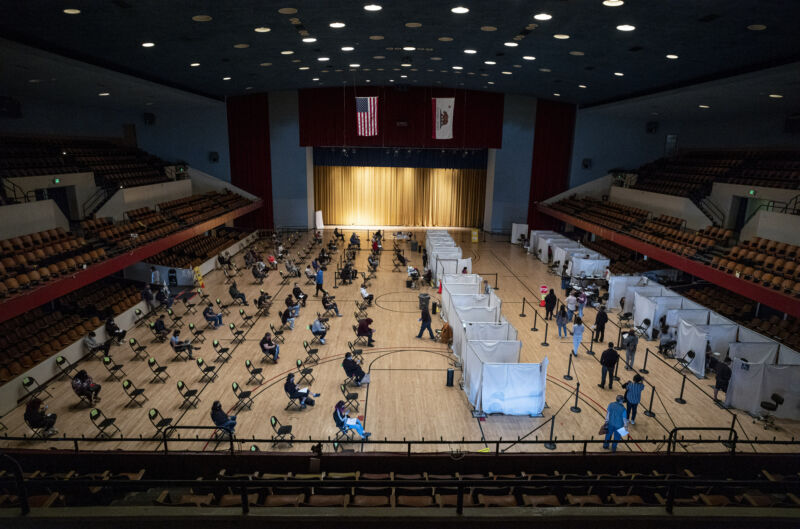
Enlarge / Residents wait in an observation area after receiving Covid-19 vaccines at a vaccination site in Richmond, California on Thursday, April 15, 2021. (credit: Getty | Bloomberg)
Cases of COVID-19 are extremely rare among people who are fully vaccinated, according to a new data analysis by the Centers for Disease Control and Prevention.
Among more than 75 million fully vaccinated people in the US, just around 5,800 people reported a “breakthrough” infection, in which they became infected with the pandemic coronavirus despite being fully vaccinated.
The numbers suggest that breakthroughs occur at the teeny rate of less than 0.008 percent of fully vaccinated people—and that over 99.992 percent of those vaccinated have not contracted a SARS-CoV-2 infection.
Social-media companies play a central role in disseminating the messaging of domestic violent extremists in the U.S., FBI Director Christopher Wray said Wednesday, likening the role platforms play in the spread of extremist thought to foreign-backed online political disinformation. From a report: "Social media has become, in many ways, the key amplifier to domestic violent extremism just as it has for malign foreign influence," Mr. Wray said in an annual worldwide-threats hearing held by the Senate Intelligence Committee. "The same things that attract people to it for good reasons are also capable of causing all kinds of harms that we are entrusted with trying to protect the American people against."
Mr. Wray's comments came as the Biden administration jump-starts efforts to combat domestic terrorism, which took on greater urgency after supporters of former President Trump stormed the U.S. Capitol on Jan. 6 claiming falsely that the 2020 election had been stolen from him. Mr. Wray's remarks were among the most strident comments from a senior U.S. intelligence official about how social media fuels the problem. Mr. Wray stopped short of blaming Silicon Valley companies for aiding domestic extremism, instead urging Americans "to understand better what the information is that they are reading" and approach it with a "greater level of discerning skepticism." The nature of social media -- an "echo chamber" in which like-minded people rarely hear from outside voices and are isolated because of the Covid-19 pandemic -- has contributed to the problem, he said.
It is Wednesday, and today’s White House briefing was dominated by questions concerning national security. White House press secretary Jen Psaki fielded queries about President Biden’s announcement that the United States will be pulling out of Afghanistan, as well as questions concerning Iran and whether or not recent claims of a cyberattack at Iranian nuclear facilities will sidetrack possible renegotiations. A couple of reporters asked Psaki to talk about the possibility of a Putin/Biden summit, and in general most of the questions referred to these foreign policy considerations.
The main point that Psaki made to reporters was that President Biden’s decision is based on the view that Afghanistan’s security issues cannot be fixed through military occupation. There is a need for better and more productive long-term solutions to our national security issues involving international terrorism. In tandem with this is the news, reported out of Iran, that their nuclear facilities were the victims of a cyberattack. Psaki reiterated the White House’s position that a.) the United States was not involved in the attack; b.) the White House will not openly speculate as to who is responsible for such an attack; and c.) the White House remains committed to reopening negotiations with Iran, which were destroyed under the Trump administration.
Then, because the country’s right-wing propaganda outlets have virtually nothing even approximating policy to ask about, a question came in about the Biden administration making taxpayers pay for everybody’s abortions. I bet you didn’t know about this policy change! I bet you didn’t know because it isn’t a thing. That isn’t happening. In response, press secretary Psaki was forced to literally read the law to this reporter.
On behalf of Catholic news channel EWTN, White House correspondent Owen Jensen asked about the Biden administration’s plans to reverse the Trump administration’s radical policy change that cut millions of women off from Title X family services. Specifically, the Catholic news outlet’s correspondent was asking about Biden’s proposal to lift the “gag rule” that barred reproductive health providers who received federal funding by way of Title X from referring patients to doctors or clinics that provide abortions. Of course, this isn’t federal funding that goes into paying for or providing anyone with abortions. That money does disproportionately help lower-income communities and frequently marginalized women and families get access to better healthcare options.
Jensen, however, asked this: “Why does the Biden administration insist that pro-life Americans pay for abortions and violate their conscience?” Wild, right? Forget about the fact that even if this were the case—WHICH IT IS NOT—these asshats can get in line behind the tens of millions of Americans who don’t want to pay for an overblown military, an overblown law enforcement apparatus, and billions in corporate welfare. But I’m not the press secretary, in no small part because I would be bleeped so much it would be hard for news outlets to get a useable quote. Luckily, Jen Psaki is good at handling dunderheads in a more civil fashion.
“Well, first, that’s not an accurate depiction of what happens, and I know we want to be accurate around here, in programs where abortion is a method of family planning,” Psaki responded. She then went on to read the law’s language: “None of funds appropriated under this title should be used in programs where abortion is a method of family planning. That is written into the public health service act and it specifically states that.”
Jensen attempts to argue that these funds are an “indirect subsidizing” of abortion services, even throwing in a truly bizarre “money is fungible, it can’t be traced, we know that” claim. It is probably the idiotic condescension Owens delivers this last part with that would end with me turning furniture over and getting kicked out of the administration. But Psaki, bless her heart, replies “That is not how it works, that is the law. So I’m stating what the law is and how it is implemented legally by these organizations.”
Psaki goes on to explain that the goal here is to create more equitable health services for Americans. The Trump-era gag rule hurt families of color more than it did anything to lower abortion rates in our country. Jensen’s only response was to try and ask the question a second time. But he led it off with this remark: “You talk about equity, if I may interrupt.” He didn’t interrupt anyone. At all. It’s almost like he’s bearing false witness for the print version of what he might write later. Like he’s attempting to create a conflict where there is no conflict. I wish these reporters were more faith-based, then they would surely act less morally reprehensible.
Owens goes on to try the old twisted logic that by offering more money for family planning healthcare services to people of color, this will somehow lead to more abortions in communities of color. Shhhh. Don’t say anything! Don’t think about it! The mushed-together words are the logic-free signifier of the forced-birther movement. “How is it fighting systemic racism when abortion, we all know, disproportionately affects minority children?”
So, his argument is that even though the law doesn’t allow for taxpayer money to go to abortion services in family planning, it somehow does. And in so doing, this thing that isn’t happening will lead to communities of color having more abortions because these communities want government subsidized abortions so they can have more abortions. (In an alternate world, press secretary Einenkel was chastised for holding up both middle fingers at a reporter today ... )
Again, Psaki explained that there are laws and there are non-laws, and this is a law. The executive branch of our government is in charge of enforcing the laws … or executing those laws, as the language states. Owens tried once more to go into the BS fray, but Psaki was finished allowing him time to pretend he is a reporter and cut him off, saying, “I think I’ve answered your question.”
Jen Psaki masterfully handles a factually inaccurate, loaded question about abortion pic.twitter.com/4DG9OcrqE2
It seems like Republican South Dakota governor and noted COVID-19 superspreader Kristi Noem wants unaccompanied children and other asylum-seekers to know that they’re not welcome in her state. I mean, she really wants them to know they’re really not welcome.
“South Dakota won't be taking any illegal immigrants that the Biden Administration wants to relocate,” she wrote in a tweet that could have easily been mistaken for something from Gab or Parler but was actually her official government account. By the way, asylum is legal immigration. But anyway, back to Noem’s tweet. “My message to illegal immigrants... call me when you're an American.”
The tweet comes after a number of Republicans have taken the very pro-life and pro-family stance of informing the Biden administration that asylum-seeking kids seeking safety in the U.S. can also stay the hell out of their states, please and thank you.
“Gov. Ricketts rejects request to house migrant children in Nebraska,” Omaha World-Heraldreported this week. “This is not our problem; this is the president's problem,” Iowa’s Kim Reynolds said. But it’s not enough to tell off the president. Nope. Noem wants asylum-seekers to also be included in the berating:
South Dakota won't be taking any illegal immigrants that the Biden Administration wants to relocate. My message to illegal immigrants... call me when you're an American.
So Noem shows how Twitter can truly be a flaming dumpster fire of assholery. But the platform can also be used to push back on these garbage views, as a number of folks showed. While South Dakota is home to a smaller number of immigrants (about 35,000 in 2018, the American Immigration Council estimates) they “make up a critical share of the state’s labor force,” the organization said, and El Paso Rep. Veronica Escobar noted:
Next announce that you won’t eat food that immigrants gather for you in back-breaking agricultural work or that they cook in the restaurants you dine in or the meat you eat from meat packing plants where they work. Stop the hypocrisy and stop dehumanizing immigrants. https://t.co/StSU4wziFn
CBS News correspondent David Begnaud tweeted that he got a direct message from a physician in the state. “I’m absolutely horrified,” this doctor wrote to him. “She is as un-Jesus like as possible. Especially after the Smithfield debacle and our history of Native American issues this is as low as it gets.” Others on Twitter made similar observations.
No one is illegal on stolen land. And you are definitely - DEFINITELY - on some stolen af land. https://t.co/x7PwcthwXz
“The irony of this cruel message from the South Dakota Governor is that South Dakota only exists b/c thousands of white undocumented immigrants from Europe used the Homestead Act from 1860-1920 to steal land from Native Americans w/o compensation or reparations,” human rights attorney Qasim Rashid tweeted.
Topping this all off is the July 2020 tweet that Noem had pinned to her account as of Wednesday afternoon. It appears to be a tweet promoting the state. “There's no place in America like South Dakota. We'd love to have you join us,” it read. “Come grow your company; live your life; achieve your dreams.We can make it happen for you right now, because South Dakota Means Business.” Unless you’re an asylum-seeker. Then, the message is: Stay Out.
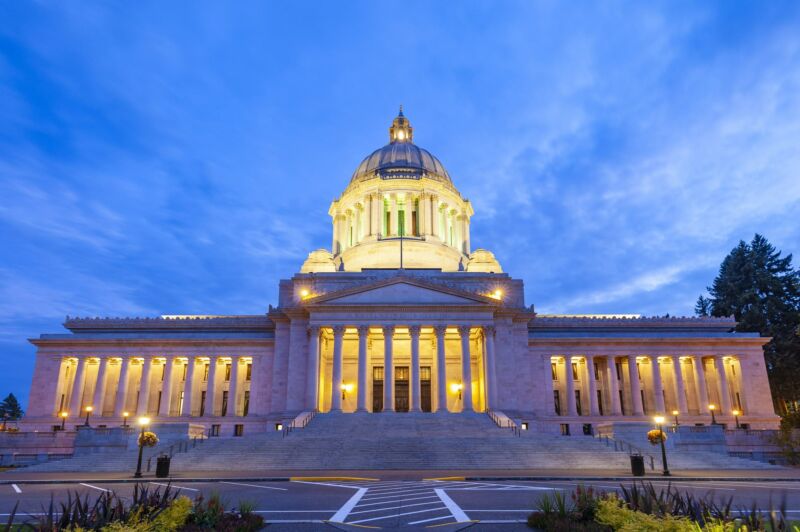
An anonymous reader quotes a report from Motherboard: Washington State lawmakers have voted to kill telecom-industry backed restrictions that limit the reach of community broadband. The Public Broadband Act (HB1336) passed the state Senate with a 27-22 vote on Sunday, after passing the House with a vote of 60-37 last February. State Representative Drew Hansen applauded the bill's passage on Twitter, stating it "reverses decades of bad policy" and opens the door to better, cheaper broadband. "Washington was one of only 18 states that restricted local governments from serving the public by providing public broadband," Hansen told Motherboard. "My bill eliminates that restriction."
In Washington, a twenty-one year old law let some local governments build their own broadband networks, but prohibited local utilities from delivering broadband to customers directly. Hansen, who was also the primary sponsor of the state's new net neutrality law, says his bill finally eliminates those unnecessary limits entirely. "The Public Broadband Act broadly authorizes all local governments to provide broadband to anyone -- people who are totally unserved, people who have some internet access but it's not affordable or reliable -- any people at all," Hansen told Motherboard. "Under the Public Broadband Act, Washington governments have completely unrestricted authority to provide broadband to the public."
The Twitter FBI is at it again. An Army sergeant has gone viral after Twitter users identified him as the racist threatening and harassing a Black man who was walking in his own neighborhood. Users identified 42-year-old Sgt. 1st Class Jonathan Pentland, who is based in Fort Jackson in Columbia, South Carolina, as the racist in question after one account posted a video of a white man harassing a young Black man unprovoked.
“Twitter, I’m told this super douche lives in The Summit in Columbia, South Carolina. If you recognize him, please DM me — I want to make sure the name I have is accurate before I blast it all over social media,” Twitter user @Angry_Staffer posted alongside the video.
The short video depicts Pentland confronting a Black man identified as Deandre for merely walking down the street. Deandre remains calm throughout the video as Pentland can be heard yelling at him to leave and threatening him physically. Despite Deandre explaining that he lives in the area, Pentland gets physical and shoves Deandre. “You can walk away or I’m going to carry your ass out of here,” Pentland said.
Twitter, I’m told this super douche lives in The Summit in Columbia, South Carolina. If you recognize him, please DM me — I want to make sure the name I have is accurate before I blast it all over social media. pic.twitter.com/LYAVzL2FaE
At one point Pentland’s wife even chimes in, calling Deandre the “aggressor,” claiming that he spent “15 minutes” standing instead of walking as he said he was. She accused him of “acting like a child” and picking a fight with neighbors. Deandre can be heard explaining that he did no such thing. Pentland’s violence continues with him threatening Deandre: “You’re in the wrong neighborhood, motherfucker.” He continues to harass Deandre for his address, and the video ends with Pentland inching towards Deandre’s face, saying, “Get the hell out of my face.” It’s clear the violence continued even though the video ended. Bystanders then allegedly intervened.
The video was shared on Facebook by a woman named Shirell Johnson, who said her friend had recorded the incident while walking in the neighborhood and asked her to post it. Johnson shared an update on Facebook that the police were eventually called and noted that despite the multiple witnesses and video evidence of Pentland’s behavior, the officer told her “that he could only charge the white guy with malicious injury to property and not assault!”
“She saw the young man in distress and knew he didn’t do anything wrong so she started videoing for his safety! (Smart girl❤️). She sent me the video last night and I got the ok to post it,” Johnson wrote on Facebook Tuesday. “I have been in contact with both D (as I call him now) to check on him and the young lady Shadae who did the video. Both are doing ok but still processing. Last night we all bonded bc we noticed a young man in distress and he happened to be black!” The women did not know Deandre beforehand.
Johnson added, “Vinnetta and I only wanted to get D to safety bc the situation was getting out of control and that white guy was very angry and yelling at him overpowering him. We circled back to get him out of that situation bc we refused to see D go to jail or lying there dead simply bc he was black. The only thing he did was be black while walking!!!”
The woman who filmed the video, Shadae McCallum, also posted the video to Twitter and explained the events leading up to the incident in a thread. In a tweet she noted that after her recording, Pentland stepped on Deandre’s phone. “There was also a part that I didn’t record of the taller man slapping the phone out of Deandre’s hands and stepping on it. The taller man also pushed Deandre several times off camera.” She added that while she is thankful “Deandre was able to make it home safely, this situation was surreal.”
I went for a walk yesterday evening and I encountered a young man (Deandre)in distress. I decided to record the incident in order to protect this black man from possibly becoming a statistic pic.twitter.com/fdgfAmc6zb
In a tweet on Wednesday, McCallum shared another update: “Deandre is fine, just shaken up and overwhelmed.”
Residents of the city have reached out to the Richland County Sheriff’s Department asking why charges weren’t filed. The department’s Facebook page has multiple comments noting the disturbing incident, including one that said: “Why was Jonathan Pentland only issued a citation for property damage when he is on video clearly assaulting a young man and there were multiple witnesses stating they saw the assault? Who was the RCSD supervisor who issued the directive not to proceed with assault charges? Why were the proper charges not filed? Is this the narrative that RCSD wants to support-that a stranger can walk up to you during your afternoon walk and assault you with no consequences?”
On Wednesday, the Richland County Sheriff’s Department issued a statement on Twitter noting department officials would meet “with elected officials and reps of various organizations today to discuss the Summit incident.” Additionally, the department noted that they are aware of the “disturbing video” and that the incident would be taken seriously.
Police officials were not the only ones Twitter users and community members called out to in regards to the incident. After identifying the man as an Army sergeant, the Twitter user @Angry_Staffer, whose post went viral, tagged Fort Jackson officials asking for a response on their staff member’s behavior. To this, Pentland’s commanding officer responded that the incident would be looked into as soon as possible.
This is by no means condoned by any service member. We will get to the bottom of this ASAP.
— Fort Jackson Commanding General (@fortjacksoncg) April 14, 2021
Since it was shared yesterday, the incident’s footage has been viewed more than 1.3 million on Twitter alone. Users have shared photos of both Pentland and his wife and called for justice.
Kristen Clarke, President Biden’s nominee to lead the Civil Rights Division of the Justice Department, got some very familiar treatment from Senate Judiciary Committee Republicans at her confirmation hearing Wednesday. That is to say, faced with a Black woman committed to civil rights, Republicans were angry, vituperative, and determined to put her in (what they think is) her place.
Clarke has a long record of work in civil rights law, from time at the Justice Department to her recent work as the president of the Lawyers' Committee for Civil Rights Under Law. If confirmed, she would be the first Black woman to head the Justice Department’s Civil Rights Division.
In recent months, Clarke has been repeatedly attacked by Republicans for alleged anti-Semitism, dating to her time leading Harvard’s Black Students’ Association, when the group invited an anti-Semitic author to speak. Sen. Richard Blumenthal offered her the chance to speak to that, quoting Attorney General Merrick Garland’s unequivocal defense of Clarke during his own confirmation hearing, when he responded to Lee’s questions by saying “I'm a pretty good judge of what an anti-Semite is, and I do not believe she is an anti-Semite.”
”I could not be an effective civil rights lawyer if I did not have the ability and capacity to work with, alongside, and on behalf of all people, of all backgrounds, regardless of race, religion, national background, and more,” Clarke said. “Anti-Semitism is real, and is something that I have fought throughout my career.” She went on to describe the Lawyers’ Committee’s work against neo-Nazis and a New York State Attorney General’s Office religious rights unit she helped to launch, and cited her endorsements from a long list of Jewish organizations.
In its endorsement of Clarke, the Union for Reform Judaism wrote, “Our experience working alongside Ms. Clarke to oppose hate in all its forms makes clear that her life has been dedicated to the civil rights values that should and must be reflected within the Department of Justice.
“We are deeply pained that there are some who are weaponizing antisemitism in their effort to derail Ms. Clarke’s nomination. The violence at Pittsburgh’s Tree of Life synagogue and at Poway’s Chabad synagogue, the gathering of neo-Nazis in Charlottesville, and the growing participation in online hate forums demonstrates that the threat from anti-Semites is real. We cannot be distracted from our shared mission to defeat these hateful forces by spurious claims of antisemitism. The real ones are all too prevalent.”
At the hearing, though, Republicans spent less time on this issue than on assailing Clarke for opposing racism.
Sen. John Cornyn distinguished himself by pressing Clarke about a satiric piece she wrote as a 19-year-old college student, reversing the racist tropes of the book The Bell Curve to declare “African Americans were genetically superior to Caucasians.” Emphasizing that, yes, the obvious satire was satire, Clarke also pointed out that “contemporaneous reporting by the campus paper made very clear that this was not a view that I espoused. What I was seeking to do was to hold up a mirror, and put one racist theory alongside another to challenge people as to why we were unwilling to wholly reject the racist theory that defined The Bell Curve book.”
“So this was satire?” Cornyn replied, sounding bewildered. Yet, despite Clarke’s very clear—and documentable—answer, he then took to Twitter to defend himself against eyerolling at the ridiculous question, tweeting, “Should we give all nominees the benefit of the doubt? That doesn’t seem to be the prevailing standard. Should we apply a double standard? I think not.”
This is a man who had Donald Trump’s back every step of the way talking about how it would be a double standard if he didn’t attack a Black woman for decades-old satire.
Sen. Mike Lee also jumped in on the “you’re the real racist” angle, by spitting out what he called a “non-exhaustive list of elements of American society, elements that you have at one point or another described as ‘racist.’” That list included police departments, federal agencies, AirBnB, and more, all of which have at minimum committed acts of racism. Sen. Ted Cruz tried to paint Clarke as a full-throated proponent of defunding police, which she is not, though she has called for the U.S. to “invest less in police and more in social workers.”
Sen. Tom Cotton, who previously attacked Vanita Gupta, Biden’s nominee for associate attorney general, for understanding that implicit bias is a real thing, this time attacked Clarke for thinking that police officers who kill unarmed Black people should be prosecuted. This was the issue he chose to go all in on during the trial of former officer Derek Chauvin for murdering George Floyd, and on the day former officer Kim Potter was charged with manslaughter for killing Daunte Wright.
This comes after they have consistently saved their fiercest opposition to Biden nominees for women of color: Clarke’s treatment is part of a pattern. To these Republicans, the act of taking civil rights and racism seriously is an obvious disqualification—to run the Civil Rights Division. Being a Black woman taking civil rights and racism seriously is grounds for naked hostility, and that was what Republicans directed at Clarke.
Cryptocurrency exchange Coinbase opened trading on Wednesday at $381 per share, giving it a fully diluted market value of around $102 billion. From a report: This is a slight premium to the most recent private trades for Coinbase stock, and more than 50% higher than the reference price set last night by the Nasdaq. Coinbase's public listing has been among the most anticipated in recent years, with expectations it will garner a massive market cap. Further reading: Coinbase's blockbuster debut is a 'watershed' for crypto -- but there are risks ahead.
But doesn't "real murica" love their personal responsibility? Oh wait, they only apply that to democrats and non-white people.
Americans will soon begin to fall back into the rhythms of pre-pandemic life—attending sunny summer weddings, squishing into booths at chain restaurants, laughing together at movies on the big screen—and it will feel like a victory over the coronavirus. But the virus might not actually be gone. In pockets of the country, vaccination rates could stay low, creating little islands where the coronavirus survives and thrives—sickening and killing people for months after the pandemic has ebbed elsewhere. In a worst-case scenario, the virus could mutate, becoming a highly transmissible and much more lethal version of itself. Eventually, the new variant could leak from these islands and spread into the broader population, posing a threat to already-vaccinated people.
This is the future that keeps some public-health experts awake at night. Right now America is in the simplest stage of its vaccination campaign: getting shots to people who want them. But many Americans are still reluctant to get a vaccine—especially those living in rural areas, who tend to be politically conservative and are among the most fervently opposed to inoculation. Public-health leaders will soon have to refocus their efforts toward the next and more difficult stage of the campaign: persuasion. Over the next few months, “the number of willing individuals to get vaccinated will be depleted,” says Timothy Callaghan, a rural-health researcher and professor at Texas A&M University. “Then the work begins.”
The politicization of vaccines will complicate this effort. Curiously, it’s a relatively recent phenomenon. Anti-vaccine sentiment has been around since the early days of the smallpox vaccine, and that sentiment grew stronger after the discredited British physician Andrew Wakefield published a now-retracted paper linking vaccines to autism in 1998. But vaccine opponents’ concerns were mostly medical rather than ideological, David Broniatowski, a professor at George Washington University who studies group decision making and behavioral epidemiology, told me. In a recent study analyzing a decade of anti-vaccine rhetoric on Facebook, Broniatowski and a research team concluded that vaccine opposition first became politicized in 2015. That year, a measles outbreak linked to two Disneyland theme parks in California affected more than 100 people and triggered a “multi-state public health incident.” Most of those infected were unvaccinated or had an unknown vaccination status, and the California state legislature responded by removing personal-belief exemptions from public-school immunization requirements. The backlash from vaccine opponents was fierce: Suddenly, the issue was less about medical safety and more about freedom and individual choice. The following year, the propaganda film Vaxxed helped crystallize vaccination as a civil-liberties concern, and vaccine opposition became much more common among conservatives, who were more likely than liberals to be critical of government interference in Americans’ private lives, Broniatowski said.
This history helps explain conservatives’ reluctance today to get the COVID-19 vaccine. Until vaccines are available to every person nationwide, it’ll be hard to accurately gauge how widespread vaccine hesitancy is. But new polling data indicate that serious investment in persuasion campaigns will be necessary, especially in rural communities. Rural Americans are twice as likely as people in urban areas to say they will “definitely not” get a shot, and nearly three-quarters of them identify as Republican or Republican-leaning, according to new survey data from the nonpartisan Kaiser Family Foundation. Rural Americans are more apt to see vaccination as a civil-liberties issue: “More (58%) rural residents view getting vaccinated as a personal choice rather than part of everyone’s responsibility to protect the health of others (42%),” the KFF survey found. (The reverse is true for urban residents.) This group is also much more likely than any other to say that the news media have exaggerated the pandemic’s seriousness, Liz Hamel, who directs KFF’s polling work, told me.
It’s possible—even probable—public-health experts told me, that months from now, some rural areas will still have very low vaccination rates, providing isolated havens for the coronavirus. That outcome could be calamitous. First, as long as unvaccinated individuals live together in a community, frequenting the same shops, offices, and classrooms, the virus can find hosts through which to spread. Second, and even worse, a virus left unchecked will evolve—that’s what viruses do best—and could become more infectious, more lethal, and more resistant to existing vaccines. Which means that, ultimately, a new, super-charged coronavirus variant could create the conditions for another epidemic, the experts told me. This is why “we need people vaccinated now, not four months from now,” says Alan Morgan, the CEO of the nonprofit National Rural Health Association.
Vaccine hesitancy is now the chief focus for rural-health experts like Morgan. They have an obligation to change minds, and fast. But persuasion works only with trustworthy messengers, such as local leaders, physicians, and pharmacists—people who already have relationships and friendships with community members, who share similar values, and whose children go to school together. “Rather than have these mass-vaccination sites through government-funded health departments with the National Guard” overseeing operations, health officials need to send vaccines straight to places such as doctors’ offices, churches, and familiar local clinics, Michael Meit, the research director at East Tennessee State University’s Center for Rural Health Research, told me. “It’s those relational pieces that are so, so important in our rural communities.”
Actually, personal relationships are important in all public-health messaging, regardless of geography. Take the 2019 measles outbreak in parts of New York City. In early spring that year, nearly 600 people across several Hasidic Jewish neighborhoods got sick, most of them unvaccinated children. Immunization rates there were low, in part because the Hasidic community had been targeted by anti-vaccination groups making false claims about vaccine safety. In response, city public-health officials enlisted the help of local doctors and rabbis to encourage locals to inoculate their kids. They also created informational booklets with accurate vaccine information in Yiddish, and distributed them to 30,000 households. Their efforts were successful: In the Williamsburg neighborhood of Brooklyn, where case numbers were highest, the share of people who had gotten the measles vaccine increased from 79 percent at the outbreak’s start to 91 percent by the end, Jennifer Rosen, the director of epidemiology and surveillance for the New York City Bureau of Immunization, told me.
Effective vaccine messaging has to be tailored to people’s specific fears: If someone is worried about government overreach, the messenger should use language that affirms their right to make their own medical decisions, Broniatowski says. “Of course it’s your choice,” he advises messengers to say. “Here’s why it’s the right choice.” Facts alone won’t do the trick, and neither will shaming. Many conservatives have found the discourse around COVID-19 and vaccines to be “very demeaning,” he added. “There’s a lot of communication from people on the periphery of science communication that say things that come across as ‘What’s wrong, you idiot? Don’t you trust science?’” But it’s natural for people to be reluctant about a brand-new vaccine, and people shouldn’t be scolded for having doubts. Roger Brock, the public-health administrator in rural Barry County, Missouri, told me that he tries to create a judgment-free zone. After listening to patients’ concerns, he explains to them that the vaccines were developed by the smartest scientists in the world, who have no political agenda. (He also reminds them that the vaccines don’t contain microchips, Brock said with a laugh.) “Sometimes you have success” persuading people, “and sometimes you don’t,” he added.
Morgan, at the National Rural Health Association, is working to enlist members of the National Corn Growers Association and the Farm Bureau to act as local persuasion leaders. Federally, the CDC is investing millions of dollars in local efforts to improve vaccine access and uptake, and the Biden administration recently launched an ad campaign to persuade holdouts. KFF’s polling offers reason to be optimistic about these efforts overall: Although the most staunchly vaccine-hesitant Americans haven’t budged from their position since December, the number of people who want to get a vaccine is higher than it was over the winter. Rural Americans are still the most hesitant group in the country, but as of this month, more than half of them say they have received at least one vaccine dose or intend to do so as soon as possible.
In rural Ripley County, Missouri, the public-health administrator Jan Morrow has been working overtime for months on the persuasion effort. Every night after she returns home from the public-health center, she takes calls from the nervous and the skeptical. Earlier in the pandemic, her neighbors would ask about the efficacy of face masks, or question whether the media were exaggerating COVID-19’s severity, she told me. Nowadays, they’re calling to ask for advice on whether to get the vaccine. “We’re not going to make you take this vaccine. That is your choice,” she usually responds. Sometimes Morrow emphasizes how devastating the pandemic has been for public-health professionals like her—how it felt to watch 19 people in Ripley County, population 13,000, die of COVID-19 in the past year. “I took the vaccine with no hesitancy at all because I have seen our case loads,” she tells them.
Just last week, a young man Morrow has known since he was a toddler called to get her opinion on booking an appointment. “I walked him through what the vaccine was gonna do,” she said. By the end of the conversation, she’d scheduled him for a shot.
The Atlantic’s COVID-19 coverage is supported by a grant from the Chan Zuckerberg Initiative.
With a first-in-the-nation policy, Las Vegas is seeking to ban grass that nobody walks on. "Las Vegas-area water officials have spent two decades trying to get people to replace thirsty greenery with desert plants, and now they're asking the Nevada Legislature to outlaw roughly 40% of the turf that's left," reports The Associated Press. By outlawing this ornamental grass that requires four times as much water as drought-tolerant landscaping, the region can reduce annual water consumption by roughly 15% and save about 14 gallons of water per person per day. From the report: The proposal is part of a turf war waged since at least 2003, when the water authority banned developers from planting green front yards in new subdivisions. It also offers owners of older properties the region's most generous rebate policies to tear out sod -- up to $3 per square foot. Those efforts are slowing. The agency says the number of acres converted under its rebate program fell last year to six times less than what it was in 2008. Meanwhile, water consumption in southern Nevada has increased 9% since 2019.
Justin Jones, a Clark County commissioner who serves on the water authority's board, doesn't think ripping out ornamental turf will upend people's lives. "To be clear, we are not coming after your average homeowner's backyard," he said. But grass in the middle of a parkway, where no one walks: "That's dumb." "The only people that ever set foot on grass that's in the middle of a roadway system are people cutting the grass," Jones said. The agency has different regulations for yards and public parks. Based on satellite imaging, it believes banning ornamental grass will primarily affect common areas maintained by homeowner associations and commercial property owners.
We'll see if corps wake up to their very unreliable partner
As an unmoored Republican Party searches for ways to curry favor with a base eager for sugar highs, the GOP is becoming ever more a party of opportunists in search of attention, however fleeting.
That's the best framework through which to view the latest announcement from three Republican senators targeting Major League Baseball's exemption from antitrust laws after the league relocated its All-Star Game over Georgia's new voter suppression law.
On Tuesday, Sens. Mike Lee of Utah, Ted Cruz of Texas, and Josh Hawley of Missouri announced an effort to punish MLB by removing its antitrust shield. Lee said the legal exemption had been created from "whole cloth" by the Supreme Court nearly 100 years ago.
Cruz, a perennial huffer, criticized "woke corporations" for becoming a "political enforcer for Democrats" in Washington.
Hawley painted corporate monopolies as an enemy of freedom. “When you have a concentration of economic power, political power follows,” he said. “It’s time for a new round of trust-busting in the United States. Major League Baseball is a good place to start.”
Whatever one thinks of the MLB's antitrust exemption, the notable point here is a triad of Republicans taking direct aim at powerful corporations now that they no longer like how those corporations are using the power the GOP helped them amass.
Again, it's just a head-spinning turn of events that is likely to only get more common in the coming months. “Since the 1950s, people have associated the GOP and big business. It doesn’t work anymore,” Jeffrey Sonnenfeld, a professor at Yale University’s School of Management, told the Washington Post. Sonnenfeld helped organize a recent call among 100 corporate leaders as they grappled with how to demonstrate their opposition to GOP voter suppression measures. Outside of an issue like raising the corporate tax rate, Sonnenfeld said corporations were growing continually more out of step with Republicans. “They don’t have a political home," he said.
It's also important to note that GOP lawmakers are living in a world where the base of Trump voters they aim to please seems entirely disinterested in actual policy outcomes. Bluster and vitriol alone are enough for Trumpers. They simply want their leaders to draw blood regardless of whether it produces any long-term change.
The tactic also isn't reserved for Republicans in Washington. Florida Gov. Ron DeSantis, for instance, is now telling a luxury cruise line it can't require its passengers to be vaccinated for COVID-19. “The Governor’s Executive Order provides that businesses in Florida are prohibited from requiring patrons or customers to provide any documentation certifying COVID-19 vaccination or post-transmission recovery to gain access to, entry upon, or service from the business,” press secretary Cody McCloud told the Florida-based Sun-Sentinel. “Therefore, the Executive Order prohibits cruise lines from requiring vaccine passports for their Florida operations.”
Ultimately, DeSantis may not have the legal authority he is claiming, but that's not the goal. The goal is simply to score points with a GOP base that is ever more focused on hyperbolic grandstanding than outcomes.
The difference now is that absolutely everyone and everything is fair game as Republican politicians look for ways to ingratiate themselves to Trump’s base voters. Corporations, Major League Baseball—it’s all open season in the GOP.
Tesla has jacked up the price of its solar roof, which integrates solar panels directly into roof tiles, Electrek reports. A 12.3 kW system that Electrek priced at $54,966 last summer now costs more than $70,000, according to Tesla's online calculator.
Customers report that Tesla is not only raising prices for future solar roof installations—it's demanding more money from some existing customers whose panels haven't been installed yet.
"Tesla has reneged on its solar roof contracts and has raised the prices for people (like me) who have already signed contract with them," one Ars reader told us. "For example, they are asking for an additional $21,000 for my project from about $66,000 to $87,000."
Apple needs to give up their Disney morality police bullshit
Enlarge / This cute little pig has obviously seen some things that iOS users will no longer be allowed to see on Discord.
Discord users who access the Discord app through iOS will now face restrictions on adult content that go beyond those for other platforms. The gaming-focused social networking app—which lets users create public or private servers to chat via text, image, voice, and video livestreaming—announced this week that "all users on the iOS platform (including those aged 18+) will be blocked from joining and accessing NSFW servers. iOS users aged 18+ will still be able to join and access NSFW communities on the desktop and web versions of Discord."
That NSFW designation can be set by the server owner or by Discord itself, in keeping with community guidelines requiring the label on "adult content." Individual channels within a server can be designated as NSFW without imposing limits on the full server, but an entire server may be labeled as NSFW "if the community is organized around NSFW themes or if the majority of the server’s content is 18+," the company said.
Discord has set up an appeals process for server owners to challenge an NSFW designation. Individual users can also contact Discord if they were accidentally identified as minors during an age-verification process. But that age change will still be meaningless on iOS, where users of all ages will be barred from NSFW content.
The Washington state legislature has voted to end limits on municipal broadband, and the bill lifting those restrictions now awaits the signature of Democratic Gov. Jay Inslee. The state Senate passed the bill Sunday in a 27-22 vote, and the state House passed it on February 23 by a vote of 60-37.
"This bill reverses decades of bad policy—Washington was one of only 18 states with a STATE LAW prohibiting some local governments from offering broadband directly to the public," Democratic Rep. Drew Hansen, the bill's lead sponsor, wrote on Twitter. "Long overdue. Thanks to the BIPARTISAN group of Senators who stood up for public broadband today!!"
The Senate vote went mostly along party lines, but one Republican (Brad Hawkins) voted yea and three Democrats (Steve Hobbs, Mark Mullet, and Lisa Wellman) voted nay.
Gee, again, farmers fucking up the entire country for private profit. I'm shocked. Oh wait.
Getty Images
A new study reveals how the companies you buy meat from block climate action.
You probably already know that the fossil fuel industry has spent many millions of dollars trying to sow doubt about climate change and the industry’s role in it.
But did you know that big meat and dairy companies do the same thing?
According to a new study out of NYU, these companies have spent millions of dollars lobbying against climate policies and funding dubious research that tries to blur the links between animal agriculture and our climate emergency. The biggest link is thatabout 14 percent of global greenhouse gas emissions come from meat and dairy.
“US beef and dairy companies appear to act collectively in ways similar to the fossil fuel industry, which built an extensive climate change countermovement,” write the authors of the study, published in the journal Climatic Change.
One of the authors, Jennifer Jacquet, says the paper should spur a vigorous public response.“People should be mad,” she said. “And we should build a system where we can prevent this kind of influence.”
Comparing the meat and dairy industry with the fossil fuel industry is not a facile analogy. These industries have worked in tandem for years to undercut climate policy.
For example, in 2009, Tyson and other meat companies got nervous about the American Clean Energy and Security Act, also known as Waxman-Markey,which would have established a cap-and-trade system. They worked alongside the fossil fuel industry to stop the bill. Had it passed, it would’ve been the first congressional bill to directly tackle greenhouse gas emissions. But it never made it past the House.
Now, more information is coming to light about how big meat and dairy companies work against climate policies: through lobbying, through political campaigns, and through academic research.
How Big Meat lobbies against climate-friendly policies
Let’s start with lobbying.
It’s not a surprise that meat and dairy trade associations would lobby for things like access to federally owned public lands for cattle-grazing or industry-friendly manure management regulations. That’s more or less their raison d’être, and it’s what they’ve done for decades. But as the authors determined, “more recently they have been involved in blocking climate policy that would limit production.”
Six of the big US groups — the National Cattlemen’s Beef Association, the National Pork Producers Council, the North American Meat Institute, the National Chicken Council, the International Dairy Foods Association, and the American Farm Bureau Federation — have together spent about $200 million in lobbying since 2000. And they’ve been lobbying annually against climate policies like cap-and-trade, the Clean Air Act, and regulations that would require farms to report emissions.
Individual meat companies likewise spend millions on lobbying. Tyson, for example, has spent $25 million since 2000. Now, that may not sound like much if we compare it to what individual companies in the fossil fuel industry spend — Exxon alone spent over $240 million during the same period. But the study notes that we have to look at these amounts in proportion to each company’s bottom line. Taken as a share of total revenue over the past two decades, Tyson has spent 33 percent more on lobbying than Exxon has.
“The relative spending is very much an indicator of political engagement,” Jacquet said.
These figures refer to meat companies’ total spending on lobbying, not only climate-specific lobbying. That said, even policies that are not explicitly about climate — like crop incentives or land-use decisions — can also drive harmful emissions.
When Big Meat gets involved in political campaigns
The study also found that the big US meat companies have spent millions on political campaigns, typically to support Republican candidates.
Again, these companies are big spenders in this arena relative to their bottom line. Since 2000, Exxon spent about $17 million on US federal political campaigns, while Tyson spent $3.2 million. “But taken as a share of each company’s total revenue over that period, Tyson has spent double what Exxon has on political campaigns,” the study notes.
Meat and dairy companies bankroll candidates because it pays off. Members of Congress they’ve funded, like Rep. Pete Sessions (R-TX), Sen. Saxby Chambliss (R-GA), and Rep. Roy Blunt (R-MO), have backed pro-agriculture bills and frequently voted against climate change legislation, including cap-and-trade.
According to the study, in some cases funding from Big Meat is the biggest contributor to a politician’s financial resources: “Hormel Foods was the largest contributor to Rep. Gutknecht (R-MN) over the course of his career — a former Congressman who has regularly questioned climate science.”
Sometimes, Big Meat has also funded Democratic candidates. During the 1992 presidential campaign, Tyson was known to be one of Bill Clinton’s main backers — to the point that Clinton was actually nicknamed the “Chicken Man.” Tyson, which is headquartered in Clinton’s home state of Arkansas, did not respond to a request for comment.
Can you trust environmental research funded by Big Meat?
The meat and dairy industries also fund their own academic experts, who then publish research that minimizes or denies the causal link between animal agriculture and climate change.
Industry-funded research isn’t always necessarily flawed. But it’s certainly fair to wonder about the integrity of industry-funded research that happens to advance that industry’s goals. As Undark has reported, you might read a white paper that paints a hopeful picture of the cattle industry’s emissions, only to then realize that the co-authors run dairy groups or received livestock industry funding.
This happens in adjacent industries, too: You might hear a scientist denying that overfishing is a major problem, say, only to then find out that they’ve received funding from fisheries and seafood industry groups. (To be fair, we should note that plant-based meat companies have also commissioned analyses from outside researchers, though much less extensively.)
The new study out of NYU provides other examples of how meat-industry-funded research seeks to downplay the industry’s environmental costs — like emphasizing that its emissions are small relative to those of other sectors, like transportation, instead of acknowledging that animal agriculture causes almost 15 percent of greenhouse gas emissions, which means it’s still a big driver of climate change.
In fact, the NYU paper notes that if the Food and Agriculture Organization is right in projecting that meat consumption will rise 73 percent by 2050, emissions by some meat and dairy companies could exceed the emissions of several fossil fuel companies.
That means people who care about the climate need to get serious about holding Big Meat and Big Dairy accountable, just as they’ve been trying to do for years with Big Oil.
“There has to be a big reimagining of meat and dairy,” Jacquet said. Whether that will entail a reduction in meat consumption or a total switch to plant-based or lab-grown meat and dairy, one thing is for sure: “Given what we know about climate change,” Jacquet said, “it seems clear that business as usual is not the answer.”
Again, white people are the problem here. "Explicit beneficiaries unsure about systematic changes" is an equally useful headline here.
Daunte Wright was driving in his car through Brooklyn Center, Minnesota, two days ago when police officers pulled him over and later fatally shot him. This isn’t the first time cops have used excessive or fatal force against a Black person. In fact, just 10 miles away from where Wright died, former Minneapolis police officer Derek Chauvin was on trial for murder after kneeling on George Floyd’s neck for more than nine minutes last year.
Floyd’s death sparked a massive movement against police brutality and a sweeping shift in public opinion. And while it’s possible that in the wake of the latest tragedy, public support for reforming policing might increase again, new calls for change face a significant obstacle in public opinion. Gains in support for reform, especially among white Americans, tend to be fleeting, and there’s no consensus on what type of reforms the public wants.
Eleven months after Floyd’s death, support for the Black Lives Matter movement has fallen, while America’s trust in law enforcement has risen. Sixty-nine percent of Americans, according to a USA Today/Ipsos survey from March, now trust local police and law enforcement to promote justice and equal treatment of all races versus 56 percent who felt the same way last June.
Meanwhile, in the almost four years Civiqs has been asking about support for the Black Lives Matter movement, a majority of white people have never supported the movement.27 Support peaked at 43 percent last June, just days after Floyd’s death. Since then, white Americans’ support for the movement has dipped back down to roughly where it was before Floyd’s death and is currently at 37 percent.
Some of the biggest drops in support among white Americans occurred among older people (between the ages of 50 and 64), Republicans and men. Black Americans, meanwhile, have remained steady in their support of the movement. Overall, 85 percent of Black Americans say they support Black Lives Matter, compared to 88 percent last year. And that cuts across age, education and gender.
It’s a stark reminder, though, that despite theheavy media coveragethe Chauvin trialhas received in its first three weeks, its outcome is anything but certain. As we’ve written before, it’s uncommon for police officers to face legal consequences for excessive force. While a majority of Americans (57 percent) think Chauvin should be found guilty, according to a recent Economist/YouGov poll, 56 percent of registered voters told Morning Consult in a separate poll that they’re not following the trial closely. Twenty-one percent said it was because they didn’t think anything will change.
But even if Chauvin is convicted, it’s unlikely policing will fundamentally change in the U.S. Not only is public opinion variable, leading lawmakers to back off reform, law enforcement is often reluctant to admit wrongdoing toward Black people.
Police officers have long disputed that they treat people of color differently based on race despite available historical, statistical and anecdotal evidence showing the opposite, as my colleague Perry Bacon Jr. reported last year. While we don’t have a ton of data on the political views of police officers, a 2016 survey from the Pew Research Center of 8,000 police officers nationwide found that 67 percent believed the deaths of Black people during police encounters were isolated incidents, compared with only 31 percent who saw it as signs of a broader problem. This was the exact opposite of how the general public felt: Thirty-nine percent of U.S. adults said they thought the killings were isolated incidents versus 60 percent who felt it was indicative of a broader problem. And Black Americans were even more likely than white Americans to say police killings were a sign of a broader problem, 79 percent to 54 percent. An NPR/PBS NewsHour/Marist poll found last year that nearly half of Black Americans — 48 percent — have very little to no confidence at all that local police treat Black and white people the same; just 12 percent of white Americans had the same view.
The pressure on local lawmakers to enact lasting change is fleeting, depending on the news cycle and current events. Even at the height of calls for police reform, getting bills turned into laws takes time, said Rashawn Ray, a sociology professor at the University of Maryland, College Park, who studiespolice-civilian relation. Ray told me there was an uptick in calls for police-related reforms at both the local, state and federal levels after Floyd’s death since the Black Lives Matter movement became mainstream. “[Black Lives Matter] wasn’t a global movement in 2014,” he said, referring to the year Michael Brown was fatally shot by a white police officer in Ferguson, Missouri. “People have become more aware of what’s happening. … The movement for Black lives and the attention to mistreatment by police has led to this moment.”
But even with more protesters calling for changes in policing, cities’ and states’ proposals will not automatically get passed. While some places, like Los Angeles and Baltimore, were successful in reallocating money away from police departments, others have struggled. In Minneapolis, where Floyd died, promises to “end policing as we know it” fell apart in late June after lawmakers failed to compromise. And in New York City, mayoral candidates who once advocated for defunding the New York Police Department have already begun to distance themselves from the proposal during the competitive race. “The fear of ‘defunding’ messages, lack of understanding or awareness around them and lack of political and community will to change the status quo have certainly caused a considerable amount of retrenchment from those ideas,” said Keon Gilbert, a professor of behavioral science and health education at Saint Louis University. As we get further from last year, he added, cities may be more inclined to either pause reform efforts or back away from them completely.
Another part of the reason police reform is so tricky to navigate is because public opinion is all over the place. Just over half of Americans, according to USA Today/Ipsos, oppose redirecting police funds to social services (57 percent) while 43 percent supported the idea — a slight decline from last August. The only thing most people can seem to agree on — even at the height of the protests after Floyd’s death — is that they’re against the idea of defunding the police. And this remains true today, even among Black Americans and Democrats.
Because many Americans are so split on what they want, police reform is often politicized — leading many Democrats to tread cautiously about saying they support “defunding the police.” President Biden, for instance, was careful ahead of Election Day to say he was in favor of a law enforcement overhaul and maintained that “most cops are good.” (Of course, these more measured stances likely helped him in November since voters didn’t appear to link his views to the Black Lives Matter movement, which was already seeing decreased support at the time of the election.)
But even with a Democratic majority in both congressional chambers, Biden hasn’t changed his messaging. He’s encouraged congressional Democrats to pass a sweeping police reform bill, which would ban chokeholds and create national standards for policing to bolster accountability, but he hasn’t broached legislation that would radically transform policing that the progressive wing of the Democratic Party is calling for.
That said, Americans — both Democrats and Republicans — want somesort of reform. A poll released last week from Vox/Data For Progress found that nearly three-fourths of Americans (71 percent) either support or strongly support a federal ban on police chokeholds. Seventy-one percent of respondents also want to end police racial profiling, while 84 percent are in favor of mandating body camera use. (Republicans were less likely than Democrats to support all three reforms, but they supported mandating body cameras at nearly the same rate as Democratic respondents, 80 percent and 88 percent, respectively.)
At this point, it’s unclear what’s next in both the Chauvin murder trial (closing arguments may start Monday) and what will happen to the officer who shot and killed Wright, but what happens next is likely to have an impact on both policing and reform in years to come.
CORRECTION (April 14, 2021, 10:50 a.m.): This article previously stated that 45 percent of respondents to a Morning Consult poll said they were not following the Derek Chauvin murder trial more closely because they didn’t think anything would change. In fact, it was 21 percent of registered voters.
Tuscon Police Chief Chris Magnus to be nominated as Biden’s Commissioner of Customs and Border Protection
Maybe you remember seeing the picture of a Bay Area police chief holding a Black Lives Matter sign just before Trump was elected? It was powerful to see the Police Chief of Richmond, California in uniform with it. It’s even more powerful after 4 years of further polarizing leadership. And it’s not the only thing Chris Magnus, now police chief in Tucson, Arizona and President Biden’s choice for Commissioner of Customs and Border Protection is known for.
Through the Trump years, he was vocal in his opposition to Trump’s immigration policies and wouldn’t let Border Patrol use his facilities or officers. Most significantly Chief Magnus is widely recognized for his effective results and paradigm-shifting policing. He’s also known for being the first gay police chief to avail himself of marriage equality.
If confirmed, Magnus will be a key figure working on one of the toughest, messiest issues facing the Biden/Harris administration. Confirmation would also make him the first gay commissioner of the U.S. Customs, part of Homeland Security.
“As police chief of gritty Richmond, California, Chris Magnus embraced Black Lives Matter, all but eliminated fatal shootings by police, and cut the homicide rate in half.
Magnus spent his early career rising through the ranks in his hometown of Lansing, Michigan, moving on to become chief in Fargo, North Dakota. In later moved on to become Chief in Richmond, California and 10 years later to Tucson.
The White House described his career saying , “In each of these cities Chief Magnus developed a reputation as a progressive police leader who focused on relationship-building between the police and community, implementing evidence-based best practices, promoting reform, and insisting on police accountability.”
His leadership in Richmond continues to be cited for resetting the relationship between the police and the community and for the dramatic drop in homicides and police shootings. There was controversy even among his officers. The SF Chronicle reported that he “gained nationwide attention for holding a sign reading “Black lives matter” at a peaceful protest in his city, was criticized by his department’s rank-and-file Friday for doing so in uniform.”
His response to the reporter, “When did it become a political act to acknowledge that ‘black lives matter’ and show respect for the very real concerns of our minority communities? This should not be about ‘us versus them.’ It should be about finding ways to build bridges and address the schism that exists between many of our residents and police.”
It was during those years, SFGate reports that “He would marry [Richmond] mayor Tom Butt’s chief of staff Terrance Cheung and said to be the first openly gay male police chief to marry.”
Magnus was openly critical of Trump’s ideas on immigration to the point that he wrote a pro-sanctuary city opinion piece for the New York Times. His position obviously drove the decision to not have his station be part of the Border Patrol operations, and The Observer describes the backlash he faced in his border-adjacent town. Home to more than a few Border Patrol, some took this as a betrayal among law enforcement and it inevitably turned homophobic.
Last October, 2020 Magnus was recognized by the national Police Research Forum and given the top honor for his contributions and leadership. They cited three of his initiatives: Training new Sergeants to handle tough human situations. His efforts to bring wellness and stress management to his departments, and most notably development of a ‘Sentinel Event Review Board’ to investigate policing events in the way the NTSB looks into transportation accidents, rigorously looking to learn from anything systemic. The first report found 32 factors that led to the deaths of two men in Tucson police custody (An incident after which Chief Magnus offered his resignation and was refused.).
The Award nomination described Magnus as “kind and humble…has unshakeable inner strength, deep compassion, and unwavering moral compass, and … He considers honest conversations about difficult topics essential to his role as police chief.”
For some further insights into his thoughts on policing, read a column written by the Chief about how policing must change. I’ve read a lot on policing in the last few years and have not read anyone else saying, “But in the police culture, “studying the film” has been always been frowned upon. The culture tends to shut down conversations at the very moment those conversations need to be taking place. This can be especially true when the discussions involve issues of race.”
Enlarge / What's missing from this console profile shot in April 2021? A compatible expansion drive for next-gen game storage. (credit: Sony Interactive Entertainment)
On Monday, Sony posted a bulletin to PlayStation 5 fans letting them know about a sweeping new system update, meant largely to touch up the game console's menu interface. The blog post includes a long-winded notice about one update that, for some players, won't seem like much of an update at all: "cold storage."
As a result, PlayStation 5 is now five months out from its launch while continuing to lack something kind of important in a game console: a way to add functional storage space, which is required to play any PS5 game you own.
Call of Duty, call of download
Last year's new consoles, the Xbox Series X/S and PlayStation 5, have a ton in common as far as hardware is concerned. As just one example, they lean on a new generation of internal storage—rated PCIe 4.0 and connected via the NVMe protocol. With this jump, read and write speeds increase dramatically, and that has been part of the latest next-gen gaming sales pitch.


/cdn.vox-cdn.com/uploads/chorus_asset/file/8319829/gun_homicides_developed_countries.0.jpg) Javier Zarracina/Vox
Javier Zarracina/Vox
/cdn.vox-cdn.com/uploads/chorus_asset/file/11575915/Small_Arms_Survey_civilian_gun_ownership_by_country.png)
/cdn.vox-cdn.com/uploads/chorus_asset/file/4036522/gun%20ownership.png)
/cdn.vox-cdn.com/uploads/chorus_asset/file/10259683/mother_jones_gun_deaths_by_state.png)
/cdn.vox-cdn.com/uploads/chorus_asset/file/12543393/GUN_SCATTER2.jpg) Javier Zarracina/Vox
Javier Zarracina/Vox
/cdn.vox-cdn.com/uploads/chorus_asset/file/10328651/CRIME_15_COUNTRIES_US.jpg) Javier Zarracina/Vox
Javier Zarracina/Vox
/cdn.vox-cdn.com/uploads/chorus_asset/file/10325617/HOMICIDE_GUN_US.jpg) Javier Zarracina/Vox
Javier Zarracina/Vox
/cdn.vox-cdn.com/uploads/chorus_asset/file/9371639/guns_support.png)
/cdn.vox-cdn.com/uploads/chorus_asset/file/9371681/gun_control_public_opinion.png)
/cdn.vox-cdn.com/uploads/chorus_asset/file/4124128/firearm%20suicides%20australia.jpg)